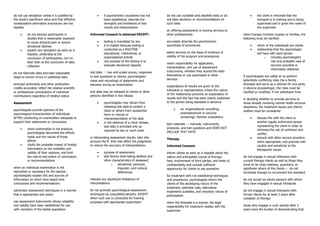
PAP Code of Ethics
General Principles
I. Respect for the Dignity of Persons and
Peoples
recognizes the inherent worth of all human
beings, regardless of perceived or real
differences in social status, ethnic origin,
gender, capacities, or other characteristics
it means that all human beings are worthy of
equal moral consideration
Related Values:
respect for the unique worth and inherent
dignity
respect for diversity among persons and
peoples
respect for customs and beliefs of cultures,
limited only when a custom or belief seriously
contravenes this principle or causes serious
harm to their well-being
free and informed consent
privacy for individuals, families, groups, and
communities
protection of confidentiality
fairness and justice in treatment
respect for the environment
Note:
In short, we need to respect human beings
and protect their dignity REGARDLESS
kung saan sila ethnicity or culture nagmula.
II. Competent Caring for the Well-Being
of Persons and Peoples
involves working for the benefit of persons
and peoples and, above all, doing no harm
maximizing benefits, minimizing potential
harm, and offsetting or correcting harm
requires the application of knowledge and
skills that are appropriate for the situation and
the social & cultural context
requires adequate self-knowledge of how
one’s values, experiences, culture, and social
context might influence one’s actions and
interpretations
Related Values:
active concern for well-being in the delivery of
psychological services
do no harm
maximizing benefits and minimizing potential
harm
correcting or offsetting harmful effects that
have occurred as a result of their activities
developing and maintaining competence
self-knowledge
respect for the ability of clients to make
decisions for themselves and to care for
themselves and each other
Note:
Every decision and actions that we wiil do,
dapat it is for the BENEFIT and DOING NO
HARM. (beneficence and non
maleficence)
III. Integrity
based on honesty, and o truthful, open and
accurate communications
recognizing, monitoring, and managing
potential biases, multiple relationships, and
other conflicts of interest that could result in
harm and exploitation of persons or peoples
complete openness and disclosure of
information must be balanced with other
ethical considerations
monitoring and management are needed to
ensure that self-interest does not interfere
with acting in the best interests of persons
and peoples.
Related Values:
honest, truthful and prudent, open and
accurate communications
avoiding incomplete disclosure of
information unless complete disclosure
is culturally inappropriate, or violates
confidentiality, or carries the potential to do
serious harm
maximizing impartiality and minimizing biases
not exploiting persons or peoples for personal,
professional, or financial gain
avoiding conflicts of interests and declaring
them when they cannot be avoided or are
inappropriate to avoid
Note:
Being HONEST sa mga reports na gagawin
mo. Iwasan ang MULTIPLE
RELATIONSHIP.
If may conflict, DECLARE them!
IV. Professional and Scientific
Responsibilities to Society
responsibilities include contributing to the
knowledge about human behavior and to
persons’ understanding of themselves and
others
Related Values:
increase scientific and professional knowledge
in ways that allow the promotion of the well-
being of society and all its members
use psychological knowledge for beneficial
purposes and to protect such knowledge from
being misused, used incompetently, or made
useless
conduct its affairs in ways that are ethical and
consistent with the promotion of the well-
being of society and all its members
promote the highest ethical ideals in the
scientific, professional, and educational
activities of its members
adequately train and supervise its members in
their ethical responsibilities and required
competencies
develop its ethical awareness and sensitivity,
and to be as self-correcting as possible
Note:
CONTRIBUTING to the BODY OF
KNOWLEDGE (research)
General Ethical Standards and
Procedures
I. Resolving Ethical Issues
A. Misuse of the Psychology
Professional’s Works
take appropriate and reasonable steps to
correct or minimize the effects of misuse or
misrepresentation of our work
B. Conflicts between Ethics and Law,
Regulations or other Governing legal
Authority
when the Code of Ethics is in conflict with the
law, the first step is to resolve the
conflicts while being committed to the
COE
• if conflicts cannot be resolved, we
adhere to the law
C. Conflicts between Ethics and
Organizational Demands
The Code is made known to the organization
by declaring our commitment and
adherence to the Code when resolving
conflicts
• LAW > ETHICS >
ORGANIZATION
D. Informal Resolution of Ethical
Violations
resolve issues of another practitioner violating
the Code through informal means by
bringing it to the attention of the
concerned professional
- INFORMAL WAY MUNA
- Approach muna natin siya and
pagsabihan.
E. Reporting Ethical Violations
if there is likely to have substantial harm,
we take further action to report the violation
to appropriate institutional authorities
this does not apply when it would violate
confidentiality rights or when we are called to
review the work of another psychology
practitioner whose professional conduct is in
question
• BE CAREFUL when it comes to
reporting possible COE violation.
Baka may ma-leak na info ng
patient
F. Cooperating with Ethics Committee
cooperate with the ethics committees of any
psychological association we belong to.
G. Improper Complaints
do not file ethical complaints with reckless
disregard or willful ignorance of facts
that would disprove allegations and refrain
from making complaints without factual
evidence, as well as coercing someone to file
complaints against another person.
• Make sure na kapag nagreport ka,
matibay talaga evidence. Hindi yung
haka-haka mo lang. BAWAL NA YON
UY, PARANG NAG MARITES LANG
HUHU
H. Unfair Discrimination Against
Complainants and Respondents
do not discriminate against complainants and
respondents of ethical complaints by denying
them opportunities
• this does not rule out taking
appropriate actions based on
outcomes of proceedings
II. COMPETENCIES
A. Boundaries of Competence
1. As specified in RA 10029, only licensed
and registered psychologists and
psychometricians are legally allowed to
practice their profession
2. We provide service within the
boundaries of our competence →
education, training, supervised practicum,
consultation, thorough study, or professional
experience
3. We make appropriate referrals when
our competencies are not sufficient to ensure
effective implementation of services
• EXCEPT KAPAG NASA EMERGENCY
4. We must undertake relevant education
or training when we plan to provide services
that are new to us or are beyond our existing
competence
5. So as not to deprive necessary services, we
may provide services for which we do not
have existing competence as long as:
• we have closely related prior
training or experience
• we make a reasonable effort to
obtain the competence required
B. Providing Services in Emergencies
we shall make available our services in
emergency situations while taking care to
prevent harm
• HOWEVER, we immediately
discontinue said services as
soon as the emergency has ended,
and ensure appropriate competent
services are made available
C. Maintaining Competence
regularly engaging in Continuing Professional
Development (CPD) activities to ensure our
services remain relevant and applicable
• accumulation of CPD points is
necessary for renewal of license as
provided in RA 10912 or
Continuing Professional
Development Act of 2016
D. Bases for Scientific and Professional
Judgments
we base our work upon established
scientific and professional knowledge of
the discipline
E. Delegation of Work to Others
in delegating work to others:
• avoid delegating to persons who
have multiple relationships with
the clients
• authorize only responsibilities that
such persons can be expected to
perform competently (naka
based sa background nila)
• inform the client that the task is
delegated and they have a choice to
discontinue or reschedule
• see that such persons are able to
perform services competently
F. Personal Problems and Conflicts
1. refrain from initiating an activity when
we know or anticipate that our personal
problems will prevent us from working
competently
• e.g. Kapag broken hearted ka a day
before your assessment sa isang
client, better to RESECHED nalang
or ipasa sa ibang COMPETENT na
assessor kesa sa ituloy mo.
2. We shall become aware of personal
problems that may interfere with our work
and take appropriate measures, such as
obtaining professional consultation or
assistance, and determine whether we should
limit, suspend, or terminate these work-
related duties
3. Foremost ethical obligation → take care of
our own health and well-being so that we
can continue rendering competent service to
others.
III. HUMAN RELATIONS
A. Unfair Discrimination
we shall not discriminate against persons
on any basis
B. Sexual Harassment
we do not engage in sexual harassment as
defined in RA 7877 or Philippine Anti-
Sexual Harassment Act
C. Other Harassment
We shall not knowingly harass or demean
persons with whom we interact in our work.
D. Avoiding Harm
take reasonable steps to avoid harming
people with whom we work with and provide
our services to, and to minimize harm where it
is foreseeable but unavoidable
E. Multiple Relationships
1. Refrain from entering into multiple
relationships if it would impair our
objectivity, competence, or effectiveness, or
otherwise risk exploitation or harm to the
person
multiple relationships occur when a
practitioner is in a professional role and at the
same time:
• in another role with the client
• in a relationship with a person
closely associated with or related to
the client
• promises to enter into a future
relationship with the client or person
closely associated or related to them
if due to unforeseen factors, a potentially
harmful multiple relationship has arisen, it
must be resolved with regard to the best
interests of the affected person and maximum
compliance with the COE
2. When required by law to serve in more
than one role in judicial or administrative
proceedings, we shall inform authorities
about the COE, to clarify role
expectations and extent of confidentiality
and thereafter as changes occur
F. Conflict of Interest
refrain from taking on a professional role
when personal, scientific, professional, legal,
financial, or other interests or relationship
could be expected to
• impair our objectivity, competence,
or effectiveness
• expose the person or organization
with whom out professional
relationship exists to harm or to
exploitation
G. Third-Party Requests for Services
when agreeing to provide services at the
request of a third party, we attempt to
clarify the nature of the relationship
with all individuals or organizations
involved and it includes:
• expected role
• identification of who is the client
• probable uses of the services
provided or information obtained
• limits to confidentiality
H. Exploitative Relationships
we shall not exploit persons over whom we
have supervisory, evaluative, or other
authority
I. Cooperation with Other Professionals
we shall cooperate with other
professionals in order to serve our clients
effectively and appropriately
J. Informed Consent
1. When providing services, we shall obtain
the informed consent using language
that is reasonably understandable to the
persons involved, except when conducting
activities without consent is mandated by law
2. For those who are legally incapable of
giving informed consent:
• provide an appropriate
explanation
• seek assent
• consider their preferences and best
interests
• obtain appropriate permission from
a legally authorized person, if such
substitute consent is permitted or
required by law
3. We inform the individual of the nature of
services when it is court ordered as well as
any limits of confidentiality before proceeding
• MANDATED man siya ng law, make
sure to EXPLAIN pa rin yung
process kay client.
4. Appropriate documentation of written
or clearly expressed unwritten advanced
directives, oral consent, permission, and
assent
K. Psychological Services Delivered To or
Through Organizations
when delivering services to or through
organizations, we provide information
beforehand to clients and those directly
affected by services about:
• nature and objectives of the
services
• intended recipients
• which of the individuals are clients
• relationship we will have with each
person and the organization
• probable uses of the services
provided and info obtained
• who will have access to the
information
• limits of confidentiality
2. We provide info about the results of the
conclusions to appropriate persons
L. Interruption of Psychological Services
Unless covered by contract, we shall plan
for facilitating services in the event that
psychological services are interrupted by
factors such as illness, death, unavailability,
relocation, or retirement or by the client’s
relocation or financial limitations.
IV. CONFIDENTIALITY
A. Maintaining Confidentiality
our duty is to safeguard information
divulged by clients
- make sure na wala sila sa mga
gadgets na easily accessible
B. Limitations of Confidentiality
1. Discuss limitations of confidentiality to
clients (primary or legal
guardian/representative is informed in cases
where the client is incapable of giving
consent)
2. Explain explicitly to the client all anticipated
uses of the information they will disclose.
- Do this BEFORE ka maginterview or
magcollect ng kahit anong
information.
3. We may release info to appropriate
authorities only after careful deliberation or
when there is imminent danger
• in court cases, info disclosed is
limited only to those pertinent to
the legitimate request of the
court
4. I through online nakuha yung information,
it is our duty to inform the clients of risks to
privacy.
C. Recording
obtain consent for recording voices or
images of clients and explain all anticipated
uses of recorded data
D. Minimizing Invasions of Privacy
1. When consulting cases with colleagues or
making written and oral reports, we only
reveal information that is relevant to the
purpose for which the communication is made
• personal identifiers are not disclosed
E. Disclosures
1. We take reasonable steps to ensure that
information to be disclosed will not be
misused
2. We may disclose confidential information
only when the client or legal
representative gave their consent, unless
prohibited by law
3. We may disclose info only to the source of
referral and with a written permission from
the client if it is self-referral
4. We may disclose info without consent when
it is mandated by law for valid purposes:
1. professional services are needed to
be provided
2. appropriate professional
consultations are needed to be
obtained
3. when there is a need to protect
people from harm
4. when payments for psychological
services are needed to be obtained
from a client who does not pay as
agreed
5. the extent to which we divulge info is
limited to what is only needed to achieve
the purpose
6. When shared with schools, organizations,
social agencies or industry, only qualified
psychology practitioners will supervise
such releases
7. Information gathered from school, hospital,
office or organization becomes part of the
institution where it was obtained
• release of such information
becomes confidential and may be
acquired only with prior approval
from management
F. Consultation
we do not discuss with colleagues
confidential information that could lead to
the identification of the client, unless the client
gave consent or disclosure cannot be avoided
• the extent to which we disclose info
is limited to what is only needed to
achieve the purpose
V. Advertisements and Public
Statements
A. Avoidance of False or Deceptive
Statements
1. We make sure announcements include
scientifically acceptable and factually
informative material, and are presented
without any trace of sensationalism,
exaggeration, or superficiality
in all forms of media, we do not make false,
deceptive or fraudulent statements concerning
ourselves or our colleagues as well as avoid
using information that could be misinterpreted
and we act quickly to correct such
misinterpretation
B. Public Statements
1. Avoid making malicious remarks that
demean the character and reputation of
others
2. Make sure that we communicate as
accurately and objective as possible and
correct and misinterpretation or misconception
3. We state whether we are representing
ourselves as private citizens, as members of
organizations or groups, or as representative
of the discipline of psychology
4. Do not seek personal gain by
recommending the purchase or use of any
product, activities, or service to the general
public
5. We retain professional responsibility when
engaging others to create public statements
about our professional practice, products, or
activities
6. We shall not compensate or give anything
of value to the representatives of the press in
return for professional publicity in a news item
7. Avoid any comparative denigration of the
services of other professionals and do not
claims our services are of superlative quality
or that we give better services than others
8. Do not advertise, claim, or imply the
certainty of cure for any conditions to be
treated nor the certainty of success of our
psychological services
9. Do not advertise or offer refund of money
to dissatisfied users of our psychological
services
D. Media Presentations
When providing public advice or comments,
our statements should be based on our
professional knowledge, training or experience
in accord with appropriate literature and
practice
• consistent with the COE
• not indicative that a professional
relationship has been established
with the recipient
E. Testimonials
We do not ask for testimonials from
current and past clients
VI. Records and Fees
A. Documentation and Maintenance of
Records
We create records and data relating to our
work in order to:
• facilitate provision of services by
ourselves or other professionals
• allow for replication and evaluation
of research
• meet institutional requirements
• ensure accuracy of billing and
payments
• ensure compliance with relevant
laws
B. Confidentiality of Records
1. We maintain confidentiality in managing our
records
2. When it is entered into databases available
to other people, we use codes, passwords,
and other techniques to avoid inclusion of
personal identifiers
3. When we anticipate retirement, transfer,
resignation, or withdrawal from a position or
practice, we make advanced plans to
facilitate appropriate transfer and protect
the confidentiality of records and data
C. Withholding Client Records
We may not withhold records needed for a
client’s emergency treatment, solely
because payment has not been received
D. Fees and financial arrangements
we agree upon the compensation and billing
arrangements as early as is feasible and we
do not misrepresent our fees
Ethical Standards and Procedures in
Specific Functions
VII. ASSESSMENT
A. Bases for Assessment
expert opinions are based on substantial
information and appropriate assessment
techniques
we provide expert opinions only after
employing assessment procedures and
examination to support conclusions
In instances where examination is not
conducted, we discuss the limitations of
our opinions and basis of conclusions and
recommendations
B. Informed Consent in Assessment
We gather informed consent prior to
assessment, except:
1. when mandated by law
2. when implied such as in routine
educational, institutional, and
organizational activity
3. when purpose of the assessment is
to determine the individual’s
decisional capacity
Teleassessment - we inform testtakers of
the implications of poor internet
connectivity during test-taking session on
test performance, particularly for timed
assessments
C. Assessment Tools
1. We select and administer only tests which
are appropriate and pertinent for the
referral question
2. Use standardized, valid, reliable, and
has normative data directly referable to the
population of the clients
3. Use appropriate to the language,
competence, and other client characteristics
4. Use only original copies of test materials
and not photocopies
D. Obsolete and Outdated Test Results
Do not base conclusions, interpretations, and
recommendations on outdated test results
and obsolete tests
E. Interpreting Assessment Results
Under no circumstances should we report test
results without considering the validity,
reliability, and appropriateness of the
test
• indicate reservations regarding the
interpretations
F. Release of Test Data
Test results are only released to sources of
referral and with a written permission from
the client if it is a self-referral
Do not release test data in the forms of raw
and scaled scores, client’s responses to
test questions or stimuli, and notes
regarding the client’s statements and
behaviors during the examination unless
regulated by the court.
G. Explaining Assessment Results
When results have to be disclosed to relatives,
parents, or teachers, we explain them through
non-technical language
We disclose results to clients or
representatives except when prevented by
prior agreement or explanation prior to testing
When test results needs to be shared with
schools, social agencies, the courts or
industry, we supervise such releases
When explaining test results online, clients
may request if the session can be
recorded
H. Test Security
The administration and handling of all test
materials shall be handled only by
qualified/licensed users or personnel.
I. Assessment by Unqualified Persons
We do not promote the use of assessment
tools and methods by unqualified persons
except for training purposes with
adequate supervision
• test materials and test data are kept
secured from unqualified persons
We practice under the boundaries prescribed
in RA10029 and operate under the
supervision of a registered psychologist
when applicable
VIII. Therapy
A. Confidentiality
Restrict disclosure of information except
when mandated or regulated by the law
We discuss the results of clinical and
counseling relationships with colleagues
concerning materials that will not constitute
undue invasion of privacy
Disclosure of client data must only be
pertinent to the legitimate request of the court
or appropriate to achieve the intended
purpose
B. Informed Consent
Respect the clients rights to commit to,
terminate, or withdraw from therapy
Discuss everything prior to commencement of
therapy when using procedures that are not
yet established, we discuss the nature of the
treatment, its developing nature, risks, and
alternatives (obtain consent for voluntary
participation)
As psychometricians, we are prohibited
from the practice of therapy, unless in
emergency situations
C. Client’s Well-being
We do not provide services when we are
physically, mentally, or emotionally unfit to
do so
We are responsible for learning and taking
into account beliefs, practices, and customs
that pertain to different working contexts and
cultures
We do not enter into a client-clinician
relationship other than for professional
purposes
D. Relationships
Do not enter multiple relationships
avoid emotional involvement that would be
detrimental to client’s well-being
do not engage in sexual intimacies with clients
(as well as their relatives or their significant
others)
- after 2 years palang pwedeng
makipagrelasyon with your
client
F. Competent Practice
We keep up to date with the latest knowledge
and scientific advancements to respond to
changing circumstances
• we review our own need for
continuing need for
professional development and
engage in appropriate educational
activities
• we monitor and maintain our fitness
to provide therapy
• we seek peer or colleague
supervision or consultative
support, when needed
H. Referrals
We ensure referrals are discussed and
consented by clients
• we ensure the recipient of the
referral is competent in providing
the service
• we carefully assess the
appropriateness of the referral, its
benefits, and adequacy of client’s
consent
I. Interruption
We assume orderly and appropriate
resolution of responsibility in instances when
therapy sessions are interrupted or when the
entire service is terminated
proper distress protocols are undertaken when
there is interruption due to poor internet
connectivity (i.e. provision of emergency
contact numbers, etc.)
J. Termination
We terminate therapy when we are quite sure
that the client no longer needs the
therapy, is not likely to benefit from it, or will
be harmed by continued therapy
When therapy is prematurely terminated, we
provide pretermination counseling and
arrange for referral
We also terminate therapy when there is
imminent risk of being harmed by the
client or when they do not comply with what
is stipulated in the contract or agreement
upon onset of treatment.
IX. Education and Training
A. Design of Education and Training
Programs
Ensure that education and training programs
are designed to provide appropriate
knowledge and proper experiences, and to
meet the goals claimed by the program
B. Descriptions of Education and
Training Programs
ensure that programs have current and
accurate description of content, objectives,
benefits, and requirements to be met for
satisfactory completion
C. Accuracy in Teaching
ensure that course syllabi are accurate and
updated
when engaged in teaching or training, we
present psychological information accurately
D. Student Disclosure of Personal
Information
Do not require students or supervisees to
disclose personal information regarding sexual
history, history of abuse and neglect,
psychological treatment, and relationships
with parents, peers, and spouses or significant
others, except:
The program or training facility clearly
identified this requirement in its admissions
and program materials
The information is necessary to evaluate or
obtain assistance when personal problems are
preventing them from performing their
training in a competent manner or posing a
threat to students or others
E. Mandatory Individual or Group
Therapy
when individual or group therapy is mandatory
in the program, we ensure that students are
given the option of selecting such therapy
from practitioners not affiliated with the
program
faculty or staff responsible for evaluating
student performance do not themselves
provide the therapy
X. Research
A. Rights and Dignity of Participants
Before beginning research in an unfamiliar
community, we obtain information about
culture, social structure, customs, and
traditions
We respect and abide by cultural
expectations so long as this does not
contravene any ethical principles
Respect the rights of participants to
withdraw at any time
• be responsive to non-verbal
indications of a desire to withdraw
especially if the person has difficulty
with verbal communication, is a
young child, or is culturally unlikely
to communicate
We seek independent and sufficient ethical
review of possible risks our research may pose
to participants
B. Informed Consent to Research
We do not just ask participants to sign in the
consent form. We recognize that informed
consent happens due to the willingness of
the participants to work collaboratively with us
Make sure that the consent form is translated
in language or dialect that the participants
understand.
When conducting research with persons below
18 y/o, we obtain assent and consent from
parents or legal guardian
When with adult participants who have
difficulties in comprehension or
communication, we obtain consent from adult
family members and approval from
independent advisors
When with detained persons, we pay
attention to special circumstances which
would affect their ability to give consent
in experimental studies, we explain the
ff:
a) experimental nature of treatment
b) services that will or will not be
available to control groups if
appropriate
c) means by which assignment to
treatment and control groups will be
made
d) available treatment alternatives if an
individual does not wish to
participate or withdraws
participation
e) compensation for or monetary costs
of participating
In longitudinal research, we obtain
informed consent on more than one
occasion
C. Informed Consent for Recording
Voices and Images in Research
Obtain informed consent before recording
voices or images, except:
• research consists of only
naturalistic observations in
public places
• research includes deception and
consent for use of the recording is
obtained during debriefing
E. Dispensing with Informed Consent for
Research
we dispense informed consent on the ff.
conditions:
We believe that the research would not
distress or create harm to participants or
general welfare or when the study involves:
• educational settings
• anonymous questionnaires,
naturalistic observations, or archival
research
• organizational settings
when mandated by law or is an institutional
regulation
G. Deception in Research
refrain from using deception, except:
a) when we have determined that
deceptive techniques is justified by
the study’s prospective value
b) when effective non-deceptive
alternative procedures are not
possible
do not deceive when the study is reasonably
expected to interfere with their decision to five
informed consent
• ensure that the level of risk,
discomfort, or inconvenience that
could cause physical pain or severe
emotional distress is not withheld
it is our duty to explain any deception as an
integral feature of design as soon as possible,
preferably at the end of their participation but
not later than the end of data gathering
H. Debriefing
When debriefing, we inform the participants
that they have contributed to the body of
knowledge and make sure that they have
also learned from their participation
• give participants the opportunity to
obtain the nature, results, and
conclusions of the study and correct
any misconceptions they may have
especially when they have been
deceived.
• seek to reestablish trust if it has
been lost due to deception
when research procedures have harmed a
participant, we act to correct and
minimize the harm
after debriefing and the participants decided
to withdraw their data, we grant their
request
L. Reporting Research Results
when reporting research results:
use language that is appropriate and
comprehensible to the target population
Consult with groups, organizations, or
communities being studied so as to increase
the accuracy of interpretation and minimize
the risk of misunderstanding, misinterpretation
or misuse.
Be cautious when reporting results pertaining
to vulnerable groups or communities
Be cautious when discussion the results of
children with parents, legal guardians, or
teachers
Do not fabricate data
we correct errors if we discover significant
errors in published data
Note:
In short, CLARIFY EVEYRTHING para iwas
MISUSE and MISUNDERSTANDING.
M. Publication Credit
We take responsibility and credit only for work
we have actually done and credit others for
work they have actually performed or have
contributed
Principal authorship or co-authorship should
accurately reflect the relative scientific or
professional contributions of those involved,
regardless of relative status
In a multiple-authored article that is partly
and/or substantially based on the student’s
thesis, we shall give appropriate
publication credit to the student based on
their relative contribution compared with other
authors
• if mainly based, we credit the
student with primary authorship
N. Duplicate Publication of Data
Republishing of data is not prohibited as long
as proper acknowledgement is clearly stated
O. Sharing Research Data for Verification
We do not withhold our data to other
competent professionals who seek to verify
and reanalyze the results and substantive
claims of our publication provided that:
• professionals obtain prior written
agreement for use of data
• professionals intend to use the data
solely for the purpose declared
• professionals hold responsibility for
costs associated with release of data
• confidentiality of participants can be
protected
unless legal rights concerning proprietary data
prevent release, the professionals should seek
permission from concerned institution,
organization, or agency
P. Reviewers
We respect confidentiality and proprietary
rights when reviewing others’ material
Q. Limitations of the Study
We acknowledge the limitations of our
knowledge, methods, findings, interventions,
interpretations, and conclusions
Discuss the limits of data with respect to social
policy if the study touches on policies and
structures of communities which we do not
belong
Do not conceal disconfirming evidence and
acknowledge alternative hypotheses and
explanations.
PAP Guide for Conducting
Telepsychology
telepsychology → provision of psychological
services using telecommunication
technologies, which include but are not limited
to telephone, mobile devices, interactive
videoconferencing, e-mail, chat, and text
Ensure Competence
Competence in Practicing Psychology
only registered and licensed psychologists are
allowed to provide counseling and
psychotherapy
provide services only within the boundaries of
competence
determine if telepsychology is suitable for a
client based on literature, best practice, and
client preference
keep updated with latest relevant literature
and gain access to training and supervision
programs to enhance skills
Competence in Application of
Technology
before starting online services, make sure you
have enough knowledge in using the online
platform you prefer
if clients are not familiar with the preferred
platform, they can be oriented with its
features by creating a standard orientation
script to be used for every first session with a
client
be familiar with more than one platform to
give clients choices
learn important security features to ensure
confidentiality
• consult technology experts to
augment your knowledge of
telecommunication technologies if
necessary
Uphold Ethical Practice
apply the same ethical principles that are
required when providing face-to-face
psychological services
at all times, do no harm by protecting the
client, oneself, and the integrity of the
profession
examine potential risk and benefits of
providing telepsychology services with
consideration of multicultural issues that may
arise
be informed of the social norm, laws and
ordinances in your area, as well as your
client’s
if telepsychology is no longer beneficial or
present a risk to the client’s wellbeing,
thoroughly discuss these concerns with the
client and appropriately terminate services
with adequate notice, and refer or offer
alternative services
Obtain Informed Consent
may be done through email or filling up e-
forms online
state what data will be stored, how it will be
stored and accessed, the kind of security of
the data and who can access, any technology-
related vulnerability to their confidentiality
that is incurred by creating and storing
electronic client data, and how long it will be
stored
indicate recording policies
explain that clients are discouraged from
recording online therapy sessions for
protection of their privacy
client is required to provide emergency
contact
set clear boundaries
• explain the rights and
responsibilities of entering a
therapist-client relationship
• avoid multiple relationships
authenticate the client’s identity at the start of
the online relationship by asking for a valid ID
• if there is no access to camera,
agree on an identity verification
process, such as a password, at the
start of each online counseling
session
Develop an Efficient System of Providing
Online Services
have clear policies and expectations in the
areas of individual roles, specific services
provided, and protocols & procedures
continuous updating, training, and supervision
is provided to team members (when work is
within shared practices) to improve
competence in practice and application of
technology and guarding ethical standards
personal styles are encouraged, but
standardized protocols and scripts ensure
delivery of quality services, which includes:
• introduction of services to the client
• starting and ending sessions
• responses to frequently asked
questions
• responses about and to reactions to
the pandemic
• protocol in case of disruption to
internet connection
• procedures in making referrals to
another psychologist/professional
integrity of psychometric properties of the test
and assessment procedures must be ensured
psychometricians and other mental health
advocates who are part of the professional
team have an equally important role
• for instance, they may be tasked to
develop and disseminate credible
psychoeducational materials
create a setting that resembles a face-to-face
clinic
• choose a room with the best
soundproofing and least prone to
distractions
• ask the client to be in a private
room with no distractions during
each session
• make sure that both ends have
excellent internet connection to
avoid delays
document all experiences, concerns,
challenges, and insights in order to be shared
and possibly consulted with peers or
supervisors
Be Ready to Respond to All Kinds of
Emergencies
ask for emergency contact for every client
• with expressed permission, initiate
contact with the emergency contact
to establish their role in protecting
the client in the event that there is
serious and foreseeable harm that
may befall the client and others
research and list relevant contact information
of emergency service providers in the client’s
vicinity
be familiar with the laws and rules that have
bearing on the online service provision in the
area of jurisdiction of the client
build a network of professionals who can
effectively serve the needs of the client that
may be beyond the area of expertise
Include Self-Care in Your Schedule
recognize your vulnerability to stress and
fatigue
acquire enough knowledge on how to stay
healthy and protect oneself from the threats
of the pandemic
Anticipate Changes in Practice After the
Pandemic
regularly evaluate past routines and
established practices to enhance effectiveness
as a mental health service provider
plan systematic recording and data gathering
processes that can serve as material for
sharing effective strategies and good practices
with colleagues and peers
RA 10029 - Philippine Psychology
Act of 2009
Article I. Title
Section 1 → Short Title: Philippine Psychology
Act of 2009
passed/approved → March 16, 2010
enacted → January 8, 2013
Article II. Statement of Policy
Recognizes the significance of the
psychological services that practicing
psychologists provide to diverse types of
clients
Recognizes the need to protect the public by
preventing inexperienced or untrained
individuals from offering psychological services
Article III. Definition of Terms
Section 3
Psychology - scientific study of human
behavior
Practice of Psychology
delivery of psychological services that applies
psychological principles and procedures for
describing, understanding, predicting, and
influencing the behavior of individuals or
groups
Includes but is not limited to:
psychological interventions (counseling,
psychotherapy, psychosocial support,
coaching, debriefing, group processes, etc.)
psychological assessment
psychological programs
Psychologist
natural person who is duly registered and
holds a valid certificate of registration
and a valid professional ID as professional
psychologist, issued by the Professional
Regulatory Board of Psychology and the
Professional Regulation Commission
Delivers different psychological services
defined in this Act
Psychometrician
natural person who holds a valid certificate of
registration and valid professional ID issued by
the PRB of Psychology and PRC
authorized to do any of the following provided
that it must be under the supervision of a
licensed professional psychologist:
▪ administering and scoring of
objective personality tests,
structured personality tests (Level
B), excluding projective tests and
other higher level forms of tests
(Level C)
▪ interpreting results and preparing a
written report for these results
▪ conducting preparatory intake
interviews
Article IV. Professional Regulatory Board
of Psychology
Section 4. Creation and Composition of
the PRB of Psychology
collegial body under the administrative control
and supervision of the PRC
composed of a Chairperson and two members
appointed by the President of the Philippines
from a list of 3 nominees for each position (a
total of 9 nominations)
Section 5. Qualification of the
Chairperson and Members
natural born citizen and resident of the
Philippines
at least 35 years old
possess good moral character
hold a doctorate degree in Psychology
recognized and/or accredited by CHED
at least 10 years of practice in psychology and
psychometrics and at least 5 years of teaching
experience in the field of psychology
be registered and licensed psychologists
▪ except in the case of the first
members of the Board who shall
automatically be conferred a valid
certificate of registration and valid
ID in psychology and psychometrics
upon appointment
neither an officer, trustee nor member of the
faculty of any university or school where a
regular course in psychology is offered
is not an officer, nor hold any position other
than being a member of the integrated and
accredited national organization of
psychologists
shall not have been convicted of any crime
involving moral turpitude → dishonesty or
other immorality
Section 6. Term of Office
three years or until their successors shall have
been appointed and duly qualified
each member may be reappointed for one full
term of three years
any vacancy occurring within the term of a
member shall be filled for the unexpired
portion of the term only
Section 7. Powers and Duties
administer and implement the provisions of
the Act as well as revise or update the rules
and regulations, resolutions and guidelines
subject to review and approval of the PRC
supervise and monitor the registration,
licensure and practice of psychologists and
psychometricians
administer oaths
issue, suspend, or revoke, and/or reinstate
certification of registration and professional ID
for psychologists and psychometricians
adopt an official seal of the Board
monitor factors affecting the practice of
psychology and take measures to enhance
and maintain high professional, ethical, and
technical standards of the profession
issue permits and exercise visitorial powers to
verify that persons practicing psychology are
psychologists and psychometricians with valid
certificates of registration and valid
professional IDs, and that they possess the
necessary accreditation, skills, and/or facilities
to competently carry out their functions
assist PRC in the formulation and
implementation of the guidelines on
continuing professional education for RPm and
RPsy
ensure that all educational institutions offering
psychology comply with the policies,
standards, and requirements prescribed by
CHED
investigate and, when warranted, hear
administrative cases involving violations of this
Act
▪ may issue testificandum and
subpoena duces tecum to secure
appearance of witnesses and
production of documents
▪ provided that the Board’s decision
shall be subject to review only on
appeal
Section 8. Compensation and Allowances
Chairperson and members shall receive the
same compensation and allowances as those
of existing regulatory boards under PRC
Section 9. Removal or Suspension of
Members
any member may be suspended or removed
upon recommendation of PRC for the ff.
reasons:
▪ gross neglect of duty
▪ incompetence and malpractice
▪ behavior unbecoming of a
psychology professional
▪ immorality and unethical or
dishonorable conduct
▪ final conviction of any crime
involving moral turpitude
▪ any act of graft and corruption
▪ participation in the manipulation of
or any dishonesty relative to the
licensure examinations and/or the
registration process.
Section 10. Administrative Supervision
over the Board
the Board will be under supervision and
control of PRC
all records are kept under custody of the PRC
PRC shall designate the Secretary of the Board
and shall provide the secretariat the necessary
support services
Article V. Licensure Examinations
Section 11. Examinations Required
all applicants for registration to practice
psychology and psychometrics shall be
required to pass the BLEPP
Section 12. Qualifications of Applicants
for Psychologists
Filipino citizen, a permanent resident or a
citizen of a foreign state/country which
extends reciprocity to the Philippines relative
to the practice of the profession
holds at least a master’s degree in psychology
has undergone at least 200 hours of
supervised internship/clinical experience
related to services in Section 3
is of good moral character
not been convicted of an offense involving
moral turpitude
Section 13. Qualifications of Applicants
for Psychometricians
Filipino citizen, a permanent resident or a
citizen of a foreign state/country which
extends reciprocity to the Philippines relative
to the practice of the profession
holds at least a bachelor’s degree in
psychology
is of good moral character
not been convicted of an offense involving
moral turpitude
Section 14. Exam Subjects for
Psychologists
Advanced TOP, Advanced Abnormal
Psychology, Advanced Psychological
Assessment, and Psychological Counseling and
Psychotherapy
Section 15. Exam Subjects for
Psychometricians
Developmental Psychology, Abnormal
Psychology, I/O Psychology, and Psychological
Assessment
the Board may recluster, rearrange, modify,
add, or exclude and prescribe subjects and
psychometricians as the need arises
Section 16. Registration Without Exam
for Psychologists
credentials that the applicant had on or prior
to the effectivity of the Act, either of the
following:
obtained a doctoral degree and accumulated
at least 3 years of work experience
obtained a master’s degree and accumulated
at least 5 years of work experience
psychologists or employees who hold positions
as psychologists employed in various
government or private agencies, who have a
bachelor’s degree in psychology,
accumulated at least 10 years of work
experience as a psychologist, and who have
updated their professional education in various
psychology-related functions
Section 17. Registration Without
Examination for Psychometricians
the applicant before the effectivity of the Act
had obtained a bachelor’s degree and had
accumulated at least 2 years full time work
experience in psychometrics
Note: Sections 16 and 17 do not presently
apply since they are required to submit the
aforementioned credentials within 3 years
after the creation of the Board/effectivity of
the Act
Section 18. Ratings in Examination
passing
▪ weighted general average → at
least 75%
▪ no grade lower than 60% for all
subjects
conditional passing
WGA of 75% or higher but obtains a rating
below 60% in any given subject
may retake the subject within the next 2 years
and must obtain at least 75%
▪ failure to reach 75% in the subject
will subject the examinee to retake
ALL subjects
Section 19. Report of Ratings
within 10 calendar days after the examination,
unless such period is extended for just cause
Article VI. Registration
Section 20. Oath of Psychologists and
Psychometricians
successful examinees are required to take an
oath to uphold the profession before any
member of the Board or any officer of the
Commission authorized to administer oaths
Section 21. Issuance of Certificate of
Registration and Professional ID
shall be issued upon compliance with all legal
requirements, including payment of fees to
the PRC
validity term of PRC ID → 3 years
after 3 years, it is renewable with proof of
compliance with continuing education
requirements (CPD points)
Section 22. Disclosure of Registration
Information
psychologist or psychometrician shall be
required to indicate their registration and
professional ID number and date of issuance,
duration of validity, including professional tax
receipt number on each document signed,
used, or issued in connection with the practice
of the profession
Section 23. Non-issuance of Certificate
of Registration and Professional ID
if a person convicted of a criminal offense
involving moral turpitude has been found
guilty of immoral or dishonorable conduct
if diagnosed with unsound mind
Section 24. Foreign Reciprocity
no foreigner shall be admitted to the licensure
examinations unless they prove that the
country which they are a citizen either:
▪ admits Filipino citizens to the
practice of psychology or
psychometrics without need for
registration and issuance of a
certificate of
registration/professional ID
▪ allows Filipino citizens to practice
psychology or psychometrics
without restriction
▪ allows Filipino citizens to practice
the same after an examination on
terms of strict and absolute equality
with nationals of said country
Section 25. Practice through
Special/Temporary Permit
subject to approval by PRC and payment of
appropriate fees before issuance to:
licensed psychologists or psychometricians
from foreign countries:
▪ who are internationally
acknowledged specialists or
outstanding experts in psychology
or psychometrics
o provided that their
services are important
and necessary either due
to lack of available local
specialists or in
recognition of their
potential contribution to
the advancement of
psychology and
psychometrics through
transfer of technology
whose services shall be free and offered
exclusively to indigent patients in a particular
hospital or clinic
employed as exchange professors in
universities and schools
effectivity period → not more than 1 year
subject to renewal
Section 26. Suspension or Revocation of
COR and PRC ID or Special/Temporary
Permit
on any ground set forth in Section 33 or any
of the ff:
procurement of certificate or ID or permit by
fraud or deceit
allowing an unqualified person to advertise or
practice by using one’s certificate, ID, or
permit
violating or conspiring to violate any of the
provisions in this Act, code of ethics, or code
of professional standards
manifest physical or mental incompetence to
render services
professional misconduct or negligence
engaging in the practice of the profession
during suspension
Section 27. Reinstatement
may apply to the Board at any time after 2
years from date of revocation of certificate
no certificate, ID, or permit shall be reinstated
unless the Board is satisfied that a good cause
exists to warrant it
Section 28. Appeal from Judgment
decision of the Board becomes final 15 days
from receipt of the decision by the respondent
unless appealed
PRC decision on appeal may be further
appealed before Court of Appeals within 15
days from receipt
Note: Appeal progression
o PRB → PRC → Court of
Appeals
Section 29. Rights of the Respondent
right to be represented by counsel at all
stages of the proceedings
speedy disposition of their case
confront witnesses against them in addition to
other rights in the Constitution
Article VII. Privileged Communication
and Professional Integration
Section 30. Rights to Privilege
Communication
a psychologist/psychometrician cannot be
examined on any communication or
information disclosed in the course of giving
psychological services without the client’s
consent
extends to pertinent records and shall be
available to secretary, clerk, or other staff of
the professionals
Section 31. Integration of the Profession
licensed psychologists and psychometricians
shall automatically become a member of an
national professional organization (PAP) and
shall receive the benefits and privileges and
be subject to responsibilities and obligations
upon payment of required fees.
Section 32. Code of Ethics and Code of
Practice
the Board shall adopt the COE and COP
prescribed by PAP
Article VIII. Prohibited Acts, Penalties,
and Enforcement of This Act
Section 33. Prohibited Acts
engage in the practice of the profession
without a valid certificate or ID or valid permit
represent themself to be licensed an
authorized during the time that their
certificate has been suspended or revoked, ID
not being renewed, or permit being cancelled
allow any other person to use their certificate,
ID, or permit for any purpose, regardless
of whether such enables the unqualified
individual to engage in the practice of the
profession
use, exhibit, and/or misrepresent as their own
certificate, ID, or permit that of another
give any false, inaccurate, misleading, or
incomplete information to the Board to obtain
a certificate, ID, or permit
no entity shall operate a psychology or
psychometrics office, center, clinic, or
otherwise engage in the practice or allow the
practice of the profession within its premises
without a permit from the Board
violation of any provision of this Act shall be
penalized accordingly
Section 34. Penalties
imprisonment of not less than 6 months
o not more than 3 years
a fine of not less than 10k pesos but not more
than 100k pesos
APA Code of Ethics
General Principles
It must be noted that general principles do not
represent obligations and should not form the
basis for imposing sanctions. These are just
guides that intend to guide psychologists
toward ethical ideals.
Principle A: Beneficence and
Nonmaleficence
beneficence → do good
nonmaleficence → do no harm
psychologists seek to safeguard the welfare
and rights of those with whom they interact
professionally and other affected persons
since scientific and professional judgments
and actions may affect the lives of others,
they must guard against personal, financial,
social, organizational, or political factors that
might lead to misuse of influence
be aware of one’s own physical and mental
health and its effects toward their ability to
help others
Principle B: Fidelity and Responsibility
upholding professional standards of conduct,
clarifying professional roles and obligations,
accept appropriate responsibility for behavior,
and seek to manage conflicts of interest.
psychologists consult with, refer to, or
cooperate with other professionals and
institutions based on how much is needed to
serve the best interests of clients
includes concern about the ethical compliance
of colleagues.
Principle C: Integrity
promoting accuracy, honesty, and truthfulness
psychologists strive to keep their promises and
to avoid unwise or unclear commitments
deception may be ethically justifiable in order
to maximize benefits and minimize harm
• provided that they correct any
resulting mistrust or any other
harmful effects of deception
Principle D: Justice
All persons are entitled access and benefit
from contributions of psychology and equal
quality of processes, procedures, and services
being conducted
Potential biases, boundaries of competence,
and limitations of expertise should not lead to
unjust practices
Principle E: Respect for People’s Rights
and Dignity
rights of individuals to privacy, confidentiality,
and self-determination
respect cultural, individual, and role
differences and consider these when working
with members of minority groups
eliminate the effect of biases on the basis of
cultural and individual differences
do not knowingly participate in or condone
activities of others based upon such
prejudices.
Ethical Standards
Resolving Ethical Issues
1.01 Misuse of Psychologists’ Work
take reasonable steps to correct or minimize
misuse or misinterpretation of work
1.02 Conflicts Between Ethics and Law,
Regulations, or Other Governing Legal
Authority
if ethical responsibilities conflict with law,
commitment to the Ethics Code must be made
known and under no circumstances may the
standard be used to justify or defend violating
human rights
if another professional has committed an
ethical violation:
• informal resolution → bringing it to
the attention of the individual
• referral to state or national
committees on professional ethics
→ if an ethical violation has harmed
or is likely to harm someone and is
not appropriate for informal
resolution
• by order of adherence:
o LAW → ETHICS →
ORGANIZATIONAL
DEMANDS
1.06 Cooperating with Ethics
Committees
cooperation in ethics investigations as failure
to cooperate is itself an ethics violation
• making a request for postponement
of adjudication of an ethics
complaint pending the outcome of
legal action does not alone
constitute noncooperation
do not file or encourage the filing of
complaints that are made with reckless
disregard for or willful ignorance of facts that
would disprove the allegation
do not deny persons opportunities based
solely upon their having made or their being
the subject of an ethics complaint
Competence
provide services only within the boundaries of
their competence
training should be obtained to ensure
competence of services, or make the
necessary referrals if the service being asked
for is not within one’s boundaries of
competence
psychologists planning to provide services new
to them should undertake relevant education,
training, supervised experience, consultation,
or study
in emergency situations where mental health
services are not available, psychologists with
closely related prior training or experience
may provide such services in order to ensure
that services are not denied
• services are discontinued as soon as
the emergency has ended or
appropriate services are available
psychologists are still required to ensure
competence of their work even in areas in
which generally recognized standards for
preparatory training do not yet exist
forensic roles → be familiar with judicial or
administrative rules governing this role
work should be based upon established
scientific and professional knowledge of the
discipline
delegation of work:
work should not be delegated to persons with
multiple relationships with clients
delegate work to those who can be expected
to perform competently based on their
qualifications/background
see to it that persons whom work is delegated
to are performing the work competently
refrain from initiating an activity when they
know that their personal problems may
prevent from performing competently
take appropriate measures to deal with
personal problems and determine whether to
limit, suspend, or terminate work-related
duties
Human Relations
do not engage in unfair discrimination
do not engage in sexual harassment
• sexual solicitation, physical
advances
• can consist of a single intense or
severe act or of multiple persistent
or pervasive acts
avoid harming clients are other people whom
they work with and minimize harm when it is
foreseeable and unavoidable
do not engage in multiple relationships
occurs when a psychologist is in a professional
role with a client and at the same time:
• is in another role with the client
• is in a relationship with a person
closely associated with or related to
the client
• promises to enter into another
relationship in the future with the
client or a person closely associated
or related with them
if a potentially harmful multiple relationship
has arisen due to unforeseen factors,
reasonable steps should be made to resolve it
clarification of role expectations and extent of
confidentiality are expected when serving
more than one role is required by law,
institutional policy, or extraordinary
circumstances
refrain from taking on a professional role
when there is a possibility of conflict of
interest → a clash between self-serving
interests and professional roles
• impairs objectivity, competence, or
effectiveness in performing
functions
in providing services via a third party, the
nature of relationship is clarified
• includes the role of the psychologist,
an identification of who is the client,
the probable uses of the services of
the services provided or the
information obtained, and the fact
that there may be limits to
confidentiality
do not engage in exploitative relationships
Informed Consent
• for persons who are legally
incapable of giving informed
consent, seek assent
• when services are court ordered,
inform the individual of the nature
of the anticipated services, including
limits of confidentiality
• document written or oral consent,
permission, and assent
when delivering services to or through
organization, as soon as feasible, provide
information about the results and conclusions
of such services to appropriate persons
unless otherwise covered by contract,
psychologists make reasonable efforts to plan
for facilitating services in the event that
psychological services are interrupted by
factors such as psychologist’s illness, death,
unavailability, relocation, or retirement or by
the client’s relocation or financial limitations
Privacy and Confidentiality
discuss limits of confidentiality and
foreseeable uses of the information gathered
through psychological activities
confidential information may be disclosed with
appropriate consent unless prohibited by law
disclose without consent only as mandated by
law or permitted by law for a valid purpose:
• provide needed professional
services
• obtain appropriate professional
consultations
• protect the client or others from
harm
• obtain payment for services from a
client, in which disclosure is limited
to the
• minimum that is necessary to
achieve the purpose
Advertising and Other Public Statements
do not knowingly make public statements that
are false, deceptive, or fraudulent
psychologists claim degrees as credentials for
their health services only if those degrees
were earned from a regionally accredited
educational institution or were the basis for
psychology licensure by the state in which
they practice
do not compensate employees of press, radio,
television, or other communication media in
return for publicity in a news item
ensure that statements are based on
professional knowledge or experience in
accord with appropriate psychological
literature and practice
do not solicit testimonials
do not engage in uninvited in-person
solicitation of business from actual or potential
therapy clients
does not preclude attempting to implement
appropriate collateral contacts for the purpose
of benefiting an already engaged therapy
client or providing disaster or community
outreach services
Record Keeping and Fees
use coding or other techniques to avoid
inclusion of personal identifiers when
confidential information is entered into
databases available to persons whose access
has not been consent to by the client
do not withhold records that are requested
and needed for a client’s emergency treatment
solely because payment has not been received
as early as is feasible, clinicians and clients
must reach an agreement specifying
compensation and billing arrangements
barter is permitted only if it is not clinically
contraindicated and the resulting arrangement
is not exploitative
when receiving payment from or divide fees
with another professional, the payment to
each is based on the services provided and
not on the referral itself
Research and Publication
conduct research in accordance with the
approved research protocol
Informed Consent includes:
• purpose of the research, expected
duration, and procedures
• right to decline and to withdraw
from the research
• foreseeable consequences of
declining or withdrawing
• reasonably foreseeable factors that
may be expected to influence their
willingness to participate such as
risks, discomfort, or adverse effects
• research benefits
• limits of confidentiality
• incentives for participation
• contact information
informed consent may not be obtained if
research consists solely of naturalistic
observations in public places and the
recording will not be used in a manner that
could cause personal identification or harm
• if research involves deception,
consent for use of the recording is
obtained during debriefing
avoid making inappropriate or excessive
financial or other inducements for research
participation when such inducements are likely
to coerce participation
offering professional services can be
inducements for research participation
provided that there is clarification of the
nature of services, risks, obligations, and
limitations
do not use deception unless it is justified by
the study’s significant value and that effective
nondeceptive alternative procedures are not
feasible
• do not deceive participants in
studies that is reasonably expected
to cause physical pain or severe
emotional distress
• explain any deception as early as is
feasible, preferably at the
conclusion of participation, but no
later than at the conclusion of data
collection
do not fabricate data and take reasonable
steps to correct errors in published data
principal authorship and other publication
credits accurately reflect the relative scientific
or professional contributions of individual
contributions regardless of relative status
Assessment
psychologists provide opinions of the
psychological characteristics of individuals
AFTER conducting an examination adequate to
support their statements or conclusions
• when examination is not practical,
psychologists document the efforts
made and the results of those
efforts
• clarify the probable impact of limited
information on the reliability and
validity of their opinions, and limit
the nature and extent of conclusions
or recommendations
when an individual examination is not
warranted or necessary for the opinion,
psychologists explain this and sources of
information on which they based their
conclusions and recommendations
administer assessment techniques in a manner
that is appropriate and useful
use assessment instruments whose reliability
and validity have been established for use
with members of the tested population
• if psychometric soundness has not
been established, describe the
strengths and limitations of test
results and interpretation
Informed Consent is obtained EXCEPT:
• testing is mandated by law
• it is implied because testing is
conducted as a ROUTINE
educational, institutional, or
organizational activity
• one purpose of the testing is to
evaluate decisional capacity
test data → raw and scaled scores, responses
to test questions or stimuli, psychologists’
notes and recordings of statements and
behavior during an examination
test data may be released to clients or other
persons identified in the release
• psychologists may refrain from
releasing test data to protect a
client or others from substantial
harm or misuse or
misrepresentation of the data
• in the absence of a client release,
test data is provided only as
required by law or court order
in interpreting assessment results, take into
account the ff. that may affect the judgments
or reduce the accuracy of interpretations:
• purpose of assessment
• test factors (test-taking abilities and
other characteristics of assessee)
o situational, personal,
linguistic, and cultural
differences
indicate any significant limitations of
interpretations
do not promote psychological assessment
techniques by unqualified persons, EXCEPT
when such use is conducted for training
purposes with appropriate supervision
do not use outdated and obsolete tests or do
not base decisions or recommendations on
such tests
on offering assessment or scoring services to
other professionals:
accurately describe the psychometric
soundness of procedures
select services on the basis of evidence of
validity of the program and procedures
retain responsibility for application,
interpretation, and use of assessment
instruments, whether they scored the tests
themselves or use automated or other
services
explanations of results are given to the
individual or representative unless the nature
of the relationship prevents an explanation of
results and this fact has been clearly explained
to the person being assessed in advance
• ex. organizational consulting,
preemployment or security
screenings, forensic evaluations
test materials → manuals, instruments,
protocols, and test questions and DOES NOT
INCLUDE TEST DATA
Therapy
Informed Consent:
inform clients as early as is feasible about the
nature and anticipated course of therapy,
fees, involvement of third parties, and limits of
confidentiality and provide sufficient
opportunity for clients to ask questions
for treatment with not established techniques
and procedures, psychologists inform the
clients of the developing nature of the
treatment, potential risks, alternative
treatments available, and voluntary nature of
participation
when the therapist is a trainee, the legal
responsibility for treatment resides with the
supervisor
• the client is informed that the
therapist is in training and is being
supervised and is given the name of
the supervisor
when therapy involves couples or families, the
following must be clarified:
• which of the individuals are clients
• relationship that the psychologist
will have with each person
o includes psychologist’s
role and probable uses of
services provided or
information obtained
if psychologists are called on to perform
potentially conflicting roles (be a family
therapist and serve as a witness for one party
in divorce proceedings), the roles must be
clarified or modified, if not withdrawn from
in deciding whether to provide services to
those already receiving mental health services
elsewhere, the treatment issues and client’s
welfare must be considered
• discuss this with the client or
another legally authorized person
representing the client in order to
minimize the risk of confusion and
conflict
• consult with other service providers
when appropriate, and proceed with
caution and sensitivity to the
therapeutic issues
do not engage in sexual intimacies with
current therapy clients as well as those they
know to be close relatives, guardians, or
significant others of the clients ← do not
terminate therapy to circumvent this standard
do not accept as clients persons with whom
they have engaged in sexual intimacies
do not engage in sexual intimacies with
former clients for at least 2 years after
cessation of therapy
those who engage in such activity after 2
years have the burden of demonstrating that
there has been no exploitation in light of the
following factors:
• amount of time that passed since
therapy terminated
• nature, duration, and intensity of
the therapy
• circumstances of termination
• client’s personal history and current
mental status
• likelihood of adverse impact
• any statements or actions made by
the therapist during the course of
therapy suggesting or inviting the
possibility of a post-termination
sexual or romantic relationship
provide for orderly and appropriate resolution
of responsibility for patient care in then event
that the employment/contractual relationship
ends while considering patient welfare
therapy is terminated when it becomes clear
that the client no longer needs the service, is
not likely to benefit, or is being harmed by
continued service
therapy may be terminated when threatened
or endangered by the client or another person
with whom the client has a relationship
prior to termination of therapy, provide
pretermination counseling and suggest
alternative service providers as possible
except when prevented by the actions of
clients or third-party payors

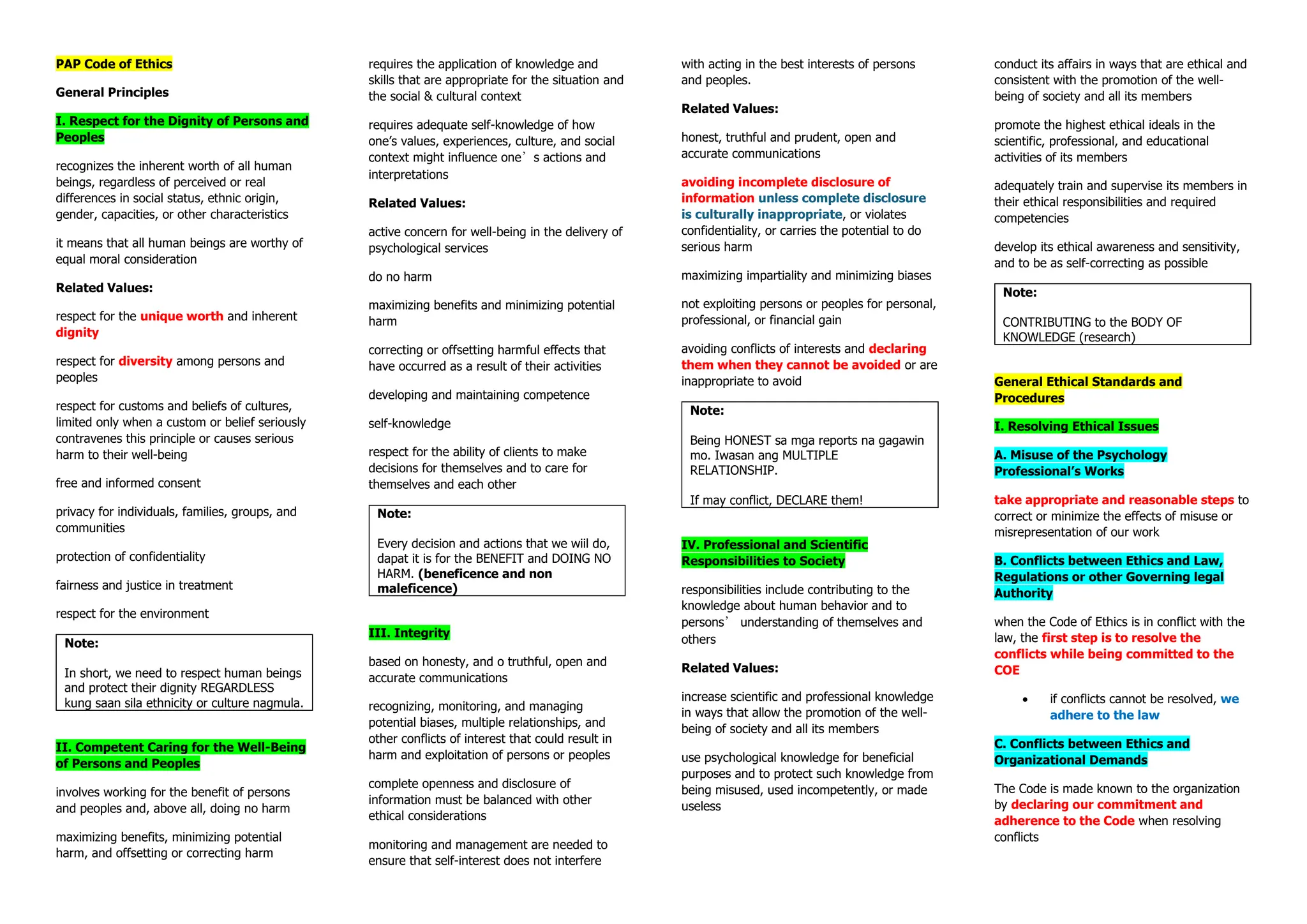
PAP Code of Ethics.pdf PAP Code of Ethics.pdf

  • 1.
    PAP Code ofEthics General Principles I. Respect for the Dignity of Persons and Peoples recognizes the inherent worth of all human beings, regardless of perceived or real differences in social status, ethnic origin, gender, capacities, or other characteristics it means that all human beings are worthy of equal moral consideration Related Values: respect for the unique worth and inherent dignity respect for diversity among persons and peoples respect for customs and beliefs of cultures, limited only when a custom or belief seriously contravenes this principle or causes serious harm to their well-being free and informed consent privacy for individuals, families, groups, and communities protection of confidentiality fairness and justice in treatment respect for the environment Note: In short, we need to respect human beings and protect their dignity REGARDLESS kung saan sila ethnicity or culture nagmula. II. Competent Caring for the Well-Being of Persons and Peoples involves working for the benefit of persons and peoples and, above all, doing no harm maximizing benefits, minimizing potential harm, and offsetting or correcting harm requires the application of knowledge and skills that are appropriate for the situation and the social & cultural context requires adequate self-knowledge of how one’s values, experiences, culture, and social context might influence one’s actions and interpretations Related Values: active concern for well-being in the delivery of psychological services do no harm maximizing benefits and minimizing potential harm correcting or offsetting harmful effects that have occurred as a result of their activities developing and maintaining competence self-knowledge respect for the ability of clients to make decisions for themselves and to care for themselves and each other Note: Every decision and actions that we wiil do, dapat it is for the BENEFIT and DOING NO HARM. (beneficence and non maleficence) III. Integrity based on honesty, and o truthful, open and accurate communications recognizing, monitoring, and managing potential biases, multiple relationships, and other conflicts of interest that could result in harm and exploitation of persons or peoples complete openness and disclosure of information must be balanced with other ethical considerations monitoring and management are needed to ensure that self-interest does not interfere with acting in the best interests of persons and peoples. Related Values: honest, truthful and prudent, open and accurate communications avoiding incomplete disclosure of information unless complete disclosure is culturally inappropriate, or violates confidentiality, or carries the potential to do serious harm maximizing impartiality and minimizing biases not exploiting persons or peoples for personal, professional, or financial gain avoiding conflicts of interests and declaring them when they cannot be avoided or are inappropriate to avoid Note: Being HONEST sa mga reports na gagawin mo. Iwasan ang MULTIPLE RELATIONSHIP. If may conflict, DECLARE them! IV. Professional and Scientific Responsibilities to Society responsibilities include contributing to the knowledge about human behavior and to persons’ understanding of themselves and others Related Values: increase scientific and professional knowledge in ways that allow the promotion of the well- being of society and all its members use psychological knowledge for beneficial purposes and to protect such knowledge from being misused, used incompetently, or made useless conduct its affairs in ways that are ethical and consistent with the promotion of the well- being of society and all its members promote the highest ethical ideals in the scientific, professional, and educational activities of its members adequately train and supervise its members in their ethical responsibilities and required competencies develop its ethical awareness and sensitivity, and to be as self-correcting as possible Note: CONTRIBUTING to the BODY OF KNOWLEDGE (research) General Ethical Standards and Procedures I. Resolving Ethical Issues A. Misuse of the Psychology Professional’s Works take appropriate and reasonable steps to correct or minimize the effects of misuse or misrepresentation of our work B. Conflicts between Ethics and Law, Regulations or other Governing legal Authority when the Code of Ethics is in conflict with the law, the first step is to resolve the conflicts while being committed to the COE • if conflicts cannot be resolved, we adhere to the law C. Conflicts between Ethics and Organizational Demands The Code is made known to the organization by declaring our commitment and adherence to the Code when resolving conflicts
  • 2.
    • LAW >ETHICS > ORGANIZATION D. Informal Resolution of Ethical Violations resolve issues of another practitioner violating the Code through informal means by bringing it to the attention of the concerned professional - INFORMAL WAY MUNA - Approach muna natin siya and pagsabihan. E. Reporting Ethical Violations if there is likely to have substantial harm, we take further action to report the violation to appropriate institutional authorities this does not apply when it would violate confidentiality rights or when we are called to review the work of another psychology practitioner whose professional conduct is in question • BE CAREFUL when it comes to reporting possible COE violation. Baka may ma-leak na info ng patient F. Cooperating with Ethics Committee cooperate with the ethics committees of any psychological association we belong to. G. Improper Complaints do not file ethical complaints with reckless disregard or willful ignorance of facts that would disprove allegations and refrain from making complaints without factual evidence, as well as coercing someone to file complaints against another person. • Make sure na kapag nagreport ka, matibay talaga evidence. Hindi yung haka-haka mo lang. BAWAL NA YON UY, PARANG NAG MARITES LANG HUHU H. Unfair Discrimination Against Complainants and Respondents do not discriminate against complainants and respondents of ethical complaints by denying them opportunities • this does not rule out taking appropriate actions based on outcomes of proceedings II. COMPETENCIES A. Boundaries of Competence 1. As specified in RA 10029, only licensed and registered psychologists and psychometricians are legally allowed to practice their profession 2. We provide service within the boundaries of our competence → education, training, supervised practicum, consultation, thorough study, or professional experience 3. We make appropriate referrals when our competencies are not sufficient to ensure effective implementation of services • EXCEPT KAPAG NASA EMERGENCY 4. We must undertake relevant education or training when we plan to provide services that are new to us or are beyond our existing competence 5. So as not to deprive necessary services, we may provide services for which we do not have existing competence as long as: • we have closely related prior training or experience • we make a reasonable effort to obtain the competence required B. Providing Services in Emergencies we shall make available our services in emergency situations while taking care to prevent harm • HOWEVER, we immediately discontinue said services as soon as the emergency has ended, and ensure appropriate competent services are made available C. Maintaining Competence regularly engaging in Continuing Professional Development (CPD) activities to ensure our services remain relevant and applicable • accumulation of CPD points is necessary for renewal of license as provided in RA 10912 or Continuing Professional Development Act of 2016 D. Bases for Scientific and Professional Judgments we base our work upon established scientific and professional knowledge of the discipline E. Delegation of Work to Others in delegating work to others: • avoid delegating to persons who have multiple relationships with the clients • authorize only responsibilities that such persons can be expected to perform competently (naka based sa background nila) • inform the client that the task is delegated and they have a choice to discontinue or reschedule • see that such persons are able to perform services competently F. Personal Problems and Conflicts 1. refrain from initiating an activity when we know or anticipate that our personal problems will prevent us from working competently • e.g. Kapag broken hearted ka a day before your assessment sa isang client, better to RESECHED nalang or ipasa sa ibang COMPETENT na assessor kesa sa ituloy mo. 2. We shall become aware of personal problems that may interfere with our work and take appropriate measures, such as obtaining professional consultation or assistance, and determine whether we should limit, suspend, or terminate these work- related duties 3. Foremost ethical obligation → take care of our own health and well-being so that we can continue rendering competent service to others. III. HUMAN RELATIONS A. Unfair Discrimination we shall not discriminate against persons on any basis B. Sexual Harassment we do not engage in sexual harassment as defined in RA 7877 or Philippine Anti- Sexual Harassment Act C. Other Harassment We shall not knowingly harass or demean persons with whom we interact in our work. D. Avoiding Harm take reasonable steps to avoid harming people with whom we work with and provide our services to, and to minimize harm where it is foreseeable but unavoidable E. Multiple Relationships 1. Refrain from entering into multiple relationships if it would impair our objectivity, competence, or effectiveness, or otherwise risk exploitation or harm to the person multiple relationships occur when a practitioner is in a professional role and at the same time:
  • 3.
    • in anotherrole with the client • in a relationship with a person closely associated with or related to the client • promises to enter into a future relationship with the client or person closely associated or related to them if due to unforeseen factors, a potentially harmful multiple relationship has arisen, it must be resolved with regard to the best interests of the affected person and maximum compliance with the COE 2. When required by law to serve in more than one role in judicial or administrative proceedings, we shall inform authorities about the COE, to clarify role expectations and extent of confidentiality and thereafter as changes occur F. Conflict of Interest refrain from taking on a professional role when personal, scientific, professional, legal, financial, or other interests or relationship could be expected to • impair our objectivity, competence, or effectiveness • expose the person or organization with whom out professional relationship exists to harm or to exploitation G. Third-Party Requests for Services when agreeing to provide services at the request of a third party, we attempt to clarify the nature of the relationship with all individuals or organizations involved and it includes: • expected role • identification of who is the client • probable uses of the services provided or information obtained • limits to confidentiality H. Exploitative Relationships we shall not exploit persons over whom we have supervisory, evaluative, or other authority I. Cooperation with Other Professionals we shall cooperate with other professionals in order to serve our clients effectively and appropriately J. Informed Consent 1. When providing services, we shall obtain the informed consent using language that is reasonably understandable to the persons involved, except when conducting activities without consent is mandated by law 2. For those who are legally incapable of giving informed consent: • provide an appropriate explanation • seek assent • consider their preferences and best interests • obtain appropriate permission from a legally authorized person, if such substitute consent is permitted or required by law 3. We inform the individual of the nature of services when it is court ordered as well as any limits of confidentiality before proceeding • MANDATED man siya ng law, make sure to EXPLAIN pa rin yung process kay client. 4. Appropriate documentation of written or clearly expressed unwritten advanced directives, oral consent, permission, and assent K. Psychological Services Delivered To or Through Organizations when delivering services to or through organizations, we provide information beforehand to clients and those directly affected by services about: • nature and objectives of the services • intended recipients • which of the individuals are clients • relationship we will have with each person and the organization • probable uses of the services provided and info obtained • who will have access to the information • limits of confidentiality 2. We provide info about the results of the conclusions to appropriate persons L. Interruption of Psychological Services Unless covered by contract, we shall plan for facilitating services in the event that psychological services are interrupted by factors such as illness, death, unavailability, relocation, or retirement or by the client’s relocation or financial limitations. IV. CONFIDENTIALITY A. Maintaining Confidentiality our duty is to safeguard information divulged by clients - make sure na wala sila sa mga gadgets na easily accessible B. Limitations of Confidentiality 1. Discuss limitations of confidentiality to clients (primary or legal guardian/representative is informed in cases where the client is incapable of giving consent) 2. Explain explicitly to the client all anticipated uses of the information they will disclose. - Do this BEFORE ka maginterview or magcollect ng kahit anong information. 3. We may release info to appropriate authorities only after careful deliberation or when there is imminent danger • in court cases, info disclosed is limited only to those pertinent to the legitimate request of the court 4. I through online nakuha yung information, it is our duty to inform the clients of risks to privacy. C. Recording obtain consent for recording voices or images of clients and explain all anticipated uses of recorded data D. Minimizing Invasions of Privacy 1. When consulting cases with colleagues or making written and oral reports, we only reveal information that is relevant to the purpose for which the communication is made • personal identifiers are not disclosed E. Disclosures 1. We take reasonable steps to ensure that information to be disclosed will not be misused 2. We may disclose confidential information only when the client or legal representative gave their consent, unless prohibited by law 3. We may disclose info only to the source of referral and with a written permission from the client if it is self-referral 4. We may disclose info without consent when it is mandated by law for valid purposes: 1. professional services are needed to be provided 2. appropriate professional consultations are needed to be obtained 3. when there is a need to protect people from harm
  • 4.
    4. when paymentsfor psychological services are needed to be obtained from a client who does not pay as agreed 5. the extent to which we divulge info is limited to what is only needed to achieve the purpose 6. When shared with schools, organizations, social agencies or industry, only qualified psychology practitioners will supervise such releases 7. Information gathered from school, hospital, office or organization becomes part of the institution where it was obtained • release of such information becomes confidential and may be acquired only with prior approval from management F. Consultation we do not discuss with colleagues confidential information that could lead to the identification of the client, unless the client gave consent or disclosure cannot be avoided • the extent to which we disclose info is limited to what is only needed to achieve the purpose V. Advertisements and Public Statements A. Avoidance of False or Deceptive Statements 1. We make sure announcements include scientifically acceptable and factually informative material, and are presented without any trace of sensationalism, exaggeration, or superficiality in all forms of media, we do not make false, deceptive or fraudulent statements concerning ourselves or our colleagues as well as avoid using information that could be misinterpreted and we act quickly to correct such misinterpretation B. Public Statements 1. Avoid making malicious remarks that demean the character and reputation of others 2. Make sure that we communicate as accurately and objective as possible and correct and misinterpretation or misconception 3. We state whether we are representing ourselves as private citizens, as members of organizations or groups, or as representative of the discipline of psychology 4. Do not seek personal gain by recommending the purchase or use of any product, activities, or service to the general public 5. We retain professional responsibility when engaging others to create public statements about our professional practice, products, or activities 6. We shall not compensate or give anything of value to the representatives of the press in return for professional publicity in a news item 7. Avoid any comparative denigration of the services of other professionals and do not claims our services are of superlative quality or that we give better services than others 8. Do not advertise, claim, or imply the certainty of cure for any conditions to be treated nor the certainty of success of our psychological services 9. Do not advertise or offer refund of money to dissatisfied users of our psychological services D. Media Presentations When providing public advice or comments, our statements should be based on our professional knowledge, training or experience in accord with appropriate literature and practice • consistent with the COE • not indicative that a professional relationship has been established with the recipient E. Testimonials We do not ask for testimonials from current and past clients VI. Records and Fees A. Documentation and Maintenance of Records We create records and data relating to our work in order to: • facilitate provision of services by ourselves or other professionals • allow for replication and evaluation of research • meet institutional requirements • ensure accuracy of billing and payments • ensure compliance with relevant laws B. Confidentiality of Records 1. We maintain confidentiality in managing our records 2. When it is entered into databases available to other people, we use codes, passwords, and other techniques to avoid inclusion of personal identifiers 3. When we anticipate retirement, transfer, resignation, or withdrawal from a position or practice, we make advanced plans to facilitate appropriate transfer and protect the confidentiality of records and data C. Withholding Client Records We may not withhold records needed for a client’s emergency treatment, solely because payment has not been received D. Fees and financial arrangements we agree upon the compensation and billing arrangements as early as is feasible and we do not misrepresent our fees Ethical Standards and Procedures in Specific Functions VII. ASSESSMENT A. Bases for Assessment expert opinions are based on substantial information and appropriate assessment techniques we provide expert opinions only after employing assessment procedures and examination to support conclusions In instances where examination is not conducted, we discuss the limitations of our opinions and basis of conclusions and recommendations B. Informed Consent in Assessment We gather informed consent prior to assessment, except: 1. when mandated by law 2. when implied such as in routine educational, institutional, and organizational activity 3. when purpose of the assessment is to determine the individual’s decisional capacity Teleassessment - we inform testtakers of the implications of poor internet connectivity during test-taking session on test performance, particularly for timed assessments C. Assessment Tools 1. We select and administer only tests which are appropriate and pertinent for the referral question
  • 5.
    2. Use standardized,valid, reliable, and has normative data directly referable to the population of the clients 3. Use appropriate to the language, competence, and other client characteristics 4. Use only original copies of test materials and not photocopies D. Obsolete and Outdated Test Results Do not base conclusions, interpretations, and recommendations on outdated test results and obsolete tests E. Interpreting Assessment Results Under no circumstances should we report test results without considering the validity, reliability, and appropriateness of the test • indicate reservations regarding the interpretations F. Release of Test Data Test results are only released to sources of referral and with a written permission from the client if it is a self-referral Do not release test data in the forms of raw and scaled scores, client’s responses to test questions or stimuli, and notes regarding the client’s statements and behaviors during the examination unless regulated by the court. G. Explaining Assessment Results When results have to be disclosed to relatives, parents, or teachers, we explain them through non-technical language We disclose results to clients or representatives except when prevented by prior agreement or explanation prior to testing When test results needs to be shared with schools, social agencies, the courts or industry, we supervise such releases When explaining test results online, clients may request if the session can be recorded H. Test Security The administration and handling of all test materials shall be handled only by qualified/licensed users or personnel. I. Assessment by Unqualified Persons We do not promote the use of assessment tools and methods by unqualified persons except for training purposes with adequate supervision • test materials and test data are kept secured from unqualified persons We practice under the boundaries prescribed in RA10029 and operate under the supervision of a registered psychologist when applicable VIII. Therapy A. Confidentiality Restrict disclosure of information except when mandated or regulated by the law We discuss the results of clinical and counseling relationships with colleagues concerning materials that will not constitute undue invasion of privacy Disclosure of client data must only be pertinent to the legitimate request of the court or appropriate to achieve the intended purpose B. Informed Consent Respect the clients rights to commit to, terminate, or withdraw from therapy Discuss everything prior to commencement of therapy when using procedures that are not yet established, we discuss the nature of the treatment, its developing nature, risks, and alternatives (obtain consent for voluntary participation) As psychometricians, we are prohibited from the practice of therapy, unless in emergency situations C. Client’s Well-being We do not provide services when we are physically, mentally, or emotionally unfit to do so We are responsible for learning and taking into account beliefs, practices, and customs that pertain to different working contexts and cultures We do not enter into a client-clinician relationship other than for professional purposes D. Relationships Do not enter multiple relationships avoid emotional involvement that would be detrimental to client’s well-being do not engage in sexual intimacies with clients (as well as their relatives or their significant others) - after 2 years palang pwedeng makipagrelasyon with your client F. Competent Practice We keep up to date with the latest knowledge and scientific advancements to respond to changing circumstances • we review our own need for continuing need for professional development and engage in appropriate educational activities • we monitor and maintain our fitness to provide therapy • we seek peer or colleague supervision or consultative support, when needed H. Referrals We ensure referrals are discussed and consented by clients • we ensure the recipient of the referral is competent in providing the service • we carefully assess the appropriateness of the referral, its benefits, and adequacy of client’s consent I. Interruption We assume orderly and appropriate resolution of responsibility in instances when therapy sessions are interrupted or when the entire service is terminated proper distress protocols are undertaken when there is interruption due to poor internet connectivity (i.e. provision of emergency contact numbers, etc.) J. Termination We terminate therapy when we are quite sure that the client no longer needs the therapy, is not likely to benefit from it, or will be harmed by continued therapy When therapy is prematurely terminated, we provide pretermination counseling and arrange for referral We also terminate therapy when there is imminent risk of being harmed by the client or when they do not comply with what is stipulated in the contract or agreement upon onset of treatment. IX. Education and Training A. Design of Education and Training Programs Ensure that education and training programs are designed to provide appropriate knowledge and proper experiences, and to meet the goals claimed by the program
  • 6.
    B. Descriptions ofEducation and Training Programs ensure that programs have current and accurate description of content, objectives, benefits, and requirements to be met for satisfactory completion C. Accuracy in Teaching ensure that course syllabi are accurate and updated when engaged in teaching or training, we present psychological information accurately D. Student Disclosure of Personal Information Do not require students or supervisees to disclose personal information regarding sexual history, history of abuse and neglect, psychological treatment, and relationships with parents, peers, and spouses or significant others, except: The program or training facility clearly identified this requirement in its admissions and program materials The information is necessary to evaluate or obtain assistance when personal problems are preventing them from performing their training in a competent manner or posing a threat to students or others E. Mandatory Individual or Group Therapy when individual or group therapy is mandatory in the program, we ensure that students are given the option of selecting such therapy from practitioners not affiliated with the program faculty or staff responsible for evaluating student performance do not themselves provide the therapy X. Research A. Rights and Dignity of Participants Before beginning research in an unfamiliar community, we obtain information about culture, social structure, customs, and traditions We respect and abide by cultural expectations so long as this does not contravene any ethical principles Respect the rights of participants to withdraw at any time • be responsive to non-verbal indications of a desire to withdraw especially if the person has difficulty with verbal communication, is a young child, or is culturally unlikely to communicate We seek independent and sufficient ethical review of possible risks our research may pose to participants B. Informed Consent to Research We do not just ask participants to sign in the consent form. We recognize that informed consent happens due to the willingness of the participants to work collaboratively with us Make sure that the consent form is translated in language or dialect that the participants understand. When conducting research with persons below 18 y/o, we obtain assent and consent from parents or legal guardian When with adult participants who have difficulties in comprehension or communication, we obtain consent from adult family members and approval from independent advisors When with detained persons, we pay attention to special circumstances which would affect their ability to give consent in experimental studies, we explain the ff: a) experimental nature of treatment b) services that will or will not be available to control groups if appropriate c) means by which assignment to treatment and control groups will be made d) available treatment alternatives if an individual does not wish to participate or withdraws participation e) compensation for or monetary costs of participating In longitudinal research, we obtain informed consent on more than one occasion C. Informed Consent for Recording Voices and Images in Research Obtain informed consent before recording voices or images, except: • research consists of only naturalistic observations in public places • research includes deception and consent for use of the recording is obtained during debriefing E. Dispensing with Informed Consent for Research we dispense informed consent on the ff. conditions: We believe that the research would not distress or create harm to participants or general welfare or when the study involves: • educational settings • anonymous questionnaires, naturalistic observations, or archival research • organizational settings when mandated by law or is an institutional regulation G. Deception in Research refrain from using deception, except: a) when we have determined that deceptive techniques is justified by the study’s prospective value b) when effective non-deceptive alternative procedures are not possible do not deceive when the study is reasonably expected to interfere with their decision to five informed consent • ensure that the level of risk, discomfort, or inconvenience that could cause physical pain or severe emotional distress is not withheld it is our duty to explain any deception as an integral feature of design as soon as possible, preferably at the end of their participation but not later than the end of data gathering H. Debriefing When debriefing, we inform the participants that they have contributed to the body of knowledge and make sure that they have also learned from their participation • give participants the opportunity to obtain the nature, results, and conclusions of the study and correct any misconceptions they may have especially when they have been deceived. • seek to reestablish trust if it has been lost due to deception when research procedures have harmed a participant, we act to correct and minimize the harm after debriefing and the participants decided to withdraw their data, we grant their request
  • 7.
    L. Reporting ResearchResults when reporting research results: use language that is appropriate and comprehensible to the target population Consult with groups, organizations, or communities being studied so as to increase the accuracy of interpretation and minimize the risk of misunderstanding, misinterpretation or misuse. Be cautious when reporting results pertaining to vulnerable groups or communities Be cautious when discussion the results of children with parents, legal guardians, or teachers Do not fabricate data we correct errors if we discover significant errors in published data Note: In short, CLARIFY EVEYRTHING para iwas MISUSE and MISUNDERSTANDING. M. Publication Credit We take responsibility and credit only for work we have actually done and credit others for work they have actually performed or have contributed Principal authorship or co-authorship should accurately reflect the relative scientific or professional contributions of those involved, regardless of relative status In a multiple-authored article that is partly and/or substantially based on the student’s thesis, we shall give appropriate publication credit to the student based on their relative contribution compared with other authors • if mainly based, we credit the student with primary authorship N. Duplicate Publication of Data Republishing of data is not prohibited as long as proper acknowledgement is clearly stated O. Sharing Research Data for Verification We do not withhold our data to other competent professionals who seek to verify and reanalyze the results and substantive claims of our publication provided that: • professionals obtain prior written agreement for use of data • professionals intend to use the data solely for the purpose declared • professionals hold responsibility for costs associated with release of data • confidentiality of participants can be protected unless legal rights concerning proprietary data prevent release, the professionals should seek permission from concerned institution, organization, or agency P. Reviewers We respect confidentiality and proprietary rights when reviewing others’ material Q. Limitations of the Study We acknowledge the limitations of our knowledge, methods, findings, interventions, interpretations, and conclusions Discuss the limits of data with respect to social policy if the study touches on policies and structures of communities which we do not belong Do not conceal disconfirming evidence and acknowledge alternative hypotheses and explanations. PAP Guide for Conducting Telepsychology telepsychology → provision of psychological services using telecommunication technologies, which include but are not limited to telephone, mobile devices, interactive videoconferencing, e-mail, chat, and text Ensure Competence Competence in Practicing Psychology only registered and licensed psychologists are allowed to provide counseling and psychotherapy provide services only within the boundaries of competence determine if telepsychology is suitable for a client based on literature, best practice, and client preference keep updated with latest relevant literature and gain access to training and supervision programs to enhance skills Competence in Application of Technology before starting online services, make sure you have enough knowledge in using the online platform you prefer if clients are not familiar with the preferred platform, they can be oriented with its features by creating a standard orientation script to be used for every first session with a client be familiar with more than one platform to give clients choices learn important security features to ensure confidentiality • consult technology experts to augment your knowledge of telecommunication technologies if necessary Uphold Ethical Practice apply the same ethical principles that are required when providing face-to-face psychological services at all times, do no harm by protecting the client, oneself, and the integrity of the profession examine potential risk and benefits of providing telepsychology services with consideration of multicultural issues that may arise be informed of the social norm, laws and ordinances in your area, as well as your client’s if telepsychology is no longer beneficial or present a risk to the client’s wellbeing, thoroughly discuss these concerns with the client and appropriately terminate services with adequate notice, and refer or offer alternative services Obtain Informed Consent may be done through email or filling up e- forms online state what data will be stored, how it will be stored and accessed, the kind of security of the data and who can access, any technology- related vulnerability to their confidentiality that is incurred by creating and storing electronic client data, and how long it will be stored indicate recording policies explain that clients are discouraged from recording online therapy sessions for protection of their privacy client is required to provide emergency contact set clear boundaries • explain the rights and responsibilities of entering a therapist-client relationship
  • 8.
    • avoid multiplerelationships authenticate the client’s identity at the start of the online relationship by asking for a valid ID • if there is no access to camera, agree on an identity verification process, such as a password, at the start of each online counseling session Develop an Efficient System of Providing Online Services have clear policies and expectations in the areas of individual roles, specific services provided, and protocols & procedures continuous updating, training, and supervision is provided to team members (when work is within shared practices) to improve competence in practice and application of technology and guarding ethical standards personal styles are encouraged, but standardized protocols and scripts ensure delivery of quality services, which includes: • introduction of services to the client • starting and ending sessions • responses to frequently asked questions • responses about and to reactions to the pandemic • protocol in case of disruption to internet connection • procedures in making referrals to another psychologist/professional integrity of psychometric properties of the test and assessment procedures must be ensured psychometricians and other mental health advocates who are part of the professional team have an equally important role • for instance, they may be tasked to develop and disseminate credible psychoeducational materials create a setting that resembles a face-to-face clinic • choose a room with the best soundproofing and least prone to distractions • ask the client to be in a private room with no distractions during each session • make sure that both ends have excellent internet connection to avoid delays document all experiences, concerns, challenges, and insights in order to be shared and possibly consulted with peers or supervisors Be Ready to Respond to All Kinds of Emergencies ask for emergency contact for every client • with expressed permission, initiate contact with the emergency contact to establish their role in protecting the client in the event that there is serious and foreseeable harm that may befall the client and others research and list relevant contact information of emergency service providers in the client’s vicinity be familiar with the laws and rules that have bearing on the online service provision in the area of jurisdiction of the client build a network of professionals who can effectively serve the needs of the client that may be beyond the area of expertise Include Self-Care in Your Schedule recognize your vulnerability to stress and fatigue acquire enough knowledge on how to stay healthy and protect oneself from the threats of the pandemic Anticipate Changes in Practice After the Pandemic regularly evaluate past routines and established practices to enhance effectiveness as a mental health service provider plan systematic recording and data gathering processes that can serve as material for sharing effective strategies and good practices with colleagues and peers
  • 9.
    RA 10029 -Philippine Psychology Act of 2009 Article I. Title Section 1 → Short Title: Philippine Psychology Act of 2009 passed/approved → March 16, 2010 enacted → January 8, 2013 Article II. Statement of Policy Recognizes the significance of the psychological services that practicing psychologists provide to diverse types of clients Recognizes the need to protect the public by preventing inexperienced or untrained individuals from offering psychological services Article III. Definition of Terms Section 3 Psychology - scientific study of human behavior Practice of Psychology delivery of psychological services that applies psychological principles and procedures for describing, understanding, predicting, and influencing the behavior of individuals or groups Includes but is not limited to: psychological interventions (counseling, psychotherapy, psychosocial support, coaching, debriefing, group processes, etc.) psychological assessment psychological programs Psychologist natural person who is duly registered and holds a valid certificate of registration and a valid professional ID as professional psychologist, issued by the Professional Regulatory Board of Psychology and the Professional Regulation Commission Delivers different psychological services defined in this Act Psychometrician natural person who holds a valid certificate of registration and valid professional ID issued by the PRB of Psychology and PRC authorized to do any of the following provided that it must be under the supervision of a licensed professional psychologist: ▪ administering and scoring of objective personality tests, structured personality tests (Level B), excluding projective tests and other higher level forms of tests (Level C) ▪ interpreting results and preparing a written report for these results ▪ conducting preparatory intake interviews Article IV. Professional Regulatory Board of Psychology Section 4. Creation and Composition of the PRB of Psychology collegial body under the administrative control and supervision of the PRC composed of a Chairperson and two members appointed by the President of the Philippines from a list of 3 nominees for each position (a total of 9 nominations) Section 5. Qualification of the Chairperson and Members natural born citizen and resident of the Philippines at least 35 years old possess good moral character hold a doctorate degree in Psychology recognized and/or accredited by CHED at least 10 years of practice in psychology and psychometrics and at least 5 years of teaching experience in the field of psychology be registered and licensed psychologists ▪ except in the case of the first members of the Board who shall automatically be conferred a valid certificate of registration and valid ID in psychology and psychometrics upon appointment neither an officer, trustee nor member of the faculty of any university or school where a regular course in psychology is offered is not an officer, nor hold any position other than being a member of the integrated and accredited national organization of psychologists shall not have been convicted of any crime involving moral turpitude → dishonesty or other immorality Section 6. Term of Office three years or until their successors shall have been appointed and duly qualified each member may be reappointed for one full term of three years any vacancy occurring within the term of a member shall be filled for the unexpired portion of the term only Section 7. Powers and Duties administer and implement the provisions of the Act as well as revise or update the rules and regulations, resolutions and guidelines subject to review and approval of the PRC supervise and monitor the registration, licensure and practice of psychologists and psychometricians administer oaths issue, suspend, or revoke, and/or reinstate certification of registration and professional ID for psychologists and psychometricians adopt an official seal of the Board monitor factors affecting the practice of psychology and take measures to enhance and maintain high professional, ethical, and technical standards of the profession issue permits and exercise visitorial powers to verify that persons practicing psychology are psychologists and psychometricians with valid certificates of registration and valid professional IDs, and that they possess the necessary accreditation, skills, and/or facilities to competently carry out their functions assist PRC in the formulation and implementation of the guidelines on continuing professional education for RPm and RPsy ensure that all educational institutions offering psychology comply with the policies, standards, and requirements prescribed by CHED investigate and, when warranted, hear administrative cases involving violations of this Act ▪ may issue testificandum and subpoena duces tecum to secure appearance of witnesses and production of documents ▪ provided that the Board’s decision shall be subject to review only on appeal Section 8. Compensation and Allowances Chairperson and members shall receive the same compensation and allowances as those of existing regulatory boards under PRC
  • 10.
    Section 9. Removalor Suspension of Members any member may be suspended or removed upon recommendation of PRC for the ff. reasons: ▪ gross neglect of duty ▪ incompetence and malpractice ▪ behavior unbecoming of a psychology professional ▪ immorality and unethical or dishonorable conduct ▪ final conviction of any crime involving moral turpitude ▪ any act of graft and corruption ▪ participation in the manipulation of or any dishonesty relative to the licensure examinations and/or the registration process. Section 10. Administrative Supervision over the Board the Board will be under supervision and control of PRC all records are kept under custody of the PRC PRC shall designate the Secretary of the Board and shall provide the secretariat the necessary support services Article V. Licensure Examinations Section 11. Examinations Required all applicants for registration to practice psychology and psychometrics shall be required to pass the BLEPP Section 12. Qualifications of Applicants for Psychologists Filipino citizen, a permanent resident or a citizen of a foreign state/country which extends reciprocity to the Philippines relative to the practice of the profession holds at least a master’s degree in psychology has undergone at least 200 hours of supervised internship/clinical experience related to services in Section 3 is of good moral character not been convicted of an offense involving moral turpitude Section 13. Qualifications of Applicants for Psychometricians Filipino citizen, a permanent resident or a citizen of a foreign state/country which extends reciprocity to the Philippines relative to the practice of the profession holds at least a bachelor’s degree in psychology is of good moral character not been convicted of an offense involving moral turpitude Section 14. Exam Subjects for Psychologists Advanced TOP, Advanced Abnormal Psychology, Advanced Psychological Assessment, and Psychological Counseling and Psychotherapy Section 15. Exam Subjects for Psychometricians Developmental Psychology, Abnormal Psychology, I/O Psychology, and Psychological Assessment the Board may recluster, rearrange, modify, add, or exclude and prescribe subjects and psychometricians as the need arises Section 16. Registration Without Exam for Psychologists credentials that the applicant had on or prior to the effectivity of the Act, either of the following: obtained a doctoral degree and accumulated at least 3 years of work experience obtained a master’s degree and accumulated at least 5 years of work experience psychologists or employees who hold positions as psychologists employed in various government or private agencies, who have a bachelor’s degree in psychology, accumulated at least 10 years of work experience as a psychologist, and who have updated their professional education in various psychology-related functions Section 17. Registration Without Examination for Psychometricians the applicant before the effectivity of the Act had obtained a bachelor’s degree and had accumulated at least 2 years full time work experience in psychometrics Note: Sections 16 and 17 do not presently apply since they are required to submit the aforementioned credentials within 3 years after the creation of the Board/effectivity of the Act Section 18. Ratings in Examination passing ▪ weighted general average → at least 75% ▪ no grade lower than 60% for all subjects conditional passing WGA of 75% or higher but obtains a rating below 60% in any given subject may retake the subject within the next 2 years and must obtain at least 75% ▪ failure to reach 75% in the subject will subject the examinee to retake ALL subjects Section 19. Report of Ratings within 10 calendar days after the examination, unless such period is extended for just cause Article VI. Registration Section 20. Oath of Psychologists and Psychometricians successful examinees are required to take an oath to uphold the profession before any member of the Board or any officer of the Commission authorized to administer oaths Section 21. Issuance of Certificate of Registration and Professional ID shall be issued upon compliance with all legal requirements, including payment of fees to the PRC validity term of PRC ID → 3 years after 3 years, it is renewable with proof of compliance with continuing education requirements (CPD points) Section 22. Disclosure of Registration Information psychologist or psychometrician shall be required to indicate their registration and professional ID number and date of issuance, duration of validity, including professional tax receipt number on each document signed, used, or issued in connection with the practice of the profession Section 23. Non-issuance of Certificate of Registration and Professional ID if a person convicted of a criminal offense involving moral turpitude has been found guilty of immoral or dishonorable conduct if diagnosed with unsound mind Section 24. Foreign Reciprocity no foreigner shall be admitted to the licensure examinations unless they prove that the country which they are a citizen either: ▪ admits Filipino citizens to the practice of psychology or psychometrics without need for registration and issuance of a
  • 11.
    certificate of registration/professional ID ▪allows Filipino citizens to practice psychology or psychometrics without restriction ▪ allows Filipino citizens to practice the same after an examination on terms of strict and absolute equality with nationals of said country Section 25. Practice through Special/Temporary Permit subject to approval by PRC and payment of appropriate fees before issuance to: licensed psychologists or psychometricians from foreign countries: ▪ who are internationally acknowledged specialists or outstanding experts in psychology or psychometrics o provided that their services are important and necessary either due to lack of available local specialists or in recognition of their potential contribution to the advancement of psychology and psychometrics through transfer of technology whose services shall be free and offered exclusively to indigent patients in a particular hospital or clinic employed as exchange professors in universities and schools effectivity period → not more than 1 year subject to renewal Section 26. Suspension or Revocation of COR and PRC ID or Special/Temporary Permit on any ground set forth in Section 33 or any of the ff: procurement of certificate or ID or permit by fraud or deceit allowing an unqualified person to advertise or practice by using one’s certificate, ID, or permit violating or conspiring to violate any of the provisions in this Act, code of ethics, or code of professional standards manifest physical or mental incompetence to render services professional misconduct or negligence engaging in the practice of the profession during suspension Section 27. Reinstatement may apply to the Board at any time after 2 years from date of revocation of certificate no certificate, ID, or permit shall be reinstated unless the Board is satisfied that a good cause exists to warrant it Section 28. Appeal from Judgment decision of the Board becomes final 15 days from receipt of the decision by the respondent unless appealed PRC decision on appeal may be further appealed before Court of Appeals within 15 days from receipt Note: Appeal progression o PRB → PRC → Court of Appeals Section 29. Rights of the Respondent right to be represented by counsel at all stages of the proceedings speedy disposition of their case confront witnesses against them in addition to other rights in the Constitution Article VII. Privileged Communication and Professional Integration Section 30. Rights to Privilege Communication a psychologist/psychometrician cannot be examined on any communication or information disclosed in the course of giving psychological services without the client’s consent extends to pertinent records and shall be available to secretary, clerk, or other staff of the professionals Section 31. Integration of the Profession licensed psychologists and psychometricians shall automatically become a member of an national professional organization (PAP) and shall receive the benefits and privileges and be subject to responsibilities and obligations upon payment of required fees. Section 32. Code of Ethics and Code of Practice the Board shall adopt the COE and COP prescribed by PAP Article VIII. Prohibited Acts, Penalties, and Enforcement of This Act Section 33. Prohibited Acts engage in the practice of the profession without a valid certificate or ID or valid permit represent themself to be licensed an authorized during the time that their certificate has been suspended or revoked, ID not being renewed, or permit being cancelled allow any other person to use their certificate, ID, or permit for any purpose, regardless of whether such enables the unqualified individual to engage in the practice of the profession use, exhibit, and/or misrepresent as their own certificate, ID, or permit that of another give any false, inaccurate, misleading, or incomplete information to the Board to obtain a certificate, ID, or permit no entity shall operate a psychology or psychometrics office, center, clinic, or otherwise engage in the practice or allow the practice of the profession within its premises without a permit from the Board violation of any provision of this Act shall be penalized accordingly Section 34. Penalties imprisonment of not less than 6 months o not more than 3 years a fine of not less than 10k pesos but not more than 100k pesos
  • 12.
    APA Code ofEthics General Principles It must be noted that general principles do not represent obligations and should not form the basis for imposing sanctions. These are just guides that intend to guide psychologists toward ethical ideals. Principle A: Beneficence and Nonmaleficence beneficence → do good nonmaleficence → do no harm psychologists seek to safeguard the welfare and rights of those with whom they interact professionally and other affected persons since scientific and professional judgments and actions may affect the lives of others, they must guard against personal, financial, social, organizational, or political factors that might lead to misuse of influence be aware of one’s own physical and mental health and its effects toward their ability to help others Principle B: Fidelity and Responsibility upholding professional standards of conduct, clarifying professional roles and obligations, accept appropriate responsibility for behavior, and seek to manage conflicts of interest. psychologists consult with, refer to, or cooperate with other professionals and institutions based on how much is needed to serve the best interests of clients includes concern about the ethical compliance of colleagues. Principle C: Integrity promoting accuracy, honesty, and truthfulness psychologists strive to keep their promises and to avoid unwise or unclear commitments deception may be ethically justifiable in order to maximize benefits and minimize harm • provided that they correct any resulting mistrust or any other harmful effects of deception Principle D: Justice All persons are entitled access and benefit from contributions of psychology and equal quality of processes, procedures, and services being conducted Potential biases, boundaries of competence, and limitations of expertise should not lead to unjust practices Principle E: Respect for People’s Rights and Dignity rights of individuals to privacy, confidentiality, and self-determination respect cultural, individual, and role differences and consider these when working with members of minority groups eliminate the effect of biases on the basis of cultural and individual differences do not knowingly participate in or condone activities of others based upon such prejudices. Ethical Standards Resolving Ethical Issues 1.01 Misuse of Psychologists’ Work take reasonable steps to correct or minimize misuse or misinterpretation of work 1.02 Conflicts Between Ethics and Law, Regulations, or Other Governing Legal Authority if ethical responsibilities conflict with law, commitment to the Ethics Code must be made known and under no circumstances may the standard be used to justify or defend violating human rights if another professional has committed an ethical violation: • informal resolution → bringing it to the attention of the individual • referral to state or national committees on professional ethics → if an ethical violation has harmed or is likely to harm someone and is not appropriate for informal resolution • by order of adherence: o LAW → ETHICS → ORGANIZATIONAL DEMANDS 1.06 Cooperating with Ethics Committees cooperation in ethics investigations as failure to cooperate is itself an ethics violation • making a request for postponement of adjudication of an ethics complaint pending the outcome of legal action does not alone constitute noncooperation do not file or encourage the filing of complaints that are made with reckless disregard for or willful ignorance of facts that would disprove the allegation do not deny persons opportunities based solely upon their having made or their being the subject of an ethics complaint Competence provide services only within the boundaries of their competence training should be obtained to ensure competence of services, or make the necessary referrals if the service being asked for is not within one’s boundaries of competence psychologists planning to provide services new to them should undertake relevant education, training, supervised experience, consultation, or study in emergency situations where mental health services are not available, psychologists with closely related prior training or experience may provide such services in order to ensure that services are not denied • services are discontinued as soon as the emergency has ended or appropriate services are available psychologists are still required to ensure competence of their work even in areas in which generally recognized standards for preparatory training do not yet exist forensic roles → be familiar with judicial or administrative rules governing this role work should be based upon established scientific and professional knowledge of the discipline delegation of work: work should not be delegated to persons with multiple relationships with clients delegate work to those who can be expected to perform competently based on their qualifications/background see to it that persons whom work is delegated to are performing the work competently refrain from initiating an activity when they know that their personal problems may prevent from performing competently take appropriate measures to deal with personal problems and determine whether to limit, suspend, or terminate work-related duties Human Relations do not engage in unfair discrimination do not engage in sexual harassment
  • 13.
    • sexual solicitation,physical advances • can consist of a single intense or severe act or of multiple persistent or pervasive acts avoid harming clients are other people whom they work with and minimize harm when it is foreseeable and unavoidable do not engage in multiple relationships occurs when a psychologist is in a professional role with a client and at the same time: • is in another role with the client • is in a relationship with a person closely associated with or related to the client • promises to enter into another relationship in the future with the client or a person closely associated or related with them if a potentially harmful multiple relationship has arisen due to unforeseen factors, reasonable steps should be made to resolve it clarification of role expectations and extent of confidentiality are expected when serving more than one role is required by law, institutional policy, or extraordinary circumstances refrain from taking on a professional role when there is a possibility of conflict of interest → a clash between self-serving interests and professional roles • impairs objectivity, competence, or effectiveness in performing functions in providing services via a third party, the nature of relationship is clarified • includes the role of the psychologist, an identification of who is the client, the probable uses of the services of the services provided or the information obtained, and the fact that there may be limits to confidentiality do not engage in exploitative relationships Informed Consent • for persons who are legally incapable of giving informed consent, seek assent • when services are court ordered, inform the individual of the nature of the anticipated services, including limits of confidentiality • document written or oral consent, permission, and assent when delivering services to or through organization, as soon as feasible, provide information about the results and conclusions of such services to appropriate persons unless otherwise covered by contract, psychologists make reasonable efforts to plan for facilitating services in the event that psychological services are interrupted by factors such as psychologist’s illness, death, unavailability, relocation, or retirement or by the client’s relocation or financial limitations Privacy and Confidentiality discuss limits of confidentiality and foreseeable uses of the information gathered through psychological activities confidential information may be disclosed with appropriate consent unless prohibited by law disclose without consent only as mandated by law or permitted by law for a valid purpose: • provide needed professional services • obtain appropriate professional consultations • protect the client or others from harm • obtain payment for services from a client, in which disclosure is limited to the • minimum that is necessary to achieve the purpose Advertising and Other Public Statements do not knowingly make public statements that are false, deceptive, or fraudulent psychologists claim degrees as credentials for their health services only if those degrees were earned from a regionally accredited educational institution or were the basis for psychology licensure by the state in which they practice do not compensate employees of press, radio, television, or other communication media in return for publicity in a news item ensure that statements are based on professional knowledge or experience in accord with appropriate psychological literature and practice do not solicit testimonials do not engage in uninvited in-person solicitation of business from actual or potential therapy clients does not preclude attempting to implement appropriate collateral contacts for the purpose of benefiting an already engaged therapy client or providing disaster or community outreach services Record Keeping and Fees use coding or other techniques to avoid inclusion of personal identifiers when confidential information is entered into databases available to persons whose access has not been consent to by the client do not withhold records that are requested and needed for a client’s emergency treatment solely because payment has not been received as early as is feasible, clinicians and clients must reach an agreement specifying compensation and billing arrangements barter is permitted only if it is not clinically contraindicated and the resulting arrangement is not exploitative when receiving payment from or divide fees with another professional, the payment to each is based on the services provided and not on the referral itself Research and Publication conduct research in accordance with the approved research protocol Informed Consent includes: • purpose of the research, expected duration, and procedures • right to decline and to withdraw from the research • foreseeable consequences of declining or withdrawing • reasonably foreseeable factors that may be expected to influence their willingness to participate such as risks, discomfort, or adverse effects • research benefits • limits of confidentiality • incentives for participation • contact information informed consent may not be obtained if research consists solely of naturalistic observations in public places and the recording will not be used in a manner that could cause personal identification or harm • if research involves deception, consent for use of the recording is obtained during debriefing avoid making inappropriate or excessive financial or other inducements for research participation when such inducements are likely to coerce participation offering professional services can be inducements for research participation provided that there is clarification of the nature of services, risks, obligations, and limitations
  • 14.
    do not usedeception unless it is justified by the study’s significant value and that effective nondeceptive alternative procedures are not feasible • do not deceive participants in studies that is reasonably expected to cause physical pain or severe emotional distress • explain any deception as early as is feasible, preferably at the conclusion of participation, but no later than at the conclusion of data collection do not fabricate data and take reasonable steps to correct errors in published data principal authorship and other publication credits accurately reflect the relative scientific or professional contributions of individual contributions regardless of relative status Assessment psychologists provide opinions of the psychological characteristics of individuals AFTER conducting an examination adequate to support their statements or conclusions • when examination is not practical, psychologists document the efforts made and the results of those efforts • clarify the probable impact of limited information on the reliability and validity of their opinions, and limit the nature and extent of conclusions or recommendations when an individual examination is not warranted or necessary for the opinion, psychologists explain this and sources of information on which they based their conclusions and recommendations administer assessment techniques in a manner that is appropriate and useful use assessment instruments whose reliability and validity have been established for use with members of the tested population • if psychometric soundness has not been established, describe the strengths and limitations of test results and interpretation Informed Consent is obtained EXCEPT: • testing is mandated by law • it is implied because testing is conducted as a ROUTINE educational, institutional, or organizational activity • one purpose of the testing is to evaluate decisional capacity test data → raw and scaled scores, responses to test questions or stimuli, psychologists’ notes and recordings of statements and behavior during an examination test data may be released to clients or other persons identified in the release • psychologists may refrain from releasing test data to protect a client or others from substantial harm or misuse or misrepresentation of the data • in the absence of a client release, test data is provided only as required by law or court order in interpreting assessment results, take into account the ff. that may affect the judgments or reduce the accuracy of interpretations: • purpose of assessment • test factors (test-taking abilities and other characteristics of assessee) o situational, personal, linguistic, and cultural differences indicate any significant limitations of interpretations do not promote psychological assessment techniques by unqualified persons, EXCEPT when such use is conducted for training purposes with appropriate supervision do not use outdated and obsolete tests or do not base decisions or recommendations on such tests on offering assessment or scoring services to other professionals: accurately describe the psychometric soundness of procedures select services on the basis of evidence of validity of the program and procedures retain responsibility for application, interpretation, and use of assessment instruments, whether they scored the tests themselves or use automated or other services explanations of results are given to the individual or representative unless the nature of the relationship prevents an explanation of results and this fact has been clearly explained to the person being assessed in advance • ex. organizational consulting, preemployment or security screenings, forensic evaluations test materials → manuals, instruments, protocols, and test questions and DOES NOT INCLUDE TEST DATA Therapy Informed Consent: inform clients as early as is feasible about the nature and anticipated course of therapy, fees, involvement of third parties, and limits of confidentiality and provide sufficient opportunity for clients to ask questions for treatment with not established techniques and procedures, psychologists inform the clients of the developing nature of the treatment, potential risks, alternative treatments available, and voluntary nature of participation when the therapist is a trainee, the legal responsibility for treatment resides with the supervisor • the client is informed that the therapist is in training and is being supervised and is given the name of the supervisor when therapy involves couples or families, the following must be clarified: • which of the individuals are clients • relationship that the psychologist will have with each person o includes psychologist’s role and probable uses of services provided or information obtained if psychologists are called on to perform potentially conflicting roles (be a family therapist and serve as a witness for one party in divorce proceedings), the roles must be clarified or modified, if not withdrawn from in deciding whether to provide services to those already receiving mental health services elsewhere, the treatment issues and client’s welfare must be considered • discuss this with the client or another legally authorized person representing the client in order to minimize the risk of confusion and conflict • consult with other service providers when appropriate, and proceed with caution and sensitivity to the therapeutic issues do not engage in sexual intimacies with current therapy clients as well as those they know to be close relatives, guardians, or significant others of the clients ← do not terminate therapy to circumvent this standard do not accept as clients persons with whom they have engaged in sexual intimacies do not engage in sexual intimacies with former clients for at least 2 years after cessation of therapy those who engage in such activity after 2 years have the burden of demonstrating that
  • 15.
    there has beenno exploitation in light of the following factors: • amount of time that passed since therapy terminated • nature, duration, and intensity of the therapy • circumstances of termination • client’s personal history and current mental status • likelihood of adverse impact • any statements or actions made by the therapist during the course of therapy suggesting or inviting the possibility of a post-termination sexual or romantic relationship provide for orderly and appropriate resolution of responsibility for patient care in then event that the employment/contractual relationship ends while considering patient welfare therapy is terminated when it becomes clear that the client no longer needs the service, is not likely to benefit, or is being harmed by continued service therapy may be terminated when threatened or endangered by the client or another person with whom the client has a relationship prior to termination of therapy, provide pretermination counseling and suggest alternative service providers as possible except when prevented by the actions of clients or third-party payors