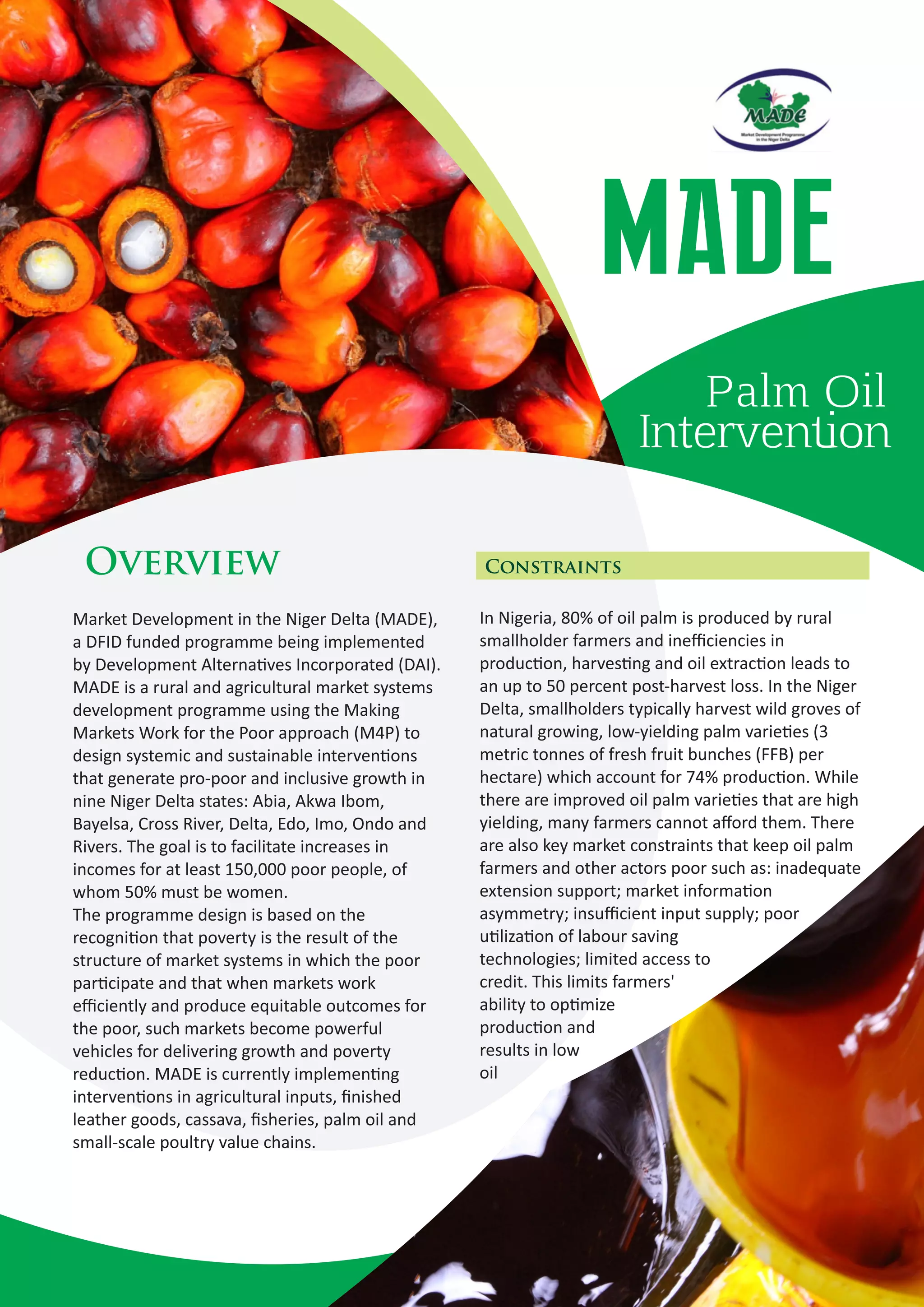
In Nigeria, 80% of oil palm is produced by rural
smallholder farmers and inefficiencies in
produc on, harves ng and oil extrac on leads to
an up to 50 percent post-harvest loss. In the Niger
Delta, smallholders typically harvest wild groves of
natural growing, low-yielding palm varie es (3
metric tonnes of fresh fruit bunches (FFB) per
hectare) which account for 74% produc on. While
there are improved oil palm varie es that are high
yielding, many farmers cannot afford them. There
are also key market constraints that keep oil palm
farmers and other actors poor such as: inadequate
extension support; market informa on
asymmetry; insufficient input supply; poor
u liza on of labour saving
technologies; limited access to
credit. This limits farmers'
ability to op mize
produc on and
results in low
oil
Constraints
MADE
Palm Oil
Interven on
Market Development in the Niger Delta (MADE),
a DFID funded programme being implemented
by Development Alterna ves Incorporated (DAI).
MADE is a rural and agricultural market systems
development programme using the Making
Markets Work for the Poor approach (M4P) to
design systemic and sustainable interven ons
that generate pro-poor and inclusive growth in
nine Niger Delta states: Abia, Akwa Ibom,
Bayelsa, Cross River, Delta, Edo, Imo, Ondo and
Rivers. The goal is to facilitate increases in
incomes for at least 150,000 poor people, of
whom 50% must be women.
The programme design is based on the
recogni on that poverty is the result of the
structure of market systems in which the poor
par cipate and that when markets work
efficiently and produce equitable outcomes for
the poor, such markets become powerful
vehicles for delivering growth and poverty
reduc on. MADE is currently implemen ng
interven ons in agricultural inputs, finished
leather goods, cassava, fisheries, palm oil and
small-scale poultry value chains.
Overview
output and earnings.
A thriving oil palm industry is an opportunity for
economic growth and food security in Nigeria,
and could provide employment for millions of
unskilled and semi-skilled labour. By op mizing
produc on, harves ng efficiency and oil
processing of the current 2.1m hectare under
cul va on, the na on could produce 6 million
metric tonnes annually and lead the produc on
of crude oil palm.
MADE's interven on in the Palm Oil value chain
seeks to contribute to an increase in produc vity
of smallholders by implemen ng ac vi es in
four interven on areas as outlined below.
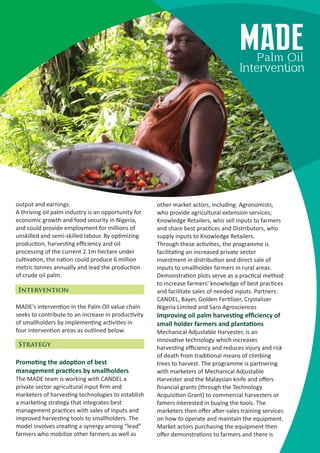
Promo ng the adop on of best
management prac ces by smallholders
The MADE team is working with CANDEL a
private sector agricultural input firm and
marketers of harves ng technologies to establish
a marke ng strategy that integrates best
management prac ces with sales of inputs and
improved harves ng tools to smallholders. The
model involves crea ng a synergy among “lead”
farmers who mobilize other farmers as well as
other market actors, including: Agronomists,
who provide agricultural extension services;
Knowledge Retailers, who sell inputs to farmers
and share best prac ces and Distributors, who
supply inputs to Knowledge Retailers.
Through these ac vi es, the programme is
facilita ng an increased private sector
investment in distribu on and direct sale of
inputs to smallholder farmers in rural areas.
Demonstra on plots serve as a prac cal method
to increase farmers' knowledge of best prac ces
and facilitate sales of needed inputs. Partners:
CANDEL, Bayer, Golden Fer lizer, Crystaliser
Nigeria Limited and Saro Agrosciences
Improving oil palm harves ng efficiency of
small holder farmers and planta ons
Mechanical Adjustable Harvester, is an
innova ve technology which increases
harves ng efficiency and reduces injury and risk
of death from tradi onal means of climbing
trees to harvest. The programme is partnering
with marketers of Mechanical Adjustable
Harvester and the Malaysian knife and offers
financial grants (through the Technology
Acquisi on Grant) to commercial harvesters or
famers interested in buying the tools. The
marketers then offer a er-sales training services
on how to operate and maintain the equipment.
Market actors purchasing the equipment then
offer demonstra ons to farmers and there is
Intervention
Strategy
MADEPalm Oil
Interven on
on Sustainable Palm Oil (RSPO) cer fica on and GAP
trainings. The planned out-grower scheme will be in
Obubra, Cross River State.
There is a need for ongoing engagement with fer liser
companies to ensure availability of products, which will
drive adop on of best prac ces introduced through
demos. In addi on, due to due to the physical rigour
required for harves ng and cultural norms around land
ownership, oil palm farming is dominated by men.
However, women are involved in the value chain at the
point of oil processing.
The cumula ve results at the end of June 2017 include:
Palm Oil interven ons had reached 12,716 smallholders
(with 36% women representa on). There has been
demonstrated farmer and processor adop on of the
improved produc on and processing techniques
introduced by the programme.
Through increased investment by market actors
(fabricators and distributors of MAH), there is improved
access to improved harves ng and processing
technologies. Out of the 10 fabricators trained to make
equipment, nine have been producing SSPEs and had sold
up to 69 SSPEs, while distributors of MAH sold a
cumula ve of 35 MAH and 110 Malaysian Knives.
Commercial mills now serve as points of leverage for poor
mill users who buy fruits for milling and get increased oil
yield. The programme recorded increased access to
improved harves ng and processing technologies.
more use of commercial harvest service because
of improved efficiency and awareness. Partners:
Agro-equipment marketers
Improving palm oil processing efficiency and
increased oil yield
MADE Programme partnered with a training
provider to train palm oil mill fabricators to cra
an improved palm oil processing machine, the
NIFOR small-scale processing equipment (SSPE).
MADE then links commercial palm oil millers
with fabricators so they can upgrade their
technology. Fabricators promote sale of
improved palm oil processors. Both millers and
fabricators increase awareness by holding
demonstra ons, reaching smallholder farmers
and mill users. Access to finance is also provided
to commercial processors to upgrade mills.
Partners: local fabricators of small-scale
processing equipment
Establishing linkages between smallholder
producers and large planta ons
The demand for industrial grade palm oil in
Nigeria is increasing, leading to large integrated
mills increasing their processing capaci es.
Based on this expansion by large integrated
mills, opportuni es exist for supplies of FFB from
small holder farmers to these mills. PZ Wilmar
has installed a palm oil refinery in Lagos, to be
supplied by established planta on and CPO mills
in Calabar, Cross Rivers State. To supplement
supply from its Calabar planta on, PZ Wilmar is
interested in establishing a RSPO -compliant out-
growers scheme. In Year 2 (April 2015 – March
2016), MADE supported the development of an
out-grower scheme model between PZ
Wilmar and small-holder farmers
with embedded Round Table
Risks
Results
MADE Office Address:
No 6 T A Phase II,ombia Street, GR
Port Har ourc t, Rivers State
Published by
Implemented By
Facebook.com/MADENigeria , @MADENigerDeltaTwitter:
/MADENigerDelta, @MADENigerDeltaYoutube.com Instagram
www.soundcloud.com/madenigerdelta, MADENigerDeltaPodcast: LinkedIn:
Medium: MADENigerDelta, Issu: MADENigerDelta
Slideshare.net/MADENigerDelta

Palm Oil Intervention Profile

  • 1.
    In Nigeria, 80%of oil palm is produced by rural smallholder farmers and inefficiencies in produc on, harves ng and oil extrac on leads to an up to 50 percent post-harvest loss. In the Niger Delta, smallholders typically harvest wild groves of natural growing, low-yielding palm varie es (3 metric tonnes of fresh fruit bunches (FFB) per hectare) which account for 74% produc on. While there are improved oil palm varie es that are high yielding, many farmers cannot afford them. There are also key market constraints that keep oil palm farmers and other actors poor such as: inadequate extension support; market informa on asymmetry; insufficient input supply; poor u liza on of labour saving technologies; limited access to credit. This limits farmers' ability to op mize produc on and results in low oil Constraints MADE Palm Oil Interven on Market Development in the Niger Delta (MADE), a DFID funded programme being implemented by Development Alterna ves Incorporated (DAI). MADE is a rural and agricultural market systems development programme using the Making Markets Work for the Poor approach (M4P) to design systemic and sustainable interven ons that generate pro-poor and inclusive growth in nine Niger Delta states: Abia, Akwa Ibom, Bayelsa, Cross River, Delta, Edo, Imo, Ondo and Rivers. The goal is to facilitate increases in incomes for at least 150,000 poor people, of whom 50% must be women. The programme design is based on the recogni on that poverty is the result of the structure of market systems in which the poor par cipate and that when markets work efficiently and produce equitable outcomes for the poor, such markets become powerful vehicles for delivering growth and poverty reduc on. MADE is currently implemen ng interven ons in agricultural inputs, finished leather goods, cassava, fisheries, palm oil and small-scale poultry value chains. Overview
  • 2.
    output and earnings. Athriving oil palm industry is an opportunity for economic growth and food security in Nigeria, and could provide employment for millions of unskilled and semi-skilled labour. By op mizing produc on, harves ng efficiency and oil processing of the current 2.1m hectare under cul va on, the na on could produce 6 million metric tonnes annually and lead the produc on of crude oil palm. MADE's interven on in the Palm Oil value chain seeks to contribute to an increase in produc vity of smallholders by implemen ng ac vi es in four interven on areas as outlined below. Promo ng the adop on of best management prac ces by smallholders The MADE team is working with CANDEL a private sector agricultural input firm and marketers of harves ng technologies to establish a marke ng strategy that integrates best management prac ces with sales of inputs and improved harves ng tools to smallholders. The model involves crea ng a synergy among “lead” farmers who mobilize other farmers as well as other market actors, including: Agronomists, who provide agricultural extension services; Knowledge Retailers, who sell inputs to farmers and share best prac ces and Distributors, who supply inputs to Knowledge Retailers. Through these ac vi es, the programme is facilita ng an increased private sector investment in distribu on and direct sale of inputs to smallholder farmers in rural areas. Demonstra on plots serve as a prac cal method to increase farmers' knowledge of best prac ces and facilitate sales of needed inputs. Partners: CANDEL, Bayer, Golden Fer lizer, Crystaliser Nigeria Limited and Saro Agrosciences Improving oil palm harves ng efficiency of small holder farmers and planta ons Mechanical Adjustable Harvester, is an innova ve technology which increases harves ng efficiency and reduces injury and risk of death from tradi onal means of climbing trees to harvest. The programme is partnering with marketers of Mechanical Adjustable Harvester and the Malaysian knife and offers financial grants (through the Technology Acquisi on Grant) to commercial harvesters or famers interested in buying the tools. The marketers then offer a er-sales training services on how to operate and maintain the equipment. Market actors purchasing the equipment then offer demonstra ons to farmers and there is Intervention Strategy MADEPalm Oil Interven on
  • 3.
    on Sustainable PalmOil (RSPO) cer fica on and GAP trainings. The planned out-grower scheme will be in Obubra, Cross River State. There is a need for ongoing engagement with fer liser companies to ensure availability of products, which will drive adop on of best prac ces introduced through demos. In addi on, due to due to the physical rigour required for harves ng and cultural norms around land ownership, oil palm farming is dominated by men. However, women are involved in the value chain at the point of oil processing. The cumula ve results at the end of June 2017 include: Palm Oil interven ons had reached 12,716 smallholders (with 36% women representa on). There has been demonstrated farmer and processor adop on of the improved produc on and processing techniques introduced by the programme. Through increased investment by market actors (fabricators and distributors of MAH), there is improved access to improved harves ng and processing technologies. Out of the 10 fabricators trained to make equipment, nine have been producing SSPEs and had sold up to 69 SSPEs, while distributors of MAH sold a cumula ve of 35 MAH and 110 Malaysian Knives. Commercial mills now serve as points of leverage for poor mill users who buy fruits for milling and get increased oil yield. The programme recorded increased access to improved harves ng and processing technologies. more use of commercial harvest service because of improved efficiency and awareness. Partners: Agro-equipment marketers Improving palm oil processing efficiency and increased oil yield MADE Programme partnered with a training provider to train palm oil mill fabricators to cra an improved palm oil processing machine, the NIFOR small-scale processing equipment (SSPE). MADE then links commercial palm oil millers with fabricators so they can upgrade their technology. Fabricators promote sale of improved palm oil processors. Both millers and fabricators increase awareness by holding demonstra ons, reaching smallholder farmers and mill users. Access to finance is also provided to commercial processors to upgrade mills. Partners: local fabricators of small-scale processing equipment Establishing linkages between smallholder producers and large planta ons The demand for industrial grade palm oil in Nigeria is increasing, leading to large integrated mills increasing their processing capaci es. Based on this expansion by large integrated mills, opportuni es exist for supplies of FFB from small holder farmers to these mills. PZ Wilmar has installed a palm oil refinery in Lagos, to be supplied by established planta on and CPO mills in Calabar, Cross Rivers State. To supplement supply from its Calabar planta on, PZ Wilmar is interested in establishing a RSPO -compliant out- growers scheme. In Year 2 (April 2015 – March 2016), MADE supported the development of an out-grower scheme model between PZ Wilmar and small-holder farmers with embedded Round Table Risks Results MADE Office Address: No 6 T A Phase II,ombia Street, GR Port Har ourc t, Rivers State Published by Implemented By Facebook.com/MADENigeria , @MADENigerDeltaTwitter: /MADENigerDelta, @MADENigerDeltaYoutube.com Instagram www.soundcloud.com/madenigerdelta, MADENigerDeltaPodcast: LinkedIn: Medium: MADENigerDelta, Issu: MADENigerDelta Slideshare.net/MADENigerDelta