ARSIAL
                                           Mr. Federico Sòrgoni

                                « Common lands for sustainable management »
                                            2nd Scientific Committee
                            Palermo (Sicily - Italy) November 2nd and 3rd , 2009.


Project co-financed by the European Regional Development Fund
I / Applicable law
•     a) Law n. 1766 - 16/06/1927 – Definitive          •   Biodiversity:
      assessment of Common Land in Italy                -   Local: Regional Law Act n.15/2000
•     b) Royal Decree n. 322 - 26/11/1928 –             -   National: Law n. 46/2007
      Application of the above Law                      -   European: Directive 62/2008/CEE
•     c) Law 397/1894 recognized the U.A. as a          •   Landscapes:
      public non economic body
                                                        -   Local: Regional Law Act n. 39/2002
•     d) Law n. 1102 - 3/12/1971 Institution of
      the Università Agrarie in Italy as public         -   National: Law n. 490/99
      interest body                                     -   European: CEE Directive 92/43 Habitat
•     e) Law n. 97/1994 Attribution to the              •   Species:
      Università Agrarie of a private legal             -   Local: Regional Law Act n. 17/95 D.G.R.
      statute                                               2146/96 and 651/05
                                                        -   National: Law n. 157/92
                                                        -   European: CEE Directives 92/43 Habitat,
                                                            n. 79/409 Birds


« Common lands for sustainable management »
2nd Scientific Committee
                                                                                                      2
Palermo (Sicily - Italy) November 2nd and 3rd , 2009.
Owner - Users
• The community in the District of the Università
  Agraria di Allumiere are both users and owners.
• Public ownership, the citizens of Allumiere district,
  therefore a group of people. The common lands are
  managed by the Università Agraria that is the
  administrative public body. Even if the land parcels
  are inscribed in the cadastre under its properties it is
  not the owner but only an administrative -
  management body.

« Common lands for sustainable management »
2nd Scientific Committee
                                                             3
Palermo (Sicily - Italy) November 2nd and 3rd , 2009.
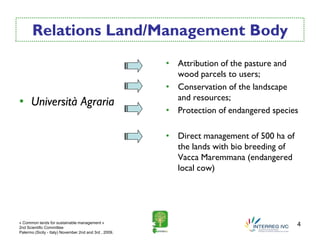
Relations Land/Management Body
                                                        • Attribution of the pasture and
                                                          wood parcels to users;
                                                        • Conservation of the landscape
                                                          and resources;
• Università Agraria
                                                        • Protection of endangered species

                                                        • Direct management of 500 ha of
                                                          the lands with bio breeding of
                                                          Vacca Maremmana (endangered
                                                          local cow)


« Common lands for sustainable management »
2nd Scientific Committee
                                                                                           4
Palermo (Sicily - Italy) November 2nd and 3rd , 2009.
Relations: Management body / User

• User and Owner coincide.                              • Take cows, horses and
                                                          donkeys to pastures;
                                                        • Collect woods for
• Users have the rights to:
                                                          heating;
• The management body                                   • Collect underbrush
  attributes the land parcels for                         fruits (mushrooms,
  pasture and wood cutting                                chestnuts, berries);
  based on resource impact
                                                        • Free access to the lands
  evaluation.
                                                          for leisure;

« Common lands for sustainable management »
2nd Scientific Committee
                                                                                 5
Palermo (Sicily - Italy) November 2nd and 3rd , 2009.
SWOT analysis
•     STRENGHTS:                                        •   OPPORTUNITIES:
•     User owned common lands with a                    •   Inclusion of the requirements present in
      dedicated office (Università Agraria)                 SIC ZPS and Habitat and Birds directive in
      directly enforcing laws and regulaments;              Forest Management Plan;
•     direct and precise knowledge of problems          •   Attribution of pasture parcels for 5 years
      and territory;                                        or more to allow breeders to access PSR
                                                            funds;


•     WEAKNESSES:                                       •   THREATS:
•     Forest Management Plan, mandatory                 •   Risk of block of activities due to the
      according to R.L.A. n. 39/02, do not                  conflict between CEE Natura 2000 norms
      include the limits imposed by SIC - ZPS               and Local norms where not integrated.
      and the Habitat and Birds CEE directives
      therefore creating a confusion in
      procedures and permissions to possible
      activities in the common lands.


« Common lands for sustainable management »
2nd Scientific Committee
                                                                                                         6
Palermo (Sicily - Italy) November 2nd and 3rd , 2009.
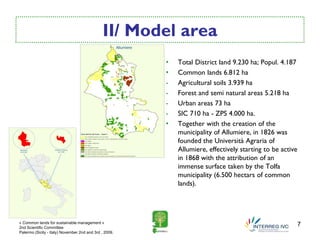
II/ Model area
                                                        •   Total District land 9.230 ha; Popul. 4.187
                                                        •   Common lands 6.812 ha
                                                        -   Agricultural soils 3.939 ha
                                                        -   Forest and semi natural areas 5.218 ha
                                                        -   Urban areas 73 ha
                                                        -   SIC 710 ha - ZPS 4.000 ha.
                                                        •   Together with the creation of the
                                                            municipality of Allumiere, in 1826 was
                                                            founded the Università Agraria of
                                                            Allumiere, effectively starting to be active
                                                            in 1868 with the attribution of an
                                                            immense surface taken by the Tolfa
                                                            municipality (6.500 hectars of common
                                                            lands).


« Common lands for sustainable management »
2nd Scientific Committee
                                                                                                           7
Palermo (Sicily - Italy) November 2nd and 3rd , 2009.
Evolution of the situation in the area and actions taken

•     The common lands of this area are mostly completely overlapped with the Natura 2000 area
      (SIC – ZPS). The norms stated in Natura 2000 are different to those in the Forest
      Management Plan stated in the Regional Act n. 39/2002. Natura 2000 and the two Habitat
      Directive 92/43/CEE and Birds Directive 79/409/CEE set strong limits to the grazing and
      woodcutting activities severely limiting the exercise of the commoner rights which are
      instead constitutionally granted. The fact that the commoners, that have exercised centuries
      old rights, could have limited or null access to the resources and to the area determines an
      abandon of the common land use. But the territory has been preserved by the presence of
      commoners taking care of the lands for their necessity, a sort of mutual relationship.
•     To allow the use of the common lands in a sustainable way the U.A. has adopted a Forest
      Management Plan that analyzes the possible number of animal per ha allowed and the wood
      cutting periods and methods. The common lands divided in parcels are assigned to local
      animal breeders. Regarding the woodlands the U.A. attributes the wood cutting to private
      professional enterprises that have the know-how of correct cutting (according to the R.L.A.
      39/02) granting on the other hand 1.000 tons per year of heating wood for the commoners.
      For the dead wood there is a specific norm reserved to the commoners that must request
      authorization to the U.A.


« Common lands for sustainable management »
2nd Scientific Committee
                                                                                                 8
Palermo (Sicily - Italy) November 2nd and 3rd , 2009.
III/ Conclusions
•     In the case of a Università Agraria there is not a strong integration into the
      political-administrative arrangement. It's true that an U.A. is an elective body
      (elected by the community) but it is only an administrative and management body
      that is subdued to Municipal, Regional and National Laws and Regulaments. They
      do not decide which policies adopt but they have to follow what is decided by the
      public bodies that can output Laws. It's not by chance that this kind of institution
      are called "Land management body". Moreover they do not own the common
      lands, that are property of the local community resident in the area.
•     The Università Agraria as a public institution has been recognized with the Law n.
      1102/1971; The members of the directive board are elected by the community and
      are direct expression of the voters. In fact a second Law (n. 97/1994) gave the
      Università Agraria a legal private statute therefore making it autonomous in its
      managing. Its statute and norms are subject to approval by the Regional body. All
      its administrative and managing activity is subject to control by the Regional body.


« Common lands for sustainable management »
2nd Scientific Committee
                                                                                         9
Palermo (Sicily - Italy) November 2nd and 3rd , 2009.

Palermo - Pp2 Grid1 Slide Allumiere

  • 1.
    ARSIAL Mr. Federico Sòrgoni « Common lands for sustainable management » 2nd Scientific Committee Palermo (Sicily - Italy) November 2nd and 3rd , 2009. Project co-financed by the European Regional Development Fund
  • 2.
    I / Applicablelaw • a) Law n. 1766 - 16/06/1927 – Definitive • Biodiversity: assessment of Common Land in Italy - Local: Regional Law Act n.15/2000 • b) Royal Decree n. 322 - 26/11/1928 – - National: Law n. 46/2007 Application of the above Law - European: Directive 62/2008/CEE • c) Law 397/1894 recognized the U.A. as a • Landscapes: public non economic body - Local: Regional Law Act n. 39/2002 • d) Law n. 1102 - 3/12/1971 Institution of the Università Agrarie in Italy as public - National: Law n. 490/99 interest body - European: CEE Directive 92/43 Habitat • e) Law n. 97/1994 Attribution to the • Species: Università Agrarie of a private legal - Local: Regional Law Act n. 17/95 D.G.R. statute 2146/96 and 651/05 - National: Law n. 157/92 - European: CEE Directives 92/43 Habitat, n. 79/409 Birds « Common lands for sustainable management » 2nd Scientific Committee 2 Palermo (Sicily - Italy) November 2nd and 3rd , 2009.
  • 3.
    Owner - Users •The community in the District of the Università Agraria di Allumiere are both users and owners. • Public ownership, the citizens of Allumiere district, therefore a group of people. The common lands are managed by the Università Agraria that is the administrative public body. Even if the land parcels are inscribed in the cadastre under its properties it is not the owner but only an administrative - management body. « Common lands for sustainable management » 2nd Scientific Committee 3 Palermo (Sicily - Italy) November 2nd and 3rd , 2009.
  • 4.
    Relations Land/Management Body • Attribution of the pasture and wood parcels to users; • Conservation of the landscape and resources; • Università Agraria • Protection of endangered species • Direct management of 500 ha of the lands with bio breeding of Vacca Maremmana (endangered local cow) « Common lands for sustainable management » 2nd Scientific Committee 4 Palermo (Sicily - Italy) November 2nd and 3rd , 2009.
  • 5.
    Relations: Management body/ User • User and Owner coincide. • Take cows, horses and donkeys to pastures; • Collect woods for • Users have the rights to: heating; • The management body • Collect underbrush attributes the land parcels for fruits (mushrooms, pasture and wood cutting chestnuts, berries); based on resource impact • Free access to the lands evaluation. for leisure; « Common lands for sustainable management » 2nd Scientific Committee 5 Palermo (Sicily - Italy) November 2nd and 3rd , 2009.
  • 6.
    SWOT analysis • STRENGHTS: • OPPORTUNITIES: • User owned common lands with a • Inclusion of the requirements present in dedicated office (Università Agraria) SIC ZPS and Habitat and Birds directive in directly enforcing laws and regulaments; Forest Management Plan; • direct and precise knowledge of problems • Attribution of pasture parcels for 5 years and territory; or more to allow breeders to access PSR funds; • WEAKNESSES: • THREATS: • Forest Management Plan, mandatory • Risk of block of activities due to the according to R.L.A. n. 39/02, do not conflict between CEE Natura 2000 norms include the limits imposed by SIC - ZPS and Local norms where not integrated. and the Habitat and Birds CEE directives therefore creating a confusion in procedures and permissions to possible activities in the common lands. « Common lands for sustainable management » 2nd Scientific Committee 6 Palermo (Sicily - Italy) November 2nd and 3rd , 2009.
  • 7.
    II/ Model area • Total District land 9.230 ha; Popul. 4.187 • Common lands 6.812 ha - Agricultural soils 3.939 ha - Forest and semi natural areas 5.218 ha - Urban areas 73 ha - SIC 710 ha - ZPS 4.000 ha. • Together with the creation of the municipality of Allumiere, in 1826 was founded the Università Agraria of Allumiere, effectively starting to be active in 1868 with the attribution of an immense surface taken by the Tolfa municipality (6.500 hectars of common lands). « Common lands for sustainable management » 2nd Scientific Committee 7 Palermo (Sicily - Italy) November 2nd and 3rd , 2009.
  • 8.
    Evolution of thesituation in the area and actions taken • The common lands of this area are mostly completely overlapped with the Natura 2000 area (SIC – ZPS). The norms stated in Natura 2000 are different to those in the Forest Management Plan stated in the Regional Act n. 39/2002. Natura 2000 and the two Habitat Directive 92/43/CEE and Birds Directive 79/409/CEE set strong limits to the grazing and woodcutting activities severely limiting the exercise of the commoner rights which are instead constitutionally granted. The fact that the commoners, that have exercised centuries old rights, could have limited or null access to the resources and to the area determines an abandon of the common land use. But the territory has been preserved by the presence of commoners taking care of the lands for their necessity, a sort of mutual relationship. • To allow the use of the common lands in a sustainable way the U.A. has adopted a Forest Management Plan that analyzes the possible number of animal per ha allowed and the wood cutting periods and methods. The common lands divided in parcels are assigned to local animal breeders. Regarding the woodlands the U.A. attributes the wood cutting to private professional enterprises that have the know-how of correct cutting (according to the R.L.A. 39/02) granting on the other hand 1.000 tons per year of heating wood for the commoners. For the dead wood there is a specific norm reserved to the commoners that must request authorization to the U.A. « Common lands for sustainable management » 2nd Scientific Committee 8 Palermo (Sicily - Italy) November 2nd and 3rd , 2009.
  • 9.
    III/ Conclusions • In the case of a Università Agraria there is not a strong integration into the political-administrative arrangement. It's true that an U.A. is an elective body (elected by the community) but it is only an administrative and management body that is subdued to Municipal, Regional and National Laws and Regulaments. They do not decide which policies adopt but they have to follow what is decided by the public bodies that can output Laws. It's not by chance that this kind of institution are called "Land management body". Moreover they do not own the common lands, that are property of the local community resident in the area. • The Università Agraria as a public institution has been recognized with the Law n. 1102/1971; The members of the directive board are elected by the community and are direct expression of the voters. In fact a second Law (n. 97/1994) gave the Università Agraria a legal private statute therefore making it autonomous in its managing. Its statute and norms are subject to approval by the Regional body. All its administrative and managing activity is subject to control by the Regional body. « Common lands for sustainable management » 2nd Scientific Committee 9 Palermo (Sicily - Italy) November 2nd and 3rd , 2009.