University of Agricultural Sciences and
                                        Veterinary Medicine
                                      Cluj-Napoca, Romania
                                         Mrs. Sonia SÂNĂ

           «Common lands for sustainable management»
                     2nd Scientific Committee
           Palermo (Sicily - Italy) November 2nd and 3rd ,
                                 2009.

    .


Project co-financed by the European Regional Development Fund
PRESENTATION OF THE
                              METHODOLOGY FOR THE
                              COMPARATIVE ANALYSIS
           «Common lands for sustainable management»
                     2nd Scientific Committee
           Palermo (Sicily - Italy) November 2nd and 3rd ,
                                 2009.

    .


Project co-financed by the European Regional Development Fund
Project first phase outputs:
  • three grids/partner which defines what
    forest based common lands are and do,
    from a legal perspective
  • a paper illustrating the results of the
    comparative analysis carried out to
    underline existing differences in the
    approach and definition of the object,
    deriving from the collected grids.

« Common lands for sustainable management »
2nd Scientific Committee
Palermo (Sicily - Italy) November 2nd and 3rd , 2009.
PROJECT OBJECTIVES
  • understand and exchanged practices on institutional
    arrangements that define a forest-based common and its
    governance system

  • identified extent to which local community actors can effectively
    govern forests in the actual institutional arrangement

  • agreement upon the evidence that forest governance based on
    commons represent an effective tool for sustainable forest
    management

  • improved institutional arrangements to implement forest-based
    common governance as environment preservation and
    valorisation tools

« Common lands for sustainable management »
2nd Scientific Committee
Palermo (Sicily - Italy) November 2nd and 3rd , 2009.
CONTENT

  1.IDENTIFICATION
  2.MANAGING STRUCTURES
  3.CASE STUDIES
  4.DE-REGISTRATION (CHANGE OF
   USE


« Common lands for sustainable management »
2nd Scientific Committee
Palermo (Sicily - Italy) November 2nd and 3rd , 2009.
I. IDENTIFICATION

  1.Definition
  2.Classification
  3.Land statute (Legislative
   background)


« Common lands for sustainable management »
2nd Scientific Committee
Palermo (Sicily - Italy) November 2nd and 3rd , 2009.
II. MANAGING STRUCTURES


  1.Property structure
  2.Owners and their rights
  3.Users and their rights


« Common lands for sustainable management »
2nd Scientific Committee
Palermo (Sicily - Italy) November 2nd and 3rd , 2009.
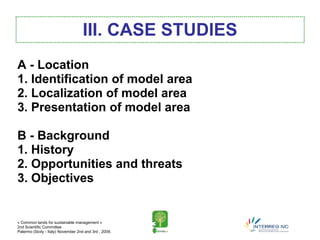
III. CASE STUDIES
A - Location
1. Identification of model area
2. Localization of model area
3. Presentation of model area

B - Background
1. History
2. Opportunities and threats
3. Objectives


« Common lands for sustainable management »
2nd Scientific Committee
Palermo (Sicily - Italy) November 2nd and 3rd , 2009.
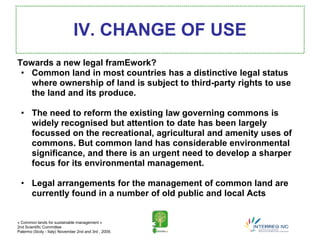
IV. CHANGE OF USE
Towards a new legal framEwork?
 • Common land in most countries has a distinctive legal status
   where ownership of land is subject to third-party rights to use
   the land and its produce.

  • The need to reform the existing law governing commons is
    widely recognised but attention to date has been largely
    focussed on the recreational, agricultural and amenity uses of
    commons. But common land has considerable environmental
    significance, and there is an urgent need to develop a sharper
    focus for its environmental management.

  • Legal arrangements for the management of common land are
    currently found in a number of old public and local Acts


« Common lands for sustainable management »
2nd Scientific Committee
Palermo (Sicily - Italy) November 2nd and 3rd , 2009.
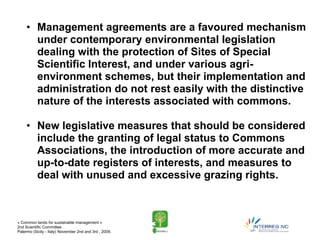
• Management agreements are a favoured mechanism
       under contemporary environmental legislation
       dealing with the protection of Sites of Special
       Scientific Interest, and under various agri-
       environment schemes, but their implementation and
       administration do not rest easily with the distinctive
       nature of the interests associated with commons.

     • New legislative measures that should be considered
       include the granting of legal status to Commons
       Associations, the introduction of more accurate and
       up-to-date registers of interests, and measures to
       deal with unused and excessive grazing rights.


« Common lands for sustainable management »
2nd Scientific Committee
Palermo (Sicily - Italy) November 2nd and 3rd , 2009.
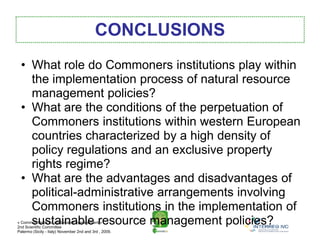
CONCLUSIONS
  • What role do Commoners institutions play within
    the implementation process of natural resource
    management policies?
  • What are the conditions of the perpetuation of
    Commoners institutions within western European
    countries characterized by a high density of
    policy regulations and an exclusive property
    rights regime?
  • What are the advantages and disadvantages of
    political-administrative arrangements involving
    Commoners institutions in the implementation of
    sustainable resource management policies?
« Common lands for sustainable management »
2nd Scientific Committee
Palermo (Sicily - Italy) November 2nd and 3rd , 2009.
RECCOMANDATIONS


« Common lands for sustainable management »
2nd Scientific Committee
Palermo (Sicily - Italy) November 2nd and 3rd , 2009.

Palermo - Romania comparative methodology

  • 1.
    University of AgriculturalSciences and Veterinary Medicine Cluj-Napoca, Romania Mrs. Sonia SÂNĂ «Common lands for sustainable management» 2nd Scientific Committee Palermo (Sicily - Italy) November 2nd and 3rd , 2009. . Project co-financed by the European Regional Development Fund
  • 2.
    PRESENTATION OF THE METHODOLOGY FOR THE COMPARATIVE ANALYSIS «Common lands for sustainable management» 2nd Scientific Committee Palermo (Sicily - Italy) November 2nd and 3rd , 2009. . Project co-financed by the European Regional Development Fund
  • 3.
    Project first phaseoutputs: • three grids/partner which defines what forest based common lands are and do, from a legal perspective • a paper illustrating the results of the comparative analysis carried out to underline existing differences in the approach and definition of the object, deriving from the collected grids. « Common lands for sustainable management » 2nd Scientific Committee Palermo (Sicily - Italy) November 2nd and 3rd , 2009.
  • 4.
    PROJECT OBJECTIVES • understand and exchanged practices on institutional arrangements that define a forest-based common and its governance system • identified extent to which local community actors can effectively govern forests in the actual institutional arrangement • agreement upon the evidence that forest governance based on commons represent an effective tool for sustainable forest management • improved institutional arrangements to implement forest-based common governance as environment preservation and valorisation tools « Common lands for sustainable management » 2nd Scientific Committee Palermo (Sicily - Italy) November 2nd and 3rd , 2009.
  • 5.
    CONTENT 1.IDENTIFICATION 2.MANAGING STRUCTURES 3.CASE STUDIES 4.DE-REGISTRATION (CHANGE OF USE « Common lands for sustainable management » 2nd Scientific Committee Palermo (Sicily - Italy) November 2nd and 3rd , 2009.
  • 6.
    I. IDENTIFICATION 1.Definition 2.Classification 3.Land statute (Legislative background) « Common lands for sustainable management » 2nd Scientific Committee Palermo (Sicily - Italy) November 2nd and 3rd , 2009.
  • 7.
    II. MANAGING STRUCTURES 1.Property structure 2.Owners and their rights 3.Users and their rights « Common lands for sustainable management » 2nd Scientific Committee Palermo (Sicily - Italy) November 2nd and 3rd , 2009.
  • 8.
    III. CASE STUDIES A- Location 1. Identification of model area 2. Localization of model area 3. Presentation of model area B - Background 1. History 2. Opportunities and threats 3. Objectives « Common lands for sustainable management » 2nd Scientific Committee Palermo (Sicily - Italy) November 2nd and 3rd , 2009.
  • 9.
    IV. CHANGE OFUSE Towards a new legal framEwork? • Common land in most countries has a distinctive legal status where ownership of land is subject to third-party rights to use the land and its produce. • The need to reform the existing law governing commons is widely recognised but attention to date has been largely focussed on the recreational, agricultural and amenity uses of commons. But common land has considerable environmental significance, and there is an urgent need to develop a sharper focus for its environmental management. • Legal arrangements for the management of common land are currently found in a number of old public and local Acts « Common lands for sustainable management » 2nd Scientific Committee Palermo (Sicily - Italy) November 2nd and 3rd , 2009.
  • 10.
    • Management agreementsare a favoured mechanism under contemporary environmental legislation dealing with the protection of Sites of Special Scientific Interest, and under various agri- environment schemes, but their implementation and administration do not rest easily with the distinctive nature of the interests associated with commons. • New legislative measures that should be considered include the granting of legal status to Commons Associations, the introduction of more accurate and up-to-date registers of interests, and measures to deal with unused and excessive grazing rights. « Common lands for sustainable management » 2nd Scientific Committee Palermo (Sicily - Italy) November 2nd and 3rd , 2009.
  • 11.
    CONCLUSIONS •What role do Commoners institutions play within the implementation process of natural resource management policies? • What are the conditions of the perpetuation of Commoners institutions within western European countries characterized by a high density of policy regulations and an exclusive property rights regime? • What are the advantages and disadvantages of political-administrative arrangements involving Commoners institutions in the implementation of sustainable resource management policies? « Common lands for sustainable management » 2nd Scientific Committee Palermo (Sicily - Italy) November 2nd and 3rd , 2009.
  • 12.
    RECCOMANDATIONS « Common landsfor sustainable management » 2nd Scientific Committee Palermo (Sicily - Italy) November 2nd and 3rd , 2009.