COUNTRY REPORT ON PAKISTAN
1
INTRODUCTON
 The Islamic Republic of Pakistan is the 33rd largest country in terms
of area and 5th most populous with over 210 million population
 The country has a considerable reservoir of young people, with 64%
below 29 and 30% between 15 and 29 years. According to the World
Bank's statistics, Pakistan is among Asia's five fastest emerging
economies, registering a growth rate of over 5.7% in 2017, a trend
projected to continue in 2018
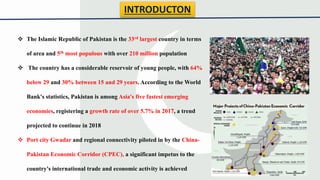
 Port city Gwadar and regional connectivity piloted in by the China-
Pakistan Economic Corridor (CPEC), a significant impetus to the
country's international trade and economic activity is achieved 2
Timeline Events
712 AD Muhammad Bin Qasim defeated Raja Dahir and established Ummayad Islamic rule on Sindh and
South Punjab (Multan)
747 AD – 751
AD
Ummayad Era finished and Abbasid Era begins
841 AD Dynastic rule of Habbaris over Sindh begin under supervision of Abbasid Caliphate.
1001 AD Mahmud Ghazni defeated Raja Jayapala of Hindu Shahi; after that Jayapala commits suicide
1351 AD Samma Dynasty assumed rule over Sindh
1526 – 1707 AD Mughal ascendancy
1739 AD Nadir Shah of Persia invades Mughal Empire
1857 AD The British control most present-day Pakistan region and incorporate it as part of the British Indian
Empire
1909 AD Muhammad Ali Jinnah was elected to the Legislative Council of All-India Muslim League
Aug. 14 1947 Pakistan was created
Oct. 7 1958 After a military coup Ayub Khan takes over
Mar. 25 1969 Ayub Khan resigns; Yahya Khan declares martial law and assumes presidency
1971 East Pakistan breaks away to become Bangladesh
HISTORY
3
GEOGRAPHY
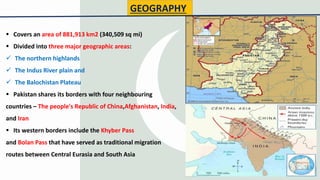
 Covers an area of 881,913 km2 (340,509 sq mi)
 Divided into three major geographic areas:
 The northern highlands
 The Indus River plain and
 The Balochistan Plateau
 Pakistan shares its borders with four neighbouring
countries – The people's Republic of China,Afghanistan, India,
and Iran
 Its western borders include the Khyber Pass
and Bolan Pass that have served as traditional migration
routes between Central Eurasia and South Asia
4
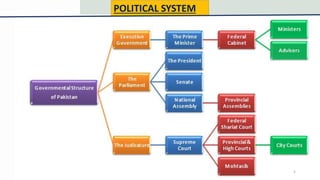
POLITICAL SYSTEM
5
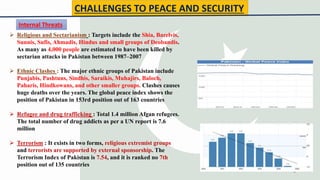
Internal Threats
 Religious and Sectarianism : Targets include the Shia, Barelvis,
Sunnis, Sufis, Ahmadis, Hindus and small groups of Deobandis.
As many as 4,000 people are estimated to have been killed by
sectarian attacks in Pakistan between 1987–2007
 Ethnic Clashes : The major ethnic groups of Pakistan include
Punjabis, Pashtuns, Sindhis, Saraikis, Muhajirs, Baloch,
Paharis, Hindkowans, and other smaller groups. Clashes causes
huge deaths over the years. The global peace index shows the
position of Pakistan in 153rd position out of 163 countries
 Refugee and drug trafficking : Total 1.4 million Afgan refugees.
The total number of drug addicts as per a UN report is 7.6
million
 Terrorism : It exists in two forms, religious extremist groups
and terrorists are supported by external sponsorship. The
Terrorism Index of Pakistan is 7.54, and it is ranked no 7th
position out of 135 countries
CHALLENGES TO PEACE AND SECURITY
6
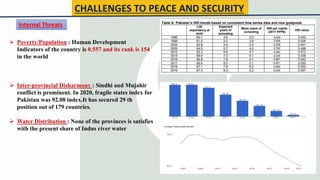
Internal Threats
 Poverty/Population : Human Development
Indicators of the country is 0.557 and its rank is 154
in the world
 Inter-provincial Disharmony : Sindhi and Mujahir
conflict is prominent. In 2020, fragile states index for
Pakistan was 92.08 index.It has secured 29 th
position out of 179 countries.
 Water Distribution : None of the provinces is satisfies
with the present share of Indus river water
CHALLENGES TO PEACE AND SECURITY
7
External threats
 Threats from India : Since partition, Kashmir, Siachin, Sir Creek, and water-related issues also take a huge chunk
of antagonism between the two countries
 Threats from Afghanistan : Pakistan has backed the Taliban from their earliest days. It nurtured the anti-Soviet
mujahideen fighters that later evolved into the Taliban. Islamabad was one of only three countries to recognize the
Taliban government in the 1990s and the last to break formal ties with it in 2001. As the Taliban swiftly capture
territory in Afghanistan, many Afghans blame Pakistan for the insurgents' success, pointing to their use of Pakistani
territory in multiple ways
 The 9/11 Incident : The terrorist attacks of 9/11 necessitated US-Pakistan cooperation to combat terrorism, which
had mixed consequences for Pakistan’s security. Further, the US supported Pakistan’s transition to democracy in
2007-2008. On the other hand, political violence grew in Pakistan, in part due to Pakistan’s close alliance with the US
CHALLENGES TO PEACE AND SECURITY
8
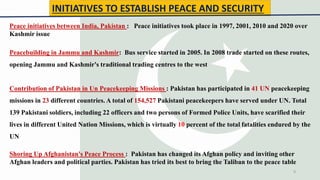
Peace initiatives between India, Pakistan : Peace initiatives took place in 1997, 2001, 2010 and 2020 over
Kashmir issue
Peacebuilding in Jammu and Kashmir: Bus service started in 2005. In 2008 trade started on these routes,
opening Jammu and Kashmir's traditional trading centres to the west
Contribution of Pakistan in Un Peacekeeping Missions : Pakistan has participated in 41 UN peacekeeping
missions in 23 different countries. A total of 154,527 Pakistani peacekeepers have served under UN. Total
139 Pakistani soldiers, including 22 officers and two persons of Formed Police Units, have scarified their
lives in different United Nation Missions, which is virtually 10 percent of the total fatalities endured by the
UN
Shoring Up Afghanistan's Peace Process : Pakistan has changed its Afghan policy and inviting other
Afghan leaders and political parties. Pakistan has tried its best to bring the Taliban to the peace table
INITIATIVES TO ESTABLISH PEACE AND SECURITY
9
CONCLUSION
10

Pakistan

  • 1.
  • 2.
    INTRODUCTON  The IslamicRepublic of Pakistan is the 33rd largest country in terms of area and 5th most populous with over 210 million population  The country has a considerable reservoir of young people, with 64% below 29 and 30% between 15 and 29 years. According to the World Bank's statistics, Pakistan is among Asia's five fastest emerging economies, registering a growth rate of over 5.7% in 2017, a trend projected to continue in 2018  Port city Gwadar and regional connectivity piloted in by the China- Pakistan Economic Corridor (CPEC), a significant impetus to the country's international trade and economic activity is achieved 2
  • 3.
    Timeline Events 712 ADMuhammad Bin Qasim defeated Raja Dahir and established Ummayad Islamic rule on Sindh and South Punjab (Multan) 747 AD – 751 AD Ummayad Era finished and Abbasid Era begins 841 AD Dynastic rule of Habbaris over Sindh begin under supervision of Abbasid Caliphate. 1001 AD Mahmud Ghazni defeated Raja Jayapala of Hindu Shahi; after that Jayapala commits suicide 1351 AD Samma Dynasty assumed rule over Sindh 1526 – 1707 AD Mughal ascendancy 1739 AD Nadir Shah of Persia invades Mughal Empire 1857 AD The British control most present-day Pakistan region and incorporate it as part of the British Indian Empire 1909 AD Muhammad Ali Jinnah was elected to the Legislative Council of All-India Muslim League Aug. 14 1947 Pakistan was created Oct. 7 1958 After a military coup Ayub Khan takes over Mar. 25 1969 Ayub Khan resigns; Yahya Khan declares martial law and assumes presidency 1971 East Pakistan breaks away to become Bangladesh HISTORY 3
  • 4.
    GEOGRAPHY  Covers anarea of 881,913 km2 (340,509 sq mi)  Divided into three major geographic areas:  The northern highlands  The Indus River plain and  The Balochistan Plateau  Pakistan shares its borders with four neighbouring countries – The people's Republic of China,Afghanistan, India, and Iran  Its western borders include the Khyber Pass and Bolan Pass that have served as traditional migration routes between Central Eurasia and South Asia 4
  • 5.
  • 6.
    Internal Threats  Religiousand Sectarianism : Targets include the Shia, Barelvis, Sunnis, Sufis, Ahmadis, Hindus and small groups of Deobandis. As many as 4,000 people are estimated to have been killed by sectarian attacks in Pakistan between 1987–2007  Ethnic Clashes : The major ethnic groups of Pakistan include Punjabis, Pashtuns, Sindhis, Saraikis, Muhajirs, Baloch, Paharis, Hindkowans, and other smaller groups. Clashes causes huge deaths over the years. The global peace index shows the position of Pakistan in 153rd position out of 163 countries  Refugee and drug trafficking : Total 1.4 million Afgan refugees. The total number of drug addicts as per a UN report is 7.6 million  Terrorism : It exists in two forms, religious extremist groups and terrorists are supported by external sponsorship. The Terrorism Index of Pakistan is 7.54, and it is ranked no 7th position out of 135 countries CHALLENGES TO PEACE AND SECURITY 6
  • 7.
    Internal Threats  Poverty/Population: Human Development Indicators of the country is 0.557 and its rank is 154 in the world  Inter-provincial Disharmony : Sindhi and Mujahir conflict is prominent. In 2020, fragile states index for Pakistan was 92.08 index.It has secured 29 th position out of 179 countries.  Water Distribution : None of the provinces is satisfies with the present share of Indus river water CHALLENGES TO PEACE AND SECURITY 7
  • 8.
    External threats  Threatsfrom India : Since partition, Kashmir, Siachin, Sir Creek, and water-related issues also take a huge chunk of antagonism between the two countries  Threats from Afghanistan : Pakistan has backed the Taliban from their earliest days. It nurtured the anti-Soviet mujahideen fighters that later evolved into the Taliban. Islamabad was one of only three countries to recognize the Taliban government in the 1990s and the last to break formal ties with it in 2001. As the Taliban swiftly capture territory in Afghanistan, many Afghans blame Pakistan for the insurgents' success, pointing to their use of Pakistani territory in multiple ways  The 9/11 Incident : The terrorist attacks of 9/11 necessitated US-Pakistan cooperation to combat terrorism, which had mixed consequences for Pakistan’s security. Further, the US supported Pakistan’s transition to democracy in 2007-2008. On the other hand, political violence grew in Pakistan, in part due to Pakistan’s close alliance with the US CHALLENGES TO PEACE AND SECURITY 8
  • 9.
    Peace initiatives betweenIndia, Pakistan : Peace initiatives took place in 1997, 2001, 2010 and 2020 over Kashmir issue Peacebuilding in Jammu and Kashmir: Bus service started in 2005. In 2008 trade started on these routes, opening Jammu and Kashmir's traditional trading centres to the west Contribution of Pakistan in Un Peacekeeping Missions : Pakistan has participated in 41 UN peacekeeping missions in 23 different countries. A total of 154,527 Pakistani peacekeepers have served under UN. Total 139 Pakistani soldiers, including 22 officers and two persons of Formed Police Units, have scarified their lives in different United Nation Missions, which is virtually 10 percent of the total fatalities endured by the UN Shoring Up Afghanistan's Peace Process : Pakistan has changed its Afghan policy and inviting other Afghan leaders and political parties. Pakistan has tried its best to bring the Taliban to the peace table INITIATIVES TO ESTABLISH PEACE AND SECURITY 9
  • 10.