C A N B E ( A L M O S T ) P A I N L E S S
C A N D A C E P E R K I N S B O W E N
S P R I N G 2 0 2 2
GRAMMAR
Why do you need to know grammar?
 To get better grades in school
 To get hired for better jobs –
 A 2021 CareerBuilder study found that 58 percent of resumes
were automatically dismissed because of typos. Candidates
who had the necessary experience were ruthlessly cut because
they had spelling errors or used text message language, like
shortening “you” to “u.”
 More than two-thirds of salaried jobs require a significant
amount of written communication
 The philosophy of the CEO of iFixit: If potential employees
don’t consider proper grammar important, they probably don’t
consider a lot of other things important either.
What’s your grammar background?
 Many schools now don’t teach grammar.
 Take part of the the Kent State School of Media and
Journalism diagnostic
 So….?
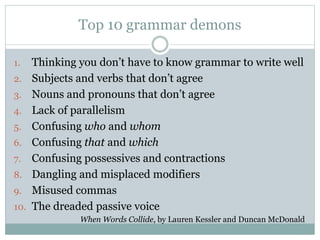
Top 10 grammar demons
1. Thinking you don’t have to know grammar to write well
2. Subjects and verbs that don’t agree
3. Nouns and pronouns that don’t agree
4. Lack of parallelism
5. Confusing who and whom
6. Confusing that and which
7. Confusing possessives and contractions
8. Dangling and misplaced modifiers
9. Misused commas
10. The dreaded passive voice
When Words Collide, by Lauren Kessler and Duncan McDonald
An approach that works
 It doesn’t matter what you call the parts, but
students need to learn structure.
 Traditional grammar terms (noun, gerund, clause, etc.)
 “New” grammar terms (main parts, lead-in parts, in-between
parts, add-on parts) by Steve Peha, “Teaching Grammar:
There has to be a better way (And there is!)”
 Explain as you use whatever term (this –ing word, a
gerund, is used as a noun. What do nouns do?)
 Teach the structure as a system and also in the
context of their writing.
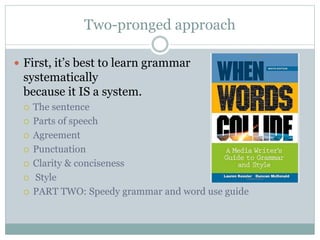
Two-pronged approach
 First, it’s best to learn grammar
systematically
because it IS a system.
 The sentence
 Parts of speech
 Agreement
 Punctuation
 Clarity & conciseness
 Style
 PART TWO: Speedy grammar and word use guide
Two-pronged approach
 Then it’s important to integrate it with their writing.
 What mistakes are they making?
 How do we explain how to fix them?
 How do we not simply edit?
 Punctuation
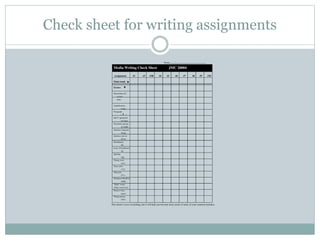
Check sheet for writing assignments
Even more integrating
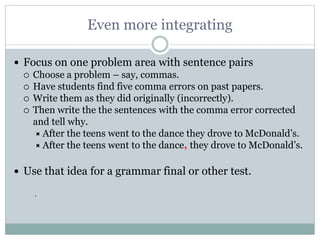
 Focus on one problem area with sentence pairs
 Choose a problem – say, commas.
 Have students find five comma errors on past papers.
 Write them as they did originally (incorrectly).
 Then write the the sentences with the comma error corrected
and tell why.
 After the teens went to the dance they drove to McDonald’s.
 After the teens went to the dance, they drove to McDonald’s.
 Use that idea for a grammar final or other test.
.
How about some resources
 JEA curriculum
Quick Hits (in Editing)
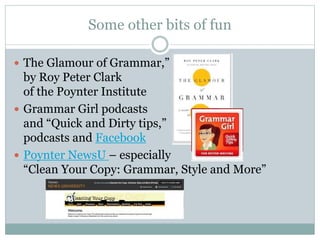
Some other bits of fun
 The Glamour of Grammar,”
by Roy Peter Clark
of the Poynter Institute
 Grammar Girl podcasts
and “Quick and Dirty tips,”
podcasts and Facebook
 Poynter NewsU – especially
“Clean Your Copy: Grammar, Style and More”

PainlessGrammar2022.pptx

  • 1.
    C A NB E ( A L M O S T ) P A I N L E S S C A N D A C E P E R K I N S B O W E N S P R I N G 2 0 2 2 GRAMMAR
  • 2.
    Why do youneed to know grammar?  To get better grades in school  To get hired for better jobs –  A 2021 CareerBuilder study found that 58 percent of resumes were automatically dismissed because of typos. Candidates who had the necessary experience were ruthlessly cut because they had spelling errors or used text message language, like shortening “you” to “u.”  More than two-thirds of salaried jobs require a significant amount of written communication  The philosophy of the CEO of iFixit: If potential employees don’t consider proper grammar important, they probably don’t consider a lot of other things important either.
  • 3.
    What’s your grammarbackground?  Many schools now don’t teach grammar.  Take part of the the Kent State School of Media and Journalism diagnostic  So….?
  • 4.
    Top 10 grammardemons 1. Thinking you don’t have to know grammar to write well 2. Subjects and verbs that don’t agree 3. Nouns and pronouns that don’t agree 4. Lack of parallelism 5. Confusing who and whom 6. Confusing that and which 7. Confusing possessives and contractions 8. Dangling and misplaced modifiers 9. Misused commas 10. The dreaded passive voice When Words Collide, by Lauren Kessler and Duncan McDonald
  • 5.
    An approach thatworks  It doesn’t matter what you call the parts, but students need to learn structure.  Traditional grammar terms (noun, gerund, clause, etc.)  “New” grammar terms (main parts, lead-in parts, in-between parts, add-on parts) by Steve Peha, “Teaching Grammar: There has to be a better way (And there is!)”  Explain as you use whatever term (this –ing word, a gerund, is used as a noun. What do nouns do?)  Teach the structure as a system and also in the context of their writing.
  • 6.
    Two-pronged approach  First,it’s best to learn grammar systematically because it IS a system.  The sentence  Parts of speech  Agreement  Punctuation  Clarity & conciseness  Style  PART TWO: Speedy grammar and word use guide
  • 7.
    Two-pronged approach  Thenit’s important to integrate it with their writing.  What mistakes are they making?  How do we explain how to fix them?  How do we not simply edit?  Punctuation
  • 8.
    Check sheet forwriting assignments
  • 9.
    Even more integrating Focus on one problem area with sentence pairs  Choose a problem – say, commas.  Have students find five comma errors on past papers.  Write them as they did originally (incorrectly).  Then write the the sentences with the comma error corrected and tell why.  After the teens went to the dance they drove to McDonald’s.  After the teens went to the dance, they drove to McDonald’s.  Use that idea for a grammar final or other test. .
  • 10.
    How about someresources  JEA curriculum Quick Hits (in Editing)
  • 11.
    Some other bitsof fun  The Glamour of Grammar,” by Roy Peter Clark of the Poynter Institute  Grammar Girl podcasts and “Quick and Dirty tips,” podcasts and Facebook  Poynter NewsU – especially “Clean Your Copy: Grammar, Style and More”

Editor's Notes

  • #12 There’s even a Facebook page: Teachers who use Grammar Girl in class” 3,939