Painless Data
Storage with
MongoDB & Go
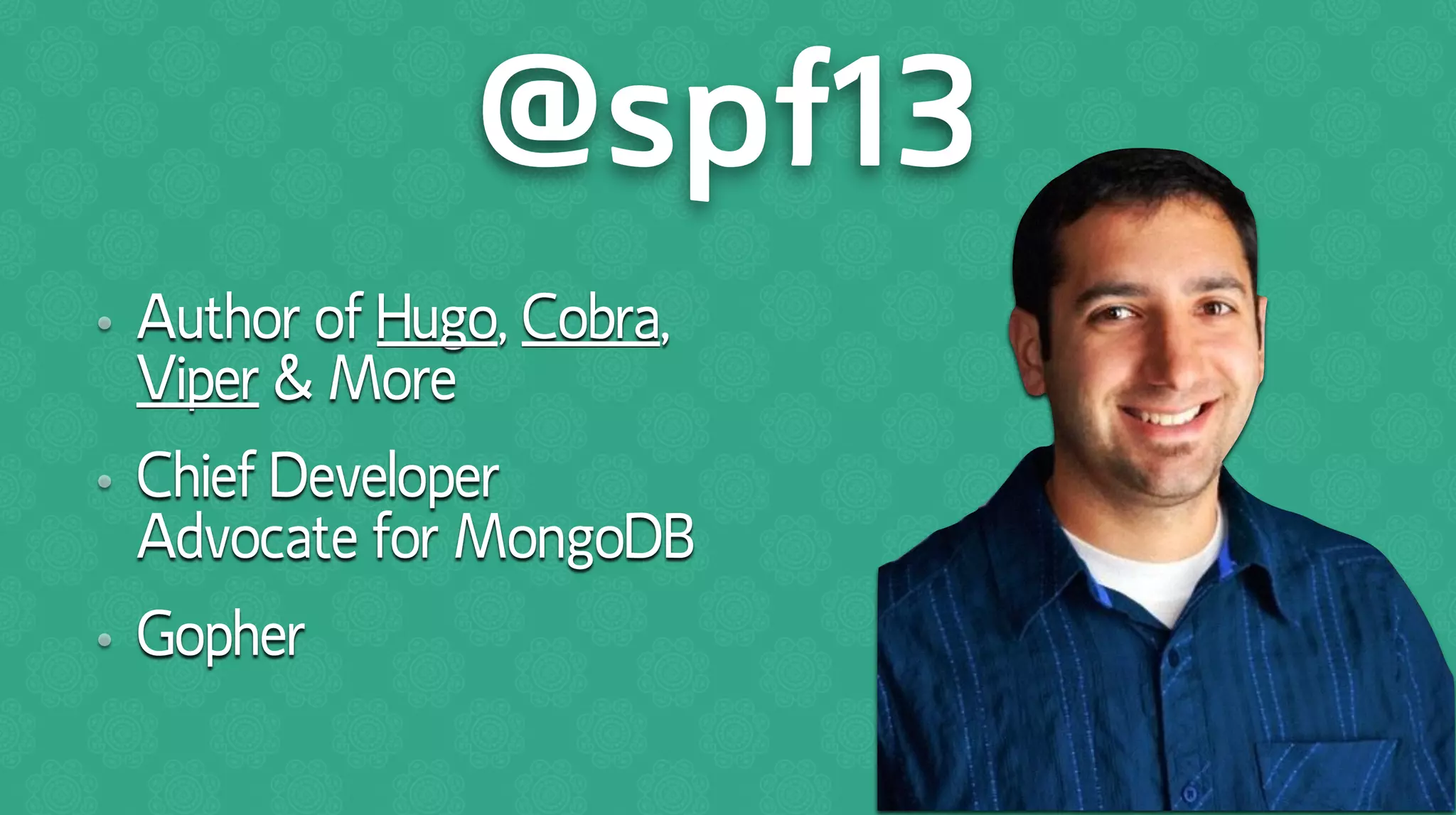
• Author of Hugo, Cobra,
Viper & More
• Chief Developer
Advocate for MongoDB
• Gopher
@spf13
Why Go?
Why Another Language?
• Software is slow
• Sofware is hard to write
• Software doesn’t scale well
Go is Fast
• Go execution speed is close to C
• Go compile time rivals dynamic
interpretation
Go is Friendly
• Feels like a dynamic language in many ways
• Very small core language, easy to
remember all of it
• Single binary installation, no dependencies
• Extensive Tooling & StdLib
Go is Concurrent
• Concurrency is part of the language
• Any function can become a goroutine
• Goroutines run concurrently, communicate
through channels
• Select waits for communication on any of a
set of channels
MongoDB
Why Another Database?
• Databases are slow
• Relational structures don’t fit well
with modern programming
(ORMs)
• Databases don’t scale well
MongoDB is Fast
• Written in C++
• Extensive use of memory-mapped files 

i.e. read-through write-through memory caching.
• Runs nearly everywhere
• Data serialized as BSON (fast parsing)
• Full support for primary & secondary indexes
• Document model = less work
MongoDB is Friendly
• Ad Hoc queries
• Real time aggregation
• Rich query capabilities
• Traditionally consistent
• Geospatial features
• Support for most programming languages
• Flexible schema
MongoDB is “Web Scale”
• Built in sharding support distributes data
across many nodes
• MongoS intelligently routes to the correct
nodes
• Aggregation done in parallel across nodes
Document Database
• Not for .PDF & .DOC files
• A document is essentially an associative array
• Document == JSON object
• Document == PHP Array
• Document == Python Dict
• Document == Ruby Hash
• etc
Data Serialization
• Applications need persistant data
• The process of translating data structures
into a format that can be stored
• Ideal format accessible from many
languages
BSON
• Inspired by JSON
• Cross language binary serialization format
• Optimized for scanning
• Support for richer types
MongoDB &
Go
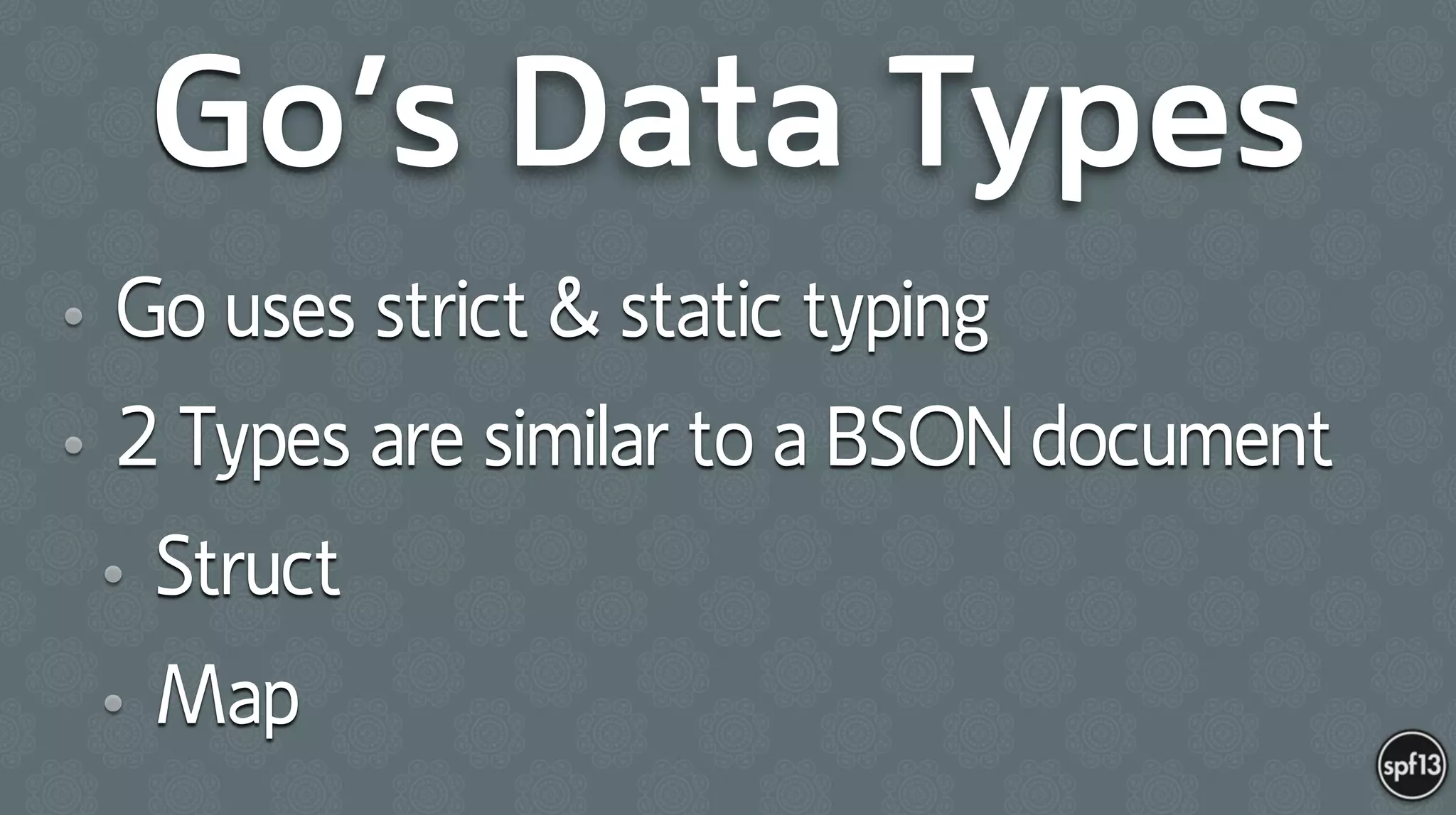
Go’s Data Types
• Go uses strict & static typing
• 2 Types are similar to a BSON document
• Struct
• Map
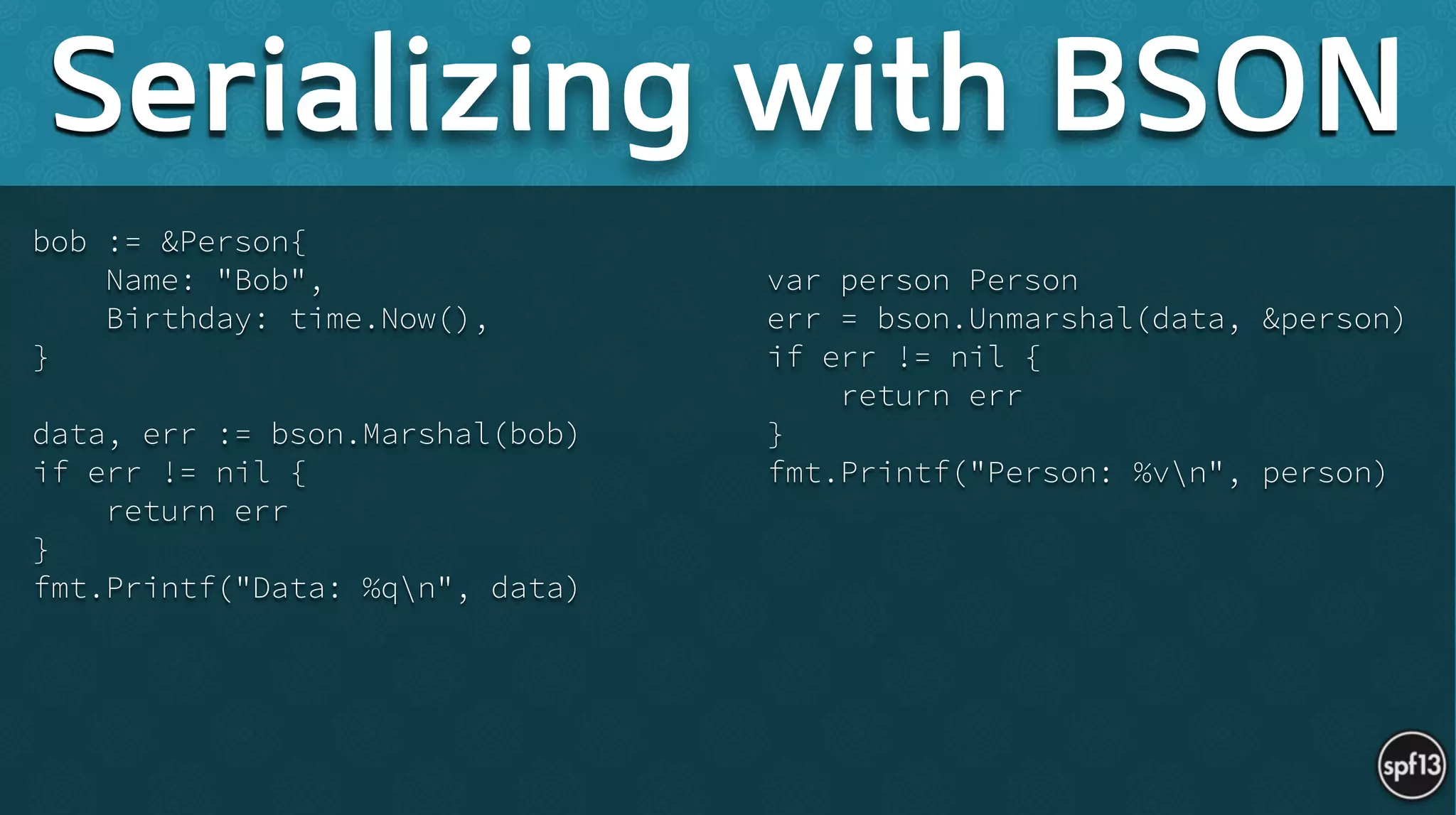
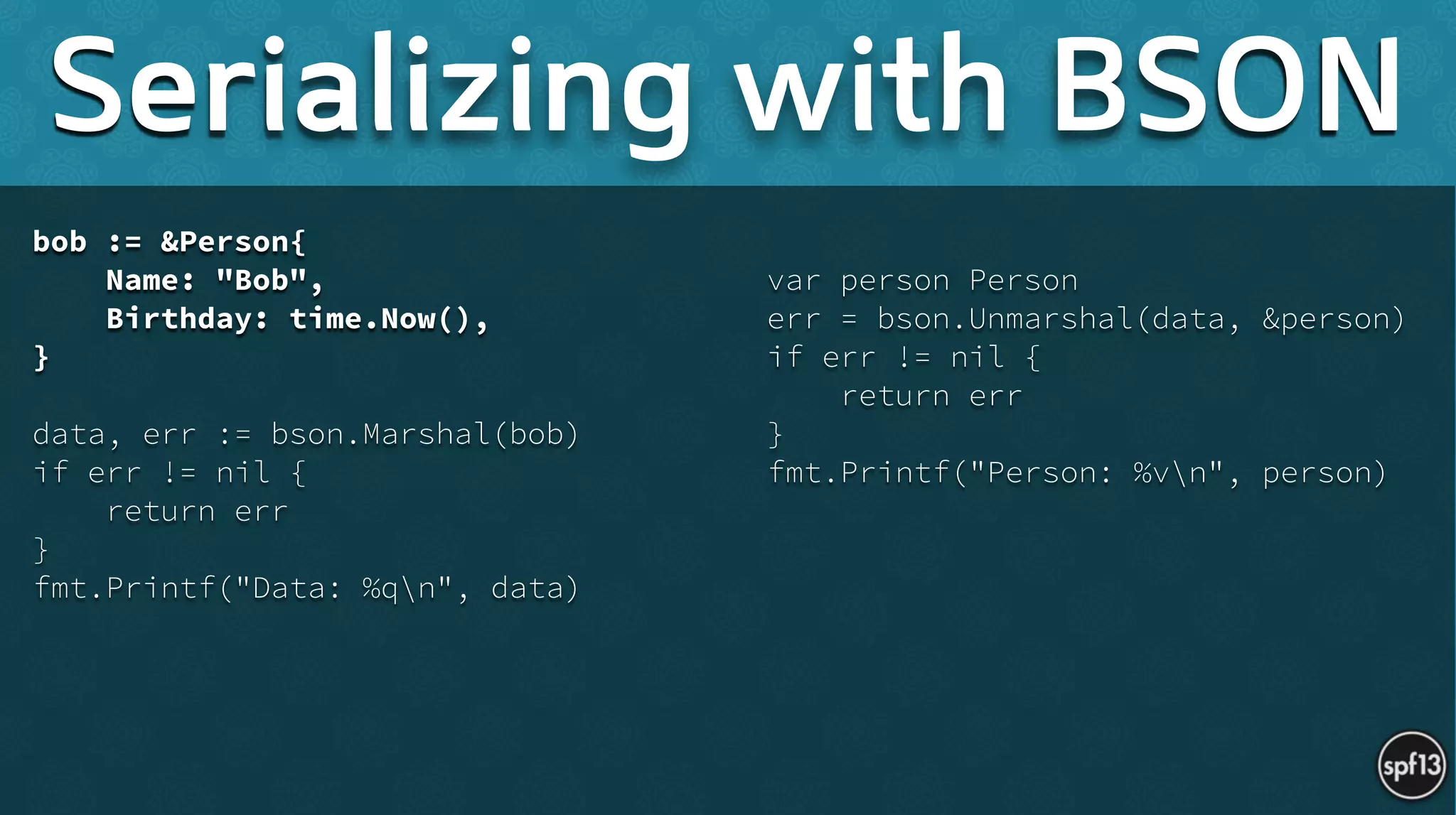
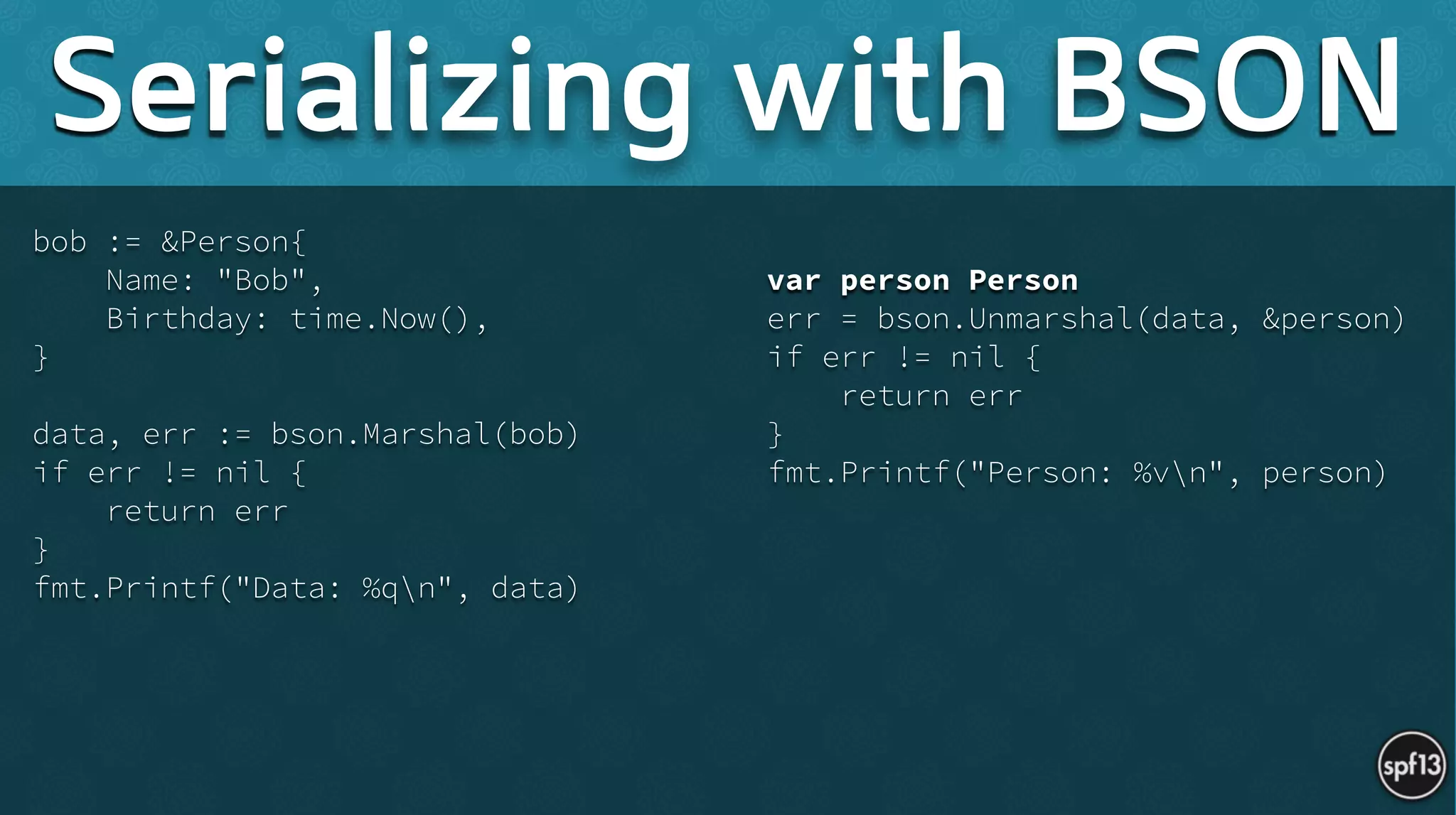
bob := &Person{
Name: "Bob",
Birthday: time.Now(),
}
!
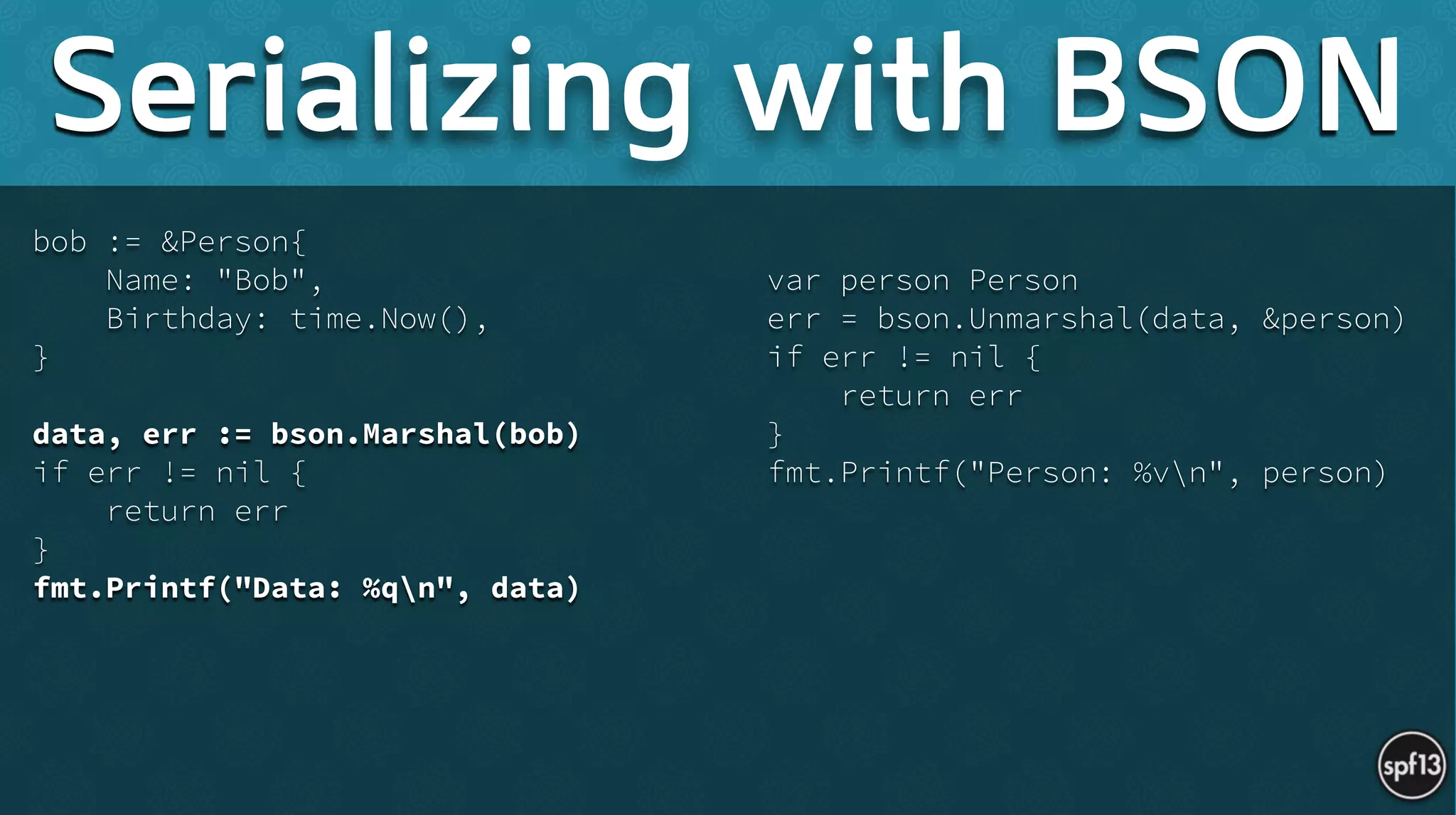
data, err := bson.Marshal(bob)
if err != nil {
return err
}
fmt.Printf("Data: %qn", data)

!
var person Person
err = bson.Unmarshal(data, &person)
if err != nil {
return err
}
fmt.Printf("Person: %vn", person)
Serializing with BSON
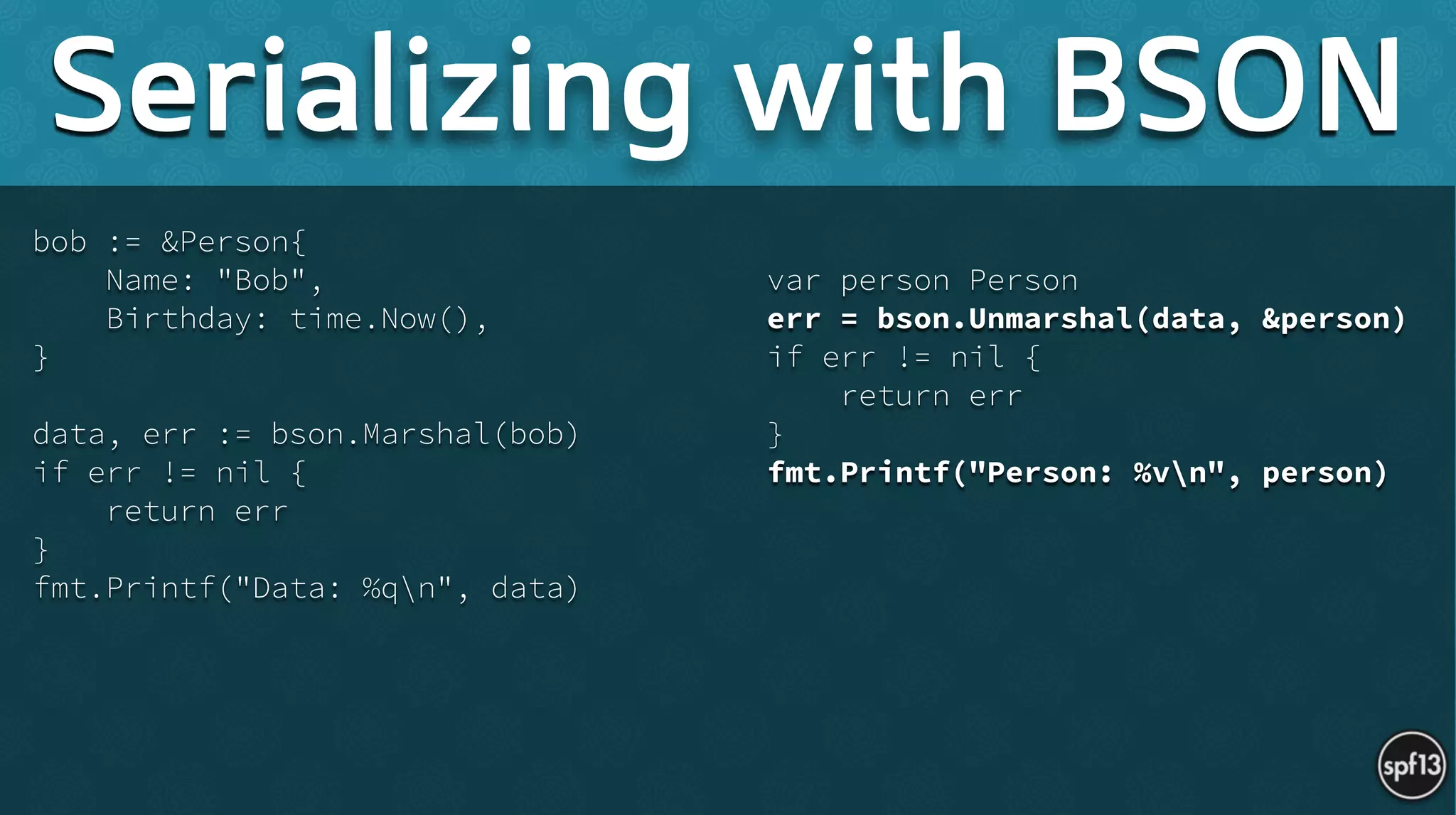
bob := &Person{
Name: "Bob",
Birthday: time.Now(),
}
!
data, err := bson.Marshal(bob)
if err != nil {
return err
}
fmt.Printf("Data: %qn", data)

!
var person Person
err = bson.Unmarshal(data, &person)
if err != nil {
return err
}
fmt.Printf("Person: %vn", person)
Serializing with BSON
bob := &Person{
Name: "Bob",
Birthday: time.Now(),
}
!
data, err := bson.Marshal(bob)
if err != nil {
return err
}
fmt.Printf("Data: %qn", data)

!
var person Person
err = bson.Unmarshal(data, &person)
if err != nil {
return err
}
fmt.Printf("Person: %vn", person)
Serializing with BSON
bob := &Person{
Name: "Bob",
Birthday: time.Now(),
}
!
data, err := bson.Marshal(bob)
if err != nil {
return err
}
fmt.Printf("Data: %qn", data)

!
var person Person
err = bson.Unmarshal(data, &person)
if err != nil {
return err
}
fmt.Printf("Person: %vn", person)
Serializing with BSON
bob := &Person{
Name: "Bob",
Birthday: time.Now(),
}
!
data, err := bson.Marshal(bob)
if err != nil {
return err
}
fmt.Printf("Data: %qn", data)

!
var person Person
err = bson.Unmarshal(data, &person)
if err != nil {
return err
}
fmt.Printf("Person: %vn", person)
Serializing with BSON
bob := &Person{
Name: "Bob",
Birthday: time.Now(),
}
!
data, err := bson.Marshal(bob)
if err != nil {
return err
}
fmt.Printf("Data: %qn", data)

!
var person Person
err = bson.Unmarshal(data, &person)
if err != nil {
return err
}
fmt.Printf("Person: %vn", person)
Serializing with BSON
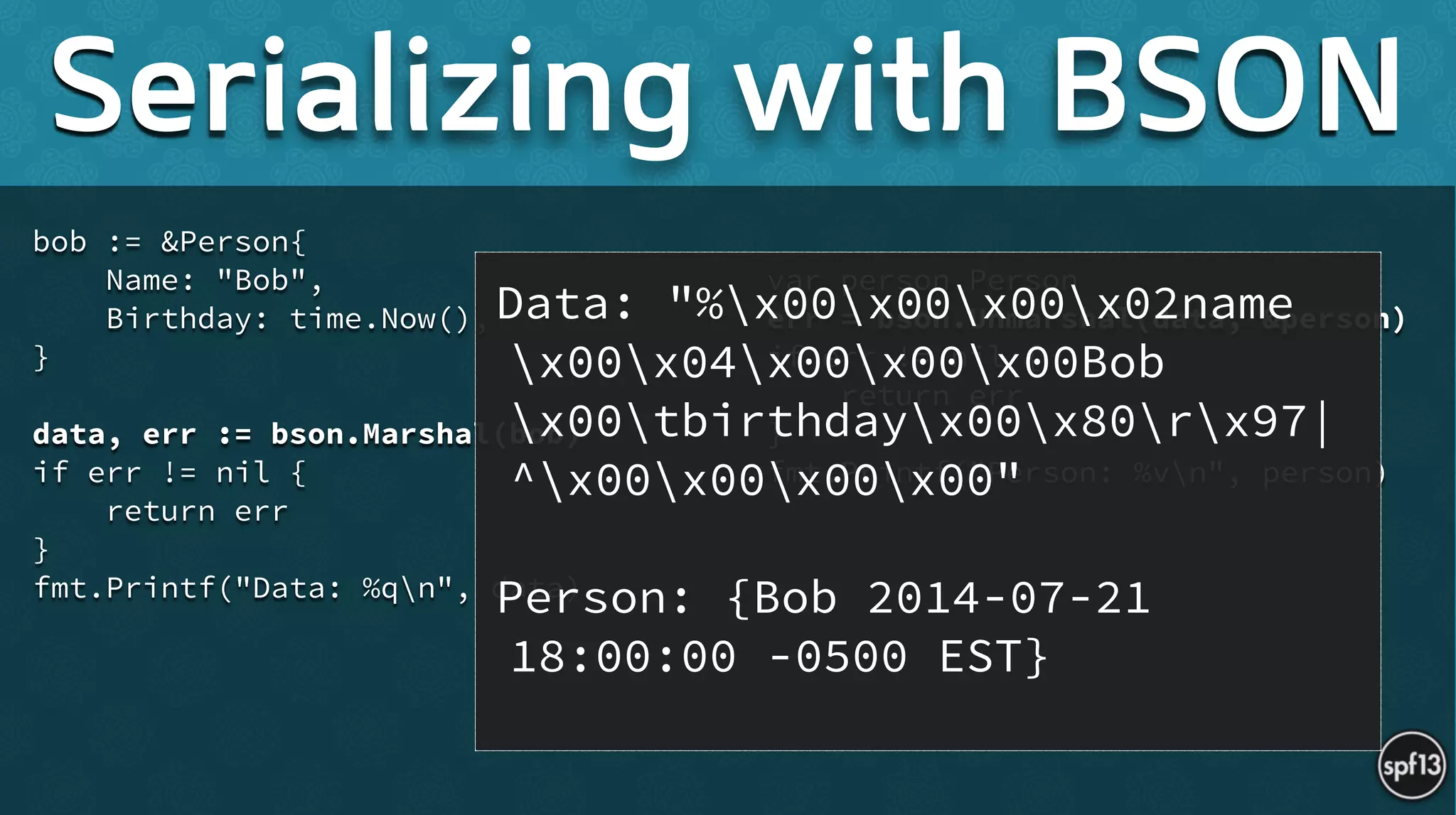
Data: "%x00x00x00x02name
x00x04x00x00x00Bob
x00tbirthdayx00x80rx97|
^x00x00x00x00"

!
Person: {Bob 2014-07-21
18:00:00 -0500 EST}
!
type Project struct {
Name string `bson:"name"`
ImportPath string `bson:"importPath"`
}
project := Project{name, path}
!
!
!
project := map[string]string{"name": name, "importPath": path}
!
!
!
project := bson.D{{"name", name}, {"importPath", path}}
Equal After Marshaling
Struct
Custom Map
Document Slice
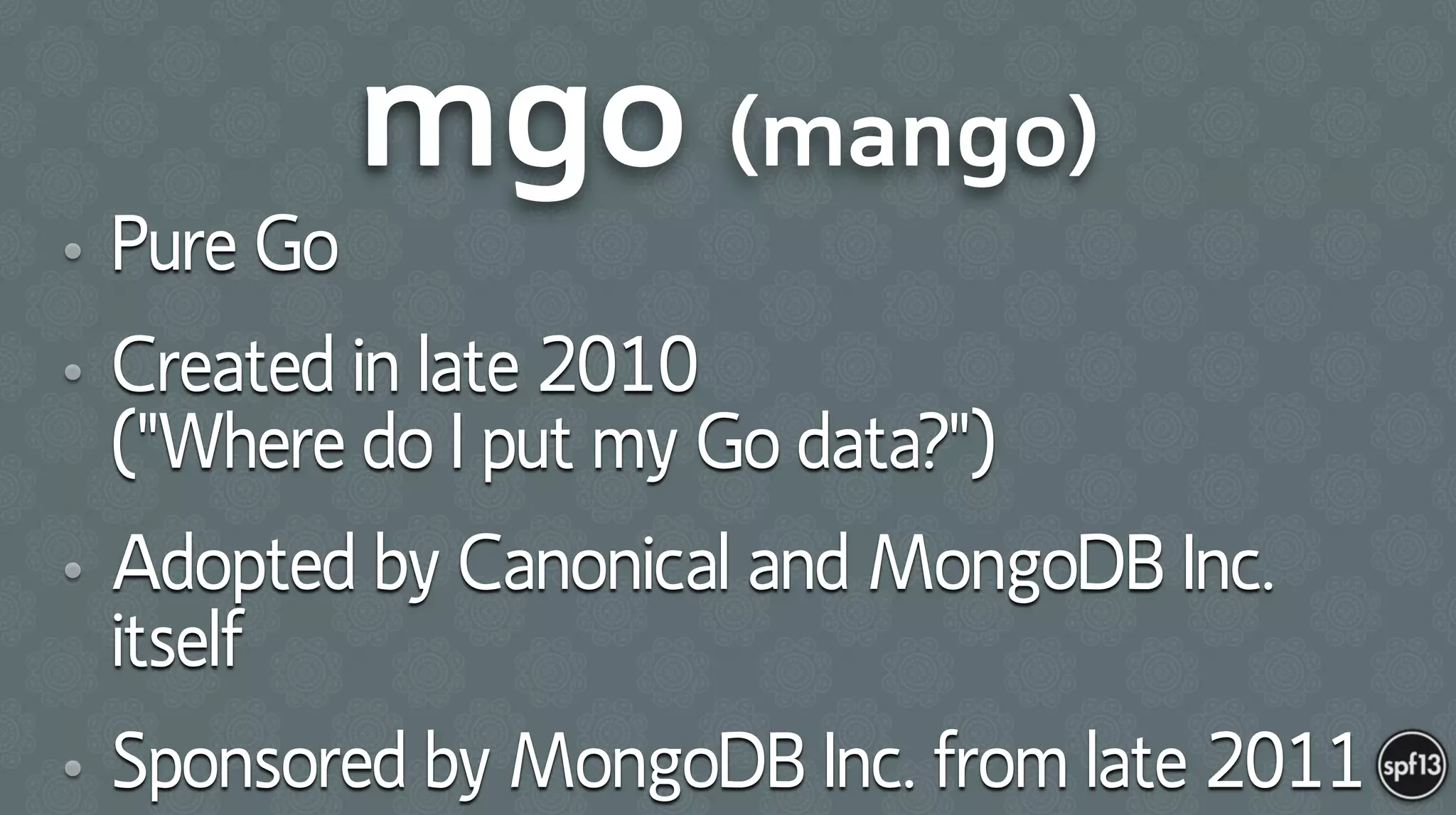
mgo (mango)
• Pure Go
• Created in late 2010 

("Where do I put my Go data?")
• Adopted by Canonical and MongoDB Inc.
itself
• Sponsored by MongoDB Inc. from late 2011
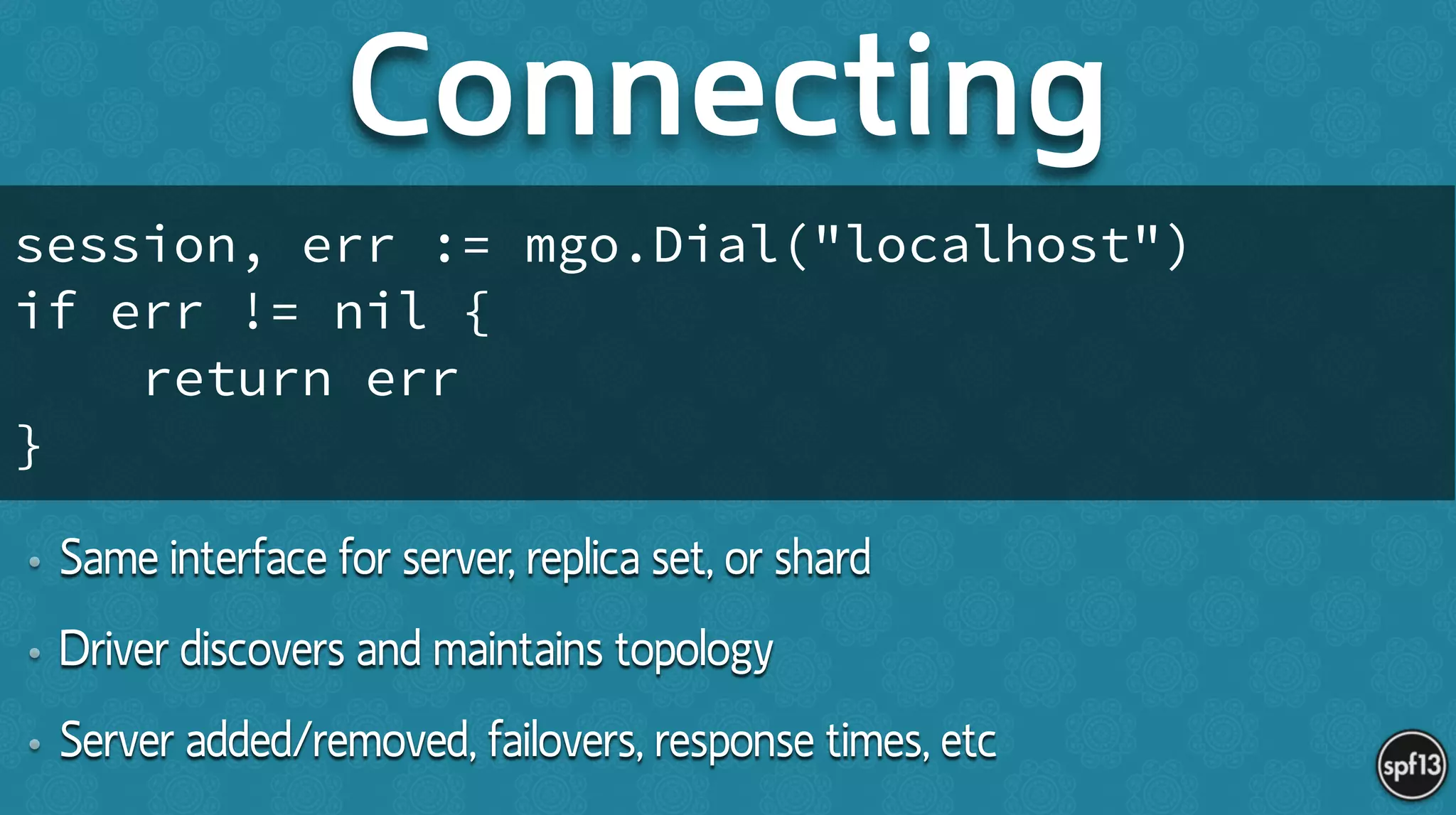
Connecting
• Same interface for server, replica set, or shard
• Driver discovers and maintains topology
• Server added/removed, failovers, response times, etc
Connecting
session, err := mgo.Dial("localhost")
if err != nil {
return err
}
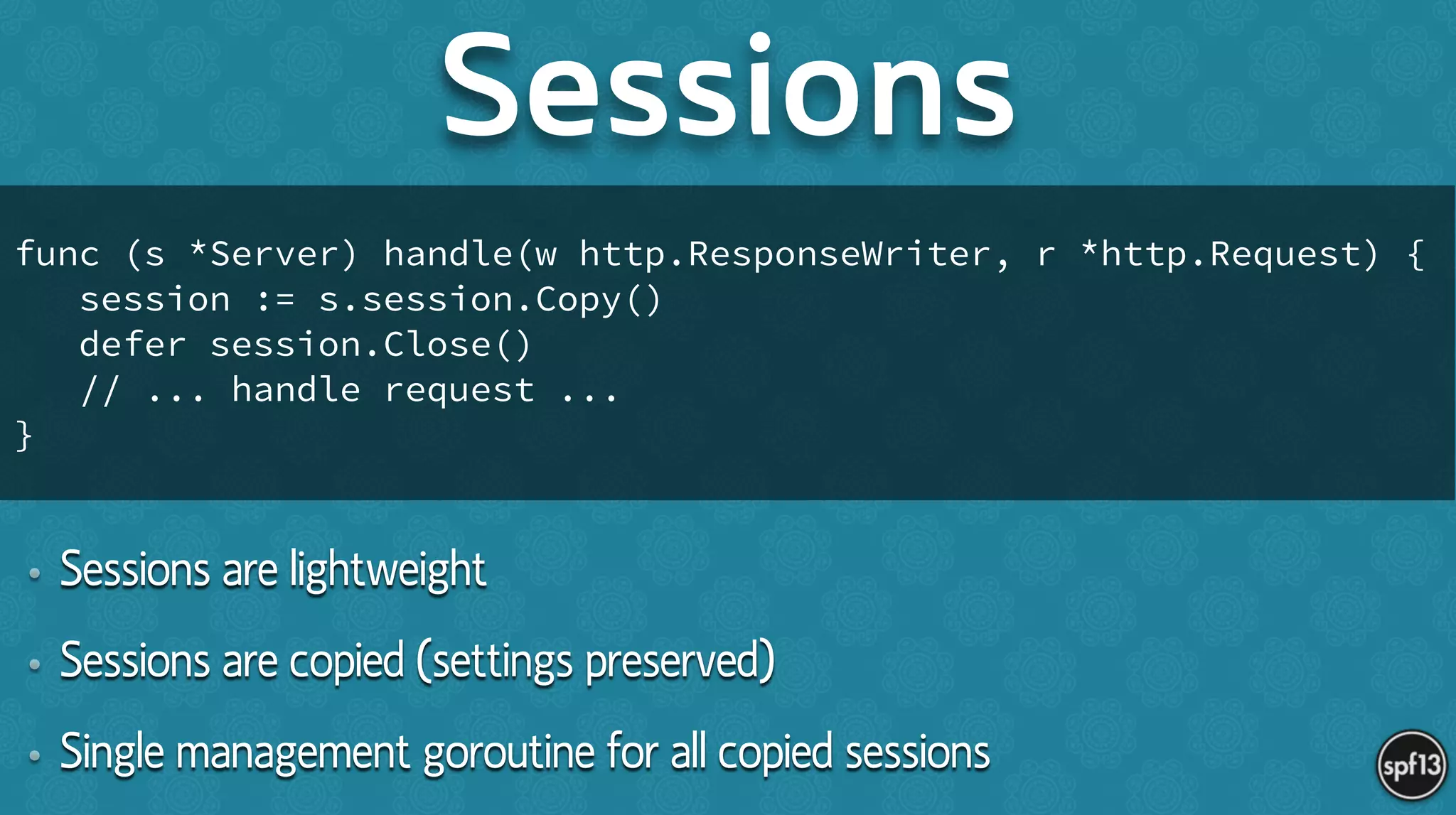
• Sessions are lightweight
• Sessions are copied (settings preserved)
• Single management goroutine for all copied sessions
Sessions
func (s *Server) handle(w http.ResponseWriter, r *http.Request) {
session := s.session.Copy()
defer session.Close()
// ... handle request ...
}
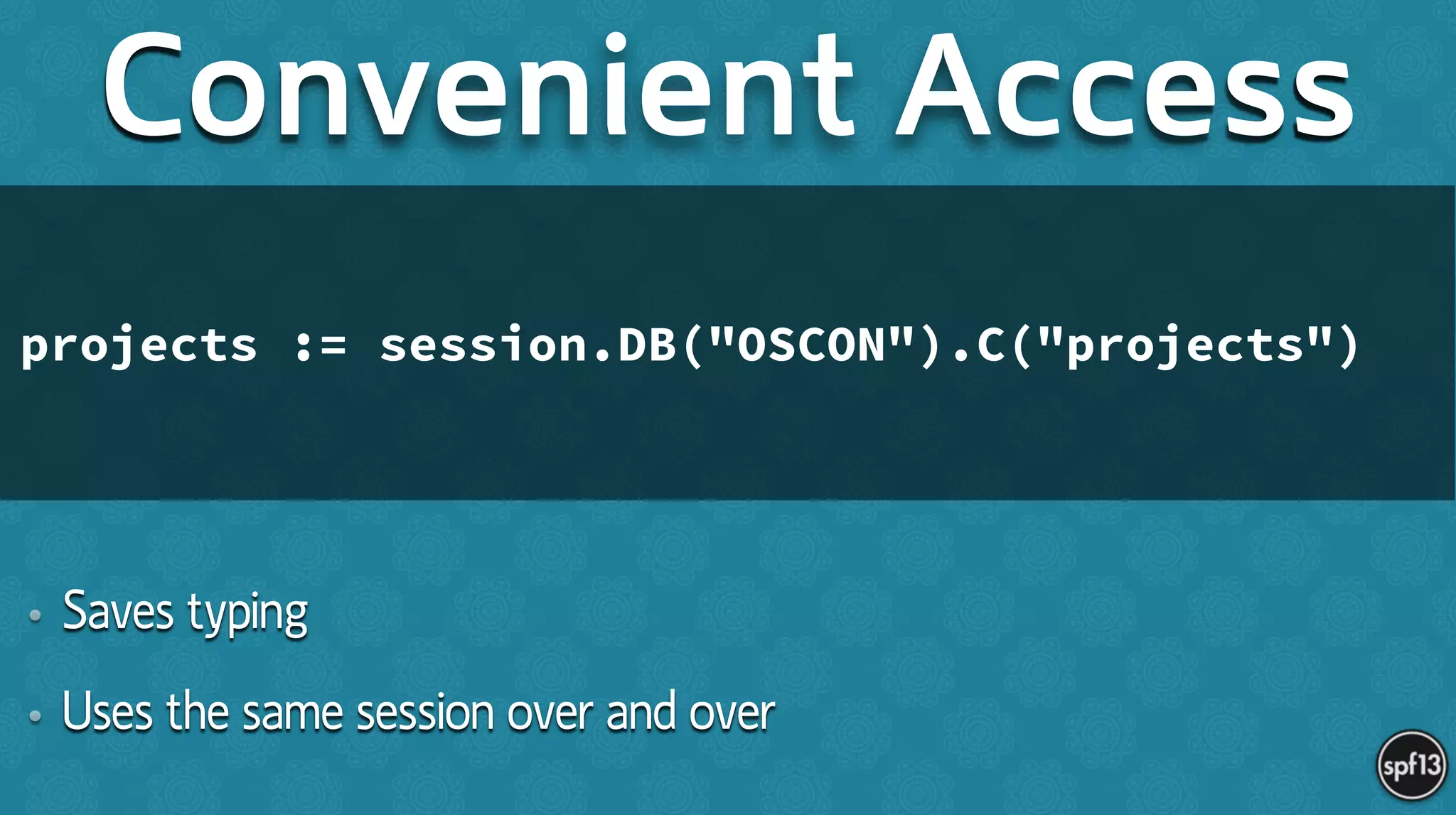
• Saves typing
• Uses the same session over and over
Convenient Access
projects := session.DB("OSCON").C("projects")
Writing
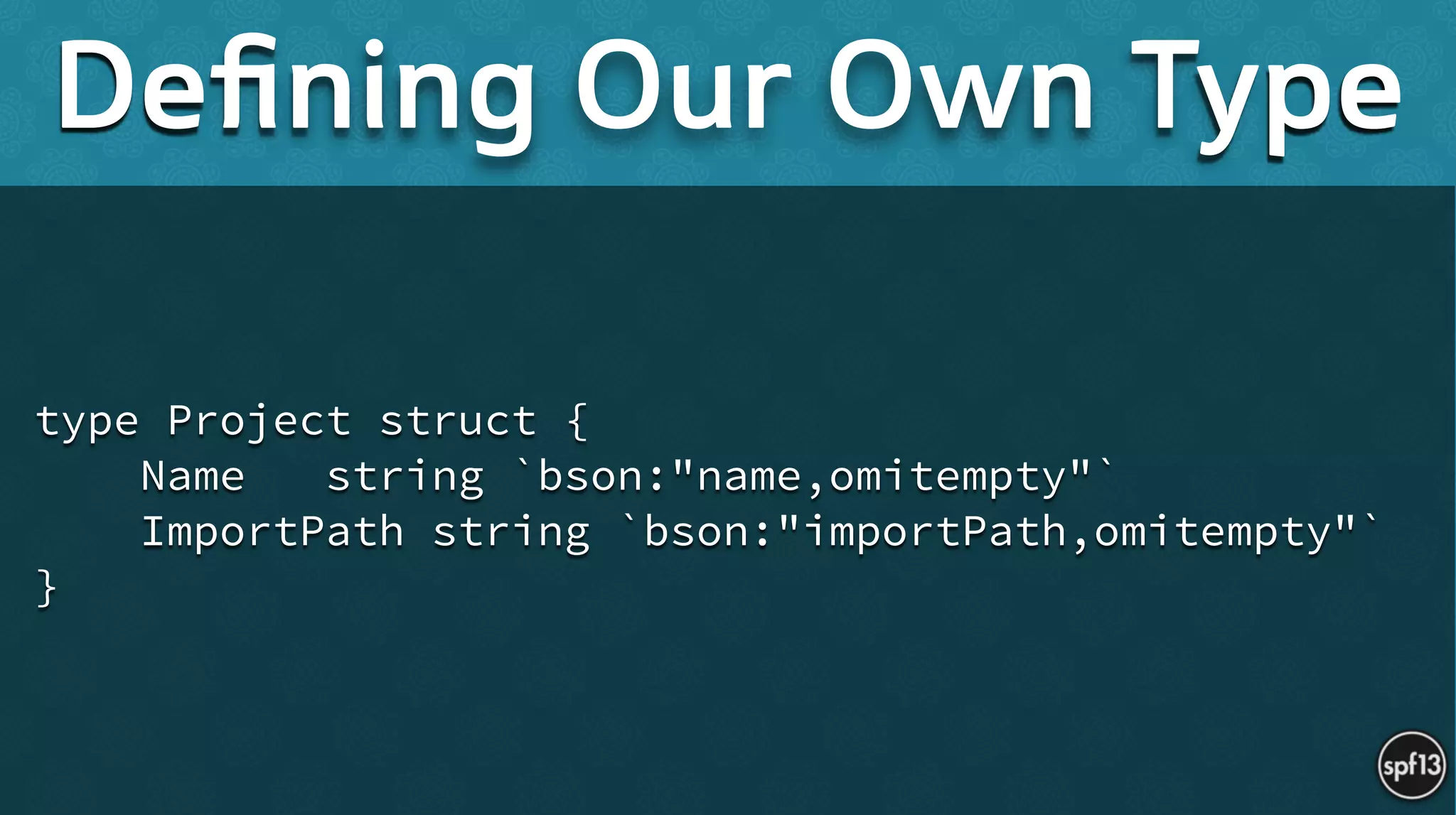
type Project struct {
Name string `bson:"name,omitempty"`
ImportPath string `bson:"importPath,omitempty"`
}
Defining Our Own Type
var projectList = []Project{
{"gocheck", "gopkg.in/check.v1"},
{"qml", "gopkg.in/qml.v0"},
{"pipe", "gopkg.in/pipe.v2"},
{"yaml", "gopkg.in/yaml.v1"},
}
!
for _, project := range projectList {
err := projects.Insert(project)
if err != nil {
return err
}
}
fmt.Println("Okay!")
Insert
Okay!
type M map[string]interface{}
!
change := M{"$set": Project{ImportPath: "gopkg.in/
qml.v1"}}
!
err = projects.Update(Project{Name: "qml"}, change)
if err != nil {
return err
}
!
fmt.Println("Done!")
Update
Done!
Querying
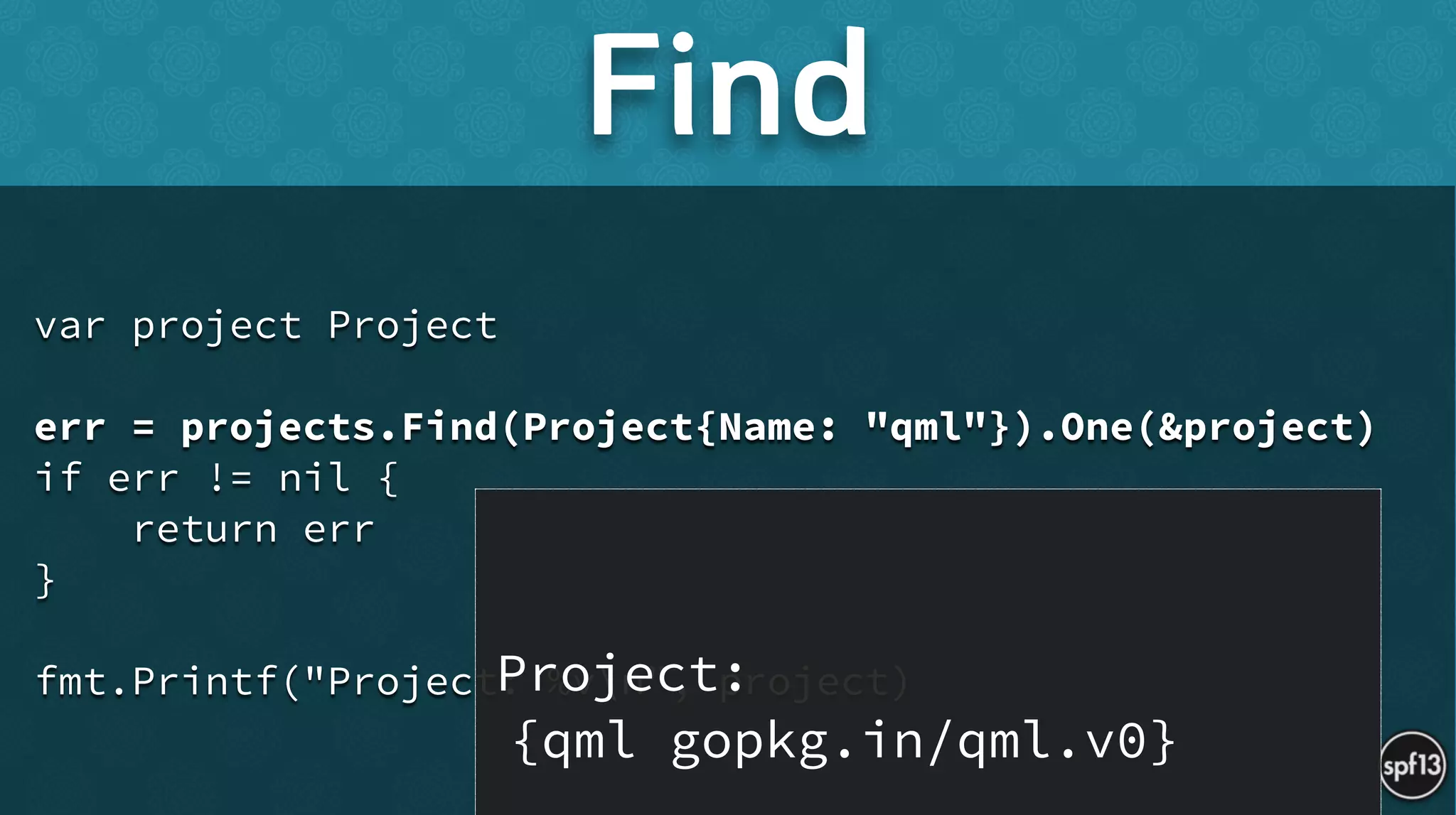
var project Project
!
err = projects.Find(Project{Name: "qml"}).One(&project)
if err != nil {
return err
}
!
fmt.Printf("Project: %vn", project)
Find
Project: 

{qml gopkg.in/qml.v0}
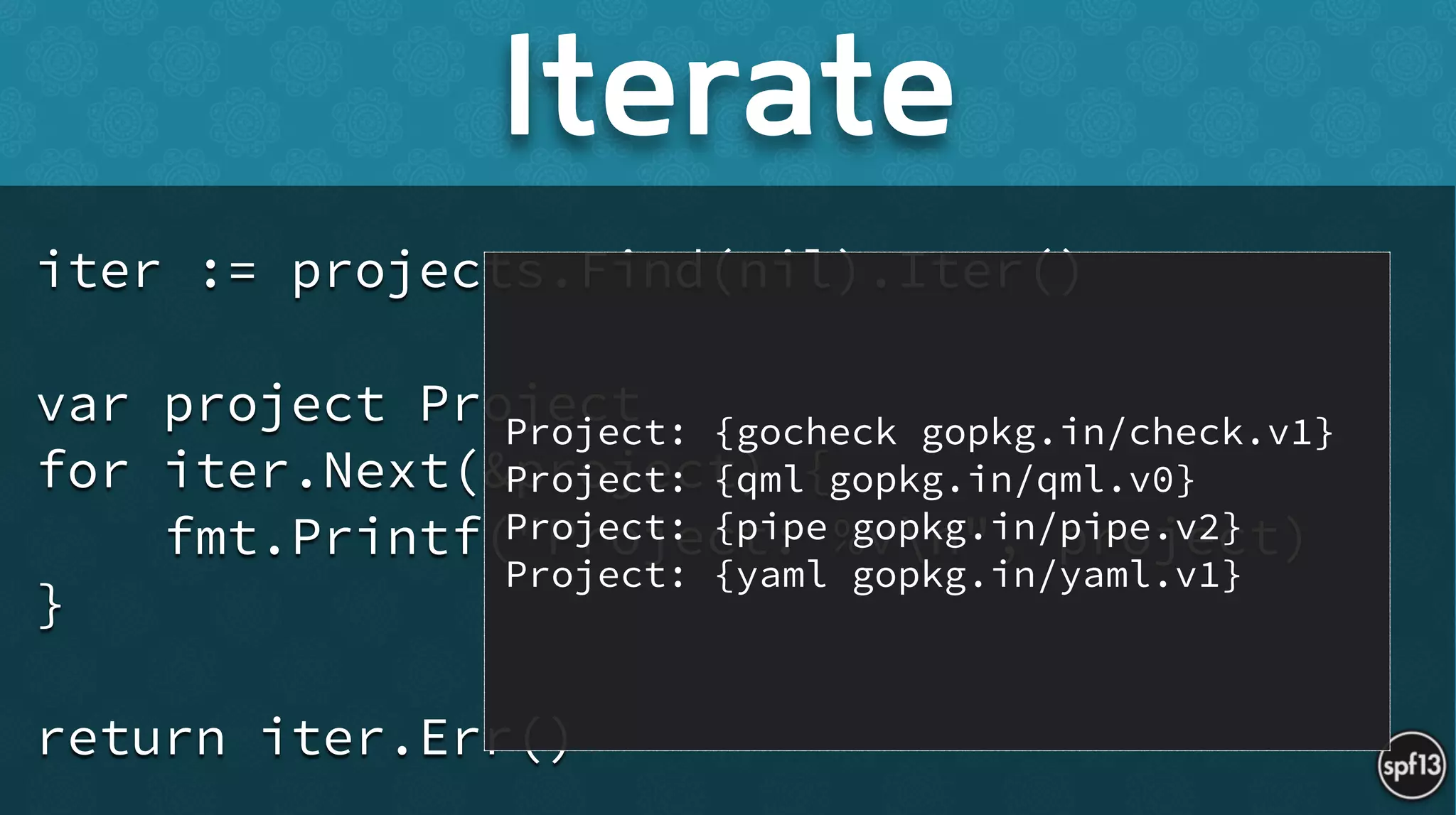
iter := projects.Find(nil).Iter()
!
var project Project
for iter.Next(&project) {
fmt.Printf("Project: %vn", project)
}
!
return iter.Err()
Iterate
Project: {gocheck gopkg.in/check.v1}
Project: {qml gopkg.in/qml.v0}
Project: {pipe gopkg.in/pipe.v2}
Project: {yaml gopkg.in/yaml.v1}
m := map[string]interface{}{
"name": "godep",
"tags": []string{"tool", "dependency"},
"contact": bson.M{
"name": "Keith Rarick",
"email": "kr@nospam.com",
},
}
!
err = projects.Insert(m)
if err != nil {
return err
}
fmt.Println("Okay!")
Nesting
Okay!
type Contact struct {
Name string
Email string
}
!
type Project struct {
Name string
Tags []string `bson:",omitempty"`
Contact Contact `bson:",omitempty"`
}
!
err = projects.Find(Project{Name: "godep"}).One(&project)
if err != nil {
return err
}
!
pretty.Println("Project:", project)
Nesting II
Project: main.Project{
Name: "godep",
Tags: {"tool",
"dependency"},
Contact: {Name:"Keith
Rarick", Email:"kr@XZY.com"},
}
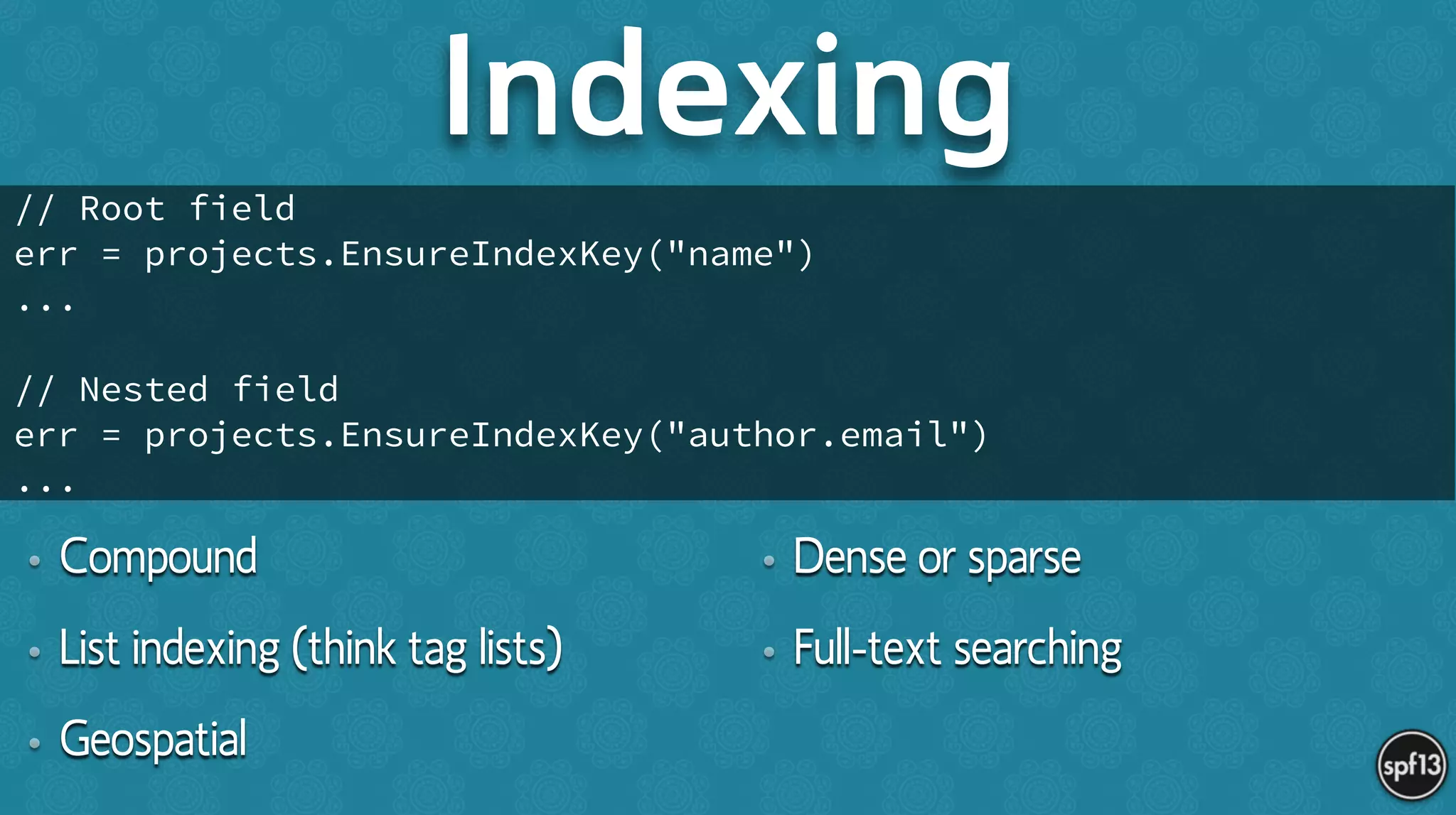
• Compound
• List indexing (think tag lists)
• Geospatial
• Dense or sparse
• Full-text searching
Indexing
// Root field
err = projects.EnsureIndexKey("name")
...
!
// Nested field
err = projects.EnsureIndexKey("author.email")
...
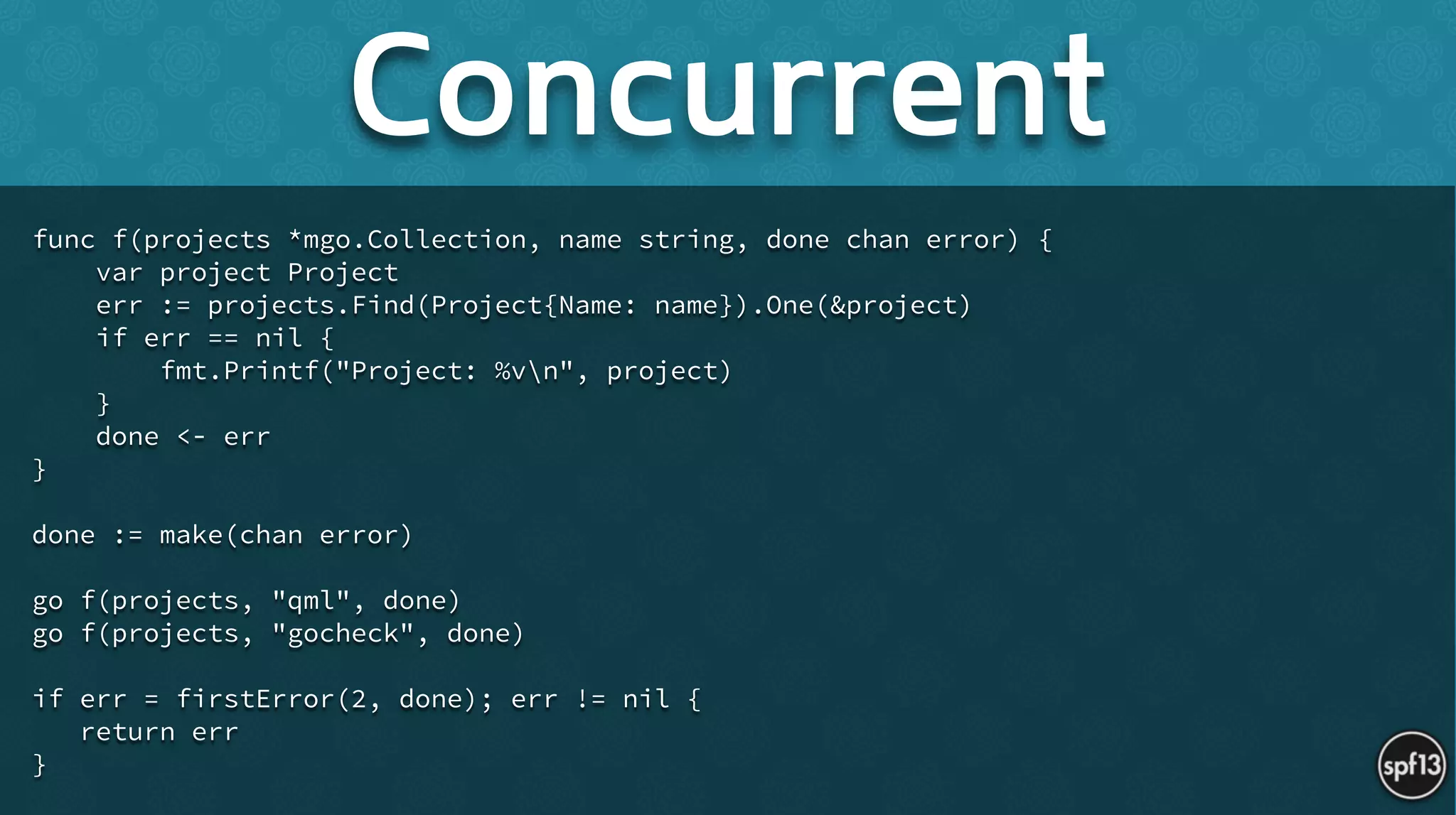
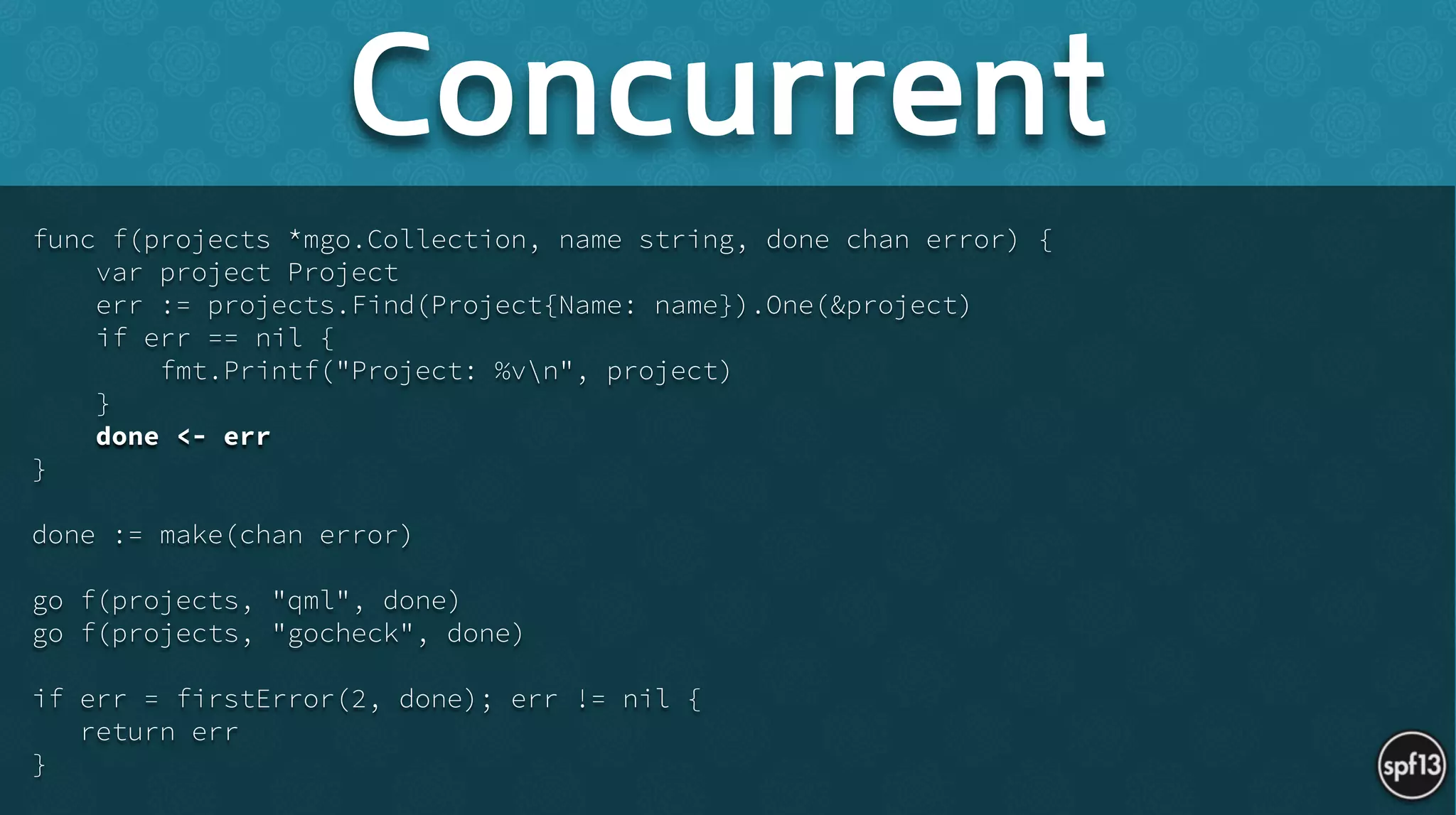
Concurrency
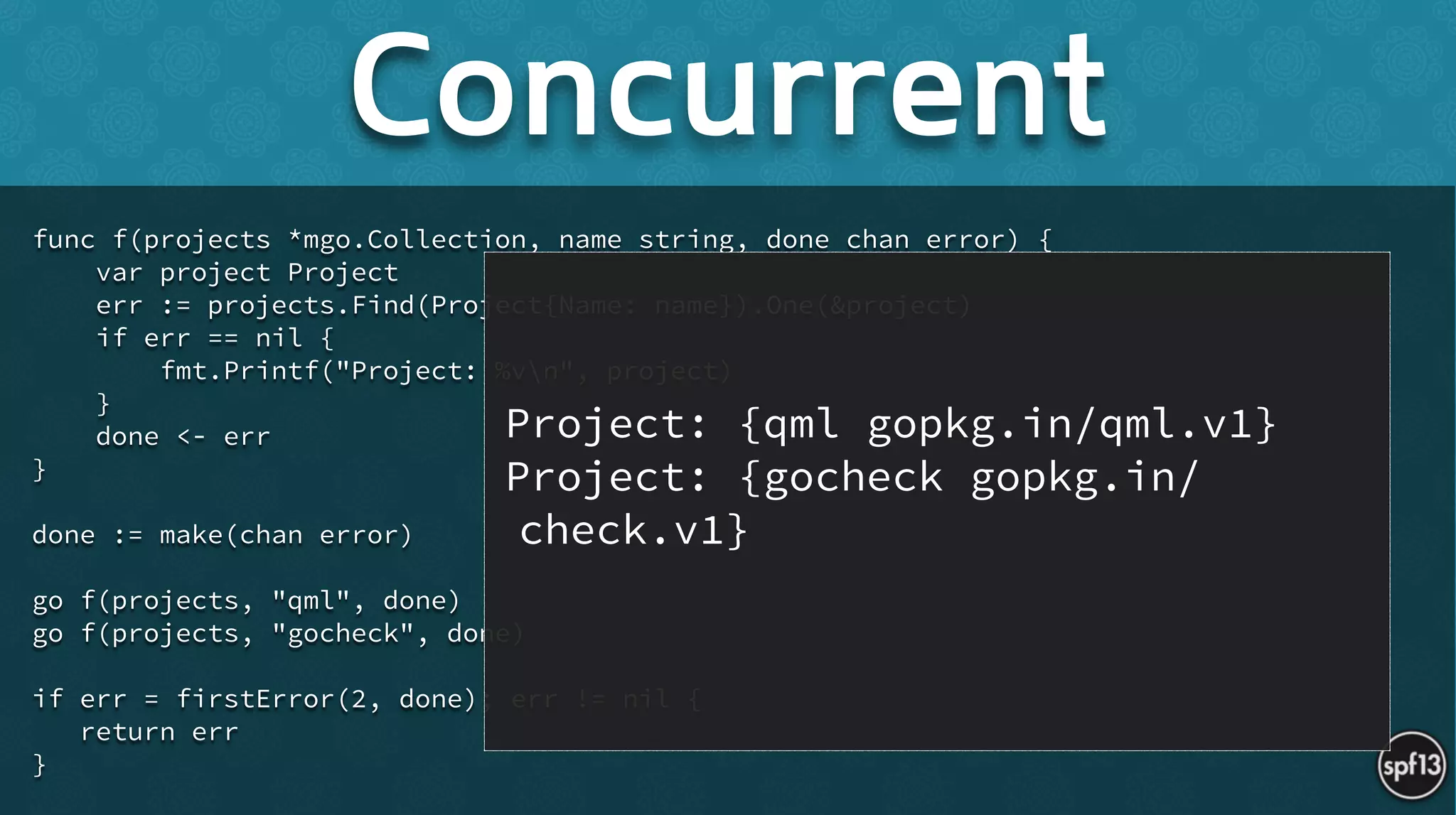
func f(projects *mgo.Collection, name string, done chan error) {
var project Project
err := projects.Find(Project{Name: name}).One(&project)
if err == nil {
fmt.Printf("Project: %vn", project)
}
done <- err
}
!
done := make(chan error)
!
go f(projects, "qml", done)
go f(projects, "gocheck", done)
!
if err = firstError(2, done); err != nil {
return err
}
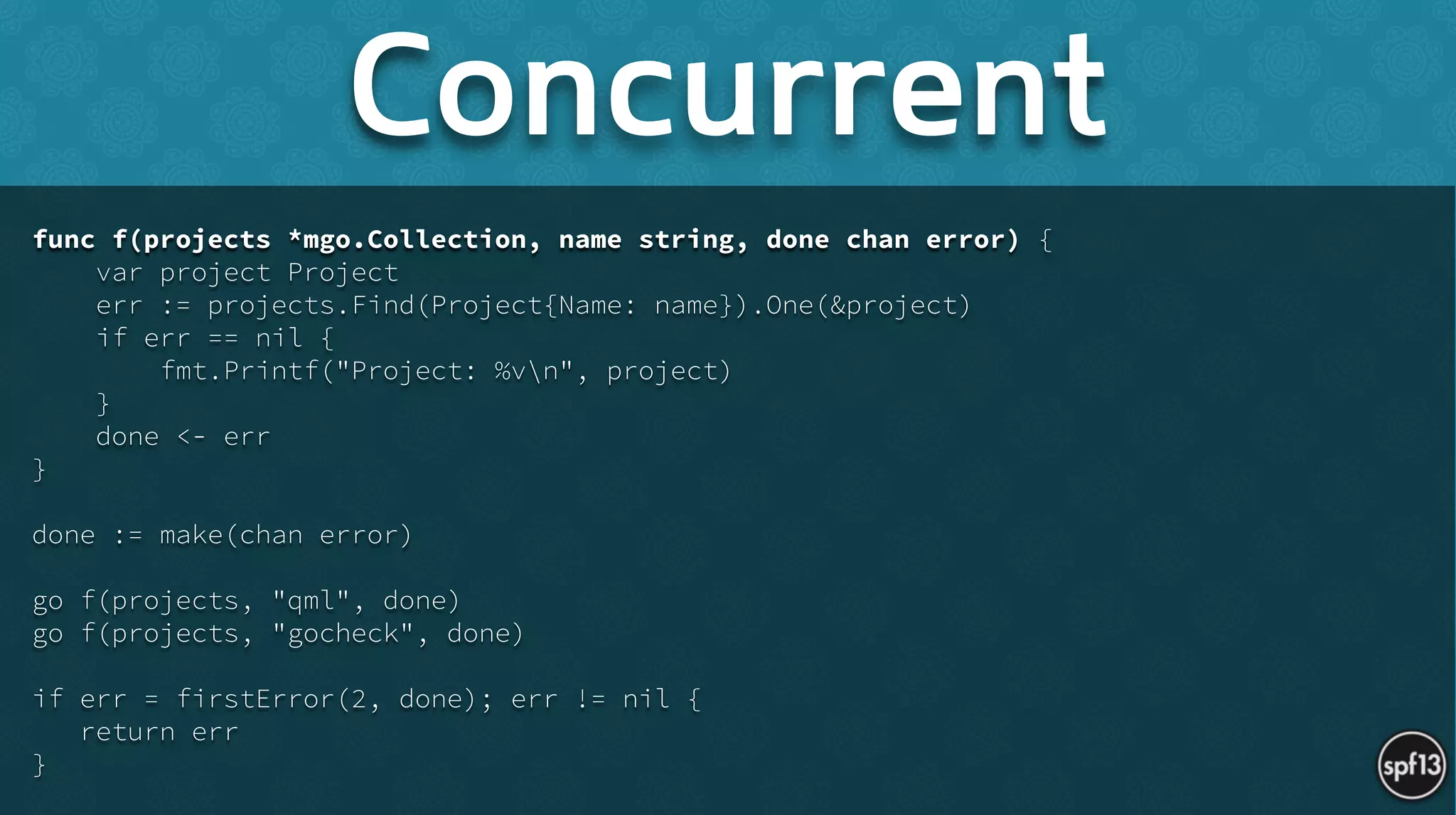
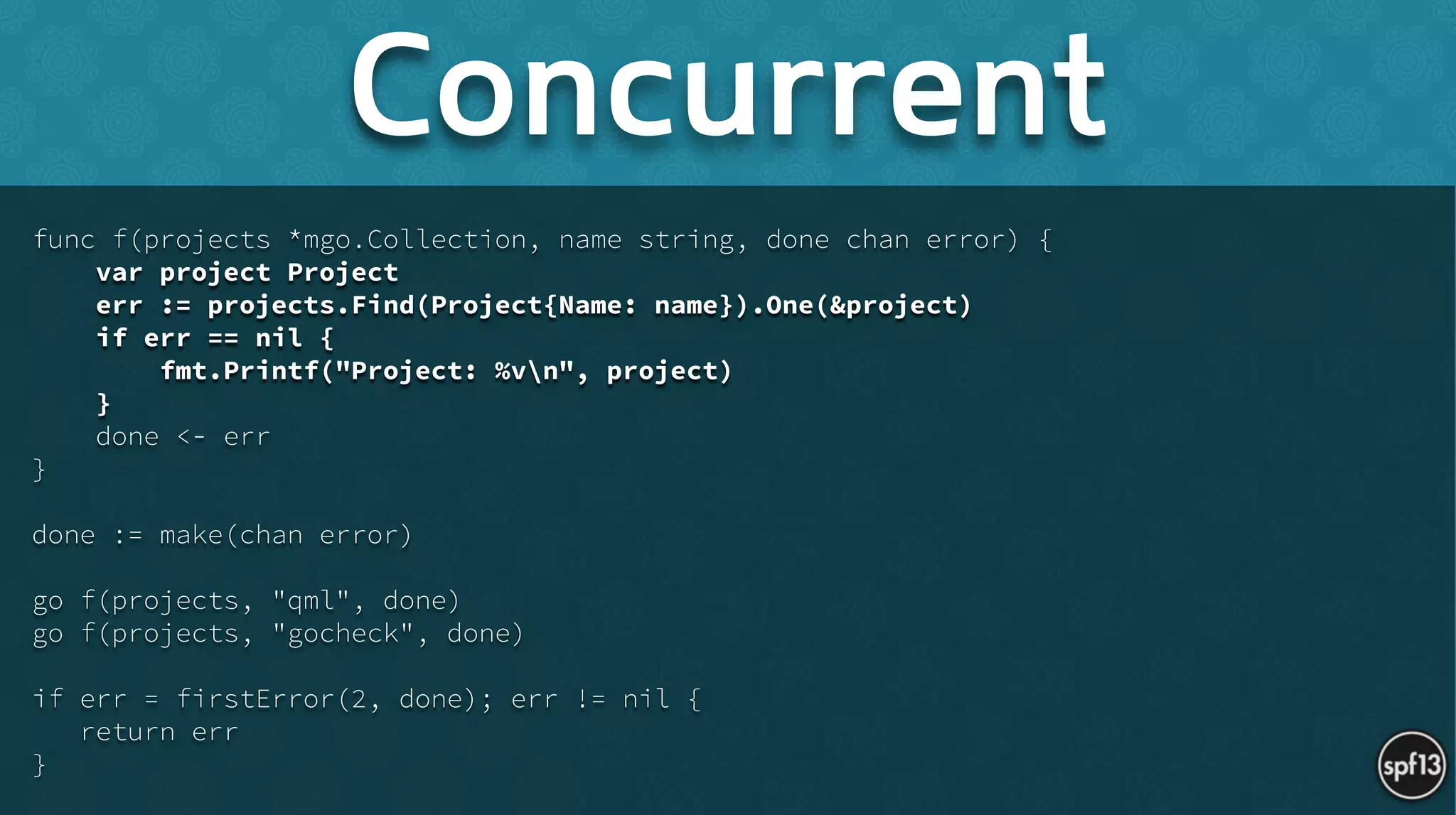
Concurrent
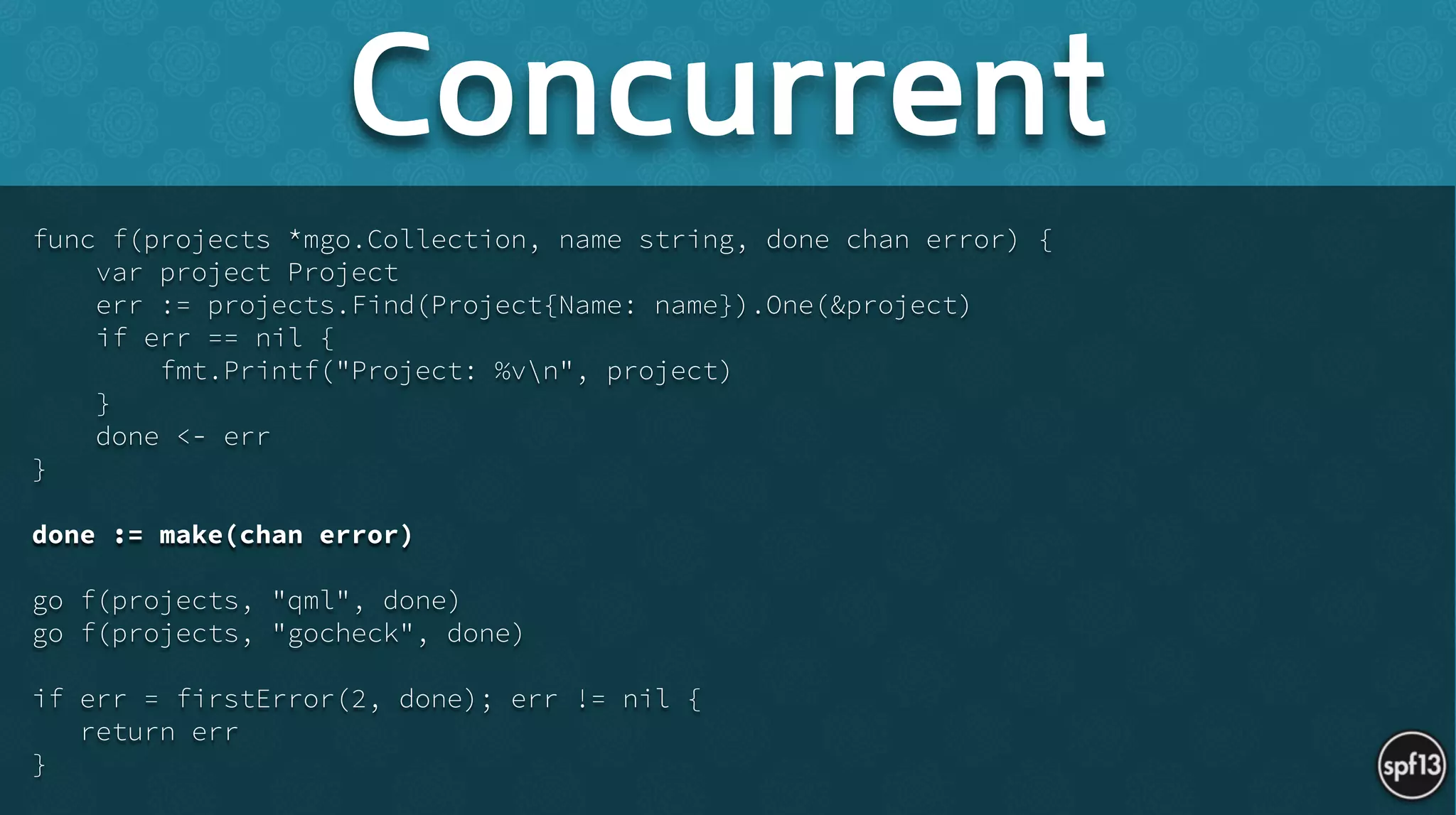
func f(projects *mgo.Collection, name string, done chan error) {
var project Project
err := projects.Find(Project{Name: name}).One(&project)
if err == nil {
fmt.Printf("Project: %vn", project)
}
done <- err
}
!
done := make(chan error)
!
go f(projects, "qml", done)
go f(projects, "gocheck", done)
!
if err = firstError(2, done); err != nil {
return err
}
Concurrent
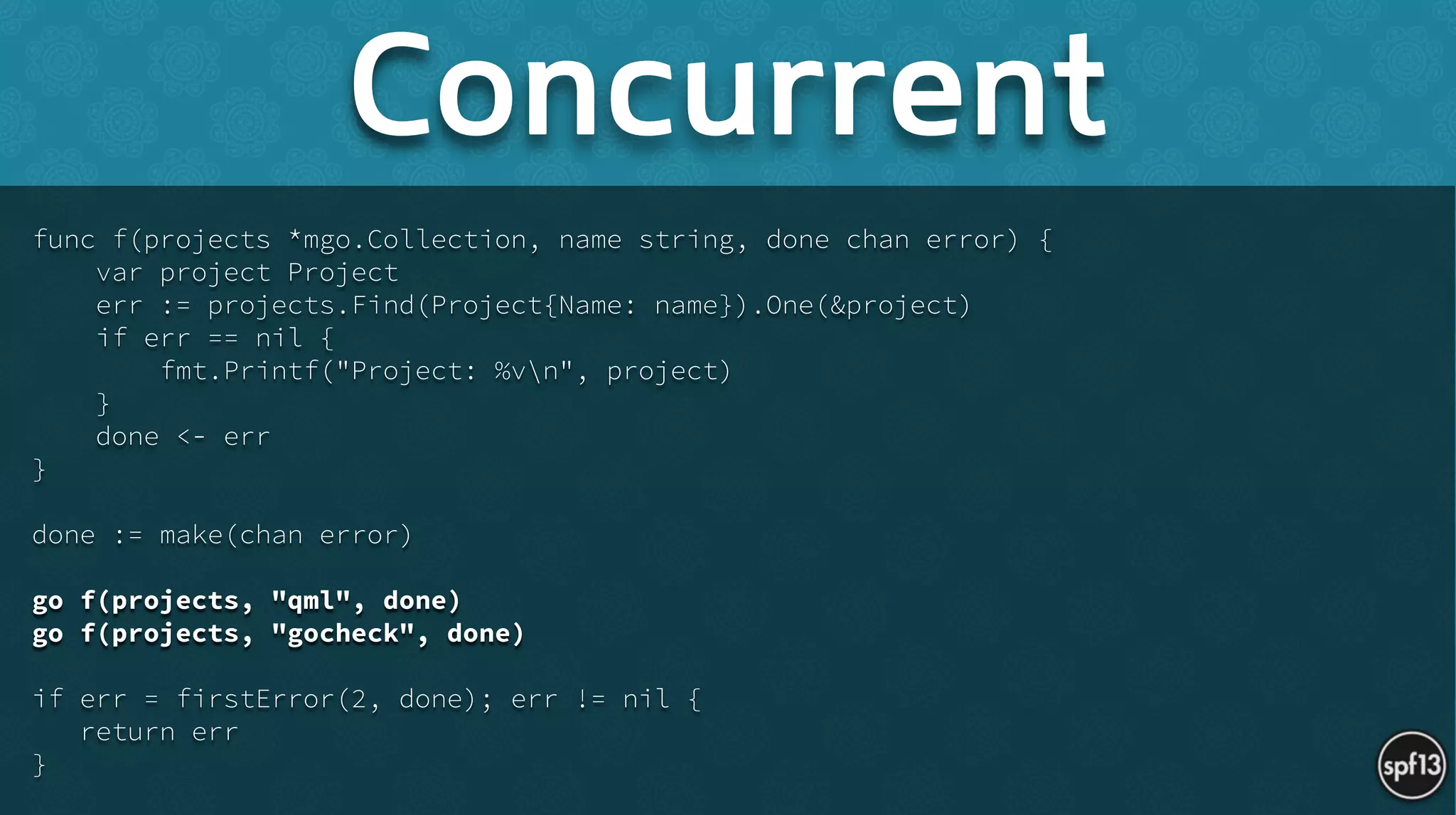
func f(projects *mgo.Collection, name string, done chan error) {
var project Project
err := projects.Find(Project{Name: name}).One(&project)
if err == nil {
fmt.Printf("Project: %vn", project)
}
done <- err
}
!
done := make(chan error)
!
go f(projects, "qml", done)
go f(projects, "gocheck", done)
!
if err = firstError(2, done); err != nil {
return err
}
Concurrent
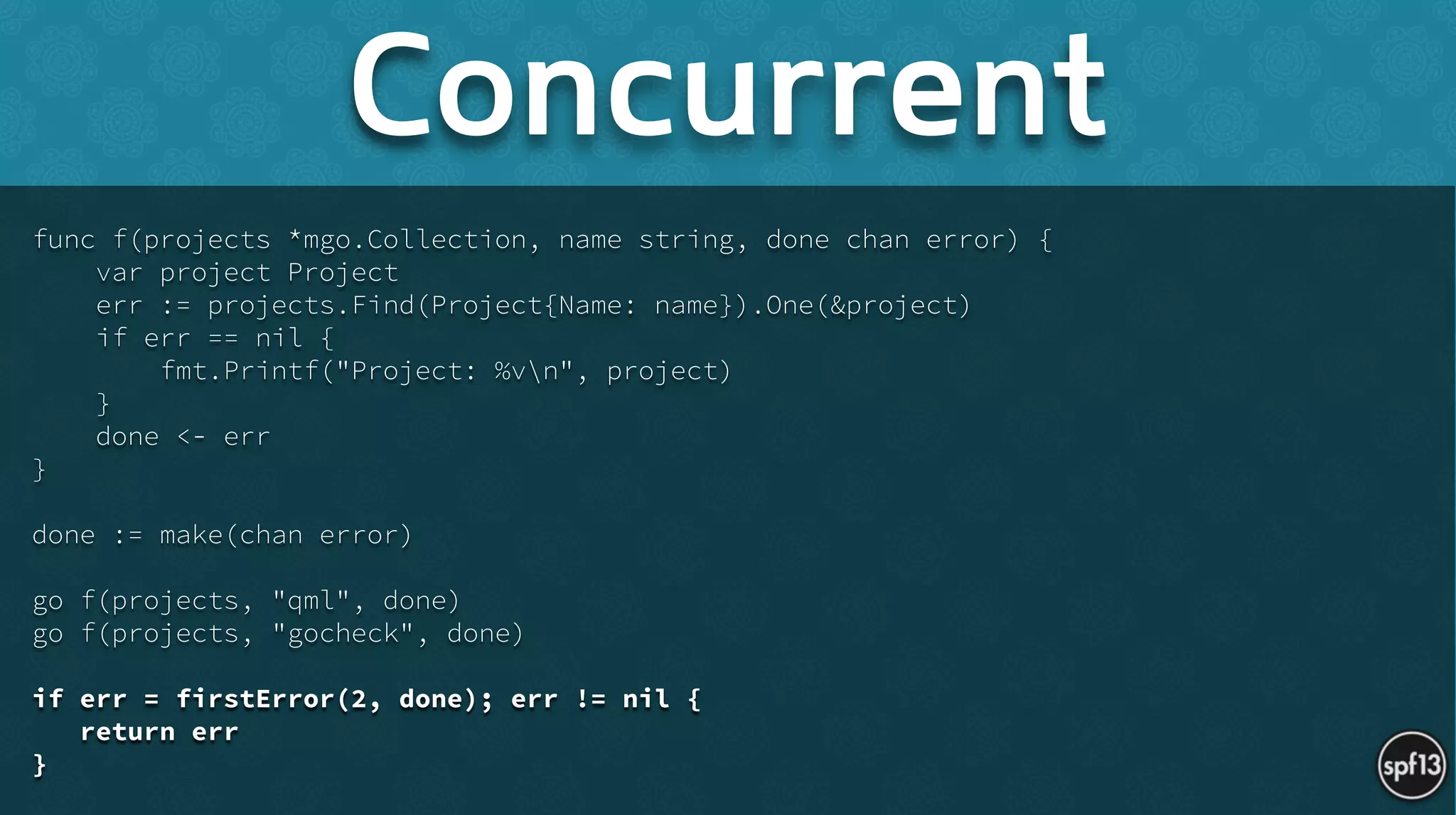
func f(projects *mgo.Collection, name string, done chan error) {
var project Project
err := projects.Find(Project{Name: name}).One(&project)
if err == nil {
fmt.Printf("Project: %vn", project)
}
done <- err
}
!
done := make(chan error)
!
go f(projects, "qml", done)
go f(projects, "gocheck", done)
!
if err = firstError(2, done); err != nil {
return err
}
Concurrent
func f(projects *mgo.Collection, name string, done chan error) {
var project Project
err := projects.Find(Project{Name: name}).One(&project)
if err == nil {
fmt.Printf("Project: %vn", project)
}
done <- err
}
!
done := make(chan error)
!
go f(projects, "qml", done)
go f(projects, "gocheck", done)
!
if err = firstError(2, done); err != nil {
return err
}
Concurrent
func f(projects *mgo.Collection, name string, done chan error) {
var project Project
err := projects.Find(Project{Name: name}).One(&project)
if err == nil {
fmt.Printf("Project: %vn", project)
}
done <- err
}
!
done := make(chan error)
!
go f(projects, "qml", done)
go f(projects, "gocheck", done)
!
if err = firstError(2, done); err != nil {
return err
}
Concurrent
func f(projects *mgo.Collection, name string, done chan error) {
var project Project
err := projects.Find(Project{Name: name}).One(&project)
if err == nil {
fmt.Printf("Project: %vn", project)
}
done <- err
}
!
done := make(chan error)
!
go f(projects, "qml", done)
go f(projects, "gocheck", done)
!
if err = firstError(2, done); err != nil {
return err
}
Concurrent
func f(projects *mgo.Collection, name string, done chan error) {
var project Project
err := projects.Find(Project{Name: name}).One(&project)
if err == nil {
fmt.Printf("Project: %vn", project)
}
done <- err
}
!
done := make(chan error)
!
go f(projects, "qml", done)
go f(projects, "gocheck", done)
!
if err = firstError(2, done); err != nil {
return err
}
Concurrent
Project: {qml gopkg.in/qml.v1}
Project: {gocheck gopkg.in/
check.v1}
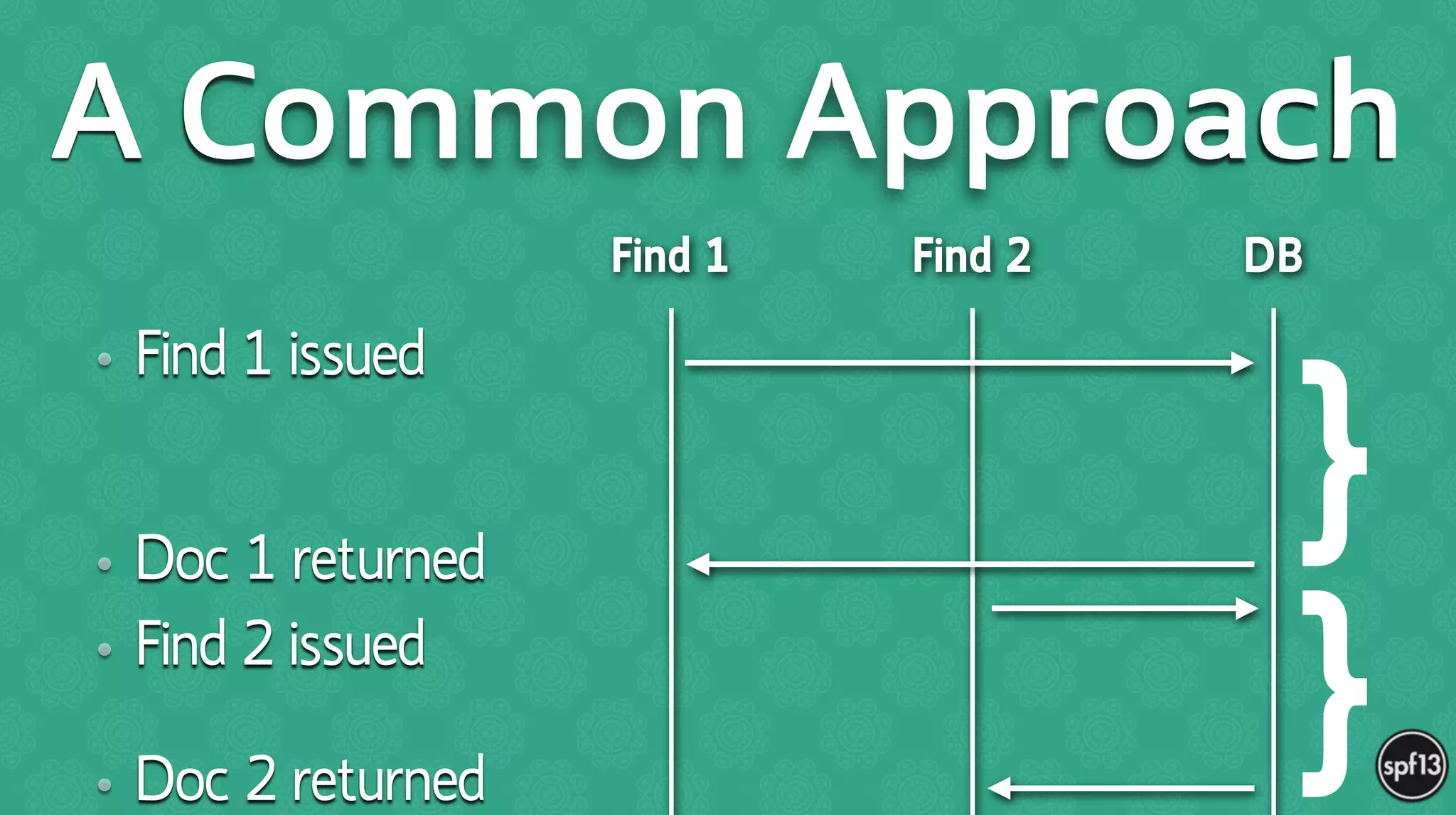
• Find 1 issued

• Doc 1 returned
• Find 2 issued

• Doc 2 returned
A Common Approach
Find 1 Find 2 DB
}
}
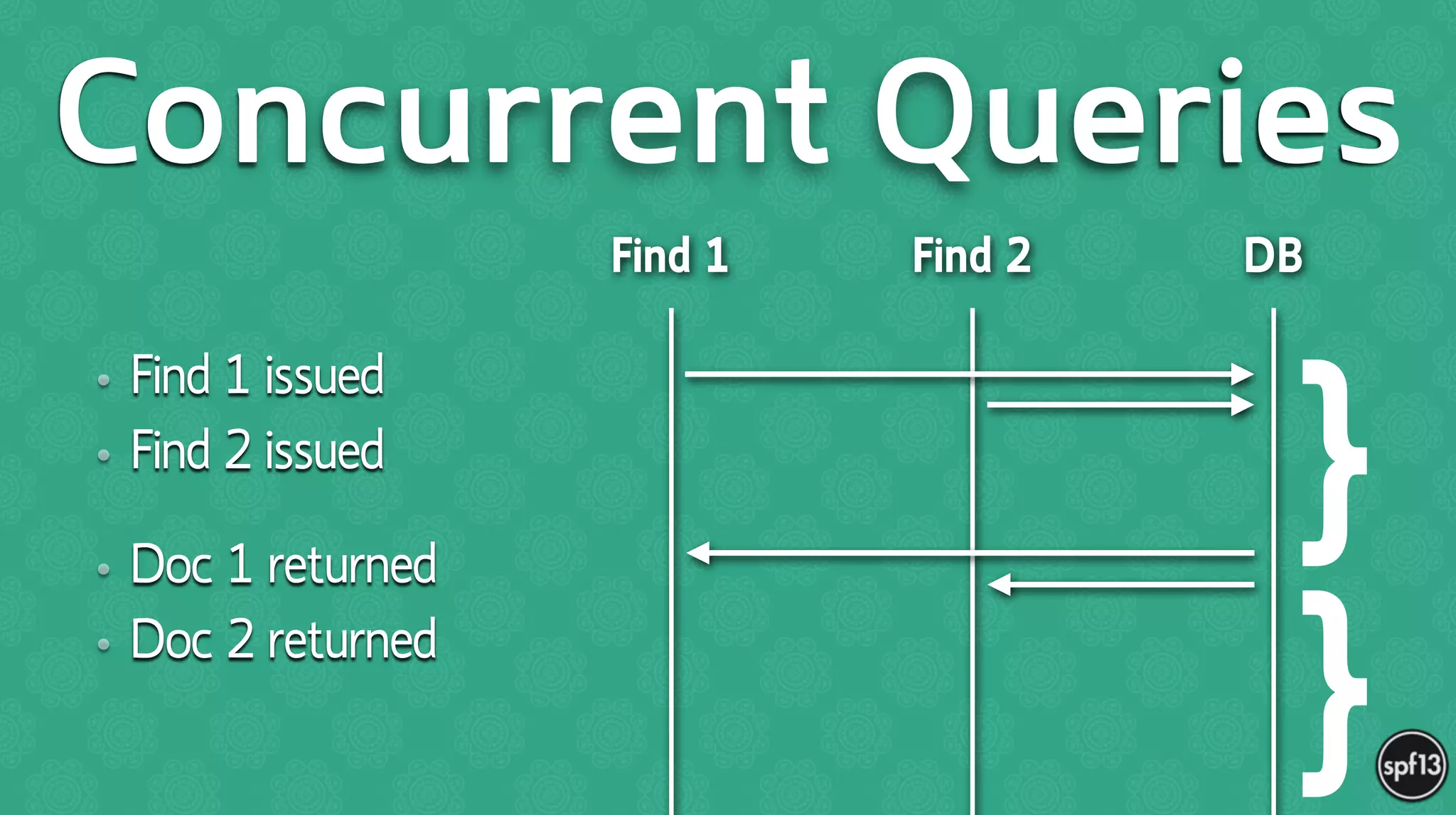
• Find 1 issued
• Find 2 issued

• Doc 1 returned
• Doc 2 returned
Concurrent Queries
Find 1 Find 2 DB
}
}
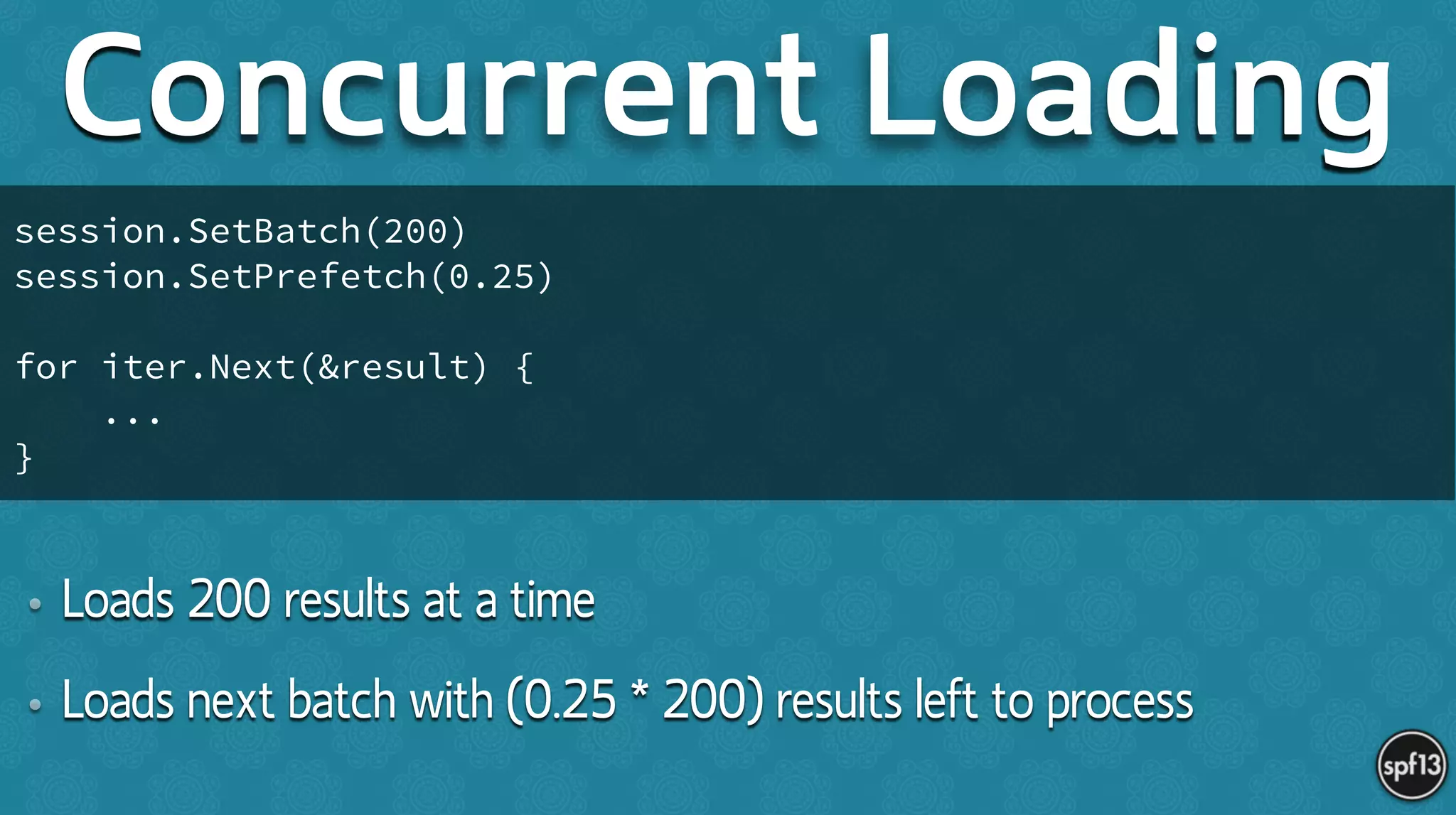
• Loads 200 results at a time
• Loads next batch with (0.25 * 200) results left to process
Concurrent Loading
session.SetBatch(200)
session.SetPrefetch(0.25)
!
for iter.Next(&result) {
...
}
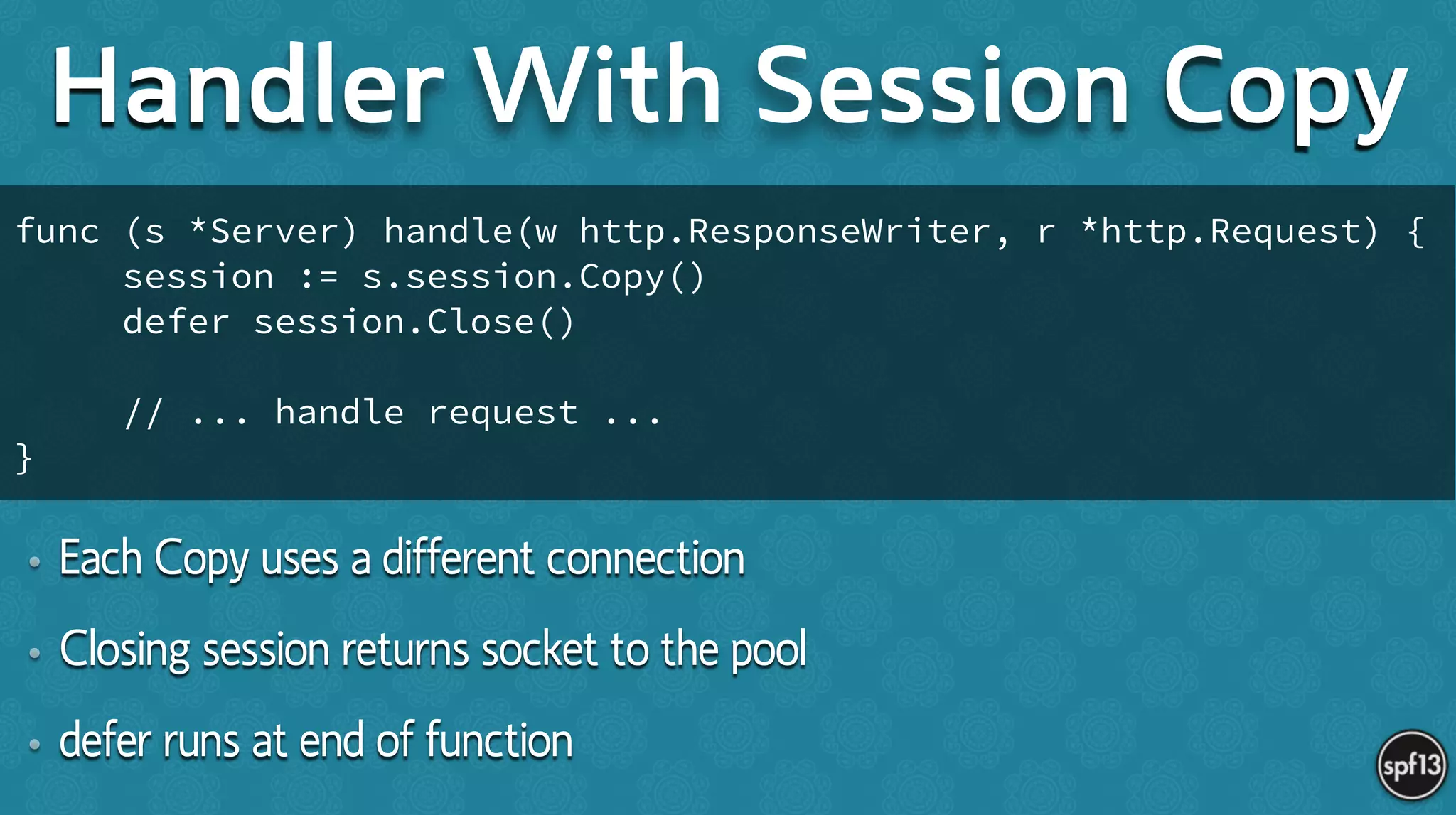
• Each Copy uses a different connection
• Closing session returns socket to the pool
• defer runs at end of function
Handler With Session Copy
func (s *Server) handle(w http.ResponseWriter, r *http.Request) {
session := s.session.Copy()
defer session.Close()
!
// ... handle request ...
}
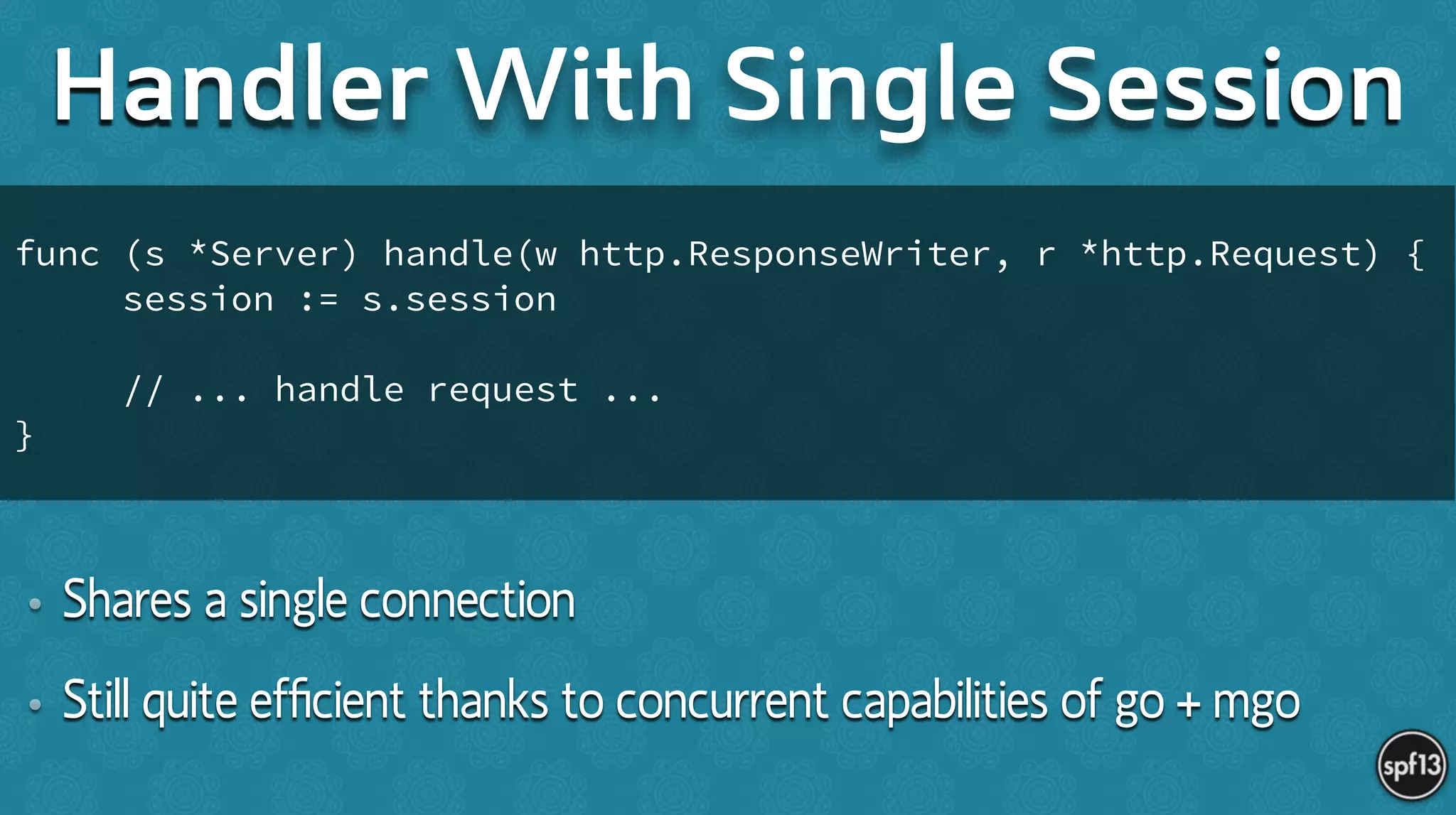
• Shares a single connection
• Still quite efficient thanks to concurrent capabilities of go + mgo
Handler With Single Session
func (s *Server) handle(w http.ResponseWriter, r *http.Request) {
session := s.session
!
// ... handle request ...
}
GridFS
GridFS
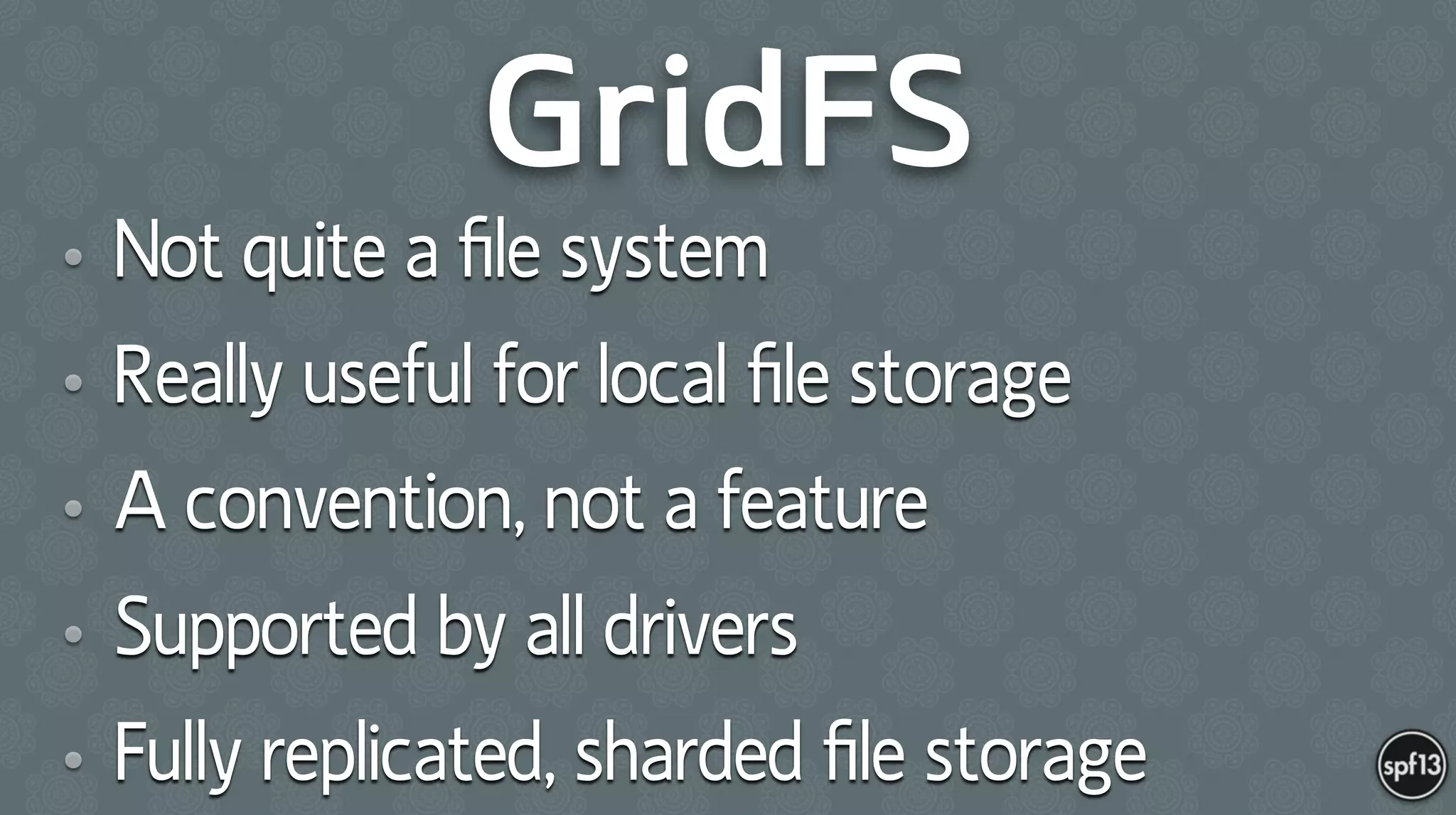
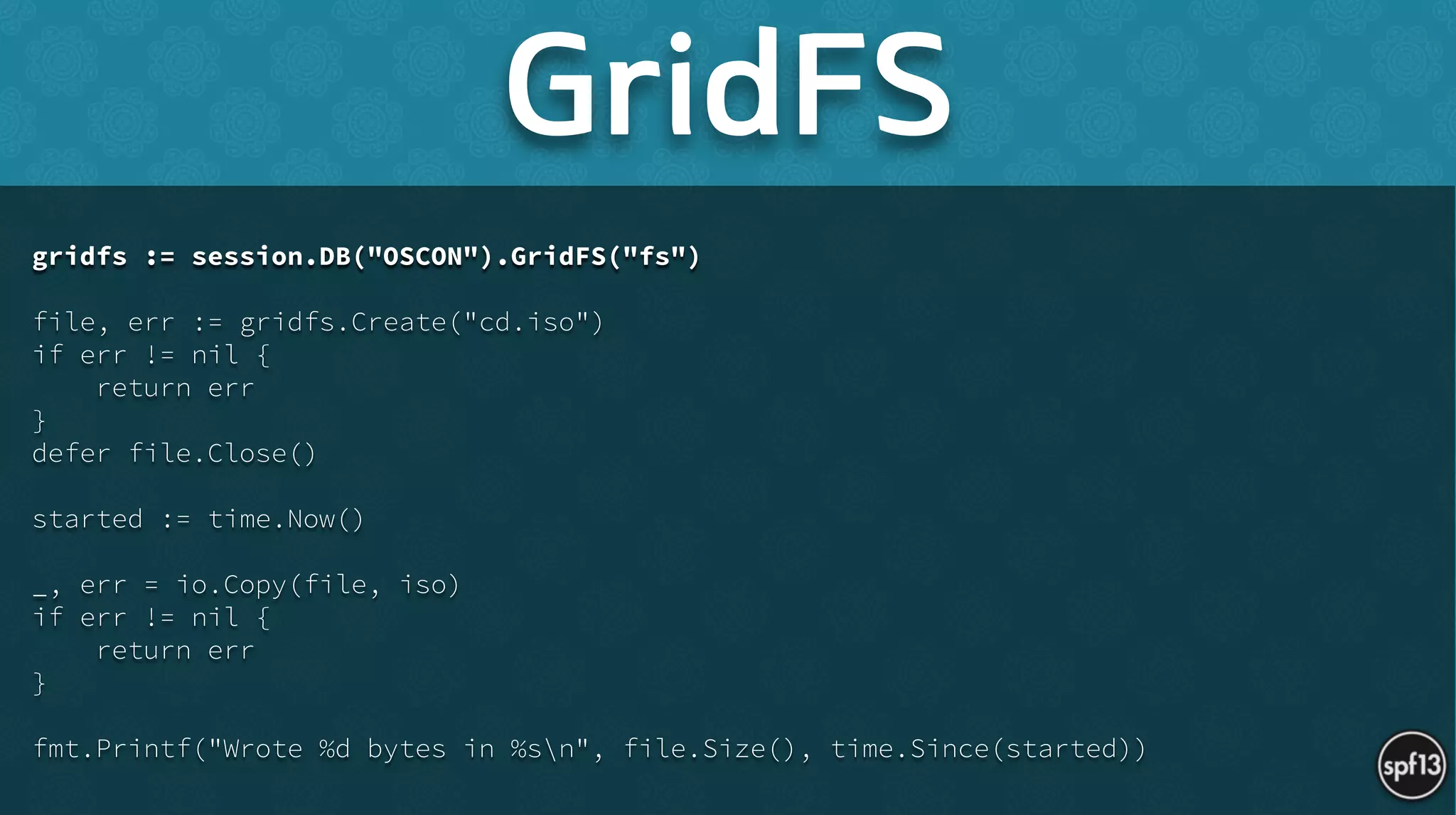
• Not quite a file system
• Really useful for local file storage
• A convention, not a feature
• Supported by all drivers
• Fully replicated, sharded file storage
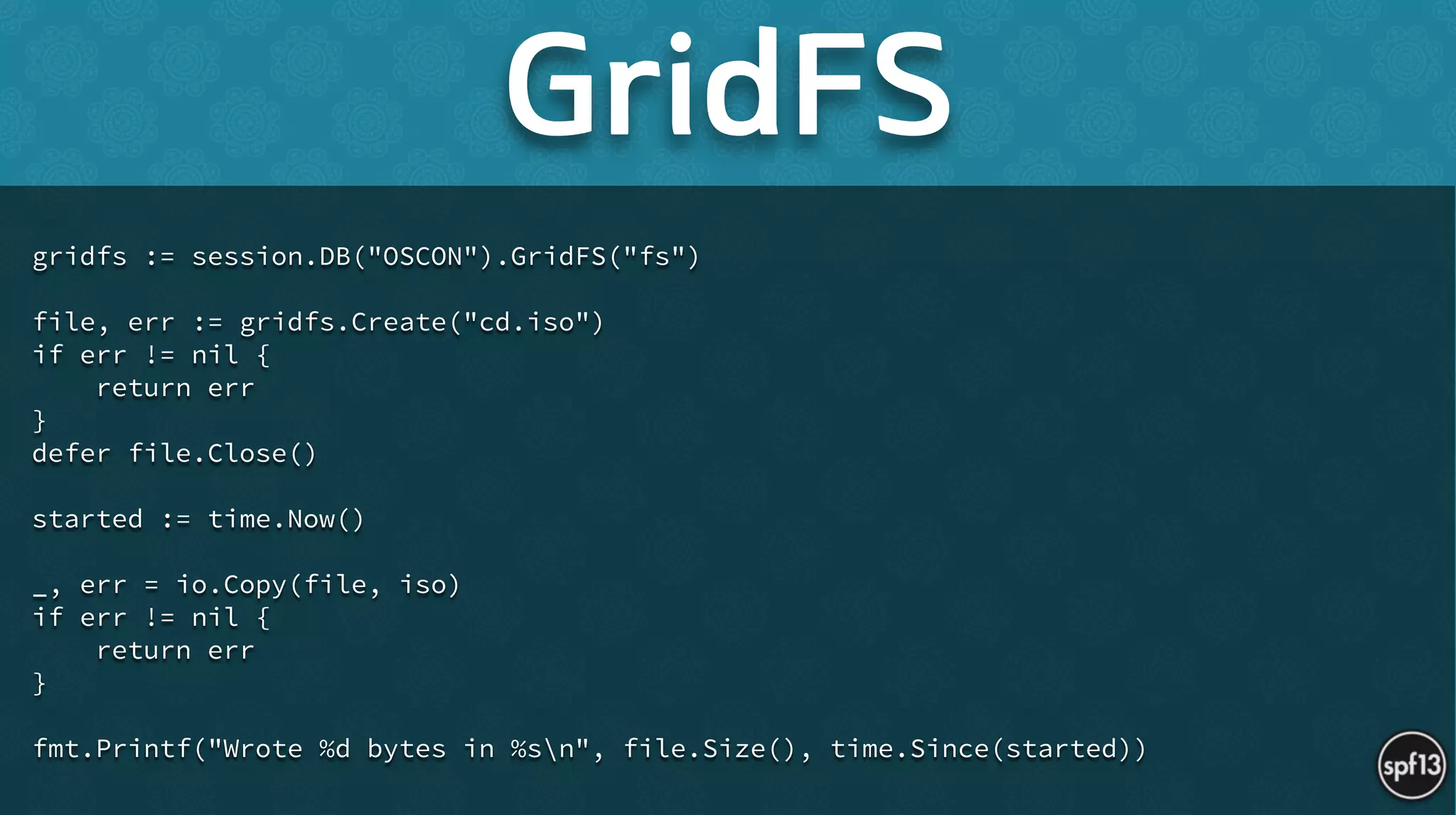
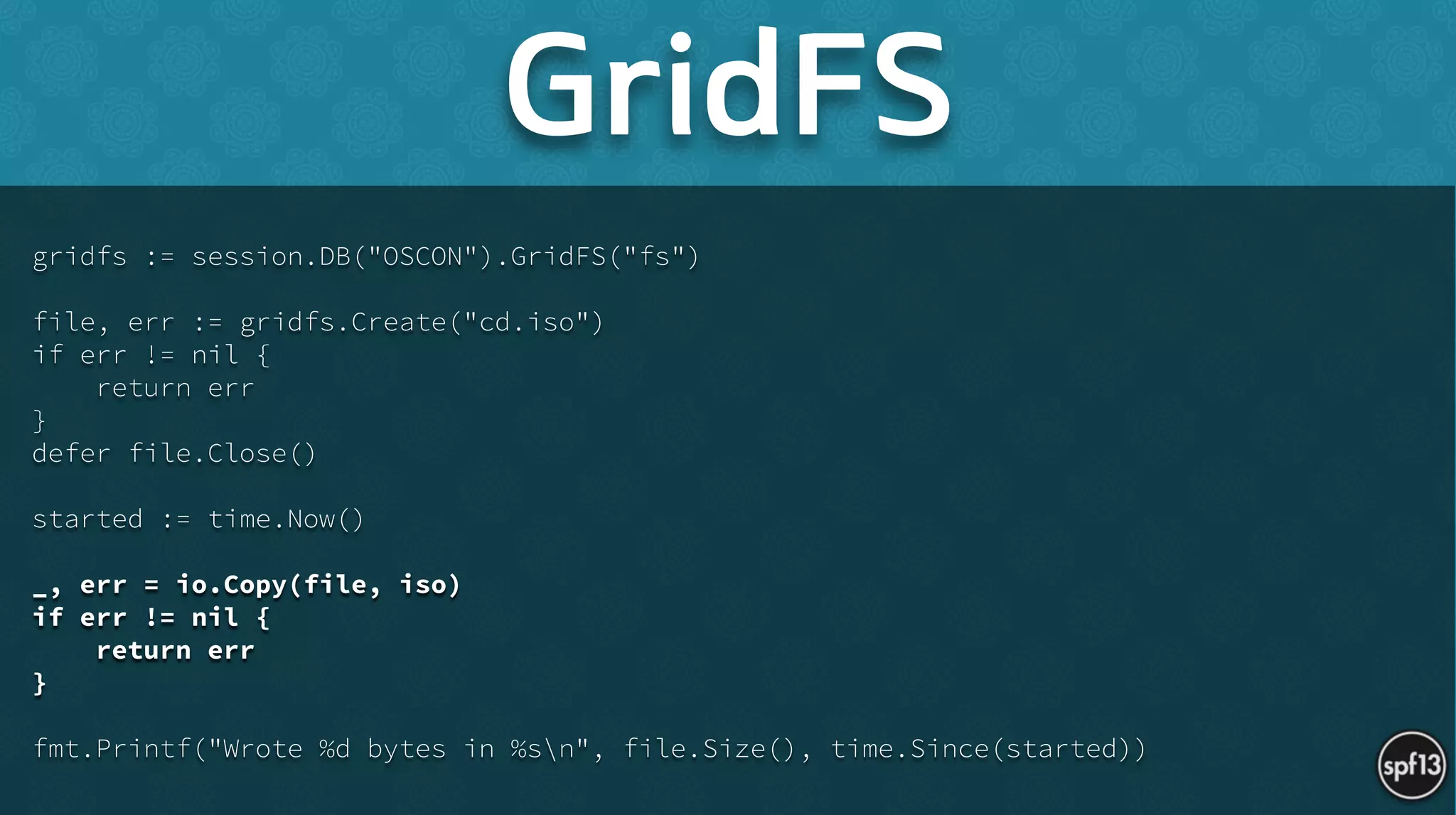
gridfs := session.DB("OSCON").GridFS("fs")
!
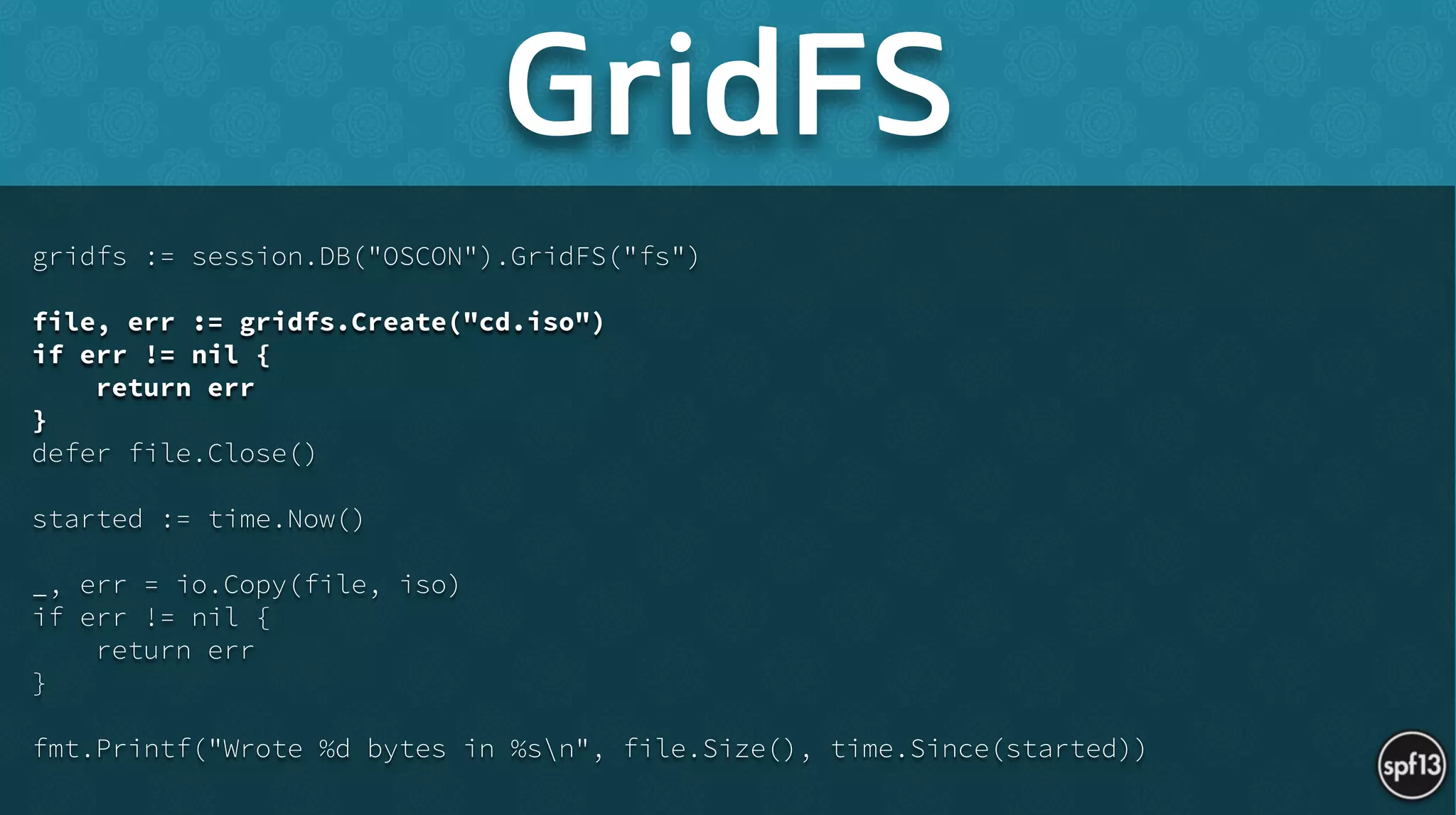
file, err := gridfs.Create("cd.iso")
if err != nil {
return err
}
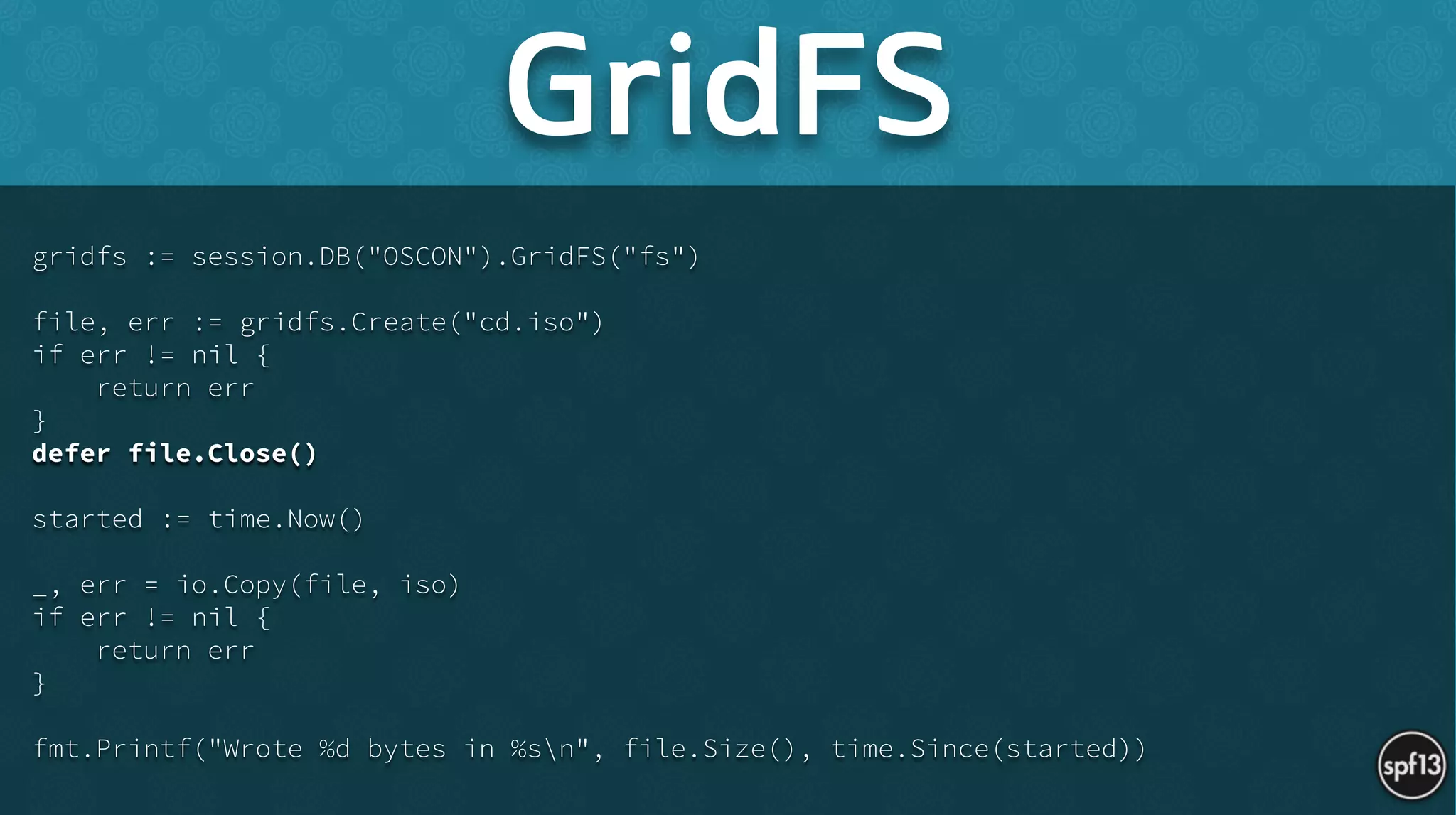
defer file.Close()
!
started := time.Now()
!
_, err = io.Copy(file, iso)
if err != nil {
return err
}
!
fmt.Printf("Wrote %d bytes in %sn", file.Size(), time.Since(started))
GridFS
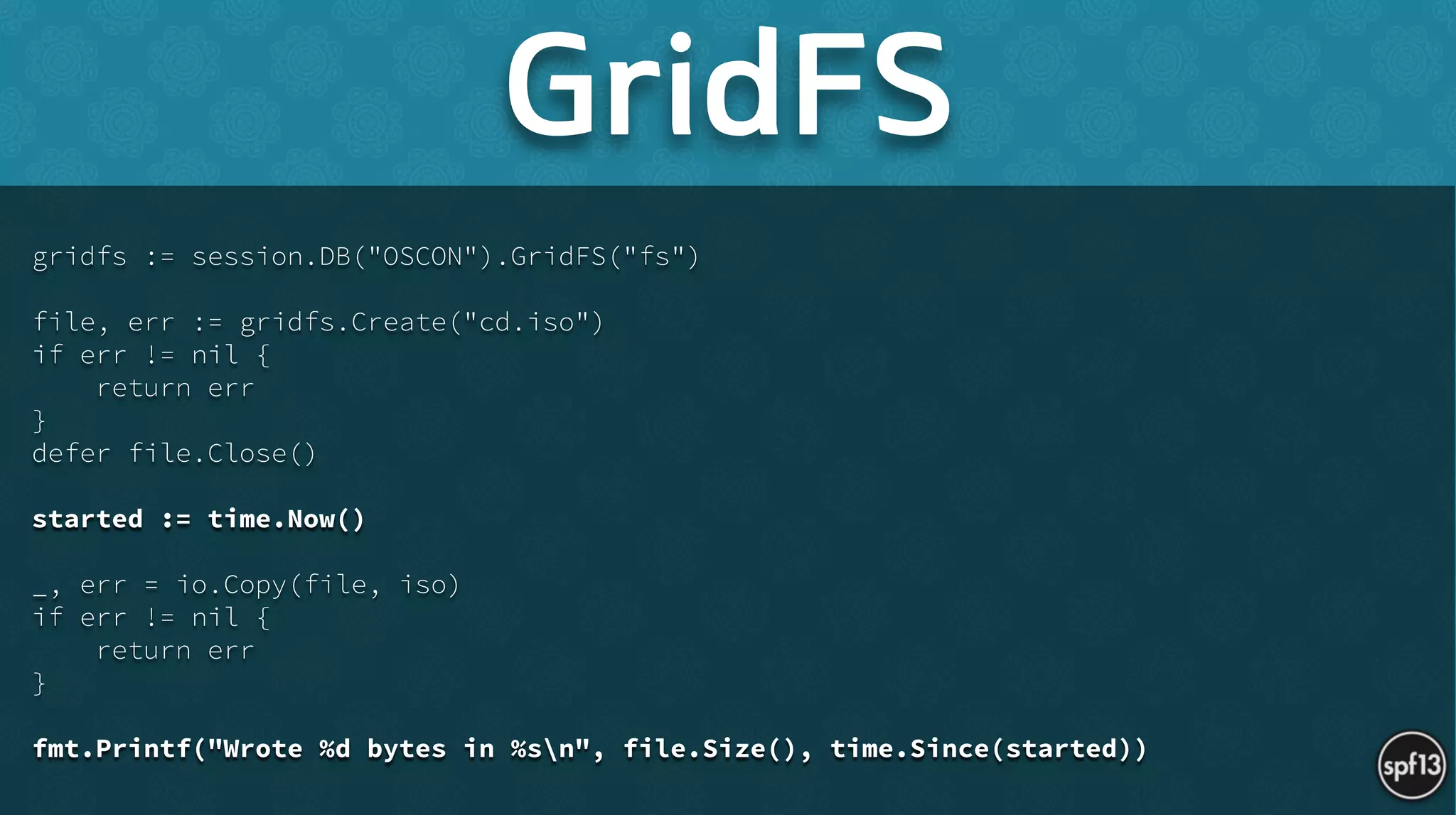
gridfs := session.DB("OSCON").GridFS("fs")
!
file, err := gridfs.Create("cd.iso")
if err != nil {
return err
}
defer file.Close()
!
started := time.Now()
!
_, err = io.Copy(file, iso)
if err != nil {
return err
}
!
fmt.Printf("Wrote %d bytes in %sn", file.Size(), time.Since(started))
GridFS
gridfs := session.DB("OSCON").GridFS("fs")
!
file, err := gridfs.Create("cd.iso")
if err != nil {
return err
}
defer file.Close()
!
started := time.Now()
!
_, err = io.Copy(file, iso)
if err != nil {
return err
}
!
fmt.Printf("Wrote %d bytes in %sn", file.Size(), time.Since(started))
GridFS
gridfs := session.DB("OSCON").GridFS("fs")
!
file, err := gridfs.Create("cd.iso")
if err != nil {
return err
}
defer file.Close()
!
started := time.Now()
!
_, err = io.Copy(file, iso)
if err != nil {
return err
}
!
fmt.Printf("Wrote %d bytes in %sn", file.Size(), time.Since(started))
GridFS
gridfs := session.DB("OSCON").GridFS("fs")
!
file, err := gridfs.Create("cd.iso")
if err != nil {
return err
}
defer file.Close()
!
started := time.Now()
!
_, err = io.Copy(file, iso)
if err != nil {
return err
}
!
fmt.Printf("Wrote %d bytes in %sn", file.Size(), time.Since(started))
GridFS
gridfs := session.DB("OSCON").GridFS("fs")
!
file, err := gridfs.Create("cd.iso")
if err != nil {
return err
}
defer file.Close()
!
started := time.Now()
!
_, err = io.Copy(file, iso)
if err != nil {
return err
}
!
fmt.Printf("Wrote %d bytes in %sn", file.Size(), time.Since(started))
GridFS
gridfs := session.DB("OSCON").GridFS("fs")
!
file, err := gridfs.Create("cd.iso")
if err != nil {
return err
}
defer file.Close()
!
started := time.Now()
!
_, err = io.Copy(file, iso)
if err != nil {
return err
}
!
fmt.Printf("Wrote %d bytes in %sn", file.Size(), time.Since(started))
GridFS
!
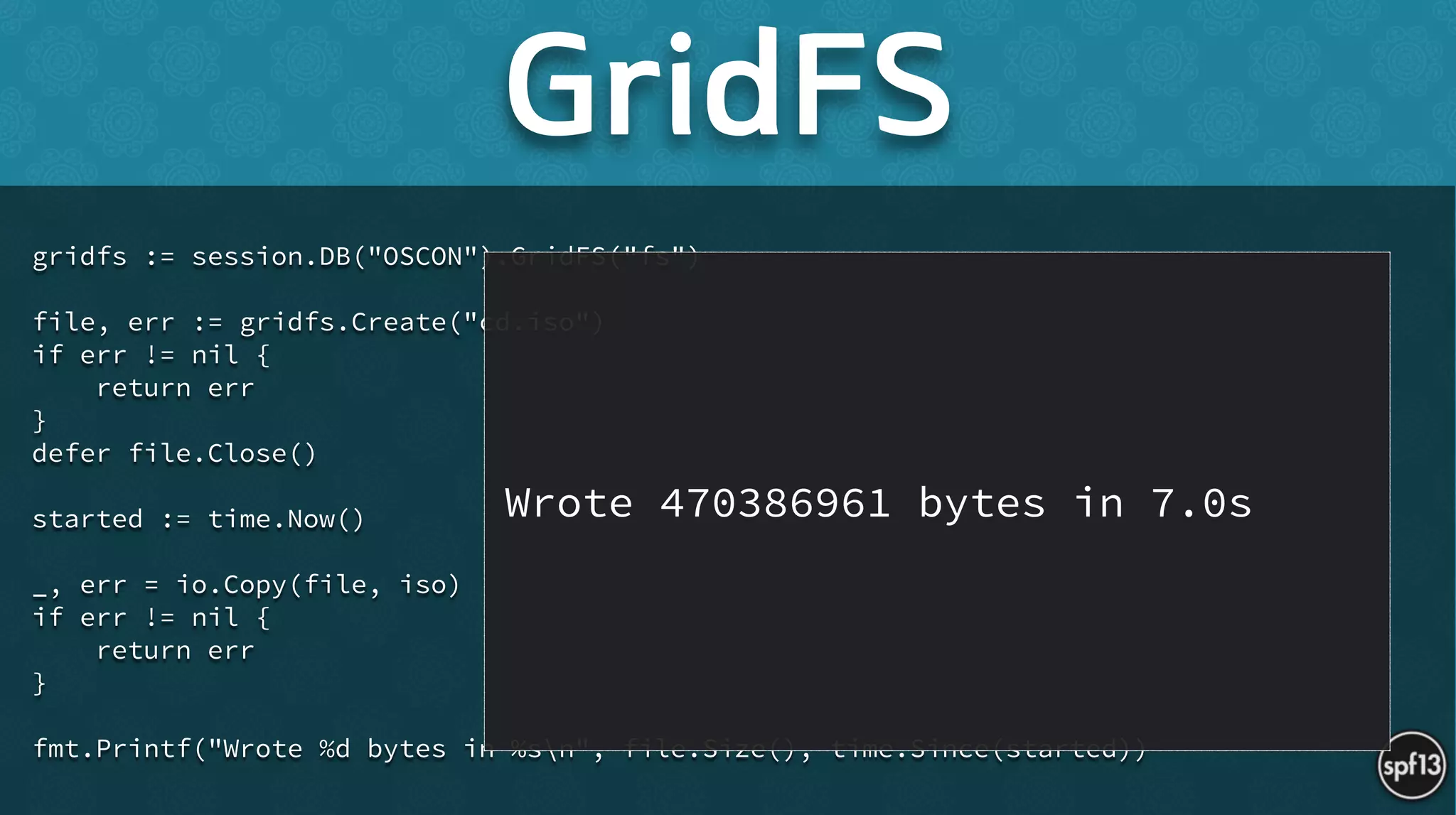
Wrote 470386961 bytes in 7.0s
Full Featured
Features
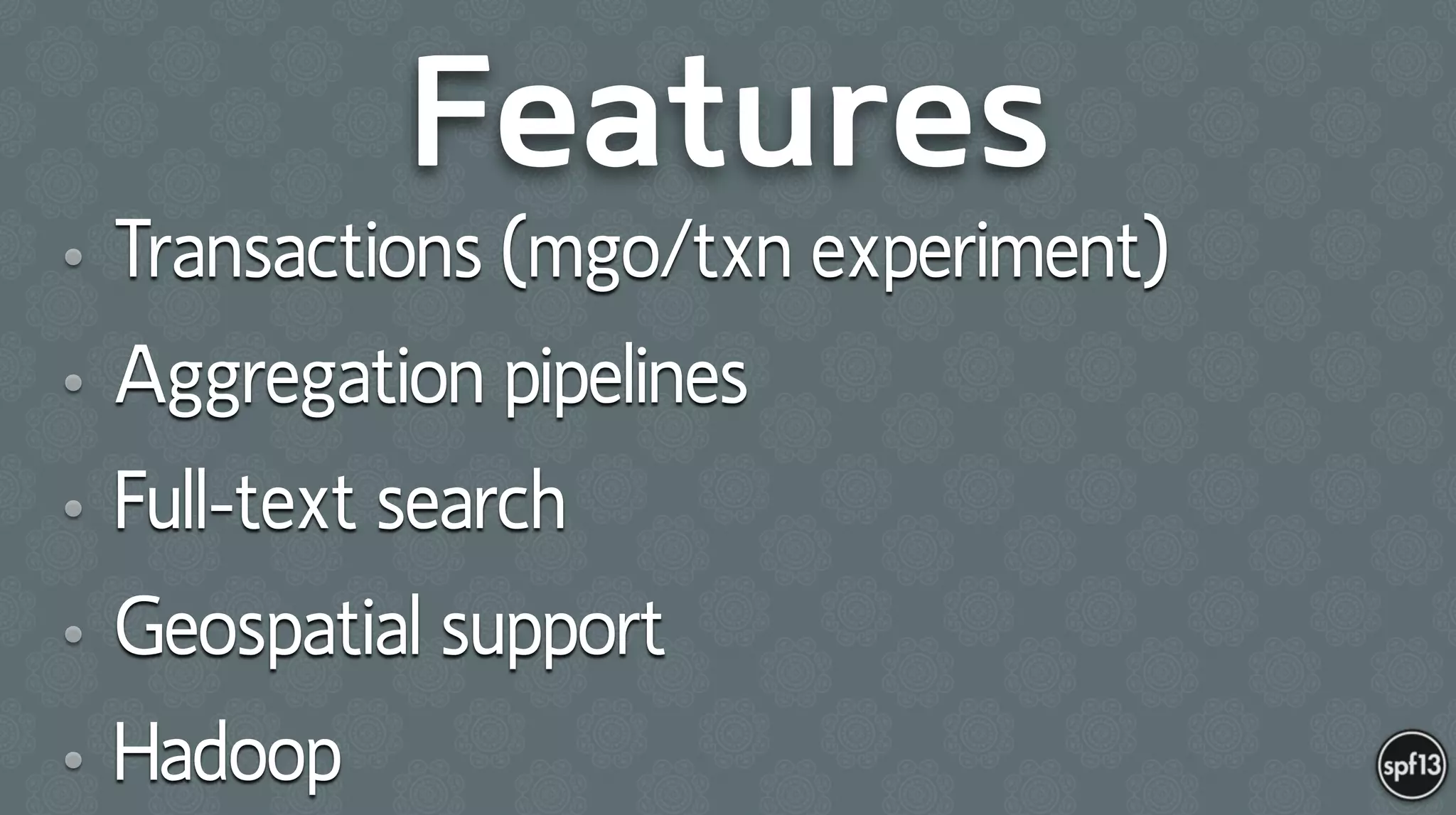
• Transactions (mgo/txn experiment)
• Aggregation pipelines
• Full-text search
• Geospatial support
• Hadoop
In Conclusion
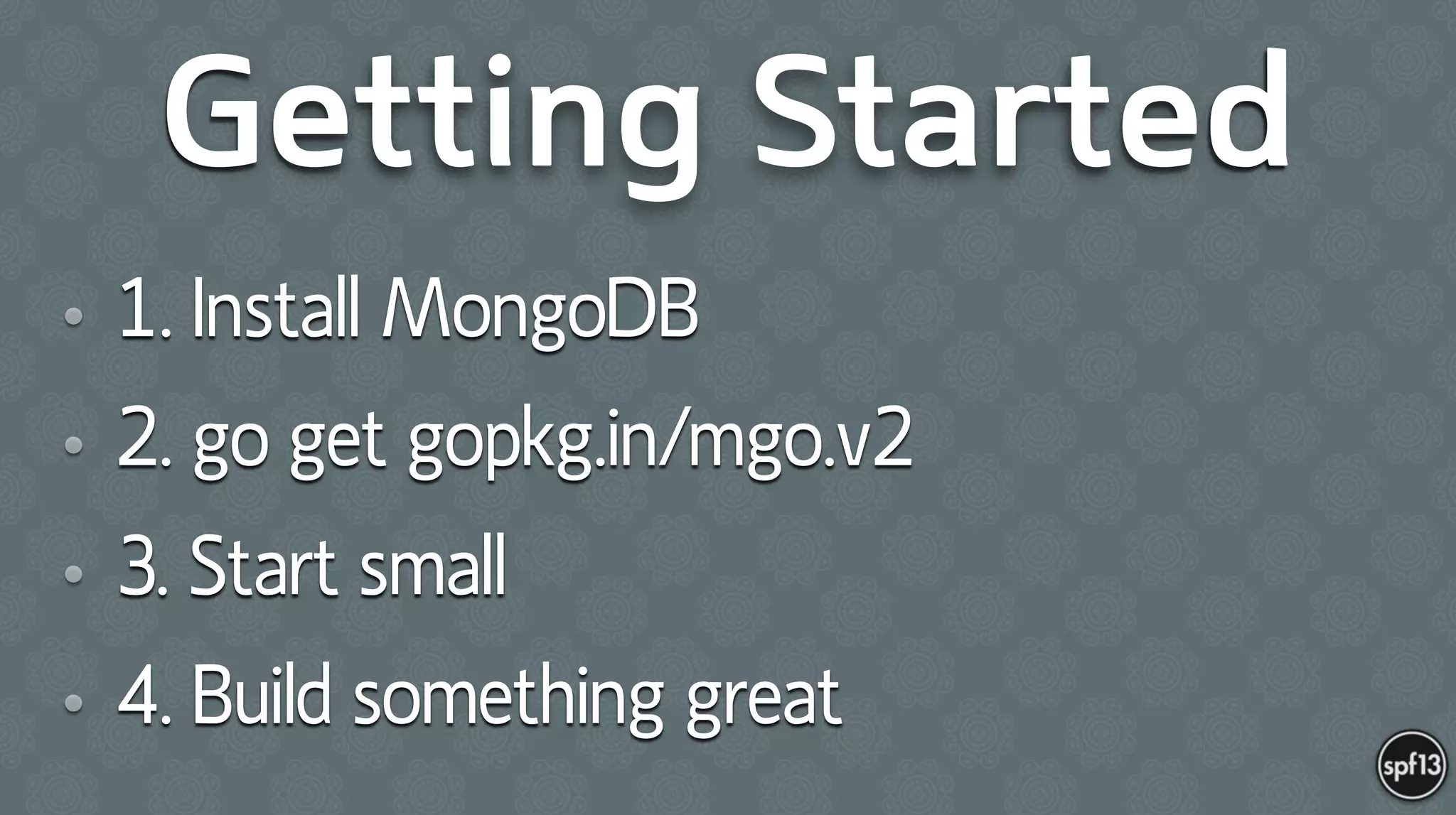
Getting Started
• 1. Install MongoDB
• 2. go get gopkg.in/mgo.v2
• 3. Start small
• 4. Build something great
Learning More
• MongoDB Manual
• Effective Go
• labix.org/mgo
Workshop Using mgo on spf13.com
on spf13.com
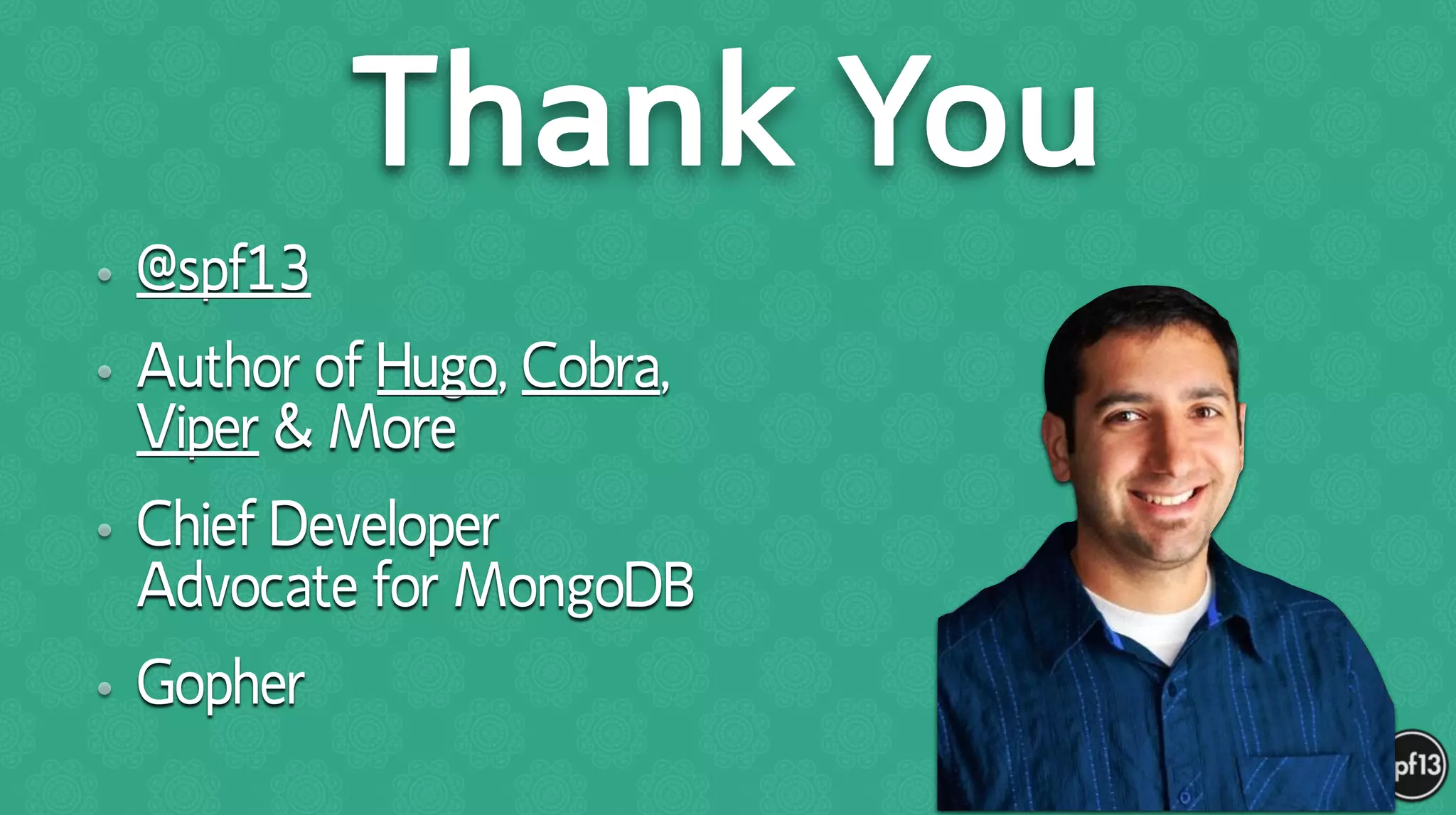
• @spf13
• Author of Hugo, Cobra,
Viper & More
• Chief Developer
Advocate for MongoDB
• Gopher
Thank You

Painless Data Storage with MongoDB & Go

  • 1.
  • 2.
    • Author ofHugo, Cobra, Viper & More • Chief Developer Advocate for MongoDB • Gopher @spf13
  • 3.
  • 4.
    Why Another Language? •Software is slow • Sofware is hard to write • Software doesn’t scale well
  • 5.
    Go is Fast •Go execution speed is close to C • Go compile time rivals dynamic interpretation
  • 6.
    Go is Friendly •Feels like a dynamic language in many ways • Very small core language, easy to remember all of it • Single binary installation, no dependencies • Extensive Tooling & StdLib
  • 7.
    Go is Concurrent •Concurrency is part of the language • Any function can become a goroutine • Goroutines run concurrently, communicate through channels • Select waits for communication on any of a set of channels
  • 8.
  • 9.
    Why Another Database? •Databases are slow • Relational structures don’t fit well with modern programming (ORMs) • Databases don’t scale well
  • 10.
    MongoDB is Fast •Written in C++ • Extensive use of memory-mapped files 
 i.e. read-through write-through memory caching. • Runs nearly everywhere • Data serialized as BSON (fast parsing) • Full support for primary & secondary indexes • Document model = less work
  • 11.
    MongoDB is Friendly •Ad Hoc queries • Real time aggregation • Rich query capabilities • Traditionally consistent • Geospatial features • Support for most programming languages • Flexible schema
  • 12.
    MongoDB is “WebScale” • Built in sharding support distributes data across many nodes • MongoS intelligently routes to the correct nodes • Aggregation done in parallel across nodes
  • 13.
    Document Database • Notfor .PDF & .DOC files • A document is essentially an associative array • Document == JSON object • Document == PHP Array • Document == Python Dict • Document == Ruby Hash • etc
  • 14.
    Data Serialization • Applicationsneed persistant data • The process of translating data structures into a format that can be stored • Ideal format accessible from many languages
  • 15.
    BSON • Inspired byJSON • Cross language binary serialization format • Optimized for scanning • Support for richer types
  • 16.
  • 17.
    Go’s Data Types •Go uses strict & static typing • 2 Types are similar to a BSON document • Struct • Map
  • 18.
    bob := &Person{ Name:"Bob", Birthday: time.Now(), } ! data, err := bson.Marshal(bob) if err != nil { return err } fmt.Printf("Data: %qn", data)
 ! var person Person err = bson.Unmarshal(data, &person) if err != nil { return err } fmt.Printf("Person: %vn", person) Serializing with BSON
  • 19.
    bob := &Person{ Name:"Bob", Birthday: time.Now(), } ! data, err := bson.Marshal(bob) if err != nil { return err } fmt.Printf("Data: %qn", data)
 ! var person Person err = bson.Unmarshal(data, &person) if err != nil { return err } fmt.Printf("Person: %vn", person) Serializing with BSON
  • 20.
    bob := &Person{ Name:"Bob", Birthday: time.Now(), } ! data, err := bson.Marshal(bob) if err != nil { return err } fmt.Printf("Data: %qn", data)
 ! var person Person err = bson.Unmarshal(data, &person) if err != nil { return err } fmt.Printf("Person: %vn", person) Serializing with BSON
  • 21.
    bob := &Person{ Name:"Bob", Birthday: time.Now(), } ! data, err := bson.Marshal(bob) if err != nil { return err } fmt.Printf("Data: %qn", data)
 ! var person Person err = bson.Unmarshal(data, &person) if err != nil { return err } fmt.Printf("Person: %vn", person) Serializing with BSON
  • 22.
    bob := &Person{ Name:"Bob", Birthday: time.Now(), } ! data, err := bson.Marshal(bob) if err != nil { return err } fmt.Printf("Data: %qn", data)
 ! var person Person err = bson.Unmarshal(data, &person) if err != nil { return err } fmt.Printf("Person: %vn", person) Serializing with BSON
  • 23.
    bob := &Person{ Name:"Bob", Birthday: time.Now(), } ! data, err := bson.Marshal(bob) if err != nil { return err } fmt.Printf("Data: %qn", data)
 ! var person Person err = bson.Unmarshal(data, &person) if err != nil { return err } fmt.Printf("Person: %vn", person) Serializing with BSON Data: "%x00x00x00x02name x00x04x00x00x00Bob x00tbirthdayx00x80rx97| ^x00x00x00x00"
 ! Person: {Bob 2014-07-21 18:00:00 -0500 EST}
  • 24.
    ! type Project struct{ Name string `bson:"name"` ImportPath string `bson:"importPath"` } project := Project{name, path} ! ! ! project := map[string]string{"name": name, "importPath": path} ! ! ! project := bson.D{{"name", name}, {"importPath", path}} Equal After Marshaling Struct Custom Map Document Slice
  • 25.
    mgo (mango) • PureGo • Created in late 2010 
 ("Where do I put my Go data?") • Adopted by Canonical and MongoDB Inc. itself • Sponsored by MongoDB Inc. from late 2011
  • 26.
  • 27.
    • Same interfacefor server, replica set, or shard • Driver discovers and maintains topology • Server added/removed, failovers, response times, etc Connecting session, err := mgo.Dial("localhost") if err != nil { return err }
  • 28.
    • Sessions arelightweight • Sessions are copied (settings preserved) • Single management goroutine for all copied sessions Sessions func (s *Server) handle(w http.ResponseWriter, r *http.Request) { session := s.session.Copy() defer session.Close() // ... handle request ... }
  • 29.
    • Saves typing •Uses the same session over and over Convenient Access projects := session.DB("OSCON").C("projects")
  • 30.
  • 31.
    type Project struct{ Name string `bson:"name,omitempty"` ImportPath string `bson:"importPath,omitempty"` } Defining Our Own Type
  • 32.
    var projectList =[]Project{ {"gocheck", "gopkg.in/check.v1"}, {"qml", "gopkg.in/qml.v0"}, {"pipe", "gopkg.in/pipe.v2"}, {"yaml", "gopkg.in/yaml.v1"}, } ! for _, project := range projectList { err := projects.Insert(project) if err != nil { return err } } fmt.Println("Okay!") Insert Okay!
  • 33.
    type M map[string]interface{} ! change:= M{"$set": Project{ImportPath: "gopkg.in/ qml.v1"}} ! err = projects.Update(Project{Name: "qml"}, change) if err != nil { return err } ! fmt.Println("Done!") Update Done!
  • 34.
  • 35.
    var project Project ! err= projects.Find(Project{Name: "qml"}).One(&project) if err != nil { return err } ! fmt.Printf("Project: %vn", project) Find Project: 
 {qml gopkg.in/qml.v0}
  • 36.
    iter := projects.Find(nil).Iter() ! varproject Project for iter.Next(&project) { fmt.Printf("Project: %vn", project) } ! return iter.Err() Iterate Project: {gocheck gopkg.in/check.v1} Project: {qml gopkg.in/qml.v0} Project: {pipe gopkg.in/pipe.v2} Project: {yaml gopkg.in/yaml.v1}
  • 37.
    m := map[string]interface{}{ "name":"godep", "tags": []string{"tool", "dependency"}, "contact": bson.M{ "name": "Keith Rarick", "email": "kr@nospam.com", }, } ! err = projects.Insert(m) if err != nil { return err } fmt.Println("Okay!") Nesting Okay!
  • 38.
    type Contact struct{ Name string Email string } ! type Project struct { Name string Tags []string `bson:",omitempty"` Contact Contact `bson:",omitempty"` } ! err = projects.Find(Project{Name: "godep"}).One(&project) if err != nil { return err } ! pretty.Println("Project:", project) Nesting II Project: main.Project{ Name: "godep", Tags: {"tool", "dependency"}, Contact: {Name:"Keith Rarick", Email:"kr@XZY.com"}, }
  • 39.
    • Compound • Listindexing (think tag lists) • Geospatial • Dense or sparse • Full-text searching Indexing // Root field err = projects.EnsureIndexKey("name") ... ! // Nested field err = projects.EnsureIndexKey("author.email") ...
  • 40.
  • 41.
    func f(projects *mgo.Collection,name string, done chan error) { var project Project err := projects.Find(Project{Name: name}).One(&project) if err == nil { fmt.Printf("Project: %vn", project) } done <- err } ! done := make(chan error) ! go f(projects, "qml", done) go f(projects, "gocheck", done) ! if err = firstError(2, done); err != nil { return err } Concurrent
  • 42.
    func f(projects *mgo.Collection,name string, done chan error) { var project Project err := projects.Find(Project{Name: name}).One(&project) if err == nil { fmt.Printf("Project: %vn", project) } done <- err } ! done := make(chan error) ! go f(projects, "qml", done) go f(projects, "gocheck", done) ! if err = firstError(2, done); err != nil { return err } Concurrent
  • 43.
    func f(projects *mgo.Collection,name string, done chan error) { var project Project err := projects.Find(Project{Name: name}).One(&project) if err == nil { fmt.Printf("Project: %vn", project) } done <- err } ! done := make(chan error) ! go f(projects, "qml", done) go f(projects, "gocheck", done) ! if err = firstError(2, done); err != nil { return err } Concurrent
  • 44.
    func f(projects *mgo.Collection,name string, done chan error) { var project Project err := projects.Find(Project{Name: name}).One(&project) if err == nil { fmt.Printf("Project: %vn", project) } done <- err } ! done := make(chan error) ! go f(projects, "qml", done) go f(projects, "gocheck", done) ! if err = firstError(2, done); err != nil { return err } Concurrent
  • 45.
    func f(projects *mgo.Collection,name string, done chan error) { var project Project err := projects.Find(Project{Name: name}).One(&project) if err == nil { fmt.Printf("Project: %vn", project) } done <- err } ! done := make(chan error) ! go f(projects, "qml", done) go f(projects, "gocheck", done) ! if err = firstError(2, done); err != nil { return err } Concurrent
  • 46.
    func f(projects *mgo.Collection,name string, done chan error) { var project Project err := projects.Find(Project{Name: name}).One(&project) if err == nil { fmt.Printf("Project: %vn", project) } done <- err } ! done := make(chan error) ! go f(projects, "qml", done) go f(projects, "gocheck", done) ! if err = firstError(2, done); err != nil { return err } Concurrent
  • 47.
    func f(projects *mgo.Collection,name string, done chan error) { var project Project err := projects.Find(Project{Name: name}).One(&project) if err == nil { fmt.Printf("Project: %vn", project) } done <- err } ! done := make(chan error) ! go f(projects, "qml", done) go f(projects, "gocheck", done) ! if err = firstError(2, done); err != nil { return err } Concurrent
  • 48.
    func f(projects *mgo.Collection,name string, done chan error) { var project Project err := projects.Find(Project{Name: name}).One(&project) if err == nil { fmt.Printf("Project: %vn", project) } done <- err } ! done := make(chan error) ! go f(projects, "qml", done) go f(projects, "gocheck", done) ! if err = firstError(2, done); err != nil { return err } Concurrent Project: {qml gopkg.in/qml.v1} Project: {gocheck gopkg.in/ check.v1}
  • 49.
    • Find 1issued
 • Doc 1 returned • Find 2 issued
 • Doc 2 returned A Common Approach Find 1 Find 2 DB } }
  • 50.
    • Find 1issued • Find 2 issued
 • Doc 1 returned • Doc 2 returned Concurrent Queries Find 1 Find 2 DB } }
  • 51.
    • Loads 200results at a time • Loads next batch with (0.25 * 200) results left to process Concurrent Loading session.SetBatch(200) session.SetPrefetch(0.25) ! for iter.Next(&result) { ... }
  • 52.
    • Each Copyuses a different connection • Closing session returns socket to the pool • defer runs at end of function Handler With Session Copy func (s *Server) handle(w http.ResponseWriter, r *http.Request) { session := s.session.Copy() defer session.Close() ! // ... handle request ... }
  • 53.
    • Shares asingle connection • Still quite efficient thanks to concurrent capabilities of go + mgo Handler With Single Session func (s *Server) handle(w http.ResponseWriter, r *http.Request) { session := s.session ! // ... handle request ... }
  • 54.
  • 55.
    GridFS • Not quitea file system • Really useful for local file storage • A convention, not a feature • Supported by all drivers • Fully replicated, sharded file storage
  • 56.
    gridfs := session.DB("OSCON").GridFS("fs") ! file,err := gridfs.Create("cd.iso") if err != nil { return err } defer file.Close() ! started := time.Now() ! _, err = io.Copy(file, iso) if err != nil { return err } ! fmt.Printf("Wrote %d bytes in %sn", file.Size(), time.Since(started)) GridFS
  • 57.
    gridfs := session.DB("OSCON").GridFS("fs") ! file,err := gridfs.Create("cd.iso") if err != nil { return err } defer file.Close() ! started := time.Now() ! _, err = io.Copy(file, iso) if err != nil { return err } ! fmt.Printf("Wrote %d bytes in %sn", file.Size(), time.Since(started)) GridFS
  • 58.
    gridfs := session.DB("OSCON").GridFS("fs") ! file,err := gridfs.Create("cd.iso") if err != nil { return err } defer file.Close() ! started := time.Now() ! _, err = io.Copy(file, iso) if err != nil { return err } ! fmt.Printf("Wrote %d bytes in %sn", file.Size(), time.Since(started)) GridFS
  • 59.
    gridfs := session.DB("OSCON").GridFS("fs") ! file,err := gridfs.Create("cd.iso") if err != nil { return err } defer file.Close() ! started := time.Now() ! _, err = io.Copy(file, iso) if err != nil { return err } ! fmt.Printf("Wrote %d bytes in %sn", file.Size(), time.Since(started)) GridFS
  • 60.
    gridfs := session.DB("OSCON").GridFS("fs") ! file,err := gridfs.Create("cd.iso") if err != nil { return err } defer file.Close() ! started := time.Now() ! _, err = io.Copy(file, iso) if err != nil { return err } ! fmt.Printf("Wrote %d bytes in %sn", file.Size(), time.Since(started)) GridFS
  • 61.
    gridfs := session.DB("OSCON").GridFS("fs") ! file,err := gridfs.Create("cd.iso") if err != nil { return err } defer file.Close() ! started := time.Now() ! _, err = io.Copy(file, iso) if err != nil { return err } ! fmt.Printf("Wrote %d bytes in %sn", file.Size(), time.Since(started)) GridFS
  • 62.
    gridfs := session.DB("OSCON").GridFS("fs") ! file,err := gridfs.Create("cd.iso") if err != nil { return err } defer file.Close() ! started := time.Now() ! _, err = io.Copy(file, iso) if err != nil { return err } ! fmt.Printf("Wrote %d bytes in %sn", file.Size(), time.Since(started)) GridFS ! Wrote 470386961 bytes in 7.0s
  • 63.
  • 64.
    Features • Transactions (mgo/txnexperiment) • Aggregation pipelines • Full-text search • Geospatial support • Hadoop
  • 65.
  • 66.
    Getting Started • 1.Install MongoDB • 2. go get gopkg.in/mgo.v2 • 3. Start small • 4. Build something great
  • 67.
    Learning More • MongoDBManual • Effective Go • labix.org/mgo
  • 68.
    Workshop Using mgoon spf13.com
  • 69.
  • 70.
    • @spf13 • Authorof Hugo, Cobra, Viper & More • Chief Developer Advocate for MongoDB • Gopher Thank You