Fluentd v0.14
Plugin API Details
Fluentd meetup 2016 Summer
Jun 1, 2016
Satoshi "Moris" Tagomori (@tagomoris)
Satoshi "Moris" Tagomori
(@tagomoris)
Fluentd, MessagePack-Ruby, Norikra, ...
Treasure Data, Inc.
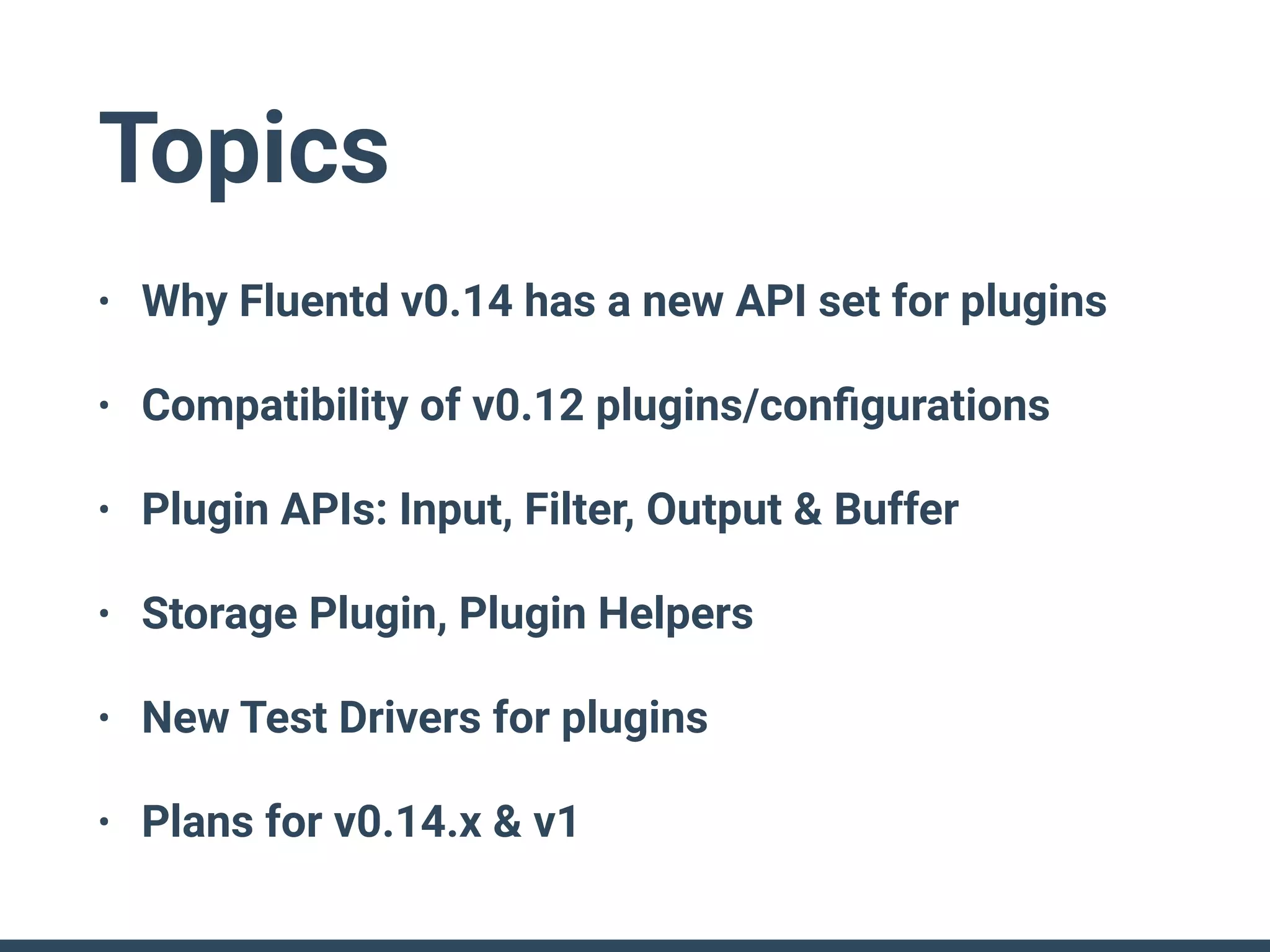
Topics
• Why Fluentd v0.14 has a new API set for plugins
• Compatibility of v0.12 plugins/configurations
• Plugin APIs: Input, Filter, Output & Buffer
• Storage Plugin, Plugin Helpers
• New Test Drivers for plugins
• Plans for v0.14.x & v1
Why Fluentd v0.14
has a New API set for plugins?
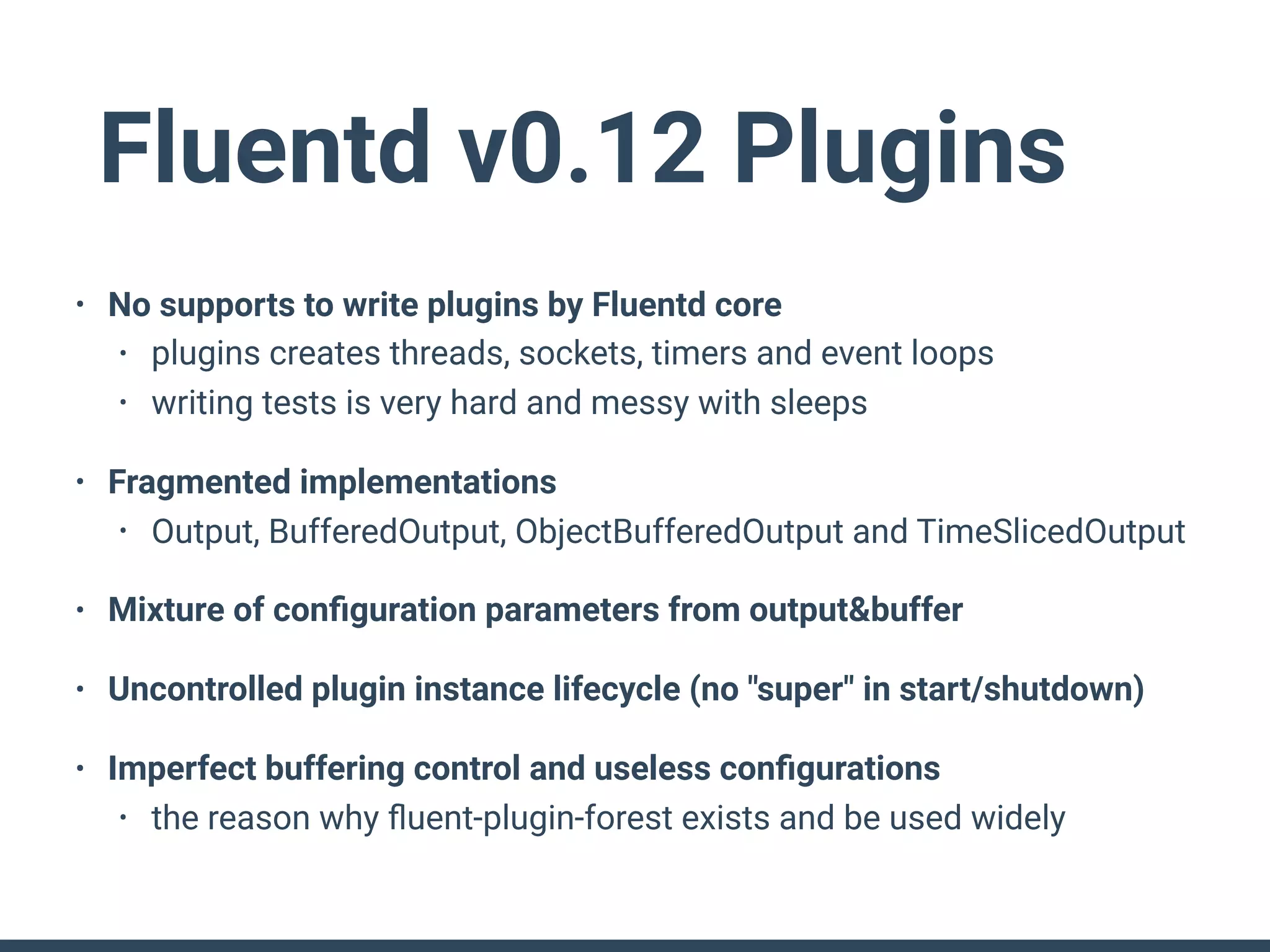
Fluentd v0.12 Plugins
• No supports to write plugins by Fluentd core
• plugins creates threads, sockets, timers and event loops
• writing tests is very hard and messy with sleeps
• Fragmented implementations
• Output, BufferedOutput, ObjectBufferedOutput and TimeSlicedOutput
• Mixture of configuration parameters from output&buffer
• Uncontrolled plugin instance lifecycle (no "super" in start/shutdown)
• Imperfect buffering control and useless configurations
• the reason why fluent-plugin-forest exists and be used widely
Fluentd v0.12 Plugins
• Insufficient buffer chunking control
• only by size, without number of events in chunks
• Forcedly synchronized buffer flushing
• no way to flush-and-commit chunks asynchronously
• Ultimate freedom for using mix-ins
• everything overrides Plugin#emit ... (the only one entry point for
events to plugins)
• no valid hook points to get metrics or something else
• Bad Ruby coding rules and practices
• too many classes at "Fluent::*" in fluent/plugin, no "require", ...
And many others!
Compatibility
of v0.12 plugins/configurations
Compatibility of plugins
• v0.12 plugins are subclass of Fluent::*
• Fluent::Input, Fluent::Filter, Fluent::Output, ...
• Compatibility layers for v0.12 plugins in v0.14
• Fluent::Compat::Klass -> Fluent::Klass (e.g., Input, Output, ...)
• it provides transformation of:
• namespaces, configuration parameters
• internal APIs, argument objects
• IT SHOULD WORK, except for :P
• 3rd party buffer plugin, part of test code
• "Engine.emit"
Compatibility of configurations
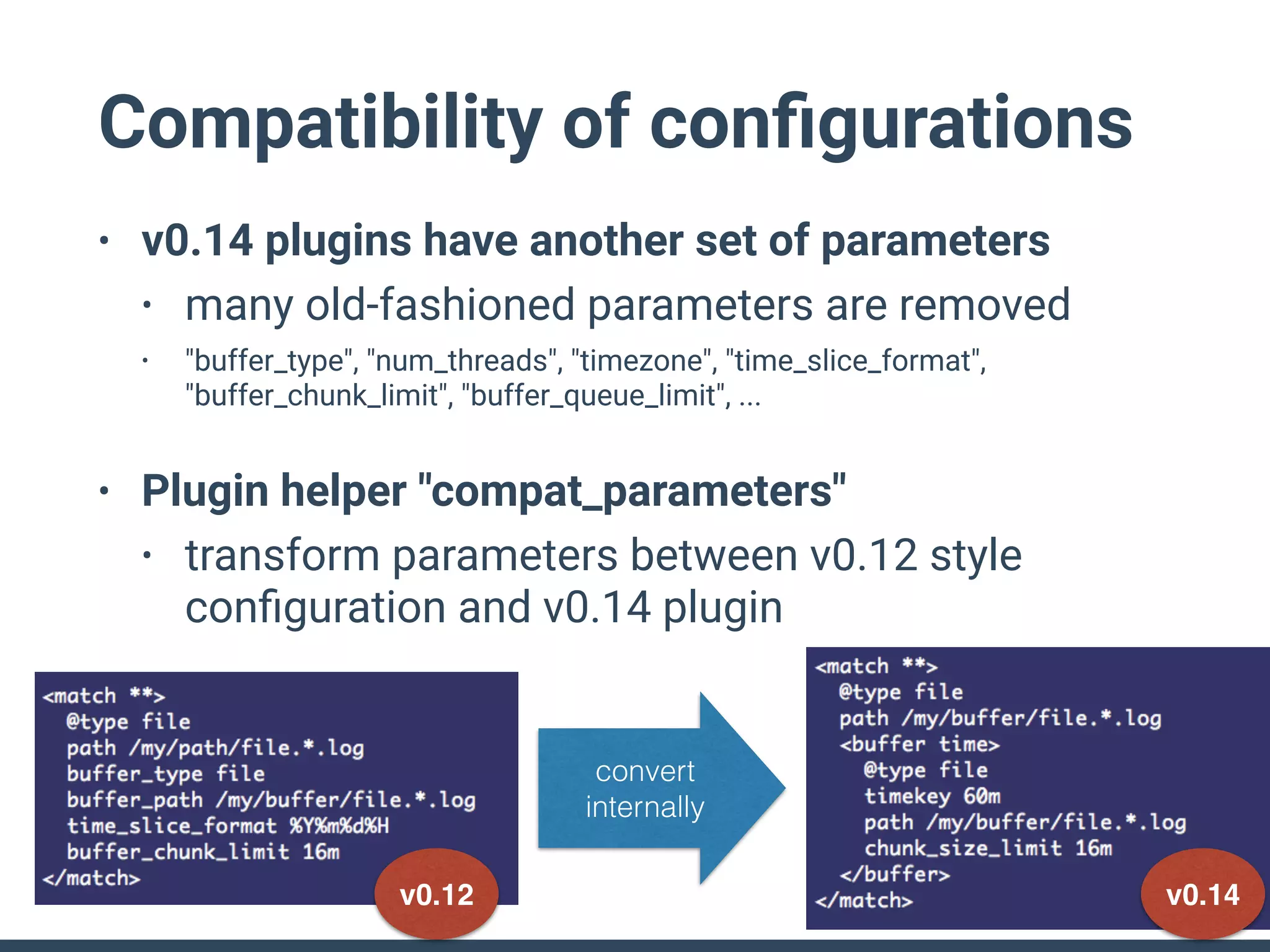
• v0.14 plugins have another set of parameters
• many old-fashioned parameters are removed
• "buffer_type", "num_threads", "timezone", "time_slice_format",
"buffer_chunk_limit", "buffer_queue_limit", ...
• Plugin helper "compat_parameters"
• transform parameters between v0.12 style
configuration and v0.14 plugin
v0.12 v0.14
convert
internally
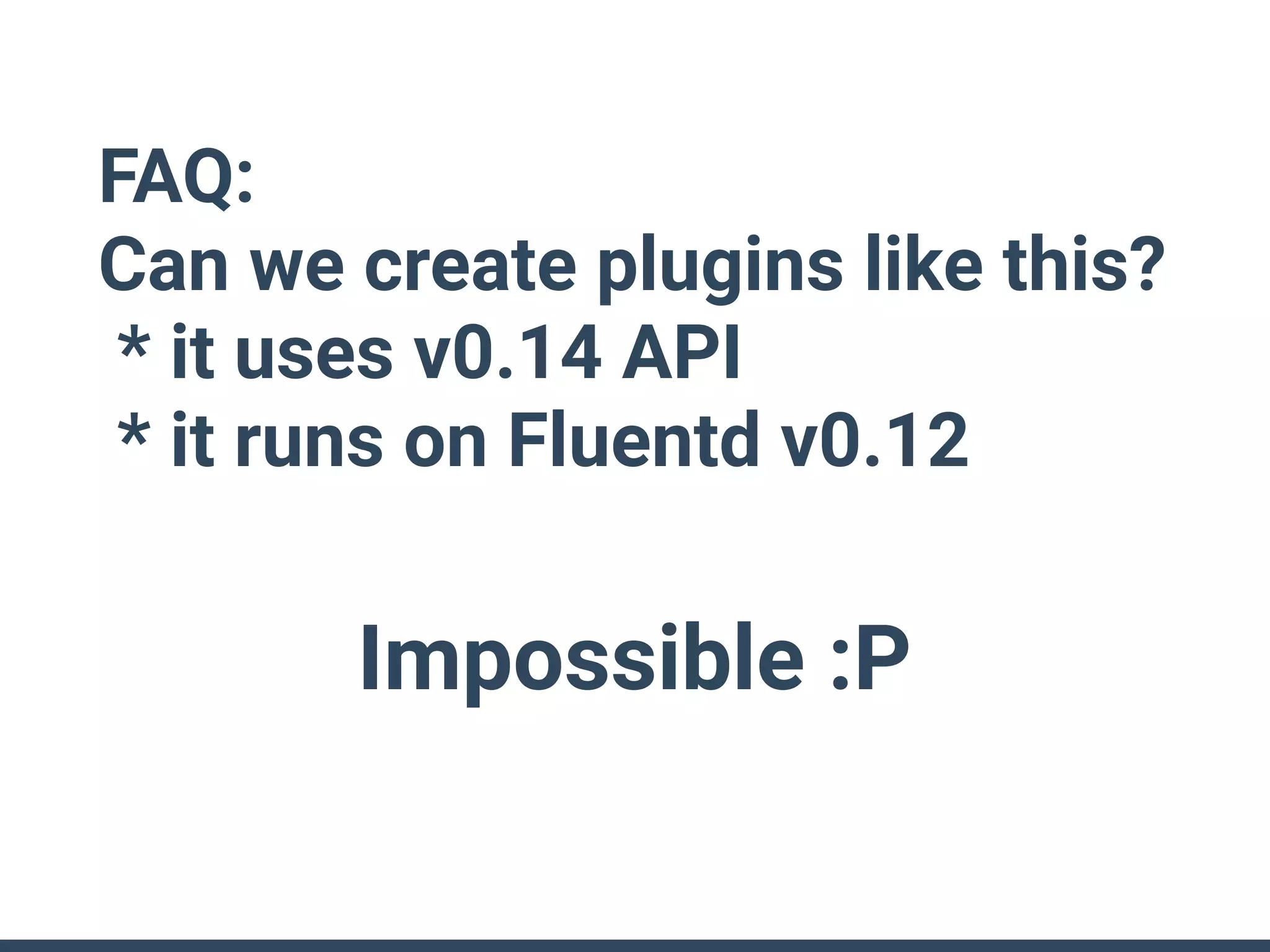
FAQ:
Can we create plugins like this?
* it uses v0.14 API
* it runs on Fluentd v0.12
Impossible :P
Overview of
v0.14 Plugin classes
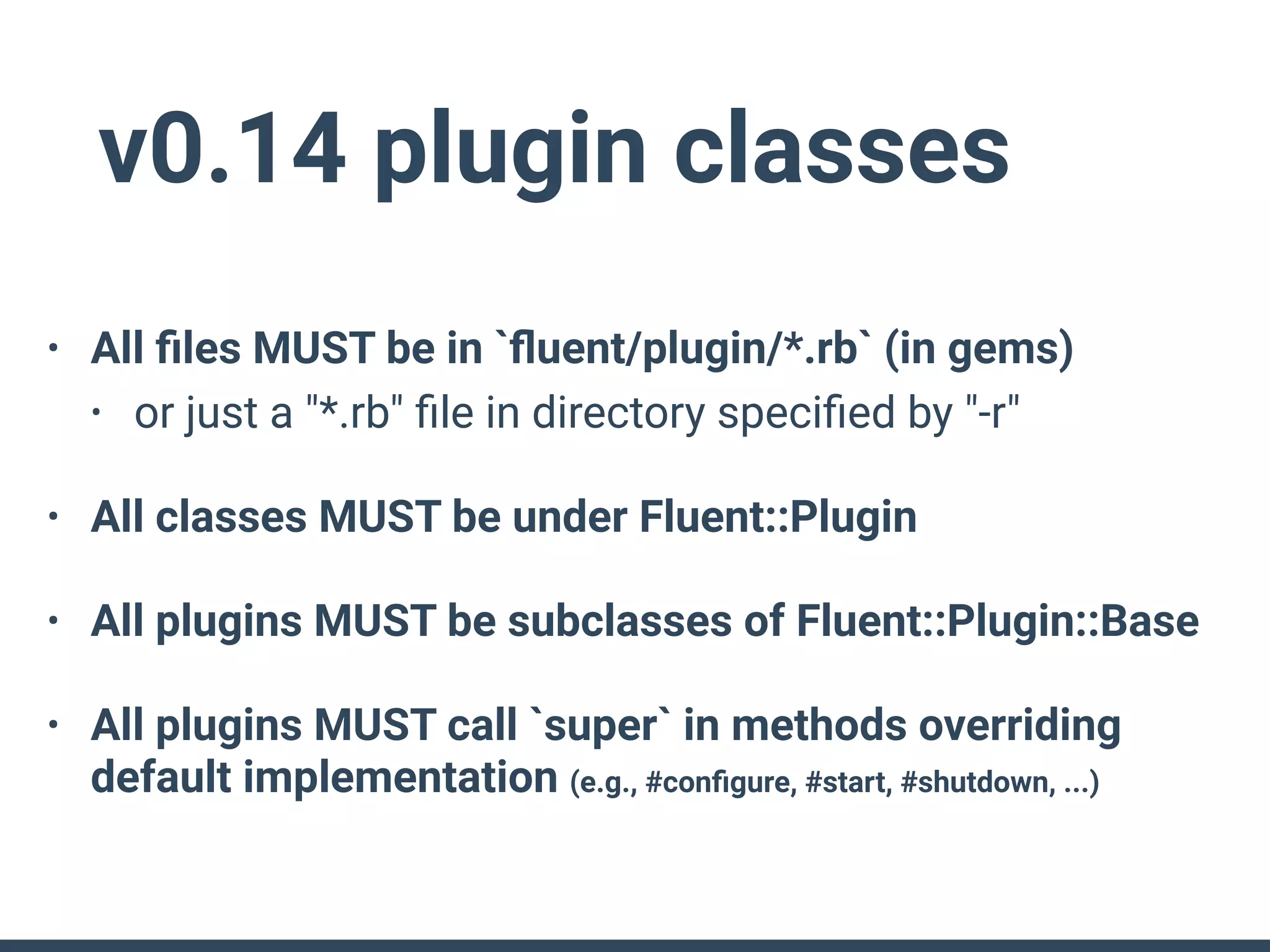
v0.14 plugin classes
• All files MUST be in `fluent/plugin/*.rb` (in gems)
• or just a "*.rb" file in directory specified by "-r"
• All classes MUST be under Fluent::Plugin
• All plugins MUST be subclasses of Fluent::Plugin::Base
• All plugins MUST call `super` in methods overriding
default implementation (e.g., #configure, #start, #shutdown, ...)
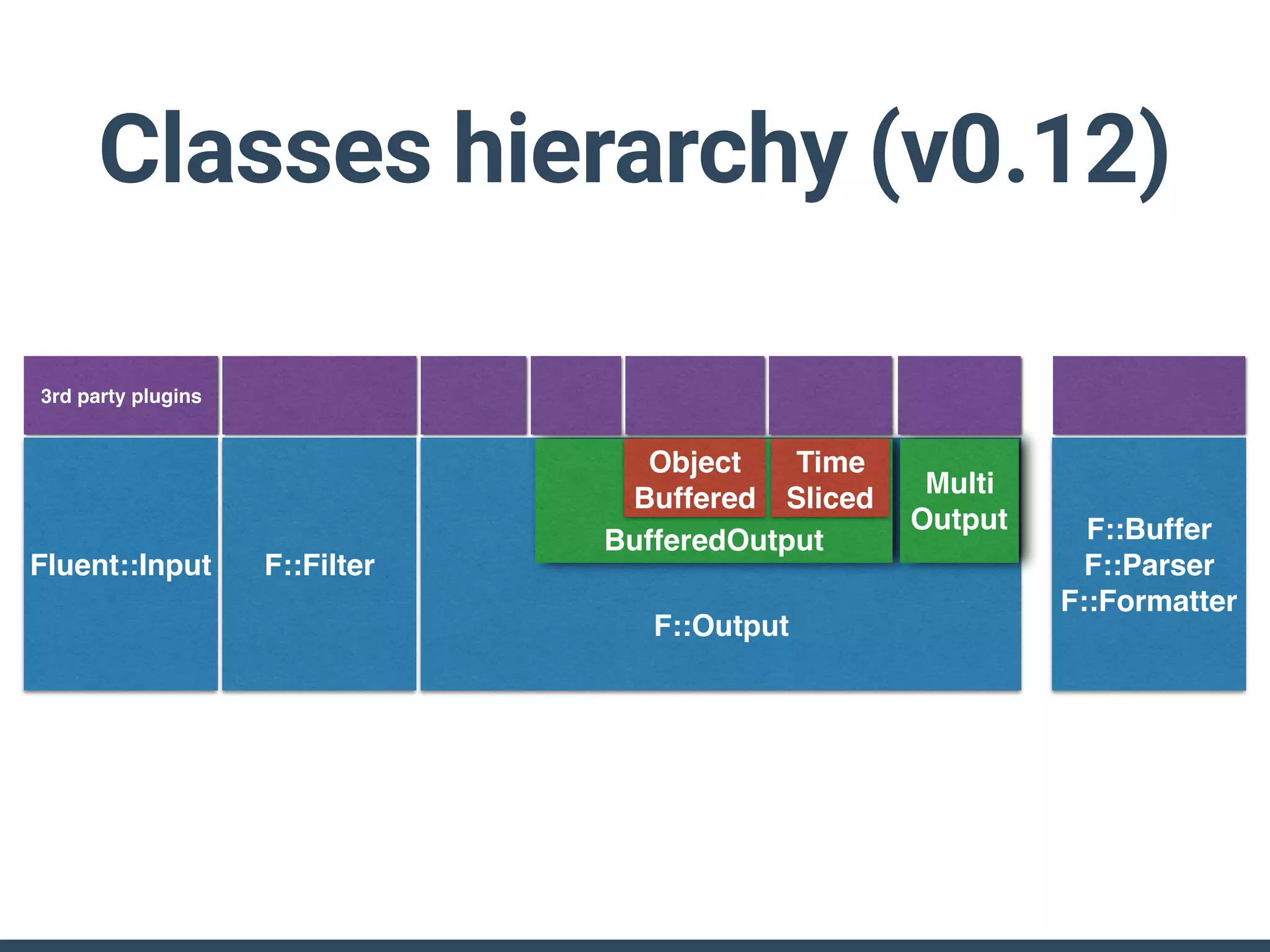
Classes hierarchy (v0.12)
Fluent::Input F::Filter
F::Output
BufferedOutput
Object
Buffered
Time
Sliced
Multi
Output F::Buffer
F::Parser
F::Formatter
3rd party plugins
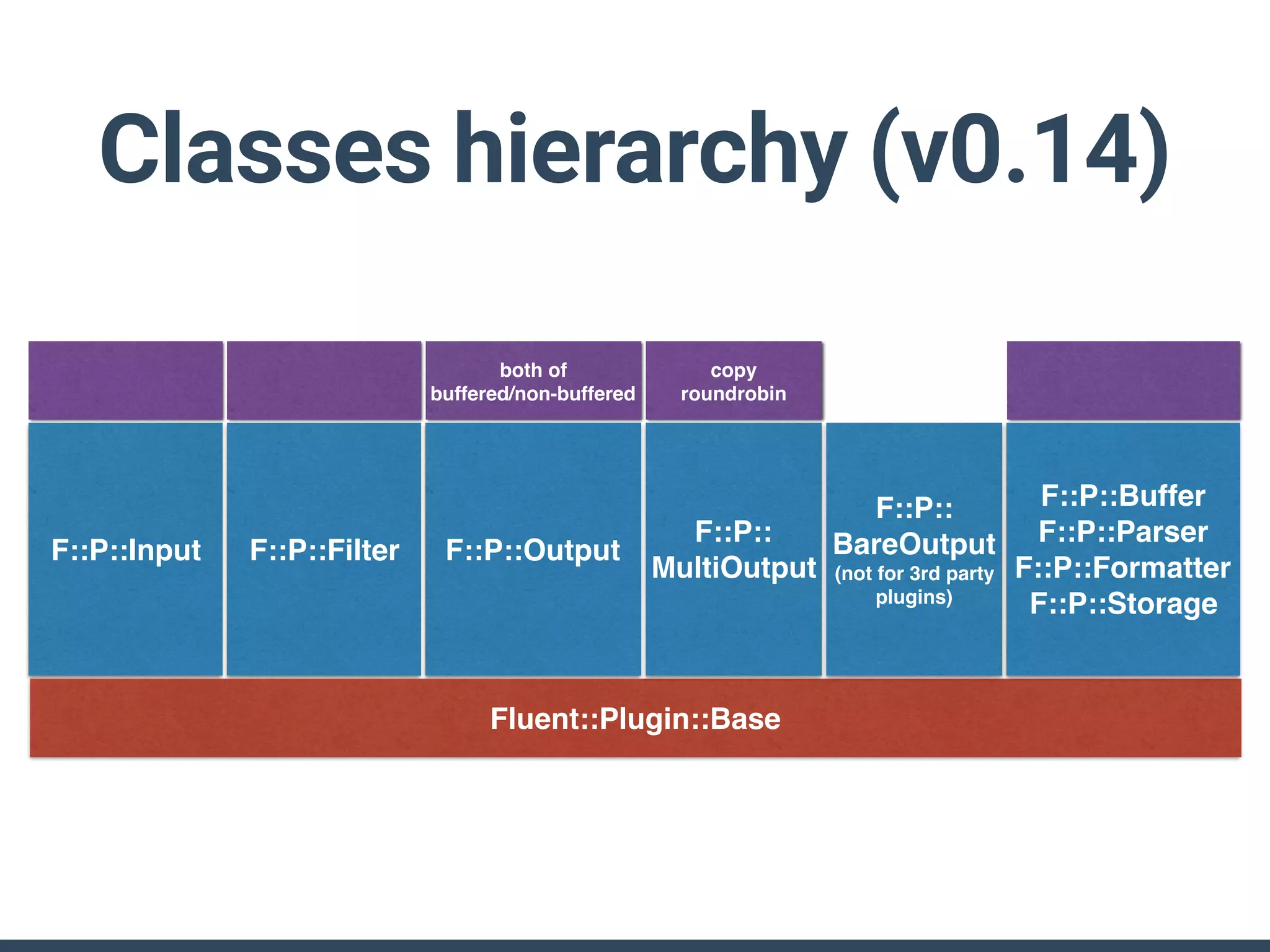
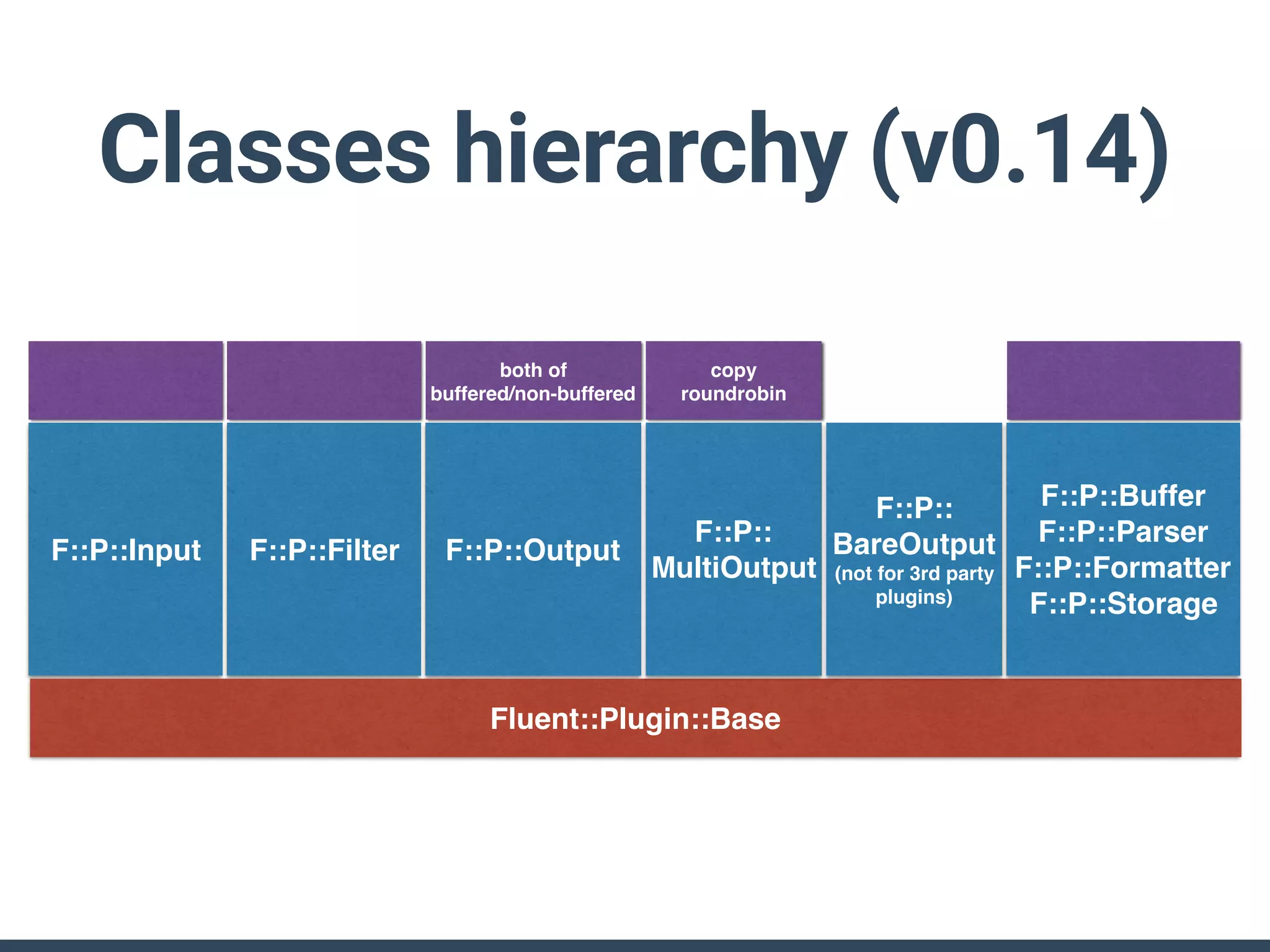
Classes hierarchy (v0.14)
F::P::Input F::P::Filter F::P::Output
Fluent::Plugin::Base
F::P::Buffer
F::P::Parser
F::P::Formatter
F::P::Storage
both of
buffered/non-buffered
F::P::
BareOutput
(not for 3rd party
plugins)
F::P::
MultiOutput
copy
roundrobin
Tour of New Plugin APIs:
Fluent::Plugin::Input
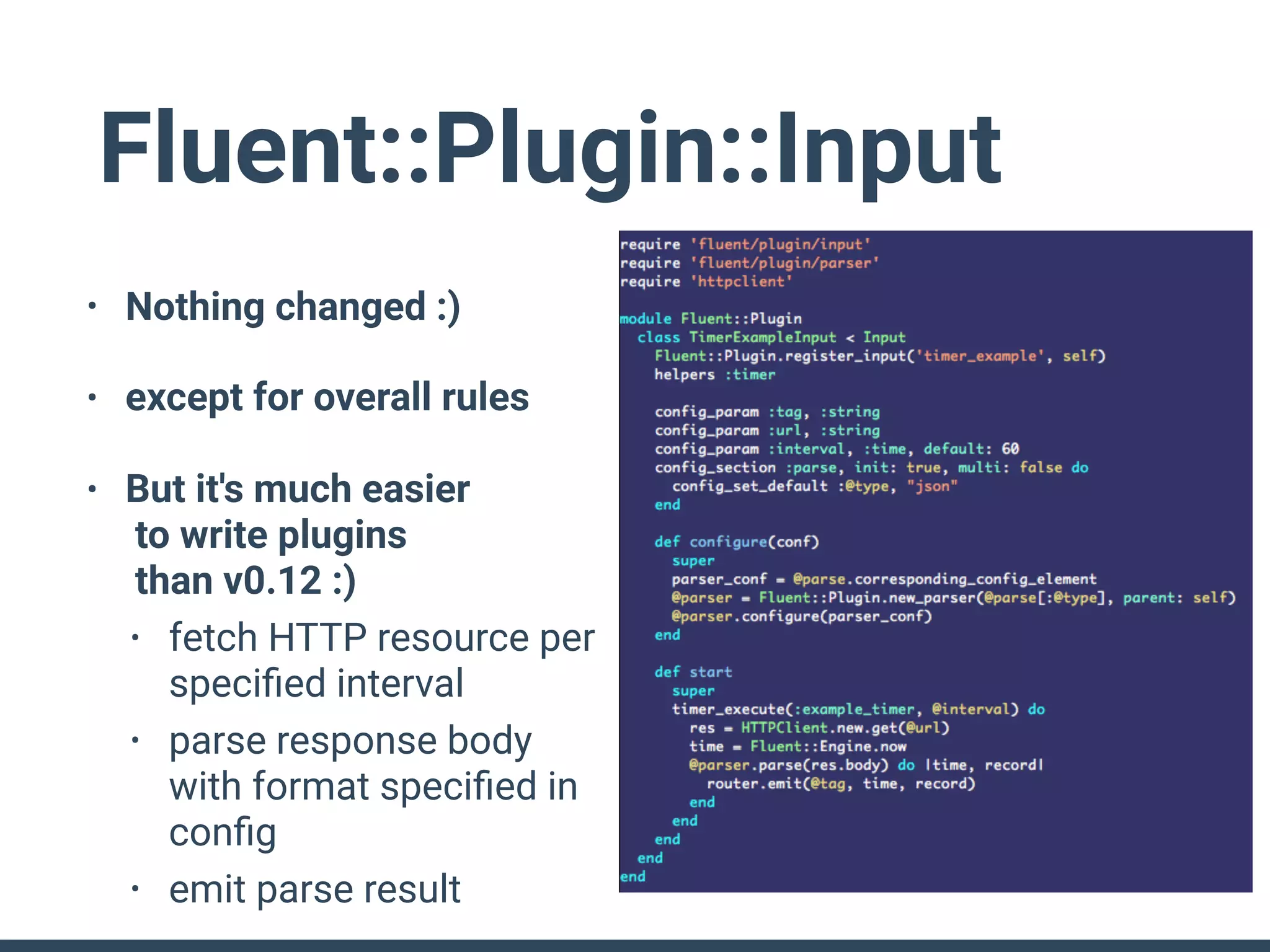
• Nothing changed :)
• except for overall rules
• But it's much easier

to write plugins

than v0.12 :)
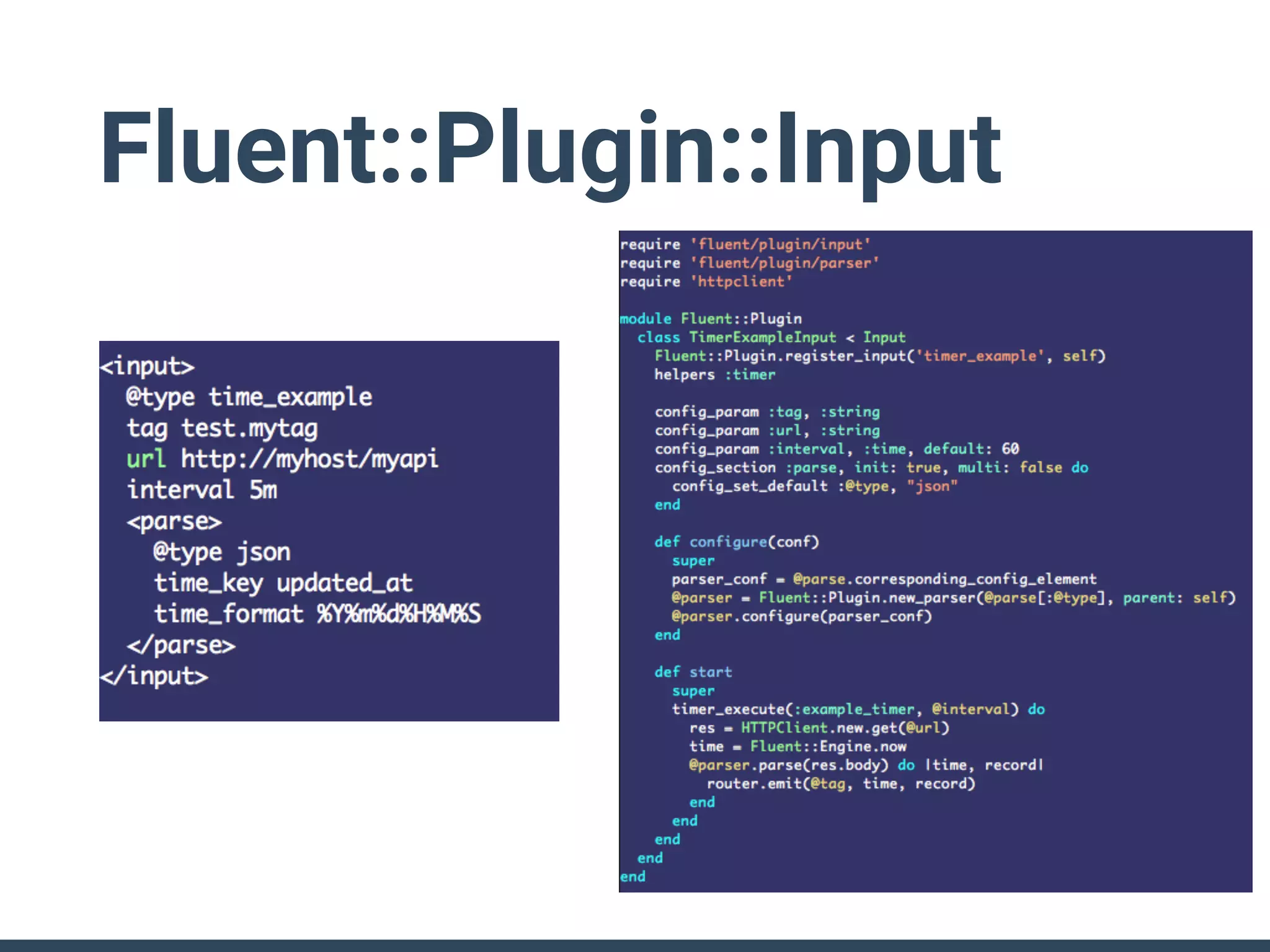
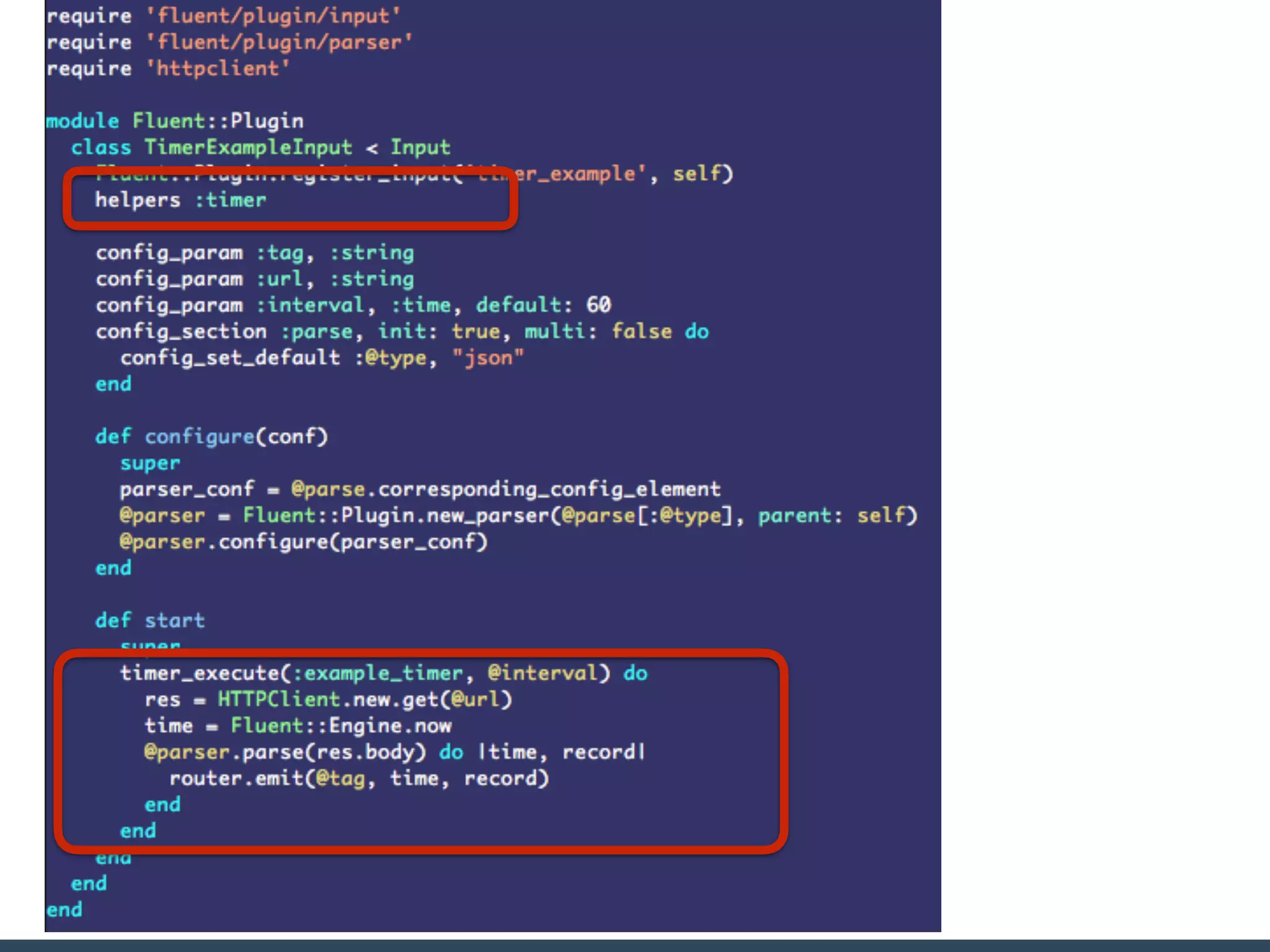
• fetch HTTP resource per
specified interval
• parse response body
with format specified in
config
• emit parse result
Fluent::Plugin::Input
Tour of New Plugin APIs:
Fluent::Plugin::Filter
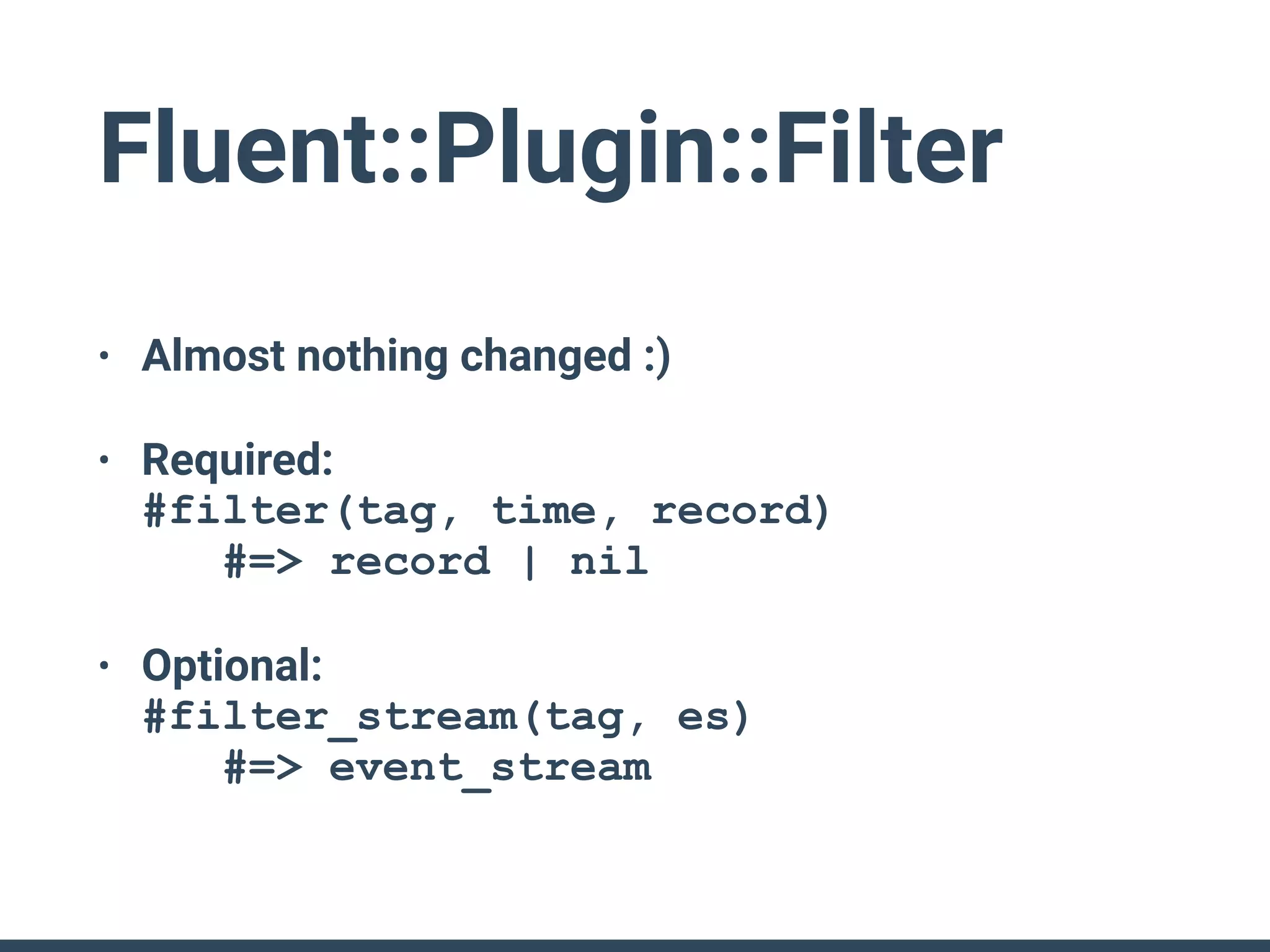
• Almost nothing changed :)
• Required:

#filter(tag, time, record)

#=> record | nil
• Optional:

#filter_stream(tag, es)

#=> event_stream
Tour of New Plugin APIs:
Fluent::Plugin::Output
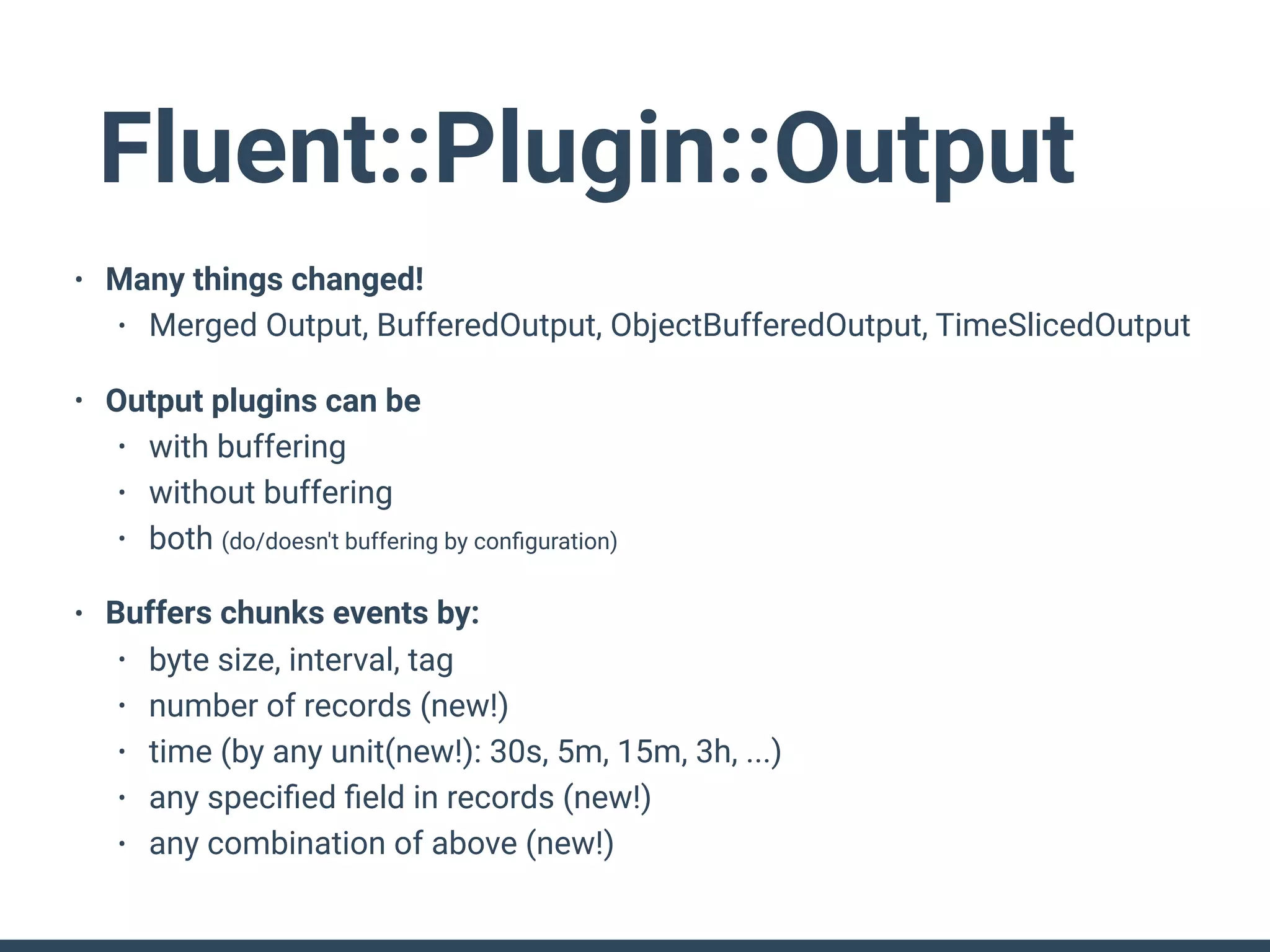
• Many things changed!
• Merged Output, BufferedOutput, ObjectBufferedOutput, TimeSlicedOutput
• Output plugins can be
• with buffering
• without buffering
• both (do/doesn't buffering by configuration)
• Buffers chunks events by:
• byte size, interval, tag
• number of records (new!)
• time (by any unit(new!): 30s, 5m, 15m, 3h, ...)
• any specified field in records (new!)
• any combination of above (new!)
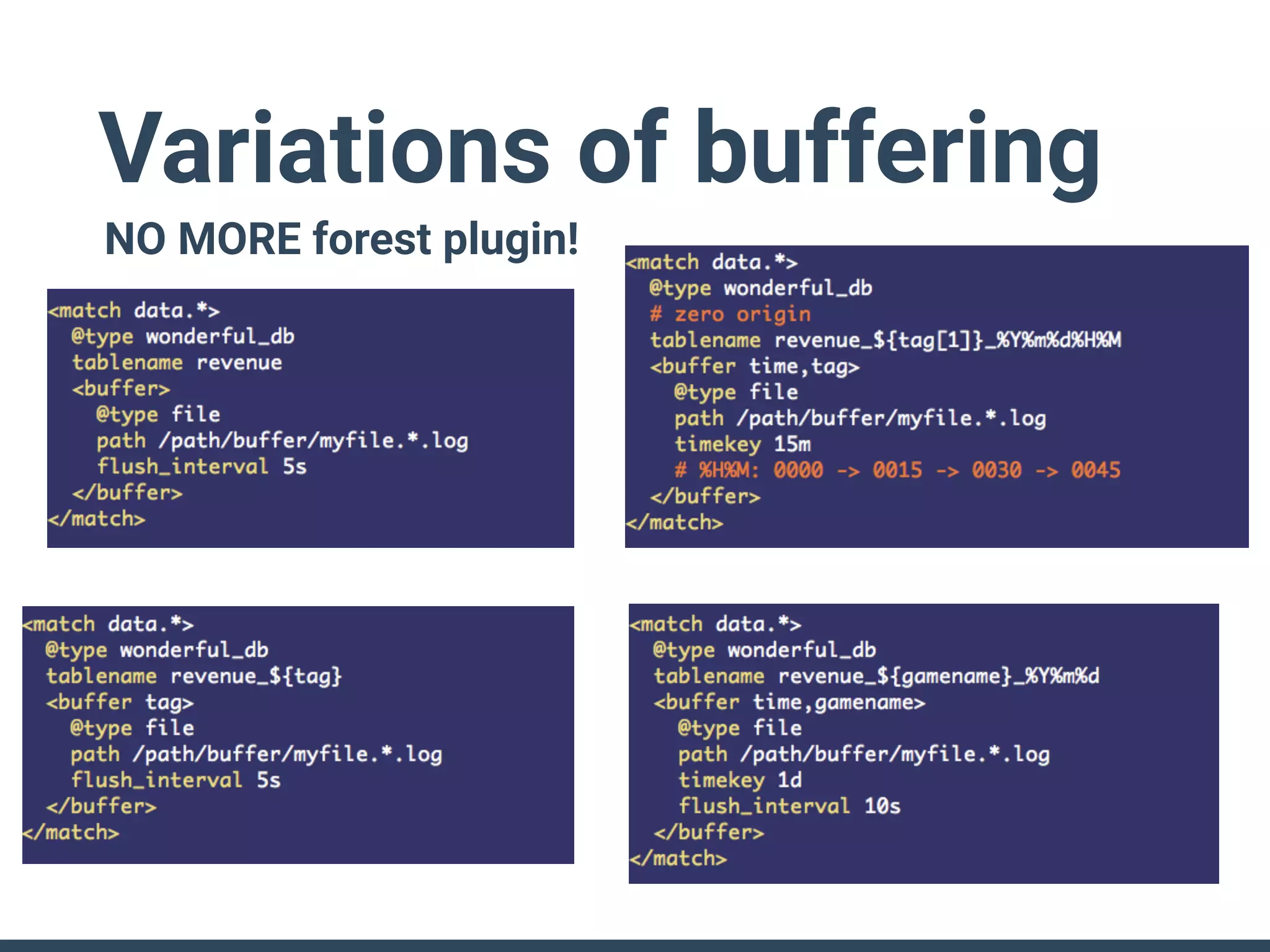
Variations of buffering
NO MORE forest plugin!
Output Plugin:
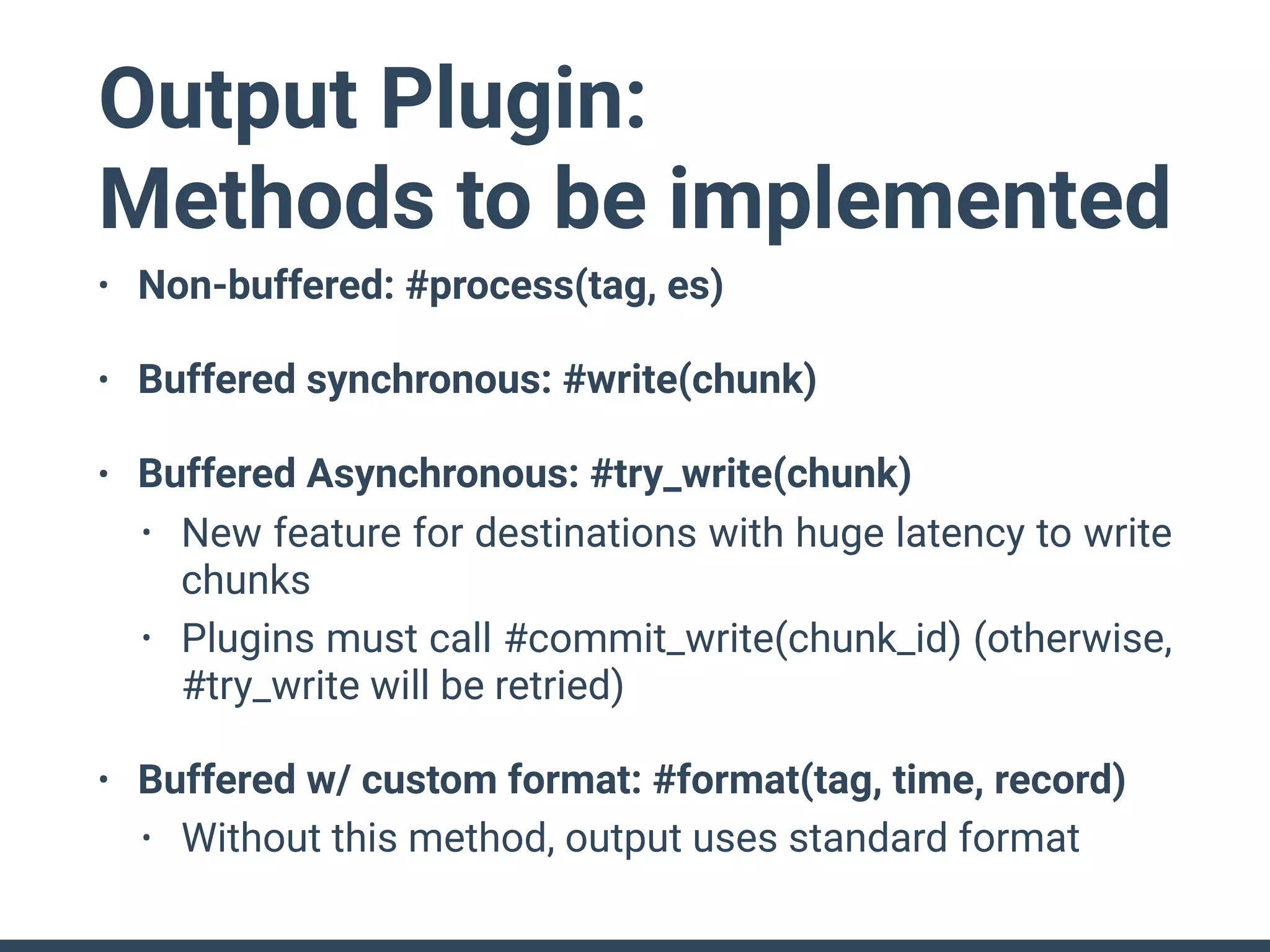
Methods to be implemented
• Non-buffered: #process(tag, es)
• Buffered synchronous: #write(chunk)
• Buffered Asynchronous: #try_write(chunk)
• New feature for destinations with huge latency to write
chunks
• Plugins must call #commit_write(chunk_id) (otherwise,
#try_write will be retried)
• Buffered w/ custom format: #format(tag, time, record)
• Without this method, output uses standard format
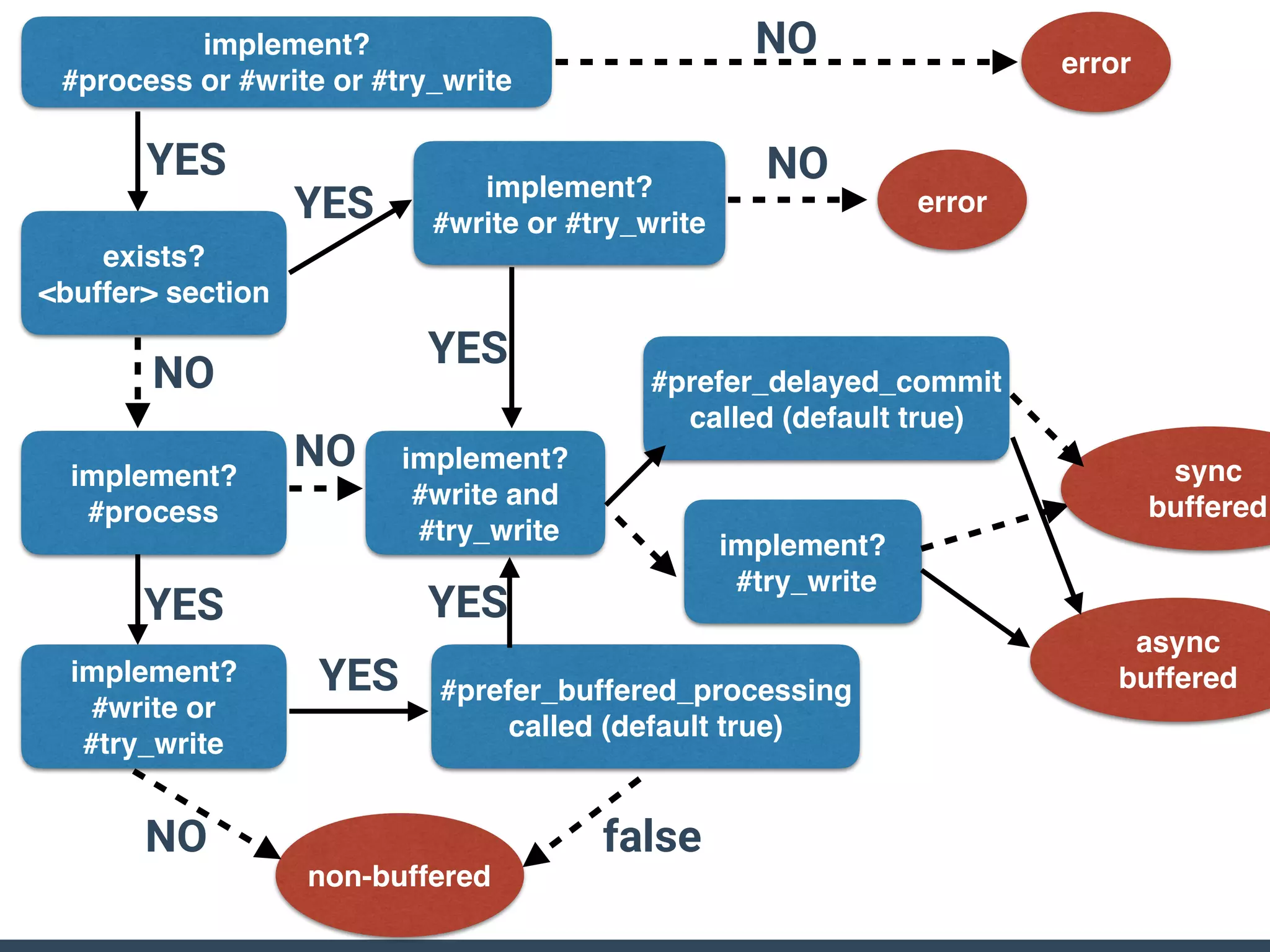
implement?
#process
implement?
#process or #write or #try_write
NO error
YES
#prefer_buffered_processing
called (default true)
NO
non-buffered
YES
exists?
<buffer> section
YES implement?
#write or #try_write
error
NO
YES
implement?
#write or
#try_write
NO
NO
YES
false
implement?
#write and
#try_write
YES
#prefer_delayed_commit
called (default true)
implement?
#try_write
sync
buffered
async
buffered
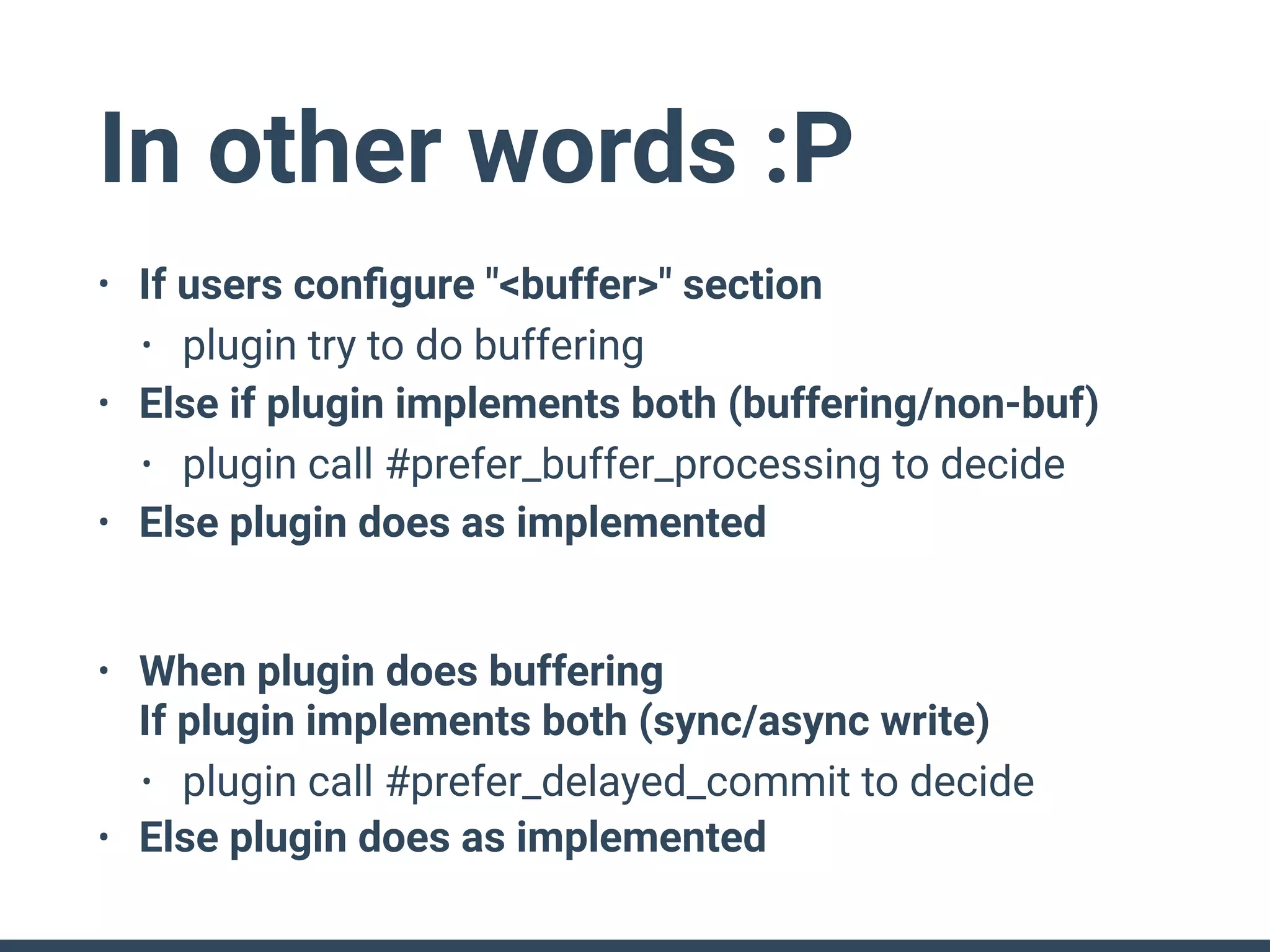
In other words :P
• If users configure "<buffer>" section
• plugin try to do buffering
• Else if plugin implements both (buffering/non-buf)
• plugin call #prefer_buffer_processing to decide
• Else plugin does as implemented
• When plugin does buffering

If plugin implements both (sync/async write)
• plugin call #prefer_delayed_commit to decide
• Else plugin does as implemented
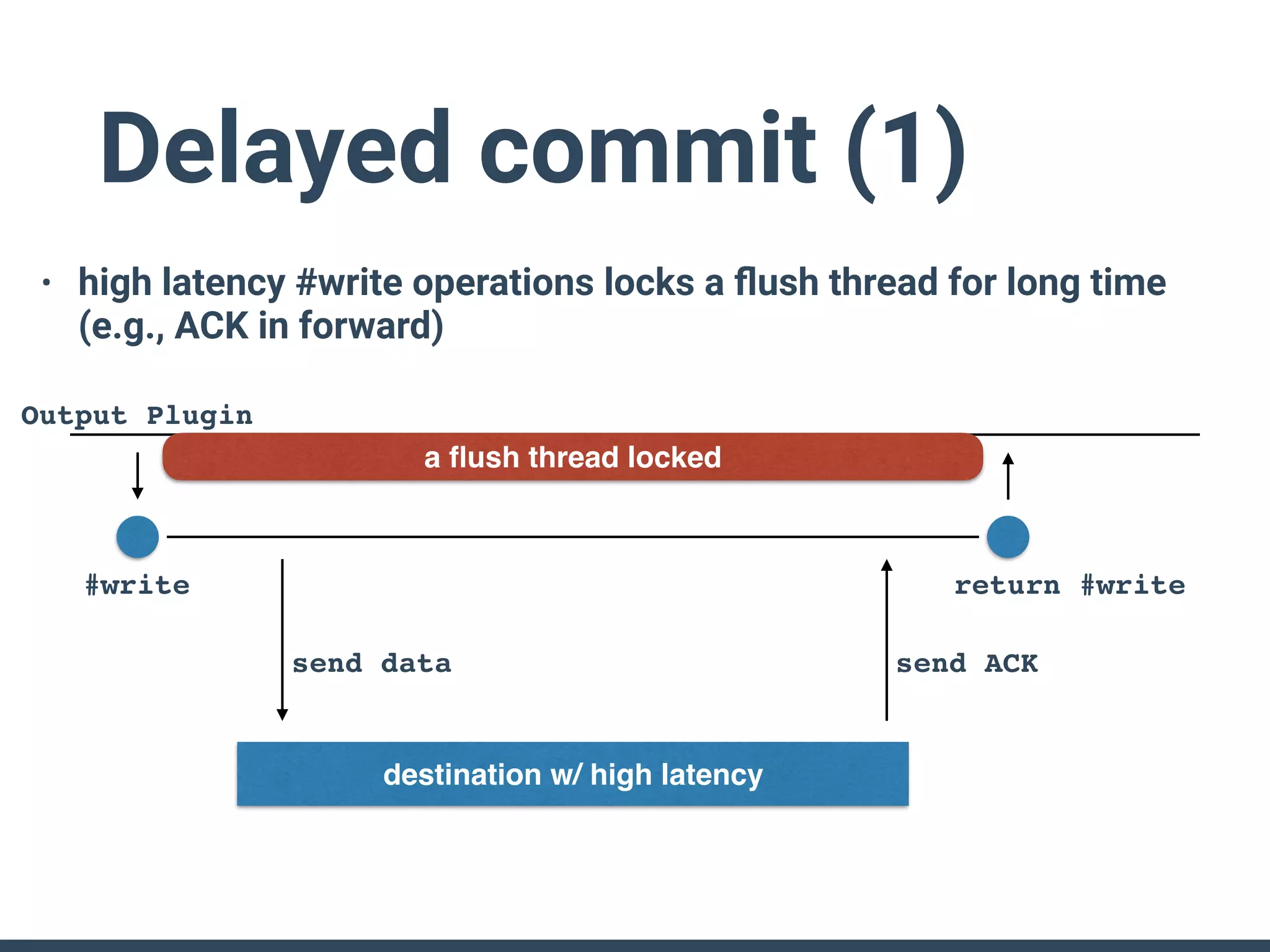
Delayed commit (1)
• high latency #write operations locks a flush thread for long time

(e.g., ACK in forward)
destination w/ high latency
#write
Output Plugin
send data send ACK
return #write
a flush thread locked
Delayed commit (2)
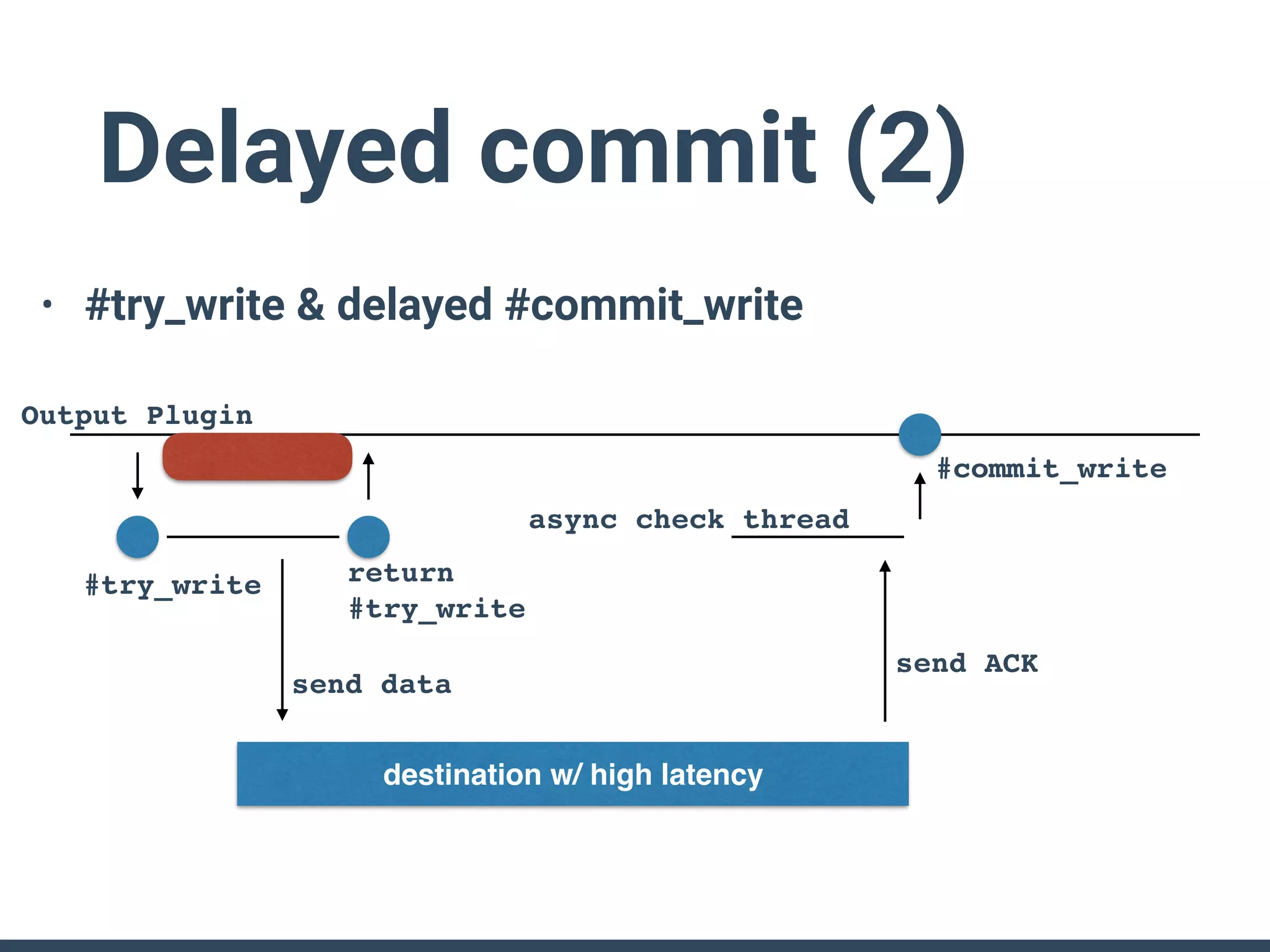
• #try_write & delayed #commit_write
destination w/ high latency
#try_write
Output Plugin
send data
send ACK
return
#try_write
async check thread
#commit_write
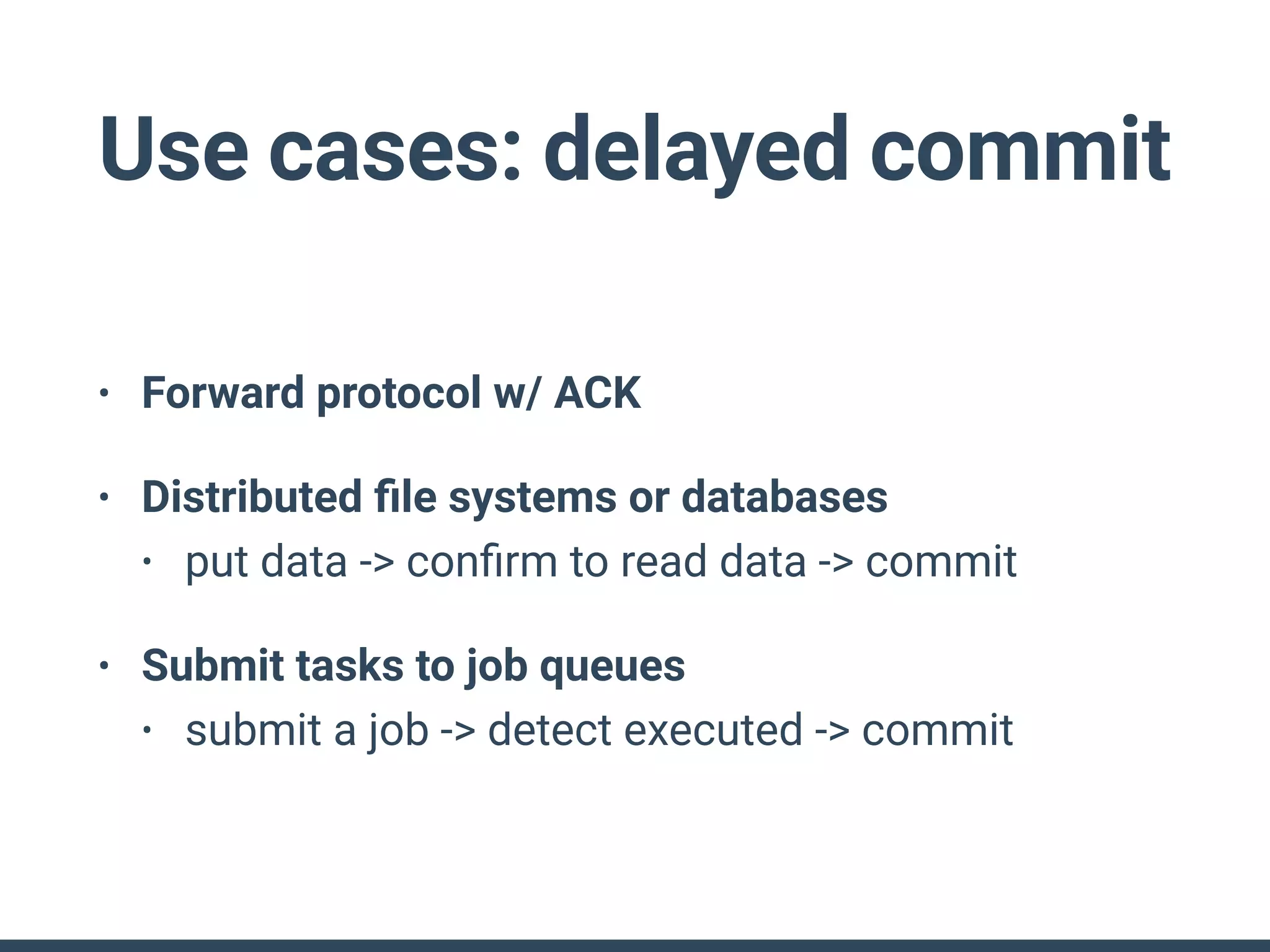
Use cases: delayed commit
• Forward protocol w/ ACK
• Distributed file systems or databases
• put data -> confirm to read data -> commit
• Submit tasks to job queues
• submit a job -> detect executed -> commit
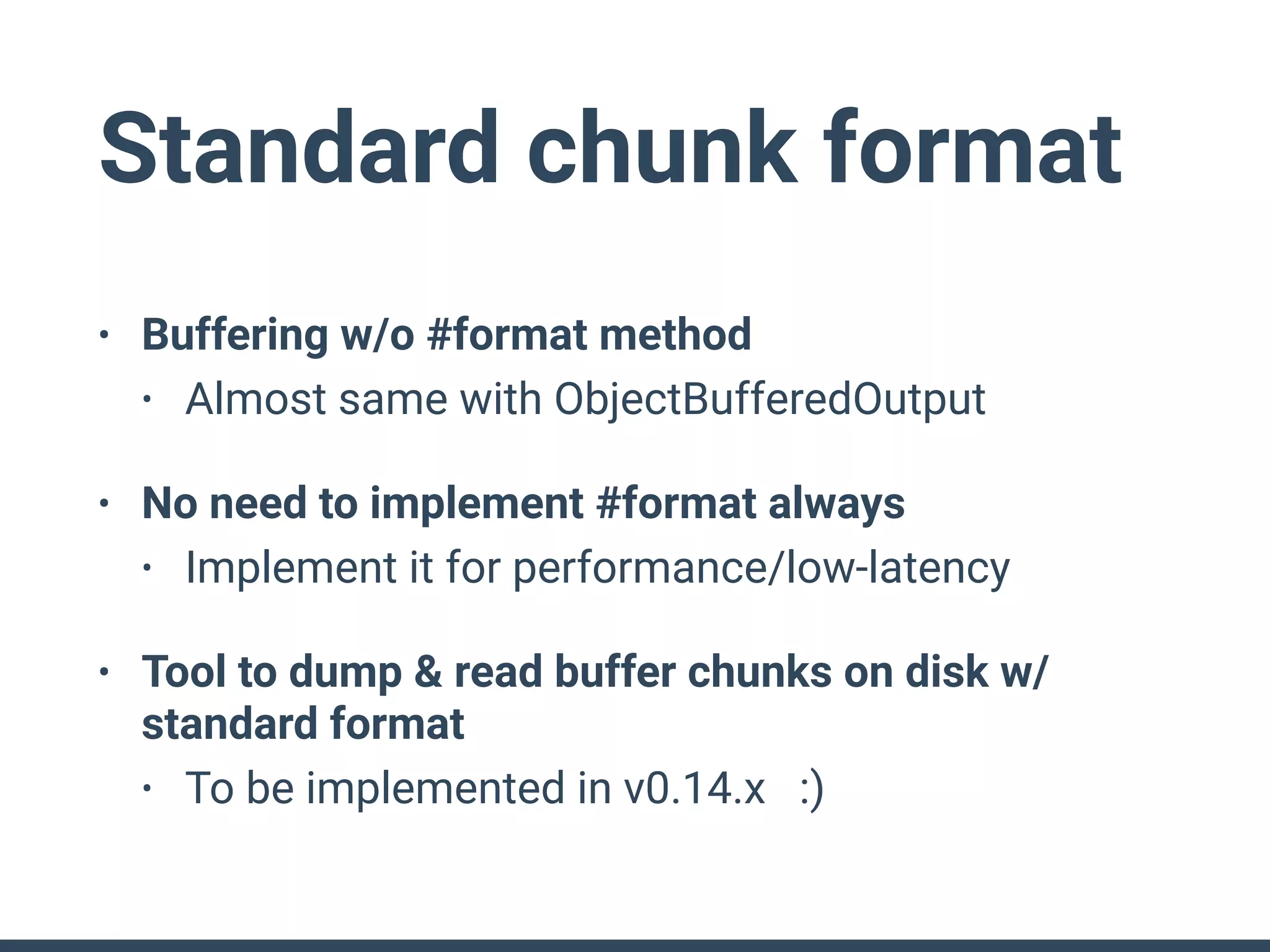
Standard chunk format
• Buffering w/o #format method
• Almost same with ObjectBufferedOutput
• No need to implement #format always
• Implement it for performance/low-latency
• Tool to dump & read buffer chunks on disk w/
standard format
• To be implemented in v0.14.x :)
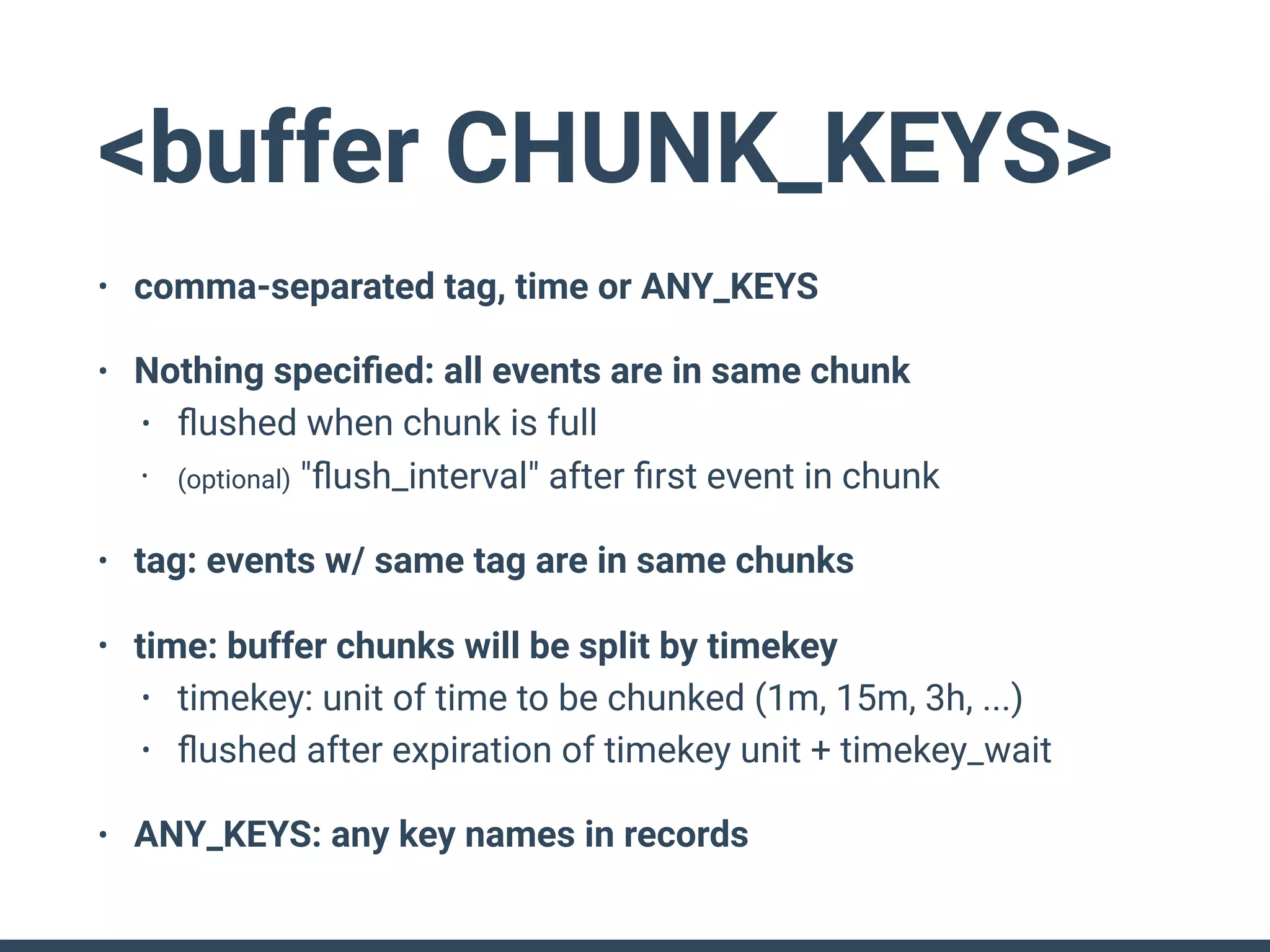
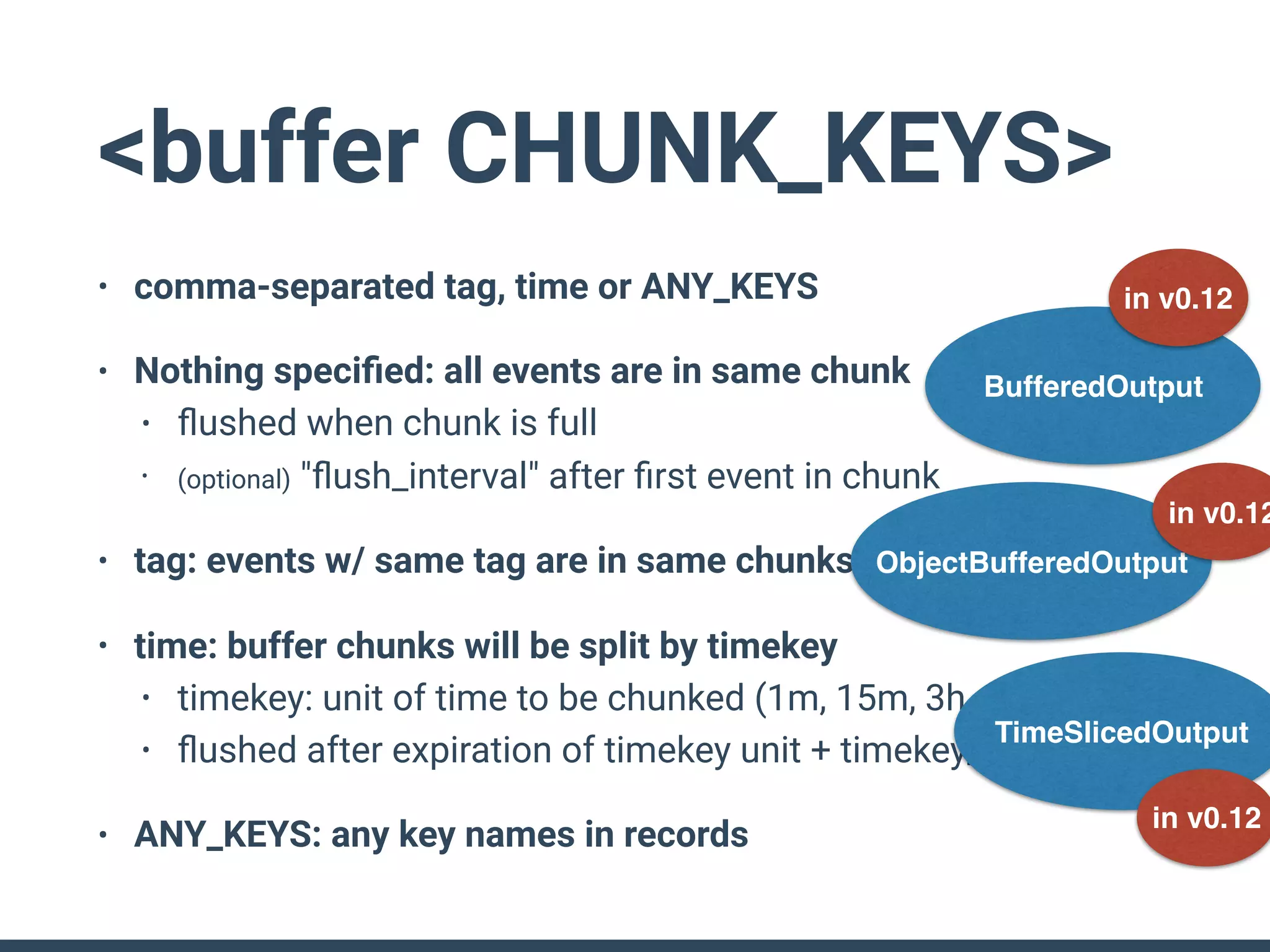
<buffer CHUNK_KEYS>
• comma-separated tag, time or ANY_KEYS
• Nothing specified: all events are in same chunk
• flushed when chunk is full
• (optional) "flush_interval" after first event in chunk
• tag: events w/ same tag are in same chunks
• time: buffer chunks will be split by timekey
• timekey: unit of time to be chunked (1m, 15m, 3h, ...)
• flushed after expiration of timekey unit + timekey_wait
• ANY_KEYS: any key names in records
• comma-separated tag, time or ANY_KEYS
• Nothing specified: all events are in same chunk
• flushed when chunk is full
• (optional) "flush_interval" after first event in chunk
• tag: events w/ same tag are in same chunks
• time: buffer chunks will be split by timekey
• timekey: unit of time to be chunked (1m, 15m, 3h, ...)
• flushed after expiration of timekey unit + timekey_wait
• ANY_KEYS: any key names in records
<buffer CHUNK_KEYS>
BufferedOutput
TimeSlicedOutput
ObjectBufferedOutput
in v0.12
in v0.12
in v0.12
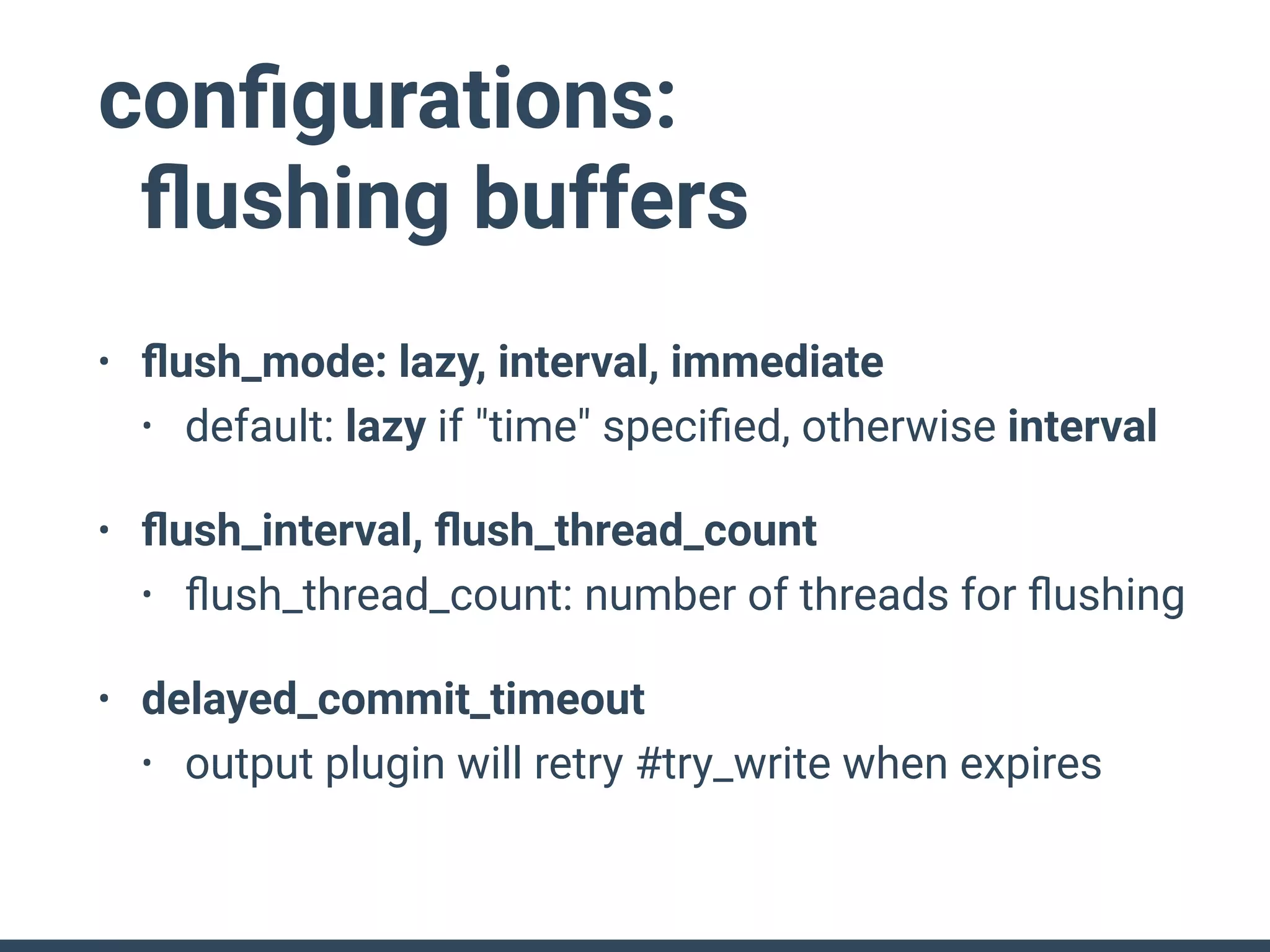
configurations:

flushing buffers
• flush_mode: lazy, interval, immediate
• default: lazy if "time" specified, otherwise interval
• flush_interval, flush_thread_count
• flush_thread_count: number of threads for flushing
• delayed_commit_timeout
• output plugin will retry #try_write when expires
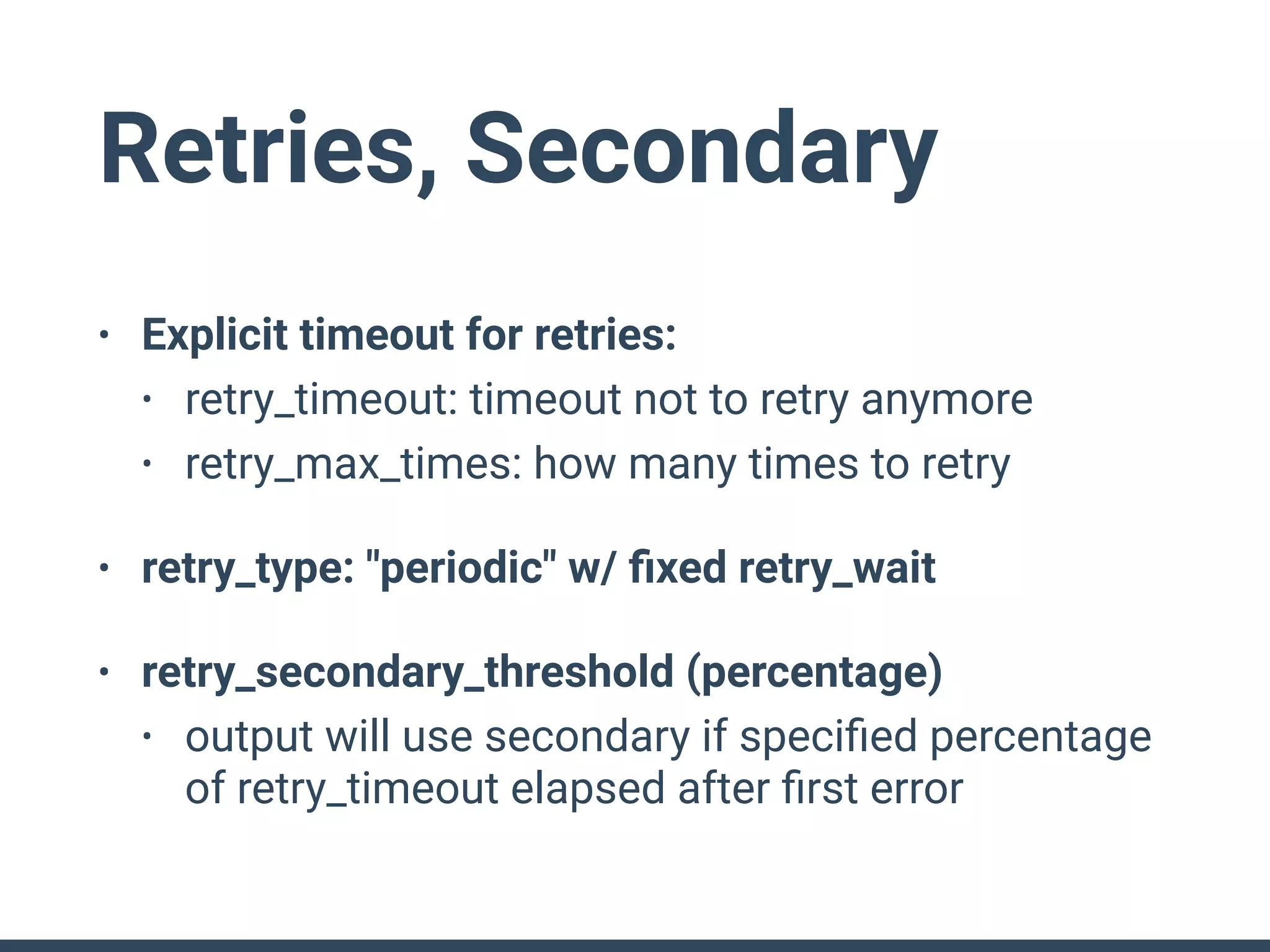
Retries, Secondary
• Explicit timeout for retries:
• retry_timeout: timeout not to retry anymore
• retry_max_times: how many times to retry
• retry_type: "periodic" w/ fixed retry_wait
• retry_secondary_threshold (percentage)
• output will use secondary if specified percentage
of retry_timeout elapsed after first error
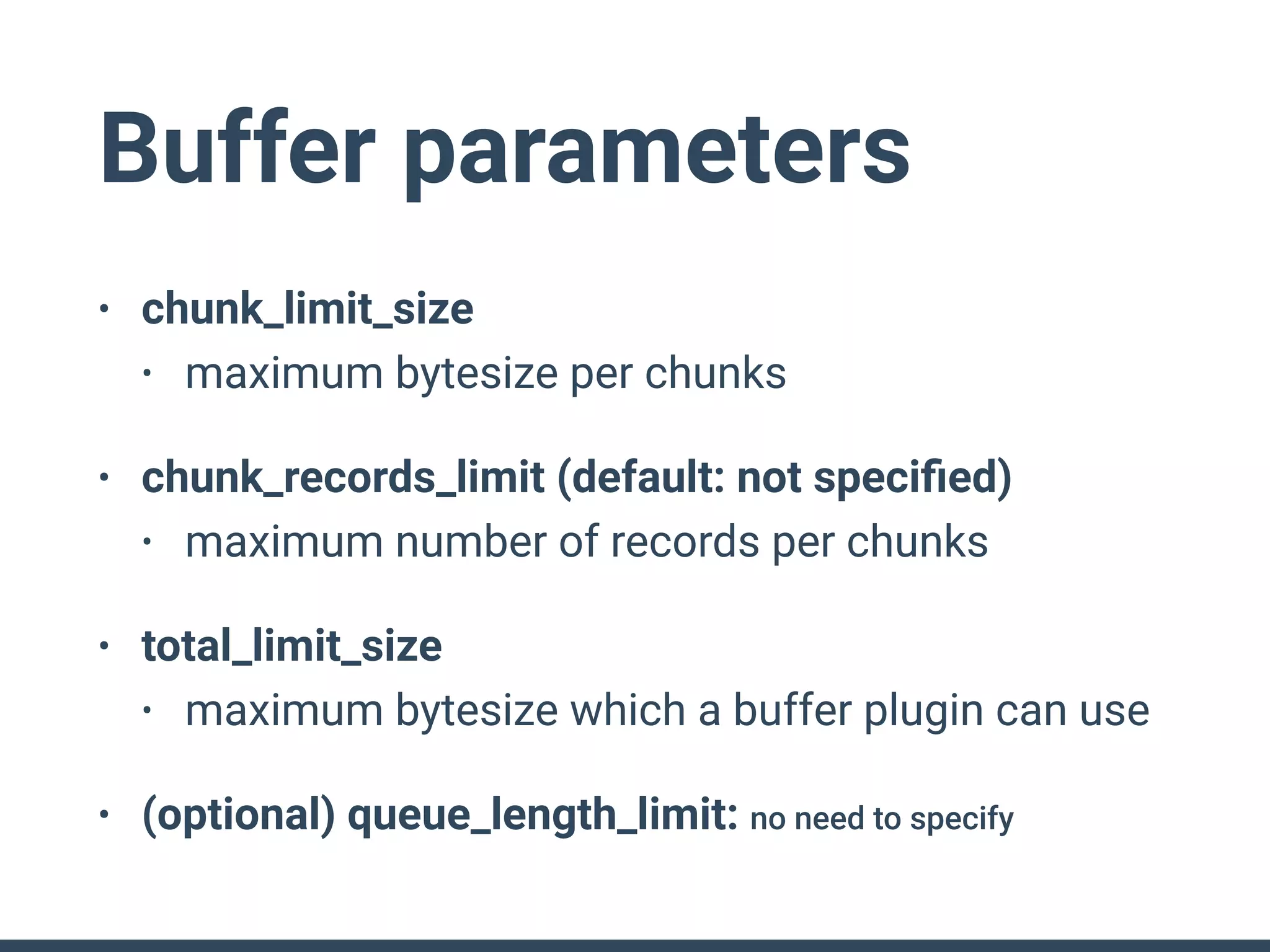
Buffer parameters
• chunk_limit_size
• maximum bytesize per chunks
• chunk_records_limit (default: not specified)
• maximum number of records per chunks
• total_limit_size
• maximum bytesize which a buffer plugin can use
• (optional) queue_length_limit: no need to specify
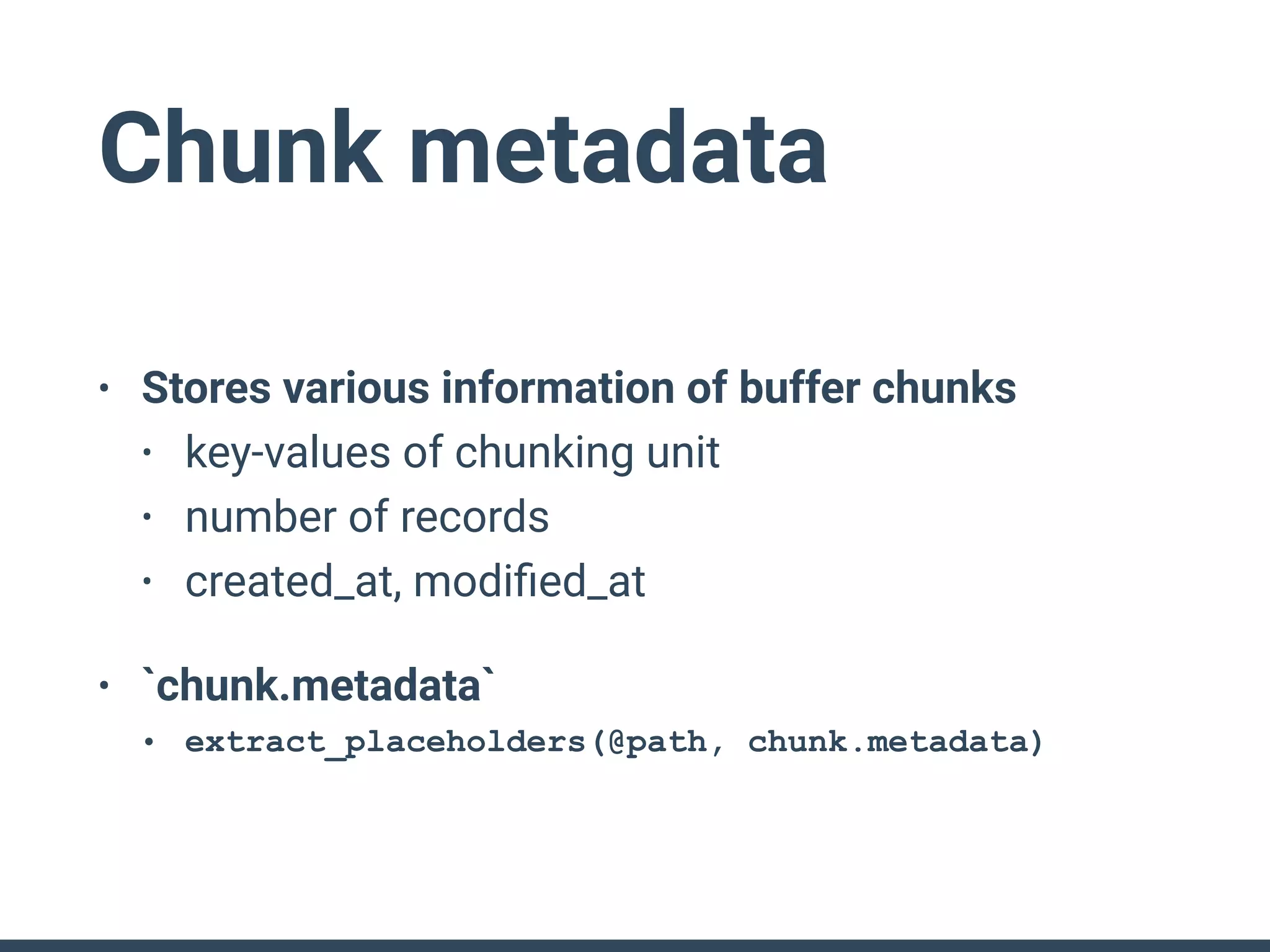
Chunk metadata
• Stores various information of buffer chunks
• key-values of chunking unit
• number of records
• created_at, modified_at
• `chunk.metadata`
• extract_placeholders(@path, chunk.metadata)
Tour of New Plugin APIs:
Other plugin types
Classes hierarchy (v0.14)
F::P::Input F::P::Filter F::P::Output
Fluent::Plugin::Base
F::P::Buffer
F::P::Parser
F::P::Formatter
F::P::Storage
both of
buffered/non-buffered
F::P::
BareOutput
(not for 3rd party
plugins)
F::P::
MultiOutput
copy
roundrobin
Classes hierarchy (v0.14)
F::P::Input F::P::Filter F::P::Output
Fluent::Plugin::Base
F::P::Buffer
F::P::Parser
F::P::Formatter
F::P::Storage
both of
buffered/non-buffered
F::P::
BareOutput
(not for 3rd party
plugins)
F::P::
MultiOutput
copy
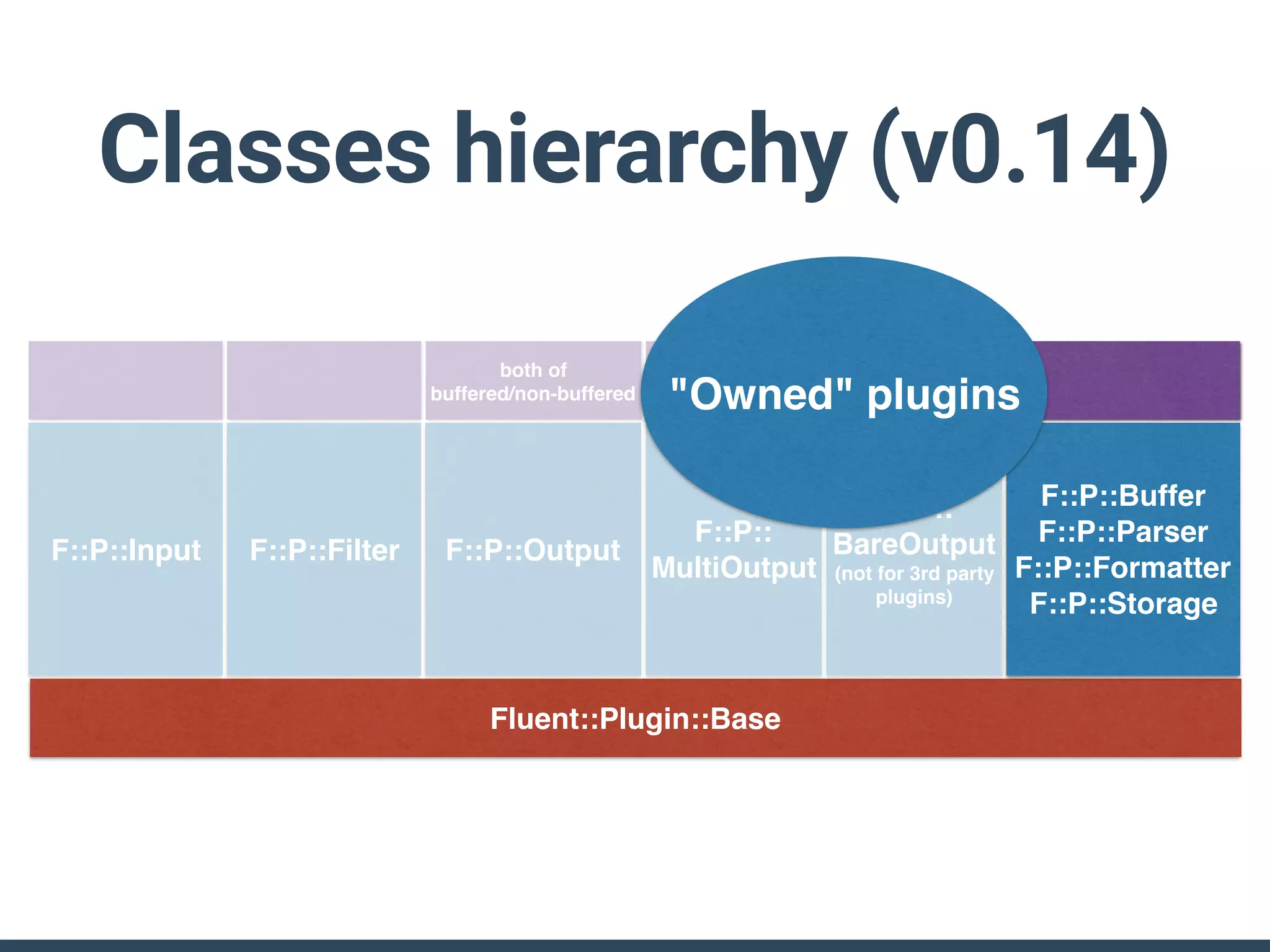
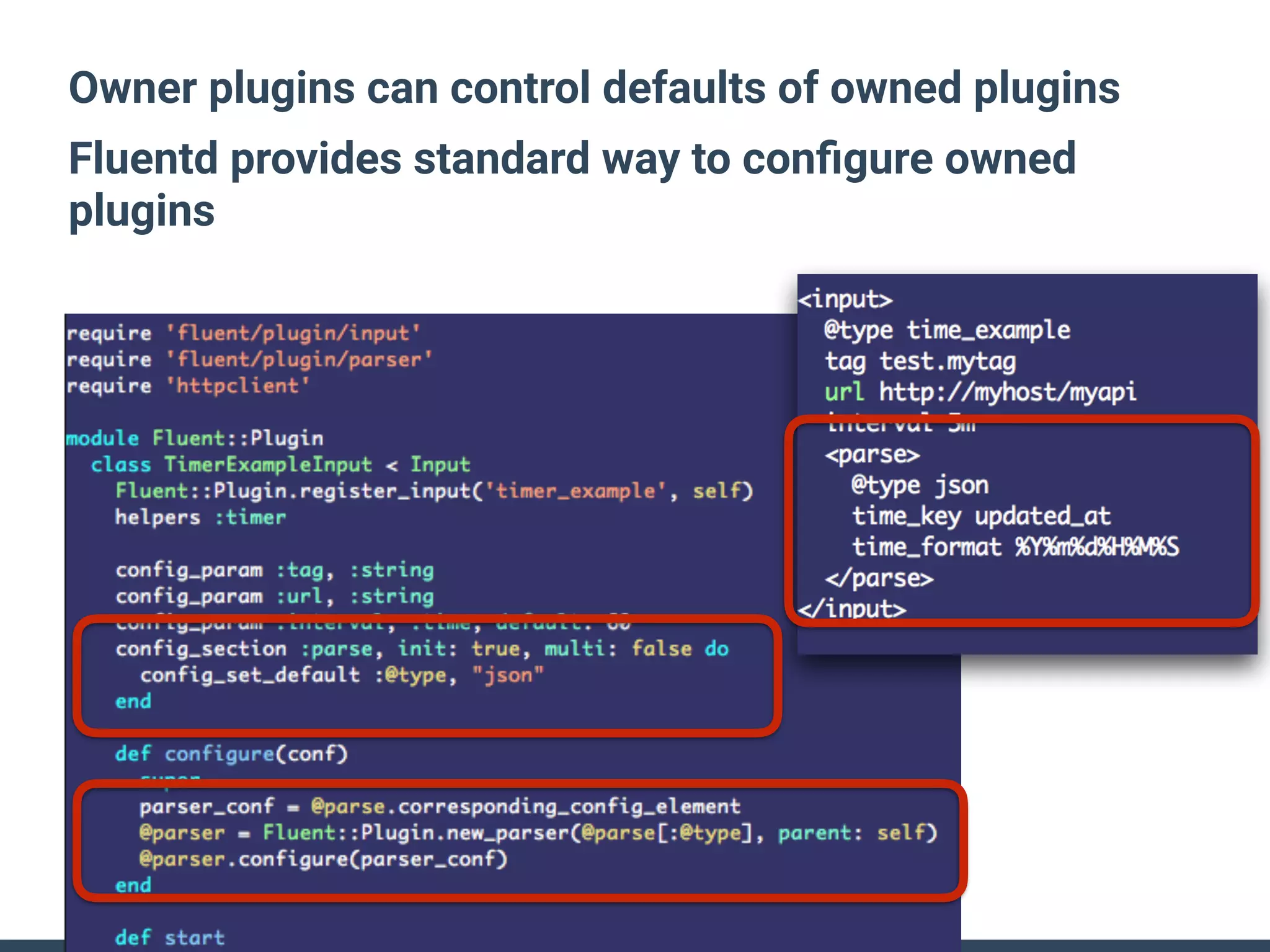
roundrobin"Owned" plugins
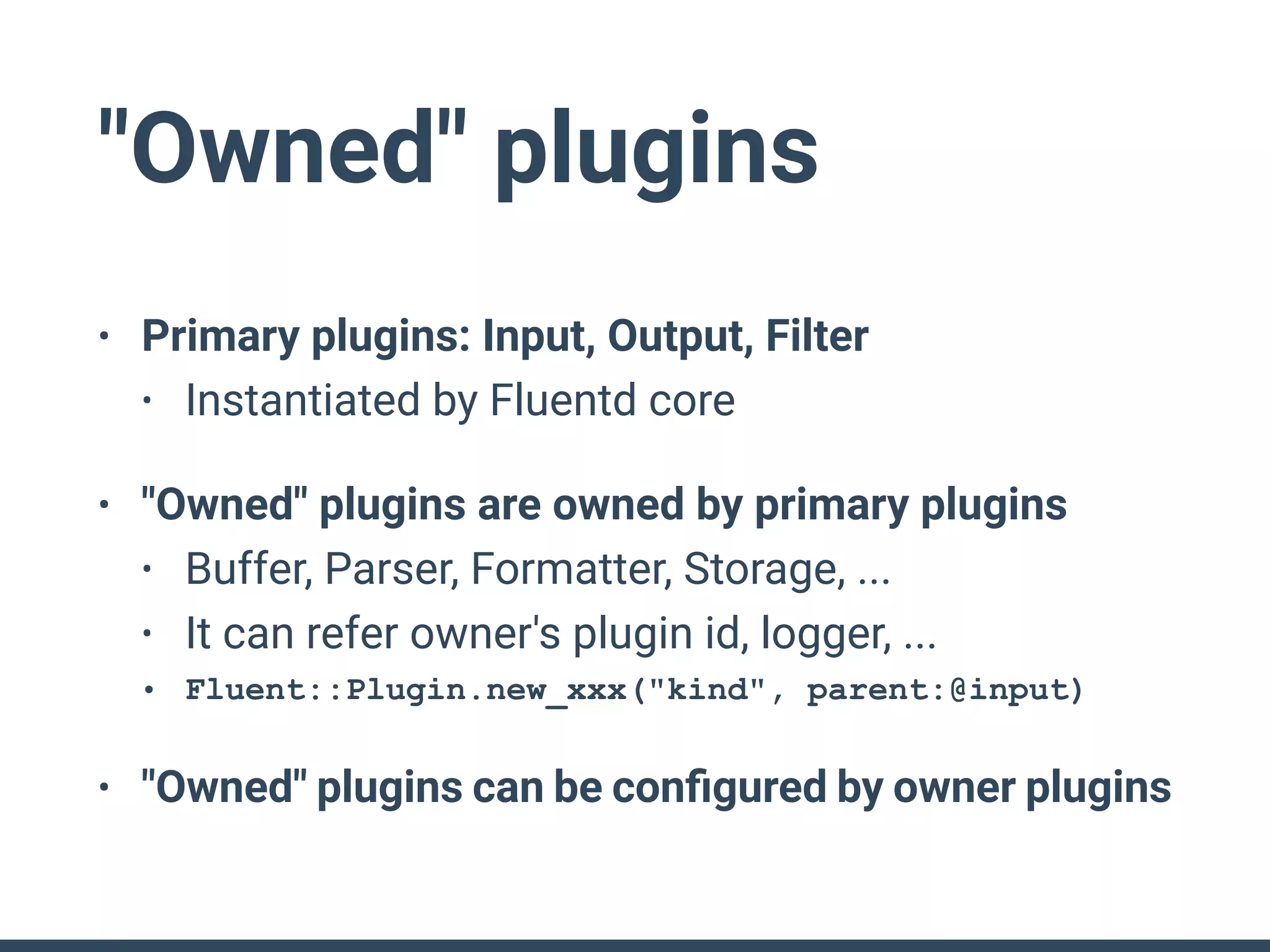
"Owned" plugins
• Primary plugins: Input, Output, Filter
• Instantiated by Fluentd core
• "Owned" plugins are owned by primary plugins
• Buffer, Parser, Formatter, Storage, ...
• It can refer owner's plugin id, logger, ...
• Fluent::Plugin.new_xxx("kind", parent:@input)
• "Owned" plugins can be configured by owner plugins
Owner plugins can control defaults of owned plugins
Fluentd provides standard way to configure owned
plugins
Tour of New Plugin APIs:
Fluent::Plugin::Storage
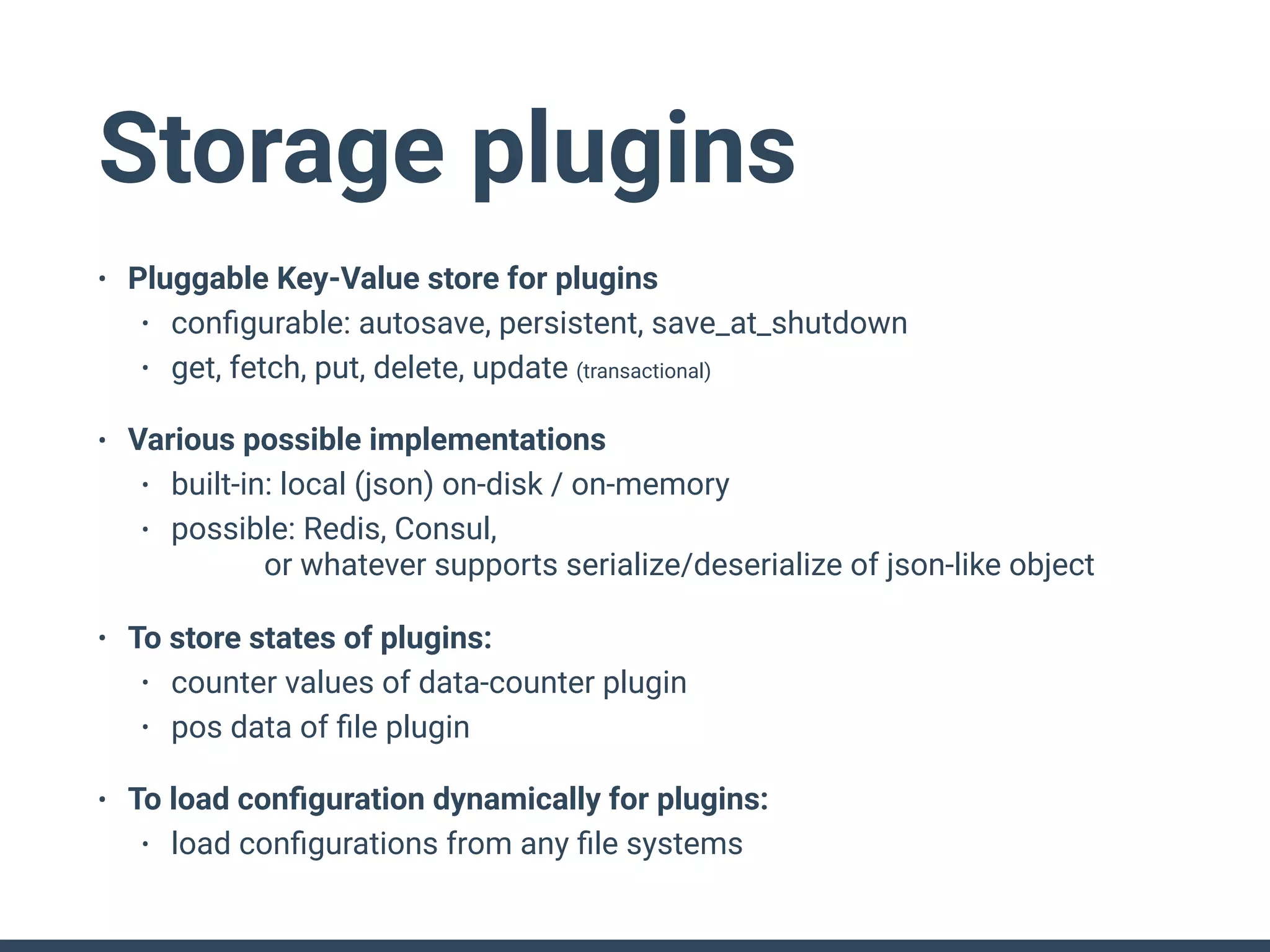
Storage plugins
• Pluggable Key-Value store for plugins
• configurable: autosave, persistent, save_at_shutdown
• get, fetch, put, delete, update (transactional)
• Various possible implementations
• built-in: local (json) on-disk / on-memory
• possible: Redis, Consul,

or whatever supports serialize/deserialize of json-like object
• To store states of plugins:
• counter values of data-counter plugin
• pos data of file plugin
• To load configuration dynamically for plugins:
• load configurations from any file systems
Tour of New Plugin APIs:
Plugin Helpers
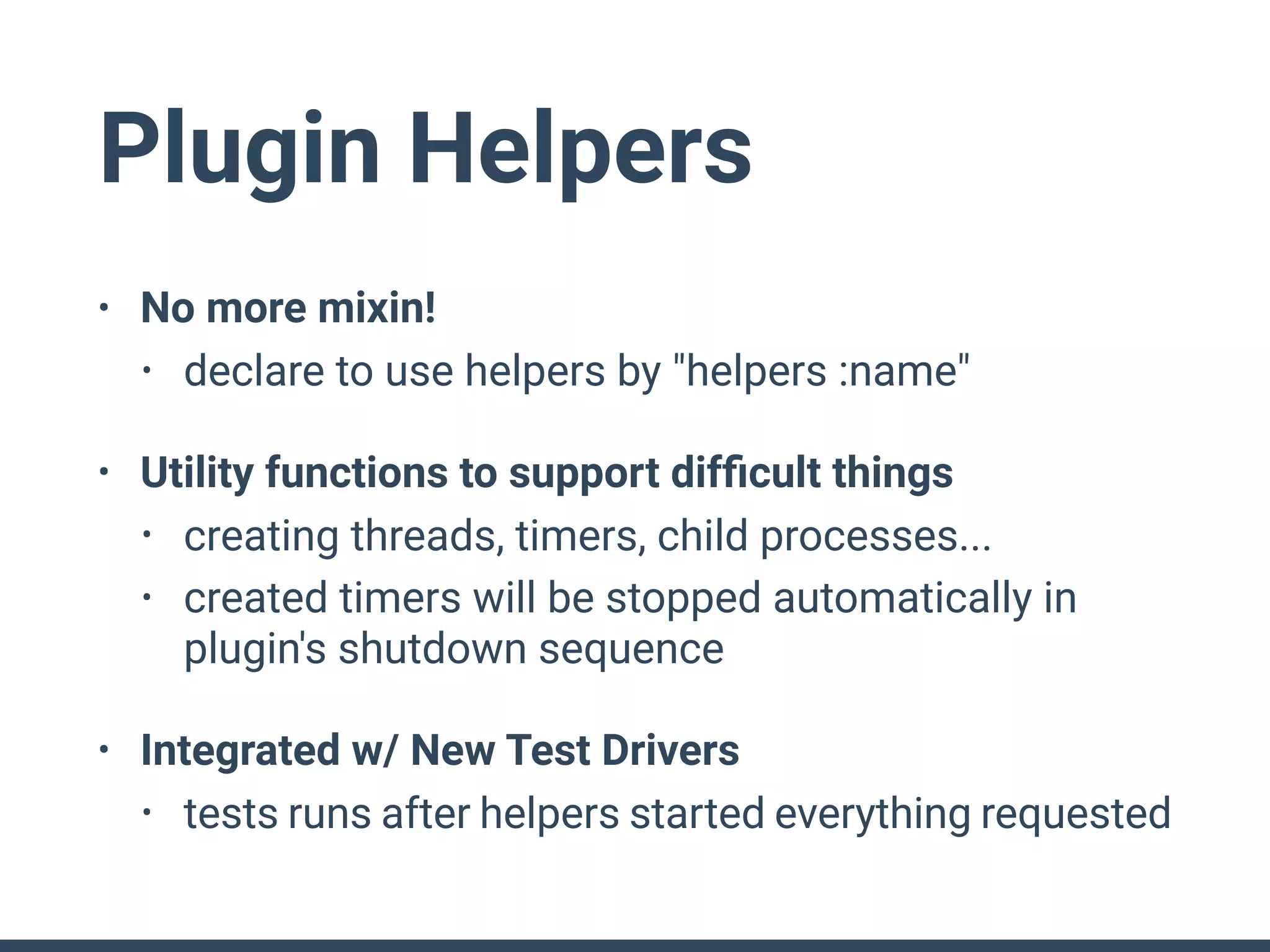
Plugin Helpers
• No more mixin!
• declare to use helpers by "helpers :name"
• Utility functions to support difficult things
• creating threads, timers, child processes...
• created timers will be stopped automatically in
plugin's shutdown sequence
• Integrated w/ New Test Drivers
• tests runs after helpers started everything requested
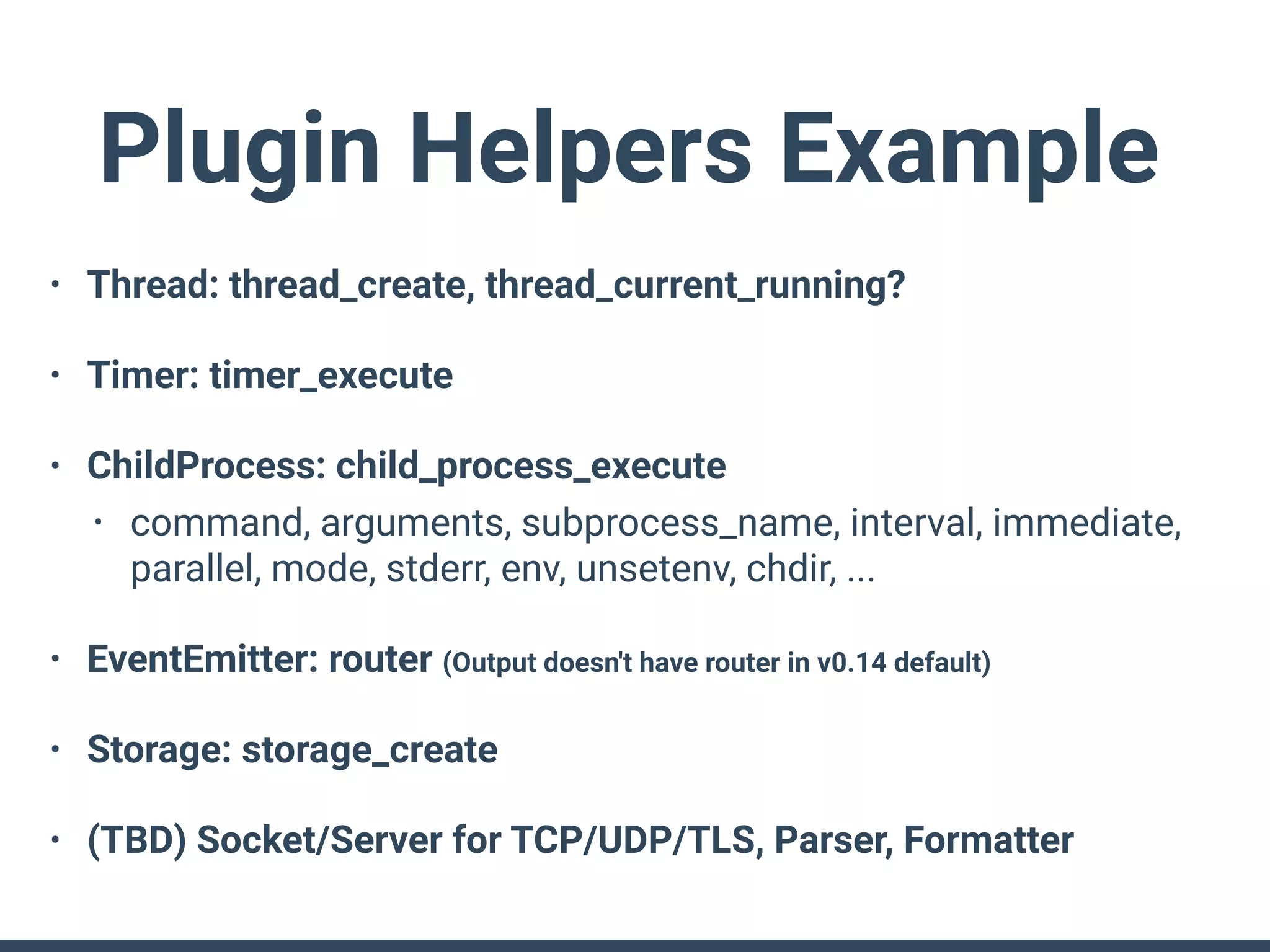
Plugin Helpers Example
• Thread: thread_create, thread_current_running?
• Timer: timer_execute
• ChildProcess: child_process_execute
• command, arguments, subprocess_name, interval, immediate,
parallel, mode, stderr, env, unsetenv, chdir, ...
• EventEmitter: router (Output doesn't have router in v0.14 default)
• Storage: storage_create
• (TBD) Socket/Server for TCP/UDP/TLS, Parser, Formatter
Tour of New Plugin APIs:
New Test Drivers
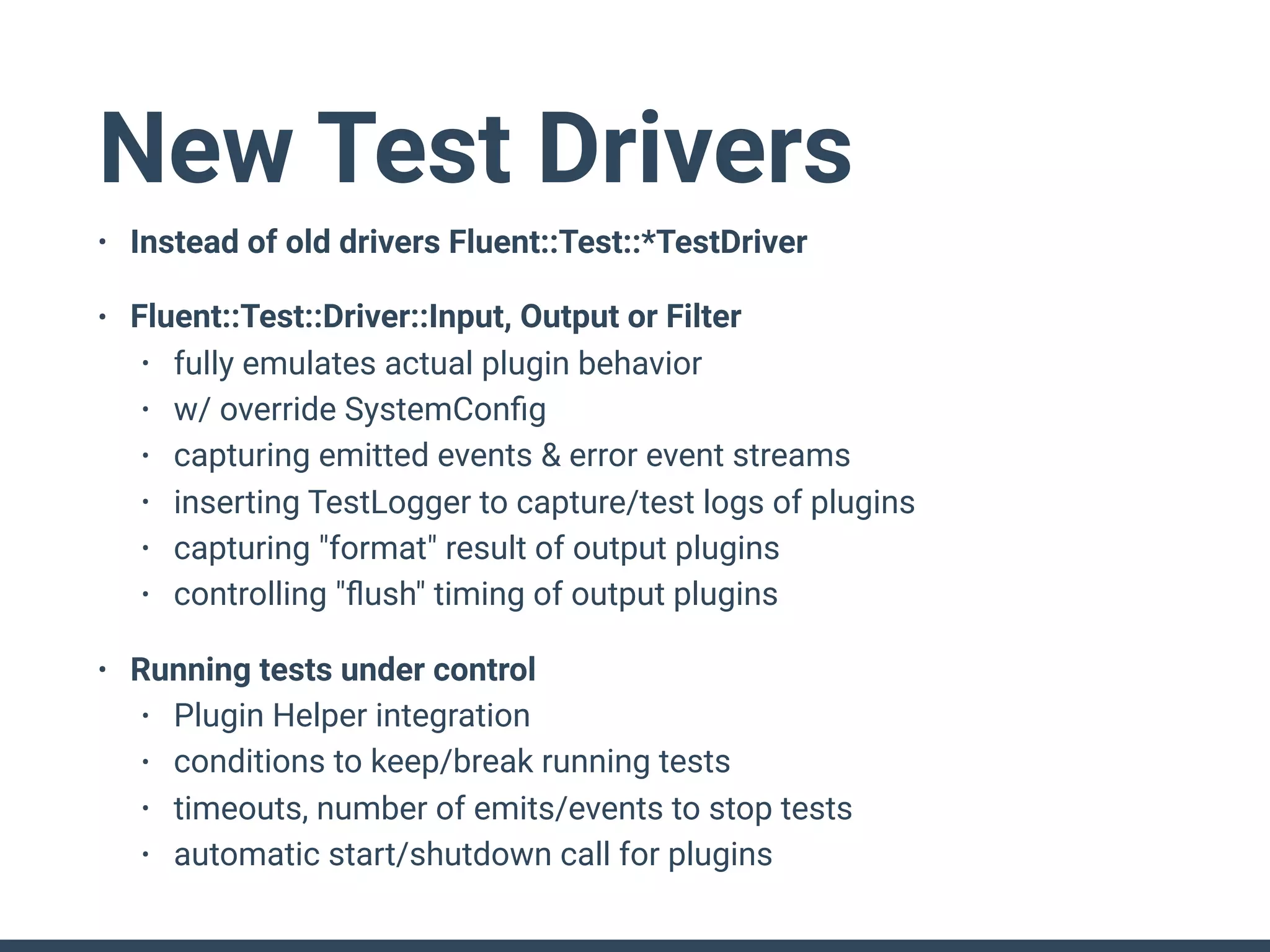
New Test Drivers
• Instead of old drivers Fluent::Test::*TestDriver
• Fluent::Test::Driver::Input, Output or Filter
• fully emulates actual plugin behavior
• w/ override SystemConfig
• capturing emitted events & error event streams
• inserting TestLogger to capture/test logs of plugins
• capturing "format" result of output plugins
• controlling "flush" timing of output plugins
• Running tests under control
• Plugin Helper integration
• conditions to keep/break running tests
• timeouts, number of emits/events to stop tests
• automatic start/shutdown call for plugins
Plans for v0.14.x
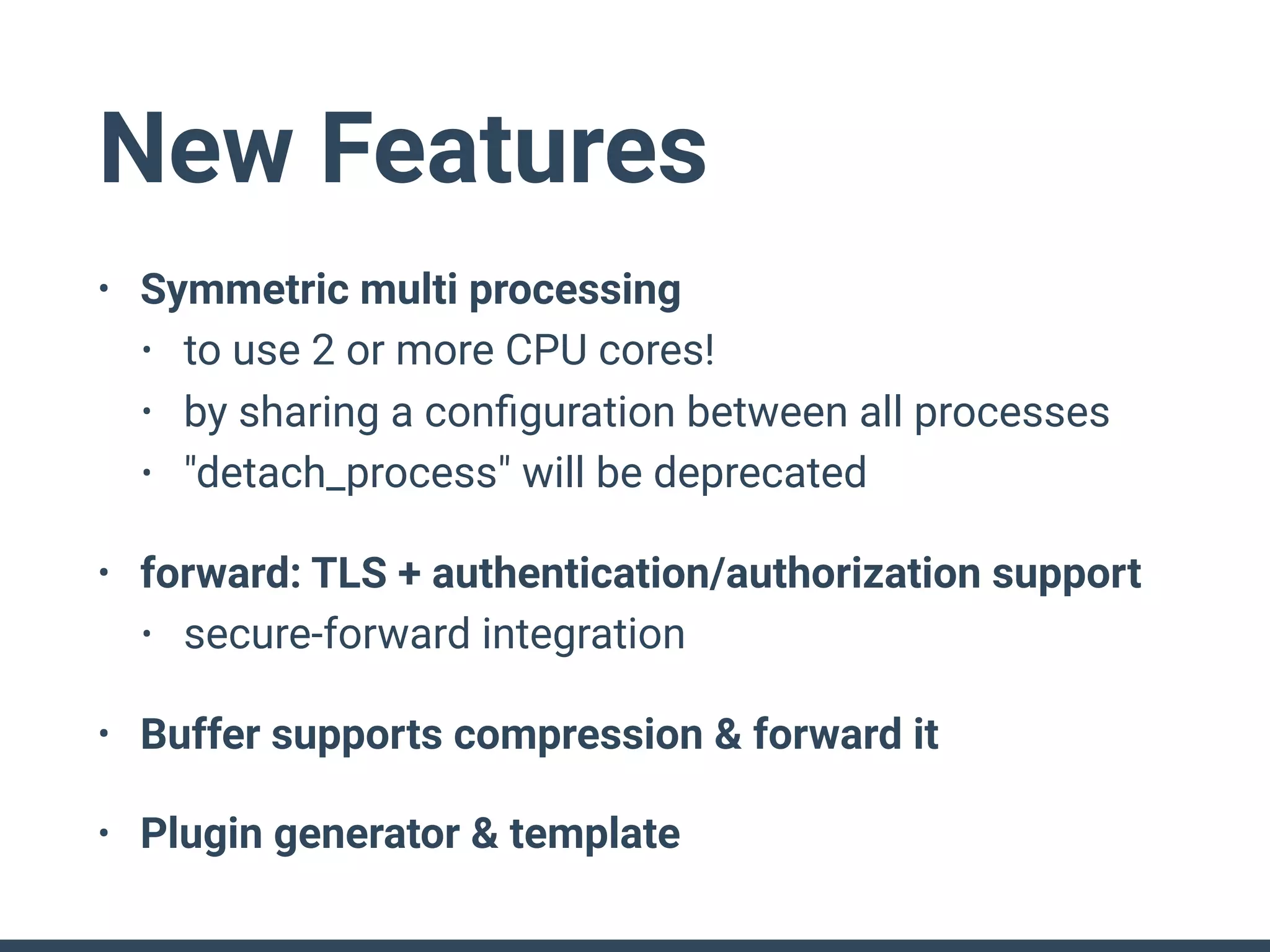
New Features
• Symmetric multi processing
• to use 2 or more CPU cores!
• by sharing a configuration between all processes
• "detach_process" will be deprecated
• forward: TLS + authentication/authorization support
• secure-forward integration
• Buffer supports compression & forward it
• Plugin generator & template
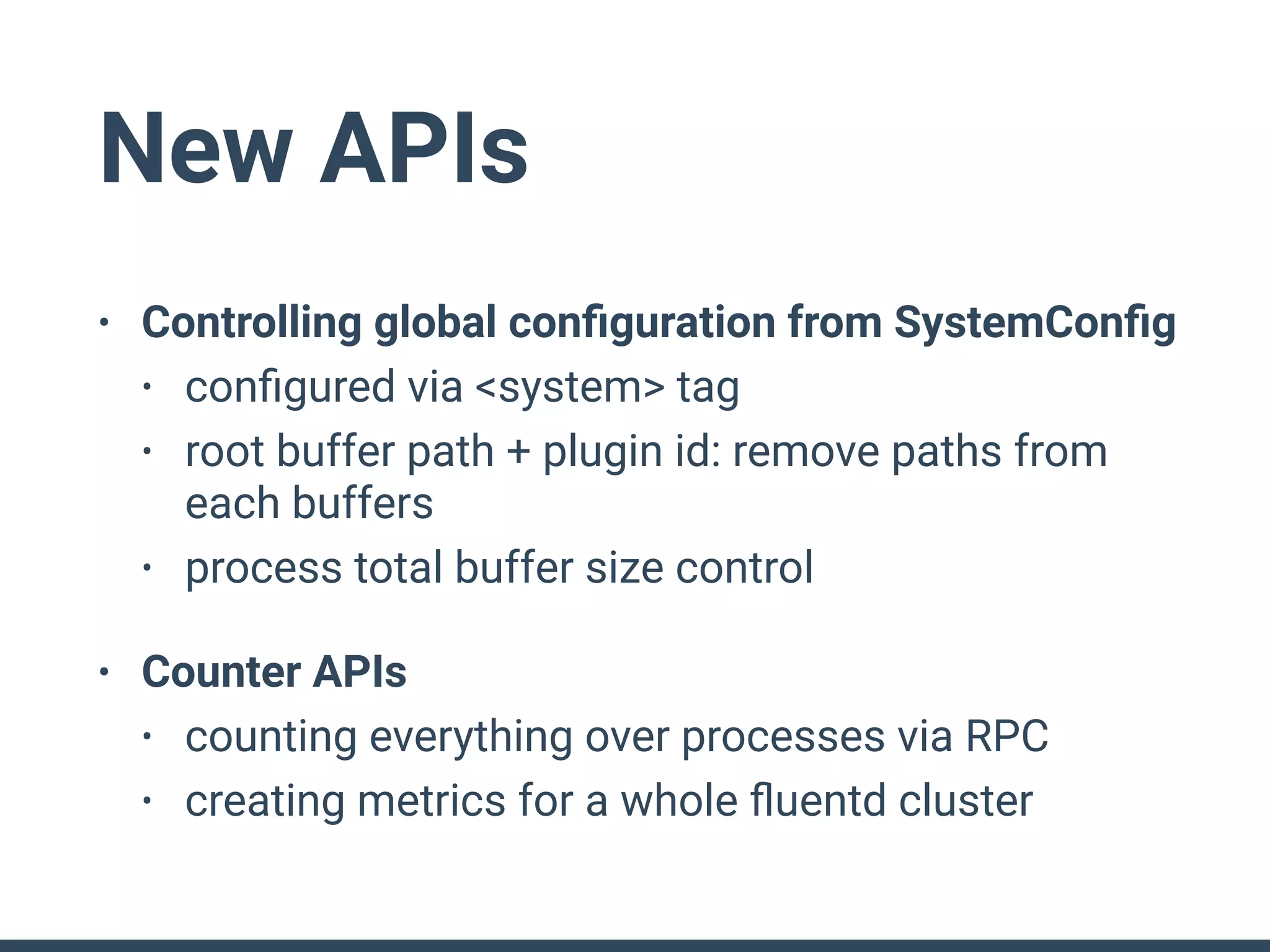
New APIs
• Controlling global configuration from SystemConfig
• configured via <system> tag
• root buffer path + plugin id: remove paths from
each buffers
• process total buffer size control
• Counter APIs
• counting everything over processes via RPC
• creating metrics for a whole fluentd cluster
For v1
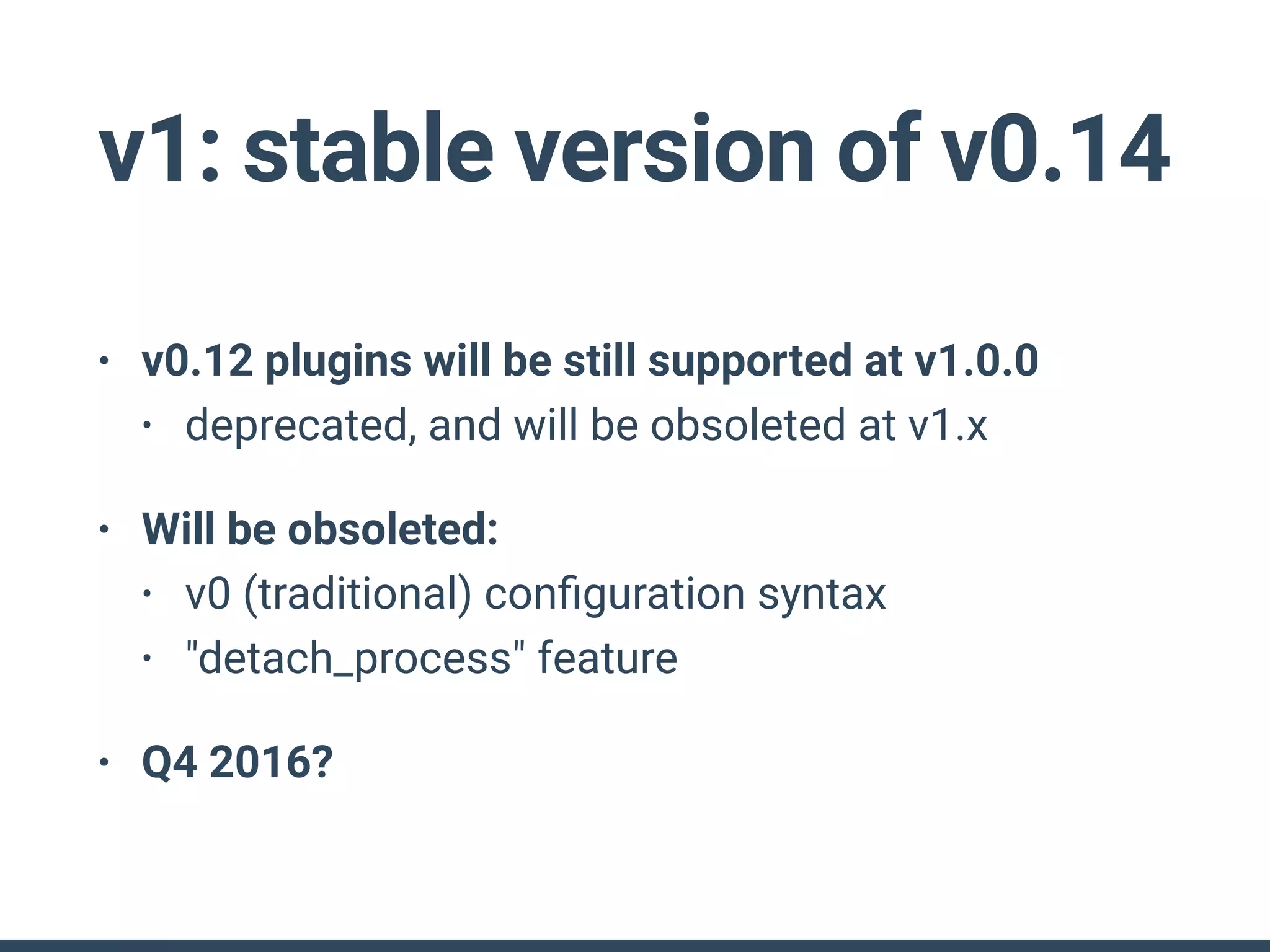
v1: stable version of v0.14
• v0.12 plugins will be still supported at v1.0.0
• deprecated, and will be obsoleted at v1.x
• Will be obsoleted:
• v0 (traditional) configuration syntax
• "detach_process" feature
• Q4 2016?
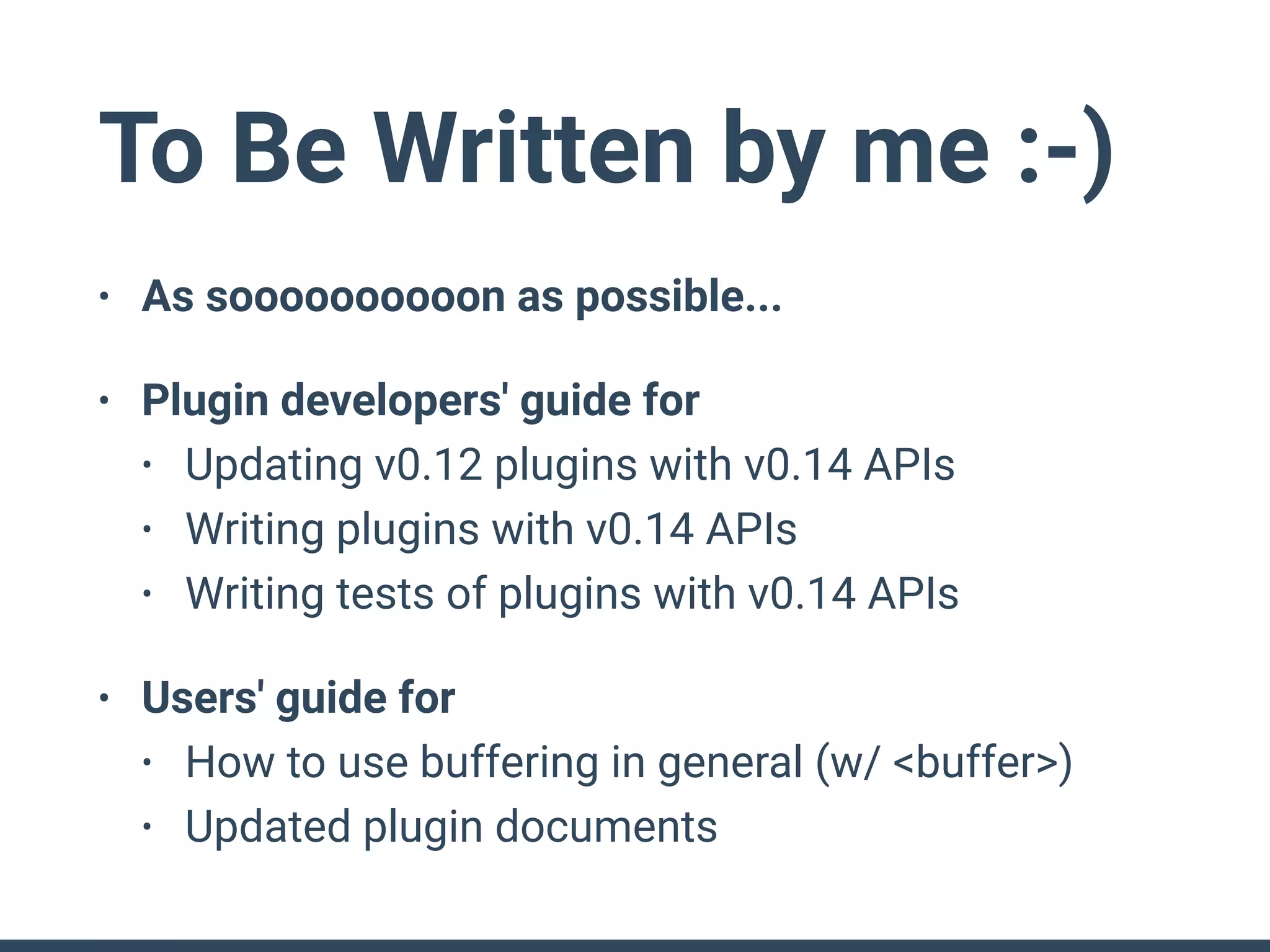
To Be Written by me :-)
• As soooooooooon as possible...
• Plugin developers' guide for
• Updating v0.12 plugins with v0.14 APIs
• Writing plugins with v0.14 APIs
• Writing tests of plugins with v0.14 APIs
• Users' guide for
• How to use buffering in general (w/ <buffer>)
• Updated plugin documents
Enjoy logging!

Fluentd v0.14 Plugin API Details

  • 1.
    Fluentd v0.14 Plugin APIDetails Fluentd meetup 2016 Summer Jun 1, 2016 Satoshi "Moris" Tagomori (@tagomoris)
  • 2.
    Satoshi "Moris" Tagomori (@tagomoris) Fluentd,MessagePack-Ruby, Norikra, ... Treasure Data, Inc.
  • 3.
    Topics • Why Fluentdv0.14 has a new API set for plugins • Compatibility of v0.12 plugins/configurations • Plugin APIs: Input, Filter, Output & Buffer • Storage Plugin, Plugin Helpers • New Test Drivers for plugins • Plans for v0.14.x & v1
  • 4.
    Why Fluentd v0.14 hasa New API set for plugins?
  • 5.
    Fluentd v0.12 Plugins •No supports to write plugins by Fluentd core • plugins creates threads, sockets, timers and event loops • writing tests is very hard and messy with sleeps • Fragmented implementations • Output, BufferedOutput, ObjectBufferedOutput and TimeSlicedOutput • Mixture of configuration parameters from output&buffer • Uncontrolled plugin instance lifecycle (no "super" in start/shutdown) • Imperfect buffering control and useless configurations • the reason why fluent-plugin-forest exists and be used widely
  • 6.
    Fluentd v0.12 Plugins •Insufficient buffer chunking control • only by size, without number of events in chunks • Forcedly synchronized buffer flushing • no way to flush-and-commit chunks asynchronously • Ultimate freedom for using mix-ins • everything overrides Plugin#emit ... (the only one entry point for events to plugins) • no valid hook points to get metrics or something else • Bad Ruby coding rules and practices • too many classes at "Fluent::*" in fluent/plugin, no "require", ...
  • 7.
  • 8.
  • 9.
    Compatibility of plugins •v0.12 plugins are subclass of Fluent::* • Fluent::Input, Fluent::Filter, Fluent::Output, ... • Compatibility layers for v0.12 plugins in v0.14 • Fluent::Compat::Klass -> Fluent::Klass (e.g., Input, Output, ...) • it provides transformation of: • namespaces, configuration parameters • internal APIs, argument objects • IT SHOULD WORK, except for :P • 3rd party buffer plugin, part of test code • "Engine.emit"
  • 10.
    Compatibility of configurations •v0.14 plugins have another set of parameters • many old-fashioned parameters are removed • "buffer_type", "num_threads", "timezone", "time_slice_format", "buffer_chunk_limit", "buffer_queue_limit", ... • Plugin helper "compat_parameters" • transform parameters between v0.12 style configuration and v0.14 plugin v0.12 v0.14 convert internally
  • 11.
    FAQ: Can we createplugins like this? * it uses v0.14 API * it runs on Fluentd v0.12 Impossible :P
  • 12.
  • 13.
    v0.14 plugin classes •All files MUST be in `fluent/plugin/*.rb` (in gems) • or just a "*.rb" file in directory specified by "-r" • All classes MUST be under Fluent::Plugin • All plugins MUST be subclasses of Fluent::Plugin::Base • All plugins MUST call `super` in methods overriding default implementation (e.g., #configure, #start, #shutdown, ...)
  • 14.
    Classes hierarchy (v0.12) Fluent::InputF::Filter F::Output BufferedOutput Object Buffered Time Sliced Multi Output F::Buffer F::Parser F::Formatter 3rd party plugins
  • 15.
    Classes hierarchy (v0.14) F::P::InputF::P::Filter F::P::Output Fluent::Plugin::Base F::P::Buffer F::P::Parser F::P::Formatter F::P::Storage both of buffered/non-buffered F::P:: BareOutput (not for 3rd party plugins) F::P:: MultiOutput copy roundrobin
  • 16.
    Tour of NewPlugin APIs: Fluent::Plugin::Input
  • 17.
    Fluent::Plugin::Input • Nothing changed:) • except for overall rules • But it's much easier
 to write plugins
 than v0.12 :) • fetch HTTP resource per specified interval • parse response body with format specified in config • emit parse result
  • 18.
  • 19.
    Tour of NewPlugin APIs: Fluent::Plugin::Filter
  • 20.
    Fluent::Plugin::Filter • Almost nothingchanged :) • Required:
 #filter(tag, time, record)
 #=> record | nil • Optional:
 #filter_stream(tag, es)
 #=> event_stream
  • 21.
    Tour of NewPlugin APIs: Fluent::Plugin::Output
  • 22.
    Fluent::Plugin::Output • Many thingschanged! • Merged Output, BufferedOutput, ObjectBufferedOutput, TimeSlicedOutput • Output plugins can be • with buffering • without buffering • both (do/doesn't buffering by configuration) • Buffers chunks events by: • byte size, interval, tag • number of records (new!) • time (by any unit(new!): 30s, 5m, 15m, 3h, ...) • any specified field in records (new!) • any combination of above (new!)
  • 23.
    Variations of buffering NOMORE forest plugin!
  • 24.
    Output Plugin: Methods tobe implemented • Non-buffered: #process(tag, es) • Buffered synchronous: #write(chunk) • Buffered Asynchronous: #try_write(chunk) • New feature for destinations with huge latency to write chunks • Plugins must call #commit_write(chunk_id) (otherwise, #try_write will be retried) • Buffered w/ custom format: #format(tag, time, record) • Without this method, output uses standard format
  • 25.
    implement? #process implement? #process or #writeor #try_write NO error YES #prefer_buffered_processing called (default true) NO non-buffered YES exists? <buffer> section YES implement? #write or #try_write error NO YES implement? #write or #try_write NO NO YES false implement? #write and #try_write YES #prefer_delayed_commit called (default true) implement? #try_write sync buffered async buffered
  • 26.
    In other words:P • If users configure "<buffer>" section • plugin try to do buffering • Else if plugin implements both (buffering/non-buf) • plugin call #prefer_buffer_processing to decide • Else plugin does as implemented • When plugin does buffering
 If plugin implements both (sync/async write) • plugin call #prefer_delayed_commit to decide • Else plugin does as implemented
  • 27.
    Delayed commit (1) •high latency #write operations locks a flush thread for long time
 (e.g., ACK in forward) destination w/ high latency #write Output Plugin send data send ACK return #write a flush thread locked
  • 28.
    Delayed commit (2) •#try_write & delayed #commit_write destination w/ high latency #try_write Output Plugin send data send ACK return #try_write async check thread #commit_write
  • 29.
    Use cases: delayedcommit • Forward protocol w/ ACK • Distributed file systems or databases • put data -> confirm to read data -> commit • Submit tasks to job queues • submit a job -> detect executed -> commit
  • 30.
    Standard chunk format •Buffering w/o #format method • Almost same with ObjectBufferedOutput • No need to implement #format always • Implement it for performance/low-latency • Tool to dump & read buffer chunks on disk w/ standard format • To be implemented in v0.14.x :)
  • 31.
    <buffer CHUNK_KEYS> • comma-separatedtag, time or ANY_KEYS • Nothing specified: all events are in same chunk • flushed when chunk is full • (optional) "flush_interval" after first event in chunk • tag: events w/ same tag are in same chunks • time: buffer chunks will be split by timekey • timekey: unit of time to be chunked (1m, 15m, 3h, ...) • flushed after expiration of timekey unit + timekey_wait • ANY_KEYS: any key names in records
  • 32.
    • comma-separated tag,time or ANY_KEYS • Nothing specified: all events are in same chunk • flushed when chunk is full • (optional) "flush_interval" after first event in chunk • tag: events w/ same tag are in same chunks • time: buffer chunks will be split by timekey • timekey: unit of time to be chunked (1m, 15m, 3h, ...) • flushed after expiration of timekey unit + timekey_wait • ANY_KEYS: any key names in records <buffer CHUNK_KEYS> BufferedOutput TimeSlicedOutput ObjectBufferedOutput in v0.12 in v0.12 in v0.12
  • 33.
    configurations:
 flushing buffers • flush_mode:lazy, interval, immediate • default: lazy if "time" specified, otherwise interval • flush_interval, flush_thread_count • flush_thread_count: number of threads for flushing • delayed_commit_timeout • output plugin will retry #try_write when expires
  • 34.
    Retries, Secondary • Explicittimeout for retries: • retry_timeout: timeout not to retry anymore • retry_max_times: how many times to retry • retry_type: "periodic" w/ fixed retry_wait • retry_secondary_threshold (percentage) • output will use secondary if specified percentage of retry_timeout elapsed after first error
  • 35.
    Buffer parameters • chunk_limit_size •maximum bytesize per chunks • chunk_records_limit (default: not specified) • maximum number of records per chunks • total_limit_size • maximum bytesize which a buffer plugin can use • (optional) queue_length_limit: no need to specify
  • 36.
    Chunk metadata • Storesvarious information of buffer chunks • key-values of chunking unit • number of records • created_at, modified_at • `chunk.metadata` • extract_placeholders(@path, chunk.metadata)
  • 37.
    Tour of NewPlugin APIs: Other plugin types
  • 38.
    Classes hierarchy (v0.14) F::P::InputF::P::Filter F::P::Output Fluent::Plugin::Base F::P::Buffer F::P::Parser F::P::Formatter F::P::Storage both of buffered/non-buffered F::P:: BareOutput (not for 3rd party plugins) F::P:: MultiOutput copy roundrobin
  • 39.
    Classes hierarchy (v0.14) F::P::InputF::P::Filter F::P::Output Fluent::Plugin::Base F::P::Buffer F::P::Parser F::P::Formatter F::P::Storage both of buffered/non-buffered F::P:: BareOutput (not for 3rd party plugins) F::P:: MultiOutput copy roundrobin"Owned" plugins
  • 40.
    "Owned" plugins • Primaryplugins: Input, Output, Filter • Instantiated by Fluentd core • "Owned" plugins are owned by primary plugins • Buffer, Parser, Formatter, Storage, ... • It can refer owner's plugin id, logger, ... • Fluent::Plugin.new_xxx("kind", parent:@input) • "Owned" plugins can be configured by owner plugins
  • 41.
    Owner plugins cancontrol defaults of owned plugins Fluentd provides standard way to configure owned plugins
  • 42.
    Tour of NewPlugin APIs: Fluent::Plugin::Storage
  • 43.
    Storage plugins • PluggableKey-Value store for plugins • configurable: autosave, persistent, save_at_shutdown • get, fetch, put, delete, update (transactional) • Various possible implementations • built-in: local (json) on-disk / on-memory • possible: Redis, Consul,
 or whatever supports serialize/deserialize of json-like object • To store states of plugins: • counter values of data-counter plugin • pos data of file plugin • To load configuration dynamically for plugins: • load configurations from any file systems
  • 44.
    Tour of NewPlugin APIs: Plugin Helpers
  • 45.
    Plugin Helpers • Nomore mixin! • declare to use helpers by "helpers :name" • Utility functions to support difficult things • creating threads, timers, child processes... • created timers will be stopped automatically in plugin's shutdown sequence • Integrated w/ New Test Drivers • tests runs after helpers started everything requested
  • 46.
    Plugin Helpers Example •Thread: thread_create, thread_current_running? • Timer: timer_execute • ChildProcess: child_process_execute • command, arguments, subprocess_name, interval, immediate, parallel, mode, stderr, env, unsetenv, chdir, ... • EventEmitter: router (Output doesn't have router in v0.14 default) • Storage: storage_create • (TBD) Socket/Server for TCP/UDP/TLS, Parser, Formatter
  • 48.
    Tour of NewPlugin APIs: New Test Drivers
  • 49.
    New Test Drivers •Instead of old drivers Fluent::Test::*TestDriver • Fluent::Test::Driver::Input, Output or Filter • fully emulates actual plugin behavior • w/ override SystemConfig • capturing emitted events & error event streams • inserting TestLogger to capture/test logs of plugins • capturing "format" result of output plugins • controlling "flush" timing of output plugins • Running tests under control • Plugin Helper integration • conditions to keep/break running tests • timeouts, number of emits/events to stop tests • automatic start/shutdown call for plugins
  • 50.
  • 51.
    New Features • Symmetricmulti processing • to use 2 or more CPU cores! • by sharing a configuration between all processes • "detach_process" will be deprecated • forward: TLS + authentication/authorization support • secure-forward integration • Buffer supports compression & forward it • Plugin generator & template
  • 52.
    New APIs • Controllingglobal configuration from SystemConfig • configured via <system> tag • root buffer path + plugin id: remove paths from each buffers • process total buffer size control • Counter APIs • counting everything over processes via RPC • creating metrics for a whole fluentd cluster
  • 53.
  • 54.
    v1: stable versionof v0.14 • v0.12 plugins will be still supported at v1.0.0 • deprecated, and will be obsoleted at v1.x • Will be obsoleted: • v0 (traditional) configuration syntax • "detach_process" feature • Q4 2016?
  • 55.
    To Be Writtenby me :-) • As soooooooooon as possible... • Plugin developers' guide for • Updating v0.12 plugins with v0.14 APIs • Writing plugins with v0.14 APIs • Writing tests of plugins with v0.14 APIs • Users' guide for • How to use buffering in general (w/ <buffer>) • Updated plugin documents
  • 56.