MongoDB
Hadoop
&
humongous data
Talking about
What is Humongous Data
Humongous Data & You
MongoDB & Data processing
Future of Humongous Data
@spf13

                  AKA
Steve Francia
15+ years building
the internet

  Father, husband,
  skateboarder


Chief Solutions Architect @
responsible for drivers,
integrations, web & docs
What is
humongous
   data ?
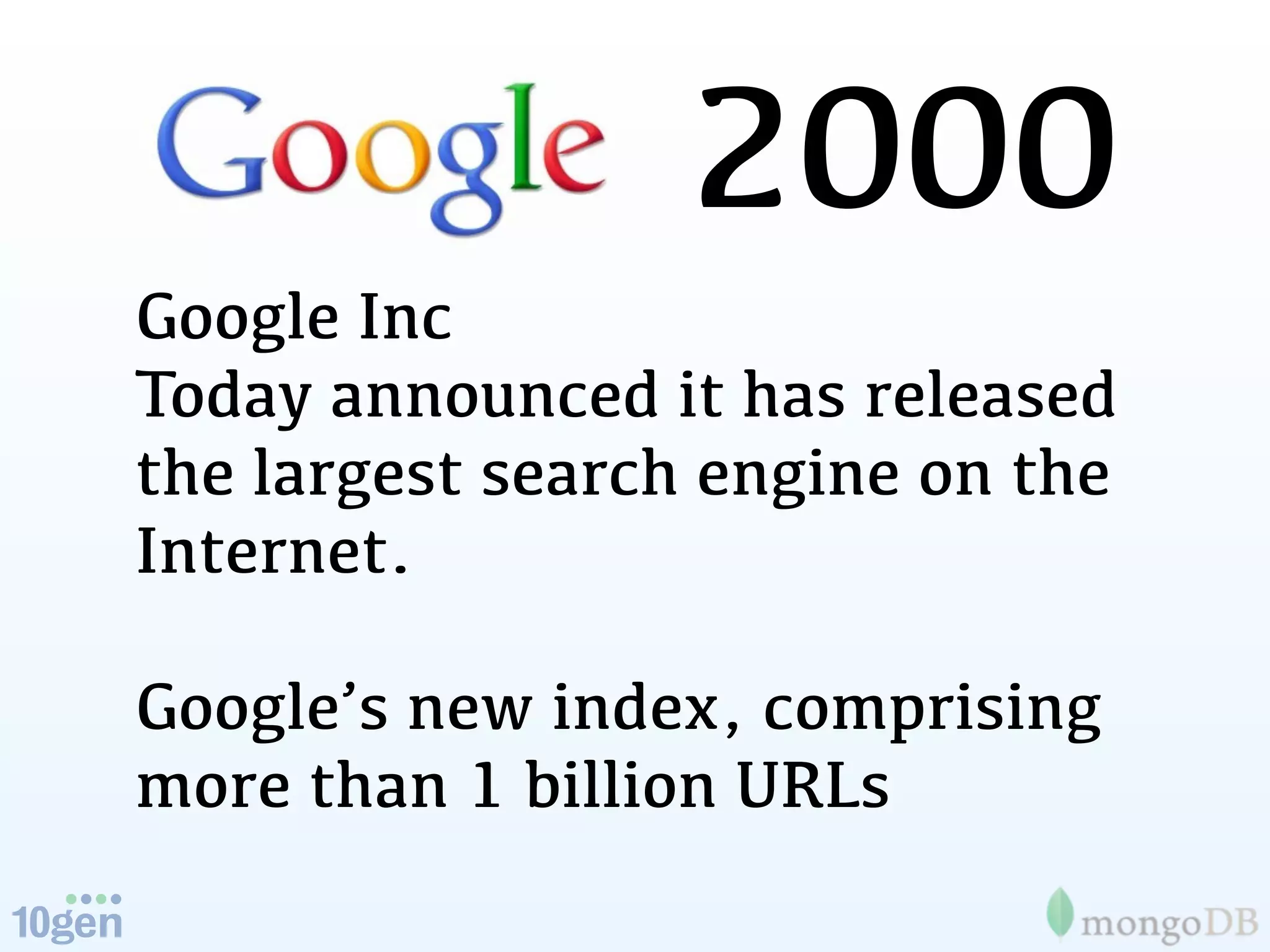
2000
Google Inc
Today announced it has released
the largest search engine on the
Internet.

Google’s new index, comprising
more than 1 billion URLs
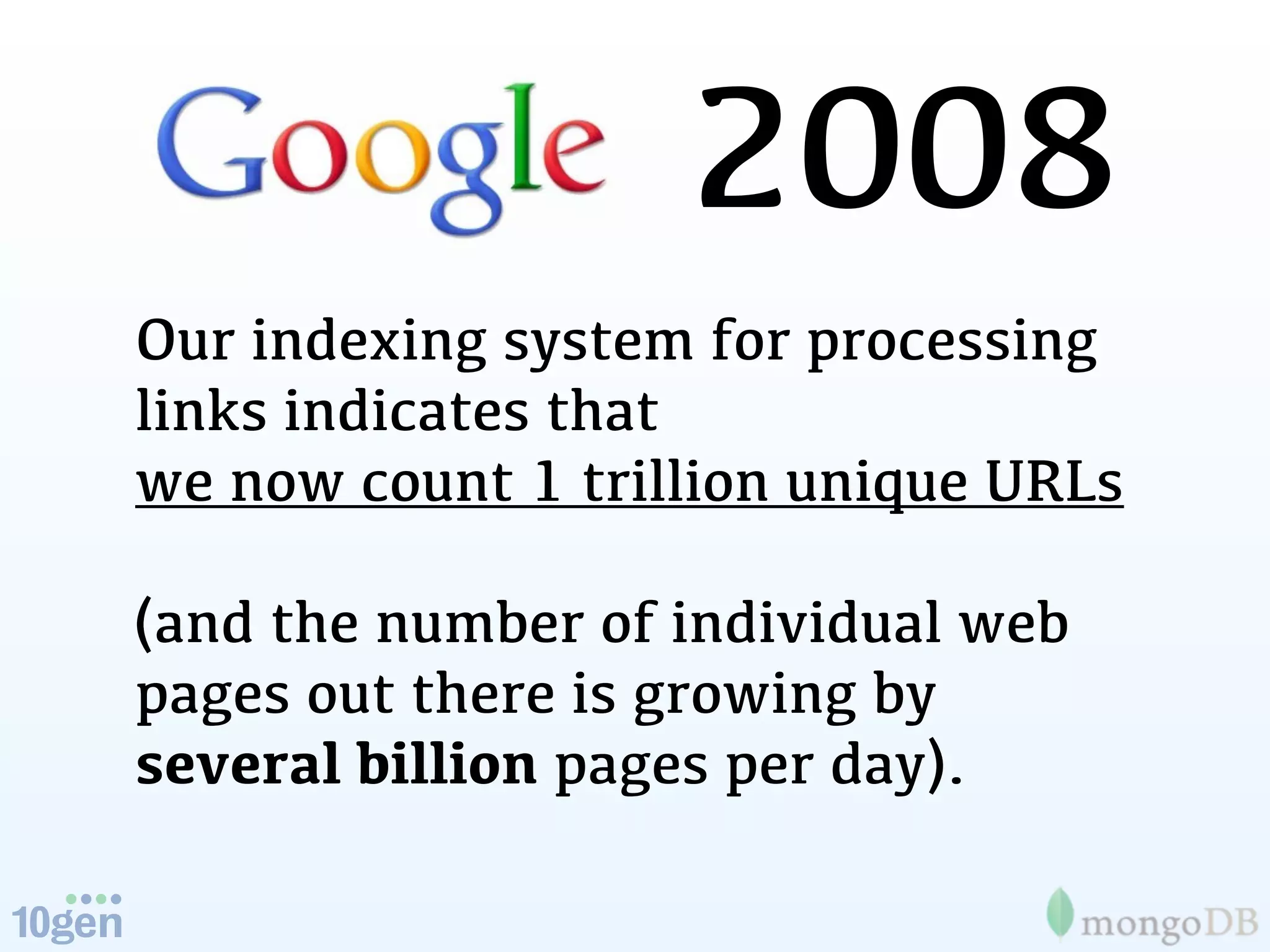
2008
Our indexing system for processing
links indicates that
we now count 1 trillion unique URLs

(and the number of individual web
pages out there is growing by
several billion pages per day).
An unprecedented
amount of data is
being created and is
accessible
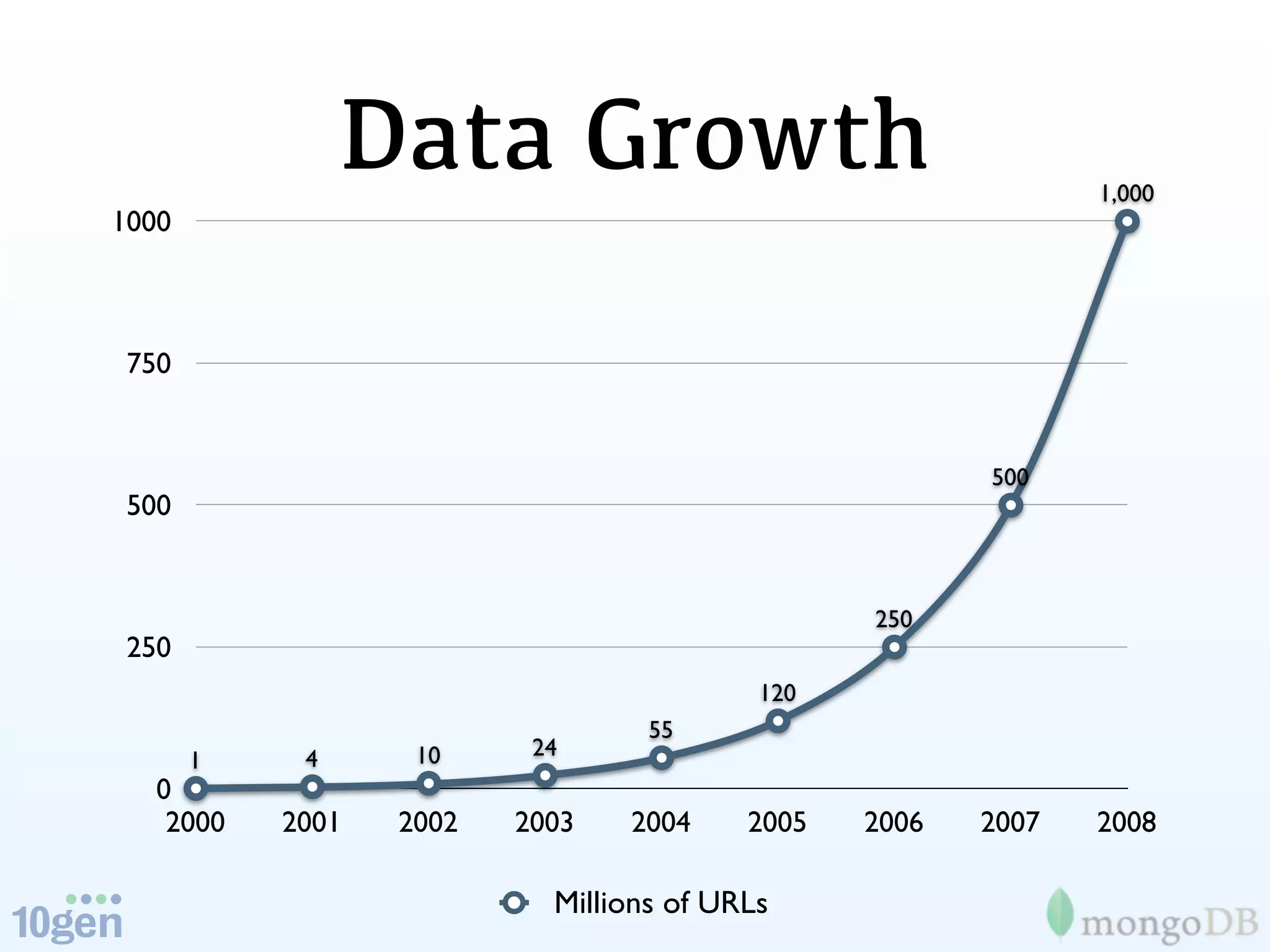
Data Growth                                   1,000
1000


 750


                                                       500
 500


                                                250
 250
                                          120
                                  55
            4      10     24
       1
   0
    2000   2001   2002   2003   2004     2005   2006   2007   2008

                           Millions of URLs
Truly Exponential
        Growth
Is hard for people to grasp


A BBC reporter recently: "Your current PC
is more powerful than the computer they
had on board the first flight to the moon".
Moore’s Law
Applies to more than just CPUs


Boiled down it is that things double at
regular intervals


It’s exponential growth.. and applies to
big data
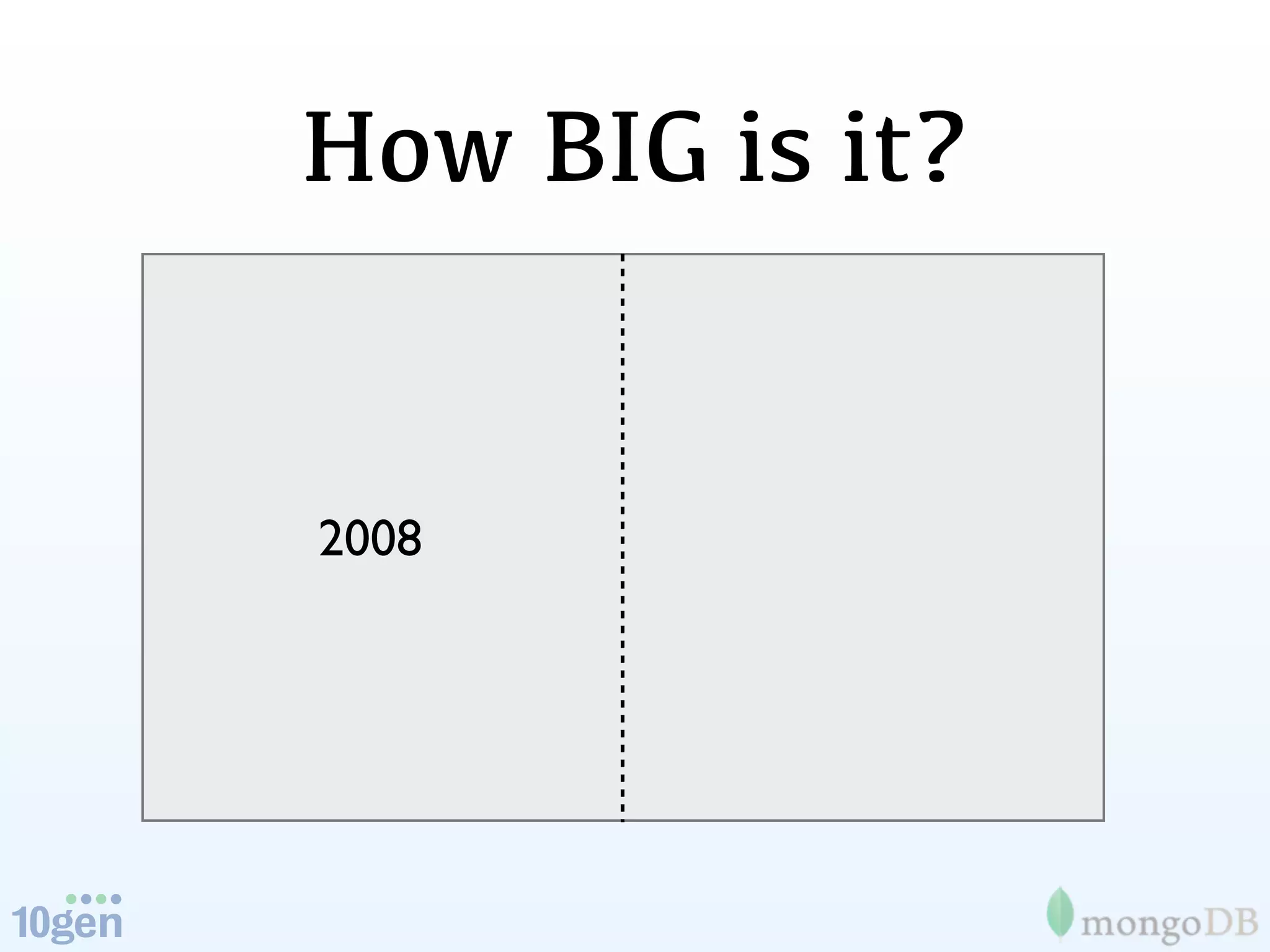
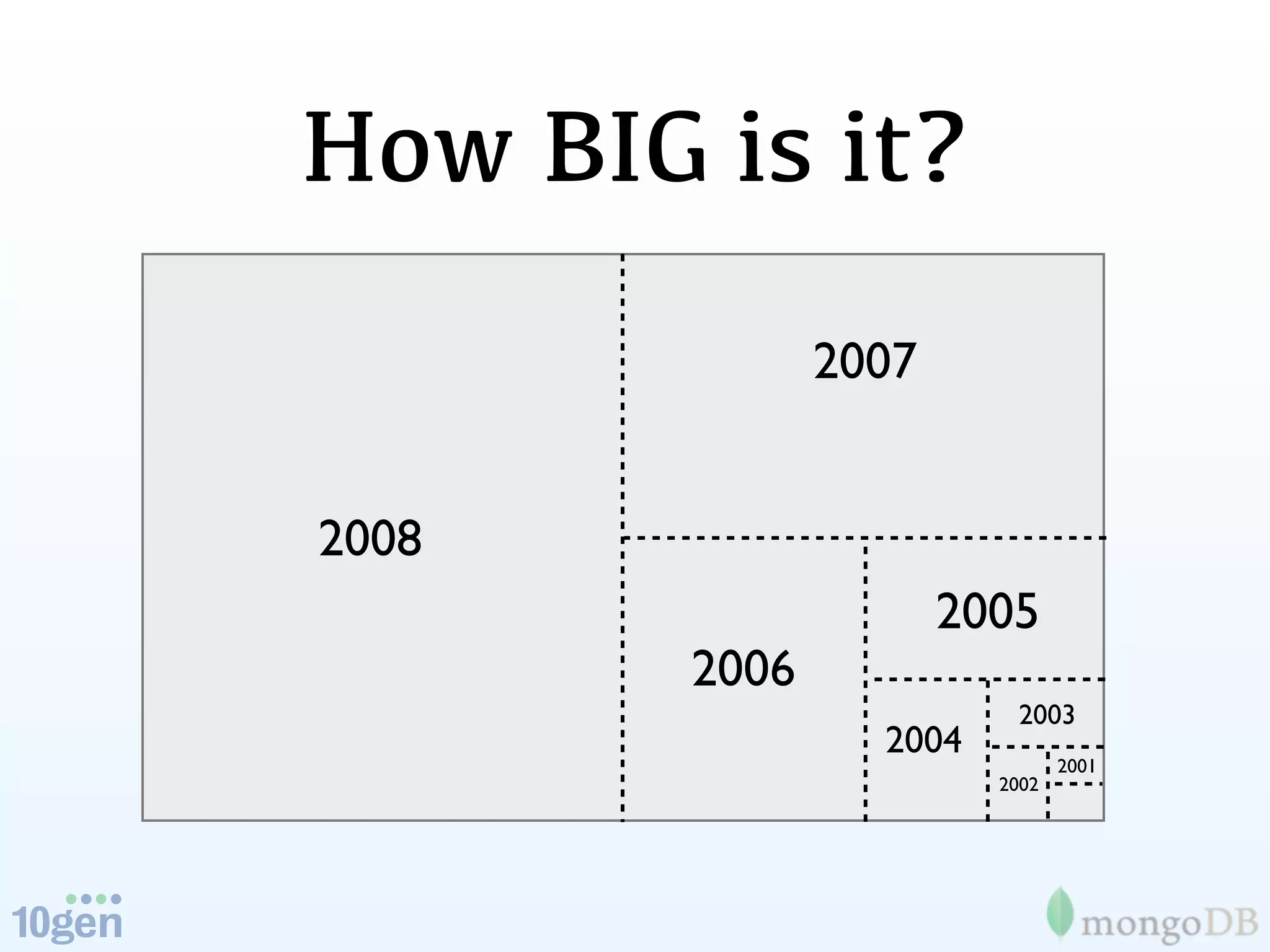
How BIG is it?
How BIG is it?


2008
How BIG is it?
               2007


2008
                      2005
        2006
                          2003
                 2004
                               2001
                        2002
Why all this
talk about BIG
  Data now?
In the past few
years open source
software emerged
enabling ‘us’ to
handle BIG Data
The Big Data
   Story
Is actually
two stories
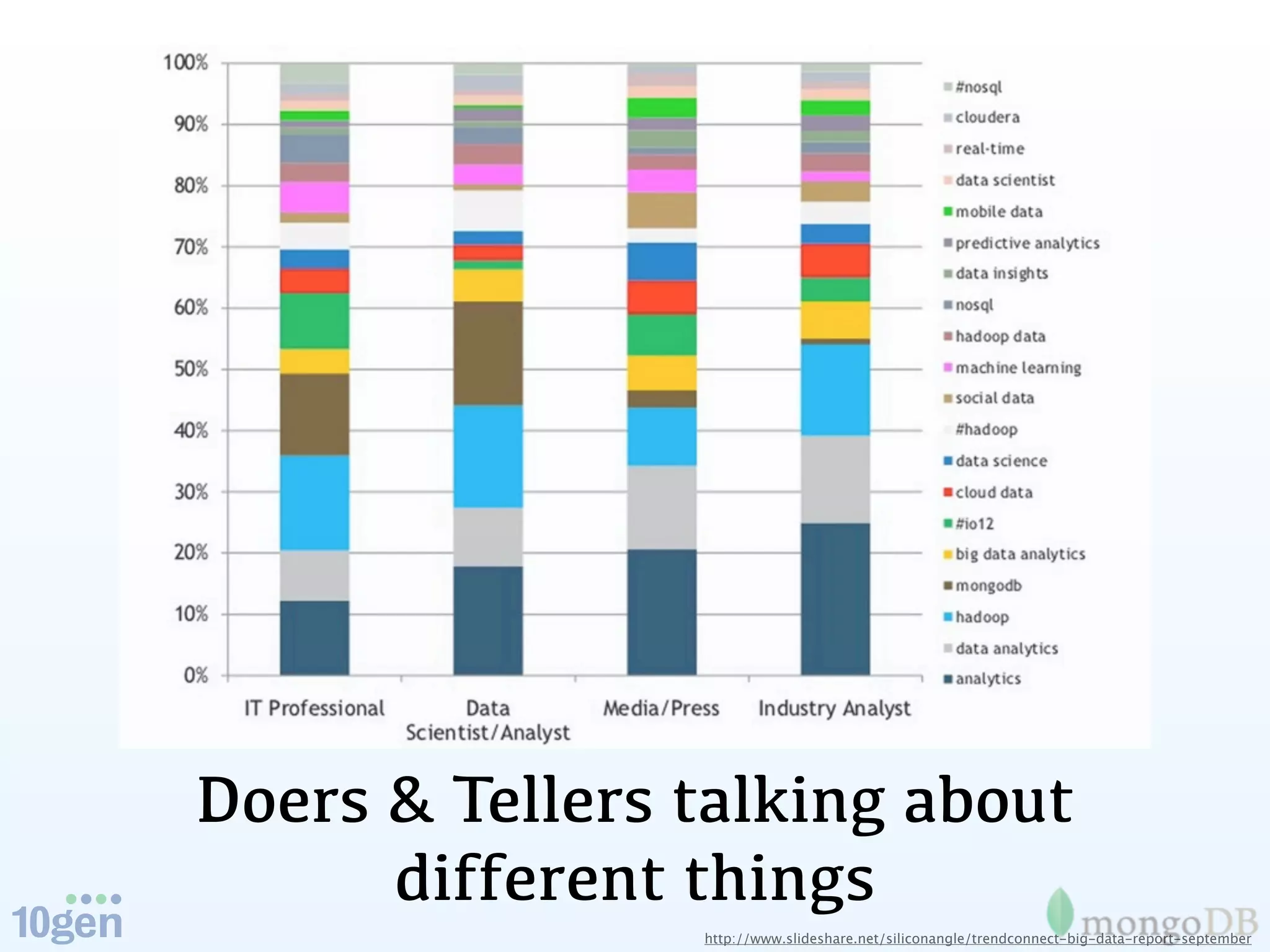
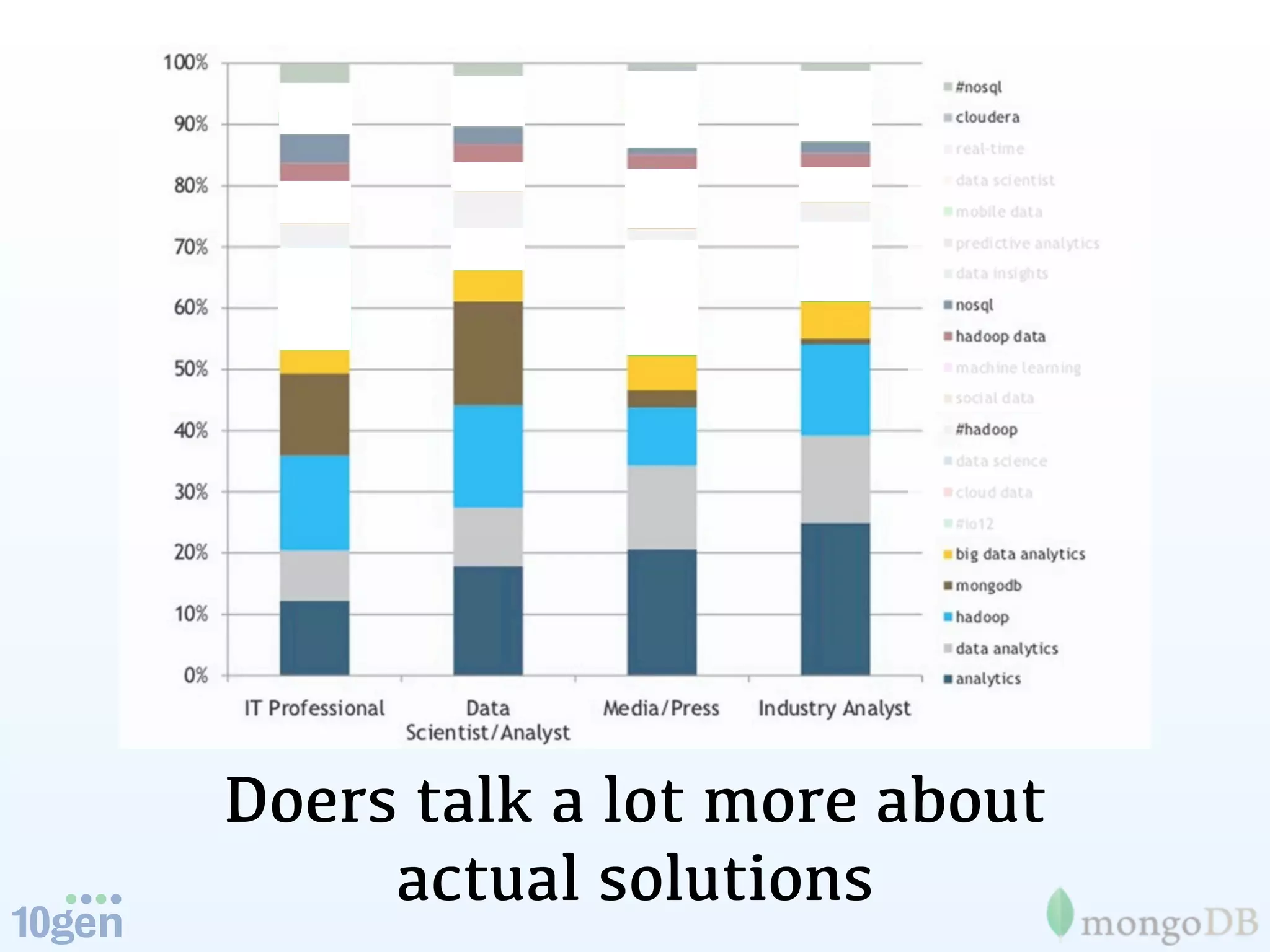
Doers & Tellers talking about
      different things
                http://www.slideshare.net/siliconangle/trendconnect-big-data-report-september
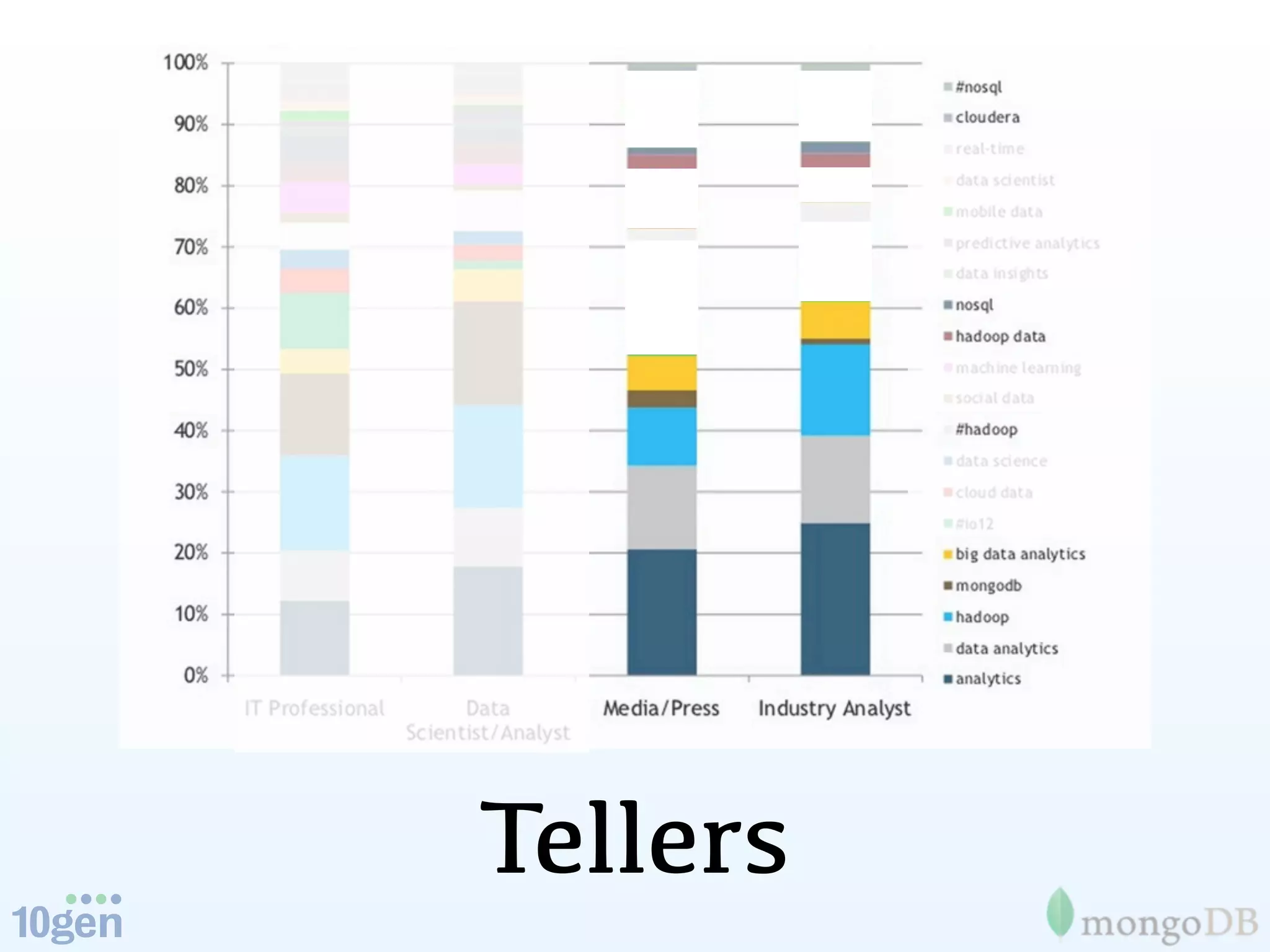
Tellers
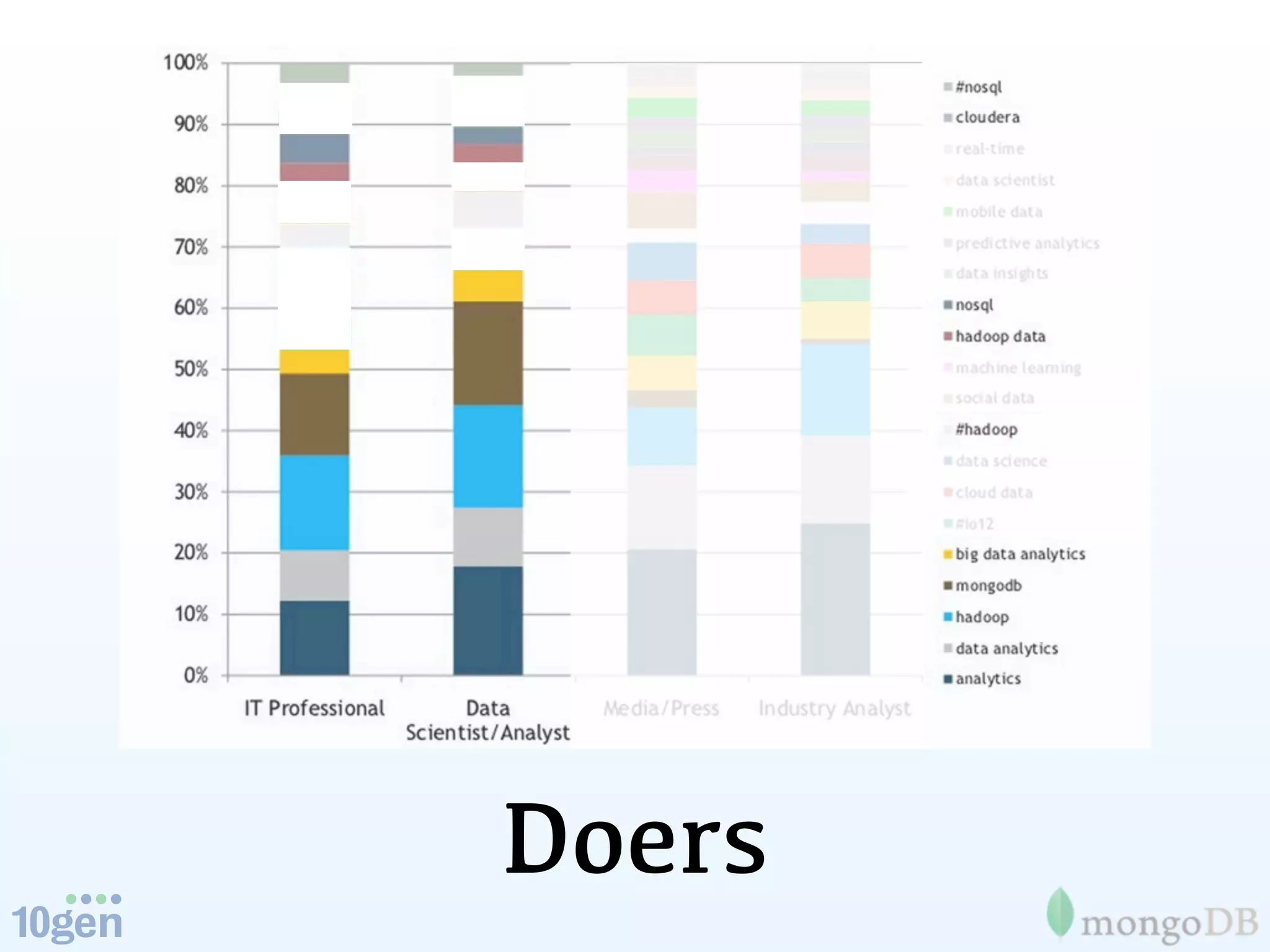
Doers
Doers talk a lot more about
     actual solutions
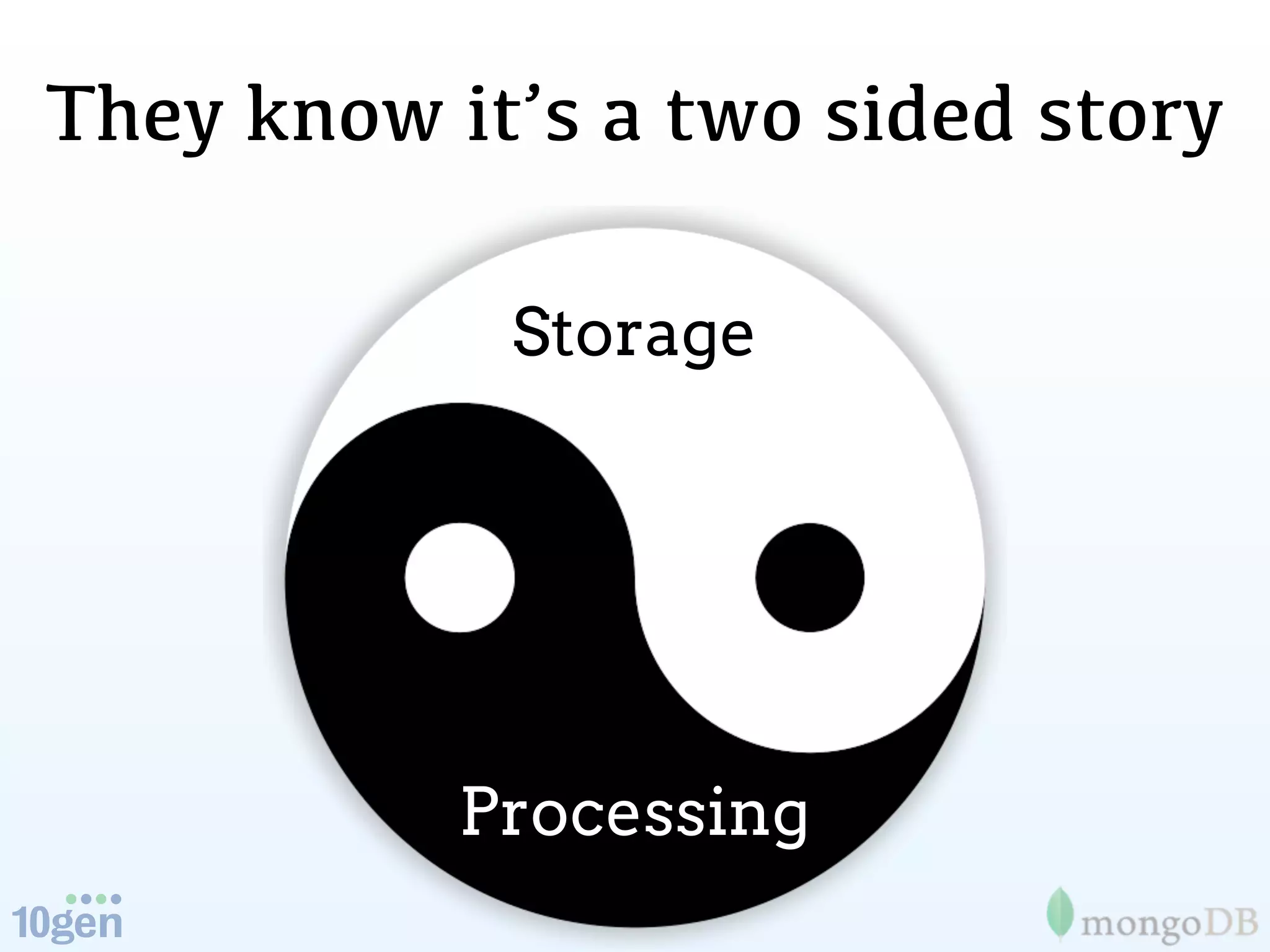
They know it’s a two sided story

            Storage


           Processing
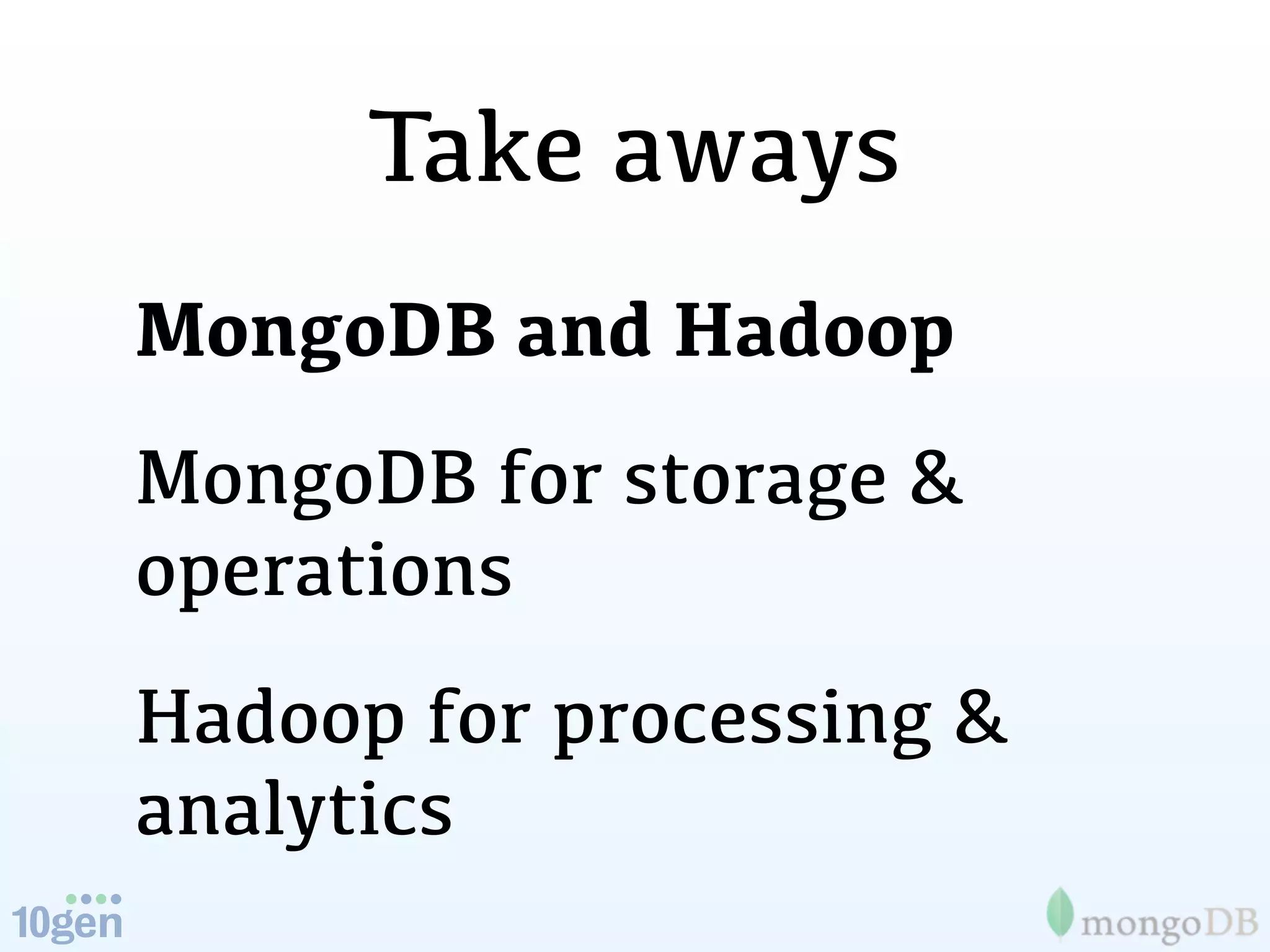
Take aways
MongoDB and Hadoop
MongoDB for storage &
operations
Hadoop for processing &
analytics
MongoDB
& Data Processing
Applications have
    complex needs
MongoDB ideal operational
database
MongoDB ideal for BIG data
Not a data processing engine, but
provides processing functionality
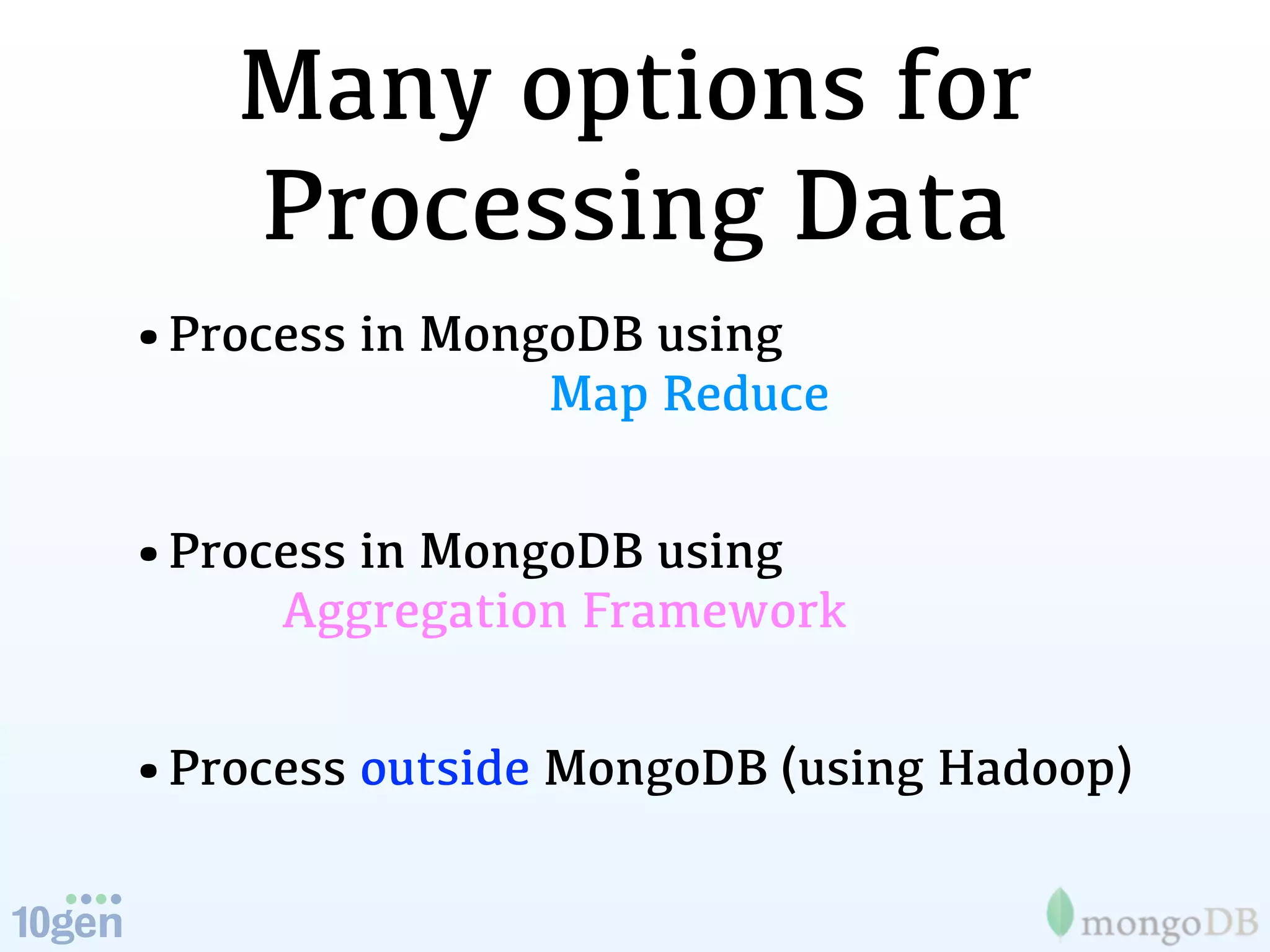
Many options for
    Processing Data
•Process in MongoDB using
                Map Reduce


•Process in MongoDB using
     Aggregation Framework


•Process outside MongoDB (using Hadoop)
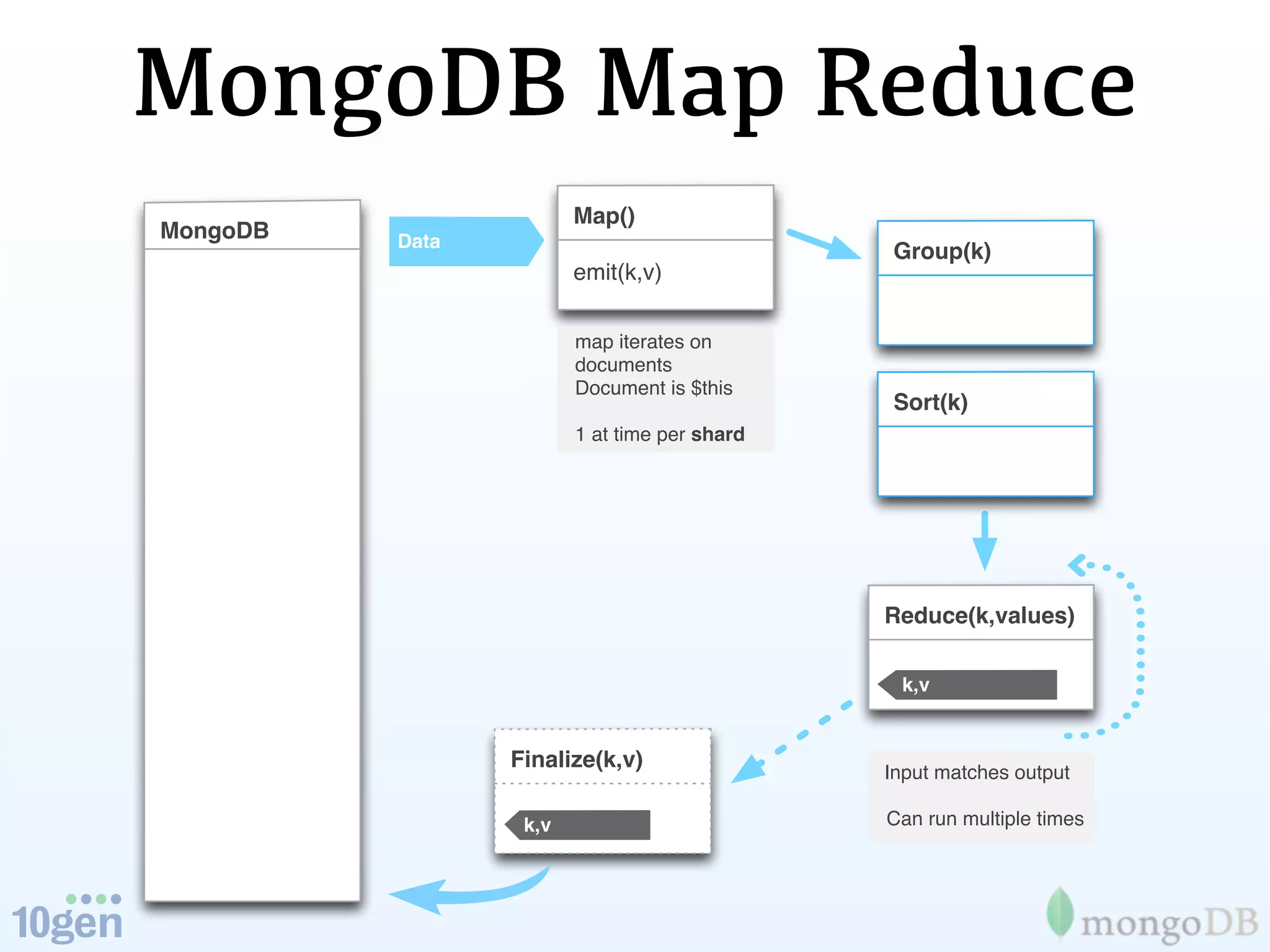
MongoDB Map Reduce
                        Map()
MongoDB   Data
                                              Group(k)
                        emit(k,v)

                        map iterates on
                        documents
                        Document is $this
                                              Sort(k)
                        1 at time per shard


                                              Reduce(k,values)

                                               k,v


                 Finalize(k,v)
                                              Input matches output

                  k,v                         Can run multiple times
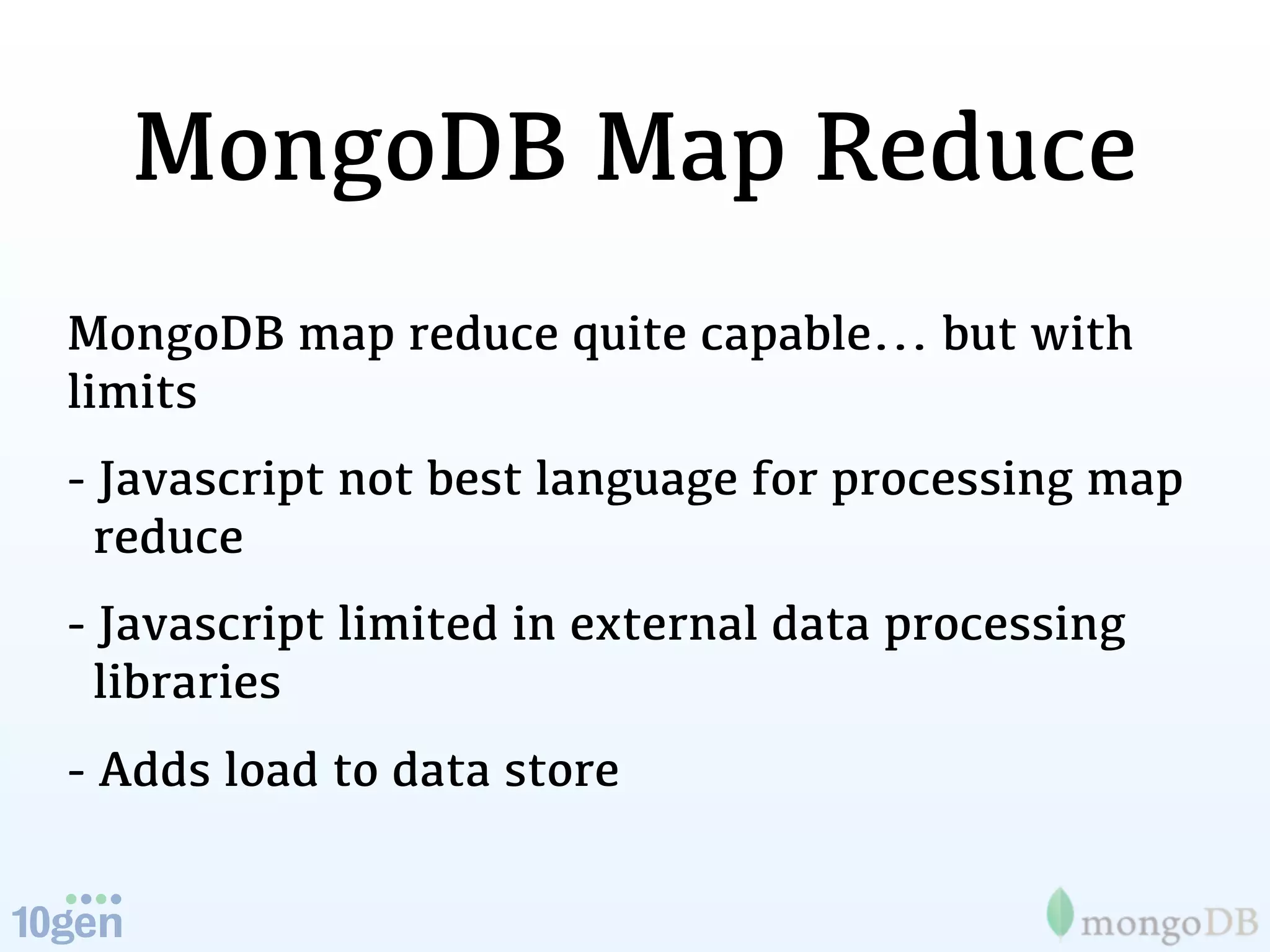
MongoDB Map Reduce
MongoDB map reduce quite capable... but with
limits
- Javascript not best language for processing map
  reduce
- Javascript limited in external data processing
  libraries
- Adds load to data store
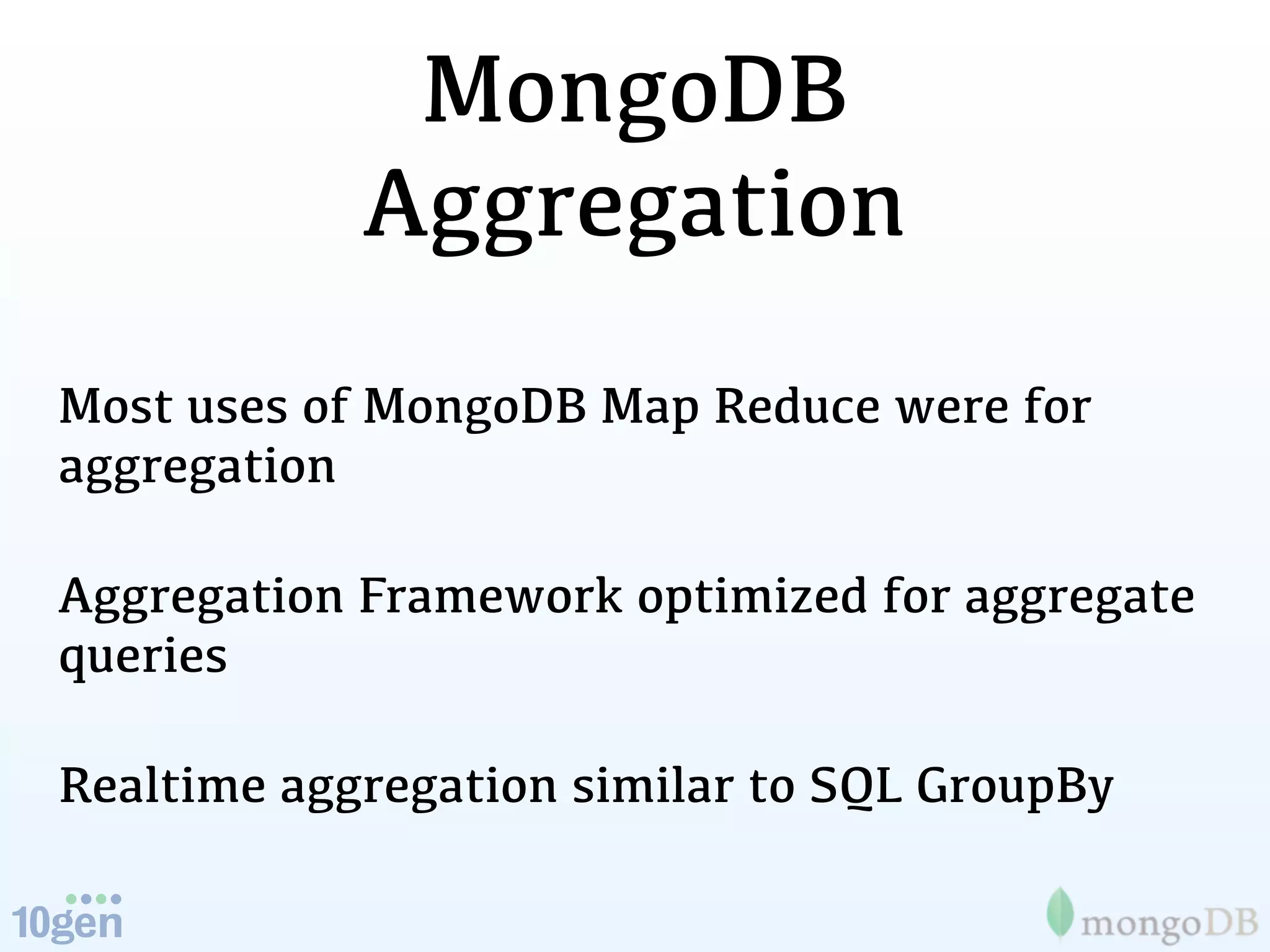
MongoDB
            Aggregation
Most uses of MongoDB Map Reduce were for
aggregation

Aggregation Framework optimized for aggregate
queries

Realtime aggregation similar to SQL GroupBy
MongoDB & Hadoop
                      same as Mongo's          Many map operations
MongoDB             shard chunks (64mb)        1 at time per input split

                   Creates a list     each split      Map (k1,1v1,1ctx)                          Runs on same
                   of Input Splits                     Map (k ,1v ,1ctx)                         thread as map
                                      each split        Map (k , v , ctx)
single server or
sharded cluster    (InputFormat)      each split           ctx.write(k2,v2)2
                                                             ctx.write(k2,v )2            Combiner(k2,values2)2
                                     RecordReader              ctx.write(k2,v )            Combiner(k2,values )2
                                                                                            Combiner(k2,values )
                                                                                                k2, 2v3 3
                                                                                                 k , 2v 3
                                                                                                     k ,v


                                               Partitioner(k2)2
                                                Partitioner(k )2
                                                 Partitioner(k )
                                                                                  Sort(keys2)
                                                                                   Sort(k2)2
                                                                                    Sort(k )

MongoDB


                                                                                                            Reducer threads


                                                                 Reduce(k2,values3)
                                           Output Format                                    Runs once per key

                                                                    kf,vf
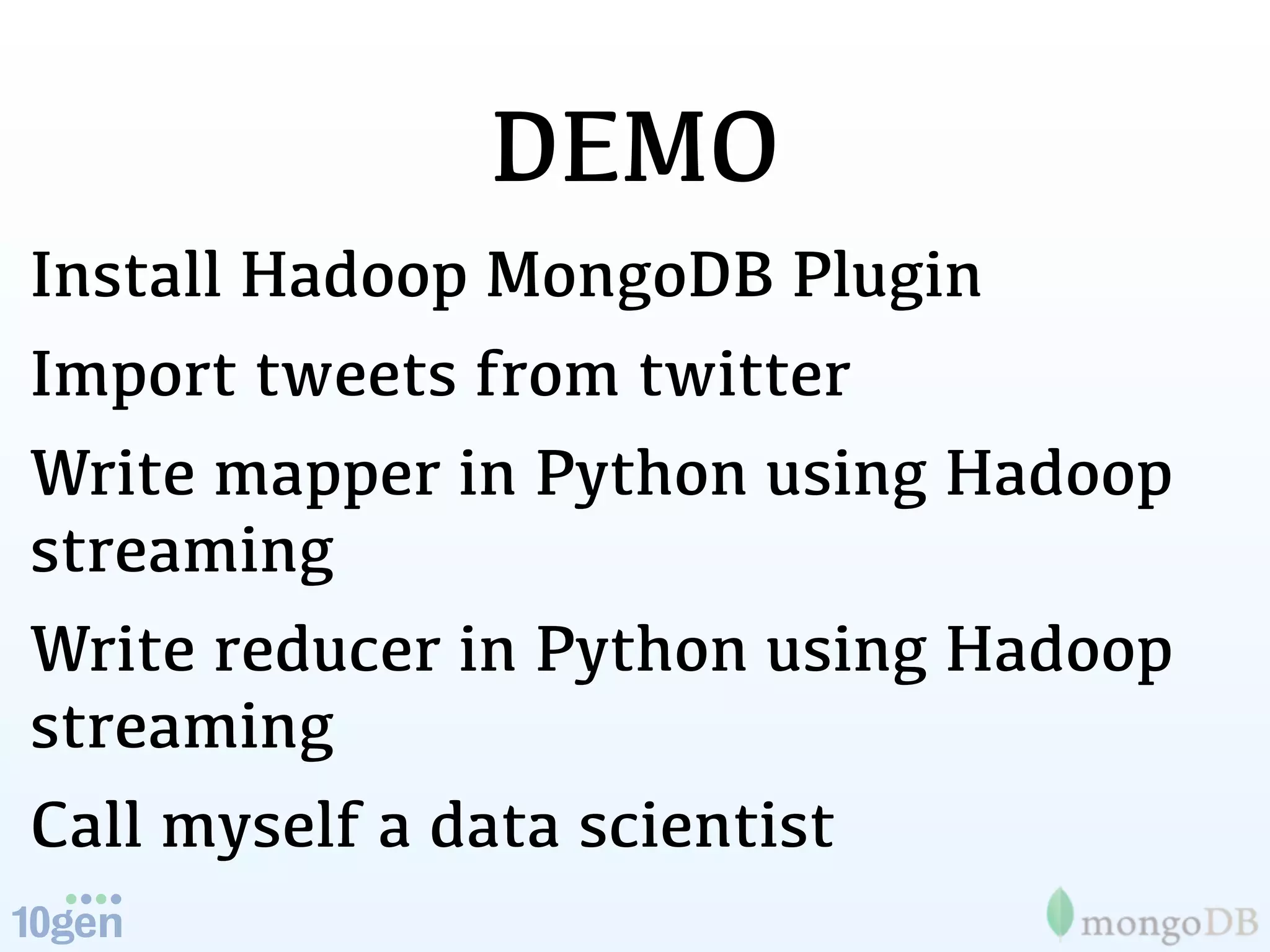
DEMO
TIME
DEMO
Install Hadoop MongoDB Plugin
Import tweets from twitter
Write mapper in Python using Hadoop
streaming
Write reducer in Python using Hadoop
streaming
Call myself a data scientist
Installing Mongo-hadoop
                   https://gist.github.com/1887726

hadoop_version '0.23'
hadoop_path="/usr/local/Cellar/hadoop/
$hadoop_version.0/libexec/lib"

git clone git://github.com/mongodb/mongo-
hadoop.git
cd mongo-hadoop
sed -i '' "s/default/$hadoop_version/g" build.sbt
cd streaming
./build.sh
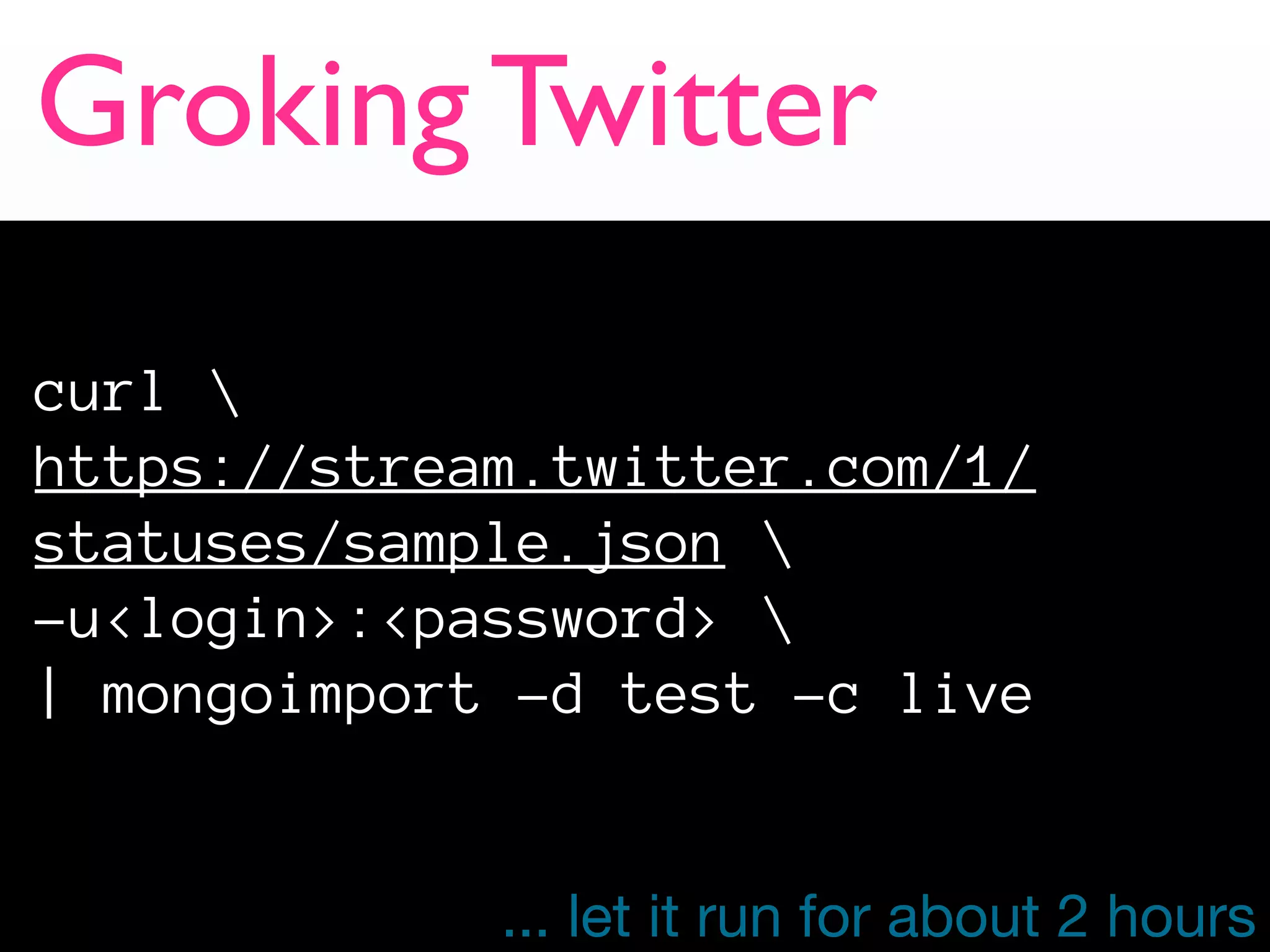
Groking Twitter

curl 
https://stream.twitter.com/1/
statuses/sample.json 
-u<login>:<password> 
| mongoimport -d test -c live


             ... let it run for about 2 hours
DEMO 1
Map Hashtags in Python
#!/usr/bin/env python

import sys
sys.path.append(".")

from pymongo_hadoop import BSONMapper

def mapper(documents):
    for doc in documents:
        for hashtag in doc['entities']['hashtags']:
            yield {'_id': hashtag['text'], 'count': 1}

BSONMapper(mapper)
print >> sys.stderr, "Done Mapping."
Reduce hashtags in Python
#!/usr/bin/env python

import sys
sys.path.append(".")

from pymongo_hadoop import BSONReducer

def reducer(key, values):
    print >> sys.stderr, "Hashtag %s" % key.encode('utf8')
    _count = 0
    for v in values:
        _count += v['count']
    return {'_id': key.encode('utf8'), 'count': _count}

BSONReducer(reducer)
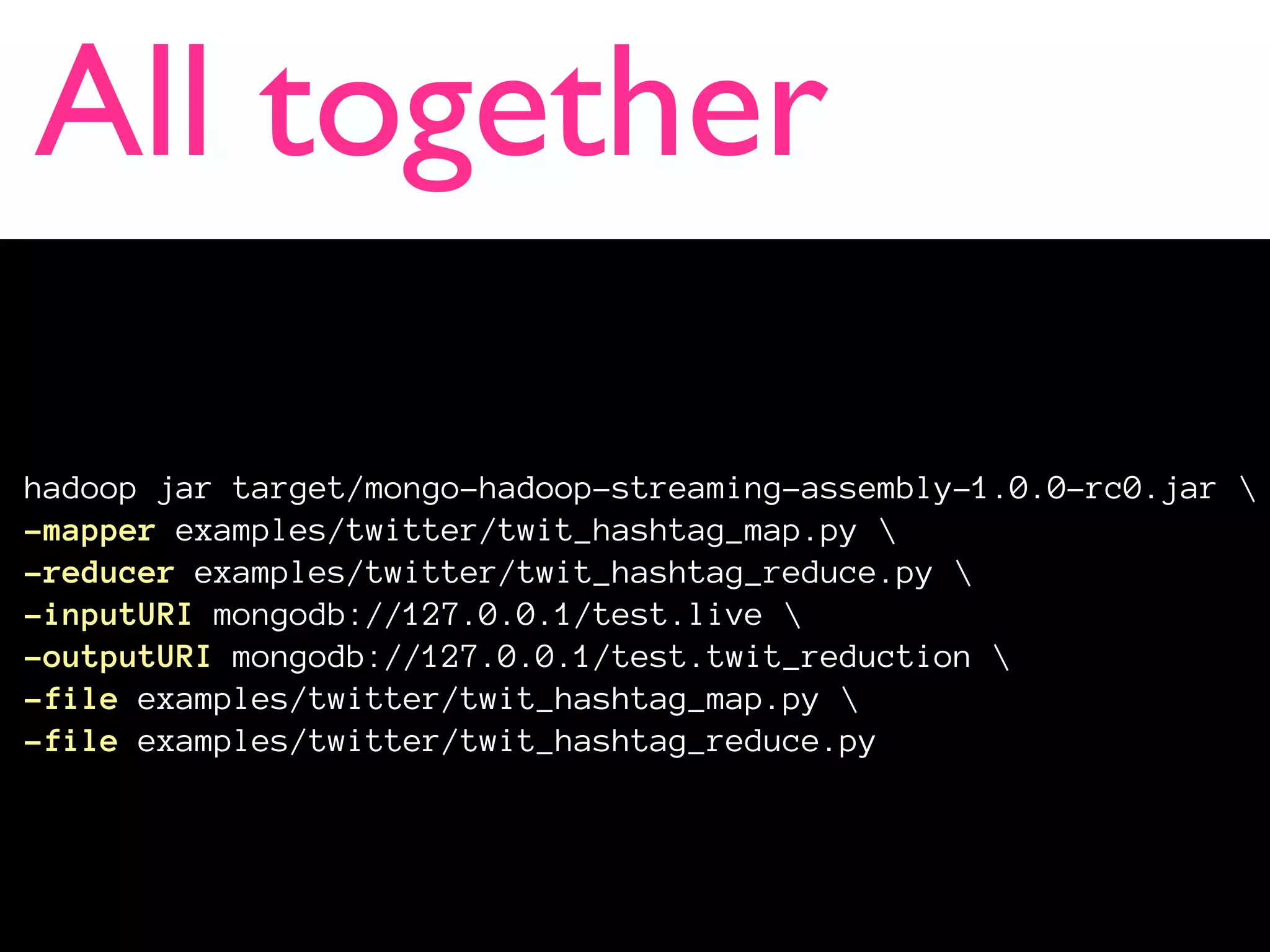
All together

hadoop jar target/mongo-hadoop-streaming-assembly-1.0.0-rc0.jar 
-mapper examples/twitter/twit_hashtag_map.py 
-reducer examples/twitter/twit_hashtag_reduce.py 
-inputURI mongodb://127.0.0.1/test.live 
-outputURI mongodb://127.0.0.1/test.twit_reduction 
-file examples/twitter/twit_hashtag_map.py 
-file examples/twitter/twit_hashtag_reduce.py
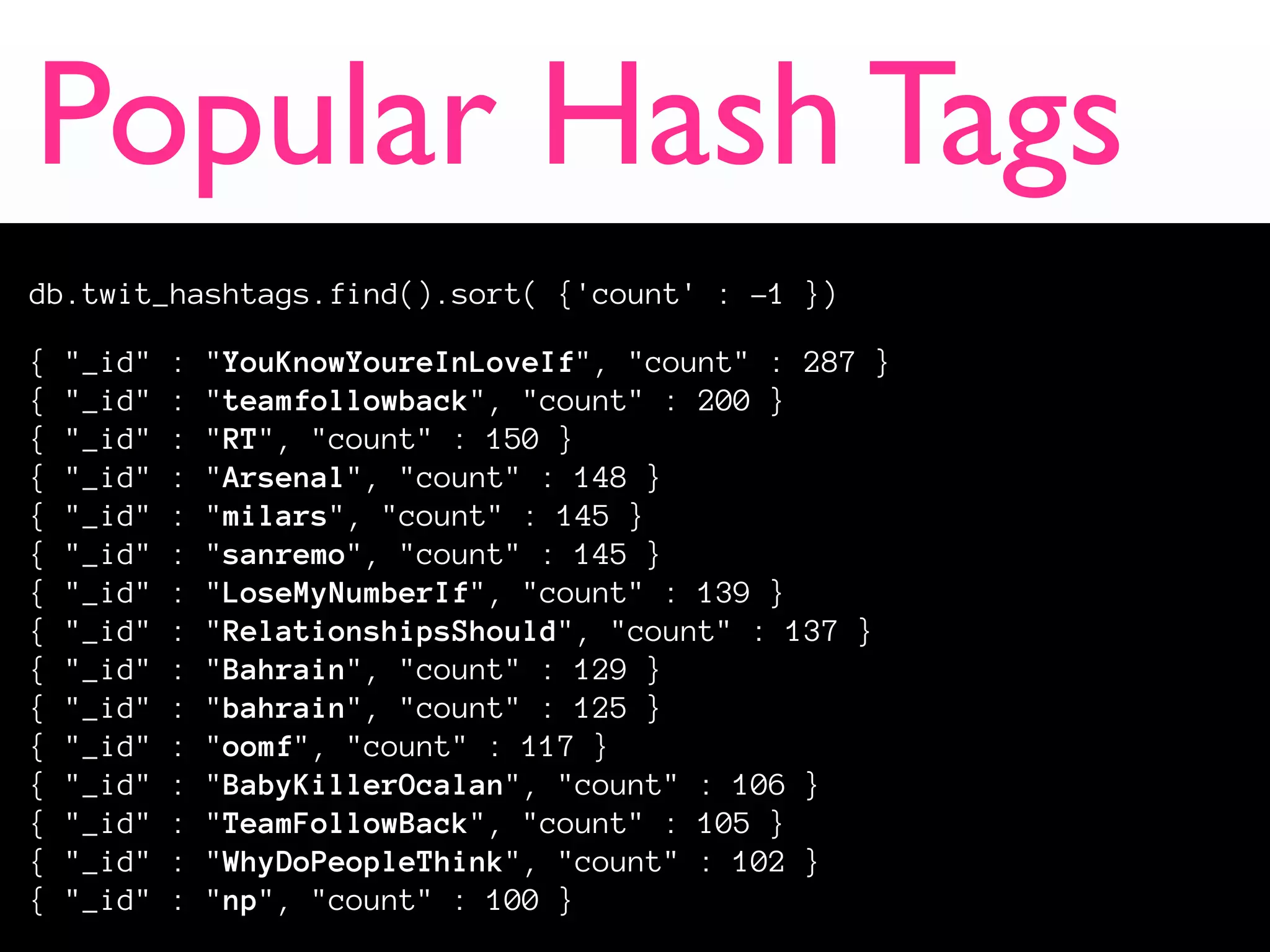
Popular Hash Tags
db.twit_hashtags.find().sort( {'count' : -1 })

{   "_id"   :   "YouKnowYoureInLoveIf", "count" : 287 }
{   "_id"   :   "teamfollowback", "count" : 200 }
{   "_id"   :   "RT", "count" : 150 }
{   "_id"   :   "Arsenal", "count" : 148 }
{   "_id"   :   "milars", "count" : 145 }
{   "_id"   :   "sanremo", "count" : 145 }
{   "_id"   :   "LoseMyNumberIf", "count" : 139 }
{   "_id"   :   "RelationshipsShould", "count" : 137 }
{   "_id"   :   "Bahrain", "count" : 129 }
{   "_id"   :   "bahrain", "count" : 125 }
{   "_id"   :   "oomf", "count" : 117 }
{   "_id"   :   "BabyKillerOcalan", "count" : 106 }
{   "_id"   :   "TeamFollowBack", "count" : 105 }
{   "_id"   :   "WhyDoPeopleThink", "count" : 102 }
{   "_id"   :   "np", "count" : 100 }
DEMO 2
Aggregation in Mongo 2.1
    db.live.aggregate(
    { $unwind : "$entities.hashtags" } ,
    { $match :
       { "entities.hashtags.text" :
           { $exists : true } } } ,
    { $group :
       { _id : "$entities.hashtags.text",
       count : { $sum : 1 } } } ,
    { $sort : { count : -1 } },
    { $limit : 10 }
)
Popular Hash Tags
    db.twit_hashtags.aggregate(a){
     "result" : [
        { "_id" : "YouKnowYoureInLoveIf", "count" : 287 },
        { "_id" : "teamfollowback", "count" : 200 },
        { "_id" : "RT", "count" : 150 },
        { "_id" : "Arsenal", "count" : 148 },
        { "_id" : "milars", "count" : 145 },
        { "_id" : "sanremo","count" : 145 },
        { "_id" : "LoseMyNumberIf", "count" : 139 },
        { "_id" : "RelationshipsShould", "count" : 137 },
        { "_id" : "Bahrain", "count" : 129 },
        { "_id" : "bahrain", "count" : 125 }
      ],"ok" : 1
}
The
      Future of
humongous
            data
What is BIG?
  BIG today is
normal tomorrow
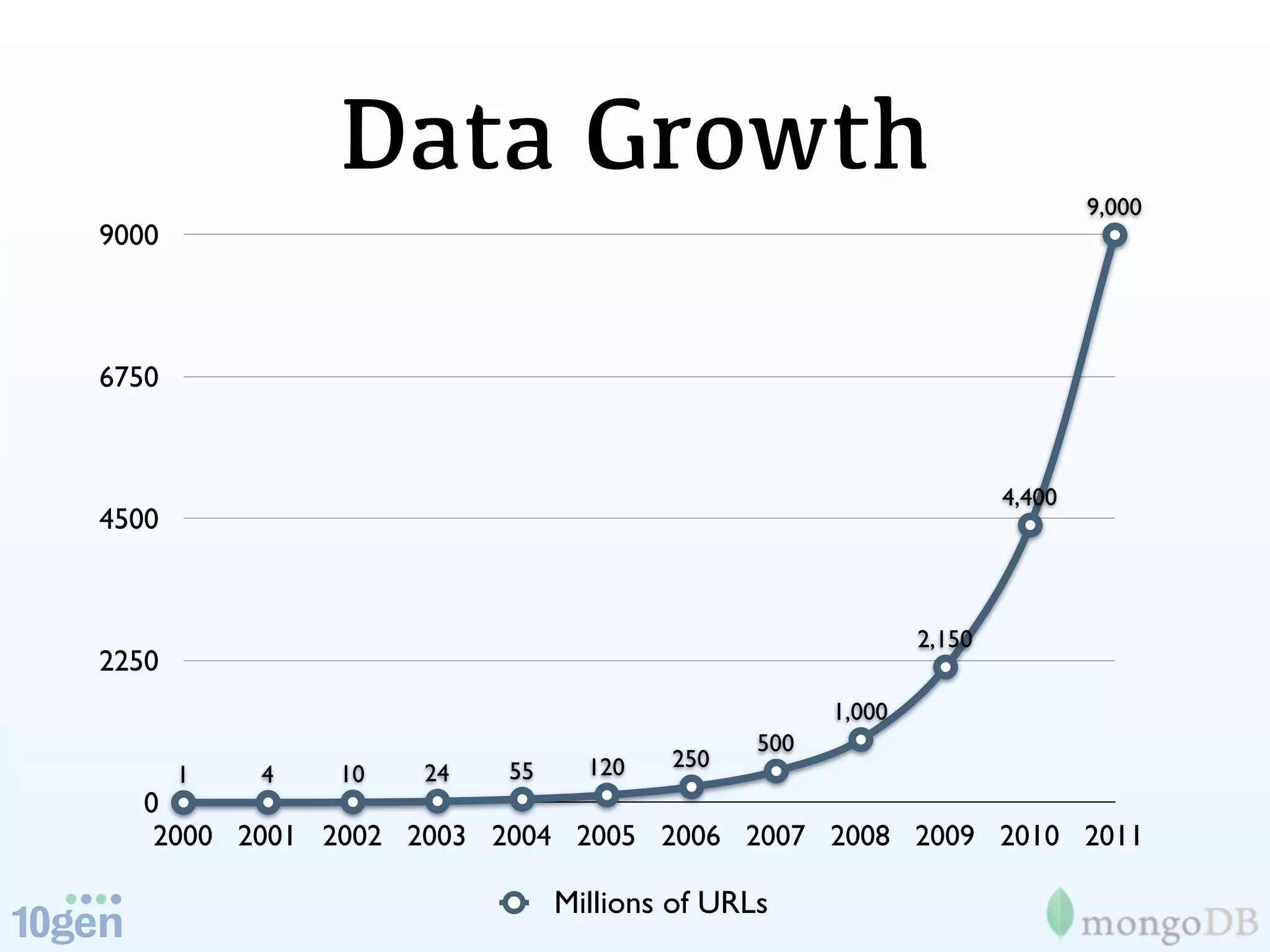
Data Growth                                                 9,000
9000


6750


                                                                   4,400
4500


                                                           2,150
2250
                                                   1,000
                                             500
                         55     120   250
       1   4   10   24
  0
   2000 2001 2002 2003 2004 2005 2006 2007 2008 2009 2010 2011

                              Millions of URLs
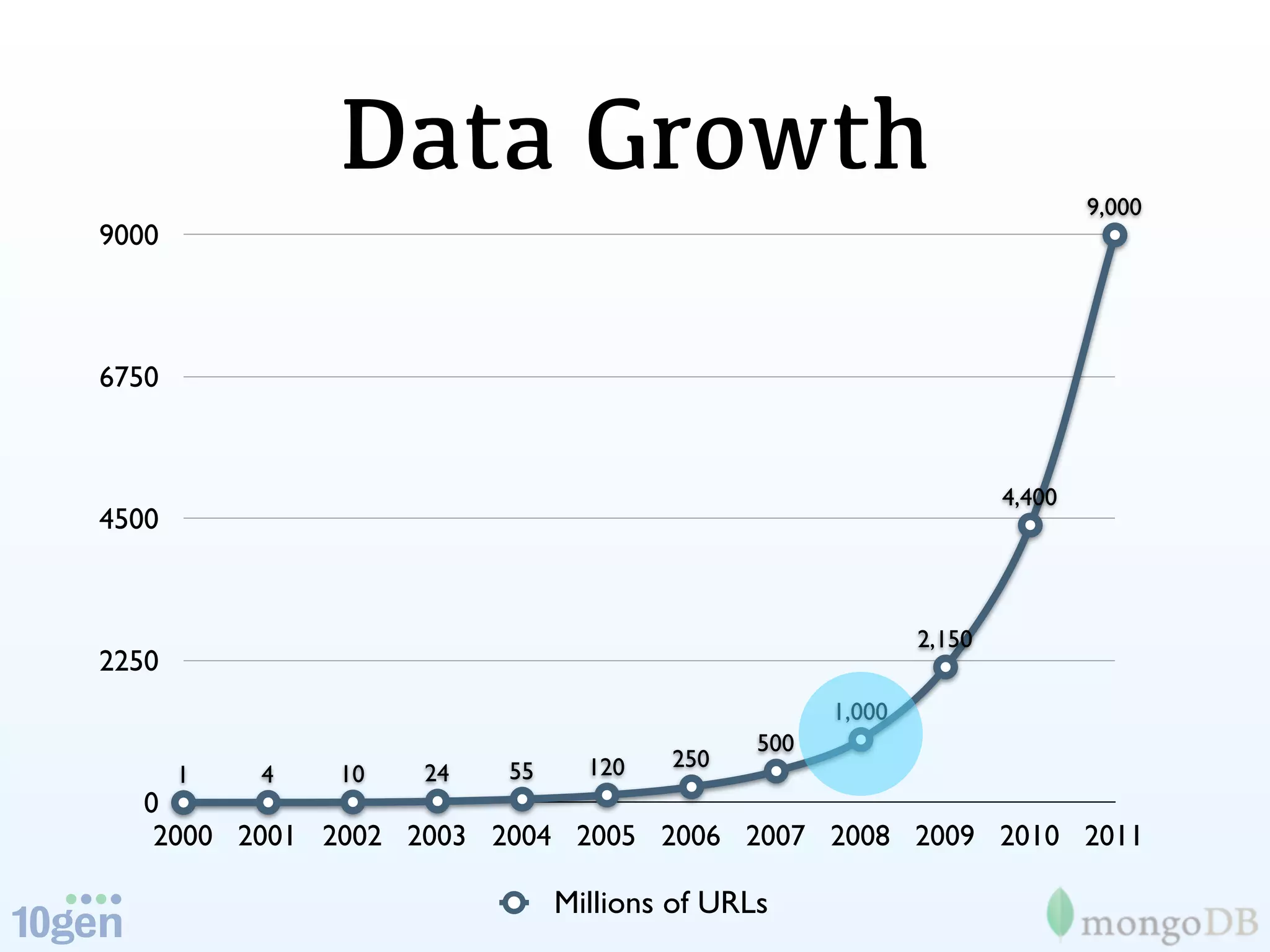
Data Growth                                                 9,000
9000


6750


                                                                   4,400
4500


                                                           2,150
2250
                                                   1,000
                                             500
                         55     120   250
       1   4   10   24
  0
   2000 2001 2002 2003 2004 2005 2006 2007 2008 2009 2010 2011

                              Millions of URLs
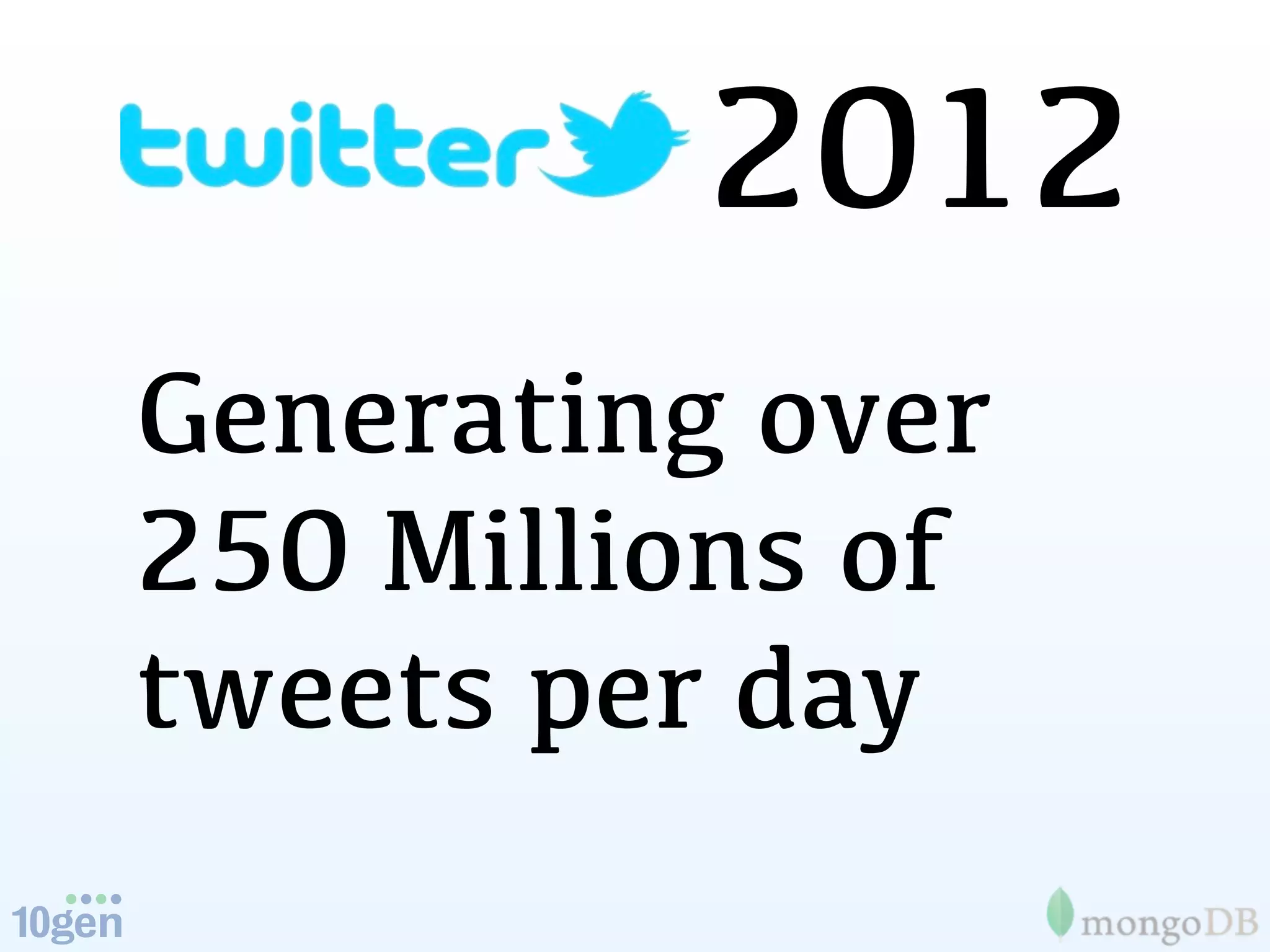
2012
Generating over
250 Millions of
tweets per day
MongoDB enables us to scale
with the redefinition of BIG.

New processing tools like
Hadoop & Storm are enabling
us to process the new BIG.
Hadoop is our
  first step
MongoDB is
committed to working
 with best data tools
      including
 Hadoop, Storm,
Disco, Spark & more
http://spf13.com
                  http://github.com/spf13
                  @spf13


Questions?
 download at
 github.com/mongodb/mongo-hadoop
MongoDB, Hadoop and humongous data - MongoSV 2012

MongoDB, Hadoop and humongous data - MongoSV 2012

  • 1.
  • 2.
    Talking about What isHumongous Data Humongous Data & You MongoDB & Data processing Future of Humongous Data
  • 3.
    @spf13 AKA Steve Francia 15+ years building the internet Father, husband, skateboarder Chief Solutions Architect @ responsible for drivers, integrations, web & docs
  • 4.
  • 5.
    2000 Google Inc Today announcedit has released the largest search engine on the Internet. Google’s new index, comprising more than 1 billion URLs
  • 6.
    2008 Our indexing systemfor processing links indicates that we now count 1 trillion unique URLs (and the number of individual web pages out there is growing by several billion pages per day).
  • 7.
    An unprecedented amount ofdata is being created and is accessible
  • 8.
    Data Growth 1,000 1000 750 500 500 250 250 120 55 4 10 24 1 0 2000 2001 2002 2003 2004 2005 2006 2007 2008 Millions of URLs
  • 9.
    Truly Exponential Growth Is hard for people to grasp A BBC reporter recently: "Your current PC is more powerful than the computer they had on board the first flight to the moon".
  • 10.
    Moore’s Law Applies tomore than just CPUs Boiled down it is that things double at regular intervals It’s exponential growth.. and applies to big data
  • 11.
  • 12.
    How BIG isit? 2008
  • 13.
    How BIG isit? 2007 2008 2005 2006 2003 2004 2001 2002
  • 14.
    Why all this talkabout BIG Data now?
  • 15.
    In the pastfew years open source software emerged enabling ‘us’ to handle BIG Data
  • 16.
  • 17.
  • 18.
    Doers & Tellerstalking about different things http://www.slideshare.net/siliconangle/trendconnect-big-data-report-september
  • 19.
  • 20.
  • 21.
    Doers talk alot more about actual solutions
  • 22.
    They know it’sa two sided story Storage Processing
  • 23.
    Take aways MongoDB andHadoop MongoDB for storage & operations Hadoop for processing & analytics
  • 24.
  • 25.
    Applications have complex needs MongoDB ideal operational database MongoDB ideal for BIG data Not a data processing engine, but provides processing functionality
  • 26.
    Many options for Processing Data •Process in MongoDB using Map Reduce •Process in MongoDB using Aggregation Framework •Process outside MongoDB (using Hadoop)
  • 27.
    MongoDB Map Reduce Map() MongoDB Data Group(k) emit(k,v) map iterates on documents Document is $this Sort(k) 1 at time per shard Reduce(k,values) k,v Finalize(k,v) Input matches output k,v Can run multiple times
  • 28.
    MongoDB Map Reduce MongoDBmap reduce quite capable... but with limits - Javascript not best language for processing map reduce - Javascript limited in external data processing libraries - Adds load to data store
  • 29.
    MongoDB Aggregation Most uses of MongoDB Map Reduce were for aggregation Aggregation Framework optimized for aggregate queries Realtime aggregation similar to SQL GroupBy
  • 30.
    MongoDB & Hadoop same as Mongo's Many map operations MongoDB shard chunks (64mb) 1 at time per input split Creates a list each split Map (k1,1v1,1ctx) Runs on same of Input Splits Map (k ,1v ,1ctx) thread as map each split Map (k , v , ctx) single server or sharded cluster (InputFormat) each split ctx.write(k2,v2)2 ctx.write(k2,v )2 Combiner(k2,values2)2 RecordReader ctx.write(k2,v ) Combiner(k2,values )2 Combiner(k2,values ) k2, 2v3 3 k , 2v 3 k ,v Partitioner(k2)2 Partitioner(k )2 Partitioner(k ) Sort(keys2) Sort(k2)2 Sort(k ) MongoDB Reducer threads Reduce(k2,values3) Output Format Runs once per key kf,vf
  • 31.
  • 32.
    DEMO Install Hadoop MongoDBPlugin Import tweets from twitter Write mapper in Python using Hadoop streaming Write reducer in Python using Hadoop streaming Call myself a data scientist
  • 33.
    Installing Mongo-hadoop https://gist.github.com/1887726 hadoop_version '0.23' hadoop_path="/usr/local/Cellar/hadoop/ $hadoop_version.0/libexec/lib" git clone git://github.com/mongodb/mongo- hadoop.git cd mongo-hadoop sed -i '' "s/default/$hadoop_version/g" build.sbt cd streaming ./build.sh
  • 34.
    Groking Twitter curl https://stream.twitter.com/1/ statuses/sample.json -u<login>:<password> | mongoimport -d test -c live ... let it run for about 2 hours
  • 35.
  • 36.
    Map Hashtags inPython #!/usr/bin/env python import sys sys.path.append(".") from pymongo_hadoop import BSONMapper def mapper(documents): for doc in documents: for hashtag in doc['entities']['hashtags']: yield {'_id': hashtag['text'], 'count': 1} BSONMapper(mapper) print >> sys.stderr, "Done Mapping."
  • 37.
    Reduce hashtags inPython #!/usr/bin/env python import sys sys.path.append(".") from pymongo_hadoop import BSONReducer def reducer(key, values): print >> sys.stderr, "Hashtag %s" % key.encode('utf8') _count = 0 for v in values: _count += v['count'] return {'_id': key.encode('utf8'), 'count': _count} BSONReducer(reducer)
  • 38.
    All together hadoop jartarget/mongo-hadoop-streaming-assembly-1.0.0-rc0.jar -mapper examples/twitter/twit_hashtag_map.py -reducer examples/twitter/twit_hashtag_reduce.py -inputURI mongodb://127.0.0.1/test.live -outputURI mongodb://127.0.0.1/test.twit_reduction -file examples/twitter/twit_hashtag_map.py -file examples/twitter/twit_hashtag_reduce.py
  • 39.
    Popular Hash Tags db.twit_hashtags.find().sort({'count' : -1 }) { "_id" : "YouKnowYoureInLoveIf", "count" : 287 } { "_id" : "teamfollowback", "count" : 200 } { "_id" : "RT", "count" : 150 } { "_id" : "Arsenal", "count" : 148 } { "_id" : "milars", "count" : 145 } { "_id" : "sanremo", "count" : 145 } { "_id" : "LoseMyNumberIf", "count" : 139 } { "_id" : "RelationshipsShould", "count" : 137 } { "_id" : "Bahrain", "count" : 129 } { "_id" : "bahrain", "count" : 125 } { "_id" : "oomf", "count" : 117 } { "_id" : "BabyKillerOcalan", "count" : 106 } { "_id" : "TeamFollowBack", "count" : 105 } { "_id" : "WhyDoPeopleThink", "count" : 102 } { "_id" : "np", "count" : 100 }
  • 40.
  • 41.
    Aggregation in Mongo2.1 db.live.aggregate( { $unwind : "$entities.hashtags" } , { $match : { "entities.hashtags.text" : { $exists : true } } } , { $group : { _id : "$entities.hashtags.text", count : { $sum : 1 } } } , { $sort : { count : -1 } }, { $limit : 10 } )
  • 42.
    Popular Hash Tags db.twit_hashtags.aggregate(a){ "result" : [ { "_id" : "YouKnowYoureInLoveIf", "count" : 287 }, { "_id" : "teamfollowback", "count" : 200 }, { "_id" : "RT", "count" : 150 }, { "_id" : "Arsenal", "count" : 148 }, { "_id" : "milars", "count" : 145 }, { "_id" : "sanremo","count" : 145 }, { "_id" : "LoseMyNumberIf", "count" : 139 }, { "_id" : "RelationshipsShould", "count" : 137 }, { "_id" : "Bahrain", "count" : 129 }, { "_id" : "bahrain", "count" : 125 } ],"ok" : 1 }
  • 43.
    The Future of humongous data
  • 44.
    What is BIG? BIG today is normal tomorrow
  • 45.
    Data Growth 9,000 9000 6750 4,400 4500 2,150 2250 1,000 500 55 120 250 1 4 10 24 0 2000 2001 2002 2003 2004 2005 2006 2007 2008 2009 2010 2011 Millions of URLs
  • 46.
    Data Growth 9,000 9000 6750 4,400 4500 2,150 2250 1,000 500 55 120 250 1 4 10 24 0 2000 2001 2002 2003 2004 2005 2006 2007 2008 2009 2010 2011 Millions of URLs
  • 47.
  • 48.
    MongoDB enables usto scale with the redefinition of BIG. New processing tools like Hadoop & Storm are enabling us to process the new BIG.
  • 49.
    Hadoop is our first step
  • 50.
    MongoDB is committed toworking with best data tools including Hadoop, Storm, Disco, Spark & more
  • 51.
    http://spf13.com http://github.com/spf13 @spf13 Questions? download at github.com/mongodb/mongo-hadoop