f
e
h
W U
w k
M
w
P n
I
v
ZA
S
U
G
k
C
w
P
U
7
and when to avoid them
Common

Mistakes 

In Go
f
e
h
W U
w k
M
w
P n
I
v
ZA
S
U
G
k
C
w
P
U
@Spf13
Docker 

Chief Operator

&
Author of Hugo,
Cobra, Afero, Viper

f
e
h
W U
w k
M
w
P n
I
v
ZA
S
U
G
k
C
w
P
U
f
e
h
W U
w k
M
w
P n
I
v
ZA
S
U
G
k
C
w
P
U
“Do you want to know the
difference between a
master and a beginner?
The master has failed
more times than the
beginner has tried.”
f
e
h
W U
w k
M
w
P n
I
v
ZA
S
U
G
k
C
w
P
U
–Ed Catmull
“We need to think about failure
differently.
Most people think mistakes are a
necessary evil. Mistakes aren't a
necessary evil, they aren't evil at
all. They are an inevitable
consequence of doing something
new and as such should be seen
as valuable. “
f
e
h
W U
w k
M
w
P n
I
v
ZA
S
U
G
k
C
w
P
U
Mistake . 


Not Accepting
Interfaces
1
f
e
h
W U
w k
M
w
P n
I
v
ZA
S
U
G
k
C
w
P
U
State & Behavior
•Types can express state &
behavior
•State = data structure
•Behavior = methods
f
e
h
W U
w k
M
w
P n
I
v
ZA
S
U
G
k
C
w
P
U
Interfaces
•One of Go’s most powerful
features
•Permits extensibility
•Defined by methods
•Adherence is only satisfied by
behavior
f
e
h
W U
w k
M
w
P n
I
v
ZA
S
U
G
k
C
w
P
U
•Fastest static site
generator
•Native Go
•35+ themes
•Flexible
•100s of contributors
•Powers GopherAcademy
gohugo.io
func (page *Page) saveSourceAs(path string) {
b := new(bytes.Buffer)
b.Write(page.Source.Content)
page.saveSource(b.Bytes(), path)
}
func (page *Page) saveSource(by []byte, inpath
string) {
WriteToDisk(inpath, bytes.NewReader(by))
}
Stop Doing This!!
func (page *Page) saveSourceAs(path string) {
b := new(bytes.Buffer)
b.Write(page.Source.Content)
page.saveSource(b.Bytes(), path)
}
func (page *Page) saveSource(by []byte, inpath
string) {
WriteToDisk(inpath, bytes.NewReader(by))
}
Stop Doing This!!
func (page *Page) saveSourceAs(path string) {
b := new(bytes.Buffer)
b.Write(page.Source.Content)
page.saveSource(b.Bytes(), path)
}
func (page *Page) saveSource(by []byte, inpath
string) {
WriteToDisk(inpath, bytes.NewReader(by))
}
Stop Doing This!!
https://github.com/spf13/hugo/blob/master/hugolib/page.go#L582
func (page *Page) saveSourceAs(path string) {
b := new(bytes.Buffer)
b.Write(page.Source.Content)
page.saveSource(b, path)
}
func (page *Page) saveSource(b io.Reader, inpath
string) {
WriteToDisk(inpath, b)
}
Instead
f
e
h
W U
w k
M
w
P n
I
v
ZA
S
U
G
k
C
w
P
U
Mistake . 


Not Using
Io.Reader &
Io.Writer
2
f
e
h
W U
w k
M
w
P n
I
v
ZA
S
U
G
k
C
w
P
U
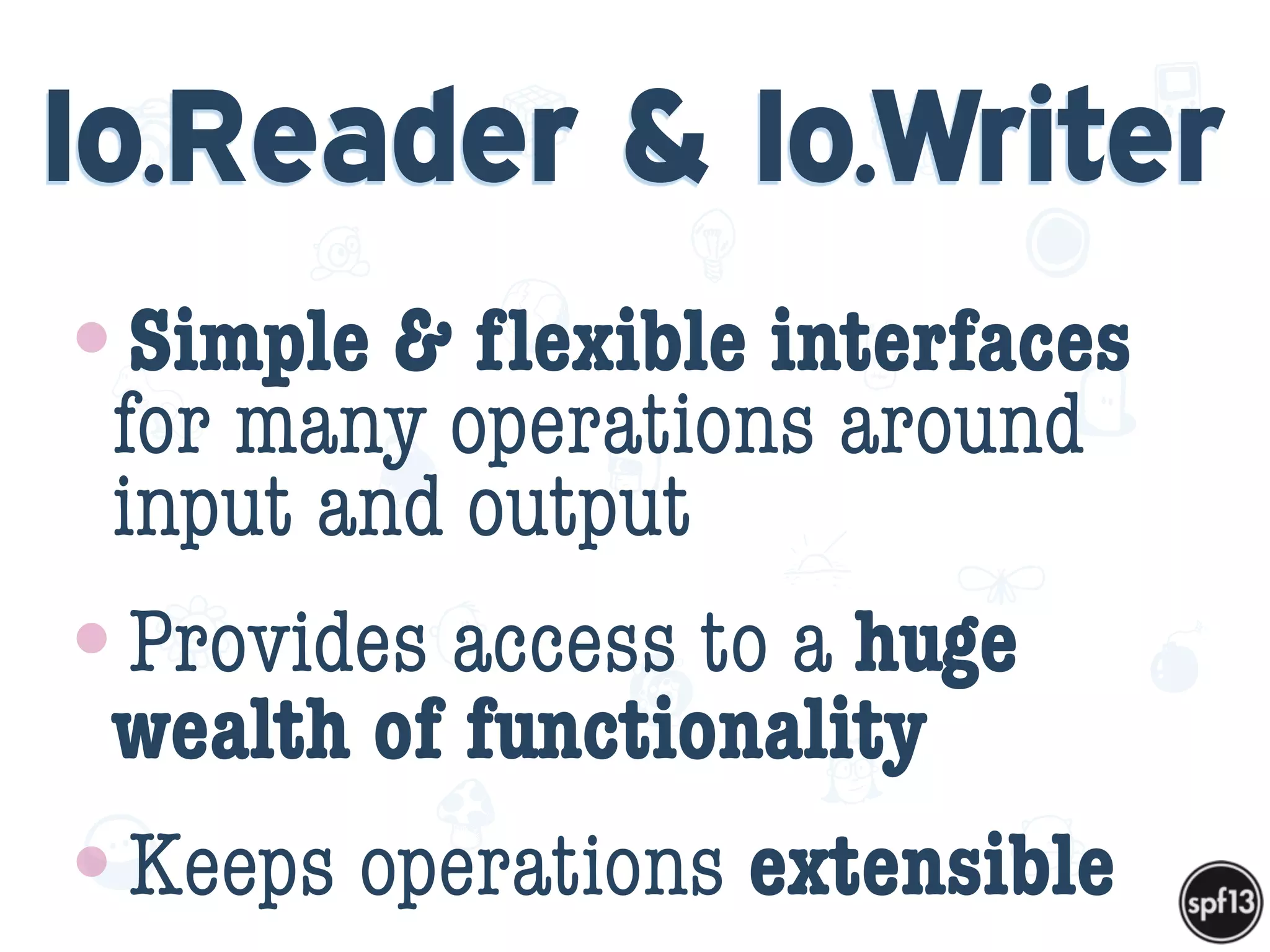
Io.Reader & Io.Writer
•Simple & flexible interfaces
for many operations around
input and output
•Provides access to a huge
wealth of functionality
•Keeps operations extensible
type Reader interface {
Read(p []byte) (n int, err error)
}
type Writer interface {
Write(p []byte) (n int, err error)
}
Io.Reader & Io.Writer
f
e
h
W U
w k
M
w
P n
I
v
ZA
S
U
G
k
C
w
P
U
Cobra Cli
Commander
•Fast and flexible
•Powers 

Kubernetes & Hugo
•Provides subcommands, help,
man pages, bash autocomplete
github.com/spf13/cobra
// SetOutput sets the destination for
usage and error messages.
// If output is nil, os.Stderr is used.
func (c *Command) SetOutput(o io.Writer) {
c.output = o
}
Cobra Apps Enabled
f
e
h
W U
w k
M
w
P n
I
v
ZA
S
U
G
k
C
w
P
U
Viper
•Configuration management
•Supports json, yaml, toml,
defaults, flags, env vars &
remote key value
•Supports nesting, cascading
& aliases
github.com/spf13/viper
func (v *Viper) ReadBufConfig(buf *bytes.Buffer) error {
v.config = make(map[string]interface{})
v.marshalReader(buf, v.config)
return nil
}
Really Stop Doing This!!
func (v *Viper) ReadConfig(in io.Reader) error {
v.config = make(map[string]interface{})
v.marshalReader(in, v.config)
return nil
}
Instead
f
e
h
W U
w k
M
w
P n
I
v
ZA
S
U
G
k
C
w
P
U
Mistake .


Requiring Broad
Interfaces
3
f
e
h
W U
w k
M
w
P n
I
v
ZA
S
U
G
k
C
w
P
U
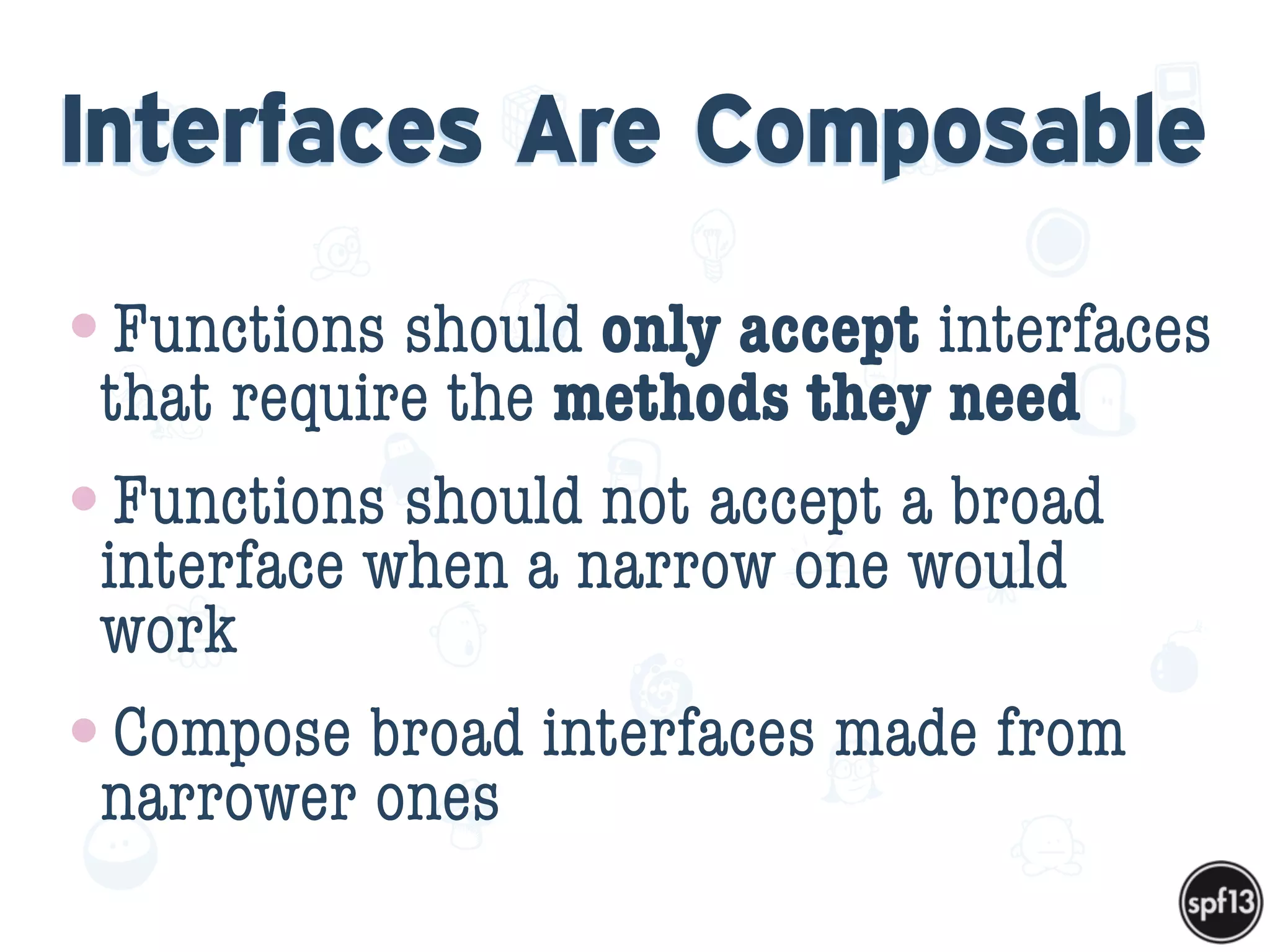
Interfaces Are Composable
•Functions should only accept interfaces
that require the methods they need
•Functions should not accept a broad
interface when a narrow one would
work
•Compose broad interfaces made from
narrower ones
f
e
h
W U
w k
M
w
P n
I
v
ZA
S
U
G
k
C
w
P
U
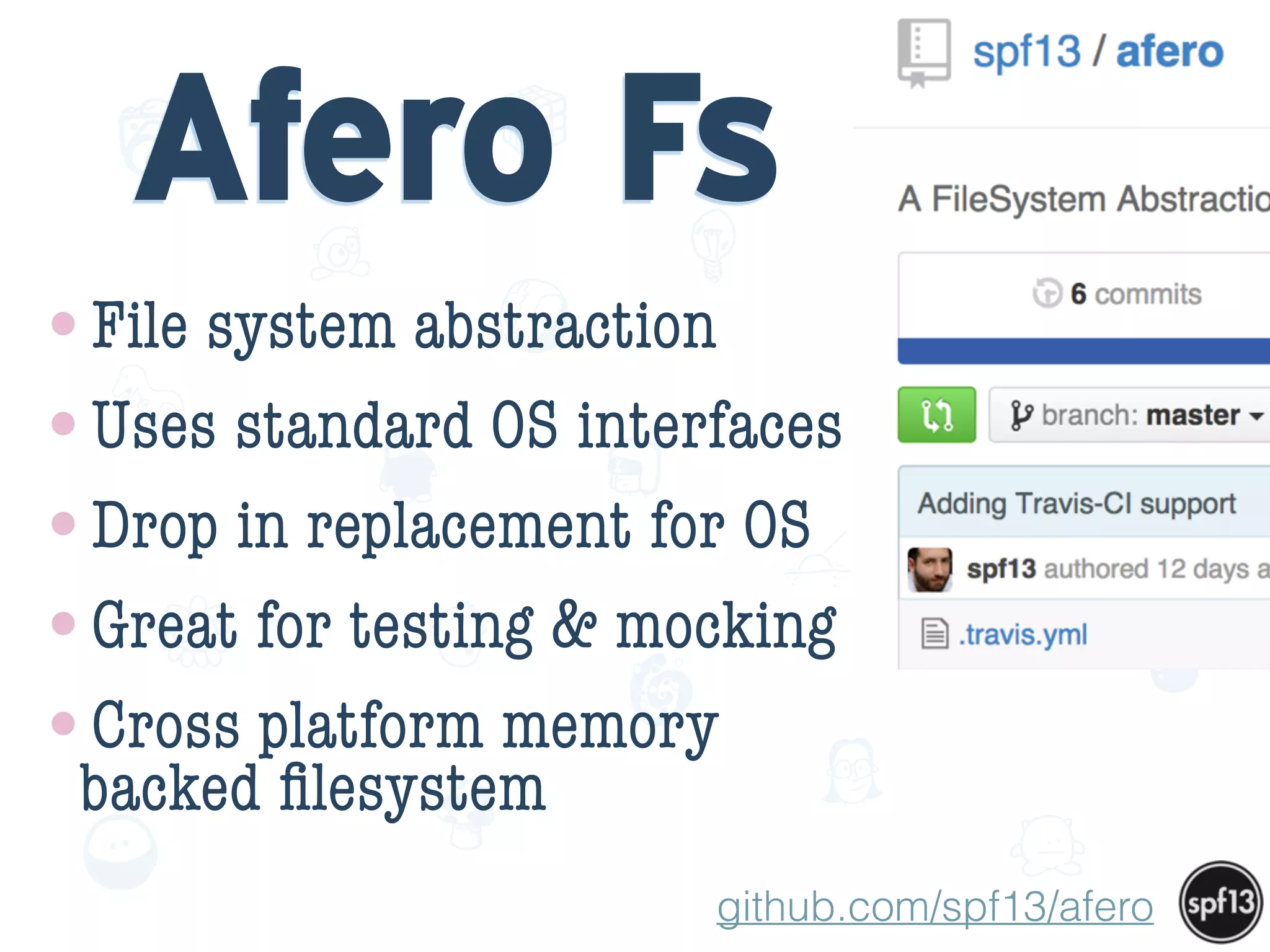
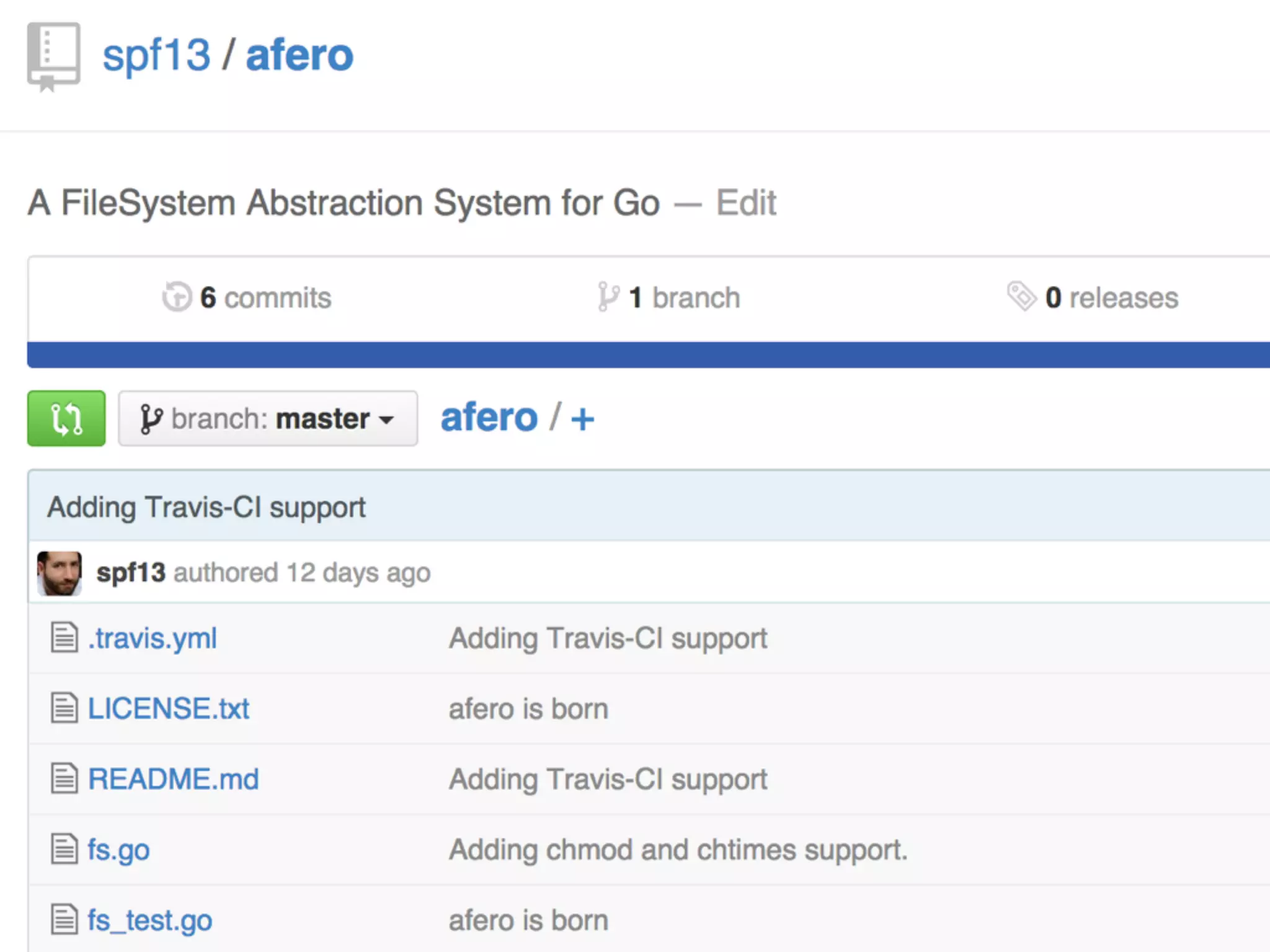
Afero Fs
•File system abstraction
•Uses standard OS interfaces
•Drop in replacement for OS
•Great for testing & mocking
•Cross platform memory
backed filesystem
github.com/spf13/afero
type File interface {
io.Closer
io.Reader
io.ReaderAt
io.Seeker
io.Writer
io.WriterAt
}
Composing Interfaces
func ReadIn(f File) {
b := []byte{}
n, err := f.Read(b)
...
}
Requiring Broad Interfaces
func ReadIn(r Reader) {
b := []byte{}
n, err := r.Read(b)
...
}
Requiring Narrow Interfaces
f
e
h
W U
w k
M
w
P n
I
v
ZA
S
U
G
k
C
w
P
U
Mistake .


Methods Vs
Functions
4
f
e
h
W U
w k
M
w
P n
I
v
ZA
S
U
G
k
C
w
P
U
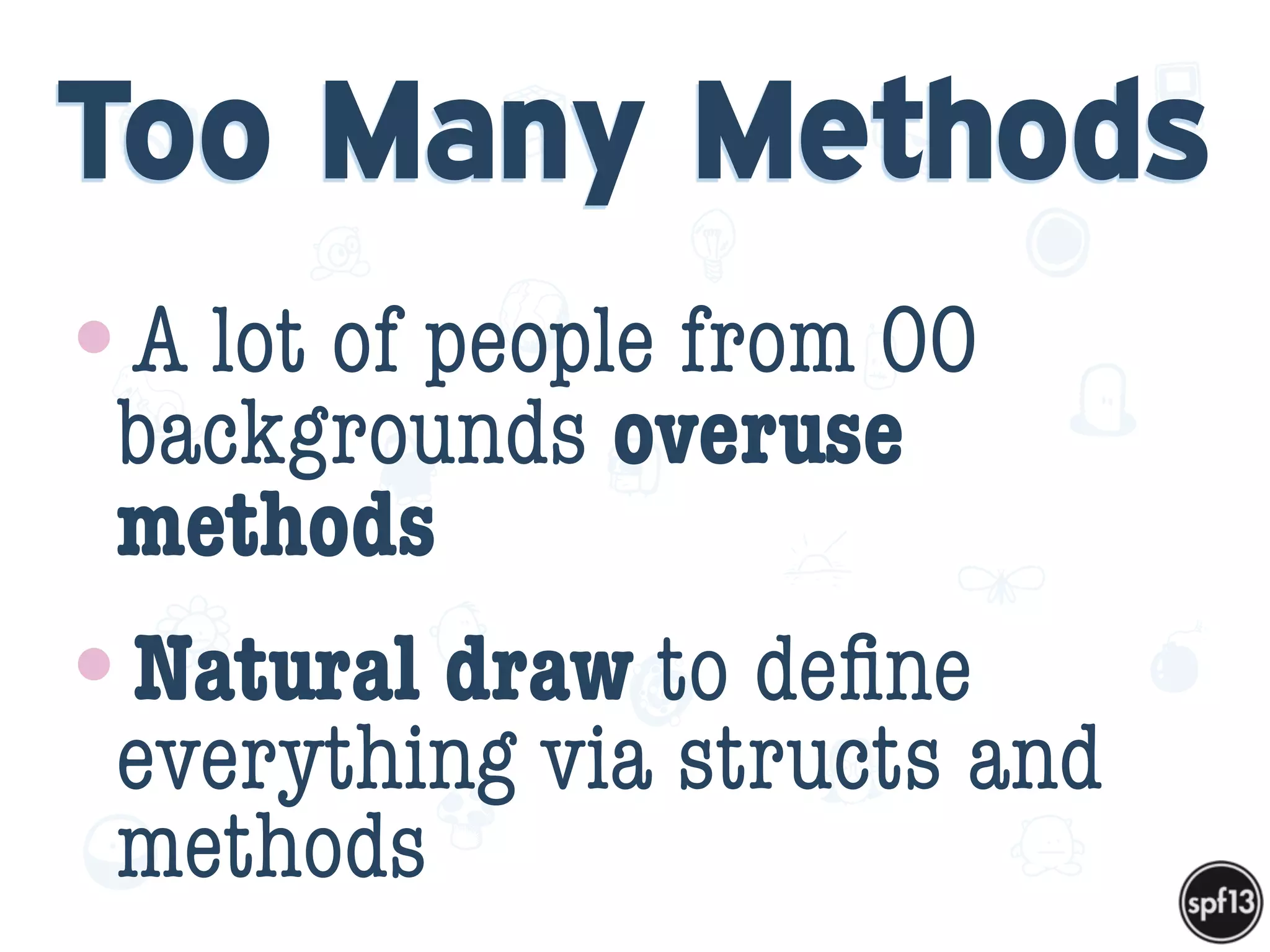
Too Many Methods
•A lot of people from OO
backgrounds overuse
methods
•Natural draw to define
everything via structs and
methods
f
e
h
W U
w k
M
w
P n
I
v
ZA
S
U
G
k
C
w
P
U
What Is A Function?
•Operations performed on N1
inputs that results in N2 outputs
•The same inputs will always
result in the same outputs
•Functions should not depend on
state
f
e
h
W U
w k
M
w
P n
I
v
ZA
S
U
G
k
C
w
P
U
What Is A Method?
•Defines the behavior of a type
•A function that operates
against a value
•Should use state
•Logically connected
f
e
h
W U
w k
M
w
P n
I
v
ZA
S
U
G
k
C
w
P
U
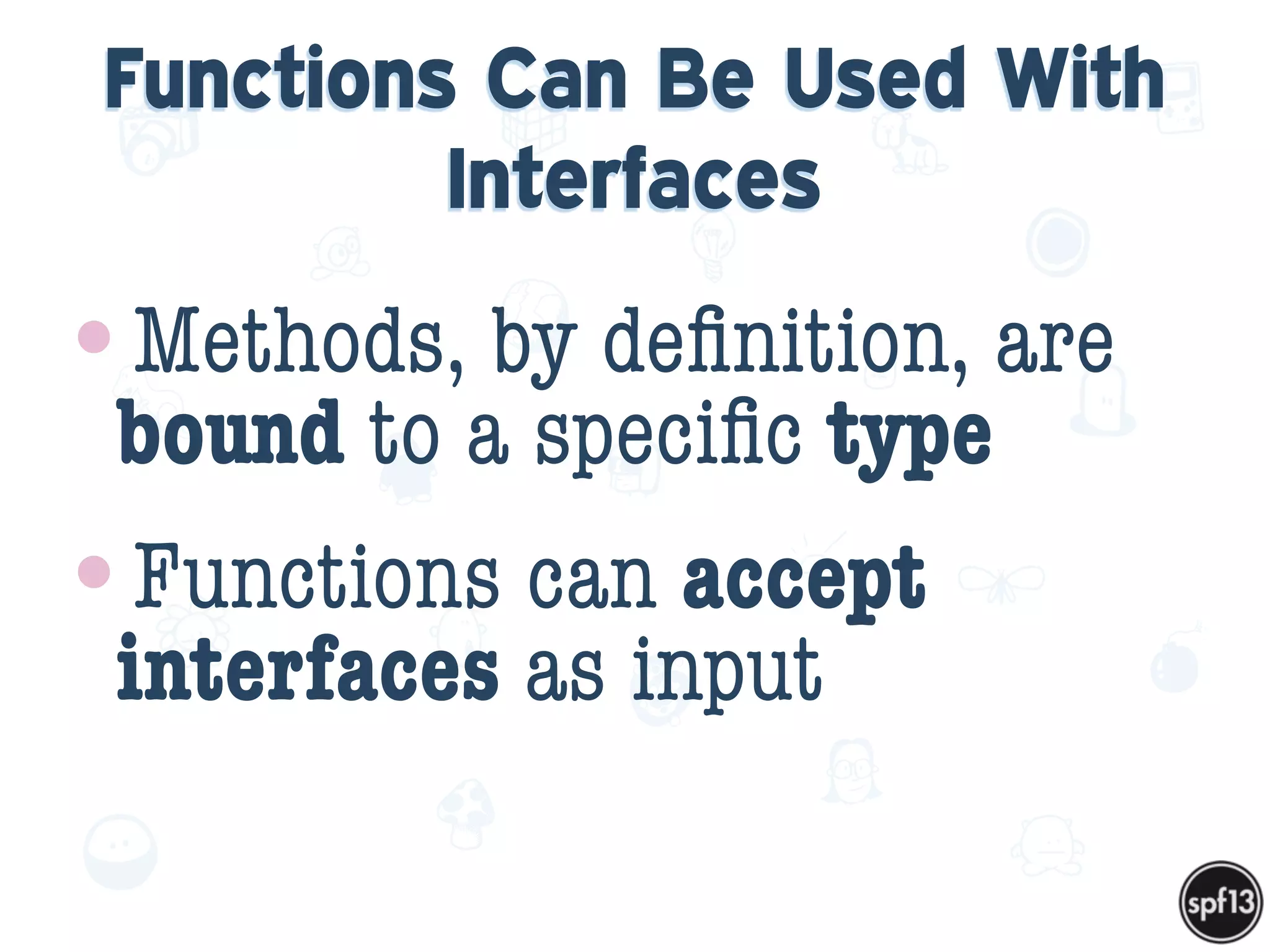
Functions Can Be Used With
Interfaces
•Methods, by definition, are
bound to a specific type
•Functions can accept
interfaces as input
func extractShortcodes(s string, p *Page, t
Template) (string, map[string]shortcode, error) {
...
for {
switch currItem.typ {
...
case tError:
err := fmt.Errorf("%s:%d: %s",
p.BaseFileName(),
(p.lineNumRawContentStart()
+ pt.lexer.lineNum() - 1), currItem)
}
}
...
}
Example From Hugo
func extractShortcodes(s string, p *Page, t
Template) (string, map[string]shortcode, error) {
...
for {
switch currItem.typ {
...
case tError:
err := fmt.Errorf("%s:%d: %s",
p.BaseFileName(),
(p.lineNumRawContentStart()
+ pt.lexer.lineNum() - 1), currItem)
}
}
...
}
Example From Hugo
f
e
h
W U
w k
M
w
P n
I
v
ZA
S
U
G
k
C
w
P
U
Mistake . 


Pointers Vs
Values
5
f
e
h
W U
w k
M
w
P n
I
v
ZA
S
U
G
k
C
w
P
U
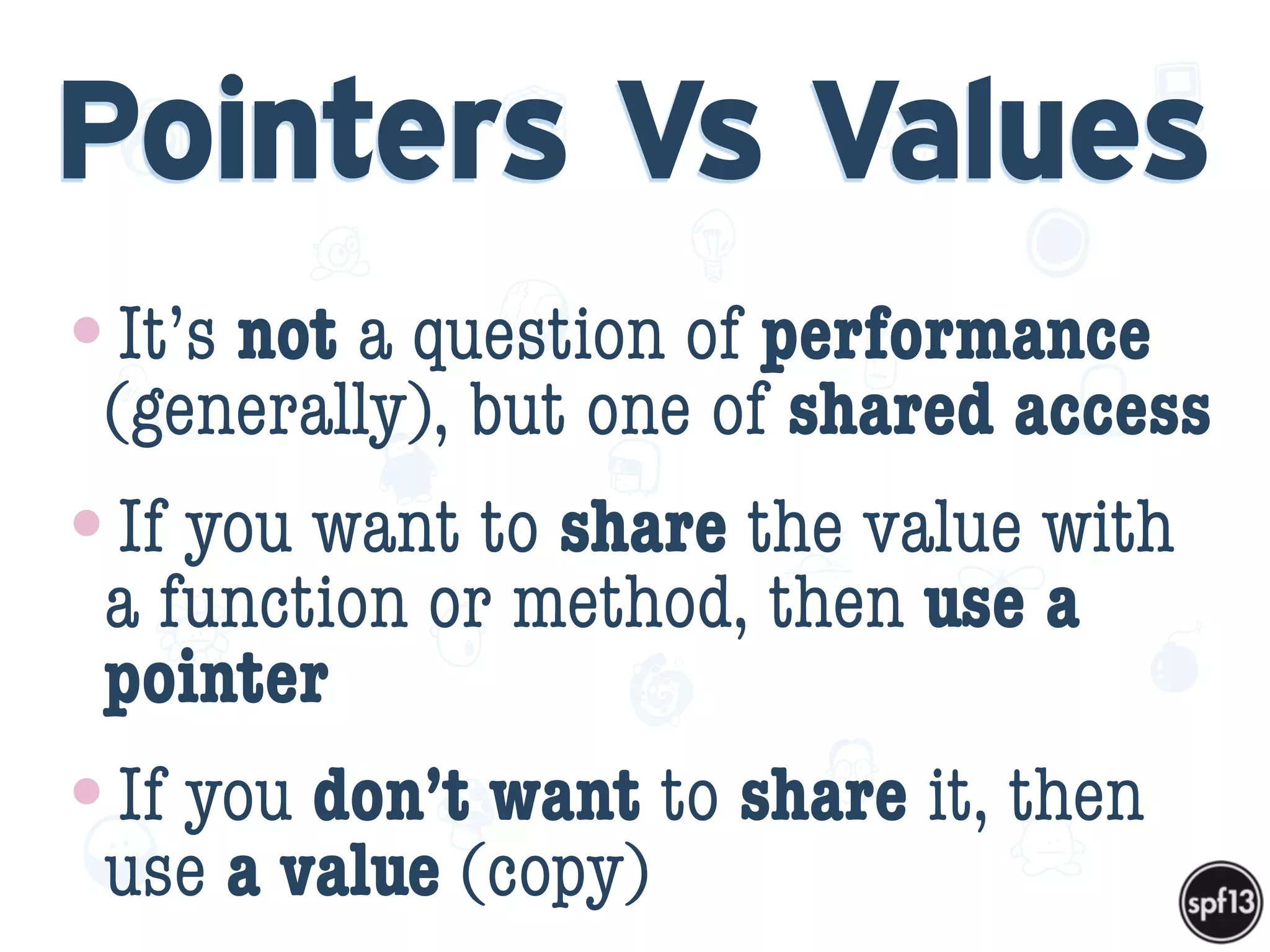
Pointers Vs Values
•It’s not a question of performance
(generally), but one of shared access
•If you want to share the value with
a function or method, then use a
pointer
•If you don’t want to share it, then
use a value (copy)
func (page *Page)
saveSource(b io.Reader)

func (page Page)
saveSource(b io.Reader)
Pointer Vs Value Receivers
f
e
h
W U
w k
M
w
P n
I
v
ZA
S
U
G
k
C
w
P
U
Pointer Receivers
•If you want to share a value with
it’s method, use a pointer
receiver
•Since methods commonly manage
state, this is the common usage
•Not safe for concurrent access
f
e
h
W U
w k
M
w
P n
I
v
ZA
S
U
G
k
C
w
P
U
Value Receivers
•If you want the value copied
(not shared), use values
•If the type is an empty struct
(stateless, just behavior)…
then just use value
•Safe for concurrent access
type InMemoryFile struct {
at int64
name string
data []byte
closed bool
}
func (f *InMemoryFile) Close() error {
atomic.StoreInt64(&f.at, 0)
f.closed = true
return nil
}
Afero File
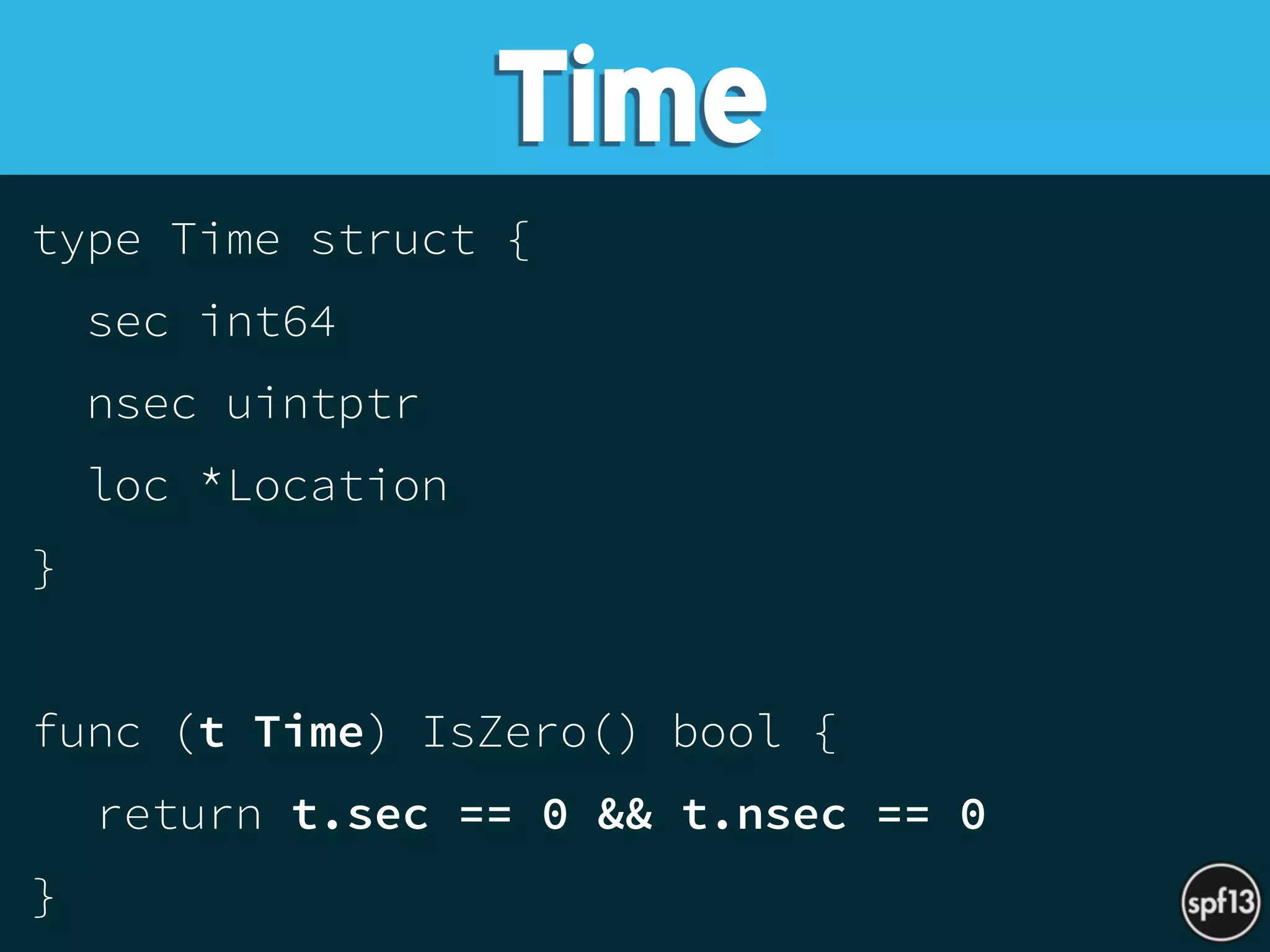
type Time struct {
sec int64
nsec uintptr
loc *Location
}
func (t Time) IsZero() bool {
return t.sec == 0 && t.nsec == 0
}
Time
f
e
h
W U
w k
M
w
P n
I
v
ZA
S
U
G
k
C
w
P
U
Mistake . 


Thinking Of
Errors As Strings
6
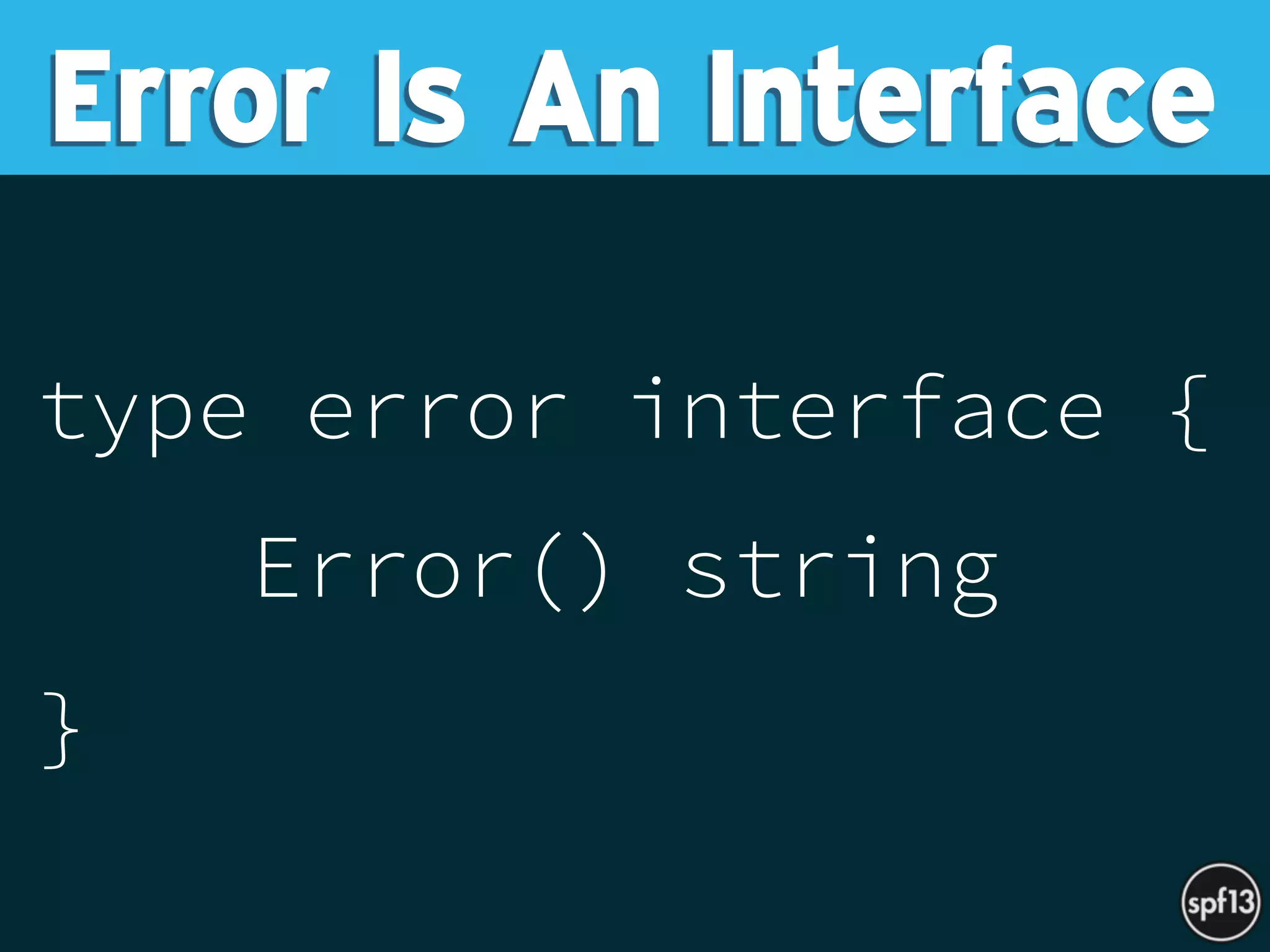
type error interface {
Error() string
}
Error Is An Interface
f
e
h
W U
w k
M
w
P n
I
v
ZA
S
U
G
k
C
w
P
U
Standard Errors
•errors.New(“error here”) is
usually sufficient
•Exported Error Variables
can be easily checked
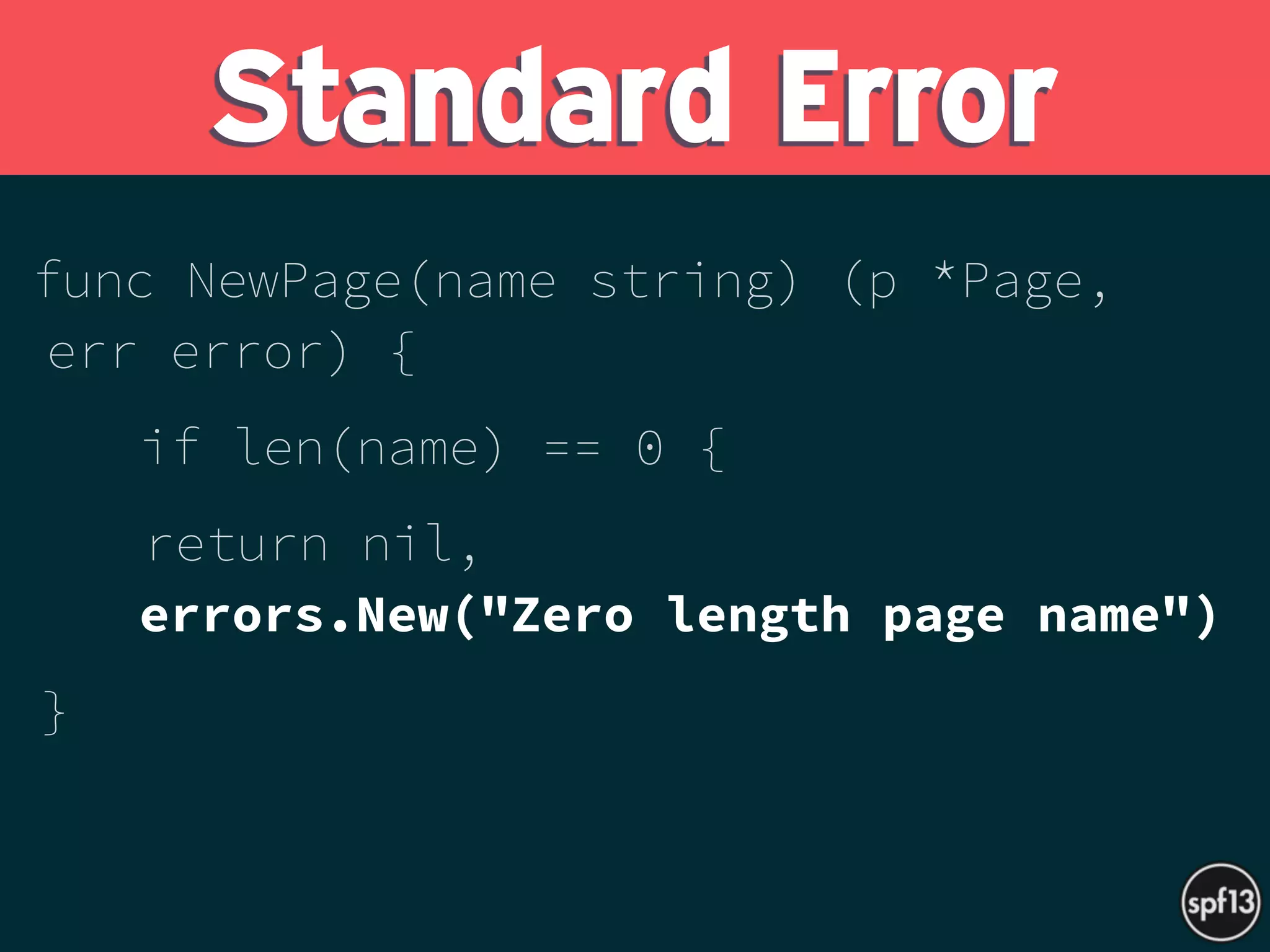
func NewPage(name string) (p *Page,
err error) {
if len(name) == 0 {
return nil, 

errors.New("Zero length page name")
}


Standard Error
var ErrNoName = errors.New("Zero length
page name")


func NewPage(name string) (*Page, error)
{
if len(name) == 0 {
return nil, ErrNoName
}


Exported Error Var
var ErrNoName = errors.New("Zero length page name")


func Foo(name string) (error) {
err := NewPage("bar")
if err == ErrNoName {
newPage("default")
} else {
log.FatalF(err)
}
}

Exported Error Var
f
e
h
W U
w k
M
w
P n
I
v
ZA
S
U
G
k
C
w
P
U
Custom Errors
•Can provide context to
guarantee consistent feedback
•Provide a type which can be
different from the error value
•Can provide dynamic values 

(based on internal error state)
f
e
h
W U
w k
M
w
P n
I
v
ZA
S
U
G
k
C
w
P
U
•Container runtime
& image format
•Native Go
•22k stars
•1000+ contributors
docker.com
type Error struct {
Code ErrorCode
Message string
Detail interface{}
}
// Error returns a human readable representation of the error.
func (e Error) Error() string {
return fmt.Sprintf("%s: %s",
strings.ToLower(strings.Replace(e.Code.String(), "_", " ",
-1)), e.Message)
}
Internationalization Of Errors
f
e
h
W U
w k
M
w
P n
I
v
ZA
S
U
G
k
C
w
P
U
Go StdLib
•Standard Go 

Libraries
•Comprehensive and 

powerful
•Great examples of “good” Go
http://golang.org/pkg/
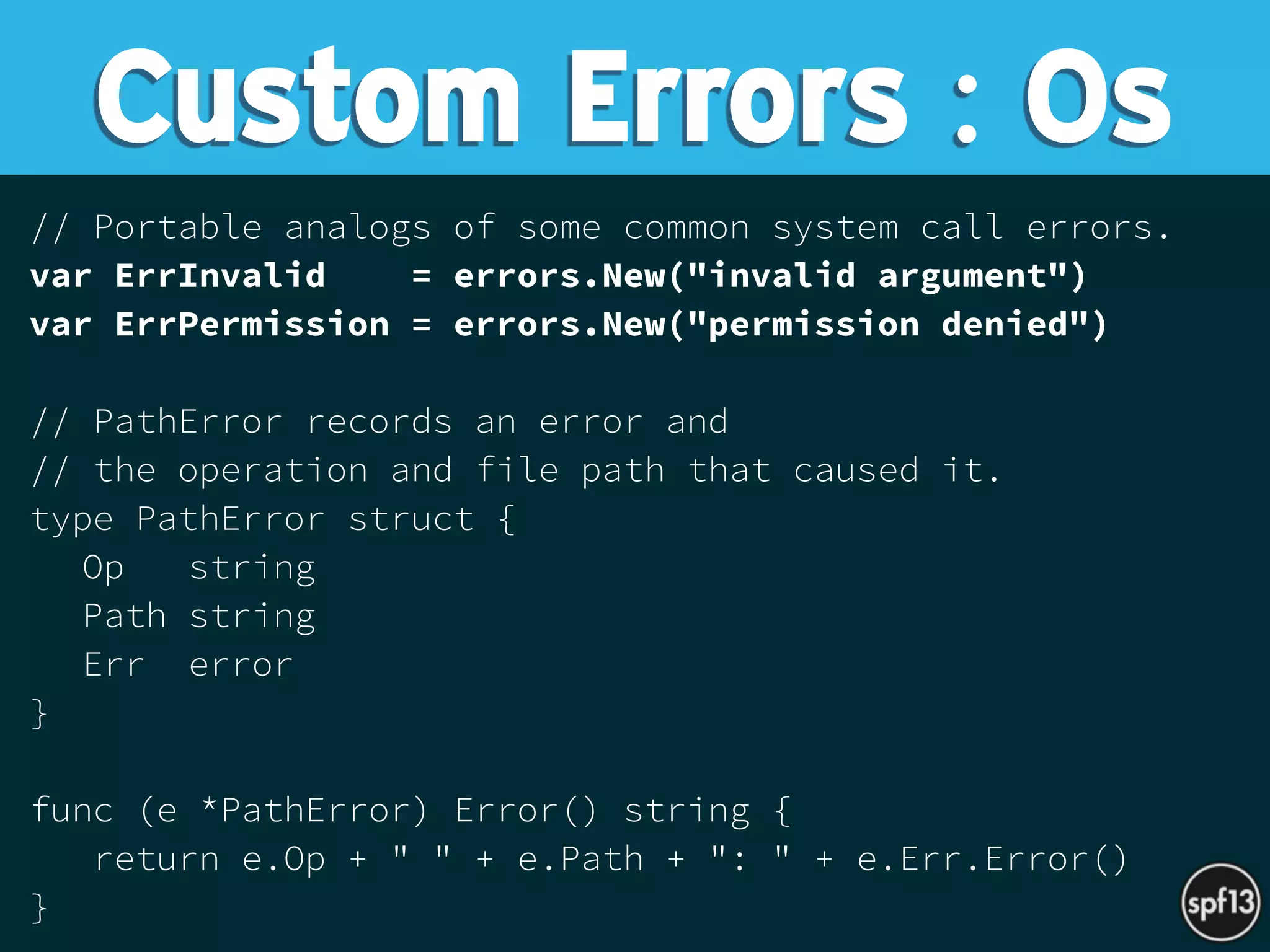
// Portable analogs of some common system call errors.
var ErrInvalid = errors.New("invalid argument")
var ErrPermission = errors.New("permission denied")
// PathError records an error and
// the operation and file path that caused it.
type PathError struct {
Op string
Path string
Err error
}
func (e *PathError) Error() string {
return e.Op + " " + e.Path + ": " + e.Err.Error()
}
Custom Errors : Os
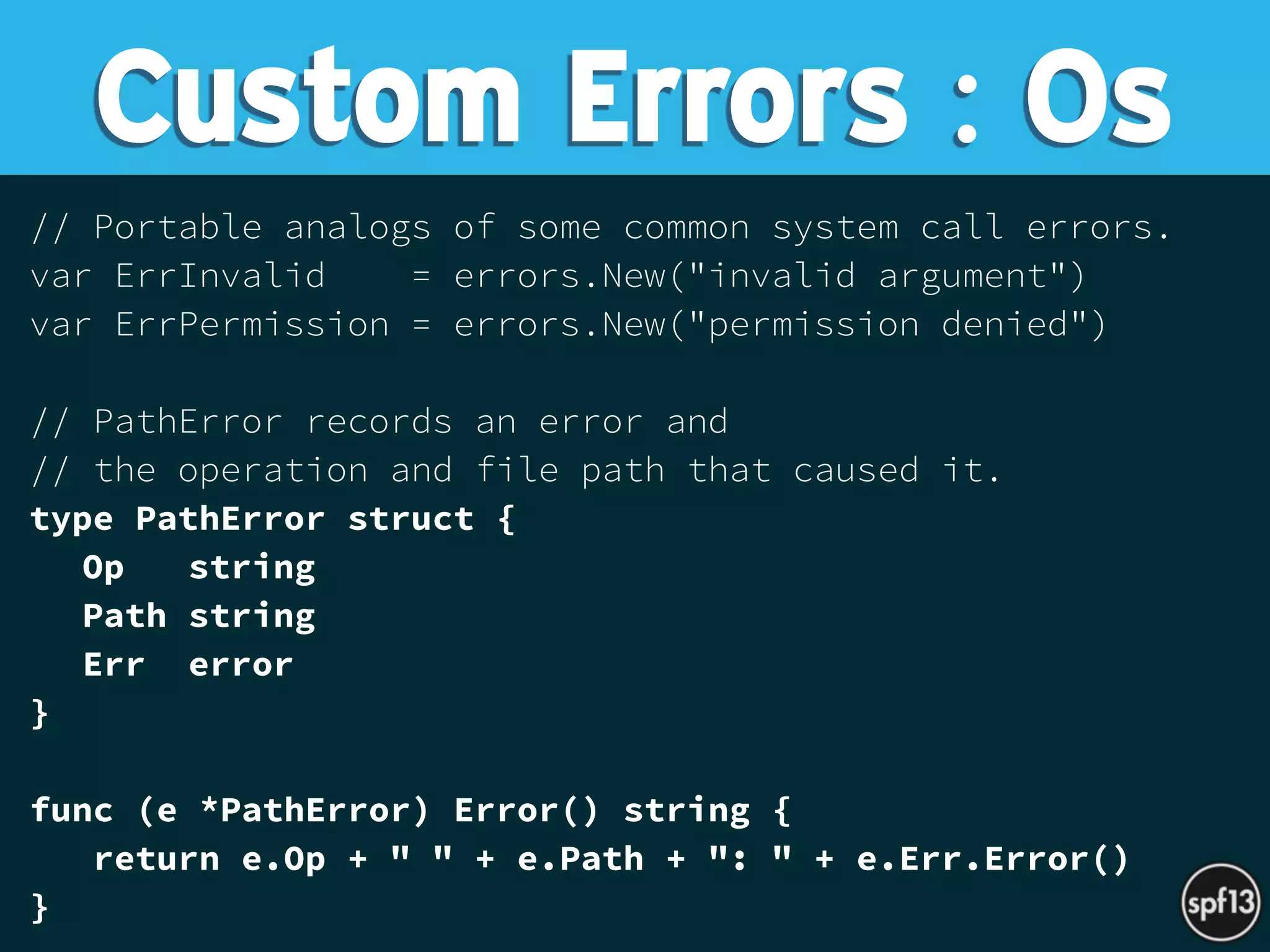
// Portable analogs of some common system call errors.
var ErrInvalid = errors.New("invalid argument")
var ErrPermission = errors.New("permission denied")
// PathError records an error and
// the operation and file path that caused it.
type PathError struct {
Op string
Path string
Err error
}
func (e *PathError) Error() string {
return e.Op + " " + e.Path + ": " + e.Err.Error()
}
Custom Errors : Os
func (f *File) WriteAt(b []byte, off int64) (n int, err error) {
if f == nil {
return 0, ErrInvalid
}
for len(b) > 0 {
m, e := f.pwrite(b, off)
if e != nil {
err = &PathError{"write", f.name, e}
break
}
n += m
b = b[m:]
off += int64(m)
}
return
}
Custom Errors : Os
func (f *File) WriteAt(b []byte, off int64) (n int, err error) {
if f == nil {
return 0, ErrInvalid
}
for len(b) > 0 {
m, e := f.pwrite(b, off)
if e != nil {
err = &PathError{"write", f.name, e}
break
}
n += m
b = b[m:]
off += int64(m)
}
return
}
Custom Errors : Os
func (f *File) WriteAt(b []byte, off int64) (n int, err error) {
if f == nil {
return 0, ErrInvalid
}
for len(b) > 0 {
m, e := f.pwrite(b, off)
if e != nil {
err = &PathError{"write", f.name, e}
break
}
n += m
b = b[m:]
off += int64(m)
}
return
}
Custom Errors : Os
func baa(f *file) error {
…
n, err := f.WriteAt(x, 3)
if _, ok := err.(*PathError) {
…

} else {
log.Fatalf(err)
}
}
Custom Errors : Os
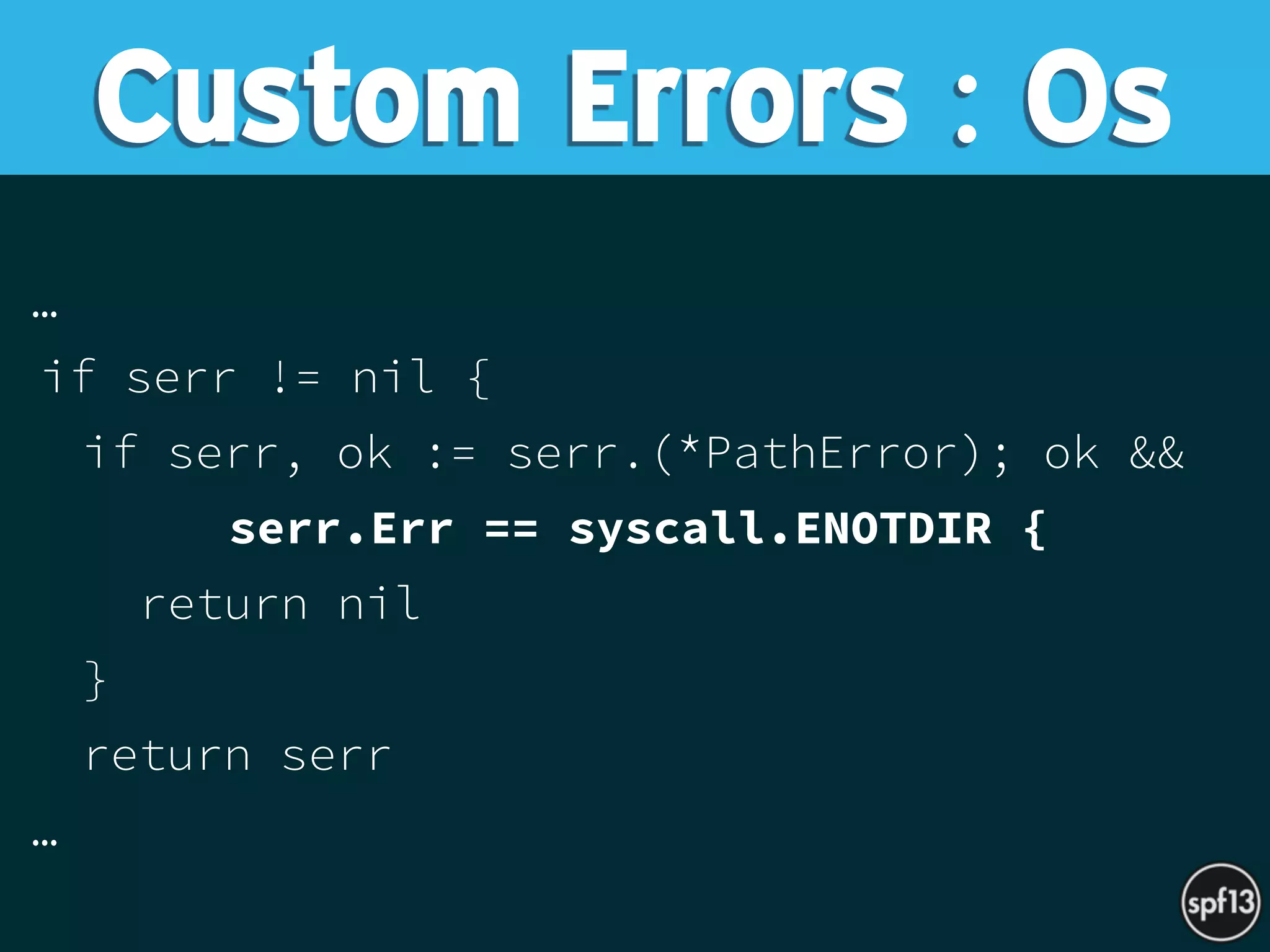
…
if serr != nil {
if serr, ok := serr.(*PathError); ok &&
serr.Err == syscall.ENOTDIR {
return nil
}
return serr
…
Custom Errors : Os
…
if serr != nil {
if serr, ok := serr.(*PathError); ok &&
serr.Err == syscall.ENOTDIR {
return nil
}
return serr
…
Custom Errors : Os
f
e
h
W U
w k
M
w
P n
I
v
ZA
S
U
G
k
C
w
P
U
Mistake . 


To Be Safe
Or Not To Be
7
f
e
h
W U
w k
M
w
P n
I
v
ZA
S
U
G
k
C
w
P
U
You Can’t Make
Everyone Happy

You Aren’t A Jar
Of Nutella
f
e
h
W U
w k
M
w
P n
I
v
ZA
S
U
G
k
C
w
P
U
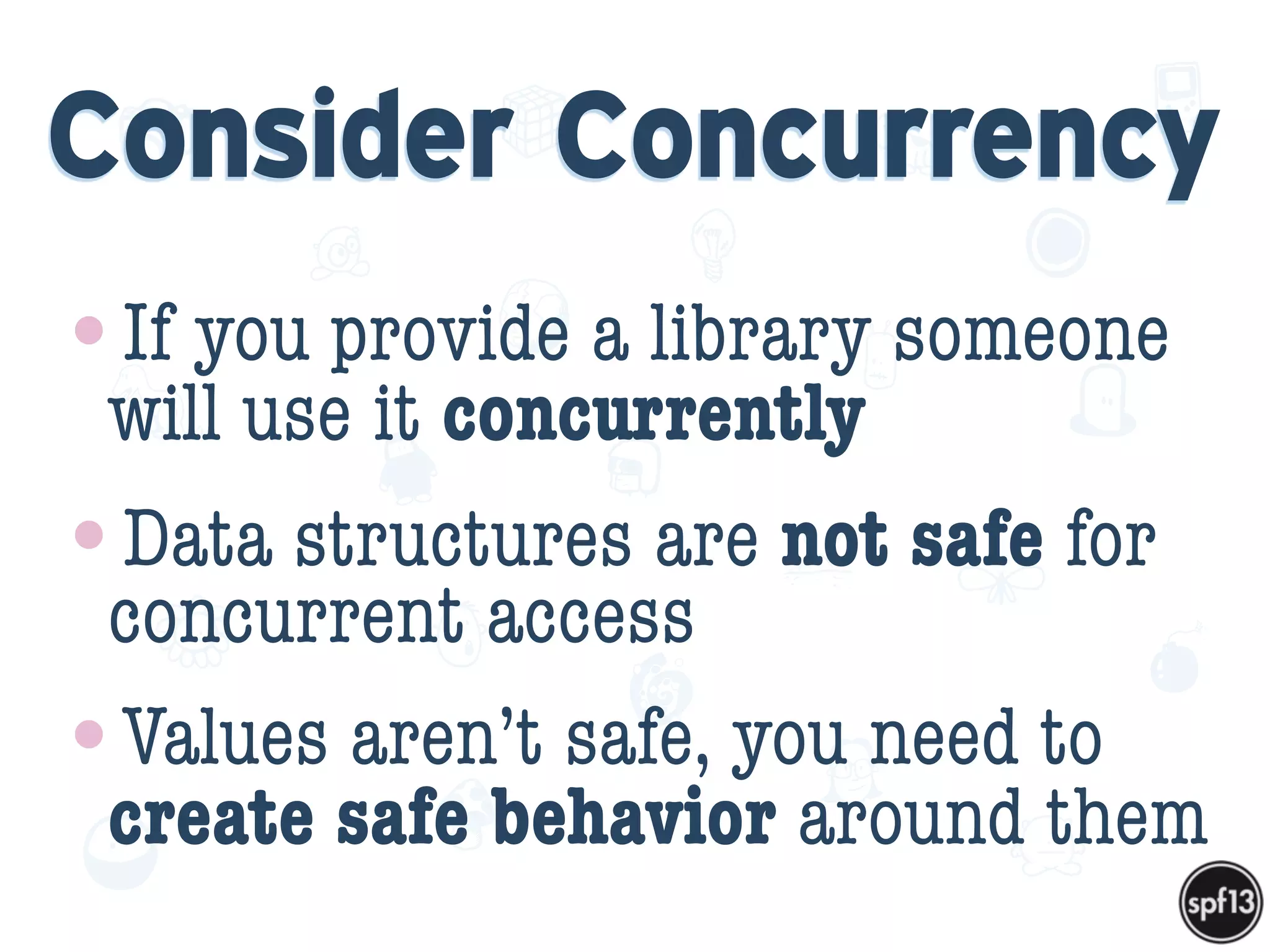
Consider Concurrency
•If you provide a library someone
will use it concurrently
•Data structures are not safe for
concurrent access
•Values aren’t safe, you need to
create safe behavior around them
f
e
h
W U
w k
M
w
P n
I
v
ZA
S
U
G
k
C
w
P
U
Making It Safe
•Sync package provides behavior
to make a value safe (Atomic/
Mutex)
•Channels coordinate values
across go routines by permitting
one go routine to access at a
time
func (m *MMFS) Create(name string) (File, error) {
m.getData()[name] = MemFileCreate(name)
m.registerDirs(m.getData()[name])
return m.getData()[name], nil
}
Maps Are Not Safe
func (m *MMFS) Create(name string) (File, error) {
m.getData()[name] = MemFileCreate(name)
m.registerDirs(m.getData()[name])
return m.getData()[name], nil
}
Maps Are Not Safe
panic: runtime error: invalid memory address or nil
pointer dereference
[signal 0xb code=0x1 addr=0x28 pc=0x1691a7]
goroutine 90 [running]:
runtime.panic(0x501ea0, 0x86b104)
/usr/local/Cellar/go/1.3.3/libexec/src/pkg/runtime/
panic.c:279 +0xf5
github.com/spf13/afero.
(*MemMapFs).registerDirs(0xc208000860, 0x0, 0x0)
/Users/spf13/gopath/src/github.com/spf13/afero/
memmap.go:88 +0x27
Maps Are Not Safe
func (m *MMFS) Create(name string) (File, error) {
m.lock()
m.getData()[name] = MemFileCreate(name)
m.unlock()
m.registerDirs(m.getData()[name])
return m.getData()[name], nil
}
Safe Maps With Mutex
f
e
h
W U
w k
M
w
P n
I
v
ZA
S
U
G
k
C
w
P
U
Keeping It Unsafe
•Safety comes at a cost
•Imposes behaviors on consumer
•Proper API allows consumers to
add safety as needed
•Consumers can use channels or
mutexes
func (m *MMFS) Create(name string) (File, error) {
m.lock()
m.getData()[name] = MemFileCreate(name)
m.unlock()
m.registerDirs(m.getData()[name])
return m.getData()[name], nil
}
Safe Maps With Mutex
f
e
h
W U
w k
M
w
P n
I
v
ZA
S
U
G
k
C
w
P
U
Maps Are Unsafe By Design
•Often safety is unnecessary
•Enables consumers to
implement safety as needed
•Enables consumers to
implement safety as desired
f
e
h
W U
w k
M
w
P n
I
v
ZA
S
U
G
k
C
w
P
U
Biggsest
Mistake;
Not Makimg
Mistakes
f
e
h
W U
w k
M
w
P n
I
v
ZA
S
U
G
k
C
w
P
U
–Ed Catmull
Failure is a manifestation of learning
and exploration. 


If you aren't experiencing failure
than you are making a far worse
mistake. 


You are being driven by the desire
to avoid it.
f
e
h
W U
w k
M
w
P n
I
v
ZA
S
U
G
k
C
w
P
U
@Spf13
Docker 

Chief of Operations

&
Author of Hugo,
Cobra, Afero, Viper


7 Common Mistakes in Go (2015)

  • 1.
    f e h W U w k M w Pn I v ZA S U G k C w P U 7 and when to avoid them Common
 Mistakes 
 In Go
  • 2.
    f e h W U w k M w Pn I v ZA S U G k C w P U @Spf13 Docker 
 Chief Operator
 & Author of Hugo, Cobra, Afero, Viper

  • 3.
    f e h W U w k M w Pn I v ZA S U G k C w P U
  • 4.
    f e h W U w k M w Pn I v ZA S U G k C w P U “Do you want to know the difference between a master and a beginner? The master has failed more times than the beginner has tried.”
  • 5.
    f e h W U w k M w Pn I v ZA S U G k C w P U –Ed Catmull “We need to think about failure differently. Most people think mistakes are a necessary evil. Mistakes aren't a necessary evil, they aren't evil at all. They are an inevitable consequence of doing something new and as such should be seen as valuable. “
  • 8.
    f e h W U w k M w Pn I v ZA S U G k C w P U Mistake . 
 
 Not Accepting Interfaces 1
  • 9.
    f e h W U w k M w Pn I v ZA S U G k C w P U State & Behavior •Types can express state & behavior •State = data structure •Behavior = methods
  • 10.
    f e h W U w k M w Pn I v ZA S U G k C w P U Interfaces •One of Go’s most powerful features •Permits extensibility •Defined by methods •Adherence is only satisfied by behavior
  • 11.
    f e h W U w k M w Pn I v ZA S U G k C w P U •Fastest static site generator •Native Go •35+ themes •Flexible •100s of contributors •Powers GopherAcademy gohugo.io
  • 12.
    func (page *Page)saveSourceAs(path string) { b := new(bytes.Buffer) b.Write(page.Source.Content) page.saveSource(b.Bytes(), path) } func (page *Page) saveSource(by []byte, inpath string) { WriteToDisk(inpath, bytes.NewReader(by)) } Stop Doing This!!
  • 13.
    func (page *Page)saveSourceAs(path string) { b := new(bytes.Buffer) b.Write(page.Source.Content) page.saveSource(b.Bytes(), path) } func (page *Page) saveSource(by []byte, inpath string) { WriteToDisk(inpath, bytes.NewReader(by)) } Stop Doing This!!
  • 14.
    func (page *Page)saveSourceAs(path string) { b := new(bytes.Buffer) b.Write(page.Source.Content) page.saveSource(b.Bytes(), path) } func (page *Page) saveSource(by []byte, inpath string) { WriteToDisk(inpath, bytes.NewReader(by)) } Stop Doing This!! https://github.com/spf13/hugo/blob/master/hugolib/page.go#L582
  • 15.
    func (page *Page)saveSourceAs(path string) { b := new(bytes.Buffer) b.Write(page.Source.Content) page.saveSource(b, path) } func (page *Page) saveSource(b io.Reader, inpath string) { WriteToDisk(inpath, b) } Instead
  • 16.
    f e h W U w k M w Pn I v ZA S U G k C w P U Mistake . 
 
 Not Using Io.Reader & Io.Writer 2
  • 17.
    f e h W U w k M w Pn I v ZA S U G k C w P U Io.Reader & Io.Writer •Simple & flexible interfaces for many operations around input and output •Provides access to a huge wealth of functionality •Keeps operations extensible
  • 18.
    type Reader interface{ Read(p []byte) (n int, err error) } type Writer interface { Write(p []byte) (n int, err error) } Io.Reader & Io.Writer
  • 19.
    f e h W U w k M w Pn I v ZA S U G k C w P U Cobra Cli Commander •Fast and flexible •Powers 
 Kubernetes & Hugo •Provides subcommands, help, man pages, bash autocomplete github.com/spf13/cobra
  • 20.
    // SetOutput setsthe destination for usage and error messages. // If output is nil, os.Stderr is used. func (c *Command) SetOutput(o io.Writer) { c.output = o } Cobra Apps Enabled
  • 21.
    f e h W U w k M w Pn I v ZA S U G k C w P U Viper •Configuration management •Supports json, yaml, toml, defaults, flags, env vars & remote key value •Supports nesting, cascading & aliases github.com/spf13/viper
  • 22.
    func (v *Viper)ReadBufConfig(buf *bytes.Buffer) error { v.config = make(map[string]interface{}) v.marshalReader(buf, v.config) return nil } Really Stop Doing This!!
  • 23.
    func (v *Viper)ReadConfig(in io.Reader) error { v.config = make(map[string]interface{}) v.marshalReader(in, v.config) return nil } Instead
  • 24.
    f e h W U w k M w Pn I v ZA S U G k C w P U Mistake .
 
 Requiring Broad Interfaces 3
  • 25.
    f e h W U w k M w Pn I v ZA S U G k C w P U Interfaces Are Composable •Functions should only accept interfaces that require the methods they need •Functions should not accept a broad interface when a narrow one would work •Compose broad interfaces made from narrower ones
  • 26.
    f e h W U w k M w Pn I v ZA S U G k C w P U Afero Fs •File system abstraction •Uses standard OS interfaces •Drop in replacement for OS •Great for testing & mocking •Cross platform memory backed filesystem github.com/spf13/afero
  • 27.
    type File interface{ io.Closer io.Reader io.ReaderAt io.Seeker io.Writer io.WriterAt } Composing Interfaces
  • 28.
    func ReadIn(f File){ b := []byte{} n, err := f.Read(b) ... } Requiring Broad Interfaces
  • 29.
    func ReadIn(r Reader){ b := []byte{} n, err := r.Read(b) ... } Requiring Narrow Interfaces
  • 30.
    f e h W U w k M w Pn I v ZA S U G k C w P U Mistake .
 
 Methods Vs Functions 4
  • 31.
    f e h W U w k M w Pn I v ZA S U G k C w P U Too Many Methods •A lot of people from OO backgrounds overuse methods •Natural draw to define everything via structs and methods
  • 32.
    f e h W U w k M w Pn I v ZA S U G k C w P U What Is A Function? •Operations performed on N1 inputs that results in N2 outputs •The same inputs will always result in the same outputs •Functions should not depend on state
  • 33.
    f e h W U w k M w Pn I v ZA S U G k C w P U What Is A Method? •Defines the behavior of a type •A function that operates against a value •Should use state •Logically connected
  • 34.
    f e h W U w k M w Pn I v ZA S U G k C w P U Functions Can Be Used With Interfaces •Methods, by definition, are bound to a specific type •Functions can accept interfaces as input
  • 36.
    func extractShortcodes(s string,p *Page, t Template) (string, map[string]shortcode, error) { ... for { switch currItem.typ { ... case tError: err := fmt.Errorf("%s:%d: %s", p.BaseFileName(), (p.lineNumRawContentStart() + pt.lexer.lineNum() - 1), currItem) } } ... } Example From Hugo
  • 37.
    func extractShortcodes(s string,p *Page, t Template) (string, map[string]shortcode, error) { ... for { switch currItem.typ { ... case tError: err := fmt.Errorf("%s:%d: %s", p.BaseFileName(), (p.lineNumRawContentStart() + pt.lexer.lineNum() - 1), currItem) } } ... } Example From Hugo
  • 38.
    f e h W U w k M w Pn I v ZA S U G k C w P U Mistake . 
 
 Pointers Vs Values 5
  • 39.
    f e h W U w k M w Pn I v ZA S U G k C w P U Pointers Vs Values •It’s not a question of performance (generally), but one of shared access •If you want to share the value with a function or method, then use a pointer •If you don’t want to share it, then use a value (copy)
  • 40.
    func (page *Page) saveSource(bio.Reader)
 func (page Page) saveSource(b io.Reader) Pointer Vs Value Receivers
  • 41.
    f e h W U w k M w Pn I v ZA S U G k C w P U Pointer Receivers •If you want to share a value with it’s method, use a pointer receiver •Since methods commonly manage state, this is the common usage •Not safe for concurrent access
  • 42.
    f e h W U w k M w Pn I v ZA S U G k C w P U Value Receivers •If you want the value copied (not shared), use values •If the type is an empty struct (stateless, just behavior)… then just use value •Safe for concurrent access
  • 44.
    type InMemoryFile struct{ at int64 name string data []byte closed bool } func (f *InMemoryFile) Close() error { atomic.StoreInt64(&f.at, 0) f.closed = true return nil } Afero File
  • 45.
    type Time struct{ sec int64 nsec uintptr loc *Location } func (t Time) IsZero() bool { return t.sec == 0 && t.nsec == 0 } Time
  • 46.
    f e h W U w k M w Pn I v ZA S U G k C w P U Mistake . 
 
 Thinking Of Errors As Strings 6
  • 47.
    type error interface{ Error() string } Error Is An Interface
  • 48.
    f e h W U w k M w Pn I v ZA S U G k C w P U Standard Errors •errors.New(“error here”) is usually sufficient •Exported Error Variables can be easily checked
  • 50.
    func NewPage(name string)(p *Page, err error) { if len(name) == 0 { return nil, 
 errors.New("Zero length page name") }
 
 Standard Error
  • 51.
    var ErrNoName =errors.New("Zero length page name")
 
 func NewPage(name string) (*Page, error) { if len(name) == 0 { return nil, ErrNoName }
 
 Exported Error Var
  • 52.
    var ErrNoName =errors.New("Zero length page name")
 
 func Foo(name string) (error) { err := NewPage("bar") if err == ErrNoName { newPage("default") } else { log.FatalF(err) } }
 Exported Error Var
  • 53.
    f e h W U w k M w Pn I v ZA S U G k C w P U Custom Errors •Can provide context to guarantee consistent feedback •Provide a type which can be different from the error value •Can provide dynamic values 
 (based on internal error state)
  • 54.
    f e h W U w k M w Pn I v ZA S U G k C w P U •Container runtime & image format •Native Go •22k stars •1000+ contributors docker.com
  • 55.
    type Error struct{ Code ErrorCode Message string Detail interface{} } // Error returns a human readable representation of the error. func (e Error) Error() string { return fmt.Sprintf("%s: %s", strings.ToLower(strings.Replace(e.Code.String(), "_", " ", -1)), e.Message) } Internationalization Of Errors
  • 56.
    f e h W U w k M w Pn I v ZA S U G k C w P U Go StdLib •Standard Go 
 Libraries •Comprehensive and 
 powerful •Great examples of “good” Go http://golang.org/pkg/
  • 57.
    // Portable analogsof some common system call errors. var ErrInvalid = errors.New("invalid argument") var ErrPermission = errors.New("permission denied") // PathError records an error and // the operation and file path that caused it. type PathError struct { Op string Path string Err error } func (e *PathError) Error() string { return e.Op + " " + e.Path + ": " + e.Err.Error() } Custom Errors : Os
  • 58.
    // Portable analogsof some common system call errors. var ErrInvalid = errors.New("invalid argument") var ErrPermission = errors.New("permission denied") // PathError records an error and // the operation and file path that caused it. type PathError struct { Op string Path string Err error } func (e *PathError) Error() string { return e.Op + " " + e.Path + ": " + e.Err.Error() } Custom Errors : Os
  • 59.
    func (f *File)WriteAt(b []byte, off int64) (n int, err error) { if f == nil { return 0, ErrInvalid } for len(b) > 0 { m, e := f.pwrite(b, off) if e != nil { err = &PathError{"write", f.name, e} break } n += m b = b[m:] off += int64(m) } return } Custom Errors : Os
  • 60.
    func (f *File)WriteAt(b []byte, off int64) (n int, err error) { if f == nil { return 0, ErrInvalid } for len(b) > 0 { m, e := f.pwrite(b, off) if e != nil { err = &PathError{"write", f.name, e} break } n += m b = b[m:] off += int64(m) } return } Custom Errors : Os
  • 61.
    func (f *File)WriteAt(b []byte, off int64) (n int, err error) { if f == nil { return 0, ErrInvalid } for len(b) > 0 { m, e := f.pwrite(b, off) if e != nil { err = &PathError{"write", f.name, e} break } n += m b = b[m:] off += int64(m) } return } Custom Errors : Os
  • 62.
    func baa(f *file)error { … n, err := f.WriteAt(x, 3) if _, ok := err.(*PathError) { …
 } else { log.Fatalf(err) } } Custom Errors : Os
  • 63.
    … if serr !=nil { if serr, ok := serr.(*PathError); ok && serr.Err == syscall.ENOTDIR { return nil } return serr … Custom Errors : Os
  • 64.
    … if serr !=nil { if serr, ok := serr.(*PathError); ok && serr.Err == syscall.ENOTDIR { return nil } return serr … Custom Errors : Os
  • 65.
    f e h W U w k M w Pn I v ZA S U G k C w P U Mistake . 
 
 To Be Safe Or Not To Be 7
  • 66.
    f e h W U w k M w Pn I v ZA S U G k C w P U You Can’t Make Everyone Happy
 You Aren’t A Jar Of Nutella
  • 67.
    f e h W U w k M w Pn I v ZA S U G k C w P U Consider Concurrency •If you provide a library someone will use it concurrently •Data structures are not safe for concurrent access •Values aren’t safe, you need to create safe behavior around them
  • 68.
    f e h W U w k M w Pn I v ZA S U G k C w P U Making It Safe •Sync package provides behavior to make a value safe (Atomic/ Mutex) •Channels coordinate values across go routines by permitting one go routine to access at a time
  • 70.
    func (m *MMFS)Create(name string) (File, error) { m.getData()[name] = MemFileCreate(name) m.registerDirs(m.getData()[name]) return m.getData()[name], nil } Maps Are Not Safe
  • 71.
    func (m *MMFS)Create(name string) (File, error) { m.getData()[name] = MemFileCreate(name) m.registerDirs(m.getData()[name]) return m.getData()[name], nil } Maps Are Not Safe
  • 72.
    panic: runtime error:invalid memory address or nil pointer dereference [signal 0xb code=0x1 addr=0x28 pc=0x1691a7] goroutine 90 [running]: runtime.panic(0x501ea0, 0x86b104) /usr/local/Cellar/go/1.3.3/libexec/src/pkg/runtime/ panic.c:279 +0xf5 github.com/spf13/afero. (*MemMapFs).registerDirs(0xc208000860, 0x0, 0x0) /Users/spf13/gopath/src/github.com/spf13/afero/ memmap.go:88 +0x27 Maps Are Not Safe
  • 73.
    func (m *MMFS)Create(name string) (File, error) { m.lock() m.getData()[name] = MemFileCreate(name) m.unlock() m.registerDirs(m.getData()[name]) return m.getData()[name], nil } Safe Maps With Mutex
  • 74.
    f e h W U w k M w Pn I v ZA S U G k C w P U Keeping It Unsafe •Safety comes at a cost •Imposes behaviors on consumer •Proper API allows consumers to add safety as needed •Consumers can use channels or mutexes
  • 75.
    func (m *MMFS)Create(name string) (File, error) { m.lock() m.getData()[name] = MemFileCreate(name) m.unlock() m.registerDirs(m.getData()[name]) return m.getData()[name], nil } Safe Maps With Mutex
  • 76.
    f e h W U w k M w Pn I v ZA S U G k C w P U Maps Are Unsafe By Design •Often safety is unnecessary •Enables consumers to implement safety as needed •Enables consumers to implement safety as desired
  • 77.
    f e h W U w k M w Pn I v ZA S U G k C w P U Biggsest Mistake; Not Makimg Mistakes
  • 78.
    f e h W U w k M w Pn I v ZA S U G k C w P U –Ed Catmull Failure is a manifestation of learning and exploration. 
 
 If you aren't experiencing failure than you are making a far worse mistake. 
 
 You are being driven by the desire to avoid it.
  • 80.
    f e h W U w k M w Pn I v ZA S U G k C w P U @Spf13 Docker 
 Chief of Operations
 & Author of Hugo, Cobra, Afero, Viper