RESEARCH POSTER PRESENTATION DESIGN © 2015
www.PosterPresentations.com
Effective pain management/ relief is crucial for successful
post-operative recovery.
On a surgical oncology floor, there is a need for management
of both acute post-surgical pain and chronic cancer pain. 40-
90% of cancer patients will complain of pain due to disease,
treatment or recovery (Cambron, 2015).
There are health risks, side effects and costs to consider when
using pharmacologic interventions.
Introduction
Research Overview
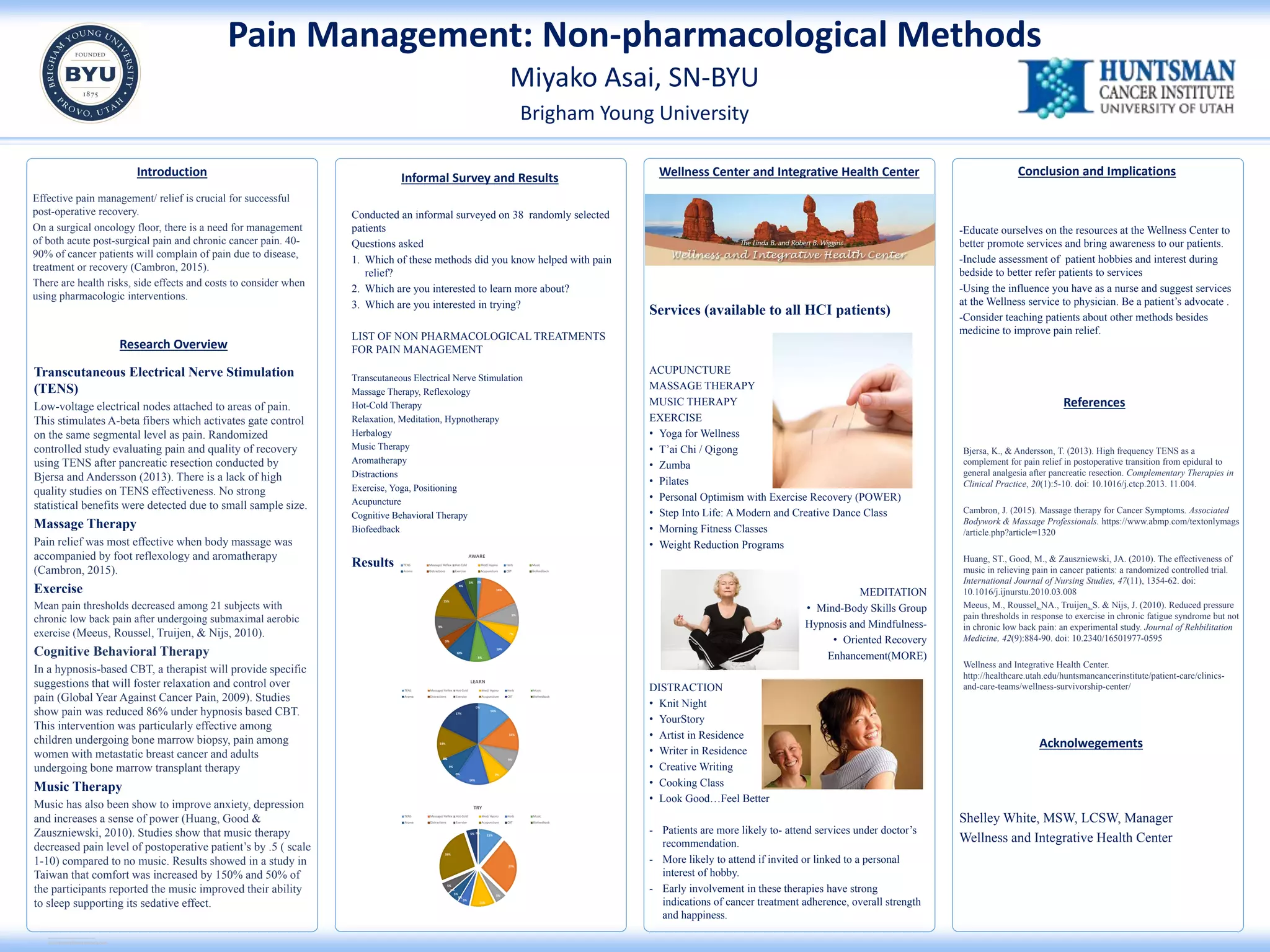
Conducted an informal surveyed on 38 randomly selected
patients
Questions asked
1. Which of these methods did you know helped with pain
relief?
2. Which are you interested to learn more about?
3. Which are you interested in trying?
LIST OF NON PHARMACOLOGICAL TREATMENTS
FOR PAIN MANAGEMENT
Transcutaneous Electrical Nerve Stimulation
Massage Therapy, Reflexology
Hot-Cold Therapy
Relaxation, Meditation, Hypnotherapy
Herbalogy
Music Therapy
Aromatherapy
Distractions
Exercise, Yoga, Positioning
Acupuncture
Cognitive Behavioral Therapy
Biofeedback
Results
Informal Survey and Results
Services (available to all HCI patients)
ACUPUNCTURE
MASSAGE THERAPY
MUSIC THERAPY
EXERCISE
• Yoga for Wellness
• T’ai Chi / Qigong
• Zumba
• Pilates
• Personal Optimism with Exercise Recovery (POWER)
• Step Into Life: A Modern and Creative Dance Class
• Morning Fitness Classes
• Weight Reduction Programs
MEDITATION
• Mind-Body Skills Group
Hypnosis and Mindfulness-
• Oriented Recovery
Enhancement(MORE)
DISTRACTION
• Knit Night
• YourStory
• Artist in Residence
• Writer in Residence
• Creative Writing
• Cooking Class
• Look Good…Feel Better
- Patients are more likely to- attend services under doctor’s
recommendation.
- More likely to attend if invited or linked to a personal
interest of hobby.
- Early involvement in these therapies have strong
indications of cancer treatment adherence, overall strength
and happiness.
Wellness Center and Integrative Health Center Conclusion and Implications
-Educate ourselves on the resources at the Wellness Center to
better promote services and bring awareness to our patients.
-Include assessment of patient hobbies and interest during
bedside to better refer patients to services
-Using the influence you have as a nurse and suggest services
at the Wellness service to physician. Be a patient’s advocate .
-Consider teaching patients about other methods besides
medicine to improve pain relief.
References
Bjersa, K., & Andersson, T. (2013). High frequency TENS as a
complement for pain relief in postoperative transition from epidural to
general analgesia after pancreatic resection. Complementary Therapies in
Clinical Practice, 20(1):5-10. doi: 10.1016/j.ctcp.2013. 11.004.
Cambron, J. (2015). Massage therapy for Cancer Symptoms. Associated
Bodywork & Massage Professionals. https://www.abmp.com/textonlymags
/article.php?article=1320
Huang, ST., Good, M., & Zauszniewski, JA. (2010). The effectiveness of
music in relieving pain in cancer patients: a randomized controlled trial.
International Journal of Nursing Studies, 47(11), 1354-62. doi:
10.1016/j.ijnurstu.2010.03.008
Meeus, M., Roussel, NA., Truijen, S. & Nijs, J. (2010). Reduced pressure
pain thresholds in response to exercise in chronic fatigue syndrome but not
in chronic low back pain: an experimental study. Journal of Rehbilitation
Medicine, 42(9):884-90. doi: 10.2340/16501977-0595
Wellness and Integrative Health Center.
http://healthcare.utah.edu/huntsmancancerinstitute/patient-care/clinics-
and-care-teams/wellness-survivorship-center/
Acknolwegements
Shelley White, MSW, LCSW, Manager
Wellness and Integrative Health Center
Transcutaneous Electrical Nerve Stimulation
(TENS)
Low-voltage electrical nodes attached to areas of pain.
This stimulates A-beta fibers which activates gate control
on the same segmental level as pain. Randomized
controlled study evaluating pain and quality of recovery
using TENS after pancreatic resection conducted by
Bjersa and Andersson (2013). There is a lack of high
quality studies on TENS effectiveness. No strong
statistical benefits were detected due to small sample size.
Massage Therapy
Pain relief was most effective when body massage was
accompanied by foot reflexology and aromatherapy
(Cambron, 2015).
Exercise
Mean pain thresholds decreased among 21 subjects with
chronic low back pain after undergoing submaximal aerobic
exercise (Meeus, Roussel, Truijen, & Nijs, 2010).
Cognitive Behavioral Therapy
In a hypnosis-based CBT, a therapist will provide specific
suggestions that will foster relaxation and control over
pain (Global Year Against Cancer Pain, 2009). Studies
show pain was reduced 86% under hypnosis based CBT.
This intervention was particularly effective among
children undergoing bone marrow biopsy, pain among
women with metastatic breast cancer and adults
undergoing bone marrow transplant therapy
Music Therapy
Music has also been show to improve anxiety, depression
and increases a sense of power (Huang, Good &
Zauszniewski, 2010). Studies show that music therapy
decreased pain level of postoperative patient’s by .5 ( scale
1-10) compared to no music. Results showed in a study in
Taiwan that comfort was increased by 150% and 50% of
the participants reported the music improved their ability
to sleep supporting its sedative effect.
Brigham Young University
Miyako Asai, SN-BYU
Pain Management: Non-pharmacological Methods
2%
16%
9%
7%
10%
8%
10%
5%
9%
15%
4%
5%
AWARE
TENS Massage/ Reflex Hot-Cold Med/ Hypno Herb Music
Aroma Distractions Exercise Acupuncture CBT Biofeedback
14%
14%
9%
9%
14%
0%
9%
0%0%
14%
17%
0%
LEARN
TENS Massage/ Reflex Hot-Cold Med/ Hypno Herb Music
Aroma Distractions Exercise Acupuncture CBT Biofeedback
11%
27%
5%
11%
5%
0%
5%
0%
5%
26%
5% 0%
TRY
TENS Massage/ Reflex Hot-Cold Med/ Hypno Herb Music
Aroma Distractions Exercise Acupuncture CBT Biofeedback

Capstone Presentation

  • 1.
    RESEARCH POSTER PRESENTATIONDESIGN © 2015 www.PosterPresentations.com Effective pain management/ relief is crucial for successful post-operative recovery. On a surgical oncology floor, there is a need for management of both acute post-surgical pain and chronic cancer pain. 40- 90% of cancer patients will complain of pain due to disease, treatment or recovery (Cambron, 2015). There are health risks, side effects and costs to consider when using pharmacologic interventions. Introduction Research Overview Conducted an informal surveyed on 38 randomly selected patients Questions asked 1. Which of these methods did you know helped with pain relief? 2. Which are you interested to learn more about? 3. Which are you interested in trying? LIST OF NON PHARMACOLOGICAL TREATMENTS FOR PAIN MANAGEMENT Transcutaneous Electrical Nerve Stimulation Massage Therapy, Reflexology Hot-Cold Therapy Relaxation, Meditation, Hypnotherapy Herbalogy Music Therapy Aromatherapy Distractions Exercise, Yoga, Positioning Acupuncture Cognitive Behavioral Therapy Biofeedback Results Informal Survey and Results Services (available to all HCI patients) ACUPUNCTURE MASSAGE THERAPY MUSIC THERAPY EXERCISE • Yoga for Wellness • T’ai Chi / Qigong • Zumba • Pilates • Personal Optimism with Exercise Recovery (POWER) • Step Into Life: A Modern and Creative Dance Class • Morning Fitness Classes • Weight Reduction Programs MEDITATION • Mind-Body Skills Group Hypnosis and Mindfulness- • Oriented Recovery Enhancement(MORE) DISTRACTION • Knit Night • YourStory • Artist in Residence • Writer in Residence • Creative Writing • Cooking Class • Look Good…Feel Better - Patients are more likely to- attend services under doctor’s recommendation. - More likely to attend if invited or linked to a personal interest of hobby. - Early involvement in these therapies have strong indications of cancer treatment adherence, overall strength and happiness. Wellness Center and Integrative Health Center Conclusion and Implications -Educate ourselves on the resources at the Wellness Center to better promote services and bring awareness to our patients. -Include assessment of patient hobbies and interest during bedside to better refer patients to services -Using the influence you have as a nurse and suggest services at the Wellness service to physician. Be a patient’s advocate . -Consider teaching patients about other methods besides medicine to improve pain relief. References Bjersa, K., & Andersson, T. (2013). High frequency TENS as a complement for pain relief in postoperative transition from epidural to general analgesia after pancreatic resection. Complementary Therapies in Clinical Practice, 20(1):5-10. doi: 10.1016/j.ctcp.2013. 11.004. Cambron, J. (2015). Massage therapy for Cancer Symptoms. Associated Bodywork & Massage Professionals. https://www.abmp.com/textonlymags /article.php?article=1320 Huang, ST., Good, M., & Zauszniewski, JA. (2010). The effectiveness of music in relieving pain in cancer patients: a randomized controlled trial. International Journal of Nursing Studies, 47(11), 1354-62. doi: 10.1016/j.ijnurstu.2010.03.008 Meeus, M., Roussel, NA., Truijen, S. & Nijs, J. (2010). Reduced pressure pain thresholds in response to exercise in chronic fatigue syndrome but not in chronic low back pain: an experimental study. Journal of Rehbilitation Medicine, 42(9):884-90. doi: 10.2340/16501977-0595 Wellness and Integrative Health Center. http://healthcare.utah.edu/huntsmancancerinstitute/patient-care/clinics- and-care-teams/wellness-survivorship-center/ Acknolwegements Shelley White, MSW, LCSW, Manager Wellness and Integrative Health Center Transcutaneous Electrical Nerve Stimulation (TENS) Low-voltage electrical nodes attached to areas of pain. This stimulates A-beta fibers which activates gate control on the same segmental level as pain. Randomized controlled study evaluating pain and quality of recovery using TENS after pancreatic resection conducted by Bjersa and Andersson (2013). There is a lack of high quality studies on TENS effectiveness. No strong statistical benefits were detected due to small sample size. Massage Therapy Pain relief was most effective when body massage was accompanied by foot reflexology and aromatherapy (Cambron, 2015). Exercise Mean pain thresholds decreased among 21 subjects with chronic low back pain after undergoing submaximal aerobic exercise (Meeus, Roussel, Truijen, & Nijs, 2010). Cognitive Behavioral Therapy In a hypnosis-based CBT, a therapist will provide specific suggestions that will foster relaxation and control over pain (Global Year Against Cancer Pain, 2009). Studies show pain was reduced 86% under hypnosis based CBT. This intervention was particularly effective among children undergoing bone marrow biopsy, pain among women with metastatic breast cancer and adults undergoing bone marrow transplant therapy Music Therapy Music has also been show to improve anxiety, depression and increases a sense of power (Huang, Good & Zauszniewski, 2010). Studies show that music therapy decreased pain level of postoperative patient’s by .5 ( scale 1-10) compared to no music. Results showed in a study in Taiwan that comfort was increased by 150% and 50% of the participants reported the music improved their ability to sleep supporting its sedative effect. Brigham Young University Miyako Asai, SN-BYU Pain Management: Non-pharmacological Methods 2% 16% 9% 7% 10% 8% 10% 5% 9% 15% 4% 5% AWARE TENS Massage/ Reflex Hot-Cold Med/ Hypno Herb Music Aroma Distractions Exercise Acupuncture CBT Biofeedback 14% 14% 9% 9% 14% 0% 9% 0%0% 14% 17% 0% LEARN TENS Massage/ Reflex Hot-Cold Med/ Hypno Herb Music Aroma Distractions Exercise Acupuncture CBT Biofeedback 11% 27% 5% 11% 5% 0% 5% 0% 5% 26% 5% 0% TRY TENS Massage/ Reflex Hot-Cold Med/ Hypno Herb Music Aroma Distractions Exercise Acupuncture CBT Biofeedback