Pain
Management
in Cancer
Patients
By
Dr.Ayush Garg
Types
Nociceptive : pain signals from nerve
endings
Neuropathic : damage to nerve fibres.
•What Pain
Rating Scales Do
We Know??
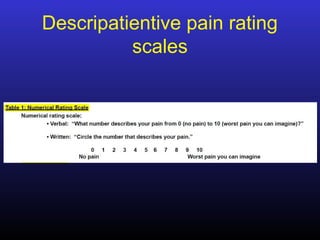
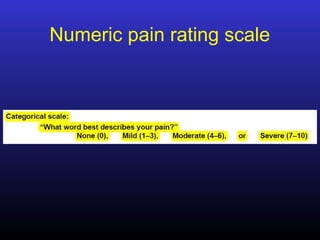
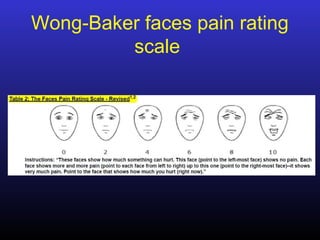
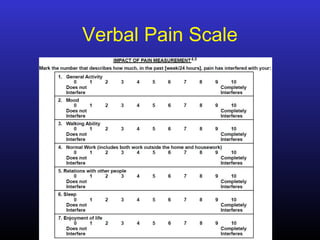
Descripatientive pain rating
scales
Numeric pain rating scale
Wong-Baker faces pain rating
scale
Verbal Pain Scale
Cancer Pain
Nociceptive
Somatic:
intermittent to constant
sharp, knife-like, localized
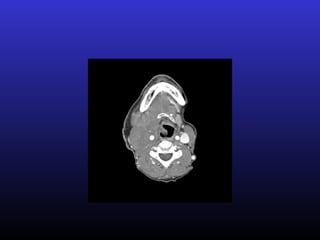
e.g. soft tissue infiltration
Cancer Pain
Nociceptive
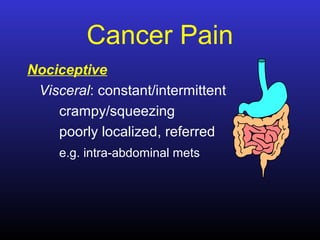
Visceral: constant/intermittent
crampy/squeezing
poorly localized, referred
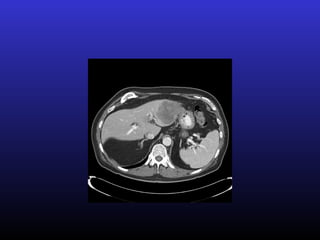
e.g. intra-abdominal mets
Cancer Pain
Nociceptive
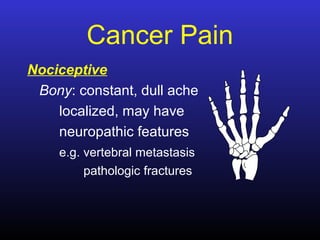
Bony: constant, dull ache
localized, may have
neuropathic features
e.g. vertebral metastasis
pathologic fractures
Cancer Pain
Neuropathic
Destruction/infiltration of nerves
a) dysesthetic:
burning/tingling
constant, radiates
e.g. post-herpetic neuralgia
Cancer Pain
Neuropathic
Destruction/infiltration of nerves
b) neuralgic:
shooting/stabbing
shock-like/lancinating
paroxysmal
e.g. trigeminal neuralgia
Neuropathc pain
 Chemotherapy induced Neuropathies
• Cisplatin,Oxaliplatin
• Paclitaxel,Thalidomide
• Vincristine,Vinblastine
 Surgical Neuropathies
• Phantom Limb pain
• Post mastectomy syndrome
• Post thoracotomy syndrome
Cancer Pain
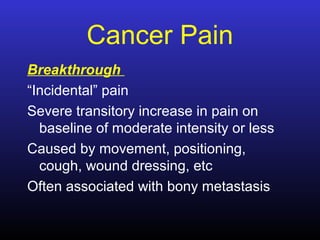
Breakthrough
“Incidental” pain
Severe transitory increase in pain on
baseline of moderate intensity or less
Caused by movement, positioning,
cough, wound dressing, etc
Often associated with bony metastasis
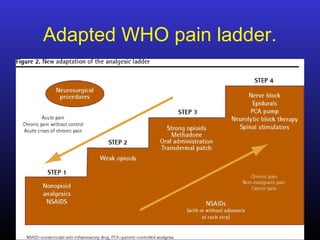
Adapted WHO pain ladder.
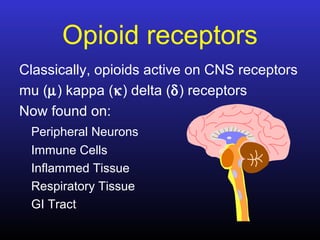
Opioid receptors
Classically, opioids active on CNS receptors
mu (µ) kappa (κ) delta (δ) receptors
Now found on:
Peripheral Neurons
Immune Cells
Inflammed Tissue
Respiratory Tissue
GI Tract
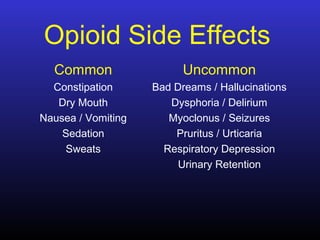
Opioid Side Effects
Common Uncommon
Constipation Bad Dreams / Hallucinations
Dry Mouth Dysphoria / Delirium
Nausea / Vomiting Myoclonus / Seizures
Sedation Pruritus / Urticaria
Sweats Respiratory Depression
Urinary Retention
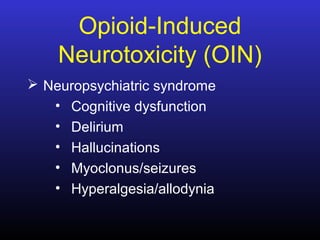
Opioid-Induced
Neurotoxicity (OIN)
 Neuropsychiatric syndrome
• Cognitive dysfunction
• Delirium
• Hallucinations
• Myoclonus/seizures
• Hyperalgesia/allodynia
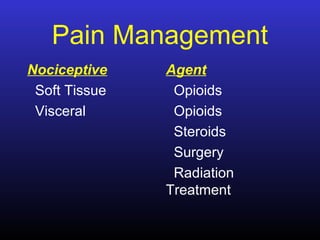
Pain Management
Nociceptive
Soft Tissue
Visceral
Agent
Opioids
Opioids
Steroids
Surgery
Radiation
Treatment
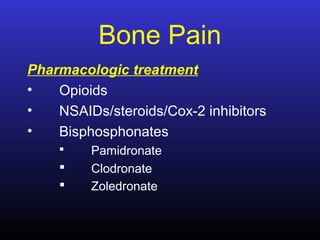
Bone Pain
Pharmacologic treatment
• Opioids
• NSAIDs/steroids/Cox-2 inhibitors
• Bisphosphonates
 Pamidronate
 Clodronate
 Zoledronate
Bone Pain
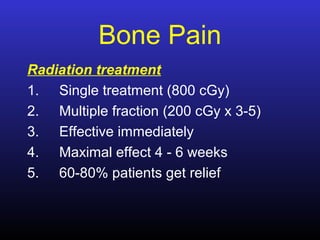
Radiation treatment
1. Single treatment (800 cGy)
2. Multiple fraction (200 cGy x 3-5)
3. Effective immediately
4. Maximal effect 4 - 6 weeks
5. 60-80% patients get relief
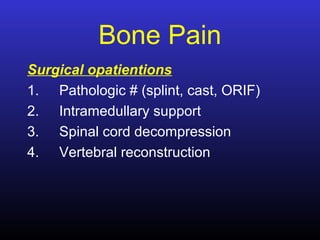
Bone Pain
Surgical opatientions
1. Pathologic # (splint, cast, ORIF)
2. Intramedullary support
3. Spinal cord decompression
4. Vertebral reconstruction
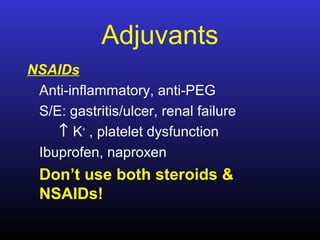
Adjuvants
NSAIDs
Anti-inflammatory, anti-PEG
S/E: gastritis/ulcer, renal failure
↑ K+
, platelet dysfunction
Ibuprofen, naproxen
Don’t use both steroids &
NSAIDs!
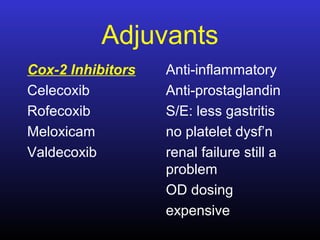
Adjuvants
Cox-2 Inhibitors
Celecoxib
Rofecoxib
Meloxicam
Valdecoxib
Anti-inflammatory
Anti-prostaglandin
S/E: less gastritis
no platelet dysf’n
renal failure still a
problem
OD dosing
expensive
Adjuvants
Steroids
↓ inflammation
↓ edema
↓ spontaneous nerve depolarization
Multipurpose
Adjuvants
Anticonvulsants
Gabapentin
Lamotrigine
Carbamazepine
Valproic acid
Adjuvants
Antidepressants
Amitriptyline
Nortriptyline
Desipramine
SSRIs: results disappointing
Adjuvants
NMDA Receptor Antagonists
(N-methyl-D-aspartate)
Ketamine
Dextromethorphan
Methadone
Neuropathic Pain
Non-pharmacologic
 Radiation treatment
 Anaesthetic treatment
• Nerve Block
• Epidural Block
Neuropathic Pain
Pharmacologic treatment
• Opioids
• Steroids
• Anticonvulsants
• TCAs (dysesthetic)
• NMDA receptor antagonists
• Anaesthetics
Step 4
Interventions
Alternative Therapies
Acupuncture
Cognitive/behavioral therapy
Meditation/relaxation
Guided imagery
Herbal preparations
Magnets
Therapeutic massage
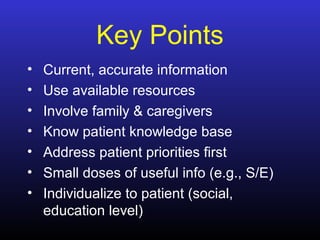
Key Points
• Current, accurate information
• Use available resources
• Involve family & caregivers
• Know patient knowledge base
• Address patient priorities first
• Small doses of useful info (e.g., S/E)
• Individualize to patient (social,
education level)
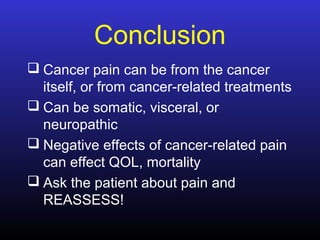
Conclusion
 Cancer pain can be from the cancer
itself, or from cancer-related treatments
 Can be somatic, visceral, or
neuropathic
 Negative effects of cancer-related pain
can effect QOL, mortality
 Ask the patient about pain and
REASSESS!
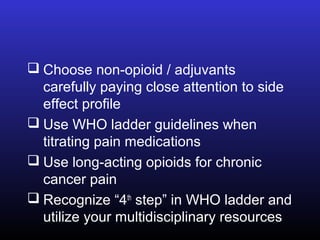
 Choose non-opioid / adjuvants
carefully paying close attention to side
effect profile
 Use WHO ladder guidelines when
titrating pain medications
 Use long-acting opioids for chronic
cancer pain
 Recognize “4th
step” in WHO ladder and
utilize your multidisciplinary resources
Can we offer this ?

Pain Management

Editor's Notes

  • #10 patient with H&N cancer – large R sided mass – ex. Somatic pain
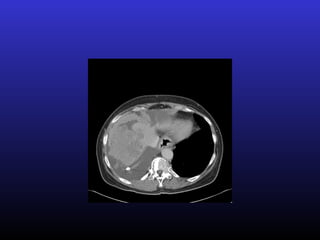
  • #12 Colorectal CA with liver met – left lobe of liver – visceral pain
  • #14 Vertebral met – localized somatic pain to vertebrae, visceral pain in abdomen – and neuropathic pain from nerve root involvement – ex – many cancer patients will have several sources and can have a combination of how they’re experiencing pain
  • #17 patients can have chemo-related neuropathies – cisplatin, taxol, the vinca alkaloid are well known players – patients usually have a symmetrical polyneuropathy – localized in hands and feet SURGICAL neuropathies – have distinct pain syndromes – phantom limb pain s/p amputation Post-mastectomy syndrome – neuropathic pain in posterior arm, axilla and anterior chest wall – due to the interrupatiention of the intercostal brachial nerve (cutaneous sensory branch of T1-2) – little bit of a misnomer – you see this syndrome in women who have undergone a radical mastectomy, lumpectomy, even just an axillary node dissection ; 5% of women who undergo any of those procedures will have this syndrome (ex. Lady with dcis – b mastectomy- did fine (felt a lump in her axilla – lymph node dissection (fortunately benign) and since then has had debilitating neuropathic pain) Same with post-thoracotomy – neuropathic pain along the distribution of an intercostal nerve following injury or surgery – ex. Lung ca patients s/p lobectomy
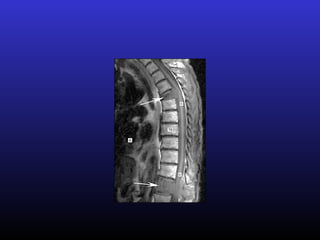
  • #18 Lastly – what type of neuropathic pain does this picture demonstrate?? – CORD compression – which we’ll talk about later
  • #22 Constipation – easier to prevent than treat; all patients on opioids need a bowel regimen, dry mouth, nausea, sedation – usually go away in a few days; always clarify when a patient says they have an allergy to morphine More uncommon adverse effects can combat many side effects with medication, or with opioid rotation The big fear – respiratory depression – patients will fall asleep/somnolent before their resp drive is affected When we see it – patients continuing to get their opioids after they’ve become somnolent – RNs, family pushing pca, combining benzos and opiates; if vitals are stable and patient protecting airway – can just observe – if showing signs of resp depression – then give narcan
  • #28 It increases the risk of developing pepatientic ulcers