Singaporean & Sustainable Home
ridhwanikhsan <ID>
Icp863managementofproperty&environment
Hitherto,
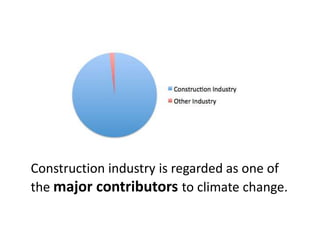
Construction industry is regarded as one of
the major contributors to climate change.
According to the American Institute of Architects, the
biggest source of emissions and energy consumption
around the globe is the construction industry.
….except China.
Hitherto,
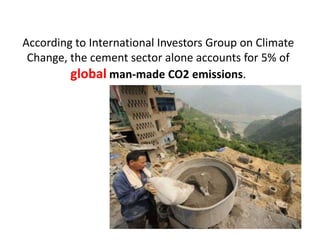
According to International Investors Group on Climate
Change, the cement sector alone accounts for 5% of
global man-made CO2 emissions.
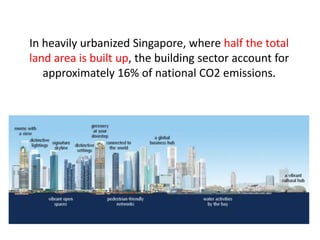
In heavily urbanized Singapore, where half the total
land area is built up, the building sector account for
approximately 16% of national CO2 emissions.
Singapore Building and Construction Authority’s (BCA)
Green Mark Scheme was launched in January 2005.
It is a green building rating system that assesses buildings and
rates their performance in the areas of energy efficiency, water
efficiency, environmental protection, indoor environmental
quality and other green initiatives.
Well, at least…
The scheme to promote the adoption of green
building design and technologies that improve
energy efficiency and reduce the impact of
buildings on the environment.
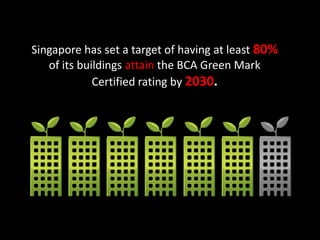
Singapore has set a target of having at least 80%
of its buildings attain the BCA Green Mark
Certified rating by 2030.
The incorporation of green features to achieve Green Mark
certification generally leads to higher construction costs.
It is important to construct
in an environmentally
sustainable manner because
the construction sector emits
significant greenhouse gases.
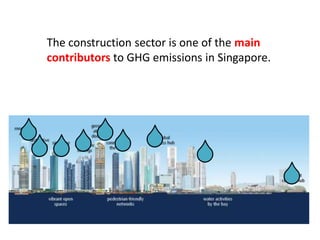
The construction sector is one of the main
contributors to GHG emissions in Singapore.
Hitherto,
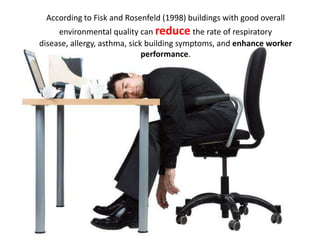
According to Fisk and Rosenfeld (1998) buildings with good overall
environmental quality can reduce the rate of respiratory
disease, allergy, asthma, sick building symptoms, and enhance worker
performance.
$
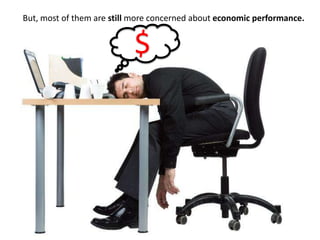
But, most of them are still more concerned about economic performance.
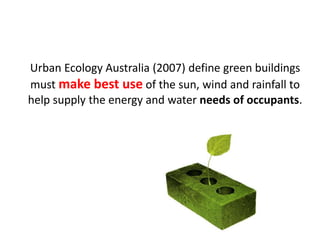
Urban Ecology Australia (2007) define green buildings
must make best use of the sun, wind and rainfall to
help supply the energy and water needs of occupants.
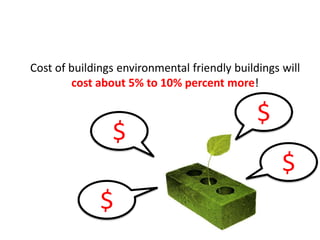
Cost of buildings environmental friendly buildings will
cost about 5% to 10% percent more!
$
$
$
$
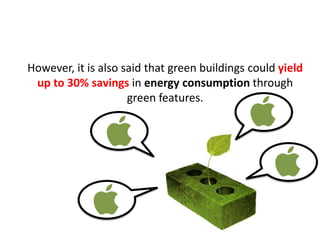
However, it is also said that green buildings could yield
up to 30% savings in energy consumption through
green features.
Reduce heat absorption, provide more day light, maximize
natural ventilation, and use more energy efficient
air-conditioning systems and light fittings.
Shendler and Udall (2005) argued
that a significant portion of the
additional costs of a green building
derives not from the hard costs of
purchasing green systems and
materials but rather from the soft
costs of
design, certification, modeling and
consulting.
Hitherto,
The general research approach Singaporean
respondents were requested to base their
responses on the new home that they would
purchase in the near future.
Willingness to pay more for green homes
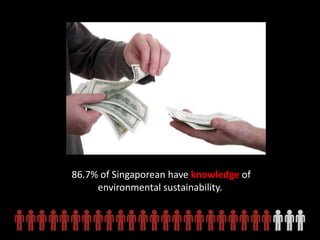
86.7% of Singaporean have knowledge of
environmental sustainability.
Willingness to pay more for green homes
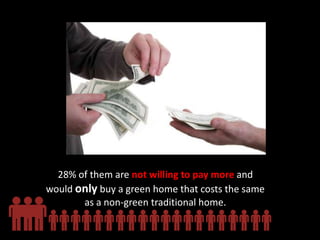
28% of them are not willing to pay more and
would only buy a green home that costs the same
as a non-green traditional home.
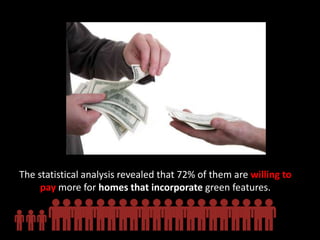
The statistical analysis revealed that 72% of them are willing to
pay more for homes that incorporate green features.
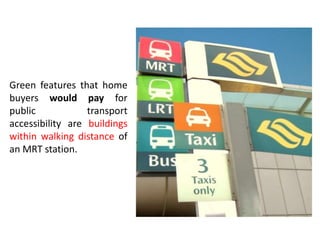
Green features that home
buyers would pay for
public transport
accessibility are buildings
within walking distance of
an MRT station.
Buyers also likely to pay more to know that contractors
adopted sustainable practices during construction stage.
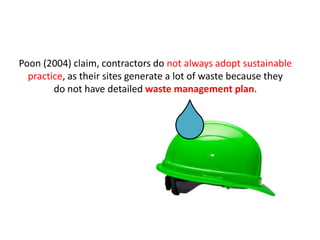
Poon (2004) claim, contractors do not always adopt sustainable
practice, as their sites generate a lot of waste because they
do not have detailed waste management plan.
Hitherto,
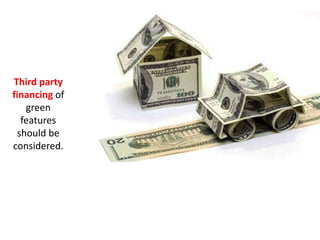
Third party
financing of
green
features
should be
considered.
funding green features
It is recommended to provide affordable low interest loans
to end-users so that they can pay for green features by
themselves and payoff the loans from the savings achieved
from the green features used in the building.
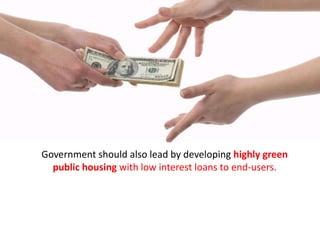
Government should also lead by developing highly green
public housing with low interest loans to end-users.
New York State Energy Research and Development Authority administers
approximately 2,700 projects through its New York Energy Smart Scheme
that the homeowners who qualify under the scheme can get
low-interest loans to include green features into their homes through
the New York Energy Smart Loan Program.
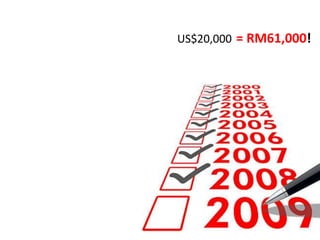
Homeowners could get up to US$20,000 as unsecured
loans payable during a period of up to ten years.
Homeowners could get up to US$20,000 as unsecured
loans payable during a period of up to ten years.
= RM61,000!
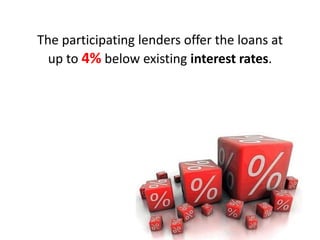
The participating lenders offer the loans at
up to 4% below existing interest rates.
The state also offers federal tax incentives to those who
install energy efficient equipment and measures into their homes.
provide mandatory provisions
standards to adhere
policy makers and regulators involve
✓
✓
✓
Legislation
Hitherto,
Building Control (Environmental
Sustainability) Regulations 2008
have mandatory provisions on
the minimum environmental
sustainability standards that
construction projects must
adhere to.
Policy makers and regulators
may need to take into
consideration issues.
Recommendation that
potential home buyers
be educated
about lifecycle
costs instead of
focusing merely on
upfront costs.
Reference:
slides prepared by:
Discussion?
thnks

Singaporean & Sustainable Home

  • 1.
    Singaporean & SustainableHome ridhwanikhsan <ID> Icp863managementofproperty&environment
  • 2.
  • 3.
    Construction industry isregarded as one of the major contributors to climate change.
  • 4.
    According to theAmerican Institute of Architects, the biggest source of emissions and energy consumption around the globe is the construction industry.
  • 5.
  • 6.
  • 7.
    According to InternationalInvestors Group on Climate Change, the cement sector alone accounts for 5% of global man-made CO2 emissions.
  • 8.
    In heavily urbanizedSingapore, where half the total land area is built up, the building sector account for approximately 16% of national CO2 emissions.
  • 9.
    Singapore Building andConstruction Authority’s (BCA) Green Mark Scheme was launched in January 2005.
  • 10.
    It is agreen building rating system that assesses buildings and rates their performance in the areas of energy efficiency, water efficiency, environmental protection, indoor environmental quality and other green initiatives.
  • 11.
  • 12.
    The scheme topromote the adoption of green building design and technologies that improve energy efficiency and reduce the impact of buildings on the environment.
  • 13.
    Singapore has seta target of having at least 80% of its buildings attain the BCA Green Mark Certified rating by 2030.
  • 14.
    The incorporation ofgreen features to achieve Green Mark certification generally leads to higher construction costs.
  • 15.
    It is importantto construct in an environmentally sustainable manner because the construction sector emits significant greenhouse gases.
  • 16.
    The construction sectoris one of the main contributors to GHG emissions in Singapore.
  • 17.
  • 18.
    According to Fiskand Rosenfeld (1998) buildings with good overall environmental quality can reduce the rate of respiratory disease, allergy, asthma, sick building symptoms, and enhance worker performance.
  • 19.
    $ But, most ofthem are still more concerned about economic performance.
  • 20.
    Urban Ecology Australia(2007) define green buildings must make best use of the sun, wind and rainfall to help supply the energy and water needs of occupants.
  • 21.
    Cost of buildingsenvironmental friendly buildings will cost about 5% to 10% percent more! $ $ $ $
  • 22.
    However, it isalso said that green buildings could yield up to 30% savings in energy consumption through green features.
  • 23.
    Reduce heat absorption,provide more day light, maximize natural ventilation, and use more energy efficient air-conditioning systems and light fittings.
  • 24.
    Shendler and Udall(2005) argued that a significant portion of the additional costs of a green building derives not from the hard costs of purchasing green systems and materials but rather from the soft costs of design, certification, modeling and consulting.
  • 25.
  • 26.
    The general researchapproach Singaporean respondents were requested to base their responses on the new home that they would purchase in the near future.
  • 27.
    Willingness to paymore for green homes 86.7% of Singaporean have knowledge of environmental sustainability.
  • 28.
    Willingness to paymore for green homes 28% of them are not willing to pay more and would only buy a green home that costs the same as a non-green traditional home.
  • 29.
    The statistical analysisrevealed that 72% of them are willing to pay more for homes that incorporate green features.
  • 30.
    Green features thathome buyers would pay for public transport accessibility are buildings within walking distance of an MRT station.
  • 31.
    Buyers also likelyto pay more to know that contractors adopted sustainable practices during construction stage.
  • 32.
    Poon (2004) claim,contractors do not always adopt sustainable practice, as their sites generate a lot of waste because they do not have detailed waste management plan.
  • 33.
  • 34.
  • 35.
    funding green features Itis recommended to provide affordable low interest loans to end-users so that they can pay for green features by themselves and payoff the loans from the savings achieved from the green features used in the building.
  • 36.
    Government should alsolead by developing highly green public housing with low interest loans to end-users.
  • 37.
    New York StateEnergy Research and Development Authority administers approximately 2,700 projects through its New York Energy Smart Scheme that the homeowners who qualify under the scheme can get low-interest loans to include green features into their homes through the New York Energy Smart Loan Program.
  • 38.
    Homeowners could getup to US$20,000 as unsecured loans payable during a period of up to ten years.
  • 39.
    Homeowners could getup to US$20,000 as unsecured loans payable during a period of up to ten years. = RM61,000!
  • 40.
    The participating lendersoffer the loans at up to 4% below existing interest rates.
  • 41.
    The state alsooffers federal tax incentives to those who install energy efficient equipment and measures into their homes.
  • 43.
    provide mandatory provisions standardsto adhere policy makers and regulators involve ✓ ✓ ✓
  • 44.
  • 45.
  • 46.
    Building Control (Environmental Sustainability)Regulations 2008 have mandatory provisions on the minimum environmental sustainability standards that construction projects must adhere to.
  • 47.
    Policy makers andregulators may need to take into consideration issues.
  • 48.
    Recommendation that potential homebuyers be educated about lifecycle costs instead of focusing merely on upfront costs.
  • 49.
  • 50.
  • 51.
  • 52.