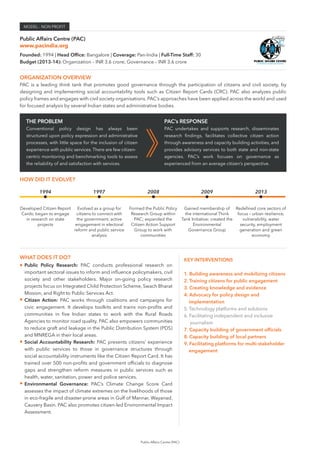
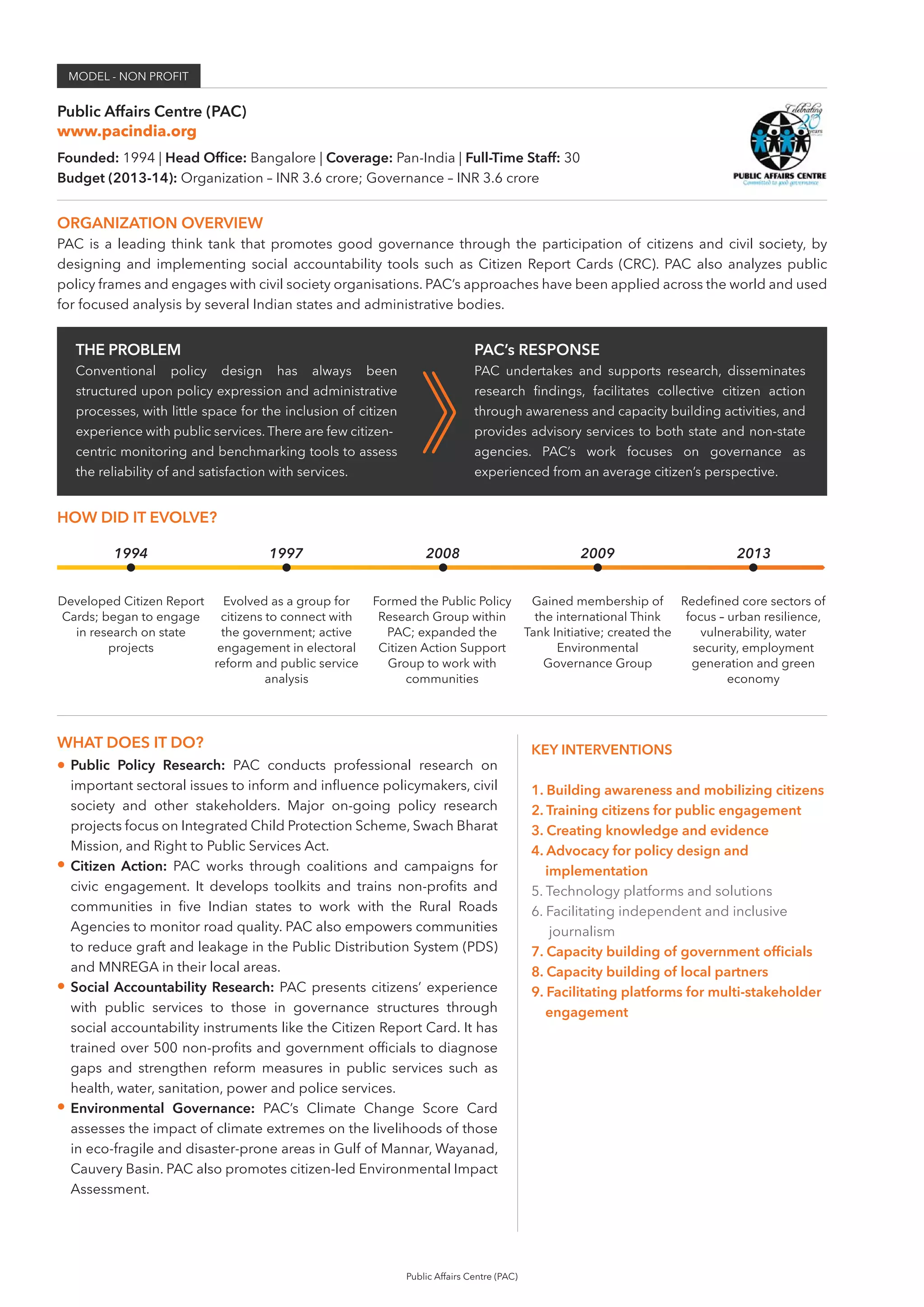
MODEL - NON PROFIT
ORGANIZATION OVERVIEW
PAC is a leading think tank that promotes good governance through the participation of citizens and civil society, by
designing and implementing social accountability tools such as Citizen Report Cards (CRC). PAC also analyzes public
policy frames and engages with civil society organisations. PAC’s approaches have been applied across the world and used
for focused analysis by several Indian states and administrative bodies.
THE PROBLEM
Conventional policy design has always been
structured upon policy expression and administrative
processes, with little space for the inclusion of citizen
experience with public services. There are few citizen-
centric monitoring and benchmarking tools to assess
the reliability of and satisfaction with services.
PAC’s RESPONSE
PAC undertakes and supports research, disseminates
research findings, facilitates collective citizen action
through awareness and capacity building activities, and
provides advisory services to both state and non-state
agencies. PAC’s work focuses on governance as
experienced from an average citizen’s perspective.
Public Affairs Centre (PAC)
Founded: 1994 | Head Office: Bangalore | Coverage: Pan-India | Full-Time Staff: 30
Budget (2013-14): Organization – INR 3.6 crore; Governance – INR 3.6 crore
HOW DID IT EVOLVE?
Public Affairs Centre (PAC)
WHAT DOES IT DO?
www.pacindia.org
Developed Citizen Report
Cards; began to engage
in research on state
projects
Evolved as a group for
citizens to connect with
the government; active
engagement in electoral
reform and public service
analysis
Formed the Public Policy
Research Group within
PAC; expanded the
Citizen Action Support
Group to work with
communities
Gained membership of
the international Think
Tank Initiative; created the
Environmental
Governance Group
Redefined core sectors of
focus – urban resilience,
vulnerability, water
security, employment
generation and green
economy
1994 1997 2008 2009 2013
Public Policy Research: PAC conducts professional research on
important sectoral issues to inform and influence policymakers, civil
society and other stakeholders. Major on-going policy research
projects focus on Integrated Child Protection Scheme, Swach Bharat
Mission, and Right to Public Services Act.
Citizen Action: PAC works through coalitions and campaigns for
civic engagement. It develops toolkits and trains non-profits and
communities in five Indian states to work with the Rural Roads
Agencies to monitor road quality. PAC also empowers communities
to reduce graft and leakage in the Public Distribution System (PDS)
and MNREGA in their local areas.
Social Accountability Research: PAC presents citizens’ experience
with public services to those in governance structures through
social accountability instruments like the Citizen Report Card. It has
trained over 500 non-profits and government officials to diagnose
gaps and strengthen reform measures in public services such as
health, water, sanitation, power and police services.
Environmental Governance: PAC’s Climate Change Score Card
assesses the impact of climate extremes on the livelihoods of those
in eco-fragile and disaster-prone areas in Gulf of Mannar, Wayanad,
Cauvery Basin. PAC also promotes citizen-led Environmental Impact
Assessment.
KEY INTERVENTIONS
1. Building awareness and mobilizing citizens
2. Training citizens for public engagement
3. Creating knowledge and evidence
4. Advocacy for policy design and
implementation
5. Technology platforms and solutions
6. Facilitating independent and inclusive
journalism
7. Capacity building of government officials
8. Capacity building of local partners
9. Facilitating platforms for multi-stakeholder
engagement
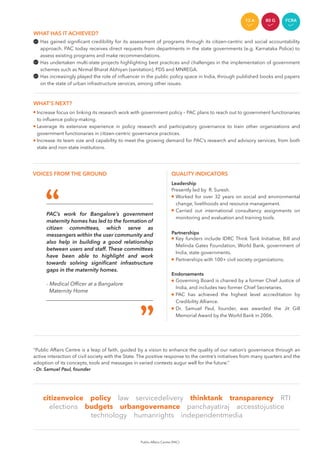
WHAT’S NEXT?
Increase focus on linking its research work with government policy – PAC plans to reach out to government functionaries
to influence policy-making.
Leverage its extensive experience in policy research and participatory governance to train other organizations and
government functionaries in citizen-centric governance practices.
Increase its team size and capability to meet the growing demand for PAC’s research and advisory services, from both
state and non-state institutions.
"Public Affairs Centre is a leap of faith, guided by a vision to enhance the quality of our nation’s governance through an
active interaction of civil society with the State. The positive response to the centre’s initiatives from many quarters and the
adoption of its concepts, tools and messages in varied contexts augur well for the future.”
- Dr. Samuel Paul, founder
citizenvoice policy law servicedelivery thinktank transparency RTI
elections budgets urbangovernance panchayatiraj accesstojustice
technology humanrights independentmedia
PAC’s work for Bangalore’s government
maternity homes has led to the formation of
citizen committees, which serve as
messengers within the user community and
also help in building a good relationship
between users and staff. These committees
have been able to highlight and work
towards solving significant infrastructure
gaps in the maternity homes.
- Medical Officer at a Bangalore
Maternity Home
Has gained significant credibility for its assessment of programs through its citizen-centric and social accountability
approach. PAC today receives direct requests from departments in the state governments (e.g. Karnataka Police) to
assess existing programs and make recommendations.
Has undertaken multi-state projects highlighting best practices and challenges in the implementation of government
schemes such as Nirmal Bharat Abhiyan (sanitation), PDS and MNREGA.
Has increasingly played the role of influencer in the public policy space in India, through published books and papers
on the state of urban infrastructure services, among other issues.
WHAT HAS IT ACHIEVED?
VOICES FROM THE GROUND
Worked for over 32 years on social and environmental
change, livelihoods and resource management.
Carried out international consultancy assignments on
monitoring and evaluation and training tools.
Key funders include IDRC Think Tank Initiative, Bill and
Melinda Gates Foundation, World Bank, government of
India, state governments.
Partnerships with 100+ civil society organizations.
Governing Board is chaired by a former Chief Justice of
India, and includes two former Chief Secretaries.
PAC has achieved the highest level accreditation by
Credibility Alliance.
Dr. Samuel Paul, founder, was awarded the Jit Gill
Memorial Award by the World Bank in 2006.
QUALITY INDICATORS
Public Affairs Centre (PAC)
FCRA12 A 80 G FCRA
Leadership
Presently led by R. Suresh.
Partnerships
Endorsements

Public Affairs Centre (PAC)

  • 1.
    MODEL - NONPROFIT ORGANIZATION OVERVIEW PAC is a leading think tank that promotes good governance through the participation of citizens and civil society, by designing and implementing social accountability tools such as Citizen Report Cards (CRC). PAC also analyzes public policy frames and engages with civil society organisations. PAC’s approaches have been applied across the world and used for focused analysis by several Indian states and administrative bodies. THE PROBLEM Conventional policy design has always been structured upon policy expression and administrative processes, with little space for the inclusion of citizen experience with public services. There are few citizen- centric monitoring and benchmarking tools to assess the reliability of and satisfaction with services. PAC’s RESPONSE PAC undertakes and supports research, disseminates research findings, facilitates collective citizen action through awareness and capacity building activities, and provides advisory services to both state and non-state agencies. PAC’s work focuses on governance as experienced from an average citizen’s perspective. Public Affairs Centre (PAC) Founded: 1994 | Head Office: Bangalore | Coverage: Pan-India | Full-Time Staff: 30 Budget (2013-14): Organization – INR 3.6 crore; Governance – INR 3.6 crore HOW DID IT EVOLVE? Public Affairs Centre (PAC) WHAT DOES IT DO? www.pacindia.org Developed Citizen Report Cards; began to engage in research on state projects Evolved as a group for citizens to connect with the government; active engagement in electoral reform and public service analysis Formed the Public Policy Research Group within PAC; expanded the Citizen Action Support Group to work with communities Gained membership of the international Think Tank Initiative; created the Environmental Governance Group Redefined core sectors of focus – urban resilience, vulnerability, water security, employment generation and green economy 1994 1997 2008 2009 2013 Public Policy Research: PAC conducts professional research on important sectoral issues to inform and influence policymakers, civil society and other stakeholders. Major on-going policy research projects focus on Integrated Child Protection Scheme, Swach Bharat Mission, and Right to Public Services Act. Citizen Action: PAC works through coalitions and campaigns for civic engagement. It develops toolkits and trains non-profits and communities in five Indian states to work with the Rural Roads Agencies to monitor road quality. PAC also empowers communities to reduce graft and leakage in the Public Distribution System (PDS) and MNREGA in their local areas. Social Accountability Research: PAC presents citizens’ experience with public services to those in governance structures through social accountability instruments like the Citizen Report Card. It has trained over 500 non-profits and government officials to diagnose gaps and strengthen reform measures in public services such as health, water, sanitation, power and police services. Environmental Governance: PAC’s Climate Change Score Card assesses the impact of climate extremes on the livelihoods of those in eco-fragile and disaster-prone areas in Gulf of Mannar, Wayanad, Cauvery Basin. PAC also promotes citizen-led Environmental Impact Assessment. KEY INTERVENTIONS 1. Building awareness and mobilizing citizens 2. Training citizens for public engagement 3. Creating knowledge and evidence 4. Advocacy for policy design and implementation 5. Technology platforms and solutions 6. Facilitating independent and inclusive journalism 7. Capacity building of government officials 8. Capacity building of local partners 9. Facilitating platforms for multi-stakeholder engagement
  • 2.
    WHAT’S NEXT? Increase focuson linking its research work with government policy – PAC plans to reach out to government functionaries to influence policy-making. Leverage its extensive experience in policy research and participatory governance to train other organizations and government functionaries in citizen-centric governance practices. Increase its team size and capability to meet the growing demand for PAC’s research and advisory services, from both state and non-state institutions. "Public Affairs Centre is a leap of faith, guided by a vision to enhance the quality of our nation’s governance through an active interaction of civil society with the State. The positive response to the centre’s initiatives from many quarters and the adoption of its concepts, tools and messages in varied contexts augur well for the future.” - Dr. Samuel Paul, founder citizenvoice policy law servicedelivery thinktank transparency RTI elections budgets urbangovernance panchayatiraj accesstojustice technology humanrights independentmedia PAC’s work for Bangalore’s government maternity homes has led to the formation of citizen committees, which serve as messengers within the user community and also help in building a good relationship between users and staff. These committees have been able to highlight and work towards solving significant infrastructure gaps in the maternity homes. - Medical Officer at a Bangalore Maternity Home Has gained significant credibility for its assessment of programs through its citizen-centric and social accountability approach. PAC today receives direct requests from departments in the state governments (e.g. Karnataka Police) to assess existing programs and make recommendations. Has undertaken multi-state projects highlighting best practices and challenges in the implementation of government schemes such as Nirmal Bharat Abhiyan (sanitation), PDS and MNREGA. Has increasingly played the role of influencer in the public policy space in India, through published books and papers on the state of urban infrastructure services, among other issues. WHAT HAS IT ACHIEVED? VOICES FROM THE GROUND Worked for over 32 years on social and environmental change, livelihoods and resource management. Carried out international consultancy assignments on monitoring and evaluation and training tools. Key funders include IDRC Think Tank Initiative, Bill and Melinda Gates Foundation, World Bank, government of India, state governments. Partnerships with 100+ civil society organizations. Governing Board is chaired by a former Chief Justice of India, and includes two former Chief Secretaries. PAC has achieved the highest level accreditation by Credibility Alliance. Dr. Samuel Paul, founder, was awarded the Jit Gill Memorial Award by the World Bank in 2006. QUALITY INDICATORS Public Affairs Centre (PAC) FCRA12 A 80 G FCRA Leadership Presently led by R. Suresh. Partnerships Endorsements