MODEL - NON PROFIT
ORGANIZATION OVERVIEW
Transparent Chennai (TC) aggregates, creates and disseminates data, maps and research about important civic issues in
Chennai. Its aim is to empower citizens and government officials to use this information to improve city planning and
service provision for the benefit of the city’s residents, especially the urban poor. TC’s use of mapping technology to
advocate for change is unique in Chennai and rare in India.
THE PROBLEM
There is a lack of data concerning public service
provision and existing data is often inaccurate or
incomplete. Hence citizens have little evidence to
claim their rights, and government bodies are not
held accountable, and do not have the information
to provide adequate public services to citizens.
Creation of mapping tools,data, research highlighting civic issues:
TC conducts research on electoral accountability, city governance,
pedestrian infrastructure, road safety, sanitation and solid waste
management, slums and informal settlements and open data.
Existing data on these issues is aggregated from multiple sources,
including government offices, RTI requests and newspaper reports.
Study areas are chosen based on parameters such as relationships
with councilors and demand from the community.
Public meetings are organized to establish relations between
different stakeholders and engage citizens in data collection.
With the help of citizens, new data is collected using mobile phone
surveys, interviews, GPS devices, and pen and paper maps; details
such as location and salient features are recorded.
This information is digitized and visualized using tools such as QGIS,
OpenStreetMaps, Google Maps and Carto DB.
Interactive maps are created to reveal insights into urban
governance issues by juxtaposing layers of different kinds of data.
TC’s RESPONSE
TC creates maps and data including features such as
location and quality of public services to highlight gaps
in government service provision. It helps citizens use this
data to advocate for their entitlements and engages
government officials to use better data methodologies
to improve city planning and service provision.
Transparent Chennai
Founded: 2010 | Head Office: Chennai | Coverage: Chennai | Full-Time Staff: 11
Budget (2013-14): Organization – INR 1.5 crore; Governance – INR 1.5 crore
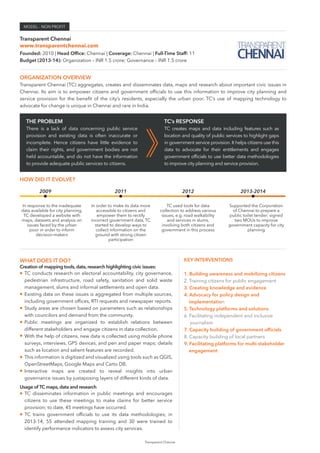
HOW DID IT EVOLVE?
Transparent Chennai
WHAT DOES IT DO?
www.transparentchennai.com
In response to the inadequate
data available for city planning,
TC developed a website with
maps, datasets and analysis on
issues faced by the urban
poor in order to inform
decision-makers
In order to make its data more
accessible to citizens and
empower them to rectify
incorrect government data, TC
started to develop ways to
collect information on the
ground with strong citizen
participation
TC used tools for data
collection to address various
issues, e.g. road walkability
and services in slums,
involving both citizens and
government in this process
Supported the Corporation
of Chennai to prepare a
public toilet tender; signed
two MOUs to improve
government capacity for city
planning
2009 2011 2012 2013-2014
Usage of TC maps, data and research
TC disseminates information in public meetings and encourages
citizens to use these meetings to make claims for better service
provision; to date, 45 meetings have occurred.
TC trains government officials to use its data methodologies; in
2013-14, 55 attended mapping training and 30 were trained to
identify performance indicators to assess city services.
KEY INTERVENTIONS
1. Building awareness and mobilizing citizens
2. Training citizens for public engagement
3. Creating knowledge and evidence
4. Advocacy for policy design and
implementation
5. Technology platforms and solutions
6. Facilitating independent and inclusive
journalism
7. Capacity building of government officials
8. Capacity building of local partners
9. Facilitating platforms for multi-stakeholder
engagement
WHAT’S NEXT?
“Narratives about urban India are often very bleak and Indians face seemingly insurmountable problems.Transparent Chennai’s
work supports substantive change by improving the availability and quality of information about the urban poor, and building
the capacities of both government and citizen groups to use this information to ameliorate local conditions. Our work lays the
groundwork for a new practice of urban planning that truly emerges from and responds to local conditions.”
– Nithya Raman, founder
citizenvoice policy law servicedelivery thinktank transparency RTI
elections budgets urbangovernance panchayatiraj accesstojustice
technology humanrights independentmedia
I have 117 streets in my ward to monitor…It
takes three months just to survey them all.
We are short-staffed, so it is difficult to
address the specific needs each community
has. Transparent Chennai’s surveys helped
in setting the priority.
- Aavin R. Arulvel,
Ward Councilor of Kalyanapuram
In 2013, TC worked with Corporation of Chennai (CoC) officials to prepare a tender for new public toilets; it was the first
time that CoC used spatial data to plan for public toilets and mobile phones to collect that data.
In 2014, TC signed two MOUs with the CoC: one to create a Web portal to improve data management practices for city
planning and the other to create data to address urban poverty using maps and improved survey methodologies.
To date, nearly 800 residents in Chennai have participated in TC data creation exercises.
There has been strong interest in replicating TC’s tools and methodologies by non-profits in other countries: TC trained
61 staff of the South African Aids Trust in Johannesburg and Tanzania to collect data and create maps.
Broaden its research focus and increase the number of wards in which it works in Chennai.
Seek to establish partnerships with communities and Civil Society Organizations (CSO) that would like to use
TC’s methodologies and tools.
Continue to develop opportunities to work with government to support the better use of data for planning
and implementation of city initiatives.
Over the next year, TC plans to scale up its outreach and impact. This will include the following activities:
WHAT HAS IT ACHIEVED?
VOICES FROM THE GROUND
Has previously worked at IFMR, Amnesty International
and the Hazards Centre.
Has a BA from Harvard University and a Masters in Urban
Planning from the Massachusetts Institute of Technology.
Key funders: Asia Foundation; Ford Foundation; World
Wide Web Foundation; Shakti Foundation; Rockefeller
Foundation.
Key program partners: Tata Institute of Social Sciences;
Madras Institute of Development Studies; Global Alliance
for Incinerator Alternatives; Corporation of Chennai.
Networks: Open Data in Developing Countries; Open
Knowledge Foundation.
QUALITY INDICATORS
Transparent Chennai
12 A 80 G FCRA
Leadership
Nithya Raman, founder and director, TC.
Partnerships

Transparent Chennai

  • 1.
    MODEL - NONPROFIT ORGANIZATION OVERVIEW Transparent Chennai (TC) aggregates, creates and disseminates data, maps and research about important civic issues in Chennai. Its aim is to empower citizens and government officials to use this information to improve city planning and service provision for the benefit of the city’s residents, especially the urban poor. TC’s use of mapping technology to advocate for change is unique in Chennai and rare in India. THE PROBLEM There is a lack of data concerning public service provision and existing data is often inaccurate or incomplete. Hence citizens have little evidence to claim their rights, and government bodies are not held accountable, and do not have the information to provide adequate public services to citizens. Creation of mapping tools,data, research highlighting civic issues: TC conducts research on electoral accountability, city governance, pedestrian infrastructure, road safety, sanitation and solid waste management, slums and informal settlements and open data. Existing data on these issues is aggregated from multiple sources, including government offices, RTI requests and newspaper reports. Study areas are chosen based on parameters such as relationships with councilors and demand from the community. Public meetings are organized to establish relations between different stakeholders and engage citizens in data collection. With the help of citizens, new data is collected using mobile phone surveys, interviews, GPS devices, and pen and paper maps; details such as location and salient features are recorded. This information is digitized and visualized using tools such as QGIS, OpenStreetMaps, Google Maps and Carto DB. Interactive maps are created to reveal insights into urban governance issues by juxtaposing layers of different kinds of data. TC’s RESPONSE TC creates maps and data including features such as location and quality of public services to highlight gaps in government service provision. It helps citizens use this data to advocate for their entitlements and engages government officials to use better data methodologies to improve city planning and service provision. Transparent Chennai Founded: 2010 | Head Office: Chennai | Coverage: Chennai | Full-Time Staff: 11 Budget (2013-14): Organization – INR 1.5 crore; Governance – INR 1.5 crore HOW DID IT EVOLVE? Transparent Chennai WHAT DOES IT DO? www.transparentchennai.com In response to the inadequate data available for city planning, TC developed a website with maps, datasets and analysis on issues faced by the urban poor in order to inform decision-makers In order to make its data more accessible to citizens and empower them to rectify incorrect government data, TC started to develop ways to collect information on the ground with strong citizen participation TC used tools for data collection to address various issues, e.g. road walkability and services in slums, involving both citizens and government in this process Supported the Corporation of Chennai to prepare a public toilet tender; signed two MOUs to improve government capacity for city planning 2009 2011 2012 2013-2014 Usage of TC maps, data and research TC disseminates information in public meetings and encourages citizens to use these meetings to make claims for better service provision; to date, 45 meetings have occurred. TC trains government officials to use its data methodologies; in 2013-14, 55 attended mapping training and 30 were trained to identify performance indicators to assess city services. KEY INTERVENTIONS 1. Building awareness and mobilizing citizens 2. Training citizens for public engagement 3. Creating knowledge and evidence 4. Advocacy for policy design and implementation 5. Technology platforms and solutions 6. Facilitating independent and inclusive journalism 7. Capacity building of government officials 8. Capacity building of local partners 9. Facilitating platforms for multi-stakeholder engagement
  • 2.
    WHAT’S NEXT? “Narratives abouturban India are often very bleak and Indians face seemingly insurmountable problems.Transparent Chennai’s work supports substantive change by improving the availability and quality of information about the urban poor, and building the capacities of both government and citizen groups to use this information to ameliorate local conditions. Our work lays the groundwork for a new practice of urban planning that truly emerges from and responds to local conditions.” – Nithya Raman, founder citizenvoice policy law servicedelivery thinktank transparency RTI elections budgets urbangovernance panchayatiraj accesstojustice technology humanrights independentmedia I have 117 streets in my ward to monitor…It takes three months just to survey them all. We are short-staffed, so it is difficult to address the specific needs each community has. Transparent Chennai’s surveys helped in setting the priority. - Aavin R. Arulvel, Ward Councilor of Kalyanapuram In 2013, TC worked with Corporation of Chennai (CoC) officials to prepare a tender for new public toilets; it was the first time that CoC used spatial data to plan for public toilets and mobile phones to collect that data. In 2014, TC signed two MOUs with the CoC: one to create a Web portal to improve data management practices for city planning and the other to create data to address urban poverty using maps and improved survey methodologies. To date, nearly 800 residents in Chennai have participated in TC data creation exercises. There has been strong interest in replicating TC’s tools and methodologies by non-profits in other countries: TC trained 61 staff of the South African Aids Trust in Johannesburg and Tanzania to collect data and create maps. Broaden its research focus and increase the number of wards in which it works in Chennai. Seek to establish partnerships with communities and Civil Society Organizations (CSO) that would like to use TC’s methodologies and tools. Continue to develop opportunities to work with government to support the better use of data for planning and implementation of city initiatives. Over the next year, TC plans to scale up its outreach and impact. This will include the following activities: WHAT HAS IT ACHIEVED? VOICES FROM THE GROUND Has previously worked at IFMR, Amnesty International and the Hazards Centre. Has a BA from Harvard University and a Masters in Urban Planning from the Massachusetts Institute of Technology. Key funders: Asia Foundation; Ford Foundation; World Wide Web Foundation; Shakti Foundation; Rockefeller Foundation. Key program partners: Tata Institute of Social Sciences; Madras Institute of Development Studies; Global Alliance for Incinerator Alternatives; Corporation of Chennai. Networks: Open Data in Developing Countries; Open Knowledge Foundation. QUALITY INDICATORS Transparent Chennai 12 A 80 G FCRA Leadership Nithya Raman, founder and director, TC. Partnerships