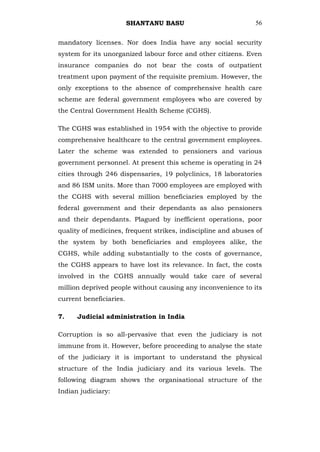
PURPOSE      OF    RESEARCH:       Strategies    for   combating
corruption in an established and developing democracy

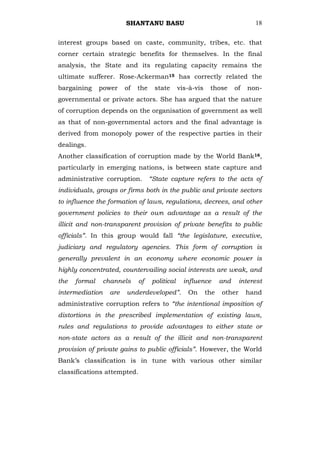
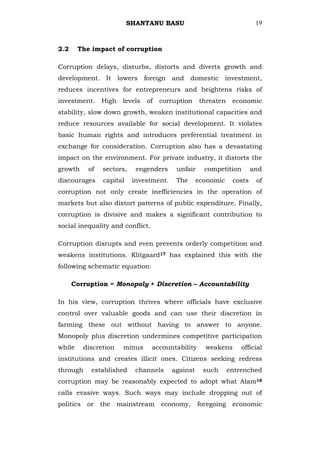
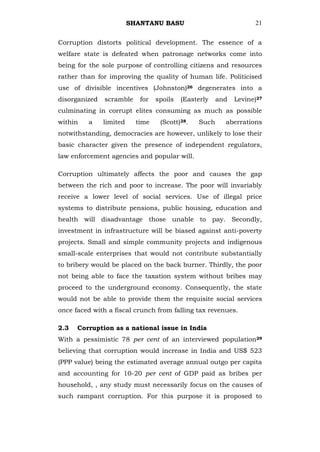
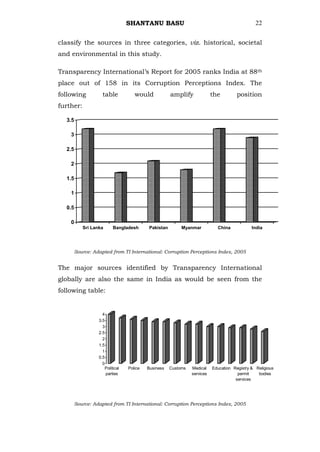
The objective of this paper is to highlight the extent of
corruption in India by identifying the main causes for
corruption in major sectors such as the bureaucracy, judiciary
and polity and suggest remedial measures. Unlike other middle-
income newly independent nations that are yet to build up their
political, judicial and executive governance infrastructure, India
has a well—established governance system with all the requisite
institutions in place for over half a century now. This research
therefore, takes into account the natural and human resources,
industrial and technological skills available within India and
contrasts it with the underlying corruption as a way of life
retarding progress and development and depriving citizens of
their legitimate right to ensure a better quality of life for
themselves. The weak rule of law and a drastic overhaul of the
legal system and other accountability systems therefore feature
prominently in this paper. Deregulation and outsourcing too
occupy a significant position being major elements in devolving
power to citizens and assuring indirect popular participation in
governance. While there may be more than an alternate opinion
on many of the suggestions made as being Draconian, the fact
would, nonetheless, remain that perhaps only such Draconian
changes and enforcement alone can lift India from the morass it
has sunk into in the last six decades since independence.
Unless corruption as a national way of life is jettisoned to the
extent of at least 70-80 per cent of its present level, annual GDP
growth rate of over 8 per cent would remain only an impressive
statistic and not translate to a better quality of life for India‘s
citizens who belong to the world‘s two largest ‗tiger‘ economies.
It is this issue that my research would seek to investigate. In
doing so such research would also touch upon several other


                       SHANTANU BASU
SHANTANU BASU                              2


facets that would be of interest not only to other relatively
smaller and less complex developing countries but also many
international organisations and multinational corporations and
other bodies corporate who are investing substantial capital and
resources in these countries. Such research may also be of help
not only to academic researchers but also foreign educational
institutions and other corporate bodies as they cross the seven
seas to establish their satellite campuses or seek to invest in
educational systems, health services, transportation and a host
of other infrastructure areas.

Therefore the purpose of this research is to briefly analyse
corruption in seven key sectors in public administration in
India:

              Bureaucracy

              Elections and political party funding

              Judicial administration

              Police administration

              Municipal administration

              Health administration

              Education administration

So   far    anti-corruption   measures   have     mainly   confined
themselves     to   addressing   administrative     corruption   by
reforming     public   administration    and      public   financial
management. However, with increasing recognition that the
roots of corruption extend much beyond lacunae in government,
suggestions for redressal are focusing on broader structural
relationships such as those relating to the organisation of the
political system, states and firms and states and civil society. No
single strategy would succeed, instead a healthy mix of coercion
and incentives in varying measures may provide answers to the
SHANTANU BASU                                              3


      complexities of the Indian situation. Such strategies would also
      have to take into account the presence of powerful vested
      interest,       political    compulsions,          considerations          of    caste,
      community, geographical and linguistic chauvinism, etc. The
      following diagram would show the symbiotic interplay of various
      forces that would recall the need for a multi-pronged strategy to
      combat corruption:


Competitive Private Sector                                       Political Accountability
Economic policy reform                                      Political competition, credible political
Competitive restructuring of monopolies                     parties
Regulatory simplification for entry                         Transparency in party financing
Transparency in corporate governance                        Disclosure of parliamentary votes
Collective business associations                            Asset declaration, conflict of interest rules


                           ANTI-CORRUPTION

    Institutional Restraints                                   Civil Society Participation
Independent and effective judiciary                         Freedom of Information
Legislative oversight                                       Public hearings of draft laws
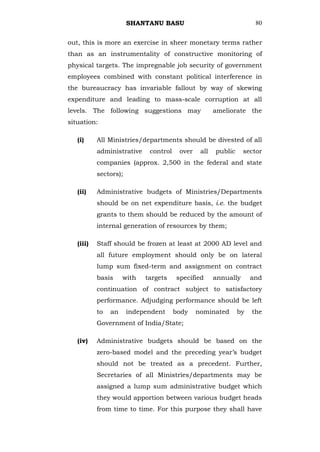
Independent prosecution, enforcement                        Role for media/NGOs


                                    Public Management
                         Meritocratic civil service with monetized,
                         adequate pay
                         Budget management (coverage, treasury,
                         procurement, audit)
                         Tax and customs
                         Sectoral service delivery (health, education,
                         energy)
                         Decentralisation with accountability


      Source: The World Bank, 2000: Anticorruption in Transition – A Contribution to the
      Policy debate


      Although        corrective      models       may      vary     by    practice         and
      experience, yet the goals remain identical, viz. enhancing state
      capacity and public sector management, strengthening political
      accountability, enabling civil society and increasing economic
      competition. Though a formidable task, a healthy interplay
      between the executive, polity and judiciary and a country‘s
SHANTANU BASU                                    4


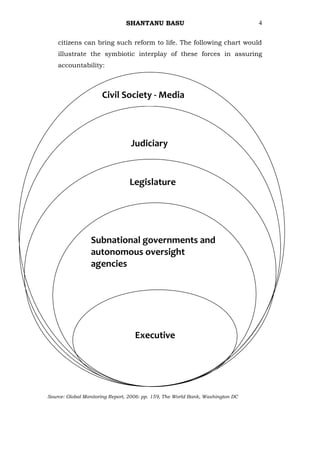
    citizens can bring such reform to life. The following chart would
    illustrate the symbiotic interplay of these forces in assuring
    accountability:


                      Civil Society - Media


                                  Judiciary


                                 Legislature


                 Subnational governments and
                 autonomous oversight
                 agencies


                                   Executive


Source: Global Monitoring Report, 2006: pp. 159, The World Bank, Washington DC
SHANTANU BASU                            5


         Strategies to Combat Corruption
           in Public Management in India

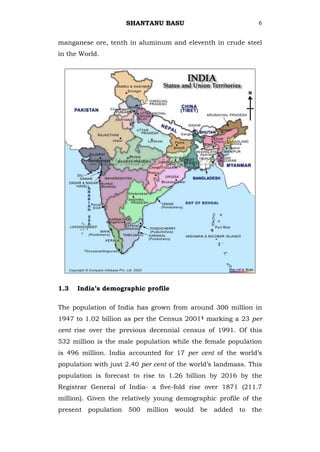
1.1   India: The Geographical Background

India, the second largest country in the world population wise
and seventh territory wise, lies north of the Equator, between
8'4''to 37'6" North latitude and 68'7"to 97'25" East longitude.
The country's landmass is flanked by the Bay of Bengal and the
Arabian Sea, along the southeast and along the southwest
respectively. On the western border is situated Pakistan and in
the east, Bangladesh and Myanmar. Along her northern
boundary are Bhutan, Nepal, and Tibet and Sinkiang region of
China. The Gulf of Mannar and the Palk Strait separate India
from Sri Lanka. From North to South, India measures about
3214 km and from east to west, about 2933 km. The total land
area is 3,268,090 sq. km. Its land frontier is 15,200km and
coastline, 6,103km. The Andaman and Nicobar Islands in the
Bay of Bengal and Lakshadweep in the Arabian Sea are parts of
Indian territory.

1.2   India’s natural resources

India has a large number of economically useful minerals and
they constitute one-quarter of the world's known mineral
resources. India also has the world's largest deposits of coal.
Next to Russia, India has the largest supply of manganese. India
also produces three quarters of the world's mica. The country
has substantial resources in chromite, bauxite, gypsum, nickel,
copper, ileminite, silimanite, gold, uranium and rare earths.
Petroleum deposits are found mainly in Assam and Gujarat and
off the Western coast. India ranks 3rd in production of coal,
lignite and barytes, fourth in iron ore, sixth in bauxite and
SHANTANU BASU                             6


manganese ore, tenth in aluminum and eleventh in crude steel
in the World.


1.3   India’s demographic profile

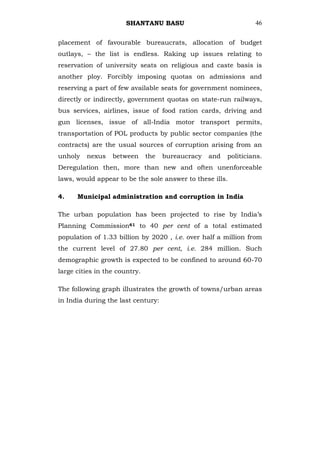
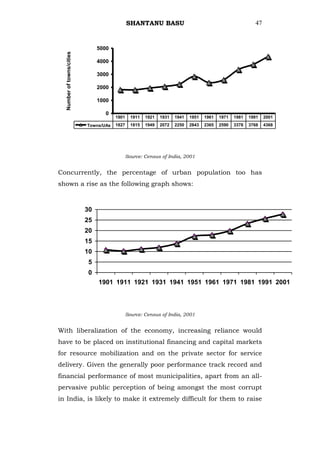
The population of India has grown from around 300 million in
1947 to 1.02 billion as per the Census 20011 marking a 23 per
cent rise over the previous decennial census of 1991. Of this
532 million is the male population while the female population
is 496 million. India accounted for 17 per cent of the world‘s
population with just 2.40 per cent of the world‘s landmass. This
population is forecast to rise to 1.26 billion by 2016 by the
Registrar General of India- a five-fold rise over 1871 (211.7
million). Given the relatively young demographic profile of the
present population 500 million would be added to the
SHANTANU BASU                                            7


population in the next few decades taking the total population
by World Bank estimates to 1.57 billion by 2051.Translated into
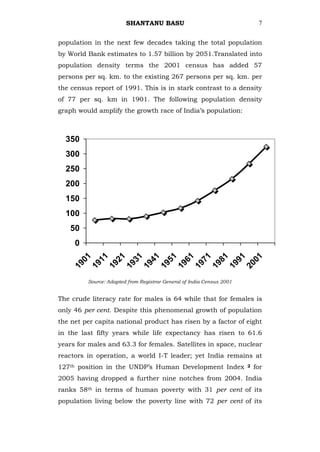
population density terms the 2001 census has added 57
persons per sq. km. to the existing 267 persons per sq. km. per
the census report of 1991. This is in stark contrast to a density
of 77 per sq. km in 1901. The following population density
graph would amplify the growth race of India‘s population:


  350
  300
  250
  200
  150
  100
   50
     0
      01

            11

                   21

                          31

                                 41

                                        51

                                               61

                                                      71

                                                             81

                                                                       91

                                                                                01
    19

          19

                19

                       19

                              19

                                     19

                                            19

                                                   19

                                                          19

                                                                 19

                                                                        20


         Source: Adapted from Registrar General of India Census 2001


The crude literacy rate for males is 64 while that for females is
only 46 per cent. Despite this phenomenal growth of population
the net per capita national product has risen by a factor of eight
in the last fifty years while life expectancy has risen to 61.6
years for males and 63.3 for females. Satellites in space, nuclear
reactors in operation, a world I-T leader; yet India remains at
127th position in the UNDP‘s Human Development Index                        2   for
2005 having dropped a further nine notches from 2004. India
ranks 58th in terms of human poverty with 31 per cent of its
population living below the poverty line with 72 per cent of its
SHANTANU BASU                              8


population in the villages, 33 per cent under the age of 15 years
and 21 per cent being malnourished. About 260 million people
live on less than a dollar a day. India‘s Constitution recognizes
22 official languages, in addition to English, although the
country has about 800 languages and 2,000 dialects. However,
India does not have any state religion and all religions have
equal rights of preaching and practicing.

1.4   India’s economic indicators

Despite the single largest handicap of a burgeoning population,
India sustained a growth rate of 7.5 per cent in 2004-05 which
is projected to rise to 8.1 per cent in 2005-063. Inflation has
mainly stabilized around the 4 per cent per annum mark and
the total GDP (PPP basis) in 2005 is estimated to be US$3.699
trillion with per capita GDP being US$3400. Agriculture has
remained largely stagnant and contributed 20.6 per cent to GDP
while services provided 51.4 per cent and industry 28.1 per cent.
The balance of trade remained unfavourable and foreign debt
totaled 22 per cent of GNP. Regrettably, the per capita income
remained at an abominable US$285 in 2004-05.

1.5   India’s infrastructure

Despite several centuries of neglect and colonial administration,
India today boasts of 50,000 km of national highways and
3,000,000 km of secondary and other roads, 11 major and 163
minor ports along its 6,000 km long coastline. India's 21.59
million-line land telephone and 41 million cellular networks are
one of the largest in the world and the 3rd largest among
emerging economies (after China and Republic of Korea). Given
the low telephone penetration rate - 2.2 per 100 people of
population, which is much below the global average, India offers
vast scope for growth. It is therefore not surprising that India
SHANTANU BASU                             9


has one of the fastest growing telecommunication systems in
the world with system size (total connections) growing at an
average of more than 20 per cent over the last 4 years. This is
despite only 31 per cent of India‘s population living in urban
agglomerations. Indian Railways extend over 60,000 route km
and carry 25 million passengers annually. India‘s information
technology industry has become a global phenomenon.

1.6   Paradox of development and future growth

Vision   20204,   a   document    published   by   the   Planning
Commission of the Government of India envisages the creation
of 150-200 million jobs by 2020 distributed over commercial
agriculture, tourism, construction, housing, I-T and I-T enabled
services, transport and communication, education and health.
This, in turn, would require doubling of allocation of resources
for education to about 6-7 per cent of GDP per annum and a
four-fold rise in health. Expenditure on R&D would raise
manifold from its present level of 1/60th of South Korea‘s. Public
mass transportation and telecommunications too would witness
a manifold rise. For India to rise to the world‘s fourth largest
economy by 2020, the country would have to produce 10 per
cent annual GDP growth rate during 2007-11 and 13 per cent
during 2012-20, both within the realm of the possible. A
colossal sum of US $ 72 billion is estimated to be required for a
cent per cent literate India by 2010.

At the same time India produces 441,000 technical graduates,
nearly 2.3 million other graduates and more than 300,000 post-
graduates every year. Bharat Forge, a private Indian company is
the world‘s second largest maker of forgings for car-engine and
chassis components, behind Thyssen-Krupp of Germany5. The
production efficiencies of Indian private industry too are
improving rapidly. While in the early 1990s, Bajaj Auto, a
SHANTANU BASU                             10


leading Indian manufacturer of two-wheelers, was producing a
million vehicles with 24,000 workers; in 2005 it produced 2.4
million vehicles with only 10,500 workers. While Indian garment
exports climbed to US$ 7.5 billion of total textile exports of US$
17 billion, nevertheless they remained a poor second to China
with figures of US$ 40 billion of a total of US$ 107 billion, after
accounting for trade safeguards. Peak electricity supply falls 11
per cent short and 56 per cent of households live without
connections. Although India‘s has a road network of 65,000 km,
of national highways only 9 per cent have four-lane traffic.
Although domestic air travel have increased by over 25 per cent
per annum and Bombay-Delhi air fares down to an all-time low
of US$40 (one-way), aircraft often have to circle overhead for
over 30 minutes for want of runways at airports. India‘s annual
expenditure on infrastructure has fallen to 3.5 per cent of GDP
at US$ 21 billion compared to China where the corresponding
figures were 10.5 per cent and US$ 150 billion. While
investment of US$ 55 billion is required for airports and
railways,   power    would    require   US$     75   billion   and
telecommunications US$ 25 billion. Poor and slow inland
transport causes 35-40 per cent of fresh farm produce to rot
before distribution while it takes a transport lorry 32 hours to
transit between Delhi and Bombay, a distance of about 1,400
kms.

Yet Indian industry has not given up. Reliance Industries
Limited, India‘s largest private conglomerate plans to establish
over the next four years a mega chain of 1,000 hypermarkets
and 2,000 supermarkets that would be an ―integrated farm-to-
fork supply chain‖. Similarly, Indian industry estimates that the
number of mobile telephone users would cross the half-billion
mark by the next decade. The market capitalization of major
Indian companies too has undergone a sea change with
SHANTANU BASU                                                        11


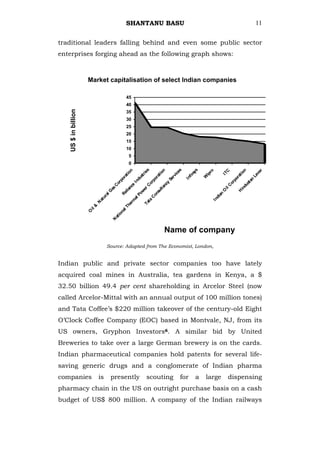
traditional leaders falling behind and even some public sector
enterprises forging ahead as the following graph shows:


                     Market capitalisation of select Indian companies

                                           45
                                           40
   US $ in billion


                                           35
                                           30
                                           25
                                           20
                                           15
                                           10
                                             5
                                             0
                                                                          s


                                                                         es


                                                                                    s


                                                                                                                  n
                                                                          n
                                                                          n


                                                                                           ro


                                                                                                                   r
                                                                                                                  C
                                                                       rie


                                                                                                                ve
                                                                                  sy


                                                                                                               tio
                                                                     tio
                                                                     tio


                                                                                                               IT
                                                                      ic


                                                                                         ip
                                                                                fo


                                                                                                             Le
                                                                    st


                                                                   rv


                                                                                                             ra
                                                                  ra
                                                                  ra


                                                                                        W
                                                                              In
                                                                 du


                                                                Se


                                                                                                          po
                                                                po
                                                                po


                                                                                                          an
                                                              In


                                                                                                       or
                                                             or
                                                             or


                                                              y


                                                                                                       st
                                                           nc


                                                                                                     du
                                                            e


                                                                                                        C
                                                           C
                                                           C


                                                         nc


                                                        lta
                                                        as


                                                                                                   in
                                                                                                     il
                                                        er
                                                      lia


                                                                                                 O
                                                     su


                                                                                                 H
                                                     G


                                                     w
                                                  Re


                                                 Po


                                                 on


                                                                                                an
                                                  al
                                               ur


                                                                                              di
                                               C
                                             al


                                                                                            In
                                            at


                                           ta
                                          rm
                         N


                                         Ta
                                        he
                        &


                                     lT
                     il


                                   na
                     O


                                 io
                              at
                            N


                                                                 Name of company
                                 Source: Adapted from The Economist, London,


Indian public and private sector companies too have lately
acquired coal mines in Australia, tea gardens in Kenya, a $
32.50 billion 49.4 per cent shareholding in Arcelor Steel (now
called Arcelor-Mittal with an annual output of 100 million tones)
and Tata Coffee‘s $220 million takeover of the century-old Eight
O‘Clock Coffee Company (EOC) based in Montvale, NJ, from its
US owners, Gryphon Investors6. A similar bid by United
Breweries to take over a large German brewery is on the cards.
Indian pharmaceutical companies hold patents for several life-
saving generic drugs and a conglomerate of Indian pharma
companies                   is    presently            scouting           for      a     large         dispensing
pharmacy chain in the US on outright purchase basis on a cash
budget of US$ 800 million. A company of the Indian railways
SHANTANU BASU                              12


provided the software, its operation and maintenance for the
London Tube while a combine of two public sector companies
has bagged orders for the turnkey construction of thermal
power plants in Australia, Belgium and a number of other
countries in Europe in global competitive bidding.

But would the Indian bureaucracy be able to fulfill such
expectations despite the inherent strength and resilience of the
Indian people, entrepreneurship and knowledge and the natural
resources of the land? The answer would seem to lie in the
ability of the country to combat corruption which has engulfed
almost every aspect of national life and is retarding it progress
and development.

2.    Defining corruption

Corruption involves behavior on the part of officials in the
public and private sectors, in which they improperly and
unlawfully enrich themselves and/or those close to them, or
induce others to do so, by misusing the position in which they
are placed. Transparency International (TI)7, the leading NGO in
the global anticorruption effort defines corruption as:

      “Corruption involves behavior on the part of officials in the
      public sector, whether politicians or civil servants, in which
      they improperly and unlawfully enrich themselves, or those
      close to them, by the misuse of the public power entrusted
      to them.”

An illustrative List of Corrupt Behaviours8 published by the
Asian Development Bank includes the following:

      The design or selection of uneconomical projects because
      of opportunities for financial kickbacks and political
      patronage.
SHANTANU BASU                                13


Procurement fraud, including collusion, overcharging, or
the selection of contractors, suppliers, and consultants on
criteria other than the lowest evaluated substantially
responsive bidder.
Illicit payments of "speed money" to government officials
to facilitate the timely delivery of goods and services to
which the public is rightfully entitled, such as permits
and licenses.
Illicit payments to government officials to facilitate access
to goods, services, and/or information to which the public
is not entitled, or to deny the public access to goods and
services to which it is legally entitled.
Illicit payments to prevent the application of rules and
regulations in a fair and consistent manner, particularly
in areas concerning public safety, law enforcement, or
revenue collection.
Payments to government officials to foster or sustain
monopolistic or oligopolistic access to markets in the
absence of a compelling economic rationale for such
restrictions.
The misappropriation of confidential information for
personal gain, such as using knowledge about public
transportation routings to invest in real estate that is
likely to appreciate.
The   deliberate      disclosure   of   false   or   misleading
information on the financial status of corporations that
would prevent potential investors from accurately valuing
their worth, such as the failure to disclose large
contingent liabilities or the undervaluing of assets in
enterprises slated for privatization.
The theft or embezzlement of public property and monies.
SHANTANU BASU                                14


      The sale of official posts, positions, or promotions;
      nepotism; or other actions that undermine the creation of
      a professional, meritocratic civil service.
      Extortion and the abuse of public office, such as using the
      threat of a tax audit or legal sanctions to extract personal
      favors.
      Obstruction of justice and interference in the duties of
      agencies    tasked     with   detecting,   investigating,   and
      prosecuting illicit behavior.

The   Oxford    Unabridged    Dictionary   defines   corruption    as
“perversion or destruction of integrity in the discharge of public
duties by bribery or favor.” The Merriam Webster‘s Collegiate
Dictionary defines it as “inducement to wrong by improper or
unlawful means (as bribery).” It is often useful to differentiate
between grand corruption, which typically involves senior
officials, major decisions or contracts, and the exchange of large
sums of money; and petty corruption, which involves low-level
officials, the provision of routine services and goods, and small
sums of money9. It is also useful to differentiate between
systemic corruption, which permeates an entire government or
ministry; and individual corruption, which is more isolated and
sporadic. Finally, it is useful to distinguish between syndicated
corruption in which elaborate systems are devised for receiving
and disseminating bribes, and non-syndicated corruption, in
which individual officials may seek or compete for bribes in an
ad hoc and uncoordinated fashion. Some types of corruption are
internal, in that they interfere with the ability of a government
agency to recruit or manage its staff, make efficient use of its
resources, or conduct impartial in-house investigations. Others
are external, in that they involve efforts to manipulate or extort
money from clients or suppliers, or to benefit from inside
information. Still others involve unwarranted interference in
SHANTANU BASU                             15


market operations, such as the use of state power to artificially
restrict competition and generate monopoly rents. The World
Bank labels this as administrative corruption and refers to it as
the “intentional imposition of distortions in the prescribed
implementation of existing laws, rules and regulations to provide
advantages to either state or non-state actors as a result of the
illicit and non-transparent provision of private gains to public
officials”5. Joseph S. Nye10 posits a fairly comprehensive
definition of corruption:

“Corruption is behavior which deviates from the formal duties of a
public role because of private-regarding (family, close family,
private clique) pecuniary or status gains; or violates rules against
the exercise of certain types of private-regarding influence. This
includes such behavior as bribery; use of a reward to pervert the
judgment of a person in a position of trust; nepotism (bestowal of
patronage by reason of ascriptive relationship rather than merit);
and misappropriation (illegal appropriation of public resources for
private-regarding uses).

In continuation of Nye‘s definition, Mushtaq Khan11 defines
corruption as “behaviour that deviates from the formal rules of
private-regarding motives such as wealth, power, or status”. In a
statistical study of 106 countries during the late 1970s and
early   1980s,   IMF   economist    Paolo   Mauro12    found   that
corruption ―is strongly negatively associated with the investment
rate, regardless of the amount of red tape.‖ Mauro‘s model
indicates that a one standard deviation improvement in the
―corruption index‖ will translate into an increase of 4 per cent in
the investment rate and more than a 0.5 per cent increase in the
annual per capita rate of GDP growth. Thus ―if Bangladesh (with
a score of 4.7) were to improve the integrity and efficiency of its
bureaucracy to the level of that of Uruguay (score 6.8), its
investment rate would rise by almost five percentage points and
SHANTANU BASU                              16


its yearly GDP growth rate would rise by over half a percentage
point‖.

2.1   The extent and forms of corruption

That corruption in various forms is endemic to all nations is a
universally acknowledged fact. It only differs in content and
direction. The following instances would show the extent of
corruption worldwide13:
      Some estimates calculate that as much as $30 billion in
      aid for Africa has ended up in foreign bank accounts. This
      amount is twice the annual gross domestic product (GDP)
      of Ghana, Kenya, and Uganda combined;
      Over the last 20 years, one East Asian country is
      estimated to have lost $48 billion due to corruption,
      surpassing its entire foreign debt of $40.6 billion;
      An internal report of another Asian government found
      that over the past decade, state assets have fallen by more
      than $50 billion, primarily because corrupt officials have
      deliberately undervalued them in trading off big property
      stakes to private interests or to international investors in
      return for payoffs;
      In one South Asian country, recent government reports
      indicate that $50 million daily is misappropriated due to
      mismanagement and corruption. The Prime Minister
      stated publicly recently that the majority of bureaucrats
      and the administrative machinery from top to bottom are
      corrupt;
      In one North American city, businesses were able to cut
      $330 million from an annual waste disposal bill of $1.5
      billion    by   ridding   the   garbage   industry   of   Mafia
      domination. A particular problem was the permeation of
      regulatory bodies by organized crime;
SHANTANU BASU                          17


       Studies of the impact of corruption upon government
       procurement policies in several Asian countries reveal
       that these governments have paid from 20% to 100%
       more for goods and services than they would have
       otherwise;
       Corruption can cost many governments as much as 50%
       of their tax revenues. When customs officials in a Latin
       American country were allowed to receive a percentage of
       what they collected, there was a 60% increase in customs
       revenues within one year;
       Some estimates of the role of corruption in a European
       country concluded that it has inflated this country's total
       outstanding government debt by as much as 15 per cent
       or $200 billion. In one city, anticorruption initiatives have
       reduced the cost of infrastructure outlays by 35-40 per
       cent, allowing the city to significantly increase its outlays
       for the maintenance of schools, roads, street lamps, and
       social services.
Academicians     over     the   decades   have   provided   various
classifications of corruption. Amundsen14 provides a useful
classification. The basic level of corruption is grand and petty
corruption that plagues the political leadership and the
bureaucracy. This can be further sub-classified into private and
collective (institutionalised) corruption and redistributive (from
below) and extractive (from above) corruption. While private
corruption is normally limited to an individual or a small set of
individuals, collective corruption is a societal phenomenon with
more      pronounced         negative     economic     effect    by
extortion/extraction in collusion between groups/classes of
individuals for their respective group/class benefit. Similarly,
while extractive corruption is limited to extraction by select
ruling elite (such as the Duvaliers of Haiti 1957-86 or Mobutu of
Zaire 1965-97), redistributive corruption stems from powerful
SHANTANU BASU                                         18


interest groups based on caste, community, tribes, etc. that
corner certain strategic benefits for themselves. In the final
analysis, the State and its regulating capacity remains the
ultimate sufferer. Rose-Ackerman15 has correctly related the
bargaining     power    of   the    state      vis-à-vis    those      of   non-
governmental or private actors. She has argued that the nature
of corruption depends on the organisation of government as well
as that of non-governmental actors and the final advantage is
derived from monopoly power of the respective parties in their
dealings.
Another classification of corruption made by the World Bank16,
particularly in emerging nations, is between state capture and
administrative corruption.         “State capture refers to the acts of
individuals, groups or firms both in the public and private sectors
to influence the formation of laws, regulations, decrees, and other
government policies to their own advantage as a result of the
illicit and non-transparent provision of private benefits to public
officials”. In this group would fall “the legislature, executive,
judiciary and regulatory agencies. This form of corruption is
generally prevalent in an economy where economic power is
highly concentrated, countervailing social interests are weak, and
the   formal     channels    of    political     influence       and     interest
intermediation    are   underdeveloped”.          On       the   other      hand
administrative corruption refers to “the intentional imposition of
distortions in the prescribed implementation of existing laws,
rules and regulations to provide advantages to either state or
non-state actors as a result of the illicit and non-transparent
provision of private gains to public officials”. However, the World
Bank‘s classification is in tune with various other similar
classifications attempted.
SHANTANU BASU                                   19


2.2     The impact of corruption

Corruption delays, disturbs, distorts and diverts growth and
development. It lowers foreign and                domestic investment,
reduces incentives for entrepreneurs and heightens risks of
investment.      High    levels   of   corruption    threaten     economic
stability, slow down growth, weaken institutional capacities and
reduce resources available for social development. It violates
basic human rights and introduces preferential treatment in
exchange for consideration. Corruption also has a devastating
impact on the environment. For private industry, it distorts the
growth      of   sectors,    engenders      unfair     competition        and
discourages      capital    investment.     The     economic      costs    of
corruption not only create inefficiencies in the operation of
markets but also distort patterns of public expenditure. Finally,
corruption is divisive and makes a significant contribution to
social inequality and conflict.

Corruption disrupts and even prevents orderly competition and
weakens institutions. Klitgaard17 has explained this with the
following schematic equation:

      Corruption = Monopoly + Discretion – Accountability

In his view, corruption thrives where officials have exclusive
control over valuable goods and can use their discretion in
farming these out without having to answer to anyone.
Monopoly plus discretion undermines competitive participation
while      discretion    minus     accountability      weakens       official
institutions and creates illicit ones. Citizens seeking redress
through      established     channels     against     such       entrenched
corruption may be reasonably expected to adopt what Alam18
calls evasive ways. Such ways may include dropping out of
politics    or   the    mainstream     economy,      foregoing    economic
SHANTANU BASU                               20


benefits or even use corrupt links of their own. In fact they can
swell the ranks of corrupt interests.

For some time viewed as an agent for promoting economic
growth by creating informal markets and price systems and
integrating political systems (Leff)19 corruption is today viewed
as a major source of economic and political retardation of
nations keeping in view its long-term effects (Rose-Ackerman)20.
In the process of replacing fair competition by illegal payments,
corruption severely undermines entrepreneurial activity from
productive action into rent seeking. Ironically, corruption also is
seen as an aid to augmenting efficiency (Kaufmann and
Kaliberda)21 - efficiency of extortion. Decline in investments for
human development also leads to a corresponding decline in the
quality of public services (Mauro and Rauch)22. The value and
positive inclination of prospective investors too takes a hit as
corruption   becomes    a   tax    on    such   investment    (Wei)23.
Corruption also fosters crime. Corrupt businesses are sheltered
from competition with legitimate businesses by their illegality.
In corrupt systems they also operate without fear of prosecution
by paying off the police and politicians or by incorporating them,
directly or indirectly, into their businesses. The danger for
economic development arises when organized criminal groups
begin to dominate otherwise legal business, e.g. control over
petrol bunks or coal transport contracts in India. Profits from
such illegal business are diverted to legitimate businesses often
undermining them in the process of obtaining public contracts
(Gambetta    and   Varese)24.     Such   criminality   can   generate
financial resources at usurious rates by threatening violence in
a scarce capital scenario in certain industries (Webster; Webster
and Charap; Yabrak and Webster)25, e.g. the Bombay film
industry which is, to a large extent, financed by the underworld.
SHANTANU BASU                             21


Corruption distorts political development. The essence of a
welfare state is defeated when patronage networks come into
being for the sole purpose of controlling citizens and resources
rather than for improving the quality of human life. Politicised
use of divisible incentives (Johnston)26 degenerates into a
disorganized   scramble     for   spoils   (Easterly   and   Levine)27
culminating in corrupt elites consuming as much as possible
within   a     limited     time    (Scott)28.   Such     aberrations
notwithstanding, democracies are however, unlikely to lose their
basic character given the presence of independent regulators,
law enforcement agencies and popular will.

Corruption ultimately affects the poor and causes the gap
between the rich and poor to increase. The poor will invariably
receive a lower level of social services. Use of illegal price
systems to distribute pensions, public housing, education and
health will disadvantage those unable to pay. Secondly,
investment in infrastructure will be biased against anti-poverty
projects. Small and simple community projects and indigenous
small-scale enterprises that would not contribute substantially
to bribery would be placed on the back burner. Thirdly, the poor
not being able to face the taxation system without bribes may
proceed to the underground economy. Consequently, the state
would not be able to provide them the requisite social services
once faced with a fiscal crunch from falling tax revenues.

2.3   Corruption as a national issue in India
With a pessimistic 78 per cent of an interviewed population29
believing that corruption would increase in India and US$ 523
(PPP value) being the estimated average annual outgo per capita
and accounting for 10-20 per cent of GDP paid as bribes per
household, , any study must necessarily focus on the causes of
such rampant corruption. For this purpose it is proposed to
SHANTANU BASU                                                  22


classify the sources in three categories, viz. historical, societal
and environmental in this study.

Transparency International‘s Report for 2005 ranks India at 88th
place out of 158 in its Corruption Perceptions Index. The
following           table           would             amplify              the         position
further:

  3.5

    3

  2.5

    2

  1.5

    1

  0.5

    0
           Sri Lanka      Bangladesh       Pakistan        Myanmar           China            India


        Source: Adapted from TI International: Corruption Perceptions Index, 2005


The major sources identified by Transparency International
globally are also the same in India as would be seen from the
following table:


                    4
                  3.5
                    3
                  2.5
                    2
                  1.5
                    1
                  0.5
                    0
                     Political   Police   Business    Customs   Medical    Education Registry & Religious
                      parties                                   services               permit    bodies
                                                                                      services


        Source: Adapted from TI International: Corruption Perceptions Index, 2005
SHANTANU BASU                                       23


This is all-important when one considers the public perception
of basic public services as being excessively corrupt as would be
seen from the following table from Transparency International
India‘s (CMS) study in 200528:
                                           Using
Department          Direct      Poor     influence/   Corruption   Commitment   Perception   Composite
                  experience   quality   middlemen    perception    to reduce   increased      Index
                  of bribing     of                    of dept.    corruption                  value
                               service


NEED BASED


RFI                   19         23          14          25            31          29           22


Income Tax            20         30          23          62            38          38           35
(individual
assesses)


Municipalities        23         60          32          75            60          57           47


Judiciary             47         62          31          81            58          63           59


Land                  48         58          37          79            63          62           59
administration


Police               8-0         74          12          88            64          77           77


BASIC


Schools (up to        18         20           9          45           27           31           26
Grade 12)


Water supply          9          33          13          56           37           38           29


Public                16         43          27          62           48           46           37
Distribution
system


Electricity           20         41          12          67           50           49           39
(consumers)


Govt. hospitals       27         44          18          67           48           50           42


Average               18        36.2        15.8        59.4          42          42.8         34.6
SHANTANU BASU                                    24


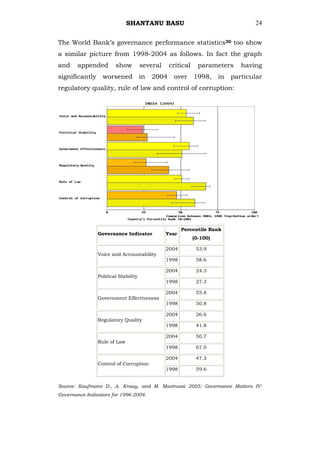
The World Bank‘s governance performance statistics30 too show
a similar picture from 1998-2004 as follows. In fact the graph
and    appended         show          several    critical     parameters   having
significantly worsened in 2004 over 1998, in particular
regulatory quality, rule of law and control of corruption:


                                                       Percentile Rank
                Governance Indicator            Year
                                                            (0-100)

                                                2004         53.9
                Voice and Accountability
                                                1998         58.6

                                                2004         24.3
                Political Stability
                                                1998         27.3

                                                2004         55.8
                Government Effectiveness
                                                1998         50.8

                                                2004         26.6
                Regulatory Quality
                                                1998         41.8

                                                2004         50.7
                Rule of Law
                                                1998         67.0

                                                2004         47.3
                Control of Corruption
                                                1998         59.6


Source: Kaufmann D., A. Kraay, and M. Mastruzzi 2005: Governance Matters IV:
Governance Indicators for 1996-2004.
SHANTANU BASU                            25


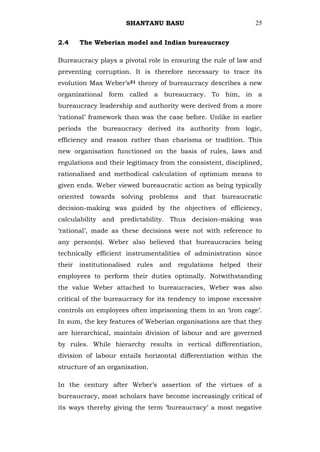
2.4   The Weberian model and Indian bureaucracy

Bureaucracy plays a pivotal role in ensuring the rule of law and
preventing corruption. It is therefore necessary to trace its
evolution Max Weber‘s31 theory of bureaucracy describes a new
organizational form called a bureaucracy. To him, in a
bureaucracy leadership and authority were derived from a more
‗rational‘ framework than was the case before. Unlike in earlier
periods the bureaucracy derived its authority from logic,
efficiency and reason rather than charisma or tradition. This
new organisation functioned on the basis of rules, laws and
regulations and their legitimacy from the consistent, disciplined,
rationalised and methodical calculation of optimum means to
given ends. Weber viewed bureaucratic action as being typically
oriented towards solving problems and that bureaucratic
decision-making was guided by the objectives of efficiency,
calculability and predictability. Thus decision-making was
‗rational‘, made as these decisions were not with reference to
any person(s). Weber also believed that bureaucracies being
technically efficient instrumentalities of administration since
their institutionalised rules and regulations helped         their
employees to perform their duties optimally. Notwithstanding
the value Weber attached to bureaucracies, Weber was also
critical of the bureaucracy for its tendency to impose excessive
controls on employees often imprisoning them in an ‗iron cage‘.
In sum, the key features of Weberian organisations are that they
are hierarchical, maintain division of labour and are governed
by rules. While hierarchy results in vertical differentiation,
division of labour entails horizontal differentiation within the
structure of an organisation.

In the century after Weber‘s assertion of the virtues of a
bureaucracy, most scholars have become increasingly critical of
its ways thereby giving the term ‗bureaucracy‘ a most negative
SHANTANU BASU                                 26


connotation in more modern times. Burns and Stalker32
observed that highly bureaucratic organisations were change-
resistant. The traditional hierarchical structure itself promoted
self-perpetuation and retarded innovation. Another negative
quality was the sub-optimisation‘ (Selznick)33 in bureaucracies
by which units possessing delegated powers worked at cross-
purposes with the stated objectives of the mother organisation.
Yet another criticism of the traditional theory has come from
Gouldner34 who found that the ‗govern according to rules‘
culture in bureaucratic organisations led to members following
the minimum possible rules required. This, in turn, had a
cascading effect in obtaining more than minimally acceptable
behaviour from members. Merton35 has stated that a major
failing   of   bureaucracy    was   its   tendency    to   foster   ‗goal
displacement‘. In the process of following rules and regulations
rigorously resulted in rules becoming an end in them thereby
subverting     the   real   goals   of    an   organisation.   Further,
application of rules and regulations often in inappropriate
circumstances and the tendency to routines unique events
resulted in dysfunctional outcomes. The role of individuals in a
bureaucratic organisation has been commented upon adversely
by Blau36 who proposed that in bureaucratic organisations,
certain people who knew how to ‗play by the rules‘ shifted power
from the nominal leaders, who did not know how to play by the
rules, to with people who did. In a similar vein, Ostrom37 has
argued that the bureaucratic structures ―are necessary but not
sufficient structures for a productive and responsive public
service economy.‖ Claus Offe38 has, in his counter Weberian
analysis spoken of a bureaucratic structure as running against
the rationality of developed welfare-state capitalism unlike the
Weberian bureaucracy that was relevant to a ―specific historical
phase and contingent from the standpoint of functional
rationality‖. Mainly, scholastic studies have dwelt upon specific
SHANTANU BASU                            27


aspects of the bureaucracy such as inefficiency, corruption,
concentration of power, managerial frustration, dissatisfaction,
low creativity, organizational conflict, poor decision-making,
misuse of power, political interference, etc.

Yet studies have found that bureaucracies work well in certain
contexts such as the evolution of society in erstwhile communist
USSR, decline of the ancient Roman army and the development
of the British pottery industry during the Industrial Revolution.
However, these appear to be more by way of exceptions than as
rules. An attempt has been made to fuse some of the above
theories and opinions in the Indian context in the succeeding
paragraphs.

2.5   Causes of corruption in India

Before delving into the causes of administrative corruption, it is
important to understand the hierarchical organisation of the
bureaucracy in India. The following diagram shows the layout of
a typical federal Ministry/Department:
SHANTANU BASU                                                                            28


                                                                                     Prime
                                                                                    Minister


                                                                              Cabinet
                                                                              Minister


                                                                                    Minister of      Secretary
                                                                                      State


                      Secretary                                                                                         Same as for the other Secretary


                                  Additional Secretary/Jt.
                                         Secretary


                                                                     Director/Dy.
                                                                      Secretary


                                                              Under
                                                             Secretary


                                                   Section
                                                   Officer


                                                 Clerical staff


            Chairperson, Advisory Councils


 Directors-General Central Police Forces [Home only]


          Autonomous body CEOs


             Public sector CEOs


Average: Secretaries (2-3); Addl. Secretaries: 1-2; Jt. Secretaries: 5-7; Directors/Dy.
Secretaries:         10-15;           Under           Secretaries:            15-20;              Section        Officers:      15-20
SHANTANU BASU                            29


2.5.1 Historical causes of administrative corruption in India

For 4850 of its 5000 year history, India remained a bevy of
feuding princely states whose sole sources of revenue came
either from land and trade or pillage. Colonial administration
relied mainly on strength of Draconian laws, police and military
might, fostering dissension amongst the Indian princes and a
fear of the State apparatus on the citizenry to govern the
country. Nor was Indian enterprise and capital encouraged to
flourish. Needless to say, democratic institutions did not have
any opportunity of formation. At the dawn of Independence in
1947, India had a band of visionary and dedicated leaders with
a   colonial   bureaucracy     to     overcome   centuries    of
maladministration and human suffering.

Bureaucracy in India – its structure, role, behaviour and
interrelationships – has evolved over 150 years. The Macaulay
Committee Report (1854)39 recommended a civil service based
on the merit system establishing the principle that ―henceforth,
an appointment to the civil service of the (East India) Company
will not be a matter of favour but a matter of right. He who
obtains such an appointment will owe it solely to his own
abilities and industry.‖ This was significant since a study has
shown that 23 per cent of nominations to the Indian Civil
Service between 1809 and 1850 were made to relatives of
Directors of the East India Company while 55 per cent were on
the basis of friendship (Cohn)40. This bureaucracy also had a
Weberian side to it inasmuch as it was recruited from the
affluent sections of society owing allegiance to the English
Crown- exclusivity that Weber felt was essential to a true
bureaucracy.    Recognising    this    bureaucracy‘s   imperial
significance Prime Minister Lloyd George declared in the House
of Commons in 192241 that ―they are the steel frame of the
whole structure. I do not care what you build upon it - if you
SHANTANU BASU                                        30


        take the steel frame out, the fabric will collapse‖. This
        perception did not change even with post-independence leaders
        of the stature of Jawaharlal Nehru (India‘s first Prime Minister
        1947-64) and Vallabh Bhai Patel (India‘s first Home [Interior]
        Minister 1947-50). This was perhaps on account of the
        bureaucracy and the political leadership sharing a common
        social and cultural background42. Wedded to the Weberian
        characteristics of hierarchy, status and rigidity of rules and
        regulations and concerned mainly with the enforcement of law
        and order and collection of revenues, the Indian bureaucracy in
        its colonial form did not fit into the priorities of a developing
        state.

        Up to the 1930s the Indian bureaucracy was well-paid even by
        contemporary international standards as Potter43 has shown in
        the following table:

  Top Indian Civil service     Monthly pay           Comparative Posts               Monthly pay
             Posts
                               (In Rupees)                                               (In Rupees)


Governor of United Provinces     10,000                          -                            -


Governor of Bihar                 8,333      Governor, New York State                      5,687


Member Viceroy‘s Council          6,666      Cabinet Minister, UK                          5,555


Governor of Assam                 5,500      Chief    Justice,       US   Supreme          4,550
                                             Court


Secretary, Govt. of India         4,000      Treasury Secretary, UK                        3,333


Chief Secretary, Madras           3,750      Cabinet Member, USA                           3,412


Commissioner, Bombay              3,500      President, Poland                             1,560


Chief Secretary, Bihar            3,000      Governor, South Dakota                         682


Secretary, Madras                 2,750      Prime Minister, Japan                          622
SHANTANU BASU                               31


The idealism of the pre-Independence leaders soon gave way to
a sea of political leaders claiming to represent caste and
communal interests and whose sole interest lay in vote politics
based on caste, regional and linguistic basis while the
bureaucracy gained in strength as the ultimate arbiters of
India‘s destiny. In doing so, the bureaucracy fully ‗lived up‘ to
the   words   of   Sir John     Simon    in his Indian     Statutory
Commission Report (1930)44:

“In a country of small cultivators, no accumulated resources and
little experience in organisation, except along the limited and
traditional lines of the village community, private enterprise
cannot undertake new and costly experiments. The task of
bringing within reach of such a society the benefits of the
administrative experience and the applied science of the West
was possible for one agency only-Government; no other had the
necessary knowledge or machinery. Thus the civil service of
India, which in origin was little more than a revenue collecting
agency, gradually took upon itself a very wide range of duties. As
the work became specialized, new services had to be created to
carry it on, and in this way there grew up departments dealing
with public health, education, forestry, agriculture, irrigation,
archaeology, and many more. India looks to government to do
many    things     which   in   the   west   are   done   by   private
entrepreneurs.”

Idealism and euphoria arising from newly found freedom
coupled with the multifarious problems from the greatest divide
in human history (Partition) and a sudden vacuum created by
the departure of colonial administrators ensured that the
colonial bureaucracy assumed control. The press and media,
stifled by years of colonial repression, neither had the networks
SHANTANU BASU                               32


nor the capital to enhance their coverage. Neither had the
telecommunication and education sectors developed nor the
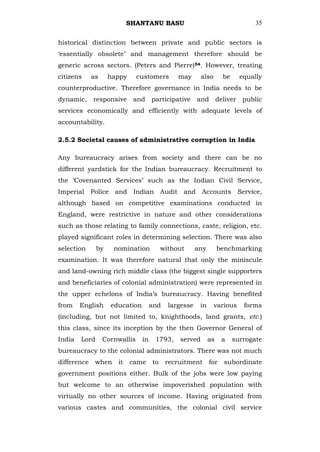
capabilities of the accountability enforcing agencies. Grinding
poverty, hunger and disease disallowed the population from
devoting its energies to enforcing accountability. The middle
class and intelligentsia also constituted a miniscule proportion
of the population and even so, were more favourably disposed to
the erstwhile colonial rulers that had created this class. The
legal system too, suffering from the ravages of Partition, was in
no position to play the role of an effective enforcer. Therefore it
was but natural that India had little choice but to fall back upon
the bureaucracy to administer the nation during this crisis and
execute the first mega development projects. A millennium of
civil strife, foreign invasion, colonial rule and societal divisions
centering on religion, community and caste, absence of political
cohesion amongst rulers, ensured that the impoverished and
hungry population, at the dawn of Independence, possessed
neither the bare minimum educational attainments nor the
capital and resolves to claim their lawful rights and participate
in government.

Conditioned by the demands of a highly stratified feudal society
and lured by an utter mismatch between a burgeoning
population and available infrastructure and services, open to
not infrequent political intervention, India‘s civil service is yet to
come to grips with the fast changing economic scenario and
desperately clings to its colonial vestiges with an adopted veneer
of modernity and a put-on concern for welfare of the community
of governed citizens. Shrouded in a veil of secrecy with an open
disdain   for   professionals,   mainly   confined   to   mass-scale
graduate and post-graduate degrees and deeply rooted in
colonial times, India‘s bureaucracy is partly responsible for the
country‘s abysmal rating by Transparency International. The
SHANTANU BASU                              33


Indian bureaucracy‘s inability to deal effectively with the
complexities and ravages of a post-Partition (1947) India
stemmed from the facts that they were ill-equipped both by
training and mindset to cater to the wave of rising expectations
of a newly independent population in a democratic polity. Nor
did they possess what Bhatt45 quantifies as the sole objective to
―emphasize results, rather than procedures, team-work rather
than hierarchy and status, [and] flexibility and decentralisation
rather than control and authority‖.

It was quite unlike what Woodrow Wilson in his seminal essay
on ‗The Science of Administration‘ (1887)46 had envisioned the
role of government:

“There is scarcely a duty of government which was once simple
which is not now complex; government once had but a few
masters; it now has scores of masters. Majorities formerly
underwent government; they now conduct government. Where
government once might follow the whims of a court, it must now
follow the views of a nation.”

This essay was written when there was a public outcry against
corruption, improvement of efficiency and streamlining of
service delivery in the pursuit of public interest – a scenario that
is being presently repeated in India. Therefore it is imperative
that the Indian bureaucracy, as Esman47 says, accepts its
limitations and works in tandem with community and private
agencies. In a similar vein, Chambers48 describes the need for
‗bureaucratic reversals‘ in most situations where officials know
less than their clients; professionals should move from being
experts transferring information to become consultants and
collaborators of the poor. Disillusionment with the bureaucracy
and its inability to deliver on promises has fuelled demands
from a section of academia that sees non-governmental
SHANTANU BASU                                     34


organisations (NGOs) as agents of development (Korten)49.
Notwithstanding such opinions, one cannot wish away the
continued importance of governance and it three main organs,
viz. the executive, judiciary and legislature. Governance in the
contemporary context is as Rhodes50 states “……. the new
method by which society is governed”. “Thus the governance
concept points to the creation of a structure or an order which
cannot be externally imposed but is the result of the interasction
of a multiplicity of governing and each other influencing actors”
(Kooiman and Van Vliet)51. Thus the role of governance retains
centre stage in all lending operations of the World Bank52 as
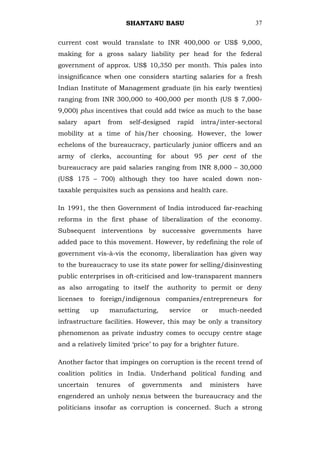
would be seen from the following table:

             Category                        Proportion of lending
                                         operations with governance
                                                content (per cent)

Legal framework                                            6

Participation                                             30

State-owned enterprises reform                            33

Economic management                                       49

Capacity building                                         68

Democratisation                                           68

     Source: World Bank, 1992. Governance and Development, Washington DC


Expansion of market concepts in the public sector is taking
place coinciding with the thrust to build administrative systems
that address the problems of a growing urban-industrial nation.
That is why the public sector appears to be large, cumbersome,
wasteful and beyond citizen control (King and Stivers)53. The
SHANTANU BASU                                       35


historical distinction between private and public sectors is
‗essentially obsolete‘ and management therefore should be
generic across sectors. (Peters and Pierre)54. However, treating
citizens     as     happy      customers       may      also       be     equally
counterproductive. Therefore governance in India needs to be
dynamic, responsive and participative and deliver public
services economically and efficiently with adequate levels of
accountability.

2.5.2 Societal causes of administrative corruption in India

Any bureaucracy arises from society and there can be no
different yardstick for the Indian bureaucracy. Recruitment to
the ‗Covenanted Services‘ such as the Indian Civil Service,
Imperial Police and Indian Audit and Accounts Service,
although based on competitive examinations conducted in
England, were restrictive in nature and other considerations
such as those relating to family connections, caste, religion, etc.
played significant roles in determining selection. There was also
selection      by    nomination           without      any        benchmarking
examination. It was therefore natural that only the miniscule
and land-owning rich middle class (the biggest single supporters
and beneficiaries of colonial administration) were represented in
the upper echelons of India‘s bureaucracy. Having benefited
from    English     education        and    largesse    in     various     forms
(including, but not limited to, knighthoods, land grants, etc.)
this class, since its inception by the then Governor General of
India   Lord      Cornwallis    in    1793,    served        as    a    surrogate
bureaucracy to the colonial administrators. There was not much
difference    when    it    came     to    recruitment       for    subordinate
government positions either. Bulk of the jobs were low paying
but welcome to an otherwise impoverished population with
virtually no other sources of income. Having originated from
various castes and communities, the colonial civil service
SHANTANU BASU                               36


favoured regional and caste based loyalties and was looked
upon as the saviours by fellow citizens. It was this very class of
indigenous colonial administrators that decided the distribution
of projects, their executors, funding, and deployment of
personnel and shaping of a nascent nation‘s laws. Centuries of
deprivation and impoverishment coupled with the laxity of the
post-independence polity enabled the Indian bureaucracy to
make inroads into every sphere of life in India, irrespective of
their capabilities.

2.5.3 Environmental causes of administrative corruption in
         India

The causes under this category are mainly economic and partly
related to service conditions of the bureaucracy.

2.5.3.1 Economic causes of administrative corruption in
         India

An important economic cause of corruption is the relatively low
salaries of the 20 million government work force, particularly
the senior civil services. A secretary (in his mid to late-fifties) to
the Government of India (the topmost rung of the civil service)
today earns around INR 60,000 per mensem that translates to
US$ 1350. However, added to this are non-taxable fringe
benefits     such      as    chauffeured        staff    cars,   orderly
messengers/attenders, other personal staff, virtually unlimited
telecom facilities, leave travel concession by air for himself and
his dependants, spacious premium government residential
family accommodation, inflation-indexed lifetime pension and
family     pension    thereafter,   provident    fund,   comprehensive
lifetime health care (at US$ 3 per month) for himself and his
dependants and, in case of railway officers , the lifetime privilege
of free air-conditioned first class railway travel for himself and
his spouse. An approximate additional cost to all these items at
SHANTANU BASU                              37


current cost would translate to INR 400,000 or US$ 9,000,
making for a gross salary liability per head for the federal
government of approx. US$ 10,350 per month. This pales into
insignificance when one considers starting salaries for a fresh
Indian Institute of Management graduate (in his early twenties)
ranging from INR 300,000 to 400,000 per month (US $ 7,000-
9,000) plus incentives that could add twice as much to the base
salary    apart   from   self-designed   rapid   intra/inter-sectoral
mobility at a time of his/her choosing. However, the lower
echelons of the bureaucracy, particularly junior officers and an
army of clerks, accounting for about 95 per cent of the
bureaucracy are paid salaries ranging from INR 8,000 – 30,000
(US$ 175 – 700) although they too have scaled down non-
taxable perquisites such as pensions and health care.

In 1991, the then Government of India introduced far-reaching
reforms in the first phase of liberalization of the economy.
Subsequent interventions by successive governments have
added pace to this movement. However, by redefining the role of
government vis-à-vis the economy, liberalization has given way
to the bureaucracy to use its state power for selling/disinvesting
public enterprises in oft-criticised and low-transparent manners
as also arrogating to itself the authority to permit or deny
licenses to foreign/indigenous companies/entrepreneurs for
setting     up    manufacturing,      service    or     much-needed
infrastructure facilities. However, this may be only a transitory
phenomenon as private industry comes to occupy centre stage
and a relatively limited ‗price‘ to pay for a brighter future.

Another factor that impinges on corruption is the recent trend of
coalition politics in India. Underhand political funding and
uncertain    tenures     of   governments    and      ministers   have
engendered an unholy nexus between the bureaucracy and the
politicians insofar as corruption is concerned. Such a strong
SHANTANU BASU                              38


nexus also becomes apparent when one considers the utter
helplessness of accountability agencies that are either given
advisory status or have to wait endlessly for government
permission   to   institute   prosecution     proceedings   against
delinquent   officers/politicians.    Even    proceedings    where
launched are stymied by poor legal follow-up and presentation,
absence/destruction of original evidence, layers of legal appeals
and ultimately, nominal exemplary punishments.

The all-pervasive lure of ill-gotten money that India‘s Central
Vigilance Commission characterizes as a ―low-risk and high-
return‖ enterprise has encouraged the average citizen to view
the Indian bureaucracy as predatory and oppressive rather than
enabling thereby reinforcing their sense of helplessness and
exclusion. By distorting development priorities such as the
execution of often-controversial single mega projects instead of
localized smaller and functional ones (without attendant
problems of rehabilitation, employment, etc.) in the search of a
bigger ‗share‘ of the ‗booty‘, the bureaucracy, in tandem with the
political leadership has skewed development to the detriment of
the population.

2.5.3.2 Service    conditions    as   cause    of   administrative
         corruption in India

An interesting feature about India‘s bureaucracy is that it
constitutes only around 1.2 per cent of the population against
the OECD average of 7.7 per cent (with pronounced reliance on
private sector delivery mechanisms)55 and yet exercises a
stranglehold on the country. While there is, prima facie, a strong
case for increasing the government workforce, yet there are
major angularities in the staffing patterns thereby giving an
impression that salary and pension spending at around 25 per
cent of total government expenditures is too high relative to non-
SHANTANU BASU                                       39


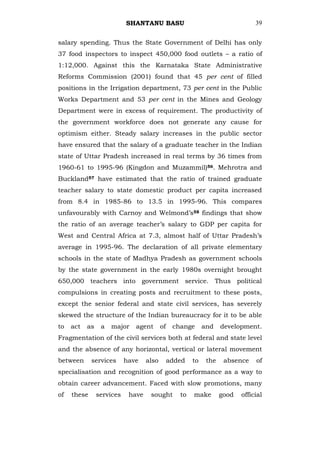
salary spending. Thus the State Government of Delhi has only
37 food inspectors to inspect 450,000 food outlets – a ratio of
1:12,000. Against this the Karnataka State Administrative
Reforms Commission (2001) found that 45 per cent of filled
positions in the Irrigation department, 73 per cent in the Public
Works Department and 53 per cent in the Mines and Geology
Department were in excess of requirement. The productivity of
the government workforce does not generate any cause for
optimism either. Steady salary increases in the public sector
have ensured that the salary of a graduate teacher in the Indian
state of Uttar Pradesh increased in real terms by 36 times from
1960-61 to 1995-96 (Kingdon and Muzammil)56. Mehrotra and
Buckland57 have estimated that the ratio of trained graduate
teacher salary to state domestic product per capita increased
from 8.4 in 1985-86 to 13.5 in 1995-96. This compares
unfavourably with Carnoy and Welmond‘s58 findings that show
the ratio of an average teacher‘s salary to GDP per capita for
West and Central Africa at 7.3, almost half of Uttar Pradesh‘s
average in 1995-96. The declaration of all private elementary
schools in the state of Madhya Pradesh as government schools
by the state government in the early 1980s overnight brought
650,000 teachers into government service. Thus political
compulsions in creating posts and recruitment to these posts,
except the senior federal and state civil services, has severely
skewed the structure of the Indian bureaucracy for it to be able
to   act   as    a   major    agent       of    change      and    development.
Fragmentation of the civil services both at federal and state level
and the absence of any horizontal, vertical or lateral movement
between      services      have    also        added   to    the    absence    of
specialisation and recognition of good performance as a way to
obtain career advancement. Faced with slow promotions, many
of   these      services    have    sought        to   make        good   official
SHANTANU BASU                             40


compensation with less honourable means fuelling corruption
further.

An important aspect that merits discussion is the training of
personnel. Although the Government of India has laid down that
every Ministry/Department shall earmark one per cent of its
gross annual expenditure on staff training and training
institutions have mushroomed, yet the quality and commitment
to such training remains well below par. An unwillingness to
serve in any training institution and perception of such
institutions   as    being    anti-professional    climbers    has
characterized these institutions. Although the senior federal
services are trained in private institutions such as Indian
Institutes of Management and foreign universities, the training
effort for the bulk of the file-processing ranks has been
lackadaisical at best. The end result is a vast bureaucracy that
frequently oversteps its rights and obligations, is ill-equipped to
comprehend the subtleties of current-day economics and
finance, yet standing in the way of professionalisation of these
services. A standing example of bureaucratic ennui is the
almost daily multiple interventions by courts of law, including
the federal Supreme Court, on issues relating to subjects as
diverse as admissions to educational institutions, environment,
unauthorised constructions, etc.

A major factor that affects the civil services in India is that of
chronic and rampant political interference leading to frequent
suspensions from service and transfers and diluting or even
removing any accountability of these officers. This engenders
corruption by way of informal auction of posts to the highest
bidder by politicians. About two decades back, Robert Wade
noted the buying and selling of posts in his study of the
irrigation department of a major south Indian state government.
Wade59 noted that irrigation engineers were able to extract large
SHANTANU BASU                          41


amounts from the sale of posts as well as award of contracts
and water to lobby groups. After a share for the engineers, the
bulk of this money found its way into the coffers of politicians
for elections and other purposes. The buyers of these posts, in
turn, had to work hard to recoup their investment by extracting
as much revenue as they could before either being transferred
or winning an extension with this wealth. Evidently, the more
downstream problem of chaos in administration caused by high
turnover rates is linked to the upstream imperative effacing
politicians to extract revenue from routine government functions
to finance their quest for office.

Another important factor that adds to the limited capabilities of
the bureaucracy and engenders corruption is the continued
employment uncertainties of the bureaucracy, particularly in
the wake of recent government pronouncements and action in
strategic disinvestment, winding up of unprofitable ventures,
ban on recruitment, economy instructions, scaling down of
some redundant organisations, etc. All these have been mainly
done by governments unable to make their balance sheets tally.
Lowering of revenue barriers, post-WTO, also has meant a
general decline, in real terms, of government revenues and
consequently the affordability of several government structures
in a scenario where a dynamic private sector has emerged as a
powerhouse of industry and services. With the services sector of
the economy expanding at almost breakneck speed, many
government departments would have to be eventually closed
down. Possessed of very limited educational and professional
attainments and skills vis-à-vis fast advancing technology and
skills from the private sector and the perceived absence of
alternative employment opportunities have led the bureaucracy
into believing that as a facilitator alone, their sources of
‗supplemental‘ income would eventually dry up. This perhaps
SHANTANU BASU                              42


has also led the bureaucracy at all levels to attempt a free run
on all the resources that India has.

A bureaucracy mirrors the societal environment of any country
which also becomes its biggest negativity. Complacency arising
from excessive insulation by a maze of antiquated rules,
regulations and laws, high levels of illiteracy in the population, a
non-participatory monolithic administrative organisation vested
with unwritten discretion, regional and caste loyalties – all these
and more serve to make the Indian bureaucracy expensive and
expansive, inefficient and corrupt apart from engendering
mediocrity.

3.    Elections and political party funding as a source of
      corruption in India

The evolution of a democracy usually takes several centuries
and several generations of citizens to mature. While the UK
became a constitutional monarchy in 1689, established the
Tories, Whigs and Liberals as the precursors of today‘s parties,
introduced universal suffrage in 1918, it was not until 1945
that a well-defined and distinct two-party political system was
evolved. Similarly, although France became a constitutional
monarchy in 1790 and a democratic republic in 1871, yet a
stable democracy came into being only in 1958. The US too,
starting with independence in 1783, introduction of the party
system in 1824, established the present party system in 1856.
Thus while the UK took between 27 and 256 years to build its
democracy, France took 78-168 years, Germany 30-80 years,
the US 30-70 years and Japan around 50 years. However, none
of these nations had ever to carry a colonial burden or were
faced with a fragmented and fractured society, political disunity
and major social divides. Compared to these nations India‘s
democracy has found firm roots although it would yet take
SHANTANU BASU                                          43


perhaps another five decades to reach a similar level of
maturity. Nevertheless, the basic concepts of a democratic polity
such                          as       universal      franchise,      popular      sovereignty,          and
institutionalised control of power and pluralism of political
forces are quite well established in India.

Since Independence (1947), India has witnessed series of
elections to the lower House of Parliament (Lok Sabha or the
House                             of   the     People).    The    official    estimated        figures    of
expenditure on such elections are shown in the following graph:


                                  14000
   Expenditure incurred (In INR


                                  12000
                                  10000
            million)


                                   8000
                                   6000
                                   4000
                                   2000
                                      0
                                          52

                                                   62

                                                             71

                                                                     80

                                                                              89

                                                                                       96

                                                                                                  99
                                       19

                                                19

                                                          19

                                                                  19

                                                                           19

                                                                                    19

                                                                                               19


                                                                          Year


                                       Source: Adapted from data available at www.eci.gov.in


The size of the electorate too is perhaps the largest in the world,
proof of India‘s living democracy as shown in the following
graph:
SHANTANU BASU                                              44


                      800000000


                      700000000


                      600000000


                      500000000
 Number of electors


                      400000000


                      300000000


                      200000000


                      100000000


                              0
                                  1     2     3    4    5     6      7          8   9   10   11    12   13    14
                                                                         Year


                                      Source: Adapted from data available at www.eci.gov.in


In 1991, the conduct of general elections required some 600,000
polling stations (775,000 for 1999 and 687,000 for 2004
elections) for the country's 3,941 state legislative assembly and
543 parliamentary constituencies. To attempt to ensure fair
elections, the Election Commission in India deployed more than
3.5 million officials, most of who were temporarily seconded
from the government bureaucracy, and 2 million police,
paramilitary, and military forces. Loksatta60, an Indian NGO,
estimates expenditure incurred by parties and candidates for
Parliament and State Assembly elections to be about Rs.7000
crore. Strangely, this figure in absolute terms is comparable to
the exorbitant election expenditure in the US. In the 2000
elections in the US for the presidency, both Houses of Congress,
gubernatorial                               offices    and        state         legislatures,     the    total
expenditure was estimated to be about US$ 3 billion. About half
of it was incurred for issue-advertising by political action
committees (PACs) and pressure groups. The actual campaign
expenditure was probably about $ 1.5 billion, which is almost
exactly the amount spent in Indian elections! When one
SHANTANU BASU                             45


considers the high purchasing power of the INR as opposed to
its low exchange value, India‘s real expenditures are about five
to six times that in the US. Yet, India‘s income per capita is
nearly one-eightieth of that in the US. Adjusting for India‘s
higher population, and relative to per capita income, the
country‘s per capita election expenditure is several times (about
20 times in purchasing power terms and 100 times in absolute
terms) than in the US!

However, that the desired maturity level of Indian democracy is
yet to be reached is evident from the fact that there are no
meaningful laws and conventions on regulation of political party
funding. Thus a legal provision that allows only public sector
companies to contribute to political parties (an impossible task)
while the Income-Tax law provides for limited exemptions on
contributions made by corporate entities to political parties. In a
highly   politically     fractured   polity   combined    with    the
uncertainties of multi-party coalition politics, to expect any
corporate entity in the private sector to identify itself with any
political party is most inappropriate for reasons of vendetta at a
later date. No clear cut guidelines or laws either exist to govern
political party funding.

It is therefore a natural phenomenon that parties and their
politicians often extort finances from private companies and
businessmen either by way of denial of a license, not allowing
change of land end-use, environmental clearances, media
advertisements    from     government     agencies,   transfers   and
postings of bureaucrats, budgetary support, and grants to
NGOs, etc. The administrative system similarly promotes
political corruption. Virtual auction of civil engineering officers‘
posts in public works departments, Project General Managers in
the telecommunications sector, national highway projects,
irrigation   projects,     out-of-turn    promotions,     convenient
SHANTANU BASU                              46


placement of favourable bureaucrats, allocation of budget
outlays, – the list is endless. Raking up issues relating to
reservation of university seats on religious and caste basis is
another ploy. Forcibly imposing quotas on admissions and
reserving a part of few available seats for government nominees,
directly or indirectly, government quotas on state-run railways,
bus services, airlines, issue of food ration cards, driving and
gun licenses, issue of all-India motor transport permits,
transportation of POL products by public sector companies (the
contracts) are the usual sources of corruption arising from an
unholy   nexus    between      the   bureaucracy   and   politicians.
Deregulation then, more than new and often unenforceable
laws, would appear to be the sole answer to these ills.

4.    Municipal administration and corruption in India

The urban population has been projected to rise by India‘s
Planning Commission61 to 40 per cent of a total estimated
population of 1.33 billion by 2020 , i.e. over half a million from
the current level of 27.80 per cent, i.e. 284 million. Such
demographic growth is expected to be confined to around 60-70
large cities in the country.

The following graph illustrates the growth of towns/urban areas
in India during the last century:
SHANTANU BASU                                               47


                                5000


  Number of towns/cities
                                4000

                                3000

                                2000

                                1000

                                  0
                                       1901     1911   1921   1931   1941   1951   1961   1971   1981   1991   2001
                           Towns/UAs   1827     1815   1949   2072   2250   2843   2365   2590   3378   3768   4368


                                              Source: Census of India, 2001


Concurrently, the percentage of urban population too has
shown a rise as the following graph shows:


                           30
                           25
                           20
                           15
                           10
                            5
                            0
                                1901 1911 1921 1931 1941 1951 1961 1971 1981 1991 2001


                                              Source: Census of India, 2001


With liberalization of the economy, increasing reliance would
have to be placed on institutional financing and capital markets
for resource mobilization and on the private sector for service
delivery. Given the generally poor performance track record and
financial performance of most municipalities, apart from an all-
pervasive public perception of being amongst the most corrupt
in India, is likely to make it extremely difficult for them to raise
SHANTANU BASU                            48


resources from the market. Issues such as those relating to
reduction   of   urban    poverty,   employment,      environment
management, housing, water supply, energy, transportation,
road decongestion, town planning, zoning, sanitation, etc. would
increasingly come into focus.

Financing urban services is perhaps the single major challenge
that faces India‘s planners.    In 2001-02 municipal revenues
constituted barely 3 per cent of total government revenues
although the served population was nearly 300 million. This
was after a more than 10 per cent annual revenue expenditure
growth rate over the last decade. Consequently, municipalities
have had to depend on devolution of resources from the State
governments which too did no have adequate resources. This
has translated into abysmally low levels of civic services.

Rampant corruption has further reduced the efficacy even of
these limited resources for citizens‘ welfare. Fifty to eighty per
cent of all municipal resources are consumed by salaries while
operations and maintenance expenditure account for 20-40 per
cent of the total expenditure of a municipality. Some metro area
municipalities such as those in Bombay, Calcutta and Delhi are
unmanageably large and have fallen victim to priorities of the
elected representatives that head them. Here too the unholy
nexus between municipal officers and employees and their
political masters has contributed in some measure to the
quality and distortion of urban development plans.

Some municipalities have become unmanageably large and have
indisciplined and huge departmental work forces that are
recruited in much less than transparent manner poorly
educated and virtually untrained. Efforts to break-up these
monolithic entities have not succeeded for a variety of reasons.
SHANTANU BASU                                          49


        5.     Education administration and corruption

        India is home to 17 per cent of the world‘s total population
        accommodated in an area which is 2.4 per cent of the world‘s
        total area. Of 2820 languages in the world, as many as 325
        languages are effectively used in India alone. The country has
        witnessed phenomenal educational development – both in
        quantitative and qualitative terms, since independence. The
        country has also made significant strides in higher and
        technical education. India spent a nominal 4.02 per cent of its
        GDP on education during 2001-2002 but about 44 per cent of
        its adult population still remains to be made literate62. The
        following statement compares the population, area, density,
        literacy rates and level of public expenditure on education in
        India and some of its neighbouring countries:
 Particulars     Population     Area   Density Percentage              Percentage Public expr.
                  (millions) (Sq. Kms)          to world                 of adult     on
                   (2000)                                               illiterate education
                                                                       Population as %age of
                                                                           2000    GNP (1996)
World              6055.0 * 135604354         45      100     100          20.6       NA
Afghanistan        21.2 #        652090        33     0.48   0.35          63.7           N.A.
Bangladesh          129.2        143998       897     0.11   2.13          59.2           2.2
China              1277.6       9596961       133     7.08   21.10         15.0           2.3
India              1027 $       3287590       312     2.42   16.96         44.2           3.2
Indonesia           212.1       1904569       111     1.40   3.50          13.0           1.4
Japan               126.9        377801       336     0.28   2.10           NA            3.6
Myanmar             46.4         676578        69     0.50   0.77          15.3          1.2 &
Nepal              22.5 #        140797       160     0.10   0.37          58.6          3.2 @
Pakistan            156.5        796095       197     0.59   2.58          56.7          2.7 @
Sri Lanka          18.8 #         65610       286     0.05   0.31           8.4           3.4
Thailand           62.0 #        513115       121     0.38   1.02           4.4           4.8
SOURCE: Statistical Yearbook, 1999 UNESCO
* Estimated population for 2000, # Reference year 1999, $ Reference year 2001
& Reference year 1994, @ Reference year 1997
Note: The area figures of India exclude area under illegal occupation of Pakistan and China.


        The following chart shows the slow trend of public expenditure
        on education as part of GDP in India during the period 1951-52
        to 2001-2002:
SHANTANU BASU                                             50


                                                                                     4.02
      4.5                                                                3.8

        4
                                                       2.92
      3.5
        3                               2.25
      2.5
                             1.52
        2
      1.5        0.64
        1
      0.5
        0
              1951-52        1961-62     971-72      1981-82        1991-92         2001-02


             Source: Adapted from data available at www.education.nic.in


Another chart would show the growth of educational facilities in
India during the same period:


   2000-01

   1990-91

   1980-81

   1970-71

   1960-61

   1950-51

            0%           20%           40%             60%               80%           100%

                   Primary      Upper Primary + High          Colleges         Universities


             Source: Adapted from data available at www.education.nic.in


Colonial rule introduced concepts of a modern state, economy
and an education system. By linking entrance and advancement
in government service to academic education, colonial rule
contributed to the legacy of an education system geared to
preserving the position and prerogatives of the more privileged
(Lall)63. In order to correct this and provide for more broad-
SHANTANU BASU                                  51


based universal education, the Government of India established
the Kothari Commission (1964-66) to formulate a                    more
contemporary education policy for India. These principles were
further developed in the National Policy on Education (1986)
that came out with more concrete programmes such as:

Operation      Blackboard     (1987-88)   with   the   objective     of
improving human and physical resources in primary schools;

Restructuring and Reorganization of Teacher Education
(1987) for providing facilities for continuous upgradation of
teachers‘ knowledge and competence;

District    Primary    Education        Programme         (1993)    for
decentralised planning and management, improved teaching
and learning materials and school effectiveness;

Despite the above and many other programmes, progress of
enrolment in elementary school was negated by relatively high
drop-out rates at Standard-10 level. Although government
statistics claimed credit for establishing thousands of schools,
yet government evaluation agencies such as the Comptroller
and Auditor General of India64 found that most schools did not
have teachers at all, that teachers were not qualified, teacher
absenteeism, basic infrastructure including buildings, potable
water, sanitation and furniture, teaching aids, etc. were grossly
inadequate or absent in toto. Inadequate and that too erratic
State funding compounded the existing misery.

Another major issue that faces school education is that there is
no common school system in India. Instead the school
education system is controlled by different Boards, viz. Central
Board of Secondary Education (CBSE under the federal
government),    Council     for   the   Indian   School     certificate
Examinations (CISCE) Board, State Boards, National Open
SHANTANU BASU                                   52


School (federal) and international schools that mimic schools in
Europe and America and affiliation to one of these Boards is
mandatory     for        recognition.    Thus     affordability    of   quality
education largely remains related to means and backgrounds of
parents. Even the existing curricula in these Boards have not
been free of politicisation with governing committee members
being placed by successive governments on religious, caste and
political affiliations. Revisions of text books that allegedly sullied
India‘s multi-religious heritage were re-written and supervisory
institutions/Boards reconstituted frequently. Needless to add,
school children were the hardest hit although they had no say
in the repeated revisions of their curricula. The existing school
system also suffers from a severe shortage of seats which, in
turn, has led to malpractices such as demands for donations
and stiff entrance/admission fees, interviews for 2-3 year old
children, political and bureaucratic interference, unannounced
modifications       in     state   aid    to    minority-run      institutions,
mushrooming of unaffiliated schools without any quality
benchmarks,     siphoning          of    school   financial    resources     to
subserve the interest of promoters and sponsoring mother
organisations. Salaries of teachers in many Board affiliated
schools are often decided arbitrarily and are low in most non-
government schools. School curricula too emphasizes learning
by rote that often poses serious health hazards to children who
have to carry bags weighing 5-7 kg to school every day.
Although curricula have been modified over the years, they
nevertheless remain confined to the narrow cloisters of tradition
and do not incorporate large contemporary elements such as
computer-aided design, graphic designing, commercial art, etc.

The present school system with its emphasis on learning by rote
finds reflection in school leaving examination results. Children
scoring aggregates of 97-99 per cent marks in their terminal
SHANTANU BASU                                     53


school examinations is invariably reflected in undergraduate
colleges raising their minimum cut-off marks for admission.
Recent media reports indicate that around 55 per cent of high
school graduates would not be able to obtain admission in any
Delhi University undergraduate college during the 2006-07
academic       year.   These    children    would      therefore    look   to
neighbouring or other states for admission. Disparities being
large in marking of examination paper norms between states
and federal or autonomous boards and state domicile (akin to
in-state/out-of-state in the US), it is not unlikely that students
from Delhi would be able to obtain very few admission berths.

This brings us to the issue of vocational training for children
who are unable to secure admission to universities or who, for
reasons of inclination, ability or finances are unable to pursue
higher    education.     Although    both       the    federal   and    state
governments       have   established       several    hundred      Industrial
Training Institutes over the last few decades, the available seats
do not cater to more than a microscopic minority of students
leading to malpractices and corruption in the admission
process. State funding is also insufficient and upgrading a
training laboratory could take years or even decades to
accomplish. The social acceptance of a non-graduate apprentice
and stigma attached to undertaking jobs relating to carpentry,
plumbing and repairs of electronic gadgets compounds matters.
However, in tune with the changing times, at least Indian call-
centres or BPO offices of transnational companies accept
Standard-12 graduates. The Standard-10 graduates yet do not
figure    in    employability     statistics.     An     all-encompassing
recruitment benchmark both in the private and public sectors
for graduate employees and the consequent availability of a job
does not factor in the limited availability of academic seats
either.
SHANTANU BASU                                         54


Higher education in universities is regulated by the University
Grants Commission (UGC), an autonomous body under the
federal Ministry of Human Resources Development. The UGC
too   has    not      been     above     politicization   with         successive
Chairpersons being appointed on the basis of their political
affiliations. With a decline in real terms of state aid for institutes
of higher learning, the UGC is unable to provide adequate
grants to universities. Education is funded by both the federal
and State governments. Given the poor financial condition of
State government finances, the ability of each state to fund the
higher education system varies widely. University campuses
have also become a happy hunting ground for all political
parties in both teacher and student communities with elections
to student and teacher bodies being contested with substantial
budgets, campaigning and violence. Political affiliations of
university Vice-Chancellors and teachers vis-à-vis the federal
and state governments are known to effect positive or negative
modifications in the extent of budgetary support to such
institutions.

Even in specialized institutions of international repute such as
the   Indian     Institutes     of   Technology,       Indian        Institute   of
Management or All-India Institute of Medical Sciences attempts
to curb their autonomy have been recently made by the present
UPA government. For how long such institutions would be able
to retain their autonomy solely on the basis of public outcry and
protest given successive governments‘ political compulsions in
forcibly imposing caste and community based quotas in such
institutes remains a debatable point. Political interference in the
constitution     of     Governing        Bodies   of    these        institutions,
withholding of grants and absence of any political will to raise
costs of education from paltry levels, delays in government
clearances      to    invite   foreign    guest   faculty       or     permitting
SHANTANU BASU                                        55


academicians     to     visit   similar     institutions     abroad          have
characterised these institutions of international repute.

6.     Health care administration and corruption

Health care in India has been traditionally vested in the State
and Federal government hospital/dispensary network. This
network spans 500,000 doctors, 700,000 health care workers,
25,000 primary and community health centres and 1,600,000
sub-centres complemented by 22,000 dispensaries and 2,800
hospitals. However, this infrastructure remains under-equipped,
under-manned and under-financed to cope with the challenge of
eradicating major threats to human life. Even this over-
stretched system suffers from irregularities in recruitment and
promotion of doctors and para-medical staff, unwillingness of
medical personnel to serve in rural/semi-rural areas, political
interference in appointment and transfers of doctors and
support staff, political affiliations of staff and doctors unions,
major financial irregularities in procurement of medicines and
equipment, wastage of scarce financial resources by way of
uninstalled    equipment        and       shelf-life    specific    medicines,
spurious drugs, etc.

With   no     major     initiative    in     establishing        hospitals    by
governments in last few decades and reduction in government
assistance both in physical and real terms, the existing facilities
are on the brink of collapse. While private enterprise has come
forward in a limited way these are largely beyond the reach of
common      citizens.    While     authorised          private   clinics     have
mushroomed to fill in the gap the state governments are lacking
in the legal enforcement and monitoring machinery. Private
unauthorised clinics offering a range of illegal services ranging
from foetal sex determination and abortion to treatment of
medico-legal cases at usurious rates and operate without the
SHANTANU BASU                         56


mandatory licenses. Nor does India have any social security
system for its unorganized labour force and other citizens. Even
insurance companies do not bear the costs of outpatient
treatment upon payment of the requisite premium. However, the
only exceptions to the absence of comprehensive health care
scheme are federal government employees who are covered by
the Central Government Health Scheme (CGHS).

The CGHS was established in 1954 with the objective to provide
comprehensive healthcare to the central government employees.
Later the scheme was extended to pensioners and various
government personnel. At present this scheme is operating in 24
cities through 246 dispensaries, 19 polyclinics, 18 laboratories
and 86 ISM units. More than 7000 employees are employed with
the CGHS with several million beneficiaries employed by the
federal government and their dependants as also pensioners
and their dependants. Plagued by inefficient operations, poor
quality of medicines, frequent strikes, indiscipline and abuses of
the system by both beneficiaries and employees alike, the
CGHS, while adding substantially to the costs of governance,
the CGHS appears to have lost its relevance. In fact, the costs
involved in the CGHS annually would take care of several
million deprived people without causing any inconvenience to its
current beneficiaries.

7.    Judicial administration in India

Corruption is so all-pervasive that even the judiciary is not
immune from it. However, before proceeding to analyse the state
of the judiciary it is important to understand the physical
structure of the India judiciary and its various levels. The
following diagram shows the organisational structure of the
Indian judiciary:
SHANTANU BASU                                                                           57


                                                                 Supreme Court


                                                                  High Courts


        Sessions Courts


                          Sessions Judges


                                            Chief Metropolitan Magistrate


                                                                            Metropolitan Magistrate


                                              Assistant Sessions Judges


                                               Chief Judicial Magistrate


                                                                           Sub-Divisional magistrates


                                                                                                        Judicial Magistrates of I    Class


                                                                                                        Judicial Magistrates of II   Class


                                                                                                Special Judicial Magistrates of II Class


Source: South Asia Human Rights Documentation Centre, 2006: Handbook of Human
Rights and criminal Justice. Ch 1- Criminal Procedure and Human Rights in India, p.13.
Oxford University Press, New Delhi=, India

7.1     Judicial corruption in India

The judicial system derives from legislation mainly passed by a
colonial administration. Most of the laws are either dated or do
not mirror contemporary realities. Till recently epilepsy patients
were covered by the Indian Lunacy Act. The physical size of the
judiciary has not expanded in direct proportion to the increase
in population. Even within the existing judiciary there are large
numbers of unfilled vacancies of judges. As on December 31,
2005, a mind-boggling 29,210,015 cases were pending before
SHANTANU BASU                             58


the Supreme Court, 21 High Courts and the subordinate courts
in India against total unfilled vacancies of nearly 3,000. In Delhi
alone, the High Court has six positions and subordinate courts
have 123 positions waiting to be filled where 78,379 and
786,464 cases respectively were pending. Similarly, the Patna
High Court tops the list for vacancies with 22 out of the total 43
vacant positions. The court has 91,580 pending cases. The
District and Subordinate Courts in Uttar Pradesh (UP) have by
far the largest number of vacancies with 756 out of an approved
strength of 2,172 vacant seats. It is no surprise then that UP‘s
subordinate courts also have the highest pending numbers of
civil and criminal cases, with 4,458,861 cases still left to be
dealt with. For such large number of pending cases, India has
barely 10 judges for every million of population compared to 107
in the US, 75.2 in Canada and 50.9 in the UK. Added to this is
the absence of a clear distinction between the administrative
and judicial functions of legal officers. Ill-defined original
jurisdictions of High Courts often mean that small value cases
are heard by them while high value cases are heard by lower
courts.

In 1924, the colonial government set up the Justice Rankin
Commission to speed up the judicial process. Justice Rankin
had remarked:

“Unless a court can start with a reasonably clean slate,
improvement of methods is likely to tantalize only. The existence
of a mass of arrears takes the heart out of a presiding judge. He
can hardly be expected to take a strong interest in the
preliminaries, when he knows that the hearing of the evidence
and the decision will not be by him but by his successor after his
transfer. So long as such arrears exist, there is temptation to
which many presiding officers succumb, to hold back the heavier
contested suits and devote attention to the lighter ones. The
SHANTANU BASU                            59


turnout of decisions in contested suits is thus maintained near
the figure of institution, while the real difficult work is pushed
into the background.”

Eighty years later there is no change in this situation. Although
several new path breaking legal enactments have been passed
by Parliament since Independence such as the Arbitration and
Conciliation Act, 1996, Foreign Exchange Management Act,
Money Laundering Act, etc., yet basic law such as the Criminal
Procedure Code and the Civil Procedure Code remain rooted in
colonial   times.   Regulatory   laws   such   as   the   Essential
Commodities Act, 1955 have long outlived their utility and need
to be repealed. Another category of laws that need to be urgently
amended relate to patents, food adulteration, companies and
corporations, demonopolisation of the banking and insurance
sectors, telecommunications, industrial disputes, etc.

7.2   Causes of judicial corruption in India

Judicial corruption has been an oft discussed subject in India.
In the last five years several members of the higher judiciary
have been accused of corruption, some even convicted and some
had their properties confiscated and sold. With large numbers of
pending cases, the premium for a favourable judgment or even a
timely hearing is understandably high and may vary from a few
dollars to several thousand. Dated colonial laws often require a
contemporary verdict which too commands a hefty premium.
Often government agencies find themselves at the receiving end
as large payouts are passed by courts and arbitrators in cases
relating to land, inheritance, compensation, etc. Even in quasi-
judicial proceedings such as those relating to land acquisition
for projects of public importance that are conducted by
administrative officers vested with judicial powers are fertile
breeding grounds for corruption. The act of a court assistant in
SHANTANU BASU                              60


‗pushing‘ a case file ‗up‘ for hearing is rewarding. So is a private
audience with a judge. In cases relating to evasion of taxes,
notably customs, excise and corporation, payouts by appellants
may be substantial. In another category fall such cases that are
referred to appeal tribunals with adjudicating powers. It is
common knowledge what reward an out-of-court settlement at a
figure many times lower than the officially assessed figure
fetches. Despite such widespread judicial corruption and denial
of justice, several High Courts and the Supreme Court of India
have pronounced landmark judgments in cases relating to
environment     protection,   reservations   in   university   seats,
disqualification of members of Parliament, rights of minorities,
unauthorised constructions, etc. Despite successive National
Law Commission reports, initiatives by the federal Cabinet
Secretariat and the Prime Minister‘s Office, Committee on
Administrative Law reform, etc., none of their recommendations
have found favour with the judiciary, executive, politicians and
lawyers, solicitor firms.

The multiple layers of appeal in the Indian legal system coupled
with antiquated and often contradictory laws foster greater
corruption in the entire body politic. In civil cases there is
normally the right to make as first appeal on a fact or point of
law to district courts (Section 96, Civil procedure Code) and a
second appeal to high courts on a point of law (Section 100,
Civil Procedure Code). If the second appeal is heard by a single
judge, the appellant can pray for an additional appeal, known as
letters patent appeal, to a division bench of the high court.
There is no single Article for appeals against judgments, decrees
or orders of high courts. Most appeals therefore finally end up in
the Supreme Court. Nor has the provision of a second appeal to
the High Court been scrapped. Tortuous litigation, often
SHANTANU BASU                            61


frivolous, thus provides ample scope for corruption.             AP
Herbert65 remarks aptly sum up the Indian situation:

“The people may be taught to believe in one court of appeal but
where there are two, they cannot be blamed if they believe in
neither. When a man keeps two clocks which tell the time
differently, his fellows will receive with suspicion his weightiest
pronouncements upon the hour of the day even if one of them
happens to be right”.

Open-ended laws also promote corruption in the judiciary and
the   legal   system.    The   Civil   procedure   Code   provides
innumerable opportunities to lawyers to delay proceedings.
Lawyers may file applications for interrogatories, appointment of
a commissioner for local inspection, a temporary injunction
(interlocutory order) and arrest or attachment of movable assets
before judgment. Each application, and two can be made, is
required to be heard and disposed accounting for at least one
year in each appeal. While the first appeal may take up to three
years, the second may takes at least 7-8 years if admitted in a
High Court. Added to this are long-winded arguments of lawyers
with no time limits specified in law for such arguments and
repeated adjournments sought by lawyers on behalf of their
clients without any cap specified for such requests. Rampant
delays   in   pronouncing      judgments   following   closure   of
arguments and the obtaining of a decree that may take several
months or years more provide all the more reason for corruption
in the legal system.

The manner of appointment and transfer of judges and cases
from courts by governments also fosters uncertainty and
corruption in the judiciary. A high turnover of Chief Justices at
the Supreme Court – 12 between 1987 and 1999 and 4 in 2002
alone - has only compounded delays. Delayed anticipation of
SHANTANU BASU                              62


judicial vacancies, inordinately long time taken in verification of
antecedents of prospective judges and recommendations of the
state governments are some factors that ensure the shortage of
judges in the judiciary and a consequential build up of backlog
of cases. Nor has a single judge been impeached in the last fifty
years giving judges the right to remain unaccountable for their
deeds. In recent times high court judges have also been arrested
for immoral human trafficking and corruption in real estate,
illegal remittance of foreign currency abroad and benefits
obtained from state governments by way of housing land, etc.
Needless to add, the cases in these issues would last for several
years and there is no assurance that the final verdict would
even exonerate the judge for some procedural deficiency in the
cases   registered   by   enforcement    agencies    against   him.
Corruption then is inevitable as millions of aggrieved citizens
are often willing to pay bribes in their quest for relatively
speedier justice.

Contemporary laws too have often proved to be a source of
corruption. While the Narcotics and Psychotropic Substances
act, 1985, prescribes a minimum penalty of ten years‘
imprisonment and/or a fine of US$ 4,500 this is regardless of
whether the drug is poppy straw, prepared opium, cannabis or a
psychotropic substance.       This reduces the probability of
prosecution and the probability of conviction when prosecuted.
Thus enforcement agencies who file case have a large element of
discretion while courts have the last say in determining the
applicability of any particular section of this Act to a defendant.

Doubts have often been raised about the qualifications and
experience of judges in dealing with cases. Although the lower
judiciary is recruited through a competitive examination system,
this does not always assure that the best students join the
judiciary. Plagued by poor pay structures, uncertainties of
SHANTANU BASU                                         63


promotions     and       tenures,    a    constant       face-off     with   their
appointing executive and low levels of in-service training are
other    major      factors      affecting     India‘s     judiciary.     Lateral
recruitment      into     the    higher      judiciary     on   the     basis    of
nominations by governments have often been accused of being
less than transparent and aimed at the creation of a ‗committed
judiciary‘ – committed to the interests of the ruling dispensation
that appoints them. Such commitment is often rewarded by
ruling elites that provide luxury official cars to high court judges
and other non-taxable perks such as a handsome transport
allowance of INR 15,000 per month to judges of the Calcutta
High Court.

India has also been quite liberal in granting large number of
holidays to its employees. Courts are no exception either.
(Debroy66). The working hours in Indian courts range from 5.5
hours per day in subordinate courts to 5 hours in different High
Courts and the Supreme Court. This is in contrast to Malaysian
courts that operate for an average of 6.5 hours per day. The
Indian Supreme Court operates for only 180 years per annum.
For high courts, working days are around 200-210 per annum
while in subordinate courts it varies from 240-270 days. This is
again in contrast to the Malaysian Federal Court that operates
for 220 days while the other courts are open for 220-260 days
per annum.

Last, but not the least, most courts in India, particularly at the
lower echelons, are not automated.                       Court registries are
therefore not always able to list all items in chronological order
and     take   up       listed   matters       sequentially     without         any
arbitrariness. The absence of automation therefore invariably
leaves ample room for discretion and corruption in the hands of
lower court employees to accord preference for listing to one
case over another.
SHANTANU BASU                             64


Zuckerman‘s67 remark „A sense of crisis in the administration of
civil justice is by no means universal, but it is widespread‟ is
certainly applicable to the Indian judiciary. Notwithstanding
such a gloomy situation, the Supreme and High Courts have,
over the years, evolved their own institutional mechanisms and
pronounced judgments in a variety of cases ranging from
environment to frivolous litigation, perjury to marital divorce,
child adoption to illegal construction activity and women‘s rights
to electoral malpractices apart from clearly defining the powers
of the State vis-à-vis the Constitution. Public Interest Litigation
(PIL) pioneered by a former Supreme Court Chief Justice PN
Bhagwati has also enabled citizens to approach this Court on
the basis of a postcard complaint. The Court has gone further
and also entertained media reports in cases relating to
maladministration and many other social issues. Such yeoman
service has restored citizens‘ faith in the higher judiciary
although much more needs to be done since judicial activism
alone cannot substitute for bureaucratic failure, antiquated
laws and procedures and financial unaffordability.

8.    Police administration and corruption in India

The India Act XIII of 1856 reformed the municipal police
administration in the three Presidency capitals (Calcutta,
Madras, and Bombay). They were each placed under a
Commissioner who was responsible directly to the Governor of
the Province. India Act V of 1861 (commonly known as the
Indian Police Act, 1861) established a uniform system of police
administration throughout British India with an Inspector
General at the head of the police in each province. The Superior
Police Services, later known as the Indian (Imperial) Police,
consisted of an Inspector General, Deputy Inspectors General,
District    Superintendents        and      Assistant      District
Superintendents. The Subordinate Police Service in each
SHANTANU BASU                            65


province      consisted    of    Inspectors,   Sub-Inspectors,   Head
Constables and Constables. The rank of Sergeant (equivalent to
Head Constable) also existed but was mainly confined to
Europeans or Eurasians who served in the City forces or in
cantonments. The Indian Police (Superior) Service in its earlier
days included many European officers of the Indian Army.
Before 1893 appointments to all senior grades (i.e. Assistant
District Superintendent and above) were made locally in India.
From 1893 most new entrants to the top echelon were
appointed by examination or selection in the UK. In the lower
branch, the Subordinate Services were mainly constituted of
Indians with some Europeans and Eurasians in the higher
ranks. The Indian Police structure was again changed in 1905
when the rank of Deputy Superintendent with four grades was
created within the subordinate services. The term 'Provincial
Service' was used to refer to these four grades. The design of the
colonial police force was therefore „not independent of the
economic, political and administrative realities that existed‟
(Arnold)68.

The parent law governing police functioning in India continues
to be the 145-year old Indian Police Act of 1861, which is
completely outdated. It was framed immediately after the Indian
Mutiny in 1857, and reflects the contemporary angst of the
British to maintain internal order with an iron hand and
perpetuate their rule over India. In consequence, this Act was
designed to establish a force to protect the rulers, and not one
for   the     community     to   claim   ownership.   The   brutality,
unresponsiveness, and other vices associated with the police in
India derive from this limited charter of their duties, which
distinguishes the rulers from the ruled. Incidentally, the major
enactments concerned with the administration of criminal
justice like the Indian Penal Code, the Code of Criminal
SHANTANU BASU                             66


Procedure and the Indian Evidence Act were framed in the latter
half of the nineteenth century. Except for a few amendments
these enactments, along with the Indian Police Act, provide the
basic framework for administering criminal justice in India.

The image of the Indian police is not that of a citizen-friendly
force. Public criticism varies from its alleged overzealousness
and brutalization at one end of the spectrum, to ineffectiveness
in controlling crime and criminals at the other - not surprising
in the face of mounting evidence of violence and crime. The poor
image of the police, in some states like Bihar, has darkened
even further. Instead of being an instrument to enforce the rule
of law, it is increasingly seen as a pliable tool in the hands of
unscrupulous politicians. This is not a new development. The
Indian police have a long tradition of being a partisan
instrument in the hands of the rulers since colonial times. At
the heart of the problem is the fact that a section of police
officers instead of fighting crime and criminals decided to join
them, because doing so was more profitable and less risky.

The increasing politicisation of the police in India has seriously
affected its morale and discipline. The resulting polarization in
some of the states has been along religious, caste and ethnic
lines, eroding its credibility. The emergence of armed caste-
centric senas (private armed militias) in Bihar and Uttar
Pradesh was a consequence of this loss of faith in the state
police to protect people's life and property. An unholy nexus has
developed between corrupt police officers and unscrupulous
politicians. The criminalisation of politics has affected police
performance more than the performance of any other state
institution.

The wholesale transfer of police officers with each change of
government has become a routine matter. Officers have to
SHANTANU BASU                                67


undergo the humiliation and harassment of being transferred
again and again, sometimes within 24 hours. To expect a police
force led by such demoralised officers perform in a fair and
effective manner may therefore be misplaced.

The police have not escaped the evil effects of communalism and
casteism in Indian society either. A partisan and politicised
police has often been used to intimidate adversaries and reward
supporters. When the police uses its discretionary powers and
enforces the law in a selective manner, as happens quite
blatantly in states like Bihar and Uttar Pradesh, it is no longer
trusted   by   the   people.   The   registration   of   cases,   their
investigation and prosecution has increasingly become a matter
of political expediency. Even arrests and searches by the police
are often made to serve partisan ends.

Nowhere in the world can a police force effectively perform its
role without the cooperation of the people. It is not a
coincidence that senas have mushroomed in those parts of the
country where the police has ceased to be a professional force to
provide a sense of security to the weak and deprived. It is not
that criticism against the police is a new phenomenon. Much of
what is being alleged today has been said earlier too. The
allegations of incompetence, corruption, brutalization, and
being a violator rather than an enforcer of the rule of law, have
all been voiced before. But the deteriorating law and order
situation and an increasing sense of insecurity in the country
have lent a new edge to these allegations.

The present system of administrative and political supervision
over the police suffers from many distortions. After the
separation of the executive from the judiciary with the
amendment of the Criminal Procedure Code in 1973, the so-
called magisterial control has lost its original motivation.
SHANTANU BASU                              68


Complete control has now passed on to political rulers. Not
surprisingly, the police tend to be the handmaiden of the
political rulers of the day. There is no alternative to creating
institutional mechanisms to insulate the police from arbitrary
administrative and political control, and to subject it to the
control of an agency which functions in a non-partisan manner
and holds the rule of law and public interest as the sole criteria
for judging police performance.

A major negative feature in police administration is the system
of dual control -- one exercised by the IPS and the other
operated through the office of District Magistrate and the Home
Ministry staffed by the non-police civil services. Even though in
the Police Act of 1861, control by the then Indian Civil Service
was limited to the administration at the district level, the control
mechanism grew geometrically. First it led to the establishment
of the Home Ministry that began controlling the police
organization, formulating its policies and controlling its budget.
Furthermore, at every level of administration the police were
subordinated to the corresponding civilian officer. Thus, the
police ranges were made smaller units than revenue divisions
and the Divisional Commissioner (a state government official)
became the superior officer of the DIG. Indeed, in many states,
even the Zonal Inspectors General have been subordinated to
the Divisional Commissioner. A much junior ranking IAS officer
has been elevated to the rank of Home Secretary where he
begins to dictate to the Chief of Police - the DGP, an officer who
may be at least 10 years senior in rank. The present system has
therefore ensured through various mechanisms to subordinate
the police service to that of administrative service. This has
prevented growth of professionalism in police and created a
situation where people with little stake in the police organization
make its policy and control its functions. Nonetheless, the
SHANTANU BASU                                69


importance        of    the    District    Magistrate   as    the   principal
coordinating authority in districts cannot be denied.

The over 100 year old system of maintaining police records of
crime and criminals has become non-functional because of a
huge increase in crime and the number of criminals. Frustrated
at their failure to control crime and angry at the unjust criticism
against the force, police officers give vent to their feelings by
resorting    to        extra-legal      measures.   Illegal   arrests,   fake
encounters and torture in police custody may bring about some
visible signs of improvement and positive media attention for a
brief period, but in the long run they cannot control crime.
Traditionally, third-degree methods of interrogation have been
applied during investigation with some tacit social sanction. The
problem, however, is that it does not take long for some officers
to resort to strong-arm methods for extortion and political ends.
The growing nexus between the police, politician and criminal is
a logical outcome of this process.

Eighty per cent of the police force comprises of constabulary.
Constables        have        varying     educational   qualifications    for
recruitment stooping as low as a school grade-Iv passed in the
state of Bihar. They enjoy little legal powers and are made to
perform demeaning duties for officers and walking the beat-
loosely dressed, overworked, uncouth but still able to exercise
extraordinary powers. In fact a recent survey found that
constables were exercising considerable discretionary powers,
settling disputes and resolving social conflicts without any
recognition or departmental guidelines (Griffith, Murphy and
Verma)69. While the Indian Police Service is well-trained and
enjoys all the benefits admissible to other senior civil servants,
the lower ranks, including investigating officers, have a low
social status and work for 10-12 hours every day. Housing is
available to barely 2-3 per cent of the force and there are no
SHANTANU BASU                             70


provisions for over-time, transport and promotions. During
elections and festivals policemen are on duty for 12-15 hours a
day. Yet their emoluments, perks and other organisational
support are weak. There are few vehicles for the police stations
and communication equipments like wireless sets and telephone
instruments are in short supply. Most stations are and other
buildings are in poor shape and urgently need repairs. Poor
training and neglect of working conditions have therefore
undermined the professionalism of the police forces. It is
therefore not unusual to find a distinct police sub-culture in
which hostility towards the citizens, group solidarity and
secrecy were paramount has come into being (Westley)70. The
discretion vested in a police officer vis-à-vis the limited legal
knowledge of a citizen lends itself to misuse when cases are
often    deliberately   not   registered   under   the   appropriate
provisions of the law, leading to excessive or low level of penal
action. At the higher levels discretion is exercised by Indian
Police Service officers in deciding the quantum of force to be
deployed, in identifying the sensitivity of election voting booths
for protection and pre-election preventive arrests. The superior
police service is also guilty of demoralizing the subordinate
forces by extorting moneys form subordinates for promotions
and postings to ‗attractive‘ posts and stations. In time all these
lead to the politicisation of the police forces.

9.      Remedial measures to contain corruption in India

While there is certainly a crisis of governance in India, this does
not necessarily mirror a corresponding crisis of governability.
While governance relates to the quality of government – its
capacity to deliver services, regulate levels of public corruption,
etc., governability has more to do with the resilience of
democratic stability. ―The multiplicity of India‘s institutional
pluralism is both cause and consequence of its crisis of
SHANTANU BASU                                     71


governance.     India‘s       multiple     institutions   assist,      thwart,
manipulate and subvert each other, but at the same time
appear to have provided a system that undergirds apparent
fragmentation      and    chaos.    The      very   features    that    make
governance more problematic also reduce covariance risk and
thereby systemic threats to instability.‖ (Kapur and Mehta)71.

Therefore no single remedy can be a prescription for multi-
faceted corruption that India is faced with. Only a blend of
coercion, restructuring, outsourcing and incentives can ensure
enforcement and compliance without excessive opposition. The
primary areas to start with appropriately would therefore be the
political, executive, judicial systems. Some measures to contain
corruption are given in the succeeding paragraphs.

9.1    Civil service reform

9.1.1 Global trends in civil service reform

In the UK efforts at civil service reforms started in 1979 with the
creation of an efficiency unit in the Prime Minister‘s office. The
Financial Management Initiative sought to remedy several flaws
in the civil service. The Next Steps study resulted in the creation
of executive agencies. While New Zealand and UK concentrated
on agencification and managerilaising their core public services,
Germany‘s New Steering Model left the style of public service
intact and focused on readjustment of administrative functions
and financial responsibilities between the federal and Lander
governments. Australia, Canada and Ireland have also made
efforts towards reforming the civil service, including opening up
the senior structure and contractual management. Australia
also   went   in   for    a    Financial     Management        Improvement
Programme. In Malaysia systemic changes have been introduced
in budgeting and accounting to permit managers to achieve
SHANTANU BASU                              72


optimal utilisation of resources. The new remuneration system
attempts to create a new work culture by emphasizing
performance    quality    and    productivity.   The   Total   Quality
management programme has been adopted to provide for
citizen-friendly organisation.

9.2    Pre-Independence

In India attempts at civil service reform began as early as 1886
when    the   first   Public     Service   Commission    under    the
chairmanship of Sir Charles Aitchison was constituted72. The
Commission recommended that the general administrative staff
in India should be divided into three branches: the Indian Civil
service, Provincial Civil service and Subordinate Civil Service.
The second Public Service Commission (Islington Commission)
was constituted in 1912. This Commission expanded the scope
of recruitment to the ICS and allowed Indianisation of this
covenanted service by a higher proportion. It also recommended
promotions to the ICS from the PCS. Salaries and allowances
too were proposed to be increased by 15 per cent. A third Public
Service Commission (Lee Commission) was set up in 1923
following large vacancies in the ICS and unwillingness to join for
want of better pay and promotion prospects. This Commission
specified quotas for Europeans, Indians and PCS. While
recommending a substantial increase in emoluments (also
called the ‗Lee Loot‘ worth about INR 125 million), this
Commission also made an important recommendation about the
pension system. These reforms ensured that the numbers of the
ICS were strictly controlled while it became a representative
bureaucracy by lateral upward movement from the subordinate
civil services. At the same time it did not dilute the basic
colonial character of the ICS.
SHANTANU BASU                              73


9.3   Post-Independence

Since Independence, there have been more than 600 committees
and commissions at the federal and state levels to examine what
can be broadly characterised as administrative reforms73. The
reports of Gorwala (1951), Gopalaswami (1952), Mudaliar
(1956), Krishnamachari (1962), Kothari (1977) and Satish
Chandra (1977) are some instances. These reports suggested
retaining the open-entry and meritocratic nature of the civil
service and incremental improvements to the recruitment
system. With a rapid increase in the size of the bureaucracy, the
Government of India invited Paul H. Appleby to carry out one of
the first systematic studies of public administration in India.
Appleby emphasized the need for the establishment of a central
office charged with the responsibility of reviewing structures,
management and procedures in government. This resulted in
the creation of the Organisation and Methods Division in the
cabinet secretary‘s office and publication of the first Manual of
Office procedure common to all ministries and departments of
the federal government. A report by TT Krishnamachari dwelt
on the importance of training for the civil service and
improvements in district administration. K. Santhanam (1964)
addressed the issue of corruption as early as 1964. The
inadequacies of the bureaucracy in dealing with development
invited   the   establishment   of   the   Administrative   Reforms
Commission (1966). In the four years of its existence this
Commission       submitted      20    reports    containing    581
recommendations in all areas of administration. Although it
took government nearly a decade to implement many of these
Commission‘s recommendations, nevertheless the following
major reforms were put in place:
SHANTANU BASU                                   74


   a. The Department of Personnel and Administrative Reforms
      was created;

   b. A new system of secretariat functioning based on the desk
      officer system was introduced to replace the existing large
      sectional officers charges;

   c. A new principle in delegation of financial powers was
      enunciated whereby it was decided that wherever powers
      were to be delegated these should be the maximum
      possible and not the minimum necessary.

   d. The entry of generalists into top positions in the public
      sector was curbed and proper procedures for recruiting
      top level professionals from outside were introduced.

The   Department     of   Personnel       &    Administrative   Reforms
addressed specific areas of reform and undertook several useful
management studies. These finally led to improvements in
financial administration – the integration of internal and
associate finance in federal Ministries into a single integrated
financial adviser, departmentalization of accounts, payment of
government dues across departmental counters, etc. States too
established corresponding Departments of Personnel. Increasing
emphasis was laid on training.

In 1985, India‘s Prime Minister, Rajiv Gandhi, unveiled a
package of measures aimed at making administration an
instrument of social and economic transformation. The package
included   decentralisation   of    the       decision-making   process,
enforcing accountability, simplifying rules and procedures,
prompt service to citizens and creation of a separate Ministry
called the Ministry of Programme Implementation. As follow-up
action on this announcement, the government introduced the
concept of Annual Action Plans (AAPs) for all ministries and
SHANTANU BASU                                           75


public      enterprises.      Authority        was     delegated      for    online
monitoring of development projects. Management by Objectives
(MBO) too was introduced during these years. For the public
sector, a system of signing memorandums of Understanding
was introduced and these were effectively their AAPs.

Other major measures included time-bound inter-ministerial
consultation and broad guidelines were laid down by specialists
for   project     implementation.         In    such    cases       the    onus    of
implementation lay on the secretary of a Ministry and
introduced higher levels of accountability for failure to meet
targets. Improvement in work environment and introduction of
modern         equipment      followed.        The    machinery       for    public
grievances was revamped and a Director of Public Grievance
within the Department of Personnel was established. Each
Ministry too was required to appoint a nodal Public Grievance
officer. For the first time, institutional linkages between
government        and    NGOs      were        established.     Extensive         and
compulsory training of civil servants was also taken up at
institutions such as the Administrative Staff College of India
and      the     Lal    Bahadur      Shastri         National       Academy        of
Administration and State Institutes of Public Administration.
The government also issued orders earmarking a minimum one
per cent of the gross expenditure of a Ministry/Department to
be utilised for training. Unfortunately, with a change in
government and the subsequent assassination of Rajiv Gandhi,
civil service reform once again took the back seat. With the
liberalization of the economy starting in 1991, the Indian
bureaucracy and the spectacular performance of the private
sector, the ways of the bureaucracy militate against progress in
citizens‘      perceptions.    Recognizing           this   fact,    the    federal
government has set up the Second Administrative Reforms
SHANTANU BASU                                  76


Commission (2006) to address the contentious issue of civil
service reform in more contemporary environmental conditions.

No discussion on civil service reform in India can be complete
without a reference to the successive Pay commissions, five of
which have submitted their reports to date while the sixth is
expected to be announced in July 2006. Over the years, the Pay
Commissions proposed rationalising bureaucratic structures
but at the behest of the bureaucracy itself that chose to guide
the recommendations for its own benefit. Such state capture not
only enabled them to extract better benefits every five and later
ten years while the exponential and often misplaced population
boom went unchecked. Positive recommendations of such
Commissions that would have had a salutary effect on
containing India‘s burgeoning budget deficit on revenue account
were not accepted or modified in such a manner as to suit the
demands of the bureaucracy. In fact successive governments
went    overboard   in    vastly   extending   the    scope     of    the
recommendations of the Pay Commission in specific instances.

At no stage was there any attempt to unify the civil service from
its present fragmented complexion nor was there the political
will to implement any worthwhile recommendation of any of
these   600   committees     and    commissions      although        these
consumed vast public funds over the last six decades.
Maheswari‘s74 comment that India‘s effort at reform have
amounted to “correction slips to the inherited administrative
system” is therefore not misplaced. In fact, Das‘75 comment that
“Indian civil service reform efforts were not even correction slips –
they were more in the nature of endorsement slips” mirrors
reality even more closely.

The near absence of any political will to carry out civil service
and public management reforms and the stranglehold exercised
SHANTANU BASU                              77


by the senior levels of the bureaucracy has stymied all attempts
at reform. The situation is akin to French bureaucrats who, as
Crozier76 has shown, have resisted all attempts at change. An
unholy nexus between the bureaucracy and political leadership
in a mutually beneficial marriage has ensured that only lip-
service to such reform is paid. Civil service reform, so far
relegated to the background by successive governments,
therefore needs to be pursued as a major national issue with a
blend    of   divestment,   outsourcing,    decentralisation    and
devolution to lower formations of the bureaucracy.

10.     Measures to contain corruption in India

10.1 Measures to contain bureaucratic corruption in India

The budget deficit on revenue account has been steadily
expanding over the last few decades and has sharply risen since
the implementation of the Vth Central Pay Commission Report
in 1998. While the cost of salaries has risen, overall inflation too
has caused an overall rise in the cost of governance. While the
inevitable pressures in a democracy governed at the centre by a
coalition and in the states by diverse local parties cannot be
ignored, nevertheless governments would have to exercise
greater fiscal discipline and cut their overheads drastically if
development is not to suffer. Some suggestions that may reduce
the cost of governance are as follows:

a. The fragmented federal and state civil services needs to be
   unified to provide for lateral, vertical and horizontal mobility,
   equality of opportunity for all and revised job gradings by
   evaluation for each post and its equivalents. Scales of pay
   should also be rationalised to around 20-25 as has been
   suggested by the First Administrative Reforms Commission,
   instead of the several hundreds, or even thousands, available
   today. This model has been adopted by Pakistan in the
SHANTANU BASU                                     78


  1970s by its army rulers upon a perhaps reasoned belief that
  a unified civil service would ably support the army‘s
  perpetuation of its political power. Though a similar analogy
  does not exist in India, yet the basic reform toward a unified
  civil service may unleash hidden talent in other services that
  may not have come to the fore at the point and age of
  recruitment. This measure would also encourage and reward
  individual performance and industry and keep alive an
  apprehended     threat      of   change      of    charge     upon   poor
  performance.

b. Outsourcing of all non-essential security, sanitation, staff
  departmental      vehicle    and    office        equipment    provision,
  operation   and       maintenance,    clerical       staff,   etc.   Since
  employee resistance would be stiff and have political backing,
  it may be advisable to form a special purpose vehicle in the
  form of a 50 per cent employee held umbrella company (the
  remaining 50 per cent held by the federal government) that
  would    have   all    presently     government         vehicles,    office
  equipment, etc. transferred on an as-is-where-is basis to it
  and use the services of surplus staff as service providers on
  commercial terms with government ministries/departments.
  This would obviate large salary, pension, medical and other
  perquisite payments and could be substituted with a
  generous medical insurance and contributory social security
  scheme, partly funded by profits from such commercial
  operations and partly by government for the next decade;

c. Disposal of all government owned residences all over India,
  development of these properties for private commercial and
  residential purposes with private builders and developers on
  profit-sharing basis. Occupiers of such residences could be
  compensated by allowing 60-70 per cent of basic salary level
  as house rent allowance this expenditure being funded in a
SHANTANU BASU                                    79


   phased manner from realizations from sale of government
   properties. This would also allow large savings by way of
   operation and maintenance costs of these complexes by
   government agencies and more than offset additional burden
   by way of house rent allowance to a lesser number of
   government employees consequent upon implementation of
   (a) above;

d. Withdrawal of all government owned health care facilities for
   employees and replacement with health insurance through
   private insurers, funded by government. However, outpatient
   treatment would have to be provided for by service providers
   as   insurance     companies     presently        do    not   provide
   reimbursement of outpatient health care costs. This would
   lower   medical    coverage    costs        substantially   and    also
   substantially    improve   access      to    modern    hospitals    for
   treatment;

e. Presently government budget allocations totaling several
   billion dollars made at the beginning of the year lie with the
   reserve Bank of India without any gain on interest. Even if a
   conservative 1.5 per cent per quarter interest is earned by
   investing these funds in a financial institution till such time
   as actual requirement arises, this measure would certainly
   help in containing profligacy and the deficit in tandem with
   the other measures suggested earlier;

f. Government rules for conduct of government business in
   India hark back to the colonial times and often do not
   promote accountability of its employees. The budget of a
   Ministry/department is quantified twice per annum in
   monetary terms and distributed budget head wise, based on
   projections that are invariably inflated and presented on ad
   hoc basis. Although monthly review of expenditure is carried
SHANTANU BASU                                 80


out, this is more an exercise in sheer monetary terms rather
than as an instrumentality of constructive monitoring of
physical targets. The impregnable job security of government
employees combined with constant political interference in
the bureaucracy has invariable fallout by way of skewing
expenditure and leading to mass-scale corruption at all
levels. The following suggestions may                 ameliorate the
situation:

   (i)     All Ministries/departments should be divested of all
           administrative    control    over    all   public     sector
           companies (approx. 2,500 in the federal and state
           sectors);

   (ii)    Administrative budgets of Ministries/Departments
           should be on net expenditure basis, i.e. the budget
           grants to them should be reduced by the amount of
           internal generation of resources by them;

   (iii)   Staff should be frozen at least at 2000 AD level and
           all future employment should only be on lateral
           lump sum fixed-term and assignment on contract
           basis     with   targets    specified      annually      and
           continuation of contract subject to satisfactory
           performance. Adjudging performance should be left
           to   an     independent     body    nominated       by   the
           Government of India/State;

   (iv)    Administrative budgets should be based on the
           zero-based model and the preceding year‘s budget
           should not be treated as a precedent. Further,
           Secretaries of all Ministries/departments may be
           assigned a lump sum administrative budget which
           they would apportion between various budget heads
           from time to time. For this purpose they shall have
SHANTANU BASU                                    81


      full   delegation   of   financial     and   administrative
      powers. While the existing rules of staffing in
      government      would      partly     remain      unchanged,
      Secretaries would have powers of redeploying staff
      across the entire spectrum of technical and non-
      technical staff and have powers to contract part-
      time employees/institutions on lump sum salary
      packages. Any legislation required for this purpose
      may be on the lines of The Financial Management
      and     Accountability    Act,    1997    promulgated       in
      Australia;

(v)   While     the   present     cash      accounting        system
      mandated for governments in India is useful for
      managing cash flows, it does not help in asset
      management. Thus the cash system does not
      provide any incentive to government departments to
      extract the best value from their capital. Nor does it
      generate     information     on     the   basis    of   which
      governments can decide whether to use an existing
      infrastructure or take up new capital investments.
      Thus governments are unable to balance capital
      and revenue expenditure giving rise to very high
      capital-output ratios in government departments.
      Although cash accounting is useful in tracking
      annual     expenditure     and      identifying   short-term
      effects of current policy, it is not suited to providing
      information on long-term impacts of current policies
      and calculate future revenues to pay for past debts
      as well as for future services. Cash accounting also
      enables governments to suppress liabilities, does
      not reflect the value of subsidies or estimated losses
      and cost of administration of loans and subsidies.
SHANTANU BASU                                            82


        Nor does this system reflect the long-term costs
        involved when government gives guarantees for
        repayment      of     loans.       It   also    lends   itself    to
        malpractices        like    manipulation         of   deficits    or
        surpluses by varying the time of receipts or
        payments.   Lastly,         it   does     not    promote       fiscal
        discipline since up to 50 per cent of annual
        government expenditure is incurred during the last
        quarter of a financial year (April-March).Therefore it
        is imperative that governments progress within a
        specified, time frame, say five years, to accrual
        accounting and budgeting irrespective of possible
        high costs and political and bureaucratic resistance
        that may be involved in such transition;

(vi)    Each    Ministry/Department                should       have      an
        Ombudsman vested with the powers of a federal
        High Court and supported by judicial members who
        would constitute benches to hear complaints by
        citizens and allow compensation, grant permission
        to   prosecute       delinquent         public    officials      and
        adjudicate on cases filed by federal and state
        investigating agencies against such employees. All
        cases of corruption against public officials would
        automatically              stand         transferred           from
        county/district courts to the new institution. At the
        federal level there should be an Appellate Tribunal
        that would have original and appellate jurisdiction
        in all such cases. No appeal would lie to the Federal
        Supreme Court.

(vii)   For all development funds flowing to federal and
        state level agencies there would be a Appraisal
        Board (as distinct from the Planning Boards
SHANTANU BASU                                        83


       presently) comprising of 5-7 members each drawn
       from   the    fields     of    economics,        law,    sociology,
       accountants        and        auditors     and     distinguished
       citizens    appointed         by   a     high    level     selection
       committee nominated by Parliament. This Board
       would also have the right to hear state level
       complaints     from      citizens      and      original    judicial
       jurisdiction for all cases of corruption against public
       servants, private executive agencies, etc. The Court
       of the Ombudsman would act as the Appellate
       Court in such cases;

(viii) In order to tide over the huge arrears of anti-
       corruption cases filed by investigating agencies,
       federal and state governments may establish fast-
       track courts with the original jurisdiction of a state
       high Court to ensure that speedier and exemplary
       justice is meted out to delinquent officers and staff;

(ix)   The institution of the Comptroller and Auditor
       General of India, presently staffed (with around
       60,000 personnel) needs to be professionalized with
       qualified      contract            employees,            chartered
       accountants,           cost        accountants,            company
       secretaries, forensic auditors and accountants, I-T
       experts, etc. being brought in on a mass scale. This
       institution should also be given judicial powers and
       have original jurisdiction over all anti-corruption
       cases found during audit. However, India‘s Supreme
       Audit Institution should be made a three-man
       judicial     commission            and     qualifications        for
       appointment to this post should be prescribed for
       this   end    to    be        adequately        met.     Extensive
       professional training at institutions of excellence in
SHANTANU BASU                                 84


        India and abroad and creation of specialist audit
        units either sectorally or theme wise may be
        considered.   The    SAI    while    reporting   to   the
        Legislature annually would also be free to enforce
        its findings independently without constituting a
        breach of privilege of the Legislature;

(x)     Similarly, the recommendations of the Central and
        State Vigilance Commissions to their respective
        Governments may be dispensed with and these
        Commissions may be given full powers of trying all
        anti-corruption cases either referred to them by the
        Ministries/Departments or from citizens;

(xi)    Enforcement agencies such as State Anti-corruption
        Bureaus and the federal Enforcement Directorate
        should not be necessarily manned by police and
        customs officers but also have professionals such
        as forensic scientists within the organisation. The
        heads and other officers of these agencies may be
        granted constitutional protection for a fixed tenure
        other than for case of corruption against them;

(xii)   The Indian bureaucracy, particularly at levels of
        Joint Secretary (the third senior most rung in the
        federal civil service) and above have, for decades,
        dodged all attempts by politicians and citizens alike
        to be prosecuted without the sanction of the
        President     of    India     that        involves    7-8
        Ministries/agencies.    Cases       where   investigating
        agencies have sought permission of their respective
        state and federal government run into thousands
        stretching over several decades. With the creation of
        fast-track courts, ombudsmen, audit commission,
SHANTANU BASU                               85


     etc. suggested above, this provision in the rules
     would become redundant and must therefore, be
     abrogated or as suggested by the current Federal
     Administrative Reforms Commission in June 2006,
     be amalgamated with a similar Act of Parliament to
     provide limited immunity from prosecution;

(xiii) Promotions from one rung in the hierarchy to the
     next higher rung should be made only after the
     passing of a compliance examination and interviews
     to be conducted by the Union Public Service
     Commission for all federal services and by the State
     Public Service Commissions for the state services;

(xiv) An appropriate system of built-in rewards and
     punishments also needs to be incorporated into
     service rules, development schemes, projects, etc.
     Thus for example, an executive engineer entrusted
     with the construction of a traffic flyover should have
     the targets quantified, say, on a quarterly basis. If
     three spans of a bridge of a total of 8 spans that
     were to be completed between April-June 2005 and
     only two are complete a punitive fine amounting to
     0.25 per cent of the pro rated cost of the single span
     should be recovered from his salary. Conversely, if 4
     spans are ready against the target of three, he
     should be awarded 0.25 per cent of the pro rated
     estimated cost of the fourth span. Although India‘s
     Ministry of Personnel and notified a system of
     targets for all officers over a decade ago, most of
     these targets are referred to while writing the
     Annual Confidential Report (ACR) of an officer
     without even verifying the truth contained in the
     self-appraisal of the ACR form;
SHANTANU BASU                                       86


         (xv)   The long-delayed Companies Act needs to be passed
                by Parliament urgently as this would have the
                maximum            impact     on     corporate         governance
                (including         the   public    sector    enterprises).       Key
                features such as accounting and auditing standards
                also need to be incorporated into this Act to provide
                for     the    twin      purposes     of     higher     levels     of
                accountability and self-regulatory enforcement vis-
                à-vis    malfeasance,         insider       trading     on     stock
                exchanges, etc.;

The      establishment        of    an   independent        but    representative
standing Civil Services Commission as a judicial body to deal
with all appointments to the federal civil services, their
conditions of service, periodical postings and transfers needs to
be implemented without any further delay;

10.2. Measures to contain electoral and political party
malpractices

Some suggestions that could perhaps ameliorate the situation
are contained in the following paragraphs.

   (i)      The existing Election Fund of India administered by
            the Election Commission of India may be extended in
            the following manner:

            a. All contributions to political parties in any manner
                may be credited to this Fund;

            b. All purchases of goods over a threshold limit of US$
                25,000 may be subjected to the payment of a 0.25 -
                0.5 per cent cess on the basic price of the good(s)
                and     buyers        may    be    allowed        to   claim     this
                expenditure as expense for income tax purposes.
SHANTANU BASU                                         87


  The onus of depositing these amount into the above
  Fund would lie on the seller;

c. 2 per cent of all service tax proceeds may be
  credited to the Fund. This tax is presently being
  collected as a part of central excise;

d. Government     may    declare         a     one-time    amnesty
  limited to say three months during which all
  contributions in cash to this Fund would be
  converted into 10-year interest bearing bonds (2%
  below the prevailing market rate) and no future
  investigations would be made by the Income tax
  officers for such amounts. All political parties too
  would be eligible to buy these bonds;

e. Government may amend the existing disclosure
  laws      to    provide       for            exemption       from
  income/corporate       tax        as       part   of    business
  expenditure to the extent of 50 per cent of such
  contributions    made        to        the    Fund.      Identical
  provisions     would   govern           individual      or   other
  institutional investors;

f. All corporate entities would, by law, have to
  contribute 0.50-1 per cent of their annual sales
  turnover to this Fund that would be fully tax-
  exempt;

g. All budget allocations held by the Reserve Bank of
  India on behalf of various government spending
  units would henceforth be held in interest-bearing
  securities on quarterly withdrawal basis and 1-2
  peer cent of such interest income would be credited
  to this Fund;
SHANTANU BASU                            88


        h. Disbursement from this Fund to political parties
           would be based on the following yardsticks:

(ii)    The Companies Act, 1956 may be amended to legalise
        all contributions made by corporate bodies and exhibit
        them in their annual accounts as a lump sum.
        However, the details would have to be mandatorily be
        submitted to the regional registrar of Companies
        confidentially. Severe penalties may be built into the
        company law including prolonged imprisonment of up
        to 10 years and pecuniary penalties starting from US$
        250,000 for every US$ 10 million under disclosed.
        Corresponding changes would also have to carried out
        in other corresponding statutes;

(iii)   Disclosure norms under the Companies act, 1956
        would also include making accounting standards
        legally enforceable and the introduction of separate
        accounting standards for political party funding.
        Similarly, auditing standards should form part of the
        company law and auditors held liable for reporting on
        company donations;

(iv)    Although a Money Laundering Act is in place, the
        enforcement machinery for the same is yet to be
        established on a firm footing. The Serious Frauds office
        under the federal Finance Ministry is similarly placed.
        These bodies need to be professionally staffed by non-
        bureaucratic personnel with much higher salaries and
        perquisites on the lines of India‘s biggest private
        companies. This machinery also should be vested with
        powers of search and seizure, arrest, trial and
        punishment. The legal support service too should be
        drawn from the country‘s best solicitor firms each with
SHANTANU BASU                                       89


      an annual turnover of not less than US$ 1 million.
      These bodies may also be given unfettered rights to
      monitor telephone, fax and e-mails of all suspects;

(v)   A regulatory commission to oversee all real estate deals
      above a threshold limit of US$ 250,000 may be
      constituted headed by a sitting judge of the State High
      Court in each state and by a judge of the Supreme
      Court at the federal level in an appellate capacity. The
      Members of these agencies may be elected for a period
      of   three    years    by   popular       franchise.        Minimum
      professional     attainments    may         be    prescribed     and
      thorough screening of their character antecedents may
      be made before permitting them to offer themselves as
      candidates. Such agencies will determine real estate
      prices by surveys, allow deviations up to a ceiling of
      10-15        per cent, devise building by-laws, direct
      compulsory       enforcement        by     municipal        agencies,
      regulate the registration of builders after causing
      verification of their antecedents, regulate all academic
      institutions in this field and have the original powers of
      a state High Court in trials and imposing punishment
      and also all anti-corruption cases against public
      officials    insofar   as    they    relate       to   real    estate
      management and regulation. Such agencies may
      constitute separate benches to assist them in what
      would become an increasingly heavy responsibility. In
      sum, real estate in India, like elsewhere in the world, is
      the single largest consumer of illegally obtained funds
      and rapidly ballooning real estate prices even in remote
      geographical     locations    with       little   or   no     support
      infrastructure therefore merits a closer mention;
SHANTANU BASU                             90


(vi)    Another major area of interest and consumer of ill-
        gotten funds of bureaucrats and politicians is the
        capital market. Registering a company in India is not
        difficult and therefore the multiplicity of companies
        floated in the names of frontsmen by politicians is
        large. These companies not only show ill-gotten
        moneys as share capital but also enter the stock
        market often driving the share market violently up and
        don, before collapsing with several million dollars
        worth of citizens‘ investments. Given the long-drawn
        out legal proceedings and an equally corrupt police
        force, the promoters of such companies go scot free in
        most cases even as cases against them linger on in
        courts for decades together. Therefore the process of
        registering a company needs to be suitably tightened
        as also stock exchange rules of disclosure. Although
        the Securities and Exchanges Board of India (SEBI) is
        rendering yeoman service to regulating the capital
        market, yet its success would hinge on enforcement of
        allied laws and rules by related agencies. Although
        insider trading earlier resulted in a ruinous crash of
        the capital market about a decade back, the recent run
        of bulls and bears remains a cause of deep concern;

(vii)   The Election Commission of India at the federal level
        and State Election Commissions need to be vested with
        full judicial powers for taking action against violators
        of the election laws up to and including local body
        elections. However, they would not be competent to
        pronounce judgments on constitutional matters. They
        would also have powers to debar candidates from
        contesting future elections up to a maximum of 7-10
        years and also attaching ill-gotten properties and
SHANTANU BASU                                91


       finances of candidates without the right of appeal to
       another court;

(viii) All candidates with criminal cases pending against
       them in courts and civil cases relating to fraud,
       embezzlement,      corruption,     defamation,      dowry,
       extortion, etc. may not be permitted, by amendment of
       the election laws, to offer themselves as candidates for
       any election till such time as the final verdict on their
       guilt or otherwise is published. All efforts in this
       direction made by a pioneering Election Commission of
       India have so far been stymied by repeated references
       to constitutional law to the Supreme Court;

(ix)   The formation of political parties is also a sad
       commentary on the state of the Indian polity. Mere
       minor differences of opinion and numbers are the sole
       criteria for registering a new party with the Election
       Commission of India. This has led to a situation in
       which no party is able to garner even a simple majority
       and is therefore dependant on such disparate parties
       for   support    with   or    without     participation   in
       government. It is therefore not surprising that prior to
       the formation of a new party, the constituents are
       moved covertly to neighbouring states and ‗locked‘
       away in luxury hotels and resorts. Such is the allure of
       office that large sums exchange hands for switching
       party loyalties. Therefore commitment to party ideals
       and agenda invariably plays second fiddle to the lure of
       office. In order to rectify the situation the definition of
       what constitutes a political party needs to be recast.
       Registering a party should include a registration fee of
       least US$ 250,000 and be subject to verification of
       character   antecedents      of   each.    The   President,
SHANTANU BASU                                92


       Treasurer and Secretary of the new party would also be
       required to submit personal surety bonds of at least
       US$ 100,000 each that would be invoked if they
       defect/split from this party in the coming five years. In
       the    event    they   defect/split     after   the   five-year
       moratorium, all the above bonds would stand forfeited
       and fresh application would have to be filed. While this
       measure may sound Draconian and even repugnant to
       the basic freedom of choice and political conviction in a
       democracy, the current situation demands no less a
       solution;

Further, the following yardsticks could also be used to
determine the definition of political parties for federal and
state elections:

National: Parties that are in power in at least three state
level governments and/or in the federal government, are the
largest or second largest party in a state or federal legislature
and have an audited and independently certified primary
membership of at least 250,000. For these parties for federal
elections an individual candidate would be eligible for an
outright grant of US$ 25,000 while for state elections this
amount would be limited to US$15,000 after fulfillment of
the conditions laid down in sub-para (ix) supra;

Regional: All other parties that do not fulfill the requirement
of national parties. There would be no distinction with
national level parties or with the provisions contained in sub-
para   (ix)   supra.    However,   for   the   proposed      provision
contained in sub-para (viii) supra, the limits for these parties
would be limited to three-quarters.

(x)    Similarly the minimum educational qualification that a
       prospective candidate is required to fulfill before
SHANTANU BASU                                 93


           offering himself for election should be revised to at
           least   a   graduation   degree.   In     addition,   a   non-
           refundable application fee of at least US$15,000 would
           have to be made by each candidate. This would be
           credited to the Election Fund of India. In addition, a
           non-interest bearing refundable security deposit of at
           least US$ 20,000 would be held by the District
           (county) Returning Officer for a period of three months
           after declaration of the final election results. This
           amount would be utilized for cleaning of defaced public
           and private properties during election campaigns,
           unpaid dues of contractors engaged by candidates for
           printing, erecting temporary structures for meetings
           and other damages to life and property. A part of this
           security deposit would also be deductible towards a
           compoundable system of fines for violating election
           laws. No appeal would lie against any deductions in
           the refunded amount of the security deposit;

  (xi)     The suggestions made for electoral reform by the Chief
           Election Commissioner of India to India‘s Prime
           Minister in July 2004 need to be implemented without
           any further delay.

10.3 Measures to contain judicial corruption in India

  Some measures to contain judicial corruption in India are
  contained in the following paragraphs:

     (i)      Empower the existing National Law Commission
              with judicial powers to make appointments to the
              higher judiciary and their transfers without advice
              from the federal government. All complaints against
              members of the higher judiciary shall lie to this
              Commission     both    in   original    jurisdiction   and
SHANTANU BASU                                  94


        appellate jurisdiction (different benches). No appeal
        shall lie to the Supreme Court. This Commission
        would also have judicial authority to promulgate
        rules and regulations relating to all echelons of the
        judiciary all over India, their recruitment, conduct
        of compliance examinations, try all anti-judicial
        corruption cases in the manner specified above, fix
        terms and conditions of service, salaries and
        allowances for all members of the judiciary, licenses
        for lawyers, solicitor firms and other agencies like
        notaries, etc. All other bodies at national and state
        level shall be disbanded. Instead some of these may
        be converted into State benches of the National
        Commission;

(ii)    Complete      the   ongoing   exercise   to    review   all
        antiquated laws and repeal them by 2010 AD;

(iii)   Enact   all     contemporary     legislation    presently
        pending at various stages by 2010 AD;

(iv)    Enact contemporary legislation such as those
        relating to credit cards, ATMs, hire purchase and
        leasing, electronic data interchanges, biodiversity,
        intellectual property rights, competition policy,
        electronic commerce, etc;

(v)     Harmonise all laws on a single subject such as
        those relating to labour or the poor and orders and
        rules and subordinate legislation by governments;

(vi)    Reduce transaction costs associated with obeying
        the law so that the incentive to operate illegally is
        partly removed. This would bring down the number
        of cases filed in courts of law the arrears of which
SHANTANU BASU                             95


        would otherwise take nearly 250 years to settle. For
        a weak procedural law combined with a strong
        substantive law weakness the base on which a case
        is contested;

(vii)   All existing administrative dispute resolution bodies
        may be armed with executive and quasi-judicial
        powers of settlement, evidence, appearance, etc.;

(viii) Provide for separate fast track courts for litigation
        between government departments that threaten to
        crowd-out public litigation. The existing Central
        Administrative Tribunals may be empowered to
        cover   all   government   cases   and   not   restrict
        themselves to government employees‘ terms and
        conditions of service;

(ix)    Provide severe penalties on litigants for frivolous
        litigation;

(x)     Presently, a typical civil suit goes through the
        following ten stages:
        a. Institution of the suit by filing of a complaint by
           the plaintiff;
        b. Issue of summons;
        c. Appearance of defendant and filing of written
           statements;
        d. Production of documents for evidence;
        e. Framing of issues;
        f. Fixing the date of trial. This may range from 12
           years in Delhi High Court and 16 in the Bombay
           High Court;
        g. Trial, including examination of witnesses and
           oral arguments;
        h. Arguments, judgment and decree;
SHANTANU BASU                            96


              i. Execution of the decree
              j. Appeals

Unless these multiple stages are amended and procedural law
simplified neither would costs nor would often century-long wait
for justice periods come down;

10.4 Measures to contain corruption in police services in
      India

It is known that over ninety per cent of all policemen are in the
ranks of constables and head constables. The constabulary is ill
educated, poorly trained; it lacks initiative and looks up to
superior ranks. The disparity in human quality between the
bottom and top ranks of the police hierarchy in India is striking
and it reflects the disparity in the larger society. Initiative and
responsibility are concentrated at the top of the police
hierarchy; the bottom layer is not allowed to display such
qualities. Thus, the Indian police are said to 'systematically put
its worst foot forward‘. The Police Commission of 1902 had said
that 'the duties of a constable should be of a mechanical
character'. It added that 'duties requiring the exercise of
discretion and judgment' should not be entrusted to constables,
'from whom such qualifications cannot be reasonably expected'.
Since police recruits learned their duties and an elementary
knowledge of colonial law from the 'Constable's Catechism', they
were not expected to have an intelligent understanding of their
responsibilities. The end of colonial rule in 1947 did not change
the role of constables as agents of colonial rule nor reduce their
predatory disposition towards the people. Though a 'despised
minority', because of its predatory activities and its human
rights violations, the constabulary remains an exploited section
in the police hierarchy.
SHANTANU BASU                                 97


Any significant attempt to reform the Indian police must
therefore begin with the men at the bottom, not at the top. The
quality of police performance can improve only if the bottom
rung changes. The quality is hindered by human deficiencies,
not legal impediments. The problems of police practice can be
resolved only by reshaping the constabulary. Further, judicial
suspicion of the police can only be removed by better
performance from the bottom up; nepotism and political
influence play a large role in police activities.

The ranks of assistant sub-inspectors, sub-inspectors and
inspectors must replace the constabulary. These ranks should
be capable of taking independent initiative and discharging the
essential duties of a police officer. The new police officer should
begin to break the suspicion that tarnishes police relations with
the public, the judiciary, the politicians, and even superior
police officers. The armed police must be reduced in numbers
making available more unarmed policemen for patrolling and for
police station duties. A greater measure of egalitarianism should
be introduced in police ranks by raising the responsibility, pay
and respect of the lowest ranks.

Traffic management, crowd control, and organised crimes are
examples of areas which require high levels of expertise.
Specialisation   in   different   aspects   of   policing,   such    as
intelligence and investigation, should be introduced. Police
officers should be encouraged to opt for specialisation in various
streams of police administration. After a few years of exposure
to different police jobs, police officers should be earmarked for
different   branches     depending     on    their    aptitude      and
performance. Policing is too complicated a job to be handled
efficiently only through commonsense as was the case in the
past. Rapid urbanisation and the revolution in information
technology and communications have changed all that. Police
SHANTANU BASU                                   98


officers must become true professionals if they are to succeed in
controlling crime and criminals. Basic reforms in recruitment
methods, training and system of promotions and posting are
necessary to make the force more professional and less brutal.
Officers should be encouraged to opt for one stream of police
administration or the other, depending on their aptitude and
inclination. Only a professional body of well-trained and
motivated officers can deal with difficult and complicated
problems of today. Even a beat constable needs access to
modern technology for communication and information about
crime and criminals. To function effectively in the age of
information      revolution,    the     police      require   technological
upgradation        and   an      element       of     specialisation    and
professionalism. To ensure that senior police officers are more
sensitive to the needs of the constabulary, officers of the Indian
Police Service should serve for some time as constables before
promotion     to    higher     ranks.    The     Commissioner      of   the
Metropolitan Police in London, the senior-most police officer in
Britain, starts his career in the rank of a constable. The time
has come for the removal of the artificial distinction between
'officers and men'. A system of accelerated promotions for the
more qualified and better performers can be devised to
substitute the present 'caste' system.

The path-breaking recommendations of the National Police
Commission (NPC) since 1977 also need to be acted upon by the
government. The main categories of the recommendations of the
NPC relate to:

   a. Police recruitment and training;
   b. Organisational restructuring to include more investigating
      officers than constabulary;
   c. Other service conditions such as housing, education,
      compensation;
SHANTANU BASU                              99


   d. Appointment of a Criminal Justice Commission and State
      Security Commissions to provide for suitable amendments
      to the law and for non-political superintendence of the
      police forces;

10.5 Measures to contain corruption in municipal services
   in India

Although the recent establishment of a special purpose vehicle,
India Infrastructure Finance Company (IIFC) is a welcome first
step in this direction, unless the following courses of action are
minimally implemented, 40 per cent of India‘s population would
continue to remain deprived of the basic civic amenities of life:

a. Municipalities are give extended rights of taxation within
   their   jurisdictions    instead   of   linking   them   wholly   to
   devolution of taxes from State governments;

b. Greater institutional flexibility to recover cost of services
   rendered by them by way of fixing of tariffs, etc.;

c. Outsourcing several municipal services such as mass and
   departmental        transportation,      civil    and     electrical
   maintenance, sanitation and security services, I-T services,
   tax collection, etc;

d. Municipal schools and dispensaries could be grouped for sets
   of municipalities, say within a 100 km radius of the biggest
   municipality, and self-governing institutions be established
   with     about 25 per cent of their share capital being
   contributed in equal measure by the State and federal
   governments;

e. Municipalities should also be free to obtain credit ratings and
   float bonds in the capital market;
SHANTANU BASU                            100


f. Floating of joint ventures with private developers for
  developing currently vacant municipal lands;

g. Establish a financing/refinancing company with 50 per cent
  shareholding by government and the rest by public issue, for
  financing urban development projects in India on the lines of
  the IIFC, preferably on a regional basis that would involve
  the community too;

h. Establish regional or State wise Ombudsmen with judicial
  powers of a district court to try cases of corruption amongst
  municipal employees;

10.6 Measures to contain corruption in health care in India

For a start, the following courses could be considered for
adoption:

  a. All government-run hospitals in states could be brought
     under one publicly held umbrella company run entirely
     on commercial lines, maybe as a joint venture with
     governments being minority share holders and the private
     partner the managing agency;

  b. Publicly list such companies to provide for public
     participation and go in for IPOs;

  c. Similarly, the next lower tier, the dispensaries and sub-
     centres could be treated like the hospitals;

  d. A Central Health Care Regulatory Authority would
     however, have to be established. This Authority would
     also oversee related subjects such as admissions to
     medical schools, ethics, licensing of physicians, conduct
     compliance examinations, import of medical equipment,
     disaster relief operations, pharmaceutical tariffs, etc. The
SHANTANU BASU                             101


      Authority would also be vested with judicial powers
      normally   vested   in   a   State   High   Court.   However,
      appointment to this body would be made either through
      popular election or by some other transparent method;

Government may establish a publicly-held Hospital Finance
Corporation that would finance/refinance new infrastructure
underwrite investment risks, give interest subsidies for bank
loans, etc.;

10.7 Measures to contain corruption in education services
      in India

While governments in India have traditionally been the principal
source of sustenance for the education sector in India, with
large infrastructural deficiencies in the economy, government
finances are unlikely to ensure a cent per cent literate India even
by 2020 AD. Although India‘s private sector has come up in the
education services sector, it has still got a long way to go in
terms of creating affordable infrastructure. Added to this is a
parallel cash trade economy the size of which is variously
estimated to be around 40-50 per cent of India‘s annual GDP.
Although governments have in the past, attempted to draw out
these hidden funds, success has been limited for various
reasons. A major reason for such failure has been the taxation
system. Even if 20 per cent of these funds are brought into the
resources-starved education sector the vision of a literate India
may be achieved within the next decade. Some measures to
contain corruption in the education services sector in India re
as follows:

   a. A general amnesty from tax investigation for unaccounted
      moneys        channeled         directly      by       private
      entrepreneurs/companies into educational institutions
SHANTANU BASU                                  102


  limited to a maximum of 10 per cent of an entity‘s annual
  turnover;

b. Tax rebates for private investment in public libraries,
  university libraries and equipment, buildings, etc. and
  interest subsidy on commercial bank loans by the federal
  government for the purpose of establishing schools,
  polytechnics,       universities,        R&D     laboratories.   These
  measures would assure the availability of much larger
  numbers of seats in educational institutions and clear the
  imbalance between prospective students and the number
  of seats, particularly in higher education;

c. Establish an Education Finance Corporation at the
  federal level with State subsidiaries as a publicly-held
  company to provide loans to the private sector for
  educational infrastructure. This company may issue tax-
  free bonds against cash up to INR equivalent of US$
  500,000 like those being issued by other infrastructure
  development         agencies      like    the    National   Highways
  Authority     of     India     and       National    Housing     Bank.
  Governments may partly underwrite the expenditure on
  interest by providing direct interest subsidy to financing
  banks to minimise fraud and diversion;

d. Groups of financially viable government schools may be
  placed on management contract basis with private
  education foundations/companies with governments‘ role
  being that of a stakeholder only without managing rights.
  The present teachers and employees of such schools may
  be given stock options and the authority to subscribe to
  the   share        capital   of    such        companies.    However,
  governments may divert their full share of the profits from
  such joint undertakings to subsidizing tuition and other
SHANTANU BASU                                   103


   fees     and   text      books     for    children   from    deprived
   families/homes;

e. Set up an independent School Services Authority for each
   state charged with the duty of administering the school
   system and reporting to the central regulator;

f. Establish properly trained and staffed inspection units for
   each State under the federal regulator and establish
   informal parents‘ education monitoring for a to visit
   schools and carry out independent surveys on quality of
   school education;

g. Set up a Central Education Services Regulatory Authority
   with branches in all State capitals to regulate both
   government         and   private    educational      establishments,
   administer all scholarship schemes, R&D in teaching
   methods, curricula and act as the enforcement arm of the
   state;

h. The system of multiple school boards may be abolished
   and      instead    substituted      by    the   Central    Board    of
   Secondary Education (CBSE) to enable uniform text
   books, marking, evaluation, teaching standards and
   norms and migration from one geographical extremity of
   the country to another at any time of the academic year.
   All states would have to abide by the new Board‘s rules
   and regulations;

i. The grade point average system needs to be introduced
   without any further delay;

j. Recruitment         of    teachers        to     government,    joint
   undertakings and private schools would be conducted on
   an all India basis by the CBSE who would also train such
SHANTANU BASU                           104


  recruits from time to time. Scales of pay and incentives for
  teachers at all levels would be regulated uniformly by the
  CBSE, affiliation with which would become mandatory for
  all schools;

k. For higher education a separate service called the Indian
  Education Service should be constituted as a federal
  service for government owned and joint sector educational
  institutions. This service would comprise of all higher
  education teachers and would have an all-India transfer
  liability that would retard in-campus union politics. Being
  part of a hierarchical setup, promotion prospects too
  would not be a disincentive. However, promotions should
  be publication and compliance examination based and
  not solely on the basis of seniority/efflux of time;

l. Universities may be encouraged to introduce teachers‘
  training courses at all levels. Alternatively, universities
  catering solely teachers‘ training in diverse disciplines
  could also be contemplated. Such universities would also
  provide a forum for undertaking basic research in other
  disciplines in tandem with existing laboratories in the
  government and private sectors;

m. While establishing any new academic institutions, care
  needs to be taken to outsource all non-teaching services
  and also obtain services of part-time or contractual
  teachers. Such teachers could be people engaged in
  fundamental research and for whom the absence of a
  teaching qualification would not be a disqualification.
  This would also help to relate research to the community‘s
  needs and vice-versa;

n. India‘s information technology prowess could also be
  harnessed for training of teachers;
SHANTANU BASU                                    105


10.8 Information       technology        as     a   tool    to     contain
corruption in India

10.8.1        Information technology at the federal level

In recent years India has established its own Ministry of
Information     Technology,     promulgated         the    path-breaking
Information Technology Act, 2004, set up cyber crime police
teams, the National Informatics Centre (NIC), MediaLab Asia,
Centre for Development of Telematics (C-DAC), Centre for
Railway Information Systems (CRIS), etc., yet the use of
information technology (I-T) for the benefit of citizens and
enforcing accountability in governance remains limited.

In the bulk of Ministries/Departments, computers are used as
word processors. Most departments, although having a Local
Area Network, have not developed suitable application packages
to derive the fullest benefits. For instance, there is no
customizable ERP for any government office. Instead payroll,
bills   payable/recoverable,        personnel    information       systems,
inventory    management       have     been     developed     on     diverse
platforms and that too on ad hoc basis within the same
department. There is very limited sharing of data across
databases of different Ministries. Each Ministry is loath to part
with     information   on     the      grounds      of    secrecy.     Even
computerization projects are mired in large-scale corruption,
particularly when one considers the gigantic proportions of
government I-T requirements – perhaps the largest requirement
ever in the world. Perhaps the few honourable exceptions are
banks and insurance companies.

In fact, perhaps the bureaucracy apprehensive of being called to
account has only to fall back upon an apprehended violation of
the antiquated Official Secrets Act – again a colonial legacy – to
negate    any   semblance      of    accountability.      Endless     inter-
SHANTANU BASU                             106


departmental meetings instead remain the norm. A nationwide
OFC backbone has recently been created by a major private
company on a large budget. However, the Indian Railways
despite having a route line network of around 60,000 km and
ownership of lands along these lines was unable to establish a
nationwide OFC backbone at a fraction of the cost. The end
result was that although the network has come up now to the
extent of 60 per cent of the original project, there is very little
demand and it has become a heavily losing proposition. Even
after establishment of such capital-intensive digital backbones
and submarine cables to the gateway in Singapore and London
in recent times, the federal government has not established a
nationwide Wide Area Network (WAN). Instead some enterprising
Ministries/Departments/public sectors have established their
own WANs to the exclusion of other Ministries/Departments.
Thus federal and state police networks are not integrated, nor
are those of the federal taxation agencies, accounts offices and
their clients have virtually no integration, mountains of reports
from diverse regions of the country with a goldmine of data
remain virtually utilized oblivious of the large costs of collection
of such data.

Despite rank bureaucratic apathy and often lip-service and
hostility, the I-T industry has made giant strides. That CRIS has
been awarded the ticketing contract operation and maintenance
for the London Metro System and the National Thermal Power
Corporation-Bharat Heavy Electricals (public sector) combine is
constructing nearly fully-automated thermal plants in Australia
and Belgium in global bidding is no mean tribute to the
resilience and onward march of the Indian I-T industry. That
India also boasts one of the largest I-T consultancy services
private companies in the world – Tata Consultancy Services –
that engages over 75,000 highly-skilled employees in over 75
SHANTANU BASU                              107


different countries of the world is a greater tribute. Similarly,
the twin initiatives of the Indian Central Board of Direct Taxes
to   establish   a   WAN   to   plug   loopholes   in   income   tax
administration and that of the Central Board of Excise and
Customs, particularly for customs operations, are indeed
laudable.

However, I-T to the aid of common citizens remains a pipe
dream in India remaining confined to web sites (not updated for
months together) and select applications such as few citizen
services (municipal and passport forms, pension release status,
etc.).

10.8.2       Information Technology in states

While some state governments, notably Andhra Pradesh,
Karnataka, Tamil Nadu, Kerala, Gujarat and lately West Bengal,
have made major strides in promoting an e-culture in their
respective states most other states are ways behind. In these
states a number of citizens‘ services have been brought under
the e-umbrella. Thus payment of annual property taxes cannot
be done online in Delhi, a tax deduction certificate for an aged
pensioner has to be obtained from a bank in person and
income-tax returns have to be manually filed (although this is
expected to change in another 1-2 years), refunds of tax too are
time-consuming and manually done leaving ample room for
corrupt practices. Video conferencing networks, although in
existence in a few states between districts (counties) have found
little favour with erratic electrical supply and ignorance at the
lowest levels of the bureaucracy. The charm of a trip at
government expense to the state capital or national capital
remains a favoured alternative, notwithstanding large costs
involved.
SHANTANU BASU                             108


10.8.3        Information technology in combating corruption

The use of information technology would fulfill citizens‘
aspirations    for   participation    in   government   by   reducing
discretion in the hands of public servants and making them
accountable in greater measure. Some suggestions that may be
implemented are contained in the following paragraphs:

   (i)     A third of the savings from reduction in government
           spending should be channeled into a National I-T Fund
           that would also enjoy charitable status qualifying for
           income tax exemptions;

   (ii)    A quarter of this Fund would be utilised to train at
           least 20 per cent of teachers at primary school level in
           the vernacular as trainers and provide at least one
           computer (with peripherals) to at least 10 children;

   (iii)   Another quarter of this Fund would be utilized to fund
           NGOs to take up mass e-awareness and training
           programmes with careful monitoring;

   (iv)    The last quarter from this Fund should go to
           establishing institutions devoted exclusively to higher
           e-learning. However, such institutions should not be
           government owned and operated but in private hands.
           Government assistance would be limited to granting of
           bank loan (for construction, library, equipment, etc.)
           interest subsidy. Nor would government have any say
           in their administration;

   (v)     The last quarter of this Fund should be applied to
           renewal and extension of I-T assets created by
           government, grant of scholarships, establishment of
SHANTANU BASU                             109


        sponsored chairs at e-universities and digitization of
        documents in academic institutions, etc.;

(vi)    I-T education should be made a compulsory subject
        from primary school level and continue till graduation
        level with at least fifty per cent of all courses going in
        for online examinations (at notified centres alone). Use
        of computers and multimedia in classroom teaching,
        particularly at high school level and onward may be
        made compulsory as is the case in universities in the
        developed world;

(vii)   Tax incentives for NGOs and private companies
        wishing to set up computer training institutes may be
        considered favourably by governments;

(viii) A time frame may be notified by law within which to
        implement at least 3/4th of all citizen services over the
        Internet, at federal, state and municipal levels. The
        medical records of a citizen ought to be available online
        at a government hospital with the attending physician,
        chemist, and stores issue clerk and procurement
        officer. Similarly, income tax returns should be capable
        of being filed anywhere in the country;

(ix)    All citizens over the age of 18 years should be
        assigned a digital I-D that would enable all agencies to
        track criminal records, educational qualifications,
        professional, all tax, family, medical, fingerprinting,
        travel and other records on a centralised database or
        series of interlinked databases (with appropriate levels
        of security and access);

(x)     Similar provisions would enable citizens to track the
        status of their applications/representations to various
SHANTANU BASU                                          110


         government agencies and seek legal redress in case of
         any unwarranted delays from any of the proposed
         grievance redressal agencies specified elsewhere in this
         paper;

  (xi)   Government        should       make       it   mandatory      on    all
         Ministries/Departments          of    the       federal    and   state
         governments to lay OFC backbones connecting all
         government departments for sharing databases and
         information between them. Such information could be
         related to the budget, real time accounts figures,
         videoconferencing, updates on daily purchase prices of
         commodities for farmers, dynamic POL pricing, seats
         available   for    admission         in    universities     or     even
         municipal schools, etc.. Insofar as funding of such
         major projects are concerned, a minimum of 5-10 per
         cent of all federal grants to state and municipal
         governments under each project/scheme may be
         earmarked and a similar amount by way of earmarking
         taxes devolving to governments with no provision in
         the rules for diversion of funds intended for I-T;

Governments should mandatorily automate all their routine
procedural functions within a time frame of not more than 2010
AD;

10.9 Strategic     exit    of     government            from   non-essential
      activities as a measure to contain corruption

That government is ‗unaffordable‘ and therefore government
participation in economy and society should be reduced only to
inescapable levels is the common refrain of all citizens. The
acceptance    of     the        Fifth    Central         Pay       Commission
recommendations raised the central government's wage bill
SHANTANU BASU                            111


(including pension dues of Rs 50.94 billion) from Rs 218.85
billion – equivalent to US$ 5 billion (in 1996-1997 by nearly 99
per cent to Rs 435.68 billion – equivalent to US$ 9.70 billion - in
1999-2000. The state governments‘ wage bill went up by 74 per
cent to Rs 898.13 billion- equivalent to US$ 20 billion - in 1999
from Rs 515.48 billion – equivalent to US$ 11.50 billion in 1997.
The impact of the Fifth Pay Commission was so brutal that
some 13 states did not have money to pay salaries in 2000.
Some of the Fifth Pay Commission's other recommendations
included slashing the government workforce by 30 per cent,
abolishing 350,000 vacant posts and reducing the number of
pay scales from 51 to 34, were never implemented. Since
traditionally Pay Commissions are appointed on a decennial
basis, the Central Government is now arguing in favour of a
Sixth Commission on the grounds that the states have surplus
revenues of Rs. 408 billion - equivalent of US$ 9 billion - to fuel
this step and that too for around 20 million employees whose
annual wage bill is over US$ 15 billion! This is aside from
central and state pensionary liabilities that the World Bank
estimates could account for 25 per cent of India‘s GDP, provided
no further hikes are announced and only price-indexation
continues to be sole causative factor for a relatively retarded
pace of growth. Needless to add, such raises raised hackles from
one and all alike.

Therefore outsourcing of a large percentage of government
activity may be an answer to curb the sheer numbers of the
bureaucracy. The following example would illustrate one such
possible area.

10.9.1      Public Works in india

Given the paucity of capital and knowledge available in India
during the colonial years and the requirements of a colony,
SHANTANU BASU                                 112


infrastructure development passed entirely into the hands of
government. While in the States, Public Works departments
(PWD) were established, at the federal level, the Central Public
Works Department (CPWD) was established. In addition public
works were also undertaken by the Irrigation and Public Health
departments. The forest, posts & telecommunications, railways,
etc. too had their own independent works departments. In
addition, local governments too established their public works
departments. The village communities took care of their
requirements under their own arrangements. Little has changed
since then. In fact the CPWD has grown to a mammoth
organisation with nearly 50,000 personnel. While there can be
no denying the critical role played by these organisations in
establishing the initial infrastructure in India, their role is
increasingly coming into question with major Indian civil and
structural engineering private companies bidding for such
projects   (and   winning    them)     in    international   competitive
bidding.   The    overhead    costs,    particularly   post-Fifth     Pay
Commission are, more often than not, crippling. Added to this is
the ‗padded‘ cost in estimates drawn by these agencies that
often inflate estimates by as much as 20-40 per cent apart from
major procedural delays in completion of projects leading to
major time and cost overruns. For a start, the following courses
of action could be adopted:

   a. Exit from all new public works and maintenance of public
      buildings entrusting them instead to private contractors;

   b. Transfer    the   execution      and    maintenance     works    to
      Ministries and departments and attach existing personnel
      as an in-house consulting works unit;
SHANTANU BASU                              113


c. Convert the CPWD/PWD/Irrigation to a centralized and
   purely consulting organisation taking advantage of its
   established combined expertise;

d. Convert this new entity into a separate business unit run,
   in its entirety, on commercial lines and with public
   participation in shareholding. This would also enable the
   organisation to cash in on the current boom in real estate
   in India;

e. Constitute a Regulatory Commission with well-defined
   powers, including punitive ones akin to those of a federal
   court,      to regulate government building/maintenance
   activity and appoint regional Ombudsmen to safeguard
   the interest of shareholders and contractors and others
   engaged in such works;

f. Constitute a Central Government Land and Buildings
   Authority as the nodal administrator charged with the
   task of disposing of all surplus land and buildings,
   conversion of office and residential buildings into new
   complexes       with   revenue    sharing   arrangements      in
   collaboration with the private sector. However, the
   Authority would have to be appointed by a transparent
   selection process with due public participation. Vested
   with judicial powers and functioning through benches
   staffed by professionals in their respective fields. These
   measures would generate several billion dollars for
   development and assure the population of housing by
   2020;

g. This Authority would also be the supreme public works
   coordination agency for all Ministries and departments of
   the   federal    government      and   synergize   the   existing
   resources and expertise of all units after due hearing by
SHANTANU BASU                                114


      the benches. Thus huge tracts of Railway land could be
      used for creating medical colleges, hospitals, industries,
      etc. while defence land could be converted similarly to
      stadia, museums, etc.;

10.10.         Citizens’ participation in government to combat
corruption in government

India‘s Parliament passed the Information Technology Act, 2004

and the Right to Information Act, 2005 which can justifiably

mark the beginning of greater accountability in all walks of life,

particularly    in    government.   Understandably,     the    Indian

bureaucracy has not taken too kindly to the passage of both

these Acts. Nor have these prevented citizens from making

outrageous demands for information from government agencies.

Thus if a citizen requested for land records for parcels of land

for the last 30 years, the bureaucracy refused to hand over the

300,000 photocopied sheets unless the bill (provided for in the

Act) amounting to US$ 7000 was first paid! Perhaps this is only

the transition stage and things would normalize in a year or

two. Nonetheless, post-Independence (1947), these remain two

outstanding pieces of original legislation. However, legislation

alone is unlikely to be the panacea of all evils in a country

famed for its excess of laws and very little justice. Citizens‘

participation    in   government    would   be   a   major    step    in

supplementing the efforts of law-makers and law-enforcers. For

instance, Bangalore City Corporation has recently introduced
SHANTANU BASU                            115


the Fund Based Accounting System (FBAS) as a strategic

management tool. Apart from radically altering the basic

financial architecture by generating accurate and timely data,

FBAS also loops back the information to the public domain.

This highly enabling framework of integrating backend reforms

with   front-end   outreach    has   virtually   galvanized   civic

participation by applying this credible and open information

base to monitor the activities of the local government.


This initiative (called PROOF -Public Record of Operations and

Finance) is an advocacy campaign that uses the quarterly

statement of the corporation as a tool to take information about

the financial performance of the corporation to citizens. It seeks

to bring multiple stakeholders together in an exercise to track

financial statements of the government, develop performance

indicators for different expenditures, and create a space for

management discussion. It seeks to ask the basic question,

where is the money of the government going and what value are

we getting out of the money being spent.


The work of PROOF has enabled questions to be raised about

the assets owned by the city corporation, the way in which these

assets are being used, and also the examination of whether

development expenditure, like in education, is giving value for

money.
SHANTANU BASU                               116


Another highly enabling application has been in the field of

procurement. Bids and tenders for public works are widely

perceived to be the fountain-head of corruption in local

governments. Saukaryam in Vishakapatnam has addressed this

issue by an e-enabled disclosure process of publishing all

financial transactions     -   bidding and     auctions, decisions,

tenders, procurement etc. through the net into the public

domain.


Online Citizen Charters on key services is another example of
using the power of ICT to usher in more transparency and
accountability.The following suggestions may constitute such
supplemental efforts:

   (i)    Delhi has strong Residents‘ Welfare Associations (RWA)
          whose office bearers are often professionally qualified
          and eminent persons with sufficient local following in a
          locality. RWAs have been at constant loggerheads with
          municipal     agencies    over   local   issues    such   as
          sanitation, public health, water supply, horticulture,
          etc. The controversies center mainly on quality of
          municipal services and a resistance of municipal
          agencies to RWAs raising their own financial resources.
          Given the abysmal state of municipal services, it may
          be worthwhile for the federal government to consider a
          one-time lump sum grant to each registered RWA to be
          held as an interest-bearing deposit with a government
          financial institution/bank and interest from it used to
          defray   expenses    on    sanitation,   private   security,
          advertising, maintenance of area markets, horticulture,
          etc. It would be mandatory for each family residing in
SHANTANU BASU                            117


       any locality to be part of the RWA and pay a monthly
       maintenance fee to the RWA that, along with the
       interest on the deposit, would be applied to common
       services. This step would reduce on the number of
       sanitation, inspection, security, and horticulture staff
       and create a sense of belonging and cooperation
       between all RWA members. It would also be much
       cheaper and perhaps more efficient to provide these
       services without government paid employees. Similarly,
       RWAs may be considered for powers of collecting and
       accounting for property taxes on private property on
       behalf of municipalities. RWAs may also be empowered
       to provide for inspection of construction sites to check
       on unauthorised buildings/extensions and take local
       police and municipal help in stopping/demolishing
       such constructions through the municipalities. They
       may also be empowered to raise additional resources
       by licensing private and commercial properties to use
       common areas such as parks, road signage, etc. for
       advertising, concerts and the like. However, in order to
       ensure accountability, a regulatory mechanism would
       necessarily have to be devised, format of accounts and
       audit prescribed, reporting standards enunciated and
       a system of punishments built into the new system;

(ii)   While petty municipal courts do exist, it is imperative
       that fast track courts with the original jurisdiction of
       state High Courts are established to dispense justice in
       cases relating to property dues, municipal taxation,
       land demarcation within municipal limits, change of
       land-use   patterns,   and   corruption   by   municipal
       servants, etc. This would reduce the burden on district
SHANTANU BASU                               118


        and High Courts that have millions of cases pending
        over several decades;

(iii)   Peer   groups   of   citizens   may   be    appointed   by
        governments     to   evaluate    projects    of   national
        importance on a quarterly basis. Such groups could
        comprise senior members of industry, NGOs, eminent
        citizens possessing the technical qualifications, etc.
        There are quite a few NGOs such as Common Cause
        that have taken up cudgels on behalf of citizens in the
        Supreme Court with substantial degrees of success.
        Social audits on subjects of local administration such
        as the Municipal Corporation of Delhi‘s efforts to desilt
        choked storm water drains, billing by joint sector
        power utilities, leakage of water from public utility
        pipelines are likely to yield positive results to awaken
        an usually somnolent local administration;

(iv)    Institute a system of calling for public referendum
        conducted by the Election Commission of India on
        issues of national importance and making the outcome
        binding on the Legislature;
SHANTANU BASU                               119


11.       Implications of this research for policy makers

Long attuned to a system where maintenance of the status
quo was the byword for success and personal gain, India‘s
policy makers would have to take cognizance of the rapidly
changing economic scenario. With participative democracy
and citizens‘ rights becoming the norm, policy makers would
have to fall upon private entrepreneurial abilities and
resources to make good the deficiencies in the State operated
machinery. This would naturally entail many major systemic
changes    in   legislation   and   an   overweening   desire    to
implement by successive governments. While opposition to
reform would mainly come from an entrenched bureaucracy
and a corrupt polity, the desire of the large majority of the
country‘s citizens for better public and community services
cannot be ignored any longer. Colonial traditions and a
taxation system that rewards dishonesty and penalizes
honest tax payers combined with a new outlook enforced as
much by education and awareness as much by the will to
assure a better quality of life would be the main factor in
determining the course of action for successive governments
in India, oblivious of their political predilections and
compulsions.
SHANTANU BASU                           120


                           REFERENCES


1    Registrar General of India, 2001: Census. Publications
Division, Ministry of Information and Broadcasting, Govt. of
India

2    United Nations Development Programme, 2000: Human
Development Index, Washington

3   Ministry of Finance, Govt. of India, 2005-06: Economic Survey

4    Planning Commission, Government of India, 2002, India
Vision 2020, New Delhi

5    The Economist, 2006: Survey of business in India. pp. 3-17,
3-9th June , London

6    The Telegraph, 2006: Business Telegraph, p. 15, 26th June.
Kolkata, India

7    Pope, Jeremy (ed.): TI Source Book 2000. Confronting
Corruption: The Elements of a National Integrity System

8    Asian Development Bank, 2006: Definitions of Corruption,
Manila

9    Amundsen, Inge: Corruption: Definitions and Concepts, Chr.
Michelsen Institute, Development Studies and Human Rights

10   Nye, JS: “Corruption and Political Development: A Cost-Benefit
Analysis” in American Political Science Review, vol. 61, no. 3,
Sept. 1996, pp. 309-320

11    Khan, Mushtaq H.: “A Typology of Corrupt Transactions in
Developing Countries” in IDS Bulletin, vol. 27, no. 2, April 1996

12    Mauro, Paulo, 1995: “Corruption and Growth” in Quarterly
Journal of Economics 110 (3): pp. 662-97

________________, 1997. “The Effects of Corruption on Growth,
Investment and Government Expenditure: A Cross-Country
SHANTANU BASU                                 121


Analysis”. In Kimberly Ann Elliott, ed. Corruption in the Global
Economy. Washington DC: Institute for International Economics

13   Asian Development Bank, 2006: The Costs of Corruption,
2006, Manila

14   Amundsen, Inge: “In search of counter-hegemony. State and
civil society in the struggle for democracy in Africa. Unpublished
PhD thesis, Institute of Political Science, University of Tromso,
1997

15    Rose-Ackerman,    Susan:     Corruption   and        Government.
Causes,     Consequences     and     Reform.    Cambridge,       1999,
Cambridge University Press

16   Pradhan, Sanjay (Ed.): Anti-Corruption in Transition. A
Contribution to the Policy Debate. The World Bank, Washington
DC.

17   Klitgaard, Robert, 1988: Controlling Corruption. Berkeley:
University of California Press

18   Alam, MS, 1995. “A Theory of Limits on Corruption and Some
Applications.” Kyklos 48 (3): pp. 419-35

19   Leff, N., 1964: “Economic Development through Bureaucratic
Corruption.” American Behavioral Scientist 8(3) (November), pp.
8-14

20    Rose-Ackerman,    Susan,     1996:   ―When      is    Corruption
harmful?‖. World Bank, Washington DC

21     Kaufman,    Daniel.   1994.     “Diminishing        Returns    to
Administrative Controls and the Emergence of the Unofficial
Economy: A Framework of Analysis and Applications to Ukraine.”
Economic Policy. Pp. 51-69

Kaufman, Daniel and Kaliberda, Aleksandr, 1996: “Integrating
the Unofficial Economy into the dynamics of Post-Socialist
SHANTANU BASU                       122


Economies.” In B. Kaminski, ed. Economic Transition in Russia
and the New States of Eurasia. Armonk, New York: ME Sharpe

22   Paolo, Mauro, 2000: “The Effects of Corruption on Growth and
Public Expenditure.” In Heidenheimer, Arnold J. and Johnston,
Michael, 2000. Political Corruption 2000. New Brunswick, NJ:
Transaction Press

Rauch, James, 1995: “Bureaucracy, Infrastructure and Economic
Growth: Evidence from US Cities During the Progressive Era.”
American Economic Review 85(4): pp. 968-979

23    Wei,   Shang-Jin,    1997.   “How taxing is corruption on
International Investors?”. National Bureau of Economic Research
Working Paper 6030, Cambridge, Massachusetts

24   Gambetta, Diego, 1993: The Sicilian Mafia. Cambridge,
Mass.: Harvard University Press

Varese, Federico, 1994: ―Is Sicily the Future of Russia? Private
Protection and the Rise of the Russian Mafia.” Archives of
European Sociology 35(2): pp. 224-58

25   Webster, Leila M., 1993a: “The Emergence of private Sector
Manufacturing in Hungary”. World Bank Technical Paper 237.
Washington DC

________________, 1993b. “The Emergence of Private Sector
Manufacturing in Poland”. World Bank Technical Paper 237,
Washington DC

Webster, Leila M. and Charap, Joshua, 1993: “The Emergence of
Private Sector Manufacturing in St. Petersburg.” World Bank
Technical Paper 228. Washington DC

Yabrak, Isil and Webster, Leila M., 1995: “Small and medium
Enterprises in Lebanon: A Survey.” World Bank, Middle East and
North Africa country department II, Private Sector Development
Department and Industry and Energy Division, Washington DC
SHANTANU BASU                          123


26   Johnston, Michael, 1982: “Political Corruption and Public
Policy in America”. Monterrey, CA: Brooks-Cole

27   Easterly, William and Levine, Ross, 1996: “Africa‟s Growth
Tragedy: Policies and Ethnic Divisions.” World Bank Policy
Research Department, Macroeconomics and Growth Division,
Washington DC

28   Scott, James, C. 1972: Comparative Political Corruption.
Englewood Cliffs, New Jersey: Prentice-Hall

29    Centre for Media Studies, 2005. Study designed and
conducted for TI India, New Delhi 2005

30   www.worldbank.org

31   Weber, Max, 1947: The Theory of Social and Economic
Organisation. Translated by AM Henderson and Talcott Parsons,
The Free Press

32   Burns, T. and Child, J., 1988: “The Iron Law of Fiefs:
Bureaucratic Failure and the Problem of Governance in the
Chinese Economic Reforms.” Administrative Science Quarterly
(33:4), 12/1988, pp. 507-27

33   Selznick, P., 1949: TVA and the Grass Roots. University of
California Press, Berkeley

34   Gouldner, AW, 1954: Patterns of Industrial Bureaucracy. Free
Press of Glencoe, Glencoe, Ill

35   Merton, RK, 1957: Social Theory and Social Structure. Free
Press, Glencoe

___________, 1976: Sociological Ambivalence and Other Essays.
Free Press, New York

36   Blau, P., 1956: Bureaucracy in Modern Society. Random
House, New York
SHANTANU BASU                                 124


37   Ostrom, Vincent, 1974: The Intellectual Crisis in American
Public Administration, University of Alabama Press, Tuscaloosa
and London

38   Offe, Claus, 1983: Disorganized Capitalism: Contemporary
Transformation of Work and Politics. Polity Press, Cambridge

39    The   Fulton    Committee     Report,     1975:      The   Macaulay
Committee report (1854) pp. 125. HMSO, London

40   Cohn, Bernard, S., 1966: “Recruitment and Training of British
Administration in India, 1600-1800” in Braibanti, R. (ed.) Asian
Bureaucratic Systems Emerging from the British Imperial
tradition. Durham: Duke University Press

41   Mason, Philip, 1997 (reprint): The Men Who Ruled India. Pp.
xv. Rupa & Co. Calcutta

42   Vithal, BPR: Evolving Trends in the Bureaucracy pp. 124 in
Chatterjee, Partha (ed.) State and Politics in India, Oxford
University Press, Delhi

43   Potter, David C., 1996: India‘s Political Administrators: From
ICS to IAS. Oxford University Press. delhi

44   Report of the India Statutory Commission, vol. II, London:
HMSO,       1930,    cited   in   Maheshwari,        SR,    2005:   Public
Administration in India. The Higher Civil Service. Oxford
University Press

45    Bhatt, Anil, 1979: ―Colonial Bureaucratic Culture and
Development      Administration:     Portrait   of    an    Old-fashioned
Bureaucrat”.     Journal     of   Commonwealth        and    Comparative
politics, vol. 17 (3) pp. 259

46    Wilson, Woodrow, 1887: The Study of Administration,
Political Science Quarterly,       2nd June, pp. 197-222 cited in
Chakrabarty, B. and Bhattacharya, M (ed.): Administrative
SHANTANU BASU                                125


Change      and   Innovation.   A   Reader.   Pp.   85-101.      Oxford
University Press

47    Esman.      MJ,   1988:   ―The   Maturing     of     Development
Administration”. Public Administration and Development. 8(2),
pp. 125-34

48    Chambers, R, 1988: ―Bureaucratic Reversals and local
identity‟. Bulletin of the Institute of Development Studies, 19(4),
pp. 50-56

____________, 1993: Challenging the Professions, IT Publications

49   Korten, D., 1989: “The Community: Master or Client? A reply”.
Public Administration and Development, 9(5) pp. 569-575

__________, 1990: Getting to the 21st Century, Kumarian Press

50   Rhodes, R, 1996: “The New Governance: Governing without
Government”. Political Studies, 44, pp. 652-57

51   Kooiman, J. and Van Vliet, M., 1993: “Governance and Public
Management” p. 64 in Ehassen, K. and Kooiman, J. (eds.)
Managing Public Organisations (2nd edn), Sage. London

52    World    Bank,    1994:   Governance:   The        World   Bank‘s
Experience, Washington DC

53   King, CS and Stivers, C., 1998: Government is US: Public
Administration in an Anti-government Era. Pp. 3-18. Sage.
Thousand Oaks, CA

54   Peters, BG and Pierre, J., 1998: “Governance                without
Government? Rethinking Public Administration”. Journal of
Public Administration Research and Theory, 8, pp. 223-43

55   Howes, Stephen and Murgai, Rinku, 2004: ―Subsidies and
salaries: Issues in the Restructuring of Government Expenditure
in Indi”a. Prepared for IMF-NIPFP conference on fiscal reform,
January, 2004, New Delhi, World Bank. Washington DC
SHANTANU BASU                                     126


56   Kingdon, Geeta Gandhi and Muzammil, Mohd, 2000: “A
Political Economy of Education in India: The Case of UP.” Mimeo;
first half published in Economic and Political weekly, 11th
August 2001

57   Mehrotra, Santosh and Buckland, Peter, 2001: “Managing
School Teacher Costs for Access and Quality in Developing
Countries – A Comparative Analysis”. Economic and Political
Weekly, December 8th

58   Carnoy and Welmond, 1996: “Do teachers get paid too much?
A worldwide comparison of teacher pay.” Mimeo, Stanford
University

59   Wade, R, 1982: “The System of Administrative and Political
corruption:      Canal    Irrigation    in   South     India”.     Journal    of
Administrative studies, 18,3

60   http://www.loksatta.org/et17mar01.htm

61   Planning Commission of India: India Vision 2020, op. cit

62    Ministry    of     Education,     Government        of     India,   2006:
www.education.nic.in

63   Lall, Marie, 2005: The Challenges for India‘s Education
System, Asia Programme, Chatham House (ASP BP 05/03)

64   Comptroller and Auditor General of India: Union Civil Report
for the financial year ended 31st March 2001: Review of the
District Primary Education Programme (DPEP)

65   Herbert AP: Uncommon Law. Quoted by the Supreme Court
in Sita Ram vs. State of Uttar Pradesh, 1979

66   Debroy, Bibek, 2005: ―Some Issues in Law Reform in India” in
Dethier, Jean-Jacques (ed.): Governance, Decentralization and
Reform     in    China,     India      and   Russia,    Kluwer       Academic
Publishers, pp. 339-368
SHANTANU BASU                           127


67   Zuckerman, Adrian (ed.), 1999: Civil Justice in Crisis. Oxford
University Press, Oxford, UK.
68   Arnold, David, 1986: Police Power and Colonial Rule, Madras
1859-1947. Oxford University Press, Delhi
_____________, 1992: “The Demise of British Rule in India” in
Anderson, David M. and Killingray, David (eds.) Policing and
decolonization. Pp. 42-61. University of Manchester Press.
Manchester.

69   Verma, Arvind, 2005: Design, Performance and Adaptability
in Kapur, Devesh and Mehta, Pratap Bhanu: Public Institutions
in India. Performance and Design. Oxford University Press.
Delhi, India

70   Westley, W., 1970: Violence and the Police: A Sociological
Study of Law, Custom and Morality, Cambridge, MA. MIT Press
71   Kapur and Mehta op. cit
72   O‘Malley, LSS, 1931: The Indian Civil Service 1601-1930.
John Murray, London

73   Arora, Ramesh K. and Goyal, Rajni, 1995: Indian Public
Administration: Institutions and Issues. Wishwa Prakashan.
Delhi, India

74    Maheswari,     SR,   1972:   The    Administrative   Reforms
Commission, p. 55. Lakshmi Narain Agarwal, Agra, India.

75   Das, SK, 1998: Civil Service Reform & Structural Adjustment
p. 213. Oxford University Press. Delhi, India

76    Crozier, Michel, 1964: The Bureaucratic Phenomenon,
University of Chicago Press. Chicago, IL

Combating corruption in india some suggestions

  • 1.
    PURPOSE OF RESEARCH: Strategies for combating corruption in an established and developing democracy The objective of this paper is to highlight the extent of corruption in India by identifying the main causes for corruption in major sectors such as the bureaucracy, judiciary and polity and suggest remedial measures. Unlike other middle- income newly independent nations that are yet to build up their political, judicial and executive governance infrastructure, India has a well—established governance system with all the requisite institutions in place for over half a century now. This research therefore, takes into account the natural and human resources, industrial and technological skills available within India and contrasts it with the underlying corruption as a way of life retarding progress and development and depriving citizens of their legitimate right to ensure a better quality of life for themselves. The weak rule of law and a drastic overhaul of the legal system and other accountability systems therefore feature prominently in this paper. Deregulation and outsourcing too occupy a significant position being major elements in devolving power to citizens and assuring indirect popular participation in governance. While there may be more than an alternate opinion on many of the suggestions made as being Draconian, the fact would, nonetheless, remain that perhaps only such Draconian changes and enforcement alone can lift India from the morass it has sunk into in the last six decades since independence. Unless corruption as a national way of life is jettisoned to the extent of at least 70-80 per cent of its present level, annual GDP growth rate of over 8 per cent would remain only an impressive statistic and not translate to a better quality of life for India‘s citizens who belong to the world‘s two largest ‗tiger‘ economies. It is this issue that my research would seek to investigate. In doing so such research would also touch upon several other SHANTANU BASU
  • 2.
    SHANTANU BASU 2 facets that would be of interest not only to other relatively smaller and less complex developing countries but also many international organisations and multinational corporations and other bodies corporate who are investing substantial capital and resources in these countries. Such research may also be of help not only to academic researchers but also foreign educational institutions and other corporate bodies as they cross the seven seas to establish their satellite campuses or seek to invest in educational systems, health services, transportation and a host of other infrastructure areas. Therefore the purpose of this research is to briefly analyse corruption in seven key sectors in public administration in India: Bureaucracy Elections and political party funding Judicial administration Police administration Municipal administration Health administration Education administration So far anti-corruption measures have mainly confined themselves to addressing administrative corruption by reforming public administration and public financial management. However, with increasing recognition that the roots of corruption extend much beyond lacunae in government, suggestions for redressal are focusing on broader structural relationships such as those relating to the organisation of the political system, states and firms and states and civil society. No single strategy would succeed, instead a healthy mix of coercion and incentives in varying measures may provide answers to the
  • 3.
    SHANTANU BASU 3 complexities of the Indian situation. Such strategies would also have to take into account the presence of powerful vested interest, political compulsions, considerations of caste, community, geographical and linguistic chauvinism, etc. The following diagram would show the symbiotic interplay of various forces that would recall the need for a multi-pronged strategy to combat corruption: Competitive Private Sector Political Accountability Economic policy reform Political competition, credible political Competitive restructuring of monopolies parties Regulatory simplification for entry Transparency in party financing Transparency in corporate governance Disclosure of parliamentary votes Collective business associations Asset declaration, conflict of interest rules ANTI-CORRUPTION Institutional Restraints Civil Society Participation Independent and effective judiciary Freedom of Information Legislative oversight Public hearings of draft laws Independent prosecution, enforcement Role for media/NGOs Public Management Meritocratic civil service with monetized, adequate pay Budget management (coverage, treasury, procurement, audit) Tax and customs Sectoral service delivery (health, education, energy) Decentralisation with accountability Source: The World Bank, 2000: Anticorruption in Transition – A Contribution to the Policy debate Although corrective models may vary by practice and experience, yet the goals remain identical, viz. enhancing state capacity and public sector management, strengthening political accountability, enabling civil society and increasing economic competition. Though a formidable task, a healthy interplay between the executive, polity and judiciary and a country‘s
  • 4.
    SHANTANU BASU 4 citizens can bring such reform to life. The following chart would illustrate the symbiotic interplay of these forces in assuring accountability: Civil Society - Media Judiciary Legislature Subnational governments and autonomous oversight agencies Executive Source: Global Monitoring Report, 2006: pp. 159, The World Bank, Washington DC
  • 5.
    SHANTANU BASU 5 Strategies to Combat Corruption in Public Management in India 1.1 India: The Geographical Background India, the second largest country in the world population wise and seventh territory wise, lies north of the Equator, between 8'4''to 37'6" North latitude and 68'7"to 97'25" East longitude. The country's landmass is flanked by the Bay of Bengal and the Arabian Sea, along the southeast and along the southwest respectively. On the western border is situated Pakistan and in the east, Bangladesh and Myanmar. Along her northern boundary are Bhutan, Nepal, and Tibet and Sinkiang region of China. The Gulf of Mannar and the Palk Strait separate India from Sri Lanka. From North to South, India measures about 3214 km and from east to west, about 2933 km. The total land area is 3,268,090 sq. km. Its land frontier is 15,200km and coastline, 6,103km. The Andaman and Nicobar Islands in the Bay of Bengal and Lakshadweep in the Arabian Sea are parts of Indian territory. 1.2 India’s natural resources India has a large number of economically useful minerals and they constitute one-quarter of the world's known mineral resources. India also has the world's largest deposits of coal. Next to Russia, India has the largest supply of manganese. India also produces three quarters of the world's mica. The country has substantial resources in chromite, bauxite, gypsum, nickel, copper, ileminite, silimanite, gold, uranium and rare earths. Petroleum deposits are found mainly in Assam and Gujarat and off the Western coast. India ranks 3rd in production of coal, lignite and barytes, fourth in iron ore, sixth in bauxite and
  • 6.
    SHANTANU BASU 6 manganese ore, tenth in aluminum and eleventh in crude steel in the World. 1.3 India’s demographic profile The population of India has grown from around 300 million in 1947 to 1.02 billion as per the Census 20011 marking a 23 per cent rise over the previous decennial census of 1991. Of this 532 million is the male population while the female population is 496 million. India accounted for 17 per cent of the world‘s population with just 2.40 per cent of the world‘s landmass. This population is forecast to rise to 1.26 billion by 2016 by the Registrar General of India- a five-fold rise over 1871 (211.7 million). Given the relatively young demographic profile of the present population 500 million would be added to the
  • 7.
    SHANTANU BASU 7 population in the next few decades taking the total population by World Bank estimates to 1.57 billion by 2051.Translated into population density terms the 2001 census has added 57 persons per sq. km. to the existing 267 persons per sq. km. per the census report of 1991. This is in stark contrast to a density of 77 per sq. km in 1901. The following population density graph would amplify the growth race of India‘s population: 350 300 250 200 150 100 50 0 01 11 21 31 41 51 61 71 81 91 01 19 19 19 19 19 19 19 19 19 19 20 Source: Adapted from Registrar General of India Census 2001 The crude literacy rate for males is 64 while that for females is only 46 per cent. Despite this phenomenal growth of population the net per capita national product has risen by a factor of eight in the last fifty years while life expectancy has risen to 61.6 years for males and 63.3 for females. Satellites in space, nuclear reactors in operation, a world I-T leader; yet India remains at 127th position in the UNDP‘s Human Development Index 2 for 2005 having dropped a further nine notches from 2004. India ranks 58th in terms of human poverty with 31 per cent of its population living below the poverty line with 72 per cent of its
  • 8.
    SHANTANU BASU 8 population in the villages, 33 per cent under the age of 15 years and 21 per cent being malnourished. About 260 million people live on less than a dollar a day. India‘s Constitution recognizes 22 official languages, in addition to English, although the country has about 800 languages and 2,000 dialects. However, India does not have any state religion and all religions have equal rights of preaching and practicing. 1.4 India’s economic indicators Despite the single largest handicap of a burgeoning population, India sustained a growth rate of 7.5 per cent in 2004-05 which is projected to rise to 8.1 per cent in 2005-063. Inflation has mainly stabilized around the 4 per cent per annum mark and the total GDP (PPP basis) in 2005 is estimated to be US$3.699 trillion with per capita GDP being US$3400. Agriculture has remained largely stagnant and contributed 20.6 per cent to GDP while services provided 51.4 per cent and industry 28.1 per cent. The balance of trade remained unfavourable and foreign debt totaled 22 per cent of GNP. Regrettably, the per capita income remained at an abominable US$285 in 2004-05. 1.5 India’s infrastructure Despite several centuries of neglect and colonial administration, India today boasts of 50,000 km of national highways and 3,000,000 km of secondary and other roads, 11 major and 163 minor ports along its 6,000 km long coastline. India's 21.59 million-line land telephone and 41 million cellular networks are one of the largest in the world and the 3rd largest among emerging economies (after China and Republic of Korea). Given the low telephone penetration rate - 2.2 per 100 people of population, which is much below the global average, India offers vast scope for growth. It is therefore not surprising that India
  • 9.
    SHANTANU BASU 9 has one of the fastest growing telecommunication systems in the world with system size (total connections) growing at an average of more than 20 per cent over the last 4 years. This is despite only 31 per cent of India‘s population living in urban agglomerations. Indian Railways extend over 60,000 route km and carry 25 million passengers annually. India‘s information technology industry has become a global phenomenon. 1.6 Paradox of development and future growth Vision 20204, a document published by the Planning Commission of the Government of India envisages the creation of 150-200 million jobs by 2020 distributed over commercial agriculture, tourism, construction, housing, I-T and I-T enabled services, transport and communication, education and health. This, in turn, would require doubling of allocation of resources for education to about 6-7 per cent of GDP per annum and a four-fold rise in health. Expenditure on R&D would raise manifold from its present level of 1/60th of South Korea‘s. Public mass transportation and telecommunications too would witness a manifold rise. For India to rise to the world‘s fourth largest economy by 2020, the country would have to produce 10 per cent annual GDP growth rate during 2007-11 and 13 per cent during 2012-20, both within the realm of the possible. A colossal sum of US $ 72 billion is estimated to be required for a cent per cent literate India by 2010. At the same time India produces 441,000 technical graduates, nearly 2.3 million other graduates and more than 300,000 post- graduates every year. Bharat Forge, a private Indian company is the world‘s second largest maker of forgings for car-engine and chassis components, behind Thyssen-Krupp of Germany5. The production efficiencies of Indian private industry too are improving rapidly. While in the early 1990s, Bajaj Auto, a
  • 10.
    SHANTANU BASU 10 leading Indian manufacturer of two-wheelers, was producing a million vehicles with 24,000 workers; in 2005 it produced 2.4 million vehicles with only 10,500 workers. While Indian garment exports climbed to US$ 7.5 billion of total textile exports of US$ 17 billion, nevertheless they remained a poor second to China with figures of US$ 40 billion of a total of US$ 107 billion, after accounting for trade safeguards. Peak electricity supply falls 11 per cent short and 56 per cent of households live without connections. Although India‘s has a road network of 65,000 km, of national highways only 9 per cent have four-lane traffic. Although domestic air travel have increased by over 25 per cent per annum and Bombay-Delhi air fares down to an all-time low of US$40 (one-way), aircraft often have to circle overhead for over 30 minutes for want of runways at airports. India‘s annual expenditure on infrastructure has fallen to 3.5 per cent of GDP at US$ 21 billion compared to China where the corresponding figures were 10.5 per cent and US$ 150 billion. While investment of US$ 55 billion is required for airports and railways, power would require US$ 75 billion and telecommunications US$ 25 billion. Poor and slow inland transport causes 35-40 per cent of fresh farm produce to rot before distribution while it takes a transport lorry 32 hours to transit between Delhi and Bombay, a distance of about 1,400 kms. Yet Indian industry has not given up. Reliance Industries Limited, India‘s largest private conglomerate plans to establish over the next four years a mega chain of 1,000 hypermarkets and 2,000 supermarkets that would be an ―integrated farm-to- fork supply chain‖. Similarly, Indian industry estimates that the number of mobile telephone users would cross the half-billion mark by the next decade. The market capitalization of major Indian companies too has undergone a sea change with
  • 11.
    SHANTANU BASU 11 traditional leaders falling behind and even some public sector enterprises forging ahead as the following graph shows: Market capitalisation of select Indian companies 45 40 US $ in billion 35 30 25 20 15 10 5 0 s es s n n n ro r C rie ve sy tio tio tio IT ic ip fo Le st rv ra ra ra W In du Se po po po an In or or or y st nc du e C C C nc lta as in il er lia O su H G w Re Po on an al ur di C al In at ta rm N Ta he & lT il na O io at N Name of company Source: Adapted from The Economist, London, Indian public and private sector companies too have lately acquired coal mines in Australia, tea gardens in Kenya, a $ 32.50 billion 49.4 per cent shareholding in Arcelor Steel (now called Arcelor-Mittal with an annual output of 100 million tones) and Tata Coffee‘s $220 million takeover of the century-old Eight O‘Clock Coffee Company (EOC) based in Montvale, NJ, from its US owners, Gryphon Investors6. A similar bid by United Breweries to take over a large German brewery is on the cards. Indian pharmaceutical companies hold patents for several life- saving generic drugs and a conglomerate of Indian pharma companies is presently scouting for a large dispensing pharmacy chain in the US on outright purchase basis on a cash budget of US$ 800 million. A company of the Indian railways
  • 12.
    SHANTANU BASU 12 provided the software, its operation and maintenance for the London Tube while a combine of two public sector companies has bagged orders for the turnkey construction of thermal power plants in Australia, Belgium and a number of other countries in Europe in global competitive bidding. But would the Indian bureaucracy be able to fulfill such expectations despite the inherent strength and resilience of the Indian people, entrepreneurship and knowledge and the natural resources of the land? The answer would seem to lie in the ability of the country to combat corruption which has engulfed almost every aspect of national life and is retarding it progress and development. 2. Defining corruption Corruption involves behavior on the part of officials in the public and private sectors, in which they improperly and unlawfully enrich themselves and/or those close to them, or induce others to do so, by misusing the position in which they are placed. Transparency International (TI)7, the leading NGO in the global anticorruption effort defines corruption as: “Corruption involves behavior on the part of officials in the public sector, whether politicians or civil servants, in which they improperly and unlawfully enrich themselves, or those close to them, by the misuse of the public power entrusted to them.” An illustrative List of Corrupt Behaviours8 published by the Asian Development Bank includes the following: The design or selection of uneconomical projects because of opportunities for financial kickbacks and political patronage.
  • 13.
    SHANTANU BASU 13 Procurement fraud, including collusion, overcharging, or the selection of contractors, suppliers, and consultants on criteria other than the lowest evaluated substantially responsive bidder. Illicit payments of "speed money" to government officials to facilitate the timely delivery of goods and services to which the public is rightfully entitled, such as permits and licenses. Illicit payments to government officials to facilitate access to goods, services, and/or information to which the public is not entitled, or to deny the public access to goods and services to which it is legally entitled. Illicit payments to prevent the application of rules and regulations in a fair and consistent manner, particularly in areas concerning public safety, law enforcement, or revenue collection. Payments to government officials to foster or sustain monopolistic or oligopolistic access to markets in the absence of a compelling economic rationale for such restrictions. The misappropriation of confidential information for personal gain, such as using knowledge about public transportation routings to invest in real estate that is likely to appreciate. The deliberate disclosure of false or misleading information on the financial status of corporations that would prevent potential investors from accurately valuing their worth, such as the failure to disclose large contingent liabilities or the undervaluing of assets in enterprises slated for privatization. The theft or embezzlement of public property and monies.
  • 14.
    SHANTANU BASU 14 The sale of official posts, positions, or promotions; nepotism; or other actions that undermine the creation of a professional, meritocratic civil service. Extortion and the abuse of public office, such as using the threat of a tax audit or legal sanctions to extract personal favors. Obstruction of justice and interference in the duties of agencies tasked with detecting, investigating, and prosecuting illicit behavior. The Oxford Unabridged Dictionary defines corruption as “perversion or destruction of integrity in the discharge of public duties by bribery or favor.” The Merriam Webster‘s Collegiate Dictionary defines it as “inducement to wrong by improper or unlawful means (as bribery).” It is often useful to differentiate between grand corruption, which typically involves senior officials, major decisions or contracts, and the exchange of large sums of money; and petty corruption, which involves low-level officials, the provision of routine services and goods, and small sums of money9. It is also useful to differentiate between systemic corruption, which permeates an entire government or ministry; and individual corruption, which is more isolated and sporadic. Finally, it is useful to distinguish between syndicated corruption in which elaborate systems are devised for receiving and disseminating bribes, and non-syndicated corruption, in which individual officials may seek or compete for bribes in an ad hoc and uncoordinated fashion. Some types of corruption are internal, in that they interfere with the ability of a government agency to recruit or manage its staff, make efficient use of its resources, or conduct impartial in-house investigations. Others are external, in that they involve efforts to manipulate or extort money from clients or suppliers, or to benefit from inside information. Still others involve unwarranted interference in
  • 15.
    SHANTANU BASU 15 market operations, such as the use of state power to artificially restrict competition and generate monopoly rents. The World Bank labels this as administrative corruption and refers to it as the “intentional imposition of distortions in the prescribed implementation of existing laws, rules and regulations to provide advantages to either state or non-state actors as a result of the illicit and non-transparent provision of private gains to public officials”5. Joseph S. Nye10 posits a fairly comprehensive definition of corruption: “Corruption is behavior which deviates from the formal duties of a public role because of private-regarding (family, close family, private clique) pecuniary or status gains; or violates rules against the exercise of certain types of private-regarding influence. This includes such behavior as bribery; use of a reward to pervert the judgment of a person in a position of trust; nepotism (bestowal of patronage by reason of ascriptive relationship rather than merit); and misappropriation (illegal appropriation of public resources for private-regarding uses). In continuation of Nye‘s definition, Mushtaq Khan11 defines corruption as “behaviour that deviates from the formal rules of private-regarding motives such as wealth, power, or status”. In a statistical study of 106 countries during the late 1970s and early 1980s, IMF economist Paolo Mauro12 found that corruption ―is strongly negatively associated with the investment rate, regardless of the amount of red tape.‖ Mauro‘s model indicates that a one standard deviation improvement in the ―corruption index‖ will translate into an increase of 4 per cent in the investment rate and more than a 0.5 per cent increase in the annual per capita rate of GDP growth. Thus ―if Bangladesh (with a score of 4.7) were to improve the integrity and efficiency of its bureaucracy to the level of that of Uruguay (score 6.8), its investment rate would rise by almost five percentage points and
  • 16.
    SHANTANU BASU 16 its yearly GDP growth rate would rise by over half a percentage point‖. 2.1 The extent and forms of corruption That corruption in various forms is endemic to all nations is a universally acknowledged fact. It only differs in content and direction. The following instances would show the extent of corruption worldwide13: Some estimates calculate that as much as $30 billion in aid for Africa has ended up in foreign bank accounts. This amount is twice the annual gross domestic product (GDP) of Ghana, Kenya, and Uganda combined; Over the last 20 years, one East Asian country is estimated to have lost $48 billion due to corruption, surpassing its entire foreign debt of $40.6 billion; An internal report of another Asian government found that over the past decade, state assets have fallen by more than $50 billion, primarily because corrupt officials have deliberately undervalued them in trading off big property stakes to private interests or to international investors in return for payoffs; In one South Asian country, recent government reports indicate that $50 million daily is misappropriated due to mismanagement and corruption. The Prime Minister stated publicly recently that the majority of bureaucrats and the administrative machinery from top to bottom are corrupt; In one North American city, businesses were able to cut $330 million from an annual waste disposal bill of $1.5 billion by ridding the garbage industry of Mafia domination. A particular problem was the permeation of regulatory bodies by organized crime;
  • 17.
    SHANTANU BASU 17 Studies of the impact of corruption upon government procurement policies in several Asian countries reveal that these governments have paid from 20% to 100% more for goods and services than they would have otherwise; Corruption can cost many governments as much as 50% of their tax revenues. When customs officials in a Latin American country were allowed to receive a percentage of what they collected, there was a 60% increase in customs revenues within one year; Some estimates of the role of corruption in a European country concluded that it has inflated this country's total outstanding government debt by as much as 15 per cent or $200 billion. In one city, anticorruption initiatives have reduced the cost of infrastructure outlays by 35-40 per cent, allowing the city to significantly increase its outlays for the maintenance of schools, roads, street lamps, and social services. Academicians over the decades have provided various classifications of corruption. Amundsen14 provides a useful classification. The basic level of corruption is grand and petty corruption that plagues the political leadership and the bureaucracy. This can be further sub-classified into private and collective (institutionalised) corruption and redistributive (from below) and extractive (from above) corruption. While private corruption is normally limited to an individual or a small set of individuals, collective corruption is a societal phenomenon with more pronounced negative economic effect by extortion/extraction in collusion between groups/classes of individuals for their respective group/class benefit. Similarly, while extractive corruption is limited to extraction by select ruling elite (such as the Duvaliers of Haiti 1957-86 or Mobutu of Zaire 1965-97), redistributive corruption stems from powerful
  • 18.
    SHANTANU BASU 18 interest groups based on caste, community, tribes, etc. that corner certain strategic benefits for themselves. In the final analysis, the State and its regulating capacity remains the ultimate sufferer. Rose-Ackerman15 has correctly related the bargaining power of the state vis-à-vis those of non- governmental or private actors. She has argued that the nature of corruption depends on the organisation of government as well as that of non-governmental actors and the final advantage is derived from monopoly power of the respective parties in their dealings. Another classification of corruption made by the World Bank16, particularly in emerging nations, is between state capture and administrative corruption. “State capture refers to the acts of individuals, groups or firms both in the public and private sectors to influence the formation of laws, regulations, decrees, and other government policies to their own advantage as a result of the illicit and non-transparent provision of private benefits to public officials”. In this group would fall “the legislature, executive, judiciary and regulatory agencies. This form of corruption is generally prevalent in an economy where economic power is highly concentrated, countervailing social interests are weak, and the formal channels of political influence and interest intermediation are underdeveloped”. On the other hand administrative corruption refers to “the intentional imposition of distortions in the prescribed implementation of existing laws, rules and regulations to provide advantages to either state or non-state actors as a result of the illicit and non-transparent provision of private gains to public officials”. However, the World Bank‘s classification is in tune with various other similar classifications attempted.
  • 19.
    SHANTANU BASU 19 2.2 The impact of corruption Corruption delays, disturbs, distorts and diverts growth and development. It lowers foreign and domestic investment, reduces incentives for entrepreneurs and heightens risks of investment. High levels of corruption threaten economic stability, slow down growth, weaken institutional capacities and reduce resources available for social development. It violates basic human rights and introduces preferential treatment in exchange for consideration. Corruption also has a devastating impact on the environment. For private industry, it distorts the growth of sectors, engenders unfair competition and discourages capital investment. The economic costs of corruption not only create inefficiencies in the operation of markets but also distort patterns of public expenditure. Finally, corruption is divisive and makes a significant contribution to social inequality and conflict. Corruption disrupts and even prevents orderly competition and weakens institutions. Klitgaard17 has explained this with the following schematic equation: Corruption = Monopoly + Discretion – Accountability In his view, corruption thrives where officials have exclusive control over valuable goods and can use their discretion in farming these out without having to answer to anyone. Monopoly plus discretion undermines competitive participation while discretion minus accountability weakens official institutions and creates illicit ones. Citizens seeking redress through established channels against such entrenched corruption may be reasonably expected to adopt what Alam18 calls evasive ways. Such ways may include dropping out of politics or the mainstream economy, foregoing economic
  • 20.
    SHANTANU BASU 20 benefits or even use corrupt links of their own. In fact they can swell the ranks of corrupt interests. For some time viewed as an agent for promoting economic growth by creating informal markets and price systems and integrating political systems (Leff)19 corruption is today viewed as a major source of economic and political retardation of nations keeping in view its long-term effects (Rose-Ackerman)20. In the process of replacing fair competition by illegal payments, corruption severely undermines entrepreneurial activity from productive action into rent seeking. Ironically, corruption also is seen as an aid to augmenting efficiency (Kaufmann and Kaliberda)21 - efficiency of extortion. Decline in investments for human development also leads to a corresponding decline in the quality of public services (Mauro and Rauch)22. The value and positive inclination of prospective investors too takes a hit as corruption becomes a tax on such investment (Wei)23. Corruption also fosters crime. Corrupt businesses are sheltered from competition with legitimate businesses by their illegality. In corrupt systems they also operate without fear of prosecution by paying off the police and politicians or by incorporating them, directly or indirectly, into their businesses. The danger for economic development arises when organized criminal groups begin to dominate otherwise legal business, e.g. control over petrol bunks or coal transport contracts in India. Profits from such illegal business are diverted to legitimate businesses often undermining them in the process of obtaining public contracts (Gambetta and Varese)24. Such criminality can generate financial resources at usurious rates by threatening violence in a scarce capital scenario in certain industries (Webster; Webster and Charap; Yabrak and Webster)25, e.g. the Bombay film industry which is, to a large extent, financed by the underworld.
  • 21.
    SHANTANU BASU 21 Corruption distorts political development. The essence of a welfare state is defeated when patronage networks come into being for the sole purpose of controlling citizens and resources rather than for improving the quality of human life. Politicised use of divisible incentives (Johnston)26 degenerates into a disorganized scramble for spoils (Easterly and Levine)27 culminating in corrupt elites consuming as much as possible within a limited time (Scott)28. Such aberrations notwithstanding, democracies are however, unlikely to lose their basic character given the presence of independent regulators, law enforcement agencies and popular will. Corruption ultimately affects the poor and causes the gap between the rich and poor to increase. The poor will invariably receive a lower level of social services. Use of illegal price systems to distribute pensions, public housing, education and health will disadvantage those unable to pay. Secondly, investment in infrastructure will be biased against anti-poverty projects. Small and simple community projects and indigenous small-scale enterprises that would not contribute substantially to bribery would be placed on the back burner. Thirdly, the poor not being able to face the taxation system without bribes may proceed to the underground economy. Consequently, the state would not be able to provide them the requisite social services once faced with a fiscal crunch from falling tax revenues. 2.3 Corruption as a national issue in India With a pessimistic 78 per cent of an interviewed population29 believing that corruption would increase in India and US$ 523 (PPP value) being the estimated average annual outgo per capita and accounting for 10-20 per cent of GDP paid as bribes per household, , any study must necessarily focus on the causes of such rampant corruption. For this purpose it is proposed to
  • 22.
    SHANTANU BASU 22 classify the sources in three categories, viz. historical, societal and environmental in this study. Transparency International‘s Report for 2005 ranks India at 88th place out of 158 in its Corruption Perceptions Index. The following table would amplify the position further: 3.5 3 2.5 2 1.5 1 0.5 0 Sri Lanka Bangladesh Pakistan Myanmar China India Source: Adapted from TI International: Corruption Perceptions Index, 2005 The major sources identified by Transparency International globally are also the same in India as would be seen from the following table: 4 3.5 3 2.5 2 1.5 1 0.5 0 Political Police Business Customs Medical Education Registry & Religious parties services permit bodies services Source: Adapted from TI International: Corruption Perceptions Index, 2005
  • 23.
    SHANTANU BASU 23 This is all-important when one considers the public perception of basic public services as being excessively corrupt as would be seen from the following table from Transparency International India‘s (CMS) study in 200528: Using Department Direct Poor influence/ Corruption Commitment Perception Composite experience quality middlemen perception to reduce increased Index of bribing of of dept. corruption value service NEED BASED RFI 19 23 14 25 31 29 22 Income Tax 20 30 23 62 38 38 35 (individual assesses) Municipalities 23 60 32 75 60 57 47 Judiciary 47 62 31 81 58 63 59 Land 48 58 37 79 63 62 59 administration Police 8-0 74 12 88 64 77 77 BASIC Schools (up to 18 20 9 45 27 31 26 Grade 12) Water supply 9 33 13 56 37 38 29 Public 16 43 27 62 48 46 37 Distribution system Electricity 20 41 12 67 50 49 39 (consumers) Govt. hospitals 27 44 18 67 48 50 42 Average 18 36.2 15.8 59.4 42 42.8 34.6
  • 24.
    SHANTANU BASU 24 The World Bank‘s governance performance statistics30 too show a similar picture from 1998-2004 as follows. In fact the graph and appended show several critical parameters having significantly worsened in 2004 over 1998, in particular regulatory quality, rule of law and control of corruption: Percentile Rank Governance Indicator Year (0-100) 2004 53.9 Voice and Accountability 1998 58.6 2004 24.3 Political Stability 1998 27.3 2004 55.8 Government Effectiveness 1998 50.8 2004 26.6 Regulatory Quality 1998 41.8 2004 50.7 Rule of Law 1998 67.0 2004 47.3 Control of Corruption 1998 59.6 Source: Kaufmann D., A. Kraay, and M. Mastruzzi 2005: Governance Matters IV: Governance Indicators for 1996-2004.
  • 25.
    SHANTANU BASU 25 2.4 The Weberian model and Indian bureaucracy Bureaucracy plays a pivotal role in ensuring the rule of law and preventing corruption. It is therefore necessary to trace its evolution Max Weber‘s31 theory of bureaucracy describes a new organizational form called a bureaucracy. To him, in a bureaucracy leadership and authority were derived from a more ‗rational‘ framework than was the case before. Unlike in earlier periods the bureaucracy derived its authority from logic, efficiency and reason rather than charisma or tradition. This new organisation functioned on the basis of rules, laws and regulations and their legitimacy from the consistent, disciplined, rationalised and methodical calculation of optimum means to given ends. Weber viewed bureaucratic action as being typically oriented towards solving problems and that bureaucratic decision-making was guided by the objectives of efficiency, calculability and predictability. Thus decision-making was ‗rational‘, made as these decisions were not with reference to any person(s). Weber also believed that bureaucracies being technically efficient instrumentalities of administration since their institutionalised rules and regulations helped their employees to perform their duties optimally. Notwithstanding the value Weber attached to bureaucracies, Weber was also critical of the bureaucracy for its tendency to impose excessive controls on employees often imprisoning them in an ‗iron cage‘. In sum, the key features of Weberian organisations are that they are hierarchical, maintain division of labour and are governed by rules. While hierarchy results in vertical differentiation, division of labour entails horizontal differentiation within the structure of an organisation. In the century after Weber‘s assertion of the virtues of a bureaucracy, most scholars have become increasingly critical of its ways thereby giving the term ‗bureaucracy‘ a most negative
  • 26.
    SHANTANU BASU 26 connotation in more modern times. Burns and Stalker32 observed that highly bureaucratic organisations were change- resistant. The traditional hierarchical structure itself promoted self-perpetuation and retarded innovation. Another negative quality was the sub-optimisation‘ (Selznick)33 in bureaucracies by which units possessing delegated powers worked at cross- purposes with the stated objectives of the mother organisation. Yet another criticism of the traditional theory has come from Gouldner34 who found that the ‗govern according to rules‘ culture in bureaucratic organisations led to members following the minimum possible rules required. This, in turn, had a cascading effect in obtaining more than minimally acceptable behaviour from members. Merton35 has stated that a major failing of bureaucracy was its tendency to foster ‗goal displacement‘. In the process of following rules and regulations rigorously resulted in rules becoming an end in them thereby subverting the real goals of an organisation. Further, application of rules and regulations often in inappropriate circumstances and the tendency to routines unique events resulted in dysfunctional outcomes. The role of individuals in a bureaucratic organisation has been commented upon adversely by Blau36 who proposed that in bureaucratic organisations, certain people who knew how to ‗play by the rules‘ shifted power from the nominal leaders, who did not know how to play by the rules, to with people who did. In a similar vein, Ostrom37 has argued that the bureaucratic structures ―are necessary but not sufficient structures for a productive and responsive public service economy.‖ Claus Offe38 has, in his counter Weberian analysis spoken of a bureaucratic structure as running against the rationality of developed welfare-state capitalism unlike the Weberian bureaucracy that was relevant to a ―specific historical phase and contingent from the standpoint of functional rationality‖. Mainly, scholastic studies have dwelt upon specific
  • 27.
    SHANTANU BASU 27 aspects of the bureaucracy such as inefficiency, corruption, concentration of power, managerial frustration, dissatisfaction, low creativity, organizational conflict, poor decision-making, misuse of power, political interference, etc. Yet studies have found that bureaucracies work well in certain contexts such as the evolution of society in erstwhile communist USSR, decline of the ancient Roman army and the development of the British pottery industry during the Industrial Revolution. However, these appear to be more by way of exceptions than as rules. An attempt has been made to fuse some of the above theories and opinions in the Indian context in the succeeding paragraphs. 2.5 Causes of corruption in India Before delving into the causes of administrative corruption, it is important to understand the hierarchical organisation of the bureaucracy in India. The following diagram shows the layout of a typical federal Ministry/Department:
  • 28.
    SHANTANU BASU 28 Prime Minister Cabinet Minister Minister of Secretary State Secretary Same as for the other Secretary Additional Secretary/Jt. Secretary Director/Dy. Secretary Under Secretary Section Officer Clerical staff Chairperson, Advisory Councils Directors-General Central Police Forces [Home only] Autonomous body CEOs Public sector CEOs Average: Secretaries (2-3); Addl. Secretaries: 1-2; Jt. Secretaries: 5-7; Directors/Dy. Secretaries: 10-15; Under Secretaries: 15-20; Section Officers: 15-20
  • 29.
    SHANTANU BASU 29 2.5.1 Historical causes of administrative corruption in India For 4850 of its 5000 year history, India remained a bevy of feuding princely states whose sole sources of revenue came either from land and trade or pillage. Colonial administration relied mainly on strength of Draconian laws, police and military might, fostering dissension amongst the Indian princes and a fear of the State apparatus on the citizenry to govern the country. Nor was Indian enterprise and capital encouraged to flourish. Needless to say, democratic institutions did not have any opportunity of formation. At the dawn of Independence in 1947, India had a band of visionary and dedicated leaders with a colonial bureaucracy to overcome centuries of maladministration and human suffering. Bureaucracy in India – its structure, role, behaviour and interrelationships – has evolved over 150 years. The Macaulay Committee Report (1854)39 recommended a civil service based on the merit system establishing the principle that ―henceforth, an appointment to the civil service of the (East India) Company will not be a matter of favour but a matter of right. He who obtains such an appointment will owe it solely to his own abilities and industry.‖ This was significant since a study has shown that 23 per cent of nominations to the Indian Civil Service between 1809 and 1850 were made to relatives of Directors of the East India Company while 55 per cent were on the basis of friendship (Cohn)40. This bureaucracy also had a Weberian side to it inasmuch as it was recruited from the affluent sections of society owing allegiance to the English Crown- exclusivity that Weber felt was essential to a true bureaucracy. Recognising this bureaucracy‘s imperial significance Prime Minister Lloyd George declared in the House of Commons in 192241 that ―they are the steel frame of the whole structure. I do not care what you build upon it - if you
  • 30.
    SHANTANU BASU 30 take the steel frame out, the fabric will collapse‖. This perception did not change even with post-independence leaders of the stature of Jawaharlal Nehru (India‘s first Prime Minister 1947-64) and Vallabh Bhai Patel (India‘s first Home [Interior] Minister 1947-50). This was perhaps on account of the bureaucracy and the political leadership sharing a common social and cultural background42. Wedded to the Weberian characteristics of hierarchy, status and rigidity of rules and regulations and concerned mainly with the enforcement of law and order and collection of revenues, the Indian bureaucracy in its colonial form did not fit into the priorities of a developing state. Up to the 1930s the Indian bureaucracy was well-paid even by contemporary international standards as Potter43 has shown in the following table: Top Indian Civil service Monthly pay Comparative Posts Monthly pay Posts (In Rupees) (In Rupees) Governor of United Provinces 10,000 - - Governor of Bihar 8,333 Governor, New York State 5,687 Member Viceroy‘s Council 6,666 Cabinet Minister, UK 5,555 Governor of Assam 5,500 Chief Justice, US Supreme 4,550 Court Secretary, Govt. of India 4,000 Treasury Secretary, UK 3,333 Chief Secretary, Madras 3,750 Cabinet Member, USA 3,412 Commissioner, Bombay 3,500 President, Poland 1,560 Chief Secretary, Bihar 3,000 Governor, South Dakota 682 Secretary, Madras 2,750 Prime Minister, Japan 622
  • 31.
    SHANTANU BASU 31 The idealism of the pre-Independence leaders soon gave way to a sea of political leaders claiming to represent caste and communal interests and whose sole interest lay in vote politics based on caste, regional and linguistic basis while the bureaucracy gained in strength as the ultimate arbiters of India‘s destiny. In doing so, the bureaucracy fully ‗lived up‘ to the words of Sir John Simon in his Indian Statutory Commission Report (1930)44: “In a country of small cultivators, no accumulated resources and little experience in organisation, except along the limited and traditional lines of the village community, private enterprise cannot undertake new and costly experiments. The task of bringing within reach of such a society the benefits of the administrative experience and the applied science of the West was possible for one agency only-Government; no other had the necessary knowledge or machinery. Thus the civil service of India, which in origin was little more than a revenue collecting agency, gradually took upon itself a very wide range of duties. As the work became specialized, new services had to be created to carry it on, and in this way there grew up departments dealing with public health, education, forestry, agriculture, irrigation, archaeology, and many more. India looks to government to do many things which in the west are done by private entrepreneurs.” Idealism and euphoria arising from newly found freedom coupled with the multifarious problems from the greatest divide in human history (Partition) and a sudden vacuum created by the departure of colonial administrators ensured that the colonial bureaucracy assumed control. The press and media, stifled by years of colonial repression, neither had the networks
  • 32.
    SHANTANU BASU 32 nor the capital to enhance their coverage. Neither had the telecommunication and education sectors developed nor the capabilities of the accountability enforcing agencies. Grinding poverty, hunger and disease disallowed the population from devoting its energies to enforcing accountability. The middle class and intelligentsia also constituted a miniscule proportion of the population and even so, were more favourably disposed to the erstwhile colonial rulers that had created this class. The legal system too, suffering from the ravages of Partition, was in no position to play the role of an effective enforcer. Therefore it was but natural that India had little choice but to fall back upon the bureaucracy to administer the nation during this crisis and execute the first mega development projects. A millennium of civil strife, foreign invasion, colonial rule and societal divisions centering on religion, community and caste, absence of political cohesion amongst rulers, ensured that the impoverished and hungry population, at the dawn of Independence, possessed neither the bare minimum educational attainments nor the capital and resolves to claim their lawful rights and participate in government. Conditioned by the demands of a highly stratified feudal society and lured by an utter mismatch between a burgeoning population and available infrastructure and services, open to not infrequent political intervention, India‘s civil service is yet to come to grips with the fast changing economic scenario and desperately clings to its colonial vestiges with an adopted veneer of modernity and a put-on concern for welfare of the community of governed citizens. Shrouded in a veil of secrecy with an open disdain for professionals, mainly confined to mass-scale graduate and post-graduate degrees and deeply rooted in colonial times, India‘s bureaucracy is partly responsible for the country‘s abysmal rating by Transparency International. The
  • 33.
    SHANTANU BASU 33 Indian bureaucracy‘s inability to deal effectively with the complexities and ravages of a post-Partition (1947) India stemmed from the facts that they were ill-equipped both by training and mindset to cater to the wave of rising expectations of a newly independent population in a democratic polity. Nor did they possess what Bhatt45 quantifies as the sole objective to ―emphasize results, rather than procedures, team-work rather than hierarchy and status, [and] flexibility and decentralisation rather than control and authority‖. It was quite unlike what Woodrow Wilson in his seminal essay on ‗The Science of Administration‘ (1887)46 had envisioned the role of government: “There is scarcely a duty of government which was once simple which is not now complex; government once had but a few masters; it now has scores of masters. Majorities formerly underwent government; they now conduct government. Where government once might follow the whims of a court, it must now follow the views of a nation.” This essay was written when there was a public outcry against corruption, improvement of efficiency and streamlining of service delivery in the pursuit of public interest – a scenario that is being presently repeated in India. Therefore it is imperative that the Indian bureaucracy, as Esman47 says, accepts its limitations and works in tandem with community and private agencies. In a similar vein, Chambers48 describes the need for ‗bureaucratic reversals‘ in most situations where officials know less than their clients; professionals should move from being experts transferring information to become consultants and collaborators of the poor. Disillusionment with the bureaucracy and its inability to deliver on promises has fuelled demands from a section of academia that sees non-governmental
  • 34.
    SHANTANU BASU 34 organisations (NGOs) as agents of development (Korten)49. Notwithstanding such opinions, one cannot wish away the continued importance of governance and it three main organs, viz. the executive, judiciary and legislature. Governance in the contemporary context is as Rhodes50 states “……. the new method by which society is governed”. “Thus the governance concept points to the creation of a structure or an order which cannot be externally imposed but is the result of the interasction of a multiplicity of governing and each other influencing actors” (Kooiman and Van Vliet)51. Thus the role of governance retains centre stage in all lending operations of the World Bank52 as would be seen from the following table: Category Proportion of lending operations with governance content (per cent) Legal framework 6 Participation 30 State-owned enterprises reform 33 Economic management 49 Capacity building 68 Democratisation 68 Source: World Bank, 1992. Governance and Development, Washington DC Expansion of market concepts in the public sector is taking place coinciding with the thrust to build administrative systems that address the problems of a growing urban-industrial nation. That is why the public sector appears to be large, cumbersome, wasteful and beyond citizen control (King and Stivers)53. The
  • 35.
    SHANTANU BASU 35 historical distinction between private and public sectors is ‗essentially obsolete‘ and management therefore should be generic across sectors. (Peters and Pierre)54. However, treating citizens as happy customers may also be equally counterproductive. Therefore governance in India needs to be dynamic, responsive and participative and deliver public services economically and efficiently with adequate levels of accountability. 2.5.2 Societal causes of administrative corruption in India Any bureaucracy arises from society and there can be no different yardstick for the Indian bureaucracy. Recruitment to the ‗Covenanted Services‘ such as the Indian Civil Service, Imperial Police and Indian Audit and Accounts Service, although based on competitive examinations conducted in England, were restrictive in nature and other considerations such as those relating to family connections, caste, religion, etc. played significant roles in determining selection. There was also selection by nomination without any benchmarking examination. It was therefore natural that only the miniscule and land-owning rich middle class (the biggest single supporters and beneficiaries of colonial administration) were represented in the upper echelons of India‘s bureaucracy. Having benefited from English education and largesse in various forms (including, but not limited to, knighthoods, land grants, etc.) this class, since its inception by the then Governor General of India Lord Cornwallis in 1793, served as a surrogate bureaucracy to the colonial administrators. There was not much difference when it came to recruitment for subordinate government positions either. Bulk of the jobs were low paying but welcome to an otherwise impoverished population with virtually no other sources of income. Having originated from various castes and communities, the colonial civil service
  • 36.
    SHANTANU BASU 36 favoured regional and caste based loyalties and was looked upon as the saviours by fellow citizens. It was this very class of indigenous colonial administrators that decided the distribution of projects, their executors, funding, and deployment of personnel and shaping of a nascent nation‘s laws. Centuries of deprivation and impoverishment coupled with the laxity of the post-independence polity enabled the Indian bureaucracy to make inroads into every sphere of life in India, irrespective of their capabilities. 2.5.3 Environmental causes of administrative corruption in India The causes under this category are mainly economic and partly related to service conditions of the bureaucracy. 2.5.3.1 Economic causes of administrative corruption in India An important economic cause of corruption is the relatively low salaries of the 20 million government work force, particularly the senior civil services. A secretary (in his mid to late-fifties) to the Government of India (the topmost rung of the civil service) today earns around INR 60,000 per mensem that translates to US$ 1350. However, added to this are non-taxable fringe benefits such as chauffeured staff cars, orderly messengers/attenders, other personal staff, virtually unlimited telecom facilities, leave travel concession by air for himself and his dependants, spacious premium government residential family accommodation, inflation-indexed lifetime pension and family pension thereafter, provident fund, comprehensive lifetime health care (at US$ 3 per month) for himself and his dependants and, in case of railway officers , the lifetime privilege of free air-conditioned first class railway travel for himself and his spouse. An approximate additional cost to all these items at
  • 37.
    SHANTANU BASU 37 current cost would translate to INR 400,000 or US$ 9,000, making for a gross salary liability per head for the federal government of approx. US$ 10,350 per month. This pales into insignificance when one considers starting salaries for a fresh Indian Institute of Management graduate (in his early twenties) ranging from INR 300,000 to 400,000 per month (US $ 7,000- 9,000) plus incentives that could add twice as much to the base salary apart from self-designed rapid intra/inter-sectoral mobility at a time of his/her choosing. However, the lower echelons of the bureaucracy, particularly junior officers and an army of clerks, accounting for about 95 per cent of the bureaucracy are paid salaries ranging from INR 8,000 – 30,000 (US$ 175 – 700) although they too have scaled down non- taxable perquisites such as pensions and health care. In 1991, the then Government of India introduced far-reaching reforms in the first phase of liberalization of the economy. Subsequent interventions by successive governments have added pace to this movement. However, by redefining the role of government vis-à-vis the economy, liberalization has given way to the bureaucracy to use its state power for selling/disinvesting public enterprises in oft-criticised and low-transparent manners as also arrogating to itself the authority to permit or deny licenses to foreign/indigenous companies/entrepreneurs for setting up manufacturing, service or much-needed infrastructure facilities. However, this may be only a transitory phenomenon as private industry comes to occupy centre stage and a relatively limited ‗price‘ to pay for a brighter future. Another factor that impinges on corruption is the recent trend of coalition politics in India. Underhand political funding and uncertain tenures of governments and ministers have engendered an unholy nexus between the bureaucracy and the politicians insofar as corruption is concerned. Such a strong
  • 38.
    SHANTANU BASU 38 nexus also becomes apparent when one considers the utter helplessness of accountability agencies that are either given advisory status or have to wait endlessly for government permission to institute prosecution proceedings against delinquent officers/politicians. Even proceedings where launched are stymied by poor legal follow-up and presentation, absence/destruction of original evidence, layers of legal appeals and ultimately, nominal exemplary punishments. The all-pervasive lure of ill-gotten money that India‘s Central Vigilance Commission characterizes as a ―low-risk and high- return‖ enterprise has encouraged the average citizen to view the Indian bureaucracy as predatory and oppressive rather than enabling thereby reinforcing their sense of helplessness and exclusion. By distorting development priorities such as the execution of often-controversial single mega projects instead of localized smaller and functional ones (without attendant problems of rehabilitation, employment, etc.) in the search of a bigger ‗share‘ of the ‗booty‘, the bureaucracy, in tandem with the political leadership has skewed development to the detriment of the population. 2.5.3.2 Service conditions as cause of administrative corruption in India An interesting feature about India‘s bureaucracy is that it constitutes only around 1.2 per cent of the population against the OECD average of 7.7 per cent (with pronounced reliance on private sector delivery mechanisms)55 and yet exercises a stranglehold on the country. While there is, prima facie, a strong case for increasing the government workforce, yet there are major angularities in the staffing patterns thereby giving an impression that salary and pension spending at around 25 per cent of total government expenditures is too high relative to non-
  • 39.
    SHANTANU BASU 39 salary spending. Thus the State Government of Delhi has only 37 food inspectors to inspect 450,000 food outlets – a ratio of 1:12,000. Against this the Karnataka State Administrative Reforms Commission (2001) found that 45 per cent of filled positions in the Irrigation department, 73 per cent in the Public Works Department and 53 per cent in the Mines and Geology Department were in excess of requirement. The productivity of the government workforce does not generate any cause for optimism either. Steady salary increases in the public sector have ensured that the salary of a graduate teacher in the Indian state of Uttar Pradesh increased in real terms by 36 times from 1960-61 to 1995-96 (Kingdon and Muzammil)56. Mehrotra and Buckland57 have estimated that the ratio of trained graduate teacher salary to state domestic product per capita increased from 8.4 in 1985-86 to 13.5 in 1995-96. This compares unfavourably with Carnoy and Welmond‘s58 findings that show the ratio of an average teacher‘s salary to GDP per capita for West and Central Africa at 7.3, almost half of Uttar Pradesh‘s average in 1995-96. The declaration of all private elementary schools in the state of Madhya Pradesh as government schools by the state government in the early 1980s overnight brought 650,000 teachers into government service. Thus political compulsions in creating posts and recruitment to these posts, except the senior federal and state civil services, has severely skewed the structure of the Indian bureaucracy for it to be able to act as a major agent of change and development. Fragmentation of the civil services both at federal and state level and the absence of any horizontal, vertical or lateral movement between services have also added to the absence of specialisation and recognition of good performance as a way to obtain career advancement. Faced with slow promotions, many of these services have sought to make good official
  • 40.
    SHANTANU BASU 40 compensation with less honourable means fuelling corruption further. An important aspect that merits discussion is the training of personnel. Although the Government of India has laid down that every Ministry/Department shall earmark one per cent of its gross annual expenditure on staff training and training institutions have mushroomed, yet the quality and commitment to such training remains well below par. An unwillingness to serve in any training institution and perception of such institutions as being anti-professional climbers has characterized these institutions. Although the senior federal services are trained in private institutions such as Indian Institutes of Management and foreign universities, the training effort for the bulk of the file-processing ranks has been lackadaisical at best. The end result is a vast bureaucracy that frequently oversteps its rights and obligations, is ill-equipped to comprehend the subtleties of current-day economics and finance, yet standing in the way of professionalisation of these services. A standing example of bureaucratic ennui is the almost daily multiple interventions by courts of law, including the federal Supreme Court, on issues relating to subjects as diverse as admissions to educational institutions, environment, unauthorised constructions, etc. A major factor that affects the civil services in India is that of chronic and rampant political interference leading to frequent suspensions from service and transfers and diluting or even removing any accountability of these officers. This engenders corruption by way of informal auction of posts to the highest bidder by politicians. About two decades back, Robert Wade noted the buying and selling of posts in his study of the irrigation department of a major south Indian state government. Wade59 noted that irrigation engineers were able to extract large
  • 41.
    SHANTANU BASU 41 amounts from the sale of posts as well as award of contracts and water to lobby groups. After a share for the engineers, the bulk of this money found its way into the coffers of politicians for elections and other purposes. The buyers of these posts, in turn, had to work hard to recoup their investment by extracting as much revenue as they could before either being transferred or winning an extension with this wealth. Evidently, the more downstream problem of chaos in administration caused by high turnover rates is linked to the upstream imperative effacing politicians to extract revenue from routine government functions to finance their quest for office. Another important factor that adds to the limited capabilities of the bureaucracy and engenders corruption is the continued employment uncertainties of the bureaucracy, particularly in the wake of recent government pronouncements and action in strategic disinvestment, winding up of unprofitable ventures, ban on recruitment, economy instructions, scaling down of some redundant organisations, etc. All these have been mainly done by governments unable to make their balance sheets tally. Lowering of revenue barriers, post-WTO, also has meant a general decline, in real terms, of government revenues and consequently the affordability of several government structures in a scenario where a dynamic private sector has emerged as a powerhouse of industry and services. With the services sector of the economy expanding at almost breakneck speed, many government departments would have to be eventually closed down. Possessed of very limited educational and professional attainments and skills vis-à-vis fast advancing technology and skills from the private sector and the perceived absence of alternative employment opportunities have led the bureaucracy into believing that as a facilitator alone, their sources of ‗supplemental‘ income would eventually dry up. This perhaps
  • 42.
    SHANTANU BASU 42 has also led the bureaucracy at all levels to attempt a free run on all the resources that India has. A bureaucracy mirrors the societal environment of any country which also becomes its biggest negativity. Complacency arising from excessive insulation by a maze of antiquated rules, regulations and laws, high levels of illiteracy in the population, a non-participatory monolithic administrative organisation vested with unwritten discretion, regional and caste loyalties – all these and more serve to make the Indian bureaucracy expensive and expansive, inefficient and corrupt apart from engendering mediocrity. 3. Elections and political party funding as a source of corruption in India The evolution of a democracy usually takes several centuries and several generations of citizens to mature. While the UK became a constitutional monarchy in 1689, established the Tories, Whigs and Liberals as the precursors of today‘s parties, introduced universal suffrage in 1918, it was not until 1945 that a well-defined and distinct two-party political system was evolved. Similarly, although France became a constitutional monarchy in 1790 and a democratic republic in 1871, yet a stable democracy came into being only in 1958. The US too, starting with independence in 1783, introduction of the party system in 1824, established the present party system in 1856. Thus while the UK took between 27 and 256 years to build its democracy, France took 78-168 years, Germany 30-80 years, the US 30-70 years and Japan around 50 years. However, none of these nations had ever to carry a colonial burden or were faced with a fragmented and fractured society, political disunity and major social divides. Compared to these nations India‘s democracy has found firm roots although it would yet take
  • 43.
    SHANTANU BASU 43 perhaps another five decades to reach a similar level of maturity. Nevertheless, the basic concepts of a democratic polity such as universal franchise, popular sovereignty, and institutionalised control of power and pluralism of political forces are quite well established in India. Since Independence (1947), India has witnessed series of elections to the lower House of Parliament (Lok Sabha or the House of the People). The official estimated figures of expenditure on such elections are shown in the following graph: 14000 Expenditure incurred (In INR 12000 10000 million) 8000 6000 4000 2000 0 52 62 71 80 89 96 99 19 19 19 19 19 19 19 Year Source: Adapted from data available at www.eci.gov.in The size of the electorate too is perhaps the largest in the world, proof of India‘s living democracy as shown in the following graph:
  • 44.
    SHANTANU BASU 44 800000000 700000000 600000000 500000000 Number of electors 400000000 300000000 200000000 100000000 0 1 2 3 4 5 6 7 8 9 10 11 12 13 14 Year Source: Adapted from data available at www.eci.gov.in In 1991, the conduct of general elections required some 600,000 polling stations (775,000 for 1999 and 687,000 for 2004 elections) for the country's 3,941 state legislative assembly and 543 parliamentary constituencies. To attempt to ensure fair elections, the Election Commission in India deployed more than 3.5 million officials, most of who were temporarily seconded from the government bureaucracy, and 2 million police, paramilitary, and military forces. Loksatta60, an Indian NGO, estimates expenditure incurred by parties and candidates for Parliament and State Assembly elections to be about Rs.7000 crore. Strangely, this figure in absolute terms is comparable to the exorbitant election expenditure in the US. In the 2000 elections in the US for the presidency, both Houses of Congress, gubernatorial offices and state legislatures, the total expenditure was estimated to be about US$ 3 billion. About half of it was incurred for issue-advertising by political action committees (PACs) and pressure groups. The actual campaign expenditure was probably about $ 1.5 billion, which is almost exactly the amount spent in Indian elections! When one
  • 45.
    SHANTANU BASU 45 considers the high purchasing power of the INR as opposed to its low exchange value, India‘s real expenditures are about five to six times that in the US. Yet, India‘s income per capita is nearly one-eightieth of that in the US. Adjusting for India‘s higher population, and relative to per capita income, the country‘s per capita election expenditure is several times (about 20 times in purchasing power terms and 100 times in absolute terms) than in the US! However, that the desired maturity level of Indian democracy is yet to be reached is evident from the fact that there are no meaningful laws and conventions on regulation of political party funding. Thus a legal provision that allows only public sector companies to contribute to political parties (an impossible task) while the Income-Tax law provides for limited exemptions on contributions made by corporate entities to political parties. In a highly politically fractured polity combined with the uncertainties of multi-party coalition politics, to expect any corporate entity in the private sector to identify itself with any political party is most inappropriate for reasons of vendetta at a later date. No clear cut guidelines or laws either exist to govern political party funding. It is therefore a natural phenomenon that parties and their politicians often extort finances from private companies and businessmen either by way of denial of a license, not allowing change of land end-use, environmental clearances, media advertisements from government agencies, transfers and postings of bureaucrats, budgetary support, and grants to NGOs, etc. The administrative system similarly promotes political corruption. Virtual auction of civil engineering officers‘ posts in public works departments, Project General Managers in the telecommunications sector, national highway projects, irrigation projects, out-of-turn promotions, convenient
  • 46.
    SHANTANU BASU 46 placement of favourable bureaucrats, allocation of budget outlays, – the list is endless. Raking up issues relating to reservation of university seats on religious and caste basis is another ploy. Forcibly imposing quotas on admissions and reserving a part of few available seats for government nominees, directly or indirectly, government quotas on state-run railways, bus services, airlines, issue of food ration cards, driving and gun licenses, issue of all-India motor transport permits, transportation of POL products by public sector companies (the contracts) are the usual sources of corruption arising from an unholy nexus between the bureaucracy and politicians. Deregulation then, more than new and often unenforceable laws, would appear to be the sole answer to these ills. 4. Municipal administration and corruption in India The urban population has been projected to rise by India‘s Planning Commission61 to 40 per cent of a total estimated population of 1.33 billion by 2020 , i.e. over half a million from the current level of 27.80 per cent, i.e. 284 million. Such demographic growth is expected to be confined to around 60-70 large cities in the country. The following graph illustrates the growth of towns/urban areas in India during the last century:
  • 47.
    SHANTANU BASU 47 5000 Number of towns/cities 4000 3000 2000 1000 0 1901 1911 1921 1931 1941 1951 1961 1971 1981 1991 2001 Towns/UAs 1827 1815 1949 2072 2250 2843 2365 2590 3378 3768 4368 Source: Census of India, 2001 Concurrently, the percentage of urban population too has shown a rise as the following graph shows: 30 25 20 15 10 5 0 1901 1911 1921 1931 1941 1951 1961 1971 1981 1991 2001 Source: Census of India, 2001 With liberalization of the economy, increasing reliance would have to be placed on institutional financing and capital markets for resource mobilization and on the private sector for service delivery. Given the generally poor performance track record and financial performance of most municipalities, apart from an all- pervasive public perception of being amongst the most corrupt in India, is likely to make it extremely difficult for them to raise
  • 48.
    SHANTANU BASU 48 resources from the market. Issues such as those relating to reduction of urban poverty, employment, environment management, housing, water supply, energy, transportation, road decongestion, town planning, zoning, sanitation, etc. would increasingly come into focus. Financing urban services is perhaps the single major challenge that faces India‘s planners. In 2001-02 municipal revenues constituted barely 3 per cent of total government revenues although the served population was nearly 300 million. This was after a more than 10 per cent annual revenue expenditure growth rate over the last decade. Consequently, municipalities have had to depend on devolution of resources from the State governments which too did no have adequate resources. This has translated into abysmally low levels of civic services. Rampant corruption has further reduced the efficacy even of these limited resources for citizens‘ welfare. Fifty to eighty per cent of all municipal resources are consumed by salaries while operations and maintenance expenditure account for 20-40 per cent of the total expenditure of a municipality. Some metro area municipalities such as those in Bombay, Calcutta and Delhi are unmanageably large and have fallen victim to priorities of the elected representatives that head them. Here too the unholy nexus between municipal officers and employees and their political masters has contributed in some measure to the quality and distortion of urban development plans. Some municipalities have become unmanageably large and have indisciplined and huge departmental work forces that are recruited in much less than transparent manner poorly educated and virtually untrained. Efforts to break-up these monolithic entities have not succeeded for a variety of reasons.
  • 49.
    SHANTANU BASU 49 5. Education administration and corruption India is home to 17 per cent of the world‘s total population accommodated in an area which is 2.4 per cent of the world‘s total area. Of 2820 languages in the world, as many as 325 languages are effectively used in India alone. The country has witnessed phenomenal educational development – both in quantitative and qualitative terms, since independence. The country has also made significant strides in higher and technical education. India spent a nominal 4.02 per cent of its GDP on education during 2001-2002 but about 44 per cent of its adult population still remains to be made literate62. The following statement compares the population, area, density, literacy rates and level of public expenditure on education in India and some of its neighbouring countries: Particulars Population Area Density Percentage Percentage Public expr. (millions) (Sq. Kms) to world of adult on (2000) illiterate education Population as %age of 2000 GNP (1996) World 6055.0 * 135604354 45 100 100 20.6 NA Afghanistan 21.2 # 652090 33 0.48 0.35 63.7 N.A. Bangladesh 129.2 143998 897 0.11 2.13 59.2 2.2 China 1277.6 9596961 133 7.08 21.10 15.0 2.3 India 1027 $ 3287590 312 2.42 16.96 44.2 3.2 Indonesia 212.1 1904569 111 1.40 3.50 13.0 1.4 Japan 126.9 377801 336 0.28 2.10 NA 3.6 Myanmar 46.4 676578 69 0.50 0.77 15.3 1.2 & Nepal 22.5 # 140797 160 0.10 0.37 58.6 3.2 @ Pakistan 156.5 796095 197 0.59 2.58 56.7 2.7 @ Sri Lanka 18.8 # 65610 286 0.05 0.31 8.4 3.4 Thailand 62.0 # 513115 121 0.38 1.02 4.4 4.8 SOURCE: Statistical Yearbook, 1999 UNESCO * Estimated population for 2000, # Reference year 1999, $ Reference year 2001 & Reference year 1994, @ Reference year 1997 Note: The area figures of India exclude area under illegal occupation of Pakistan and China. The following chart shows the slow trend of public expenditure on education as part of GDP in India during the period 1951-52 to 2001-2002:
  • 50.
    SHANTANU BASU 50 4.02 4.5 3.8 4 2.92 3.5 3 2.25 2.5 1.52 2 1.5 0.64 1 0.5 0 1951-52 1961-62 971-72 1981-82 1991-92 2001-02 Source: Adapted from data available at www.education.nic.in Another chart would show the growth of educational facilities in India during the same period: 2000-01 1990-91 1980-81 1970-71 1960-61 1950-51 0% 20% 40% 60% 80% 100% Primary Upper Primary + High Colleges Universities Source: Adapted from data available at www.education.nic.in Colonial rule introduced concepts of a modern state, economy and an education system. By linking entrance and advancement in government service to academic education, colonial rule contributed to the legacy of an education system geared to preserving the position and prerogatives of the more privileged (Lall)63. In order to correct this and provide for more broad-
  • 51.
    SHANTANU BASU 51 based universal education, the Government of India established the Kothari Commission (1964-66) to formulate a more contemporary education policy for India. These principles were further developed in the National Policy on Education (1986) that came out with more concrete programmes such as: Operation Blackboard (1987-88) with the objective of improving human and physical resources in primary schools; Restructuring and Reorganization of Teacher Education (1987) for providing facilities for continuous upgradation of teachers‘ knowledge and competence; District Primary Education Programme (1993) for decentralised planning and management, improved teaching and learning materials and school effectiveness; Despite the above and many other programmes, progress of enrolment in elementary school was negated by relatively high drop-out rates at Standard-10 level. Although government statistics claimed credit for establishing thousands of schools, yet government evaluation agencies such as the Comptroller and Auditor General of India64 found that most schools did not have teachers at all, that teachers were not qualified, teacher absenteeism, basic infrastructure including buildings, potable water, sanitation and furniture, teaching aids, etc. were grossly inadequate or absent in toto. Inadequate and that too erratic State funding compounded the existing misery. Another major issue that faces school education is that there is no common school system in India. Instead the school education system is controlled by different Boards, viz. Central Board of Secondary Education (CBSE under the federal government), Council for the Indian School certificate Examinations (CISCE) Board, State Boards, National Open
  • 52.
    SHANTANU BASU 52 School (federal) and international schools that mimic schools in Europe and America and affiliation to one of these Boards is mandatory for recognition. Thus affordability of quality education largely remains related to means and backgrounds of parents. Even the existing curricula in these Boards have not been free of politicisation with governing committee members being placed by successive governments on religious, caste and political affiliations. Revisions of text books that allegedly sullied India‘s multi-religious heritage were re-written and supervisory institutions/Boards reconstituted frequently. Needless to add, school children were the hardest hit although they had no say in the repeated revisions of their curricula. The existing school system also suffers from a severe shortage of seats which, in turn, has led to malpractices such as demands for donations and stiff entrance/admission fees, interviews for 2-3 year old children, political and bureaucratic interference, unannounced modifications in state aid to minority-run institutions, mushrooming of unaffiliated schools without any quality benchmarks, siphoning of school financial resources to subserve the interest of promoters and sponsoring mother organisations. Salaries of teachers in many Board affiliated schools are often decided arbitrarily and are low in most non- government schools. School curricula too emphasizes learning by rote that often poses serious health hazards to children who have to carry bags weighing 5-7 kg to school every day. Although curricula have been modified over the years, they nevertheless remain confined to the narrow cloisters of tradition and do not incorporate large contemporary elements such as computer-aided design, graphic designing, commercial art, etc. The present school system with its emphasis on learning by rote finds reflection in school leaving examination results. Children scoring aggregates of 97-99 per cent marks in their terminal
  • 53.
    SHANTANU BASU 53 school examinations is invariably reflected in undergraduate colleges raising their minimum cut-off marks for admission. Recent media reports indicate that around 55 per cent of high school graduates would not be able to obtain admission in any Delhi University undergraduate college during the 2006-07 academic year. These children would therefore look to neighbouring or other states for admission. Disparities being large in marking of examination paper norms between states and federal or autonomous boards and state domicile (akin to in-state/out-of-state in the US), it is not unlikely that students from Delhi would be able to obtain very few admission berths. This brings us to the issue of vocational training for children who are unable to secure admission to universities or who, for reasons of inclination, ability or finances are unable to pursue higher education. Although both the federal and state governments have established several hundred Industrial Training Institutes over the last few decades, the available seats do not cater to more than a microscopic minority of students leading to malpractices and corruption in the admission process. State funding is also insufficient and upgrading a training laboratory could take years or even decades to accomplish. The social acceptance of a non-graduate apprentice and stigma attached to undertaking jobs relating to carpentry, plumbing and repairs of electronic gadgets compounds matters. However, in tune with the changing times, at least Indian call- centres or BPO offices of transnational companies accept Standard-12 graduates. The Standard-10 graduates yet do not figure in employability statistics. An all-encompassing recruitment benchmark both in the private and public sectors for graduate employees and the consequent availability of a job does not factor in the limited availability of academic seats either.
  • 54.
    SHANTANU BASU 54 Higher education in universities is regulated by the University Grants Commission (UGC), an autonomous body under the federal Ministry of Human Resources Development. The UGC too has not been above politicization with successive Chairpersons being appointed on the basis of their political affiliations. With a decline in real terms of state aid for institutes of higher learning, the UGC is unable to provide adequate grants to universities. Education is funded by both the federal and State governments. Given the poor financial condition of State government finances, the ability of each state to fund the higher education system varies widely. University campuses have also become a happy hunting ground for all political parties in both teacher and student communities with elections to student and teacher bodies being contested with substantial budgets, campaigning and violence. Political affiliations of university Vice-Chancellors and teachers vis-à-vis the federal and state governments are known to effect positive or negative modifications in the extent of budgetary support to such institutions. Even in specialized institutions of international repute such as the Indian Institutes of Technology, Indian Institute of Management or All-India Institute of Medical Sciences attempts to curb their autonomy have been recently made by the present UPA government. For how long such institutions would be able to retain their autonomy solely on the basis of public outcry and protest given successive governments‘ political compulsions in forcibly imposing caste and community based quotas in such institutes remains a debatable point. Political interference in the constitution of Governing Bodies of these institutions, withholding of grants and absence of any political will to raise costs of education from paltry levels, delays in government clearances to invite foreign guest faculty or permitting
  • 55.
    SHANTANU BASU 55 academicians to visit similar institutions abroad have characterised these institutions of international repute. 6. Health care administration and corruption Health care in India has been traditionally vested in the State and Federal government hospital/dispensary network. This network spans 500,000 doctors, 700,000 health care workers, 25,000 primary and community health centres and 1,600,000 sub-centres complemented by 22,000 dispensaries and 2,800 hospitals. However, this infrastructure remains under-equipped, under-manned and under-financed to cope with the challenge of eradicating major threats to human life. Even this over- stretched system suffers from irregularities in recruitment and promotion of doctors and para-medical staff, unwillingness of medical personnel to serve in rural/semi-rural areas, political interference in appointment and transfers of doctors and support staff, political affiliations of staff and doctors unions, major financial irregularities in procurement of medicines and equipment, wastage of scarce financial resources by way of uninstalled equipment and shelf-life specific medicines, spurious drugs, etc. With no major initiative in establishing hospitals by governments in last few decades and reduction in government assistance both in physical and real terms, the existing facilities are on the brink of collapse. While private enterprise has come forward in a limited way these are largely beyond the reach of common citizens. While authorised private clinics have mushroomed to fill in the gap the state governments are lacking in the legal enforcement and monitoring machinery. Private unauthorised clinics offering a range of illegal services ranging from foetal sex determination and abortion to treatment of medico-legal cases at usurious rates and operate without the
  • 56.
    SHANTANU BASU 56 mandatory licenses. Nor does India have any social security system for its unorganized labour force and other citizens. Even insurance companies do not bear the costs of outpatient treatment upon payment of the requisite premium. However, the only exceptions to the absence of comprehensive health care scheme are federal government employees who are covered by the Central Government Health Scheme (CGHS). The CGHS was established in 1954 with the objective to provide comprehensive healthcare to the central government employees. Later the scheme was extended to pensioners and various government personnel. At present this scheme is operating in 24 cities through 246 dispensaries, 19 polyclinics, 18 laboratories and 86 ISM units. More than 7000 employees are employed with the CGHS with several million beneficiaries employed by the federal government and their dependants as also pensioners and their dependants. Plagued by inefficient operations, poor quality of medicines, frequent strikes, indiscipline and abuses of the system by both beneficiaries and employees alike, the CGHS, while adding substantially to the costs of governance, the CGHS appears to have lost its relevance. In fact, the costs involved in the CGHS annually would take care of several million deprived people without causing any inconvenience to its current beneficiaries. 7. Judicial administration in India Corruption is so all-pervasive that even the judiciary is not immune from it. However, before proceeding to analyse the state of the judiciary it is important to understand the physical structure of the India judiciary and its various levels. The following diagram shows the organisational structure of the Indian judiciary:
  • 57.
    SHANTANU BASU 57 Supreme Court High Courts Sessions Courts Sessions Judges Chief Metropolitan Magistrate Metropolitan Magistrate Assistant Sessions Judges Chief Judicial Magistrate Sub-Divisional magistrates Judicial Magistrates of I Class Judicial Magistrates of II Class Special Judicial Magistrates of II Class Source: South Asia Human Rights Documentation Centre, 2006: Handbook of Human Rights and criminal Justice. Ch 1- Criminal Procedure and Human Rights in India, p.13. Oxford University Press, New Delhi=, India 7.1 Judicial corruption in India The judicial system derives from legislation mainly passed by a colonial administration. Most of the laws are either dated or do not mirror contemporary realities. Till recently epilepsy patients were covered by the Indian Lunacy Act. The physical size of the judiciary has not expanded in direct proportion to the increase in population. Even within the existing judiciary there are large numbers of unfilled vacancies of judges. As on December 31, 2005, a mind-boggling 29,210,015 cases were pending before
  • 58.
    SHANTANU BASU 58 the Supreme Court, 21 High Courts and the subordinate courts in India against total unfilled vacancies of nearly 3,000. In Delhi alone, the High Court has six positions and subordinate courts have 123 positions waiting to be filled where 78,379 and 786,464 cases respectively were pending. Similarly, the Patna High Court tops the list for vacancies with 22 out of the total 43 vacant positions. The court has 91,580 pending cases. The District and Subordinate Courts in Uttar Pradesh (UP) have by far the largest number of vacancies with 756 out of an approved strength of 2,172 vacant seats. It is no surprise then that UP‘s subordinate courts also have the highest pending numbers of civil and criminal cases, with 4,458,861 cases still left to be dealt with. For such large number of pending cases, India has barely 10 judges for every million of population compared to 107 in the US, 75.2 in Canada and 50.9 in the UK. Added to this is the absence of a clear distinction between the administrative and judicial functions of legal officers. Ill-defined original jurisdictions of High Courts often mean that small value cases are heard by them while high value cases are heard by lower courts. In 1924, the colonial government set up the Justice Rankin Commission to speed up the judicial process. Justice Rankin had remarked: “Unless a court can start with a reasonably clean slate, improvement of methods is likely to tantalize only. The existence of a mass of arrears takes the heart out of a presiding judge. He can hardly be expected to take a strong interest in the preliminaries, when he knows that the hearing of the evidence and the decision will not be by him but by his successor after his transfer. So long as such arrears exist, there is temptation to which many presiding officers succumb, to hold back the heavier contested suits and devote attention to the lighter ones. The
  • 59.
    SHANTANU BASU 59 turnout of decisions in contested suits is thus maintained near the figure of institution, while the real difficult work is pushed into the background.” Eighty years later there is no change in this situation. Although several new path breaking legal enactments have been passed by Parliament since Independence such as the Arbitration and Conciliation Act, 1996, Foreign Exchange Management Act, Money Laundering Act, etc., yet basic law such as the Criminal Procedure Code and the Civil Procedure Code remain rooted in colonial times. Regulatory laws such as the Essential Commodities Act, 1955 have long outlived their utility and need to be repealed. Another category of laws that need to be urgently amended relate to patents, food adulteration, companies and corporations, demonopolisation of the banking and insurance sectors, telecommunications, industrial disputes, etc. 7.2 Causes of judicial corruption in India Judicial corruption has been an oft discussed subject in India. In the last five years several members of the higher judiciary have been accused of corruption, some even convicted and some had their properties confiscated and sold. With large numbers of pending cases, the premium for a favourable judgment or even a timely hearing is understandably high and may vary from a few dollars to several thousand. Dated colonial laws often require a contemporary verdict which too commands a hefty premium. Often government agencies find themselves at the receiving end as large payouts are passed by courts and arbitrators in cases relating to land, inheritance, compensation, etc. Even in quasi- judicial proceedings such as those relating to land acquisition for projects of public importance that are conducted by administrative officers vested with judicial powers are fertile breeding grounds for corruption. The act of a court assistant in
  • 60.
    SHANTANU BASU 60 ‗pushing‘ a case file ‗up‘ for hearing is rewarding. So is a private audience with a judge. In cases relating to evasion of taxes, notably customs, excise and corporation, payouts by appellants may be substantial. In another category fall such cases that are referred to appeal tribunals with adjudicating powers. It is common knowledge what reward an out-of-court settlement at a figure many times lower than the officially assessed figure fetches. Despite such widespread judicial corruption and denial of justice, several High Courts and the Supreme Court of India have pronounced landmark judgments in cases relating to environment protection, reservations in university seats, disqualification of members of Parliament, rights of minorities, unauthorised constructions, etc. Despite successive National Law Commission reports, initiatives by the federal Cabinet Secretariat and the Prime Minister‘s Office, Committee on Administrative Law reform, etc., none of their recommendations have found favour with the judiciary, executive, politicians and lawyers, solicitor firms. The multiple layers of appeal in the Indian legal system coupled with antiquated and often contradictory laws foster greater corruption in the entire body politic. In civil cases there is normally the right to make as first appeal on a fact or point of law to district courts (Section 96, Civil procedure Code) and a second appeal to high courts on a point of law (Section 100, Civil Procedure Code). If the second appeal is heard by a single judge, the appellant can pray for an additional appeal, known as letters patent appeal, to a division bench of the high court. There is no single Article for appeals against judgments, decrees or orders of high courts. Most appeals therefore finally end up in the Supreme Court. Nor has the provision of a second appeal to the High Court been scrapped. Tortuous litigation, often
  • 61.
    SHANTANU BASU 61 frivolous, thus provides ample scope for corruption. AP Herbert65 remarks aptly sum up the Indian situation: “The people may be taught to believe in one court of appeal but where there are two, they cannot be blamed if they believe in neither. When a man keeps two clocks which tell the time differently, his fellows will receive with suspicion his weightiest pronouncements upon the hour of the day even if one of them happens to be right”. Open-ended laws also promote corruption in the judiciary and the legal system. The Civil procedure Code provides innumerable opportunities to lawyers to delay proceedings. Lawyers may file applications for interrogatories, appointment of a commissioner for local inspection, a temporary injunction (interlocutory order) and arrest or attachment of movable assets before judgment. Each application, and two can be made, is required to be heard and disposed accounting for at least one year in each appeal. While the first appeal may take up to three years, the second may takes at least 7-8 years if admitted in a High Court. Added to this are long-winded arguments of lawyers with no time limits specified in law for such arguments and repeated adjournments sought by lawyers on behalf of their clients without any cap specified for such requests. Rampant delays in pronouncing judgments following closure of arguments and the obtaining of a decree that may take several months or years more provide all the more reason for corruption in the legal system. The manner of appointment and transfer of judges and cases from courts by governments also fosters uncertainty and corruption in the judiciary. A high turnover of Chief Justices at the Supreme Court – 12 between 1987 and 1999 and 4 in 2002 alone - has only compounded delays. Delayed anticipation of
  • 62.
    SHANTANU BASU 62 judicial vacancies, inordinately long time taken in verification of antecedents of prospective judges and recommendations of the state governments are some factors that ensure the shortage of judges in the judiciary and a consequential build up of backlog of cases. Nor has a single judge been impeached in the last fifty years giving judges the right to remain unaccountable for their deeds. In recent times high court judges have also been arrested for immoral human trafficking and corruption in real estate, illegal remittance of foreign currency abroad and benefits obtained from state governments by way of housing land, etc. Needless to add, the cases in these issues would last for several years and there is no assurance that the final verdict would even exonerate the judge for some procedural deficiency in the cases registered by enforcement agencies against him. Corruption then is inevitable as millions of aggrieved citizens are often willing to pay bribes in their quest for relatively speedier justice. Contemporary laws too have often proved to be a source of corruption. While the Narcotics and Psychotropic Substances act, 1985, prescribes a minimum penalty of ten years‘ imprisonment and/or a fine of US$ 4,500 this is regardless of whether the drug is poppy straw, prepared opium, cannabis or a psychotropic substance. This reduces the probability of prosecution and the probability of conviction when prosecuted. Thus enforcement agencies who file case have a large element of discretion while courts have the last say in determining the applicability of any particular section of this Act to a defendant. Doubts have often been raised about the qualifications and experience of judges in dealing with cases. Although the lower judiciary is recruited through a competitive examination system, this does not always assure that the best students join the judiciary. Plagued by poor pay structures, uncertainties of
  • 63.
    SHANTANU BASU 63 promotions and tenures, a constant face-off with their appointing executive and low levels of in-service training are other major factors affecting India‘s judiciary. Lateral recruitment into the higher judiciary on the basis of nominations by governments have often been accused of being less than transparent and aimed at the creation of a ‗committed judiciary‘ – committed to the interests of the ruling dispensation that appoints them. Such commitment is often rewarded by ruling elites that provide luxury official cars to high court judges and other non-taxable perks such as a handsome transport allowance of INR 15,000 per month to judges of the Calcutta High Court. India has also been quite liberal in granting large number of holidays to its employees. Courts are no exception either. (Debroy66). The working hours in Indian courts range from 5.5 hours per day in subordinate courts to 5 hours in different High Courts and the Supreme Court. This is in contrast to Malaysian courts that operate for an average of 6.5 hours per day. The Indian Supreme Court operates for only 180 years per annum. For high courts, working days are around 200-210 per annum while in subordinate courts it varies from 240-270 days. This is again in contrast to the Malaysian Federal Court that operates for 220 days while the other courts are open for 220-260 days per annum. Last, but not the least, most courts in India, particularly at the lower echelons, are not automated. Court registries are therefore not always able to list all items in chronological order and take up listed matters sequentially without any arbitrariness. The absence of automation therefore invariably leaves ample room for discretion and corruption in the hands of lower court employees to accord preference for listing to one case over another.
  • 64.
    SHANTANU BASU 64 Zuckerman‘s67 remark „A sense of crisis in the administration of civil justice is by no means universal, but it is widespread‟ is certainly applicable to the Indian judiciary. Notwithstanding such a gloomy situation, the Supreme and High Courts have, over the years, evolved their own institutional mechanisms and pronounced judgments in a variety of cases ranging from environment to frivolous litigation, perjury to marital divorce, child adoption to illegal construction activity and women‘s rights to electoral malpractices apart from clearly defining the powers of the State vis-à-vis the Constitution. Public Interest Litigation (PIL) pioneered by a former Supreme Court Chief Justice PN Bhagwati has also enabled citizens to approach this Court on the basis of a postcard complaint. The Court has gone further and also entertained media reports in cases relating to maladministration and many other social issues. Such yeoman service has restored citizens‘ faith in the higher judiciary although much more needs to be done since judicial activism alone cannot substitute for bureaucratic failure, antiquated laws and procedures and financial unaffordability. 8. Police administration and corruption in India The India Act XIII of 1856 reformed the municipal police administration in the three Presidency capitals (Calcutta, Madras, and Bombay). They were each placed under a Commissioner who was responsible directly to the Governor of the Province. India Act V of 1861 (commonly known as the Indian Police Act, 1861) established a uniform system of police administration throughout British India with an Inspector General at the head of the police in each province. The Superior Police Services, later known as the Indian (Imperial) Police, consisted of an Inspector General, Deputy Inspectors General, District Superintendents and Assistant District Superintendents. The Subordinate Police Service in each
  • 65.
    SHANTANU BASU 65 province consisted of Inspectors, Sub-Inspectors, Head Constables and Constables. The rank of Sergeant (equivalent to Head Constable) also existed but was mainly confined to Europeans or Eurasians who served in the City forces or in cantonments. The Indian Police (Superior) Service in its earlier days included many European officers of the Indian Army. Before 1893 appointments to all senior grades (i.e. Assistant District Superintendent and above) were made locally in India. From 1893 most new entrants to the top echelon were appointed by examination or selection in the UK. In the lower branch, the Subordinate Services were mainly constituted of Indians with some Europeans and Eurasians in the higher ranks. The Indian Police structure was again changed in 1905 when the rank of Deputy Superintendent with four grades was created within the subordinate services. The term 'Provincial Service' was used to refer to these four grades. The design of the colonial police force was therefore „not independent of the economic, political and administrative realities that existed‟ (Arnold)68. The parent law governing police functioning in India continues to be the 145-year old Indian Police Act of 1861, which is completely outdated. It was framed immediately after the Indian Mutiny in 1857, and reflects the contemporary angst of the British to maintain internal order with an iron hand and perpetuate their rule over India. In consequence, this Act was designed to establish a force to protect the rulers, and not one for the community to claim ownership. The brutality, unresponsiveness, and other vices associated with the police in India derive from this limited charter of their duties, which distinguishes the rulers from the ruled. Incidentally, the major enactments concerned with the administration of criminal justice like the Indian Penal Code, the Code of Criminal
  • 66.
    SHANTANU BASU 66 Procedure and the Indian Evidence Act were framed in the latter half of the nineteenth century. Except for a few amendments these enactments, along with the Indian Police Act, provide the basic framework for administering criminal justice in India. The image of the Indian police is not that of a citizen-friendly force. Public criticism varies from its alleged overzealousness and brutalization at one end of the spectrum, to ineffectiveness in controlling crime and criminals at the other - not surprising in the face of mounting evidence of violence and crime. The poor image of the police, in some states like Bihar, has darkened even further. Instead of being an instrument to enforce the rule of law, it is increasingly seen as a pliable tool in the hands of unscrupulous politicians. This is not a new development. The Indian police have a long tradition of being a partisan instrument in the hands of the rulers since colonial times. At the heart of the problem is the fact that a section of police officers instead of fighting crime and criminals decided to join them, because doing so was more profitable and less risky. The increasing politicisation of the police in India has seriously affected its morale and discipline. The resulting polarization in some of the states has been along religious, caste and ethnic lines, eroding its credibility. The emergence of armed caste- centric senas (private armed militias) in Bihar and Uttar Pradesh was a consequence of this loss of faith in the state police to protect people's life and property. An unholy nexus has developed between corrupt police officers and unscrupulous politicians. The criminalisation of politics has affected police performance more than the performance of any other state institution. The wholesale transfer of police officers with each change of government has become a routine matter. Officers have to
  • 67.
    SHANTANU BASU 67 undergo the humiliation and harassment of being transferred again and again, sometimes within 24 hours. To expect a police force led by such demoralised officers perform in a fair and effective manner may therefore be misplaced. The police have not escaped the evil effects of communalism and casteism in Indian society either. A partisan and politicised police has often been used to intimidate adversaries and reward supporters. When the police uses its discretionary powers and enforces the law in a selective manner, as happens quite blatantly in states like Bihar and Uttar Pradesh, it is no longer trusted by the people. The registration of cases, their investigation and prosecution has increasingly become a matter of political expediency. Even arrests and searches by the police are often made to serve partisan ends. Nowhere in the world can a police force effectively perform its role without the cooperation of the people. It is not a coincidence that senas have mushroomed in those parts of the country where the police has ceased to be a professional force to provide a sense of security to the weak and deprived. It is not that criticism against the police is a new phenomenon. Much of what is being alleged today has been said earlier too. The allegations of incompetence, corruption, brutalization, and being a violator rather than an enforcer of the rule of law, have all been voiced before. But the deteriorating law and order situation and an increasing sense of insecurity in the country have lent a new edge to these allegations. The present system of administrative and political supervision over the police suffers from many distortions. After the separation of the executive from the judiciary with the amendment of the Criminal Procedure Code in 1973, the so- called magisterial control has lost its original motivation.
  • 68.
    SHANTANU BASU 68 Complete control has now passed on to political rulers. Not surprisingly, the police tend to be the handmaiden of the political rulers of the day. There is no alternative to creating institutional mechanisms to insulate the police from arbitrary administrative and political control, and to subject it to the control of an agency which functions in a non-partisan manner and holds the rule of law and public interest as the sole criteria for judging police performance. A major negative feature in police administration is the system of dual control -- one exercised by the IPS and the other operated through the office of District Magistrate and the Home Ministry staffed by the non-police civil services. Even though in the Police Act of 1861, control by the then Indian Civil Service was limited to the administration at the district level, the control mechanism grew geometrically. First it led to the establishment of the Home Ministry that began controlling the police organization, formulating its policies and controlling its budget. Furthermore, at every level of administration the police were subordinated to the corresponding civilian officer. Thus, the police ranges were made smaller units than revenue divisions and the Divisional Commissioner (a state government official) became the superior officer of the DIG. Indeed, in many states, even the Zonal Inspectors General have been subordinated to the Divisional Commissioner. A much junior ranking IAS officer has been elevated to the rank of Home Secretary where he begins to dictate to the Chief of Police - the DGP, an officer who may be at least 10 years senior in rank. The present system has therefore ensured through various mechanisms to subordinate the police service to that of administrative service. This has prevented growth of professionalism in police and created a situation where people with little stake in the police organization make its policy and control its functions. Nonetheless, the
  • 69.
    SHANTANU BASU 69 importance of the District Magistrate as the principal coordinating authority in districts cannot be denied. The over 100 year old system of maintaining police records of crime and criminals has become non-functional because of a huge increase in crime and the number of criminals. Frustrated at their failure to control crime and angry at the unjust criticism against the force, police officers give vent to their feelings by resorting to extra-legal measures. Illegal arrests, fake encounters and torture in police custody may bring about some visible signs of improvement and positive media attention for a brief period, but in the long run they cannot control crime. Traditionally, third-degree methods of interrogation have been applied during investigation with some tacit social sanction. The problem, however, is that it does not take long for some officers to resort to strong-arm methods for extortion and political ends. The growing nexus between the police, politician and criminal is a logical outcome of this process. Eighty per cent of the police force comprises of constabulary. Constables have varying educational qualifications for recruitment stooping as low as a school grade-Iv passed in the state of Bihar. They enjoy little legal powers and are made to perform demeaning duties for officers and walking the beat- loosely dressed, overworked, uncouth but still able to exercise extraordinary powers. In fact a recent survey found that constables were exercising considerable discretionary powers, settling disputes and resolving social conflicts without any recognition or departmental guidelines (Griffith, Murphy and Verma)69. While the Indian Police Service is well-trained and enjoys all the benefits admissible to other senior civil servants, the lower ranks, including investigating officers, have a low social status and work for 10-12 hours every day. Housing is available to barely 2-3 per cent of the force and there are no
  • 70.
    SHANTANU BASU 70 provisions for over-time, transport and promotions. During elections and festivals policemen are on duty for 12-15 hours a day. Yet their emoluments, perks and other organisational support are weak. There are few vehicles for the police stations and communication equipments like wireless sets and telephone instruments are in short supply. Most stations are and other buildings are in poor shape and urgently need repairs. Poor training and neglect of working conditions have therefore undermined the professionalism of the police forces. It is therefore not unusual to find a distinct police sub-culture in which hostility towards the citizens, group solidarity and secrecy were paramount has come into being (Westley)70. The discretion vested in a police officer vis-à-vis the limited legal knowledge of a citizen lends itself to misuse when cases are often deliberately not registered under the appropriate provisions of the law, leading to excessive or low level of penal action. At the higher levels discretion is exercised by Indian Police Service officers in deciding the quantum of force to be deployed, in identifying the sensitivity of election voting booths for protection and pre-election preventive arrests. The superior police service is also guilty of demoralizing the subordinate forces by extorting moneys form subordinates for promotions and postings to ‗attractive‘ posts and stations. In time all these lead to the politicisation of the police forces. 9. Remedial measures to contain corruption in India While there is certainly a crisis of governance in India, this does not necessarily mirror a corresponding crisis of governability. While governance relates to the quality of government – its capacity to deliver services, regulate levels of public corruption, etc., governability has more to do with the resilience of democratic stability. ―The multiplicity of India‘s institutional pluralism is both cause and consequence of its crisis of
  • 71.
    SHANTANU BASU 71 governance. India‘s multiple institutions assist, thwart, manipulate and subvert each other, but at the same time appear to have provided a system that undergirds apparent fragmentation and chaos. The very features that make governance more problematic also reduce covariance risk and thereby systemic threats to instability.‖ (Kapur and Mehta)71. Therefore no single remedy can be a prescription for multi- faceted corruption that India is faced with. Only a blend of coercion, restructuring, outsourcing and incentives can ensure enforcement and compliance without excessive opposition. The primary areas to start with appropriately would therefore be the political, executive, judicial systems. Some measures to contain corruption are given in the succeeding paragraphs. 9.1 Civil service reform 9.1.1 Global trends in civil service reform In the UK efforts at civil service reforms started in 1979 with the creation of an efficiency unit in the Prime Minister‘s office. The Financial Management Initiative sought to remedy several flaws in the civil service. The Next Steps study resulted in the creation of executive agencies. While New Zealand and UK concentrated on agencification and managerilaising their core public services, Germany‘s New Steering Model left the style of public service intact and focused on readjustment of administrative functions and financial responsibilities between the federal and Lander governments. Australia, Canada and Ireland have also made efforts towards reforming the civil service, including opening up the senior structure and contractual management. Australia also went in for a Financial Management Improvement Programme. In Malaysia systemic changes have been introduced in budgeting and accounting to permit managers to achieve
  • 72.
    SHANTANU BASU 72 optimal utilisation of resources. The new remuneration system attempts to create a new work culture by emphasizing performance quality and productivity. The Total Quality management programme has been adopted to provide for citizen-friendly organisation. 9.2 Pre-Independence In India attempts at civil service reform began as early as 1886 when the first Public Service Commission under the chairmanship of Sir Charles Aitchison was constituted72. The Commission recommended that the general administrative staff in India should be divided into three branches: the Indian Civil service, Provincial Civil service and Subordinate Civil Service. The second Public Service Commission (Islington Commission) was constituted in 1912. This Commission expanded the scope of recruitment to the ICS and allowed Indianisation of this covenanted service by a higher proportion. It also recommended promotions to the ICS from the PCS. Salaries and allowances too were proposed to be increased by 15 per cent. A third Public Service Commission (Lee Commission) was set up in 1923 following large vacancies in the ICS and unwillingness to join for want of better pay and promotion prospects. This Commission specified quotas for Europeans, Indians and PCS. While recommending a substantial increase in emoluments (also called the ‗Lee Loot‘ worth about INR 125 million), this Commission also made an important recommendation about the pension system. These reforms ensured that the numbers of the ICS were strictly controlled while it became a representative bureaucracy by lateral upward movement from the subordinate civil services. At the same time it did not dilute the basic colonial character of the ICS.
  • 73.
    SHANTANU BASU 73 9.3 Post-Independence Since Independence, there have been more than 600 committees and commissions at the federal and state levels to examine what can be broadly characterised as administrative reforms73. The reports of Gorwala (1951), Gopalaswami (1952), Mudaliar (1956), Krishnamachari (1962), Kothari (1977) and Satish Chandra (1977) are some instances. These reports suggested retaining the open-entry and meritocratic nature of the civil service and incremental improvements to the recruitment system. With a rapid increase in the size of the bureaucracy, the Government of India invited Paul H. Appleby to carry out one of the first systematic studies of public administration in India. Appleby emphasized the need for the establishment of a central office charged with the responsibility of reviewing structures, management and procedures in government. This resulted in the creation of the Organisation and Methods Division in the cabinet secretary‘s office and publication of the first Manual of Office procedure common to all ministries and departments of the federal government. A report by TT Krishnamachari dwelt on the importance of training for the civil service and improvements in district administration. K. Santhanam (1964) addressed the issue of corruption as early as 1964. The inadequacies of the bureaucracy in dealing with development invited the establishment of the Administrative Reforms Commission (1966). In the four years of its existence this Commission submitted 20 reports containing 581 recommendations in all areas of administration. Although it took government nearly a decade to implement many of these Commission‘s recommendations, nevertheless the following major reforms were put in place:
  • 74.
    SHANTANU BASU 74 a. The Department of Personnel and Administrative Reforms was created; b. A new system of secretariat functioning based on the desk officer system was introduced to replace the existing large sectional officers charges; c. A new principle in delegation of financial powers was enunciated whereby it was decided that wherever powers were to be delegated these should be the maximum possible and not the minimum necessary. d. The entry of generalists into top positions in the public sector was curbed and proper procedures for recruiting top level professionals from outside were introduced. The Department of Personnel & Administrative Reforms addressed specific areas of reform and undertook several useful management studies. These finally led to improvements in financial administration – the integration of internal and associate finance in federal Ministries into a single integrated financial adviser, departmentalization of accounts, payment of government dues across departmental counters, etc. States too established corresponding Departments of Personnel. Increasing emphasis was laid on training. In 1985, India‘s Prime Minister, Rajiv Gandhi, unveiled a package of measures aimed at making administration an instrument of social and economic transformation. The package included decentralisation of the decision-making process, enforcing accountability, simplifying rules and procedures, prompt service to citizens and creation of a separate Ministry called the Ministry of Programme Implementation. As follow-up action on this announcement, the government introduced the concept of Annual Action Plans (AAPs) for all ministries and
  • 75.
    SHANTANU BASU 75 public enterprises. Authority was delegated for online monitoring of development projects. Management by Objectives (MBO) too was introduced during these years. For the public sector, a system of signing memorandums of Understanding was introduced and these were effectively their AAPs. Other major measures included time-bound inter-ministerial consultation and broad guidelines were laid down by specialists for project implementation. In such cases the onus of implementation lay on the secretary of a Ministry and introduced higher levels of accountability for failure to meet targets. Improvement in work environment and introduction of modern equipment followed. The machinery for public grievances was revamped and a Director of Public Grievance within the Department of Personnel was established. Each Ministry too was required to appoint a nodal Public Grievance officer. For the first time, institutional linkages between government and NGOs were established. Extensive and compulsory training of civil servants was also taken up at institutions such as the Administrative Staff College of India and the Lal Bahadur Shastri National Academy of Administration and State Institutes of Public Administration. The government also issued orders earmarking a minimum one per cent of the gross expenditure of a Ministry/Department to be utilised for training. Unfortunately, with a change in government and the subsequent assassination of Rajiv Gandhi, civil service reform once again took the back seat. With the liberalization of the economy starting in 1991, the Indian bureaucracy and the spectacular performance of the private sector, the ways of the bureaucracy militate against progress in citizens‘ perceptions. Recognizing this fact, the federal government has set up the Second Administrative Reforms
  • 76.
    SHANTANU BASU 76 Commission (2006) to address the contentious issue of civil service reform in more contemporary environmental conditions. No discussion on civil service reform in India can be complete without a reference to the successive Pay commissions, five of which have submitted their reports to date while the sixth is expected to be announced in July 2006. Over the years, the Pay Commissions proposed rationalising bureaucratic structures but at the behest of the bureaucracy itself that chose to guide the recommendations for its own benefit. Such state capture not only enabled them to extract better benefits every five and later ten years while the exponential and often misplaced population boom went unchecked. Positive recommendations of such Commissions that would have had a salutary effect on containing India‘s burgeoning budget deficit on revenue account were not accepted or modified in such a manner as to suit the demands of the bureaucracy. In fact successive governments went overboard in vastly extending the scope of the recommendations of the Pay Commission in specific instances. At no stage was there any attempt to unify the civil service from its present fragmented complexion nor was there the political will to implement any worthwhile recommendation of any of these 600 committees and commissions although these consumed vast public funds over the last six decades. Maheswari‘s74 comment that India‘s effort at reform have amounted to “correction slips to the inherited administrative system” is therefore not misplaced. In fact, Das‘75 comment that “Indian civil service reform efforts were not even correction slips – they were more in the nature of endorsement slips” mirrors reality even more closely. The near absence of any political will to carry out civil service and public management reforms and the stranglehold exercised
  • 77.
    SHANTANU BASU 77 by the senior levels of the bureaucracy has stymied all attempts at reform. The situation is akin to French bureaucrats who, as Crozier76 has shown, have resisted all attempts at change. An unholy nexus between the bureaucracy and political leadership in a mutually beneficial marriage has ensured that only lip- service to such reform is paid. Civil service reform, so far relegated to the background by successive governments, therefore needs to be pursued as a major national issue with a blend of divestment, outsourcing, decentralisation and devolution to lower formations of the bureaucracy. 10. Measures to contain corruption in India 10.1 Measures to contain bureaucratic corruption in India The budget deficit on revenue account has been steadily expanding over the last few decades and has sharply risen since the implementation of the Vth Central Pay Commission Report in 1998. While the cost of salaries has risen, overall inflation too has caused an overall rise in the cost of governance. While the inevitable pressures in a democracy governed at the centre by a coalition and in the states by diverse local parties cannot be ignored, nevertheless governments would have to exercise greater fiscal discipline and cut their overheads drastically if development is not to suffer. Some suggestions that may reduce the cost of governance are as follows: a. The fragmented federal and state civil services needs to be unified to provide for lateral, vertical and horizontal mobility, equality of opportunity for all and revised job gradings by evaluation for each post and its equivalents. Scales of pay should also be rationalised to around 20-25 as has been suggested by the First Administrative Reforms Commission, instead of the several hundreds, or even thousands, available today. This model has been adopted by Pakistan in the
  • 78.
    SHANTANU BASU 78 1970s by its army rulers upon a perhaps reasoned belief that a unified civil service would ably support the army‘s perpetuation of its political power. Though a similar analogy does not exist in India, yet the basic reform toward a unified civil service may unleash hidden talent in other services that may not have come to the fore at the point and age of recruitment. This measure would also encourage and reward individual performance and industry and keep alive an apprehended threat of change of charge upon poor performance. b. Outsourcing of all non-essential security, sanitation, staff departmental vehicle and office equipment provision, operation and maintenance, clerical staff, etc. Since employee resistance would be stiff and have political backing, it may be advisable to form a special purpose vehicle in the form of a 50 per cent employee held umbrella company (the remaining 50 per cent held by the federal government) that would have all presently government vehicles, office equipment, etc. transferred on an as-is-where-is basis to it and use the services of surplus staff as service providers on commercial terms with government ministries/departments. This would obviate large salary, pension, medical and other perquisite payments and could be substituted with a generous medical insurance and contributory social security scheme, partly funded by profits from such commercial operations and partly by government for the next decade; c. Disposal of all government owned residences all over India, development of these properties for private commercial and residential purposes with private builders and developers on profit-sharing basis. Occupiers of such residences could be compensated by allowing 60-70 per cent of basic salary level as house rent allowance this expenditure being funded in a
  • 79.
    SHANTANU BASU 79 phased manner from realizations from sale of government properties. This would also allow large savings by way of operation and maintenance costs of these complexes by government agencies and more than offset additional burden by way of house rent allowance to a lesser number of government employees consequent upon implementation of (a) above; d. Withdrawal of all government owned health care facilities for employees and replacement with health insurance through private insurers, funded by government. However, outpatient treatment would have to be provided for by service providers as insurance companies presently do not provide reimbursement of outpatient health care costs. This would lower medical coverage costs substantially and also substantially improve access to modern hospitals for treatment; e. Presently government budget allocations totaling several billion dollars made at the beginning of the year lie with the reserve Bank of India without any gain on interest. Even if a conservative 1.5 per cent per quarter interest is earned by investing these funds in a financial institution till such time as actual requirement arises, this measure would certainly help in containing profligacy and the deficit in tandem with the other measures suggested earlier; f. Government rules for conduct of government business in India hark back to the colonial times and often do not promote accountability of its employees. The budget of a Ministry/department is quantified twice per annum in monetary terms and distributed budget head wise, based on projections that are invariably inflated and presented on ad hoc basis. Although monthly review of expenditure is carried
  • 80.
    SHANTANU BASU 80 out, this is more an exercise in sheer monetary terms rather than as an instrumentality of constructive monitoring of physical targets. The impregnable job security of government employees combined with constant political interference in the bureaucracy has invariable fallout by way of skewing expenditure and leading to mass-scale corruption at all levels. The following suggestions may ameliorate the situation: (i) All Ministries/departments should be divested of all administrative control over all public sector companies (approx. 2,500 in the federal and state sectors); (ii) Administrative budgets of Ministries/Departments should be on net expenditure basis, i.e. the budget grants to them should be reduced by the amount of internal generation of resources by them; (iii) Staff should be frozen at least at 2000 AD level and all future employment should only be on lateral lump sum fixed-term and assignment on contract basis with targets specified annually and continuation of contract subject to satisfactory performance. Adjudging performance should be left to an independent body nominated by the Government of India/State; (iv) Administrative budgets should be based on the zero-based model and the preceding year‘s budget should not be treated as a precedent. Further, Secretaries of all Ministries/departments may be assigned a lump sum administrative budget which they would apportion between various budget heads from time to time. For this purpose they shall have
  • 81.
    SHANTANU BASU 81 full delegation of financial and administrative powers. While the existing rules of staffing in government would partly remain unchanged, Secretaries would have powers of redeploying staff across the entire spectrum of technical and non- technical staff and have powers to contract part- time employees/institutions on lump sum salary packages. Any legislation required for this purpose may be on the lines of The Financial Management and Accountability Act, 1997 promulgated in Australia; (v) While the present cash accounting system mandated for governments in India is useful for managing cash flows, it does not help in asset management. Thus the cash system does not provide any incentive to government departments to extract the best value from their capital. Nor does it generate information on the basis of which governments can decide whether to use an existing infrastructure or take up new capital investments. Thus governments are unable to balance capital and revenue expenditure giving rise to very high capital-output ratios in government departments. Although cash accounting is useful in tracking annual expenditure and identifying short-term effects of current policy, it is not suited to providing information on long-term impacts of current policies and calculate future revenues to pay for past debts as well as for future services. Cash accounting also enables governments to suppress liabilities, does not reflect the value of subsidies or estimated losses and cost of administration of loans and subsidies.
  • 82.
    SHANTANU BASU 82 Nor does this system reflect the long-term costs involved when government gives guarantees for repayment of loans. It also lends itself to malpractices like manipulation of deficits or surpluses by varying the time of receipts or payments. Lastly, it does not promote fiscal discipline since up to 50 per cent of annual government expenditure is incurred during the last quarter of a financial year (April-March).Therefore it is imperative that governments progress within a specified, time frame, say five years, to accrual accounting and budgeting irrespective of possible high costs and political and bureaucratic resistance that may be involved in such transition; (vi) Each Ministry/Department should have an Ombudsman vested with the powers of a federal High Court and supported by judicial members who would constitute benches to hear complaints by citizens and allow compensation, grant permission to prosecute delinquent public officials and adjudicate on cases filed by federal and state investigating agencies against such employees. All cases of corruption against public officials would automatically stand transferred from county/district courts to the new institution. At the federal level there should be an Appellate Tribunal that would have original and appellate jurisdiction in all such cases. No appeal would lie to the Federal Supreme Court. (vii) For all development funds flowing to federal and state level agencies there would be a Appraisal Board (as distinct from the Planning Boards
  • 83.
    SHANTANU BASU 83 presently) comprising of 5-7 members each drawn from the fields of economics, law, sociology, accountants and auditors and distinguished citizens appointed by a high level selection committee nominated by Parliament. This Board would also have the right to hear state level complaints from citizens and original judicial jurisdiction for all cases of corruption against public servants, private executive agencies, etc. The Court of the Ombudsman would act as the Appellate Court in such cases; (viii) In order to tide over the huge arrears of anti- corruption cases filed by investigating agencies, federal and state governments may establish fast- track courts with the original jurisdiction of a state high Court to ensure that speedier and exemplary justice is meted out to delinquent officers and staff; (ix) The institution of the Comptroller and Auditor General of India, presently staffed (with around 60,000 personnel) needs to be professionalized with qualified contract employees, chartered accountants, cost accountants, company secretaries, forensic auditors and accountants, I-T experts, etc. being brought in on a mass scale. This institution should also be given judicial powers and have original jurisdiction over all anti-corruption cases found during audit. However, India‘s Supreme Audit Institution should be made a three-man judicial commission and qualifications for appointment to this post should be prescribed for this end to be adequately met. Extensive professional training at institutions of excellence in
  • 84.
    SHANTANU BASU 84 India and abroad and creation of specialist audit units either sectorally or theme wise may be considered. The SAI while reporting to the Legislature annually would also be free to enforce its findings independently without constituting a breach of privilege of the Legislature; (x) Similarly, the recommendations of the Central and State Vigilance Commissions to their respective Governments may be dispensed with and these Commissions may be given full powers of trying all anti-corruption cases either referred to them by the Ministries/Departments or from citizens; (xi) Enforcement agencies such as State Anti-corruption Bureaus and the federal Enforcement Directorate should not be necessarily manned by police and customs officers but also have professionals such as forensic scientists within the organisation. The heads and other officers of these agencies may be granted constitutional protection for a fixed tenure other than for case of corruption against them; (xii) The Indian bureaucracy, particularly at levels of Joint Secretary (the third senior most rung in the federal civil service) and above have, for decades, dodged all attempts by politicians and citizens alike to be prosecuted without the sanction of the President of India that involves 7-8 Ministries/agencies. Cases where investigating agencies have sought permission of their respective state and federal government run into thousands stretching over several decades. With the creation of fast-track courts, ombudsmen, audit commission,
  • 85.
    SHANTANU BASU 85 etc. suggested above, this provision in the rules would become redundant and must therefore, be abrogated or as suggested by the current Federal Administrative Reforms Commission in June 2006, be amalgamated with a similar Act of Parliament to provide limited immunity from prosecution; (xiii) Promotions from one rung in the hierarchy to the next higher rung should be made only after the passing of a compliance examination and interviews to be conducted by the Union Public Service Commission for all federal services and by the State Public Service Commissions for the state services; (xiv) An appropriate system of built-in rewards and punishments also needs to be incorporated into service rules, development schemes, projects, etc. Thus for example, an executive engineer entrusted with the construction of a traffic flyover should have the targets quantified, say, on a quarterly basis. If three spans of a bridge of a total of 8 spans that were to be completed between April-June 2005 and only two are complete a punitive fine amounting to 0.25 per cent of the pro rated cost of the single span should be recovered from his salary. Conversely, if 4 spans are ready against the target of three, he should be awarded 0.25 per cent of the pro rated estimated cost of the fourth span. Although India‘s Ministry of Personnel and notified a system of targets for all officers over a decade ago, most of these targets are referred to while writing the Annual Confidential Report (ACR) of an officer without even verifying the truth contained in the self-appraisal of the ACR form;
  • 86.
    SHANTANU BASU 86 (xv) The long-delayed Companies Act needs to be passed by Parliament urgently as this would have the maximum impact on corporate governance (including the public sector enterprises). Key features such as accounting and auditing standards also need to be incorporated into this Act to provide for the twin purposes of higher levels of accountability and self-regulatory enforcement vis- à-vis malfeasance, insider trading on stock exchanges, etc.; The establishment of an independent but representative standing Civil Services Commission as a judicial body to deal with all appointments to the federal civil services, their conditions of service, periodical postings and transfers needs to be implemented without any further delay; 10.2. Measures to contain electoral and political party malpractices Some suggestions that could perhaps ameliorate the situation are contained in the following paragraphs. (i) The existing Election Fund of India administered by the Election Commission of India may be extended in the following manner: a. All contributions to political parties in any manner may be credited to this Fund; b. All purchases of goods over a threshold limit of US$ 25,000 may be subjected to the payment of a 0.25 - 0.5 per cent cess on the basic price of the good(s) and buyers may be allowed to claim this expenditure as expense for income tax purposes.
  • 87.
    SHANTANU BASU 87 The onus of depositing these amount into the above Fund would lie on the seller; c. 2 per cent of all service tax proceeds may be credited to the Fund. This tax is presently being collected as a part of central excise; d. Government may declare a one-time amnesty limited to say three months during which all contributions in cash to this Fund would be converted into 10-year interest bearing bonds (2% below the prevailing market rate) and no future investigations would be made by the Income tax officers for such amounts. All political parties too would be eligible to buy these bonds; e. Government may amend the existing disclosure laws to provide for exemption from income/corporate tax as part of business expenditure to the extent of 50 per cent of such contributions made to the Fund. Identical provisions would govern individual or other institutional investors; f. All corporate entities would, by law, have to contribute 0.50-1 per cent of their annual sales turnover to this Fund that would be fully tax- exempt; g. All budget allocations held by the Reserve Bank of India on behalf of various government spending units would henceforth be held in interest-bearing securities on quarterly withdrawal basis and 1-2 peer cent of such interest income would be credited to this Fund;
  • 88.
    SHANTANU BASU 88 h. Disbursement from this Fund to political parties would be based on the following yardsticks: (ii) The Companies Act, 1956 may be amended to legalise all contributions made by corporate bodies and exhibit them in their annual accounts as a lump sum. However, the details would have to be mandatorily be submitted to the regional registrar of Companies confidentially. Severe penalties may be built into the company law including prolonged imprisonment of up to 10 years and pecuniary penalties starting from US$ 250,000 for every US$ 10 million under disclosed. Corresponding changes would also have to carried out in other corresponding statutes; (iii) Disclosure norms under the Companies act, 1956 would also include making accounting standards legally enforceable and the introduction of separate accounting standards for political party funding. Similarly, auditing standards should form part of the company law and auditors held liable for reporting on company donations; (iv) Although a Money Laundering Act is in place, the enforcement machinery for the same is yet to be established on a firm footing. The Serious Frauds office under the federal Finance Ministry is similarly placed. These bodies need to be professionally staffed by non- bureaucratic personnel with much higher salaries and perquisites on the lines of India‘s biggest private companies. This machinery also should be vested with powers of search and seizure, arrest, trial and punishment. The legal support service too should be drawn from the country‘s best solicitor firms each with
  • 89.
    SHANTANU BASU 89 an annual turnover of not less than US$ 1 million. These bodies may also be given unfettered rights to monitor telephone, fax and e-mails of all suspects; (v) A regulatory commission to oversee all real estate deals above a threshold limit of US$ 250,000 may be constituted headed by a sitting judge of the State High Court in each state and by a judge of the Supreme Court at the federal level in an appellate capacity. The Members of these agencies may be elected for a period of three years by popular franchise. Minimum professional attainments may be prescribed and thorough screening of their character antecedents may be made before permitting them to offer themselves as candidates. Such agencies will determine real estate prices by surveys, allow deviations up to a ceiling of 10-15 per cent, devise building by-laws, direct compulsory enforcement by municipal agencies, regulate the registration of builders after causing verification of their antecedents, regulate all academic institutions in this field and have the original powers of a state High Court in trials and imposing punishment and also all anti-corruption cases against public officials insofar as they relate to real estate management and regulation. Such agencies may constitute separate benches to assist them in what would become an increasingly heavy responsibility. In sum, real estate in India, like elsewhere in the world, is the single largest consumer of illegally obtained funds and rapidly ballooning real estate prices even in remote geographical locations with little or no support infrastructure therefore merits a closer mention;
  • 90.
    SHANTANU BASU 90 (vi) Another major area of interest and consumer of ill- gotten funds of bureaucrats and politicians is the capital market. Registering a company in India is not difficult and therefore the multiplicity of companies floated in the names of frontsmen by politicians is large. These companies not only show ill-gotten moneys as share capital but also enter the stock market often driving the share market violently up and don, before collapsing with several million dollars worth of citizens‘ investments. Given the long-drawn out legal proceedings and an equally corrupt police force, the promoters of such companies go scot free in most cases even as cases against them linger on in courts for decades together. Therefore the process of registering a company needs to be suitably tightened as also stock exchange rules of disclosure. Although the Securities and Exchanges Board of India (SEBI) is rendering yeoman service to regulating the capital market, yet its success would hinge on enforcement of allied laws and rules by related agencies. Although insider trading earlier resulted in a ruinous crash of the capital market about a decade back, the recent run of bulls and bears remains a cause of deep concern; (vii) The Election Commission of India at the federal level and State Election Commissions need to be vested with full judicial powers for taking action against violators of the election laws up to and including local body elections. However, they would not be competent to pronounce judgments on constitutional matters. They would also have powers to debar candidates from contesting future elections up to a maximum of 7-10 years and also attaching ill-gotten properties and
  • 91.
    SHANTANU BASU 91 finances of candidates without the right of appeal to another court; (viii) All candidates with criminal cases pending against them in courts and civil cases relating to fraud, embezzlement, corruption, defamation, dowry, extortion, etc. may not be permitted, by amendment of the election laws, to offer themselves as candidates for any election till such time as the final verdict on their guilt or otherwise is published. All efforts in this direction made by a pioneering Election Commission of India have so far been stymied by repeated references to constitutional law to the Supreme Court; (ix) The formation of political parties is also a sad commentary on the state of the Indian polity. Mere minor differences of opinion and numbers are the sole criteria for registering a new party with the Election Commission of India. This has led to a situation in which no party is able to garner even a simple majority and is therefore dependant on such disparate parties for support with or without participation in government. It is therefore not surprising that prior to the formation of a new party, the constituents are moved covertly to neighbouring states and ‗locked‘ away in luxury hotels and resorts. Such is the allure of office that large sums exchange hands for switching party loyalties. Therefore commitment to party ideals and agenda invariably plays second fiddle to the lure of office. In order to rectify the situation the definition of what constitutes a political party needs to be recast. Registering a party should include a registration fee of least US$ 250,000 and be subject to verification of character antecedents of each. The President,
  • 92.
    SHANTANU BASU 92 Treasurer and Secretary of the new party would also be required to submit personal surety bonds of at least US$ 100,000 each that would be invoked if they defect/split from this party in the coming five years. In the event they defect/split after the five-year moratorium, all the above bonds would stand forfeited and fresh application would have to be filed. While this measure may sound Draconian and even repugnant to the basic freedom of choice and political conviction in a democracy, the current situation demands no less a solution; Further, the following yardsticks could also be used to determine the definition of political parties for federal and state elections: National: Parties that are in power in at least three state level governments and/or in the federal government, are the largest or second largest party in a state or federal legislature and have an audited and independently certified primary membership of at least 250,000. For these parties for federal elections an individual candidate would be eligible for an outright grant of US$ 25,000 while for state elections this amount would be limited to US$15,000 after fulfillment of the conditions laid down in sub-para (ix) supra; Regional: All other parties that do not fulfill the requirement of national parties. There would be no distinction with national level parties or with the provisions contained in sub- para (ix) supra. However, for the proposed provision contained in sub-para (viii) supra, the limits for these parties would be limited to three-quarters. (x) Similarly the minimum educational qualification that a prospective candidate is required to fulfill before
  • 93.
    SHANTANU BASU 93 offering himself for election should be revised to at least a graduation degree. In addition, a non- refundable application fee of at least US$15,000 would have to be made by each candidate. This would be credited to the Election Fund of India. In addition, a non-interest bearing refundable security deposit of at least US$ 20,000 would be held by the District (county) Returning Officer for a period of three months after declaration of the final election results. This amount would be utilized for cleaning of defaced public and private properties during election campaigns, unpaid dues of contractors engaged by candidates for printing, erecting temporary structures for meetings and other damages to life and property. A part of this security deposit would also be deductible towards a compoundable system of fines for violating election laws. No appeal would lie against any deductions in the refunded amount of the security deposit; (xi) The suggestions made for electoral reform by the Chief Election Commissioner of India to India‘s Prime Minister in July 2004 need to be implemented without any further delay. 10.3 Measures to contain judicial corruption in India Some measures to contain judicial corruption in India are contained in the following paragraphs: (i) Empower the existing National Law Commission with judicial powers to make appointments to the higher judiciary and their transfers without advice from the federal government. All complaints against members of the higher judiciary shall lie to this Commission both in original jurisdiction and
  • 94.
    SHANTANU BASU 94 appellate jurisdiction (different benches). No appeal shall lie to the Supreme Court. This Commission would also have judicial authority to promulgate rules and regulations relating to all echelons of the judiciary all over India, their recruitment, conduct of compliance examinations, try all anti-judicial corruption cases in the manner specified above, fix terms and conditions of service, salaries and allowances for all members of the judiciary, licenses for lawyers, solicitor firms and other agencies like notaries, etc. All other bodies at national and state level shall be disbanded. Instead some of these may be converted into State benches of the National Commission; (ii) Complete the ongoing exercise to review all antiquated laws and repeal them by 2010 AD; (iii) Enact all contemporary legislation presently pending at various stages by 2010 AD; (iv) Enact contemporary legislation such as those relating to credit cards, ATMs, hire purchase and leasing, electronic data interchanges, biodiversity, intellectual property rights, competition policy, electronic commerce, etc; (v) Harmonise all laws on a single subject such as those relating to labour or the poor and orders and rules and subordinate legislation by governments; (vi) Reduce transaction costs associated with obeying the law so that the incentive to operate illegally is partly removed. This would bring down the number of cases filed in courts of law the arrears of which
  • 95.
    SHANTANU BASU 95 would otherwise take nearly 250 years to settle. For a weak procedural law combined with a strong substantive law weakness the base on which a case is contested; (vii) All existing administrative dispute resolution bodies may be armed with executive and quasi-judicial powers of settlement, evidence, appearance, etc.; (viii) Provide for separate fast track courts for litigation between government departments that threaten to crowd-out public litigation. The existing Central Administrative Tribunals may be empowered to cover all government cases and not restrict themselves to government employees‘ terms and conditions of service; (ix) Provide severe penalties on litigants for frivolous litigation; (x) Presently, a typical civil suit goes through the following ten stages: a. Institution of the suit by filing of a complaint by the plaintiff; b. Issue of summons; c. Appearance of defendant and filing of written statements; d. Production of documents for evidence; e. Framing of issues; f. Fixing the date of trial. This may range from 12 years in Delhi High Court and 16 in the Bombay High Court; g. Trial, including examination of witnesses and oral arguments; h. Arguments, judgment and decree;
  • 96.
    SHANTANU BASU 96 i. Execution of the decree j. Appeals Unless these multiple stages are amended and procedural law simplified neither would costs nor would often century-long wait for justice periods come down; 10.4 Measures to contain corruption in police services in India It is known that over ninety per cent of all policemen are in the ranks of constables and head constables. The constabulary is ill educated, poorly trained; it lacks initiative and looks up to superior ranks. The disparity in human quality between the bottom and top ranks of the police hierarchy in India is striking and it reflects the disparity in the larger society. Initiative and responsibility are concentrated at the top of the police hierarchy; the bottom layer is not allowed to display such qualities. Thus, the Indian police are said to 'systematically put its worst foot forward‘. The Police Commission of 1902 had said that 'the duties of a constable should be of a mechanical character'. It added that 'duties requiring the exercise of discretion and judgment' should not be entrusted to constables, 'from whom such qualifications cannot be reasonably expected'. Since police recruits learned their duties and an elementary knowledge of colonial law from the 'Constable's Catechism', they were not expected to have an intelligent understanding of their responsibilities. The end of colonial rule in 1947 did not change the role of constables as agents of colonial rule nor reduce their predatory disposition towards the people. Though a 'despised minority', because of its predatory activities and its human rights violations, the constabulary remains an exploited section in the police hierarchy.
  • 97.
    SHANTANU BASU 97 Any significant attempt to reform the Indian police must therefore begin with the men at the bottom, not at the top. The quality of police performance can improve only if the bottom rung changes. The quality is hindered by human deficiencies, not legal impediments. The problems of police practice can be resolved only by reshaping the constabulary. Further, judicial suspicion of the police can only be removed by better performance from the bottom up; nepotism and political influence play a large role in police activities. The ranks of assistant sub-inspectors, sub-inspectors and inspectors must replace the constabulary. These ranks should be capable of taking independent initiative and discharging the essential duties of a police officer. The new police officer should begin to break the suspicion that tarnishes police relations with the public, the judiciary, the politicians, and even superior police officers. The armed police must be reduced in numbers making available more unarmed policemen for patrolling and for police station duties. A greater measure of egalitarianism should be introduced in police ranks by raising the responsibility, pay and respect of the lowest ranks. Traffic management, crowd control, and organised crimes are examples of areas which require high levels of expertise. Specialisation in different aspects of policing, such as intelligence and investigation, should be introduced. Police officers should be encouraged to opt for specialisation in various streams of police administration. After a few years of exposure to different police jobs, police officers should be earmarked for different branches depending on their aptitude and performance. Policing is too complicated a job to be handled efficiently only through commonsense as was the case in the past. Rapid urbanisation and the revolution in information technology and communications have changed all that. Police
  • 98.
    SHANTANU BASU 98 officers must become true professionals if they are to succeed in controlling crime and criminals. Basic reforms in recruitment methods, training and system of promotions and posting are necessary to make the force more professional and less brutal. Officers should be encouraged to opt for one stream of police administration or the other, depending on their aptitude and inclination. Only a professional body of well-trained and motivated officers can deal with difficult and complicated problems of today. Even a beat constable needs access to modern technology for communication and information about crime and criminals. To function effectively in the age of information revolution, the police require technological upgradation and an element of specialisation and professionalism. To ensure that senior police officers are more sensitive to the needs of the constabulary, officers of the Indian Police Service should serve for some time as constables before promotion to higher ranks. The Commissioner of the Metropolitan Police in London, the senior-most police officer in Britain, starts his career in the rank of a constable. The time has come for the removal of the artificial distinction between 'officers and men'. A system of accelerated promotions for the more qualified and better performers can be devised to substitute the present 'caste' system. The path-breaking recommendations of the National Police Commission (NPC) since 1977 also need to be acted upon by the government. The main categories of the recommendations of the NPC relate to: a. Police recruitment and training; b. Organisational restructuring to include more investigating officers than constabulary; c. Other service conditions such as housing, education, compensation;
  • 99.
    SHANTANU BASU 99 d. Appointment of a Criminal Justice Commission and State Security Commissions to provide for suitable amendments to the law and for non-political superintendence of the police forces; 10.5 Measures to contain corruption in municipal services in India Although the recent establishment of a special purpose vehicle, India Infrastructure Finance Company (IIFC) is a welcome first step in this direction, unless the following courses of action are minimally implemented, 40 per cent of India‘s population would continue to remain deprived of the basic civic amenities of life: a. Municipalities are give extended rights of taxation within their jurisdictions instead of linking them wholly to devolution of taxes from State governments; b. Greater institutional flexibility to recover cost of services rendered by them by way of fixing of tariffs, etc.; c. Outsourcing several municipal services such as mass and departmental transportation, civil and electrical maintenance, sanitation and security services, I-T services, tax collection, etc; d. Municipal schools and dispensaries could be grouped for sets of municipalities, say within a 100 km radius of the biggest municipality, and self-governing institutions be established with about 25 per cent of their share capital being contributed in equal measure by the State and federal governments; e. Municipalities should also be free to obtain credit ratings and float bonds in the capital market;
  • 100.
    SHANTANU BASU 100 f. Floating of joint ventures with private developers for developing currently vacant municipal lands; g. Establish a financing/refinancing company with 50 per cent shareholding by government and the rest by public issue, for financing urban development projects in India on the lines of the IIFC, preferably on a regional basis that would involve the community too; h. Establish regional or State wise Ombudsmen with judicial powers of a district court to try cases of corruption amongst municipal employees; 10.6 Measures to contain corruption in health care in India For a start, the following courses could be considered for adoption: a. All government-run hospitals in states could be brought under one publicly held umbrella company run entirely on commercial lines, maybe as a joint venture with governments being minority share holders and the private partner the managing agency; b. Publicly list such companies to provide for public participation and go in for IPOs; c. Similarly, the next lower tier, the dispensaries and sub- centres could be treated like the hospitals; d. A Central Health Care Regulatory Authority would however, have to be established. This Authority would also oversee related subjects such as admissions to medical schools, ethics, licensing of physicians, conduct compliance examinations, import of medical equipment, disaster relief operations, pharmaceutical tariffs, etc. The
  • 101.
    SHANTANU BASU 101 Authority would also be vested with judicial powers normally vested in a State High Court. However, appointment to this body would be made either through popular election or by some other transparent method; Government may establish a publicly-held Hospital Finance Corporation that would finance/refinance new infrastructure underwrite investment risks, give interest subsidies for bank loans, etc.; 10.7 Measures to contain corruption in education services in India While governments in India have traditionally been the principal source of sustenance for the education sector in India, with large infrastructural deficiencies in the economy, government finances are unlikely to ensure a cent per cent literate India even by 2020 AD. Although India‘s private sector has come up in the education services sector, it has still got a long way to go in terms of creating affordable infrastructure. Added to this is a parallel cash trade economy the size of which is variously estimated to be around 40-50 per cent of India‘s annual GDP. Although governments have in the past, attempted to draw out these hidden funds, success has been limited for various reasons. A major reason for such failure has been the taxation system. Even if 20 per cent of these funds are brought into the resources-starved education sector the vision of a literate India may be achieved within the next decade. Some measures to contain corruption in the education services sector in India re as follows: a. A general amnesty from tax investigation for unaccounted moneys channeled directly by private entrepreneurs/companies into educational institutions
  • 102.
    SHANTANU BASU 102 limited to a maximum of 10 per cent of an entity‘s annual turnover; b. Tax rebates for private investment in public libraries, university libraries and equipment, buildings, etc. and interest subsidy on commercial bank loans by the federal government for the purpose of establishing schools, polytechnics, universities, R&D laboratories. These measures would assure the availability of much larger numbers of seats in educational institutions and clear the imbalance between prospective students and the number of seats, particularly in higher education; c. Establish an Education Finance Corporation at the federal level with State subsidiaries as a publicly-held company to provide loans to the private sector for educational infrastructure. This company may issue tax- free bonds against cash up to INR equivalent of US$ 500,000 like those being issued by other infrastructure development agencies like the National Highways Authority of India and National Housing Bank. Governments may partly underwrite the expenditure on interest by providing direct interest subsidy to financing banks to minimise fraud and diversion; d. Groups of financially viable government schools may be placed on management contract basis with private education foundations/companies with governments‘ role being that of a stakeholder only without managing rights. The present teachers and employees of such schools may be given stock options and the authority to subscribe to the share capital of such companies. However, governments may divert their full share of the profits from such joint undertakings to subsidizing tuition and other
  • 103.
    SHANTANU BASU 103 fees and text books for children from deprived families/homes; e. Set up an independent School Services Authority for each state charged with the duty of administering the school system and reporting to the central regulator; f. Establish properly trained and staffed inspection units for each State under the federal regulator and establish informal parents‘ education monitoring for a to visit schools and carry out independent surveys on quality of school education; g. Set up a Central Education Services Regulatory Authority with branches in all State capitals to regulate both government and private educational establishments, administer all scholarship schemes, R&D in teaching methods, curricula and act as the enforcement arm of the state; h. The system of multiple school boards may be abolished and instead substituted by the Central Board of Secondary Education (CBSE) to enable uniform text books, marking, evaluation, teaching standards and norms and migration from one geographical extremity of the country to another at any time of the academic year. All states would have to abide by the new Board‘s rules and regulations; i. The grade point average system needs to be introduced without any further delay; j. Recruitment of teachers to government, joint undertakings and private schools would be conducted on an all India basis by the CBSE who would also train such
  • 104.
    SHANTANU BASU 104 recruits from time to time. Scales of pay and incentives for teachers at all levels would be regulated uniformly by the CBSE, affiliation with which would become mandatory for all schools; k. For higher education a separate service called the Indian Education Service should be constituted as a federal service for government owned and joint sector educational institutions. This service would comprise of all higher education teachers and would have an all-India transfer liability that would retard in-campus union politics. Being part of a hierarchical setup, promotion prospects too would not be a disincentive. However, promotions should be publication and compliance examination based and not solely on the basis of seniority/efflux of time; l. Universities may be encouraged to introduce teachers‘ training courses at all levels. Alternatively, universities catering solely teachers‘ training in diverse disciplines could also be contemplated. Such universities would also provide a forum for undertaking basic research in other disciplines in tandem with existing laboratories in the government and private sectors; m. While establishing any new academic institutions, care needs to be taken to outsource all non-teaching services and also obtain services of part-time or contractual teachers. Such teachers could be people engaged in fundamental research and for whom the absence of a teaching qualification would not be a disqualification. This would also help to relate research to the community‘s needs and vice-versa; n. India‘s information technology prowess could also be harnessed for training of teachers;
  • 105.
    SHANTANU BASU 105 10.8 Information technology as a tool to contain corruption in India 10.8.1 Information technology at the federal level In recent years India has established its own Ministry of Information Technology, promulgated the path-breaking Information Technology Act, 2004, set up cyber crime police teams, the National Informatics Centre (NIC), MediaLab Asia, Centre for Development of Telematics (C-DAC), Centre for Railway Information Systems (CRIS), etc., yet the use of information technology (I-T) for the benefit of citizens and enforcing accountability in governance remains limited. In the bulk of Ministries/Departments, computers are used as word processors. Most departments, although having a Local Area Network, have not developed suitable application packages to derive the fullest benefits. For instance, there is no customizable ERP for any government office. Instead payroll, bills payable/recoverable, personnel information systems, inventory management have been developed on diverse platforms and that too on ad hoc basis within the same department. There is very limited sharing of data across databases of different Ministries. Each Ministry is loath to part with information on the grounds of secrecy. Even computerization projects are mired in large-scale corruption, particularly when one considers the gigantic proportions of government I-T requirements – perhaps the largest requirement ever in the world. Perhaps the few honourable exceptions are banks and insurance companies. In fact, perhaps the bureaucracy apprehensive of being called to account has only to fall back upon an apprehended violation of the antiquated Official Secrets Act – again a colonial legacy – to negate any semblance of accountability. Endless inter-
  • 106.
    SHANTANU BASU 106 departmental meetings instead remain the norm. A nationwide OFC backbone has recently been created by a major private company on a large budget. However, the Indian Railways despite having a route line network of around 60,000 km and ownership of lands along these lines was unable to establish a nationwide OFC backbone at a fraction of the cost. The end result was that although the network has come up now to the extent of 60 per cent of the original project, there is very little demand and it has become a heavily losing proposition. Even after establishment of such capital-intensive digital backbones and submarine cables to the gateway in Singapore and London in recent times, the federal government has not established a nationwide Wide Area Network (WAN). Instead some enterprising Ministries/Departments/public sectors have established their own WANs to the exclusion of other Ministries/Departments. Thus federal and state police networks are not integrated, nor are those of the federal taxation agencies, accounts offices and their clients have virtually no integration, mountains of reports from diverse regions of the country with a goldmine of data remain virtually utilized oblivious of the large costs of collection of such data. Despite rank bureaucratic apathy and often lip-service and hostility, the I-T industry has made giant strides. That CRIS has been awarded the ticketing contract operation and maintenance for the London Metro System and the National Thermal Power Corporation-Bharat Heavy Electricals (public sector) combine is constructing nearly fully-automated thermal plants in Australia and Belgium in global bidding is no mean tribute to the resilience and onward march of the Indian I-T industry. That India also boasts one of the largest I-T consultancy services private companies in the world – Tata Consultancy Services – that engages over 75,000 highly-skilled employees in over 75
  • 107.
    SHANTANU BASU 107 different countries of the world is a greater tribute. Similarly, the twin initiatives of the Indian Central Board of Direct Taxes to establish a WAN to plug loopholes in income tax administration and that of the Central Board of Excise and Customs, particularly for customs operations, are indeed laudable. However, I-T to the aid of common citizens remains a pipe dream in India remaining confined to web sites (not updated for months together) and select applications such as few citizen services (municipal and passport forms, pension release status, etc.). 10.8.2 Information Technology in states While some state governments, notably Andhra Pradesh, Karnataka, Tamil Nadu, Kerala, Gujarat and lately West Bengal, have made major strides in promoting an e-culture in their respective states most other states are ways behind. In these states a number of citizens‘ services have been brought under the e-umbrella. Thus payment of annual property taxes cannot be done online in Delhi, a tax deduction certificate for an aged pensioner has to be obtained from a bank in person and income-tax returns have to be manually filed (although this is expected to change in another 1-2 years), refunds of tax too are time-consuming and manually done leaving ample room for corrupt practices. Video conferencing networks, although in existence in a few states between districts (counties) have found little favour with erratic electrical supply and ignorance at the lowest levels of the bureaucracy. The charm of a trip at government expense to the state capital or national capital remains a favoured alternative, notwithstanding large costs involved.
  • 108.
    SHANTANU BASU 108 10.8.3 Information technology in combating corruption The use of information technology would fulfill citizens‘ aspirations for participation in government by reducing discretion in the hands of public servants and making them accountable in greater measure. Some suggestions that may be implemented are contained in the following paragraphs: (i) A third of the savings from reduction in government spending should be channeled into a National I-T Fund that would also enjoy charitable status qualifying for income tax exemptions; (ii) A quarter of this Fund would be utilised to train at least 20 per cent of teachers at primary school level in the vernacular as trainers and provide at least one computer (with peripherals) to at least 10 children; (iii) Another quarter of this Fund would be utilized to fund NGOs to take up mass e-awareness and training programmes with careful monitoring; (iv) The last quarter from this Fund should go to establishing institutions devoted exclusively to higher e-learning. However, such institutions should not be government owned and operated but in private hands. Government assistance would be limited to granting of bank loan (for construction, library, equipment, etc.) interest subsidy. Nor would government have any say in their administration; (v) The last quarter of this Fund should be applied to renewal and extension of I-T assets created by government, grant of scholarships, establishment of
  • 109.
    SHANTANU BASU 109 sponsored chairs at e-universities and digitization of documents in academic institutions, etc.; (vi) I-T education should be made a compulsory subject from primary school level and continue till graduation level with at least fifty per cent of all courses going in for online examinations (at notified centres alone). Use of computers and multimedia in classroom teaching, particularly at high school level and onward may be made compulsory as is the case in universities in the developed world; (vii) Tax incentives for NGOs and private companies wishing to set up computer training institutes may be considered favourably by governments; (viii) A time frame may be notified by law within which to implement at least 3/4th of all citizen services over the Internet, at federal, state and municipal levels. The medical records of a citizen ought to be available online at a government hospital with the attending physician, chemist, and stores issue clerk and procurement officer. Similarly, income tax returns should be capable of being filed anywhere in the country; (ix) All citizens over the age of 18 years should be assigned a digital I-D that would enable all agencies to track criminal records, educational qualifications, professional, all tax, family, medical, fingerprinting, travel and other records on a centralised database or series of interlinked databases (with appropriate levels of security and access); (x) Similar provisions would enable citizens to track the status of their applications/representations to various
  • 110.
    SHANTANU BASU 110 government agencies and seek legal redress in case of any unwarranted delays from any of the proposed grievance redressal agencies specified elsewhere in this paper; (xi) Government should make it mandatory on all Ministries/Departments of the federal and state governments to lay OFC backbones connecting all government departments for sharing databases and information between them. Such information could be related to the budget, real time accounts figures, videoconferencing, updates on daily purchase prices of commodities for farmers, dynamic POL pricing, seats available for admission in universities or even municipal schools, etc.. Insofar as funding of such major projects are concerned, a minimum of 5-10 per cent of all federal grants to state and municipal governments under each project/scheme may be earmarked and a similar amount by way of earmarking taxes devolving to governments with no provision in the rules for diversion of funds intended for I-T; Governments should mandatorily automate all their routine procedural functions within a time frame of not more than 2010 AD; 10.9 Strategic exit of government from non-essential activities as a measure to contain corruption That government is ‗unaffordable‘ and therefore government participation in economy and society should be reduced only to inescapable levels is the common refrain of all citizens. The acceptance of the Fifth Central Pay Commission recommendations raised the central government's wage bill
  • 111.
    SHANTANU BASU 111 (including pension dues of Rs 50.94 billion) from Rs 218.85 billion – equivalent to US$ 5 billion (in 1996-1997 by nearly 99 per cent to Rs 435.68 billion – equivalent to US$ 9.70 billion - in 1999-2000. The state governments‘ wage bill went up by 74 per cent to Rs 898.13 billion- equivalent to US$ 20 billion - in 1999 from Rs 515.48 billion – equivalent to US$ 11.50 billion in 1997. The impact of the Fifth Pay Commission was so brutal that some 13 states did not have money to pay salaries in 2000. Some of the Fifth Pay Commission's other recommendations included slashing the government workforce by 30 per cent, abolishing 350,000 vacant posts and reducing the number of pay scales from 51 to 34, were never implemented. Since traditionally Pay Commissions are appointed on a decennial basis, the Central Government is now arguing in favour of a Sixth Commission on the grounds that the states have surplus revenues of Rs. 408 billion - equivalent of US$ 9 billion - to fuel this step and that too for around 20 million employees whose annual wage bill is over US$ 15 billion! This is aside from central and state pensionary liabilities that the World Bank estimates could account for 25 per cent of India‘s GDP, provided no further hikes are announced and only price-indexation continues to be sole causative factor for a relatively retarded pace of growth. Needless to add, such raises raised hackles from one and all alike. Therefore outsourcing of a large percentage of government activity may be an answer to curb the sheer numbers of the bureaucracy. The following example would illustrate one such possible area. 10.9.1 Public Works in india Given the paucity of capital and knowledge available in India during the colonial years and the requirements of a colony,
  • 112.
    SHANTANU BASU 112 infrastructure development passed entirely into the hands of government. While in the States, Public Works departments (PWD) were established, at the federal level, the Central Public Works Department (CPWD) was established. In addition public works were also undertaken by the Irrigation and Public Health departments. The forest, posts & telecommunications, railways, etc. too had their own independent works departments. In addition, local governments too established their public works departments. The village communities took care of their requirements under their own arrangements. Little has changed since then. In fact the CPWD has grown to a mammoth organisation with nearly 50,000 personnel. While there can be no denying the critical role played by these organisations in establishing the initial infrastructure in India, their role is increasingly coming into question with major Indian civil and structural engineering private companies bidding for such projects (and winning them) in international competitive bidding. The overhead costs, particularly post-Fifth Pay Commission are, more often than not, crippling. Added to this is the ‗padded‘ cost in estimates drawn by these agencies that often inflate estimates by as much as 20-40 per cent apart from major procedural delays in completion of projects leading to major time and cost overruns. For a start, the following courses of action could be adopted: a. Exit from all new public works and maintenance of public buildings entrusting them instead to private contractors; b. Transfer the execution and maintenance works to Ministries and departments and attach existing personnel as an in-house consulting works unit;
  • 113.
    SHANTANU BASU 113 c. Convert the CPWD/PWD/Irrigation to a centralized and purely consulting organisation taking advantage of its established combined expertise; d. Convert this new entity into a separate business unit run, in its entirety, on commercial lines and with public participation in shareholding. This would also enable the organisation to cash in on the current boom in real estate in India; e. Constitute a Regulatory Commission with well-defined powers, including punitive ones akin to those of a federal court, to regulate government building/maintenance activity and appoint regional Ombudsmen to safeguard the interest of shareholders and contractors and others engaged in such works; f. Constitute a Central Government Land and Buildings Authority as the nodal administrator charged with the task of disposing of all surplus land and buildings, conversion of office and residential buildings into new complexes with revenue sharing arrangements in collaboration with the private sector. However, the Authority would have to be appointed by a transparent selection process with due public participation. Vested with judicial powers and functioning through benches staffed by professionals in their respective fields. These measures would generate several billion dollars for development and assure the population of housing by 2020; g. This Authority would also be the supreme public works coordination agency for all Ministries and departments of the federal government and synergize the existing resources and expertise of all units after due hearing by
  • 114.
    SHANTANU BASU 114 the benches. Thus huge tracts of Railway land could be used for creating medical colleges, hospitals, industries, etc. while defence land could be converted similarly to stadia, museums, etc.; 10.10. Citizens’ participation in government to combat corruption in government India‘s Parliament passed the Information Technology Act, 2004 and the Right to Information Act, 2005 which can justifiably mark the beginning of greater accountability in all walks of life, particularly in government. Understandably, the Indian bureaucracy has not taken too kindly to the passage of both these Acts. Nor have these prevented citizens from making outrageous demands for information from government agencies. Thus if a citizen requested for land records for parcels of land for the last 30 years, the bureaucracy refused to hand over the 300,000 photocopied sheets unless the bill (provided for in the Act) amounting to US$ 7000 was first paid! Perhaps this is only the transition stage and things would normalize in a year or two. Nonetheless, post-Independence (1947), these remain two outstanding pieces of original legislation. However, legislation alone is unlikely to be the panacea of all evils in a country famed for its excess of laws and very little justice. Citizens‘ participation in government would be a major step in supplementing the efforts of law-makers and law-enforcers. For instance, Bangalore City Corporation has recently introduced
  • 115.
    SHANTANU BASU 115 the Fund Based Accounting System (FBAS) as a strategic management tool. Apart from radically altering the basic financial architecture by generating accurate and timely data, FBAS also loops back the information to the public domain. This highly enabling framework of integrating backend reforms with front-end outreach has virtually galvanized civic participation by applying this credible and open information base to monitor the activities of the local government. This initiative (called PROOF -Public Record of Operations and Finance) is an advocacy campaign that uses the quarterly statement of the corporation as a tool to take information about the financial performance of the corporation to citizens. It seeks to bring multiple stakeholders together in an exercise to track financial statements of the government, develop performance indicators for different expenditures, and create a space for management discussion. It seeks to ask the basic question, where is the money of the government going and what value are we getting out of the money being spent. The work of PROOF has enabled questions to be raised about the assets owned by the city corporation, the way in which these assets are being used, and also the examination of whether development expenditure, like in education, is giving value for money.
  • 116.
    SHANTANU BASU 116 Another highly enabling application has been in the field of procurement. Bids and tenders for public works are widely perceived to be the fountain-head of corruption in local governments. Saukaryam in Vishakapatnam has addressed this issue by an e-enabled disclosure process of publishing all financial transactions - bidding and auctions, decisions, tenders, procurement etc. through the net into the public domain. Online Citizen Charters on key services is another example of using the power of ICT to usher in more transparency and accountability.The following suggestions may constitute such supplemental efforts: (i) Delhi has strong Residents‘ Welfare Associations (RWA) whose office bearers are often professionally qualified and eminent persons with sufficient local following in a locality. RWAs have been at constant loggerheads with municipal agencies over local issues such as sanitation, public health, water supply, horticulture, etc. The controversies center mainly on quality of municipal services and a resistance of municipal agencies to RWAs raising their own financial resources. Given the abysmal state of municipal services, it may be worthwhile for the federal government to consider a one-time lump sum grant to each registered RWA to be held as an interest-bearing deposit with a government financial institution/bank and interest from it used to defray expenses on sanitation, private security, advertising, maintenance of area markets, horticulture, etc. It would be mandatory for each family residing in
  • 117.
    SHANTANU BASU 117 any locality to be part of the RWA and pay a monthly maintenance fee to the RWA that, along with the interest on the deposit, would be applied to common services. This step would reduce on the number of sanitation, inspection, security, and horticulture staff and create a sense of belonging and cooperation between all RWA members. It would also be much cheaper and perhaps more efficient to provide these services without government paid employees. Similarly, RWAs may be considered for powers of collecting and accounting for property taxes on private property on behalf of municipalities. RWAs may also be empowered to provide for inspection of construction sites to check on unauthorised buildings/extensions and take local police and municipal help in stopping/demolishing such constructions through the municipalities. They may also be empowered to raise additional resources by licensing private and commercial properties to use common areas such as parks, road signage, etc. for advertising, concerts and the like. However, in order to ensure accountability, a regulatory mechanism would necessarily have to be devised, format of accounts and audit prescribed, reporting standards enunciated and a system of punishments built into the new system; (ii) While petty municipal courts do exist, it is imperative that fast track courts with the original jurisdiction of state High Courts are established to dispense justice in cases relating to property dues, municipal taxation, land demarcation within municipal limits, change of land-use patterns, and corruption by municipal servants, etc. This would reduce the burden on district
  • 118.
    SHANTANU BASU 118 and High Courts that have millions of cases pending over several decades; (iii) Peer groups of citizens may be appointed by governments to evaluate projects of national importance on a quarterly basis. Such groups could comprise senior members of industry, NGOs, eminent citizens possessing the technical qualifications, etc. There are quite a few NGOs such as Common Cause that have taken up cudgels on behalf of citizens in the Supreme Court with substantial degrees of success. Social audits on subjects of local administration such as the Municipal Corporation of Delhi‘s efforts to desilt choked storm water drains, billing by joint sector power utilities, leakage of water from public utility pipelines are likely to yield positive results to awaken an usually somnolent local administration; (iv) Institute a system of calling for public referendum conducted by the Election Commission of India on issues of national importance and making the outcome binding on the Legislature;
  • 119.
    SHANTANU BASU 119 11. Implications of this research for policy makers Long attuned to a system where maintenance of the status quo was the byword for success and personal gain, India‘s policy makers would have to take cognizance of the rapidly changing economic scenario. With participative democracy and citizens‘ rights becoming the norm, policy makers would have to fall upon private entrepreneurial abilities and resources to make good the deficiencies in the State operated machinery. This would naturally entail many major systemic changes in legislation and an overweening desire to implement by successive governments. While opposition to reform would mainly come from an entrenched bureaucracy and a corrupt polity, the desire of the large majority of the country‘s citizens for better public and community services cannot be ignored any longer. Colonial traditions and a taxation system that rewards dishonesty and penalizes honest tax payers combined with a new outlook enforced as much by education and awareness as much by the will to assure a better quality of life would be the main factor in determining the course of action for successive governments in India, oblivious of their political predilections and compulsions.
  • 120.
    SHANTANU BASU 120 REFERENCES 1 Registrar General of India, 2001: Census. Publications Division, Ministry of Information and Broadcasting, Govt. of India 2 United Nations Development Programme, 2000: Human Development Index, Washington 3 Ministry of Finance, Govt. of India, 2005-06: Economic Survey 4 Planning Commission, Government of India, 2002, India Vision 2020, New Delhi 5 The Economist, 2006: Survey of business in India. pp. 3-17, 3-9th June , London 6 The Telegraph, 2006: Business Telegraph, p. 15, 26th June. Kolkata, India 7 Pope, Jeremy (ed.): TI Source Book 2000. Confronting Corruption: The Elements of a National Integrity System 8 Asian Development Bank, 2006: Definitions of Corruption, Manila 9 Amundsen, Inge: Corruption: Definitions and Concepts, Chr. Michelsen Institute, Development Studies and Human Rights 10 Nye, JS: “Corruption and Political Development: A Cost-Benefit Analysis” in American Political Science Review, vol. 61, no. 3, Sept. 1996, pp. 309-320 11 Khan, Mushtaq H.: “A Typology of Corrupt Transactions in Developing Countries” in IDS Bulletin, vol. 27, no. 2, April 1996 12 Mauro, Paulo, 1995: “Corruption and Growth” in Quarterly Journal of Economics 110 (3): pp. 662-97 ________________, 1997. “The Effects of Corruption on Growth, Investment and Government Expenditure: A Cross-Country
  • 121.
    SHANTANU BASU 121 Analysis”. In Kimberly Ann Elliott, ed. Corruption in the Global Economy. Washington DC: Institute for International Economics 13 Asian Development Bank, 2006: The Costs of Corruption, 2006, Manila 14 Amundsen, Inge: “In search of counter-hegemony. State and civil society in the struggle for democracy in Africa. Unpublished PhD thesis, Institute of Political Science, University of Tromso, 1997 15 Rose-Ackerman, Susan: Corruption and Government. Causes, Consequences and Reform. Cambridge, 1999, Cambridge University Press 16 Pradhan, Sanjay (Ed.): Anti-Corruption in Transition. A Contribution to the Policy Debate. The World Bank, Washington DC. 17 Klitgaard, Robert, 1988: Controlling Corruption. Berkeley: University of California Press 18 Alam, MS, 1995. “A Theory of Limits on Corruption and Some Applications.” Kyklos 48 (3): pp. 419-35 19 Leff, N., 1964: “Economic Development through Bureaucratic Corruption.” American Behavioral Scientist 8(3) (November), pp. 8-14 20 Rose-Ackerman, Susan, 1996: ―When is Corruption harmful?‖. World Bank, Washington DC 21 Kaufman, Daniel. 1994. “Diminishing Returns to Administrative Controls and the Emergence of the Unofficial Economy: A Framework of Analysis and Applications to Ukraine.” Economic Policy. Pp. 51-69 Kaufman, Daniel and Kaliberda, Aleksandr, 1996: “Integrating the Unofficial Economy into the dynamics of Post-Socialist
  • 122.
    SHANTANU BASU 122 Economies.” In B. Kaminski, ed. Economic Transition in Russia and the New States of Eurasia. Armonk, New York: ME Sharpe 22 Paolo, Mauro, 2000: “The Effects of Corruption on Growth and Public Expenditure.” In Heidenheimer, Arnold J. and Johnston, Michael, 2000. Political Corruption 2000. New Brunswick, NJ: Transaction Press Rauch, James, 1995: “Bureaucracy, Infrastructure and Economic Growth: Evidence from US Cities During the Progressive Era.” American Economic Review 85(4): pp. 968-979 23 Wei, Shang-Jin, 1997. “How taxing is corruption on International Investors?”. National Bureau of Economic Research Working Paper 6030, Cambridge, Massachusetts 24 Gambetta, Diego, 1993: The Sicilian Mafia. Cambridge, Mass.: Harvard University Press Varese, Federico, 1994: ―Is Sicily the Future of Russia? Private Protection and the Rise of the Russian Mafia.” Archives of European Sociology 35(2): pp. 224-58 25 Webster, Leila M., 1993a: “The Emergence of private Sector Manufacturing in Hungary”. World Bank Technical Paper 237. Washington DC ________________, 1993b. “The Emergence of Private Sector Manufacturing in Poland”. World Bank Technical Paper 237, Washington DC Webster, Leila M. and Charap, Joshua, 1993: “The Emergence of Private Sector Manufacturing in St. Petersburg.” World Bank Technical Paper 228. Washington DC Yabrak, Isil and Webster, Leila M., 1995: “Small and medium Enterprises in Lebanon: A Survey.” World Bank, Middle East and North Africa country department II, Private Sector Development Department and Industry and Energy Division, Washington DC
  • 123.
    SHANTANU BASU 123 26 Johnston, Michael, 1982: “Political Corruption and Public Policy in America”. Monterrey, CA: Brooks-Cole 27 Easterly, William and Levine, Ross, 1996: “Africa‟s Growth Tragedy: Policies and Ethnic Divisions.” World Bank Policy Research Department, Macroeconomics and Growth Division, Washington DC 28 Scott, James, C. 1972: Comparative Political Corruption. Englewood Cliffs, New Jersey: Prentice-Hall 29 Centre for Media Studies, 2005. Study designed and conducted for TI India, New Delhi 2005 30 www.worldbank.org 31 Weber, Max, 1947: The Theory of Social and Economic Organisation. Translated by AM Henderson and Talcott Parsons, The Free Press 32 Burns, T. and Child, J., 1988: “The Iron Law of Fiefs: Bureaucratic Failure and the Problem of Governance in the Chinese Economic Reforms.” Administrative Science Quarterly (33:4), 12/1988, pp. 507-27 33 Selznick, P., 1949: TVA and the Grass Roots. University of California Press, Berkeley 34 Gouldner, AW, 1954: Patterns of Industrial Bureaucracy. Free Press of Glencoe, Glencoe, Ill 35 Merton, RK, 1957: Social Theory and Social Structure. Free Press, Glencoe ___________, 1976: Sociological Ambivalence and Other Essays. Free Press, New York 36 Blau, P., 1956: Bureaucracy in Modern Society. Random House, New York
  • 124.
    SHANTANU BASU 124 37 Ostrom, Vincent, 1974: The Intellectual Crisis in American Public Administration, University of Alabama Press, Tuscaloosa and London 38 Offe, Claus, 1983: Disorganized Capitalism: Contemporary Transformation of Work and Politics. Polity Press, Cambridge 39 The Fulton Committee Report, 1975: The Macaulay Committee report (1854) pp. 125. HMSO, London 40 Cohn, Bernard, S., 1966: “Recruitment and Training of British Administration in India, 1600-1800” in Braibanti, R. (ed.) Asian Bureaucratic Systems Emerging from the British Imperial tradition. Durham: Duke University Press 41 Mason, Philip, 1997 (reprint): The Men Who Ruled India. Pp. xv. Rupa & Co. Calcutta 42 Vithal, BPR: Evolving Trends in the Bureaucracy pp. 124 in Chatterjee, Partha (ed.) State and Politics in India, Oxford University Press, Delhi 43 Potter, David C., 1996: India‘s Political Administrators: From ICS to IAS. Oxford University Press. delhi 44 Report of the India Statutory Commission, vol. II, London: HMSO, 1930, cited in Maheshwari, SR, 2005: Public Administration in India. The Higher Civil Service. Oxford University Press 45 Bhatt, Anil, 1979: ―Colonial Bureaucratic Culture and Development Administration: Portrait of an Old-fashioned Bureaucrat”. Journal of Commonwealth and Comparative politics, vol. 17 (3) pp. 259 46 Wilson, Woodrow, 1887: The Study of Administration, Political Science Quarterly, 2nd June, pp. 197-222 cited in Chakrabarty, B. and Bhattacharya, M (ed.): Administrative
  • 125.
    SHANTANU BASU 125 Change and Innovation. A Reader. Pp. 85-101. Oxford University Press 47 Esman. MJ, 1988: ―The Maturing of Development Administration”. Public Administration and Development. 8(2), pp. 125-34 48 Chambers, R, 1988: ―Bureaucratic Reversals and local identity‟. Bulletin of the Institute of Development Studies, 19(4), pp. 50-56 ____________, 1993: Challenging the Professions, IT Publications 49 Korten, D., 1989: “The Community: Master or Client? A reply”. Public Administration and Development, 9(5) pp. 569-575 __________, 1990: Getting to the 21st Century, Kumarian Press 50 Rhodes, R, 1996: “The New Governance: Governing without Government”. Political Studies, 44, pp. 652-57 51 Kooiman, J. and Van Vliet, M., 1993: “Governance and Public Management” p. 64 in Ehassen, K. and Kooiman, J. (eds.) Managing Public Organisations (2nd edn), Sage. London 52 World Bank, 1994: Governance: The World Bank‘s Experience, Washington DC 53 King, CS and Stivers, C., 1998: Government is US: Public Administration in an Anti-government Era. Pp. 3-18. Sage. Thousand Oaks, CA 54 Peters, BG and Pierre, J., 1998: “Governance without Government? Rethinking Public Administration”. Journal of Public Administration Research and Theory, 8, pp. 223-43 55 Howes, Stephen and Murgai, Rinku, 2004: ―Subsidies and salaries: Issues in the Restructuring of Government Expenditure in Indi”a. Prepared for IMF-NIPFP conference on fiscal reform, January, 2004, New Delhi, World Bank. Washington DC
  • 126.
    SHANTANU BASU 126 56 Kingdon, Geeta Gandhi and Muzammil, Mohd, 2000: “A Political Economy of Education in India: The Case of UP.” Mimeo; first half published in Economic and Political weekly, 11th August 2001 57 Mehrotra, Santosh and Buckland, Peter, 2001: “Managing School Teacher Costs for Access and Quality in Developing Countries – A Comparative Analysis”. Economic and Political Weekly, December 8th 58 Carnoy and Welmond, 1996: “Do teachers get paid too much? A worldwide comparison of teacher pay.” Mimeo, Stanford University 59 Wade, R, 1982: “The System of Administrative and Political corruption: Canal Irrigation in South India”. Journal of Administrative studies, 18,3 60 http://www.loksatta.org/et17mar01.htm 61 Planning Commission of India: India Vision 2020, op. cit 62 Ministry of Education, Government of India, 2006: www.education.nic.in 63 Lall, Marie, 2005: The Challenges for India‘s Education System, Asia Programme, Chatham House (ASP BP 05/03) 64 Comptroller and Auditor General of India: Union Civil Report for the financial year ended 31st March 2001: Review of the District Primary Education Programme (DPEP) 65 Herbert AP: Uncommon Law. Quoted by the Supreme Court in Sita Ram vs. State of Uttar Pradesh, 1979 66 Debroy, Bibek, 2005: ―Some Issues in Law Reform in India” in Dethier, Jean-Jacques (ed.): Governance, Decentralization and Reform in China, India and Russia, Kluwer Academic Publishers, pp. 339-368
  • 127.
    SHANTANU BASU 127 67 Zuckerman, Adrian (ed.), 1999: Civil Justice in Crisis. Oxford University Press, Oxford, UK. 68 Arnold, David, 1986: Police Power and Colonial Rule, Madras 1859-1947. Oxford University Press, Delhi _____________, 1992: “The Demise of British Rule in India” in Anderson, David M. and Killingray, David (eds.) Policing and decolonization. Pp. 42-61. University of Manchester Press. Manchester. 69 Verma, Arvind, 2005: Design, Performance and Adaptability in Kapur, Devesh and Mehta, Pratap Bhanu: Public Institutions in India. Performance and Design. Oxford University Press. Delhi, India 70 Westley, W., 1970: Violence and the Police: A Sociological Study of Law, Custom and Morality, Cambridge, MA. MIT Press 71 Kapur and Mehta op. cit 72 O‘Malley, LSS, 1931: The Indian Civil Service 1601-1930. John Murray, London 73 Arora, Ramesh K. and Goyal, Rajni, 1995: Indian Public Administration: Institutions and Issues. Wishwa Prakashan. Delhi, India 74 Maheswari, SR, 1972: The Administrative Reforms Commission, p. 55. Lakshmi Narain Agarwal, Agra, India. 75 Das, SK, 1998: Civil Service Reform & Structural Adjustment p. 213. Oxford University Press. Delhi, India 76 Crozier, Michel, 1964: The Bureaucratic Phenomenon, University of Chicago Press. Chicago, IL