Electrical and Computer Engineering Department
Roy G. Perry College of Engineering, Prairie View A&M University,
Prairie View, TX
By
Dr. Warsame H. Ali
DYNAMIC MOVEMENT OF REFERENCE NODES,
FOR IMPROVED TRACKING ACCURACY OF
INDOOR SITUATIONAL AWARENESS SYSTEMS
DYNAMIC MOVEMENT OF REFERENCE NODES,
FOR IMPROVED TRACKING ACCURACY OF
INDOOR SITUATIONAL AWARENESS SYSTEMS
07/22/15 ICGST 2012 Presented July 17
OUTLINEOUTLINE
 Problem Statement
 Overview
 Scope
 Background
 Proposed research
 Result Analysis
 Conclusion
 Future work
07/22/15 ICGST 2012 Presented July 17
PROBLEM STATEMENTPROBLEM STATEMENT
• Design a Position, Location and Tracking(PL&T) algorithm based on
dynamic references for Indoor Situational Awareness System
07/22/15 ICGST 2012 Presented July 17
• GPS have been traditionally used for Position, Location and Tracking
(PL&T) but In several cases, GPS tends to be inaccurate in indoor
situations.
• It also tends to be inaccurate near buildings(accuracies of 20 meters)
• A self-configuring network, Mobile Ad hoc Network (MANET) is used
for robust prediction and tracking in indoor situational awareness
systems (ISM).
• Researchers have looked into the implementation of MANET using
various schemes. A common scheme is triangulation.
07/22/15 ICGST 2012 Presented July 17
• Indoor PL&T algorithm using dynamic references
 This project is a follow up on two previous work done in Prairie View
A&M University.
The senior design team at Prairie View A&M University was
saddled with the task of designing a PL&T algorithm. They came
up with the “Panther Tracker”, that uses autonomous time and
speed movement to estimate the range of a robot from its previous
position
A dissertation by “Niraj “on Antennas, Dynamic PL&T and the
security of the system
07/22/15 ICGST 2012 Presented July 17
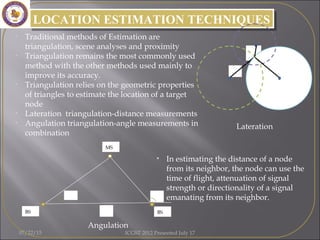
• In estimating the distance of a node
from its neighbor, the node can use the
time of flight, attenuation of signal
strength or directionality of a signal
emanating from its neighbor.
LOCATION ESTIMATION TECHNIQUESLOCATION ESTIMATION TECHNIQUES
• Traditional methods of Estimation are
triangulation, scene analyses and proximity
• Triangulation remains the most commonly used
method with the other methods used mainly to
improve its accuracy.
• Triangulation relies on the geometric properties
of triangles to estimate the location of a target
node
• Lateration triangulation-distance measurements
• Angulation triangulation-angle measurements in
combination
R2
R1
R3
θ
d
β
MS
BS BS
Lateration
Angulation
07/22/15 ICGST 2012 Presented July 17
• Difficult to implement
• Due to accuracy limitations
stemming from lack of stable clock
and random delays from contention
method in IEEE 802.11 wireless
LAN, this design method was
stopped for demonstration.
TOD/TOA APPROACHTOD/TOA APPROACH
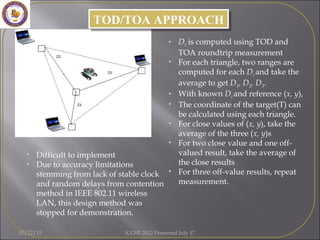
• Di is computed using TOD and
TOA roundtrip measurement
• For each triangle, two ranges are
computed for each Di and take the
average to get D1, D2, D3.
• With known Di and reference (x, y),
• The coordinate of the target(T) can
be calculated using each triangle.
• For close values of (x, y), take the
average of the three (x, y)s
• For two close value and one off-
valued result, take the average of
the close results
• For three off-value results, repeat
measurement.
07/22/15 ICGST 2012 Presented July 17
DIRECTIONAL ANTENNADIRECTIONAL ANTENNA
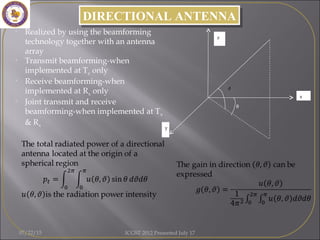
• Realized by using the beamforming
technology together with an antenna
array
• Transmit beamforming-when
implemented at Tx only
• Receive beamforming-when
implemented at Rx only
• Joint transmit and receive
beamforming-when implemented at Tx
& Rx
θ
z
x
y
07/22/15 ICGST 2012 Presented July 17
• Directional antennas have a longer transmission range
• reducing delay and increase in connection throughput
• Directional antenna also possess larger free channel space
around the transmitting node and allows more concurrent
transmission without collisions
• A two element directional antenna was found to consume
approximately 7% of the power of the omnidirectional
antenna while a four-element antenna comes just 1%.
• Used in Cellular networks such as GSM and infrastructure
WLAN
WHY USE DIRECTIONAL
ANTENNA ?
WHY USE DIRECTIONAL
ANTENNA ?
07/22/15 ICGST 2012 Presented July 17
MULTIPATH FADED CHANNELMULTIPATH FADED CHANNEL
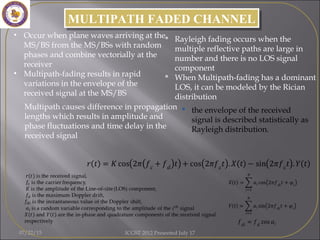
• Occur when plane waves arriving at the
MS/BS from the MS/BSs with random
phases and combine vectorially at the
receiver
• Multipath-fading results in rapid
variations in the envelope of the
received signal at the MS/BS
Multipath causes difference in propagation
lengths which results in amplitude and
phase fluctuations and time delay in the
received signal
 Rayleigh fading occurs when the
multiple reflective paths are large in
number and there is no LOS signal
component
 When Multipath-fading has a dominant
LOS, it can be modeled by the Rician
distribution
 the envelope of the received
signal is described statistically as
Rayleigh distribution.
07/22/15 ICGST 2012 Presented July 17
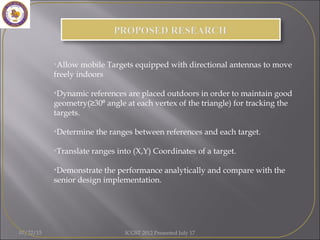
•Allow mobile Targets equipped with directional antennas to move
freely indoors
•Dynamic references are placed outdoors in order to maintain good
geometry(≥30 angle at each vertex of the triangle) for tracking the⁰
targets.
•Determine the ranges between references and each target.
•Translate ranges into (X,Y) Coordinates of a target.
•Demonstrate the performance analytically and compare with the
senior design implementation.
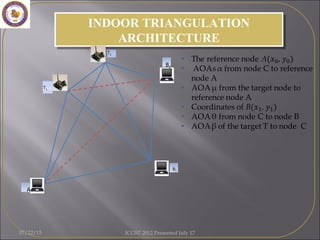
INDOOR TRIANGULATION
ARCHITECTURE
INDOOR TRIANGULATION
ARCHITECTURE
B1
A
B2
T1
T2
07/22/15 ICGST 2012 Presented July 17
FLOW MODEL FOR DYNAMIC
MOVEMENT OF REFERENCES
FLOW MODEL FOR DYNAMIC
MOVEMENT OF REFERENCES
07/22/15 ICGST 2012 Presented July 17
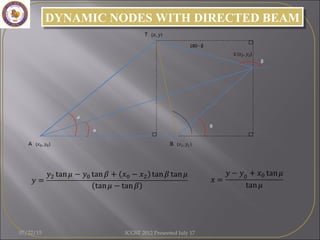
α
µ
θ
β
DYNAMIC NODES WITH DIRECTED BEAMDYNAMIC NODES WITH DIRECTED BEAM
07/22/15 ICGST 2012 Presented July 17
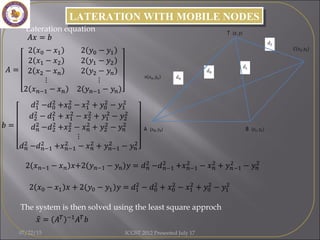
LATERATION WITH MOBILE NODESLATERATION WITH MOBILE NODES
The system is then solved using the least square approch
Lateration equation
07/22/15 ICGST 2012 Presented July 17
Runs Real Real Calculated Calculated Real DT-N Calculated Change in    
  X Y X Y A DT-N DT-N Abs(Error) %Error
1 7.3078 9.9286 7.2223 9.9406 12.3281 12.2873 0.0408 0.0408 0.3308
2 7.3078 9.9286 7.3720 10.1467 12.3281 12.5420 -0.2139 0.2139 1.7354
3 5.0000 8.0000 4.9577 7.9339 9.4340 9.3555 0.0785 0.0785 0.8318
4 5.0000 5.5000 4.6028 5.1119 7.4330 6.8788 0.5543 0.5543 7.4570
5 10.0000 8.0000 9.4708 7.6693 12.8062 12.1866 0.6196 0.6196 4.8383
6 10.0000 8.0000 9.8985 8.0156 12.8062 12.7370 0.0693 0.0693 0.5411
7 14.0000 8.5000 14.0057 8.4154 16.3783 16.3395 0.0389 0.0389 0.2373
8 14.0000 8.5000 13.8415 8.3168 16.3783 16.1479 0.2304 0.2304 1.4067
9 14.0000 8.5000 13.9886 8.4052 16.3783 16.3196 0.0588 0.0588 0.3588
10 2.0000 8.0000 2.0086 8.0560 8.2462 8.3026 -0.0564 0.0564 0.6841
11 7.3078 9.9286 7.1856 9.8902 12.3281 12.2249 0.1031 0.1031 0.8365
12 8.8877 4.5526 8.8517 4.5102 9.9859 9.9345 0.0513 0.0513 0.5142
13 9.7993 3.2141 10.0822 3.2759 10.3129 10.6011 -0.2881 0.2881 2.7937
14 9.9281 3.2314 9.6102 3.1226 10.4407 10.1048 0.3360 0.3360 3.2178
15 11.0571 8.6505 10.7716 8.4157 14.0389 13.6694 0.3695 0.3695 2.6321
16 -3.0736 13.1967 -3.0663 13.2817 13.5499 13.6311 -0.0812 0.0812 0.5990
17 -8.0266 14.3605 -7.8907 14.2351 16.4515 16.2758 0.1757 0.1757 1.0679
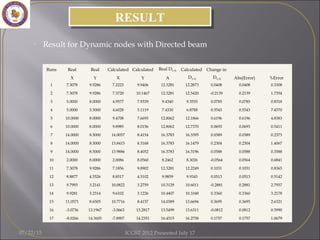
RESULTRESULT
• Result for Dynamic nodes with Directed beam
07/22/15 ICGST 2012 Presented July 17
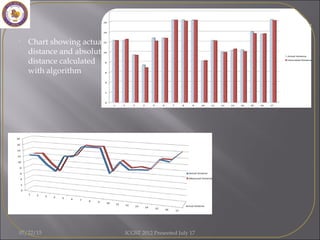
• Chart showing actual
distance and absolute
distance calculated
with algorithm
07/22/15 ICGST 2012 Presented July 17
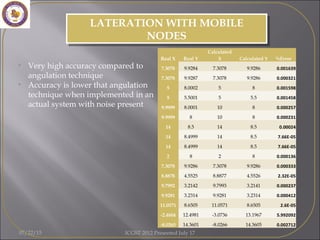
Real X Real Y
Calculated
X Calculated Y %Error
7.3078 9.9284 7.3078 9.9286 0.001639
7.3078 9.9287 7.3078 9.9286 0.000321
5 8.0002 5 8 0.001598
5 5.5001 5 5.5 0.001458
9.9999 8.0001 10 8 0.000257
9.9999 8 10 8 0.000231
14 8.5 14 8.5 0.00024
14 8.4999 14 8.5 7.66E-05
2 8 2 8 0.000136
7.3078 9.9286 7.3078 9.9286 0.000333
8.8878 4.5525 8.8877 4.5526 2.32E-05
9.7992 3.2142 9.7993 3.2141 0.000237
9.9281 3.2314 9.9281 3.2314 0.000412
11.0571 8.6505 11.0571 8.6505 2.6E-05
-2.4604 12.4981 -3.0736 13.1967 5.992092
-8.0265 14.3601 -8.0266 14.3605 0.002712
LATERATION WITH MOBILE
NODES
LATERATION WITH MOBILE
NODES
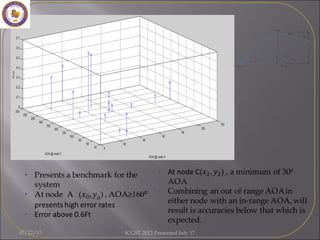
• Very high accuracy compared to
angulation technique
• Accuracy is lower that angulation
technique when implemented in an
actual system with noise present
07/22/15 ICGST 2012 Presented July 17
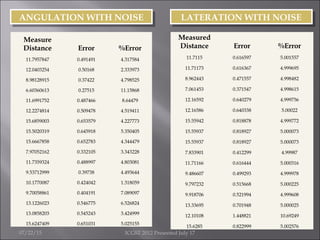
ANGULATION WITH NOISEANGULATION WITH NOISE
Measure
Distance Error %Error
11.7957847 0.491491 4.317584
12.0403254 0.50168 2.333973
8.98128915 0.37422 4.798525
6.60360613 0.27515 11.15868
11.6991752 0.487466 8.64479
12.2274814 0.509478 4.519411
15.6859003 0.653579 4.227773
15.5020319 0.645918 5.350405
15.6667858 0.652783 4.344479
7.97052162 0.332105 3.343228
11.7359324 0.488997 4.803081
9.53712999 0.39738 4.493644
10.1770087 0.424042 1.318059
9.70058861 0.404191 7.089097
13.1226023 0.546775 6.526824
13.0858203 0.545243 3.424999
15.6247409 0.651031 5.025155
Measured
Distance Error %Error
11.7115 0.616597 5.001557
11.71173 0.616367 4.999695
8.962443 0.471557 4.998482
7.061453 0.371547 4.998615
12.16592 0.640279 4.999756
12.16586 0.640338 5.00022
15.55942 0.818878 4.999772
15.55937 0.818927 5.000073
15.55937 0.818927 5.000073
7.833901 0.412299 4.99987
11.71166 0.616444 5.000316
9.486607 0.499293 4.999978
9.797232 0.515668 5.000225
9.918706 0.521994 4.999608
13.33695 0.701948 5.000025
12.10108 1.448821 10.69249
15.6285 0.822999 5.002576
LATERATION WITH NOISELATERATION WITH NOISE
07/22/15 ICGST 2012 Presented July 17
• Future work will be the development of a 3 dimensional
algorithm for PL&T in an indoor situational awareness
system.
• Another part of the proposal will be nodal
authentications.
FUTURE WORKFUTURE WORK
CONCLUSIONCONCLUSION
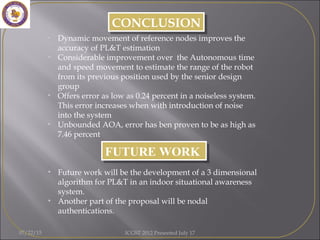
• Dynamic movement of reference nodes improves the
accuracy of PL&T estimation
• Considerable improvement over the Autonomous time
and speed movement to estimate the range of the robot
from its previous position used by the senior design
group
• Offers error as low as 0.24 percent in a noiseless system.
This error increases when with introduction of noise
into the system
• Unbounded AOA, error has ben proven to be as high as
7.46 percent
07/22/15 ICGST 2012 Presented July 17
• Rong, P; Sichitiu, M.L.; "Angle of Arrival Localization for Wireless Sensor Networks," Sensor and Ad Hoc
Communications and Networks, 2006. SECON '06. 2006 3rd Annual IEEE Communications Society on , vol.1,
no., pp.374-382, 28-28 Sept. 2006
• Jun Xu; Maode Ma; Choi Look Law, "AOA Cooperative Position Localization," Global Telecommunications
Conference, 2008. IEEE GLOBECOM 2008. IEEE , vol., no., pp.1-5, Nov. 30 2008-Dec. 4 2008
• Langendoen, K. “Distributed localization in wireless sensor networks: a quantitative
comparison.” Computer Networks 43.4 (2003): 499-518.
 Yiu-Tong Chan; Wing-Yue Tsui; Hing-Cheung So; Pak-chung Ching; , "Time-of-arrival based localization under
NLOS conditions," Vehicular Technology, IEEE Transactions on , vol.55, no.1, pp. 17- 24, Jan. 2006
 Capkun, S.; Hamdi, M.; Hubaux, J.-P.; , "GPS-free positioning in mobile ad-hoc networks," System Sciences, 2001.
Proceedings of the 34th Annual Hawaii International Conference on , vol., no., pp. 10 pp., 3-6 Jan. 2001
 Riter, S.; McCoy, J.; , "Automatic vehicle location—An overview," Vehicular Technology, IEEE Transactions on ,
vol.26, no.1, pp. 7- 11, Feb 1977
 Figel, W.G.; Shepherd, N.H.; Trammell, W.F.; , "Vehicle location by a signal attenuation method,"Vehicular
Technology Conference, 1968. 19th IEEE , vol.19, no., pp. 105- 109, 1968
 Hata, M.; Nagatsu, T.; , "Mobile location using signal strength measurements in a cellular system," Vehicular
Technology, IEEE Transactions on , vol.29, no.2, pp. 245- 252, May 1980
 Hüseyin Akcan , Vassil Kriakov , Hervé Brönnimann , Alex Delis, GPS-Free node localization in mobile
wireless sensor networks, Proceedings of the 5th ACM international workshop on Data engineering for
wireless and mobile access, June 25-25, 2006, Chicago, Illinois, USA 
 Kułakowski P, Vales-Alonso J, Egea-Lopez E, Ludwin W, Garcia-Haro J. Angle-of-arrival localization
based on antenna arrays for wireless sensor networks. In: Elsevier computers and electrical engineering
journal, vol.36(6); 2010. p. 1181–6
 Riter, S.; McCoy, J.; , "Automatic vehicle location—An overview," Vehicular Technology, IEEE Transactions
on , vol.26, no.1, pp. 7- 11, Feb 1977
 S. Yi, Y. Pei and S. Kalyanaraman, “On the capacity improvement of ad hoc wireless networks using
directional antennas,” MobiHoc2003.
 L. Tong et al., “Energy efficient multicasting using smart antennas for wireless ad hoc networks in
multipath environments,” Globeome 2004.
REFERENCESREFERENCES
07/22/15 ICGST 2012 Presented July 17

P1141214157

  • 1.
    Electrical and ComputerEngineering Department Roy G. Perry College of Engineering, Prairie View A&M University, Prairie View, TX By Dr. Warsame H. Ali DYNAMIC MOVEMENT OF REFERENCE NODES, FOR IMPROVED TRACKING ACCURACY OF INDOOR SITUATIONAL AWARENESS SYSTEMS DYNAMIC MOVEMENT OF REFERENCE NODES, FOR IMPROVED TRACKING ACCURACY OF INDOOR SITUATIONAL AWARENESS SYSTEMS 07/22/15 ICGST 2012 Presented July 17
  • 2.
    OUTLINEOUTLINE  Problem Statement Overview  Scope  Background  Proposed research  Result Analysis  Conclusion  Future work 07/22/15 ICGST 2012 Presented July 17
  • 3.
    PROBLEM STATEMENTPROBLEM STATEMENT •Design a Position, Location and Tracking(PL&T) algorithm based on dynamic references for Indoor Situational Awareness System 07/22/15 ICGST 2012 Presented July 17
  • 4.
    07/22/15 ICGST 2012Presented July 17 • GPS have been traditionally used for Position, Location and Tracking (PL&T) but In several cases, GPS tends to be inaccurate in indoor situations. • It also tends to be inaccurate near buildings(accuracies of 20 meters) • A self-configuring network, Mobile Ad hoc Network (MANET) is used for robust prediction and tracking in indoor situational awareness systems (ISM). • Researchers have looked into the implementation of MANET using various schemes. A common scheme is triangulation.
  • 5.
    07/22/15 ICGST 2012Presented July 17 • Indoor PL&T algorithm using dynamic references
  • 6.
     This projectis a follow up on two previous work done in Prairie View A&M University. The senior design team at Prairie View A&M University was saddled with the task of designing a PL&T algorithm. They came up with the “Panther Tracker”, that uses autonomous time and speed movement to estimate the range of a robot from its previous position A dissertation by “Niraj “on Antennas, Dynamic PL&T and the security of the system 07/22/15 ICGST 2012 Presented July 17
  • 7.
    • In estimatingthe distance of a node from its neighbor, the node can use the time of flight, attenuation of signal strength or directionality of a signal emanating from its neighbor. LOCATION ESTIMATION TECHNIQUESLOCATION ESTIMATION TECHNIQUES • Traditional methods of Estimation are triangulation, scene analyses and proximity • Triangulation remains the most commonly used method with the other methods used mainly to improve its accuracy. • Triangulation relies on the geometric properties of triangles to estimate the location of a target node • Lateration triangulation-distance measurements • Angulation triangulation-angle measurements in combination R2 R1 R3 θ d β MS BS BS Lateration Angulation 07/22/15 ICGST 2012 Presented July 17
  • 8.
    • Difficult toimplement • Due to accuracy limitations stemming from lack of stable clock and random delays from contention method in IEEE 802.11 wireless LAN, this design method was stopped for demonstration. TOD/TOA APPROACHTOD/TOA APPROACH • Di is computed using TOD and TOA roundtrip measurement • For each triangle, two ranges are computed for each Di and take the average to get D1, D2, D3. • With known Di and reference (x, y), • The coordinate of the target(T) can be calculated using each triangle. • For close values of (x, y), take the average of the three (x, y)s • For two close value and one off- valued result, take the average of the close results • For three off-value results, repeat measurement. 07/22/15 ICGST 2012 Presented July 17
  • 9.
    DIRECTIONAL ANTENNADIRECTIONAL ANTENNA •Realized by using the beamforming technology together with an antenna array • Transmit beamforming-when implemented at Tx only • Receive beamforming-when implemented at Rx only • Joint transmit and receive beamforming-when implemented at Tx & Rx θ z x y 07/22/15 ICGST 2012 Presented July 17
  • 10.
    • Directional antennashave a longer transmission range • reducing delay and increase in connection throughput • Directional antenna also possess larger free channel space around the transmitting node and allows more concurrent transmission without collisions • A two element directional antenna was found to consume approximately 7% of the power of the omnidirectional antenna while a four-element antenna comes just 1%. • Used in Cellular networks such as GSM and infrastructure WLAN WHY USE DIRECTIONAL ANTENNA ? WHY USE DIRECTIONAL ANTENNA ? 07/22/15 ICGST 2012 Presented July 17
  • 11.
    MULTIPATH FADED CHANNELMULTIPATHFADED CHANNEL • Occur when plane waves arriving at the MS/BS from the MS/BSs with random phases and combine vectorially at the receiver • Multipath-fading results in rapid variations in the envelope of the received signal at the MS/BS Multipath causes difference in propagation lengths which results in amplitude and phase fluctuations and time delay in the received signal  Rayleigh fading occurs when the multiple reflective paths are large in number and there is no LOS signal component  When Multipath-fading has a dominant LOS, it can be modeled by the Rician distribution  the envelope of the received signal is described statistically as Rayleigh distribution. 07/22/15 ICGST 2012 Presented July 17
  • 12.
    07/22/15 ICGST 2012Presented July 17 •Allow mobile Targets equipped with directional antennas to move freely indoors •Dynamic references are placed outdoors in order to maintain good geometry(≥30 angle at each vertex of the triangle) for tracking the⁰ targets. •Determine the ranges between references and each target. •Translate ranges into (X,Y) Coordinates of a target. •Demonstrate the performance analytically and compare with the senior design implementation.
  • 13.
  • 14.
    FLOW MODEL FORDYNAMIC MOVEMENT OF REFERENCES FLOW MODEL FOR DYNAMIC MOVEMENT OF REFERENCES 07/22/15 ICGST 2012 Presented July 17
  • 15.
    α µ θ β DYNAMIC NODES WITHDIRECTED BEAMDYNAMIC NODES WITH DIRECTED BEAM 07/22/15 ICGST 2012 Presented July 17
  • 16.
    LATERATION WITH MOBILENODESLATERATION WITH MOBILE NODES The system is then solved using the least square approch Lateration equation 07/22/15 ICGST 2012 Presented July 17
  • 17.
    Runs Real RealCalculated Calculated Real DT-N Calculated Change in       X Y X Y A DT-N DT-N Abs(Error) %Error 1 7.3078 9.9286 7.2223 9.9406 12.3281 12.2873 0.0408 0.0408 0.3308 2 7.3078 9.9286 7.3720 10.1467 12.3281 12.5420 -0.2139 0.2139 1.7354 3 5.0000 8.0000 4.9577 7.9339 9.4340 9.3555 0.0785 0.0785 0.8318 4 5.0000 5.5000 4.6028 5.1119 7.4330 6.8788 0.5543 0.5543 7.4570 5 10.0000 8.0000 9.4708 7.6693 12.8062 12.1866 0.6196 0.6196 4.8383 6 10.0000 8.0000 9.8985 8.0156 12.8062 12.7370 0.0693 0.0693 0.5411 7 14.0000 8.5000 14.0057 8.4154 16.3783 16.3395 0.0389 0.0389 0.2373 8 14.0000 8.5000 13.8415 8.3168 16.3783 16.1479 0.2304 0.2304 1.4067 9 14.0000 8.5000 13.9886 8.4052 16.3783 16.3196 0.0588 0.0588 0.3588 10 2.0000 8.0000 2.0086 8.0560 8.2462 8.3026 -0.0564 0.0564 0.6841 11 7.3078 9.9286 7.1856 9.8902 12.3281 12.2249 0.1031 0.1031 0.8365 12 8.8877 4.5526 8.8517 4.5102 9.9859 9.9345 0.0513 0.0513 0.5142 13 9.7993 3.2141 10.0822 3.2759 10.3129 10.6011 -0.2881 0.2881 2.7937 14 9.9281 3.2314 9.6102 3.1226 10.4407 10.1048 0.3360 0.3360 3.2178 15 11.0571 8.6505 10.7716 8.4157 14.0389 13.6694 0.3695 0.3695 2.6321 16 -3.0736 13.1967 -3.0663 13.2817 13.5499 13.6311 -0.0812 0.0812 0.5990 17 -8.0266 14.3605 -7.8907 14.2351 16.4515 16.2758 0.1757 0.1757 1.0679 RESULTRESULT • Result for Dynamic nodes with Directed beam 07/22/15 ICGST 2012 Presented July 17
  • 18.
    • Chart showingactual distance and absolute distance calculated with algorithm 07/22/15 ICGST 2012 Presented July 17
  • 19.
    07/22/15 ICGST 2012Presented July 17
  • 20.
    Real X RealY Calculated X Calculated Y %Error 7.3078 9.9284 7.3078 9.9286 0.001639 7.3078 9.9287 7.3078 9.9286 0.000321 5 8.0002 5 8 0.001598 5 5.5001 5 5.5 0.001458 9.9999 8.0001 10 8 0.000257 9.9999 8 10 8 0.000231 14 8.5 14 8.5 0.00024 14 8.4999 14 8.5 7.66E-05 14 8.4999 14 8.5 7.66E-05 2 8 2 8 0.000136 7.3078 9.9286 7.3078 9.9286 0.000333 8.8878 4.5525 8.8877 4.5526 2.32E-05 9.7992 3.2142 9.7993 3.2141 0.000237 9.9281 3.2314 9.9281 3.2314 0.000412 11.0571 8.6505 11.0571 8.6505 2.6E-05 -2.4604 12.4981 -3.0736 13.1967 5.992092 -8.0265 14.3601 -8.0266 14.3605 0.002712 LATERATION WITH MOBILE NODES LATERATION WITH MOBILE NODES • Very high accuracy compared to angulation technique • Accuracy is lower that angulation technique when implemented in an actual system with noise present 07/22/15 ICGST 2012 Presented July 17
  • 21.
    ANGULATION WITH NOISEANGULATIONWITH NOISE Measure Distance Error %Error 11.7957847 0.491491 4.317584 12.0403254 0.50168 2.333973 8.98128915 0.37422 4.798525 6.60360613 0.27515 11.15868 11.6991752 0.487466 8.64479 12.2274814 0.509478 4.519411 15.6859003 0.653579 4.227773 15.5020319 0.645918 5.350405 15.6667858 0.652783 4.344479 7.97052162 0.332105 3.343228 11.7359324 0.488997 4.803081 9.53712999 0.39738 4.493644 10.1770087 0.424042 1.318059 9.70058861 0.404191 7.089097 13.1226023 0.546775 6.526824 13.0858203 0.545243 3.424999 15.6247409 0.651031 5.025155 Measured Distance Error %Error 11.7115 0.616597 5.001557 11.71173 0.616367 4.999695 8.962443 0.471557 4.998482 7.061453 0.371547 4.998615 12.16592 0.640279 4.999756 12.16586 0.640338 5.00022 15.55942 0.818878 4.999772 15.55937 0.818927 5.000073 15.55937 0.818927 5.000073 7.833901 0.412299 4.99987 11.71166 0.616444 5.000316 9.486607 0.499293 4.999978 9.797232 0.515668 5.000225 9.918706 0.521994 4.999608 13.33695 0.701948 5.000025 12.10108 1.448821 10.69249 15.6285 0.822999 5.002576 LATERATION WITH NOISELATERATION WITH NOISE 07/22/15 ICGST 2012 Presented July 17
  • 22.
    • Future workwill be the development of a 3 dimensional algorithm for PL&T in an indoor situational awareness system. • Another part of the proposal will be nodal authentications. FUTURE WORKFUTURE WORK CONCLUSIONCONCLUSION • Dynamic movement of reference nodes improves the accuracy of PL&T estimation • Considerable improvement over the Autonomous time and speed movement to estimate the range of the robot from its previous position used by the senior design group • Offers error as low as 0.24 percent in a noiseless system. This error increases when with introduction of noise into the system • Unbounded AOA, error has ben proven to be as high as 7.46 percent 07/22/15 ICGST 2012 Presented July 17
  • 23.
    • Rong, P;Sichitiu, M.L.; "Angle of Arrival Localization for Wireless Sensor Networks," Sensor and Ad Hoc Communications and Networks, 2006. SECON '06. 2006 3rd Annual IEEE Communications Society on , vol.1, no., pp.374-382, 28-28 Sept. 2006 • Jun Xu; Maode Ma; Choi Look Law, "AOA Cooperative Position Localization," Global Telecommunications Conference, 2008. IEEE GLOBECOM 2008. IEEE , vol., no., pp.1-5, Nov. 30 2008-Dec. 4 2008 • Langendoen, K. “Distributed localization in wireless sensor networks: a quantitative comparison.” Computer Networks 43.4 (2003): 499-518.  Yiu-Tong Chan; Wing-Yue Tsui; Hing-Cheung So; Pak-chung Ching; , "Time-of-arrival based localization under NLOS conditions," Vehicular Technology, IEEE Transactions on , vol.55, no.1, pp. 17- 24, Jan. 2006  Capkun, S.; Hamdi, M.; Hubaux, J.-P.; , "GPS-free positioning in mobile ad-hoc networks," System Sciences, 2001. Proceedings of the 34th Annual Hawaii International Conference on , vol., no., pp. 10 pp., 3-6 Jan. 2001  Riter, S.; McCoy, J.; , "Automatic vehicle location—An overview," Vehicular Technology, IEEE Transactions on , vol.26, no.1, pp. 7- 11, Feb 1977  Figel, W.G.; Shepherd, N.H.; Trammell, W.F.; , "Vehicle location by a signal attenuation method,"Vehicular Technology Conference, 1968. 19th IEEE , vol.19, no., pp. 105- 109, 1968  Hata, M.; Nagatsu, T.; , "Mobile location using signal strength measurements in a cellular system," Vehicular Technology, IEEE Transactions on , vol.29, no.2, pp. 245- 252, May 1980  Hüseyin Akcan , Vassil Kriakov , Hervé Brönnimann , Alex Delis, GPS-Free node localization in mobile wireless sensor networks, Proceedings of the 5th ACM international workshop on Data engineering for wireless and mobile access, June 25-25, 2006, Chicago, Illinois, USA   Kułakowski P, Vales-Alonso J, Egea-Lopez E, Ludwin W, Garcia-Haro J. Angle-of-arrival localization based on antenna arrays for wireless sensor networks. In: Elsevier computers and electrical engineering journal, vol.36(6); 2010. p. 1181–6  Riter, S.; McCoy, J.; , "Automatic vehicle location—An overview," Vehicular Technology, IEEE Transactions on , vol.26, no.1, pp. 7- 11, Feb 1977  S. Yi, Y. Pei and S. Kalyanaraman, “On the capacity improvement of ad hoc wireless networks using directional antennas,” MobiHoc2003.  L. Tong et al., “Energy efficient multicasting using smart antennas for wireless ad hoc networks in multipath environments,” Globeome 2004. REFERENCESREFERENCES 07/22/15 ICGST 2012 Presented July 17
  • 24.
    07/22/15 ICGST 2012Presented July 17