OWNERSHIP AND
STRUCTURE
SAUDI ARABIA
MATI UR REHMAN
1001748258
Introduction
 Saudi Ports Authority is a government agency that supervises the ports of Saudi
Arabia. It was founded in 1976 as an independent agency of the Prime Minister's
office, to bring together the governance and operations of the multiple ports of the
country to one office.
 Over time the actual operation of the ports was devolved by government contract to
independent port operating companies.
 Coming Today, Saudi Ports Authority supervises the following major Saudi ports such
Jeddah Islamic PortKing Abdul Aziz Port
Transportation in Saudi Arabia
Source: LikedIn, Saudi Arabia's emerging role as a leading GCC Logistics market
State Ownership of Ports in Saudia
Arabia
 Ports – like other technical infrastructure networks in Saudi – are typically owned and managed by
the public sector. SOEs (State Owned Enterprises) play a leading role in the Saudi economy,
particularly in water, power, oil, natural gas, and petrochemicals.
 In the tool port model, the port authority owns, develops, and maintains the port infrastructure as
well as the superstructure, including cargo handling equipment such as quay cranes and forklift
trucks. Port authority staff usually operates all equipment owned by the port authority
 In 2002, the Supreme Economic Council announced the approval of privatization procedures, open
to domestic and foreign investors, and a timetable to transfer certain public services to the private
sector.
Autonomous Ports
 An autonomous port (or independent port) is a state-owned enterprise or an
organization managing a port area, with a legal entity and enjoying
managerial autonomy vis-à-vis its supervision
 The numbers of Saudi ports reached nine ports, 6 of them are commercial
and two indusial ports in addition to ‘Ras Alkhair’ mining port.
Municipal Ownership
One of the main targets under the national development
strategy, Vision 2030, is to replace oil exports with other, mainly
petrochemicals, exports, requiring a substantial increase of
seaport and logistical infrastructure for containerised exports.
The government has been pushing, among other things, for the
upgrading of ports
 As different from Nationalization, Municipal ownership in Saudi ports mainly
transfer from private ownership to certain levels of government
 Transferring it to the local authority or municipality for redevelopment. In
practice this is not always effective because the municipality might lack the
resources to realize the full value of the land in question.
Vision 2030
Private Ownership Ports
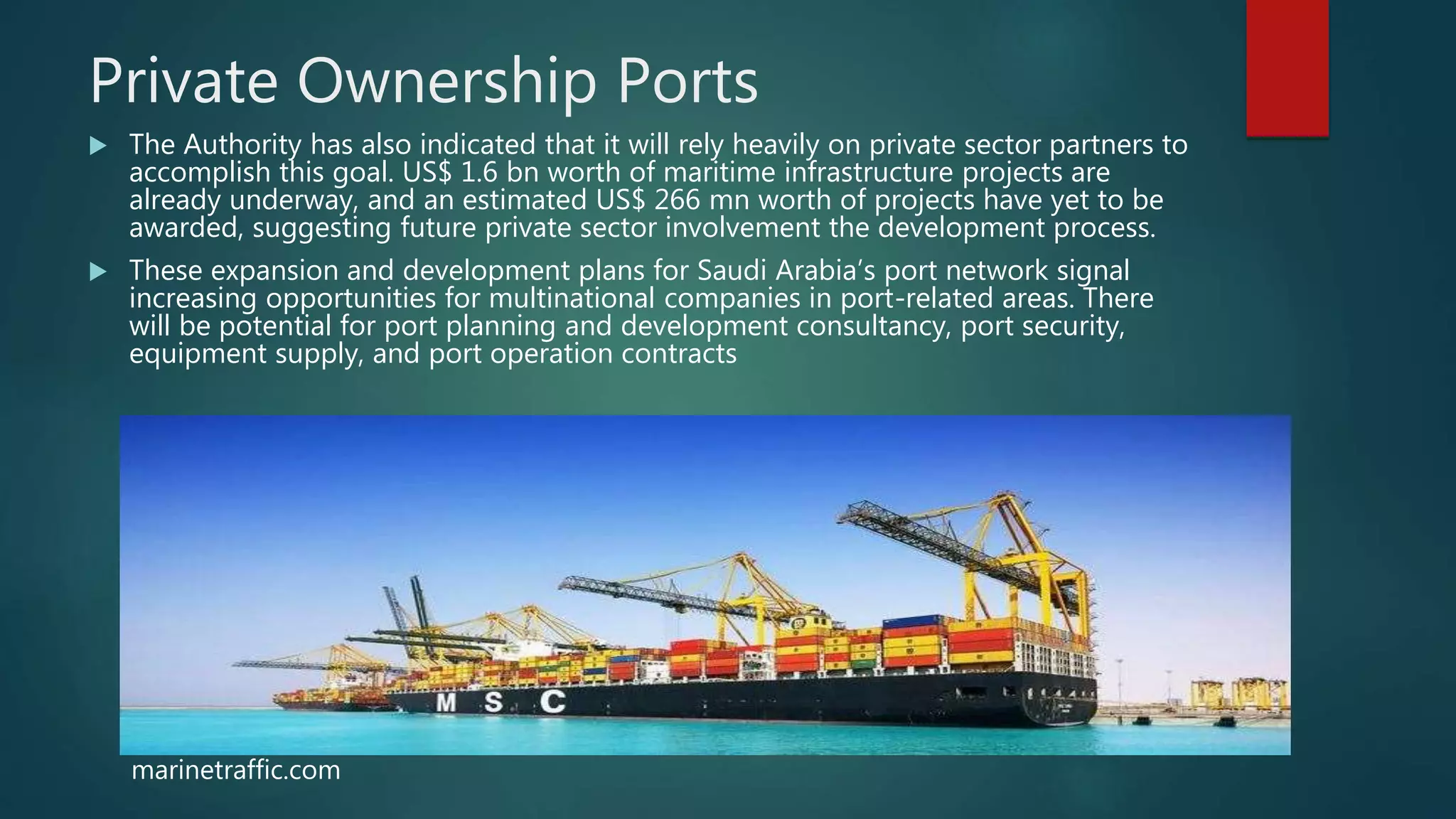
 The Authority has also indicated that it will rely heavily on private sector partners to
accomplish this goal. US$ 1.6 bn worth of maritime infrastructure projects are
already underway, and an estimated US$ 266 mn worth of projects have yet to be
awarded, suggesting future private sector involvement the development process.
 These expansion and development plans for Saudi Arabia’s port network signal
increasing opportunities for multinational companies in port-related areas. There
will be potential for port planning and development consultancy, port security,
equipment supply, and port operation contracts
marinetraffic.com
The King Abdullah Port (KAP)
 KAP is Saudi Arabia’s first privately-owned port facility and is also
the first to be run outside the control of Saudi Ports Authority
(SPA). The port has a capacity of more than 10mn twenty-foot
equivalent units (TEU) and port officials said they expect
throughput in excess of 1.5mn TEU for this year, compared to
497,000 TEU last year.
The port had opened in late 2013 and the growth in throughput
can be partly attributed to the fact that it is compared to a low
base from a slow 2014. However, KAP is attracting business from
other ports in the region too.
Landlord ports
 According (Katsarova, 2013) Landlord ports are the port
authority owns only the basic infrastructure, leasing it out
to operators, mostly on a long-term concession basis,
while retaining all regulatory functions.
 Port operations are carried out by private companies,
which provide and maintain their own superstructure,
 Saudi Arabia’s first privately owned and funded port, KAP
is owned by Ports Development Co., the landlord at
Rabigh, which in turn is owned by Emaar Economic City,
developer of King Abdullah Economic City, and Saudi bin
Laden Group.
BOT Concept
Build-operate-transfer (BOT) requires the private sector to finance, design, build,
operate and manage the facility and then transfer the asset free of charge to the
government after a specified concession period.
Now, Jeddah Islamic Port (JIP) is fast approaching capacity and there are limits to
expanding its site. Last year, Red Sea Gateway Terminal (RSGT) brought 1.8m teu
of new capacity to Jeddah. The $510m terminal is Saudi Arabia’s first build,
operate, transfer (BOT) port development project.
Vision and Mission of Ports Authority
in Saudi Arabia
 Vision: An effective encouraging for competitiveness
authority that supports the development plans and the
diversity of KSA’s economy with going with the flow of
the international developments of ports sector.
 Mission: Working to build a solid ground for the status of
Saudi Ports Authority as a leader of ports sector which
link the national economy with international market and
the unstoppable work to develop establishments and
working force to reach to the highest standards of
efficiency and continuously
Conclusion
 The privatization program aims to strengthen competition, raise the quality of
services and economic development, improve the business environment, and
remove obstacles that prevent the private sector from playing a bigger role in
the kingdom’s development
 The initiative targets 14 public-private partnership (PPP) investments worth 24
billion to 28 billion riyals. It includes the corporatization of Saudi ports
ownership and structure

ownership and structure

  • 1.
  • 2.
    Introduction  Saudi PortsAuthority is a government agency that supervises the ports of Saudi Arabia. It was founded in 1976 as an independent agency of the Prime Minister's office, to bring together the governance and operations of the multiple ports of the country to one office.  Over time the actual operation of the ports was devolved by government contract to independent port operating companies.  Coming Today, Saudi Ports Authority supervises the following major Saudi ports such Jeddah Islamic PortKing Abdul Aziz Port
  • 3.
    Transportation in SaudiArabia Source: LikedIn, Saudi Arabia's emerging role as a leading GCC Logistics market
  • 4.
    State Ownership ofPorts in Saudia Arabia  Ports – like other technical infrastructure networks in Saudi – are typically owned and managed by the public sector. SOEs (State Owned Enterprises) play a leading role in the Saudi economy, particularly in water, power, oil, natural gas, and petrochemicals.  In the tool port model, the port authority owns, develops, and maintains the port infrastructure as well as the superstructure, including cargo handling equipment such as quay cranes and forklift trucks. Port authority staff usually operates all equipment owned by the port authority  In 2002, the Supreme Economic Council announced the approval of privatization procedures, open to domestic and foreign investors, and a timetable to transfer certain public services to the private sector.
  • 5.
    Autonomous Ports  Anautonomous port (or independent port) is a state-owned enterprise or an organization managing a port area, with a legal entity and enjoying managerial autonomy vis-à-vis its supervision  The numbers of Saudi ports reached nine ports, 6 of them are commercial and two indusial ports in addition to ‘Ras Alkhair’ mining port.
  • 6.
    Municipal Ownership One ofthe main targets under the national development strategy, Vision 2030, is to replace oil exports with other, mainly petrochemicals, exports, requiring a substantial increase of seaport and logistical infrastructure for containerised exports. The government has been pushing, among other things, for the upgrading of ports  As different from Nationalization, Municipal ownership in Saudi ports mainly transfer from private ownership to certain levels of government  Transferring it to the local authority or municipality for redevelopment. In practice this is not always effective because the municipality might lack the resources to realize the full value of the land in question. Vision 2030
  • 7.
    Private Ownership Ports The Authority has also indicated that it will rely heavily on private sector partners to accomplish this goal. US$ 1.6 bn worth of maritime infrastructure projects are already underway, and an estimated US$ 266 mn worth of projects have yet to be awarded, suggesting future private sector involvement the development process.  These expansion and development plans for Saudi Arabia’s port network signal increasing opportunities for multinational companies in port-related areas. There will be potential for port planning and development consultancy, port security, equipment supply, and port operation contracts marinetraffic.com
  • 8.
    The King AbdullahPort (KAP)  KAP is Saudi Arabia’s first privately-owned port facility and is also the first to be run outside the control of Saudi Ports Authority (SPA). The port has a capacity of more than 10mn twenty-foot equivalent units (TEU) and port officials said they expect throughput in excess of 1.5mn TEU for this year, compared to 497,000 TEU last year. The port had opened in late 2013 and the growth in throughput can be partly attributed to the fact that it is compared to a low base from a slow 2014. However, KAP is attracting business from other ports in the region too.
  • 9.
    Landlord ports  According(Katsarova, 2013) Landlord ports are the port authority owns only the basic infrastructure, leasing it out to operators, mostly on a long-term concession basis, while retaining all regulatory functions.  Port operations are carried out by private companies, which provide and maintain their own superstructure,  Saudi Arabia’s first privately owned and funded port, KAP is owned by Ports Development Co., the landlord at Rabigh, which in turn is owned by Emaar Economic City, developer of King Abdullah Economic City, and Saudi bin Laden Group.
  • 10.
    BOT Concept Build-operate-transfer (BOT)requires the private sector to finance, design, build, operate and manage the facility and then transfer the asset free of charge to the government after a specified concession period. Now, Jeddah Islamic Port (JIP) is fast approaching capacity and there are limits to expanding its site. Last year, Red Sea Gateway Terminal (RSGT) brought 1.8m teu of new capacity to Jeddah. The $510m terminal is Saudi Arabia’s first build, operate, transfer (BOT) port development project.
  • 11.
    Vision and Missionof Ports Authority in Saudi Arabia  Vision: An effective encouraging for competitiveness authority that supports the development plans and the diversity of KSA’s economy with going with the flow of the international developments of ports sector.  Mission: Working to build a solid ground for the status of Saudi Ports Authority as a leader of ports sector which link the national economy with international market and the unstoppable work to develop establishments and working force to reach to the highest standards of efficiency and continuously
  • 12.
    Conclusion  The privatizationprogram aims to strengthen competition, raise the quality of services and economic development, improve the business environment, and remove obstacles that prevent the private sector from playing a bigger role in the kingdom’s development  The initiative targets 14 public-private partnership (PPP) investments worth 24 billion to 28 billion riyals. It includes the corporatization of Saudi ports