Open Source adoption:
 best practices from
European experiences


                              Carlo Daffara
        European Working Group on Libre Software
                               Conecta Research
●
    “The Swiss canton Solothurn is reversing its move
    to a complete open source desktop, Swiss and
    German media report. Major reason for the failure
    appears to be a lock-in to proprietary applications.
    Protest by users added pressure to the project …
    According to the Solothurner Zeitung, the canton
    was unable to connect the open source desktop to a
    governmental database. … [users complained]
    missing special characters and complained about
    having to switch back and forth between a Linux
    and a Windows desktop.” (source: OSOR, EU open
    source observatory)
●
  Enterprises and Public Administrations that
  performed successfully the migration to OSS tend to
  experience substantial savings (and improvements
  in flexibility).
● In the COSPA project, we measured the (true)


  costs, including intangibles, of several migrations to
  OSS in Public Administrations, and found that the
  savings are true.
● … but many migrations are not successful.

● Some are so disastrous, that the mere mention of


  Open Source to civil servants causes medical
  symptoms.
●
  The problem: looking at things from a purely
  technical way, when in reality there are always
  three components:
● Technical: Installing, checking, patching...

● Management: Understanding the procedures that


  agency heads need to put in place, and how staff
  must be coordinated
● Social: Presenting change to the staff in a positive


  manner and handling the various forms of resistance
  they will put up; interacting with the community
  that developed the software in a productive manner
● The technical part is usually the least important –


  while there is little on Management and Social...
Management guidelines
Be Sure of Management’s Commitment to
the Transition: This commitment must be
guaranteed for a time period sufficient to cover the
complete migration!
Prepare a Clear View of What Is Expected,
Including      Measurable        Benchmarks : A
worrisome signal: “It should be cheaper. We get it
from the Net from free!” ← a phrase actually heard
during one of the (failed) migrations.
Make Sure the Timetable Is Realistic : A
migration or adoption process is usually as complex
as the adoption of a new IT infrastructure or an
ERP system. Wrong timing → panic mode.
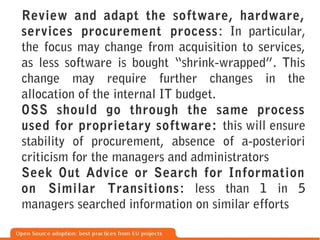
Review and adapt the software, hardware,
services procurement process : In particular,
the focus may change from acquisition to services,
as less software is bought “shrink-wrapped”. This
change may require further changes in the
allocation of the internal IT budget.
OSS should go through the same process
used for proprietary software: this will ensure
stability of procurement, absence of a-posteriori
criticism for the managers and administrators
Seek Out Advice or Search for Information
on Similar Transitions : less than 1 in 5
managers searched information on similar efforts
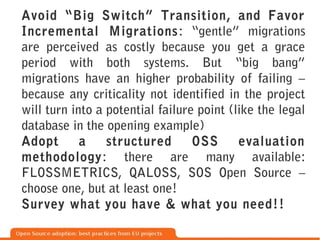
Avoid “Big Switch” Transition, and Favor
Incremental Migrations : “gentle” migrations
are perceived as costly because you get a grace
period with both systems. But “big bang”
migrations have an higher probability of failing –
because any criticality not identified in the project
will turn into a potential failure point (like the legal
database in the opening example)
Adopt       a    structured       OSS      evaluation
methodology: there are many available:
FLOSSMETRICS, QALOSS, SOS Open Source –
choose one, but at least one!
Survey what you have & what you need!!
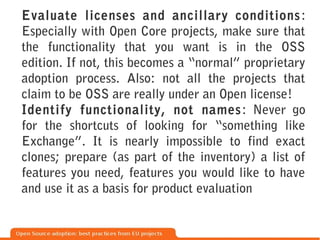
Evaluate licenses and ancillary conditions :
Especially with Open Core projects, make sure that
the functionality that you want is in the OSS
edition. If not, this becomes a “normal” proprietary
adoption process. Also: not all the projects that
claim to be OSS are really under an Open license!
Identify functionality, not names : Never go
for the shortcuts of looking for “something like
Exchange”. It is nearly impossible to find exact
clones; prepare (as part of the inventory) a list of
features you need, features you would like to have
and use it as a basis for product evaluation
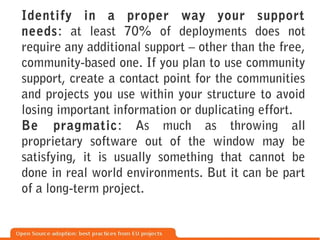
Identify in a proper way your support
needs: at least 70% of deployments does not
require any additional support – other than the free,
community-based one. If you plan to use community
support, create a contact point for the communities
and projects you use within your structure to avoid
losing important information or duplicating effort.
Be pragmatic: As much as throwing all
proprietary software out of the window may be
satisfying, it is usually something that cannot be
done in real world environments. But it can be part
of a long-term project.
Social guidelines
Inform your users: Provide background on what
is OSS, and why your agency/enterprise is adopting
it. Point out the added value of OSS: social, local
economy, inclusiveness – not only the monetary
ones.
Use the migration as an opportunity to
promote new skills : many users are happy to
learn something new, if they believe that the skills
may be useful and valuable. Use the flexible
licensing of OSS to promote wider use of OSS (for
example, in the family)
Create a migration workbook : an open wiki, a
blog, whatever – allow editing and additions.
Make it easy to experiment : Provide
“playgrounds”, manuals, guides, videos – give the
opportunity to tech and end-users to explore
without risks. Some Virtual Machines are all that is
needed. Provide a way for users to suggest new
things.
Identify local experts : The migration may
arouse some resistance from the so-called “local
gurus” who could perceive this overall improvement
as diminishing their social role as technical leaders:
Offer them higher-level training material. Identify
local OSS “champions”, and offer them additional
training opportunities or recognition.
Thanks!
       Carlo Daffara

     cdaffara@conecta.it
http://carlodaffara.conecta.it

Owf2010 daffara

  • 1.
    Open Source adoption: best practices from European experiences Carlo Daffara European Working Group on Libre Software Conecta Research
  • 2.
    “The Swiss canton Solothurn is reversing its move to a complete open source desktop, Swiss and German media report. Major reason for the failure appears to be a lock-in to proprietary applications. Protest by users added pressure to the project … According to the Solothurner Zeitung, the canton was unable to connect the open source desktop to a governmental database. … [users complained] missing special characters and complained about having to switch back and forth between a Linux and a Windows desktop.” (source: OSOR, EU open source observatory)
  • 3.
    ● Enterprisesand Public Administrations that performed successfully the migration to OSS tend to experience substantial savings (and improvements in flexibility). ● In the COSPA project, we measured the (true) costs, including intangibles, of several migrations to OSS in Public Administrations, and found that the savings are true. ● … but many migrations are not successful. ● Some are so disastrous, that the mere mention of Open Source to civil servants causes medical symptoms.
  • 4.
    ● Theproblem: looking at things from a purely technical way, when in reality there are always three components: ● Technical: Installing, checking, patching... ● Management: Understanding the procedures that agency heads need to put in place, and how staff must be coordinated ● Social: Presenting change to the staff in a positive manner and handling the various forms of resistance they will put up; interacting with the community that developed the software in a productive manner ● The technical part is usually the least important – while there is little on Management and Social...
  • 5.
  • 6.
    Be Sure ofManagement’s Commitment to the Transition: This commitment must be guaranteed for a time period sufficient to cover the complete migration! Prepare a Clear View of What Is Expected, Including Measurable Benchmarks : A worrisome signal: “It should be cheaper. We get it from the Net from free!” ← a phrase actually heard during one of the (failed) migrations. Make Sure the Timetable Is Realistic : A migration or adoption process is usually as complex as the adoption of a new IT infrastructure or an ERP system. Wrong timing → panic mode.
  • 7.
    Review and adaptthe software, hardware, services procurement process : In particular, the focus may change from acquisition to services, as less software is bought “shrink-wrapped”. This change may require further changes in the allocation of the internal IT budget. OSS should go through the same process used for proprietary software: this will ensure stability of procurement, absence of a-posteriori criticism for the managers and administrators Seek Out Advice or Search for Information on Similar Transitions : less than 1 in 5 managers searched information on similar efforts
  • 8.
    Avoid “Big Switch”Transition, and Favor Incremental Migrations : “gentle” migrations are perceived as costly because you get a grace period with both systems. But “big bang” migrations have an higher probability of failing – because any criticality not identified in the project will turn into a potential failure point (like the legal database in the opening example) Adopt a structured OSS evaluation methodology: there are many available: FLOSSMETRICS, QALOSS, SOS Open Source – choose one, but at least one! Survey what you have & what you need!!
  • 9.
    Evaluate licenses andancillary conditions : Especially with Open Core projects, make sure that the functionality that you want is in the OSS edition. If not, this becomes a “normal” proprietary adoption process. Also: not all the projects that claim to be OSS are really under an Open license! Identify functionality, not names : Never go for the shortcuts of looking for “something like Exchange”. It is nearly impossible to find exact clones; prepare (as part of the inventory) a list of features you need, features you would like to have and use it as a basis for product evaluation
  • 10.
    Identify in aproper way your support needs: at least 70% of deployments does not require any additional support – other than the free, community-based one. If you plan to use community support, create a contact point for the communities and projects you use within your structure to avoid losing important information or duplicating effort. Be pragmatic: As much as throwing all proprietary software out of the window may be satisfying, it is usually something that cannot be done in real world environments. But it can be part of a long-term project.
  • 11.
  • 12.
    Inform your users:Provide background on what is OSS, and why your agency/enterprise is adopting it. Point out the added value of OSS: social, local economy, inclusiveness – not only the monetary ones. Use the migration as an opportunity to promote new skills : many users are happy to learn something new, if they believe that the skills may be useful and valuable. Use the flexible licensing of OSS to promote wider use of OSS (for example, in the family) Create a migration workbook : an open wiki, a blog, whatever – allow editing and additions.
  • 13.
    Make it easyto experiment : Provide “playgrounds”, manuals, guides, videos – give the opportunity to tech and end-users to explore without risks. Some Virtual Machines are all that is needed. Provide a way for users to suggest new things. Identify local experts : The migration may arouse some resistance from the so-called “local gurus” who could perceive this overall improvement as diminishing their social role as technical leaders: Offer them higher-level training material. Identify local OSS “champions”, and offer them additional training opportunities or recognition.
  • 14.
    Thanks! Carlo Daffara cdaffara@conecta.it http://carlodaffara.conecta.it