PofEAA and
SQLAlchemy
INADA Naoki
@methane
Public Activity
MessagePack-Python
JSON like binary protocol
wsaccel
WebSocket accelerator for Tornado, ws4py
MyKaze
PyMySQL in Tornado (WIP)
Python for PHPer
Quick guide of Python for PHPer (Japanese)
Online Game Developer
R&D and Architect
Tuning server side middleware and application
KLab Inc.
SQLAlchemy
Great O/R Mapper
for Python
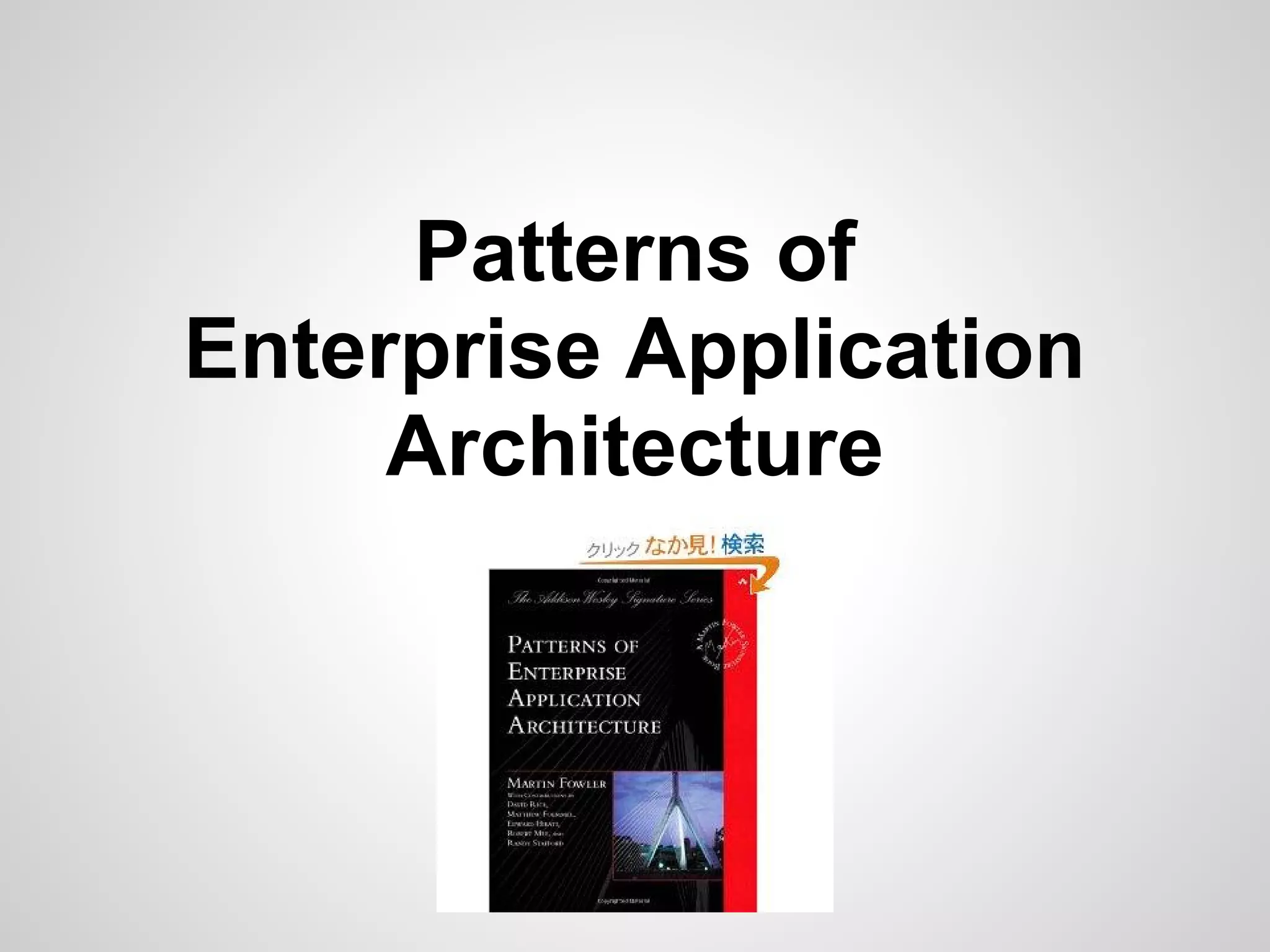
Patterns of
Enterprise Application
Architecture
Design patterns
good to know
for Web Programmers
SQLAlchemy
Quickly
(from tutorial)
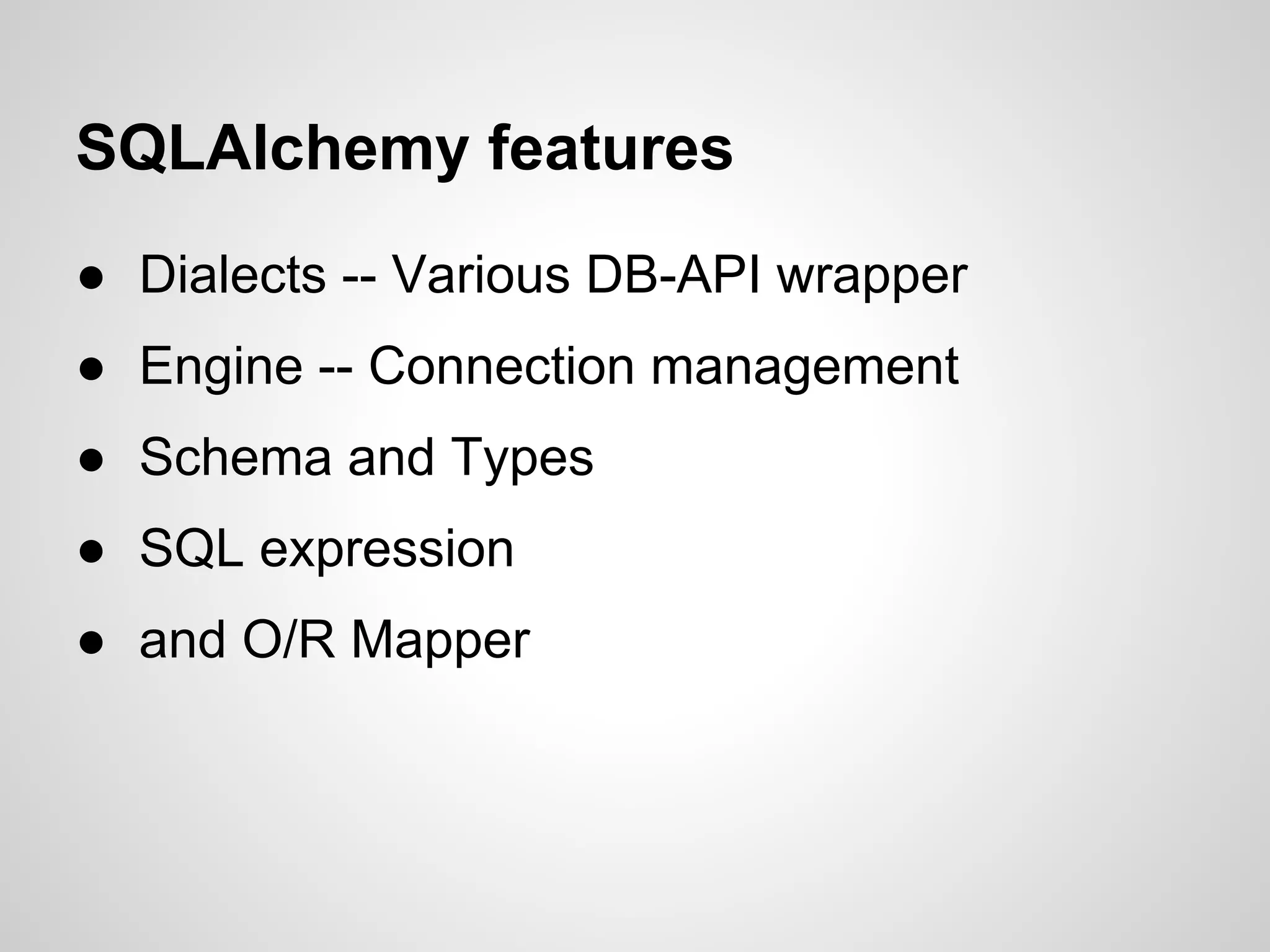
● Dialects -- Various DB-API wrapper
● Engine -- Connection management
● Schema and Types
● SQL expression
● and O/R Mapper
SQLAlchemy features
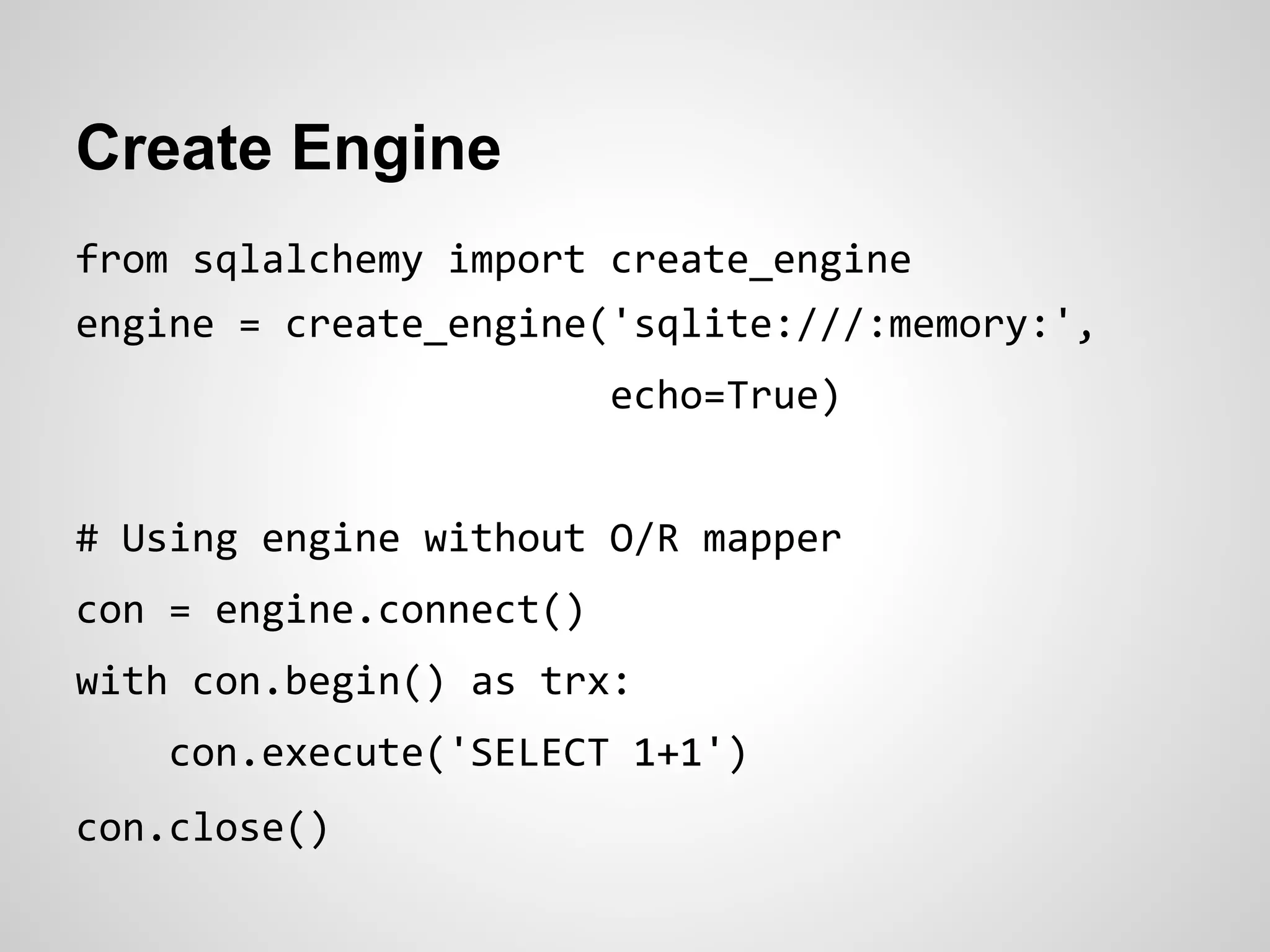
Create Engine
from sqlalchemy import create_engine
engine = create_engine('sqlite:///:memory:',
echo=True)
# Using engine without O/R mapper
con = engine.connect()
with con.begin() as trx:
con.execute('SELECT 1+1')
con.close()
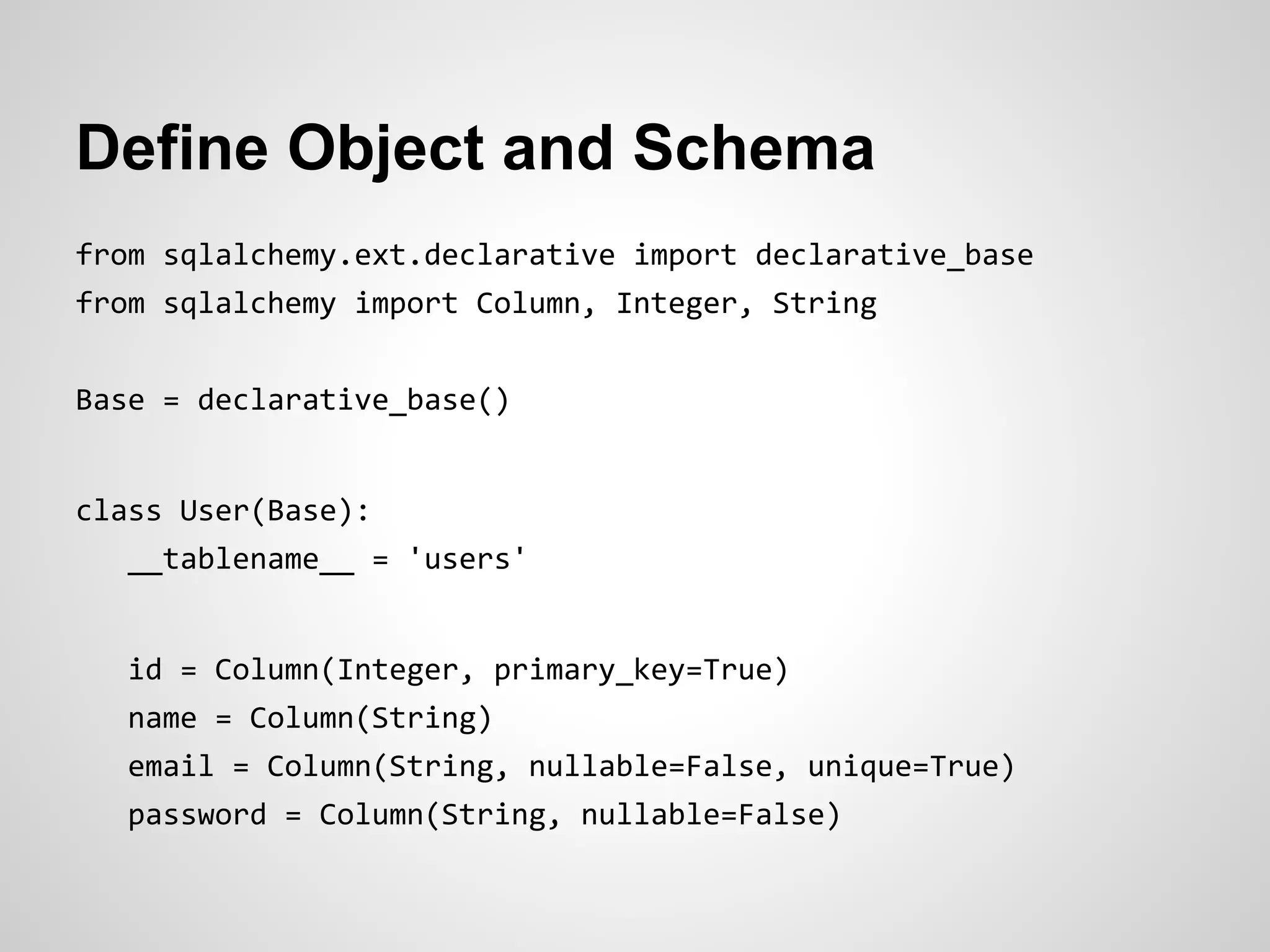
Define Object and Schema
from sqlalchemy.ext.declarative import declarative_base
from sqlalchemy import Column, Integer, String
Base = declarative_base()
class User(Base):
__tablename__ = 'users'
id = Column(Integer, primary_key=True)
name = Column(String)
email = Column(String, nullable=False, unique=True)
password = Column(String, nullable=False)
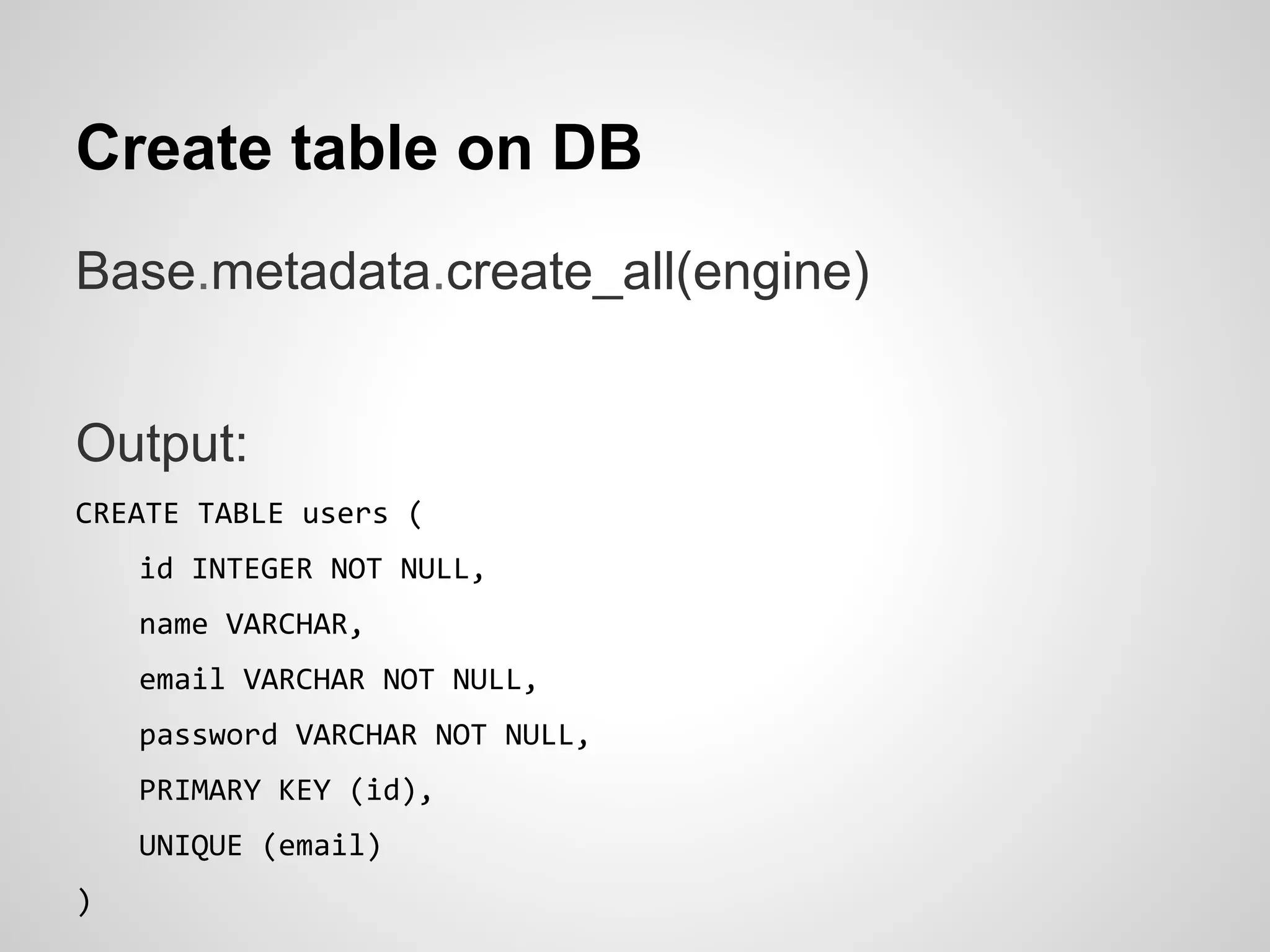
Create table on DB
Base.metadata.create_all(engine)
Output:
CREATE TABLE users (
id INTEGER NOT NULL,
name VARCHAR,
email VARCHAR NOT NULL,
password VARCHAR NOT NULL,
PRIMARY KEY (id),
UNIQUE (email)
)
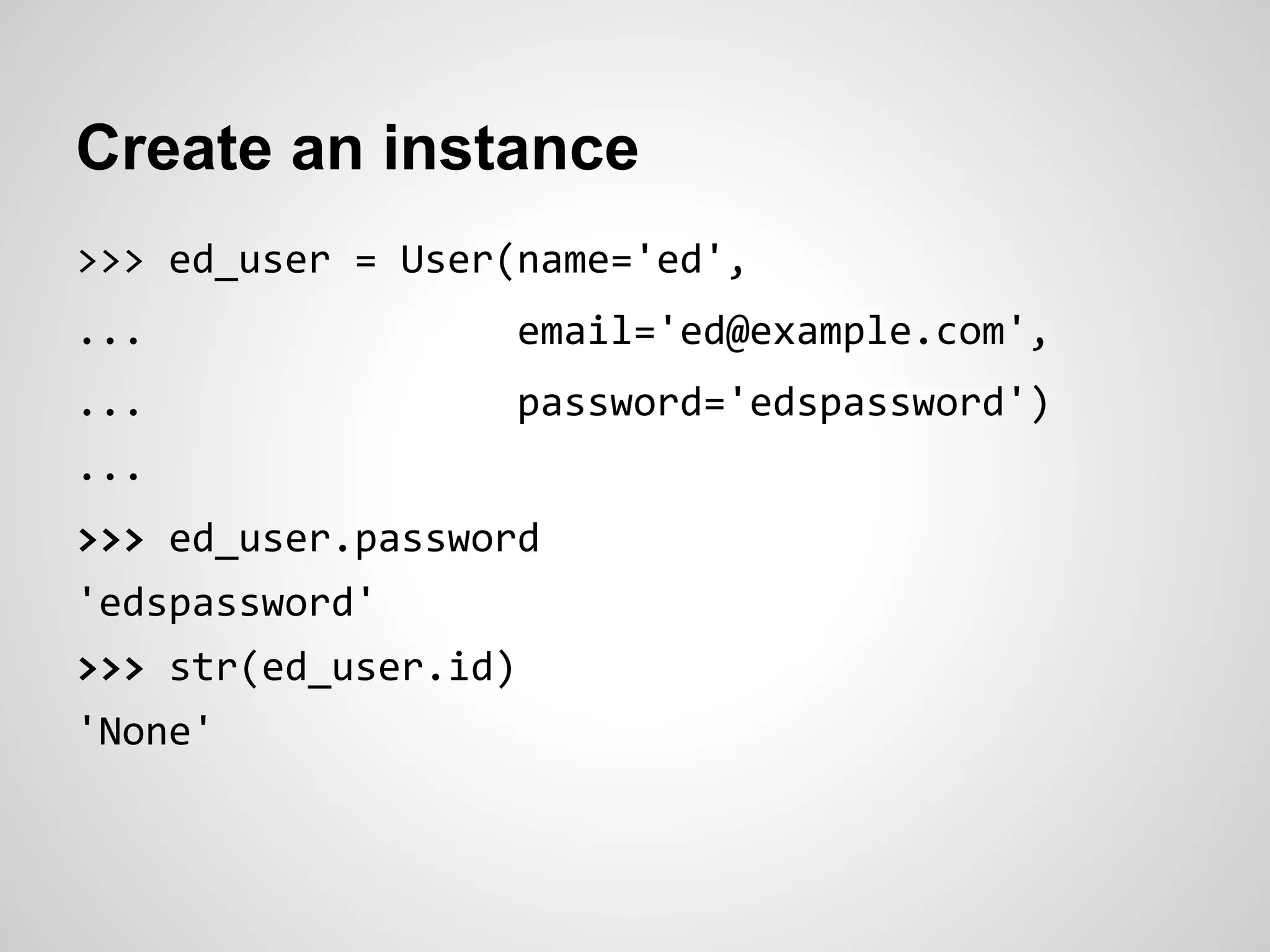
Create an instance
>>> ed_user = User(name='ed',
... email='ed@example.com',
... password='edspassword')
...
>>> ed_user.password
'edspassword'
>>> str(ed_user.id)
'None'
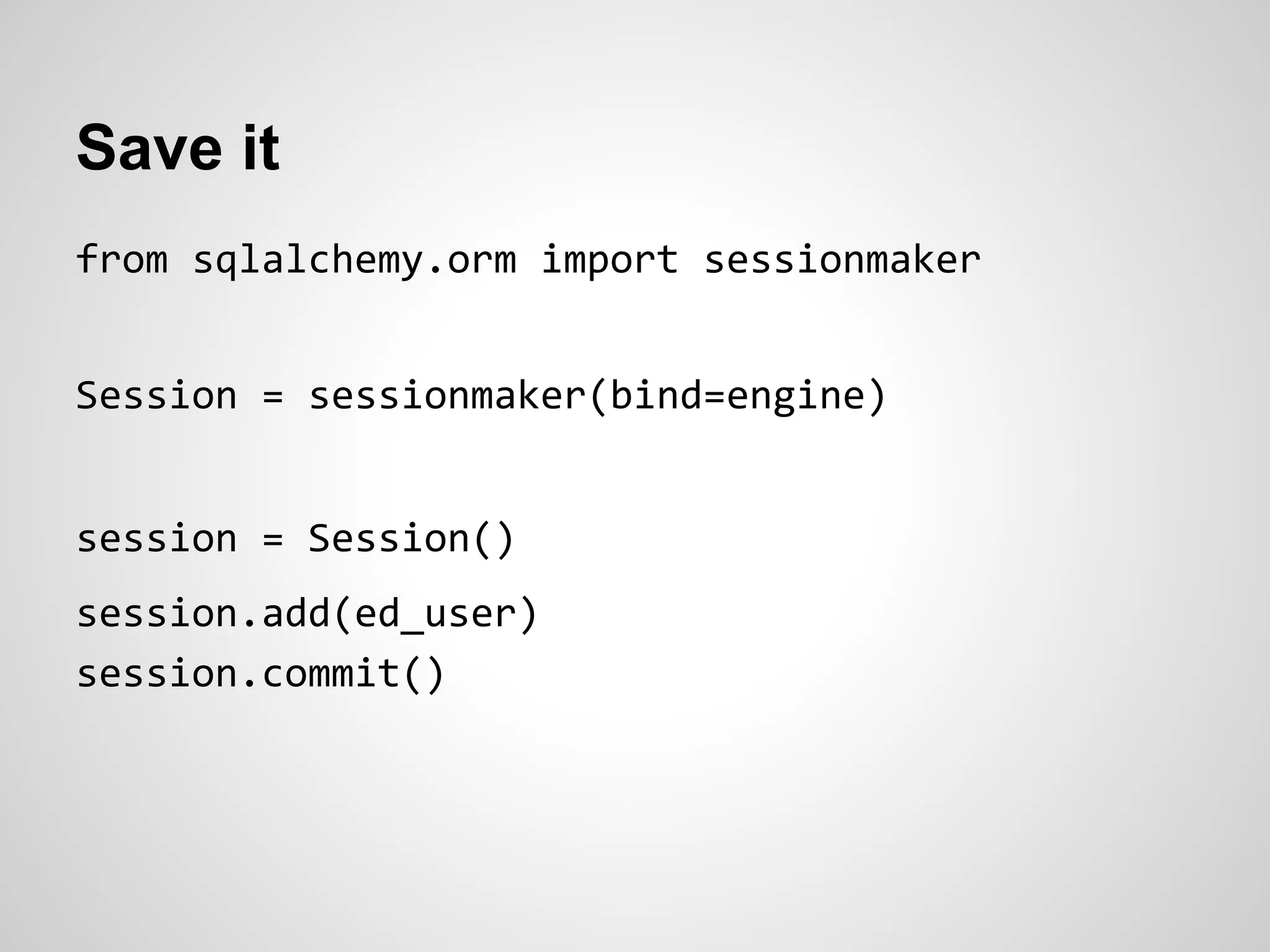
Save it
from sqlalchemy.orm import sessionmaker
Session = sessionmaker(bind=engine)
session = Session()
session.add(ed_user)
session.commit()
Too complicated?
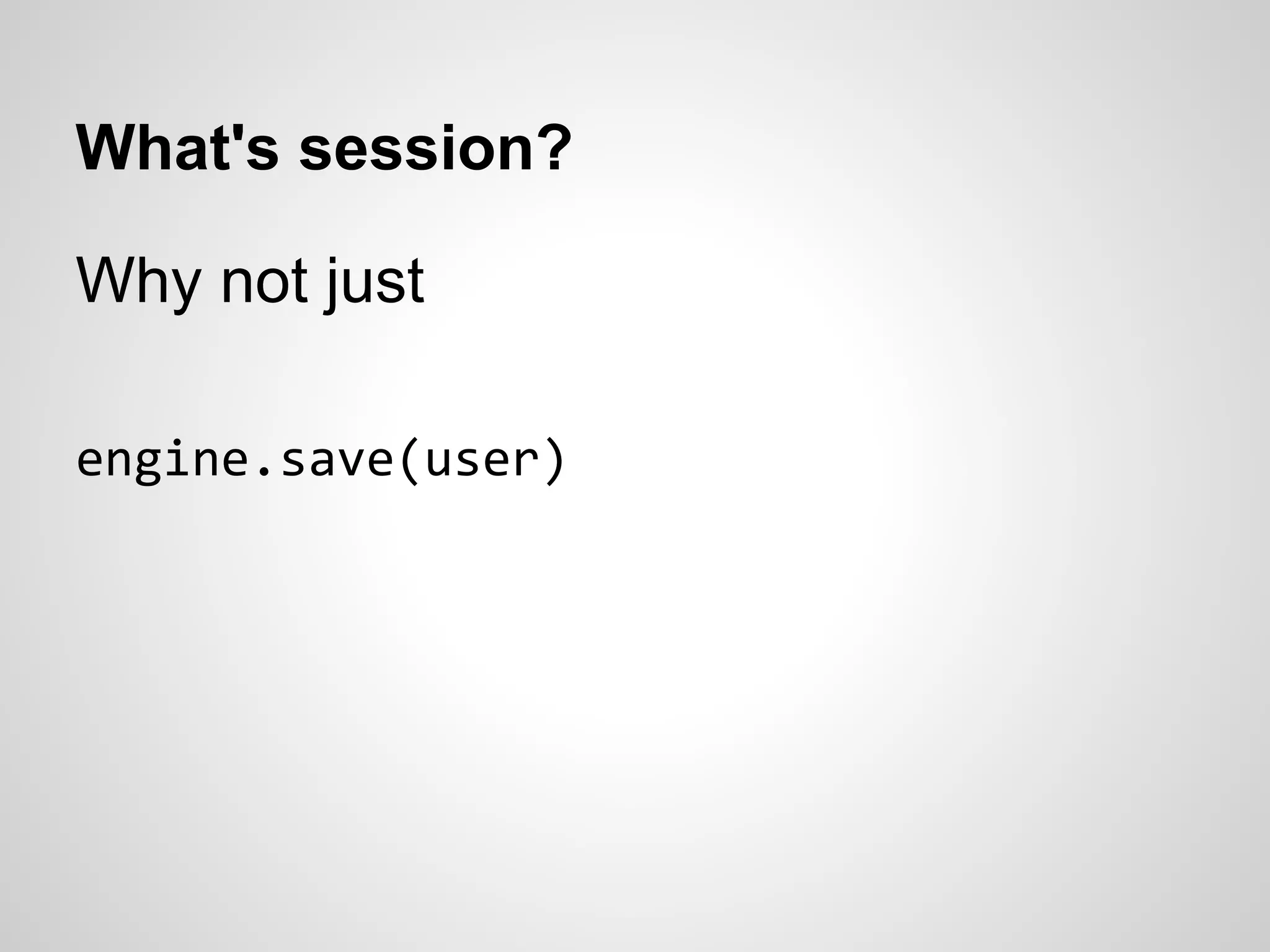
Why not just
engine.save(user)
What's session?
Session is Unit of Work
Unit of Work is
a Pattern
in PofEAA
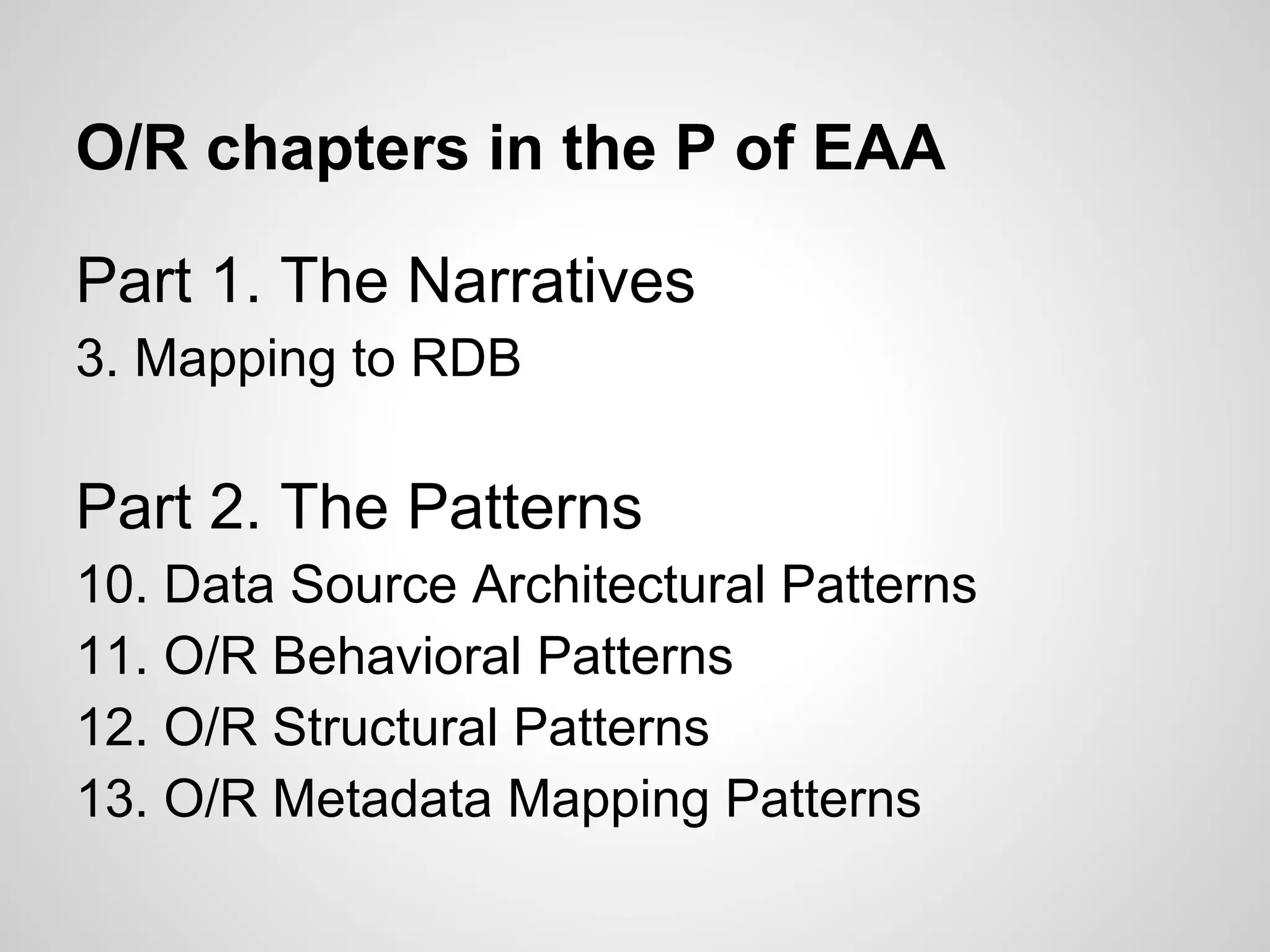
Part 1. The Narratives
3. Mapping to RDB
Part 2. The Patterns
10. Data Source Architectural Patterns
11. O/R Behavioral Patterns
12. O/R Structural Patterns
13. O/R Metadata Mapping Patterns
O/R chapters in the P of EAA
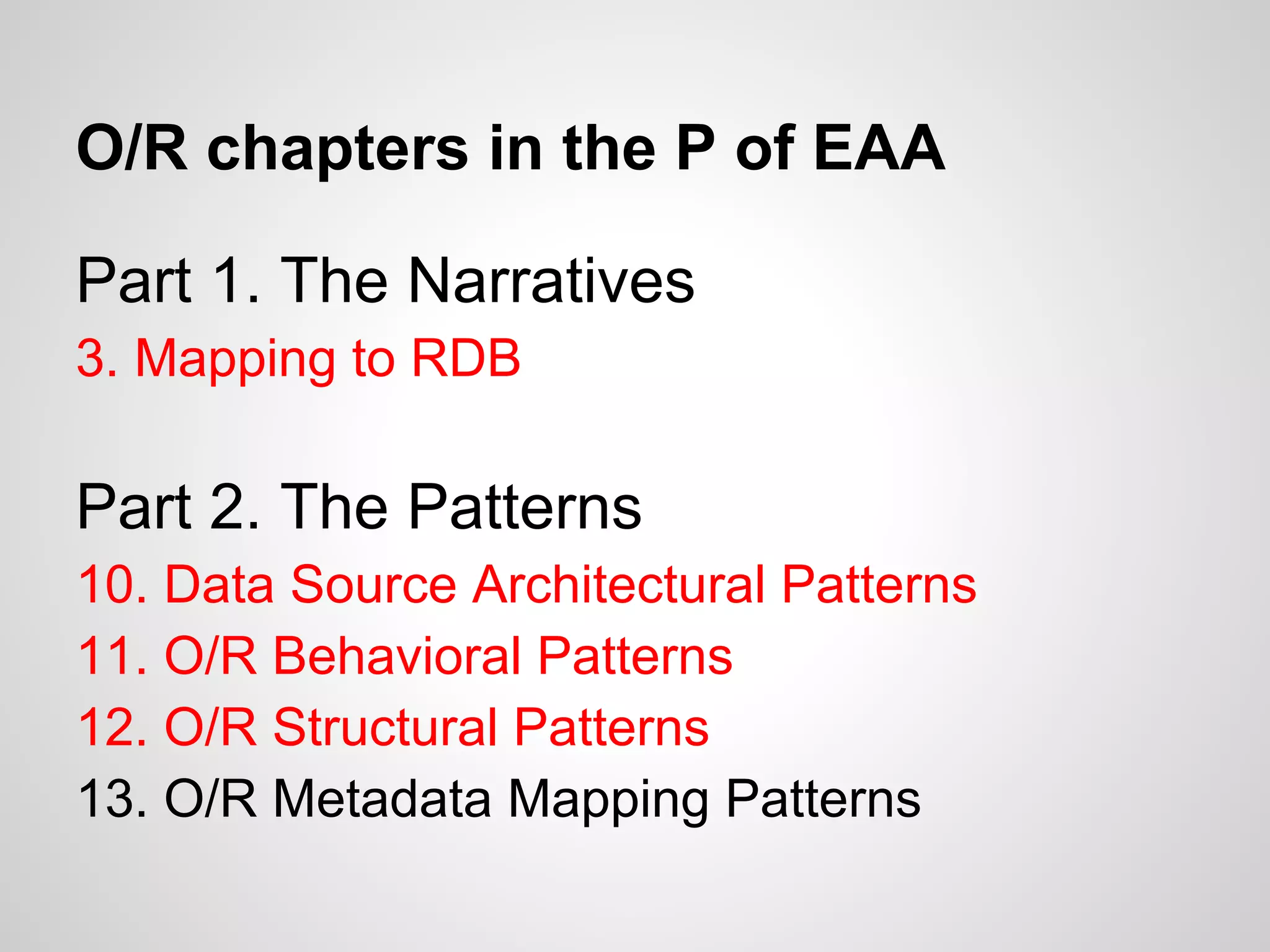
Part 1. The Narratives
3. Mapping to RDB
Part 2. The Patterns
10. Data Source Architectural Patterns
11. O/R Behavioral Patterns
12. O/R Structural Patterns
13. O/R Metadata Mapping Patterns
O/R chapters in the P of EAA
11. O/R Behavioral Patterns
● Unit of Work
● Identity map
● Lazy load
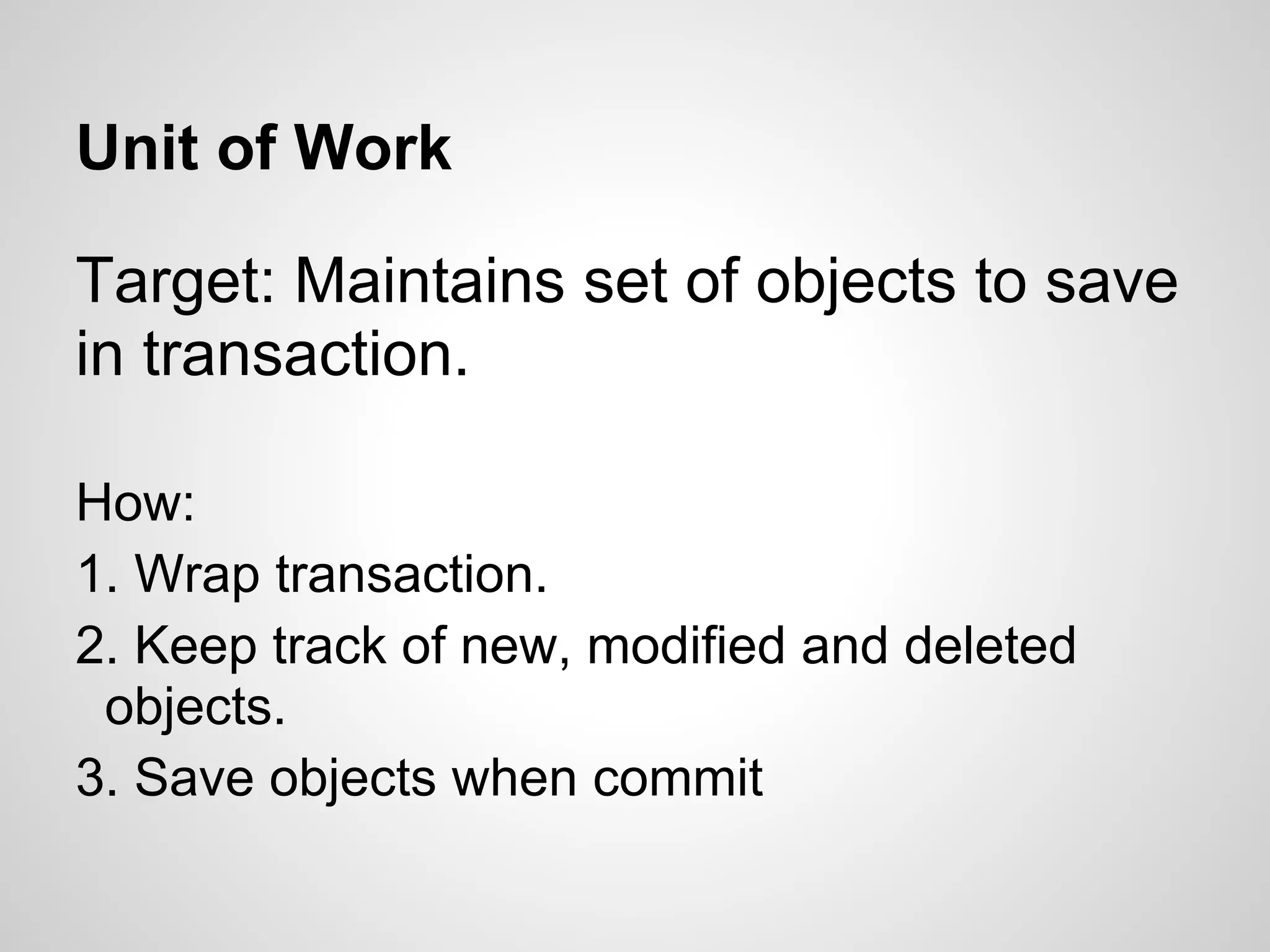
Unit of Work
Target: Maintains set of objects to save
in transaction.
How:
1. Wrap transaction.
2. Keep track of new, modified and deleted
objects.
3. Save objects when commit
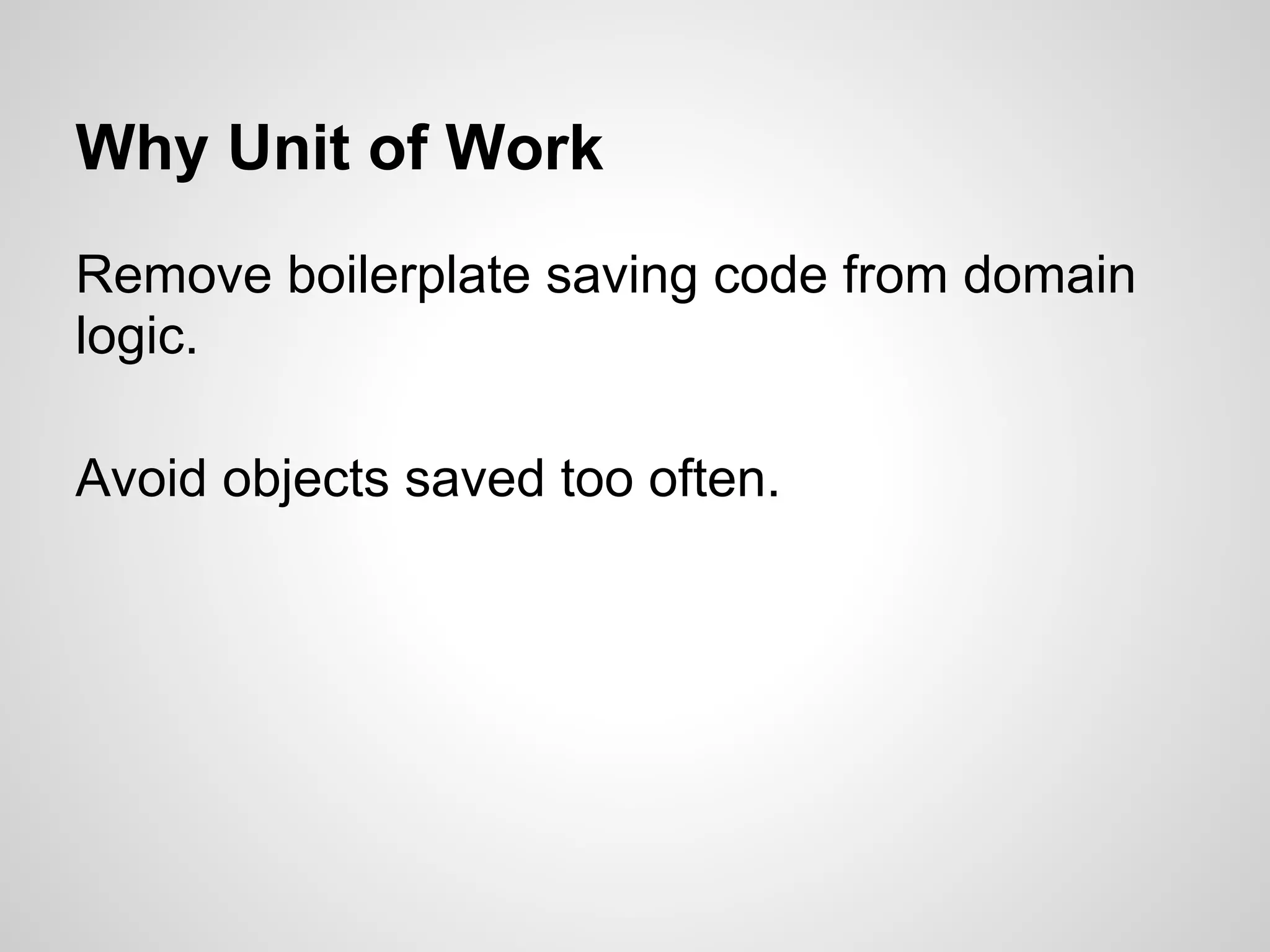
Why Unit of Work
Remove boilerplate saving code from domain
logic.
Avoid objects saved too often.
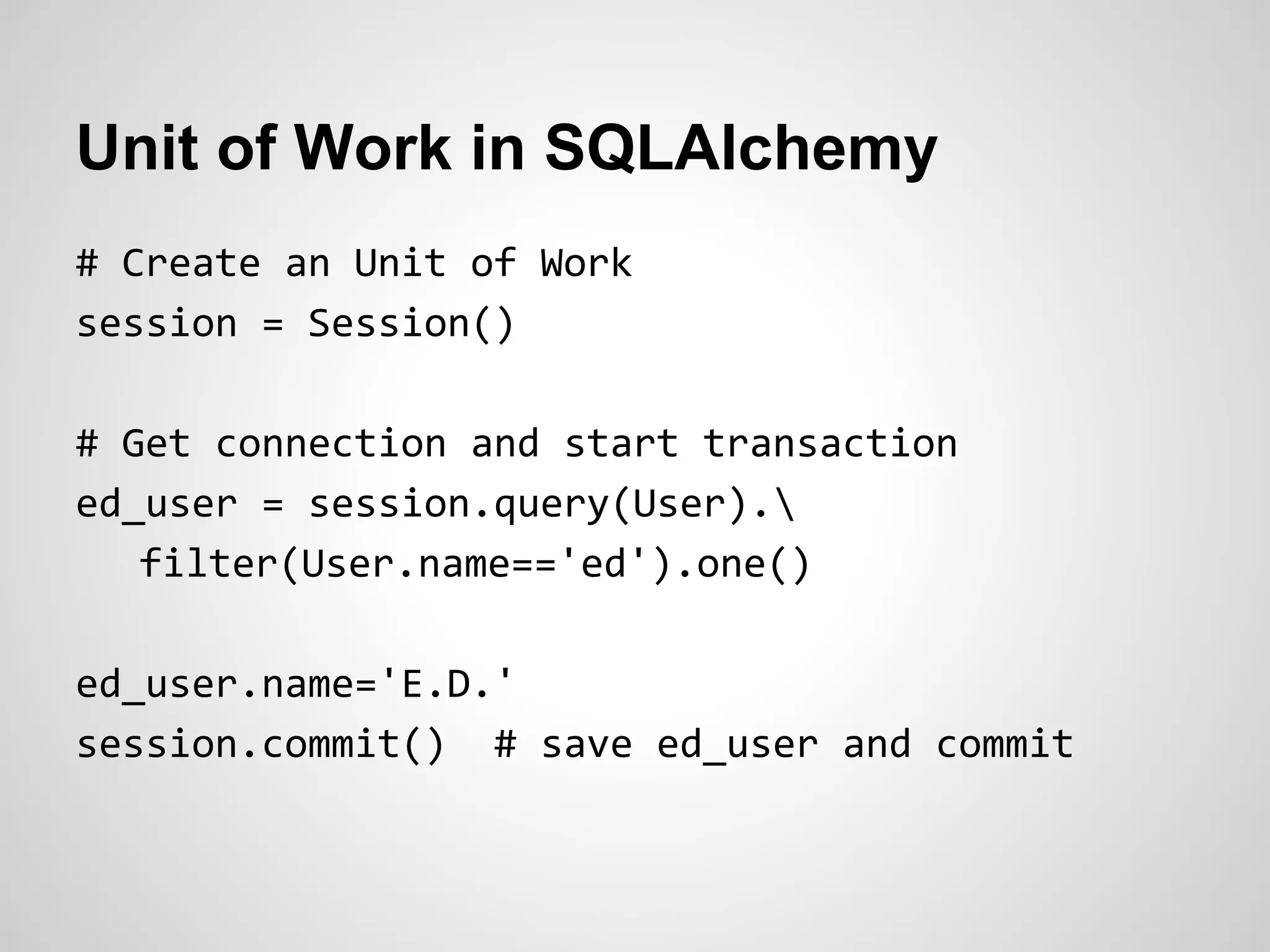
Unit of Work in SQLAlchemy
# Create an Unit of Work
session = Session()
# Get connection and start transaction
ed_user = session.query(User).
filter(User.name=='ed').one()
ed_user.name='E.D.'
session.commit() # save ed_user and commit
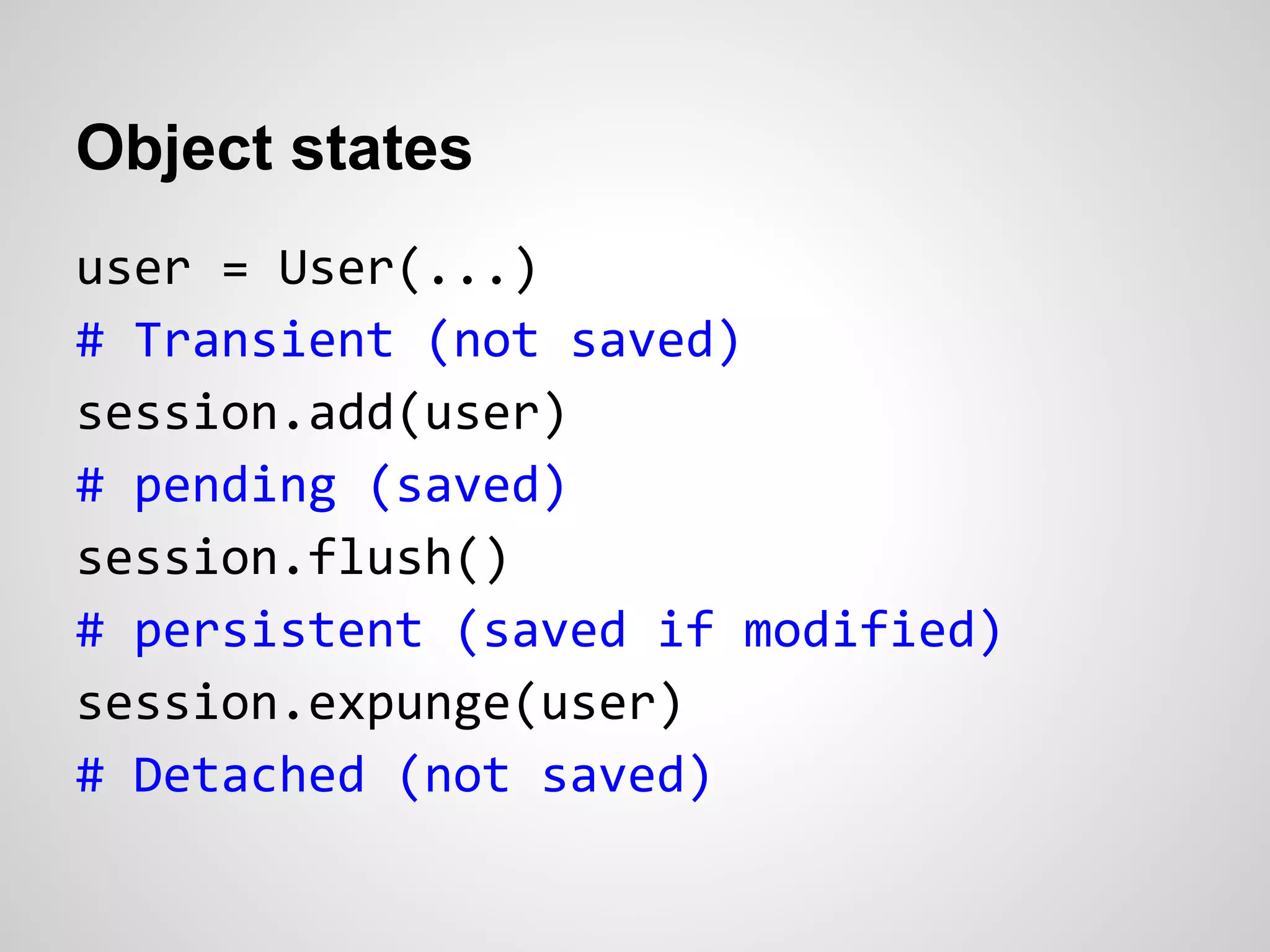
Object states
user = User(...)
# Transient (not saved)
session.add(user)
# pending (saved)
session.flush()
# persistent (saved if modified)
session.expunge(user)
# Detached (not saved)
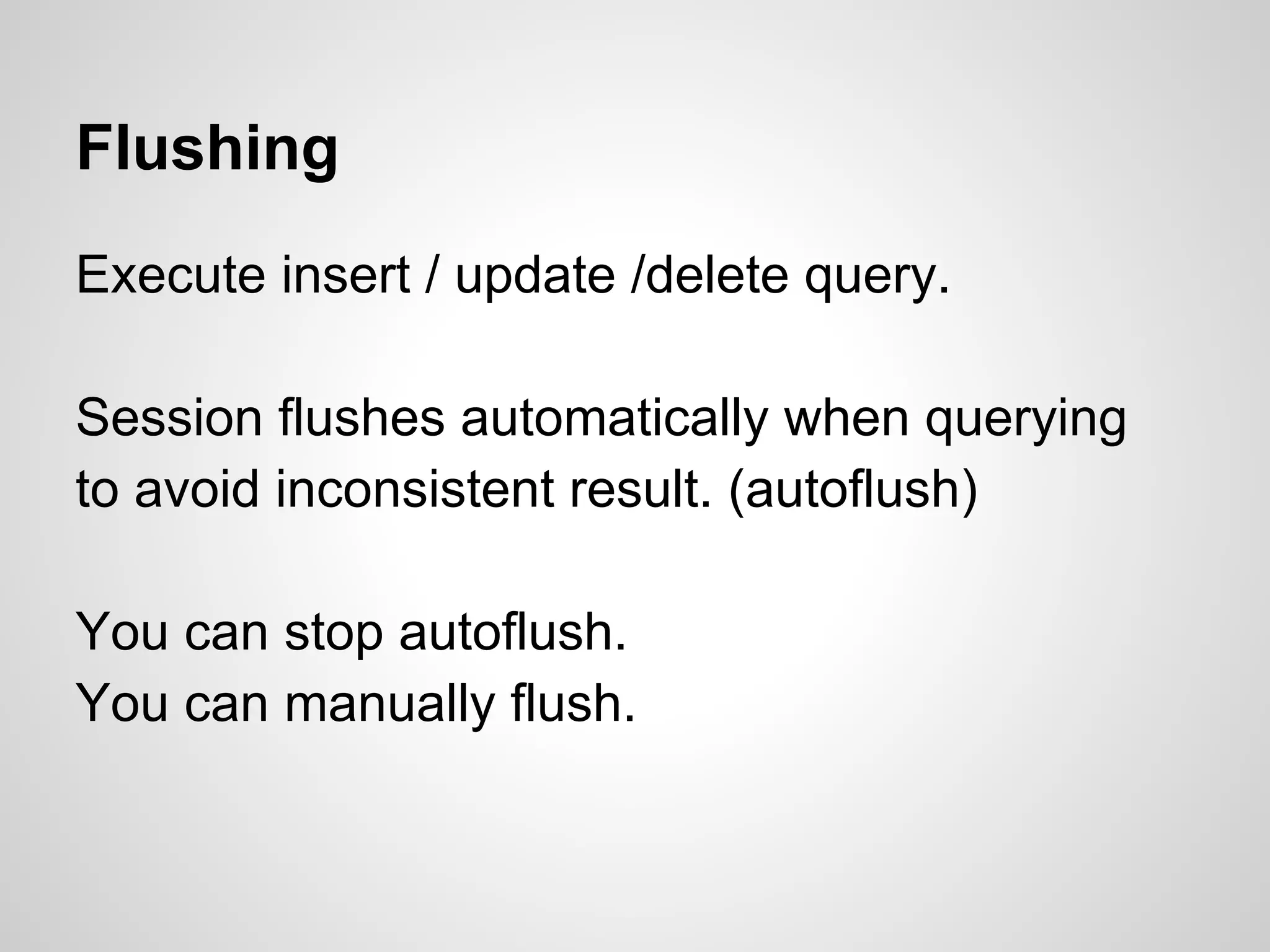
Flushing
Execute insert / update /delete query.
Session flushes automatically when querying
to avoid inconsistent result. (autoflush)
You can stop autoflush.
You can manually flush.
expire -- cause reload
session.expire(user)
print(user.name) # Cause reloading
commit() # expires all objects for consistency.
You can avoid this by
expire_on_commit=False.
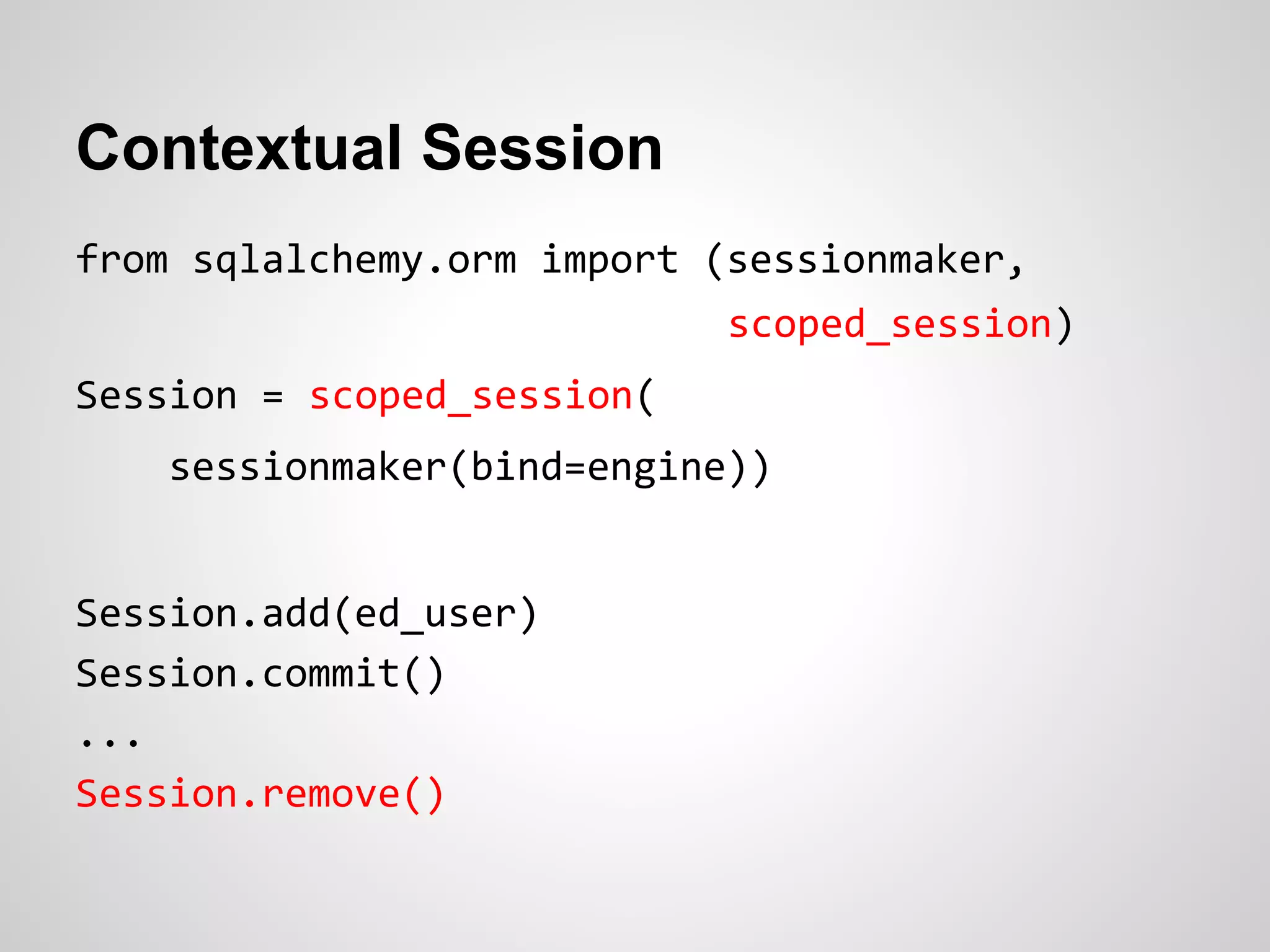
Contextual Session
from sqlalchemy.orm import (sessionmaker,
scoped_session)
Session = scoped_session(
sessionmaker(bind=engine))
Session.add(ed_user)
Session.commit()
...
Session.remove()
11. O/R Behavioral Patterns
● Unit of Work
● Identity map
● Lazy load
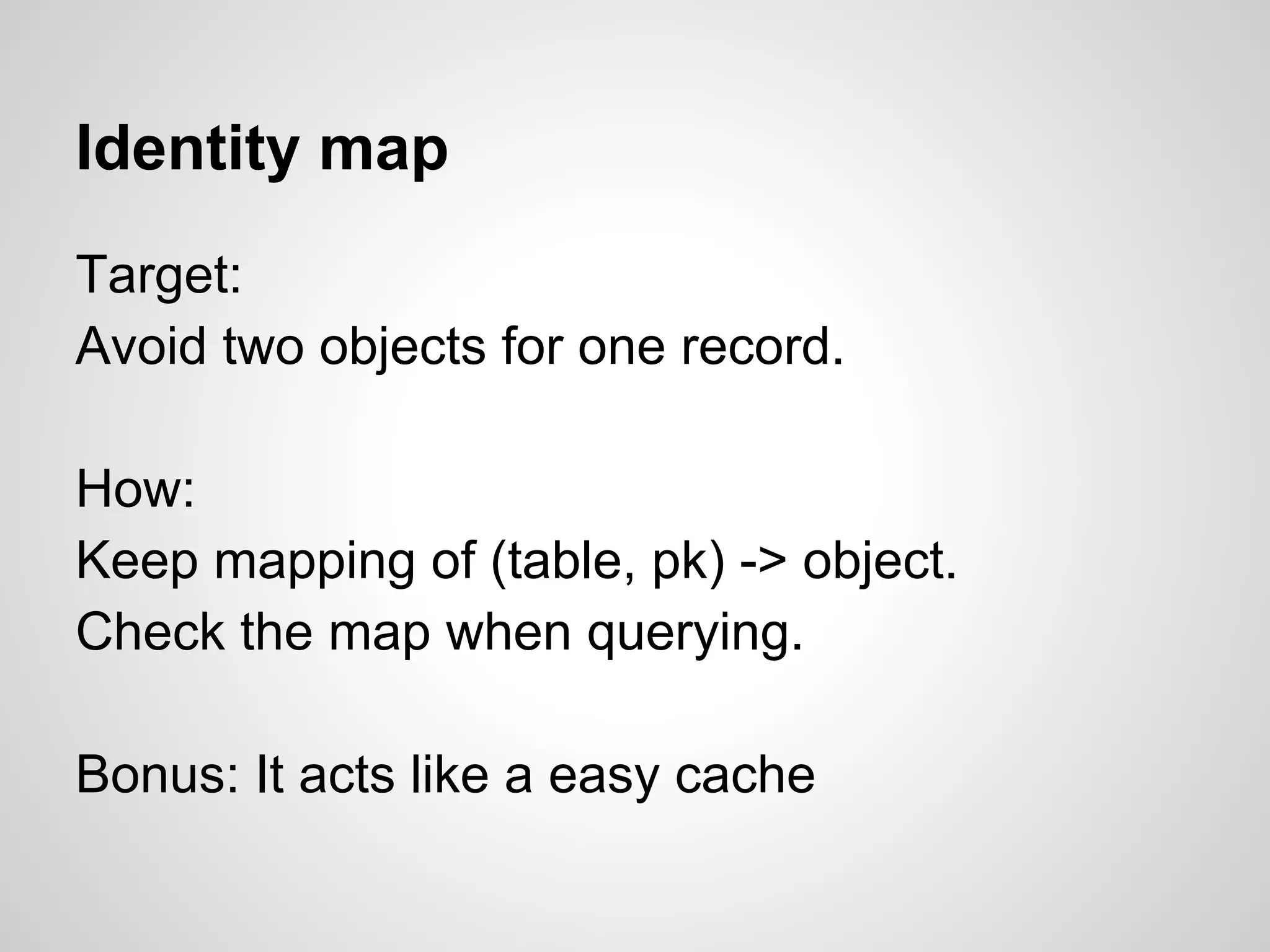
Target:
Avoid two objects for one record.
How:
Keep mapping of (table, pk) -> object.
Check the map when querying.
Bonus: It acts like a easy cache
Identity map
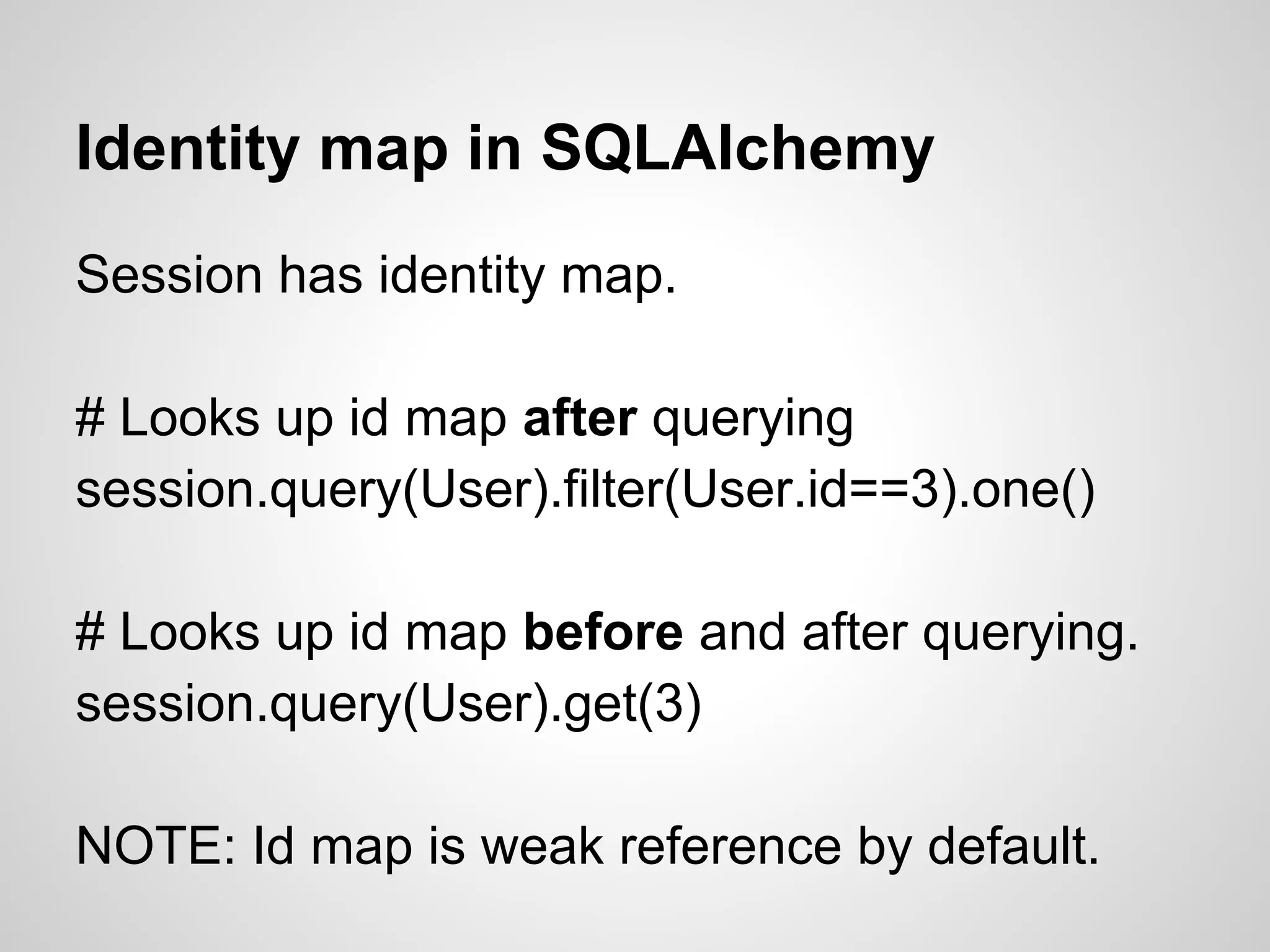
Identity map in SQLAlchemy
Session has identity map.
# Looks up id map after querying
session.query(User).filter(User.id==3).one()
# Looks up id map before and after querying.
session.query(User).get(3)
NOTE: Id map is weak reference by default.
11. O/R Behavioral Patterns
● Unit of Work
● Identity map
● Lazy load
Lazy Load
Load relation or heavy column on demand.
Lazy loading relationship
http://docs.sqlalchemy.
org/en/rel_0_8/orm/loading.html
SQLAlchemy uses lazy loading by default for
relationship.
You can choose eager loading strategy.
Lazy loading big column
http://docs.sqlalchemy.
org/en/rel_0_8/orm/mapper_config.
html#deferred-column-loading
SQLAlchemy supports deferred column to
lazy loading big BLOB/TEXT.
O/R Structural Pattern
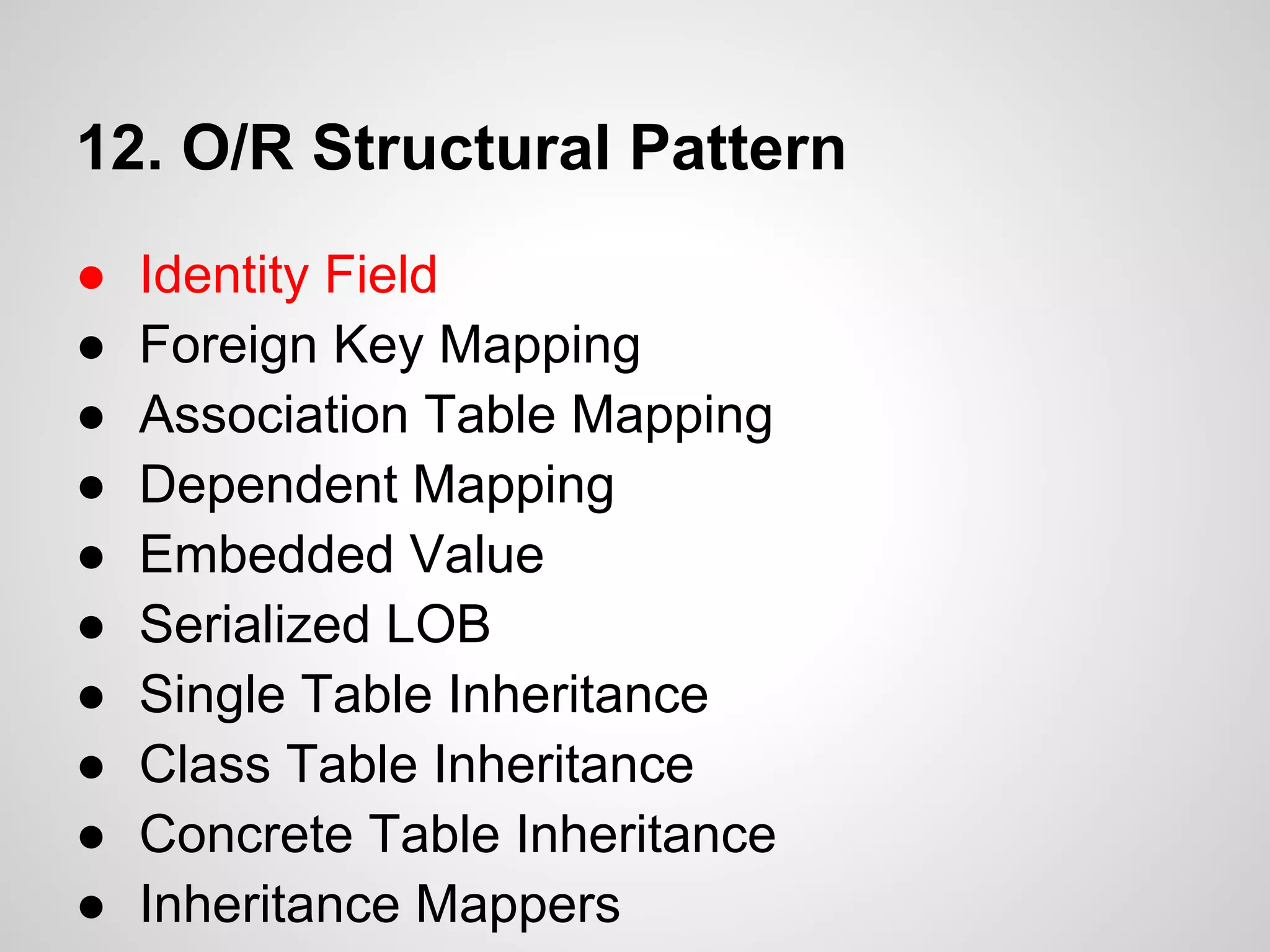
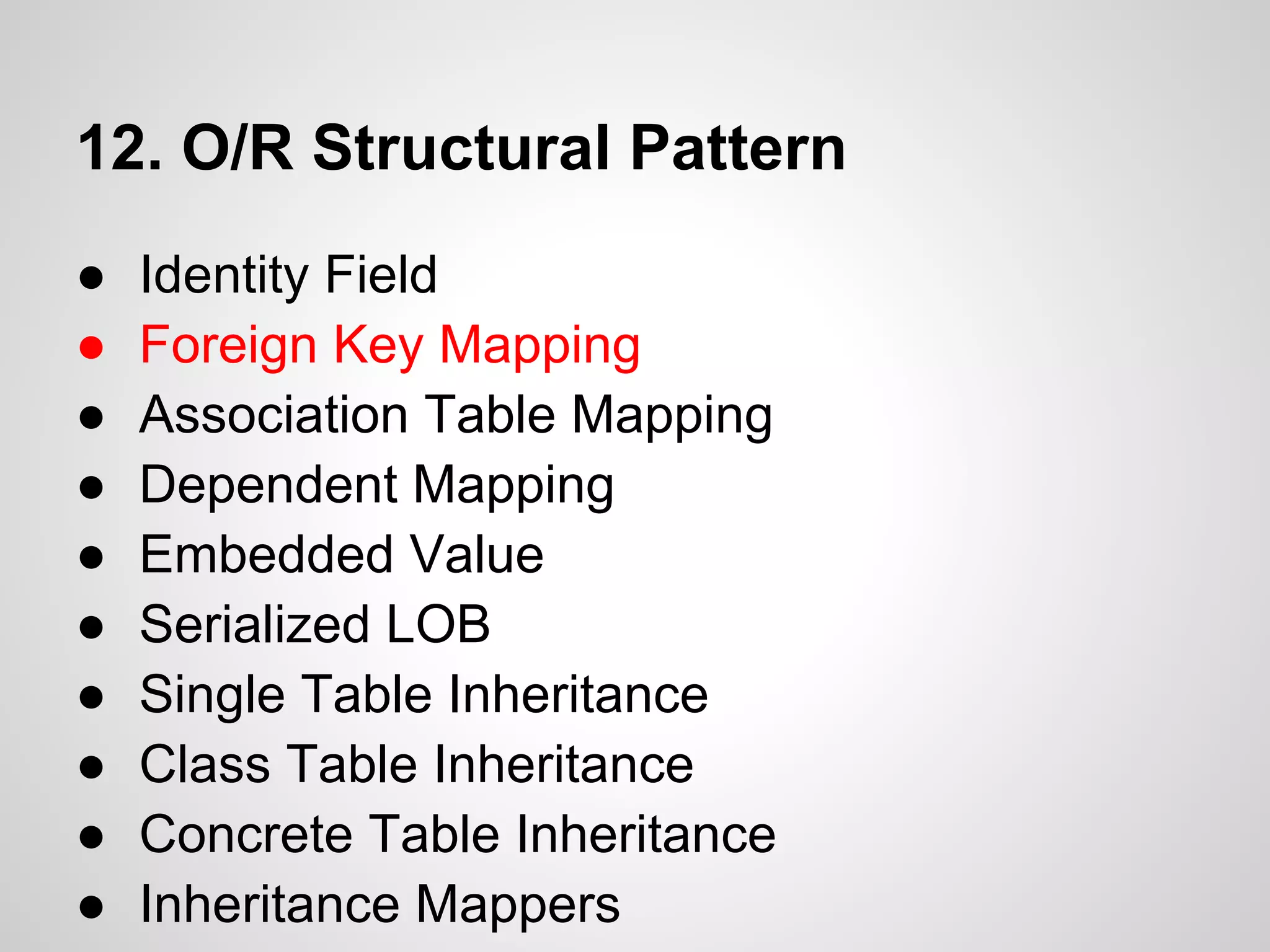
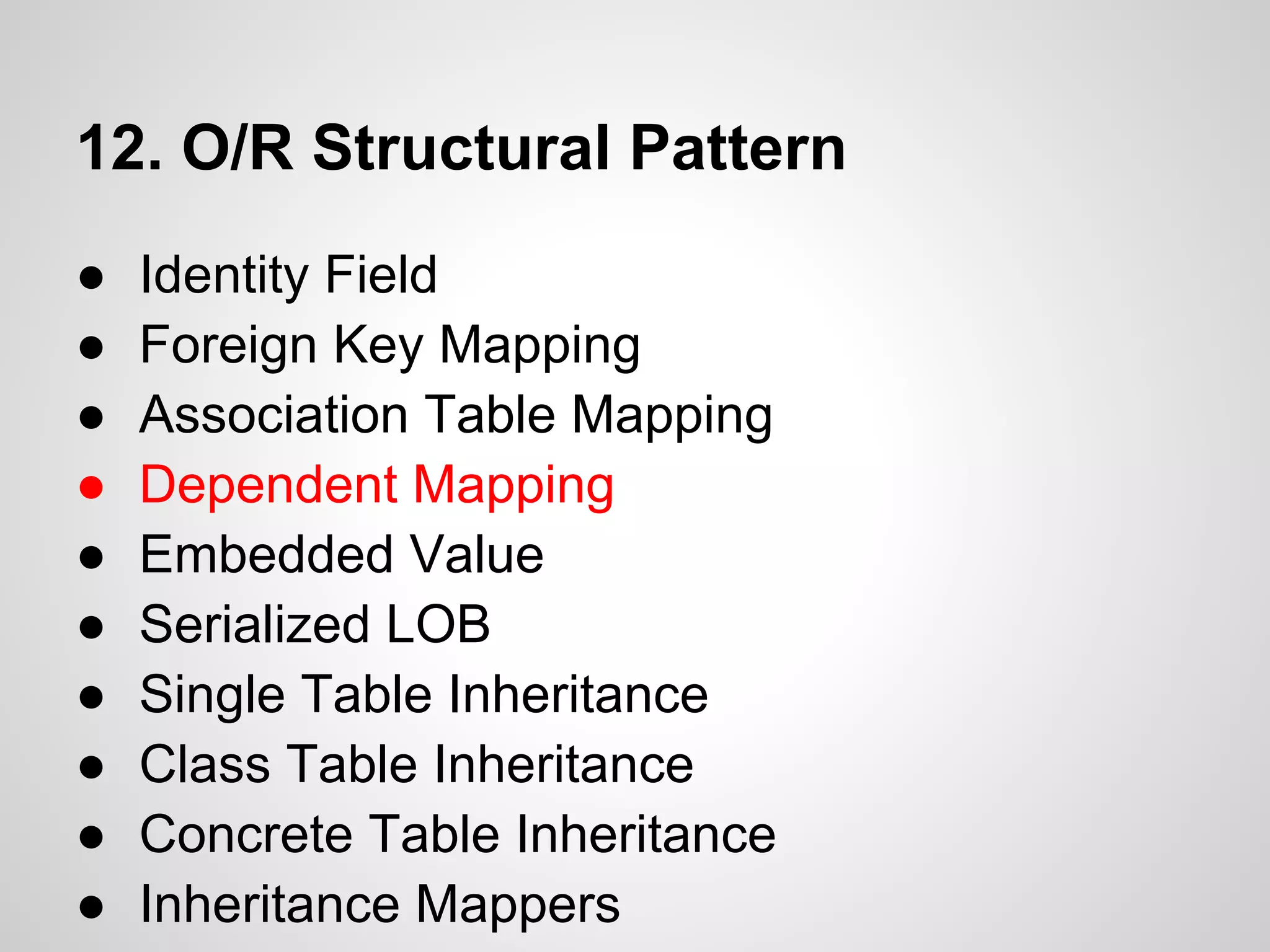
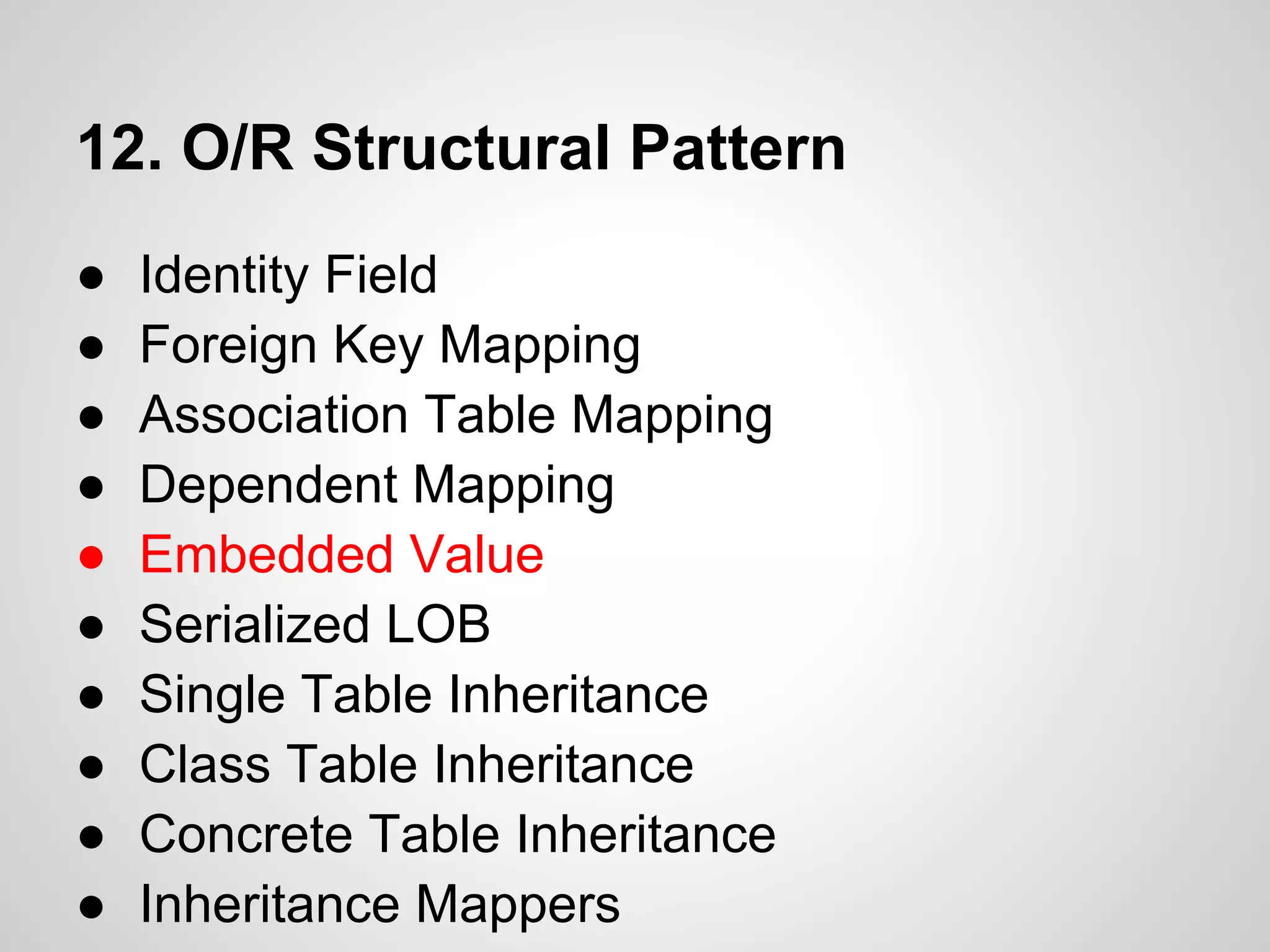
12. O/R Structural Pattern
● Identity Field
● Foreign Key Mapping
● Association Table Mapping
● Dependent Mapping
● Embedded Value
● Serialized LOB
● Single Table Inheritance
● Class Table Inheritance
● Concrete Table Inheritance
● Inheritance Mappers
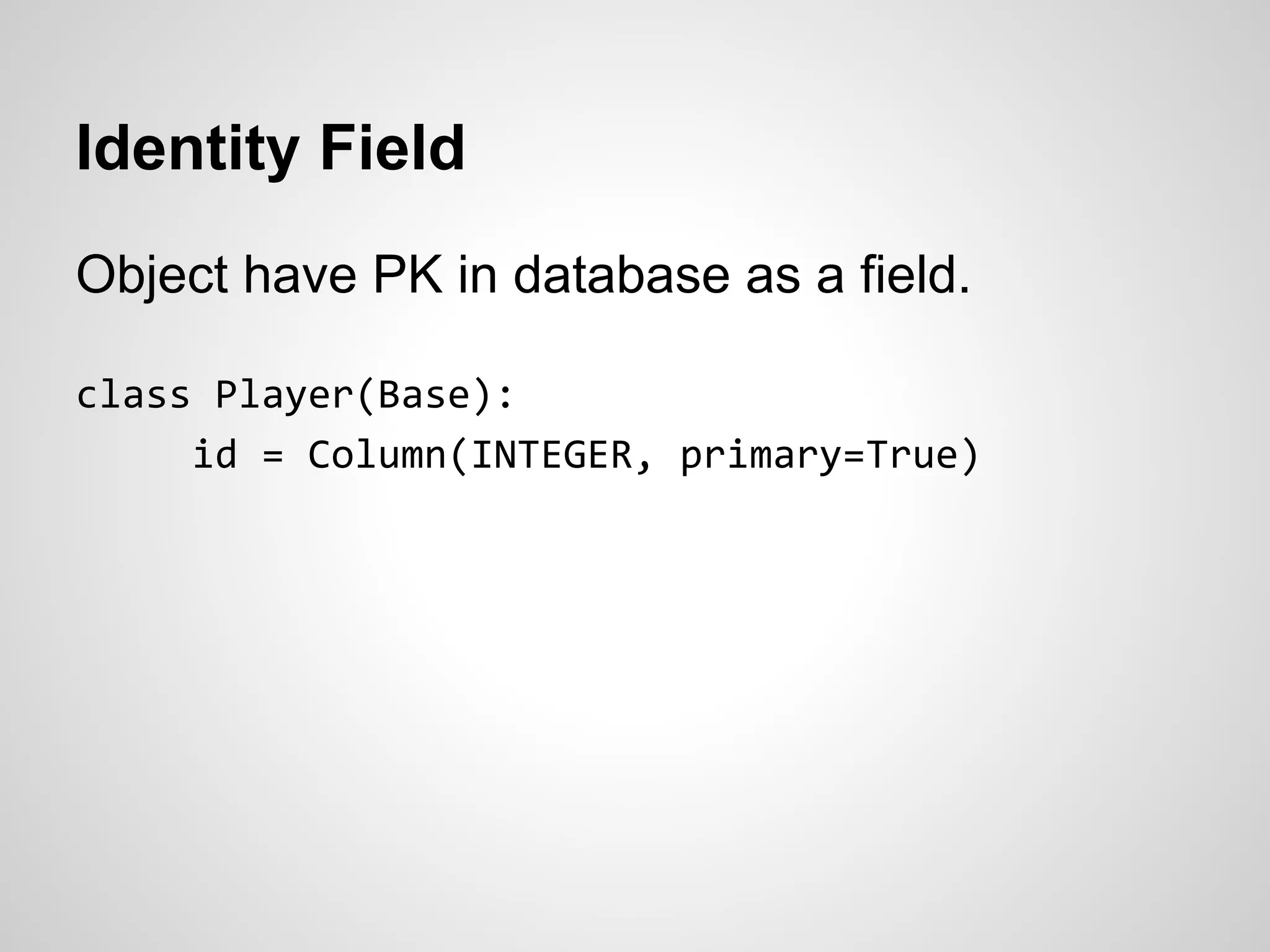
Object have PK in database as a field.
class Player(Base):
id = Column(INTEGER, primary=True)
Identity Field
12. O/R Structural Pattern
● Identity Field
● Foreign Key Mapping
● Association Table Mapping
● Dependent Mapping
● Embedded Value
● Serialized LOB
● Single Table Inheritance
● Class Table Inheritance
● Concrete Table Inheritance
● Inheritance Mappers
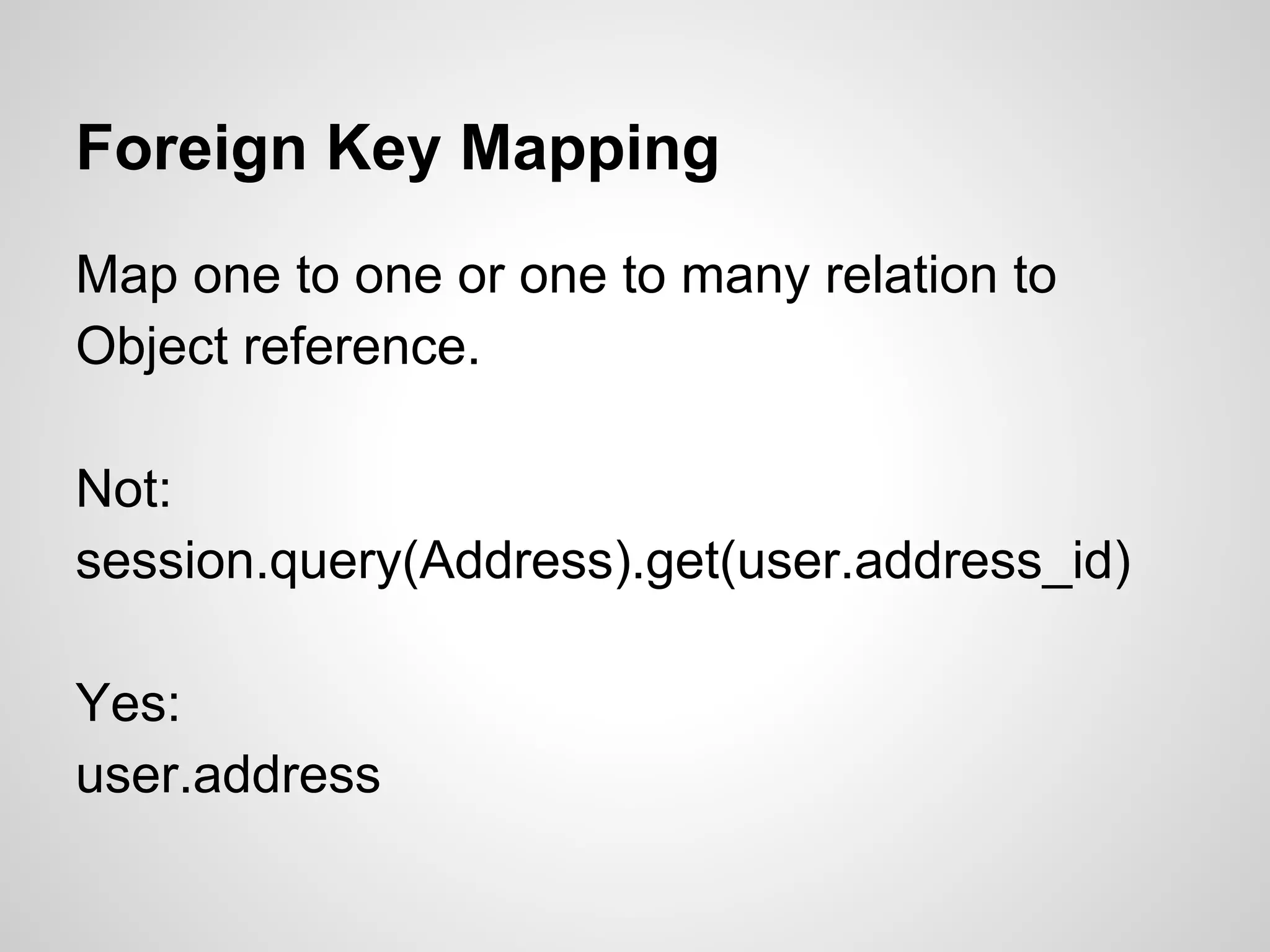
Map one to one or one to many relation to
Object reference.
Not:
session.query(Address).get(user.address_id)
Yes:
user.address
Foreign Key Mapping
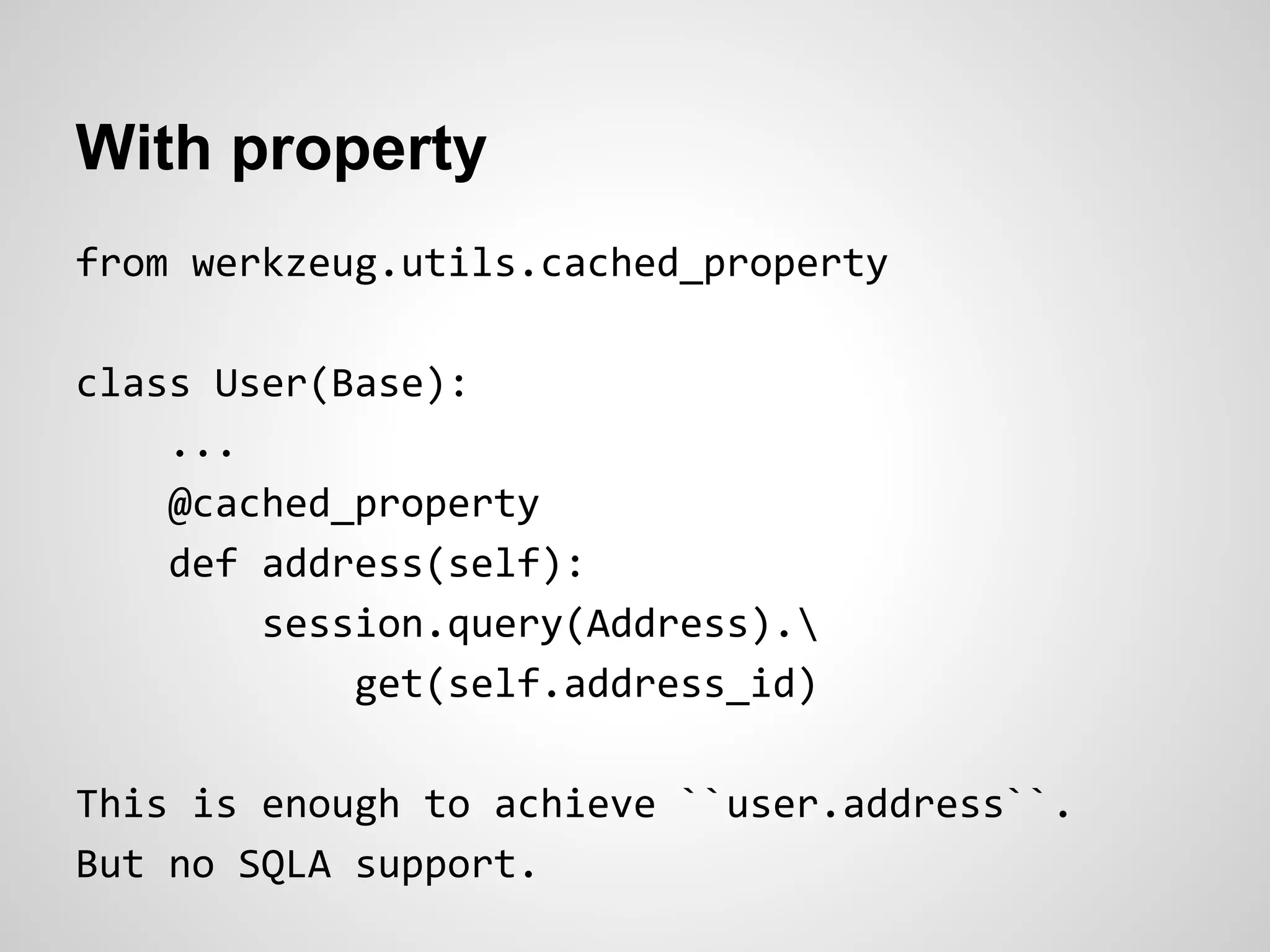
With property
from werkzeug.utils.cached_property
class User(Base):
...
@cached_property
def address(self):
session.query(Address).
get(self.address_id)
This is enough to achieve ``user.address``.
But no SQLA support.
relationship
class User(Base):
...
addresses = relationship('Address',
backref='user')
class Address(Base):
...
user_id = Column(Integer,
ForeignKey('user.id'))
12. O/R Structural Pattern
● Identity Field
● Foreign Key Mapping
● Association Table Mapping
● Dependent Mapping
● Embedded Value
● Serialized LOB
● Single Table Inheritance
● Class Table Inheritance
● Concrete Table Inheritance
● Inheritance Mappers
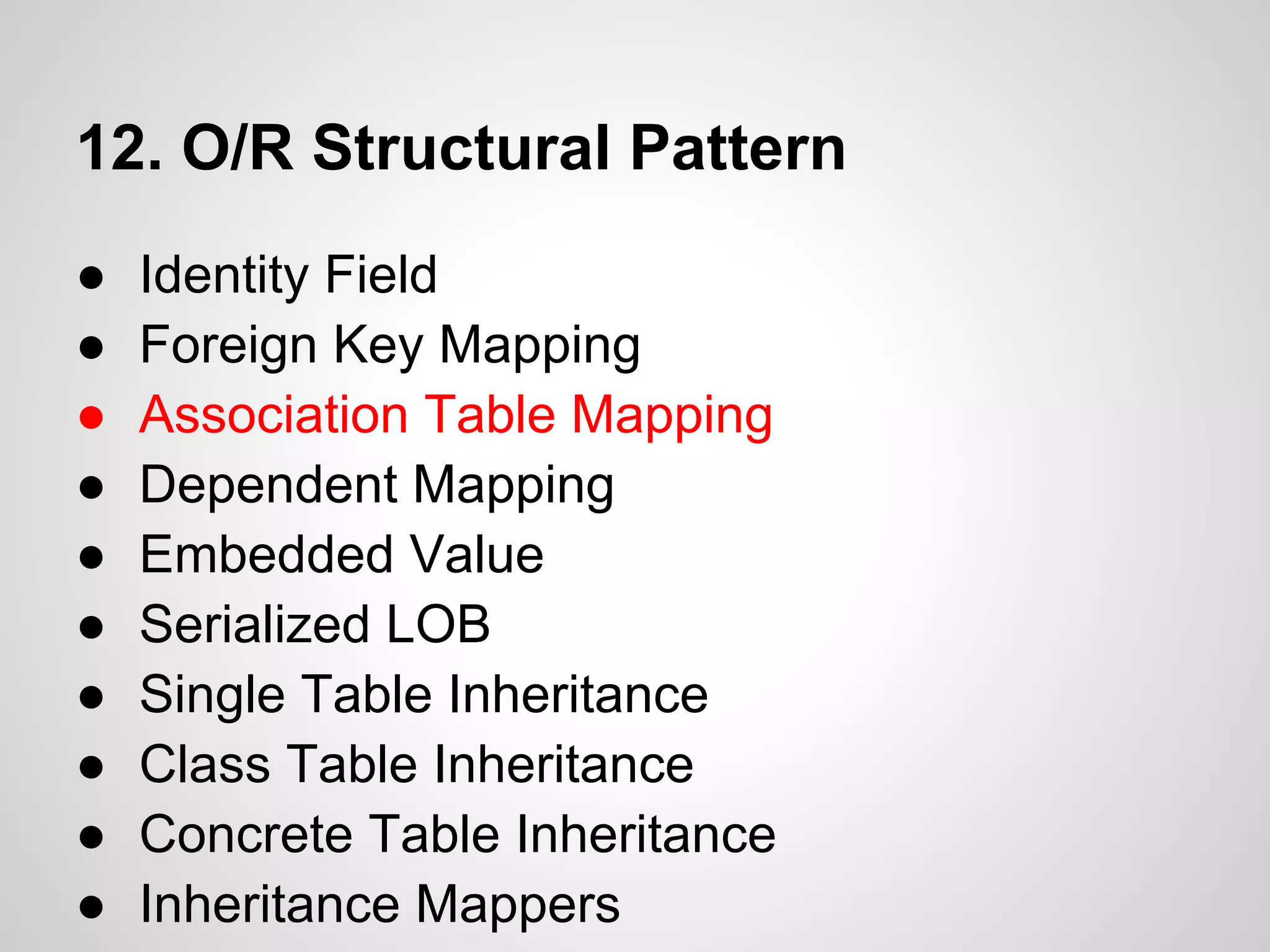
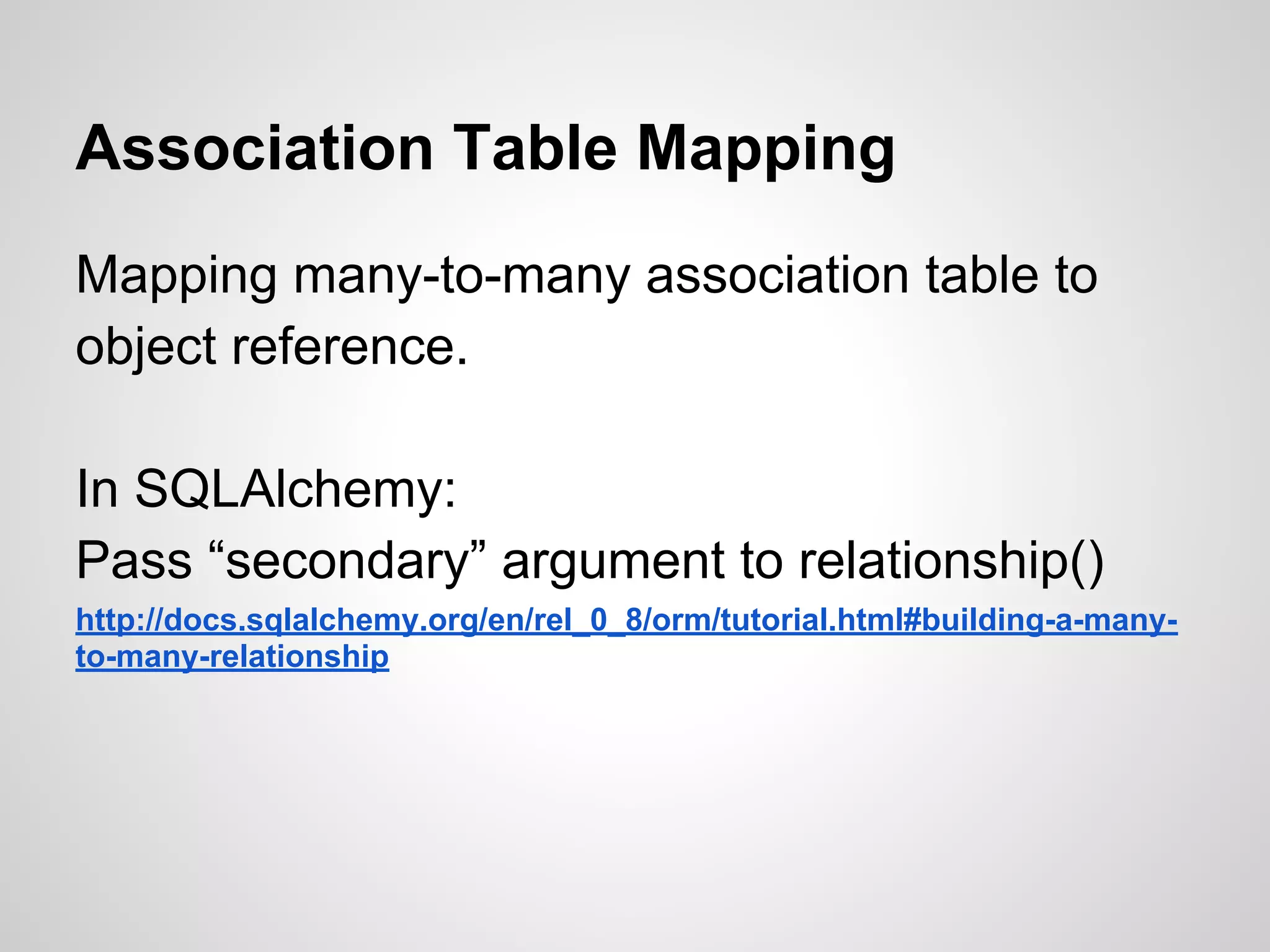
Association Table Mapping
Mapping many-to-many association table to
object reference.
In SQLAlchemy:
Pass “secondary” argument to relationship()
http://docs.sqlalchemy.org/en/rel_0_8/orm/tutorial.html#building-a-many-
to-many-relationship
12. O/R Structural Pattern
● Identity Field
● Foreign Key Mapping
● Association Table Mapping
● Dependent Mapping
● Embedded Value
● Serialized LOB
● Single Table Inheritance
● Class Table Inheritance
● Concrete Table Inheritance
● Inheritance Mappers
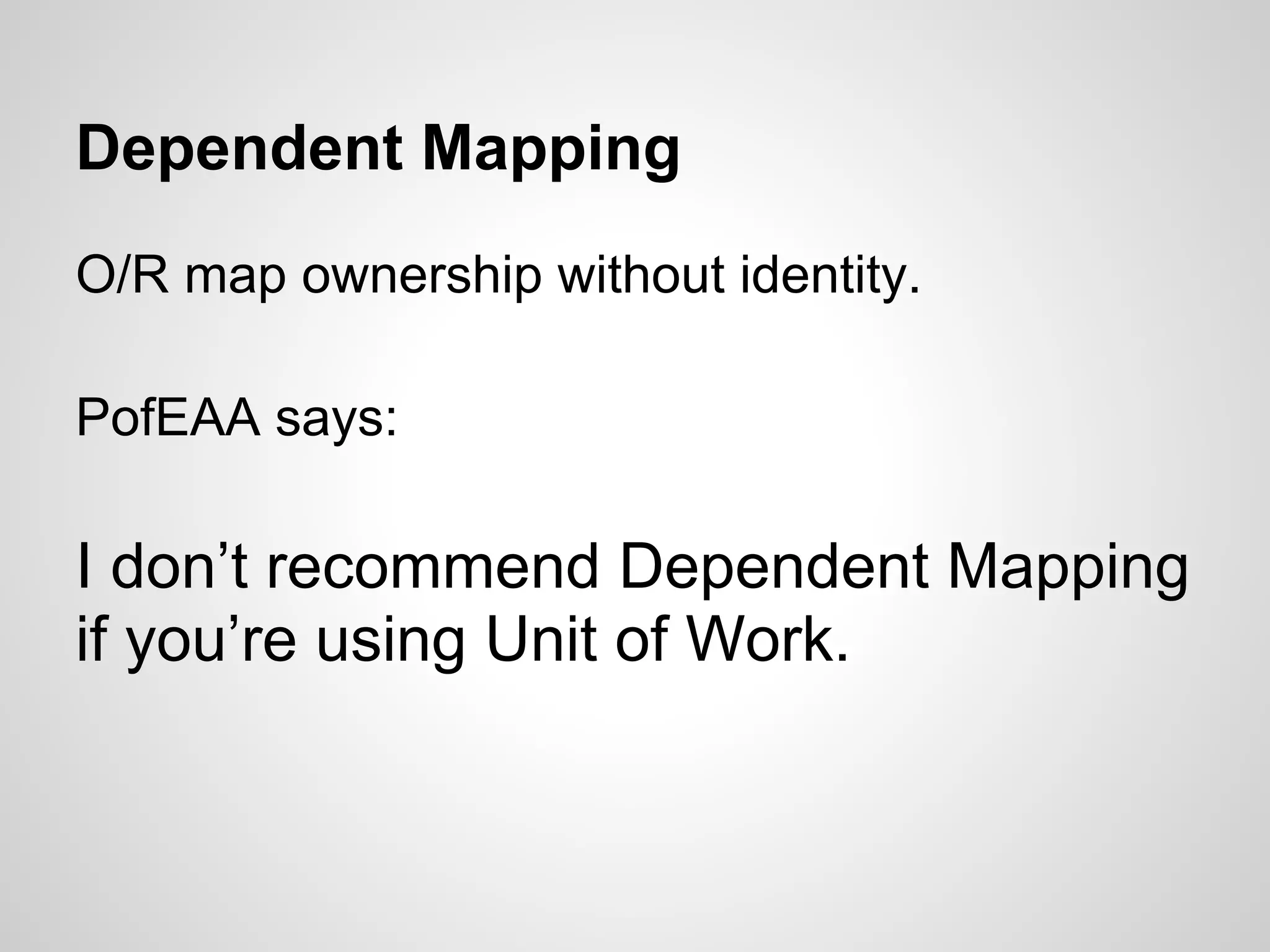
Dependent Mapping
O/R map ownership without identity.
PofEAA says:
I don’t recommend Dependent Mapping
if you’re using Unit of Work.
12. O/R Structural Pattern
● Identity Field
● Foreign Key Mapping
● Association Table Mapping
● Dependent Mapping
● Embedded Value
● Serialized LOB
● Single Table Inheritance
● Class Table Inheritance
● Concrete Table Inheritance
● Inheritance Mappers
Embedded Value
Map an object to some columns in a row.
class Duration:
start_date
end_date
class Account:
duration
CREATE TABLE account (
…
start_date DATE,
end_date DATE,
…
);
Embedded Value by property
@property
def duration(self):
return Duration(
self.start_date, self.end_date)
@duration.setter
def duration(self, duration):
self.start_date = duration.start
self.end_date = duration.end
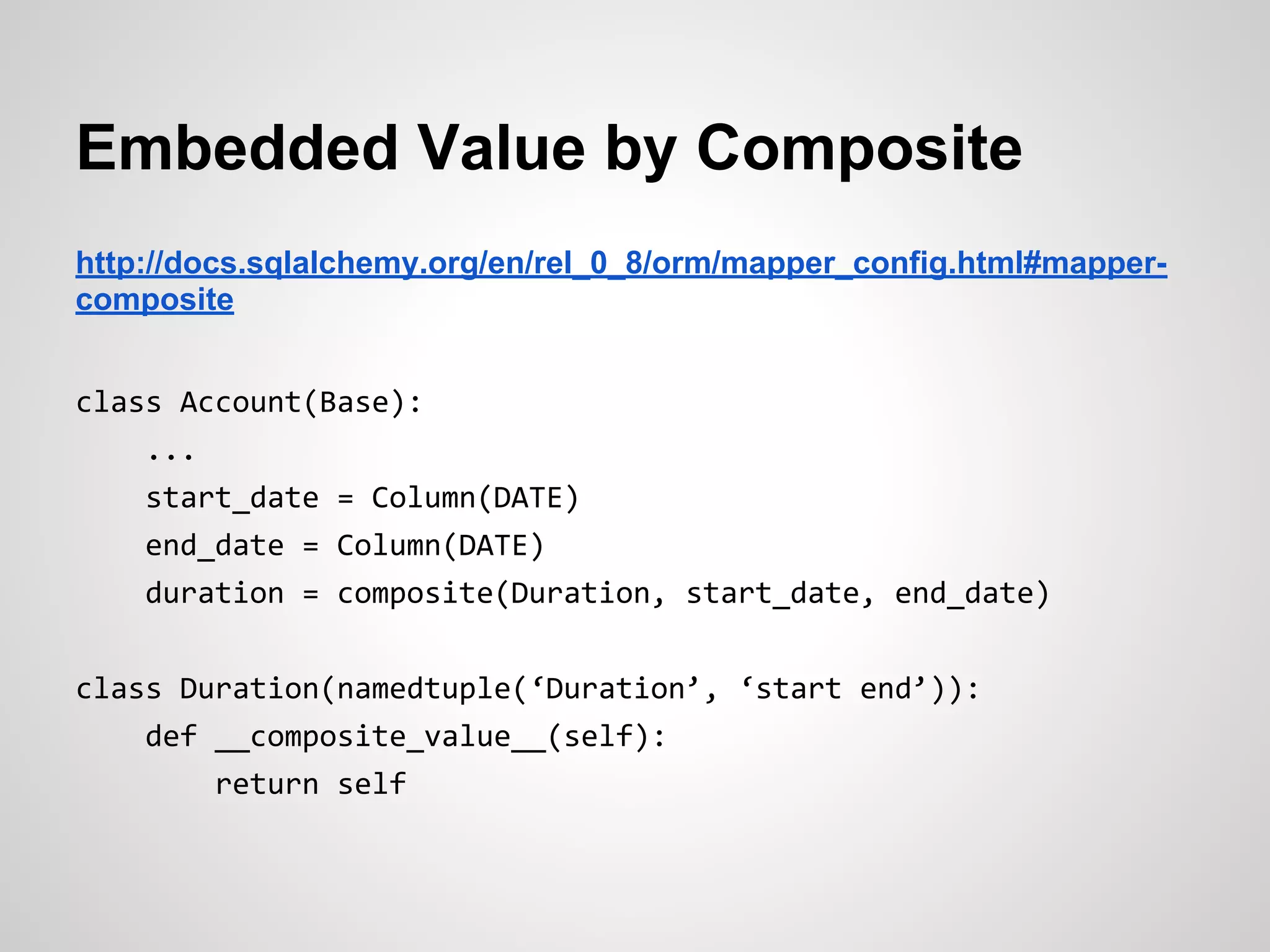
Embedded Value by Composite
http://docs.sqlalchemy.org/en/rel_0_8/orm/mapper_config.html#mapper-
composite
class Account(Base):
...
start_date = Column(DATE)
end_date = Column(DATE)
duration = composite(Duration, start_date, end_date)
class Duration(namedtuple(‘Duration’, ‘start end’)):
def __composite_value__(self):
return self
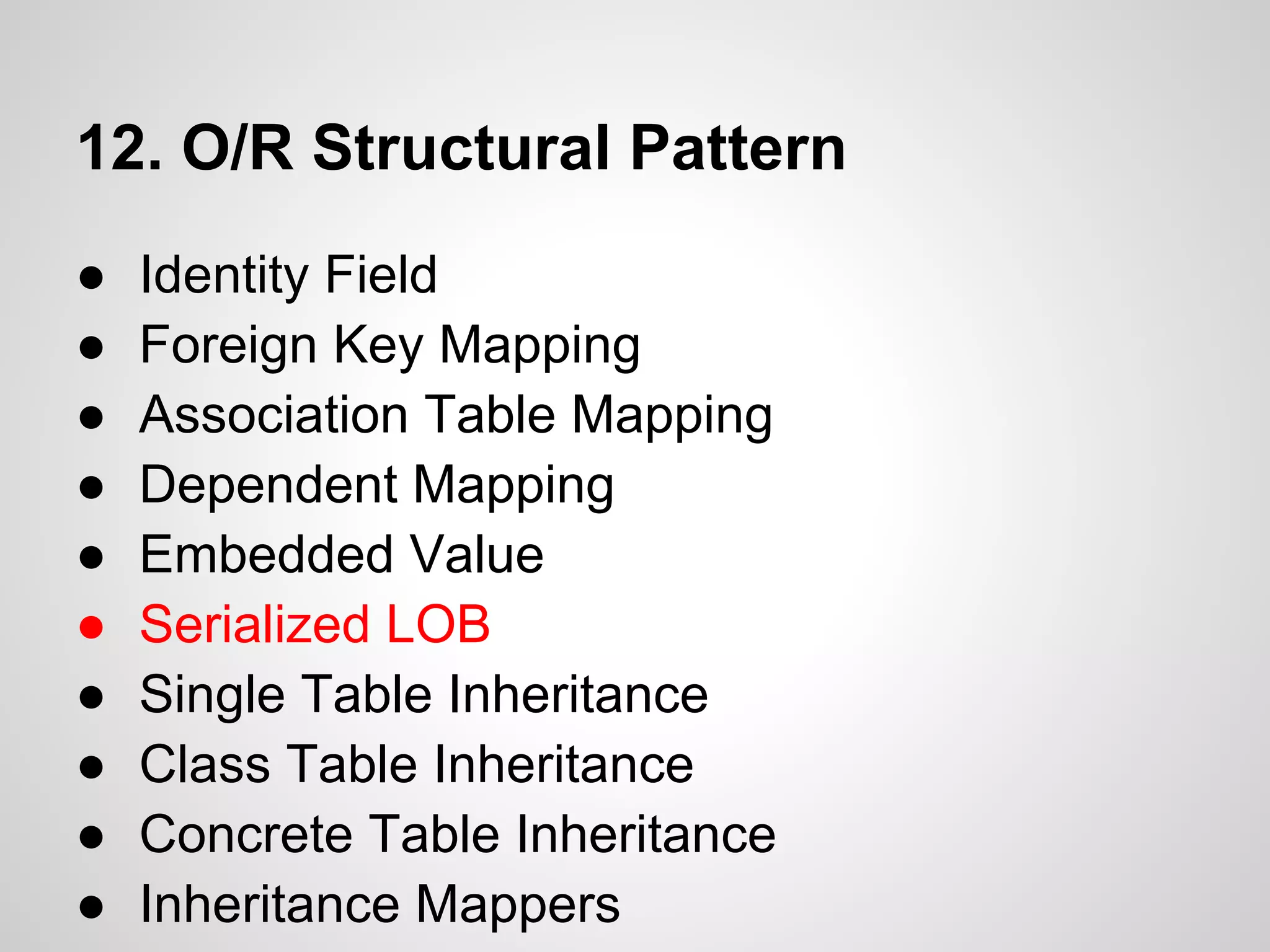
12. O/R Structural Pattern
● Identity Field
● Foreign Key Mapping
● Association Table Mapping
● Dependent Mapping
● Embedded Value
● Serialized LOB
● Single Table Inheritance
● Class Table Inheritance
● Concrete Table Inheritance
● Inheritance Mappers
Serialized LOB
Serialize objects and save to XLOB column.
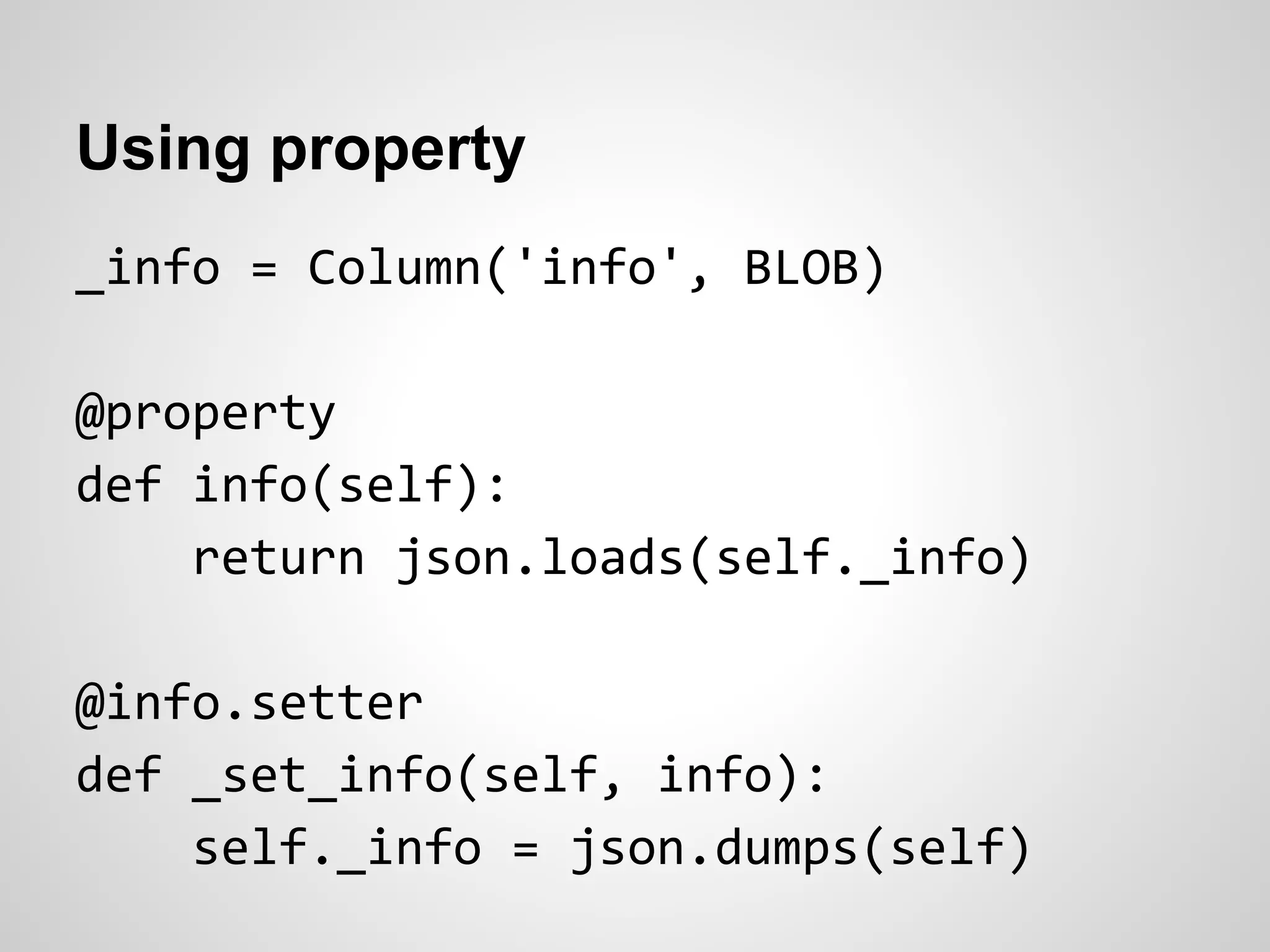
Using property
_info = Column('info', BLOB)
@property
def info(self):
return json.loads(self._info)
@info.setter
def _set_info(self, info):
self._info = json.dumps(self)
Custom Type
SQLAlchemy provides PickleType for serialized
LOB.
You can define custom type via TypeDecorator:
http://docs.sqlalchemy.org/en/rel_0_8/core/types.
html#marshal-json-strings
12. O/R Structural Pattern
● Identity Field
● Foreign Key Mapping
● Association Table Mapping
● Dependent Mapping
● Embedded Value
● Serialized LOB
● Single Table Inheritance
● Class Table Inheritance
● Concrete Table Inheritance
● Inheritance Mappers
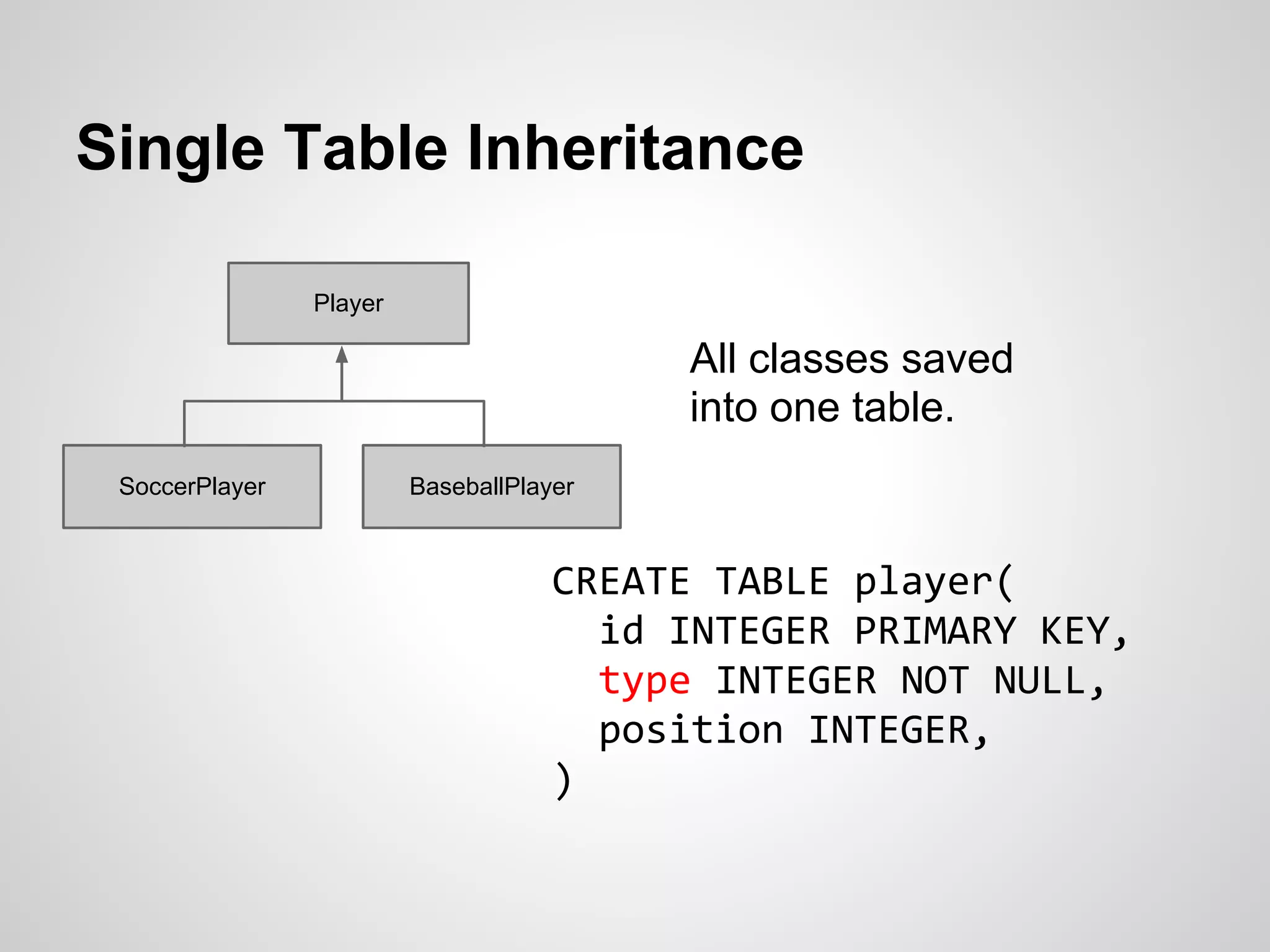
Single Table Inheritance
Player
SoccerPlayer BaseballPlayer
CREATE TABLE player(
id INTEGER PRIMARY KEY,
type INTEGER NOT NULL,
position INTEGER,
)
All classes saved
into one table.
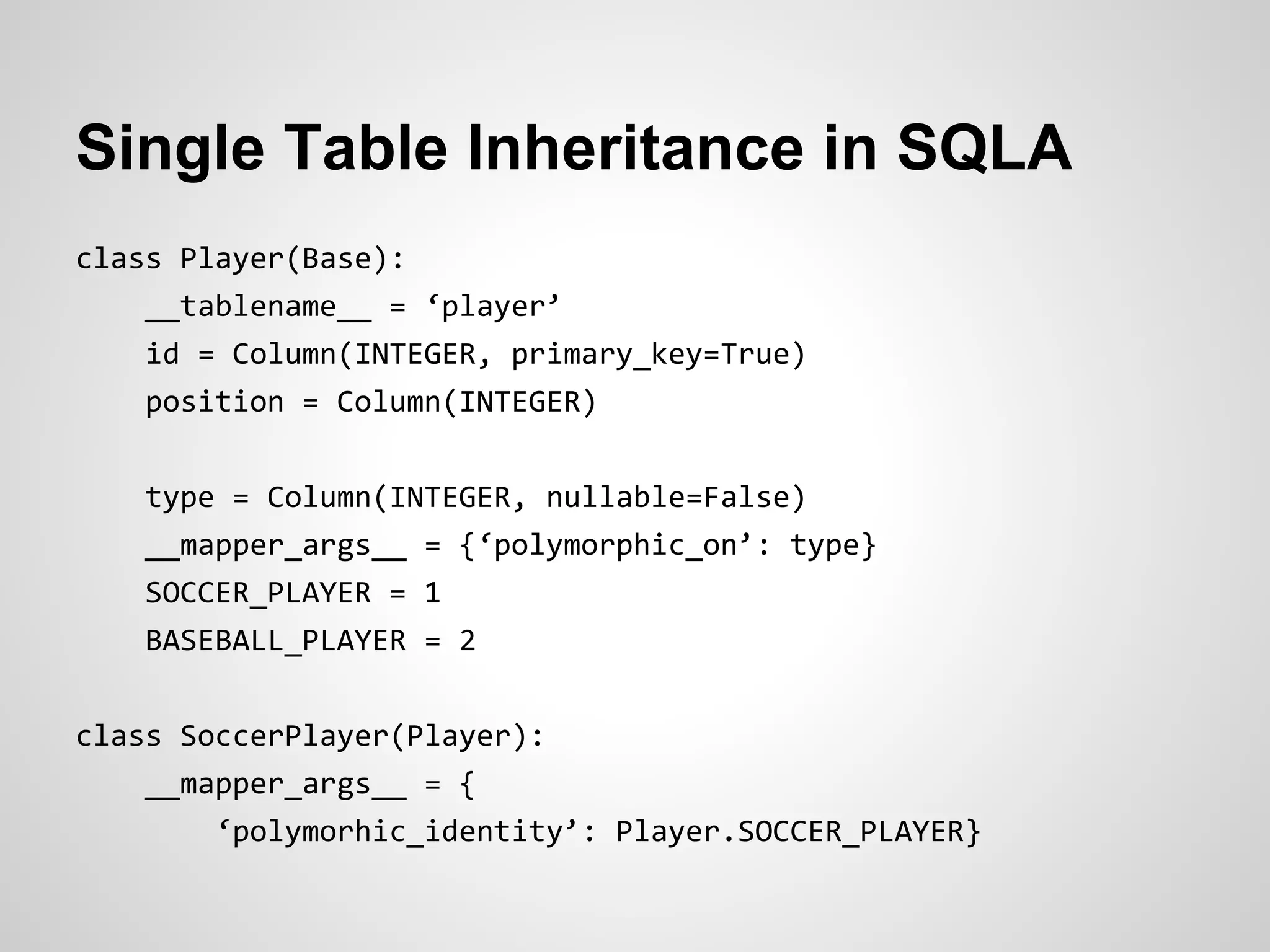
Single Table Inheritance in SQLA
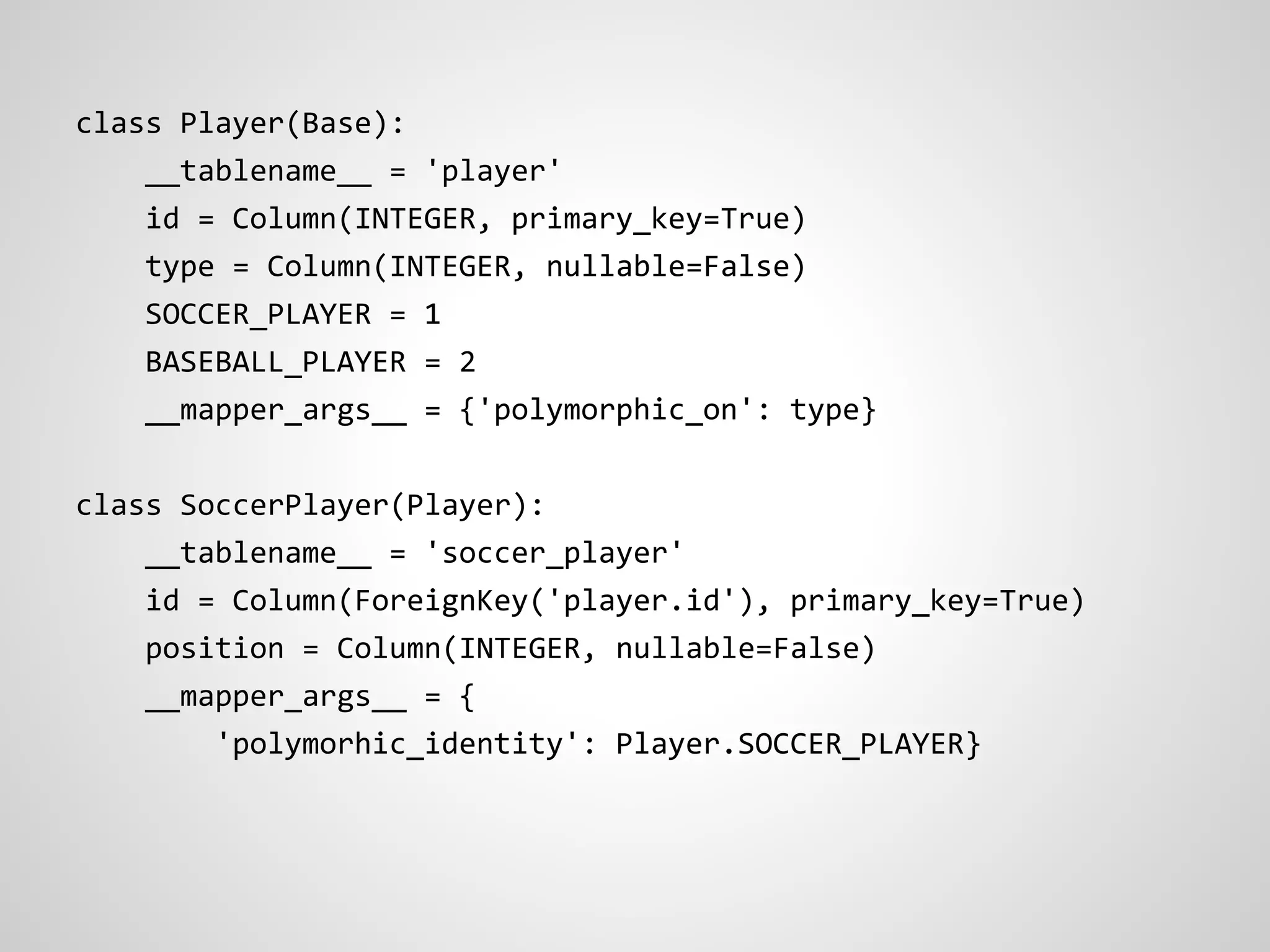
class Player(Base):
__tablename__ = ‘player’
id = Column(INTEGER, primary_key=True)
position = Column(INTEGER)
type = Column(INTEGER, nullable=False)
__mapper_args__ = {‘polymorphic_on’: type}
SOCCER_PLAYER = 1
BASEBALL_PLAYER = 2
class SoccerPlayer(Player):
__mapper_args__ = {
‘polymorhic_identity’: Player.SOCCER_PLAYER}
Defining columns in subclass
Defining columns in subclass may cause
conflict.
SQLA provides way to avoid it. See below.
http://docs.sqlalchemy.
org/en/latest/orm/extensions/declarative.html#resolving-
column-conflicts
Class Table Inheritance
Player
SoccerPlayer BaseballPlayer
CREATE TABLE player(
id INTEGER PRIMARY KEY,
type INTEGER NOT NULL
)
CREATE TABLE soccer_player(
id INTEGER PRIMARY KEY,
position INTEGER NOT NULL
)
CREATE TABLE baseball_player(
id INTEGER PRIMARY KEY,
position INTEGER NOT NULL
)
Tables for each
classes.
Class table inheritance in SQLA
SQLA call it “Joined table inheritance”
http://docs.sqlalchemy.org/en/latest/orm/extensions/declarative.html#joined-
table-inheritance
class Player(Base):
__tablename__ = 'player'
id = Column(INTEGER, primary_key=True)
type = Column(INTEGER, nullable=False)
SOCCER_PLAYER = 1
BASEBALL_PLAYER = 2
__mapper_args__ = {'polymorphic_on': type}
class SoccerPlayer(Player):
__tablename__ = 'soccer_player'
id = Column(ForeignKey('player.id'), primary_key=True)
position = Column(INTEGER, nullable=False)
__mapper_args__ = {
'polymorhic_identity': Player.SOCCER_PLAYER}
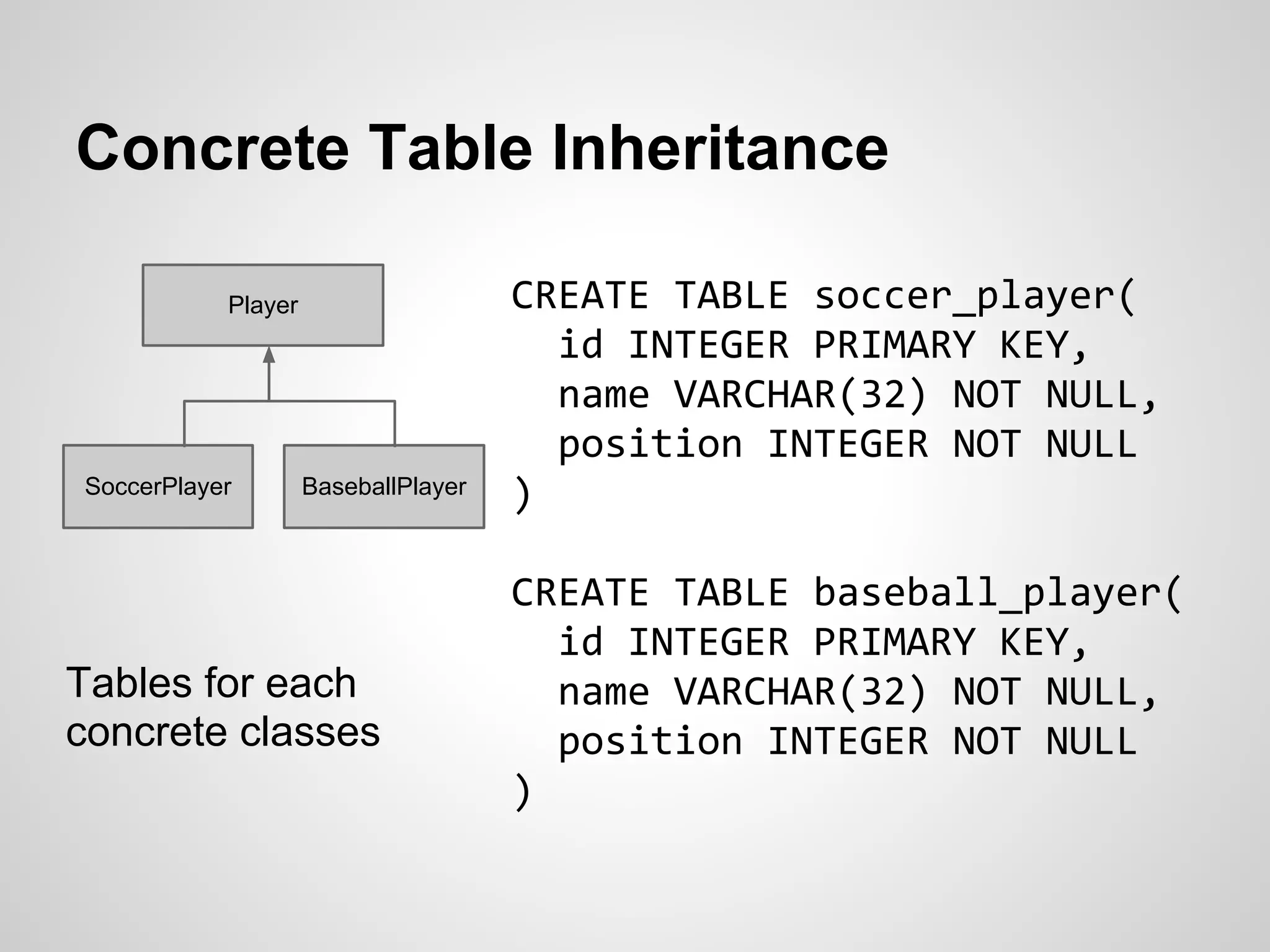
Concrete Table Inheritance
Player
SoccerPlayer BaseballPlayer
CREATE TABLE soccer_player(
id INTEGER PRIMARY KEY,
name VARCHAR(32) NOT NULL,
position INTEGER NOT NULL
)
CREATE TABLE baseball_player(
id INTEGER PRIMARY KEY,
name VARCHAR(32) NOT NULL,
position INTEGER NOT NULL
)
Tables for each
concrete classes
Mix-in
class BasePlayer(object):
id = Column(INTEGER, primary_key=True)
name = Column(VARCHAR(32), nullable=False)
class SoccerPlayer(BasePlayer, Base):
__tablename__ = ‘soccer_player’
position = Column(INTEGER, nullable=False)
Pros) Simple.
Cons) You can’t get support from SQLAlchemy
Concrete Table Inheritance in SQLA
http://docs.sqlalchemy.org/en/latest/orm/inheritance.
html#concrete-table-inheritance
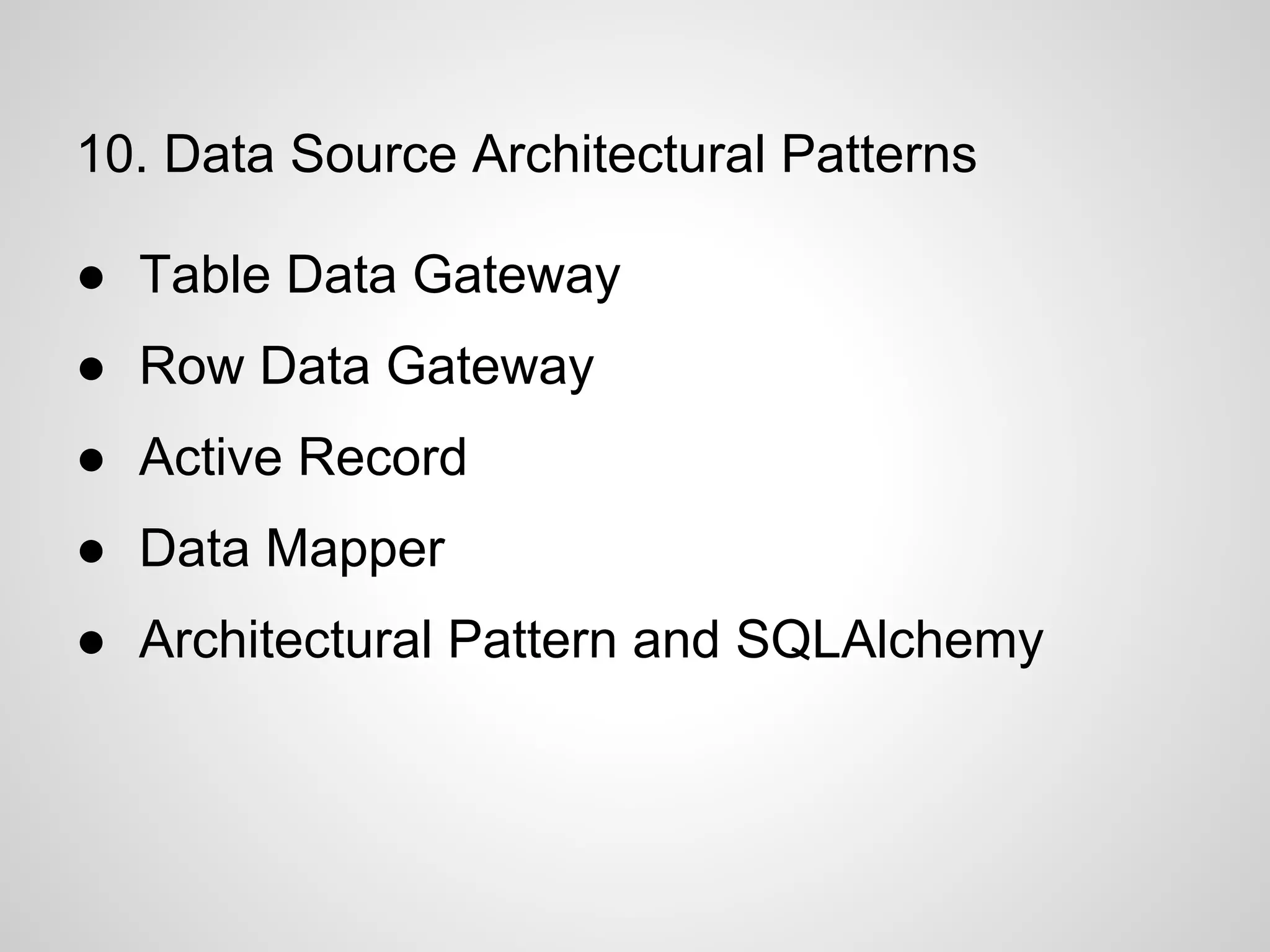
10. Data Source Architectural Patterns
● Table Data Gateway
● Row Data Gateway
● Active Record
● Data Mapper
● Architectural Pattern and SQLAlchemy
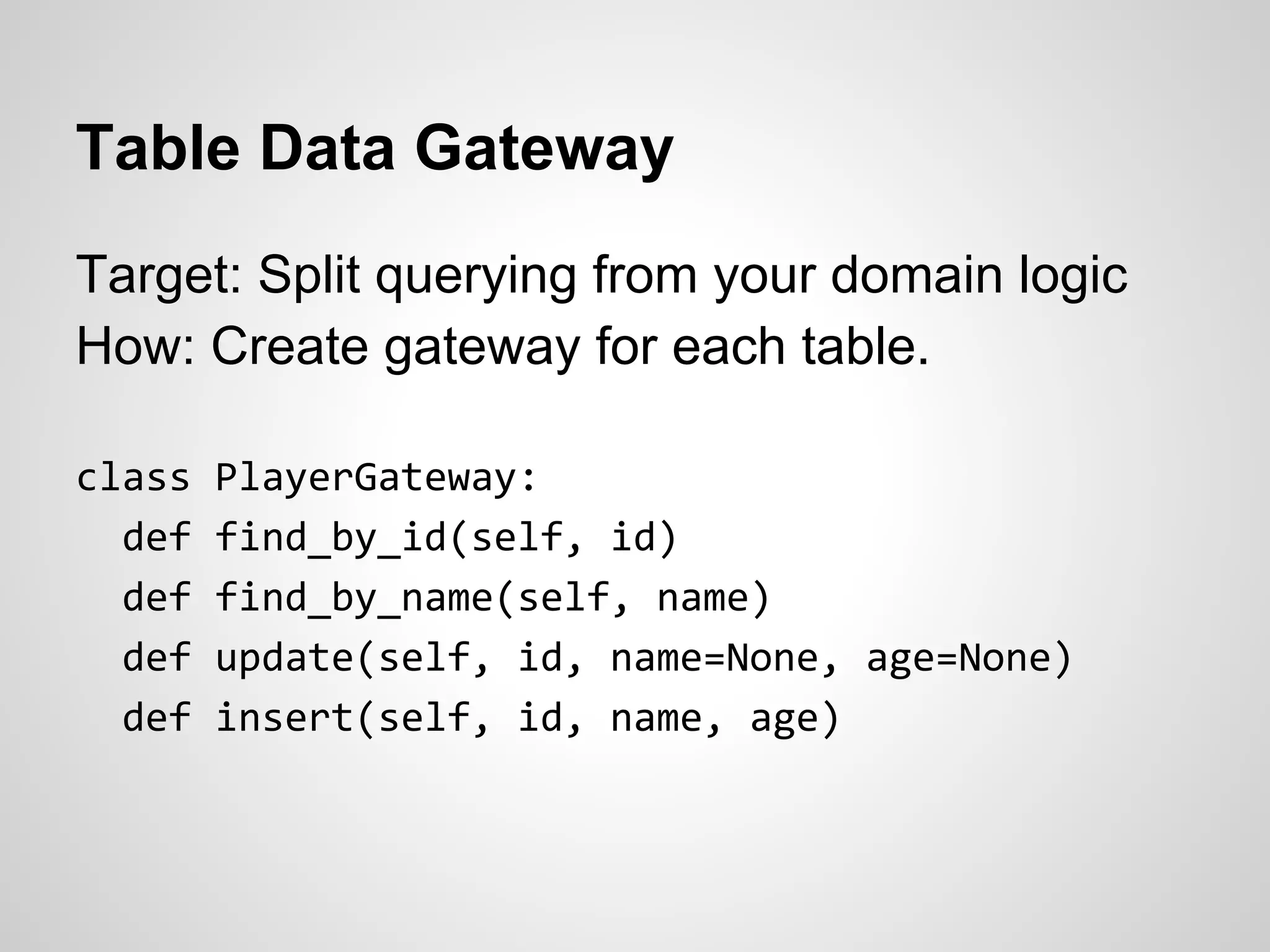
Table Data Gateway
Target: Split querying from your domain logic
How: Create gateway for each table.
class PlayerGateway:
def find_by_id(self, id)
def find_by_name(self, name)
def update(self, id, name=None, age=None)
def insert(self, id, name, age)
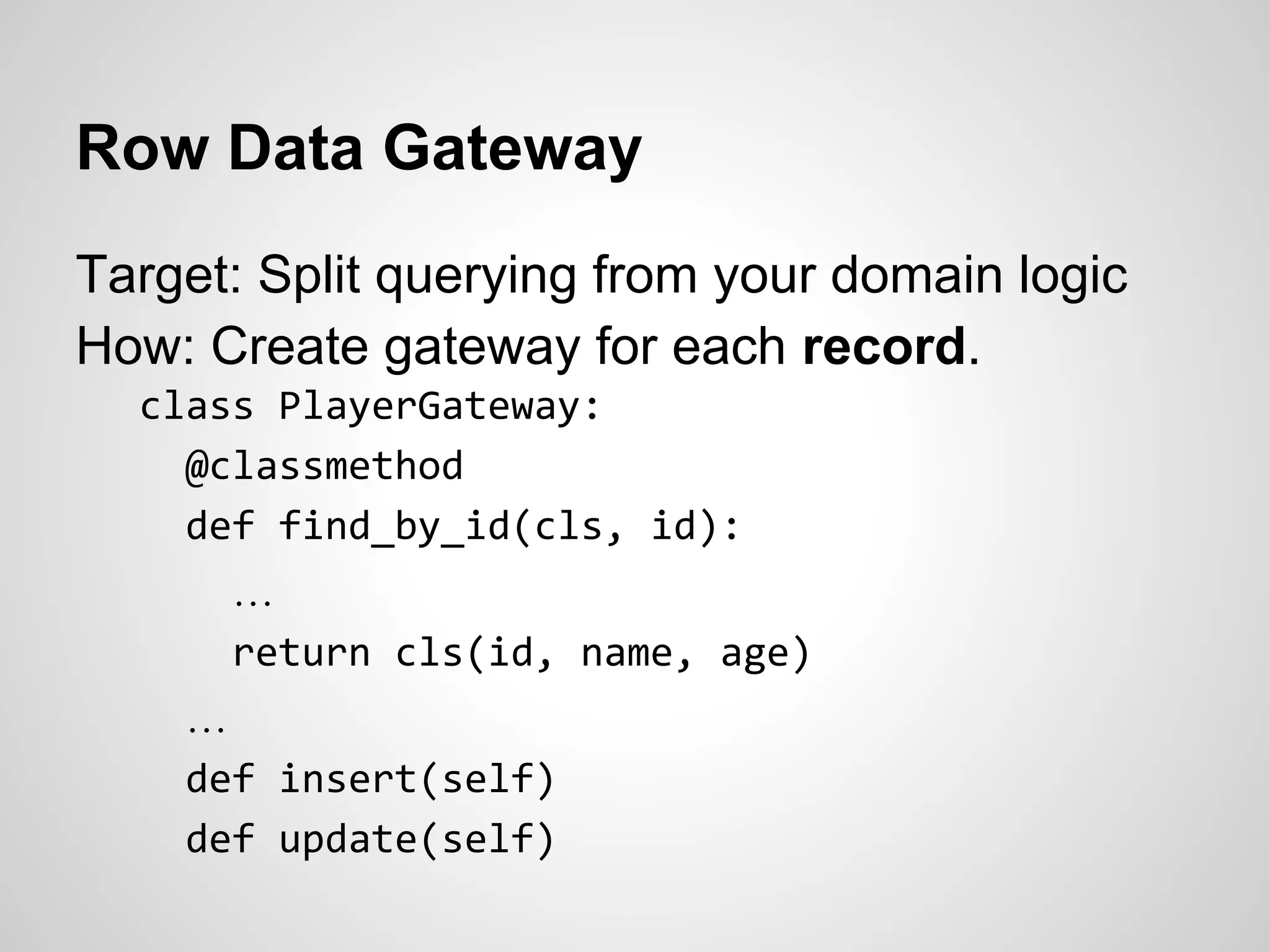
Row Data Gateway
Target: Split querying from your domain logic
How: Create gateway for each record.
class PlayerGateway:
@classmethod
def find_by_id(cls, id):
…
return cls(id, name, age)
…
def insert(self)
def update(self)
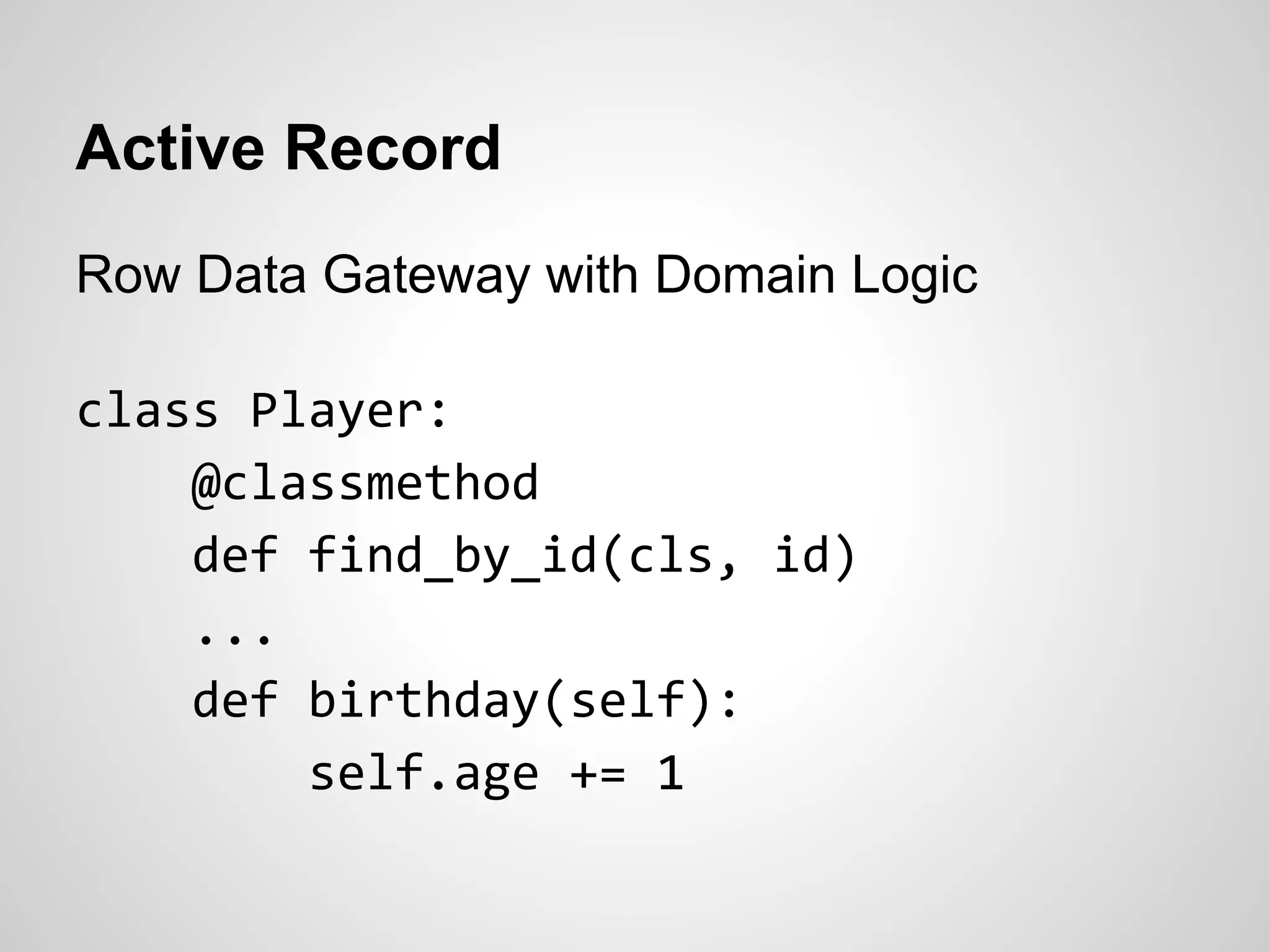
Active Record
Row Data Gateway with Domain Logic
class Player:
@classmethod
def find_by_id(cls, id)
...
def birthday(self):
self.age += 1
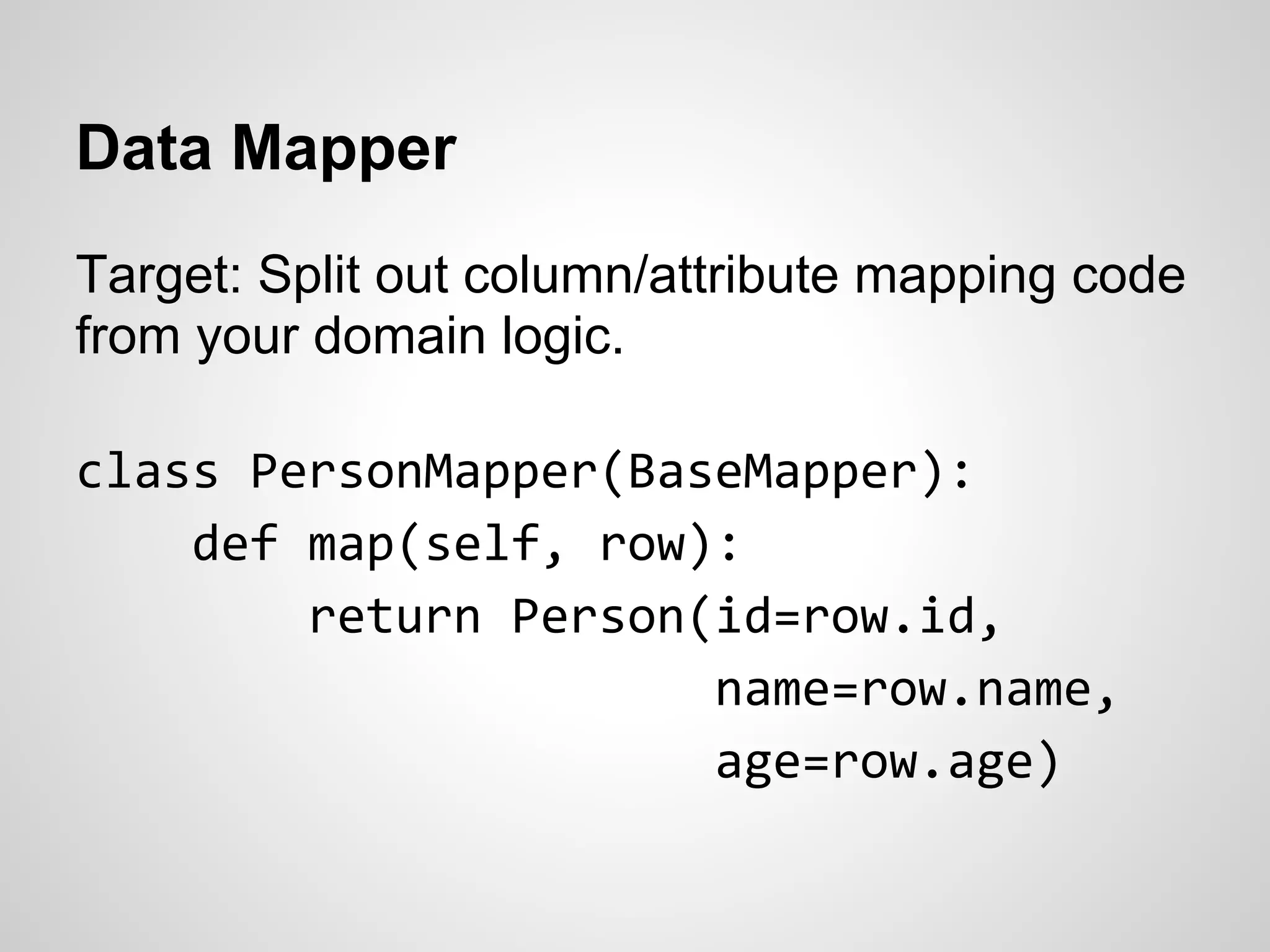
Data Mapper
Target: Split out column/attribute mapping code
from your domain logic.
class PersonMapper(BaseMapper):
def map(self, row):
return Person(id=row.id,
name=row.name,
age=row.age)
Architectural Patterns
and SQLAlchemy
My personal consideration
Querying in SQLAlchemy
Unit of Work handles most of update and insert
queries.
Easy query can be written very easy.
(Building complex query is hard)
Table Gateway?
Most tables doesn’t require Table Gateway.
When there are some complex queries,
Table Gateway is good to have.
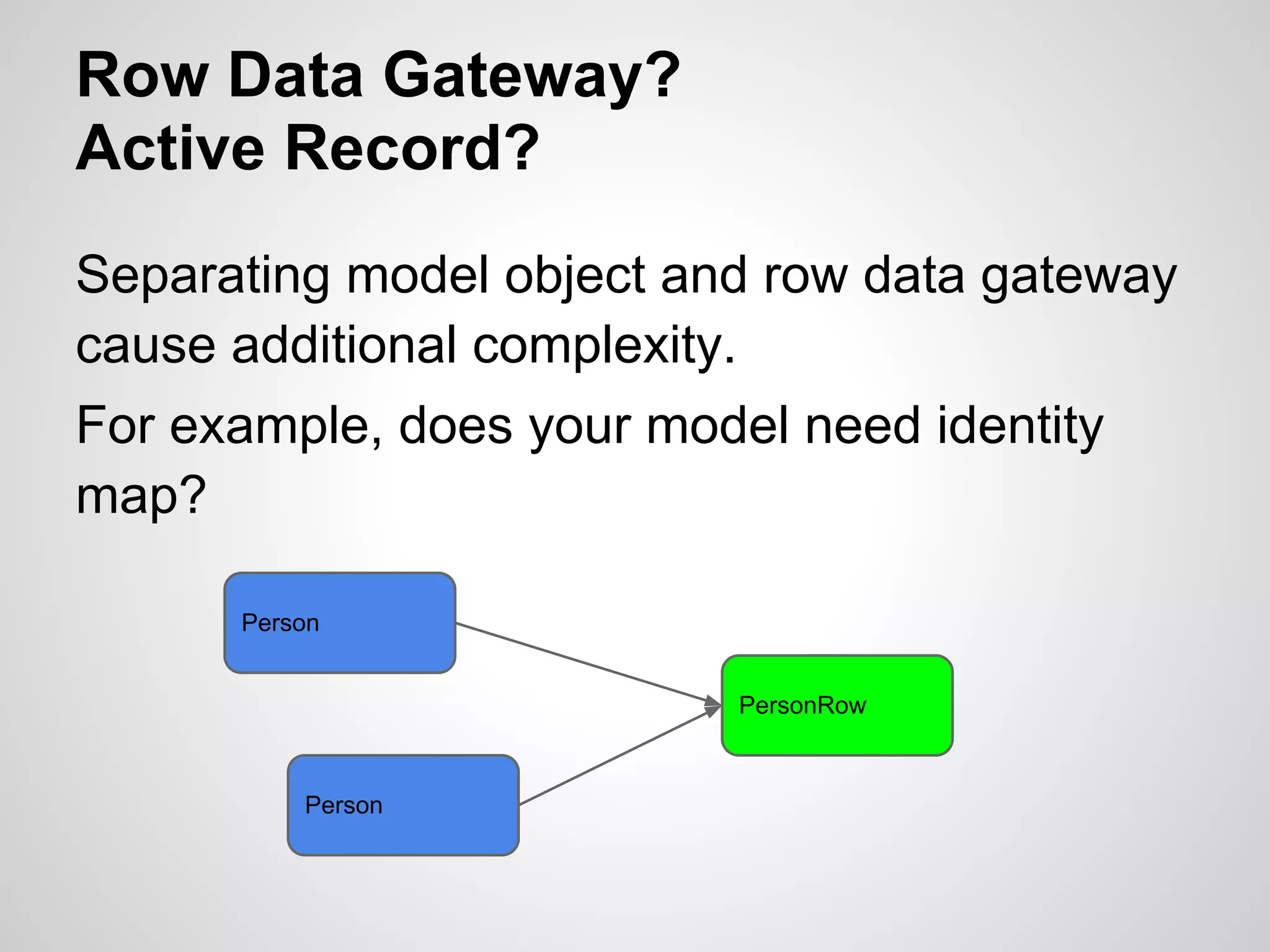
Row Data Gateway?
Active Record?
Separating model object and row data gateway
cause additional complexity.
For example, does your model need identity
map?
Person
Person
PersonRow
Active Record drawbacks
Problem: Good table design is not good class
design always.
My answer: Use structural patterns like
Embedded Value.
P: Mixing database access and domain logic is
bad idea.
A: Use Table Gateway to separate them.
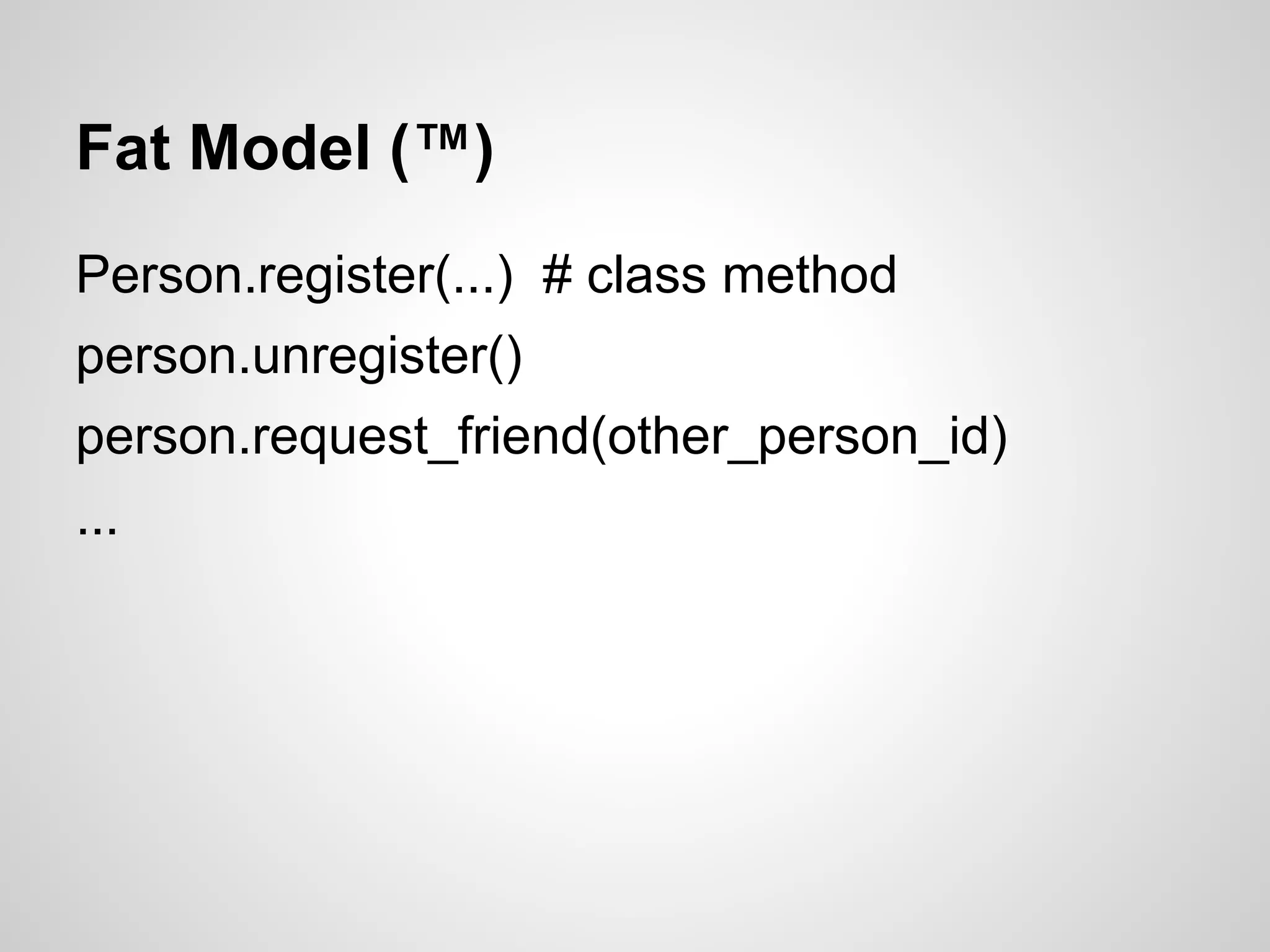
Fat Model (™)
Person.register(...) # class method
person.unregister()
person.request_friend(other_person_id)
...
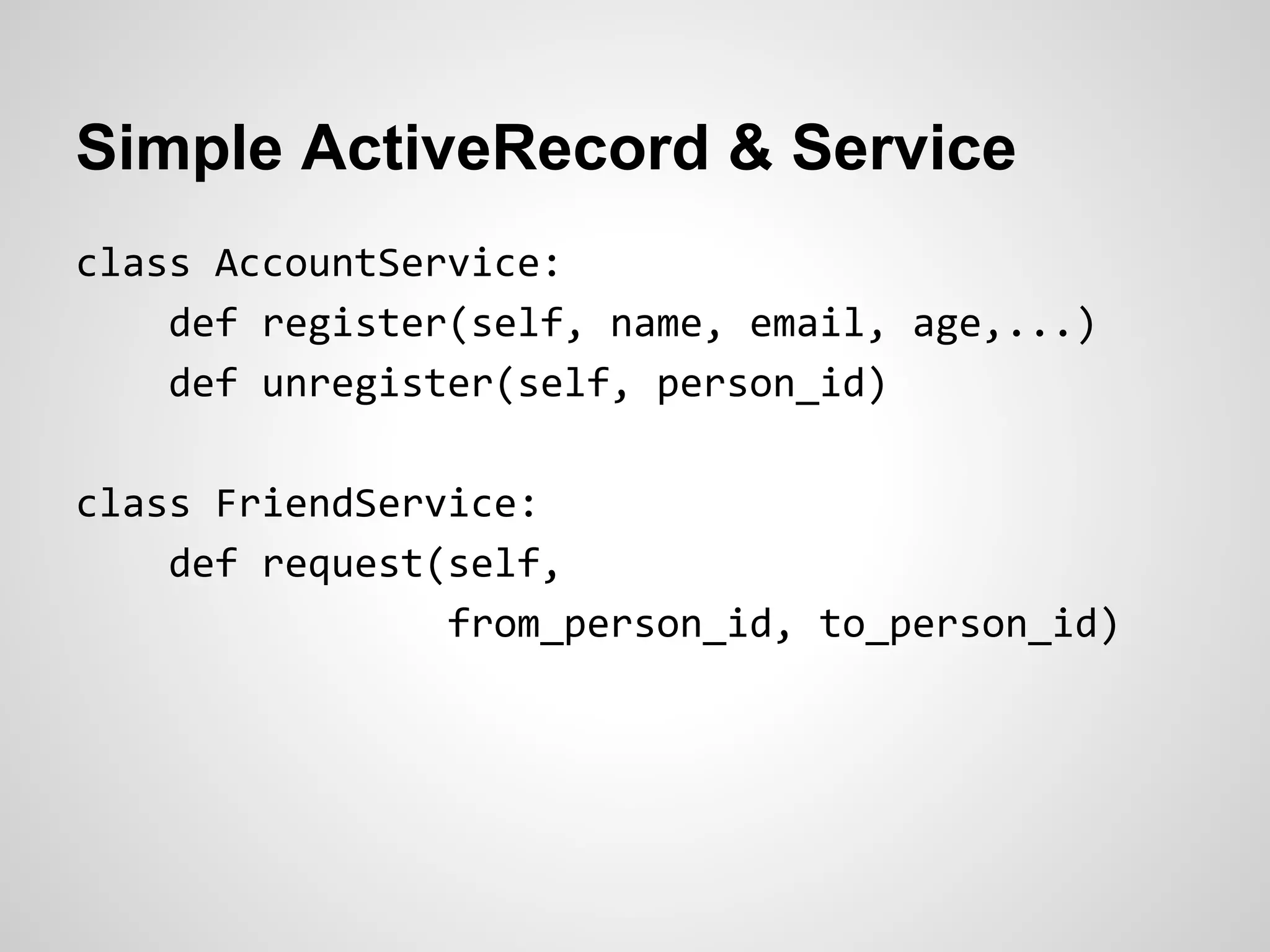
Simple ActiveRecord & Service
class AccountService:
def register(self, name, email, age,...)
def unregister(self, person_id)
class FriendService:
def request(self,
from_person_id, to_person_id)
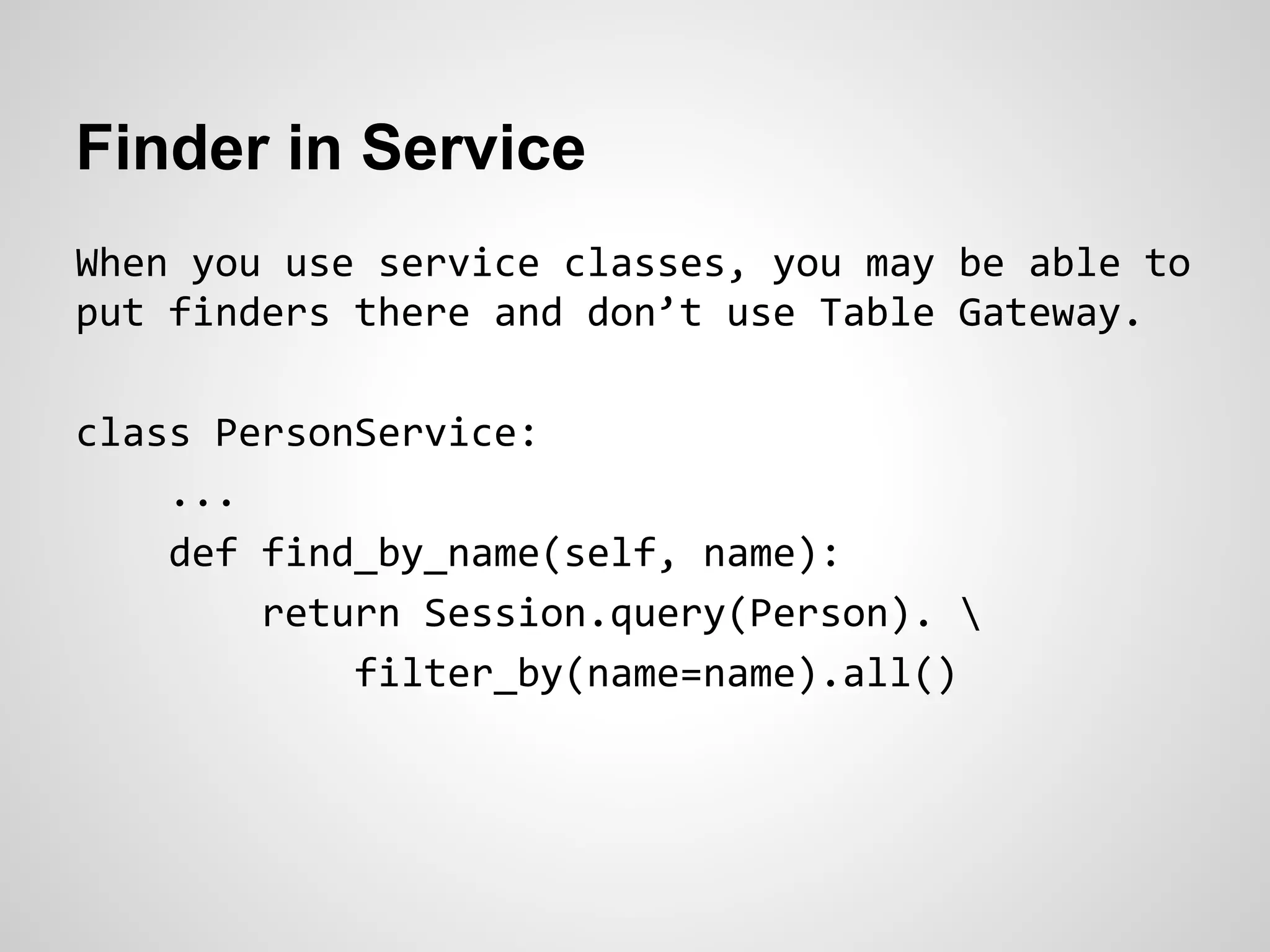
Finder in Service
When you use service classes, you may be able to
put finders there and don’t use Table Gateway.
class PersonService:
...
def find_by_name(self, name):
return Session.query(Person). 
filter_by(name=name).all()
Anemic Domain Model
http://www.martinfowler.
com/bliki/AnemicDomainModel.html
P: Implementing all domain logic in service is
not a OOP.
A: Simple Active Record + Medium sized
classes + Service
When you design large
application or framework,
PofEAA helps you lot.

PofEAA and SQLAlchemy

  • 1.
  • 3.
    Public Activity MessagePack-Python JSON likebinary protocol wsaccel WebSocket accelerator for Tornado, ws4py MyKaze PyMySQL in Tornado (WIP) Python for PHPer Quick guide of Python for PHPer (Japanese)
  • 4.
    Online Game Developer R&Dand Architect Tuning server side middleware and application KLab Inc.
  • 5.
  • 6.
  • 7.
  • 8.
    Design patterns good toknow for Web Programmers
  • 9.
  • 10.
    ● Dialects --Various DB-API wrapper ● Engine -- Connection management ● Schema and Types ● SQL expression ● and O/R Mapper SQLAlchemy features
  • 11.
    Create Engine from sqlalchemyimport create_engine engine = create_engine('sqlite:///:memory:', echo=True) # Using engine without O/R mapper con = engine.connect() with con.begin() as trx: con.execute('SELECT 1+1') con.close()
  • 12.
    Define Object andSchema from sqlalchemy.ext.declarative import declarative_base from sqlalchemy import Column, Integer, String Base = declarative_base() class User(Base): __tablename__ = 'users' id = Column(Integer, primary_key=True) name = Column(String) email = Column(String, nullable=False, unique=True) password = Column(String, nullable=False)
  • 13.
    Create table onDB Base.metadata.create_all(engine) Output: CREATE TABLE users ( id INTEGER NOT NULL, name VARCHAR, email VARCHAR NOT NULL, password VARCHAR NOT NULL, PRIMARY KEY (id), UNIQUE (email) )
  • 14.
    Create an instance >>>ed_user = User(name='ed', ... email='ed@example.com', ... password='edspassword') ... >>> ed_user.password 'edspassword' >>> str(ed_user.id) 'None'
  • 15.
    Save it from sqlalchemy.ormimport sessionmaker Session = sessionmaker(bind=engine) session = Session() session.add(ed_user) session.commit()
  • 16.
  • 17.
  • 18.
  • 19.
    Unit of Workis a Pattern in PofEAA
  • 20.
    Part 1. TheNarratives 3. Mapping to RDB Part 2. The Patterns 10. Data Source Architectural Patterns 11. O/R Behavioral Patterns 12. O/R Structural Patterns 13. O/R Metadata Mapping Patterns O/R chapters in the P of EAA
  • 21.
    Part 1. TheNarratives 3. Mapping to RDB Part 2. The Patterns 10. Data Source Architectural Patterns 11. O/R Behavioral Patterns 12. O/R Structural Patterns 13. O/R Metadata Mapping Patterns O/R chapters in the P of EAA
  • 22.
    11. O/R BehavioralPatterns ● Unit of Work ● Identity map ● Lazy load
  • 23.
    Unit of Work Target:Maintains set of objects to save in transaction. How: 1. Wrap transaction. 2. Keep track of new, modified and deleted objects. 3. Save objects when commit
  • 24.
    Why Unit ofWork Remove boilerplate saving code from domain logic. Avoid objects saved too often.
  • 25.
    Unit of Workin SQLAlchemy # Create an Unit of Work session = Session() # Get connection and start transaction ed_user = session.query(User). filter(User.name=='ed').one() ed_user.name='E.D.' session.commit() # save ed_user and commit
  • 26.
    Object states user =User(...) # Transient (not saved) session.add(user) # pending (saved) session.flush() # persistent (saved if modified) session.expunge(user) # Detached (not saved)
  • 27.
    Flushing Execute insert /update /delete query. Session flushes automatically when querying to avoid inconsistent result. (autoflush) You can stop autoflush. You can manually flush.
  • 28.
    expire -- causereload session.expire(user) print(user.name) # Cause reloading commit() # expires all objects for consistency. You can avoid this by expire_on_commit=False.
  • 29.
    Contextual Session from sqlalchemy.ormimport (sessionmaker, scoped_session) Session = scoped_session( sessionmaker(bind=engine)) Session.add(ed_user) Session.commit() ... Session.remove()
  • 30.
    11. O/R BehavioralPatterns ● Unit of Work ● Identity map ● Lazy load
  • 31.
    Target: Avoid two objectsfor one record. How: Keep mapping of (table, pk) -> object. Check the map when querying. Bonus: It acts like a easy cache Identity map
  • 32.
    Identity map inSQLAlchemy Session has identity map. # Looks up id map after querying session.query(User).filter(User.id==3).one() # Looks up id map before and after querying. session.query(User).get(3) NOTE: Id map is weak reference by default.
  • 33.
    11. O/R BehavioralPatterns ● Unit of Work ● Identity map ● Lazy load
  • 34.
    Lazy Load Load relationor heavy column on demand.
  • 35.
    Lazy loading relationship http://docs.sqlalchemy. org/en/rel_0_8/orm/loading.html SQLAlchemyuses lazy loading by default for relationship. You can choose eager loading strategy.
  • 36.
    Lazy loading bigcolumn http://docs.sqlalchemy. org/en/rel_0_8/orm/mapper_config. html#deferred-column-loading SQLAlchemy supports deferred column to lazy loading big BLOB/TEXT.
  • 37.
  • 38.
    12. O/R StructuralPattern ● Identity Field ● Foreign Key Mapping ● Association Table Mapping ● Dependent Mapping ● Embedded Value ● Serialized LOB ● Single Table Inheritance ● Class Table Inheritance ● Concrete Table Inheritance ● Inheritance Mappers
  • 39.
    Object have PKin database as a field. class Player(Base): id = Column(INTEGER, primary=True) Identity Field
  • 40.
    12. O/R StructuralPattern ● Identity Field ● Foreign Key Mapping ● Association Table Mapping ● Dependent Mapping ● Embedded Value ● Serialized LOB ● Single Table Inheritance ● Class Table Inheritance ● Concrete Table Inheritance ● Inheritance Mappers
  • 41.
    Map one toone or one to many relation to Object reference. Not: session.query(Address).get(user.address_id) Yes: user.address Foreign Key Mapping
  • 42.
    With property from werkzeug.utils.cached_property classUser(Base): ... @cached_property def address(self): session.query(Address). get(self.address_id) This is enough to achieve ``user.address``. But no SQLA support.
  • 43.
    relationship class User(Base): ... addresses =relationship('Address', backref='user') class Address(Base): ... user_id = Column(Integer, ForeignKey('user.id'))
  • 44.
    12. O/R StructuralPattern ● Identity Field ● Foreign Key Mapping ● Association Table Mapping ● Dependent Mapping ● Embedded Value ● Serialized LOB ● Single Table Inheritance ● Class Table Inheritance ● Concrete Table Inheritance ● Inheritance Mappers
  • 45.
    Association Table Mapping Mappingmany-to-many association table to object reference. In SQLAlchemy: Pass “secondary” argument to relationship() http://docs.sqlalchemy.org/en/rel_0_8/orm/tutorial.html#building-a-many- to-many-relationship
  • 46.
    12. O/R StructuralPattern ● Identity Field ● Foreign Key Mapping ● Association Table Mapping ● Dependent Mapping ● Embedded Value ● Serialized LOB ● Single Table Inheritance ● Class Table Inheritance ● Concrete Table Inheritance ● Inheritance Mappers
  • 47.
    Dependent Mapping O/R mapownership without identity. PofEAA says: I don’t recommend Dependent Mapping if you’re using Unit of Work.
  • 48.
    12. O/R StructuralPattern ● Identity Field ● Foreign Key Mapping ● Association Table Mapping ● Dependent Mapping ● Embedded Value ● Serialized LOB ● Single Table Inheritance ● Class Table Inheritance ● Concrete Table Inheritance ● Inheritance Mappers
  • 49.
    Embedded Value Map anobject to some columns in a row. class Duration: start_date end_date class Account: duration CREATE TABLE account ( … start_date DATE, end_date DATE, … );
  • 50.
    Embedded Value byproperty @property def duration(self): return Duration( self.start_date, self.end_date) @duration.setter def duration(self, duration): self.start_date = duration.start self.end_date = duration.end
  • 51.
    Embedded Value byComposite http://docs.sqlalchemy.org/en/rel_0_8/orm/mapper_config.html#mapper- composite class Account(Base): ... start_date = Column(DATE) end_date = Column(DATE) duration = composite(Duration, start_date, end_date) class Duration(namedtuple(‘Duration’, ‘start end’)): def __composite_value__(self): return self
  • 52.
    12. O/R StructuralPattern ● Identity Field ● Foreign Key Mapping ● Association Table Mapping ● Dependent Mapping ● Embedded Value ● Serialized LOB ● Single Table Inheritance ● Class Table Inheritance ● Concrete Table Inheritance ● Inheritance Mappers
  • 53.
    Serialized LOB Serialize objectsand save to XLOB column.
  • 54.
    Using property _info =Column('info', BLOB) @property def info(self): return json.loads(self._info) @info.setter def _set_info(self, info): self._info = json.dumps(self)
  • 55.
    Custom Type SQLAlchemy providesPickleType for serialized LOB. You can define custom type via TypeDecorator: http://docs.sqlalchemy.org/en/rel_0_8/core/types. html#marshal-json-strings
  • 56.
    12. O/R StructuralPattern ● Identity Field ● Foreign Key Mapping ● Association Table Mapping ● Dependent Mapping ● Embedded Value ● Serialized LOB ● Single Table Inheritance ● Class Table Inheritance ● Concrete Table Inheritance ● Inheritance Mappers
  • 57.
    Single Table Inheritance Player SoccerPlayerBaseballPlayer CREATE TABLE player( id INTEGER PRIMARY KEY, type INTEGER NOT NULL, position INTEGER, ) All classes saved into one table.
  • 58.
    Single Table Inheritancein SQLA class Player(Base): __tablename__ = ‘player’ id = Column(INTEGER, primary_key=True) position = Column(INTEGER) type = Column(INTEGER, nullable=False) __mapper_args__ = {‘polymorphic_on’: type} SOCCER_PLAYER = 1 BASEBALL_PLAYER = 2 class SoccerPlayer(Player): __mapper_args__ = { ‘polymorhic_identity’: Player.SOCCER_PLAYER}
  • 59.
    Defining columns insubclass Defining columns in subclass may cause conflict. SQLA provides way to avoid it. See below. http://docs.sqlalchemy. org/en/latest/orm/extensions/declarative.html#resolving- column-conflicts
  • 60.
    Class Table Inheritance Player SoccerPlayerBaseballPlayer CREATE TABLE player( id INTEGER PRIMARY KEY, type INTEGER NOT NULL ) CREATE TABLE soccer_player( id INTEGER PRIMARY KEY, position INTEGER NOT NULL ) CREATE TABLE baseball_player( id INTEGER PRIMARY KEY, position INTEGER NOT NULL ) Tables for each classes.
  • 61.
    Class table inheritancein SQLA SQLA call it “Joined table inheritance” http://docs.sqlalchemy.org/en/latest/orm/extensions/declarative.html#joined- table-inheritance
  • 62.
    class Player(Base): __tablename__ ='player' id = Column(INTEGER, primary_key=True) type = Column(INTEGER, nullable=False) SOCCER_PLAYER = 1 BASEBALL_PLAYER = 2 __mapper_args__ = {'polymorphic_on': type} class SoccerPlayer(Player): __tablename__ = 'soccer_player' id = Column(ForeignKey('player.id'), primary_key=True) position = Column(INTEGER, nullable=False) __mapper_args__ = { 'polymorhic_identity': Player.SOCCER_PLAYER}
  • 63.
    Concrete Table Inheritance Player SoccerPlayerBaseballPlayer CREATE TABLE soccer_player( id INTEGER PRIMARY KEY, name VARCHAR(32) NOT NULL, position INTEGER NOT NULL ) CREATE TABLE baseball_player( id INTEGER PRIMARY KEY, name VARCHAR(32) NOT NULL, position INTEGER NOT NULL ) Tables for each concrete classes
  • 64.
    Mix-in class BasePlayer(object): id =Column(INTEGER, primary_key=True) name = Column(VARCHAR(32), nullable=False) class SoccerPlayer(BasePlayer, Base): __tablename__ = ‘soccer_player’ position = Column(INTEGER, nullable=False) Pros) Simple. Cons) You can’t get support from SQLAlchemy
  • 65.
    Concrete Table Inheritancein SQLA http://docs.sqlalchemy.org/en/latest/orm/inheritance. html#concrete-table-inheritance
  • 66.
    10. Data SourceArchitectural Patterns ● Table Data Gateway ● Row Data Gateway ● Active Record ● Data Mapper ● Architectural Pattern and SQLAlchemy
  • 67.
    Table Data Gateway Target:Split querying from your domain logic How: Create gateway for each table. class PlayerGateway: def find_by_id(self, id) def find_by_name(self, name) def update(self, id, name=None, age=None) def insert(self, id, name, age)
  • 68.
    Row Data Gateway Target:Split querying from your domain logic How: Create gateway for each record. class PlayerGateway: @classmethod def find_by_id(cls, id): … return cls(id, name, age) … def insert(self) def update(self)
  • 69.
    Active Record Row DataGateway with Domain Logic class Player: @classmethod def find_by_id(cls, id) ... def birthday(self): self.age += 1
  • 70.
    Data Mapper Target: Splitout column/attribute mapping code from your domain logic. class PersonMapper(BaseMapper): def map(self, row): return Person(id=row.id, name=row.name, age=row.age)
  • 71.
  • 72.
    Querying in SQLAlchemy Unitof Work handles most of update and insert queries. Easy query can be written very easy. (Building complex query is hard)
  • 73.
    Table Gateway? Most tablesdoesn’t require Table Gateway. When there are some complex queries, Table Gateway is good to have.
  • 74.
    Row Data Gateway? ActiveRecord? Separating model object and row data gateway cause additional complexity. For example, does your model need identity map? Person Person PersonRow
  • 75.
    Active Record drawbacks Problem:Good table design is not good class design always. My answer: Use structural patterns like Embedded Value. P: Mixing database access and domain logic is bad idea. A: Use Table Gateway to separate them.
  • 76.
    Fat Model (™) Person.register(...)# class method person.unregister() person.request_friend(other_person_id) ...
  • 77.
    Simple ActiveRecord &Service class AccountService: def register(self, name, email, age,...) def unregister(self, person_id) class FriendService: def request(self, from_person_id, to_person_id)
  • 78.
    Finder in Service Whenyou use service classes, you may be able to put finders there and don’t use Table Gateway. class PersonService: ... def find_by_name(self, name): return Session.query(Person). filter_by(name=name).all()
  • 79.
    Anemic Domain Model http://www.martinfowler. com/bliki/AnemicDomainModel.html P:Implementing all domain logic in service is not a OOP. A: Simple Active Record + Medium sized classes + Service
  • 80.
    When you designlarge application or framework, PofEAA helps you lot.