RAP
by
Muthu
Behavior Definition
What is Behavior Definition?
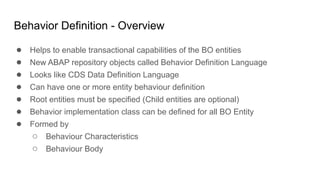
Behavior Definition - Overview
● Helps to enable transactional capabilities of the BO entities
● New ABAP repository objects called Behavior Definition Language
● Looks like CDS Data Definition Language
● Can have one or more entity behaviour definition
● Root entities must be specified (Child entities are optional)
● Behavior implementation class can be defined for all BO Entity
● Formed by
○ Behaviour Characteristics
○ Behaviour Body
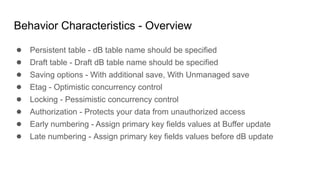
Behavior Characteristics - Overview
● Persistent table - dB table name should be specified
● Draft table - Draft dB table name should be specified
● Saving options - With additional save, With Unmanaged save
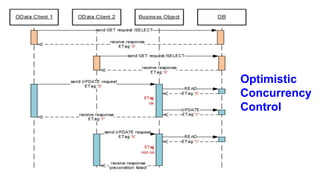
● Etag - Optimistic concurrency control
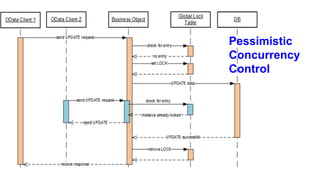
● Locking - Pessimistic concurrency control
● Authorization - Protects your data from unauthorized access
● Early numbering - Assign primary key fields values at Buffer update
● Late numbering - Assign primary key fields values before dB update
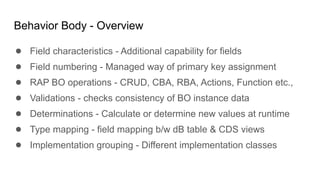
Behavior Body - Overview
● Field characteristics - Additional capability for fields
● Field numbering - Managed way of primary key assignment
● RAP BO operations - CRUD, CBA, RBA, Actions, Function etc.,
● Validations - checks consistency of BO instance data
● Determinations - Calculate or determine new values at runtime
● Type mapping - field mapping b/w dB table & CDS views
● Implementation grouping - Different implementation classes
Projection Behavior
Definition
What is Projection Behavior Definition ?
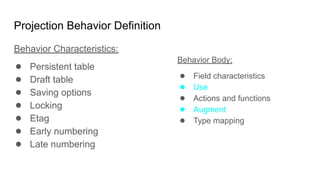
Projection Behavior Definition
Behavior Characteristics:
● Persistent table
● Draft table
● Saving options
● Locking
● Etag
● Early numbering
● Late numbering
Behavior Body:
● Field characteristics
● Use
● Actions and functions
● Augment
● Type mapping
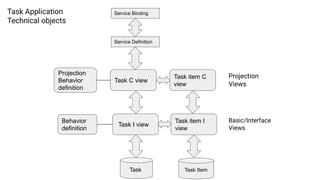
Service Definition & Binding
Business Services
Task Task Item
Task I view
Task item I
view
Task C view
Task item C
view
Behavior
definition
Projection
Behavior
definition
Task Application
Technical objects
Projection
Views
Basic/Interface
Views
Service Definition
Service Binding
Managed BO
Managed Business Objects
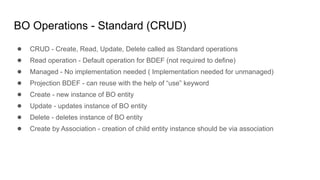
BO Operations - Standard (CRUD)
● CRUD - Create, Read, Update, Delete called as Standard operations
● Read operation - Default operation for BDEF (not required to define)
● Managed - No implementation needed ( Implementation needed for unmanaged)
● Projection BDEF - can reuse with the help of “use” keyword
● Create - new instance of BO entity
● Update - updates instance of BO entity
● Delete - deletes instance of BO entity
● Create by Association - creation of child entity instance should be via association
EML (Entity Manipulation
Language)
What is EML?
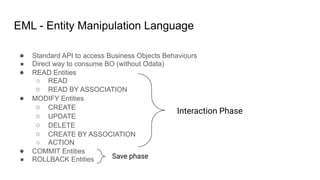
EML - Entity Manipulation Language
● Standard API to access Business Objects Behaviours
● Direct way to consume BO (without Odata)
● READ Entities
○ READ
○ READ BY ASSOCIATION
● MODIFY Entities
○ CREATE
○ UPDATE
○ DELETE
○ CREATE BY ASSOCIATION
○ ACTION
● COMMIT Entities
● ROLLBACK Entities
Interaction Phase
Save phase
Read EML
What is Read EML ?
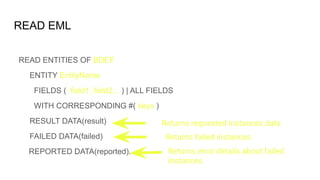
READ EML
READ ENTITIES OF BDEF
ENTITY EntityName
FIELDS ( field1, field2,.. ) | ALL FIELDS
WITH CORRESPONDING #( keys )
RESULT DATA(result)
FAILED DATA(failed)
REPORTED DATA(reported).
Returns requested instances data
Returns failed instances
Returns error details about failed
instances
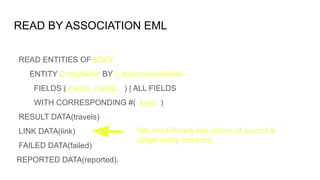
READ BY ASSOCIATION EML
READ ENTITIES OF BDEF
ENTITY EntityName BY _AssociationName
FIELDS ( Field1, Field2.. ) | ALL FIELDS
WITH CORRESPONDING #( keys )
RESULT DATA(travels)
LINK DATA(link)
FAILED DATA(failed)
REPORTED DATA(reported).
Returns Primary key values of source &
target entity instance
Create EML
Create & Create By EML
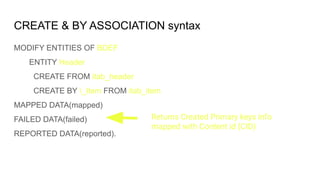
CREATE & BY ASSOCIATION syntax
MODIFY ENTITIES OF BDEF
ENTITY Header
CREATE FROM itab_header
CREATE BY _Item FROM itab_item
MAPPED DATA(mapped)
FAILED DATA(failed)
REPORTED DATA(reported).
Returns Created Primary keys info
mapped with Content id (CID)
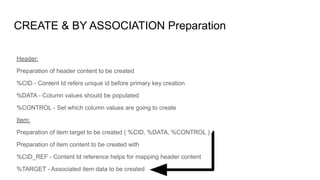
CREATE & BY ASSOCIATION Preparation
Header:
Preparation of header content to be created
%CID - Content Id refers unique id before primary key creation
%DATA - Column values should be populated
%CONTROL - Set which column values are going to create
Item:
Preparation of item target to be created ( %CID, %DATA, %CONTROL )
Preparation of item content to be created with
%CID_REF - Content Id reference helps for mapping header content
%TARGET - Associated item data to be created
Update EML
Update EML
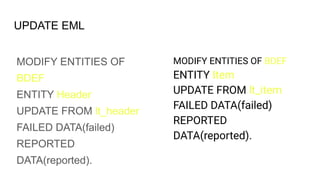
UPDATE EML
MODIFY ENTITIES OF
BDEF
ENTITY Header
UPDATE FROM lt_header
FAILED DATA(failed)
REPORTED
DATA(reported).
MODIFY ENTITIES OF BDEF
ENTITY Item
UPDATE FROM lt_item
FAILED DATA(failed)
REPORTED
DATA(reported).
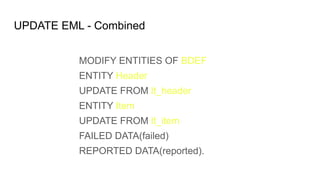
UPDATE EML - Combined
MODIFY ENTITIES OF BDEF
ENTITY Header
UPDATE FROM lt_header
ENTITY Item
UPDATE FROM lt_item
FAILED DATA(failed)
REPORTED DATA(reported).
Delete EML
Delete EML
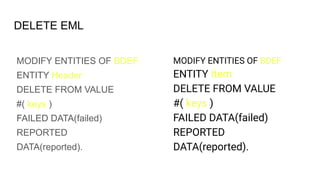
DELETE EML
MODIFY ENTITIES OF BDEF
ENTITY Header
DELETE FROM VALUE
#( keys )
FAILED DATA(failed)
REPORTED
DATA(reported).
MODIFY ENTITIES OF BDEF
ENTITY Item
DELETE FROM VALUE
#( keys )
FAILED DATA(failed)
REPORTED
DATA(reported).
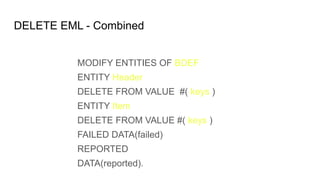
DELETE EML - Combined
MODIFY ENTITIES OF BDEF
ENTITY Header
DELETE FROM VALUE #( keys )
ENTITY Item
DELETE FROM VALUE #( keys )
FAILED DATA(failed)
REPORTED
DATA(reported).
Validations
Validation Part1
Validation Part2
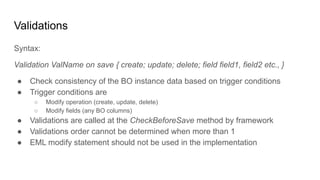
Validations
Syntax:
Validation ValName on save { create; update; delete; field field1, field2 etc., }
● Check consistency of the BO instance data based on trigger conditions
● Trigger conditions are
○ Modify operation (create, update, delete)
○ Modify fields (any BO columns)
● Validations are called at the CheckBeforeSave method by framework
● Validations order cannot be determined when more than 1
● EML modify statement should not be used in the implementation
Determinations
What is Determinations ?
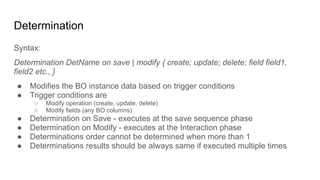
Determination
Syntax:
Determination DetName on save | modify { create; update; delete; field field1,
field2 etc., }
● Modifies the BO instance data based on trigger conditions
● Trigger conditions are
○ Modify operation (create, update, delete)
○ Modify fields (any BO columns)
● Determination on Save - executes at the save sequence phase
● Determination on Modify - executes at the Interaction phase
● Determinations order cannot be determined when more than 1
● Determinations results should be always same if executed multiple times
Actions
What is Action in RAP ?
Action with Parameters
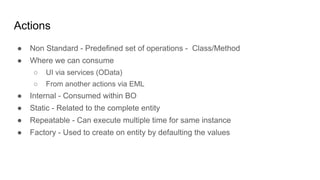
Actions
● Non Standard - Predefined set of operations - Class/Method
● Where we can consume
○ UI via services (OData)
○ From another actions via EML
● Internal - Consumed within BO
● Static - Related to the complete entity
● Repeatable - Can execute multiple time for same instance
● Factory - Used to create on entity by defaulting the values
Actions (Cont..)
Input Parameters
Output Parameters
Behaviour Characteristics
Numbering
Feature Control
Authorization
ETag
Draft handling
Feature Controls
Instance Feature Control
Static Feature Control
Global Feature Control
Numbering in RAP
Numbering
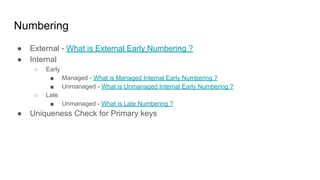
● External - What is External Early Numbering ?
● Internal
○ Early
■ Managed - What is Managed Internal Early Numbering ?
■ Unmanaged - What is Unmanaged Internal Early Numbering ?
○ Late
■ Unmanaged - What is Late Numbering ?
● Uniqueness Check for Primary keys
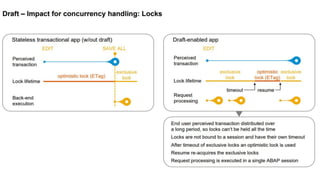
Concurrency Control
What is Concurrency Control in RAP ?
How to Define Etag in RAP ?
How to Define Locking ?
Concurrency Control
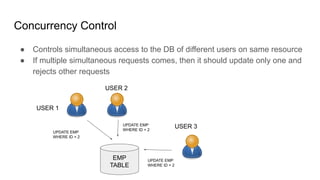
● Controls simultaneous access to the DB of different users on same resource
● If multiple simultaneous requests comes, then it should update only one and
rejects other requests
EMP
TABLE
USER 1
USER 2
USER 3
UPDATE EMP
WHERE ID = 2
UPDATE EMP
WHERE ID = 2
UPDATE EMP
WHERE ID = 2
Optimistic
Concurrency
Control
Pessimistic
Concurrency
Control
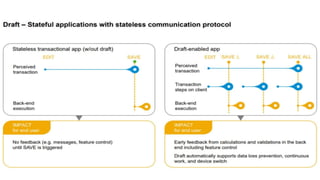
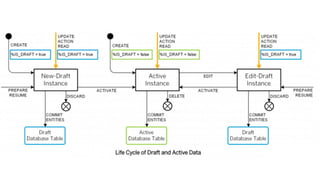
Draft Handling
Overview of Draft Handling
What is Draft Design time & Runtime ?
How to Implement Draft handling in RAP ?
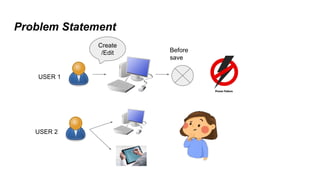
Problem Statement
USER 1
USER 2
Create
/Edit Before
save
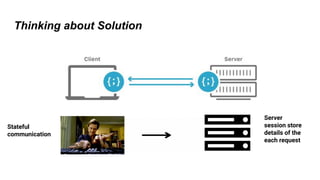
Thinking about Solution
Server
session store
details of the
each request
Stateful
communication
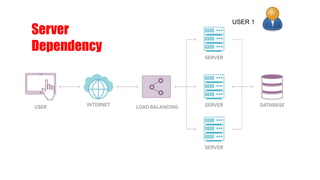
USER 1
Server
Dependency
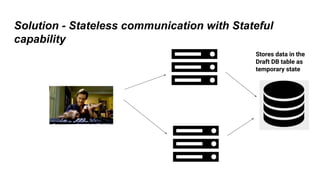
Solution - Stateless communication with Stateful
capability
Stores data in the
Draft DB table as
temporary state
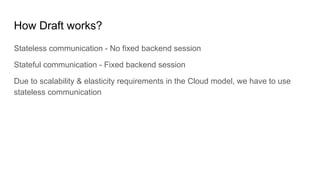
How Draft works?
Stateless communication - No fixed backend session
Stateful communication - Fixed backend session
Due to scalability & elasticity requirements in the Cloud model, we have to use
stateless communication
Side Effects in RAP
What is Side Effects ?
RAP Generator
What is RAP Generator ?
How to Deploy RAP
Application ?
Step by Step guide
Thanks for your support!
Email - muthumuthaiah@gmail.com
My Channel - Youtube Channel
LinkedIn - Muthu - Linkedin

Overview_of_RAP_ABAP_Restful_Programming_Model_1729458306.pdf

  • 1.
  • 2.
    Behavior Definition What isBehavior Definition?
  • 3.
    Behavior Definition -Overview ● Helps to enable transactional capabilities of the BO entities ● New ABAP repository objects called Behavior Definition Language ● Looks like CDS Data Definition Language ● Can have one or more entity behaviour definition ● Root entities must be specified (Child entities are optional) ● Behavior implementation class can be defined for all BO Entity ● Formed by ○ Behaviour Characteristics ○ Behaviour Body
  • 4.
    Behavior Characteristics -Overview ● Persistent table - dB table name should be specified ● Draft table - Draft dB table name should be specified ● Saving options - With additional save, With Unmanaged save ● Etag - Optimistic concurrency control ● Locking - Pessimistic concurrency control ● Authorization - Protects your data from unauthorized access ● Early numbering - Assign primary key fields values at Buffer update ● Late numbering - Assign primary key fields values before dB update
  • 5.
    Behavior Body -Overview ● Field characteristics - Additional capability for fields ● Field numbering - Managed way of primary key assignment ● RAP BO operations - CRUD, CBA, RBA, Actions, Function etc., ● Validations - checks consistency of BO instance data ● Determinations - Calculate or determine new values at runtime ● Type mapping - field mapping b/w dB table & CDS views ● Implementation grouping - Different implementation classes
  • 6.
    Projection Behavior Definition What isProjection Behavior Definition ?
  • 7.
    Projection Behavior Definition BehaviorCharacteristics: ● Persistent table ● Draft table ● Saving options ● Locking ● Etag ● Early numbering ● Late numbering Behavior Body: ● Field characteristics ● Use ● Actions and functions ● Augment ● Type mapping
  • 8.
    Service Definition &Binding Business Services
  • 9.
    Task Task Item TaskI view Task item I view Task C view Task item C view Behavior definition Projection Behavior definition Task Application Technical objects Projection Views Basic/Interface Views Service Definition Service Binding
  • 10.
  • 11.
    BO Operations -Standard (CRUD) ● CRUD - Create, Read, Update, Delete called as Standard operations ● Read operation - Default operation for BDEF (not required to define) ● Managed - No implementation needed ( Implementation needed for unmanaged) ● Projection BDEF - can reuse with the help of “use” keyword ● Create - new instance of BO entity ● Update - updates instance of BO entity ● Delete - deletes instance of BO entity ● Create by Association - creation of child entity instance should be via association
  • 12.
  • 13.
    EML - EntityManipulation Language ● Standard API to access Business Objects Behaviours ● Direct way to consume BO (without Odata) ● READ Entities ○ READ ○ READ BY ASSOCIATION ● MODIFY Entities ○ CREATE ○ UPDATE ○ DELETE ○ CREATE BY ASSOCIATION ○ ACTION ● COMMIT Entities ● ROLLBACK Entities Interaction Phase Save phase
  • 14.
    Read EML What isRead EML ?
  • 15.
    READ EML READ ENTITIESOF BDEF ENTITY EntityName FIELDS ( field1, field2,.. ) | ALL FIELDS WITH CORRESPONDING #( keys ) RESULT DATA(result) FAILED DATA(failed) REPORTED DATA(reported). Returns requested instances data Returns failed instances Returns error details about failed instances
  • 16.
    READ BY ASSOCIATIONEML READ ENTITIES OF BDEF ENTITY EntityName BY _AssociationName FIELDS ( Field1, Field2.. ) | ALL FIELDS WITH CORRESPONDING #( keys ) RESULT DATA(travels) LINK DATA(link) FAILED DATA(failed) REPORTED DATA(reported). Returns Primary key values of source & target entity instance
  • 17.
    Create EML Create &Create By EML
  • 18.
    CREATE & BYASSOCIATION syntax MODIFY ENTITIES OF BDEF ENTITY Header CREATE FROM itab_header CREATE BY _Item FROM itab_item MAPPED DATA(mapped) FAILED DATA(failed) REPORTED DATA(reported). Returns Created Primary keys info mapped with Content id (CID)
  • 19.
    CREATE & BYASSOCIATION Preparation Header: Preparation of header content to be created %CID - Content Id refers unique id before primary key creation %DATA - Column values should be populated %CONTROL - Set which column values are going to create Item: Preparation of item target to be created ( %CID, %DATA, %CONTROL ) Preparation of item content to be created with %CID_REF - Content Id reference helps for mapping header content %TARGET - Associated item data to be created
  • 20.
  • 21.
    UPDATE EML MODIFY ENTITIESOF BDEF ENTITY Header UPDATE FROM lt_header FAILED DATA(failed) REPORTED DATA(reported). MODIFY ENTITIES OF BDEF ENTITY Item UPDATE FROM lt_item FAILED DATA(failed) REPORTED DATA(reported).
  • 22.
    UPDATE EML -Combined MODIFY ENTITIES OF BDEF ENTITY Header UPDATE FROM lt_header ENTITY Item UPDATE FROM lt_item FAILED DATA(failed) REPORTED DATA(reported).
  • 23.
  • 24.
    DELETE EML MODIFY ENTITIESOF BDEF ENTITY Header DELETE FROM VALUE #( keys ) FAILED DATA(failed) REPORTED DATA(reported). MODIFY ENTITIES OF BDEF ENTITY Item DELETE FROM VALUE #( keys ) FAILED DATA(failed) REPORTED DATA(reported).
  • 25.
    DELETE EML -Combined MODIFY ENTITIES OF BDEF ENTITY Header DELETE FROM VALUE #( keys ) ENTITY Item DELETE FROM VALUE #( keys ) FAILED DATA(failed) REPORTED DATA(reported).
  • 26.
  • 27.
    Validations Syntax: Validation ValName onsave { create; update; delete; field field1, field2 etc., } ● Check consistency of the BO instance data based on trigger conditions ● Trigger conditions are ○ Modify operation (create, update, delete) ○ Modify fields (any BO columns) ● Validations are called at the CheckBeforeSave method by framework ● Validations order cannot be determined when more than 1 ● EML modify statement should not be used in the implementation
  • 28.
  • 29.
    Determination Syntax: Determination DetName onsave | modify { create; update; delete; field field1, field2 etc., } ● Modifies the BO instance data based on trigger conditions ● Trigger conditions are ○ Modify operation (create, update, delete) ○ Modify fields (any BO columns) ● Determination on Save - executes at the save sequence phase ● Determination on Modify - executes at the Interaction phase ● Determinations order cannot be determined when more than 1 ● Determinations results should be always same if executed multiple times
  • 31.
    Actions What is Actionin RAP ? Action with Parameters
  • 32.
    Actions ● Non Standard- Predefined set of operations - Class/Method ● Where we can consume ○ UI via services (OData) ○ From another actions via EML ● Internal - Consumed within BO ● Static - Related to the complete entity ● Repeatable - Can execute multiple time for same instance ● Factory - Used to create on entity by defaulting the values
  • 33.
  • 34.
  • 35.
    Feature Controls Instance FeatureControl Static Feature Control Global Feature Control
  • 36.
  • 37.
    Numbering ● External -What is External Early Numbering ? ● Internal ○ Early ■ Managed - What is Managed Internal Early Numbering ? ■ Unmanaged - What is Unmanaged Internal Early Numbering ? ○ Late ■ Unmanaged - What is Late Numbering ? ● Uniqueness Check for Primary keys
  • 38.
    Concurrency Control What isConcurrency Control in RAP ? How to Define Etag in RAP ? How to Define Locking ?
  • 39.
    Concurrency Control ● Controlssimultaneous access to the DB of different users on same resource ● If multiple simultaneous requests comes, then it should update only one and rejects other requests EMP TABLE USER 1 USER 2 USER 3 UPDATE EMP WHERE ID = 2 UPDATE EMP WHERE ID = 2 UPDATE EMP WHERE ID = 2
  • 40.
  • 41.
  • 42.
    Draft Handling Overview ofDraft Handling What is Draft Design time & Runtime ? How to Implement Draft handling in RAP ?
  • 43.
    Problem Statement USER 1 USER2 Create /Edit Before save
  • 44.
    Thinking about Solution Server sessionstore details of the each request Stateful communication
  • 45.
  • 46.
    Solution - Statelesscommunication with Stateful capability Stores data in the Draft DB table as temporary state
  • 50.
    How Draft works? Statelesscommunication - No fixed backend session Stateful communication - Fixed backend session Due to scalability & elasticity requirements in the Cloud model, we have to use stateless communication
  • 51.
    Side Effects inRAP What is Side Effects ?
  • 52.
    RAP Generator What isRAP Generator ?
  • 53.
    How to DeployRAP Application ? Step by Step guide
  • 54.
    Thanks for yoursupport! Email - muthumuthaiah@gmail.com My Channel - Youtube Channel LinkedIn - Muthu - Linkedin