Introduction Australia’s national training system is a set of organisational arrangements between the Australian Government, state and territory governments working with industry, employers and training providers to deliver vocational education and training (VET).
The Training System What is VET? Vocational Education & Training is ‘education and training for work’ and part of a broader educational network in Australia The Australian VET system is one of the most sophisticated in the world because it is: Industry-led  National Client focused
What is VET? Cont… Three identifiable sectors in Australian education system: HE (higher education) VET (vocational education and training) Schools Some dual sector VET/HE institutions but each sector has its own: Institutions Administrative arrangements Sets of qualifications
Overlapping Program Delivery VET Programs delivered in schools VET Programs delivered in universities Higher Education VET Schools
Governance
VET policies & frameworks The National Training Framework (NTF) Training packages The Australian Quality Training Framework (AQTF) –  currently AQTF 2007 The Australian Qualifications Framework (AQF) User choice Traineeship and apprenticeship arrangements The National Reporting System (NRS)
National Training Framework (NTF) The National Training Framework (NTF) is made up of the Australian Quality Training Framework (AQTF) and Training Packages The NTF is a nationally consistent, industry-led system designed to: provide high-quality skill outcomes to maintain individuals’ employability and increase their productivity  provide for nationally recognised qualifications, and  improve the competitiveness of enterprises and the nation
National Training Strategies Towards a Skilled Australia (1994-1998) A Bridge to the Future (1998-2003) Shaping Our Future (2004-2010) Builds on achievements of the two previous national VET strategies, with the vision: VET works for Australian businesses – making them internationally competitive VET works for people – giving Australians world-class skills and knowledge VET works for communities – making them inclusive and sustainable
Other national strategies The Australian Flexible Learning Framework for VET 2000-2004 A nationally agreed set of goals, principles and actions to help Australian people and industries make a rapid and successful transition to the information economy Bridging Pathways A five-year (2000-2005) national strategy and implementation plan for increasing VET opportunities for people with a disability Partners in a Learning Culture A five-year (2000 – 2005) national strategy and implementation plan for increasing VET opportunities for Indigenous people
New Directions for VET The Directions Paper  Skilling Australia – New Directions for Vocational Education and Training  set out possible models for a new national training system from 1 July 2005 when responsibilities of the Australian National Training Authority transfer to the Department of Education, Science and Training.
Skilling Australia Skilling Australia’s Workforce Act 2005 2005-2008 Commonwealth-State Agreement for Skilling Australia’s Workforce
National Goals & Objectives Industry will have a highly skilled workforce to support strong performance in the global economy Employers and individuals will be at the centre of VET Communities and regions will be strengthened economically and socially through learning and employment Indigenous Australians will have skills for viable jobs and their learning culture will be shared
National Priorities Improving the system’s responsiveness to rapid changes in demand for skills development and addressing skills shortages, especially in traditional trades and in emerging industries Delivering improved outcomes for employers, individuals and communities Improving quality Increasing participation and up-skilling mature age workers Encouraging greater re-engagement in training by Australians who are not fully participating in the labour market
Key VET Organisations & Stakeholders Department of Education, Employment and Workplace Relations (DEEWR) –  formally  Department of Education, Science and Training (DEST) –  from 1 July 2005 the responsibilities and functions of the Australian National Training Authority (ANTA) were transferred to DEST State and Territory training authorities (STAs) Industry Skills Councils (ISCs) – national industry advisory boards State and Territory ISCs State and Territory course accrediting bodies National and state employer and employee organisations Australian Apprenticeship Centres (formally New Apprenticeship Centres NACs) Training and assessment organisations – Registered Training Organisations (TAFE, private commercial colleges or companies, enterprises, community organisations, group training companies and schools)
Training Packages A training package is a set of nationally endorsed standards and qualifications for recognising and assessing people’s skills in a specific industry, industry sector or enterprise.  Training packages ensure the quality, consistency and industry relevance of training products Training packages describe the skills and knowledge that individuals need to perform effectively in the workplace. A training package does not describe how an individual should be trained Teachers and trainers develop learning and assessment strategies (the ‘how’) depending on learners’ needs, abilities and circumstances
Training Packages cont… By December 2004 there were 81 training packages (currently 86) covering most industries and over 80% of the workforce.  When there is a training need that is not addressed by an existing training package, an accredited course is developed. The National Training Information Service (NTIS) records all training packages, accredited courses, qualifications and units of competency at  www.ntis.gov.au
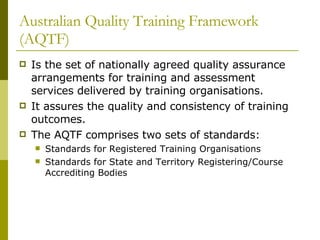
Australian Quality Training Framework (AQTF) Is the set of nationally agreed quality assurance arrangements for training and assessment services delivered by training organisations.  It assures the quality and consistency of training outcomes. The AQTF comprises two sets of standards: Standards for Registered Training Organisations Standards for State and Territory Registering/Course Accrediting Bodies
Australian Qualifications Framework (AQF) The AQF is a unified system of national qualifications
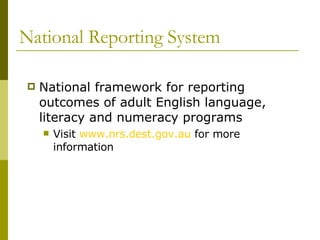
National Reporting System National framework for reporting outcomes of adult English language, literacy and numeracy programs Visit  www.nrs.dest.gov.au  for more information
Traineeship A system of vocational training combining off-the-job training at an approved training provider with on-the-job training and practical work experience. Traineeships generally take one to two years and are now a part of the Australian Apprenticeships (previously “New Apprenticeships”) system. Visit  www.australianapprenticeships.gov.au  for more information
User choice A provision of New Apprenticeships whereby an employer and an apprentice or trainee can choose the training provider for the government-funded off-the-job elements of the training program. The organisation chosen can be a TAFE or any other RTO (including school) that has been registered to deliver the required training
Industry Skills Councils (ISCs) ISCs provide advice to Australian, state & territory governments on the training required by industry. The key purpose of an ISC to to provide: comprehensive representation of industry in the management and planning of VET advice and participation in the development of training products and services to meet industry needs.
Industry Skills Councils cont… ISCs collect information on industry training needs from employers, unions and professional industry associations, thereby ensuring an industry-led VET system that is flexible and responsive. ISCs advise government on how public funds should be spent within each industry, and have primary responsibility for the development and maintenance of Training Packages. ISCs ensures that the Australian VET system remains industry-led, client focused, flexible and responsive.
Training Packages and Courses Training Packages Developed by national industry skills councils or enterprises Extensive national consultation processes Endorsed by the National Quality Council (NQC) Courses  Developed in areas not covered by training packages Consultation with industry/community Accredited by state/territory accrediting bodies
VET in Victoria In Victoria, VET programs include: Vocational Pre-vocational General education Further education VET programs may be delivered in: TAFE institutions Private RTOs ACE (Adult Community Education) providers Universities Schools  Not all VET programs are nationally recognised The VRQA (formally VQA) is the accrediting body for all VET programs which are accredited courses The same set of standards and processes apply for all VET accredited courses
VET Policy Development Consultation processes are an essential element of the VET system Opportunities to contribute to VET policy developments may occur through: Attendance at workshops and consultations conducted by relevant VET organisations and stakeholders Individual or organisational written submissions and feedback to relevant VET organisations and stakeholders Participation in forums, networks and conferences Participation in training or assessment organisation meetings Participation in validation meetings Research or consultancy Contribution to online consultations

Overview - The Training System

  • 1.
    Introduction Australia’s nationaltraining system is a set of organisational arrangements between the Australian Government, state and territory governments working with industry, employers and training providers to deliver vocational education and training (VET).
  • 2.
    The Training SystemWhat is VET? Vocational Education & Training is ‘education and training for work’ and part of a broader educational network in Australia The Australian VET system is one of the most sophisticated in the world because it is: Industry-led National Client focused
  • 3.
    What is VET?Cont… Three identifiable sectors in Australian education system: HE (higher education) VET (vocational education and training) Schools Some dual sector VET/HE institutions but each sector has its own: Institutions Administrative arrangements Sets of qualifications
  • 4.
    Overlapping Program DeliveryVET Programs delivered in schools VET Programs delivered in universities Higher Education VET Schools
  • 5.
  • 6.
    VET policies &frameworks The National Training Framework (NTF) Training packages The Australian Quality Training Framework (AQTF) – currently AQTF 2007 The Australian Qualifications Framework (AQF) User choice Traineeship and apprenticeship arrangements The National Reporting System (NRS)
  • 7.
    National Training Framework(NTF) The National Training Framework (NTF) is made up of the Australian Quality Training Framework (AQTF) and Training Packages The NTF is a nationally consistent, industry-led system designed to: provide high-quality skill outcomes to maintain individuals’ employability and increase their productivity provide for nationally recognised qualifications, and improve the competitiveness of enterprises and the nation
  • 8.
    National Training StrategiesTowards a Skilled Australia (1994-1998) A Bridge to the Future (1998-2003) Shaping Our Future (2004-2010) Builds on achievements of the two previous national VET strategies, with the vision: VET works for Australian businesses – making them internationally competitive VET works for people – giving Australians world-class skills and knowledge VET works for communities – making them inclusive and sustainable
  • 9.
    Other national strategiesThe Australian Flexible Learning Framework for VET 2000-2004 A nationally agreed set of goals, principles and actions to help Australian people and industries make a rapid and successful transition to the information economy Bridging Pathways A five-year (2000-2005) national strategy and implementation plan for increasing VET opportunities for people with a disability Partners in a Learning Culture A five-year (2000 – 2005) national strategy and implementation plan for increasing VET opportunities for Indigenous people
  • 10.
    New Directions forVET The Directions Paper Skilling Australia – New Directions for Vocational Education and Training set out possible models for a new national training system from 1 July 2005 when responsibilities of the Australian National Training Authority transfer to the Department of Education, Science and Training.
  • 11.
    Skilling Australia SkillingAustralia’s Workforce Act 2005 2005-2008 Commonwealth-State Agreement for Skilling Australia’s Workforce
  • 12.
    National Goals &Objectives Industry will have a highly skilled workforce to support strong performance in the global economy Employers and individuals will be at the centre of VET Communities and regions will be strengthened economically and socially through learning and employment Indigenous Australians will have skills for viable jobs and their learning culture will be shared
  • 13.
    National Priorities Improvingthe system’s responsiveness to rapid changes in demand for skills development and addressing skills shortages, especially in traditional trades and in emerging industries Delivering improved outcomes for employers, individuals and communities Improving quality Increasing participation and up-skilling mature age workers Encouraging greater re-engagement in training by Australians who are not fully participating in the labour market
  • 14.
    Key VET Organisations& Stakeholders Department of Education, Employment and Workplace Relations (DEEWR) – formally Department of Education, Science and Training (DEST) – from 1 July 2005 the responsibilities and functions of the Australian National Training Authority (ANTA) were transferred to DEST State and Territory training authorities (STAs) Industry Skills Councils (ISCs) – national industry advisory boards State and Territory ISCs State and Territory course accrediting bodies National and state employer and employee organisations Australian Apprenticeship Centres (formally New Apprenticeship Centres NACs) Training and assessment organisations – Registered Training Organisations (TAFE, private commercial colleges or companies, enterprises, community organisations, group training companies and schools)
  • 15.
    Training Packages Atraining package is a set of nationally endorsed standards and qualifications for recognising and assessing people’s skills in a specific industry, industry sector or enterprise. Training packages ensure the quality, consistency and industry relevance of training products Training packages describe the skills and knowledge that individuals need to perform effectively in the workplace. A training package does not describe how an individual should be trained Teachers and trainers develop learning and assessment strategies (the ‘how’) depending on learners’ needs, abilities and circumstances
  • 16.
    Training Packages cont…By December 2004 there were 81 training packages (currently 86) covering most industries and over 80% of the workforce. When there is a training need that is not addressed by an existing training package, an accredited course is developed. The National Training Information Service (NTIS) records all training packages, accredited courses, qualifications and units of competency at www.ntis.gov.au
  • 17.
    Australian Quality TrainingFramework (AQTF) Is the set of nationally agreed quality assurance arrangements for training and assessment services delivered by training organisations. It assures the quality and consistency of training outcomes. The AQTF comprises two sets of standards: Standards for Registered Training Organisations Standards for State and Territory Registering/Course Accrediting Bodies
  • 18.
    Australian Qualifications Framework(AQF) The AQF is a unified system of national qualifications
  • 19.
    National Reporting SystemNational framework for reporting outcomes of adult English language, literacy and numeracy programs Visit www.nrs.dest.gov.au for more information
  • 20.
    Traineeship A systemof vocational training combining off-the-job training at an approved training provider with on-the-job training and practical work experience. Traineeships generally take one to two years and are now a part of the Australian Apprenticeships (previously “New Apprenticeships”) system. Visit www.australianapprenticeships.gov.au for more information
  • 21.
    User choice Aprovision of New Apprenticeships whereby an employer and an apprentice or trainee can choose the training provider for the government-funded off-the-job elements of the training program. The organisation chosen can be a TAFE or any other RTO (including school) that has been registered to deliver the required training
  • 22.
    Industry Skills Councils(ISCs) ISCs provide advice to Australian, state & territory governments on the training required by industry. The key purpose of an ISC to to provide: comprehensive representation of industry in the management and planning of VET advice and participation in the development of training products and services to meet industry needs.
  • 23.
    Industry Skills Councilscont… ISCs collect information on industry training needs from employers, unions and professional industry associations, thereby ensuring an industry-led VET system that is flexible and responsive. ISCs advise government on how public funds should be spent within each industry, and have primary responsibility for the development and maintenance of Training Packages. ISCs ensures that the Australian VET system remains industry-led, client focused, flexible and responsive.
  • 24.
    Training Packages andCourses Training Packages Developed by national industry skills councils or enterprises Extensive national consultation processes Endorsed by the National Quality Council (NQC) Courses Developed in areas not covered by training packages Consultation with industry/community Accredited by state/territory accrediting bodies
  • 25.
    VET in VictoriaIn Victoria, VET programs include: Vocational Pre-vocational General education Further education VET programs may be delivered in: TAFE institutions Private RTOs ACE (Adult Community Education) providers Universities Schools Not all VET programs are nationally recognised The VRQA (formally VQA) is the accrediting body for all VET programs which are accredited courses The same set of standards and processes apply for all VET accredited courses
  • 26.
    VET Policy DevelopmentConsultation processes are an essential element of the VET system Opportunities to contribute to VET policy developments may occur through: Attendance at workshops and consultations conducted by relevant VET organisations and stakeholders Individual or organisational written submissions and feedback to relevant VET organisations and stakeholders Participation in forums, networks and conferences Participation in training or assessment organisation meetings Participation in validation meetings Research or consultancy Contribution to online consultations