Submission
    Smart & Skilled:
making NSW number one

  ACTT – Association of Concerned
           TAFE Teachers
Lee Frost, Don Gilhooly, Alex Strachan, Dorothy Tsang, Paul Vourloumis
Introduction
• The members of ACTT wish to submit the
  following submission and recommendations to
  the Board of Vocational Education and Training
  regarding the NSW Smart & Skilled policy. The
  issues to be addressed are:
• Increase participation in VET
• Target VET to business, industry and regional
  needs
• Role and function of TAFE NSW as the public
  provider
• Greater choice for individuals & employers
Increase participation in VET
   1.1 How can we engage more of the working age population in vocational
      education and training?

• By ensuring standards of private RTO’s are as high as TAFE to
  maintain quality of training that is not compromised by market
  forces.

• By ensuring courses result in a high proportion of job outcomes.
  Contestable funding in Victorian VET led to a 1000% increase in
  enrolments in courses for Fitness Instructors since 2008.

• By ensuring NSW TAFE is adequately funded to continue to
  provide high quality vocational education and training.
TAFE NSW has a high satisfaction
    factor in relation to private RTO’s
  A survey cited in the Smart & Skilled discussion
  paper states:
• 89 per cent of TAFE NSW graduates were
  satisfied with the quality of the training they
  had received.

• 87 per cent of training participants who receive
  government- funded training with private
  training providers in New South Wales were
  satisfied with the quality of training. (NSW DEC
  2011)
1.3 How can we improve training and job
     outcomes for disadvantaged learners?

• By maintaining reductions in course fees for
  financially disadvantaged learners.

• By increasing subsidised foundation services
  such as Literacy and Numeracy and IT
  support within or prior to commencement of
  training.
1.5 How can we encourage more people to complete
             higher-level qualifications?

• Lower-level qualifications need to be valued and
  not discouraged as they often underpin
  knowledge and skills, they scaffold learning for
  successful completions in higher-level
  qualifications.

• Costs for higher-level qualifications need to be
  affordable. Proposed VET FEE-HELP needs to be
  flexible and non-restrictive to lifelong learning.
1.7 To what extent could a training entitlement
 increase training participation and meet the future
 skill needs of individuals, businesses, regions and
                     our economy?
• A training entitlement is transferable Federal
  Government subsidised funding for VET
  students for their first CIII.
• Whilst successful completion of a CIII may
  increase participation and meet skills needs
  by young learners, changing industry
  demands may necessitate retraining. This
  precludes those who already have CIII or
  higher to access subsidised funding.
1.11 Should student loans be available for government-
 funded vocational qualifications? If so, what should they
                        look like?

• Student loans should not be used as an
  excuse to raise the course fees of VET to
  unreasonable levels.

• Care must be taken to not exclude learners
  from skilling down or sideways. Lifelong
  learning is not always linear.
Paul
Target VET to business, industry and
           regional needs
2.1 What is the best way to ensure that the
  government's funds for VET flow to areas that
  maximise economic benefits for our businesses
  and the state?
• We suggest that lowering fees will increase
  enrolments. The effect of this allows more
  opportunity for jobs.

• Skills needs need to be identified early.
Target VET to business, industry and
           regional needs
2.2 How can we maximise VET opportunities to
  meet the needs of our regions?
• TAFE NSW Riverina suggest graduates
  satisfaction with the training received promoted
  more funding for the institution which increases
  skill levels creating a beneficial cycle.

• Flexible distance based learning such as TAFE
  OTEN should be enhanced and have funding
  support to better service regional areas e.g.
  Increased IT resources.
Target VET to business, industry and
            regional needs
• 2.3 How can our VET system adapt and be
  responsive to meet the changing needs of
  business and industry and changes in the
  economy?
• Facilitate increased consultation with industry.

• Manufacturing Skills Australia (MSA) explain
  how authentic information from industry is
  important. The significance of this information
  can provide a waypoint to finding where future
  funding can be spent.
Lee
Role and function of TAFE NSW as the
            public provider
• 3.1 What should the role of TAFE NSW be in the context of
  a broader entitlement to training in our vocational
  education and training system?

• TAFE's role as the primary VET provider in NSW should be
  supported by government in order to maintain standards
  in course development and delivery.

• In 2010 TAFE delivered more than 70% of all flexible
  Vocational Education and Training in Australia. It has the
  infrastructure, reputation, history and the resources to
  further develop its role in VET provision. (NSW Adult
  Literacy and Numeracy Council, 2011).
Role and function of TAFE NSW as the
            public provider
• 3.2 How should TAFE NSW be better utilized to meet the
  future skill needs of our workforce?
• TAFE should develop stronger links to schools and
  universities by providing clearer pathways for vocational
  and professional training.

• TAFE has an extensive syllabus that has been
  maintained, adapted and changed according to market
  and industry needs.

• Training reforms need to support existing staff to develop
  resources and facilities that can adapt to the changing job
  market demands, and in line with the NSW 2021 plan.
Dorothy
Greater choice for individuals and
              employers
  4.1 Type of information that is needed by
  individuals and employers to inform their choice
  of VET:

• TAFE NSW works with employers in their
  workplace.

• Provides most placement support to students
  training in the workplace.
Greater choice for individuals and
               employers
• 4.2 To assure the quality of VET in the context of greater
  choice, we can
• Increased emphasis on teachers’ accountability in their classroom
  delivery.

• Maintain or update quality educational facilities or flexible
  learning options.

• Close collaboration with local community, industry and other
  stakeholders.

• Alternative career pathways available to students to encourage
  appropriate training choices.
Don
Improve VET completion rates
• 5.1How can we improve vocational education
  and training completion rates?
• Offer more ‘Gap’ training for basic.
• Greater levels of support for students
  learning.
• Value the participation as well as the
  completion.
Improve VET completion rates
• 5.3 How can we improve completions for
  apprentices and trainees?
• Comprehensive careers advice in & out of
  school.
• Integration of some courses into school
  curriculum.
• Value NSW VET relatively high completion
  rate & do not compromise it by wholesale
  introduction of contestable funding.
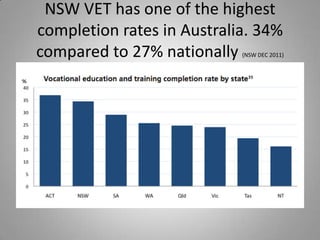
NSW VET has one of the highest
completion rates in Australia. 34%
compared to 27% nationally  (NSW DEC 2011)
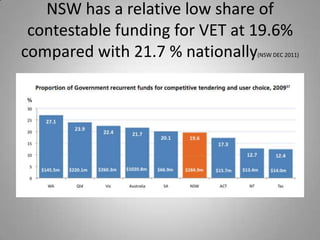
NSW has a relative low share of
 contestable funding for VET at 19.6%
compared with 21.7 % nationally (NSW DEC 2011)
Recommendations
• To increase participation in VET the government must increase or
  at least maintain funding for TAFE for it to continue providing
  premium Vocational Education and Training.
                  Value add what we have - TAFE.

• Contestable funding needs to be in line with skills needs and
  additional to current funding model so facilitating reform.
  Flexibility is allowed for.

• Keep course fees accessible for learners with careful introduction
  of an entitlement system and student loans for higher-level
  training or lowering fees to stepping up qualifications from
  previous completions.
Recommendations
• Increase subsidised foundation services such as Literacy
  and Numeracy and IT support within or prior to
  commencement of training.

• Proposed VET FEE-HELP needs to be flexible and non-
  restrictive to lifelong learning.

• ACTT suggest that lowering fees will increase enrolments.


• Facilitate increased consultation with industry, big & small
Recommendations
• Maintain or update quality educational facilities and/or flexible
  learning options, give TAFE the ability to be flexible.

• Comprehensive careers advice in & out of school.

• Value NSW VET relatively high completion rate & do not
  compromise it by wholesale introduction of contestable funding.

• Value the participation as well as the completion.


     Do we wish for a society built on a co-operative model or a
                        competitive model?
References:
•   Australian Council for Private Education and Training 2011, Smart and Skilled Submission, viewed 3
    April 2012 https://www.training.nsw.gov.au/forms_documents/.../org_acpet.pdf

•   Department of Education, Employment and Workplace Relations 2012, Skills for all Australians:
    National reforms to skill more Australians and achieve a more competitive and dynamic
    economy, viewed 24 April 2012 http://www.deewr.gov.au/Skills/Pages/SkillsforallAustralians.aspx

•   NSW Adult Literacy and Numeracy Council 2011, Submission to: Smart and Skilled: making NSW
    number one, Accessed 24 April 2012.
    http://www.nswalnc.uts.edu.au/doc/SmartSkillALNCSub2011.pdf

•   NSW Department of Education and Communities 2011, Smart and skilled: making NSW number
    one, Discussion paper, viewed 2nd April 2012
    https://www.training.nsw.gov.au/vet/skills_reform/index.html

•   Trounson, A. 2011, ‘Boom for private providors’, The Australian, Higher Education, 17 August
    2011, viewed 28 April 2012 http://www.theaustralian.com.au/higher-education/boom-for-private-
    providers/story-e6frgcjx-1226116237059

Ss submission presentation final draft

  • 1.
    Submission Smart & Skilled: making NSW number one ACTT – Association of Concerned TAFE Teachers Lee Frost, Don Gilhooly, Alex Strachan, Dorothy Tsang, Paul Vourloumis
  • 2.
    Introduction • The membersof ACTT wish to submit the following submission and recommendations to the Board of Vocational Education and Training regarding the NSW Smart & Skilled policy. The issues to be addressed are: • Increase participation in VET • Target VET to business, industry and regional needs • Role and function of TAFE NSW as the public provider • Greater choice for individuals & employers
  • 3.
    Increase participation inVET 1.1 How can we engage more of the working age population in vocational education and training? • By ensuring standards of private RTO’s are as high as TAFE to maintain quality of training that is not compromised by market forces. • By ensuring courses result in a high proportion of job outcomes. Contestable funding in Victorian VET led to a 1000% increase in enrolments in courses for Fitness Instructors since 2008. • By ensuring NSW TAFE is adequately funded to continue to provide high quality vocational education and training.
  • 4.
    TAFE NSW hasa high satisfaction factor in relation to private RTO’s A survey cited in the Smart & Skilled discussion paper states: • 89 per cent of TAFE NSW graduates were satisfied with the quality of the training they had received. • 87 per cent of training participants who receive government- funded training with private training providers in New South Wales were satisfied with the quality of training. (NSW DEC 2011)
  • 5.
    1.3 How canwe improve training and job outcomes for disadvantaged learners? • By maintaining reductions in course fees for financially disadvantaged learners. • By increasing subsidised foundation services such as Literacy and Numeracy and IT support within or prior to commencement of training.
  • 6.
    1.5 How canwe encourage more people to complete higher-level qualifications? • Lower-level qualifications need to be valued and not discouraged as they often underpin knowledge and skills, they scaffold learning for successful completions in higher-level qualifications. • Costs for higher-level qualifications need to be affordable. Proposed VET FEE-HELP needs to be flexible and non-restrictive to lifelong learning.
  • 7.
    1.7 To whatextent could a training entitlement increase training participation and meet the future skill needs of individuals, businesses, regions and our economy? • A training entitlement is transferable Federal Government subsidised funding for VET students for their first CIII. • Whilst successful completion of a CIII may increase participation and meet skills needs by young learners, changing industry demands may necessitate retraining. This precludes those who already have CIII or higher to access subsidised funding.
  • 8.
    1.11 Should studentloans be available for government- funded vocational qualifications? If so, what should they look like? • Student loans should not be used as an excuse to raise the course fees of VET to unreasonable levels. • Care must be taken to not exclude learners from skilling down or sideways. Lifelong learning is not always linear.
  • 9.
  • 10.
    Target VET tobusiness, industry and regional needs 2.1 What is the best way to ensure that the government's funds for VET flow to areas that maximise economic benefits for our businesses and the state? • We suggest that lowering fees will increase enrolments. The effect of this allows more opportunity for jobs. • Skills needs need to be identified early.
  • 11.
    Target VET tobusiness, industry and regional needs 2.2 How can we maximise VET opportunities to meet the needs of our regions? • TAFE NSW Riverina suggest graduates satisfaction with the training received promoted more funding for the institution which increases skill levels creating a beneficial cycle. • Flexible distance based learning such as TAFE OTEN should be enhanced and have funding support to better service regional areas e.g. Increased IT resources.
  • 12.
    Target VET tobusiness, industry and regional needs • 2.3 How can our VET system adapt and be responsive to meet the changing needs of business and industry and changes in the economy? • Facilitate increased consultation with industry. • Manufacturing Skills Australia (MSA) explain how authentic information from industry is important. The significance of this information can provide a waypoint to finding where future funding can be spent.
  • 13.
  • 14.
    Role and functionof TAFE NSW as the public provider • 3.1 What should the role of TAFE NSW be in the context of a broader entitlement to training in our vocational education and training system? • TAFE's role as the primary VET provider in NSW should be supported by government in order to maintain standards in course development and delivery. • In 2010 TAFE delivered more than 70% of all flexible Vocational Education and Training in Australia. It has the infrastructure, reputation, history and the resources to further develop its role in VET provision. (NSW Adult Literacy and Numeracy Council, 2011).
  • 15.
    Role and functionof TAFE NSW as the public provider • 3.2 How should TAFE NSW be better utilized to meet the future skill needs of our workforce? • TAFE should develop stronger links to schools and universities by providing clearer pathways for vocational and professional training. • TAFE has an extensive syllabus that has been maintained, adapted and changed according to market and industry needs. • Training reforms need to support existing staff to develop resources and facilities that can adapt to the changing job market demands, and in line with the NSW 2021 plan.
  • 16.
  • 17.
    Greater choice forindividuals and employers 4.1 Type of information that is needed by individuals and employers to inform their choice of VET: • TAFE NSW works with employers in their workplace. • Provides most placement support to students training in the workplace.
  • 18.
    Greater choice forindividuals and employers • 4.2 To assure the quality of VET in the context of greater choice, we can • Increased emphasis on teachers’ accountability in their classroom delivery. • Maintain or update quality educational facilities or flexible learning options. • Close collaboration with local community, industry and other stakeholders. • Alternative career pathways available to students to encourage appropriate training choices.
  • 19.
  • 20.
    Improve VET completionrates • 5.1How can we improve vocational education and training completion rates? • Offer more ‘Gap’ training for basic. • Greater levels of support for students learning. • Value the participation as well as the completion.
  • 21.
    Improve VET completionrates • 5.3 How can we improve completions for apprentices and trainees? • Comprehensive careers advice in & out of school. • Integration of some courses into school curriculum. • Value NSW VET relatively high completion rate & do not compromise it by wholesale introduction of contestable funding.
  • 22.
    NSW VET hasone of the highest completion rates in Australia. 34% compared to 27% nationally (NSW DEC 2011)
  • 23.
    NSW has arelative low share of contestable funding for VET at 19.6% compared with 21.7 % nationally (NSW DEC 2011)
  • 24.
    Recommendations • To increaseparticipation in VET the government must increase or at least maintain funding for TAFE for it to continue providing premium Vocational Education and Training. Value add what we have - TAFE. • Contestable funding needs to be in line with skills needs and additional to current funding model so facilitating reform. Flexibility is allowed for. • Keep course fees accessible for learners with careful introduction of an entitlement system and student loans for higher-level training or lowering fees to stepping up qualifications from previous completions.
  • 25.
    Recommendations • Increase subsidisedfoundation services such as Literacy and Numeracy and IT support within or prior to commencement of training. • Proposed VET FEE-HELP needs to be flexible and non- restrictive to lifelong learning. • ACTT suggest that lowering fees will increase enrolments. • Facilitate increased consultation with industry, big & small
  • 26.
    Recommendations • Maintain orupdate quality educational facilities and/or flexible learning options, give TAFE the ability to be flexible. • Comprehensive careers advice in & out of school. • Value NSW VET relatively high completion rate & do not compromise it by wholesale introduction of contestable funding. • Value the participation as well as the completion. Do we wish for a society built on a co-operative model or a competitive model?
  • 27.
    References: • Australian Council for Private Education and Training 2011, Smart and Skilled Submission, viewed 3 April 2012 https://www.training.nsw.gov.au/forms_documents/.../org_acpet.pdf • Department of Education, Employment and Workplace Relations 2012, Skills for all Australians: National reforms to skill more Australians and achieve a more competitive and dynamic economy, viewed 24 April 2012 http://www.deewr.gov.au/Skills/Pages/SkillsforallAustralians.aspx • NSW Adult Literacy and Numeracy Council 2011, Submission to: Smart and Skilled: making NSW number one, Accessed 24 April 2012. http://www.nswalnc.uts.edu.au/doc/SmartSkillALNCSub2011.pdf • NSW Department of Education and Communities 2011, Smart and skilled: making NSW number one, Discussion paper, viewed 2nd April 2012 https://www.training.nsw.gov.au/vet/skills_reform/index.html • Trounson, A. 2011, ‘Boom for private providors’, The Australian, Higher Education, 17 August 2011, viewed 28 April 2012 http://www.theaustralian.com.au/higher-education/boom-for-private- providers/story-e6frgcjx-1226116237059