Overview of hyponatremia
By Irfat Mahjabeen
Introduction:
• Serum sodium <136 mmol /L ( normal 136- 146 mmol / L )
• Most common electrolyte abnormality seen in elderly or in nursing home patients
• Affects 15% to 30% of hospital inpatients
• Age is a strong independent risk factor, and symptoms of hyponatremia are often masked in frailty.
• Poor prognosis and increased mortality risk in elderly when associated with other comorbidities.
Classification:
According to severity
• Mild 130 – 135 mmol/L.
• Moderate 125 – 129
mmol/L.
• Severe < 125 mmol/L.
According to rate of onset
• Acute —less than 48
hours.
• Chronic —48 hours or
more.
According to serum
osmolarity
• Hypertonic (Serum osm
>295 mosm/L)
• Isotonic/ pseudo
hyponatremia (serum osm
275- 295 mosm/L)
• *Hypotonic/ true
hyponatraemia (Serum
osm < 275 mosm/L
Hypotonic hyponatremia : according to volume status :
TBW ↑↑
Na ↑
TBW ↓
Na ↓↓
TBW ↑
Na ↔
Physiology :
• Hyponatremia does not always necessarily imply Na+ depletion
• Plasma Na+ concentration depends on amount of extracellular water volume
relative to sodium.
• Plasma sodium conc is maintained by:
o RAA system
o Thirst
o ADH secretion
Causes :
Hypervolemia Euvolemia Hypovolemia
• Heart failure
• Liver failure
• Nephrotic syndrome
• hypoalbuminaemia
• SIADH
• Hypothyroidism
• Primary Polydipsia
• GI or extra-renal fluid losses
• Diuretics
• Primary hypoaldosteronism
• Cerebral salt wasting syndrome
 In elderly patients, multiple factors are usually implicated in the development of hyponatremia.
• the aging-related impaired water-excretory capacity
• frequent exposure to medications and
• diseases associated with hyponatremia.
History :
Clinical features :
Postural hypotension, gait
abnormality, recurrent fall
Medication :
• Antihypertensive : ACEI, amlodipine, thiazide*, indapamide
• Anticancer drug : Cisplatin, vincristine
• Antiarrythmic : amiodarone
• Anti reflux : PPI
• Antibiotic : Trimethoprim, ciprofloxacin
• Antidepressant * : TCA, lithium, SSRI, MAOI, Phenothiazine
• Antipsychotics *: Phenothiazine
• Antiepileptics : Carbamazepine, valproate
Investigation :
1. serum osmolality
2. urine sodium concentration
3. urine osmolality
4. Others :
- Serum electrolytes, urea, creatinine, and glucose
- Urinary protein analysis and 24 hr urinary protein for NS, Liver function tests,
clotting functions and albumin in cirrhosis
- BNP, echocardiography if there are features of congestive cardiac failure
- TSH, serum cortisol level MRI brain
- serum lipids and serum protein electrophoresis
Hyponatraemia
Assess serum osmolarity
> 100 mosm /L
Isotonic 275 to 295 mosm /L
• Hyperlipidemia
• Hyperproteinemia
Hypotonic <275 mosm/L
Hypertonic >295 mosm/L
• Hyperglycemia,
• mannitol,
• IV contrast
<100 mosm /L
• Primary polydipsia
• Low solute intake
Assess Urinary Na osmolality
Diagnostic approach :
Assess urinary Na and volume status
Diuretics or kidney disease
Urinary Na < 30
Low effective arterial volume
Urinary Na > 30
Decreased GFR/ inability to dilute urine
Urinary Na osmolarity > 100 mosm/L
Euvolumic
• SIADH
• 2ndary adrenal insufficiency
• Hypothyroidism
hypovolumic
• D + V
• 3rd space fluid
loss
• Burn
Hypervolumic
• cirrhosis,
• NS,
• HF
• Hypoalbuminemia
• Diuretics
• CKD
Hypovolemia
• Primary Adrenal
insufficiency
• Cerebral salt wasting
Yes
NO
Management :
Severity of
clinical
symptoms
Duration
Volume
status
Immediate
measure
Any
medicatio
n
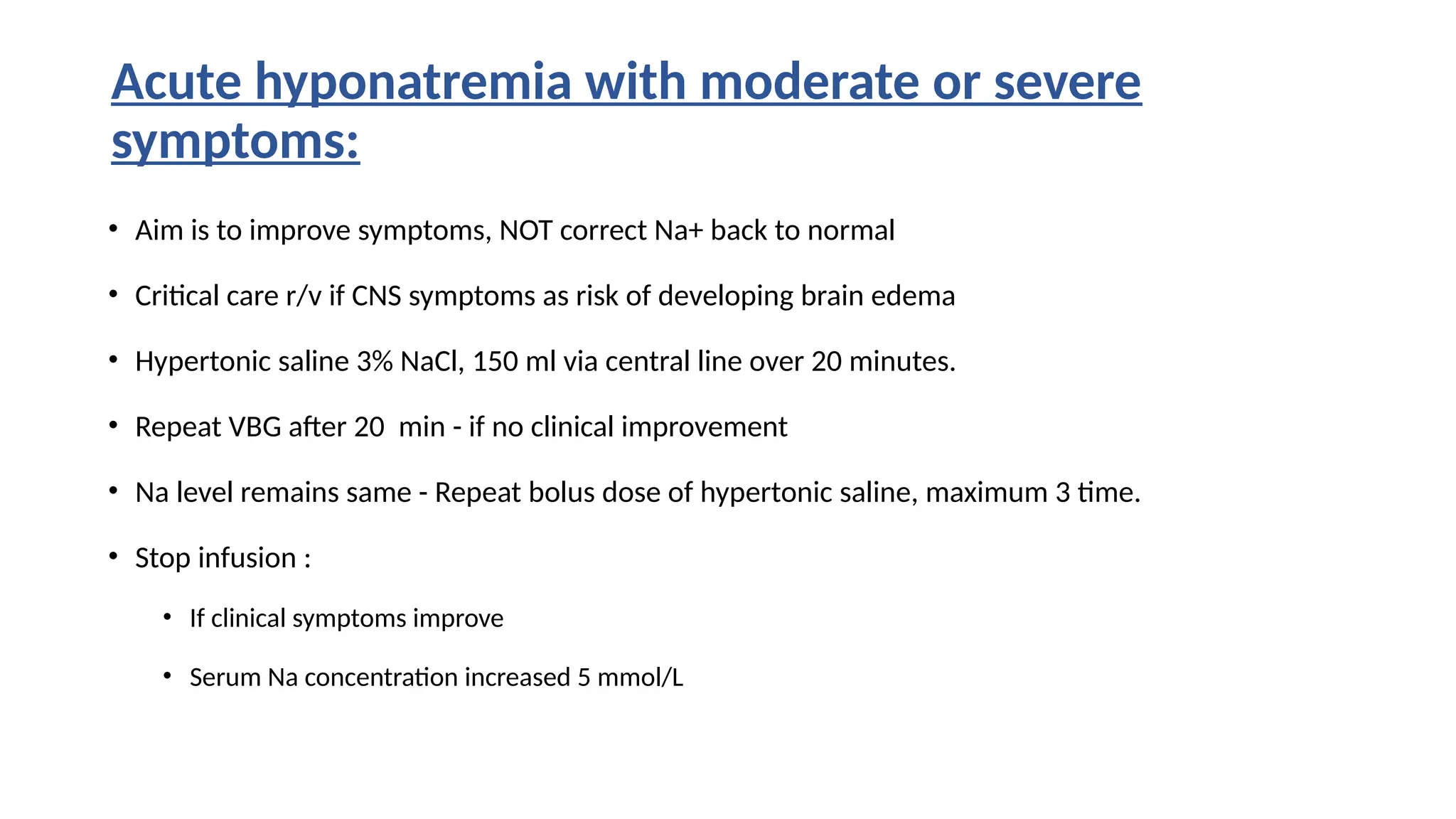
Acute hyponatremia with moderate or severe
symptoms:
• Aim is to improve symptoms, NOT correct Na+ back to normal
• Critical care r/v if CNS symptoms as risk of developing brain edema
• Hypertonic saline 3% NaCl, 150 ml via central line over 20 minutes.
• Repeat VBG after 20 min - if no clinical improvement
• Na level remains same - Repeat bolus dose of hypertonic saline, maximum 3 time.
• Stop infusion :
• If clinical symptoms improve
• Serum Na concentration increased 5 mmol/L
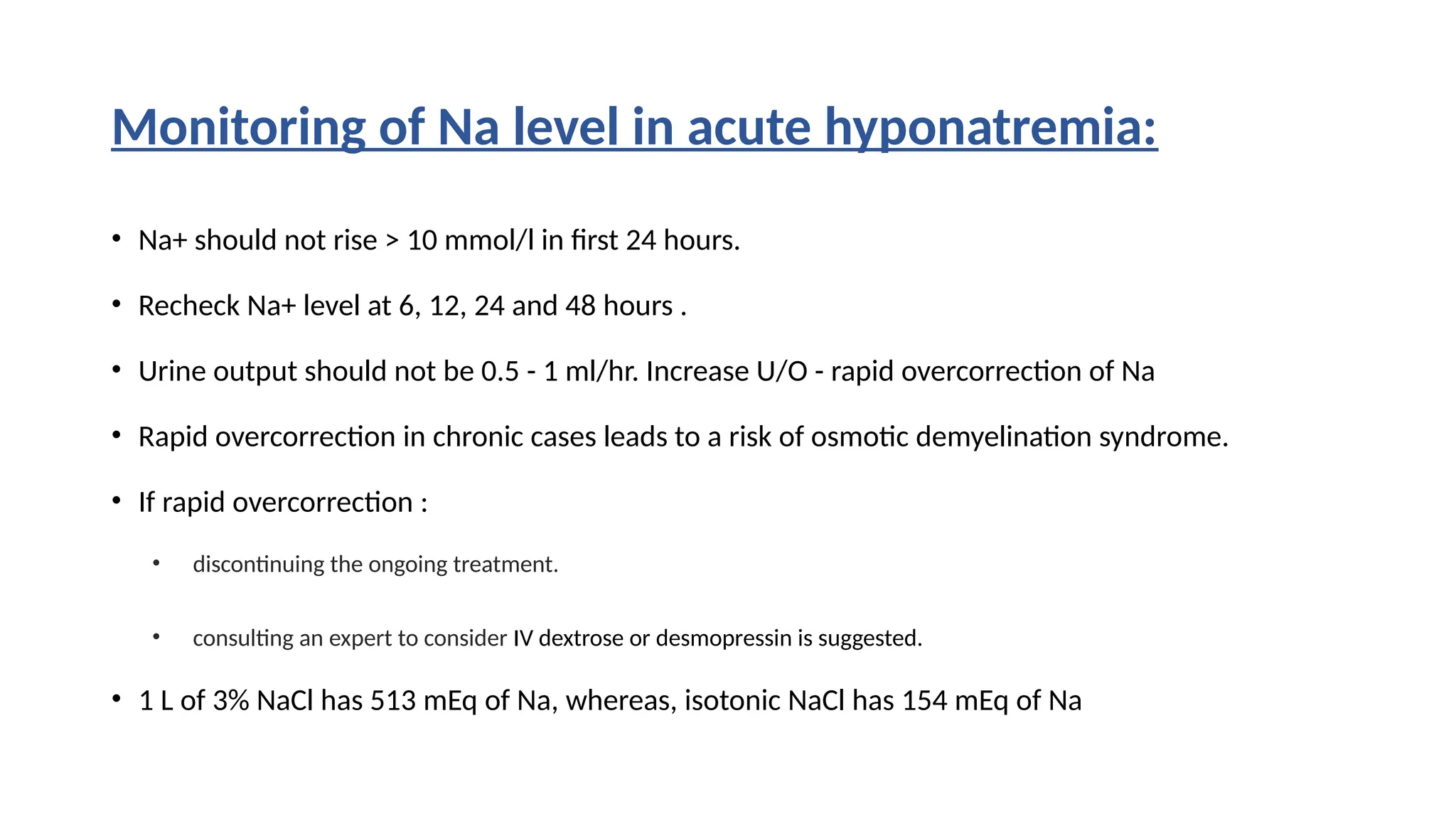
Monitoring of Na level in acute hyponatremia:
• Na+ should not rise > 10 mmol/l in first 24 hours.
• Recheck Na+ level at 6, 12, 24 and 48 hours .
• Urine output should not be 0.5 - 1 ml/hr. Increase U/O - rapid overcorrection of Na
• Rapid overcorrection in chronic cases leads to a risk of osmotic demyelination syndrome.
• If rapid overcorrection :
• discontinuing the ongoing treatment.
• consulting an expert to consider IV dextrose or desmopressin is suggested.
• 1 L of 3% NaCl has 513 mEq of Na, whereas, isotonic NaCl has 154 mEq of Na
Acute or chronic hyponatremia with mild or no
symptoms:
• Non-essential parenteral fluids
• Stop if any provoking medication
• Treatment of underlying cause.
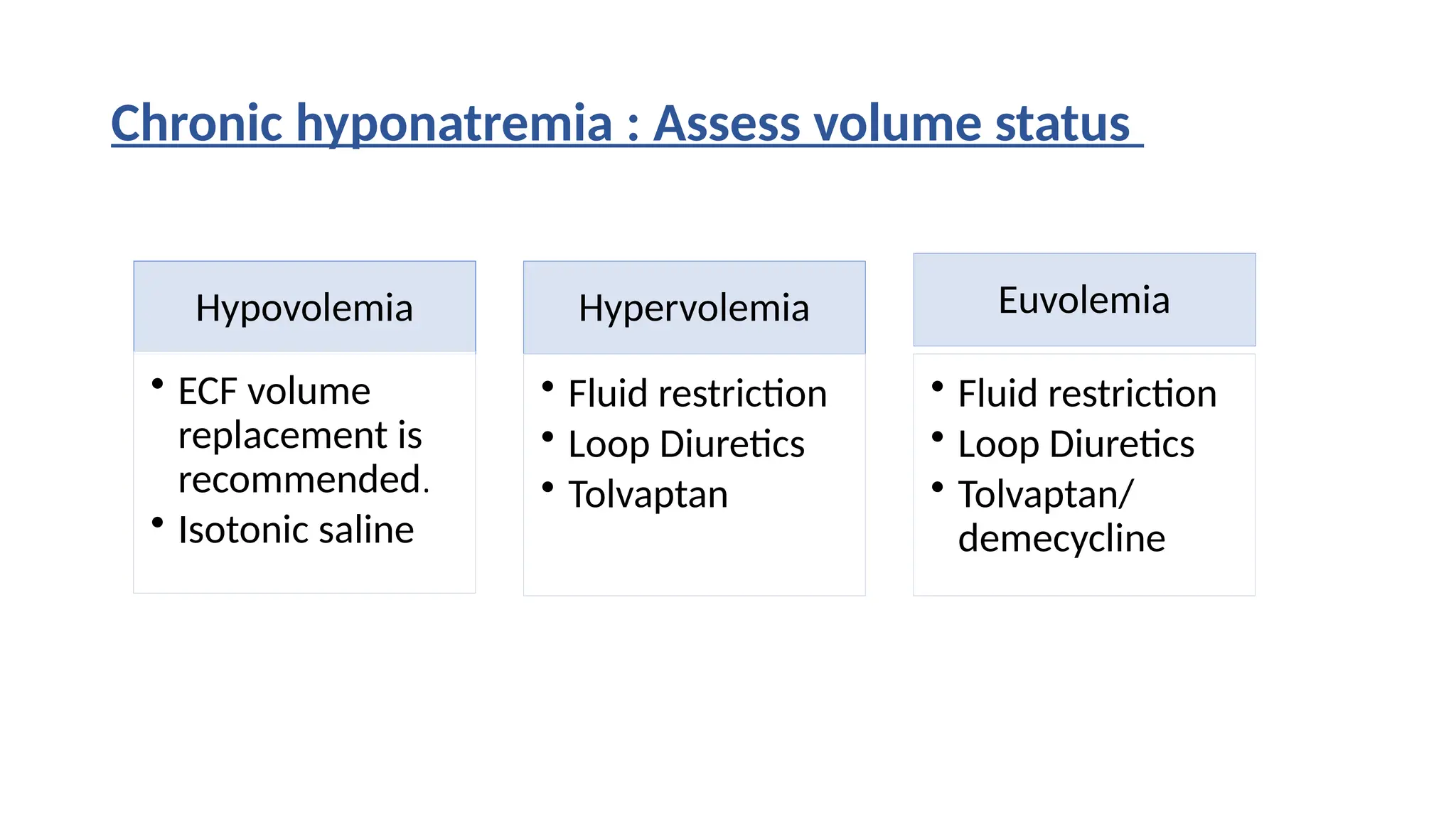
Chronic hyponatremia : Assess volume status
Hypovolemia
• ECF volume
replacement is
recommended.
• Isotonic saline
Hypervolemia
• Fluid restriction
• Loop Diuretics
• Tolvaptan
Euvolemia
• Fluid restriction
• Loop Diuretics
• Tolvaptan/
demecycline
Summary:
• Evaluation and the treatment of hyponatremia pose many challenges in the elderly population.
• In elderly, hyponatremia can be iatrogenic.
• Avoidance of polypharmacy, considering low dose of provoking medications/ alternative
should be a priority in elderly people.
• A sudden and acute fall in serum sodium concentration can result in severe cerebral oedema,
leading to cerebral herniation and death.
• Risk of morbidity from delaying in treatment is more than osmotic demyelination syndrome.
Reference :
• Hyponatremia in the elderly: challenges and solutions - PMC (nih.gov)
• Assessment of hyponatraemia - Differentials | BMJ Best Practice
• Clinical practice guideline on diagnosis and treatment of hyponatraemiaThe guidelines wer
e peer reviewed by the owner societies and by external referees prior to publication. | Euro
pean Journal of Endocrinology | Oxford Academic (oup.com)
• Hyponatraemia | Health topics A to Z | CKS | NICE
• Management of Hyponatraemia Clinical Guideline (cornwall.nhs.uk)
• http://www.gloshospitals.nhs.uk/media/documents/Hyponatraemia.pdf

Overview of hyponatremia in elderly.....

  • 1.
  • 2.
    Introduction: • Serum sodium<136 mmol /L ( normal 136- 146 mmol / L ) • Most common electrolyte abnormality seen in elderly or in nursing home patients • Affects 15% to 30% of hospital inpatients • Age is a strong independent risk factor, and symptoms of hyponatremia are often masked in frailty. • Poor prognosis and increased mortality risk in elderly when associated with other comorbidities.
  • 3.
    Classification: According to severity •Mild 130 – 135 mmol/L. • Moderate 125 – 129 mmol/L. • Severe < 125 mmol/L. According to rate of onset • Acute —less than 48 hours. • Chronic —48 hours or more. According to serum osmolarity • Hypertonic (Serum osm >295 mosm/L) • Isotonic/ pseudo hyponatremia (serum osm 275- 295 mosm/L) • *Hypotonic/ true hyponatraemia (Serum osm < 275 mosm/L
  • 4.
    Hypotonic hyponatremia :according to volume status : TBW ↑↑ Na ↑ TBW ↓ Na ↓↓ TBW ↑ Na ↔
  • 5.
    Physiology : • Hyponatremiadoes not always necessarily imply Na+ depletion • Plasma Na+ concentration depends on amount of extracellular water volume relative to sodium. • Plasma sodium conc is maintained by: o RAA system o Thirst o ADH secretion
  • 7.
    Causes : Hypervolemia EuvolemiaHypovolemia • Heart failure • Liver failure • Nephrotic syndrome • hypoalbuminaemia • SIADH • Hypothyroidism • Primary Polydipsia • GI or extra-renal fluid losses • Diuretics • Primary hypoaldosteronism • Cerebral salt wasting syndrome  In elderly patients, multiple factors are usually implicated in the development of hyponatremia. • the aging-related impaired water-excretory capacity • frequent exposure to medications and • diseases associated with hyponatremia.
  • 8.
  • 9.
    Clinical features : Posturalhypotension, gait abnormality, recurrent fall
  • 10.
    Medication : • Antihypertensive: ACEI, amlodipine, thiazide*, indapamide • Anticancer drug : Cisplatin, vincristine • Antiarrythmic : amiodarone • Anti reflux : PPI • Antibiotic : Trimethoprim, ciprofloxacin • Antidepressant * : TCA, lithium, SSRI, MAOI, Phenothiazine • Antipsychotics *: Phenothiazine • Antiepileptics : Carbamazepine, valproate
  • 11.
    Investigation : 1. serumosmolality 2. urine sodium concentration 3. urine osmolality 4. Others : - Serum electrolytes, urea, creatinine, and glucose - Urinary protein analysis and 24 hr urinary protein for NS, Liver function tests, clotting functions and albumin in cirrhosis - BNP, echocardiography if there are features of congestive cardiac failure - TSH, serum cortisol level MRI brain - serum lipids and serum protein electrophoresis
  • 12.
    Hyponatraemia Assess serum osmolarity >100 mosm /L Isotonic 275 to 295 mosm /L • Hyperlipidemia • Hyperproteinemia Hypotonic <275 mosm/L Hypertonic >295 mosm/L • Hyperglycemia, • mannitol, • IV contrast <100 mosm /L • Primary polydipsia • Low solute intake Assess Urinary Na osmolality Diagnostic approach :
  • 13.
    Assess urinary Naand volume status Diuretics or kidney disease Urinary Na < 30 Low effective arterial volume Urinary Na > 30 Decreased GFR/ inability to dilute urine Urinary Na osmolarity > 100 mosm/L Euvolumic • SIADH • 2ndary adrenal insufficiency • Hypothyroidism hypovolumic • D + V • 3rd space fluid loss • Burn Hypervolumic • cirrhosis, • NS, • HF • Hypoalbuminemia • Diuretics • CKD Hypovolemia • Primary Adrenal insufficiency • Cerebral salt wasting Yes NO
  • 14.
  • 15.
    Acute hyponatremia withmoderate or severe symptoms: • Aim is to improve symptoms, NOT correct Na+ back to normal • Critical care r/v if CNS symptoms as risk of developing brain edema • Hypertonic saline 3% NaCl, 150 ml via central line over 20 minutes. • Repeat VBG after 20 min - if no clinical improvement • Na level remains same - Repeat bolus dose of hypertonic saline, maximum 3 time. • Stop infusion : • If clinical symptoms improve • Serum Na concentration increased 5 mmol/L
  • 16.
    Monitoring of Nalevel in acute hyponatremia: • Na+ should not rise > 10 mmol/l in first 24 hours. • Recheck Na+ level at 6, 12, 24 and 48 hours . • Urine output should not be 0.5 - 1 ml/hr. Increase U/O - rapid overcorrection of Na • Rapid overcorrection in chronic cases leads to a risk of osmotic demyelination syndrome. • If rapid overcorrection : • discontinuing the ongoing treatment. • consulting an expert to consider IV dextrose or desmopressin is suggested. • 1 L of 3% NaCl has 513 mEq of Na, whereas, isotonic NaCl has 154 mEq of Na
  • 17.
    Acute or chronichyponatremia with mild or no symptoms: • Non-essential parenteral fluids • Stop if any provoking medication • Treatment of underlying cause.
  • 18.
    Chronic hyponatremia :Assess volume status Hypovolemia • ECF volume replacement is recommended. • Isotonic saline Hypervolemia • Fluid restriction • Loop Diuretics • Tolvaptan Euvolemia • Fluid restriction • Loop Diuretics • Tolvaptan/ demecycline
  • 19.
    Summary: • Evaluation andthe treatment of hyponatremia pose many challenges in the elderly population. • In elderly, hyponatremia can be iatrogenic. • Avoidance of polypharmacy, considering low dose of provoking medications/ alternative should be a priority in elderly people. • A sudden and acute fall in serum sodium concentration can result in severe cerebral oedema, leading to cerebral herniation and death. • Risk of morbidity from delaying in treatment is more than osmotic demyelination syndrome.
  • 20.
    Reference : • Hyponatremiain the elderly: challenges and solutions - PMC (nih.gov) • Assessment of hyponatraemia - Differentials | BMJ Best Practice • Clinical practice guideline on diagnosis and treatment of hyponatraemiaThe guidelines wer e peer reviewed by the owner societies and by external referees prior to publication. | Euro pean Journal of Endocrinology | Oxford Academic (oup.com) • Hyponatraemia | Health topics A to Z | CKS | NICE • Management of Hyponatraemia Clinical Guideline (cornwall.nhs.uk) • http://www.gloshospitals.nhs.uk/media/documents/Hyponatraemia.pdf