OVERVIEW
OF DATA
ANALYSIS IN
RESEARCH
KALINGA STATE UNIVERSIT Y
SEPTEMBER 1, 2024
Seminar in Research with Data Analytics
Reporter: Doddie Marie L. Duclan
Session Objective
At the end of the class session, students should be able
to Identify the following:
A. Key concepts in data analysis
B. Steps in data analysis , and
C. Considerations in data analysis
I. Introduction to Data Analysis
Definition:
Data Analysis is the process of systematically applying
statistical and/or logical techniques to describe, illustrate,
condense, recap, and evaluate data.
Importance: Ensures data integrity and accurate
research findings
Types of Data Analysis
A. Quantitative Data Analysis
A.1. Statistical Techniques:
-Data Sampling
-Central Tendency
-Random Variables
-Probability Distributions
-Statistical Inference
A.2 Examples and Applications
Types of Data Analysis
B. Qualitative Data Analysis
B.1. Iterative Process:
1.Creating a prototype or product/service
2.Getting feedback from customers and stakeholders
3. Using the feedback to improve in the next work cycle
4. Repeating this process until the desired outcome is
achieved
B.2 Examples and Applications
Key Concepts in Data Analysis
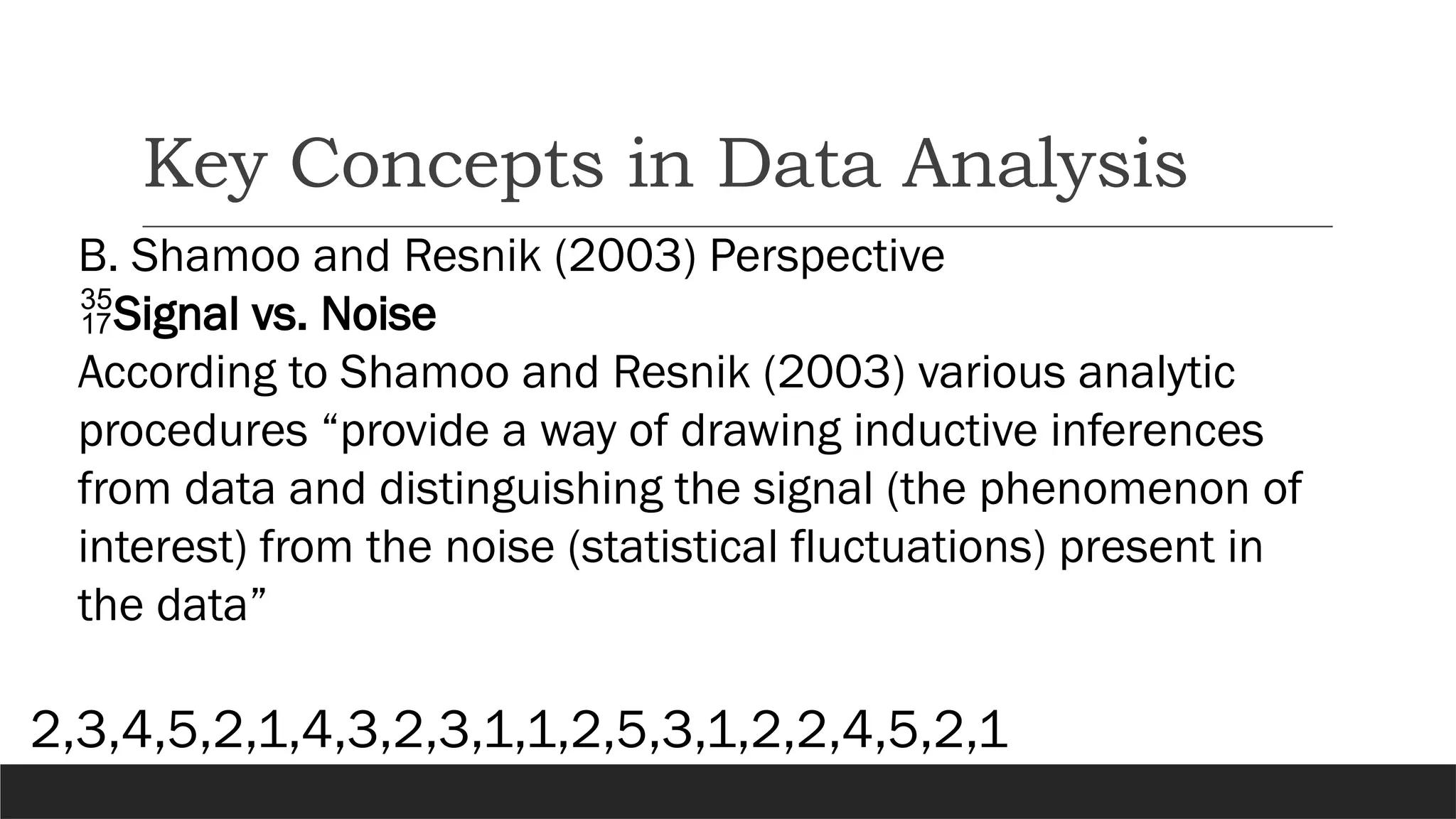
A. Inductive Inference : a reasoning method where general conclusions are
drawn from specific observations to help in making sense of data and
drawing meaningful conclusions
Importance:
1.Pattern Recognition: Helps identify patterns and trends.
2. Prediction: Allows for making predictions about future events.
3. Decision-Making: Aids in forming general rules or principles for
decision-making
Key Concepts in Data Analysis
B. Shamoo and Resnik (2003) Perspective
Signal vs. Noise
According to Shamoo and Resnik (2003) various analytic
procedures “provide a way of drawing inductive inferences
from data and distinguishing the signal (the phenomenon of
interest) from the noise (statistical fluctuations) present in
the data”
2,3,4,5,2,1,4,3,2,3,1,1,2,5,3,1,2,2,4,5,2,1
Data Analysis in Qualitative
Research
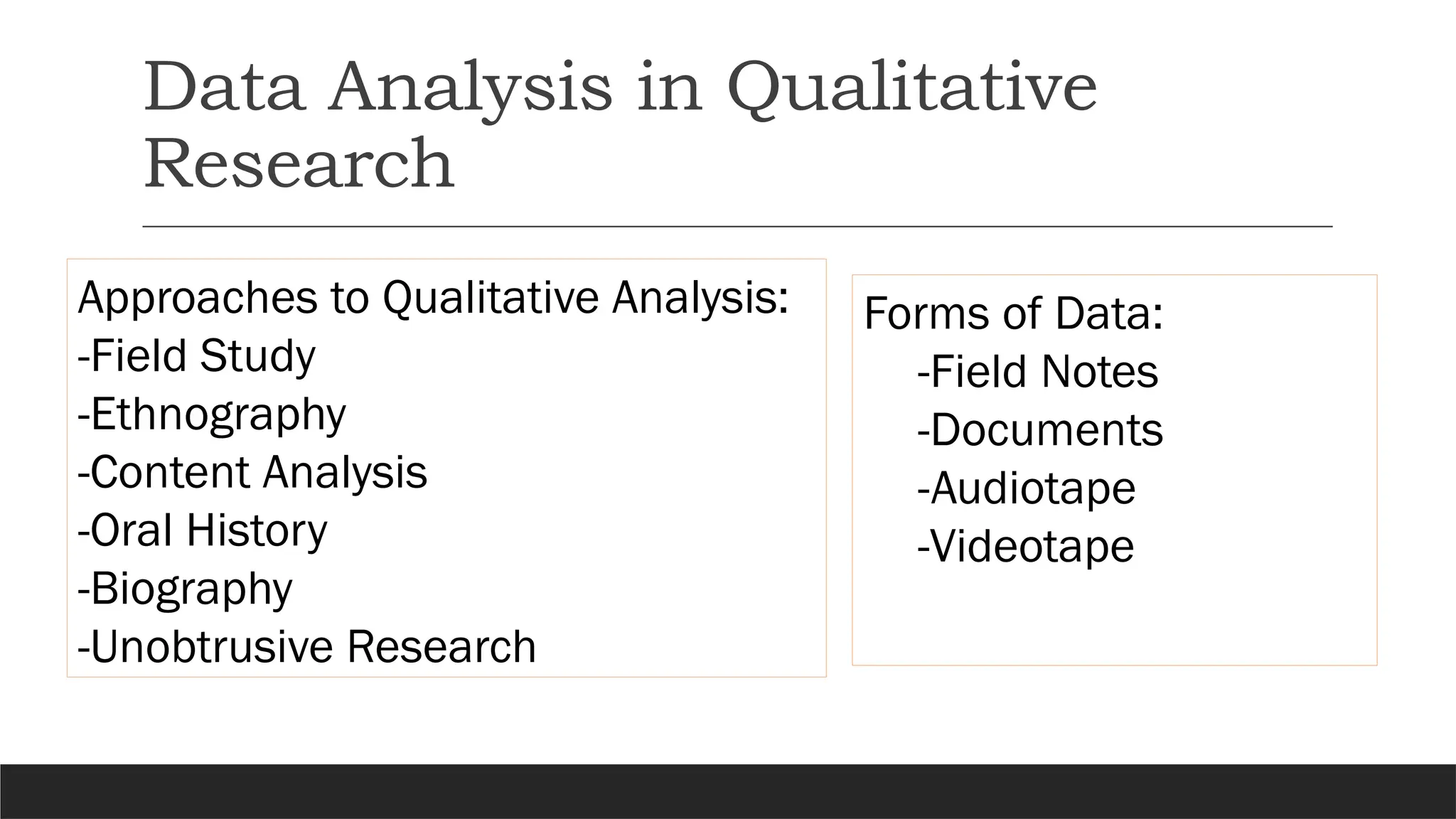
Approaches to Qualitative Analysis:
-Field Study
-Ethnography
-Content Analysis
-Oral History
-Biography
-Unobtrusive Research
Forms of Data:
-Field Notes
-Documents
-Audiotape
-Videotape
Ensuring Data Integrity
Importance:
Accurate and appropriate analysis is crucial
Consequence of improper analyses:
Improper analyses can distort findings and mislead
readers (Shepard, 2002)
Data Collection
Definition :
◦Datasets are collections of information
Purpose: used to
◦answer questions,
◦make decisions, or
◦inform reasoning
Data Collection
Impact of Information Technology
◦Generation of Vast Amounts of Data
Types of Data: Text, pictures, videos, personal information,
account data, metadata
Data Collection
Data Collection in Digital Platforms
◦Apps and Websites
◦Usage Data and User Information
Conclusion
Data analysis is a critical process in research that involves the systematic application of statistical
and logical techniques to describe, summarize, and evaluate data. It enables researchers to draw
meaningful inferences and distinguish significant patterns from random noise.
Both qualitative and quantitative research benefit from rigorous data analysis, which often involves
continuous and iterative examination of data throughout the collection phase.
The integrity of research findings heavily relies on accurate and appropriate data analysis, as
improper techniques can distort results and mislead readers.
With the advent of information technology, the volume and variety of data have increased
significantly, necessitating robust methods to ensure the reliability and validity of research
outcomes
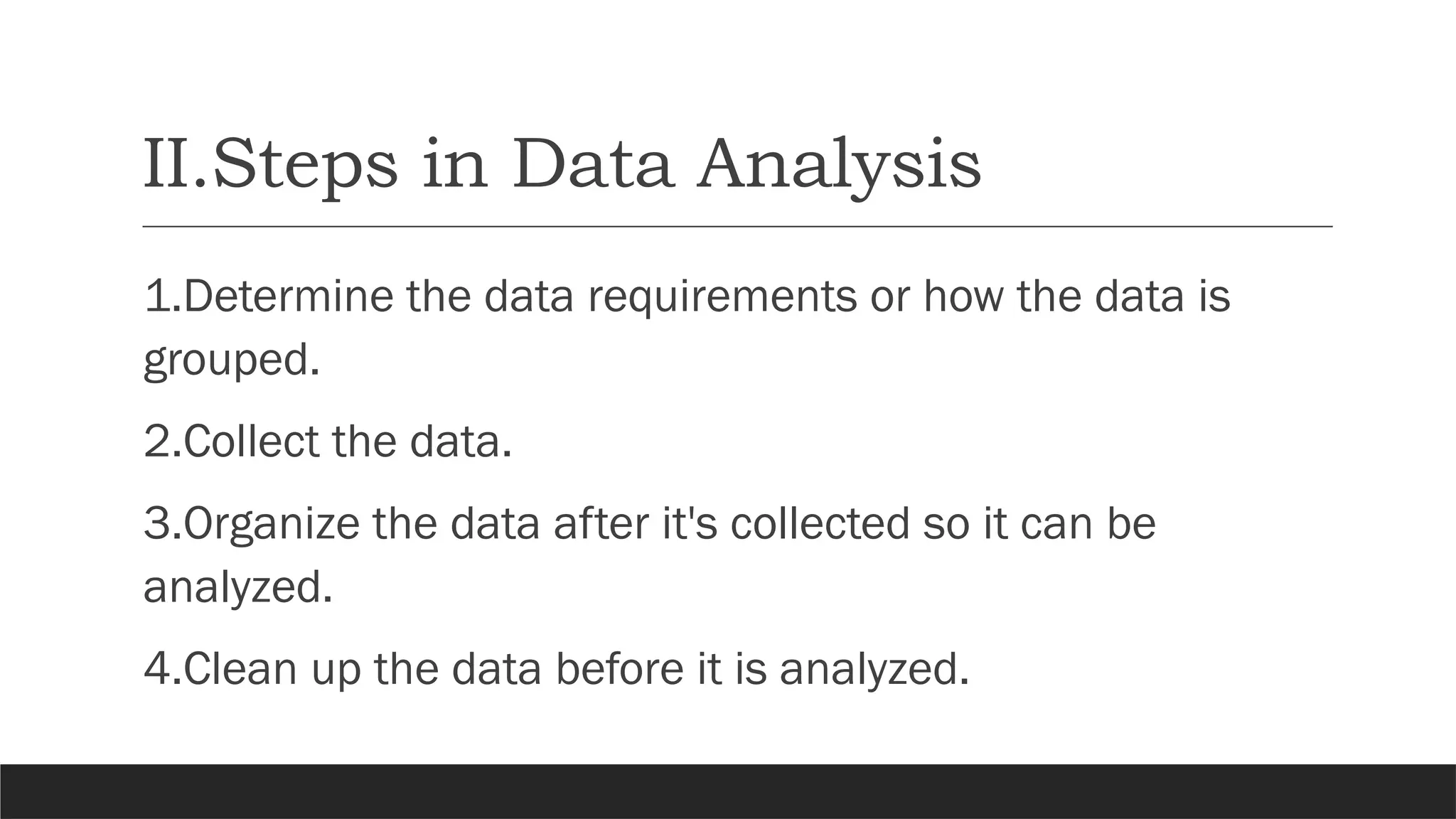
II.Steps in Data Analysis
1.Determine the data requirements or how the data is
grouped.
2.Collect the data.
3.Organize the data after it's collected so it can be
analyzed.
4.Clean up the data before it is analyzed.
III. Considerations/issues in data
analysis
1.Having the necessary skills to analyze

III. Considerations/issues in data
analysis
2. Concurrently selecting data collection methods
and appropriate analysis
III. Considerations/issues in data
analysis
3. Drawing unbiased inference

III. Considerations/issues in data
analysis
4. Inappropriate subgroup analysis
III. Considerations/issues in data
analysis
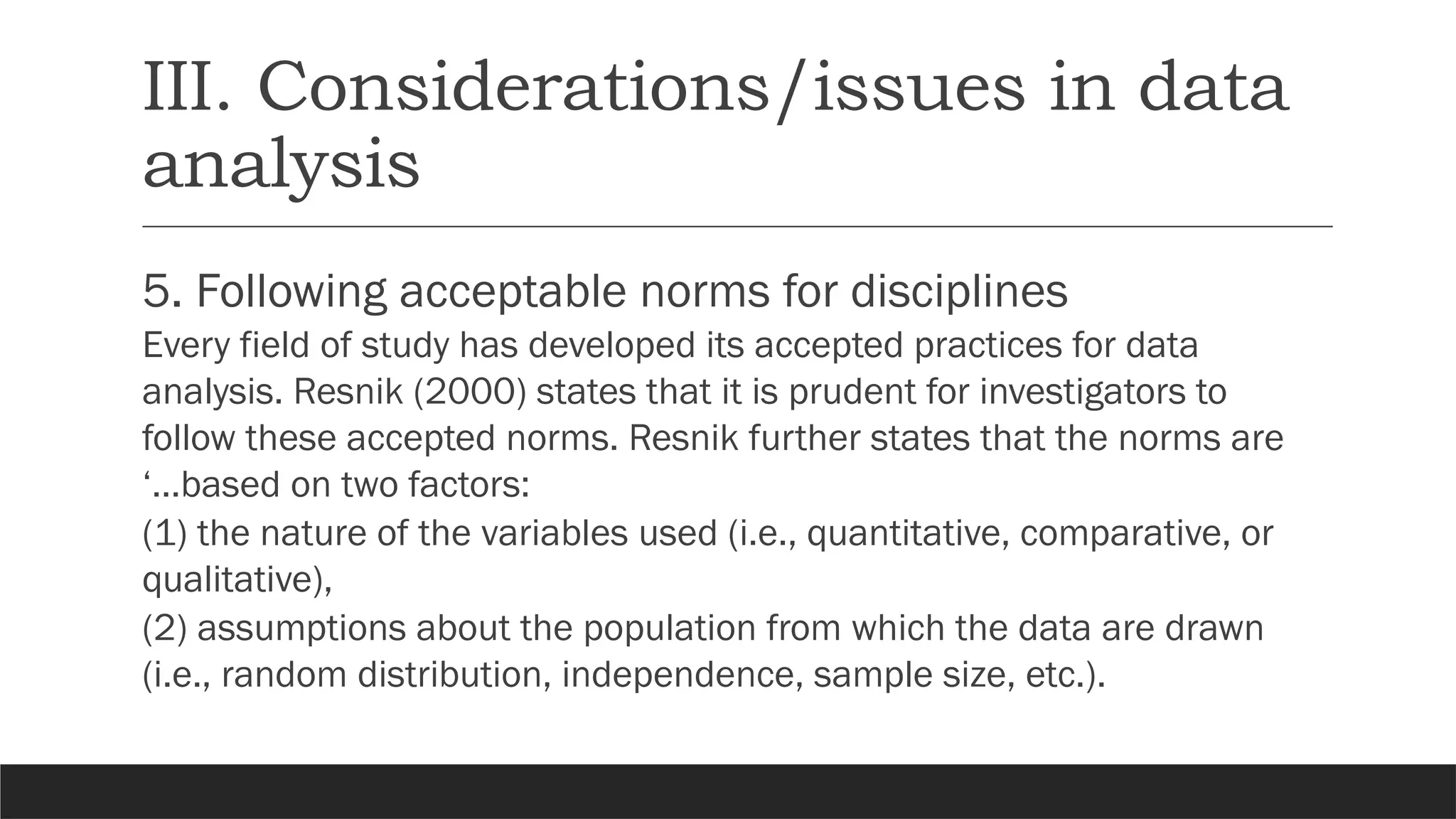
5. Following acceptable norms for disciplines
Every field of study has developed its accepted practices for data
analysis. Resnik (2000) states that it is prudent for investigators to
follow these accepted norms. Resnik further states that the norms are
‘…based on two factors:
(1) the nature of the variables used (i.e., quantitative, comparative, or
qualitative),
(2) assumptions about the population from which the data are drawn
(i.e., random distribution, independence, sample size, etc.).
III. Considerations/issues in data
analysis
6. Determining statistical significance
Researchers suggest that it may also be
appropriate to discuss whether attaining statistical
significance has a true practical meaning
III. Considerations/issues in data
analysis
7. Lack of clearly defined and objective outcome
measurements

III. Considerations/issues in data
analysis
8. Provide honest and accurate analysis

III. Considerations/issues in data
analysis
9. Environmental/contextual issues

III. Considerations/issues in data
analysis
10. Data recording method
Analyses could also be influenced by the method in which data was
recorded. For example, research events could be documented by:
a. recording audio and/or video and transcribing later
b. either a researcher or self-administered survey
c. either closed ended survey or open ended survey
d. preparing ethnographic field notes from a participant/observer
e. requesting that participants themselves take notes, compile and submit
them to researchers.
III. Considerations/issues in data
analysis
11. Reliability and Validity
Factors that can affect R&V:
A. stability , or the tendency for coders to consistently re-code the same data in the same way over a
period of time
B. reproducibility , or the tendency for a group of coders to classify categories membership in the
same way
C, accuracy , or the extent to which the classification of a text corresponds to a standard or norm
statistically
III. Considerations/issues in data
analysis
12. Extent of analysis
Whether statistical or non-statistical methods of
analyses are used, researchers should be aware
of the potential for compromising data integrity.
Post Test
1. Why is data analysis important?
2. How should data be analyzed?
3. As researchers, what factors should be
considered to avoid erroneous data analysis?
References:
Gottschalk, L. A. (1995). Content analysis of verbal behavior: New findings and clinical
applications. Hillside, NJ: Lawrence Erlbaum Associates, Inc
Jeans, M. E. (1992). Clinical significance of research: A growing concern. Canadian Journal of
Nursing Research, 24, 1-4.
Lefort, S. (1993). The statistical versus clinical significance debate. Image, 25, 57-62.
Kendall, P. C., & Grove, W. (1988). Normative comparisons in therapy outcome. Behavioral
Assessment, 10, 147-158.
Nowak, R. (1994). Problems in clinical trials go far beyond misconduct. Science. 264(5165):
1538-41.
Resnik, D. (2000). Statistics, ethics, and research: an agenda for educations and reform.
Accountability in Research. 8: 163-88
Schroder, K.E., Carey, M.P., Venable, P.A. (2003). Methodological challenges in research on sexual
risk behavior: I. Item content, scaling, and data analytic options. Ann Behav Med, 26(2): 76-103.
Shamoo, A.E., Resnik, B.R. (2003). Responsible Conduct of Research. Oxford University Press.
References:
Shamoo, A.E. (1989). Principles of Research Data Audit. Gordon and Breach, New York.
Shepard, R.J. (2002). Ethics in exercise science research. Sports Med, 32 (3): 169-183.
Silverman, S., Manson, M. (2003). Research on teaching in physical education doctoral
dissertations: a detailed investigation of focus, method, and analysis. Journal of
Teaching in Physical Education, 22(3): 280-297.
Smeeton, N., Goda, D. (2003). Conducting and presenting social work researchsome basic
statistical considerations. Br J Soc Work, 33: 567-573.
Thompson, B., Noferi, G. 2002. Statistical, practical, clinical: How many types of significance
should be considered in counseling research? Journal of Counseling & Development,
80(4):64-71.

OVERVIEW-OF-DATA-ANALYSIS-IN-RESEARCH.-for-the-class-pptx.pptx

  • 1.
    OVERVIEW OF DATA ANALYSIS IN RESEARCH KALINGASTATE UNIVERSIT Y SEPTEMBER 1, 2024 Seminar in Research with Data Analytics Reporter: Doddie Marie L. Duclan
  • 2.
    Session Objective At theend of the class session, students should be able to Identify the following: A. Key concepts in data analysis B. Steps in data analysis , and C. Considerations in data analysis
  • 3.
    I. Introduction toData Analysis Definition: Data Analysis is the process of systematically applying statistical and/or logical techniques to describe, illustrate, condense, recap, and evaluate data. Importance: Ensures data integrity and accurate research findings
  • 4.
    Types of DataAnalysis A. Quantitative Data Analysis A.1. Statistical Techniques: -Data Sampling -Central Tendency -Random Variables -Probability Distributions -Statistical Inference A.2 Examples and Applications
  • 5.
    Types of DataAnalysis B. Qualitative Data Analysis B.1. Iterative Process: 1.Creating a prototype or product/service 2.Getting feedback from customers and stakeholders 3. Using the feedback to improve in the next work cycle 4. Repeating this process until the desired outcome is achieved B.2 Examples and Applications
  • 6.
    Key Concepts inData Analysis A. Inductive Inference : a reasoning method where general conclusions are drawn from specific observations to help in making sense of data and drawing meaningful conclusions Importance: 1.Pattern Recognition: Helps identify patterns and trends. 2. Prediction: Allows for making predictions about future events. 3. Decision-Making: Aids in forming general rules or principles for decision-making
  • 7.
    Key Concepts inData Analysis B. Shamoo and Resnik (2003) Perspective Signal vs. Noise According to Shamoo and Resnik (2003) various analytic procedures “provide a way of drawing inductive inferences from data and distinguishing the signal (the phenomenon of interest) from the noise (statistical fluctuations) present in the data” 2,3,4,5,2,1,4,3,2,3,1,1,2,5,3,1,2,2,4,5,2,1
  • 8.
    Data Analysis inQualitative Research Approaches to Qualitative Analysis: -Field Study -Ethnography -Content Analysis -Oral History -Biography -Unobtrusive Research Forms of Data: -Field Notes -Documents -Audiotape -Videotape
  • 9.
    Ensuring Data Integrity Importance: Accurateand appropriate analysis is crucial Consequence of improper analyses: Improper analyses can distort findings and mislead readers (Shepard, 2002)
  • 10.
    Data Collection Definition : ◦Datasetsare collections of information Purpose: used to ◦answer questions, ◦make decisions, or ◦inform reasoning
  • 11.
    Data Collection Impact ofInformation Technology ◦Generation of Vast Amounts of Data Types of Data: Text, pictures, videos, personal information, account data, metadata
  • 12.
    Data Collection Data Collectionin Digital Platforms ◦Apps and Websites ◦Usage Data and User Information
  • 13.
    Conclusion Data analysis isa critical process in research that involves the systematic application of statistical and logical techniques to describe, summarize, and evaluate data. It enables researchers to draw meaningful inferences and distinguish significant patterns from random noise. Both qualitative and quantitative research benefit from rigorous data analysis, which often involves continuous and iterative examination of data throughout the collection phase. The integrity of research findings heavily relies on accurate and appropriate data analysis, as improper techniques can distort results and mislead readers. With the advent of information technology, the volume and variety of data have increased significantly, necessitating robust methods to ensure the reliability and validity of research outcomes
  • 14.
    II.Steps in DataAnalysis 1.Determine the data requirements or how the data is grouped. 2.Collect the data. 3.Organize the data after it's collected so it can be analyzed. 4.Clean up the data before it is analyzed.
  • 15.
    III. Considerations/issues indata analysis 1.Having the necessary skills to analyze 
  • 16.
    III. Considerations/issues indata analysis 2. Concurrently selecting data collection methods and appropriate analysis
  • 17.
    III. Considerations/issues indata analysis 3. Drawing unbiased inference 
  • 18.
    III. Considerations/issues indata analysis 4. Inappropriate subgroup analysis
  • 19.
    III. Considerations/issues indata analysis 5. Following acceptable norms for disciplines Every field of study has developed its accepted practices for data analysis. Resnik (2000) states that it is prudent for investigators to follow these accepted norms. Resnik further states that the norms are ‘…based on two factors: (1) the nature of the variables used (i.e., quantitative, comparative, or qualitative), (2) assumptions about the population from which the data are drawn (i.e., random distribution, independence, sample size, etc.).
  • 20.
    III. Considerations/issues indata analysis 6. Determining statistical significance Researchers suggest that it may also be appropriate to discuss whether attaining statistical significance has a true practical meaning
  • 21.
    III. Considerations/issues indata analysis 7. Lack of clearly defined and objective outcome measurements 
  • 22.
    III. Considerations/issues indata analysis 8. Provide honest and accurate analysis 
  • 23.
    III. Considerations/issues indata analysis 9. Environmental/contextual issues 
  • 24.
    III. Considerations/issues indata analysis 10. Data recording method Analyses could also be influenced by the method in which data was recorded. For example, research events could be documented by: a. recording audio and/or video and transcribing later b. either a researcher or self-administered survey c. either closed ended survey or open ended survey d. preparing ethnographic field notes from a participant/observer e. requesting that participants themselves take notes, compile and submit them to researchers.
  • 25.
    III. Considerations/issues indata analysis 11. Reliability and Validity Factors that can affect R&V: A. stability , or the tendency for coders to consistently re-code the same data in the same way over a period of time B. reproducibility , or the tendency for a group of coders to classify categories membership in the same way C, accuracy , or the extent to which the classification of a text corresponds to a standard or norm statistically
  • 26.
    III. Considerations/issues indata analysis 12. Extent of analysis Whether statistical or non-statistical methods of analyses are used, researchers should be aware of the potential for compromising data integrity.
  • 27.
    Post Test 1. Whyis data analysis important? 2. How should data be analyzed? 3. As researchers, what factors should be considered to avoid erroneous data analysis?
  • 28.
    References: Gottschalk, L. A.(1995). Content analysis of verbal behavior: New findings and clinical applications. Hillside, NJ: Lawrence Erlbaum Associates, Inc Jeans, M. E. (1992). Clinical significance of research: A growing concern. Canadian Journal of Nursing Research, 24, 1-4. Lefort, S. (1993). The statistical versus clinical significance debate. Image, 25, 57-62. Kendall, P. C., & Grove, W. (1988). Normative comparisons in therapy outcome. Behavioral Assessment, 10, 147-158. Nowak, R. (1994). Problems in clinical trials go far beyond misconduct. Science. 264(5165): 1538-41. Resnik, D. (2000). Statistics, ethics, and research: an agenda for educations and reform. Accountability in Research. 8: 163-88 Schroder, K.E., Carey, M.P., Venable, P.A. (2003). Methodological challenges in research on sexual risk behavior: I. Item content, scaling, and data analytic options. Ann Behav Med, 26(2): 76-103. Shamoo, A.E., Resnik, B.R. (2003). Responsible Conduct of Research. Oxford University Press.
  • 29.
    References: Shamoo, A.E. (1989).Principles of Research Data Audit. Gordon and Breach, New York. Shepard, R.J. (2002). Ethics in exercise science research. Sports Med, 32 (3): 169-183. Silverman, S., Manson, M. (2003). Research on teaching in physical education doctoral dissertations: a detailed investigation of focus, method, and analysis. Journal of Teaching in Physical Education, 22(3): 280-297. Smeeton, N., Goda, D. (2003). Conducting and presenting social work researchsome basic statistical considerations. Br J Soc Work, 33: 567-573. Thompson, B., Noferi, G. 2002. Statistical, practical, clinical: How many types of significance should be considered in counseling research? Journal of Counseling & Development, 80(4):64-71.

Editor's Notes

  • #12 Consequently, there is vastly more data being collected today than at any other time in human history. A single business may track billions of interactions with millions of consumers at hundreds of locations with thousands of employees and any number of products. Analyzing that volume of data is generally only possible using specialized computational and statistical techniques. The desire for businesses to make the best use of their data has led to the development of the field of business intelligence, which covers a variety of tools and techniques that allow businesses to perform data analysis on the information they collect.
  • #27 While statistical analysis is typically performed on quantitative data, there are numerous analytic procedures specifically designed for qualitative material including content, thematic, and ethnographic analysis. Regardless of whether one studies quantitative or qualitative phenomena, researchers use a variety of tools to analyze data in order to test hypotheses, discern patterns of behavior, and ultimately answer research questions. Failure to understand or acknowledge data analysis issues presented can compromise data integrity.