Traditional Outsourcing Arrangements
In a traditional, functional outsourcing
arrangement, an outsourcing supplier provides
very specific functions that fit within an overall
scheme of intricate business processes.
For instance, many organizations outsource
their Payroll Processing functions. They enter
into an arrangement with a Payroll Service
Provider to process payroll checks, make
required tax payments and deposits, and
prepare and file required payroll tax forms.
Business Process Outsourcing (BPO)
In BPO, the supplier not only takes on the responsibility to
take over the function or business process, but it also
reengineers the way it is done. That will include either
putting in new technology to accomplish the process, or
applying the existing technology in a new way to improve
the process.
A BPO solution typically combines computer infrastructure,
and software, IT management services, functional
operations people/labor, defined process workflows, best-
practice service disciplines and related infrastructure on a
contractual outsourced basis.
Virtually any “non-core” process or
responsibility
◦ Facility Management
◦ Food Service
◦ Legal
◦ Human Resources
◦ Security
◦ Information Technology
◦ Payroll
◦ ERP & Accounting
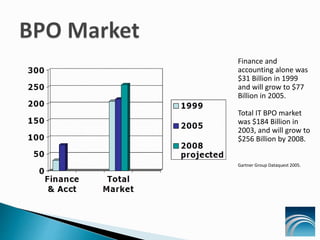
Finance and
accounting alone was
$31 Billion in 1999
and will grow to $77
Billion in 2005.
Total IT BPO market
was $184 Billion in
2003, and will grow to
$256 Billion by 2008.
Gartner Group Dataquest 2005.
Recent Survey of 500 Executives
80% said BPO’s importance is growing.
93% said there is a strong correlation between BPO
and shareholder value.
Conclusions:
In the near future, ½ of typical executive’s budget will
be outsourced.
Outsourcing is one of the most important trends in our
time
Organizational success will depend on management’s
ability to leverage outsourcing relationships effectively
Desire to gain process improvement
Focus on core operations
Reduced costs
Single point of accountability
Improved business agility
Improved quality – latest technology;
expertise
Shortage of labor
◦ Companies face challenge of hiring and retaining qualified staff.
◦ Virtually all internal accounting personnel are considered “cost centers.” In contract, BPO vendors
back-office support staff are revenue-generating employees.
Competitive and financial pressures are forcing
organizations to narrowly define their strategic core
competencies;
Outsourcing can be an effective way to gain competitive
advantage, lower costs and increase efficiency;
Outsourcing can be a cost-effective way to take advantage
of new ideas, new solutions and best-in-class processes
and technology;
Outsourcing to firms regarded as experts in the field can
help organizations gain needed credibility with external
parties;
Limited availability of qualified labor.
Not a new concept
Improvements in technology (i.e. ASP model
and internet) have made model less
expensive
Technology advances have facilitated the
outsourcing of certain business processes,
however it remains the processes
themselves that are most important
Technology outsourcing is more prevalent
and accepted in our economy
The continuing technology evolution is a key
driver of the BPO Model
Use of technology not new in outsourcing
arrangements – service bureaus, ADP
Along came the Internet
Broadband connectivity
ASP Model
Web-based apps
BSP Model
Customer Site
◦ BPO provider and software reside onsite at
customer’s location
Centralized
◦ Customer may have some remote access to
software
HB&P’s BPO model recognizes that each
client’s needs are unique.
Extensive needs assessment process
Solutions are not “system-specific”
Designed to meet specific needs of our
clients
Work with client’s existing accounting staff,
or become its virtual accounting department
Think of HB&P as the Accounting Department Down the Hall
Management retains overall responsibility
for accuracy and integrity of financial
records.
HB&P assumes the role of Management’s
Accounting Department, working under
Management’s direction.
HB&P can implement its virtual accounting
system at a fraction of the cost of the client
purchasing its own system
◦ State of the art technology
◦ Anytime/Anywhere access to information
A Typical HB&P Arrangement
Cash Disbursements Cycle:
◦ Management approves and codes vendor invoices
for payment
◦ HB&P enters properly-approved invoices into
accounting system
◦ Data entry is reviewed for accuracy
◦ Reports are generated providing Management with
relevant cash flow information
◦ Checks are prepared for Management review and
signature
A Typical HB&P Arrangement
Cash Disbursements Cycle (Continued):
◦ Vendor files are maintained for ease of research
◦ Vendor database is maintained to ensure accuracy
of vendor transaction and payment history
◦ Accounts Payable sub-ledgers are reconciled to
General Ledger to ensure accuracy of financial
reporting
◦ Bank accounts are reconciled and agreed to
relevant General Ledger account balances
A Typical HB&P Arrangement
Cash Receipts Cycle:
◦ Management prepares and approves customer
invoices based on established billing procedures
◦ HB&P enters properly-approved invoices into
accounting system
This can be “after-the-fact” entry of client-prepare invoices, or invoices can be physically
generated by HB&P
◦ Data entry is reviewed for accuracy
◦ Reports are generated providing Management with
relevant cash flow information
◦ Customer checks are received and coded by
Management
A Typical HB&P Arrangement
Cash Receipts Cycle (Continued):
◦ Deposits are made by the client and relevant
information is provided to HB&P for entry in Accounting
System
◦ Customer files are maintained for ease of research
◦ Customer database is maintained to ensure accuracy of
vendor transaction and payment history
◦ Accounts Receivable sub-ledgers are reconciled to
General Ledger to ensure accuracy of financial reporting
◦ Bank accounts are reconciled and agreed to relevant
General Ledger account balances
A Typical HB&P Arrangement
Financial Reporting Cycle:
◦ Management retains responsibility for accuracy and
completeness of financial statements
◦ HB&P prepares monthly financial statements that are
reconciled to appropriate source documents and well-
supported by meaningful workpapers
◦ Other management and financial reports are designed
to meet specific needs of client management
◦ Financial and management reports can be printed,
emailed, viewed online, etc...
◦ HB&P meets with client management to present
financials and help interpret results
◦ Client feedback is incorporated into financial reports to
ensure that reporting meets the ever-changing needs of
the client.
What’s in it for you?
A team of accounting and financial experts working
on your behalf to provide best-in-class accounting
and business processes
Ability to implement state-of-the-art Microsoft Great
Plains eEnterprise software at a fraction of the cost
of purchase
Anytime/Anywhere access to meaningful decision-
driving information
Latest technology, continually updated and improved
What’s in it for you?
Higher level of internal control
Efficient coordination with year-end audit and tax
firms
Overall cost savings vs. traditional accounting
department models
You and your team can focus on your organization’s
core functions
Audit Partner,
Halt, Buzas & Powell, Ltd.
March 16, 2005

Outsourced Accounting

  • 2.
    Traditional Outsourcing Arrangements Ina traditional, functional outsourcing arrangement, an outsourcing supplier provides very specific functions that fit within an overall scheme of intricate business processes. For instance, many organizations outsource their Payroll Processing functions. They enter into an arrangement with a Payroll Service Provider to process payroll checks, make required tax payments and deposits, and prepare and file required payroll tax forms.
  • 3.
    Business Process Outsourcing(BPO) In BPO, the supplier not only takes on the responsibility to take over the function or business process, but it also reengineers the way it is done. That will include either putting in new technology to accomplish the process, or applying the existing technology in a new way to improve the process. A BPO solution typically combines computer infrastructure, and software, IT management services, functional operations people/labor, defined process workflows, best- practice service disciplines and related infrastructure on a contractual outsourced basis.
  • 4.
    Virtually any “non-core”process or responsibility ◦ Facility Management ◦ Food Service ◦ Legal ◦ Human Resources ◦ Security ◦ Information Technology ◦ Payroll ◦ ERP & Accounting
  • 5.
    Finance and accounting alonewas $31 Billion in 1999 and will grow to $77 Billion in 2005. Total IT BPO market was $184 Billion in 2003, and will grow to $256 Billion by 2008. Gartner Group Dataquest 2005.
  • 6.
    Recent Survey of500 Executives 80% said BPO’s importance is growing. 93% said there is a strong correlation between BPO and shareholder value. Conclusions: In the near future, ½ of typical executive’s budget will be outsourced. Outsourcing is one of the most important trends in our time Organizational success will depend on management’s ability to leverage outsourcing relationships effectively
  • 7.
    Desire to gainprocess improvement Focus on core operations Reduced costs Single point of accountability Improved business agility Improved quality – latest technology; expertise Shortage of labor ◦ Companies face challenge of hiring and retaining qualified staff. ◦ Virtually all internal accounting personnel are considered “cost centers.” In contract, BPO vendors back-office support staff are revenue-generating employees.
  • 8.
    Competitive and financialpressures are forcing organizations to narrowly define their strategic core competencies; Outsourcing can be an effective way to gain competitive advantage, lower costs and increase efficiency; Outsourcing can be a cost-effective way to take advantage of new ideas, new solutions and best-in-class processes and technology; Outsourcing to firms regarded as experts in the field can help organizations gain needed credibility with external parties; Limited availability of qualified labor.
  • 9.
    Not a newconcept Improvements in technology (i.e. ASP model and internet) have made model less expensive Technology advances have facilitated the outsourcing of certain business processes, however it remains the processes themselves that are most important Technology outsourcing is more prevalent and accepted in our economy
  • 10.
    The continuing technologyevolution is a key driver of the BPO Model Use of technology not new in outsourcing arrangements – service bureaus, ADP Along came the Internet Broadband connectivity ASP Model Web-based apps BSP Model
  • 11.
    Customer Site ◦ BPOprovider and software reside onsite at customer’s location Centralized ◦ Customer may have some remote access to software
  • 12.
    HB&P’s BPO modelrecognizes that each client’s needs are unique. Extensive needs assessment process Solutions are not “system-specific” Designed to meet specific needs of our clients Work with client’s existing accounting staff, or become its virtual accounting department
  • 13.
    Think of HB&Pas the Accounting Department Down the Hall Management retains overall responsibility for accuracy and integrity of financial records. HB&P assumes the role of Management’s Accounting Department, working under Management’s direction. HB&P can implement its virtual accounting system at a fraction of the cost of the client purchasing its own system ◦ State of the art technology ◦ Anytime/Anywhere access to information
  • 14.
    A Typical HB&PArrangement Cash Disbursements Cycle: ◦ Management approves and codes vendor invoices for payment ◦ HB&P enters properly-approved invoices into accounting system ◦ Data entry is reviewed for accuracy ◦ Reports are generated providing Management with relevant cash flow information ◦ Checks are prepared for Management review and signature
  • 15.
    A Typical HB&PArrangement Cash Disbursements Cycle (Continued): ◦ Vendor files are maintained for ease of research ◦ Vendor database is maintained to ensure accuracy of vendor transaction and payment history ◦ Accounts Payable sub-ledgers are reconciled to General Ledger to ensure accuracy of financial reporting ◦ Bank accounts are reconciled and agreed to relevant General Ledger account balances
  • 16.
    A Typical HB&PArrangement Cash Receipts Cycle: ◦ Management prepares and approves customer invoices based on established billing procedures ◦ HB&P enters properly-approved invoices into accounting system This can be “after-the-fact” entry of client-prepare invoices, or invoices can be physically generated by HB&P ◦ Data entry is reviewed for accuracy ◦ Reports are generated providing Management with relevant cash flow information ◦ Customer checks are received and coded by Management
  • 17.
    A Typical HB&PArrangement Cash Receipts Cycle (Continued): ◦ Deposits are made by the client and relevant information is provided to HB&P for entry in Accounting System ◦ Customer files are maintained for ease of research ◦ Customer database is maintained to ensure accuracy of vendor transaction and payment history ◦ Accounts Receivable sub-ledgers are reconciled to General Ledger to ensure accuracy of financial reporting ◦ Bank accounts are reconciled and agreed to relevant General Ledger account balances
  • 18.
    A Typical HB&PArrangement Financial Reporting Cycle: ◦ Management retains responsibility for accuracy and completeness of financial statements ◦ HB&P prepares monthly financial statements that are reconciled to appropriate source documents and well- supported by meaningful workpapers ◦ Other management and financial reports are designed to meet specific needs of client management ◦ Financial and management reports can be printed, emailed, viewed online, etc... ◦ HB&P meets with client management to present financials and help interpret results ◦ Client feedback is incorporated into financial reports to ensure that reporting meets the ever-changing needs of the client.
  • 19.
    What’s in itfor you? A team of accounting and financial experts working on your behalf to provide best-in-class accounting and business processes Ability to implement state-of-the-art Microsoft Great Plains eEnterprise software at a fraction of the cost of purchase Anytime/Anywhere access to meaningful decision- driving information Latest technology, continually updated and improved
  • 20.
    What’s in itfor you? Higher level of internal control Efficient coordination with year-end audit and tax firms Overall cost savings vs. traditional accounting department models You and your team can focus on your organization’s core functions
  • 21.
    Audit Partner, Halt, Buzas& Powell, Ltd. March 16, 2005

Editor's Notes

  • #2  Welcome to our annual state-of-the firm address. This is the time when the partners and management team share the strategic vision for the firm. Thank you attending