Outlier Definition
“What is an outlier?” Outliers are data points that deviate
significantly from the rest of the data. They can be caused by errors in
data collection, measurement, or data entry. Outliers can also be
genuine data points that represent unusual or exceptional cases.
● Outliers can be caused by measurement or execution error. For
example, the display of a person’s age as −999 could be caused
by a program default setting of an unrecorded age. Alternatively,
outliers may be the result of inherent data variability. The salary of
the chief executive officer of a company, for instance, could
naturally stand out as an outlier among the salaries of the other
employees in the firm.
Outlier Definition
• Distortion:
Outliers can distort statistical measures like mean, variance,
and correlation, leading to incorrect conclusions.
• Model Performance:
Outliers can negatively impact the performance of machine
learning models, leading to inaccurate predictions or biased
results.
• Fraud Detection:
In financial applications, outliers can be indicative of fraudulent
transactions or unusual spending patterns.
• Medical Diagnosis:
In healthcare, outliers can help identify patients with rare
diseases or unusual health conditions.
High-dimensional data presents unique challenges for outlier detection
due to the increased complexity and sparsity of the data. The curse of
dimensionality makes traditional outlier detection methods less
effective.
Data Sparsity
In high dimensions, data points are spread out, making it difficult to
define a clear notion of "typical" or "normal."
Computational Complexity
Many outlier detection algorithms have a computational complexity that
grows exponentially with the number of dimensions, making them
computationally expensive.
Challenges of High-Dimensional Data
Distance Metrics
Choosing an appropriate distance metric becomes crucial in high dimensions as
traditional Euclidean distance can become misleading due to the increased
influence of irrelevant dimensions.
This, however, could result in the loss of important hidden information because
one person’s noise could be another person’s signal.
Thus, outlier detection and analysis is an interesting data mining task, referred
to as outlier mining.
Challenges of High-Dimensional Data
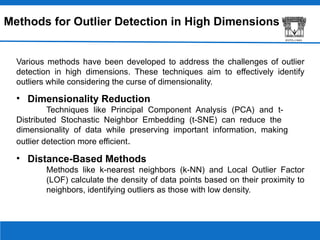
Methods for Outlier Detection in High Dimensions
Various methods have been developed to address the challenges of outlier
detection in high dimensions. These techniques aim to effectively identify
outliers while considering the curse of dimensionality.
• Dimensionality Reduction
Techniques like Principal Component Analysis (PCA) and t-
Distributed Stochastic Neighbor Embedding (t-SNE) can reduce the
dimensionality of data while preserving important information, making
outlier detection more efficient.
• Distance-Based Methods
Methods like k-nearest neighbors (k-NN) and Local Outlier Factor
(LOF) calculate the density of data points based on their proximity to
neighbors, identifying outliers as those with low density.
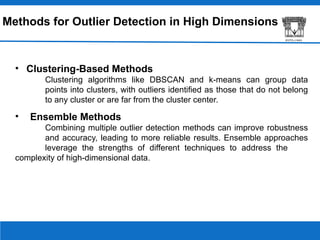
Methods for Outlier Detection in High Dimensions
• Clustering-Based Methods
Clustering algorithms like DBSCAN and k-means can group data
points into clusters, with outliers identified as those that do not belong
to any cluster or are far from the cluster center.
• Ensemble Methods
Combining multiple outlier detection methods can improve robustness
and accuracy, leading to more reliable results. Ensemble approaches
leverage the strengths of different techniques to address the
complexity of high-dimensional data.
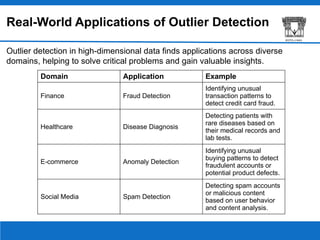
Real-World Applications of Outlier Detection
Outlier detection in high-dimensional data finds applications across diverse
domains, helping to solve critical problems and gain valuable insights.
Domain Application Example
Finance Fraud Detection
Identifying unusual
transaction patterns to
detect credit card fraud.
Healthcare Disease Diagnosis
Detecting patients with
rare diseases based on
their medical records and
lab tests.
E-commerce Anomaly Detection
Identifying unusual
buying patterns to detect
fraudulent accounts or
potential product defects.
Social Media Spam Detection
Detecting spam accounts
or malicious content
based on user behavior
and content analysis.
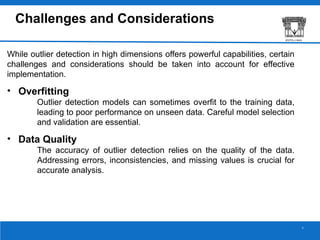
Challenges and Considerations
›
While outlier detection in high dimensions offers powerful capabilities, certain
challenges and considerations should be taken into account for effective
implementation.
• Overfitting
Outlier detection models can sometimes overfit to the training data,
leading to poor performance on unseen data. Careful model selection
and validation are essential.
• Data Quality
The accuracy of outlier detection relies on the quality of the data.
Addressing errors, inconsistencies, and missing values is crucial for
accurate analysis.
Challenges and Considerations
• Domain Expertise
Interpreting outlier detection results requires domain expertise to
understand the context and implications of detected anomalies.
• Ethical Considerations
Outlier detection can have ethical implications, particularly in
applications like credit scoring or medical diagnosis. It's crucial to
ensure fairness and minimize bias in the analysis.

Outlier-Detection-in-Higher-Dimensions in data mining

  • 1.
    Outlier Definition “What isan outlier?” Outliers are data points that deviate significantly from the rest of the data. They can be caused by errors in data collection, measurement, or data entry. Outliers can also be genuine data points that represent unusual or exceptional cases. ● Outliers can be caused by measurement or execution error. For example, the display of a person’s age as −999 could be caused by a program default setting of an unrecorded age. Alternatively, outliers may be the result of inherent data variability. The salary of the chief executive officer of a company, for instance, could naturally stand out as an outlier among the salaries of the other employees in the firm.
  • 2.
    Outlier Definition • Distortion: Outlierscan distort statistical measures like mean, variance, and correlation, leading to incorrect conclusions. • Model Performance: Outliers can negatively impact the performance of machine learning models, leading to inaccurate predictions or biased results. • Fraud Detection: In financial applications, outliers can be indicative of fraudulent transactions or unusual spending patterns. • Medical Diagnosis: In healthcare, outliers can help identify patients with rare diseases or unusual health conditions.
  • 3.
    High-dimensional data presentsunique challenges for outlier detection due to the increased complexity and sparsity of the data. The curse of dimensionality makes traditional outlier detection methods less effective. Data Sparsity In high dimensions, data points are spread out, making it difficult to define a clear notion of "typical" or "normal." Computational Complexity Many outlier detection algorithms have a computational complexity that grows exponentially with the number of dimensions, making them computationally expensive. Challenges of High-Dimensional Data
  • 4.
    Distance Metrics Choosing anappropriate distance metric becomes crucial in high dimensions as traditional Euclidean distance can become misleading due to the increased influence of irrelevant dimensions. This, however, could result in the loss of important hidden information because one person’s noise could be another person’s signal. Thus, outlier detection and analysis is an interesting data mining task, referred to as outlier mining. Challenges of High-Dimensional Data
  • 5.
    Methods for OutlierDetection in High Dimensions Various methods have been developed to address the challenges of outlier detection in high dimensions. These techniques aim to effectively identify outliers while considering the curse of dimensionality. • Dimensionality Reduction Techniques like Principal Component Analysis (PCA) and t- Distributed Stochastic Neighbor Embedding (t-SNE) can reduce the dimensionality of data while preserving important information, making outlier detection more efficient. • Distance-Based Methods Methods like k-nearest neighbors (k-NN) and Local Outlier Factor (LOF) calculate the density of data points based on their proximity to neighbors, identifying outliers as those with low density.
  • 6.
    Methods for OutlierDetection in High Dimensions • Clustering-Based Methods Clustering algorithms like DBSCAN and k-means can group data points into clusters, with outliers identified as those that do not belong to any cluster or are far from the cluster center. • Ensemble Methods Combining multiple outlier detection methods can improve robustness and accuracy, leading to more reliable results. Ensemble approaches leverage the strengths of different techniques to address the complexity of high-dimensional data.
  • 7.
    Real-World Applications ofOutlier Detection Outlier detection in high-dimensional data finds applications across diverse domains, helping to solve critical problems and gain valuable insights. Domain Application Example Finance Fraud Detection Identifying unusual transaction patterns to detect credit card fraud. Healthcare Disease Diagnosis Detecting patients with rare diseases based on their medical records and lab tests. E-commerce Anomaly Detection Identifying unusual buying patterns to detect fraudulent accounts or potential product defects. Social Media Spam Detection Detecting spam accounts or malicious content based on user behavior and content analysis.
  • 8.
    Challenges and Considerations › Whileoutlier detection in high dimensions offers powerful capabilities, certain challenges and considerations should be taken into account for effective implementation. • Overfitting Outlier detection models can sometimes overfit to the training data, leading to poor performance on unseen data. Careful model selection and validation are essential. • Data Quality The accuracy of outlier detection relies on the quality of the data. Addressing errors, inconsistencies, and missing values is crucial for accurate analysis.
  • 9.
    Challenges and Considerations •Domain Expertise Interpreting outlier detection results requires domain expertise to understand the context and implications of detected anomalies. • Ethical Considerations Outlier detection can have ethical implications, particularly in applications like credit scoring or medical diagnosis. It's crucial to ensure fairness and minimize bias in the analysis.