Outdoor games with
BLOCKSTART
Group Juggle
Form a circle.
Every participants keeps the right arm up until he/she receives the ball
once.
Toss the ball to a team member and say his name. He/she
throws it to another one and so on until they reach the last
participant with the arm up.
For the next lap you repeat the order but with
your arm down. For the next laps use 2, then 3 balls,
passing the balls faster and faster.
Look for solutions for speeding up the game.
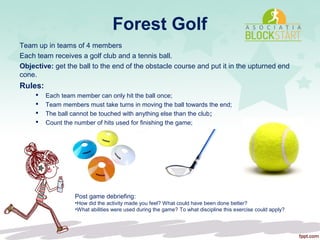
Forest Golf
Team up in teams of 4 members
Each team receives a golf club and a tennis ball.
Objective: get the ball to the end of the obstacle course and put it in the upturned end
cone.
Rules:
 Each team member can only hit the ball once;
 Team members must take turns in moving the ball towards the end;
 The ball cannot be touched with anything else than the club;
 Count the number of hits used for finishing the game;
Post game debriefing:
•How did the activity made you feel? What could have been done better?
•What abilities were used during the game? To what discipline this exercise could apply?
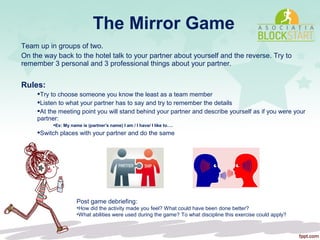
The Mirror Game
Team up in groups of two.
On the way back to the hotel talk to your partner about yourself and the reverse. Try to
remember 3 personal and 3 professional things about your partner.
Rules:
Try to choose someone you know the least as a team member
Listen to what your partner has to say and try to remember the details
At the meeting point you will stand behind your partner and describe yourself as if you were your
partner:
Ex: My name is (partner’s name) I am / I have/ I like to….
Switch places with your partner and do the same
Post game debriefing:
•How did the activity made you feel? What could have been done better?
•What abilities were used during the game? To what discipline this exercise could apply?
The robots
• Form teams of 3 on a limited surface indicated by your coordinator.
– 2 of you will be robots
– 1 of you will be the mechanic.
The robots must move only in the delimited surface and are lead by the
mechanic.
One tap on the shoulder makes them move until they are redirected
with another tap.
A tap to the left means they go left.
A tap to the right means they go to the right.
The robots do not stop, they must be redirected in
order to be kept in the game surface.
Warm-up
Form a circle, holding hands, facing in to centre.
Ask group to „Say what I say& Do what I say”: jump left, jump right,
jump in, jump out.
Ask group: „Say opposite of what I say&Do what I say”.
Ask group: „Say what I say& Do opposite of what I say”
Pass the ball, learn something new
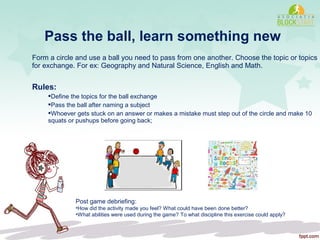
Form a circle and use a ball you need to pass from one another. Choose the topic or topics
for exchange. For ex: Geography and Natural Science, English and Math.
Rules:
Define the topics for the ball exchange
Pass the ball after naming a subject
Whoever gets stuck on an answer or makes a mistake must step out of the circle and make 10
squats or pushups before going back;
Post game debriefing:
•How did the activity made you feel? What could have been done better?
•What abilities were used during the game? To what discipline this exercise could apply?
Fun Geography
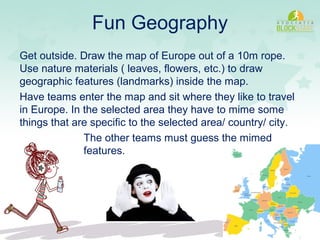
Get outside. Draw the map of Europe out of a 10m rope.
Use nature materials ( leaves, flowers, etc.) to draw
geographic features (landmarks) inside the map.
Have teams enter the map and sit where they like to travel
in Europe. In the selected area they have to mime some
things that are specific to the selected area/ country/ city.
The other teams must guess the mimed
features.
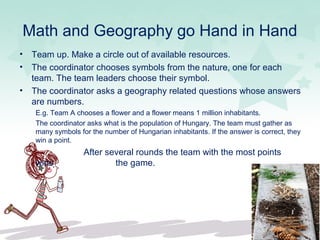
Math and Geography go Hand in Hand
• Team up. Make a circle out of available resources.
• The coordinator chooses symbols from the nature, one for each
team. The team leaders choose their symbol.
• The coordinator asks a geography related questions whose answers
are numbers.
E.g. Team A chooses a flower and a flower means 1 million inhabitants.
The coordinator asks what is the population of Hungary. The team must gather as
many symbols for the number of Hungarian inhabitants. If the answer is correct, they
win a point.
After several rounds the team with the most points
wins the game.
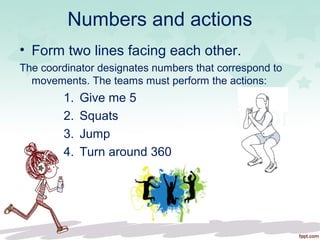
Numbers and actions
• Form two lines facing each other.
The coordinator designates numbers that correspond to
movements. The teams must perform the actions:
1. Give me 5
2. Squats
3. Jump
4. Turn around 360
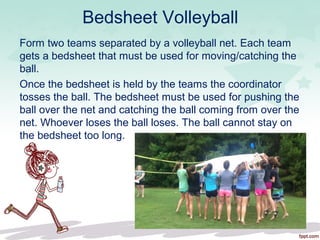
Bedsheet Volleyball
Form two teams separated by a volleyball net. Each team
gets a bedsheet that must be used for moving/catching the
ball.
Once the bedsheet is held by the teams the coordinator
tosses the ball. The bedsheet must be used for pushing the
ball over the net and catching the ball coming from over the
net. Whoever loses the ball loses. The ball cannot stay on
the bedsheet too long.
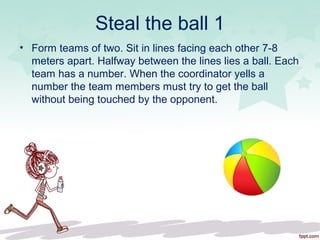
Steal the ball 1
• Form teams of two. Sit in lines facing each other 7-8
meters apart. Halfway between the lines lies a ball. Each
team has a number. When the coordinator yells a
number the team members must try to get the ball
without being touched by the opponent.
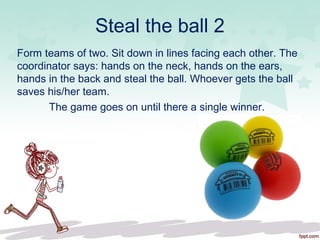
Steal the ball 2
Form teams of two. Sit down in lines facing each other. The
coordinator says: hands on the neck, hands on the ears,
hands in the back and steal the ball. Whoever gets the ball
saves his/her team.
The game goes on until there a single winner.
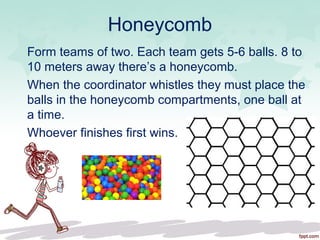
Honeycomb
Form teams of two. Each team gets 5-6 balls. 8 to
10 meters away there’s a honeycomb.
When the coordinator whistles they must place the
balls in the honeycomb compartments, one ball at
a time.
Whoever finishes first wins.
I am Picasso
Form teams of 6-8 participants. Think about art and choose
a famous work of art. Try to recreate the selected work with
the team members. Each team member can be a character
of a landscape detail in the frame.
All the team members must be in the picture. The final
work will be compared to the original work of art.
Be creative and have FUN!
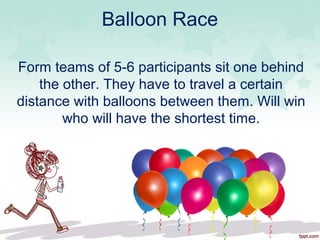
Balloon Race
Form teams of 5-6 participants sit one behind
the other. They have to travel a certain
distance with balloons between them. Will win
who will have the shortest time.
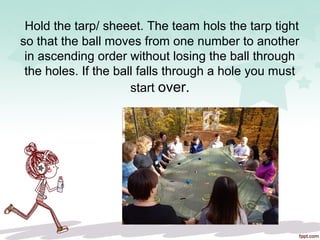
Hold the tarp/ sheeet. The team hols the tarp tight
so that the ball moves from one number to another
in ascending order without losing the ball through
the holes. If the ball falls through a hole you must
start over.
Fort teams of two. Stand back to back. I will say
jump and you have to jump to face each other.
Each team member shows some fingers to the
partner in the same time, after the jump. The one
who adds up first the sum of fingers from the team
and says it out loud wins and stays in the game.
Enjoy!
https://asociatiablockstart.com/
https://www.facebook.com/Asocia%C8%9Bia-Blockstart-90416531202738/
Vulcana-Băi, ROMANIA
E-mail: asociatia.blockstart@yahoo.com

Outdoor games blockstart

  • 1.
  • 2.
    Group Juggle Form acircle. Every participants keeps the right arm up until he/she receives the ball once. Toss the ball to a team member and say his name. He/she throws it to another one and so on until they reach the last participant with the arm up. For the next lap you repeat the order but with your arm down. For the next laps use 2, then 3 balls, passing the balls faster and faster. Look for solutions for speeding up the game.
  • 3.
    Forest Golf Team upin teams of 4 members Each team receives a golf club and a tennis ball. Objective: get the ball to the end of the obstacle course and put it in the upturned end cone. Rules:  Each team member can only hit the ball once;  Team members must take turns in moving the ball towards the end;  The ball cannot be touched with anything else than the club;  Count the number of hits used for finishing the game; Post game debriefing: •How did the activity made you feel? What could have been done better? •What abilities were used during the game? To what discipline this exercise could apply?
  • 4.
    The Mirror Game Teamup in groups of two. On the way back to the hotel talk to your partner about yourself and the reverse. Try to remember 3 personal and 3 professional things about your partner. Rules: Try to choose someone you know the least as a team member Listen to what your partner has to say and try to remember the details At the meeting point you will stand behind your partner and describe yourself as if you were your partner: Ex: My name is (partner’s name) I am / I have/ I like to…. Switch places with your partner and do the same Post game debriefing: •How did the activity made you feel? What could have been done better? •What abilities were used during the game? To what discipline this exercise could apply?
  • 5.
    The robots • Formteams of 3 on a limited surface indicated by your coordinator. – 2 of you will be robots – 1 of you will be the mechanic. The robots must move only in the delimited surface and are lead by the mechanic. One tap on the shoulder makes them move until they are redirected with another tap. A tap to the left means they go left. A tap to the right means they go to the right. The robots do not stop, they must be redirected in order to be kept in the game surface.
  • 6.
    Warm-up Form a circle,holding hands, facing in to centre. Ask group to „Say what I say& Do what I say”: jump left, jump right, jump in, jump out. Ask group: „Say opposite of what I say&Do what I say”. Ask group: „Say what I say& Do opposite of what I say”
  • 7.
    Pass the ball,learn something new Form a circle and use a ball you need to pass from one another. Choose the topic or topics for exchange. For ex: Geography and Natural Science, English and Math. Rules: Define the topics for the ball exchange Pass the ball after naming a subject Whoever gets stuck on an answer or makes a mistake must step out of the circle and make 10 squats or pushups before going back; Post game debriefing: •How did the activity made you feel? What could have been done better? •What abilities were used during the game? To what discipline this exercise could apply?
  • 8.
    Fun Geography Get outside.Draw the map of Europe out of a 10m rope. Use nature materials ( leaves, flowers, etc.) to draw geographic features (landmarks) inside the map. Have teams enter the map and sit where they like to travel in Europe. In the selected area they have to mime some things that are specific to the selected area/ country/ city. The other teams must guess the mimed features.
  • 9.
    Math and Geographygo Hand in Hand • Team up. Make a circle out of available resources. • The coordinator chooses symbols from the nature, one for each team. The team leaders choose their symbol. • The coordinator asks a geography related questions whose answers are numbers. E.g. Team A chooses a flower and a flower means 1 million inhabitants. The coordinator asks what is the population of Hungary. The team must gather as many symbols for the number of Hungarian inhabitants. If the answer is correct, they win a point. After several rounds the team with the most points wins the game.
  • 10.
    Numbers and actions •Form two lines facing each other. The coordinator designates numbers that correspond to movements. The teams must perform the actions: 1. Give me 5 2. Squats 3. Jump 4. Turn around 360
  • 11.
    Bedsheet Volleyball Form twoteams separated by a volleyball net. Each team gets a bedsheet that must be used for moving/catching the ball. Once the bedsheet is held by the teams the coordinator tosses the ball. The bedsheet must be used for pushing the ball over the net and catching the ball coming from over the net. Whoever loses the ball loses. The ball cannot stay on the bedsheet too long.
  • 12.
    Steal the ball1 • Form teams of two. Sit in lines facing each other 7-8 meters apart. Halfway between the lines lies a ball. Each team has a number. When the coordinator yells a number the team members must try to get the ball without being touched by the opponent.
  • 13.
    Steal the ball2 Form teams of two. Sit down in lines facing each other. The coordinator says: hands on the neck, hands on the ears, hands in the back and steal the ball. Whoever gets the ball saves his/her team. The game goes on until there a single winner.
  • 14.
    Honeycomb Form teams oftwo. Each team gets 5-6 balls. 8 to 10 meters away there’s a honeycomb. When the coordinator whistles they must place the balls in the honeycomb compartments, one ball at a time. Whoever finishes first wins.
  • 15.
    I am Picasso Formteams of 6-8 participants. Think about art and choose a famous work of art. Try to recreate the selected work with the team members. Each team member can be a character of a landscape detail in the frame. All the team members must be in the picture. The final work will be compared to the original work of art. Be creative and have FUN!
  • 16.
    Balloon Race Form teamsof 5-6 participants sit one behind the other. They have to travel a certain distance with balloons between them. Will win who will have the shortest time.
  • 17.
    Hold the tarp/sheeet. The team hols the tarp tight so that the ball moves from one number to another in ascending order without losing the ball through the holes. If the ball falls through a hole you must start over.
  • 18.
    Fort teams oftwo. Stand back to back. I will say jump and you have to jump to face each other. Each team member shows some fingers to the partner in the same time, after the jump. The one who adds up first the sum of fingers from the team and says it out loud wins and stays in the game.
  • 19.

Editor's Notes

  • #3 În cerc. Fiecare are brațul drept ridicat până primește mingea. Arunci mingea la un coleg și-i spui numele. El aruncă la următorul și tot așa până la ultimul cu brațul ridicat. Se repetă în aceeași ordine, dar fără braț ridicat. Se reia în aceeași ordine cu două mingi, apoi cu trei. Apoi din ce în ce mai repede. Să găsească soluții să se facă turul în cât mai puțin timp.
  • #6 Echipe de 3, pe o suprafața delimitată. Doi vor fi roboți, iar unul mecanicul. Roboții stau spate în spate și pornesc în momentul în care îi atinge mecanicul pe umăr. Dacă sunt atinși pe umărul stâng merg spre stânga. La fel pentru dreapta. Scopul este ca mecanicul să țină roboții în suprafața stabilită.
  • #9 la o oră de geografia Europei, la clasa a VI-a, se poate ieși cu elevii în curtea școlii, în parcul sau pădurea din apropiere. Avem nevoie de o sfoară groasă și lungă, cam de 10 m. Din această sfoară, pe un teren drept, realizăm conturul aproximativ al Europei. Cu ajutorul unor materiale din natură (flori, frunze, bețe, pietricele, etc), copiii vor realiza în conturul creat diverse elemente naturale (munți, ape, etc). Facem echipe de câte 3-4 elevi și-i îndemnăm să se așeze în interiorul Europei, acolo unde ar dori ei să călătorească (regiune, țară). Fiecare echipă, își va scoate în evidență regiunea aleasă printr-un joc de rol, mimând trei elemente caracteristice regiunii (poate fi un dans sau mâncare tradiționale, o statuie celebră, un sport național, etc.) Celelalte echipe vor ghici ceea ce se mimează
  • #10 , împărțim elevii în grupe. Fiecare echipă are la dispoziție un cerc sau o sfoară de aprox. 1 m, pe care o așează pe iarbă în formă de cerc. Profesorul ia din natura înconjurătoare câteva simboluri (floare, bețișor, frunză, etc), câte unul pentru fiecare echipă. Liderii echipelor își aleg simbolul. Profesorul întreabă elevii ce populație are de exemplu Ungaria? Echipele caută în natură simbolul lor (ex. o floare = 1 mil. loc). În cercul fiecărei echipe, apare numărul de elemente (flori, pietricele, etc.), egal cu numărul populației (în mil. loc.), pe care-l consideră mai apropiat de realitate. Câștigă 1 punct echipa care este cel mai aproape de răspunsul corect. În final, după mai multe întrebări, câștigă echipajul cu cât mai multe puncte obținute.
  • #11 Două linii față în față. Coordonatorul va spune numere care corespund unor mișcări, iar participanții trebuie să facă mișcarea corespunzătoare numărului pe care îl aud. 1: Give me 5; 2:squats; 3:Jump; 4: turn around 360;
  • #12 Echipe de 4-5 elevi. Fiecare are un cearșaf. Se pune în joc o minge. Fiecare echipă trebuie să treacă mingea peste fileu doar cu ajutorul cearșafului. Se punctează când mingea atinge pământul. Câștigă echipa care ajunge prima la 7 puncte.
  • #13 Echipe de 2 așezați pe două linii față în față la o distanță de 7-8m. La mijlocul distanței este așezată o minge. Fiecărei echipe îi corespunde un număr. Când coordonatorul spune un număr, fiecare dintre cei doi din echipa respectivă trebuie să încerce să ia mingea fără să fie atins de adversa
  • #14 Echipe de doi. Se așează jos, pe două linii fața în față. Coordonatorul dă comenzi: mâinile pe ceafă, mâinile pe urechi, mâinile la spate etc și „Steal the ball”. Rîmâne în joc cine ia primul mingea din fiecare echipă. Se joacă până rămâne un câștigător.
  • #15 Echipe de doi. Fiecare are 5-6 mingi. În fața fiecaruia (la o distanță de 8-10m) se află un fagure din carton. La fluier fiecare trebuie să pună mingiile în fagure, dar fiecare minge pe rând. Câștigă cine pune primul mingiile.
  • #17 Echipe de 5 așezați unul în spatele celuilalt. Trebuie să se deplaseze pe o anumită distanță având baloane între ei. Câștigă cine va avea timpul cel mai scurt.