Traditional Games
A collection of group games from around the world
T R A D I T I O N A L G A M E S : W E L C O M E
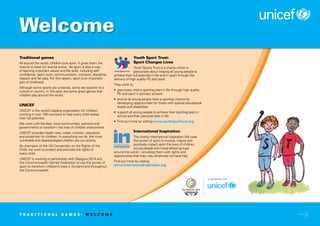
Traditional games
All around the world, children love sport. It gives them the
chance to have fun and be active. Yet sport is also a way
of learning important values and life skills, including self-
confidence, team work, communication, inclusion, discipline,
respect and fair play. For this reason, sport is an important
part of childhood.
Although some sports are universal, some are specific to a
culture or country. In this pack are some great games that
children play around the world.
UNICEF
UNICEF is the world’s leading organisation for children,
working in over 190 countries to help every child realise
their full potential.
We work with families, local communities, partners and
governments to transform the lives of children everywhere.
UNICEF provides health care, water, nutrition, education
and protection for children. In everything we do, the most
vulnerable and disadvantaged children are our priority.
As champion of the UN Convention on the Rights of the
Child, we work to protect and promote the rights of
every child.
UNICEF is working in partnership with Glasgow 2014 and
the Commonwealth Games Federation to use the power of
sport to transform children’s lives in Scotland and throughout
the Commonwealth.
Youth Sport Trust:
Sport Changes Lives
Youth Sports Trust is a charity which is
passionate about helping all young people to
achieve their full potential in life and in sport through the
delivery of high quality PE and sport.
They work to:
• give every child a sporting start in life through high quality
PE and sport in primary schools.
• ensure all young people have a sporting chance by
developing opportunities for those with special educational
needs and disabilities.
• support all young people to achieve their sporting best in
school and their personal best in life.
• Find out more by visiting www.youthsporttrust.org
International Inspiration
The charity International Inspiration (IN) uses
the power of sport to involve, inspire and
positively impact upon the lives of children,
young people and marginalised groups
around the world – providing them with rights and
opportunities that they may otherwise not have had.
Find out more by visiting
www.internationalinspiration.org
Welcome
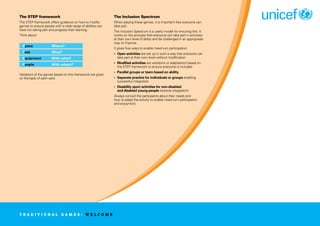
The STEP framework
The STEP framework offers guidance on how to modify
games to ensure people with a wide range of abilities can
have fun taking part and progress their learning.
Think about:
Space Where?
Task What?
Equipment With what?
People With whom?
Variations of the games based on this framework are given
on the back of each card.
The Inclusion Spectrum
When playing these games, it is important that everyone can
take part.
The Inclusion Spectrum is a useful model for ensuring this. It
works on the principle that everyone can take part in activities
at their own level of ability and be challenged in an appropriate
way to improve.
It gives five ways to enable maximum participation:
• Open activities are set up in such a way that everyone can
take part at their own level without modification
• Modified activities are variations or adaptations based on
the STEP framework to ensure everyone is included
• Parallel groups or team based on ability
• Separate practice for individuals or groups enabling
successful integration
• Disability sport activities for non-disabled
and disabled young people (reverse integration)
Always consult the participants about their needs and
how to adapt the activity to enable maximum participation
and enjoyment.
T R A D I T I O N A L G A M E S : W E L C O M E
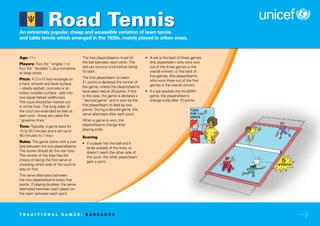
An extremely popular, cheap and accessible variation of lawn tennis
and table tennis which emerged in the 1930s, mainly played in urban areas.
Age: 11+
Players: Two (for “singles”) or
four (for “doubles”), plus someone
to keep score.
Pitch: A 21x10 foot rectangle on
a hard, smooth and level surface
– ideally asphalt, concrete or an
indoor wooden surface - split into
two equal halves widthways.
The court should be marked out
in white lines. The long sides of
the court are extended six feet at
each end – these are called the
“governor lines.”
Time: Typically, a game lasts for
15 to 20 minutes and a set up to
45 minutes to 1 hour.
Rules: The game starts with a coin
toss between the two players/teams.
The scorer should do the coin toss.
The winner of the toss has the
choice of taking the first serve or
choosing which side of the court to
play on first.
The serve alternates between
the two players/teams every five
points. If playing doubles, the serve
alternates between each player on
the team between each point.
The two players/teams must hit
the ball between each other. The
ball can bounce once before being
hit back.
The first player/team to reach
21 points is declared the winner of
the game, unless the players/teams
have been tied at 20 points. If this
is the case, the game is declared a
“deuced game” and is won by the
first player/team to lead by two
points. During a deuced game, the
serve alternates after each point.
When a game is won, the
players/teams change their
playing ends.
Scoring
• If a player hits the ball and it
lands outside of the lines, or
doesn’t reach the other side of
the court, the other player/team
gets a point.
• A set is the best of three games
(the player/team who wins two
out of the three games is the
overall winner), or the best of
five games, (the player/teams
who wins three out of the five
games is the overall winner).
• If a set reaches the third/fifth
game, the players/teams
change ends after 10 points.
Road Tennis
T R A D I T I O N A L G A M E S : B A R B A D O S
B A R B A D O S
Equipment
• A, typically wooden, net, eight
inches in height, placed over the
centre line. This should extend
beyond the width of the court by
six inches on either side, and be
painted white.
• A standard lawn tennis ball with
the fur removed.
• Each player needs a racquet,
which should be made of wood.
The racquet should be no more
than 11 inches in diameter at its
widest point.
Safety
• Players should warm up before
the game starts.
• The playing area must be clear
of any obstructions, including at
least 10ft around the court.
Adaptations and variations
Easier
• Space: Broaden the court.
• Task: NA
• Equipment: Use bigger racquets
and a slower ball. Lower the net.
• People: NA
Harder
• Space: Make the court smaller.
• Task: NA
• Equipment: Use smaller racquets
and a faster ball. Raise the net.
• People: NA
Inclusion
Try:
• Using different types of balls
and racquets.
• Increasing the size of the court
to facilitate wheelchairs.
Skills developed
• Endurance
• Teamwork
• Agility
• Speed
• Fitness
This activity can be used as
• A warm-up
• A skill development activity
• A game
Who could use this card?
• Community leaders
• Teachers
• Sports coaches
• Physical education teachers
• Parents
• Rehabilitation specialists
• Fitness enthusiasts
• Health professionals
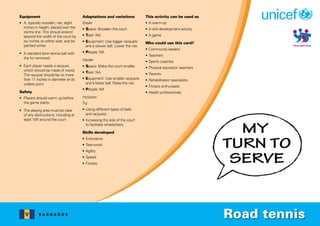
Road tennis
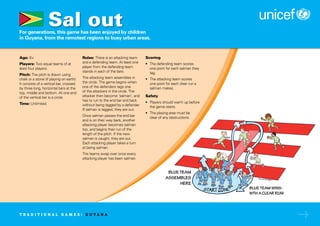
For generations, this game has been enjoyed by children
in Guyana, from the remotest regions to busy urban areas.
Age: 6+
Players: Two equal teams of at
least four players.
Pitch: The pitch is drawn using
chalk or a stone (if playing on earth).
It consists of a vertical bar, crossed
by three long, horizontal bars at the
top, middle and bottom. At one end
of the vertical bar is a circle.
Time: Unlimited.
Rules: There is an attacking team
and a defending team. At least one
player from the defending team
stands in each of the bars.
The attacking team assembles in
the circle. The game begins when
one of the defenders tags one
of the attackers in the circle. The
attacker then become ‘salman’, and
has to run to the end bar and back
without being tagged by a defender.
If salman is tagged, they are out.
Once salman passes the end bar
and is on their way back, another
attacking player becomes salman
too, and begins their run of the
length of the pitch. If the new
salman is caught, they are out.
Each attacking player takes a turn
at being salman.
The teams swap over once every
attacking player has been salman.
Scoring
• The defending team scores
one point for each salman they
tag.
• The attacking team scores
one point for each clear run a
salman makes.
Safety
• Players should warm up before
the game starts.
• The playing area must be
clear of any obstructions.
Sal out
T R A D I T I O N A L G A M E S : G U Y A N A
G U Y A N A
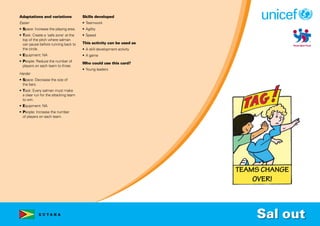
Adaptations and variations
Easier
• Space: Increase the playing area.
• Task: Create a ‘safe zone’ at the
top of the pitch where salman
can pause before running back to
the circle.
• Equipment: NA
• People: Reduce the number of
players on each team to three.
Harder
• Space: Decrease the size of
the bars.
• Task: Every salman must make
a clear run for the attacking team
to win.
• Equipment: NA
• People: Increase the number
of players on each team.
Skills developed
• Teamwork
• Agility
• Speed
This activity can be used as
• A skill development activity
• A game
Who could use this card?
• Young leaders
Sal out
For hundreds of years this game, also called ‘Tapping the ball’,
has been played in the remotest islands of Kiribati.
Age: 15+
Players: As many as you like –
enough to form a circle.
Pitch: A clear space – this doesn’t
have to be particularly large, the
game is often played in backyards
and most of Kiribati’s islands are
very narrow.
Time: Unlimited.
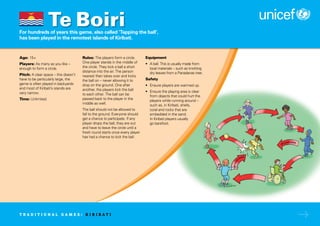
Rules: The players form a circle.
One player stands in the middle of
the circle. They kick a ball a short
distance into the air. The person
nearest then takes over and kicks
the ball on – never allowing it to
drop on the ground. One after
another, the players kick the ball
to each other. The ball can be
passed back to the player in the
middle as well.
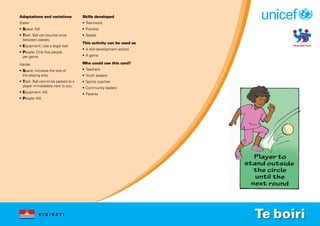
The ball should not be allowed to
fall to the ground. Everyone should
get a chance to participate. If any
player drops the ball, they are out
and have to leave the circle until a
fresh round starts once every player
has had a chance to kick the ball.
Equipment
• A ball. This is usually made from
local materials – such as knotting
dry leaves from a Panadanas tree.
Safety
• Ensure players are warmed up.
• Ensure the playing area is clear
from objects that could hurt the
players while running around –
such as, in Kiribati, shells,
coral and rocks that are
embedded in the sand.
In Kiribati players usually
go barefoot.
Te Boiri
T R A D I T I O N A L G A M E S : K I R I B A T I
K I R I B A T I
Adaptations and variations
Easier
• Space: NA
• Task: Ball can bounce once
between passes.
• Equipment: Use a larger ball.
• People: Only five people
per game.
Harder
• Space: Increase the size of
the playing area.
• Task: Ball cannot be passed to a
player immediately next to you.
• Equipment: NA
• People: NA
Skills developed
• Teamwork
• Practice
• Speed
This activity can be used as
• A skill development activity
• A game
Who could use this card?
• Teachers
• Youth leaders
• Sports coaches
• Community leaders
• Parents
Te boiri
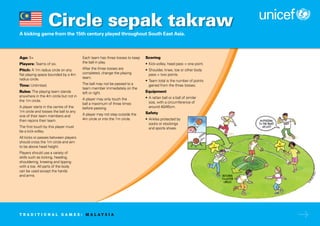
A kicking game from the 15th century played throughout South East Asia.
Age: 5+
Players: Teams of six.
Pitch: A 1m radius circle on any
flat playing space bounded by a 4m
radius circle.
Time: Unlimited.
Rules: The playing team stands
anywhere in the 4m circle but not in
the 1m circle.
A player starts in the centre of the
1m circle and tosses the ball to any
one of their team members and
then rejoins their team.
The first touch by this player must
be a kick-volley.
All kicks or passes between players
should cross the 1m circle and aim
to be above head height.
Players should use a variety of
skills such as kicking, heading,
shouldering, kneeing and tipping
with a toe. All parts of the body
can be used except the hands
and arms.
Each team has three tosses to keep
the ball in play.
After the three tosses are
completed, change the playing
team.
The ball may not be passed to a
team member immediately on the
left or right.
A player may only touch the
ball a maximum of three times
before passing.
A player may not step outside the
4m circle or into the 1m circle.
Circle sepak takraw
T R A D I T I O N A L G A M E S : M A L A Y S I A
Scoring
• Kick-volley, head pass = one point.
• Shoulder, knee, toe or other body
pass = two points.
• Team total is the number of points
gained from the three tosses.
Equipment
• A rattan ball or a ball of similar
size, with a circumference of
around 40/45cm.
Safety
• Ankles protected by
socks or stockings
and sports shoes.
M A L A Y S I A
Adaptations and variations
Easier
• Space: Use the whole playing
area (both circles).
• Task: No limit to the number of
touches before passing.
• Equipment: Use a softer ball.
• People: NA.
Harder
• Space: Make the playing
space larger.
• Task: Each player can touch the
ball a maximum of two times
before passing.
• Equipment: Use a smaller ball.
• People: Reduce the number of
players in a team.
Inclusion
An adaptation for this game could
be to use hands and arms.
Skills developed
• Kick-volley
• Heading
• Coordination
This activity can be used as
• A skill-development activity
• A game
Who could use this card?
• Teachers
• Young leaders
• Sports coaches
• Community leaders
• Students
Circle sepak takraw
This Maori game is also called ‘The Game of Stars’ or ‘The Games of Peace’.
It evolved out of multiple archaic games based on the story of legendary figure Rahi.
Age: 5+
Players: Two teams of seven
players, though this can be adjusted
depending on the size of the playing
area. One team is the Kioma and
the other team is the Taniwha – this
switches every quarter.
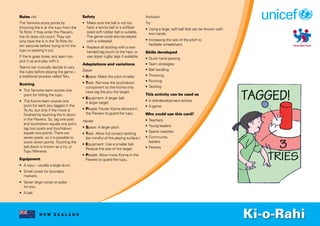
Pitch: The playing field consists of
three concentric circles – the
playing zones – intersected by a
pathway, the Te Ara. At the end of
the Te Ara, on the outside of the
largest circle, is a small circle with a
radius of 1m, called the Te
Marama. The inner circle, or
Pawero, has a radius of 4m – with a
target, the tupu, placed at the exact
centre. The middle circle, or Te
Roto, has a radius of 11m, and the
outer circle, or Te Ao, has a radius
of 21m. These distances can be
modified to fit smaller spaces.
Seven posts, or pou, are evenly
spaced around the Te Ao area.
The pitch can be marked on a
playing field or gymnasium.
Small cones can be used to mark
the boundaries.
Time: Four 10 minute quarters.
Rules: The Kioma team play in the
Pawero and Te Ao. Three Kioma
guard the tupu in the Pawero, and
the other four players are in the
Te Ao. Kiomo can swap between
the Pawero and Te Ao by running
through the Te Ara.
The Kioma have to stop the
Taniwha team from hitting the tupu
with the ball, or ki. The players in
the Pawero can use any part of
their bodies to block the ball from
hitting the target. They can also
catch or intercept the ki and throw
it out to their own players in the Te
Ao. They must pass the ball out of
the Pawero within five seconds.
The Kioma are also trying to tag
the pou in the Te Ao with the ki.
Once they have tagged one or
more pou, they must run with the ki
through the Te Roto to the Pawero
and touch the ki down, without a
Taniwha tagging them with both
hands on the hips or tackling them.
If they are tagged or tackled, they
have three seconds to pass the ball
to a teammate or it goes to
the Taniwha.
Kioma without the ball cannot stop or
interfere with a Taniwha player who
is tagging the Kioma with the ki.
A Kioma in the Te Marama kicks off
to the Kioma in the Pawero; they
then try to pass it out to their
teammates in the Te Ao.
(continued on page 2)
Ki-o-Rahi
T R A D I T I O N A L G A M E S : N E W Z E A L A N D
N E W Z E A L A N D
Rules ctd.
The Taniwha score points by
throwing the ki at the tupu from the
Te Roto: if they enter the Pawero,
the hit does not count. They can
only have the ki in the Te Roto for
ten seconds before trying to hit the
tupu or passing it out.
If the ki goes loose, any team can
pick it up and play with it.
Teams can mutually decide to vary
the rules before playing the game –
a traditional process called Tatu.
Scoring
• The Taniwha team scores one
point for hitting the tupu.
• The Kioma team scores one
point for each pou tagged in the
Te Ao, but only if the move is
finished by touching the ki down
in the Pawero. So, tag one post
and touchdown equals one point,
tag two posts and touchdown
equals two points. There are
seven posts, so it is possible to
score seven points. Touching the
ball down is known as a try, or
Tupu Manawa.
Equipment
• A tupu – usually a large drum.
• Small cones for boundary
markers.
• Seven large cones or poles
for pou.
• A ball.
Safety
• Make sure the ball is not too
hard, a tennis ball or a softball-
sized soft rubber ball is suitable.
The game could also be played
with a volleyball.
• Replace all tackling with a two-
handed tag touch to the hips, or
use ripper rugby tags if available.
Adaptations and variations
Easier
• Space: Make the pitch smaller.
• Task: Remove the touchdown
component so the Kioma only
have tag the pou the target.
• Equipment: A larger ball.
A larger target.
• People: Fewer Kioma allowed in
the Pawero to guard the tupu.
Harder
• Space: A larger pitch.
• Task: Allow full contact tackling
(be mindful of the playing surface.)
• Equipment: Use a smaller ball.
Reduce the size of the target.
• People: Allow more Kioma in the
Pawero to guard the tupu.
Inclusion
Try:
• Using a large, soft ball that can be thrown with
two hands.
• Increasing the size of the pitch to
facilitate wheelchairs.
Skills developed
• Quick hand passing
• Team strategies
• Ball handling
• Throwing
• Running
• Tackling
This activity can be used as
• A skill-development activity
• A game
Who could use this card?
• Teachers
• Young leaders
• Sports coaches
• Community
leaders
• Parents
Ki-o-Rahi
A throwing and catching game said to be
‘as old as man’, played all over Nigeria.
Age: 11+
Players: Two or more.
Pitch: 2m x 2m for two players,
a larger space is required for
more players.
Time: Unlimited.
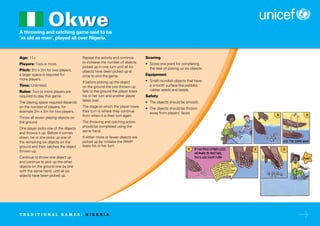
Rules: Two or more players are
required to play this game.
The playing space required depends
on the number of players, for
example 2m x 2m for two players.
Throw all seven playing objects on
the ground.
One player picks one of the objects
and throws it up. Before it comes
down, he or she picks up one of
the remaining six objects on the
ground and then catches the object
thrown up.
Continue to throw one object up
and continue to pick up the other
objects on the ground one by one
with the same hand, until all six
objects have been picked up.
Repeat the activity and continue
to increase the number of objects
picked up in one turn until all six
objects have been picked up at
once to end the game.
If before picking up the object
on the ground the one thrown up
falls to the ground the player loses
his or her turn and another player
takes over.
The stage at which the player loses
their turn is where they continue
from when it is their turn again.
The throwing and catching action
should be completed using the
same hand.
If either more or fewer objects are
picked up by mistake the player
loses his or her turn.
Scoring
• Score one point for completing
the task of picking up six objects.
Equipment
• Small roundish objects that have
a smooth surface like pebbles,
rubber seeds and beads.
Safety
• The objects should be smooth.
• The objects should be thrown
away from players’ faces.
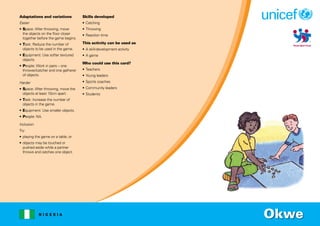
Okwe
T R A D I T I O N A L G A M E S : N I G E R I A
N I G E R I A
Adaptations and variations
Easier
• Space: After throwing, move
the objects on the floor closer
together before the game begins.
• Task: Reduce the number of
objects to be used in the game.
• Equipment: Use softer textured
objects.
• People: Work in pairs – one
thrower/catcher and one gatherer
of objects.
Harder
• Space: After throwing, move the
objects at least 10cm apart.
• Task: Increase the number of
objects in the game.
• Equipment: Use smaller objects.
• People: NA.
Inclusion
Try:
• playing the game on a table; or
• objects may be touched or
pushed aside while a partner
throws and catches one object.
Skills developed
• Catching
• Throwing
• Reaction time
This activity can be used as
• A skill-development activity
• A game
Who could use this card?
• Teachers
• Young leaders
• Sports coaches
• Community leaders
• Students
Okwe
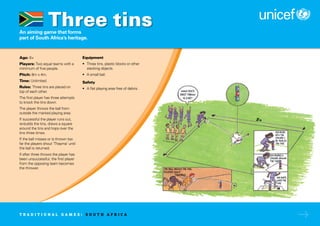
An aiming game that forms
part of South Africa’s heritage.
Age: 6+
Players: Two equal teams with a
minimum of five people.
Pitch: 8m x 4m.
Time: Unlimited.
Rules: Three tins are placed on
top of each other.
The first player has three attempts
to knock the tins down.
The player throws the ball from
outside the marked playing area.
If successful the player runs out,
re-builds the tins, draws a square
around the tins and hops over the
tins three times.
If the ball misses or is thrown too
far the players shout ‘Thayma’ until
the ball is returned.
If after three throws the player has
been unsuccessful, the first player
from the opposing team becomes
the thrower.
Equipment
• Three tins, plastic blocks or other
stacking objects.
• A small ball.
Safety
• A flat playing area free of debris.
Three tins
T R A D I T I O N A L G A M E S : S O U T H A F R I C A
S O U T H A F R I C A
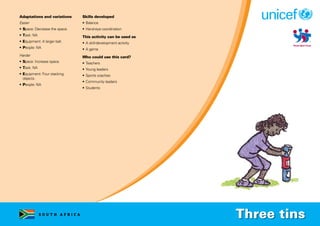
Adaptations and variations
Easier
• Space: Decrease the space.
• Task: NA
• Equipment: A larger ball.
• People: NA
Harder
• Space: Increase space.
• Task: NA
• Equipment: Four stacking
objects.
• People: NA
Skills developed
• Balance
• Hand-eye coordination
This activity can be used as
• A skill-development activity
• A game
Who could use this card?
• Teachers
• Young leaders
• Sports coaches
• Community leaders
• Students
Three tins
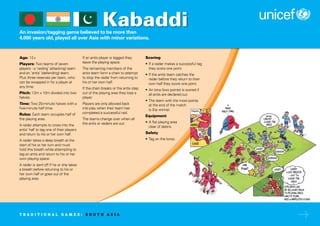
An invasion/tagging game believed to be more than
4,000 years old, played all over Asia with minor variations.
Age: 12+
Players: Two teams of seven
players - a ‘raiding’ (attacking) team
and an ‘antis’ (defending) team.
Plus three reserves per team, who
can be swapped in for a player at
any time.
Pitch: 13m x 10m divided into two
halves.
Time: Two 20-minute halves with a
five-minute half time.
Rules: Each team occupies half of
the playing area.
A raider attempts to cross into the
antis’ half to tag one of their players
and return to his or her own half.
A raider takes a deep breath at the
start of his or her turn and must
hold this breath while attempting to
tag an antis and return to his or her
own playing space.
A raider is sent off if he or she takes
a breath before returning to his or
her own half or goes out of the
playing area.
If an antis player is tagged they
leave the playing space.
The remaining members of the
antis team form a chain to attempt
to stop the raider from returning to
his or her own half.
If the chain breaks or the antis step
out of the playing area they lose a
player.
Players are only allowed back
into play when their team has
completed a successful raid.
The teams change over when all
the antis or raiders are out.
Scoring
• If a raider makes a successful tag
they score one point.
• If the antis team catches the
raider before they return to their
own half they score one point.
• An Iona (two points) is scored if
all antis are declared out.
• The team with the most points
at the end of the match
is the winner.
Equipment
• A flat playing area
clear of debris.
Safety
• Tag on the torso.
Kabaddi
T R A D I T I O N A L G A M E S : S O U T H A S I A
S O U T H A S I A
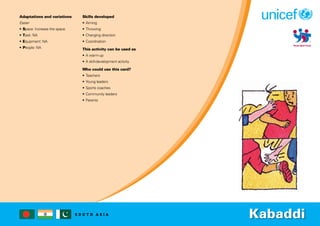
Adaptations and variations
Easier
• Space: Increase the space.
• Task: NA
• Equipment: NA
• People: NA
Skills developed
• Aiming
• Throwing
• Changing direction
• Coordination
This activity can be used as
• A warm-up
• A skill-development activity
Who could use this card?
• Teachers
• Young leaders
• Sports coaches
• Community leaders
• Parents
Kabaddi
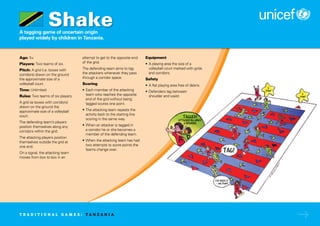
A tagging game of uncertain origin
played widely by children in Tanzania.
Age: 5+
Players: Two teams of six.
Pitch: A grid (i.e. boxes with
corridors) drawn on the ground
the approximate size of a
volleyball court.
Time: Unlimited.
Rules: Two teams of six players.
A grid (ie boxes with corridors)
drawn on the ground the
approximate size of a volleyball
court.
The defending team’s players
position themselves along any
corridors within the grid.
The attacking players position
themselves outside the grid at
one end.
On a signal, the attacking team
moves from box to box in an
attempt to get to the opposite end
of the grid.
The defending team aims to tag
the attackers whenever they pass
through a corridor space.
Scoring
• Each member of the attacking
team who reaches the opposite
end of the grid without being
tagged scores one point.
• The attacking team repeats the
activity back to the starting line
scoring in the same way.
• When an attacker is tagged in
a corridor he or she becomes a
member of the defending team.
• When the attacking team has had
two attempts to score points the
teams change over.
Equipment
• A playing area the size of a
volleyball court marked with grids
and corridors.
Safety
• A flat playing area free of debris.
• Defenders tag between
shoulder and waist.
Shake
T R A D I T I O N A L G A M E S : T A N Z A N I A
T A N Z A N I A
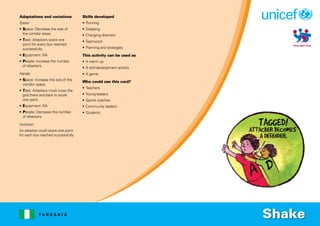
Adaptations and variations
Easier
• Space: Decrease the size of
the corridor areas.
• Task: Attackers score one
point for every box reached
successfully.
• Equipment: NA
• People: Increase the number
of attackers.
Harder
• Space: Increase the size of the
corridor space.
• Task: Attackers must cross the
grid there and back to score
one point.
• Equipment: NA
• People: Decrease the number
of attackers.
Inclusion
An attacker could score one point
for each box reached successfully.
Skills developed
• Running
• Stopping
• Changing direction
• Teamwork
• Planning and strategies
This activity can be used as
• A warm up
• A skill-development activity
• A game
Who could use this card?
• Teachers
• Young leaders
• Sports coaches
• Community leaders
• Students
Shake
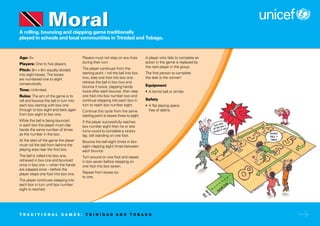
A rolling, bouncing and clapping game traditionally
played in schools and local communities in Trinidad and Tobago.
Age: 6+
Players: One to five players.
Pitch: 8m x 8m equally divided
into eight boxes. The boxes
are numbered one to eight
consecutively.
Time: Unlimited.
Rules: The aim of the game is to
roll and bounce the ball in turn into
each box starting with box one
through to box eight and back again
from box eight to box one.
While the ball is being bounced
in each box the player must clap
hands the same number of times
as the number in the box.
At the start of the game the player
must roll the ball from behind the
playing area near the first box.
The ball is rolled into box one,
retrieved in box one and bounced
once in box one –- when the hands
are clapped once – before the
player steps one foot into box one.
The player continues stepping into
each box in turn until box number
eight is reached.
Players must not step on any lines
during their turn.
The player continues from the
starting point – roll the ball into box
two, step one foot into box one,
retrieve the ball in box two and
bounce it twice, clapping hands
twice after each bounce, then step
one foot into box number two and
continue stepping into each box in
turn to reach box number eight.
Continue this cycle from the same
starting point to boxes three to eight.
If the player successfully reaches
box number eight then he or she
turns round to complete a victory
lap, still standing on one foot.
Bounce the ball eight times in box
eight clapping eight times between
each bounce.
Turn around on one foot and repeat
in box seven before stepping on
one foot into box seven.
Repeat from boxes six
to one.
A player who fails to complete an
action in the game is replaced by
the next player in the group.
The first person to complete
the task is the winner!
Equipment
• A tennis ball or similar.
Safety
• A flat playing space
free of debris.
Moral
T R A D I T I O N A L G A M E S : T R I N I D A D A N D T O B A G O
T R I N I D A D A N D T O B A G O
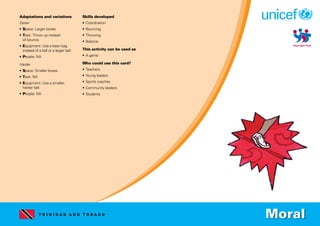
Adaptations and variations
Easier
• Space: Larger boxes.
• Task: Throw up instead
of bounce.
• Equipment: Use a bean bag
instead of a ball or a larger ball.
• People: NA
Harder
• Space: Smaller boxes.
• Task: NA
• Equipment: Use a smaller,
harder ball.
• People: NA
Skills developed
• Coordination
• Bouncing
• Throwing
• Balance
This activity can be used as
• A game
Who could use this card?
• Teachers
• Young leaders
• Sports coaches
• Community leaders
• Students
Moral
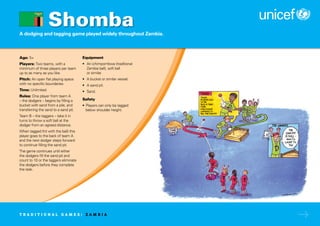
A dodging and tagging game played widely throughout Zambia.
Age: 5+
Players: Two teams, with a
minimum of three players per team
up to as many as you like.
Pitch: An open flat playing space
with no specific boundaries.
Time: Unlimited.
Rules: One player from team A
– the dodgers – begins by filling a
bucket with sand from a pile, and
transferring the sand to a sand pit.
Team B – the taggers – take it in
turns to throw a soft ball at the
dodger from an agreed distance.
When tagged (hit with the ball) this
player goes to the back of team A
and the next dodger steps forward
to continue filling the sand pit.
The game continues until either
the dodgers fill the sand pit and
count to 10 or the taggers eliminate
the dodgers before they complete
the task.
Equipment
• An ichimpombwa (traditional
Zambia ball), soft ball
or similar.
• A bucket or similar vessel.
• A sand pit.
• Sand.
Safety
• Players can only be tagged
below shoulder height.
Shomba
T R A D I T I O N A L G A M E S : Z A M B I A
Z A M B I A
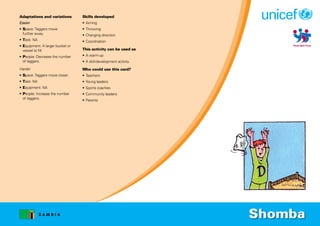
Adaptations and variations
Easier
• Space: Taggers move
further away.
• Task: NA
• Equipment: A larger bucket or
vessel to fill.
• People: Decrease the number
of taggers.
Harder
• Space: Taggers move closer.
• Task: NA
• Equipment: NA
• People: Increase the number
of taggers.
Skills developed
• Aiming
• Throwing
• Changing direction
• Coordination
This activity can be used as
• A warm-up
• A skill-development activity
Who could use this card?
• Teachers
• Young leaders
• Sports coaches
• Community leaders
• Parents
Shomba
traditionalgamesteachingresource (1).pdf

traditionalgamesteachingresource (1).pdf

  • 1.
    Traditional Games A collectionof group games from around the world
  • 2.
    T R AD I T I O N A L G A M E S : W E L C O M E Traditional games All around the world, children love sport. It gives them the chance to have fun and be active. Yet sport is also a way of learning important values and life skills, including self- confidence, team work, communication, inclusion, discipline, respect and fair play. For this reason, sport is an important part of childhood. Although some sports are universal, some are specific to a culture or country. In this pack are some great games that children play around the world. UNICEF UNICEF is the world’s leading organisation for children, working in over 190 countries to help every child realise their full potential. We work with families, local communities, partners and governments to transform the lives of children everywhere. UNICEF provides health care, water, nutrition, education and protection for children. In everything we do, the most vulnerable and disadvantaged children are our priority. As champion of the UN Convention on the Rights of the Child, we work to protect and promote the rights of every child. UNICEF is working in partnership with Glasgow 2014 and the Commonwealth Games Federation to use the power of sport to transform children’s lives in Scotland and throughout the Commonwealth. Youth Sport Trust: Sport Changes Lives Youth Sports Trust is a charity which is passionate about helping all young people to achieve their full potential in life and in sport through the delivery of high quality PE and sport. They work to: • give every child a sporting start in life through high quality PE and sport in primary schools. • ensure all young people have a sporting chance by developing opportunities for those with special educational needs and disabilities. • support all young people to achieve their sporting best in school and their personal best in life. • Find out more by visiting www.youthsporttrust.org International Inspiration The charity International Inspiration (IN) uses the power of sport to involve, inspire and positively impact upon the lives of children, young people and marginalised groups around the world – providing them with rights and opportunities that they may otherwise not have had. Find out more by visiting www.internationalinspiration.org Welcome
  • 3.
    The STEP framework TheSTEP framework offers guidance on how to modify games to ensure people with a wide range of abilities can have fun taking part and progress their learning. Think about: Space Where? Task What? Equipment With what? People With whom? Variations of the games based on this framework are given on the back of each card. The Inclusion Spectrum When playing these games, it is important that everyone can take part. The Inclusion Spectrum is a useful model for ensuring this. It works on the principle that everyone can take part in activities at their own level of ability and be challenged in an appropriate way to improve. It gives five ways to enable maximum participation: • Open activities are set up in such a way that everyone can take part at their own level without modification • Modified activities are variations or adaptations based on the STEP framework to ensure everyone is included • Parallel groups or team based on ability • Separate practice for individuals or groups enabling successful integration • Disability sport activities for non-disabled and disabled young people (reverse integration) Always consult the participants about their needs and how to adapt the activity to enable maximum participation and enjoyment. T R A D I T I O N A L G A M E S : W E L C O M E
  • 4.
    An extremely popular,cheap and accessible variation of lawn tennis and table tennis which emerged in the 1930s, mainly played in urban areas. Age: 11+ Players: Two (for “singles”) or four (for “doubles”), plus someone to keep score. Pitch: A 21x10 foot rectangle on a hard, smooth and level surface – ideally asphalt, concrete or an indoor wooden surface - split into two equal halves widthways. The court should be marked out in white lines. The long sides of the court are extended six feet at each end – these are called the “governor lines.” Time: Typically, a game lasts for 15 to 20 minutes and a set up to 45 minutes to 1 hour. Rules: The game starts with a coin toss between the two players/teams. The scorer should do the coin toss. The winner of the toss has the choice of taking the first serve or choosing which side of the court to play on first. The serve alternates between the two players/teams every five points. If playing doubles, the serve alternates between each player on the team between each point. The two players/teams must hit the ball between each other. The ball can bounce once before being hit back. The first player/team to reach 21 points is declared the winner of the game, unless the players/teams have been tied at 20 points. If this is the case, the game is declared a “deuced game” and is won by the first player/team to lead by two points. During a deuced game, the serve alternates after each point. When a game is won, the players/teams change their playing ends. Scoring • If a player hits the ball and it lands outside of the lines, or doesn’t reach the other side of the court, the other player/team gets a point. • A set is the best of three games (the player/team who wins two out of the three games is the overall winner), or the best of five games, (the player/teams who wins three out of the five games is the overall winner). • If a set reaches the third/fifth game, the players/teams change ends after 10 points. Road Tennis T R A D I T I O N A L G A M E S : B A R B A D O S
  • 5.
    B A RB A D O S Equipment • A, typically wooden, net, eight inches in height, placed over the centre line. This should extend beyond the width of the court by six inches on either side, and be painted white. • A standard lawn tennis ball with the fur removed. • Each player needs a racquet, which should be made of wood. The racquet should be no more than 11 inches in diameter at its widest point. Safety • Players should warm up before the game starts. • The playing area must be clear of any obstructions, including at least 10ft around the court. Adaptations and variations Easier • Space: Broaden the court. • Task: NA • Equipment: Use bigger racquets and a slower ball. Lower the net. • People: NA Harder • Space: Make the court smaller. • Task: NA • Equipment: Use smaller racquets and a faster ball. Raise the net. • People: NA Inclusion Try: • Using different types of balls and racquets. • Increasing the size of the court to facilitate wheelchairs. Skills developed • Endurance • Teamwork • Agility • Speed • Fitness This activity can be used as • A warm-up • A skill development activity • A game Who could use this card? • Community leaders • Teachers • Sports coaches • Physical education teachers • Parents • Rehabilitation specialists • Fitness enthusiasts • Health professionals Road tennis
  • 6.
    For generations, thisgame has been enjoyed by children in Guyana, from the remotest regions to busy urban areas. Age: 6+ Players: Two equal teams of at least four players. Pitch: The pitch is drawn using chalk or a stone (if playing on earth). It consists of a vertical bar, crossed by three long, horizontal bars at the top, middle and bottom. At one end of the vertical bar is a circle. Time: Unlimited. Rules: There is an attacking team and a defending team. At least one player from the defending team stands in each of the bars. The attacking team assembles in the circle. The game begins when one of the defenders tags one of the attackers in the circle. The attacker then become ‘salman’, and has to run to the end bar and back without being tagged by a defender. If salman is tagged, they are out. Once salman passes the end bar and is on their way back, another attacking player becomes salman too, and begins their run of the length of the pitch. If the new salman is caught, they are out. Each attacking player takes a turn at being salman. The teams swap over once every attacking player has been salman. Scoring • The defending team scores one point for each salman they tag. • The attacking team scores one point for each clear run a salman makes. Safety • Players should warm up before the game starts. • The playing area must be clear of any obstructions. Sal out T R A D I T I O N A L G A M E S : G U Y A N A
  • 7.
    G U YA N A Adaptations and variations Easier • Space: Increase the playing area. • Task: Create a ‘safe zone’ at the top of the pitch where salman can pause before running back to the circle. • Equipment: NA • People: Reduce the number of players on each team to three. Harder • Space: Decrease the size of the bars. • Task: Every salman must make a clear run for the attacking team to win. • Equipment: NA • People: Increase the number of players on each team. Skills developed • Teamwork • Agility • Speed This activity can be used as • A skill development activity • A game Who could use this card? • Young leaders Sal out
  • 8.
    For hundreds ofyears this game, also called ‘Tapping the ball’, has been played in the remotest islands of Kiribati. Age: 15+ Players: As many as you like – enough to form a circle. Pitch: A clear space – this doesn’t have to be particularly large, the game is often played in backyards and most of Kiribati’s islands are very narrow. Time: Unlimited. Rules: The players form a circle. One player stands in the middle of the circle. They kick a ball a short distance into the air. The person nearest then takes over and kicks the ball on – never allowing it to drop on the ground. One after another, the players kick the ball to each other. The ball can be passed back to the player in the middle as well. The ball should not be allowed to fall to the ground. Everyone should get a chance to participate. If any player drops the ball, they are out and have to leave the circle until a fresh round starts once every player has had a chance to kick the ball. Equipment • A ball. This is usually made from local materials – such as knotting dry leaves from a Panadanas tree. Safety • Ensure players are warmed up. • Ensure the playing area is clear from objects that could hurt the players while running around – such as, in Kiribati, shells, coral and rocks that are embedded in the sand. In Kiribati players usually go barefoot. Te Boiri T R A D I T I O N A L G A M E S : K I R I B A T I
  • 9.
    K I RI B A T I Adaptations and variations Easier • Space: NA • Task: Ball can bounce once between passes. • Equipment: Use a larger ball. • People: Only five people per game. Harder • Space: Increase the size of the playing area. • Task: Ball cannot be passed to a player immediately next to you. • Equipment: NA • People: NA Skills developed • Teamwork • Practice • Speed This activity can be used as • A skill development activity • A game Who could use this card? • Teachers • Youth leaders • Sports coaches • Community leaders • Parents Te boiri
  • 10.
    A kicking gamefrom the 15th century played throughout South East Asia. Age: 5+ Players: Teams of six. Pitch: A 1m radius circle on any flat playing space bounded by a 4m radius circle. Time: Unlimited. Rules: The playing team stands anywhere in the 4m circle but not in the 1m circle. A player starts in the centre of the 1m circle and tosses the ball to any one of their team members and then rejoins their team. The first touch by this player must be a kick-volley. All kicks or passes between players should cross the 1m circle and aim to be above head height. Players should use a variety of skills such as kicking, heading, shouldering, kneeing and tipping with a toe. All parts of the body can be used except the hands and arms. Each team has three tosses to keep the ball in play. After the three tosses are completed, change the playing team. The ball may not be passed to a team member immediately on the left or right. A player may only touch the ball a maximum of three times before passing. A player may not step outside the 4m circle or into the 1m circle. Circle sepak takraw T R A D I T I O N A L G A M E S : M A L A Y S I A Scoring • Kick-volley, head pass = one point. • Shoulder, knee, toe or other body pass = two points. • Team total is the number of points gained from the three tosses. Equipment • A rattan ball or a ball of similar size, with a circumference of around 40/45cm. Safety • Ankles protected by socks or stockings and sports shoes.
  • 11.
    M A LA Y S I A Adaptations and variations Easier • Space: Use the whole playing area (both circles). • Task: No limit to the number of touches before passing. • Equipment: Use a softer ball. • People: NA. Harder • Space: Make the playing space larger. • Task: Each player can touch the ball a maximum of two times before passing. • Equipment: Use a smaller ball. • People: Reduce the number of players in a team. Inclusion An adaptation for this game could be to use hands and arms. Skills developed • Kick-volley • Heading • Coordination This activity can be used as • A skill-development activity • A game Who could use this card? • Teachers • Young leaders • Sports coaches • Community leaders • Students Circle sepak takraw
  • 12.
    This Maori gameis also called ‘The Game of Stars’ or ‘The Games of Peace’. It evolved out of multiple archaic games based on the story of legendary figure Rahi. Age: 5+ Players: Two teams of seven players, though this can be adjusted depending on the size of the playing area. One team is the Kioma and the other team is the Taniwha – this switches every quarter. Pitch: The playing field consists of three concentric circles – the playing zones – intersected by a pathway, the Te Ara. At the end of the Te Ara, on the outside of the largest circle, is a small circle with a radius of 1m, called the Te Marama. The inner circle, or Pawero, has a radius of 4m – with a target, the tupu, placed at the exact centre. The middle circle, or Te Roto, has a radius of 11m, and the outer circle, or Te Ao, has a radius of 21m. These distances can be modified to fit smaller spaces. Seven posts, or pou, are evenly spaced around the Te Ao area. The pitch can be marked on a playing field or gymnasium. Small cones can be used to mark the boundaries. Time: Four 10 minute quarters. Rules: The Kioma team play in the Pawero and Te Ao. Three Kioma guard the tupu in the Pawero, and the other four players are in the Te Ao. Kiomo can swap between the Pawero and Te Ao by running through the Te Ara. The Kioma have to stop the Taniwha team from hitting the tupu with the ball, or ki. The players in the Pawero can use any part of their bodies to block the ball from hitting the target. They can also catch or intercept the ki and throw it out to their own players in the Te Ao. They must pass the ball out of the Pawero within five seconds. The Kioma are also trying to tag the pou in the Te Ao with the ki. Once they have tagged one or more pou, they must run with the ki through the Te Roto to the Pawero and touch the ki down, without a Taniwha tagging them with both hands on the hips or tackling them. If they are tagged or tackled, they have three seconds to pass the ball to a teammate or it goes to the Taniwha. Kioma without the ball cannot stop or interfere with a Taniwha player who is tagging the Kioma with the ki. A Kioma in the Te Marama kicks off to the Kioma in the Pawero; they then try to pass it out to their teammates in the Te Ao. (continued on page 2) Ki-o-Rahi T R A D I T I O N A L G A M E S : N E W Z E A L A N D
  • 13.
    N E WZ E A L A N D Rules ctd. The Taniwha score points by throwing the ki at the tupu from the Te Roto: if they enter the Pawero, the hit does not count. They can only have the ki in the Te Roto for ten seconds before trying to hit the tupu or passing it out. If the ki goes loose, any team can pick it up and play with it. Teams can mutually decide to vary the rules before playing the game – a traditional process called Tatu. Scoring • The Taniwha team scores one point for hitting the tupu. • The Kioma team scores one point for each pou tagged in the Te Ao, but only if the move is finished by touching the ki down in the Pawero. So, tag one post and touchdown equals one point, tag two posts and touchdown equals two points. There are seven posts, so it is possible to score seven points. Touching the ball down is known as a try, or Tupu Manawa. Equipment • A tupu – usually a large drum. • Small cones for boundary markers. • Seven large cones or poles for pou. • A ball. Safety • Make sure the ball is not too hard, a tennis ball or a softball- sized soft rubber ball is suitable. The game could also be played with a volleyball. • Replace all tackling with a two- handed tag touch to the hips, or use ripper rugby tags if available. Adaptations and variations Easier • Space: Make the pitch smaller. • Task: Remove the touchdown component so the Kioma only have tag the pou the target. • Equipment: A larger ball. A larger target. • People: Fewer Kioma allowed in the Pawero to guard the tupu. Harder • Space: A larger pitch. • Task: Allow full contact tackling (be mindful of the playing surface.) • Equipment: Use a smaller ball. Reduce the size of the target. • People: Allow more Kioma in the Pawero to guard the tupu. Inclusion Try: • Using a large, soft ball that can be thrown with two hands. • Increasing the size of the pitch to facilitate wheelchairs. Skills developed • Quick hand passing • Team strategies • Ball handling • Throwing • Running • Tackling This activity can be used as • A skill-development activity • A game Who could use this card? • Teachers • Young leaders • Sports coaches • Community leaders • Parents Ki-o-Rahi
  • 14.
    A throwing andcatching game said to be ‘as old as man’, played all over Nigeria. Age: 11+ Players: Two or more. Pitch: 2m x 2m for two players, a larger space is required for more players. Time: Unlimited. Rules: Two or more players are required to play this game. The playing space required depends on the number of players, for example 2m x 2m for two players. Throw all seven playing objects on the ground. One player picks one of the objects and throws it up. Before it comes down, he or she picks up one of the remaining six objects on the ground and then catches the object thrown up. Continue to throw one object up and continue to pick up the other objects on the ground one by one with the same hand, until all six objects have been picked up. Repeat the activity and continue to increase the number of objects picked up in one turn until all six objects have been picked up at once to end the game. If before picking up the object on the ground the one thrown up falls to the ground the player loses his or her turn and another player takes over. The stage at which the player loses their turn is where they continue from when it is their turn again. The throwing and catching action should be completed using the same hand. If either more or fewer objects are picked up by mistake the player loses his or her turn. Scoring • Score one point for completing the task of picking up six objects. Equipment • Small roundish objects that have a smooth surface like pebbles, rubber seeds and beads. Safety • The objects should be smooth. • The objects should be thrown away from players’ faces. Okwe T R A D I T I O N A L G A M E S : N I G E R I A
  • 15.
    N I GE R I A Adaptations and variations Easier • Space: After throwing, move the objects on the floor closer together before the game begins. • Task: Reduce the number of objects to be used in the game. • Equipment: Use softer textured objects. • People: Work in pairs – one thrower/catcher and one gatherer of objects. Harder • Space: After throwing, move the objects at least 10cm apart. • Task: Increase the number of objects in the game. • Equipment: Use smaller objects. • People: NA. Inclusion Try: • playing the game on a table; or • objects may be touched or pushed aside while a partner throws and catches one object. Skills developed • Catching • Throwing • Reaction time This activity can be used as • A skill-development activity • A game Who could use this card? • Teachers • Young leaders • Sports coaches • Community leaders • Students Okwe
  • 16.
    An aiming gamethat forms part of South Africa’s heritage. Age: 6+ Players: Two equal teams with a minimum of five people. Pitch: 8m x 4m. Time: Unlimited. Rules: Three tins are placed on top of each other. The first player has three attempts to knock the tins down. The player throws the ball from outside the marked playing area. If successful the player runs out, re-builds the tins, draws a square around the tins and hops over the tins three times. If the ball misses or is thrown too far the players shout ‘Thayma’ until the ball is returned. If after three throws the player has been unsuccessful, the first player from the opposing team becomes the thrower. Equipment • Three tins, plastic blocks or other stacking objects. • A small ball. Safety • A flat playing area free of debris. Three tins T R A D I T I O N A L G A M E S : S O U T H A F R I C A
  • 17.
    S O UT H A F R I C A Adaptations and variations Easier • Space: Decrease the space. • Task: NA • Equipment: A larger ball. • People: NA Harder • Space: Increase space. • Task: NA • Equipment: Four stacking objects. • People: NA Skills developed • Balance • Hand-eye coordination This activity can be used as • A skill-development activity • A game Who could use this card? • Teachers • Young leaders • Sports coaches • Community leaders • Students Three tins
  • 18.
    An invasion/tagging gamebelieved to be more than 4,000 years old, played all over Asia with minor variations. Age: 12+ Players: Two teams of seven players - a ‘raiding’ (attacking) team and an ‘antis’ (defending) team. Plus three reserves per team, who can be swapped in for a player at any time. Pitch: 13m x 10m divided into two halves. Time: Two 20-minute halves with a five-minute half time. Rules: Each team occupies half of the playing area. A raider attempts to cross into the antis’ half to tag one of their players and return to his or her own half. A raider takes a deep breath at the start of his or her turn and must hold this breath while attempting to tag an antis and return to his or her own playing space. A raider is sent off if he or she takes a breath before returning to his or her own half or goes out of the playing area. If an antis player is tagged they leave the playing space. The remaining members of the antis team form a chain to attempt to stop the raider from returning to his or her own half. If the chain breaks or the antis step out of the playing area they lose a player. Players are only allowed back into play when their team has completed a successful raid. The teams change over when all the antis or raiders are out. Scoring • If a raider makes a successful tag they score one point. • If the antis team catches the raider before they return to their own half they score one point. • An Iona (two points) is scored if all antis are declared out. • The team with the most points at the end of the match is the winner. Equipment • A flat playing area clear of debris. Safety • Tag on the torso. Kabaddi T R A D I T I O N A L G A M E S : S O U T H A S I A
  • 19.
    S O UT H A S I A Adaptations and variations Easier • Space: Increase the space. • Task: NA • Equipment: NA • People: NA Skills developed • Aiming • Throwing • Changing direction • Coordination This activity can be used as • A warm-up • A skill-development activity Who could use this card? • Teachers • Young leaders • Sports coaches • Community leaders • Parents Kabaddi
  • 20.
    A tagging gameof uncertain origin played widely by children in Tanzania. Age: 5+ Players: Two teams of six. Pitch: A grid (i.e. boxes with corridors) drawn on the ground the approximate size of a volleyball court. Time: Unlimited. Rules: Two teams of six players. A grid (ie boxes with corridors) drawn on the ground the approximate size of a volleyball court. The defending team’s players position themselves along any corridors within the grid. The attacking players position themselves outside the grid at one end. On a signal, the attacking team moves from box to box in an attempt to get to the opposite end of the grid. The defending team aims to tag the attackers whenever they pass through a corridor space. Scoring • Each member of the attacking team who reaches the opposite end of the grid without being tagged scores one point. • The attacking team repeats the activity back to the starting line scoring in the same way. • When an attacker is tagged in a corridor he or she becomes a member of the defending team. • When the attacking team has had two attempts to score points the teams change over. Equipment • A playing area the size of a volleyball court marked with grids and corridors. Safety • A flat playing area free of debris. • Defenders tag between shoulder and waist. Shake T R A D I T I O N A L G A M E S : T A N Z A N I A
  • 21.
    T A NZ A N I A Adaptations and variations Easier • Space: Decrease the size of the corridor areas. • Task: Attackers score one point for every box reached successfully. • Equipment: NA • People: Increase the number of attackers. Harder • Space: Increase the size of the corridor space. • Task: Attackers must cross the grid there and back to score one point. • Equipment: NA • People: Decrease the number of attackers. Inclusion An attacker could score one point for each box reached successfully. Skills developed • Running • Stopping • Changing direction • Teamwork • Planning and strategies This activity can be used as • A warm up • A skill-development activity • A game Who could use this card? • Teachers • Young leaders • Sports coaches • Community leaders • Students Shake
  • 22.
    A rolling, bouncingand clapping game traditionally played in schools and local communities in Trinidad and Tobago. Age: 6+ Players: One to five players. Pitch: 8m x 8m equally divided into eight boxes. The boxes are numbered one to eight consecutively. Time: Unlimited. Rules: The aim of the game is to roll and bounce the ball in turn into each box starting with box one through to box eight and back again from box eight to box one. While the ball is being bounced in each box the player must clap hands the same number of times as the number in the box. At the start of the game the player must roll the ball from behind the playing area near the first box. The ball is rolled into box one, retrieved in box one and bounced once in box one –- when the hands are clapped once – before the player steps one foot into box one. The player continues stepping into each box in turn until box number eight is reached. Players must not step on any lines during their turn. The player continues from the starting point – roll the ball into box two, step one foot into box one, retrieve the ball in box two and bounce it twice, clapping hands twice after each bounce, then step one foot into box number two and continue stepping into each box in turn to reach box number eight. Continue this cycle from the same starting point to boxes three to eight. If the player successfully reaches box number eight then he or she turns round to complete a victory lap, still standing on one foot. Bounce the ball eight times in box eight clapping eight times between each bounce. Turn around on one foot and repeat in box seven before stepping on one foot into box seven. Repeat from boxes six to one. A player who fails to complete an action in the game is replaced by the next player in the group. The first person to complete the task is the winner! Equipment • A tennis ball or similar. Safety • A flat playing space free of debris. Moral T R A D I T I O N A L G A M E S : T R I N I D A D A N D T O B A G O
  • 23.
    T R IN I D A D A N D T O B A G O Adaptations and variations Easier • Space: Larger boxes. • Task: Throw up instead of bounce. • Equipment: Use a bean bag instead of a ball or a larger ball. • People: NA Harder • Space: Smaller boxes. • Task: NA • Equipment: Use a smaller, harder ball. • People: NA Skills developed • Coordination • Bouncing • Throwing • Balance This activity can be used as • A game Who could use this card? • Teachers • Young leaders • Sports coaches • Community leaders • Students Moral
  • 24.
    A dodging andtagging game played widely throughout Zambia. Age: 5+ Players: Two teams, with a minimum of three players per team up to as many as you like. Pitch: An open flat playing space with no specific boundaries. Time: Unlimited. Rules: One player from team A – the dodgers – begins by filling a bucket with sand from a pile, and transferring the sand to a sand pit. Team B – the taggers – take it in turns to throw a soft ball at the dodger from an agreed distance. When tagged (hit with the ball) this player goes to the back of team A and the next dodger steps forward to continue filling the sand pit. The game continues until either the dodgers fill the sand pit and count to 10 or the taggers eliminate the dodgers before they complete the task. Equipment • An ichimpombwa (traditional Zambia ball), soft ball or similar. • A bucket or similar vessel. • A sand pit. • Sand. Safety • Players can only be tagged below shoulder height. Shomba T R A D I T I O N A L G A M E S : Z A M B I A
  • 25.
    Z A MB I A Adaptations and variations Easier • Space: Taggers move further away. • Task: NA • Equipment: A larger bucket or vessel to fill. • People: Decrease the number of taggers. Harder • Space: Taggers move closer. • Task: NA • Equipment: NA • People: Increase the number of taggers. Skills developed • Aiming • Throwing • Changing direction • Coordination This activity can be used as • A warm-up • A skill-development activity Who could use this card? • Teachers • Young leaders • Sports coaches • Community leaders • Parents Shomba