OUTCOME MEASURES
used at the Bobath Centre
Virginia Knox MSc PGCE MCSP
Consultant Physiotherapist and Bobath tutor
April 2013
Outcome measures at the Bobath Centre
 Outcome measures are used at the Bobath
Centre
 This presentation explains what outcome
measures are, which ones we use and how
we use them
Outcomes
 ‘Hard’ outcomes typically refer to data that can be quantified (i.e.
put into numbers)
 e.g. a child shows improved motor function on an outcome
measure; quality of life of child and/or family improved as
demonstrated by improved scores on a standardised CP quality
of life measure
 ‘Soft’ outcomes often intangible and hard to measure directly like
improved self esteem or confidence or belief you could do
something better, or may represent intermediary stages on the way
to achieving ‘hard’ outcomes,
 e.g. a family wrote saying that the visit meant a lot to them and
was very supportive, and they understood their child’s difficulties
better
 At the Bobath Centre, we focus on ‘hard’ outcomes to show
quantifiable change, but also record ‘soft’ outcomes as these can
give helpful feedback from families and children on our services
Outcome measures - definitions
 ‘a measure of change, the difference from one point in time
usually before an intervention, to another point in time usually
following an intervention’
Kendall, 1997
 ‘a test or scale administered and interpreted by therapists that
has been shown to measure accurately a particular attribute of
interest to patients and therapists and is expected to be
influenced by intervention’
Mayo
et al, 1994
How do we use Outcome measures at the Bobath
Centre?
 ‘Occasional’ children attending for 2 weeks of therapy
 If it is possible to find a relevant outcome measure which will be sensitive
enough to show change in a short period, we administer a test or one
part of a test, at the beginning and end of the 2 weeks
 If this is not possible, we use Goal attainment scaling to set GAS goals
 Children attending on a more regular basis, e.g. once a
week over several months
 Administer an outcome measure once a year or at the beginning
and end of their block of therapy
 Outcome measures may be used more frequently if we want to
record progress before and after other interventions such as
surgery or Botulinum toxin injections
Clinical Audit of Outcome Measures
 Each year we record how many outcome measures were
used and how many children showed improved scores
 This information is compared against pre-set targets to
ensure we are continuing to use measures frequently, and
to see if we are increasing the frequency of use
 Therapists receive specific training on an annual basis to
help them further develop their skills in using outcome
measures, and the clinical audit can help us determine
where training is particularly needed
Examples of outcome measures
used at the Bobath Centre
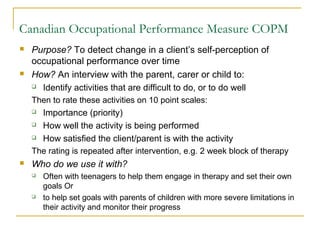
Canadian Occupational Performance Measure COPM
 Purpose? To detect change in a client’s self-perception of
occupational performance over time
 How? An interview with the parent, carer or child to:
 Identify activities that are difficult to do, or to do well
Then to rate these activities on 10 point scales:
 Importance (priority)
 How well the activity is being performed
 How satisfied the client/parent is with the activity
The rating is repeated after intervention, e.g. 2 week block of therapy
 Who do we use it with?
 Often with teenagers to help them engage in therapy and set their own
goals Or
 to help set goals with parents of children with more severe limitations in
their activity and monitor their progress
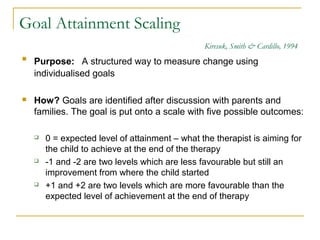
Goal Attainment Scaling
Kiresuk, Smith & Cardillo, 1994

Purpose: A structured way to measure change using
individualised goals
 How? Goals are identified after discussion with parents and
families. The goal is put onto a scale with five possible outcomes:
 0 = expected level of attainment – what the therapist is aiming for
the child to achieve at the end of the therapy
 -1 and -2 are two levels which are less favourable but still an
improvement from where the child started
 +1 and +2 are two levels which are more favourable than the
expected level of achievement at the end of therapy
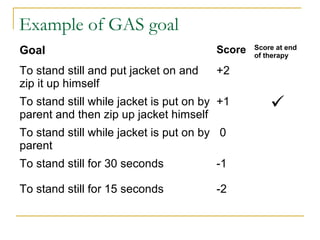
Example of GAS goal
Goal Score Score at end
of therapy
To stand still and put jacket on and
zip it up himself
+2
To stand still while jacket is put on by
parent and then zip up jacket himself
+1 
To stand still while jacket is put on by
parent
0
To stand still for 30 seconds -1
To stand still for 15 seconds -2
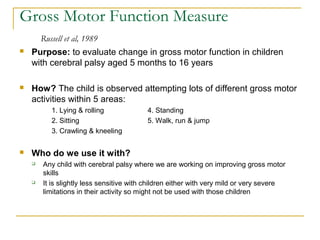
Gross Motor Function Measure
Russell et al, 1989
 Purpose: to evaluate change in gross motor function in children
with cerebral palsy aged 5 months to 16 years
 How? The child is observed attempting lots of different gross motor
activities within 5 areas:
1. Lying & rolling 4. Standing
2. Sitting 5. Walk, run & jump
3. Crawling & kneeling
 Who do we use it with?
 Any child with cerebral palsy where we are working on improving gross motor
skills
 It is slightly less sensitive with children either with very mild or very severe
limitations in their activity so might not be used with those children
Assisting Hand Assessment AHA
 Purpose: This measures how effective a child makes use of the
assisting hand during two-handed activities. It is used with
children with hemiplegia (cerebral palsy affecting one side of the
body), aged 18m to 12 years.
 How?
 A video is taken of a play session using specific toys which would
typically require the use of two hands
 The child is not instructed to use their affected hand – the test looks
at their spontaneous typical use of that hand
 Who do we use it with? Any child with hemiplegia where
therapy is aiming to improve hand function
Melbourne Assessment
 Purpose: To measure quality of upper limb function in one arm, in
children with cerebral palsy aged 2-15 years
 How?
 A video is taken of the child performing different tasks, such as
reaching and pointing, grasping different objects, manipulating
objects and a variety of functional tasks, like taking a biscuit to
their mouth.
 This is then scored for different aspects like range of movement,
accuracy, smoothness of the movement and speed
 Who do we use it with? Children where therapy is aimed at
improving hand and arm function or sometimes to see if wearing a
splint or lycra garment changes the level of hand function
Spinal Alignment & Range of Motion Measure
SAROMM
 Purpose: to give an overall score of spinal posture (alignment) and
range of movement in upper and lower limbs

How?
 Spinal alignment (posture) is observed and compared to photographs
and rated on a 4 point scale
 Range of motion (ROM) for lower limb joints and upper limbs are
measured with a goniometer according to specific instructions and the
ranges recorded on a 4 point scale
 Total spinal & ROM scores and an overall total score are calculated
 Who do we use it with? Children and teenagers where improving
mobility is a focus of therapy, e.g. an adolescent child who has recently
been getting significantly stiffer
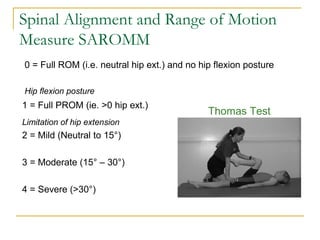
Spinal Alignment and Range of Motion
Measure SAROMM
0 = Full ROM (i.e. neutral hip ext.) and no hip flexion posture
Hip flexion posture
1 = Full PROM (ie. >0 hip ext.)
Limitation of hip extension
2 = Mild (Neutral to 15°)
3 = Moderate (15° – 30°)
4 = Severe (>30°)
Thomas Test
SAROMM
0 = No alignment
limitations
2 = Mild
1 = Scoliosis and/or rib
hump observed but
can be corrected
passively
Non reducible scoliosis & rib hump
3 = Moderate 4 = Severe
Chailey levels of Ability
 Purpose: assesses level of postural ability in children with cerebral palsy for
lying, sitting and standing. They can also be used to determine which type of
equipment, e.g. seating, helps the child achieve the highest level of posture,
e.g.
 Can the child only be placed in sitting, or can they get in and out of sitting
for themselves; can the child lie on their back and use their hands for
play
 How? The child is observed in different postures, looking at the posture
they adopt, how they move, which parts of the body are taking weight, etc.
 Who do we use it with? Children with more severe limitations to their
posture to monitor progress in their postural ability, and sometimes to
determine if different equipment or a lycra garment influence their postural
ability
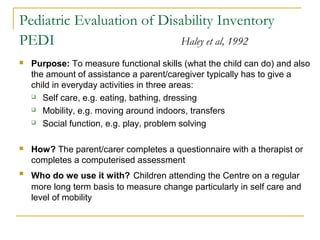
Pediatric Evaluation of Disability Inventory
PEDI Haley et al, 1992
 Purpose: To measure functional skills (what the child can do) and also
the amount of assistance a parent/caregiver typically has to give a
child in everyday activities in three areas:
 Self care, e.g. eating, bathing, dressing
 Mobility, e.g. moving around indoors, transfers
 Social function, e.g. play, problem solving
 How? The parent/carer completes a questionnaire with a therapist or
completes a computerised assessment

Who do we use it with? Children attending the Centre on a regular
more long term basis to measure change particularly in self care and
level of mobility
Caregiver Priorities and Child Health Index of Life with Disabilities
CPCHILD Narayanan et al, 2006
 Purpose? To measure health related quality of life
including the child’s health and how functional activities
are affected like personal care, positioning, transferring,
mobility, communication and comfort, and how much the
caregiver has to help the child with these activities
 How? A questionnaire for the caregivers of children, at
the beginning of a block of therapy and then repeated a
few weeks after returning home.
 Who do we use it with? Children with more severe
limitations in their activity (GMFCS IV & V)
Care & Comfort Hypertonicity Questionnaire CCHQ
Nemer McCoy et al, 2006
 Purpose? To assess the degree of difficulty in carrying out specific
personal care activities and whether there is any discomfort or pain
during such activities, e.g. Is there pain or discomfort during nappy
changes? Ease of getting in/out of wheelchair
 How? A questionnaire with a rating scale for parents/carers
 Who do we use it with? Parents/carers of children with more
stiffness, pain or discomfort which we think may change with
therapy
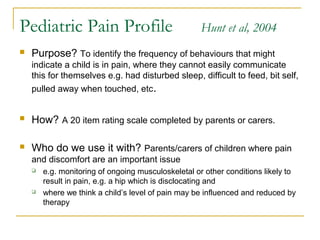
Pediatric Pain Profile Hunt et al, 2004
 Purpose? To identify the frequency of behaviours that might
indicate a child is in pain, where they cannot easily communicate
this for themselves e.g. had disturbed sleep, difficult to feed, bit self,
pulled away when touched, etc.
 How? A 20 item rating scale completed by parents or carers.
 Who do we use it with? Parents/carers of children where pain
and discomfort are an important issue
 e.g. monitoring of ongoing musculoskeletal or other conditions likely to
result in pain, e.g. a hip which is disclocating and
 where we think a child’s level of pain may be influenced and reduced by
therapy

Outcome measures used at the Bobath Centre

  • 1.
    OUTCOME MEASURES used atthe Bobath Centre Virginia Knox MSc PGCE MCSP Consultant Physiotherapist and Bobath tutor April 2013
  • 2.
    Outcome measures atthe Bobath Centre  Outcome measures are used at the Bobath Centre  This presentation explains what outcome measures are, which ones we use and how we use them
  • 3.
    Outcomes  ‘Hard’ outcomestypically refer to data that can be quantified (i.e. put into numbers)  e.g. a child shows improved motor function on an outcome measure; quality of life of child and/or family improved as demonstrated by improved scores on a standardised CP quality of life measure  ‘Soft’ outcomes often intangible and hard to measure directly like improved self esteem or confidence or belief you could do something better, or may represent intermediary stages on the way to achieving ‘hard’ outcomes,  e.g. a family wrote saying that the visit meant a lot to them and was very supportive, and they understood their child’s difficulties better  At the Bobath Centre, we focus on ‘hard’ outcomes to show quantifiable change, but also record ‘soft’ outcomes as these can give helpful feedback from families and children on our services
  • 4.
    Outcome measures -definitions  ‘a measure of change, the difference from one point in time usually before an intervention, to another point in time usually following an intervention’ Kendall, 1997  ‘a test or scale administered and interpreted by therapists that has been shown to measure accurately a particular attribute of interest to patients and therapists and is expected to be influenced by intervention’ Mayo et al, 1994
  • 5.
    How do weuse Outcome measures at the Bobath Centre?  ‘Occasional’ children attending for 2 weeks of therapy  If it is possible to find a relevant outcome measure which will be sensitive enough to show change in a short period, we administer a test or one part of a test, at the beginning and end of the 2 weeks  If this is not possible, we use Goal attainment scaling to set GAS goals  Children attending on a more regular basis, e.g. once a week over several months  Administer an outcome measure once a year or at the beginning and end of their block of therapy  Outcome measures may be used more frequently if we want to record progress before and after other interventions such as surgery or Botulinum toxin injections
  • 6.
    Clinical Audit ofOutcome Measures  Each year we record how many outcome measures were used and how many children showed improved scores  This information is compared against pre-set targets to ensure we are continuing to use measures frequently, and to see if we are increasing the frequency of use  Therapists receive specific training on an annual basis to help them further develop their skills in using outcome measures, and the clinical audit can help us determine where training is particularly needed
  • 7.
    Examples of outcomemeasures used at the Bobath Centre
  • 8.
    Canadian Occupational PerformanceMeasure COPM  Purpose? To detect change in a client’s self-perception of occupational performance over time  How? An interview with the parent, carer or child to:  Identify activities that are difficult to do, or to do well Then to rate these activities on 10 point scales:  Importance (priority)  How well the activity is being performed  How satisfied the client/parent is with the activity The rating is repeated after intervention, e.g. 2 week block of therapy  Who do we use it with?  Often with teenagers to help them engage in therapy and set their own goals Or  to help set goals with parents of children with more severe limitations in their activity and monitor their progress
  • 9.
    Goal Attainment Scaling Kiresuk,Smith & Cardillo, 1994  Purpose: A structured way to measure change using individualised goals  How? Goals are identified after discussion with parents and families. The goal is put onto a scale with five possible outcomes:  0 = expected level of attainment – what the therapist is aiming for the child to achieve at the end of the therapy  -1 and -2 are two levels which are less favourable but still an improvement from where the child started  +1 and +2 are two levels which are more favourable than the expected level of achievement at the end of therapy
  • 10.
    Example of GASgoal Goal Score Score at end of therapy To stand still and put jacket on and zip it up himself +2 To stand still while jacket is put on by parent and then zip up jacket himself +1  To stand still while jacket is put on by parent 0 To stand still for 30 seconds -1 To stand still for 15 seconds -2
  • 11.
    Gross Motor FunctionMeasure Russell et al, 1989  Purpose: to evaluate change in gross motor function in children with cerebral palsy aged 5 months to 16 years  How? The child is observed attempting lots of different gross motor activities within 5 areas: 1. Lying & rolling 4. Standing 2. Sitting 5. Walk, run & jump 3. Crawling & kneeling  Who do we use it with?  Any child with cerebral palsy where we are working on improving gross motor skills  It is slightly less sensitive with children either with very mild or very severe limitations in their activity so might not be used with those children
  • 12.
    Assisting Hand AssessmentAHA  Purpose: This measures how effective a child makes use of the assisting hand during two-handed activities. It is used with children with hemiplegia (cerebral palsy affecting one side of the body), aged 18m to 12 years.  How?  A video is taken of a play session using specific toys which would typically require the use of two hands  The child is not instructed to use their affected hand – the test looks at their spontaneous typical use of that hand  Who do we use it with? Any child with hemiplegia where therapy is aiming to improve hand function
  • 13.
    Melbourne Assessment  Purpose:To measure quality of upper limb function in one arm, in children with cerebral palsy aged 2-15 years  How?  A video is taken of the child performing different tasks, such as reaching and pointing, grasping different objects, manipulating objects and a variety of functional tasks, like taking a biscuit to their mouth.  This is then scored for different aspects like range of movement, accuracy, smoothness of the movement and speed  Who do we use it with? Children where therapy is aimed at improving hand and arm function or sometimes to see if wearing a splint or lycra garment changes the level of hand function
  • 14.
    Spinal Alignment &Range of Motion Measure SAROMM  Purpose: to give an overall score of spinal posture (alignment) and range of movement in upper and lower limbs  How?  Spinal alignment (posture) is observed and compared to photographs and rated on a 4 point scale  Range of motion (ROM) for lower limb joints and upper limbs are measured with a goniometer according to specific instructions and the ranges recorded on a 4 point scale  Total spinal & ROM scores and an overall total score are calculated  Who do we use it with? Children and teenagers where improving mobility is a focus of therapy, e.g. an adolescent child who has recently been getting significantly stiffer
  • 15.
    Spinal Alignment andRange of Motion Measure SAROMM 0 = Full ROM (i.e. neutral hip ext.) and no hip flexion posture Hip flexion posture 1 = Full PROM (ie. >0 hip ext.) Limitation of hip extension 2 = Mild (Neutral to 15°) 3 = Moderate (15° – 30°) 4 = Severe (>30°) Thomas Test
  • 16.
    SAROMM 0 = Noalignment limitations 2 = Mild 1 = Scoliosis and/or rib hump observed but can be corrected passively Non reducible scoliosis & rib hump 3 = Moderate 4 = Severe
  • 17.
    Chailey levels ofAbility  Purpose: assesses level of postural ability in children with cerebral palsy for lying, sitting and standing. They can also be used to determine which type of equipment, e.g. seating, helps the child achieve the highest level of posture, e.g.  Can the child only be placed in sitting, or can they get in and out of sitting for themselves; can the child lie on their back and use their hands for play  How? The child is observed in different postures, looking at the posture they adopt, how they move, which parts of the body are taking weight, etc.  Who do we use it with? Children with more severe limitations to their posture to monitor progress in their postural ability, and sometimes to determine if different equipment or a lycra garment influence their postural ability
  • 18.
    Pediatric Evaluation ofDisability Inventory PEDI Haley et al, 1992  Purpose: To measure functional skills (what the child can do) and also the amount of assistance a parent/caregiver typically has to give a child in everyday activities in three areas:  Self care, e.g. eating, bathing, dressing  Mobility, e.g. moving around indoors, transfers  Social function, e.g. play, problem solving  How? The parent/carer completes a questionnaire with a therapist or completes a computerised assessment  Who do we use it with? Children attending the Centre on a regular more long term basis to measure change particularly in self care and level of mobility
  • 19.
    Caregiver Priorities andChild Health Index of Life with Disabilities CPCHILD Narayanan et al, 2006  Purpose? To measure health related quality of life including the child’s health and how functional activities are affected like personal care, positioning, transferring, mobility, communication and comfort, and how much the caregiver has to help the child with these activities  How? A questionnaire for the caregivers of children, at the beginning of a block of therapy and then repeated a few weeks after returning home.  Who do we use it with? Children with more severe limitations in their activity (GMFCS IV & V)
  • 20.
    Care & ComfortHypertonicity Questionnaire CCHQ Nemer McCoy et al, 2006  Purpose? To assess the degree of difficulty in carrying out specific personal care activities and whether there is any discomfort or pain during such activities, e.g. Is there pain or discomfort during nappy changes? Ease of getting in/out of wheelchair  How? A questionnaire with a rating scale for parents/carers  Who do we use it with? Parents/carers of children with more stiffness, pain or discomfort which we think may change with therapy
  • 21.
    Pediatric Pain ProfileHunt et al, 2004  Purpose? To identify the frequency of behaviours that might indicate a child is in pain, where they cannot easily communicate this for themselves e.g. had disturbed sleep, difficult to feed, bit self, pulled away when touched, etc.  How? A 20 item rating scale completed by parents or carers.  Who do we use it with? Parents/carers of children where pain and discomfort are an important issue  e.g. monitoring of ongoing musculoskeletal or other conditions likely to result in pain, e.g. a hip which is disclocating and  where we think a child’s level of pain may be influenced and reduced by therapy