Assessing the Shift:
Shake Shack: A Sustainable Burger Strategy
Presented to: Randy Garutti (CEO of Shake Shack) & Shake Shack Executives
Private & Confidential
Prepared by: Ankit Chawla, Rizki Fadhilah, Giridhar Sowmya, Ng Gim Hunt, Chen Hsi
1. Background & Challenge
Sustainability Mission VS Company Profitability
Content:
2. Recommendation
Address current issue and plan for future sustainability
3. External Analysis
Market trend towards conscious eating & alternative meat
4. Internal Analysis
Company capabilities in developing fast-casual and iconic burger
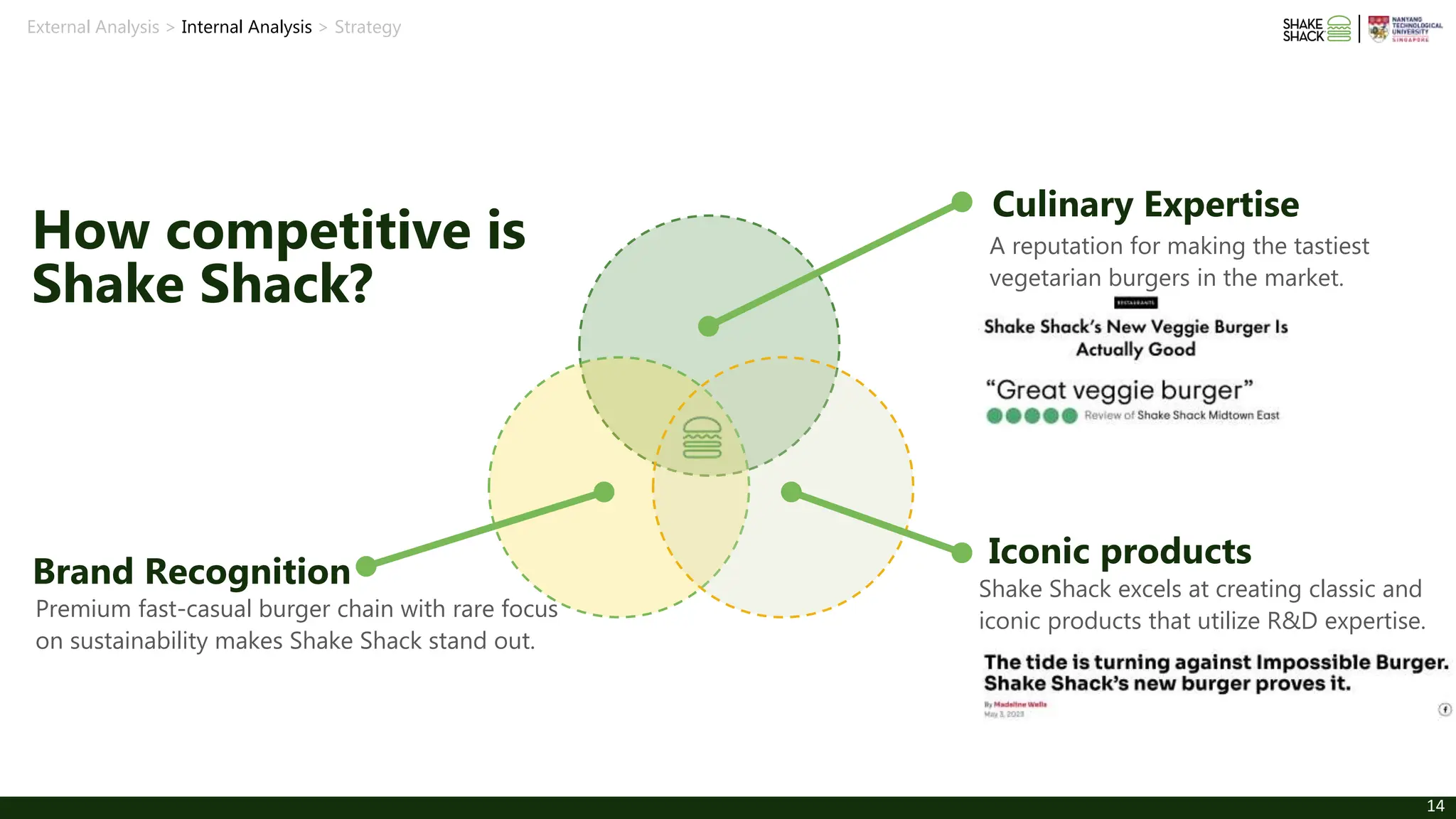
5. Company Strategy
Guideline in setting short & long-term profitability and sustainable plan
Stand for
Something Good
3
USD900 mil.
Revenue for 2022
USD24 mil.
net loss for 2022
7.8%
EBITDA
How can Shake Shack
drive profit growth, address developments in
alternative protein, and align with sustainability?
• As per Q3 2023 results, Shake Shack has made an operating profit of
$5.7 million.
• This comes after an operating loss of $4.8 million in 2022.
• High SG&A & Depreciation Cost
• Decent operational efficiency
• Have risk to long-term debt repayment if sales growth and gross
margin don't remain strong
Problem Statement
Background > Recommendation > External Analysis
4
Recommendation 1
(Short-Term)
Recommendation 2
(Long-Term)
Boost Sales with Veggie Burger
options by Amplifying Healthier
Choice and Sustainability Campaigns
Partner for R&D Investment in
Lab-Grown Meat In Anticipation of
Shift Towards Alternative Meat
Product Focus:
Veggie Shack Shroom Burger
Key Message:
Healthier Choice Tasty Try Something New
Key Customers:
Flexitarian Vegetarian Conscious Eating
Expected Outcome:
• Increase sales of Veg & Shroom burgers
• Enhanced brand image
• Deeper engagement with health-conscious consumers
Product Focus:
Meat-Based Burger
Key Message:
Future Protein
Key Partners:
Meatable & Mosa UPSIDE
Foods
Expected Outcome:
Environmental Impact
• Forefront of sustainable innovation
• Meeting evolving consumer demands
• Reducing Cost & Increase Profit in the long run.
Recommendations:
Shake Shack’s Burger Strategy for Sustainability
Eat Just Inc.
Background > Recommendation > External Analysis
Casual-Dining Fast-Casual Fast-Food
Mix
Menu
Full-Meat
Vegan/Vegetarian
Expanded the market from a fast-casual restaurant offering a full-
meat menu to incorporating vegetarian options.
5
Industry Definition
Recommendation > External Analysis > Internal Analysis
6
Shake Shack may face some challenges from Political, and Tech, Legal factors, but also benefits from
opportunities in Economic, Social Trend and Environment factors.
Political
Lobbying and Advocacy
Groups:
The influence of various
lobbying groups, such as
traditional meat industry
lobbyists or environmental
and animal welfare
groups, could sway public
policy in ways that either
hinder or help the
adoption of plant-based &
lab-grown meat.
May affect reputation if
Shake Shack market
meat alternatives at the
wrong time.
Financial Markets
Efficiency: The efficiency
of financial markets in
different regions influences
Shake Shack's ability to
raise capital and expand
into new markets.
Economic Growth Rate:
Consumer spending
power, inflation rates, and
economic growth directly
affect consumer behavior
and spending in the
restaurant industry.
However, the Americans
are undeterred when
comes to spending on
food.
Health and Ethical
Considerations: Social
trends towards healthier
and ethically sourced
foods could drive
demand.
Consumer
Acceptance: Public
perception and willingness
to embrace lab-grown
meat will be a key
determinant of success.
Social Media and
Digital Marketing: The
rise of social media,
offers new avenues for
Shake Shack to engage
with customers and
market its products.
Innovation in
Biotechnology:
Advances in biotech are
crucial for developing
lab-grown meat.
Supply Chain
Integration:
Incorporating lab-grown
meat into the existing
supply chain will require
technological
adaptations.
Economic
Recommendation > External Analysis > Internal Analysis
Social Technological
Intellectual Property:
Patents and proprietary
technology in producing
lab-grown meat could be
legal considerations.
Compliance with Food
Laws:
Ensuring lab-grown
meat complies with all
relevant food laws and
regulations.
Legend: (Positive) (Neutral) (Negative)
Legal
Reduced
Environmental Impact:
Lab-grown meat offers
potential environmental
benefits, such as lower
greenhouse gas
emissions and reduced
land and water use
compared to traditional
animal farming.
Sustainability
Narrative: Aligns with
global environmental
sustainability goals,
enhancing brand image.
Environment
Assessing the Impact of Political, Economic, Social, Technological, Legal, and
Environmental Factors on Shake Shack's Market Strategy for Meat Alternative
7
Threat of New Entrants: Bargaining of Suppliers: Bargaining of Buyers: Threat of Substitute Intensity of Competition
Key to navigating this new challenge is a multi-faceted strategy focusing on strengthening supply chain resilience, product
differentiation, and customer loyalty, also leveraging Shake Shack's brand strength and continuous innovation.
Shake Shack's Transition to Providing Meat-Alternative Burgers Presents
Opportunities in an Expanding Market While Also Encountering Challenges.
Recommendation > External Analysis > Internal Analysis
High High High High
Moderate to High
The fast-casual and plant-
based food sectors are
attractive due to growing
consumer demand for
healthier and more
sustainable food options,
It attracts new entrants.
Given the specialized
nature of alternative meat
products and the limited
number of established
suppliers in this nascent
industry, the bargaining
power of suppliers is high.
Customers have a wide
range of dining options
and are increasingly aware
of and sensitive to issues
related to health, price,
and sustainability.
The availability of a broad
array of substitutes,
including traditional meat
burgers, other plant-based
meals, and various protein
alternatives, poses a high
threat.
The fast-casual restaurant
industry, particularly in the
alternative meat segment,
is highly competitive, with
numerous players ranging
from large multinational
chains to small, specialized
eateries.
8
Full-Veggies
Full-meat
2. Mimicking Meat Burger
1. Meat Patty
Burger
3. Veggie Burger
Lab-Grown Meat Insect Protein Plant-Based Veggies + Dairy Veggies + Non-Dairy
• Vegetarian
• Vegan
• Flexitarian
• Vegetarian
• Flexitarian
General Consumer
(meat lover)
• General Consumer (meat lover)
• Flexitarian
*Flexitarian: eating mostly plant-based foods and having animal products in moderation.
Burgers made from a base of quinoa, chickpeas,
black beans, lentils, etc. They don’t mimic beef &
add variety to your diet.
Burgers made from a lab-grown meat, insect protein, and plant based, try to
mimic beef &add variety to your diet.
Burgers made from farm-
grown meat
Consumers: Consumers: Consumers: Consumers:
Shake Shack's Transition to Providing Meat-Alternative Burgers
Recommendation > External Analysis > Internal Analysis
9
2. Mimicking Meat Burger 3. Veggie Burger
Lab-Grown Meat Insect Protein Plant-Based Veggies + Dairy Veggies + Non-Dairy
Product
Development
Cost High High Low Low
This type of protein is
the most well
established and is
derived from protein-
rich seeds through dry
or wet fractionation.
The industry must over
come major technologi
cal challenges before it
can hope to become
price competitive.
It is currently cost
prohibitive to isolate
protein from the flour,
making the process
difficult to scale.
Competition
Rivalry
Consumer
Perception
Potentially
allergenic
Complex technolog
y perceived cautious
ly
Non-allergic and very safe
Non-allergic
and very safe
Low Low High Low
made from vegetables, grains, and legumes are
less expensive to produce than both meat and
lower cost of raw materials and simpler
production processes.
Environmental
Impact
Low
High Low
Low
Prioritize Veggie Burger in the short-term while strategically developing
Lab-Grown Meat Burger for long-term growth
Recommendation > External Analysis > Internal Analysis
10
Source: https://www.mckinsey.com/industries/consumer-packaged-goods/our-insights/hungry-and-confused-the-winding-road-to-conscious-eating
Enhancing the existing Veggie Burger Product instead
of venturing into the creation of new menu items.
1. Financial
Perspective:
• No additional cost for R&D expenses
for innovating new products.
• Has greater profit margins compared
to meat-based burgers.
3. Customer Perspective:
• Enhance the popularity of the
Veggie Shack and Shroom Burger
• Flexitarian Gain Traction
2. Sustainability Perspective:
Continues to support the sustainability
mission by offering alternative meat
burger options.
Veggie Burger
Veggie Shack
Shroom Burger
Flexitarian
No Meat
Restriction
Fully Vegan
Fully Vegetarian
(49%) (46%)
(1%
)
(4%
)
Recommendation > External Analysis > Internal Analysis
11
Source: Cultivated meat report, Statista
Lab-Grown Meat
Recommendation > External Analysis > Internal Analysis
Legend: Meat Vegan Meat Alternative Lab
Grown
1. Market Trend Perspective: 2. Cost Perspective
3. Legal Perspective:
USDA approves 1st ever 'cell-cultivated meat' for 2 American
manufacturers
https://abcnews.go.com/GMA/Food/fda-approves-1st-cell-cultivated-meat-upsidefoods/
Investing in R&D of Lab-Grown meat to advance Sustainability Goals
and increase Market Share in the food industry, for the future.
Competitive Advantage
Shake Shack
Delicious?
What makes
External Analysis > Internal Analysis > Strategy
Shake Shack
Delicious?
What makes
Pillowy, potato bun
Pillowy, potato bun (again)
Juicy, American Gouda cheese slices
Extra lean smashed ground beef patties
Fresh Romaine lettuce, tomato
Perfectly sour dill pickles
Delicious vegetarian patties (yum!)
External Analysis > Internal Analysis > Strategy
14
Culinary Expertise
Iconic products
Brand Recognition
A reputation for making the tastiest
vegetarian burgers in the market.
Premium fast-casual burger chain with rare focus
on sustainability makes Shake Shack stand out.
Shake Shack excels at creating classic and
iconic products that utilize R&D expertise.
How competitive is
Shake Shack?
External Analysis > Internal Analysis > Strategy
Business Growth Strategy:
• Business Model: Company-Operated Shake Shack (254 Shakes in US)
• Strict Quality Control: Strict standard on sourcing and supply chain.
(Domestic only have 9 approved raw beef suppliers; 10 approved beef
processors).
• Innovation Kitchen Strategy (*data from Reference 1- Sec.gov report 10-K-13)
15
Industry Value Chain
Industry Chain: Upstream Mid-Stream Down-Stream
Veggie
s
Meat
Bread
Subsidiary
product
Utensils …
Self
Processing
Collaborate
Processors
Central
Warehouse
Company
Operated
Licensed
USA
Oversea
$ 870 m|95% revenue |287
Shakes
Wholesaler
Distributor
Supplier
Self Pick
warehouse
transfer
Store
Factory
Consumer
$25 m | Less 5% revenue|149 Shakes
End of Year 2022
Shake Shack Reached 436 Shakes Worldwide
External Analysis > Internal Analysis > Strategy
16
Shake Shack
Strategy
Internal Analysis > Strategy > Timeline
Economic Logic
17
• Premium prices for fast casual category,
achieved through taste, quality & overall
dining experience
• A veggie focus will allow for reduced costs
• It will also improve margins with higher
pricing.
• Cost efficiency through digitalization
Economic
Logic
Shake Shack
Strategy
Internal Analysis > Strategy > Timeline
18
Staging:
• Marketing channels: Social media, influencer
partnerships, educational content, in-store
promotional campaigns, email marketing
• Growing digital and offline presence
• A/B testing of campaigns
• In-store veggie awareness
Shake Shack
Strategy
Internal Analysis > Strategy > Timeline
19
• Product: High Quality and Sustainability
• Business Growth Strategy:
• Company Operated
• Licensed
• Innovation Kitchen
• Shack-Wide Limited Time Offerings (LTO)
• Exclusive Offerings
• Supply Strategy:
• Centralized distribution process
• Quality Control system
Vehicles:
Shake Shack
Strategy
Internal Analysis > Strategy > Timeline
20
Arena:
• Gourmet casual fast food
(burgers, fries, milkshakes, lemonade,
beer, wine, hot dogs, chicken)
Shake Shack
Strategy
Internal Analysis > Strategy > Timeline
Differentiator:
Fast casual food restaurant
with continuing
sustainability mission
Any questions?
Thank you
Prepared by: Ankit Chawla, Rizki Fadhilah, Giridhar Sowmya, Ng Gim Hunt, Chen Hsi
Recommendation 1 (Short Term) Recommendation 2 (Long Term)
Boost Sales with Veggie Burger options
by Amplifying Healthier Choice and
Sustainability Campaigns
Partner for R&D Investment in Lab-Grown
Meat to Anticipate Shift Towards
Alternative Meat
22
Financial Analysis
Shake Shack have high SG&A expenses as a percentage of revenue&
High depreciation and amortization expenses as a percentage of revenue.
In 2022, revenue was $900 million, up from
$700 million in 2021, marking a $200 million
increase. However, the net loss for 2022 was
$24 million, compared to a $8.65 million loss
in 2021.
Overseas revenue constitutes only a minor
portion of Shake Shack's income, with over
95% of revenue originating from the
United States.
Why Net Loss?
Conclusions
*Data from Sec.gov Shake shack’s Securities and Exchange Commission Report
(* Appendix 1 for data details)
Appendix 1:
23
*Data from Sec.gov Shake shack’s Securities and Exchange Commission Report [Reference]
* Balance Sheet check [Appendix 4]
1.The majority of profits come from the U.S. market (Revenue exceeds 95%), and it primarily adopts a company-operated
model (with overseas franchising), where direct stores require significant capital investment.
2.Talent development is a priority for Shake Shack, with SG&A expense making up 13.2 % of revenue, partly driven by
salary increases.
Overall Reason
Profitability 2022 YoY 2021
Revenue 900,486 22% 739,893
Gross Margin 42.40% 0.90% 41.40%
EBITDA 7.80% 0.20% 7.60%
Net Profit -2.70% -1.50% -1.20%
Efficiency 2022 YoY 2021
DSO (Days) 5.6 -1.1 6.7
DIO (Days) 2.9 -0.3 3.2
DPO (Days) 14.4 -2.4 16.8
CCC (Cash Conversion Cycle) -5.9 0.9 -6.8
Liquidity 2022 YoY 2021
Current Ratio % 2.3 -1.00 3.4
Quick Ratio % 2.2 -1.10 3.3
Debt / Equity % 2.6 0.20 2.3
*Interest coverage % 50.6 13.5 37
High SG&A & Depreciation Cost
- 40% Gross Margin drop to 7.8% EBITDA
- Report of SG&A & Depreciation from data *Appendix 3
Decent operational efficiency
- Both the Days Sales Outstanding (DSO) and Days Inventory Outstanding
(DIO) cycles are very short.
- The Days Payable Outstanding (DPO) cycle to suppliers is longer than the
sum of the receivables cycle (DSO) and the inventory cycle (DIO), resulting in
a negative Cash Conversion Cycle (CCC).
Have risk to long-term debt repayment if sales growth
and gross margin don't remain strong
- Short-term repayment capability: current assets are 2-3 times current
liabilities, indicating a decent ability to pay off debts.
- Long-term repayment capacity: the Debt/Equity ratio shows that overall debt
is about 2-3 times equity, suggesting some risk to long-term debt repayment
ability.
Conclusions
(USD amount in thousands )
Legend: Good Risk
Financial Analysis
Appendix 2:
24
1、High SG&A expense
2、High Depreciation and amortization expense
Appendix 3:
25
Balance Sheet
Long-Term Debt Risk:
• Long-term debt and long-term
operating lease liabilities total
$670 million, accounting for
62% of total liabilities.
Appendix 4:
Industry
Definition:
26
1. Full Meat: Establishments that primarily focus
on serving meat-based dishes without a
significant emphasis on plant-based options.
2. Hybrid: Restaurants that offer a balanced mix
of meat-based and plant-based options,
catering to a wide range of dietary preferences.
3. Full Vegan: Restaurants exclusively serving
plant-based dishes, with no animal products on
their menu.
1. Casual Dining: Sit-down restaurants that offer
a relaxed dining atmosphere.
2. Fast Casual: A mix between fast food and
casual dining, offering a more upscale food
quality in a casual dining environment.
3. Fast Food: Quick service restaurants known for
their speed of service and often, a drive-thru
option.
Appendix 5:
27
Appendix 6:
While consumers kept spending despite
rising prices through the third quarter, there
are some warning signs as spending on
goods, led by food and beverages, gasoline
and motor vehicles, declined for the third
consecutive quarter. Meanwhile services
spending increased at an annual rate of 2.8
percent in Q3, as Americans spent more on
food services and accommodation, health
care and transportation compared to the
preceding quarter.
Economic Growth Rate
Labour Market Conditions
• The small stores also address one of the biggest limiting factors
for the growth of Shake Shack and virtually every other brand:
labor pressures.
• “It has never been harder to find great people to lead
restaurants,” Garutti said. “That’s the reason we’re not doing
100 restaurants (this year). There’s 100 sites out there right
now. … We want to make sure we have the right amount of
leaders.”
• The New York City-based fast-casual burger chain has
struggled with sluggish traffic, seeing a 2.7% traffic slide in
2018. Shake Shack’s operating profit margin fell 22.5% for
the quarter ended Dec. 26, 2018, which chain executives
attributed to mounting labor costs and the expense of
opening new units.
Source: Restaurant Business Online
28
• "We believe we’re going to continue to increase
(restaurant-level margins) over time, but some of the
macro factors impacting the company, we need some of
those to go our way,” Garutti said. “We’ve got to continue
to get staffed up. We’re missing an opportunity by not
having optimized hours or throughput. (Labor) remains a
challenge and we are putting massive efforts toward
staffing and bulking up our teams to handle this."
Source: Nation's Restaurant News
Appendix 7:
29
Supplier Consumer
Appendix 8:
Industry Value Chain on Meat Alternative
Existing supplier,
Future supplier
(Future Meat, Just
Eat.Inc, Meatable)
Existing ( Flexitarian,
Vegetarian, Vegan),
Future (General
Consumer)
33
Appendix 9:
Demand on Plant- Based food market
- Predict to grow fivefold from 2020 to 2030
source: Bloomberg
The global plant-based food
market is expected to
increase from US$29.4 billion
in 2020 to US$162 billion in
2030.
34
Shake Shack Value Chain
Firm Infrastructure
SS focuses on quality, community, digital growth, and sustainability, using technology and best practices. It values human capital, leadership, and Enlightened Hospitality™
to improve efficiency, empower employees, and satisfy customers, supporting its growth goals.
Human Resource Management
SS places significant emphasis on its people, viewing them as its most valuable asset. The company's HRM strategy focuses on recruiting, rewarding, and retaining talented
individuals who embody integrity, motivation, self-awareness, and intellectual curiosity. Training programs are aligned with the company's values of Enlightened Hospitality,
emphasizing care for employees, guests, communities, suppliers, and investors
Technology Development
SS‘s digital strategy focuses on delivering Enlightened Hospitality through multiple channels, aiming to create a seamless and personalized guest experience. Key
initiatives include enhancing digital ordering tools, integrating lifecycle marketing tools like Braze for personalized communication. Efforts also include the
introduction of digital gift card redemption and tipping across all order modes.
Procurement
SS’s strategy includes contracts for buying, building, or upgrading properties and facilities, along with commitments for inventory, equipment, marketing, software, and services.
These contracts are usually short-term, becoming liabilities upon receipt of goods or services. The company also has long-term exclusive agreements with vendors for essential
supplies like food, beverages, and paper products, requiring specific purchase quantities.
Inbound Logistics
They prioritize quality
ingredients, partnering with
suppliers that align with
their standards for natural,
hormone-free, and
humanely raised products.
Operation
Prioritize efficiency, profitability, and quality.
Using centralized distribution, stringent food
safety measures, and invest in tech to
improve service and efficiency.
Environmental sustainability is also crucial,
focusing on responsible sourcing and energy
use.
Outbound Logistics
SS emphasis on a centralized
distribution model and quality
assurance practices suggests a
streamlined approach to delivering
products to their locations, ensuring
consistency and quality across their
outlets.
Marketing & Sales
SS‘s brand recognition, digital
engagement through social
media, and innovative
collaborations for menu
development are central to
attracting and retaining
customers.
Service
SS‘s commitment to "Stand
For Something Good," along
with investments in technology
and infrastructure, underscores
their focus on enhancing the
customer service experience.
Margin
Appendix 10:
35
Profit
Revenue
No of units sold
1/3rd are willing to pay
more for plant-based
options
Net positive
Could go up in short term,
back down with scale
Neutral to negative
Fixed
Costs
Price
46% in the US are flexi-
tarians
Net positive
Irrelevant, remain stable
Neutral
Variable
Appendix 11:
Staging
• Gradual Geographic Expansion: https://www.qsrmagazine.com/story/shake-shack-now-500-locations-strong-keeps-learning-and-growing/
• Initially, Shake Shack focused on expanding within the United States, primarily targeting cities with high population densities and tourist locations. Their approach
is to establish a strong brand presence in each new city before moving on to the next.
• For example, Shake Shack started in New York City and gradually expanded to other major cities across the U.S., ensuring that each new location solidified its
presence in the market.
• International Growth: https://edition.cnn.com/2019/06/18/business/shake-shack-mexico-city/index.html
• Shake Shack’s international expansion is characterized by selective and strategic entry into global markets. They often enter new countries through partnerships
with local companies that understand the regional market.
• An instance of this strategy is Shake Shack's entry into markets like the Middle East, South Korea, and the UK through franchising and licensing agreements with
local partners.
• Digital Expansion: https://secondmeasure.com/datapoints/shake-shack-online-retail-sales-expansion/
• Alongside physical expansion, Shake Shack has also focused on growing its digital presence. This includes enhancing its online ordering system, mobile app
development, and partnerships with food delivery services.
• The emphasis on digital channels became especially significant during the COVID-19 pandemic, where they pivoted to offer more online and delivery options to
adapt to changing customer behaviors.
• Menu Innovation:
• Part of Shake Shack’s staging strategy includes gradual menu evolution to include more diverse offerings. This has included the introduction of chicken
sandwiches, limited-time offers, and vegetarian options.
• By continuously updating their menu, Shake Shack keeps the brand relevant and appealing to a broad range of customers.
• Investment in Technology and Sustainability: https://d3.harvard.edu/platform-rctom/submission/shake-shack-is-enlightened-hospitality-becoming-digitalized/
• The company is also investing in technology to improve customer experience and operational efficiency. This includes adopting new POS systems, kitchen display
systems, and other tech-driven solutions.
• Sustainability initiatives are also a part of their staging strategy, focusing on environmentally friendly practices as they expand.
36
Shake Shack's growth staging involves a careful and calculated expansion strategy. They have prioritized steady growth by gradually
opening new locations in key markets and slowly expanding their international presence. This allows them to maintain quality control and
brand consistency.
Appendix 12:
Stand for Something Good
Since day one to 20 years later, Shake Shack is continuing
to expand and evolve the mission of Stand for Something Good.
“We are continuously evolving our efforts to reduce our environmental
footprint, focusing on critical areas such as energy efficiency, reduced
waste, and collaborating with farmers, suppliers, and guests to drive
meaningful change across the food industry.”
—Jeffrey Amoscato, Senior Vice President of Supply Chain
37
Appendix 13:
38
Marketing
• Highlighting the health
benefits of reduced
meat consumption
• Highlighting climate
impact of cutting out
meat from Veggie
Shack keeps “stand for
something good”
message alive
R & D
Researching & testing
ingredients and flavor
combinations which will
offer customers great
taste, texture and quality.
Operations
• Kiosk ordering to
reduce packaging
costs
• More efficient drive-
thru buildouts
Procurement
Sourcing only the best
quality ingredients from
a limited number of
suppliers
Activity System Map
Appendix 14:
36
Timeline Implementation
A/B Testing
Strategy integration
Marketing
Testing
Deployment
Strategic integration
Implement Plans
Finalize Materials
Launch Campaigns
1st Quarter 2nd Quarter 3rd Quarter 4th Quarter
Appendix 15:
39
References
1. High SG&A expense: sec.gov/ix?doc=/Archives/edgar/data/0001620533/000162053323000015/shak-20221228.htm
2. https://www.mckinsey.com/industries/agriculture/our-insights/alternative-proteins-the-race-for-market-share-is-on#/
3. https://www.wired.com/story/lab-grown-meat-vegan-ethics-environment/
4. https://www.mckinsey.com/industries/agriculture/our-insights/how-the-global-supply-landscape-for-meat-protein-will-evolve
5. https://www.mckinsey.com/industries/consumer-packaged-goods/our-insights/five-insights-into-the-views-and-behaviors-of-the-us-
dairy-consumer
6. https://www.ey.com/en_gl/strategy/how-alternative-proteins-are-reshaping-meat-industries
7. https://www.ey.com/en_gl/consumer-products-retail/five-types-of-consumer-that-you-need-to-understand
8. https://www.theguardian.com/food/2022/sep/24/plant-based-meat-failed-impossible-burger-mcdonalds-beyond-meat
9. https://www.forbes.com/sites/juliabolayanju/2019/07/30/plant-based-meat-alternatives-perspectives-on-consumer-demands-and-
future-directions/?sh=3cd89da06daa
10. https://www.bloomberg.com/news/newsletters/2023-01-19/big-take-what-is-the-future-of-fake-meat
11. https://www.eufic.org/en/food-production/article/lab-grown-meat-how-it-is-made-and-what-are-the-pros-and-cons
12. https://abcnews.go.com/GMA/Food/fda-approves-1st-cell-cultivated-meat-upside-
foods/story?id=100278334#:~:text=UPSIDE%20will%20cultivate%20and%20sell%20chicken%20grown%20from%20animal%20cells%20in
%20bioreactors.&text=ABC%20News%27%20Devin%20Dwyer%20tours,of%20the%20U.S.%20food%20system
13. https://www.sec.gov/Archives/edgar/data/1620533/000162053323000015/shak-20221228.htm#i73ffbf248ec24128ae6b69974428e06b_91
14. https://shakeshack.com/stand-for-something-good#/
15. https://d3.harvard.edu/platform-rctom/submission/shake-shack-is-enlightened-hospitality-becoming-digitalized/
16. https://www.prnewswire.com/news-releases/flexitarianism-on-the-rise-in-us-reports-packaged-facts-301154622.html
Background & Challenges > Recommendation > External Analysis > Internal
Analysis
Background
• As per 3rd quarter 2023 results, Shake Shack has made an
operating profit of $5.7 million.
• This comes after an operating loss of $4.8 million in 2022.
• Shake Shack’s latest release is the Veggie Shack burger, which it
launched in May 2023.
Problem Statement
1. Drive Shake Shack’s profit growth.
2. Address the following concerns:
• Competitors offering plant-based alternatives.
• Potential impact of developments in alternative sources of protein.
• Impact of sustainability focus on cost, reputation and financial
results.
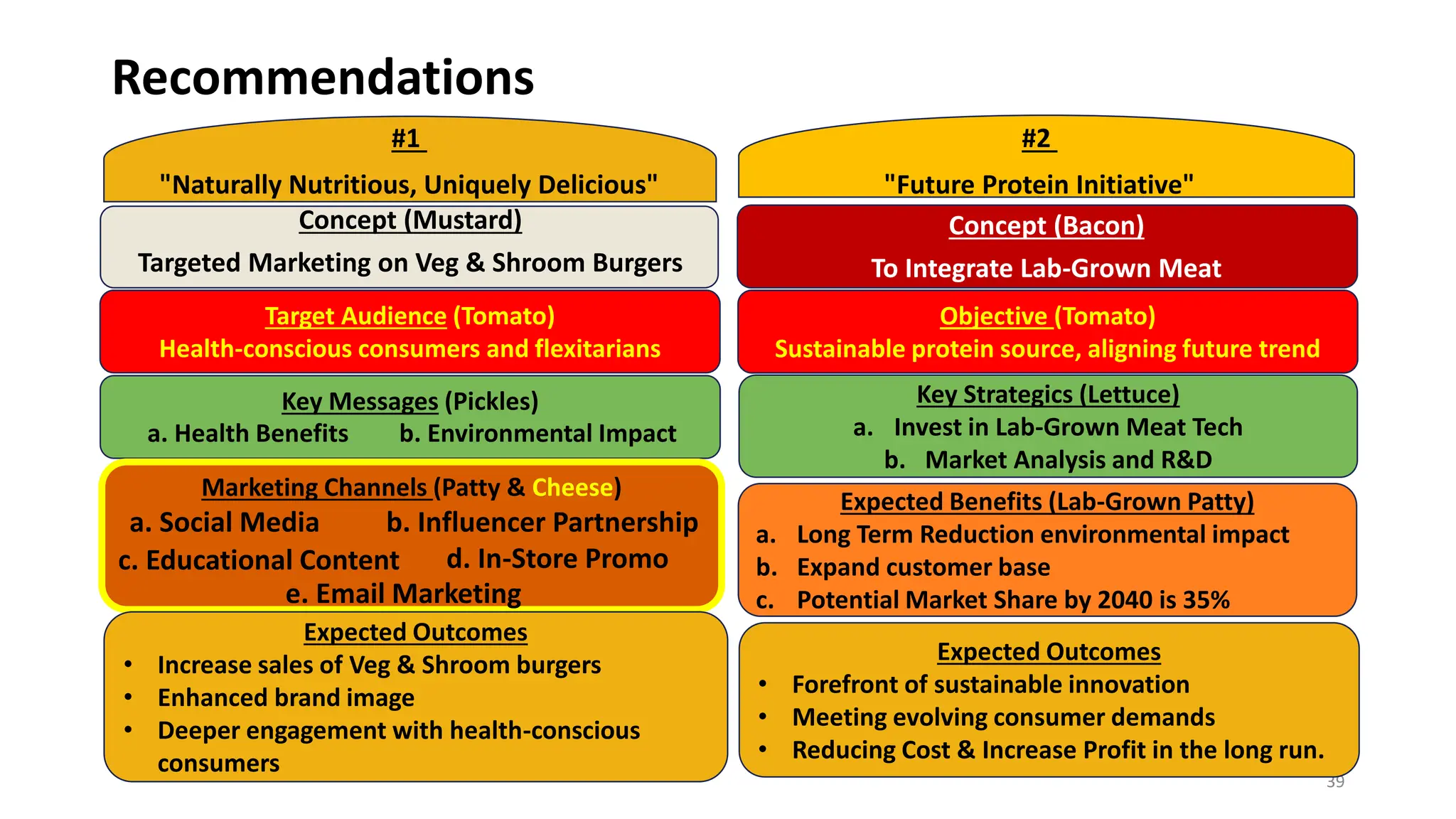
Concept (Mustard)
Targeted Marketing on Veg & Shroom Burgers
Concept (Bacon)
To Integrate Lab-Grown Meat
39
Key Messages (Pickles)
Target Audience (Tomato)
Health-conscious consumers and flexitarians
Objective (Tomato)
Sustainable protein source, aligning future trend
Key Strategics (Lettuce)
a. Invest in Lab-Grown Meat Tech
b. Market Analysis and R&D
Expected Outcomes
• Forefront of sustainable innovation
• Meeting evolving consumer demands
• Reducing Cost & Increase Profit in the long run.
a. Health Benefits b. Environmental Impact
Marketing Channels (Patty & Cheese)
a. Social Media b. Influencer Partnership
c. Educational Content d. In-Store Promo
e. Email Marketing
Expected Outcomes
• Increase sales of Veg & Shroom burgers
• Enhanced brand image
• Deeper engagement with health-conscious
consumers
Recommendations
Expected Benefits (Lab-Grown Patty)
a. Long Term Reduction environmental impact
b. Expand customer base
c. Potential Market Share by 2040 is 35%
#1
"Naturally Nutritious, Uniquely Delicious"
#2
"Future Protein Initiative"
3. Veggie Burger
40
Recommendation > External Analysis > Internal Analysis
Source: https://www.mckinsey.com/industries/consumer-packaged-goods/our-insights/hungry-and-confused-the-winding-road-to-conscious-eating
Veggie Shack
Shroom Burger
Target Consumer
Flexitarianism gains traction
Flexitarian (46%)
No Meat Restriction
(49%)
Fully Vegan (4%)
Fully Vegetarian (1%)
Key Messages
• Better for health
• Tasty
• Try something new
Consumers enjoy meat
alternative product for
their own health more
than for the environment
(US market)
Prioritize enhancing the existing Veggie Burger Product
instead of venturing into the creation of new menu
items.
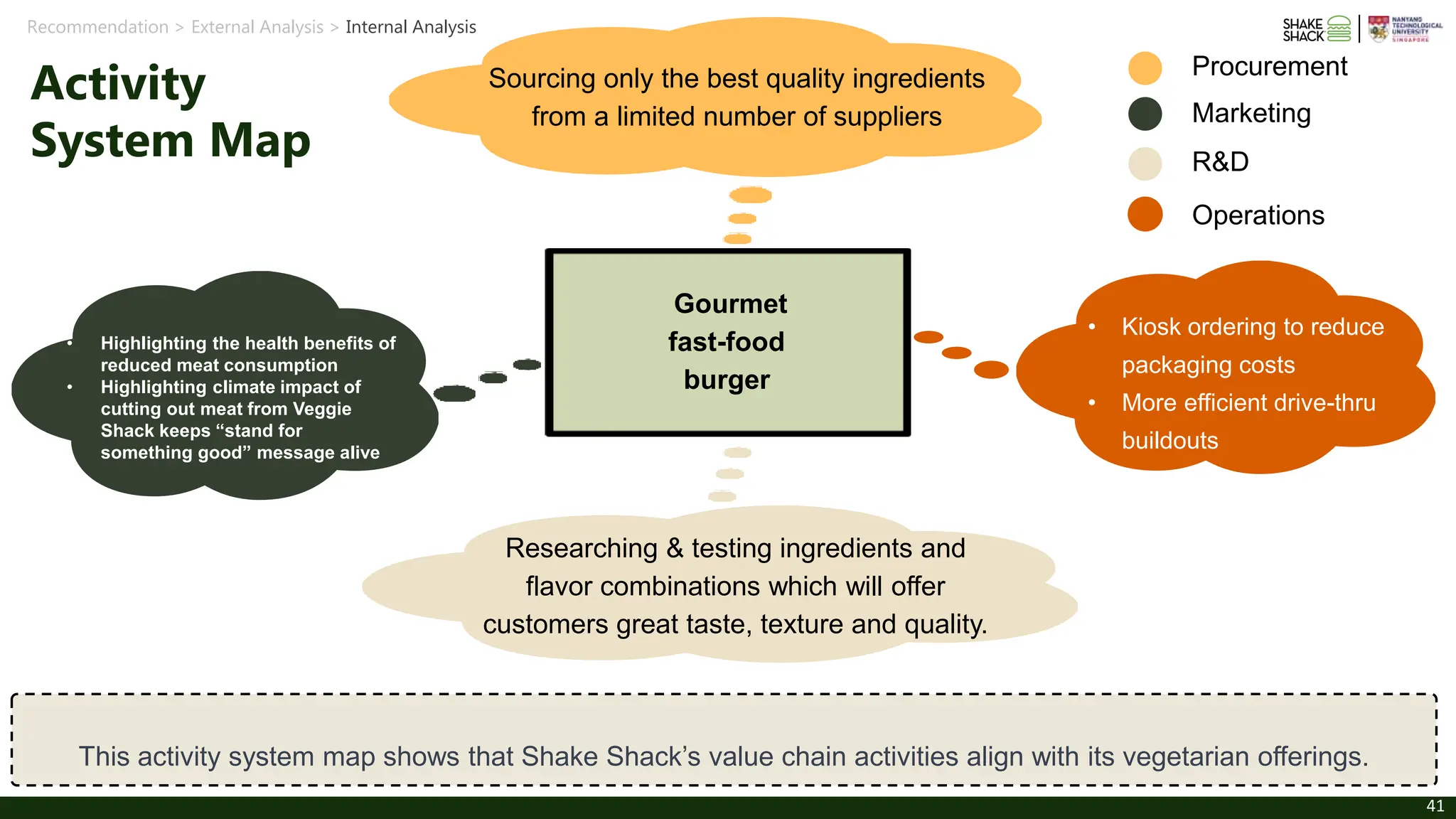
This activity system map shows that Shake Shack’s value chain activities align with its vegetarian offerings.
41
Recommendation > External Analysis > Internal Analysis
Gourmet
fast-food
burger
Researching & testing ingredients and
flavor combinations which will offer
customers great taste, texture and quality.
Sourcing only the best quality ingredients
from a limited number of suppliers
• Highlighting the health benefits of
reduced meat consumption
• Highlighting climate impact of
cutting out meat from Veggie
Shack keeps “stand for
something good” message alive
Procurement
Marketing
R&D
Activity
System Map
Operations
• Kiosk ordering to reduce
packaging costs
• More efficient drive-thru
buildouts
Tip Pooling Rule in the US
• This rule, as part of the Fair Labor Standards Act (FLSA), stipulates that
employers can take a tip credit and pay employees who receive at least
$30 per month in tips a lower cash wage, as long as their total earnings
(cash wages plus tips) meet the federal minimum wage.
• This affects Shake Shack’s labor cost calculations, payroll management,
and potentially the overall staffing strategy. Ensuring compliance with this
rule can add complexity to how Shake Shack schedules and manages their
workforce, especially in locations where a significant portion of their staff
receives tips.
Source: Square's summary of the rule
42
44
• Shake Shack has a rising costs issue
• A veggie focus will allow for reduced costs
• It will also improve margins with higher
pricing.
Economic
viability
• For marketing, sustainability and healthy
lifestyle will be a major part of brand
messaging
• Content marketing on social media and
otherwise will be crucial in sending
message across
• In-store marketing & promos
Approach
Strategy!!
45
Develop Lab-Grown Meat Burger in Achieving Sustainability Mission and Gain Market Share
in the Future. 1. Market & Consumer Perspective:
• The market share of lab-grown meat is expected to grow from
10% in 2035 to 35% by 2040.
2. Environmental Impact:
• Lorem Ipsum Dolor Sit Amet
3. Cost:
• Lorem Ipsum Dolor Sit Amet
Market Share 2030
Meat
Vegan Meat Alternatives
Lab-Grown Meat
Recommendation > External Analysis > Internal Analysis
Arenas
Staging Vehicles
Differentiators
Economic
Logic
• Gourmet fast food (burgers, fries, milkshakes, lemonade, beer, wine, hot dogs,
chicken)
• Food & Beverage Industry (Restaurants, Shack Truck)
• North America, Europe & Asia (83 countries, 477 locations)
• Value creation occurs through sourcing specialty ingredients and building
flavour combinations through Shake Shack’s innovation teams.
• Premium prices (which increased
gradually over time) for fast food
category, achieved through taste,
quality and overall dining experience
• Kiosk ordering in nearly all
restaurants by the end of 2023,
Shake Shack’s most profitable
channel.
• Shake Shack achieved cost
reductions through lower marketing
costs and more efficient drive-thru
buildouts.
Shake Shack Strategy
Sources:
1 https://www.qsrmagazine.com/growth/finance/shake-shacks-profit-reaches-record-breaking-territory/
Vehicles
• Product: High Quality and Sustainability
• Business Growth Strategy:
• Company Operated
• Licensed
• Innovation Kitchen
• Shack-Wide Limited Time Offerings
(LTO)
• Exclusive Offerings
• Supply Strategy:
• Centralized distribution process
• Quality Control system
47
Arenas
Staging Vehicles
Differentiators
Economic
Logic
• Gradual Geographic Expansion to other Major Cities
• International Growth into Global Markets
• Digital Expansion for online and delivery options
• Investment in Technology and Sustainability to
improve customers experience and operational
efficiency
51
#1
"Naturally Nutritious, Uniquely Delicious"
#2
"Future Protein Initiative"
52
Key Messages (Pickles)
Target Audience (Tomato)
Health-conscious consumers and flexitarians
Objective (Tomato)
Sustainable protein source, aligning future trend
Key Strategics (Lettuce)
a. Invest in Lab-Grown Meat Tech
b. Market Analysis and R&D
Impacts
• Forefront of sustainable innovation
• Meeting evolving consumer demands
• Reducing Cost & Increase Profit in the long run.
a. Health Benefits b. Environmental Impact
Marketing Channels (Patty & Cheese)
a. Social Media b. Influencer Partnership
c. Educational Content d. In-Store Promo
e. Email Marketing
Expected Outcomes
• Increase sales of Veg & Shroom burgers
• Enhanced brand image
• Deeper engagement with health-conscious
consumers
Recommendations
Expected Benefits (Shroom Patty)
a. Long Term Reduction environmental impact
b. Expand customer base (Environmentalist)
c. Potential Market Share by 2040 is 35%
Stand for Something Good
Since day one to 20 years later, Shake Shack is continuing
to expand and evolve the mission of Stand for Something Good.
“We are continuously evolving our efforts to reduce our environmental
footprint, focusing on critical areas such as energy efficiency, reduced
waste, and collaborating with farmers, suppliers, and guests to drive
meaningful change across the food industry.”
—Jeffrey Amoscato, Senior Vice President of Supply Chain
53
54

Shake Shack: A Sustainable Burger Strategy

  • 1.
    Assessing the Shift: ShakeShack: A Sustainable Burger Strategy Presented to: Randy Garutti (CEO of Shake Shack) & Shake Shack Executives Private & Confidential Prepared by: Ankit Chawla, Rizki Fadhilah, Giridhar Sowmya, Ng Gim Hunt, Chen Hsi
  • 2.
    1. Background &Challenge Sustainability Mission VS Company Profitability Content: 2. Recommendation Address current issue and plan for future sustainability 3. External Analysis Market trend towards conscious eating & alternative meat 4. Internal Analysis Company capabilities in developing fast-casual and iconic burger 5. Company Strategy Guideline in setting short & long-term profitability and sustainable plan
  • 3.
    Stand for Something Good 3 USD900mil. Revenue for 2022 USD24 mil. net loss for 2022 7.8% EBITDA How can Shake Shack drive profit growth, address developments in alternative protein, and align with sustainability? • As per Q3 2023 results, Shake Shack has made an operating profit of $5.7 million. • This comes after an operating loss of $4.8 million in 2022. • High SG&A & Depreciation Cost • Decent operational efficiency • Have risk to long-term debt repayment if sales growth and gross margin don't remain strong Problem Statement Background > Recommendation > External Analysis
  • 4.
    4 Recommendation 1 (Short-Term) Recommendation 2 (Long-Term) BoostSales with Veggie Burger options by Amplifying Healthier Choice and Sustainability Campaigns Partner for R&D Investment in Lab-Grown Meat In Anticipation of Shift Towards Alternative Meat Product Focus: Veggie Shack Shroom Burger Key Message: Healthier Choice Tasty Try Something New Key Customers: Flexitarian Vegetarian Conscious Eating Expected Outcome: • Increase sales of Veg & Shroom burgers • Enhanced brand image • Deeper engagement with health-conscious consumers Product Focus: Meat-Based Burger Key Message: Future Protein Key Partners: Meatable & Mosa UPSIDE Foods Expected Outcome: Environmental Impact • Forefront of sustainable innovation • Meeting evolving consumer demands • Reducing Cost & Increase Profit in the long run. Recommendations: Shake Shack’s Burger Strategy for Sustainability Eat Just Inc. Background > Recommendation > External Analysis
  • 5.
    Casual-Dining Fast-Casual Fast-Food Mix Menu Full-Meat Vegan/Vegetarian Expandedthe market from a fast-casual restaurant offering a full- meat menu to incorporating vegetarian options. 5 Industry Definition Recommendation > External Analysis > Internal Analysis
  • 6.
    6 Shake Shack mayface some challenges from Political, and Tech, Legal factors, but also benefits from opportunities in Economic, Social Trend and Environment factors. Political Lobbying and Advocacy Groups: The influence of various lobbying groups, such as traditional meat industry lobbyists or environmental and animal welfare groups, could sway public policy in ways that either hinder or help the adoption of plant-based & lab-grown meat. May affect reputation if Shake Shack market meat alternatives at the wrong time. Financial Markets Efficiency: The efficiency of financial markets in different regions influences Shake Shack's ability to raise capital and expand into new markets. Economic Growth Rate: Consumer spending power, inflation rates, and economic growth directly affect consumer behavior and spending in the restaurant industry. However, the Americans are undeterred when comes to spending on food. Health and Ethical Considerations: Social trends towards healthier and ethically sourced foods could drive demand. Consumer Acceptance: Public perception and willingness to embrace lab-grown meat will be a key determinant of success. Social Media and Digital Marketing: The rise of social media, offers new avenues for Shake Shack to engage with customers and market its products. Innovation in Biotechnology: Advances in biotech are crucial for developing lab-grown meat. Supply Chain Integration: Incorporating lab-grown meat into the existing supply chain will require technological adaptations. Economic Recommendation > External Analysis > Internal Analysis Social Technological Intellectual Property: Patents and proprietary technology in producing lab-grown meat could be legal considerations. Compliance with Food Laws: Ensuring lab-grown meat complies with all relevant food laws and regulations. Legend: (Positive) (Neutral) (Negative) Legal Reduced Environmental Impact: Lab-grown meat offers potential environmental benefits, such as lower greenhouse gas emissions and reduced land and water use compared to traditional animal farming. Sustainability Narrative: Aligns with global environmental sustainability goals, enhancing brand image. Environment Assessing the Impact of Political, Economic, Social, Technological, Legal, and Environmental Factors on Shake Shack's Market Strategy for Meat Alternative
  • 7.
    7 Threat of NewEntrants: Bargaining of Suppliers: Bargaining of Buyers: Threat of Substitute Intensity of Competition Key to navigating this new challenge is a multi-faceted strategy focusing on strengthening supply chain resilience, product differentiation, and customer loyalty, also leveraging Shake Shack's brand strength and continuous innovation. Shake Shack's Transition to Providing Meat-Alternative Burgers Presents Opportunities in an Expanding Market While Also Encountering Challenges. Recommendation > External Analysis > Internal Analysis High High High High Moderate to High The fast-casual and plant- based food sectors are attractive due to growing consumer demand for healthier and more sustainable food options, It attracts new entrants. Given the specialized nature of alternative meat products and the limited number of established suppliers in this nascent industry, the bargaining power of suppliers is high. Customers have a wide range of dining options and are increasingly aware of and sensitive to issues related to health, price, and sustainability. The availability of a broad array of substitutes, including traditional meat burgers, other plant-based meals, and various protein alternatives, poses a high threat. The fast-casual restaurant industry, particularly in the alternative meat segment, is highly competitive, with numerous players ranging from large multinational chains to small, specialized eateries.
  • 8.
    8 Full-Veggies Full-meat 2. Mimicking MeatBurger 1. Meat Patty Burger 3. Veggie Burger Lab-Grown Meat Insect Protein Plant-Based Veggies + Dairy Veggies + Non-Dairy • Vegetarian • Vegan • Flexitarian • Vegetarian • Flexitarian General Consumer (meat lover) • General Consumer (meat lover) • Flexitarian *Flexitarian: eating mostly plant-based foods and having animal products in moderation. Burgers made from a base of quinoa, chickpeas, black beans, lentils, etc. They don’t mimic beef & add variety to your diet. Burgers made from a lab-grown meat, insect protein, and plant based, try to mimic beef &add variety to your diet. Burgers made from farm- grown meat Consumers: Consumers: Consumers: Consumers: Shake Shack's Transition to Providing Meat-Alternative Burgers Recommendation > External Analysis > Internal Analysis
  • 9.
    9 2. Mimicking MeatBurger 3. Veggie Burger Lab-Grown Meat Insect Protein Plant-Based Veggies + Dairy Veggies + Non-Dairy Product Development Cost High High Low Low This type of protein is the most well established and is derived from protein- rich seeds through dry or wet fractionation. The industry must over come major technologi cal challenges before it can hope to become price competitive. It is currently cost prohibitive to isolate protein from the flour, making the process difficult to scale. Competition Rivalry Consumer Perception Potentially allergenic Complex technolog y perceived cautious ly Non-allergic and very safe Non-allergic and very safe Low Low High Low made from vegetables, grains, and legumes are less expensive to produce than both meat and lower cost of raw materials and simpler production processes. Environmental Impact Low High Low Low Prioritize Veggie Burger in the short-term while strategically developing Lab-Grown Meat Burger for long-term growth Recommendation > External Analysis > Internal Analysis
  • 10.
    10 Source: https://www.mckinsey.com/industries/consumer-packaged-goods/our-insights/hungry-and-confused-the-winding-road-to-conscious-eating Enhancing theexisting Veggie Burger Product instead of venturing into the creation of new menu items. 1. Financial Perspective: • No additional cost for R&D expenses for innovating new products. • Has greater profit margins compared to meat-based burgers. 3. Customer Perspective: • Enhance the popularity of the Veggie Shack and Shroom Burger • Flexitarian Gain Traction 2. Sustainability Perspective: Continues to support the sustainability mission by offering alternative meat burger options. Veggie Burger Veggie Shack Shroom Burger Flexitarian No Meat Restriction Fully Vegan Fully Vegetarian (49%) (46%) (1% ) (4% ) Recommendation > External Analysis > Internal Analysis
  • 11.
    11 Source: Cultivated meatreport, Statista Lab-Grown Meat Recommendation > External Analysis > Internal Analysis Legend: Meat Vegan Meat Alternative Lab Grown 1. Market Trend Perspective: 2. Cost Perspective 3. Legal Perspective: USDA approves 1st ever 'cell-cultivated meat' for 2 American manufacturers https://abcnews.go.com/GMA/Food/fda-approves-1st-cell-cultivated-meat-upsidefoods/ Investing in R&D of Lab-Grown meat to advance Sustainability Goals and increase Market Share in the food industry, for the future.
  • 12.
    Competitive Advantage Shake Shack Delicious? Whatmakes External Analysis > Internal Analysis > Strategy
  • 13.
    Shake Shack Delicious? What makes Pillowy,potato bun Pillowy, potato bun (again) Juicy, American Gouda cheese slices Extra lean smashed ground beef patties Fresh Romaine lettuce, tomato Perfectly sour dill pickles Delicious vegetarian patties (yum!) External Analysis > Internal Analysis > Strategy
  • 14.
    14 Culinary Expertise Iconic products BrandRecognition A reputation for making the tastiest vegetarian burgers in the market. Premium fast-casual burger chain with rare focus on sustainability makes Shake Shack stand out. Shake Shack excels at creating classic and iconic products that utilize R&D expertise. How competitive is Shake Shack? External Analysis > Internal Analysis > Strategy
  • 15.
    Business Growth Strategy: •Business Model: Company-Operated Shake Shack (254 Shakes in US) • Strict Quality Control: Strict standard on sourcing and supply chain. (Domestic only have 9 approved raw beef suppliers; 10 approved beef processors). • Innovation Kitchen Strategy (*data from Reference 1- Sec.gov report 10-K-13) 15 Industry Value Chain Industry Chain: Upstream Mid-Stream Down-Stream Veggie s Meat Bread Subsidiary product Utensils … Self Processing Collaborate Processors Central Warehouse Company Operated Licensed USA Oversea $ 870 m|95% revenue |287 Shakes Wholesaler Distributor Supplier Self Pick warehouse transfer Store Factory Consumer $25 m | Less 5% revenue|149 Shakes End of Year 2022 Shake Shack Reached 436 Shakes Worldwide External Analysis > Internal Analysis > Strategy
  • 16.
    16 Shake Shack Strategy Internal Analysis> Strategy > Timeline Economic Logic
  • 17.
    17 • Premium pricesfor fast casual category, achieved through taste, quality & overall dining experience • A veggie focus will allow for reduced costs • It will also improve margins with higher pricing. • Cost efficiency through digitalization Economic Logic Shake Shack Strategy Internal Analysis > Strategy > Timeline
  • 18.
    18 Staging: • Marketing channels:Social media, influencer partnerships, educational content, in-store promotional campaigns, email marketing • Growing digital and offline presence • A/B testing of campaigns • In-store veggie awareness Shake Shack Strategy Internal Analysis > Strategy > Timeline
  • 19.
    19 • Product: HighQuality and Sustainability • Business Growth Strategy: • Company Operated • Licensed • Innovation Kitchen • Shack-Wide Limited Time Offerings (LTO) • Exclusive Offerings • Supply Strategy: • Centralized distribution process • Quality Control system Vehicles: Shake Shack Strategy Internal Analysis > Strategy > Timeline
  • 20.
    20 Arena: • Gourmet casualfast food (burgers, fries, milkshakes, lemonade, beer, wine, hot dogs, chicken) Shake Shack Strategy Internal Analysis > Strategy > Timeline Differentiator: Fast casual food restaurant with continuing sustainability mission
  • 21.
    Any questions? Thank you Preparedby: Ankit Chawla, Rizki Fadhilah, Giridhar Sowmya, Ng Gim Hunt, Chen Hsi Recommendation 1 (Short Term) Recommendation 2 (Long Term) Boost Sales with Veggie Burger options by Amplifying Healthier Choice and Sustainability Campaigns Partner for R&D Investment in Lab-Grown Meat to Anticipate Shift Towards Alternative Meat
  • 22.
    22 Financial Analysis Shake Shackhave high SG&A expenses as a percentage of revenue& High depreciation and amortization expenses as a percentage of revenue. In 2022, revenue was $900 million, up from $700 million in 2021, marking a $200 million increase. However, the net loss for 2022 was $24 million, compared to a $8.65 million loss in 2021. Overseas revenue constitutes only a minor portion of Shake Shack's income, with over 95% of revenue originating from the United States. Why Net Loss? Conclusions *Data from Sec.gov Shake shack’s Securities and Exchange Commission Report (* Appendix 1 for data details) Appendix 1:
  • 23.
    23 *Data from Sec.govShake shack’s Securities and Exchange Commission Report [Reference] * Balance Sheet check [Appendix 4] 1.The majority of profits come from the U.S. market (Revenue exceeds 95%), and it primarily adopts a company-operated model (with overseas franchising), where direct stores require significant capital investment. 2.Talent development is a priority for Shake Shack, with SG&A expense making up 13.2 % of revenue, partly driven by salary increases. Overall Reason Profitability 2022 YoY 2021 Revenue 900,486 22% 739,893 Gross Margin 42.40% 0.90% 41.40% EBITDA 7.80% 0.20% 7.60% Net Profit -2.70% -1.50% -1.20% Efficiency 2022 YoY 2021 DSO (Days) 5.6 -1.1 6.7 DIO (Days) 2.9 -0.3 3.2 DPO (Days) 14.4 -2.4 16.8 CCC (Cash Conversion Cycle) -5.9 0.9 -6.8 Liquidity 2022 YoY 2021 Current Ratio % 2.3 -1.00 3.4 Quick Ratio % 2.2 -1.10 3.3 Debt / Equity % 2.6 0.20 2.3 *Interest coverage % 50.6 13.5 37 High SG&A & Depreciation Cost - 40% Gross Margin drop to 7.8% EBITDA - Report of SG&A & Depreciation from data *Appendix 3 Decent operational efficiency - Both the Days Sales Outstanding (DSO) and Days Inventory Outstanding (DIO) cycles are very short. - The Days Payable Outstanding (DPO) cycle to suppliers is longer than the sum of the receivables cycle (DSO) and the inventory cycle (DIO), resulting in a negative Cash Conversion Cycle (CCC). Have risk to long-term debt repayment if sales growth and gross margin don't remain strong - Short-term repayment capability: current assets are 2-3 times current liabilities, indicating a decent ability to pay off debts. - Long-term repayment capacity: the Debt/Equity ratio shows that overall debt is about 2-3 times equity, suggesting some risk to long-term debt repayment ability. Conclusions (USD amount in thousands ) Legend: Good Risk Financial Analysis Appendix 2:
  • 24.
    24 1、High SG&A expense 2、HighDepreciation and amortization expense Appendix 3:
  • 25.
    25 Balance Sheet Long-Term DebtRisk: • Long-term debt and long-term operating lease liabilities total $670 million, accounting for 62% of total liabilities. Appendix 4:
  • 26.
    Industry Definition: 26 1. Full Meat:Establishments that primarily focus on serving meat-based dishes without a significant emphasis on plant-based options. 2. Hybrid: Restaurants that offer a balanced mix of meat-based and plant-based options, catering to a wide range of dietary preferences. 3. Full Vegan: Restaurants exclusively serving plant-based dishes, with no animal products on their menu. 1. Casual Dining: Sit-down restaurants that offer a relaxed dining atmosphere. 2. Fast Casual: A mix between fast food and casual dining, offering a more upscale food quality in a casual dining environment. 3. Fast Food: Quick service restaurants known for their speed of service and often, a drive-thru option. Appendix 5:
  • 27.
    27 Appendix 6: While consumerskept spending despite rising prices through the third quarter, there are some warning signs as spending on goods, led by food and beverages, gasoline and motor vehicles, declined for the third consecutive quarter. Meanwhile services spending increased at an annual rate of 2.8 percent in Q3, as Americans spent more on food services and accommodation, health care and transportation compared to the preceding quarter. Economic Growth Rate
  • 28.
    Labour Market Conditions •The small stores also address one of the biggest limiting factors for the growth of Shake Shack and virtually every other brand: labor pressures. • “It has never been harder to find great people to lead restaurants,” Garutti said. “That’s the reason we’re not doing 100 restaurants (this year). There’s 100 sites out there right now. … We want to make sure we have the right amount of leaders.” • The New York City-based fast-casual burger chain has struggled with sluggish traffic, seeing a 2.7% traffic slide in 2018. Shake Shack’s operating profit margin fell 22.5% for the quarter ended Dec. 26, 2018, which chain executives attributed to mounting labor costs and the expense of opening new units. Source: Restaurant Business Online 28 • "We believe we’re going to continue to increase (restaurant-level margins) over time, but some of the macro factors impacting the company, we need some of those to go our way,” Garutti said. “We’ve got to continue to get staffed up. We’re missing an opportunity by not having optimized hours or throughput. (Labor) remains a challenge and we are putting massive efforts toward staffing and bulking up our teams to handle this." Source: Nation's Restaurant News Appendix 7:
  • 29.
    29 Supplier Consumer Appendix 8: IndustryValue Chain on Meat Alternative Existing supplier, Future supplier (Future Meat, Just Eat.Inc, Meatable) Existing ( Flexitarian, Vegetarian, Vegan), Future (General Consumer)
  • 30.
    33 Appendix 9: Demand onPlant- Based food market - Predict to grow fivefold from 2020 to 2030 source: Bloomberg The global plant-based food market is expected to increase from US$29.4 billion in 2020 to US$162 billion in 2030.
  • 31.
    34 Shake Shack ValueChain Firm Infrastructure SS focuses on quality, community, digital growth, and sustainability, using technology and best practices. It values human capital, leadership, and Enlightened Hospitality™ to improve efficiency, empower employees, and satisfy customers, supporting its growth goals. Human Resource Management SS places significant emphasis on its people, viewing them as its most valuable asset. The company's HRM strategy focuses on recruiting, rewarding, and retaining talented individuals who embody integrity, motivation, self-awareness, and intellectual curiosity. Training programs are aligned with the company's values of Enlightened Hospitality, emphasizing care for employees, guests, communities, suppliers, and investors Technology Development SS‘s digital strategy focuses on delivering Enlightened Hospitality through multiple channels, aiming to create a seamless and personalized guest experience. Key initiatives include enhancing digital ordering tools, integrating lifecycle marketing tools like Braze for personalized communication. Efforts also include the introduction of digital gift card redemption and tipping across all order modes. Procurement SS’s strategy includes contracts for buying, building, or upgrading properties and facilities, along with commitments for inventory, equipment, marketing, software, and services. These contracts are usually short-term, becoming liabilities upon receipt of goods or services. The company also has long-term exclusive agreements with vendors for essential supplies like food, beverages, and paper products, requiring specific purchase quantities. Inbound Logistics They prioritize quality ingredients, partnering with suppliers that align with their standards for natural, hormone-free, and humanely raised products. Operation Prioritize efficiency, profitability, and quality. Using centralized distribution, stringent food safety measures, and invest in tech to improve service and efficiency. Environmental sustainability is also crucial, focusing on responsible sourcing and energy use. Outbound Logistics SS emphasis on a centralized distribution model and quality assurance practices suggests a streamlined approach to delivering products to their locations, ensuring consistency and quality across their outlets. Marketing & Sales SS‘s brand recognition, digital engagement through social media, and innovative collaborations for menu development are central to attracting and retaining customers. Service SS‘s commitment to "Stand For Something Good," along with investments in technology and infrastructure, underscores their focus on enhancing the customer service experience. Margin Appendix 10:
  • 32.
    35 Profit Revenue No of unitssold 1/3rd are willing to pay more for plant-based options Net positive Could go up in short term, back down with scale Neutral to negative Fixed Costs Price 46% in the US are flexi- tarians Net positive Irrelevant, remain stable Neutral Variable Appendix 11:
  • 33.
    Staging • Gradual GeographicExpansion: https://www.qsrmagazine.com/story/shake-shack-now-500-locations-strong-keeps-learning-and-growing/ • Initially, Shake Shack focused on expanding within the United States, primarily targeting cities with high population densities and tourist locations. Their approach is to establish a strong brand presence in each new city before moving on to the next. • For example, Shake Shack started in New York City and gradually expanded to other major cities across the U.S., ensuring that each new location solidified its presence in the market. • International Growth: https://edition.cnn.com/2019/06/18/business/shake-shack-mexico-city/index.html • Shake Shack’s international expansion is characterized by selective and strategic entry into global markets. They often enter new countries through partnerships with local companies that understand the regional market. • An instance of this strategy is Shake Shack's entry into markets like the Middle East, South Korea, and the UK through franchising and licensing agreements with local partners. • Digital Expansion: https://secondmeasure.com/datapoints/shake-shack-online-retail-sales-expansion/ • Alongside physical expansion, Shake Shack has also focused on growing its digital presence. This includes enhancing its online ordering system, mobile app development, and partnerships with food delivery services. • The emphasis on digital channels became especially significant during the COVID-19 pandemic, where they pivoted to offer more online and delivery options to adapt to changing customer behaviors. • Menu Innovation: • Part of Shake Shack’s staging strategy includes gradual menu evolution to include more diverse offerings. This has included the introduction of chicken sandwiches, limited-time offers, and vegetarian options. • By continuously updating their menu, Shake Shack keeps the brand relevant and appealing to a broad range of customers. • Investment in Technology and Sustainability: https://d3.harvard.edu/platform-rctom/submission/shake-shack-is-enlightened-hospitality-becoming-digitalized/ • The company is also investing in technology to improve customer experience and operational efficiency. This includes adopting new POS systems, kitchen display systems, and other tech-driven solutions. • Sustainability initiatives are also a part of their staging strategy, focusing on environmentally friendly practices as they expand. 36 Shake Shack's growth staging involves a careful and calculated expansion strategy. They have prioritized steady growth by gradually opening new locations in key markets and slowly expanding their international presence. This allows them to maintain quality control and brand consistency. Appendix 12:
  • 34.
    Stand for SomethingGood Since day one to 20 years later, Shake Shack is continuing to expand and evolve the mission of Stand for Something Good. “We are continuously evolving our efforts to reduce our environmental footprint, focusing on critical areas such as energy efficiency, reduced waste, and collaborating with farmers, suppliers, and guests to drive meaningful change across the food industry.” —Jeffrey Amoscato, Senior Vice President of Supply Chain 37 Appendix 13:
  • 35.
    38 Marketing • Highlighting thehealth benefits of reduced meat consumption • Highlighting climate impact of cutting out meat from Veggie Shack keeps “stand for something good” message alive R & D Researching & testing ingredients and flavor combinations which will offer customers great taste, texture and quality. Operations • Kiosk ordering to reduce packaging costs • More efficient drive- thru buildouts Procurement Sourcing only the best quality ingredients from a limited number of suppliers Activity System Map Appendix 14:
  • 36.
    36 Timeline Implementation A/B Testing Strategyintegration Marketing Testing Deployment Strategic integration Implement Plans Finalize Materials Launch Campaigns 1st Quarter 2nd Quarter 3rd Quarter 4th Quarter Appendix 15:
  • 37.
    39 References 1. High SG&Aexpense: sec.gov/ix?doc=/Archives/edgar/data/0001620533/000162053323000015/shak-20221228.htm 2. https://www.mckinsey.com/industries/agriculture/our-insights/alternative-proteins-the-race-for-market-share-is-on#/ 3. https://www.wired.com/story/lab-grown-meat-vegan-ethics-environment/ 4. https://www.mckinsey.com/industries/agriculture/our-insights/how-the-global-supply-landscape-for-meat-protein-will-evolve 5. https://www.mckinsey.com/industries/consumer-packaged-goods/our-insights/five-insights-into-the-views-and-behaviors-of-the-us- dairy-consumer 6. https://www.ey.com/en_gl/strategy/how-alternative-proteins-are-reshaping-meat-industries 7. https://www.ey.com/en_gl/consumer-products-retail/five-types-of-consumer-that-you-need-to-understand 8. https://www.theguardian.com/food/2022/sep/24/plant-based-meat-failed-impossible-burger-mcdonalds-beyond-meat 9. https://www.forbes.com/sites/juliabolayanju/2019/07/30/plant-based-meat-alternatives-perspectives-on-consumer-demands-and- future-directions/?sh=3cd89da06daa 10. https://www.bloomberg.com/news/newsletters/2023-01-19/big-take-what-is-the-future-of-fake-meat 11. https://www.eufic.org/en/food-production/article/lab-grown-meat-how-it-is-made-and-what-are-the-pros-and-cons 12. https://abcnews.go.com/GMA/Food/fda-approves-1st-cell-cultivated-meat-upside- foods/story?id=100278334#:~:text=UPSIDE%20will%20cultivate%20and%20sell%20chicken%20grown%20from%20animal%20cells%20in %20bioreactors.&text=ABC%20News%27%20Devin%20Dwyer%20tours,of%20the%20U.S.%20food%20system 13. https://www.sec.gov/Archives/edgar/data/1620533/000162053323000015/shak-20221228.htm#i73ffbf248ec24128ae6b69974428e06b_91 14. https://shakeshack.com/stand-for-something-good#/ 15. https://d3.harvard.edu/platform-rctom/submission/shake-shack-is-enlightened-hospitality-becoming-digitalized/ 16. https://www.prnewswire.com/news-releases/flexitarianism-on-the-rise-in-us-reports-packaged-facts-301154622.html
  • 38.
    Background & Challenges> Recommendation > External Analysis > Internal Analysis Background • As per 3rd quarter 2023 results, Shake Shack has made an operating profit of $5.7 million. • This comes after an operating loss of $4.8 million in 2022. • Shake Shack’s latest release is the Veggie Shack burger, which it launched in May 2023. Problem Statement 1. Drive Shake Shack’s profit growth. 2. Address the following concerns: • Competitors offering plant-based alternatives. • Potential impact of developments in alternative sources of protein. • Impact of sustainability focus on cost, reputation and financial results.
  • 39.
    Concept (Mustard) Targeted Marketingon Veg & Shroom Burgers Concept (Bacon) To Integrate Lab-Grown Meat 39 Key Messages (Pickles) Target Audience (Tomato) Health-conscious consumers and flexitarians Objective (Tomato) Sustainable protein source, aligning future trend Key Strategics (Lettuce) a. Invest in Lab-Grown Meat Tech b. Market Analysis and R&D Expected Outcomes • Forefront of sustainable innovation • Meeting evolving consumer demands • Reducing Cost & Increase Profit in the long run. a. Health Benefits b. Environmental Impact Marketing Channels (Patty & Cheese) a. Social Media b. Influencer Partnership c. Educational Content d. In-Store Promo e. Email Marketing Expected Outcomes • Increase sales of Veg & Shroom burgers • Enhanced brand image • Deeper engagement with health-conscious consumers Recommendations Expected Benefits (Lab-Grown Patty) a. Long Term Reduction environmental impact b. Expand customer base c. Potential Market Share by 2040 is 35% #1 "Naturally Nutritious, Uniquely Delicious" #2 "Future Protein Initiative"
  • 40.
    3. Veggie Burger 40 Recommendation> External Analysis > Internal Analysis Source: https://www.mckinsey.com/industries/consumer-packaged-goods/our-insights/hungry-and-confused-the-winding-road-to-conscious-eating Veggie Shack Shroom Burger Target Consumer Flexitarianism gains traction Flexitarian (46%) No Meat Restriction (49%) Fully Vegan (4%) Fully Vegetarian (1%) Key Messages • Better for health • Tasty • Try something new Consumers enjoy meat alternative product for their own health more than for the environment (US market) Prioritize enhancing the existing Veggie Burger Product instead of venturing into the creation of new menu items.
  • 41.
    This activity systemmap shows that Shake Shack’s value chain activities align with its vegetarian offerings. 41 Recommendation > External Analysis > Internal Analysis Gourmet fast-food burger Researching & testing ingredients and flavor combinations which will offer customers great taste, texture and quality. Sourcing only the best quality ingredients from a limited number of suppliers • Highlighting the health benefits of reduced meat consumption • Highlighting climate impact of cutting out meat from Veggie Shack keeps “stand for something good” message alive Procurement Marketing R&D Activity System Map Operations • Kiosk ordering to reduce packaging costs • More efficient drive-thru buildouts
  • 42.
    Tip Pooling Rulein the US • This rule, as part of the Fair Labor Standards Act (FLSA), stipulates that employers can take a tip credit and pay employees who receive at least $30 per month in tips a lower cash wage, as long as their total earnings (cash wages plus tips) meet the federal minimum wage. • This affects Shake Shack’s labor cost calculations, payroll management, and potentially the overall staffing strategy. Ensuring compliance with this rule can add complexity to how Shake Shack schedules and manages their workforce, especially in locations where a significant portion of their staff receives tips. Source: Square's summary of the rule 42
  • 43.
    44 • Shake Shackhas a rising costs issue • A veggie focus will allow for reduced costs • It will also improve margins with higher pricing. Economic viability • For marketing, sustainability and healthy lifestyle will be a major part of brand messaging • Content marketing on social media and otherwise will be crucial in sending message across • In-store marketing & promos Approach Strategy!!
  • 44.
    45 Develop Lab-Grown MeatBurger in Achieving Sustainability Mission and Gain Market Share in the Future. 1. Market & Consumer Perspective: • The market share of lab-grown meat is expected to grow from 10% in 2035 to 35% by 2040. 2. Environmental Impact: • Lorem Ipsum Dolor Sit Amet 3. Cost: • Lorem Ipsum Dolor Sit Amet Market Share 2030 Meat Vegan Meat Alternatives Lab-Grown Meat Recommendation > External Analysis > Internal Analysis
  • 45.
    Arenas Staging Vehicles Differentiators Economic Logic • Gourmetfast food (burgers, fries, milkshakes, lemonade, beer, wine, hot dogs, chicken) • Food & Beverage Industry (Restaurants, Shack Truck) • North America, Europe & Asia (83 countries, 477 locations) • Value creation occurs through sourcing specialty ingredients and building flavour combinations through Shake Shack’s innovation teams. • Premium prices (which increased gradually over time) for fast food category, achieved through taste, quality and overall dining experience • Kiosk ordering in nearly all restaurants by the end of 2023, Shake Shack’s most profitable channel. • Shake Shack achieved cost reductions through lower marketing costs and more efficient drive-thru buildouts. Shake Shack Strategy Sources: 1 https://www.qsrmagazine.com/growth/finance/shake-shacks-profit-reaches-record-breaking-territory/ Vehicles • Product: High Quality and Sustainability • Business Growth Strategy: • Company Operated • Licensed • Innovation Kitchen • Shack-Wide Limited Time Offerings (LTO) • Exclusive Offerings • Supply Strategy: • Centralized distribution process • Quality Control system
  • 46.
    47 Arenas Staging Vehicles Differentiators Economic Logic • GradualGeographic Expansion to other Major Cities • International Growth into Global Markets • Digital Expansion for online and delivery options • Investment in Technology and Sustainability to improve customers experience and operational efficiency
  • 50.
  • 51.
    #1 "Naturally Nutritious, UniquelyDelicious" #2 "Future Protein Initiative" 52 Key Messages (Pickles) Target Audience (Tomato) Health-conscious consumers and flexitarians Objective (Tomato) Sustainable protein source, aligning future trend Key Strategics (Lettuce) a. Invest in Lab-Grown Meat Tech b. Market Analysis and R&D Impacts • Forefront of sustainable innovation • Meeting evolving consumer demands • Reducing Cost & Increase Profit in the long run. a. Health Benefits b. Environmental Impact Marketing Channels (Patty & Cheese) a. Social Media b. Influencer Partnership c. Educational Content d. In-Store Promo e. Email Marketing Expected Outcomes • Increase sales of Veg & Shroom burgers • Enhanced brand image • Deeper engagement with health-conscious consumers Recommendations Expected Benefits (Shroom Patty) a. Long Term Reduction environmental impact b. Expand customer base (Environmentalist) c. Potential Market Share by 2040 is 35%
  • 52.
    Stand for SomethingGood Since day one to 20 years later, Shake Shack is continuing to expand and evolve the mission of Stand for Something Good. “We are continuously evolving our efforts to reduce our environmental footprint, focusing on critical areas such as energy efficiency, reduced waste, and collaborating with farmers, suppliers, and guests to drive meaningful change across the food industry.” —Jeffrey Amoscato, Senior Vice President of Supply Chain 53
  • 53.

Editor's Notes

  • #2 https://m13.co/company/shake-shack
  • #3 https://m13.co/company/shake-shack
  • #8 Key Highlight: Providing alternative menu using meat alternative or veggie burger will be attractive market for now and future. From customer side, the number of conscious eating is growing and looking for healthy and sustainable option From the supplier side, there are couple suppliers for plant-based right now, and in the near future it will also available for lab grown meat with cheaper cost The other part is the competition is there from fast food and fast casual restaurant as well.
  • #9 Meat Alternatives -> Insect, Lab Meat, Vegetables
  • #10 Meat Alternatives -> Insect, Lab Meat, Vegetables
  • #11 Meat Alternatives -> Insect, Lab Meat, Vegetables
  • #12 Meat Alternatives -> Insect, Lab Meat, Vegetables
  • #16 Cost is high currently and Margin is low, but vegetables' cost is low,
  • #22 https://m13.co/company/shake-shack
  • #39 https://m13.co/company/shake-shack
  • #40 Option 1: Campaign Title: "Naturally Nutritious, Uniquely Delicious" Target Audience: Health-conscious consumers and flexitarians (people who are primarily vegetarian but occasionally eat meat). Key Messages: Health Benefits: Emphasize the nutritional value, such as the protein content and natural ingredients of the Veg and Shroom burgers. Contrast this with other plant-based alternatives, underscoring the superiority in terms of health and taste. Environmental Impact: Highlight the environmental benefits of choosing plant-based options over meat. Marketing Channels: Social Media Campaign: Utilize platforms like Instagram and Facebook for visually appealing posts showcasing the burgers, with testimonials from satisfied customers and nutritional experts. Influencer Partnerships: Collaborate with health and wellness influencers to reach a broader audience. Educational Content: Develop blog posts and videos explaining the health benefits and environmental impact of plant-based diets. In-Store Promotions: Offer taste tests and limited-time discounts on Veg and Shroom burgers in Shake Shack outlets. Email Marketing: Send newsletters to existing customers with information about the health benefits and special promotions for these burgers. Expected Outcomes: Increased sales of Veg and Shroom burgers. Enhanced brand image as a health-conscious and environmentally friendly option. Deeper engagement with health-conscious consumer segments. Option 2 Recommendation Title: "Sustainable Automation Revolution" Objective: To enhance operational efficiency and sustainability through the development of fully automated factories and implementation of AI and machine learning systems for inventory management. Key Strategies: Fully Automated Factories: Establish factories with minimal human intervention, operating in energy-efficient 'dark' modes to reduce heating and cooling requirements. AI and Machine Learning for Inventory: Use advanced AI systems to optimize inventory management, reducing food waste and improving supply chain efficiency. Expected Benefits: Reduced operational costs through energy savings and efficient production processes. Lower environmental impact, aligning with global sustainability goals. Address labor market challenges by reducing dependence on manual labor. Implementation Considerations: Investment in technology and research to develop effective automation systems. Training and transitioning existing workforce to new roles within the automated and AI-driven framework. Impact: This strategy aims to position Shake Shack as a leader in sustainable fast-casual dining while addressing cost efficiency and environmental concerns. It also reflects a forward-thinking approach to addressing labor market challenges and operational efficiency.
  • #41 Meat Alternatives -> Insect, Lab Meat, Vegetables
  • #46 Meat Alternatives -> Insect, Lab Meat, Vegetables
  • #53 Option 1: Campaign Title: "Naturally Nutritious, Uniquely Delicious" Target Audience: Health-conscious consumers and flexitarians (people who are primarily vegetarian but occasionally eat meat). Key Messages: Health Benefits: Emphasize the nutritional value, such as the protein content and natural ingredients of the Veg and Shroom burgers. Contrast this with other plant-based alternatives, underscoring the superiority in terms of health and taste. Environmental Impact: Highlight the environmental benefits of choosing plant-based options over meat. Marketing Channels: Social Media Campaign: Utilize platforms like Instagram and Facebook for visually appealing posts showcasing the burgers, with testimonials from satisfied customers and nutritional experts. Influencer Partnerships: Collaborate with health and wellness influencers to reach a broader audience. Educational Content: Develop blog posts and videos explaining the health benefits and environmental impact of plant-based diets. In-Store Promotions: Offer taste tests and limited-time discounts on Veg and Shroom burgers in Shake Shack outlets. Email Marketing: Send newsletters to existing customers with information about the health benefits and special promotions for these burgers. Expected Outcomes: Increased sales of Veg and Shroom burgers. Enhanced brand image as a health-conscious and environmentally friendly option. Deeper engagement with health-conscious consumer segments. Option 2 Recommendation Title: "Sustainable Automation Revolution" Objective: To enhance operational efficiency and sustainability through the development of fully automated factories and implementation of AI and machine learning systems for inventory management. Key Strategies: Fully Automated Factories: Establish factories with minimal human intervention, operating in energy-efficient 'dark' modes to reduce heating and cooling requirements. AI and Machine Learning for Inventory: Use advanced AI systems to optimize inventory management, reducing food waste and improving supply chain efficiency. Expected Benefits: Reduced operational costs through energy savings and efficient production processes. Lower environmental impact, aligning with global sustainability goals. Address labor market challenges by reducing dependence on manual labor. Implementation Considerations: Investment in technology and research to develop effective automation systems. Training and transitioning existing workforce to new roles within the automated and AI-driven framework. Impact: This strategy aims to position Shake Shack as a leader in sustainable fast-casual dining while addressing cost efficiency and environmental concerns. It also reflects a forward-thinking approach to addressing labor market challenges and operational efficiency.