I have a test network. You may know it as
production.
– Andreas Thienemann
Testing
Asking the right questions
● Information is not a scarce resource, attention
is
– Herb Simon
Asking the right questions
● Information is not a scarce resource, attention
is
– Herb Simon
● What do you know?
Asking the right questions
● Information is not a scarce resource, attention
is
– Herb Simon
● What do you know?
● What do you not know?
Asking the right questions
● Information is not a scarce resource, attention
is
– Herb Simon
● What do you know?
● What do you not know?
● What do you not know that you do not know?
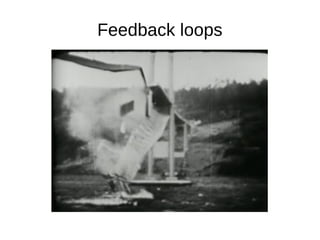
Feedback loops
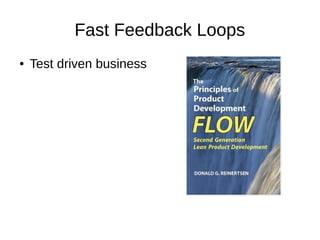
Fast Feedback Loops
● Test driven business
Fast Feedback Loops
● Test driven business
– It's like Test Driven
Design
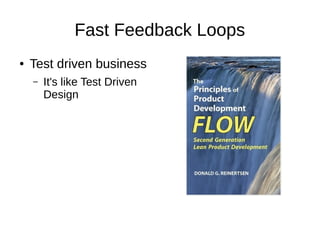
Fast Feedback Loops
● Test driven business
– It's like Test Driven
Design
● Enable IT to speak
the language of
business
Fast Feedback Loops
● Test driven business
– It's like Test Driven
Design
● Enable IT to speak
the language of
business
– Show me the data!
Fast Feedback Loops
● Test driven business
– It's like Test Driven
Design
● Enable IT to speak
the language of
business
– Show me the data!
– HIPPO
What makes software “good”?
● Developer metrics
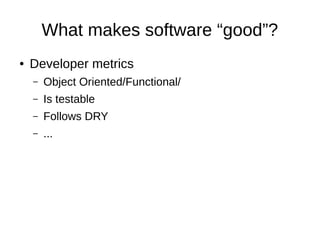
What makes software “good”?
● Developer metrics
– Object Oriented/Functional/
– Is testable
– Follows DRY
– ...
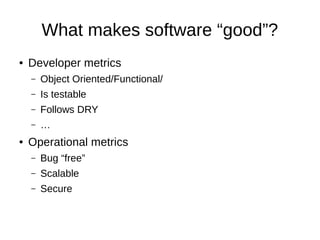
What makes software “good”?
● Developer metrics
– Object Oriented/Functional/
– Is testable
– Follows DRY
– …
● Operational metrics
– Bug “free”
– Scalable
– Secure
What makes software “good”?
● Business metrics
What makes software “good”?
● Business metrics
– Does it help me make money?
What makes software “good”?
● Business metrics
– Does it help me make money?
– Does it save me money?
What makes software “good”?
● Business metrics
– Does it help me make money?
– Does it save me money?
– Does it generate value?
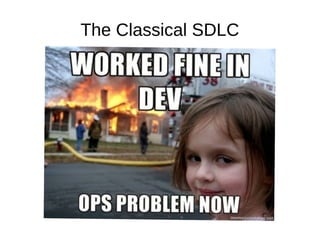
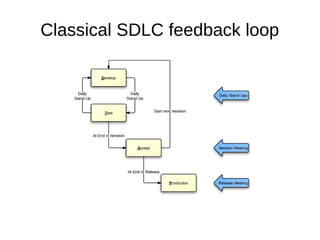
The Classical SDLC
Classical SDLC feedback loop
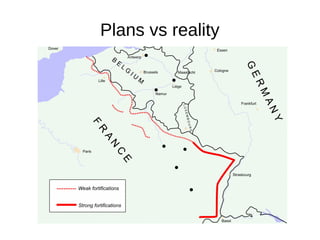
Plans vs reality
Testing vs Reality
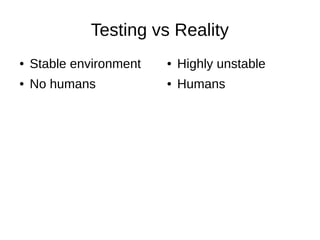
● Stable environment ● Highly unstable
Testing vs Reality
● Stable environment
● No humans
● Highly unstable
● Humans
Testing vs Reality
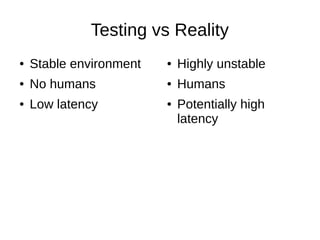
● Stable environment
● No humans
● Low latency
● Highly unstable
● Humans
● Potentially high
latency
Testing vs Reality
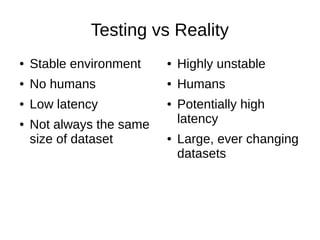
● Stable environment
● No humans
● Low latency
● Not always the same
size of dataset
● Highly unstable
● Humans
● Potentially high
latency
● Large, ever changing
datasets
Users
● Humans do strange things
Users
● Humans do strange things
● Or sometimes make mistakes
Users
● Humans do strange things
● Or sometimes make mistakes
● They come up with different requirements
Users
● Humans do strange things
● Or sometimes make mistakes
● They come up with different requirements
● They change the world your software works in
Risk management
● Approach 1:
– Scope your problems well
– Test a lot
– Release stable code
– Avoid changing a working system
Risk management
● Approach 2:
– Accept that you have an ill-defined problem
– Iterate rapidly
– Make a large number of small changes
– Build software to be able to isolate these changes
– Test them in the real world
– Keep only what works
What if When it breaks?
● Fix fast (maybe)
– “Do it right the first time” does not apply
● Business process for handling failure
– Hardware will eventually fail, software will
eventually work
The lifetime of code
● How long does your code live?
The lifetime of code
● How long does your code live?
– Hours or days?
● This should be most code out there
The lifetime of code
● How long does your code live?
– Hours or days?
● This should be most code out there
– Months?
● A little code, often “libraries” with a single application
The lifetime of code
● How long does your code live?
– Hours or days?
● This should be most code out there
– Months?
● A little code, often “libraries” with a single application
– Years?
● Very little. Just core libraries
The lifetime of code
● How long does your code live?
– Hours or days?
● This should be most code out there
– Months?
● A little code, often “libraries” with a single application
– Years?
● Very little. Just core libraries
● It is safe to delete code, if you are using version
control
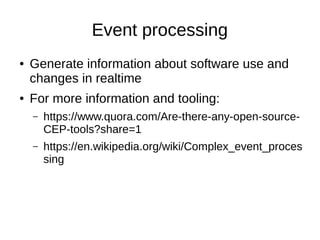
Event processing
● Generate information about software use and
changes in realtime
● For more information and tooling:
– https://www.quora.com/Are-there-any-open-source-
CEP-tools?share=1
– https://en.wikipedia.org/wiki/Complex_event_proces
sing
Event processing
● Generate information about software use and
changes in realtime
● For more information and tooling:
– https://www.quora.com/Are-there-any-open-source-
CEP-tools?share=1
– https://en.wikipedia.org/wiki/Complex_event_proces
sing
Monitoring/Alerting
● Process events to generate graphs
Monitoring/Alerting
● Process events to generate graphs
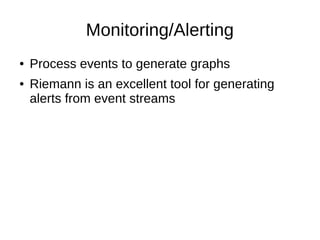
● Riemann is an excellent tool for generating
alerts from event streams
Monitoring/Alerting
● Process events to generate graphs
● Riemann is an excellent tool for generating
alerts from event streams
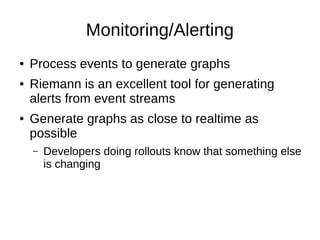
● Generate graphs as close to realtime as
possible
– Developers doing rollouts know that something else
is changing
Monitoring/Alerting
● Process events to generate graphs
● Riemann is an excellent tool for generating
alerts from event streams
● Generate graphs as close to realtime as
possible
– Developers doing rollouts know that something else
is changing
– Any major problems will be caught really quickly
Monitoring/Alerting
● Process events to generate graphs
● Riemann is an excellent tool for generating alerts
from event streams
● Generate graphs as close to realtime as possible
– Developers doing rollouts know that something else is
changing
– Any major problems will be caught really quickly
● Isolation of changes means that you can track
longer term effects of each change
OSMC 2015 | Testing in Production by Devdas Bhagat

OSMC 2015 | Testing in Production by Devdas Bhagat

  • 1.
    I have atest network. You may know it as production. – Andreas Thienemann Testing
  • 2.
    Asking the rightquestions ● Information is not a scarce resource, attention is – Herb Simon
  • 3.
    Asking the rightquestions ● Information is not a scarce resource, attention is – Herb Simon ● What do you know?
  • 4.
    Asking the rightquestions ● Information is not a scarce resource, attention is – Herb Simon ● What do you know? ● What do you not know?
  • 5.
    Asking the rightquestions ● Information is not a scarce resource, attention is – Herb Simon ● What do you know? ● What do you not know? ● What do you not know that you do not know?
  • 6.
  • 7.
    Fast Feedback Loops ●Test driven business
  • 8.
    Fast Feedback Loops ●Test driven business – It's like Test Driven Design
  • 9.
    Fast Feedback Loops ●Test driven business – It's like Test Driven Design ● Enable IT to speak the language of business
  • 10.
    Fast Feedback Loops ●Test driven business – It's like Test Driven Design ● Enable IT to speak the language of business – Show me the data!
  • 11.
    Fast Feedback Loops ●Test driven business – It's like Test Driven Design ● Enable IT to speak the language of business – Show me the data! – HIPPO
  • 12.
    What makes software“good”?
  • 13.
    What makes software“good”? ● Developer metrics
  • 14.
    What makes software“good”? ● Developer metrics – Object Oriented/Functional/ – Is testable – Follows DRY – ...
  • 15.
    What makes software“good”? ● Developer metrics – Object Oriented/Functional/ – Is testable – Follows DRY – … ● Operational metrics – Bug “free” – Scalable – Secure
  • 16.
    What makes software“good”? ● Business metrics
  • 17.
    What makes software“good”? ● Business metrics – Does it help me make money?
  • 18.
    What makes software“good”? ● Business metrics – Does it help me make money? – Does it save me money?
  • 19.
    What makes software“good”? ● Business metrics – Does it help me make money? – Does it save me money? – Does it generate value?
  • 20.
  • 21.
  • 22.
  • 24.
    Testing vs Reality ●Stable environment ● Highly unstable
  • 25.
    Testing vs Reality ●Stable environment ● No humans ● Highly unstable ● Humans
  • 26.
    Testing vs Reality ●Stable environment ● No humans ● Low latency ● Highly unstable ● Humans ● Potentially high latency
  • 27.
    Testing vs Reality ●Stable environment ● No humans ● Low latency ● Not always the same size of dataset ● Highly unstable ● Humans ● Potentially high latency ● Large, ever changing datasets
  • 28.
    Users ● Humans dostrange things
  • 29.
    Users ● Humans dostrange things ● Or sometimes make mistakes
  • 30.
    Users ● Humans dostrange things ● Or sometimes make mistakes ● They come up with different requirements
  • 31.
    Users ● Humans dostrange things ● Or sometimes make mistakes ● They come up with different requirements ● They change the world your software works in
  • 32.
    Risk management ● Approach1: – Scope your problems well – Test a lot – Release stable code – Avoid changing a working system
  • 33.
    Risk management ● Approach2: – Accept that you have an ill-defined problem – Iterate rapidly – Make a large number of small changes – Build software to be able to isolate these changes – Test them in the real world – Keep only what works
  • 34.
    What if Whenit breaks? ● Fix fast (maybe) – “Do it right the first time” does not apply ● Business process for handling failure – Hardware will eventually fail, software will eventually work
  • 35.
    The lifetime ofcode ● How long does your code live?
  • 36.
    The lifetime ofcode ● How long does your code live? – Hours or days? ● This should be most code out there
  • 37.
    The lifetime ofcode ● How long does your code live? – Hours or days? ● This should be most code out there – Months? ● A little code, often “libraries” with a single application
  • 38.
    The lifetime ofcode ● How long does your code live? – Hours or days? ● This should be most code out there – Months? ● A little code, often “libraries” with a single application – Years? ● Very little. Just core libraries
  • 39.
    The lifetime ofcode ● How long does your code live? – Hours or days? ● This should be most code out there – Months? ● A little code, often “libraries” with a single application – Years? ● Very little. Just core libraries ● It is safe to delete code, if you are using version control
  • 40.
    Event processing ● Generateinformation about software use and changes in realtime ● For more information and tooling: – https://www.quora.com/Are-there-any-open-source- CEP-tools?share=1 – https://en.wikipedia.org/wiki/Complex_event_proces sing
  • 41.
    Event processing ● Generateinformation about software use and changes in realtime ● For more information and tooling: – https://www.quora.com/Are-there-any-open-source- CEP-tools?share=1 – https://en.wikipedia.org/wiki/Complex_event_proces sing
  • 42.
  • 43.
    Monitoring/Alerting ● Process eventsto generate graphs ● Riemann is an excellent tool for generating alerts from event streams
  • 44.
    Monitoring/Alerting ● Process eventsto generate graphs ● Riemann is an excellent tool for generating alerts from event streams ● Generate graphs as close to realtime as possible – Developers doing rollouts know that something else is changing
  • 45.
    Monitoring/Alerting ● Process eventsto generate graphs ● Riemann is an excellent tool for generating alerts from event streams ● Generate graphs as close to realtime as possible – Developers doing rollouts know that something else is changing – Any major problems will be caught really quickly
  • 46.
    Monitoring/Alerting ● Process eventsto generate graphs ● Riemann is an excellent tool for generating alerts from event streams ● Generate graphs as close to realtime as possible – Developers doing rollouts know that something else is changing – Any major problems will be caught really quickly ● Isolation of changes means that you can track longer term effects of each change