Presented by:
Megan Meagher MS, CIH
Compliance Assistance Specialist
OSHA Denver Area Office
History of OSHA
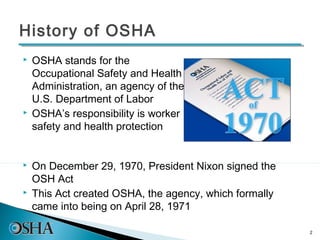
   OSHA stands for the
    Occupational Safety and Health
    Administration, an agency of the
    U.S. Department of Labor
   OSHA’s responsibility is worker
    safety and health protection


   On December 29, 1970, President Nixon signed the
    OSH Act
   This Act created OSHA, the agency, which formally
    came into being on April 28, 1971

                                                        2
OSHA’s Mission
 The mission of OSHA is to save lives, prevent
  injuries and protect the health of America’s
  workers.
 Some of the things OSHA does to carry out its

  mission are:
    ◦ developing job safety and health standards and enforcing
      them through worksite inspections,
    ◦ maintaining a reporting and recordkeeping system to keep
      track of job-related injuries and illnesses, and
    ◦ providing training programs to increase knowledge about
      occupational safety and health.


                                                                 3
What Rights Do You Have Under
OSHA?
   You have the right to:
    ◦   A safe and healthful workplace
    ◦   Know about hazardous chemicals
    ◦   Information about injuries and illnesses in your workplace
    ◦   Complain or request hazard correction from employer
    ◦   Training
    ◦   Hazard exposure and medical records
    ◦   File a complaint with OSHA
    ◦   Participate in an OSHA inspection
    ◦   Be free from retaliation for exercising safety and health
        rights


                                                                     4
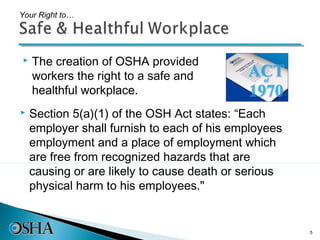
Your Right to…


   The creation of OSHA provided
    workers the right to a safe and
    healthful workplace.
   Section 5(a)(1) of the OSH Act states: “Each
    employer shall furnish to each of his employees
    employment and a place of employment which
    are free from recognized hazards that are
    causing or are likely to cause death or serious
    physical harm to his employees."


                                                      5
Your Right to…


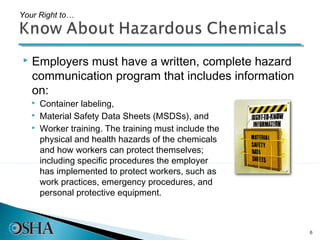
   Employers must have a written, complete hazard
    communication program that includes information
    on:
       Container labeling,
       Material Safety Data Sheets (MSDSs), and
       Worker training. The training must include the
        physical and health hazards of the chemicals
        and how workers can protect themselves;
        including specific procedures the employer
        has implemented to protect workers, such as
        work practices, emergency procedures, and
        personal protective equipment.


                                                         6
Modified Hazard
Communication Standard
Training
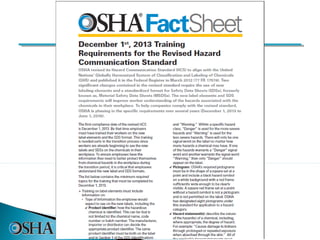
   Employers shall train employees regarding the
    new label elements and safety data sheets format
    by December 1, 2013.
Training
   Label elements
    » Train employees on the type of information that the
      employee would expect to see on the new labels.
    » How they might use that information.
      Product identifier, Signal word, Hazard statement(s),
       Pictogram(s), Precautionary statement(s), and Name, address
       and phone number of the responsible party.
      General understanding how the elements interact.
        For example, explain there are two signal words: Danger
         means a more severe hazard within a hazard class. Warning is
         for the less severe hazard
Training
   Safety Data Sheet Format
    » Train the employees on the standardized 16 section
      format and the type of information they would find in
      the various sections.
11
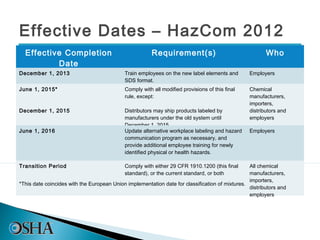
Effective Dates – HazCom 2012
  Effective Completion                                  Requirement(s)                                  Who
          Date
December 1, 2013                            Train employees on the new label elements and        Employers
                                            SDS format.
June 1, 2015*                               Comply with all modified provisions of this final    Chemical
                                            rule, except:                                        manufacturers,
                                                                                                 importers,
December 1, 2015                            Distributors may ship products labeled by            distributors and
                                            manufacturers under the old system until             employers
                                            December 1, 2015.
June 1, 2016                                Update alternative workplace labeling and hazard     Employers
                                            communication program as necessary, and
                                            provide additional employee training for newly
                                            identified physical or health hazards.

Transition Period                           Comply with either 29 CFR 1910.1200 (this final      All chemical
                                            standard), or the current standard, or both          manufacturers,
                                                                                                 importers,
*This date coincides with the European Union implementation date for classification of mixtures.
                                                                                                 distributors and
                                                                                                 employers
Your Right to…


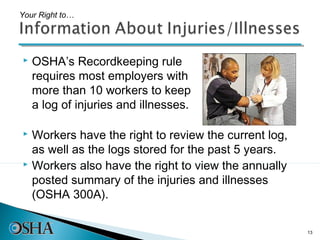
   OSHA’s Recordkeeping rule
    requires most employers with
    more than 10 workers to keep
    a log of injuries and illnesses.

 Workers have the right to review the current log,
  as well as the logs stored for the past 5 years.
 Workers also have the right to view the annually

  posted summary of the injuries and illnesses
  (OSHA 300A).

                                                      13
Your Right to…


 Workers may bring up safety and health concerns
  in the workplace to their employers without fear of
  discharge or discrimination, as long as the
  complaint is made in good faith.
 OSHA regulations [29CFR 1977.9(c)] protect

  workers who complain to their employer about
  unsafe or unhealthful conditions in the workplace.


                                                        14
Your Right to…


 Workers may file a complaint with OSHA if they
  believe a violation of a safety or health standard,
  or an imminent danger situation, exists in the
  workplace.
 Workers may request that their name not be

  revealed to the employer.
 If a worker files a complaint, they have the right to

  find out OSHA’s action on the complaint and
  request a review if an inspection is not made.


                                                          15
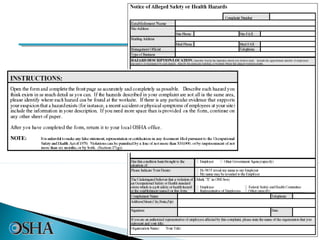
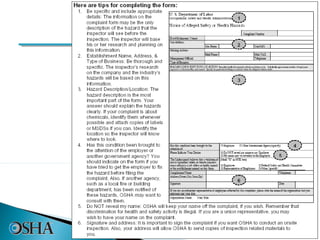
   Download the OSHA-7 form from OSHA’s website
   File the complaint online
    ◦ Workers can file a complaint
    ◦ A worker representative can file a complaint
   Telephone or visit local regional or area offices to
    discuss your concerns
   Complete the form – be specific and include appropriate
    details
   OSHA determines if an inspection is necessary
   Workers do not have to reveal their name


                                                              16
Your Right to…


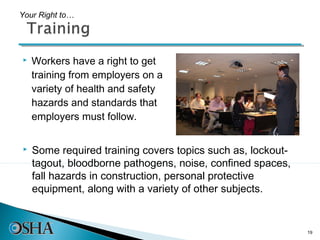
   Workers have a right to get
    training from employers on a
    variety of health and safety
    hazards and standards that
    employers must follow.


   Some required training covers topics such as, lockout-
    tagout, bloodborne pathogens, noise, confined spaces,
    fall hazards in construction, personal protective
    equipment, along with a variety of other subjects.


                                                             19
Your Right to…


 1910.1020: right to examine & copy records
 Examples of toxic substances and harmful

  physical agents are:
    ◦ Metals and dusts, such as, lead, cadmium, and silica.
    ◦ Biological agents, such as bacteria, viruses, and fungi.
    ◦ Physical stress, such as noise, heat, cold, vibration,
      repetitive motion, and ionizing and non-ionizing radiation.


                                                                    20
Your Right to…


 Employee representative can accompany OSHA
  inspector
 Workers can talk to the inspector privately.
 Workers may point out hazards, describe injuries,

  illnesses or near misses that resulted from those
  hazards and describe any concern you have
  about a safety or health issue.
 Workers can find out about inspection results,

  abatement measures and may object to dates set
  for violation to be corrected.

                                                      21
Your Right to…


 Workers have the right to be free from retaliation
  for exercising safety and health rights.
 Workers have a right to seek safety and health on

  the job without fear of punishment.
 This right is spelled out in Section 11(c) of the

  OSH Act.
 Workers have 30 days to contact OSHA if they

  feel they have been punished for exercising their
  safety and health rights.


                                                       22
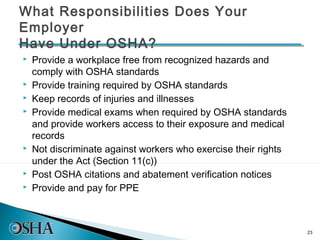
What Responsibilities Does Your
Employer
Have Under OSHA?
   Provide a workplace free from recognized hazards and
    comply with OSHA standards
   Provide training required by OSHA standards
   Keep records of injuries and illnesses
   Provide medical exams when required by OSHA standards
    and provide workers access to their exposure and medical
    records
   Not discriminate against workers who exercise their rights
    under the Act (Section 11(c))
   Post OSHA citations and abatement verification notices
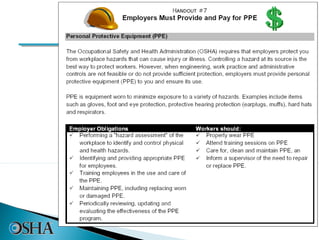
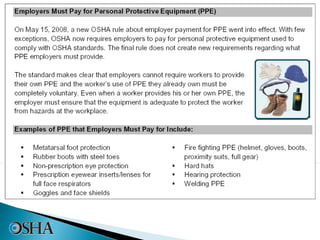
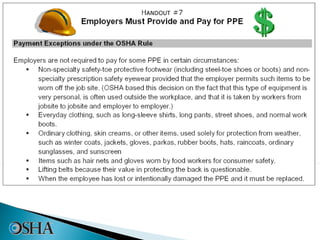
   Provide and pay for PPE


                                                                 23
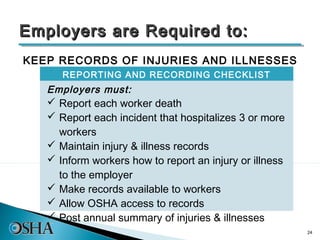
Employers are Required to:
KEEP RECORDS OF INJURIES AND ILLNESSES
      REPORTING AND RECORDING CHECKLIST
   Employers must:
    Report each worker death
    Report each incident that hospitalizes 3 or more
     workers
    Maintain injury & illness records
    Inform workers how to report an injury or illness
     to the employer
    Make records available to workers
    Allow OSHA access to records
    Post annual summary of injuries & illnesses
                                                         24
How are OSHA Inspections
Conducted?
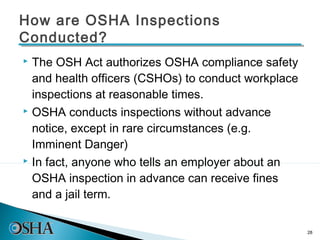
 The OSH Act authorizes OSHA compliance safety
  and health officers (CSHOs) to conduct workplace
  inspections at reasonable times.
 OSHA conducts inspections without advance

  notice, except in rare circumstances (e.g.
  Imminent Danger)
 In fact, anyone who tells an employer about an

  OSHA inspection in advance can receive fines
  and a jail term.

                                                     28
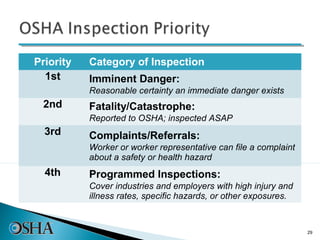
Priority   Category of Inspection
  1st      Imminent Danger:
           Reasonable certainty an immediate danger exists
 2nd       Fatality/Catastrophe:
           Reported to OSHA; inspected ASAP
  3rd      Complaints/Referrals:
           Worker or worker representative can file a complaint
           about a safety or health hazard
  4th      Programmed Inspections:
           Cover industries and employers with high injury and
           illness rates, specific hazards, or other exposures.


                                                                  29
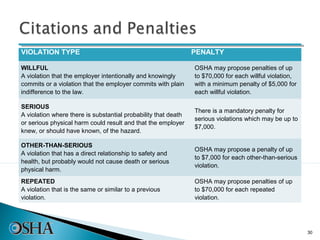
VIOLATION TYPE                                                  PENALTY

WILLFUL                                                         OSHA may propose penalties of up
A violation that the employer intentionally and knowingly       to $70,000 for each willful violation,
commits or a violation that the employer commits with plain     with a minimum penalty of $5,000 for
indifference to the law.                                        each willful violation.

SERIOUS
                                                                There is a mandatory penalty for
A violation where there is substantial probability that death
                                                                serious violations which may be up to
or serious physical harm could result and that the employer
                                                                $7,000.
knew, or should have known, of the hazard.

OTHER-THAN-SERIOUS
                                                                OSHA may propose a penalty of up
A violation that has a direct relationship to safety and
                                                                to $7,000 for each other-than-serious
health, but probably would not cause death or serious
                                                                violation.
physical harm.
REPEATED                                                        OSHA may propose penalties of up
A violation that is the same or similar to a previous           to $70,000 for each repeated
violation.                                                      violation.


                                                                                                         30
Where Can You Go For Help?
(Sources within the workplace/worksite)
 Employer or supervisor, co-workers and union
  representatives
 Material Safety Data Sheet (MSDS) for

  information on chemicals
 Labels and warning signs
 Employee orientation manuals or other training

  materials
 Work tasks and procedures instruction


                                                   31
Where Can You Go For Help?
(Sources outside the workplace/worksite)
   OSHA website: http://www.osha.gov
    ◦ Worker Rights Publications
    ◦ Teen Worker Publications
   Colorado OSHA offices (you can call or write)
   Compliance Assistance Specialists
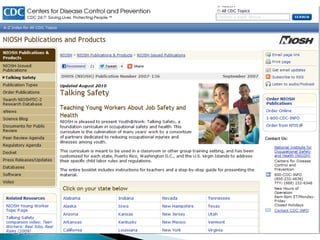
   National Institute for Occupational Safety and
    Health (NIOSH) – Young Worker Page
   OSHA Training Institute Ed Center at Red Rocks
   Public Libraries
   Other local, community-based resources

                                                     32
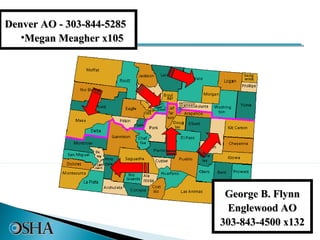
Denver AO - 303-844-5285
   •Megan Meagher x105


                            George B. Flynn
                            Englewood AO
                           303-843-4500 x132
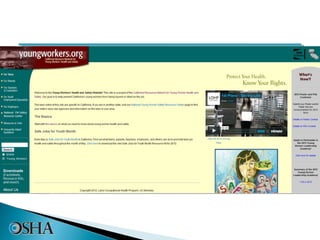
Hazards, Risks, and Rights
         in the Workplace

       www.youngworkers.org
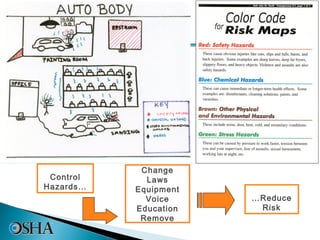
Change
 Control     Laws
Hazards…   Equipment
             Voice     …Reduce
           Education    Risk
            Remove
36
37
Disclaimer

   • This information has been developed by an OSHA Compliance
     Assistance Specialist and is intended to assist employers, workers,
     and others as they strive to improve workplace health and safety.
     While we attempt to thoroughly address specific topics, it is not
     possible to include discussion of everything necessary to ensure a
     healthy and safe working environment in a presentation of this
     nature. Thus, this information must be understood as a tool for
     addressing workplace hazards, rather than an exhaustive
     statement of an employer’s legal obligations, which are defined by
     statute, regulations, and standards. Likewise, to the extent that
     this information references practices or procedures that may
     enhance health or safety, but which are not required by a statute,
     regulation, or standard, it cannot, and does not, create additional
     legal obligations. Finally, over time, OSHA may modify rules and
     interpretations in light of new technology, information, or
     circumstances; to keep apprised of such developments, or to
     review information on a wide range of occupational safety and
     health topics, you can visit OSHA’s website at www.osha.gov.
Thank You!

Osha rights cdle 072911

  • 1.
    Presented by: Megan MeagherMS, CIH Compliance Assistance Specialist OSHA Denver Area Office
  • 2.
    History of OSHA  OSHA stands for the Occupational Safety and Health Administration, an agency of the U.S. Department of Labor  OSHA’s responsibility is worker safety and health protection  On December 29, 1970, President Nixon signed the OSH Act  This Act created OSHA, the agency, which formally came into being on April 28, 1971 2
  • 3.
    OSHA’s Mission  Themission of OSHA is to save lives, prevent injuries and protect the health of America’s workers.  Some of the things OSHA does to carry out its mission are: ◦ developing job safety and health standards and enforcing them through worksite inspections, ◦ maintaining a reporting and recordkeeping system to keep track of job-related injuries and illnesses, and ◦ providing training programs to increase knowledge about occupational safety and health. 3
  • 4.
    What Rights DoYou Have Under OSHA?  You have the right to: ◦ A safe and healthful workplace ◦ Know about hazardous chemicals ◦ Information about injuries and illnesses in your workplace ◦ Complain or request hazard correction from employer ◦ Training ◦ Hazard exposure and medical records ◦ File a complaint with OSHA ◦ Participate in an OSHA inspection ◦ Be free from retaliation for exercising safety and health rights 4
  • 5.
    Your Right to…  The creation of OSHA provided workers the right to a safe and healthful workplace.  Section 5(a)(1) of the OSH Act states: “Each employer shall furnish to each of his employees employment and a place of employment which are free from recognized hazards that are causing or are likely to cause death or serious physical harm to his employees." 5
  • 6.
    Your Right to…  Employers must have a written, complete hazard communication program that includes information on:  Container labeling,  Material Safety Data Sheets (MSDSs), and  Worker training. The training must include the physical and health hazards of the chemicals and how workers can protect themselves; including specific procedures the employer has implemented to protect workers, such as work practices, emergency procedures, and personal protective equipment. 6
  • 7.
  • 8.
    Training  Employers shall train employees regarding the new label elements and safety data sheets format by December 1, 2013.
  • 9.
    Training  Label elements » Train employees on the type of information that the employee would expect to see on the new labels. » How they might use that information.  Product identifier, Signal word, Hazard statement(s), Pictogram(s), Precautionary statement(s), and Name, address and phone number of the responsible party.  General understanding how the elements interact.  For example, explain there are two signal words: Danger means a more severe hazard within a hazard class. Warning is for the less severe hazard
  • 10.
    Training  Safety Data Sheet Format » Train the employees on the standardized 16 section format and the type of information they would find in the various sections.
  • 11.
  • 12.
    Effective Dates –HazCom 2012 Effective Completion Requirement(s) Who Date December 1, 2013 Train employees on the new label elements and Employers SDS format. June 1, 2015* Comply with all modified provisions of this final Chemical rule, except: manufacturers, importers, December 1, 2015 Distributors may ship products labeled by distributors and manufacturers under the old system until employers December 1, 2015. June 1, 2016 Update alternative workplace labeling and hazard Employers communication program as necessary, and provide additional employee training for newly identified physical or health hazards. Transition Period Comply with either 29 CFR 1910.1200 (this final All chemical standard), or the current standard, or both manufacturers, importers, *This date coincides with the European Union implementation date for classification of mixtures. distributors and employers
  • 13.
    Your Right to…  OSHA’s Recordkeeping rule requires most employers with more than 10 workers to keep a log of injuries and illnesses.  Workers have the right to review the current log, as well as the logs stored for the past 5 years.  Workers also have the right to view the annually posted summary of the injuries and illnesses (OSHA 300A). 13
  • 14.
    Your Right to… Workers may bring up safety and health concerns in the workplace to their employers without fear of discharge or discrimination, as long as the complaint is made in good faith.  OSHA regulations [29CFR 1977.9(c)] protect workers who complain to their employer about unsafe or unhealthful conditions in the workplace. 14
  • 15.
    Your Right to… Workers may file a complaint with OSHA if they believe a violation of a safety or health standard, or an imminent danger situation, exists in the workplace.  Workers may request that their name not be revealed to the employer.  If a worker files a complaint, they have the right to find out OSHA’s action on the complaint and request a review if an inspection is not made. 15
  • 16.
    Download the OSHA-7 form from OSHA’s website  File the complaint online ◦ Workers can file a complaint ◦ A worker representative can file a complaint  Telephone or visit local regional or area offices to discuss your concerns  Complete the form – be specific and include appropriate details  OSHA determines if an inspection is necessary  Workers do not have to reveal their name 16
  • 19.
    Your Right to…  Workers have a right to get training from employers on a variety of health and safety hazards and standards that employers must follow.  Some required training covers topics such as, lockout- tagout, bloodborne pathogens, noise, confined spaces, fall hazards in construction, personal protective equipment, along with a variety of other subjects. 19
  • 20.
    Your Right to… 1910.1020: right to examine & copy records  Examples of toxic substances and harmful physical agents are: ◦ Metals and dusts, such as, lead, cadmium, and silica. ◦ Biological agents, such as bacteria, viruses, and fungi. ◦ Physical stress, such as noise, heat, cold, vibration, repetitive motion, and ionizing and non-ionizing radiation. 20
  • 21.
    Your Right to… Employee representative can accompany OSHA inspector  Workers can talk to the inspector privately.  Workers may point out hazards, describe injuries, illnesses or near misses that resulted from those hazards and describe any concern you have about a safety or health issue.  Workers can find out about inspection results, abatement measures and may object to dates set for violation to be corrected. 21
  • 22.
    Your Right to… Workers have the right to be free from retaliation for exercising safety and health rights.  Workers have a right to seek safety and health on the job without fear of punishment.  This right is spelled out in Section 11(c) of the OSH Act.  Workers have 30 days to contact OSHA if they feel they have been punished for exercising their safety and health rights. 22
  • 23.
    What Responsibilities DoesYour Employer Have Under OSHA?  Provide a workplace free from recognized hazards and comply with OSHA standards  Provide training required by OSHA standards  Keep records of injuries and illnesses  Provide medical exams when required by OSHA standards and provide workers access to their exposure and medical records  Not discriminate against workers who exercise their rights under the Act (Section 11(c))  Post OSHA citations and abatement verification notices  Provide and pay for PPE 23
  • 24.
    Employers are Requiredto: KEEP RECORDS OF INJURIES AND ILLNESSES REPORTING AND RECORDING CHECKLIST Employers must:  Report each worker death  Report each incident that hospitalizes 3 or more workers  Maintain injury & illness records  Inform workers how to report an injury or illness to the employer  Make records available to workers  Allow OSHA access to records  Post annual summary of injuries & illnesses 24
  • 28.
    How are OSHAInspections Conducted?  The OSH Act authorizes OSHA compliance safety and health officers (CSHOs) to conduct workplace inspections at reasonable times.  OSHA conducts inspections without advance notice, except in rare circumstances (e.g. Imminent Danger)  In fact, anyone who tells an employer about an OSHA inspection in advance can receive fines and a jail term. 28
  • 29.
    Priority Category of Inspection 1st Imminent Danger: Reasonable certainty an immediate danger exists 2nd Fatality/Catastrophe: Reported to OSHA; inspected ASAP 3rd Complaints/Referrals: Worker or worker representative can file a complaint about a safety or health hazard 4th Programmed Inspections: Cover industries and employers with high injury and illness rates, specific hazards, or other exposures. 29
  • 30.
    VIOLATION TYPE PENALTY WILLFUL OSHA may propose penalties of up A violation that the employer intentionally and knowingly to $70,000 for each willful violation, commits or a violation that the employer commits with plain with a minimum penalty of $5,000 for indifference to the law. each willful violation. SERIOUS There is a mandatory penalty for A violation where there is substantial probability that death serious violations which may be up to or serious physical harm could result and that the employer $7,000. knew, or should have known, of the hazard. OTHER-THAN-SERIOUS OSHA may propose a penalty of up A violation that has a direct relationship to safety and to $7,000 for each other-than-serious health, but probably would not cause death or serious violation. physical harm. REPEATED OSHA may propose penalties of up A violation that is the same or similar to a previous to $70,000 for each repeated violation. violation. 30
  • 31.
    Where Can YouGo For Help? (Sources within the workplace/worksite)  Employer or supervisor, co-workers and union representatives  Material Safety Data Sheet (MSDS) for information on chemicals  Labels and warning signs  Employee orientation manuals or other training materials  Work tasks and procedures instruction 31
  • 32.
    Where Can YouGo For Help? (Sources outside the workplace/worksite)  OSHA website: http://www.osha.gov ◦ Worker Rights Publications ◦ Teen Worker Publications  Colorado OSHA offices (you can call or write)  Compliance Assistance Specialists  National Institute for Occupational Safety and Health (NIOSH) – Young Worker Page  OSHA Training Institute Ed Center at Red Rocks  Public Libraries  Other local, community-based resources 32
  • 33.
    Denver AO -303-844-5285 •Megan Meagher x105 George B. Flynn Englewood AO 303-843-4500 x132
  • 34.
    Hazards, Risks, andRights in the Workplace www.youngworkers.org
  • 35.
    Change Control Laws Hazards… Equipment Voice …Reduce Education Risk Remove
  • 36.
  • 37.
  • 38.
    Disclaimer • This information has been developed by an OSHA Compliance Assistance Specialist and is intended to assist employers, workers, and others as they strive to improve workplace health and safety. While we attempt to thoroughly address specific topics, it is not possible to include discussion of everything necessary to ensure a healthy and safe working environment in a presentation of this nature. Thus, this information must be understood as a tool for addressing workplace hazards, rather than an exhaustive statement of an employer’s legal obligations, which are defined by statute, regulations, and standards. Likewise, to the extent that this information references practices or procedures that may enhance health or safety, but which are not required by a statute, regulation, or standard, it cannot, and does not, create additional legal obligations. Finally, over time, OSHA may modify rules and interpretations in light of new technology, information, or circumstances; to keep apprised of such developments, or to review information on a wide range of occupational safety and health topics, you can visit OSHA’s website at www.osha.gov.
  • 39.

Editor's Notes

  • #2 INTRODUCTION TO OSHA 02.12.10