Don’t Let These 10 ROCs Sink Your Contract Chances Oscar Womack, Jr., CPCM, C.P.M. Coherent Contracts, LLC ©  2010 Coherent Contracts, LLC.  All Rights Reserved.
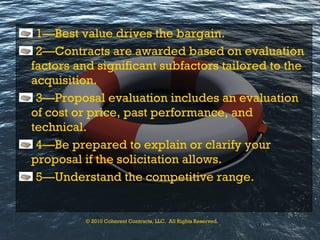
1—Best value drives the bargain. 2—Contracts are awarded based on evaluation factors and significant subfactors tailored to the acquisition. 3—Proposal evaluation includes an evaluation of cost or price, past performance, and technical. 4—Be prepared to explain or clarify your proposal if the solicitation allows. 5—Understand the competitive range. © 2010 Coherent Contracts, LLC.  All Rights Reserved.
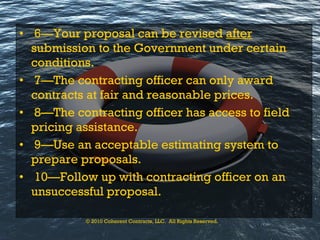
6—Your proposal can be revised  after  submission to the Government under certain conditions. 7—The contracting officer can only award contracts at fair and reasonable prices. 8—The contracting officer has access to field pricing assistance. 9—Use an acceptable estimating system to prepare proposals. 10—Follow up with contracting officer on an unsuccessful proposal. © 2010 Coherent Contracts, LLC.  All Rights Reserved.
 
1—Best value drives the bargain. “ The objective of source selection is to select the proposal that represents the  best   value  .”  -- Federal Acquisition Regulation (FAR) 15.302 © 2010 Coherent Contracts, LLC.  All Rights Reserved.
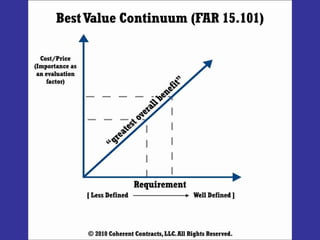
Best Value—the  ex p ected   outcome  of an acquisition that, in the Government’s estimation, provides the g reatest   overall   benefit  in response to the requirement. © 2010 Coherent Contracts, LLC.  All Rights Reserved.
 
2—Contracts are awarded based on evaluation factors and significant subfactors tailored to the acquisition. Evaluation factors and significant subfactors must— (1)  Represent the key   areas of importance   and emphasis to be considered in the source selection decision; and (2)  Support meaningful  com p arison  and  discrimination  between and among competing proposals. © 2010 Coherent Contracts, LLC.  All Rights Reserved.
 
Every source selection must evaluate: Price  or  cost  to the Government Q ualit y of the product or service by considering one or more  non -cost evaluation factors such as Past performance Compliance with solicitation requirements Technical excellence Management capability Personnel qualifications Prior experience © 2010 Coherent Contracts, LLC.  All Rights Reserved.
 
3—Proposal evaluation includes an evaluation of cost or price, past performance, and technical. Government source selection team “shall evaluate  com p etitive  proposals and then assess their relative qualities  solel y on the  factors  and  subfactors  specified in the solicitation.” [FAR 15.305(a)] © 2010 Coherent Contracts, LLC.  All Rights Reserved.
Cost realism means that the costs in an offeror’s proposal— (1)  Are realistic for the work to be performed (2)  Reflect  a  clear  understanding of the requirements (3)  Are  consistent  with the various elements of the offeror’s  technical  proposal [ FAR 2.101] © 2010 Coherent Contracts, LLC.  All Rights Reserved.
Key aspects in evaluating past performance involve the  currenc y and  relevance  of the information,  context  of the data, and g eneral   trends  in contractor performance.  The solicitation must describe the approach for evaluating offerors with no relevant performance history, and must provide offerors an opportunity   to identify past or current contracts (including Federal, state, and local   government and private) for efforts similar to the Government requirement.  © 2010 Coherent Contracts, LLC.  All Rights Reserved.
The tradeoff process is appropriate when it may be in the  best  interest of the Government to consider award to  other  than the  lowest  priced offeror or  other  than the  hi g hest  technically rated offeror.   © 2010 Coherent Contracts, LLC.  All Rights Reserved.
Solicitation must  clearl y state all factors and significant subfactors  affectin g contract award as well as  relative  importance Solicitation must also state, at a  minimum , whether all evaluation factors other than cost or price, when combined, are Si g nificantl y more important than cost or price A pp roximatel y equal to cost or price Si g nificantl y  less  important than cost or price © 2010 Coherent Contracts, LLC.  All Rights Reserved.
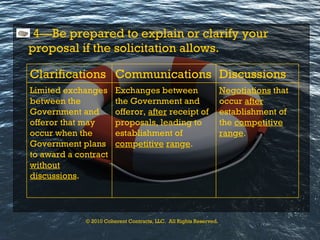
4—Be prepared to explain or clarify your proposal if the solicitation allows. © 2010 Coherent Contracts, LLC.  All Rights Reserved. Clarifications Communications Discussions Limited exchanges between the Government and offeror that may occur when the Government plans to award a contract  without   discussions . Exchanges between the Government and offeror,  after  receipt of proposals, leading to establishment of  com p etitive   ran g e . Ne g otiations  that occur  after  establishment of the  com p etitive   ran g e .
5—Understand the competitive range. Competitive range is established based on the ratings of each proposal against all evaluation factors. --  Comprised of all of the  most   hi g hl y  rated  proposals. © 2010 Coherent Contracts, LLC.  All Rights Reserved.
6—Your proposal can be revised  after  submission to the Government under certain conditions. Negotiations/discussions are held with offerors within the  com p etitive   ran g e  to allow offerors to  revise  their proposals. © 2010 Coherent Contracts, LLC.  All Rights Reserved.
At a minimum, the contracting officer must discuss the following with each offeror in the competitive range: 1)  Deficiencies  in the offeror’s proposal 2)  Significant proposal  weaknesses 3)  Adverse past performance information to which the offeror has not yet had an opportunity to respond © 2010 Coherent Contracts, LLC.  All Rights Reserved.
At the conclusion of discussions, each offeror still in the competitive range must be given an opportunity to submit a final   proposal revision.   © 2010 Coherent Contracts, LLC.  All Rights Reserved.
7—The contracting officer can only award contracts at fair and reasonable prices. “ Fair and reasonable price”—a price that is fair to  both  parties, considering the agreed-upon  conditions , promised quality, and timeliness of contract performance. --  NCMA Desktop Guide to Basic Contracting Terms © 2010 Coherent Contracts, LLC.  All Rights Reserved.
Contracting officer encouraged to “not obtain more [pricing] information than is necessary.” --  FAR 15.402(a) © 2010 Coherent Contracts, LLC.  All Rights Reserved.
Two Most Common Pricing Strategies 1—Lowest- Price -Technically- Acce p table  (L P T A ) 2— Best   Value © 2010 Coherent Contracts, LLC.  All Rights Reserved.
8—The contracting officer has access to field pricing assistance. Technical, audit, and special reports associated with the cost elements of a proposal. Information on related pricing practices and history. Information to help contracting officers determine  commercialit y and price  reasonableness . © 2010 Coherent Contracts, LLC.  All Rights Reserved.
Two Key Field Pricing Assistance Agencies 1—Defense Contract  A udit Agency (DC A A) 2—Defense Contract  M anagement Agency (DC M A) © 2010 Coherent Contracts, LLC.  All Rights Reserved.
9—Use an acceptable estimating system to prepare proposals. The primary goal of a cost estimating and accounting system is to ensure that costs are  a pp ro p riatel y,  e q uitabl y, and  consistentl y estimated and then  allocated  to all final cost objectives.   -- Gregory A. Garrett,  Cost Estimatin g  and Contract Pricin g © 2010 Coherent Contracts, LLC.  All Rights Reserved.
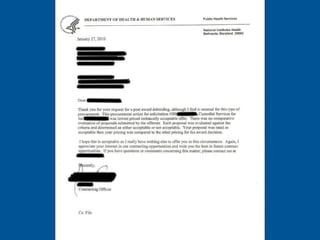
10—Follow up with contracting officer on an unsuccessful proposal. (1)  Disappointed offerors must be  notified  of an award within  three  days of  contract   award . (2)  When an award is made on the basis of  competitive  proposals, a debriefing must be provided if the procuring agency receives a written request for a debriefing from an  unsuccessful  offeror within  three  days of the date on which the  unsuccessful  offeror received  notice  of  award . (3)  The debriefing must be provided, to the maximum extent practicable, within  five  days of the agency’s receipt of the request. (4)  The debriefing must meet certain minimum requirements. © 2010 Coherent Contracts, LLC.  All Rights Reserved.
 
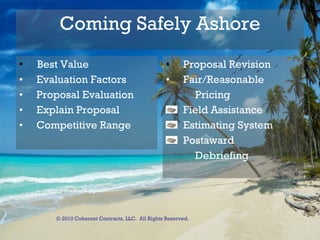
Coming Safely Ashore Best Value Evaluation Factors Proposal Evaluation Explain Proposal Competitive Range Proposal Revision Fair/Reasonable  Pricing Field Assistance Estimating System Postaward Debriefing © 2010 Coherent Contracts, LLC.  All Rights Reserved.
Oscar Womack, Jr., CPCM, C.P.M. Coherent Contracts, LLC (405) 739-6500 www.coherentcontracts.com © 2010 Coherent Contracts, LLC.  All Rights Reserved.

Oscar womack, jr. 11 03-2010

  • 1.
    Don’t Let These10 ROCs Sink Your Contract Chances Oscar Womack, Jr., CPCM, C.P.M. Coherent Contracts, LLC © 2010 Coherent Contracts, LLC. All Rights Reserved.
  • 2.
    1—Best value drivesthe bargain. 2—Contracts are awarded based on evaluation factors and significant subfactors tailored to the acquisition. 3—Proposal evaluation includes an evaluation of cost or price, past performance, and technical. 4—Be prepared to explain or clarify your proposal if the solicitation allows. 5—Understand the competitive range. © 2010 Coherent Contracts, LLC. All Rights Reserved.
  • 3.
    6—Your proposal canbe revised after submission to the Government under certain conditions. 7—The contracting officer can only award contracts at fair and reasonable prices. 8—The contracting officer has access to field pricing assistance. 9—Use an acceptable estimating system to prepare proposals. 10—Follow up with contracting officer on an unsuccessful proposal. © 2010 Coherent Contracts, LLC. All Rights Reserved.
  • 4.
  • 5.
    1—Best value drivesthe bargain. “ The objective of source selection is to select the proposal that represents the best value .” -- Federal Acquisition Regulation (FAR) 15.302 © 2010 Coherent Contracts, LLC. All Rights Reserved.
  • 6.
    Best Value—the ex p ected outcome of an acquisition that, in the Government’s estimation, provides the g reatest overall benefit in response to the requirement. © 2010 Coherent Contracts, LLC. All Rights Reserved.
  • 7.
  • 8.
    2—Contracts are awardedbased on evaluation factors and significant subfactors tailored to the acquisition. Evaluation factors and significant subfactors must— (1) Represent the key areas of importance and emphasis to be considered in the source selection decision; and (2) Support meaningful com p arison and discrimination between and among competing proposals. © 2010 Coherent Contracts, LLC. All Rights Reserved.
  • 9.
  • 10.
    Every source selectionmust evaluate: Price or cost to the Government Q ualit y of the product or service by considering one or more non -cost evaluation factors such as Past performance Compliance with solicitation requirements Technical excellence Management capability Personnel qualifications Prior experience © 2010 Coherent Contracts, LLC. All Rights Reserved.
  • 11.
  • 12.
    3—Proposal evaluation includesan evaluation of cost or price, past performance, and technical. Government source selection team “shall evaluate com p etitive proposals and then assess their relative qualities solel y on the factors and subfactors specified in the solicitation.” [FAR 15.305(a)] © 2010 Coherent Contracts, LLC. All Rights Reserved.
  • 13.
    Cost realism meansthat the costs in an offeror’s proposal— (1) Are realistic for the work to be performed (2) Reflect a clear understanding of the requirements (3) Are consistent with the various elements of the offeror’s technical proposal [ FAR 2.101] © 2010 Coherent Contracts, LLC. All Rights Reserved.
  • 14.
    Key aspects inevaluating past performance involve the currenc y and relevance of the information, context of the data, and g eneral trends in contractor performance. The solicitation must describe the approach for evaluating offerors with no relevant performance history, and must provide offerors an opportunity to identify past or current contracts (including Federal, state, and local government and private) for efforts similar to the Government requirement. © 2010 Coherent Contracts, LLC. All Rights Reserved.
  • 15.
    The tradeoff processis appropriate when it may be in the best interest of the Government to consider award to other than the lowest priced offeror or other than the hi g hest technically rated offeror. © 2010 Coherent Contracts, LLC. All Rights Reserved.
  • 16.
    Solicitation must clearl y state all factors and significant subfactors affectin g contract award as well as relative importance Solicitation must also state, at a minimum , whether all evaluation factors other than cost or price, when combined, are Si g nificantl y more important than cost or price A pp roximatel y equal to cost or price Si g nificantl y less important than cost or price © 2010 Coherent Contracts, LLC. All Rights Reserved.
  • 17.
    4—Be prepared toexplain or clarify your proposal if the solicitation allows. © 2010 Coherent Contracts, LLC. All Rights Reserved. Clarifications Communications Discussions Limited exchanges between the Government and offeror that may occur when the Government plans to award a contract without discussions . Exchanges between the Government and offeror, after receipt of proposals, leading to establishment of com p etitive ran g e . Ne g otiations that occur after establishment of the com p etitive ran g e .
  • 18.
    5—Understand the competitiverange. Competitive range is established based on the ratings of each proposal against all evaluation factors. -- Comprised of all of the most hi g hl y rated proposals. © 2010 Coherent Contracts, LLC. All Rights Reserved.
  • 19.
    6—Your proposal canbe revised after submission to the Government under certain conditions. Negotiations/discussions are held with offerors within the com p etitive ran g e to allow offerors to revise their proposals. © 2010 Coherent Contracts, LLC. All Rights Reserved.
  • 20.
    At a minimum,the contracting officer must discuss the following with each offeror in the competitive range: 1) Deficiencies in the offeror’s proposal 2) Significant proposal weaknesses 3) Adverse past performance information to which the offeror has not yet had an opportunity to respond © 2010 Coherent Contracts, LLC. All Rights Reserved.
  • 21.
    At the conclusionof discussions, each offeror still in the competitive range must be given an opportunity to submit a final proposal revision. © 2010 Coherent Contracts, LLC. All Rights Reserved.
  • 22.
    7—The contracting officercan only award contracts at fair and reasonable prices. “ Fair and reasonable price”—a price that is fair to both parties, considering the agreed-upon conditions , promised quality, and timeliness of contract performance. -- NCMA Desktop Guide to Basic Contracting Terms © 2010 Coherent Contracts, LLC. All Rights Reserved.
  • 23.
    Contracting officer encouragedto “not obtain more [pricing] information than is necessary.” -- FAR 15.402(a) © 2010 Coherent Contracts, LLC. All Rights Reserved.
  • 24.
    Two Most CommonPricing Strategies 1—Lowest- Price -Technically- Acce p table (L P T A ) 2— Best Value © 2010 Coherent Contracts, LLC. All Rights Reserved.
  • 25.
    8—The contracting officerhas access to field pricing assistance. Technical, audit, and special reports associated with the cost elements of a proposal. Information on related pricing practices and history. Information to help contracting officers determine commercialit y and price reasonableness . © 2010 Coherent Contracts, LLC. All Rights Reserved.
  • 26.
    Two Key FieldPricing Assistance Agencies 1—Defense Contract A udit Agency (DC A A) 2—Defense Contract M anagement Agency (DC M A) © 2010 Coherent Contracts, LLC. All Rights Reserved.
  • 27.
    9—Use an acceptableestimating system to prepare proposals. The primary goal of a cost estimating and accounting system is to ensure that costs are a pp ro p riatel y, e q uitabl y, and consistentl y estimated and then allocated to all final cost objectives. -- Gregory A. Garrett, Cost Estimatin g and Contract Pricin g © 2010 Coherent Contracts, LLC. All Rights Reserved.
  • 28.
    10—Follow up withcontracting officer on an unsuccessful proposal. (1) Disappointed offerors must be notified of an award within three days of contract award . (2) When an award is made on the basis of competitive proposals, a debriefing must be provided if the procuring agency receives a written request for a debriefing from an unsuccessful offeror within three days of the date on which the unsuccessful offeror received notice of award . (3) The debriefing must be provided, to the maximum extent practicable, within five days of the agency’s receipt of the request. (4) The debriefing must meet certain minimum requirements. © 2010 Coherent Contracts, LLC. All Rights Reserved.
  • 29.
  • 30.
    Coming Safely AshoreBest Value Evaluation Factors Proposal Evaluation Explain Proposal Competitive Range Proposal Revision Fair/Reasonable Pricing Field Assistance Estimating System Postaward Debriefing © 2010 Coherent Contracts, LLC. All Rights Reserved.
  • 31.
    Oscar Womack, Jr.,CPCM, C.P.M. Coherent Contracts, LLC (405) 739-6500 www.coherentcontracts.com © 2010 Coherent Contracts, LLC. All Rights Reserved.