Online Reputation Monitoring in Twitter
from an Information Access Perspective
Damiano Spina
damiano@lsi.uned.es
@damiano10

UNED NLP & IR Group
January 29, 2014
FdI UCM, Madrid, Spain
In Collaboration with
University of Amsterdam
●

Julio Gonzalo

●

Maarten de Rijke

●

Enrique Amigó

●

Edgar Meij (Yahoo! Barcelona)

●

Jorge Carrillo de Albornoz

●

Mª Hendrike Peetz

●

Irina Chugur

●

Tamara Martín

Llorente & Cuenca
●

●

Ana Pitart

●

LiMoSINe EU Project
www.limosine-project.eu

Vanessa Álvarez

Adolfo Corujo
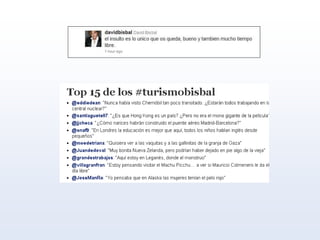
Arab Spring in Egypt, Jan 2011
Online Reputation Monitoring (ORM)
●

Reputation/public image is key for entities:
–

Companies, Organizations, Personalities
Online Reputation Monitoring (ORM)
●

Reputation/public image is key for entities:
–

●

Companies, Organizations, Personalities

Social Media:
–

Necessity (and opportunity) of handling the public image
of entities on the Web
Online Reputation Monitoring (ORM)
●

Reputation/public image is key for entities:
–

●

Companies, Organizations, Personalities

Social Media:
–

Necessity (and opportunity) of handling the public image
of entities on the Web

–

Online Reputation Managers/Analysts
●

Handle the reputation of an entity of interest (i.e., customer)

●

Among other tasks, monitoring Social Media (manually!)
–

Early detection of issues/conversations/topics that may damage the
reputation of the entity of interest
Automatic Tools for ORM
Information Access (IA) techniques for
-Tracking Relevant Mentions
- Sentiment Analysis
- Discover Keywords/Topics
Problem
●

Lack of standard benchmarks

for evaluation
Problem
●

Lack of standard benchmarks

for evaluation

●

It is hard for the analysts to know
how automatic tools will perform
on their real data
Goals
●

Formalize the Online Reputation Monitoring
problem as scientific challenges
Goals
●

Formalize the Online Reputation Monitoring
problem as scientific challenges
–

Build standard test collections

–

Organize International evaluation campaigns

–

Bring together ORM and IA experts from Industrial and
Academic communities
Goals
●

Formalize the Online Reputation Monitoring
problem as scientific challenges
–
–

Organize International evaluation campaigns

–

●

Build standard test collections

Bring together ORM and IA experts from Industrial and
Academic communities

Propose automatic solutions that may assist the
reputation manager, reducing the effort in their daily
work
Outline
●

Online Reputation Monitoring in Twitter
Outline
●

Online Reputation Monitoring in Twitter

●

Formalization from an Information Access perspective
–

Tasks Definition

–

Evaluation Framework
Outline
●

Online Reputation Monitoring in Twitter

●

Formalization from an Information Access perspective
–
–

●

Tasks Definition
Evaluation Framework

How much of the problem can be solved automatically?
–

Filtering

–

Topic Detection
Outline
●

Online Reputation Monitoring in Twitter

●

Formalization from an Information Access perspective
–
–

●

Tasks Definition
Evaluation Framework

How much of the problem can be solved automatically?
–
–

●

Filtering
Topic Detection

Putting the Human in the Loop: A Semi-Automatic ORM
Assistant
Online Reputation Monitoring in
Twitter
●

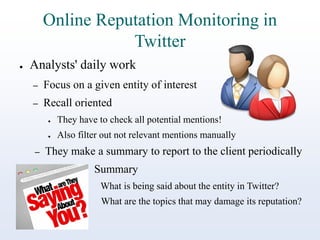
Analysts' daily work
–

Focus on a given entity of interest
Online Reputation Monitoring in
Twitter
●

Analysts' daily work
–

Focus on a given entity of interest

–

Recall oriented
●

They have to check all potential mentions!

●

Also filter out not relevant mentions manually
Online Reputation Monitoring in
Twitter
●

Analysts' daily work
–

Focus on a given entity of interest

–

Recall oriented
●
●

–

They have to check all potential mentions!

Also filter out not relevant mentions manually

They make a summary to report to the client periodically
Summary

–
●

What is being said about the entity in Twitter?
What are the topics that may damage its reputation?
Why Twitter?
●

●

(Bad) news spread earlier/faster/more unpredictable
than any other source in the Web
Most popular microblogging service
–

>230M monthly active users

–

5k tweets published per second
Why Twitter?
●

●

(Bad) news spread earlier/faster/more unpredictable
than any other source in the Web
Most popular microblogging service
–

–
●

>230M monthly active users

5k tweets published per second

Challenging for Information Access
–

Little context (only 140 characters)

–

Non-standard, SMS-like language
Online Reputation Monitoring in
Twitter
Online Reputation Monitoring in
Twitter

?
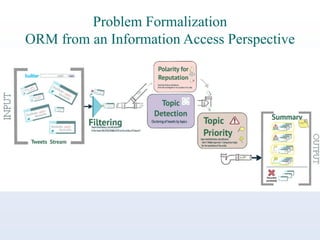
Problem Formalization
ORM from an Information Access Perspective
Filtering Task
●

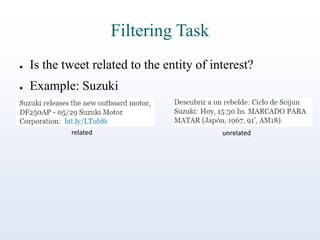
Is the tweet related to the entity of interest?

●

Example: Suzuki

related

unrelated
Filtering Task
●

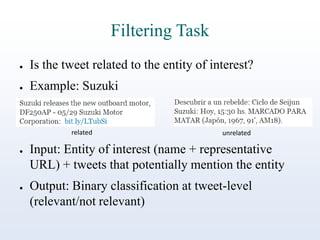
Is the tweet related to the entity of interest?

●

Example: Suzuki

related
●

●

unrelated

Input: Entity of interest (name + representative
URL) + tweets that potentially mention the entity

Output: Binary classification at tweet-level
(relevant/not relevant)
Polarity for Reputation Task
●

●

Does the tweet affect negatively/positively to the reputation
of the entity?
Example: Goldman Sachs
Polarity for Reputation Task
●

●

●

●

Does the tweet affect negatively/positively to the reputation
of the entity?
Example: Goldman Sachs

Input: Entity of interest (name + representative URL) +
Stream of tweets that potentially mention the entity

Output: Multi-class classification at tweet-level
(positive/negative/neutral)
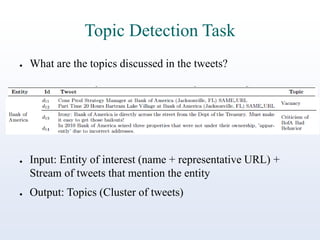
Topic Detection Task
●

What are the topics discussed in the tweets?
Topic Detection Task
●

●

●

What are the topics discussed in the tweets?

Input: Entity of interest (name + representative URL) +
Stream of tweets that mention the entity

Output: Topics (Cluster of tweets)
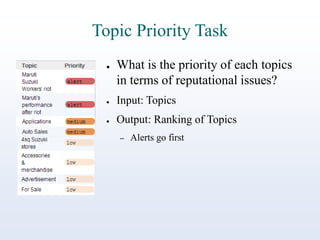
Topic Priority Task
●

What is the priority of each topics
in terms of reputational issues?

●

Input: Topics

●

Output: Ranking of Topics
–

Alerts go first
Evaluation Framework
●

Reusable Test Collections

●

Evaluation Measures
–

Compare systems to annotated ground truth
Evaluation Framework
●

Reusable Test Collections

●

Evaluation Measures
–

●

Compare systems to annotated ground truth

Evaluation Campaigns
–

Involve community

–

Compare different approaches
RepLab: Evaluating Online Reputation
Management Systems
●

Organized as CLEF Labs
Cross-Language Evaluation Forum
RepLab: Evaluating Online Reputation
Management Systems
●

Organized as CLEF Labs
Cross-Language Evaluation Forum

●

2 editions so far (+1 this year)
–

RepLab 2012
●

Filtering and Polarity for Reputation

●

Topic Detection and Topic Priority as Monitoring Pilot Task

–

RepLab 2013

–

RepLab 2014 (in progress)

E. Amigó, J. Carrillo de Albornoz, I. Chugur, A. Corujo, J. Gonzalo, T. Martín, E. Meij, M. de Rijke, D. Spina
Overview of RepLab 2013: Evaluating Online Reputation Monitoring Systems
Proceedings of the Fourth International Conference of the CLEF initiative. 2013.
Building Test Collections
Annotation Process
RepLab 2013 Annotation Tool
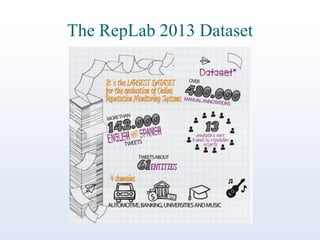
The RepLab 2013 Dataset
Evaluation
Why we Need All this Stuff?
●

To Evaluate Automatic Systems

●

To be able to answer the questions:
–

Which system performs better?

–

Can tasks be solved automatically?
Automatic Solutions for ORM:
Filtering + Topic Detection
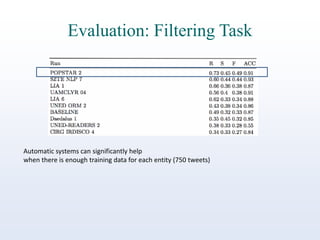
Evaluation: Filtering Task

Automatic systems can significantly help
when there is enough training data for each entity (750 tweets)
Evaluation: Filtering Task

Automatic systems can significantly help
when there is enough training data for each entity (750 tweets)
How?
* Supervised learning
POPSTAR (Univ. of Porto):
Features: Twitter metadata, textual features, keyword similarity +
external resources such as the entity’s homepage, Freebase and Wikipedia.
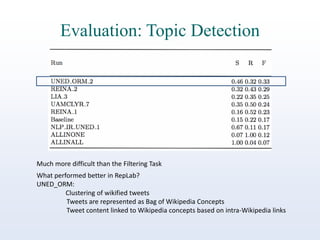
Evaluation: Topic Detection

Much more difficult than the Filtering Task
Evaluation: Topic Detection

Much more difficult than the Filtering Task
What performed better in RepLab?
UNED_ORM:
Clustering of wikified tweets
Tweets are represented as Bag of Wikipedia Concepts
Tweet content linked to Wikipedia concepts based on intra-Wikipedia links
Topic Detection Approach
●

●

Tweet -> Set of Wikipedia Concepts/Articles

Clustering: Tweets sharing x% of identified
Wikipedia articles are grouped together

D. Spina, J. Carrillo de Albornoz, T. Martín, E. Amigó, J. Gonzalo, F. Giner
UNED Online Reputation Monitoring Team at RepLab 2013
CLEF 2013 Labs and Workshops Notebook Papers. 2013.
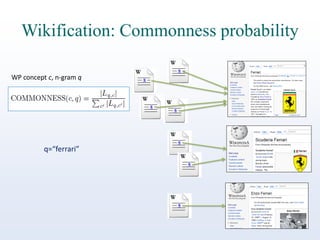
Wikification: Commonness probability
WP concept c, n-gram q

q=“ferrari”
Wikification: Commonness probability
WP concept c, n-gram q

q=“ferrari”
Wikification: Commonness probability
WP concept c, n-gram q

q=“ferrari”

COMMONNESS "Ferrari S.p.A.", "ferrari" =

4
= 0.57
(4 + 2 + 1)
Putting the Human in the Loop
Building Semi-Automatic Tools for
ORM
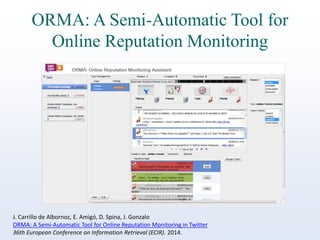
ORMA: A Semi-Automatic Tool for
Online Reputation Monitoring

J. Carrillo de Albornoz, E. Amigó, D. Spina, J. Gonzalo
ORMA: A Semi-Automatic Tool for Online Reputation Monitoring in Twitter
36th European Conference on Information Retrieval (ECIR). 2014.
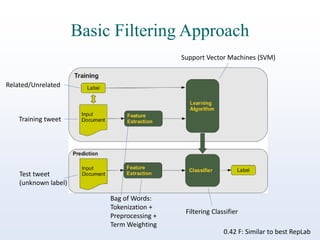
Basic Filtering Approach
Support Vector Machines (SVM)

Related/Unrelated

Training tweet

Test tweet
(unknown label)
Bag of Words:
Tokenization +
Preprocessing +
Term Weighting

Filtering Classifier
0.42 F: Similar to best RepLab
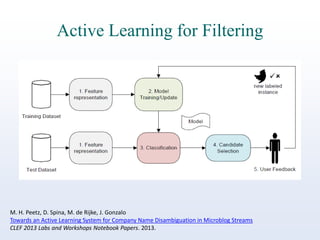
Active Learning for Filtering

M. H. Peetz, D. Spina, M. de Rijke, J. Gonzalo
Towards an Active Learning System for Company Name Disambiguation in Microblog Streams
CLEF 2013 Labs and Workshops Notebook Papers. 2013.
Active Learning for Filtering
●

Margin Sampling (confidence of the classifier)

●

After inspecting 2% of test data (30 out of 1500 tweets):
–

0.42 -> 0.52 F(R,S) (19.2% improvement)

–

Higher than the best RepLab contribution
Active Learning for Filtering
●

Margin Sampling (confidence of the classifier)

●

After inspecting 2% of test data (30 out of 1500 tweets):
–
–

●

0.42 -> 0.52 F(R,S) (19.2% improvement)
Higher than the best RepLab contribution

The cost of initial training data can be reduced
substantially:
–

Effectiveness:
10% training + 10% test for feedback = 100% training
Conclusions
Conclusions
●

Online Reputation Monitoring in Twitter
Conclusions
●

Online Reputation Monitoring in Twitter

●

Formalized as Information Access Tasks
–

Reusable Test Collections

–

Systematic Evaluation
Conclusions
●

Online Reputation Monitoring in Twitter

●

Formalized as Information Access Tasks
–
–

●

Reusable Test Collections
Systematic Evaluation

Can tasks be solved automatically?
–

Filtering: Almost solved with enough training data
(0.49F, 0.91 accuracy)

–

Topic: Systems are useful but not perfect
Conclusions
●

Online Reputation Monitoring in Twitter

●

Formalized as Information Access Tasks
–
–

●

Reusable Test Collections
Systematic Evaluation

Can tasks be solved automatically?
–

–
●

Filtering: Almost solved with enough training data
(0.49F, 0.91 accuracy)
Topic: Systems are useful but not perfect

We need the expert in the loop
–

With a substantial reduction of manual effort
Online Reputation Monitoring in Twitter
from an Information Access Persepective
Damiano Spina
damiano@lsi.uned.es
@damiano10

UNED NLP & IR Group
January 29, 2014
FdI UCM, Madrid, Spain

Online Reputation Monitoring in Twitter from an Information Access Perspective

  • 1.
    Online Reputation Monitoringin Twitter from an Information Access Perspective Damiano Spina damiano@lsi.uned.es @damiano10 UNED NLP & IR Group January 29, 2014 FdI UCM, Madrid, Spain
  • 2.
    In Collaboration with Universityof Amsterdam ● Julio Gonzalo ● Maarten de Rijke ● Enrique Amigó ● Edgar Meij (Yahoo! Barcelona) ● Jorge Carrillo de Albornoz ● Mª Hendrike Peetz ● Irina Chugur ● Tamara Martín Llorente & Cuenca ● ● Ana Pitart ● LiMoSINe EU Project www.limosine-project.eu Vanessa Álvarez Adolfo Corujo
  • 3.
    Arab Spring inEgypt, Jan 2011
  • 6.
    Online Reputation Monitoring(ORM) ● Reputation/public image is key for entities: – Companies, Organizations, Personalities
  • 7.
    Online Reputation Monitoring(ORM) ● Reputation/public image is key for entities: – ● Companies, Organizations, Personalities Social Media: – Necessity (and opportunity) of handling the public image of entities on the Web
  • 8.
    Online Reputation Monitoring(ORM) ● Reputation/public image is key for entities: – ● Companies, Organizations, Personalities Social Media: – Necessity (and opportunity) of handling the public image of entities on the Web – Online Reputation Managers/Analysts ● Handle the reputation of an entity of interest (i.e., customer) ● Among other tasks, monitoring Social Media (manually!) – Early detection of issues/conversations/topics that may damage the reputation of the entity of interest
  • 9.
    Automatic Tools forORM Information Access (IA) techniques for -Tracking Relevant Mentions - Sentiment Analysis - Discover Keywords/Topics
  • 10.
    Problem ● Lack of standardbenchmarks for evaluation
  • 11.
    Problem ● Lack of standardbenchmarks for evaluation ● It is hard for the analysts to know how automatic tools will perform on their real data
  • 12.
    Goals ● Formalize the OnlineReputation Monitoring problem as scientific challenges
  • 13.
    Goals ● Formalize the OnlineReputation Monitoring problem as scientific challenges – Build standard test collections – Organize International evaluation campaigns – Bring together ORM and IA experts from Industrial and Academic communities
  • 14.
    Goals ● Formalize the OnlineReputation Monitoring problem as scientific challenges – – Organize International evaluation campaigns – ● Build standard test collections Bring together ORM and IA experts from Industrial and Academic communities Propose automatic solutions that may assist the reputation manager, reducing the effort in their daily work
  • 15.
  • 16.
    Outline ● Online Reputation Monitoringin Twitter ● Formalization from an Information Access perspective – Tasks Definition – Evaluation Framework
  • 17.
    Outline ● Online Reputation Monitoringin Twitter ● Formalization from an Information Access perspective – – ● Tasks Definition Evaluation Framework How much of the problem can be solved automatically? – Filtering – Topic Detection
  • 18.
    Outline ● Online Reputation Monitoringin Twitter ● Formalization from an Information Access perspective – – ● Tasks Definition Evaluation Framework How much of the problem can be solved automatically? – – ● Filtering Topic Detection Putting the Human in the Loop: A Semi-Automatic ORM Assistant
  • 19.
    Online Reputation Monitoringin Twitter ● Analysts' daily work – Focus on a given entity of interest
  • 20.
    Online Reputation Monitoringin Twitter ● Analysts' daily work – Focus on a given entity of interest – Recall oriented ● They have to check all potential mentions! ● Also filter out not relevant mentions manually
  • 21.
    Online Reputation Monitoringin Twitter ● Analysts' daily work – Focus on a given entity of interest – Recall oriented ● ● – They have to check all potential mentions! Also filter out not relevant mentions manually They make a summary to report to the client periodically Summary – ● What is being said about the entity in Twitter? What are the topics that may damage its reputation?
  • 22.
    Why Twitter? ● ● (Bad) newsspread earlier/faster/more unpredictable than any other source in the Web Most popular microblogging service – >230M monthly active users – 5k tweets published per second
  • 23.
    Why Twitter? ● ● (Bad) newsspread earlier/faster/more unpredictable than any other source in the Web Most popular microblogging service – – ● >230M monthly active users 5k tweets published per second Challenging for Information Access – Little context (only 140 characters) – Non-standard, SMS-like language
  • 24.
  • 25.
  • 26.
    Problem Formalization ORM froman Information Access Perspective
  • 27.
    Filtering Task ● Is thetweet related to the entity of interest? ● Example: Suzuki related unrelated
  • 28.
    Filtering Task ● Is thetweet related to the entity of interest? ● Example: Suzuki related ● ● unrelated Input: Entity of interest (name + representative URL) + tweets that potentially mention the entity Output: Binary classification at tweet-level (relevant/not relevant)
  • 29.
    Polarity for ReputationTask ● ● Does the tweet affect negatively/positively to the reputation of the entity? Example: Goldman Sachs
  • 30.
    Polarity for ReputationTask ● ● ● ● Does the tweet affect negatively/positively to the reputation of the entity? Example: Goldman Sachs Input: Entity of interest (name + representative URL) + Stream of tweets that potentially mention the entity Output: Multi-class classification at tweet-level (positive/negative/neutral)
  • 31.
    Topic Detection Task ● Whatare the topics discussed in the tweets?
  • 32.
    Topic Detection Task ● ● ● Whatare the topics discussed in the tweets? Input: Entity of interest (name + representative URL) + Stream of tweets that mention the entity Output: Topics (Cluster of tweets)
  • 33.
    Topic Priority Task ● Whatis the priority of each topics in terms of reputational issues? ● Input: Topics ● Output: Ranking of Topics – Alerts go first
  • 34.
    Evaluation Framework ● Reusable TestCollections ● Evaluation Measures – Compare systems to annotated ground truth
  • 35.
    Evaluation Framework ● Reusable TestCollections ● Evaluation Measures – ● Compare systems to annotated ground truth Evaluation Campaigns – Involve community – Compare different approaches
  • 36.
    RepLab: Evaluating OnlineReputation Management Systems ● Organized as CLEF Labs Cross-Language Evaluation Forum
  • 37.
    RepLab: Evaluating OnlineReputation Management Systems ● Organized as CLEF Labs Cross-Language Evaluation Forum ● 2 editions so far (+1 this year) – RepLab 2012 ● Filtering and Polarity for Reputation ● Topic Detection and Topic Priority as Monitoring Pilot Task – RepLab 2013 – RepLab 2014 (in progress) E. Amigó, J. Carrillo de Albornoz, I. Chugur, A. Corujo, J. Gonzalo, T. Martín, E. Meij, M. de Rijke, D. Spina Overview of RepLab 2013: Evaluating Online Reputation Monitoring Systems Proceedings of the Fourth International Conference of the CLEF initiative. 2013.
  • 38.
  • 39.
  • 40.
  • 41.
  • 42.
  • 43.
    Why we NeedAll this Stuff? ● To Evaluate Automatic Systems ● To be able to answer the questions: – Which system performs better? – Can tasks be solved automatically?
  • 44.
    Automatic Solutions forORM: Filtering + Topic Detection
  • 45.
    Evaluation: Filtering Task Automaticsystems can significantly help when there is enough training data for each entity (750 tweets)
  • 46.
    Evaluation: Filtering Task Automaticsystems can significantly help when there is enough training data for each entity (750 tweets) How? * Supervised learning POPSTAR (Univ. of Porto): Features: Twitter metadata, textual features, keyword similarity + external resources such as the entity’s homepage, Freebase and Wikipedia.
  • 47.
    Evaluation: Topic Detection Muchmore difficult than the Filtering Task
  • 48.
    Evaluation: Topic Detection Muchmore difficult than the Filtering Task What performed better in RepLab? UNED_ORM: Clustering of wikified tweets Tweets are represented as Bag of Wikipedia Concepts Tweet content linked to Wikipedia concepts based on intra-Wikipedia links
  • 49.
    Topic Detection Approach ● ● Tweet-> Set of Wikipedia Concepts/Articles Clustering: Tweets sharing x% of identified Wikipedia articles are grouped together D. Spina, J. Carrillo de Albornoz, T. Martín, E. Amigó, J. Gonzalo, F. Giner UNED Online Reputation Monitoring Team at RepLab 2013 CLEF 2013 Labs and Workshops Notebook Papers. 2013.
  • 50.
    Wikification: Commonness probability WPconcept c, n-gram q q=“ferrari”
  • 51.
    Wikification: Commonness probability WPconcept c, n-gram q q=“ferrari”
  • 52.
    Wikification: Commonness probability WPconcept c, n-gram q q=“ferrari” COMMONNESS "Ferrari S.p.A.", "ferrari" = 4 = 0.57 (4 + 2 + 1)
  • 53.
    Putting the Humanin the Loop
  • 54.
  • 55.
    ORMA: A Semi-AutomaticTool for Online Reputation Monitoring J. Carrillo de Albornoz, E. Amigó, D. Spina, J. Gonzalo ORMA: A Semi-Automatic Tool for Online Reputation Monitoring in Twitter 36th European Conference on Information Retrieval (ECIR). 2014.
  • 56.
  • 57.
    Basic Filtering Approach SupportVector Machines (SVM) Related/Unrelated Training tweet Test tweet (unknown label) Bag of Words: Tokenization + Preprocessing + Term Weighting Filtering Classifier 0.42 F: Similar to best RepLab
  • 58.
    Active Learning forFiltering M. H. Peetz, D. Spina, M. de Rijke, J. Gonzalo Towards an Active Learning System for Company Name Disambiguation in Microblog Streams CLEF 2013 Labs and Workshops Notebook Papers. 2013.
  • 59.
    Active Learning forFiltering ● Margin Sampling (confidence of the classifier) ● After inspecting 2% of test data (30 out of 1500 tweets): – 0.42 -> 0.52 F(R,S) (19.2% improvement) – Higher than the best RepLab contribution
  • 60.
    Active Learning forFiltering ● Margin Sampling (confidence of the classifier) ● After inspecting 2% of test data (30 out of 1500 tweets): – – ● 0.42 -> 0.52 F(R,S) (19.2% improvement) Higher than the best RepLab contribution The cost of initial training data can be reduced substantially: – Effectiveness: 10% training + 10% test for feedback = 100% training
  • 61.
  • 62.
  • 63.
    Conclusions ● Online Reputation Monitoringin Twitter ● Formalized as Information Access Tasks – Reusable Test Collections – Systematic Evaluation
  • 64.
    Conclusions ● Online Reputation Monitoringin Twitter ● Formalized as Information Access Tasks – – ● Reusable Test Collections Systematic Evaluation Can tasks be solved automatically? – Filtering: Almost solved with enough training data (0.49F, 0.91 accuracy) – Topic: Systems are useful but not perfect
  • 65.
    Conclusions ● Online Reputation Monitoringin Twitter ● Formalized as Information Access Tasks – – ● Reusable Test Collections Systematic Evaluation Can tasks be solved automatically? – – ● Filtering: Almost solved with enough training data (0.49F, 0.91 accuracy) Topic: Systems are useful but not perfect We need the expert in the loop – With a substantial reduction of manual effort
  • 66.
    Online Reputation Monitoringin Twitter from an Information Access Persepective Damiano Spina damiano@lsi.uned.es @damiano10 UNED NLP & IR Group January 29, 2014 FdI UCM, Madrid, Spain