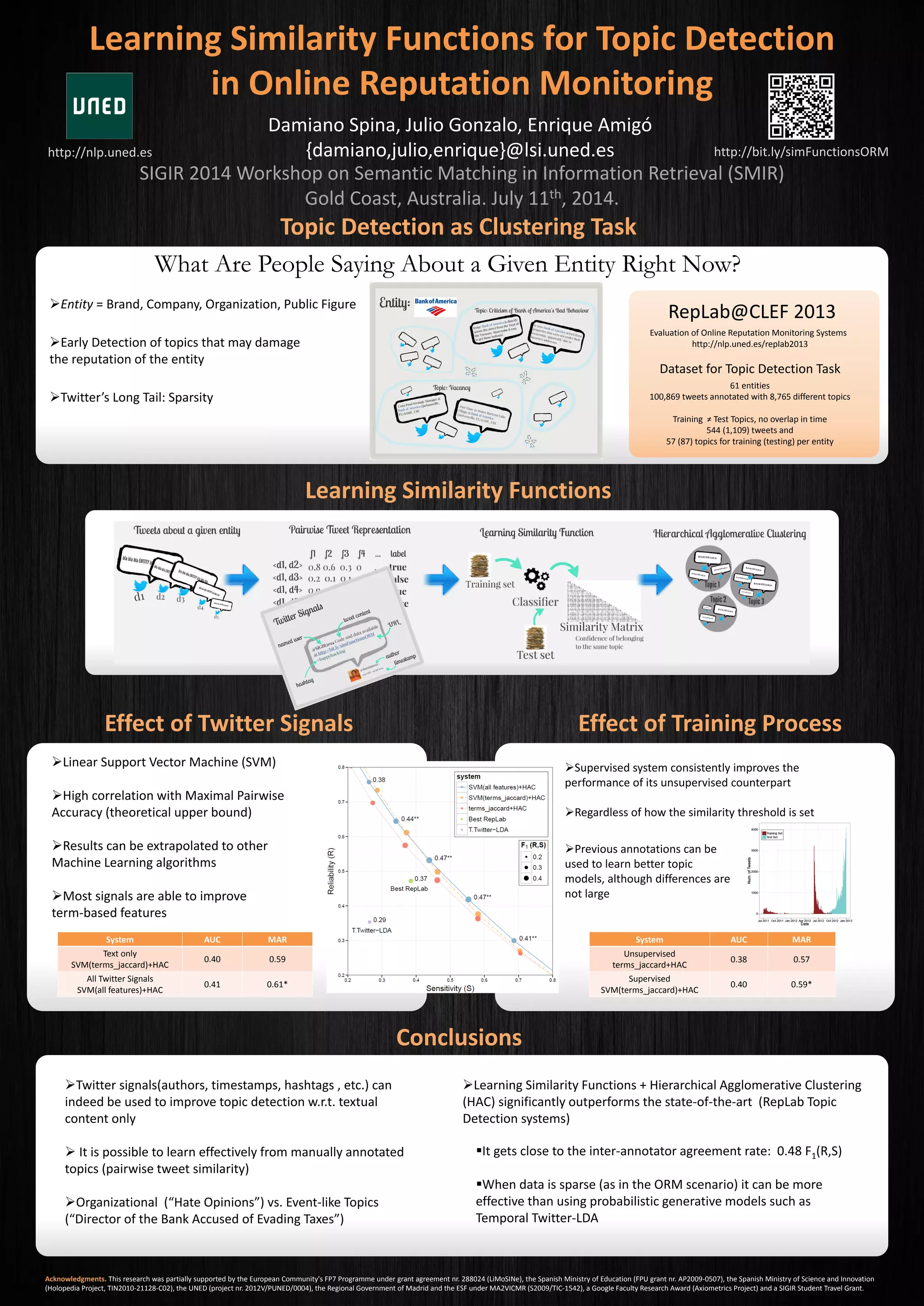
Linear Support Vector Machine (SVM)
High correlation with Maximal Pairwise
Accuracy (theoretical upper bound)
Results can be extrapolated to other
Machine Learning algorithms
Most signals are able to improve
term-based features
Supervised system consistently improves the
performance of its unsupervised counterpart
Regardless of how the similarity threshold is set
Topic Detection as Clustering Task
Conclusions
Effect of Twitter Signals Effect of Training Process
Learning Similarity Functions for Topic Detection
in Online Reputation Monitoring
SIGIR 2014 Workshop on Semantic Matching in Information Retrieval (SMIR)
Gold Coast, Australia. July 11th, 2014.
Damiano Spina, Julio Gonzalo, Enrique Amigó
{damiano,julio,enrique}@lsi.uned.es
Acknowledgments. This research was partially supported by the European Community's FP7 Programme under grant agreement nr. 288024 (LiMoSINe), the Spanish Ministry of Education (FPU grant nr. AP2009-0507), the Spanish Ministry of Science and Innovation
(Holopedia Project, TIN2010-21128-C02), the UNED (project nr. 2012V/PUNED/0004), the Regional Government of Madrid and the ESF under MA2VICMR (S2009/TIC-1542), a Google Faculty Research Award (Axiometrics Project) and a SIGIR Student Travel Grant.
What Are People Saying About a Given Entity Right Now?
Entity = Brand, Company, Organization, Public Figure
Early Detection of topics that may damage
the reputation of the entity
Twitter’s Long Tail: Sparsity
http://bit.ly/simFunctionsORM
Learning Similarity Functions
System AUC MAR
Text only
SVM(terms_jaccard)+HAC
0.40 0.59
All Twitter Signals
SVM(all features)+HAC
0.41 0.61*
System AUC MAR
Unsupervised
terms_jaccard+HAC
0.38 0.57
Supervised
SVM(terms_jaccard)+HAC
0.40 0.59*
RepLab@CLEF 2013
61 entities
100,869 tweets annotated with 8,765 different topics
Training ≠ Test Topics, no overlap in time
544 (1,109) tweets and
57 (87) topics for training (testing) per entity
Dataset for Topic Detection Task
Evaluation of Online Reputation Monitoring Systems
http://nlp.uned.es/replab2013
Twitter signals(authors, timestamps, hashtags , etc.) can
indeed be used to improve topic detection w.r.t. textual
content only
 It is possible to learn effectively from manually annotated
topics (pairwise tweet similarity)
Organizational (“Hate Opinions”) vs. Event-like Topics
(“Director of the Bank Accused of Evading Taxes”)
Learning Similarity Functions + Hierarchical Agglomerative Clustering
(HAC) significantly outperforms the state-of-the-art (RepLab Topic
Detection systems)
It gets close to the inter-annotator agreement rate: 0.48 F1(R,S)
When data is sparse (as in the ORM scenario) it can be more
effective than using probabilistic generative models such as
Temporal Twitter-LDA
http://nlp.uned.es
Previous annotations can be
used to learn better topic
models, although differences are
not large

Learning Similarity Functions for Topic Detection in Online Reputation Monitoring

  • 1.
    Linear Support VectorMachine (SVM) High correlation with Maximal Pairwise Accuracy (theoretical upper bound) Results can be extrapolated to other Machine Learning algorithms Most signals are able to improve term-based features Supervised system consistently improves the performance of its unsupervised counterpart Regardless of how the similarity threshold is set Topic Detection as Clustering Task Conclusions Effect of Twitter Signals Effect of Training Process Learning Similarity Functions for Topic Detection in Online Reputation Monitoring SIGIR 2014 Workshop on Semantic Matching in Information Retrieval (SMIR) Gold Coast, Australia. July 11th, 2014. Damiano Spina, Julio Gonzalo, Enrique Amigó {damiano,julio,enrique}@lsi.uned.es Acknowledgments. This research was partially supported by the European Community's FP7 Programme under grant agreement nr. 288024 (LiMoSINe), the Spanish Ministry of Education (FPU grant nr. AP2009-0507), the Spanish Ministry of Science and Innovation (Holopedia Project, TIN2010-21128-C02), the UNED (project nr. 2012V/PUNED/0004), the Regional Government of Madrid and the ESF under MA2VICMR (S2009/TIC-1542), a Google Faculty Research Award (Axiometrics Project) and a SIGIR Student Travel Grant. What Are People Saying About a Given Entity Right Now? Entity = Brand, Company, Organization, Public Figure Early Detection of topics that may damage the reputation of the entity Twitter’s Long Tail: Sparsity http://bit.ly/simFunctionsORM Learning Similarity Functions System AUC MAR Text only SVM(terms_jaccard)+HAC 0.40 0.59 All Twitter Signals SVM(all features)+HAC 0.41 0.61* System AUC MAR Unsupervised terms_jaccard+HAC 0.38 0.57 Supervised SVM(terms_jaccard)+HAC 0.40 0.59* RepLab@CLEF 2013 61 entities 100,869 tweets annotated with 8,765 different topics Training ≠ Test Topics, no overlap in time 544 (1,109) tweets and 57 (87) topics for training (testing) per entity Dataset for Topic Detection Task Evaluation of Online Reputation Monitoring Systems http://nlp.uned.es/replab2013 Twitter signals(authors, timestamps, hashtags , etc.) can indeed be used to improve topic detection w.r.t. textual content only  It is possible to learn effectively from manually annotated topics (pairwise tweet similarity) Organizational (“Hate Opinions”) vs. Event-like Topics (“Director of the Bank Accused of Evading Taxes”) Learning Similarity Functions + Hierarchical Agglomerative Clustering (HAC) significantly outperforms the state-of-the-art (RepLab Topic Detection systems) It gets close to the inter-annotator agreement rate: 0.48 F1(R,S) When data is sparse (as in the ORM scenario) it can be more effective than using probabilistic generative models such as Temporal Twitter-LDA http://nlp.uned.es Previous annotations can be used to learn better topic models, although differences are not large