This article can be downloaded from http://www.iajpb.com/currentissue.php
1
This article can be downloaded from http://www.iajpb.com/currentissue.php
2
Indo-Am. J. Pharm & Bio. Sc., 2021 ISSN 2347-2251 www.iajpb.com
Vol. 9, Issuse 2, April 2021
© 2014 Meghana Publications. All Rights Reserved
STUDY ON EMPLOYEE PERFORMANCE IN
ORGANIZATION WHEN JOB SATISFIED
K. Neelakanteshwar Reddy
ABSTRACT: Employees are critical to the success of any company. An organisation can't function if it
doesn't have any workers. The organisation has a wide range of effects, but the most important one
is the influence it has on its personnel. An company is constantly on the lookout for high-performing
workers who can help it expand. Workers can only be productive if they are happy in their jobs, and
happy employees are more productive. It is impossible for a person to function properly unless he or
she is happy in the workplace and content with their employment. The primary goal of this study is
to identify the variables that contribute to an employee's level of work satisfaction and to examine
the relationship between job happiness and job performance. The research is based on a sample of
100 people. The data has been collected using a convenience sample method. Data was gathered
from a variety of universities. Workplace productivity and work contentment are shown to be closely
linked, according to the findings of this research. An employee's performance increases when he or
she is happy with their employment.
KEYWORDS: Employee job satisfaction and performance are intertwined, as are the factors that
influence both.
INTRODUCTION:
Efficiency and productivity are essential if a
company is to achieve its full potential. These
aims can only be realised with a workforce
that is both motivated and content. The only
way to do this is via a well-appreciated
workforce. Workers that are satisfied with
their jobs usually put up a lot of effort and
work harder. A company's primary goal is the
achievement of long-term success and
development for the company via fostering an
atmosphere in which its people are happy and
productive. For example, if an employee is
given a tangible reward for their hard work,
such as a raise or bonus. Progression, high
pay, and other advantages will keep the
employee happy as well as productive. They
will constantly strive for success in the
workplace. It is the responsibility of the
employer to ensure that their workers are
happy with their work environment by making
measures such as improving working
conditions. encouraging them with
promotion, fringe bonuses, etc. Because As a
result, a contented employee is a more
effective one. People's definitions of job
satisfaction might vary widely, making it
difficult to generalise. For some individuals, a
tough work is a source of happiness, while for
others, a large pay, bonuses, and other perks
are. As a result, there are a plethora of
variables that influence employee happiness.
This makes it very difficult for a business to
keep its workers happy.
Research Scholar, Department Of Management, Madhav University, Pindwara, Distt-Sirohi,
Rajasthan
This article can be downloaded from http://www.iajpb.com/currentissue.php
3
Job happiness is examined in two ways by
Mullins (1991).
Fit between what the employer needs and the
employee's desires
Fit between what the employee wants and
what he/she gets. A REVIEW OF THE WORKS
OF OTHER WRITERS: Employee work
happiness is shown to be influenced by both
intrinsic and extrinsic elements, according to
Msuya (2016), who also found that both
aspects play a part in the design of employee
job satisfaction. Tang et al. (2015) investigate
the elements that influence the job
satisfaction of bank workers and discover that
the working environment, work experience,
and income all play a role. Salary,
management, coworkers, training and
advancement, and working conditions are a
few of the elements that determine how
happy people are in their jobs at BIDV,
according to Duc et al. (2015). The findings of
Jain et al. (2014) show that an employee's job
satisfaction is influenced by their working
environment, and that this link is favourable.
It turns out that the number of dependents
and work-life balance, as well as the number
of coworkers and the type of the work itself
all have a role in how content an employee
feels about their job, according to a study by
Varshney (2014; see references below). I.T.
sector employees' work happiness is
influenced by their level of involvement,
according to Thakur (2014). In his research,
Jain (2013) identifies the characteristics that
contribute to employee work satisfaction and
also identifies solutions to increase employee
happiness. According to Sinha (2013), five
factors influence employee happiness in the
workplace: empowerment and work
environment, working relationships, salaries
and future prospects, training and work
involvement, and job rotation. There is a high
degree of job satisfaction among
pharmaceutical workers, according to a study
conducted by Kabir (2011). According to
Kumari (2011),
A study of public and private sector workers'
feelings about their jobs finds that there are a
number of non-sectoral characteristics that
influence how happy they are at work.
Workplace conditions, benefits, salary, and
grievance procedures all have a part in how
happy paper mill workers are with their jobs,
as discovered by Anitha (2011). There is a
favourable relationship between
organisational culture and spiritual leadership,
according to Ceylan (2009), who examined
employee happiness in these contexts.
REASON OF STUDY: This investigation was
prompted by an increase in staff turnover. If
an employee is dissatisfied with their work,
then their performance will suffer, according
to a prior research. In other words, employee
happiness has a direct correlation to
productivity. Employees expect to be
compensated for the job they do for the
company in the form of a raise, promotion, or
other perk. If workers don't get any type of
output from the company or if they feel that
their job isn't that tough, they'll be more likely
to leave the company. This will lead to staff
turnover because of work discontent. The
findings of this research will assist
management in identifying strategies to
reduce employee turnover.
It is the goal of this research to identify those
aspects of the work that make employees
happy. When employees are content with
their work, they are less likely to leave their
jobs and thereby boost the company's
employee retention rate. As a result of this
research, several businesses now have a
better understanding of the aspects that
contribute to employee well-being.
To investigate the aspects that contribute to
an employee's sense of well-being at work.
• To find out how happy faculty members are
with their work.
In order to investigate the link between work
happiness and employee performance.
HOW TO DO RESEARCH METHODS
This article can be downloaded from http://www.iajpb.com/currentissue.php
4
The core data for the study was gathered by
visiting four Jalandhar-based higher education
institutions.
This study employed a descriptive research
design to assess faculty members' levels of
satisfaction and to make demographic
comparisons of those levels.
100 workers were chosen as a sample for this
investigation. Five colleges and universities
were used to get the data. This research used
a sample method known as convenience
sampling. Convenience sampling is used to
choose faculty members and institutions.
Procedure for Analyzing Data
Percentage technique is used to examine
data.
What Affects Employee Satisfaction at Work?
There are several types of financial incentives
that may be offered to an employee when
they reach or surpass expectations. Obviously,
when an employee gets this sort of incentive
due of their achievement, it will boost their
self-confidence and drive them to do even
better in the future.
Everyone enjoys being recognised and
thanked for their efforts. The vitality and self-
confidence of an employee are constantly
boosted when they get praise. Receiving
praise in front of coworkers is a certain
technique to spur on a worker to greater
effort.
Being Fair: The level of job satisfaction a
worker has is strongly correlated with the
fairness of his or her boss. The degree of
employee satisfaction rises if the supervisor
treats all employees equally. Employee
unhappiness is exacerbated by workers'
inability to trust one other. An employee's
level of job satisfaction is mostly determined
by how well they are treated at work.
In most organisations, this basic component
cannot be identified, thus they must begin
working on it. Employees spend a large
portion of their day at their place of
employment. Employees are more likely to be
content in their work if they feel valued as an
integral part of the company. Making an effort
to make an employee's birthday a memorable
one by sending a card or text message on
their special day boosts their sense of
belonging, which in turn raises their level of
work satisfaction.
In order to avoid employee unhappiness, an
organisation must offer credit to employees
who do well on projects they present at
conferences or seminars.
In a period of uncertainty, it's tough for the
company's management to select which route
to take. In a formal or non-formal setting, It's
usually preferable for an organisation to use a
variety of approaches rather than stick to a
single one.
try to strike a balance between the two ways
of thinking. Employees are more satisfied
when both tactics are equally used.
Employees who work for a company expect to
see their personal and professional lives
develop in the future. The degree of
unhappiness among employees increases if
they stay in the same position for a lengthy
period of time or if they learn nothing from
their work. An employee's ability to flourish in
their personal life is a significant aspect in
establishing work happiness.
Progression opportunities: Promotion
influences work satisfaction because
employees see promotion as the ultimate
success because it provides a better
compensation, more flexibility and a more
demanding job.
In order to be satisfied in one's employment,
one must have more than just monetary
compensation. An employee's ability to work
in an organisation is also influenced by the
quality of their work environment. Having a
bad work environment may have a negative
impact on an employee's productivity or job
happiness.
Conflicts and complaints are inevitable when
there are a large number of people working
together in a single location. There are
This article can be downloaded from http://www.iajpb.com/currentissue.php
5
instances when an organisation is unable to
meet the needs of its personnel. This will help
rebuild employee trust in the organisation if
management pays attention to their concerns.
Whatever the circumstances, if management
listens to workers' pain properly, they are
more likely to stay with the company.
INTERVIEW AND RESULTS:
PART A: Respondents' Personal Information
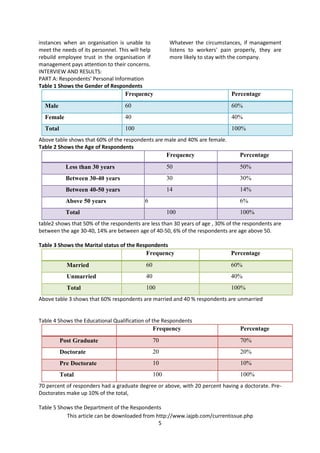
Table 1 Shows the Gender of Respondents
Frequency Percentage
Male 60 60%
Female 40 40%
Total 100 100%
Above table shows that 60% of the respondents are male and 40% are female.
Table 2 Shows the Age of Respondents
Frequency Percentage
Less than 30 years 50 50%
Between 30-40 years 30 30%
Between 40-50 years 14 14%
Above 50 years 6 6%
Total 100 100%
table2 shows that 50% of the respondents are less than 30 years of age , 30% of the respondents are
between the age 30-40, 14% are between age of 40-50, 6% of the respondents are age above 50.
Table 3 Shows the Marital status of the Respondents
Frequency Percentage
Married 60 60%
Unmarried 40 40%
Total 100 100%
Above table 3 shows that 60% respondents are married and 40 % respondents are unmarried
Table 4 Shows the Educational Qualification of the Respondents
Frequency Percentage
Post Graduate 70 70%
Doctorate 20 20%
Pre Doctorate 10 10%
Total 100 100%
70 percent of responders had a graduate degree or above, with 20 percent having a doctorate. Pre-
Doctorates make up 10% of the total,
Table 5 Shows the Department of the Respondents
This article can be downloaded from http://www.iajpb.com/currentissue.php
6
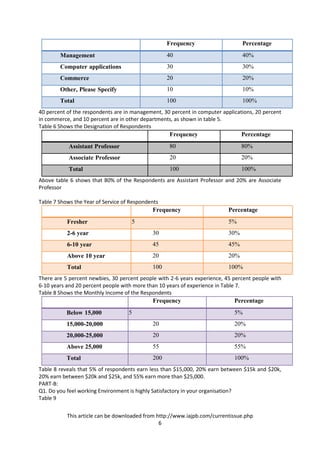
Frequency Percentage
Management 40 40%
Computer applications 30 30%
Commerce 20 20%
Other, Please Specify 10 10%
Total 100 100%
40 percent of the respondents are in management, 30 percent in computer applications, 20 percent
in commerce, and 10 percent are in other departments, as shown in table 5.
Table 6 Shows the Designation of Respondents
Frequency Percentage
Assistant Professor 80 80%
Associate Professor 20 20%
Total 100 100%
Above table 6 shows that 80% of the Respondents are Assistant Professor and 20% are Associate
Professor
Table 7 Shows the Year of Service of Respondents
Frequency Percentage
Fresher 5 5%
2-6 year 30 30%
6-10 year 45 45%
Above 10 year 20 20%
Total 100 100%
There are 5 percent newbies, 30 percent people with 2-6 years experience, 45 percent people with
6-10 years and 20 percent people with more than 10 years of experience in Table 7.
Table 8 Shows the Monthly Income of the Respondents
Frequency Percentage
Below 15,000 5 5%
15,000-20,000 20 20%
20,000-25,000 20 20%
Above 25,000 55 55%
Total 200 100%
Table 8 reveals that 5% of respondents earn less than $15,000, 20% earn between $15k and $20k,
20% earn between $20k and $25k, and 55% earn more than $25,000.
PART-B:
Q1. Do you feel working Environment is highly Satisfactory in your organisation?
Table 9
This article can be downloaded from http://www.iajpb.com/currentissue.php
7
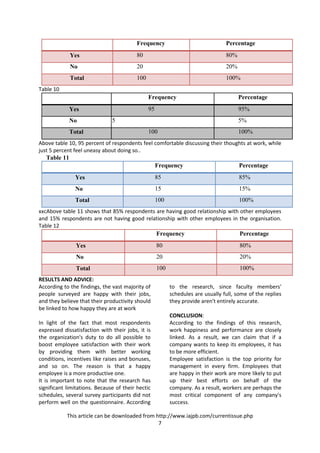
Frequency Percentage
Yes 80 80%
No 20 20%
Total 100 100%
Table 10
Frequency Percentage
Yes 95 95%
No 5 5%
Total 100 100%
Above table 10, 95 percent of respondents feel comfortable discussing their thoughts at work, while
just 5 percent feel uneasy about doing so..
Table 11
Frequency Percentage
Yes 85 85%
No 15 15%
Total 100 100%
xxcAbove table 11 shows that 85% respondents are having good relationship with other employees
and 15% respondents are not having good relationship with other employees in the organisation.
Table 12
Frequency Percentage
Yes 80 80%
No 20 20%
Total 100 100%
RESULTS AND ADVICE:
According to the findings, the vast majority of
people surveyed are happy with their jobs,
and they believe that their productivity should
be linked to how happy they are at work
In light of the fact that most respondents
expressed dissatisfaction with their jobs, it is
the organization's duty to do all possible to
boost employee satisfaction with their work
by providing them with better working
conditions, incentives like raises and bonuses,
and so on. The reason is that a happy
employee is a more productive one.
It is important to note that the research has
significant limitations. Because of their hectic
schedules, several survey participants did not
perform well on the questionnaire. According
to the research, since faculty members'
schedules are usually full, some of the replies
they provide aren't entirely accurate.
CONCLUSION:
According to the findings of this research,
work happiness and performance are closely
linked. As a result, we can claim that if a
company wants to keep its employees, it has
to be more efficient.
Employee satisfaction is the top priority for
management in every firm. Employees that
are happy in their work are more likely to put
up their best efforts on behalf of the
company. As a result, workers are perhaps the
most critical component of any company's
success.
This article can be downloaded from http://www.iajpb.com/currentissue.php
8
REFERENCES:
1. Ayse Ceylan, author (2009).
An investigation on the relationship between
organisational culture and spiritual leadership
and the level of satisfaction among
employees. Int. J. Bus. and Managment, 159-
168.
2. Doctor Dar (2013).
Elementary School Teachers' Job Satisfaction
at Government and Private Schools. The
International Journal of Science and Research,
172-176.
3. Dr.R.Anitha. (2011). A Study On Job
Satisfaction Of Paper Mill Employees With
Special
. Journal of Management and Science , 36-47.
a. D. M. (2013). A Study on the
Effects of Employee Job Satisfaction on their
Work Productivity. In the Journal of Indian
Research, 105-111
4. The author's name is M. M.
(2011). Employee Job Satisfaction in the
Pharmaceutical Sector: Factors Affecting It.
113-123 in Australian Journal of Business and
Management Research.
5. Msuya, O. W. (2016).
Exploring levels of job satisfaction among
teachers in public secondary schools in
Tanzania. International Journal of Educational
Administration and Policy Studies, 9-16.
6. Pabla, D. M. (2012). A Study
of Job Satisfaction among Teachers of
Professional Colleges in Punjab. Indian Journal
of Research, 111-113.
7. TILAK RAJ, L. A. (2013).
Comparative Study of Teachers' Job
Satisfaction in Private and Public Schools.
Social Science & Interdisciplinary Research: An
Interdisciplinary Journal, 151-158.
8. 8. Toan Le Duc, N. H. (2015).
Employee Job Satisfaction at BIDV: A Research
Study (Bank for Investment and Development
of Vietnam). APAC Conference on Business,
Economics, and Social Sciences in the Global
Economy and Financial System (pp. 1-14).
Globalbizresearch is based in Danang,
Vietnam.

original research papers

  • 1.
    This article canbe downloaded from http://www.iajpb.com/currentissue.php 1
  • 2.
    This article canbe downloaded from http://www.iajpb.com/currentissue.php 2 Indo-Am. J. Pharm & Bio. Sc., 2021 ISSN 2347-2251 www.iajpb.com Vol. 9, Issuse 2, April 2021 © 2014 Meghana Publications. All Rights Reserved STUDY ON EMPLOYEE PERFORMANCE IN ORGANIZATION WHEN JOB SATISFIED K. Neelakanteshwar Reddy ABSTRACT: Employees are critical to the success of any company. An organisation can't function if it doesn't have any workers. The organisation has a wide range of effects, but the most important one is the influence it has on its personnel. An company is constantly on the lookout for high-performing workers who can help it expand. Workers can only be productive if they are happy in their jobs, and happy employees are more productive. It is impossible for a person to function properly unless he or she is happy in the workplace and content with their employment. The primary goal of this study is to identify the variables that contribute to an employee's level of work satisfaction and to examine the relationship between job happiness and job performance. The research is based on a sample of 100 people. The data has been collected using a convenience sample method. Data was gathered from a variety of universities. Workplace productivity and work contentment are shown to be closely linked, according to the findings of this research. An employee's performance increases when he or she is happy with their employment. KEYWORDS: Employee job satisfaction and performance are intertwined, as are the factors that influence both. INTRODUCTION: Efficiency and productivity are essential if a company is to achieve its full potential. These aims can only be realised with a workforce that is both motivated and content. The only way to do this is via a well-appreciated workforce. Workers that are satisfied with their jobs usually put up a lot of effort and work harder. A company's primary goal is the achievement of long-term success and development for the company via fostering an atmosphere in which its people are happy and productive. For example, if an employee is given a tangible reward for their hard work, such as a raise or bonus. Progression, high pay, and other advantages will keep the employee happy as well as productive. They will constantly strive for success in the workplace. It is the responsibility of the employer to ensure that their workers are happy with their work environment by making measures such as improving working conditions. encouraging them with promotion, fringe bonuses, etc. Because As a result, a contented employee is a more effective one. People's definitions of job satisfaction might vary widely, making it difficult to generalise. For some individuals, a tough work is a source of happiness, while for others, a large pay, bonuses, and other perks are. As a result, there are a plethora of variables that influence employee happiness. This makes it very difficult for a business to keep its workers happy. Research Scholar, Department Of Management, Madhav University, Pindwara, Distt-Sirohi, Rajasthan
  • 3.
    This article canbe downloaded from http://www.iajpb.com/currentissue.php 3 Job happiness is examined in two ways by Mullins (1991). Fit between what the employer needs and the employee's desires Fit between what the employee wants and what he/she gets. A REVIEW OF THE WORKS OF OTHER WRITERS: Employee work happiness is shown to be influenced by both intrinsic and extrinsic elements, according to Msuya (2016), who also found that both aspects play a part in the design of employee job satisfaction. Tang et al. (2015) investigate the elements that influence the job satisfaction of bank workers and discover that the working environment, work experience, and income all play a role. Salary, management, coworkers, training and advancement, and working conditions are a few of the elements that determine how happy people are in their jobs at BIDV, according to Duc et al. (2015). The findings of Jain et al. (2014) show that an employee's job satisfaction is influenced by their working environment, and that this link is favourable. It turns out that the number of dependents and work-life balance, as well as the number of coworkers and the type of the work itself all have a role in how content an employee feels about their job, according to a study by Varshney (2014; see references below). I.T. sector employees' work happiness is influenced by their level of involvement, according to Thakur (2014). In his research, Jain (2013) identifies the characteristics that contribute to employee work satisfaction and also identifies solutions to increase employee happiness. According to Sinha (2013), five factors influence employee happiness in the workplace: empowerment and work environment, working relationships, salaries and future prospects, training and work involvement, and job rotation. There is a high degree of job satisfaction among pharmaceutical workers, according to a study conducted by Kabir (2011). According to Kumari (2011), A study of public and private sector workers' feelings about their jobs finds that there are a number of non-sectoral characteristics that influence how happy they are at work. Workplace conditions, benefits, salary, and grievance procedures all have a part in how happy paper mill workers are with their jobs, as discovered by Anitha (2011). There is a favourable relationship between organisational culture and spiritual leadership, according to Ceylan (2009), who examined employee happiness in these contexts. REASON OF STUDY: This investigation was prompted by an increase in staff turnover. If an employee is dissatisfied with their work, then their performance will suffer, according to a prior research. In other words, employee happiness has a direct correlation to productivity. Employees expect to be compensated for the job they do for the company in the form of a raise, promotion, or other perk. If workers don't get any type of output from the company or if they feel that their job isn't that tough, they'll be more likely to leave the company. This will lead to staff turnover because of work discontent. The findings of this research will assist management in identifying strategies to reduce employee turnover. It is the goal of this research to identify those aspects of the work that make employees happy. When employees are content with their work, they are less likely to leave their jobs and thereby boost the company's employee retention rate. As a result of this research, several businesses now have a better understanding of the aspects that contribute to employee well-being. To investigate the aspects that contribute to an employee's sense of well-being at work. • To find out how happy faculty members are with their work. In order to investigate the link between work happiness and employee performance. HOW TO DO RESEARCH METHODS
  • 4.
    This article canbe downloaded from http://www.iajpb.com/currentissue.php 4 The core data for the study was gathered by visiting four Jalandhar-based higher education institutions. This study employed a descriptive research design to assess faculty members' levels of satisfaction and to make demographic comparisons of those levels. 100 workers were chosen as a sample for this investigation. Five colleges and universities were used to get the data. This research used a sample method known as convenience sampling. Convenience sampling is used to choose faculty members and institutions. Procedure for Analyzing Data Percentage technique is used to examine data. What Affects Employee Satisfaction at Work? There are several types of financial incentives that may be offered to an employee when they reach or surpass expectations. Obviously, when an employee gets this sort of incentive due of their achievement, it will boost their self-confidence and drive them to do even better in the future. Everyone enjoys being recognised and thanked for their efforts. The vitality and self- confidence of an employee are constantly boosted when they get praise. Receiving praise in front of coworkers is a certain technique to spur on a worker to greater effort. Being Fair: The level of job satisfaction a worker has is strongly correlated with the fairness of his or her boss. The degree of employee satisfaction rises if the supervisor treats all employees equally. Employee unhappiness is exacerbated by workers' inability to trust one other. An employee's level of job satisfaction is mostly determined by how well they are treated at work. In most organisations, this basic component cannot be identified, thus they must begin working on it. Employees spend a large portion of their day at their place of employment. Employees are more likely to be content in their work if they feel valued as an integral part of the company. Making an effort to make an employee's birthday a memorable one by sending a card or text message on their special day boosts their sense of belonging, which in turn raises their level of work satisfaction. In order to avoid employee unhappiness, an organisation must offer credit to employees who do well on projects they present at conferences or seminars. In a period of uncertainty, it's tough for the company's management to select which route to take. In a formal or non-formal setting, It's usually preferable for an organisation to use a variety of approaches rather than stick to a single one. try to strike a balance between the two ways of thinking. Employees are more satisfied when both tactics are equally used. Employees who work for a company expect to see their personal and professional lives develop in the future. The degree of unhappiness among employees increases if they stay in the same position for a lengthy period of time or if they learn nothing from their work. An employee's ability to flourish in their personal life is a significant aspect in establishing work happiness. Progression opportunities: Promotion influences work satisfaction because employees see promotion as the ultimate success because it provides a better compensation, more flexibility and a more demanding job. In order to be satisfied in one's employment, one must have more than just monetary compensation. An employee's ability to work in an organisation is also influenced by the quality of their work environment. Having a bad work environment may have a negative impact on an employee's productivity or job happiness. Conflicts and complaints are inevitable when there are a large number of people working together in a single location. There are
  • 5.
    This article canbe downloaded from http://www.iajpb.com/currentissue.php 5 instances when an organisation is unable to meet the needs of its personnel. This will help rebuild employee trust in the organisation if management pays attention to their concerns. Whatever the circumstances, if management listens to workers' pain properly, they are more likely to stay with the company. INTERVIEW AND RESULTS: PART A: Respondents' Personal Information Table 1 Shows the Gender of Respondents Frequency Percentage Male 60 60% Female 40 40% Total 100 100% Above table shows that 60% of the respondents are male and 40% are female. Table 2 Shows the Age of Respondents Frequency Percentage Less than 30 years 50 50% Between 30-40 years 30 30% Between 40-50 years 14 14% Above 50 years 6 6% Total 100 100% table2 shows that 50% of the respondents are less than 30 years of age , 30% of the respondents are between the age 30-40, 14% are between age of 40-50, 6% of the respondents are age above 50. Table 3 Shows the Marital status of the Respondents Frequency Percentage Married 60 60% Unmarried 40 40% Total 100 100% Above table 3 shows that 60% respondents are married and 40 % respondents are unmarried Table 4 Shows the Educational Qualification of the Respondents Frequency Percentage Post Graduate 70 70% Doctorate 20 20% Pre Doctorate 10 10% Total 100 100% 70 percent of responders had a graduate degree or above, with 20 percent having a doctorate. Pre- Doctorates make up 10% of the total, Table 5 Shows the Department of the Respondents
  • 6.
    This article canbe downloaded from http://www.iajpb.com/currentissue.php 6 Frequency Percentage Management 40 40% Computer applications 30 30% Commerce 20 20% Other, Please Specify 10 10% Total 100 100% 40 percent of the respondents are in management, 30 percent in computer applications, 20 percent in commerce, and 10 percent are in other departments, as shown in table 5. Table 6 Shows the Designation of Respondents Frequency Percentage Assistant Professor 80 80% Associate Professor 20 20% Total 100 100% Above table 6 shows that 80% of the Respondents are Assistant Professor and 20% are Associate Professor Table 7 Shows the Year of Service of Respondents Frequency Percentage Fresher 5 5% 2-6 year 30 30% 6-10 year 45 45% Above 10 year 20 20% Total 100 100% There are 5 percent newbies, 30 percent people with 2-6 years experience, 45 percent people with 6-10 years and 20 percent people with more than 10 years of experience in Table 7. Table 8 Shows the Monthly Income of the Respondents Frequency Percentage Below 15,000 5 5% 15,000-20,000 20 20% 20,000-25,000 20 20% Above 25,000 55 55% Total 200 100% Table 8 reveals that 5% of respondents earn less than $15,000, 20% earn between $15k and $20k, 20% earn between $20k and $25k, and 55% earn more than $25,000. PART-B: Q1. Do you feel working Environment is highly Satisfactory in your organisation? Table 9
  • 7.
    This article canbe downloaded from http://www.iajpb.com/currentissue.php 7 Frequency Percentage Yes 80 80% No 20 20% Total 100 100% Table 10 Frequency Percentage Yes 95 95% No 5 5% Total 100 100% Above table 10, 95 percent of respondents feel comfortable discussing their thoughts at work, while just 5 percent feel uneasy about doing so.. Table 11 Frequency Percentage Yes 85 85% No 15 15% Total 100 100% xxcAbove table 11 shows that 85% respondents are having good relationship with other employees and 15% respondents are not having good relationship with other employees in the organisation. Table 12 Frequency Percentage Yes 80 80% No 20 20% Total 100 100% RESULTS AND ADVICE: According to the findings, the vast majority of people surveyed are happy with their jobs, and they believe that their productivity should be linked to how happy they are at work In light of the fact that most respondents expressed dissatisfaction with their jobs, it is the organization's duty to do all possible to boost employee satisfaction with their work by providing them with better working conditions, incentives like raises and bonuses, and so on. The reason is that a happy employee is a more productive one. It is important to note that the research has significant limitations. Because of their hectic schedules, several survey participants did not perform well on the questionnaire. According to the research, since faculty members' schedules are usually full, some of the replies they provide aren't entirely accurate. CONCLUSION: According to the findings of this research, work happiness and performance are closely linked. As a result, we can claim that if a company wants to keep its employees, it has to be more efficient. Employee satisfaction is the top priority for management in every firm. Employees that are happy in their work are more likely to put up their best efforts on behalf of the company. As a result, workers are perhaps the most critical component of any company's success.
  • 8.
    This article canbe downloaded from http://www.iajpb.com/currentissue.php 8 REFERENCES: 1. Ayse Ceylan, author (2009). An investigation on the relationship between organisational culture and spiritual leadership and the level of satisfaction among employees. Int. J. Bus. and Managment, 159- 168. 2. Doctor Dar (2013). Elementary School Teachers' Job Satisfaction at Government and Private Schools. The International Journal of Science and Research, 172-176. 3. Dr.R.Anitha. (2011). A Study On Job Satisfaction Of Paper Mill Employees With Special . Journal of Management and Science , 36-47. a. D. M. (2013). A Study on the Effects of Employee Job Satisfaction on their Work Productivity. In the Journal of Indian Research, 105-111 4. The author's name is M. M. (2011). Employee Job Satisfaction in the Pharmaceutical Sector: Factors Affecting It. 113-123 in Australian Journal of Business and Management Research. 5. Msuya, O. W. (2016). Exploring levels of job satisfaction among teachers in public secondary schools in Tanzania. International Journal of Educational Administration and Policy Studies, 9-16. 6. Pabla, D. M. (2012). A Study of Job Satisfaction among Teachers of Professional Colleges in Punjab. Indian Journal of Research, 111-113. 7. TILAK RAJ, L. A. (2013). Comparative Study of Teachers' Job Satisfaction in Private and Public Schools. Social Science & Interdisciplinary Research: An Interdisciplinary Journal, 151-158. 8. 8. Toan Le Duc, N. H. (2015). Employee Job Satisfaction at BIDV: A Research Study (Bank for Investment and Development of Vietnam). APAC Conference on Business, Economics, and Social Sciences in the Global Economy and Financial System (pp. 1-14). Globalbizresearch is based in Danang, Vietnam.