Orientation to Adult Health
Nursing I Practicum
Year2, Semester I
2021-2022
Mrs. Basma Al-Mahrouqi
AHNI Practicum Coordinator
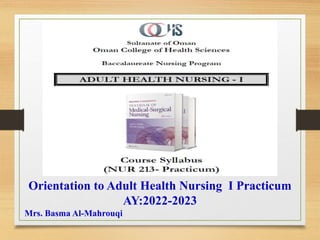
Orientation to Adult Health Nursing I Practicum
AY:2022-2023
Mrs. Basma Al-Mahrouqi
Adult Health Nursing Practicum I
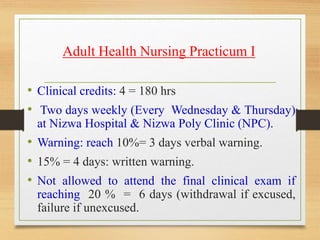
• Clinical credits: 4 = 180 hrs
• Two days weekly (Every Wednesday & Thursday)
at Nizwa Hospital & Nizwa Poly Clinic (NPC).
• Warning: reach 10%= 3 days verbal warning.
• 15% = 4 days: written warning.
• Not allowed to attend the final clinical exam if
reaching 20 % = 6 days (withdrawal if excused,
failure if unexcused.
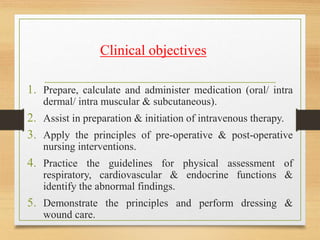
Clinical objectives
1. Prepare, calculate and administer medication (oral/ intra
dermal/ intra muscular & subcutaneous).
2. Assist in preparation & initiation of intravenous therapy.
3. Apply the principles of pre-operative & post-operative
nursing interventions.
4. Practice the guidelines for physical assessment of
respiratory, cardiovascular & endocrine functions &
identify the abnormal findings.
5. Demonstrate the principles and perform dressing &
wound care.
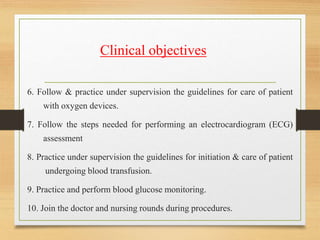
6. Follow & practice under supervision the guidelines for care of patient
with oxygen devices.
7. Follow the steps needed for performing an electrocardiogram (ECG)
assessment
8. Practice under supervision the guidelines for initiation & care of patient
undergoing blood transfusion.
9. Practice and perform blood glucose monitoring.
10. Join the doctor and nursing rounds during procedures.
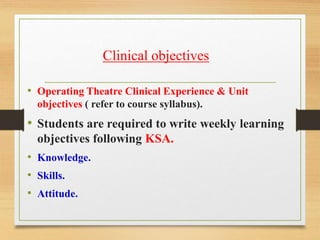
Clinical objectives
• Operating Theatre Clinical Experience & Unit
objectives ( refer to course syllabus).
• Students are required to write weekly learning
objectives following KSA.
• Knowledge.
• Skills.
• Attitude.
Clinical objectives
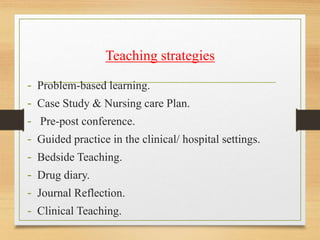
Teaching strategies
- Problem-based learning.
- Case Study & Nursing care Plan.
- Pre-post conference.
- Guided practice in the clinical/ hospital settings.
- Bedside Teaching.
- Drug diary.
- Journal Reflection.
- Clinical Teaching.
SAFETY TIPS IN THE CLINICAL
AREA
1. Administer medication and perform procedures ONLY under the
direct supervision of the clinical instructor or designated staff
RN.
2. Introduce yourself to your patient and his/her nurse both when
you go to collect data and provide patient care.
3. Be specific when discussing with the staff nurse the patient care
activities you will perform during your shift.
4. NEVER disconnect or adjust any piece of equipment unless
instructed to do so by your clinical instructor or staff nurse.
5. You may assist nurses with their nursing care; however, your
primary patient(s) should be your first priority.
6. Students will NOT be allowed to initiate blood transfusions
or chemotherapy or to manipulate pain control pumps.
7. Prior to administering any medication you are to know the
action, safe dosages, appropriateness of the drug for this
particular client, therapeutic and side effects, interaction
effects, and nursing considerations. Do NOT administer a
drug if you are unfamiliar with these aspects of the drug.
8. NEVER give a medication prepared for administration by
another nurse.
UNSAFE PRACTICES THAT ENDANGERS
PATIENT’S LIFE
Error in patient identification
Lack of knowledge regarding action or effects of medications
Medication administration errors including calculation mistakes.
Lack of aseptic technique while handling central lines, immuno-
compromised patients, repeatedly contaminating lines, avoiding
hand washing.
Leaving patients unattended: unconscious patients, disabled
patients, infants, newborn, and patients with suicidal tendencies.
Causing environmental hazards that jeopardize patient’s safety
and excessive property damage such as fire, lack of infection
control, causing patient’s fall.
Error in communicating significant information in
documentation/reporting.
 Unsafe handling of equipment, syringe pump, and lifesaving
equipment.
 Improper handling of sharps and needles.
Omission of major scientific steps in nursing procedures, e.g. not
checking nasogastric tube placement before each feeding, not
checking pulse, BP, and blood sugar as required.
Negligence or threatening a patient’s life while on oxygen therapy,
suctioning, vital signs etc.
Not following hospital policies when performing specific
procedures (disposal of infected materials, etc.)
 Any other activity that is not listed above and evaluated or judged
as unsafe by the assessors when such situations arise.
Student Learning Activities
• Each students is expected to search for a journal
related to the medical diagnosis of their assigned
patient and will write a reflection based on the
following elements such as medications, laboratory
investigations or diagnostic procedures, and
nursing interventions including patient education.
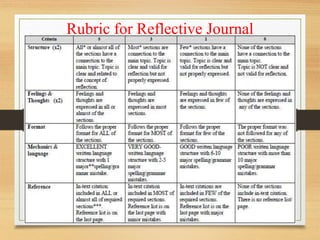
Rubric for Reflective Journal
Guidelines for Reflection Assignment
General instructions: The aim of this assignment is to reflect on a
particular clinical situation/experience students have encountered
during their clinical placements. The assignment should be 2 pages
long (approximately 500 words) excluding the cover page and the
references page. The guidelines are adopted from Gibbs
Reflection Cycle & Tanner’s Clinical Judgment Model.
1. Introduction (50 words)
2. Feelings & Thoughts (100 words)
3. Interpretation/Evaluation (100 words)
4. Analysis (100 words)
5. Conclusion (50 words)
6. Reflection-on-action & Clinical Learning (100 words)
7. References.
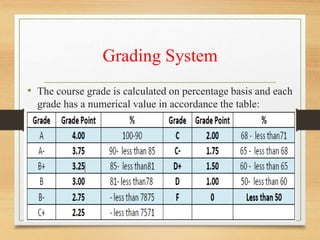
Grading System
• The course grade is calculated on percentage basis and each
grade has a numerical value in accordance the table:
Clinical Rotation
1. Nizwa Hospital (10 )
a) General medical & surgical wards
- MMW & MSW
- FMW & FSW
b) Critical areas (AICU, CCU).
c) Endoscopy, Physiotherapy.
d) Fracture Clinic, COPD, SOPD, A&E, OT.
2. Nizwa Poly Clinic (5 ) (GP, S.OPD, M.OPD, DC).
Clinical Rules
 Be on time for clinical Time: From 7:30-1:15PM.
 Have all pocket items Pen, pencil, scissors,
Calculator , watch note book.
 Strictly : do not spend more time chatting with
your colleague or staff unnecessary
 Late Submission of Case Study: work that is not
submitted on the specified date will be considered
as late and will be penalized 10% off of the
assigned grade per day late. If a student is absent
on the day of submission, the work assigned is still
due via email during the working hours of the
specified submission date
Continue
 Extension: Rarely granted and only allowed in
unforeseen circumstances) Student’s severe sickness, death
of a family member, events that beyond student’s control
e.g. natural events.
 Academic Integrity & unfair practices policy: Cheating,
Plagiarism, and academic Fraud.
Clinical focus
• Weekly learning objectives
• Procedure guide
• Procedure log sheet
• Health teaching plan
Weekly assignment
• Nizwa Hospital:
a. General patient assessment format.
b. Weekly care plan
c. One case study
d. Procedure log sheet
• NPC:
a) General patient assessment including nursing care plan
b) Procedure log sheet (MUST BE MAINTAINED AND
SUBMITTED BEFORE THE END OF THE
SEMESTER FOR EVALUATION).
Case Study
• Referred to CS. Page. No 41-63
Case Study
• Patient’s Demographic data
• Medical data
• Health history
• Past medical history
• Definition of the disease
• Pathophysiology
• Etiology of the disease
• Clinical manifestation
• Investigations ( lab &
diagnostic tests)
• Treatment carried out for your
patient
• List of nursing diagnosis
• Nursing care plan
• Evidence (1)
• Health education
• References (APA format)
Evidence
• How it is related to your patient
• Summary of literature finding
• Compare literature finding with real practice
• Implication in practice
• Your learning experience
** EVIDENCE SHOULD BE NON-
PHARMACOLOGICAL
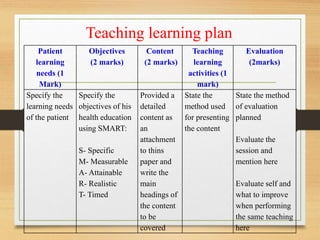
Teaching learning plan
Patient
learning
needs (1
Mark)
Objectives
(2 marks)
Content
(2 marks)
Teaching
learning
activities (1
mark)
Evaluation
(2marks)
Specify the
learning needs
of the patient
Specify the
objectives of his
health education
using SMART:
S- Specific
M- Measurable
A- Attainable
R- Realistic
T- Timed
Provided a
detailed
content as
an
attachment
to thins
paper and
write the
main
headings of
the content
to be
covered
State the
method used
for presenting
the content
State the method
of evaluation
planned
Evaluate the
session and
mention here
Evaluate self and
what to improve
when performing
the same teaching
here
Criteria for Evaluation of Written case
study
• Introduction and background of the topic and
clarity of themes
• Organization, arrangement of ideas, and adequacy
of sections
• Content coverage and discussion of the topic
Continue
• Relevance and credibility of evidence to support
the topic theme(s)
• In-text citation and referencing style of sources
• Writing mechanics: spelling, grammar, punctuation.
• Contribution of student’s thoughts to the paper
• Overall effectiveness
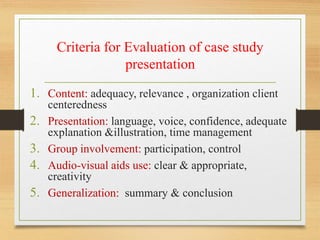
Criteria for Evaluation of case study
presentation
1. Content: adequacy, relevance , organization client
centeredness
2. Presentation: language, voice, confidence, adequate
explanation &illustration, time management
3. Group involvement: participation, control
4. Audio-visual aids use: clear & appropriate,
creativity
5. Generalization: summary & conclusion

Orientation to AHN I Practicum 22-23.pptx

  • 1.
    Orientation to AdultHealth Nursing I Practicum Year2, Semester I 2021-2022 Mrs. Basma Al-Mahrouqi AHNI Practicum Coordinator
  • 2.
    Orientation to AdultHealth Nursing I Practicum AY:2022-2023 Mrs. Basma Al-Mahrouqi
  • 3.
    Adult Health NursingPracticum I • Clinical credits: 4 = 180 hrs • Two days weekly (Every Wednesday & Thursday) at Nizwa Hospital & Nizwa Poly Clinic (NPC). • Warning: reach 10%= 3 days verbal warning. • 15% = 4 days: written warning. • Not allowed to attend the final clinical exam if reaching 20 % = 6 days (withdrawal if excused, failure if unexcused.
  • 4.
    Clinical objectives 1. Prepare,calculate and administer medication (oral/ intra dermal/ intra muscular & subcutaneous). 2. Assist in preparation & initiation of intravenous therapy. 3. Apply the principles of pre-operative & post-operative nursing interventions. 4. Practice the guidelines for physical assessment of respiratory, cardiovascular & endocrine functions & identify the abnormal findings. 5. Demonstrate the principles and perform dressing & wound care.
  • 5.
    6. Follow &practice under supervision the guidelines for care of patient with oxygen devices. 7. Follow the steps needed for performing an electrocardiogram (ECG) assessment 8. Practice under supervision the guidelines for initiation & care of patient undergoing blood transfusion. 9. Practice and perform blood glucose monitoring. 10. Join the doctor and nursing rounds during procedures. Clinical objectives
  • 6.
    • Operating TheatreClinical Experience & Unit objectives ( refer to course syllabus). • Students are required to write weekly learning objectives following KSA. • Knowledge. • Skills. • Attitude. Clinical objectives
  • 7.
    Teaching strategies - Problem-basedlearning. - Case Study & Nursing care Plan. - Pre-post conference. - Guided practice in the clinical/ hospital settings. - Bedside Teaching. - Drug diary. - Journal Reflection. - Clinical Teaching.
  • 8.
    SAFETY TIPS INTHE CLINICAL AREA 1. Administer medication and perform procedures ONLY under the direct supervision of the clinical instructor or designated staff RN. 2. Introduce yourself to your patient and his/her nurse both when you go to collect data and provide patient care. 3. Be specific when discussing with the staff nurse the patient care activities you will perform during your shift. 4. NEVER disconnect or adjust any piece of equipment unless instructed to do so by your clinical instructor or staff nurse. 5. You may assist nurses with their nursing care; however, your primary patient(s) should be your first priority.
  • 9.
    6. Students willNOT be allowed to initiate blood transfusions or chemotherapy or to manipulate pain control pumps. 7. Prior to administering any medication you are to know the action, safe dosages, appropriateness of the drug for this particular client, therapeutic and side effects, interaction effects, and nursing considerations. Do NOT administer a drug if you are unfamiliar with these aspects of the drug. 8. NEVER give a medication prepared for administration by another nurse.
  • 10.
    UNSAFE PRACTICES THATENDANGERS PATIENT’S LIFE Error in patient identification Lack of knowledge regarding action or effects of medications Medication administration errors including calculation mistakes. Lack of aseptic technique while handling central lines, immuno- compromised patients, repeatedly contaminating lines, avoiding hand washing. Leaving patients unattended: unconscious patients, disabled patients, infants, newborn, and patients with suicidal tendencies. Causing environmental hazards that jeopardize patient’s safety and excessive property damage such as fire, lack of infection control, causing patient’s fall.
  • 11.
    Error in communicatingsignificant information in documentation/reporting.  Unsafe handling of equipment, syringe pump, and lifesaving equipment.  Improper handling of sharps and needles. Omission of major scientific steps in nursing procedures, e.g. not checking nasogastric tube placement before each feeding, not checking pulse, BP, and blood sugar as required. Negligence or threatening a patient’s life while on oxygen therapy, suctioning, vital signs etc. Not following hospital policies when performing specific procedures (disposal of infected materials, etc.)  Any other activity that is not listed above and evaluated or judged as unsafe by the assessors when such situations arise.
  • 12.
    Student Learning Activities •Each students is expected to search for a journal related to the medical diagnosis of their assigned patient and will write a reflection based on the following elements such as medications, laboratory investigations or diagnostic procedures, and nursing interventions including patient education.
  • 13.
  • 14.
    Guidelines for ReflectionAssignment General instructions: The aim of this assignment is to reflect on a particular clinical situation/experience students have encountered during their clinical placements. The assignment should be 2 pages long (approximately 500 words) excluding the cover page and the references page. The guidelines are adopted from Gibbs Reflection Cycle & Tanner’s Clinical Judgment Model. 1. Introduction (50 words) 2. Feelings & Thoughts (100 words) 3. Interpretation/Evaluation (100 words) 4. Analysis (100 words) 5. Conclusion (50 words) 6. Reflection-on-action & Clinical Learning (100 words) 7. References.
  • 15.
    Grading System • Thecourse grade is calculated on percentage basis and each grade has a numerical value in accordance the table:
  • 16.
    Clinical Rotation 1. NizwaHospital (10 ) a) General medical & surgical wards - MMW & MSW - FMW & FSW b) Critical areas (AICU, CCU). c) Endoscopy, Physiotherapy. d) Fracture Clinic, COPD, SOPD, A&E, OT. 2. Nizwa Poly Clinic (5 ) (GP, S.OPD, M.OPD, DC).
  • 17.
    Clinical Rules  Beon time for clinical Time: From 7:30-1:15PM.  Have all pocket items Pen, pencil, scissors, Calculator , watch note book.  Strictly : do not spend more time chatting with your colleague or staff unnecessary  Late Submission of Case Study: work that is not submitted on the specified date will be considered as late and will be penalized 10% off of the assigned grade per day late. If a student is absent on the day of submission, the work assigned is still due via email during the working hours of the specified submission date
  • 18.
    Continue  Extension: Rarelygranted and only allowed in unforeseen circumstances) Student’s severe sickness, death of a family member, events that beyond student’s control e.g. natural events.  Academic Integrity & unfair practices policy: Cheating, Plagiarism, and academic Fraud.
  • 19.
    Clinical focus • Weeklylearning objectives • Procedure guide • Procedure log sheet • Health teaching plan
  • 20.
    Weekly assignment • NizwaHospital: a. General patient assessment format. b. Weekly care plan c. One case study d. Procedure log sheet • NPC: a) General patient assessment including nursing care plan b) Procedure log sheet (MUST BE MAINTAINED AND SUBMITTED BEFORE THE END OF THE SEMESTER FOR EVALUATION).
  • 21.
    Case Study • Referredto CS. Page. No 41-63
  • 22.
    Case Study • Patient’sDemographic data • Medical data • Health history • Past medical history • Definition of the disease • Pathophysiology • Etiology of the disease • Clinical manifestation • Investigations ( lab & diagnostic tests) • Treatment carried out for your patient • List of nursing diagnosis • Nursing care plan • Evidence (1) • Health education • References (APA format)
  • 23.
    Evidence • How itis related to your patient • Summary of literature finding • Compare literature finding with real practice • Implication in practice • Your learning experience ** EVIDENCE SHOULD BE NON- PHARMACOLOGICAL
  • 24.
    Teaching learning plan Patient learning needs(1 Mark) Objectives (2 marks) Content (2 marks) Teaching learning activities (1 mark) Evaluation (2marks) Specify the learning needs of the patient Specify the objectives of his health education using SMART: S- Specific M- Measurable A- Attainable R- Realistic T- Timed Provided a detailed content as an attachment to thins paper and write the main headings of the content to be covered State the method used for presenting the content State the method of evaluation planned Evaluate the session and mention here Evaluate self and what to improve when performing the same teaching here
  • 25.
    Criteria for Evaluationof Written case study • Introduction and background of the topic and clarity of themes • Organization, arrangement of ideas, and adequacy of sections • Content coverage and discussion of the topic
  • 26.
    Continue • Relevance andcredibility of evidence to support the topic theme(s) • In-text citation and referencing style of sources • Writing mechanics: spelling, grammar, punctuation. • Contribution of student’s thoughts to the paper • Overall effectiveness
  • 27.
    Criteria for Evaluationof case study presentation 1. Content: adequacy, relevance , organization client centeredness 2. Presentation: language, voice, confidence, adequate explanation &illustration, time management 3. Group involvement: participation, control 4. Audio-visual aids use: clear & appropriate, creativity 5. Generalization: summary & conclusion