International Journal of Computer Science & Engineering Survey (IJCSES) Vol.8, No.2, April 2017
DOI:10.5121/ijcses.2017.8202 13
ORIENTATION EFFECTIVENESS IN THE OBJECTS
DETECTED AREAS USING DIFFERENT TYPES OF
EDGES DETECTION TECHNIQUES
Muhamad Azhar Abdilatef AL-Obaidy
Department of Mechatronics Engineering, College of Engineering, University of Mosul,
Mosul, Iraq
ABSTRACT
This paper presents a study for the orientation effectiveness on the detected areas for many sampled
objects when many type of the edges detection are applied. The Canny, Laplace, Prewitt and Sobel are
applied for three objects (pencils’ sharpeners with different colors). The MBR (Minimal Bounding
Rectangular) are used to calculate the area in pixels, centroid and the orientation. The MR
(Misclassification Ratio) is used to find the different between the edges detection techniques. The Canny
edges detection technique gives the best result for the three used object using all orientations.
KEYWORDS
Orientation, Edge Detection, MR, Objects, tp rate, sharpeners, Canny, Sobel, Laplace, Prewitt.
1. INTRODUCTION
The object detection technique is one of the most important image processing and computer
vision methods those used in many fields today. During the detection many features can be
extracted such as colors, orientations, centroids, textures, edges, and ext. the detection methods
and especially the edges techniques are used in the fields of military, medicine, biological
researches, industrial applications and many others. These techniques are sometime used to
support other types of detection methods, it can help them to complete the final work such as the
medical and the industrial applications, in other time it represent the mainly part of the work.
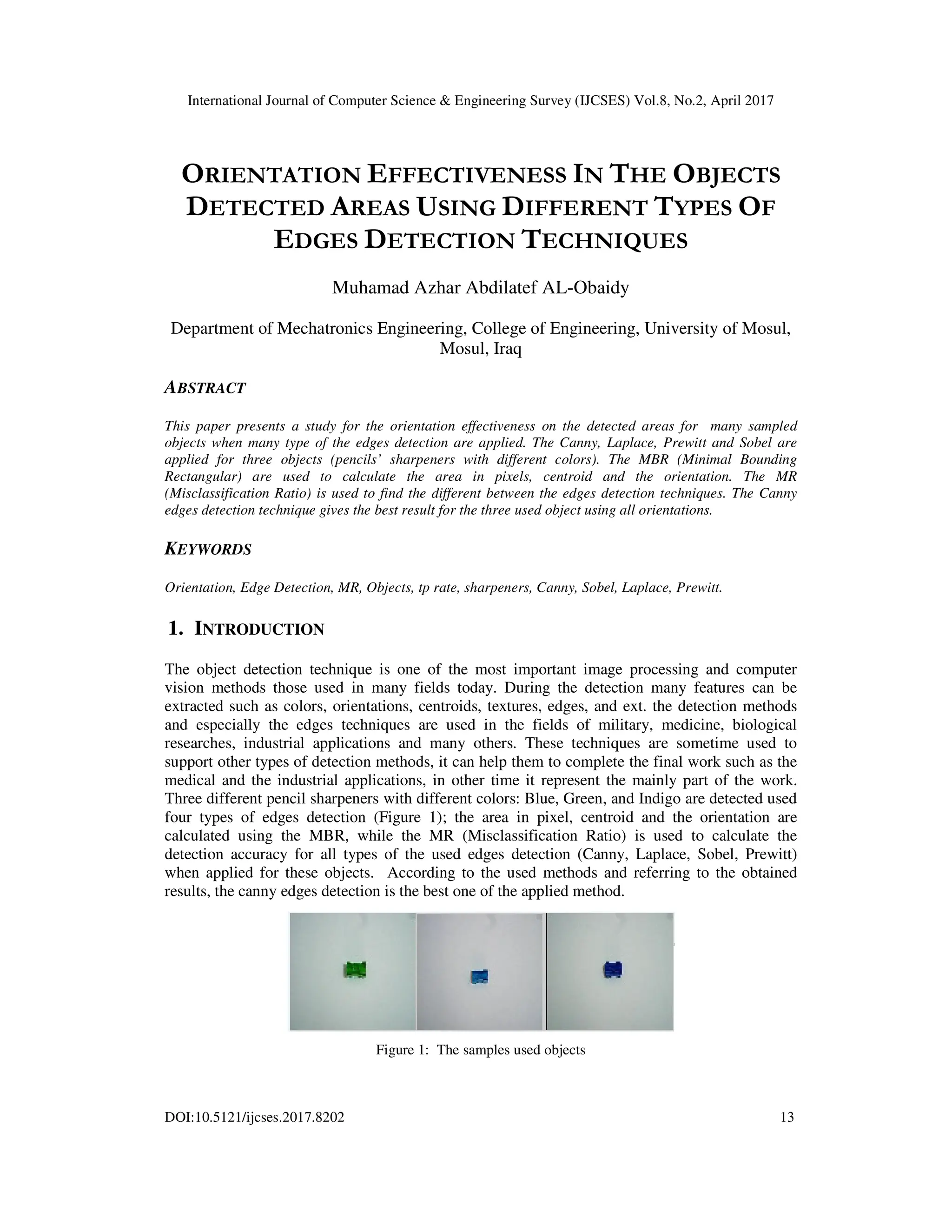
Three different pencil sharpeners with different colors: Blue, Green, and Indigo are detected used
four types of edges detection (Figure 1); the area in pixel, centroid and the orientation are
calculated using the MBR, while the MR (Misclassification Ratio) is used to calculate the
detection accuracy for all types of the used edges detection (Canny, Laplace, Sobel, Prewitt)
when applied for these objects. According to the used methods and referring to the obtained
results, the canny edges detection is the best one of the applied method.
Figure 1: The samples used objects
International Journal of Computer Science & Engineering Survey (IJCSES) Vol.8, No.2, April 2017
14
2. RELATIVE WORKS
Canny and other types of edges detection techniques are used by the researcher inside other type
of image processing detection methods in their works, as mentioned before, these methods can be
used individually or with others, the canny edge detection is an operator developed by John F.
Canny, it is used for purpose of detection, it uses a multi stage algorithm type [7]. The Sobel
technique which is mostly named the sobel filter or sobel-Feldman operator is presented by Irwin
Sobel in 1968, it is used in computer vision and also image processing detection algorithms [11],
it is really a discrete differentiation technique, it can compute the gradient of the intensity
function of the image, in this type, each point or pixel inside the image is corresponded as a
gradient vector or norm to it. The prewitt operator [12] which is presented by Judith M.S. Prewitt
is found the edges using the prewitt approximation to the derivative. In most of the works today,
many proposed methods merged between two or more methods to present new techniques with
many enhancements, other researches are done depending on a comparison between many
methods over the same material (objects). In [1], Min. C. Shin and et.al a comparison between
the edges detection techniques is done. They used the structure from motion (SMF) to do an
evaluation over the algorithms of edges detections. The obtained results suggested that the ratings
of the canny detector performance is based on the pixel level matrices and also on the SFM are
related one to each other and have high performance like canny and other detectors. In [2], Sayed
Jahanzeb Hussien Pirzada and et.al are enhanced the edges detection techniques using low pass
filter inside the canny edge detection, this algorithm is used as a features extraction, the extracted
features are not same when its captured from different directions. In this work, a study of an
orientation’s effectiveness for the detected objects is done, assumed that the objects images are
captured from many sides; many edges types are applied for these images with which are content
same shape objects with different colors. In [3], Andrew H. S Lai, and Nelson H. C. Yung are
presented a novel method for lane algorithm detection used for surveillance traffics tracking, they
tried to isolate one path from all the captured image then surrounding or mask the car needed to
be detected or tracked from the other parts, also used to notes any sudden changes or movements,
the edges techniques are used here and the orientation is detected during the detection and
tracking tackle, most of the time when the objects are detected more one time with many
orientations, the shapes and also number of pixels those extracted are not the same. Another study
for the orientation inside the colors is done by Viswanath Gopalakrishnan, Yiquan Hu, and Deepu
Rajan [4], they used the detection framework which is based on both color and orientation those
distributed in image, the orientation framework is used to detect regions in images based on
global and local behaviour of different orientations in images. In robotics field when an objects
sometime has to be gripped by the fingers of the robots, it is very important to know the
orientation of it to rotate the robot arm according to that and catch it, In [5], a study for a mobile
cleaning robot is done to measure the error in orientation, a new method is used to reduce the
error in localization. In this paper , after studied the ideas given before, a new study for the
orientation effectiveness is used to compare between many edges detection techniques when the
same regions are detected from different sides, this rule is applied for the areas of detected objects
used these many edges techniques.
2.1. Canny Edge Detection Technique
The canny edge detection is an operator or technique used for extracting the useful information
and structures details from different vision’s object, canny and the other type of edges techniques
can reduce the amount of data to be processed. The canny algorithm includes applying the
Gaussian filter which is used to smooth the image to remove the noisy parts, find the image
gradients’ intensity, applying the non-maximum type of suppression for the purpose of liquidation
for the response’s spurious to the edge detection, duplicate the normal value of threshold and
finally using the hysteresis to track the edge [7].
International Journal of Computer Science & Engineering Survey (IJCSES) Vol.8, No.2, April 2017
15
2.2. Sobel Edge Detection Technique
Sobel filter or as it is sometime called Sobel- Feldman operator, is a type of edges techniques
used in image processing and also in computer vision, this type consist of two separated
operations: the first one make a smoothing to be perpendicular to the direction that is derivative
with a triangle filter, the second one is the central simple difference in the derivative direction, the
Sobel operator can reduce the artifacts that is associated with the pure central operator’s
differences, but it does not have a perfect rotational symmetry. So this is a disadvantage of using
it [8].
2.3. Laplace Edge Detection Technique
The Laplace detector or as it is named the Laplacian operator is mostly represented as a blob
detector that is used in computer vision field for the purpose of regions detection in digital
captured images from a real or offline video (recorded video), this type of operators is used in this
paper as one of many techniques applied for the purpose of orientation effectiveness.
2.4. Prewitt Edge Detection Technique
It is a discrete differentiation technique or operator that includes computing the gradient
approximately for the image intensity function, this operator is usually based on convolving the
used image with a separable, small, and integer filter value in both horizontal and vertical
directions, it like Sobel operator in that it is inexpensive in computations relatively.
3. WORK AND RESULTS
In this paper, canny, Sobel, Prewitt, and Laplace edges detection methods are applied for three
colors of a pencil sharpener (light blue - dark blue - green), each of these three sharpeners are
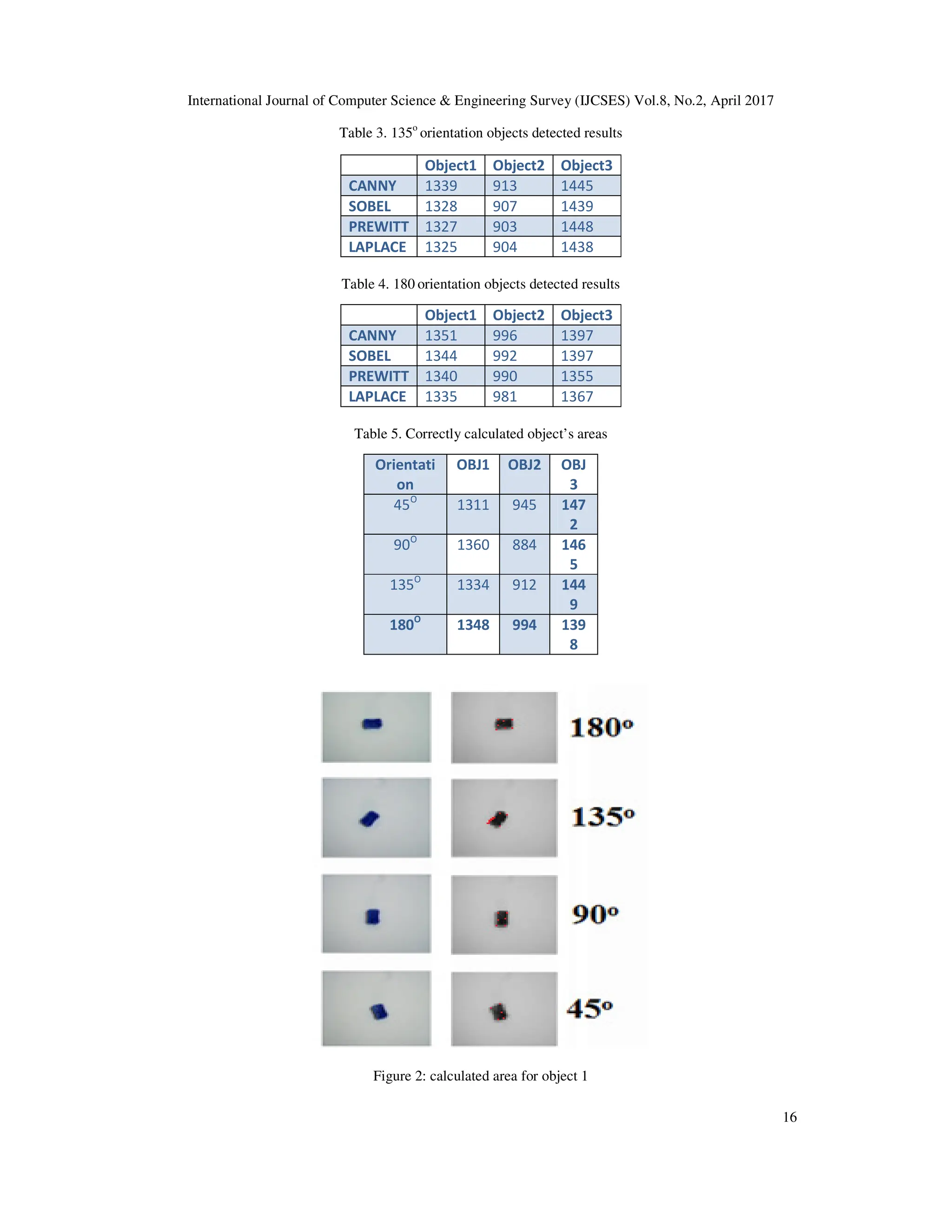
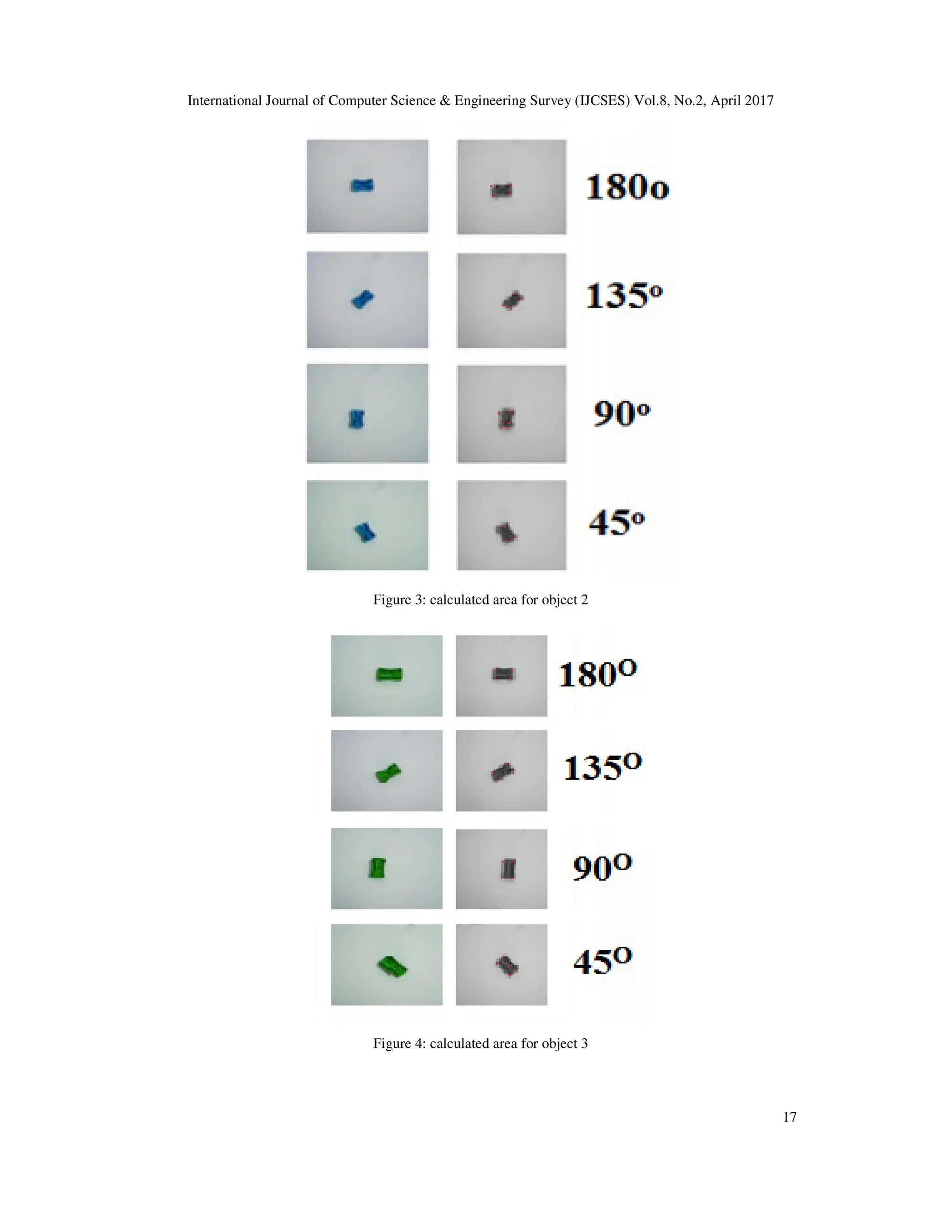
captured in many orientations: (45o, 90o, 135o, 180o), figures (2-4), includes the area in pixels
which are detected for three sharpeners with all the four mentioned orientations after applying the
edges. The MBR is used to get the wanted orientation exactly, The purpose of this operation is to
see if the changes in orientations may cause effects in detection (the edges techniques) or not, and
to see also which type of edges techniques has the less effectiveness when the orientation is
changed, the following tables (1 - 4) are included the areas detected using the edges detection
techniques for the sharpeners in all orientations cases, table 5 includes the correctly calculated
areas before applying the edges techniques.
Table 1. 45o
orientation objects detected results
Object1 Object2 Object3
CANNY 1313 946 1458
SOBEL 1309 942 1466
PREWITT 1307 944 1471
LAPLACE 1305 938 1466
Table 2. 90o
orientation objects detected results
Object1 Object2 Object3
CANNY 1363 885 1451
SOBEL 1346 882 1460
PREWITT 1359 883 1456
LAPLACE 1349 871 1455
International Journal of Computer Science & Engineering Survey (IJCSES) Vol.8, No.2, April 2017
16
Table 3. 135o
orientation objects detected results
Object1 Object2 Object3
CANNY 1339 913 1445
SOBEL 1328 907 1439
PREWITT 1327 903 1448
LAPLACE 1325 904 1438
Table 4. 180 orientation objects detected results
Object1 Object2 Object3
CANNY 1351 996 1397
SOBEL 1344 992 1397
PREWITT 1340 990 1355
LAPLACE 1335 981 1367
Table 5. Correctly calculated object’s areas
Orientati
on
OBJ1 OBJ2 OBJ
3
45O
1311 945 147
2
90O
1360 884 146
5
135O
1334 912 144
9
180O
1348 994 139
8
Figure 2: calculated area for object 1
International Journal of Computer Science & Engineering Survey (IJCSES) Vol.8, No.2, April 2017
17
Figure 3: calculated area for object 2
Figure 4: calculated area for object 3
International Journal of Computer Science & Engineering Survey (IJCSES) Vol.8, No.2, April 2017
18
Sometime the number of detected pixels in the region of interest are not reach the actual
foreground pixel’s number thus many methods are used over the time to refer to the errors and
make many enhancement for the not well detected methods, the MR (Misclassification Ratio) [9-
10], is used to find the error in detection for each one of the three used sharpeners (objects) for
the four detected orientations (45, 90, 135, 180); to do that, the correctly area of the objects has to
be calculated firstly, this is done by assuming that the object (sharpener) is a foreground part
while the other parts are represented as a background, thus the subtraction operation is applied for
the binary images mode to calculate the correctly object’s area. The following steps and equations
are used to find the MR:
• Total positive numbers (foreground) pixels which are correctly classified (TP) are
normalized by the total positive (foreground) in order pixels to find (tp rate).
• Total positive numbers (foreground) pixels which are incorrectly classified (FP) are
normalized by the total positive (foreground) pixels in order to find (fp rate).
• Total negative numbers (background) pixels which are correctly classified (TN).
• Total negative numbers (background) pixels which are incorrectly classified (FN).
• The true positive rate [10] (also called hit rate and recall) of a classifier is estimated as:
• tp rate = Positives correctly classified (TP) / Total positives (1)
• The false positive rate [10] (also called false alarm rate) of the classifier is estimated as:
• fp rate= Positive incorrectly classified (FP) / Total negatives (2)
• Finally to calculate the MR the following equation has to be used according to the
following equation:
• MR =(FP+FN)/( TP+TN+FN+TN)* 100% (3)
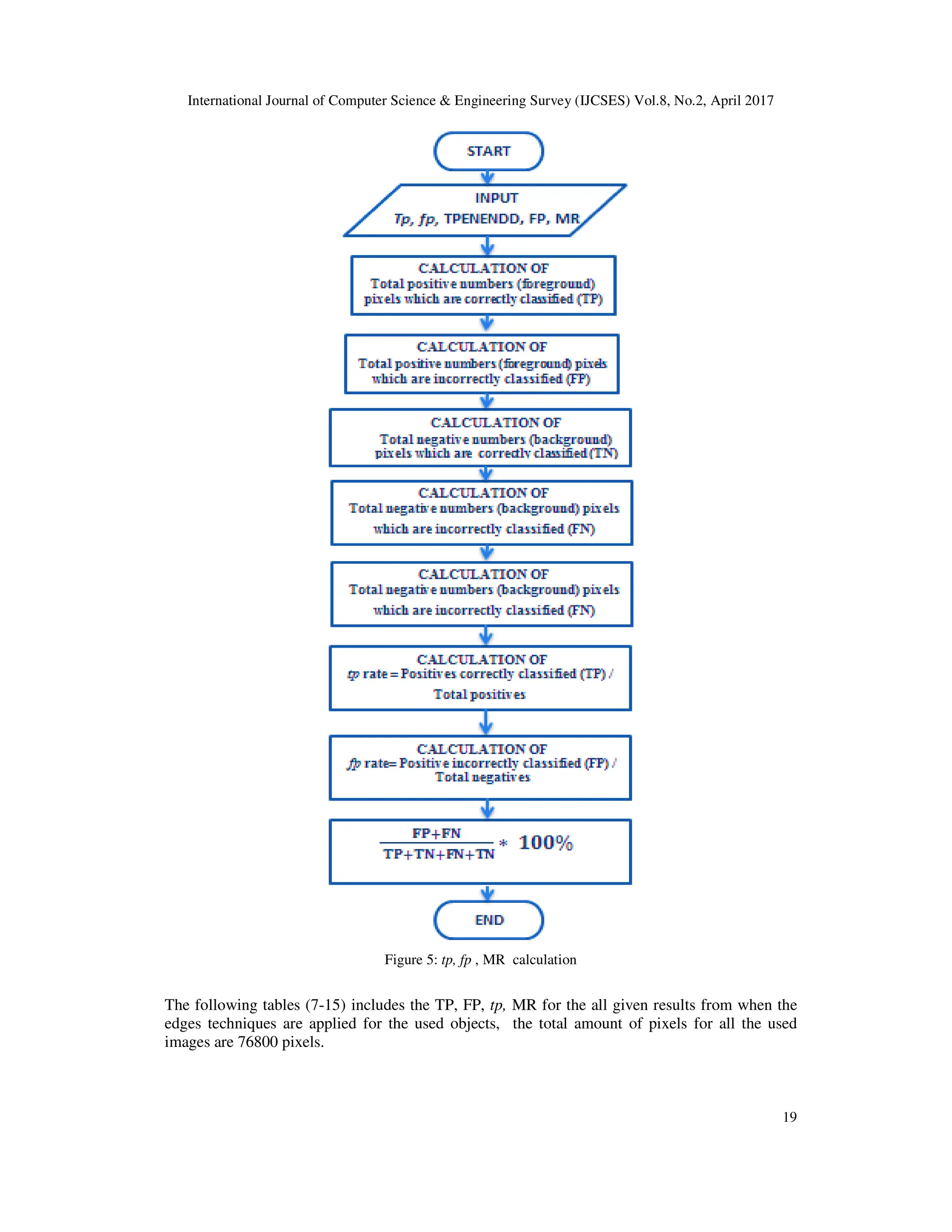
Figure 5 include a flow chard to find the tp, fp and MR factors in steps. In order find all of the
mentioned factors, it is important to record the information of the captured images for the used
objects before applying operations, these information include the directions of image to calculate
the amount of each image’s pixels, table 6 include the properties for the used images.
Table 6. Used images properties
Dimensions 320 x 240
Width 320 pixels
Height 240 pixels
Horizontal
Resolution
96 dpi
Vertical Resolution 96 dpi
Bit Depth 24
International Journal of Computer Science & Engineering Survey (IJCSES) Vol.8, No.2, April 2017
19
Figure 5: tp, fp , MR calculation
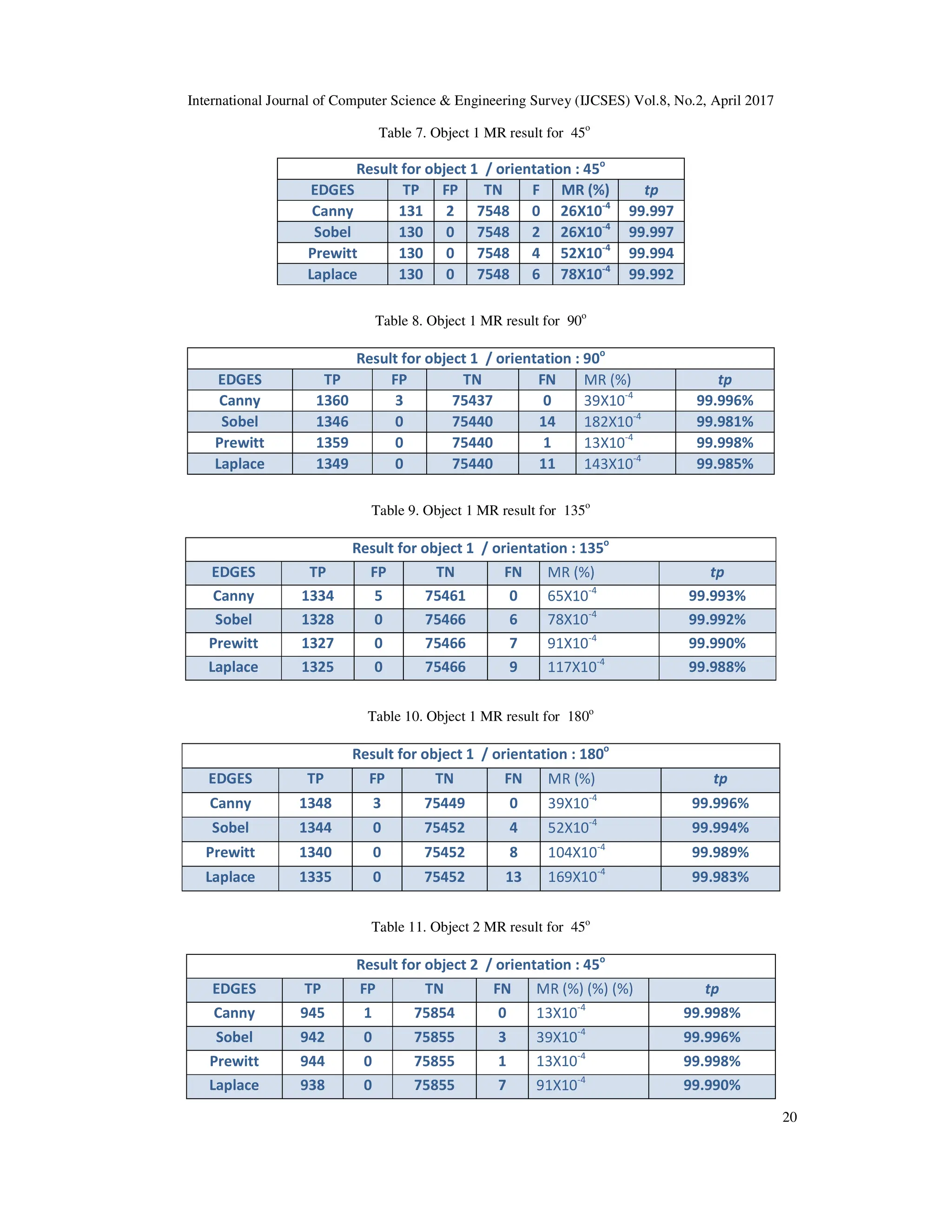
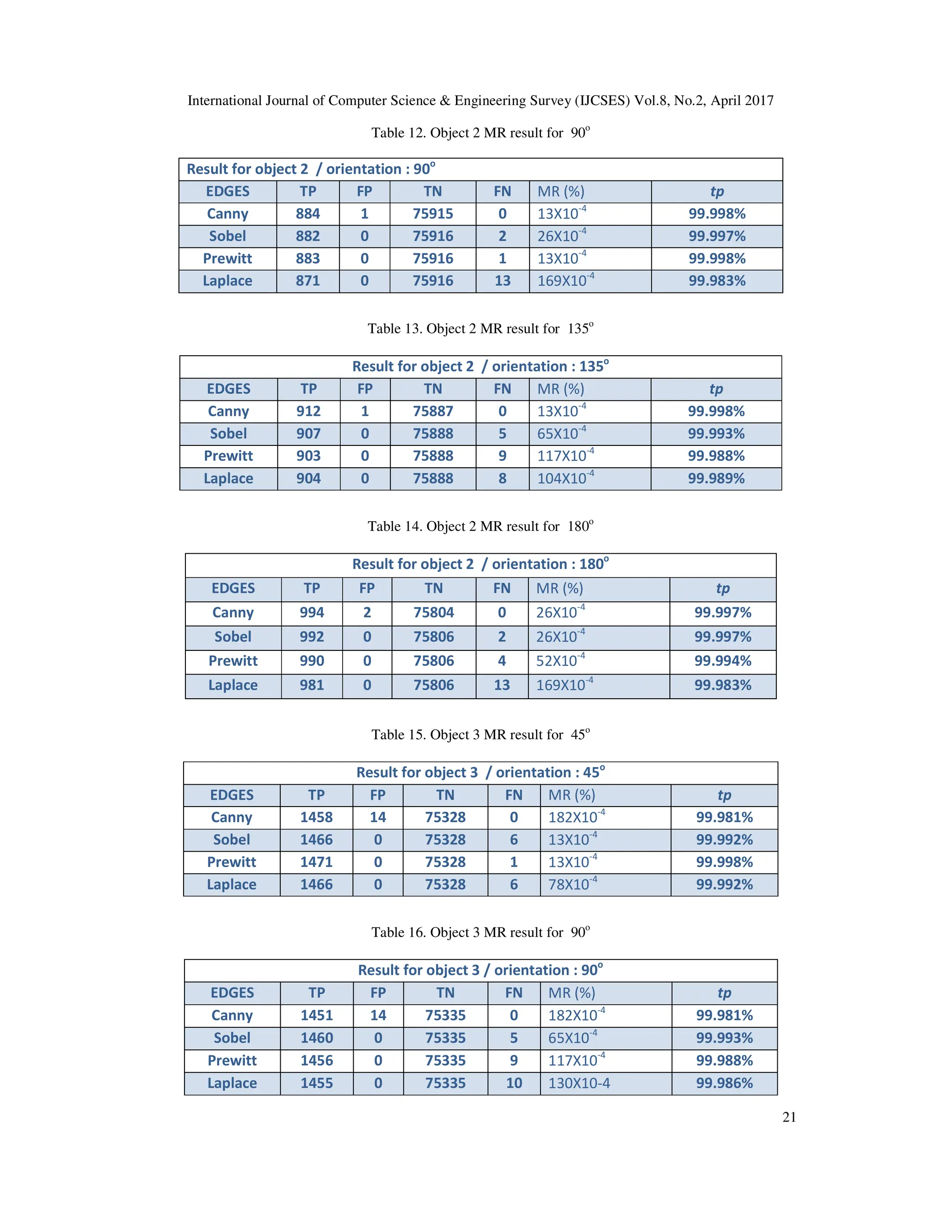
The following tables (7-15) includes the TP, FP, tp, MR for the all given results from when the
edges techniques are applied for the used objects, the total amount of pixels for all the used
images are 76800 pixels.
International Journal of Computer Science & Engineering Survey (IJCSES) Vol.8, No.2, April 2017
20
Table 7. Object 1 MR result for 45o
Result for object 1 / orientation : 45o
EDGES TP FP TN F MR (%) tp
Canny 131 2 7548 0 26X10-4
99.997
Sobel 130 0 7548 2 26X10-4
99.997
Prewitt 130 0 7548 4 52X10-4
99.994
Laplace 130 0 7548 6 78X10-4
99.992
Table 8. Object 1 MR result for 90o
Result for object 1 / orientation : 90o
EDGES TP FP TN FN MR (%) tp
Canny 1360 3 75437 0 39X10-4
99.996%
Sobel 1346 0 75440 14 182X10-4
99.981%
Prewitt 1359 0 75440 1 13X10-4
99.998%
Laplace 1349 0 75440 11 143X10-4
99.985%
Table 9. Object 1 MR result for 135o
Result for object 1 / orientation : 135o
EDGES TP FP TN FN MR (%) tp
Canny 1334 5 75461 0 65X10-4
99.993%
Sobel 1328 0 75466 6 78X10-4
99.992%
Prewitt 1327 0 75466 7 91X10-4
99.990%
Laplace 1325 0 75466 9 117X10-4
99.988%
Table 10. Object 1 MR result for 180o
Result for object 1 / orientation : 180o
EDGES TP FP TN FN MR (%) tp
Canny 1348 3 75449 0 39X10-4
99.996%
Sobel 1344 0 75452 4 52X10-4
99.994%
Prewitt 1340 0 75452 8 104X10-4
99.989%
Laplace 1335 0 75452 13 169X10-4
99.983%
Table 11. Object 2 MR result for 45o
Result for object 2 / orientation : 45o
EDGES TP FP TN FN MR (%) (%) (%)
(%)
tp
Canny 945 1 75854 0 13X10-4
99.998%
Sobel 942 0 75855 3 39X10-4
99.996%
Prewitt 944 0 75855 1 13X10-4
99.998%
Laplace 938 0 75855 7 91X10-4
99.990%
International Journal of Computer Science & Engineering Survey (IJCSES) Vol.8, No.2, April 2017
21
Table 12. Object 2 MR result for 90o
Result for object 2 / orientation : 90o
EDGES TP FP TN FN MR (%) tp
Canny 884 1 75915 0 13X10-4
99.998%
Sobel 882 0 75916 2 26X10-4
99.997%
Prewitt 883 0 75916 1 13X10-4
99.998%
Laplace 871 0 75916 13 169X10-4
99.983%
Table 13. Object 2 MR result for 135o
Result for object 2 / orientation : 135o
EDGES TP FP TN FN MR (%) tp
Canny 912 1 75887 0 13X10-4
99.998%
Sobel 907 0 75888 5 65X10-4
99.993%
Prewitt 903 0 75888 9 117X10-4
99.988%
Laplace 904 0 75888 8 104X10-4
99.989%
Table 14. Object 2 MR result for 180o
Result for object 2 / orientation : 180o
EDGES TP FP TN FN MR (%) tp
Canny 994 2 75804 0 26X10-4
99.997%
Sobel 992 0 75806 2 26X10-4
99.997%
Prewitt 990 0 75806 4 52X10-4
99.994%
Laplace 981 0 75806 13 169X10-4
99.983%
Table 15. Object 3 MR result for 45o
Result for object 3 / orientation : 45o
EDGES TP FP TN FN MR (%) tp
Canny 1458 14 75328 0 182X10-4
99.981%
Sobel 1466 0 75328 6 13X10-4
99.992%
Prewitt 1471 0 75328 1 13X10-4
99.998%
Laplace 1466 0 75328 6 78X10-4
99.992%
Table 16. Object 3 MR result for 90o
Result for object 3 / orientation : 90o
EDGES TP FP TN FN MR (%) tp
Canny 1451 14 75335 0 182X10-4
99.981%
Sobel 1460 0 75335 5 65X10-4
99.993%
Prewitt 1456 0 75335 9 117X10-4
99.988%
Laplace 1455 0 75335 10 130X10-4 99.986%
International Journal of Computer Science & Engineering Survey (IJCSES) Vol.8, No.
Table 17. Object 3 MR result for 135
Result for object 3 / orientation : 135
EDGES TP
Canny 1445
Sobel 1439
Prewitt 1448
Laplace 1438
Table 18. Object 3 MR result for 180
Result for object 3 / orientation : 180
EDGES TP FP
Canny 1397 0
Sobel 1397 0
Prewitt 1355 0
Laplace 1367 0
In the following figures histograms (6, 7, 8, 9), the MR for all the used edges techniques are
implemented when applied for the three used sharpeners
135o
, 180o
), each histogram figure include the MR% (Misclassification ratio %) of using the
edges types over the three objects for one orientation divided by (10
more clearly than the actual values. Table 1
the orientation cases, this table is gave a pre
the object and not effected with the orientation of it. The figures mention
tables above to compare and find the best edge operator used to detect the sharpeners.
Figure
0
50
100
150
200
canny
International Journal of Computer Science & Engineering Survey (IJCSES) Vol.8, No.2,
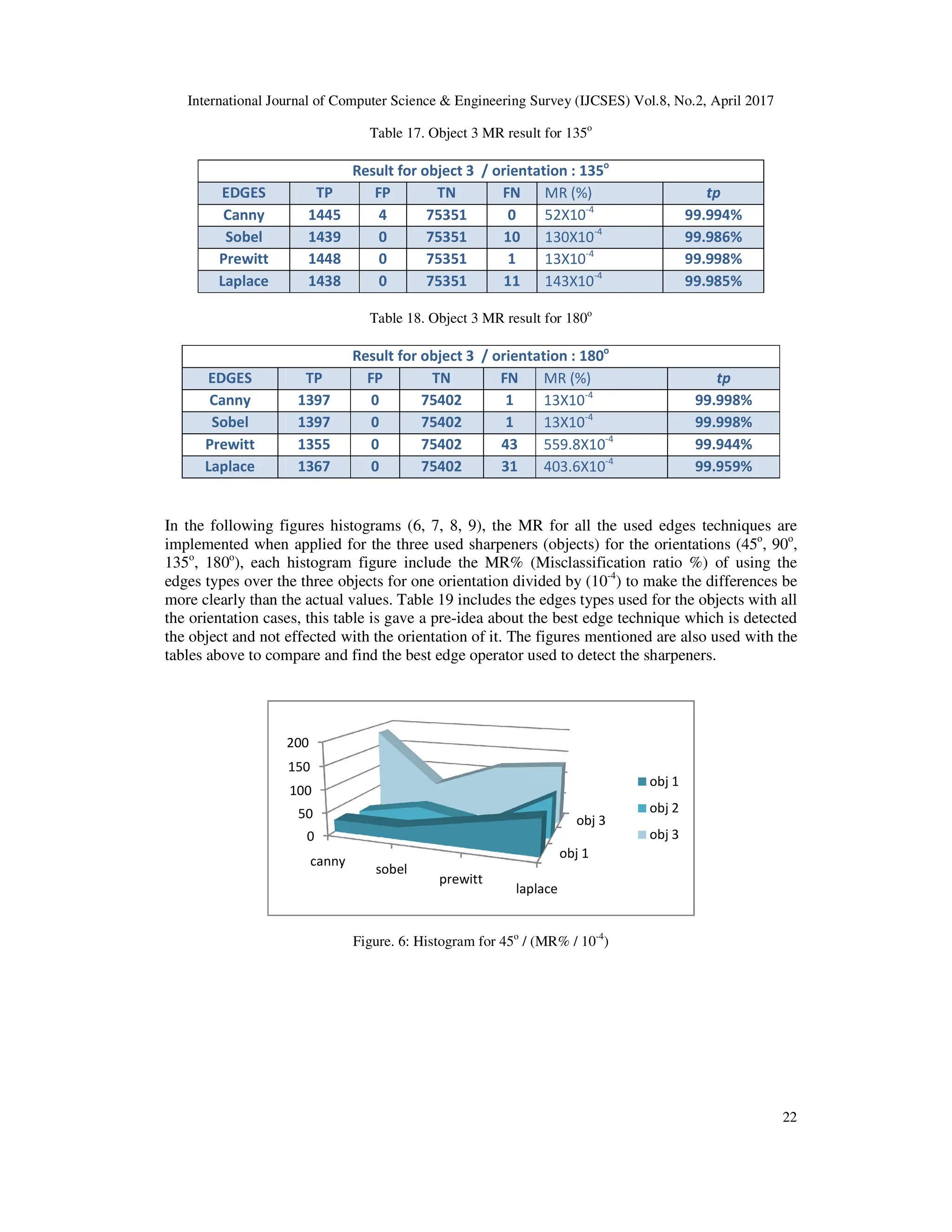
Table 17. Object 3 MR result for 135o
Result for object 3 / orientation : 135o
FP TN FN MR (%) tp
4 75351 0 52X10-4
99.994%
0 75351 10 130X10-4
99.986%
0 75351 1 13X10-4
99.998%
0 75351 11 143X10-4
99.985%
Table 18. Object 3 MR result for 180o
Result for object 3 / orientation : 180o
FP TN FN MR (%)
0 75402 1 13X10-4
99.998%
0 75402 1 13X10-4
99.998%
0 75402 43 559.8X10⁻⁴
99.944%
0 75402 31 403.6X10⁻⁴
99.959%
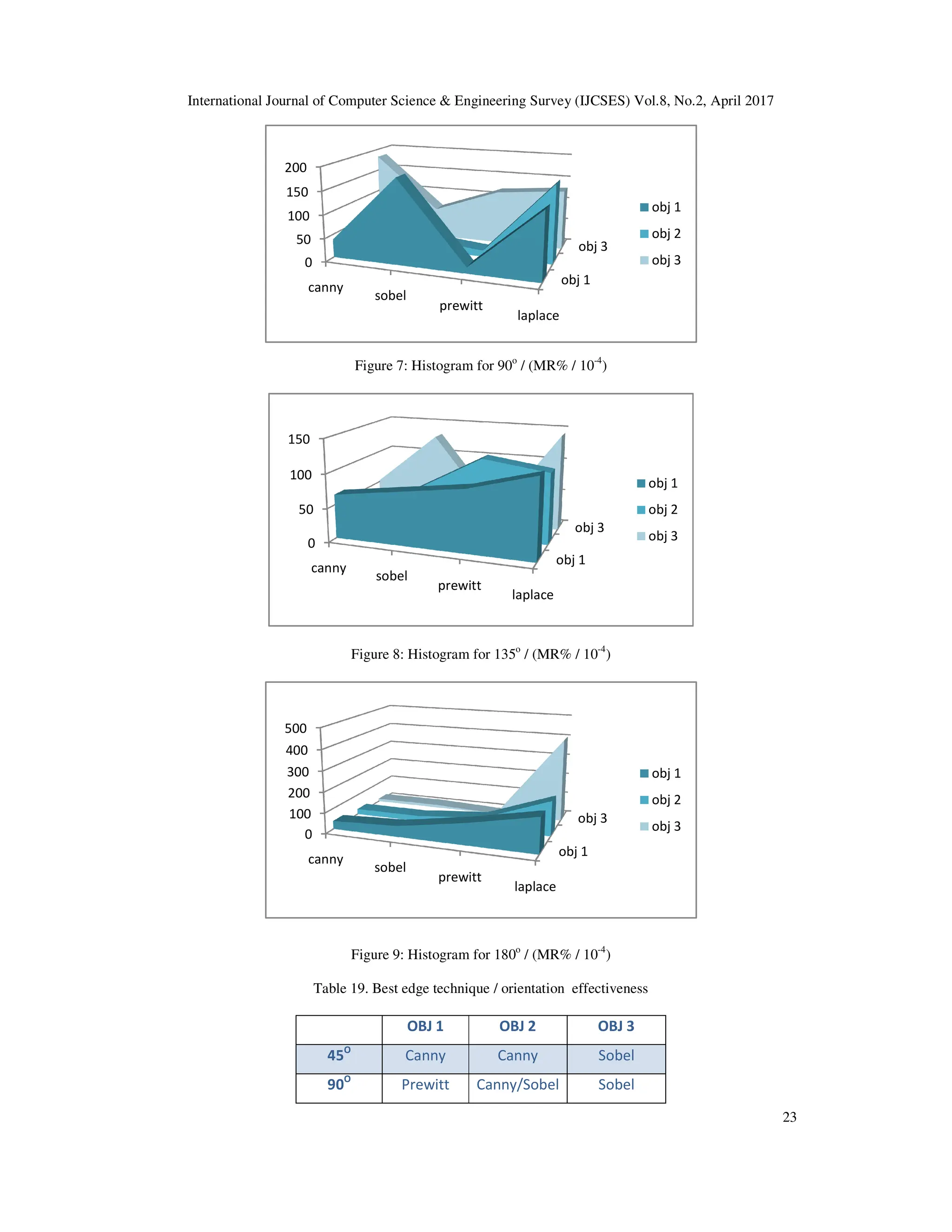
In the following figures histograms (6, 7, 8, 9), the MR for all the used edges techniques are
implemented when applied for the three used sharpeners (objects) for the orientations (45
), each histogram figure include the MR% (Misclassification ratio %) of using the
edges types over the three objects for one orientation divided by (10-4
) to make the differences be
actual values. Table 19 includes the edges types used for the objects with all
the orientation cases, this table is gave a pre-idea about the best edge technique which is detected
the object and not effected with the orientation of it. The figures mentioned are also used with the
tables above to compare and find the best edge operator used to detect the sharpeners.
ure. 6: Histogram for 45o
/ (MR% / 10-4
)
obj 1
obj 3
sobel
prewitt
laplace
obj 1
obj 2
obj 3
, April 2017
22
tp
99.994%
99.986%
99.998%
99.985%
tp
99.998%
99.998%
99.944%
99.959%
In the following figures histograms (6, 7, 8, 9), the MR for all the used edges techniques are
(objects) for the orientations (45o
, 90o
,
), each histogram figure include the MR% (Misclassification ratio %) of using the
) to make the differences be
includes the edges types used for the objects with all
idea about the best edge technique which is detected
ed are also used with the
tables above to compare and find the best edge operator used to detect the sharpeners.
International Journal of Computer Science & Engineering Survey (IJCSES) Vol.8, No.
Figure
Figure
Figure
Table 19. Best edge technique / orientation effectiveness
45O
90O
0
50
100
150
200
canny
0
50
100
150
canny
0
100
200
300
400
500
canny
sobel
International Journal of Computer Science & Engineering Survey (IJCSES) Vol.8, No.2,
ure 7: Histogram for 90o
/ (MR% / 10-4
)
ure 8: Histogram for 135o
/ (MR% / 10-4
)
ure 9: Histogram for 180o
/ (MR% / 10-4
)
. Best edge technique / orientation effectiveness
OBJ 1 OBJ 2 OBJ 3
Canny Canny Sobel
Prewitt Canny/Sobel Sobel
obj 1
obj 3
sobel
prewitt
laplace
obj 1
obj 2
obj 3
obj 1
obj 3
sobel
prewitt
laplace
obj 1
obj 2
obj 3
obj 1
obj 3
sobel
prewitt
laplace
obj 1
obj 2
obj 3
, April 2017
23
International Journal of Computer Science & Engineering Survey (IJCSES) Vol.8, No.
135O
180O
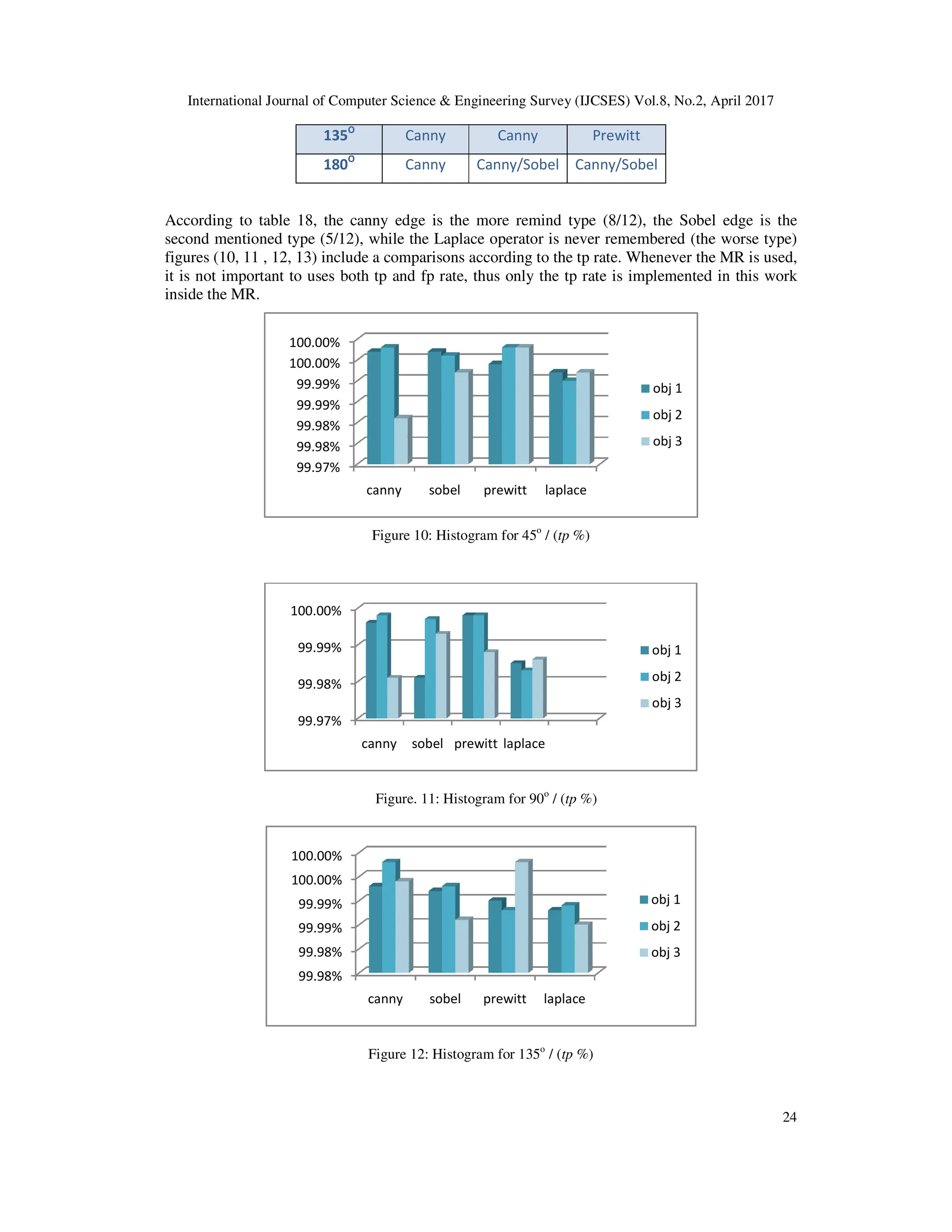
According to table 18, the canny edge is the more remind type (8/12), the Sobel edge is the
second mentioned type (5/12), while the Laplace operator is never remembered (the worse type)
figures (10, 11 , 12, 13) include a comparisons according to the tp ra
it is not important to uses both tp and fp rate, thus only the tp rate is implemented in this work
inside the MR.
Figure 10: Histogram for 45
Figure 12:
99.97%
99.98%
99.98%
99.99%
99.99%
100.00%
100.00%
canny
99.97%
99.98%
99.99%
100.00%
canny
99.98%
99.98%
99.99%
99.99%
100.00%
100.00%
canny
International Journal of Computer Science & Engineering Survey (IJCSES) Vol.8, No.2,
Canny Canny Prewitt
Canny Canny/Sobel Canny/Sobel
According to table 18, the canny edge is the more remind type (8/12), the Sobel edge is the
second mentioned type (5/12), while the Laplace operator is never remembered (the worse type)
figures (10, 11 , 12, 13) include a comparisons according to the tp rate. Whenever the MR is used,
it is not important to uses both tp and fp rate, thus only the tp rate is implemented in this work
Figure 10: Histogram for 45o
/ (tp %)
Figure. 11: Histogram for 90o
/ (tp %)
Figure 12: Histogram for 135o
/ (tp %)
canny sobel prewitt laplace
obj 1
obj 2
obj 3
canny sobel prewitt laplace
obj 1
obj 2
obj 3
canny sobel prewitt laplace
obj 1
obj 2
obj 3
, April 2017
24
According to table 18, the canny edge is the more remind type (8/12), the Sobel edge is the
second mentioned type (5/12), while the Laplace operator is never remembered (the worse type)
te. Whenever the MR is used,
it is not important to uses both tp and fp rate, thus only the tp rate is implemented in this work
International Journal of Computer Science & Engineering Survey (IJCSES) Vol.8, No.
Fig
4. CONCLUSION
In this work, a study of orientation effectiveness is done for many edges detection techniques,
the Canny, Sobel, Prewitt, and the Laplace operators are used to detect three different colored
sharpeners, each one of these sharpeners are captured and dete
(45o, 90o, 135o, 180o), the results of detections using these detection types are compared one
with each other for the all objects (sharpeners) under the orientations used during the camera
capturing operation, in order to
misclassification ratio, are used, the tp rate are then used inside the MR to ensure the given
results, although that the Sobel is be
sharpener (light green sharpener) but the average given results shown that the canny edge type is
the best used one, the Laplace operator is the worst used technique for all the objects and the used
orientations, finally and according to the results the canny e
objects have to be detected or captured by camera under many expected orientation.
5. FUTURE WORK
Other type of complex objects ‘shapes can be used inside the sharpeners. Insides the edges
techniques, many other detection
effectiveness. Other type of methods can be used inside the MR and the tp rate to find the best or
the less effected method with the object orientation or effectiveness of the camera
for the captured images.
6. REFERENCES
[1] Min C. Shin, Dmitry B. Goldgof, Kevin W. Bowyer, and Savvas Nikiforou, 2001. Comparison of
Edge Detection Algorithms Using a Structure from Motion Task. IEEE Transactions on systems
man, and cybernetics - part B: cybernetics, Vol. 31, N
[2] Syed Jahanzeb Hussain Pirzada, Ayesha Siddiqui. 2013. Analysis of Edge Detection Algorithms
for Feature Extraction in Satellite Images IEEE International Conference on Space
Science and Communication, Melaka, Malaysia.
[3] Andrew H. S. Lai, Member, IEEE, and Nelson H. C. Yung, Senior Member, IEEE, 2000.
Detection by Orientation and Length Discrimination, IEE transactions on systems, man and
cybernetics, Vol. 30, No. 4.
[4] Viswanath Gopalakrishnan, Stud
IEEE, 2009. Salient Region Detection by Modeling Distributions of Color and Orientation
99.90%
99.92%
99.94%
99.96%
99.98%
100.00%
canny
International Journal of Computer Science & Engineering Survey (IJCSES) Vol.8, No.2,
Figure 13: Histogram for 180o
/ (tp %)
In this work, a study of orientation effectiveness is done for many edges detection techniques,
the Canny, Sobel, Prewitt, and the Laplace operators are used to detect three different colored
sharpeners, each one of these sharpeners are captured and detected in many orientation cases
(45o, 90o, 135o, 180o), the results of detections using these detection types are compared one
with each other for the all objects (sharpeners) under the orientations used during the camera
capturing operation, in order to compare between the used edges detection techniques, the
misclassification ratio, are used, the tp rate are then used inside the MR to ensure the given
obel is better than the other in two orientation used for the third
ner (light green sharpener) but the average given results shown that the canny edge type is
aplace operator is the worst used technique for all the objects and the used
orientations, finally and according to the results the canny edge is nominated to be used when an
objects have to be detected or captured by camera under many expected orientation.
Other type of complex objects ‘shapes can be used inside the sharpeners. Insides the edges
techniques, many other detection methods can be examined to check their orientations
effectiveness. Other type of methods can be used inside the MR and the tp rate to find the best or
the less effected method with the object orientation or effectiveness of the camera
Min C. Shin, Dmitry B. Goldgof, Kevin W. Bowyer, and Savvas Nikiforou, 2001. Comparison of
Edge Detection Algorithms Using a Structure from Motion Task. IEEE Transactions on systems
part B: cybernetics, Vol. 31, No. 4.
Syed Jahanzeb Hussain Pirzada, Ayesha Siddiqui. 2013. Analysis of Edge Detection Algorithms
for Feature Extraction in Satellite Images IEEE International Conference on Space
Science and Communication, Melaka, Malaysia.
Andrew H. S. Lai, Member, IEEE, and Nelson H. C. Yung, Senior Member, IEEE, 2000.
Detection by Orientation and Length Discrimination, IEE transactions on systems, man and
Viswanath Gopalakrishnan, Student Member, IEEE, Yiqun Hu, and Deepu Rajan, Member,
IEEE, 2009. Salient Region Detection by Modeling Distributions of Color and Orientation
canny sobel prewitt laplace
obj 1
obj 2
obj 3
, April 2017
25
In this work, a study of orientation effectiveness is done for many edges detection techniques,
the Canny, Sobel, Prewitt, and the Laplace operators are used to detect three different colored
cted in many orientation cases
(45o, 90o, 135o, 180o), the results of detections using these detection types are compared one
with each other for the all objects (sharpeners) under the orientations used during the camera
compare between the used edges detection techniques, the
misclassification ratio, are used, the tp rate are then used inside the MR to ensure the given
ter than the other in two orientation used for the third
ner (light green sharpener) but the average given results shown that the canny edge type is
aplace operator is the worst used technique for all the objects and the used
dge is nominated to be used when an
Other type of complex objects ‘shapes can be used inside the sharpeners. Insides the edges
methods can be examined to check their orientations
effectiveness. Other type of methods can be used inside the MR and the tp rate to find the best or
the less effected method with the object orientation or effectiveness of the camera’s orientation
Min C. Shin, Dmitry B. Goldgof, Kevin W. Bowyer, and Savvas Nikiforou, 2001. Comparison of
Edge Detection Algorithms Using a Structure from Motion Task. IEEE Transactions on systems
Syed Jahanzeb Hussain Pirzada, Ayesha Siddiqui. 2013. Analysis of Edge Detection Algorithms
for Feature Extraction in Satellite Images IEEE International Conference on Space
Andrew H. S. Lai, Member, IEEE, and Nelson H. C. Yung, Senior Member, IEEE, 2000. Lane
Detection by Orientation and Length Discrimination, IEE transactions on systems, man and
ent Member, IEEE, Yiqun Hu, and Deepu Rajan, Member,
IEEE, 2009. Salient Region Detection by Modeling Distributions of Color and Orientation
International Journal of Computer Science & Engineering Survey (IJCSES) Vol.8, No.
[5] Sherman Y. T. Lang, Member, IEEE, and Yili Fu, Member, IEEE, 2000. Visua
Measurement of Orientation Error for a Mobile Robot, IEEE transactions on industrial and
measurement, Vol. 49, No. 6.
[6] Umbaugh, Scott E 2010. Digital image processing and analysis : human and computer vision
applications with CVIP tools (2nd
[7] Canny ,J, 1986, A Computational Approach To Edge Detection, IEEE Trans. Pattern
Analysis and Machine Intelligence, 8(6):679
[8] Scharr, Hanno, 2000., Optimal Operators
for Scientific Computing, Heidelberg University, Heidelberg, Germany.
[9] Gönen M., (2013), “Receiver Operating Characteristic (ROC) Curves”, Memorial Sloan
Kettering Cancer Center, Statistical and Data Analysis, Vol. 31, No. 210, pp. 1
[10] Fawcett T., (2005), “An Introduction to ROC Analysis”, Pattern Recognition Letters, Institute for the
Study of Learning and Expertise, Vol. 27, No. 8, pp. 861
[11] Irwin Sobel, (2014), “ History and Definition of the so
named the Sobel-Feldman Operator”, www.researchgate.net/publication/239398674.
[12] J. M. S. Prewit, “Object Enhancement and Extraction” Picture and Pr
Lipkin and A Rosenfeld, EDS, New York: Academic Press, 1970, PP.. 75
ACKNOWLEDGEMENTS
I would like to thank my family for
Mothanna Osama kashmola for his support.
AUTHOR
Muhamad Azhar Abdilatef Al-Obaidy
1984, he got the M.Sc. in computer engineering from Cankaya University, Ankara
Turkey, 2014, B.Sc. in computer Engineerin
2006, Now, he is an assistant lecturer at college of engineering
mechatronics engineering department
Development Department, Presidency of University of Mos
International Journal of Computer Science & Engineering Survey (IJCSES) Vol.8, No.2,
Sherman Y. T. Lang, Member, IEEE, and Yili Fu, Member, IEEE, 2000. Visua
Measurement of Orientation Error for a Mobile Robot, IEEE transactions on industrial and
Umbaugh, Scott E 2010. Digital image processing and analysis : human and computer vision
applications with CVIP tools (2nd ed.). Boca Raton, FL: CRC Press. ISBN 978-1-4398-
Canny ,J, 1986, A Computational Approach To Edge Detection, IEEE Trans. Pattern
Analysis and Machine Intelligence, 8(6):679–698..
Scharr, Hanno, 2000., Optimal Operators in Digital Image Processing. Interdisciplinary Center
for Scientific Computing, Heidelberg University, Heidelberg, Germany.
Gönen M., (2013), “Receiver Operating Characteristic (ROC) Curves”, Memorial Sloan
Cancer Center, Statistical and Data Analysis, Vol. 31, No. 210, pp. 1-18 .
Fawcett T., (2005), “An Introduction to ROC Analysis”, Pattern Recognition Letters, Institute for the
Study of Learning and Expertise, Vol. 27, No. 8, pp. 861–874 .
Irwin Sobel, (2014), “ History and Definition of the so-called “Sobel Operator” more appropriately
Feldman Operator”, www.researchgate.net/publication/239398674.
J. M. S. Prewit, “Object Enhancement and Extraction” Picture and Processing and Psychopictorics, B
Lipkin and A Rosenfeld, EDS, New York: Academic Press, 1970, PP.. 75-149
family for their help and support, the Mosul university staff, my friend
kashmola for his support.
Obaidy, Iraqi nationality, born in London –UK in
M.Sc. in computer engineering from Cankaya University, Ankara –
Turkey, 2014, B.Sc. in computer Engineering form Mosul University, Mosul , Iraq,
Now, he is an assistant lecturer at college of engineering, university of Mosul,
mechatronics engineering department , and also the head of Research and
Development Department, Presidency of University of Mosul.
, April 2017
26
Sherman Y. T. Lang, Member, IEEE, and Yili Fu, Member, IEEE, 2000. Visual
Measurement of Orientation Error for a Mobile Robot, IEEE transactions on industrial and
Umbaugh, Scott E 2010. Digital image processing and analysis : human and computer vision
-0205-2.
Canny ,J, 1986, A Computational Approach To Edge Detection, IEEE Trans. Pattern
in Digital Image Processing. Interdisciplinary Center
Gönen M., (2013), “Receiver Operating Characteristic (ROC) Curves”, Memorial Sloan
Fawcett T., (2005), “An Introduction to ROC Analysis”, Pattern Recognition Letters, Institute for the
called “Sobel Operator” more appropriately
Feldman Operator”, www.researchgate.net/publication/239398674.
ocessing and Psychopictorics, B
iversity staff, my friend

ORIENTATION EFFECTIVENESS IN THE OBJECTS DETECTED AREAS USING DIFFERENT TYPES OF EDGES DETECTION TECHNIQUES

  • 1.
    International Journal ofComputer Science & Engineering Survey (IJCSES) Vol.8, No.2, April 2017 DOI:10.5121/ijcses.2017.8202 13 ORIENTATION EFFECTIVENESS IN THE OBJECTS DETECTED AREAS USING DIFFERENT TYPES OF EDGES DETECTION TECHNIQUES Muhamad Azhar Abdilatef AL-Obaidy Department of Mechatronics Engineering, College of Engineering, University of Mosul, Mosul, Iraq ABSTRACT This paper presents a study for the orientation effectiveness on the detected areas for many sampled objects when many type of the edges detection are applied. The Canny, Laplace, Prewitt and Sobel are applied for three objects (pencils’ sharpeners with different colors). The MBR (Minimal Bounding Rectangular) are used to calculate the area in pixels, centroid and the orientation. The MR (Misclassification Ratio) is used to find the different between the edges detection techniques. The Canny edges detection technique gives the best result for the three used object using all orientations. KEYWORDS Orientation, Edge Detection, MR, Objects, tp rate, sharpeners, Canny, Sobel, Laplace, Prewitt. 1. INTRODUCTION The object detection technique is one of the most important image processing and computer vision methods those used in many fields today. During the detection many features can be extracted such as colors, orientations, centroids, textures, edges, and ext. the detection methods and especially the edges techniques are used in the fields of military, medicine, biological researches, industrial applications and many others. These techniques are sometime used to support other types of detection methods, it can help them to complete the final work such as the medical and the industrial applications, in other time it represent the mainly part of the work. Three different pencil sharpeners with different colors: Blue, Green, and Indigo are detected used four types of edges detection (Figure 1); the area in pixel, centroid and the orientation are calculated using the MBR, while the MR (Misclassification Ratio) is used to calculate the detection accuracy for all types of the used edges detection (Canny, Laplace, Sobel, Prewitt) when applied for these objects. According to the used methods and referring to the obtained results, the canny edges detection is the best one of the applied method. Figure 1: The samples used objects
  • 2.
    International Journal ofComputer Science & Engineering Survey (IJCSES) Vol.8, No.2, April 2017 14 2. RELATIVE WORKS Canny and other types of edges detection techniques are used by the researcher inside other type of image processing detection methods in their works, as mentioned before, these methods can be used individually or with others, the canny edge detection is an operator developed by John F. Canny, it is used for purpose of detection, it uses a multi stage algorithm type [7]. The Sobel technique which is mostly named the sobel filter or sobel-Feldman operator is presented by Irwin Sobel in 1968, it is used in computer vision and also image processing detection algorithms [11], it is really a discrete differentiation technique, it can compute the gradient of the intensity function of the image, in this type, each point or pixel inside the image is corresponded as a gradient vector or norm to it. The prewitt operator [12] which is presented by Judith M.S. Prewitt is found the edges using the prewitt approximation to the derivative. In most of the works today, many proposed methods merged between two or more methods to present new techniques with many enhancements, other researches are done depending on a comparison between many methods over the same material (objects). In [1], Min. C. Shin and et.al a comparison between the edges detection techniques is done. They used the structure from motion (SMF) to do an evaluation over the algorithms of edges detections. The obtained results suggested that the ratings of the canny detector performance is based on the pixel level matrices and also on the SFM are related one to each other and have high performance like canny and other detectors. In [2], Sayed Jahanzeb Hussien Pirzada and et.al are enhanced the edges detection techniques using low pass filter inside the canny edge detection, this algorithm is used as a features extraction, the extracted features are not same when its captured from different directions. In this work, a study of an orientation’s effectiveness for the detected objects is done, assumed that the objects images are captured from many sides; many edges types are applied for these images with which are content same shape objects with different colors. In [3], Andrew H. S Lai, and Nelson H. C. Yung are presented a novel method for lane algorithm detection used for surveillance traffics tracking, they tried to isolate one path from all the captured image then surrounding or mask the car needed to be detected or tracked from the other parts, also used to notes any sudden changes or movements, the edges techniques are used here and the orientation is detected during the detection and tracking tackle, most of the time when the objects are detected more one time with many orientations, the shapes and also number of pixels those extracted are not the same. Another study for the orientation inside the colors is done by Viswanath Gopalakrishnan, Yiquan Hu, and Deepu Rajan [4], they used the detection framework which is based on both color and orientation those distributed in image, the orientation framework is used to detect regions in images based on global and local behaviour of different orientations in images. In robotics field when an objects sometime has to be gripped by the fingers of the robots, it is very important to know the orientation of it to rotate the robot arm according to that and catch it, In [5], a study for a mobile cleaning robot is done to measure the error in orientation, a new method is used to reduce the error in localization. In this paper , after studied the ideas given before, a new study for the orientation effectiveness is used to compare between many edges detection techniques when the same regions are detected from different sides, this rule is applied for the areas of detected objects used these many edges techniques. 2.1. Canny Edge Detection Technique The canny edge detection is an operator or technique used for extracting the useful information and structures details from different vision’s object, canny and the other type of edges techniques can reduce the amount of data to be processed. The canny algorithm includes applying the Gaussian filter which is used to smooth the image to remove the noisy parts, find the image gradients’ intensity, applying the non-maximum type of suppression for the purpose of liquidation for the response’s spurious to the edge detection, duplicate the normal value of threshold and finally using the hysteresis to track the edge [7].
  • 3.
    International Journal ofComputer Science & Engineering Survey (IJCSES) Vol.8, No.2, April 2017 15 2.2. Sobel Edge Detection Technique Sobel filter or as it is sometime called Sobel- Feldman operator, is a type of edges techniques used in image processing and also in computer vision, this type consist of two separated operations: the first one make a smoothing to be perpendicular to the direction that is derivative with a triangle filter, the second one is the central simple difference in the derivative direction, the Sobel operator can reduce the artifacts that is associated with the pure central operator’s differences, but it does not have a perfect rotational symmetry. So this is a disadvantage of using it [8]. 2.3. Laplace Edge Detection Technique The Laplace detector or as it is named the Laplacian operator is mostly represented as a blob detector that is used in computer vision field for the purpose of regions detection in digital captured images from a real or offline video (recorded video), this type of operators is used in this paper as one of many techniques applied for the purpose of orientation effectiveness. 2.4. Prewitt Edge Detection Technique It is a discrete differentiation technique or operator that includes computing the gradient approximately for the image intensity function, this operator is usually based on convolving the used image with a separable, small, and integer filter value in both horizontal and vertical directions, it like Sobel operator in that it is inexpensive in computations relatively. 3. WORK AND RESULTS In this paper, canny, Sobel, Prewitt, and Laplace edges detection methods are applied for three colors of a pencil sharpener (light blue - dark blue - green), each of these three sharpeners are captured in many orientations: (45o, 90o, 135o, 180o), figures (2-4), includes the area in pixels which are detected for three sharpeners with all the four mentioned orientations after applying the edges. The MBR is used to get the wanted orientation exactly, The purpose of this operation is to see if the changes in orientations may cause effects in detection (the edges techniques) or not, and to see also which type of edges techniques has the less effectiveness when the orientation is changed, the following tables (1 - 4) are included the areas detected using the edges detection techniques for the sharpeners in all orientations cases, table 5 includes the correctly calculated areas before applying the edges techniques. Table 1. 45o orientation objects detected results Object1 Object2 Object3 CANNY 1313 946 1458 SOBEL 1309 942 1466 PREWITT 1307 944 1471 LAPLACE 1305 938 1466 Table 2. 90o orientation objects detected results Object1 Object2 Object3 CANNY 1363 885 1451 SOBEL 1346 882 1460 PREWITT 1359 883 1456 LAPLACE 1349 871 1455
  • 4.
    International Journal ofComputer Science & Engineering Survey (IJCSES) Vol.8, No.2, April 2017 16 Table 3. 135o orientation objects detected results Object1 Object2 Object3 CANNY 1339 913 1445 SOBEL 1328 907 1439 PREWITT 1327 903 1448 LAPLACE 1325 904 1438 Table 4. 180 orientation objects detected results Object1 Object2 Object3 CANNY 1351 996 1397 SOBEL 1344 992 1397 PREWITT 1340 990 1355 LAPLACE 1335 981 1367 Table 5. Correctly calculated object’s areas Orientati on OBJ1 OBJ2 OBJ 3 45O 1311 945 147 2 90O 1360 884 146 5 135O 1334 912 144 9 180O 1348 994 139 8 Figure 2: calculated area for object 1
  • 5.
    International Journal ofComputer Science & Engineering Survey (IJCSES) Vol.8, No.2, April 2017 17 Figure 3: calculated area for object 2 Figure 4: calculated area for object 3
  • 6.
    International Journal ofComputer Science & Engineering Survey (IJCSES) Vol.8, No.2, April 2017 18 Sometime the number of detected pixels in the region of interest are not reach the actual foreground pixel’s number thus many methods are used over the time to refer to the errors and make many enhancement for the not well detected methods, the MR (Misclassification Ratio) [9- 10], is used to find the error in detection for each one of the three used sharpeners (objects) for the four detected orientations (45, 90, 135, 180); to do that, the correctly area of the objects has to be calculated firstly, this is done by assuming that the object (sharpener) is a foreground part while the other parts are represented as a background, thus the subtraction operation is applied for the binary images mode to calculate the correctly object’s area. The following steps and equations are used to find the MR: • Total positive numbers (foreground) pixels which are correctly classified (TP) are normalized by the total positive (foreground) in order pixels to find (tp rate). • Total positive numbers (foreground) pixels which are incorrectly classified (FP) are normalized by the total positive (foreground) pixels in order to find (fp rate). • Total negative numbers (background) pixels which are correctly classified (TN). • Total negative numbers (background) pixels which are incorrectly classified (FN). • The true positive rate [10] (also called hit rate and recall) of a classifier is estimated as: • tp rate = Positives correctly classified (TP) / Total positives (1) • The false positive rate [10] (also called false alarm rate) of the classifier is estimated as: • fp rate= Positive incorrectly classified (FP) / Total negatives (2) • Finally to calculate the MR the following equation has to be used according to the following equation: • MR =(FP+FN)/( TP+TN+FN+TN)* 100% (3) Figure 5 include a flow chard to find the tp, fp and MR factors in steps. In order find all of the mentioned factors, it is important to record the information of the captured images for the used objects before applying operations, these information include the directions of image to calculate the amount of each image’s pixels, table 6 include the properties for the used images. Table 6. Used images properties Dimensions 320 x 240 Width 320 pixels Height 240 pixels Horizontal Resolution 96 dpi Vertical Resolution 96 dpi Bit Depth 24
  • 7.
    International Journal ofComputer Science & Engineering Survey (IJCSES) Vol.8, No.2, April 2017 19 Figure 5: tp, fp , MR calculation The following tables (7-15) includes the TP, FP, tp, MR for the all given results from when the edges techniques are applied for the used objects, the total amount of pixels for all the used images are 76800 pixels.
  • 8.
    International Journal ofComputer Science & Engineering Survey (IJCSES) Vol.8, No.2, April 2017 20 Table 7. Object 1 MR result for 45o Result for object 1 / orientation : 45o EDGES TP FP TN F MR (%) tp Canny 131 2 7548 0 26X10-4 99.997 Sobel 130 0 7548 2 26X10-4 99.997 Prewitt 130 0 7548 4 52X10-4 99.994 Laplace 130 0 7548 6 78X10-4 99.992 Table 8. Object 1 MR result for 90o Result for object 1 / orientation : 90o EDGES TP FP TN FN MR (%) tp Canny 1360 3 75437 0 39X10-4 99.996% Sobel 1346 0 75440 14 182X10-4 99.981% Prewitt 1359 0 75440 1 13X10-4 99.998% Laplace 1349 0 75440 11 143X10-4 99.985% Table 9. Object 1 MR result for 135o Result for object 1 / orientation : 135o EDGES TP FP TN FN MR (%) tp Canny 1334 5 75461 0 65X10-4 99.993% Sobel 1328 0 75466 6 78X10-4 99.992% Prewitt 1327 0 75466 7 91X10-4 99.990% Laplace 1325 0 75466 9 117X10-4 99.988% Table 10. Object 1 MR result for 180o Result for object 1 / orientation : 180o EDGES TP FP TN FN MR (%) tp Canny 1348 3 75449 0 39X10-4 99.996% Sobel 1344 0 75452 4 52X10-4 99.994% Prewitt 1340 0 75452 8 104X10-4 99.989% Laplace 1335 0 75452 13 169X10-4 99.983% Table 11. Object 2 MR result for 45o Result for object 2 / orientation : 45o EDGES TP FP TN FN MR (%) (%) (%) (%) tp Canny 945 1 75854 0 13X10-4 99.998% Sobel 942 0 75855 3 39X10-4 99.996% Prewitt 944 0 75855 1 13X10-4 99.998% Laplace 938 0 75855 7 91X10-4 99.990%
  • 9.
    International Journal ofComputer Science & Engineering Survey (IJCSES) Vol.8, No.2, April 2017 21 Table 12. Object 2 MR result for 90o Result for object 2 / orientation : 90o EDGES TP FP TN FN MR (%) tp Canny 884 1 75915 0 13X10-4 99.998% Sobel 882 0 75916 2 26X10-4 99.997% Prewitt 883 0 75916 1 13X10-4 99.998% Laplace 871 0 75916 13 169X10-4 99.983% Table 13. Object 2 MR result for 135o Result for object 2 / orientation : 135o EDGES TP FP TN FN MR (%) tp Canny 912 1 75887 0 13X10-4 99.998% Sobel 907 0 75888 5 65X10-4 99.993% Prewitt 903 0 75888 9 117X10-4 99.988% Laplace 904 0 75888 8 104X10-4 99.989% Table 14. Object 2 MR result for 180o Result for object 2 / orientation : 180o EDGES TP FP TN FN MR (%) tp Canny 994 2 75804 0 26X10-4 99.997% Sobel 992 0 75806 2 26X10-4 99.997% Prewitt 990 0 75806 4 52X10-4 99.994% Laplace 981 0 75806 13 169X10-4 99.983% Table 15. Object 3 MR result for 45o Result for object 3 / orientation : 45o EDGES TP FP TN FN MR (%) tp Canny 1458 14 75328 0 182X10-4 99.981% Sobel 1466 0 75328 6 13X10-4 99.992% Prewitt 1471 0 75328 1 13X10-4 99.998% Laplace 1466 0 75328 6 78X10-4 99.992% Table 16. Object 3 MR result for 90o Result for object 3 / orientation : 90o EDGES TP FP TN FN MR (%) tp Canny 1451 14 75335 0 182X10-4 99.981% Sobel 1460 0 75335 5 65X10-4 99.993% Prewitt 1456 0 75335 9 117X10-4 99.988% Laplace 1455 0 75335 10 130X10-4 99.986%
  • 10.
    International Journal ofComputer Science & Engineering Survey (IJCSES) Vol.8, No. Table 17. Object 3 MR result for 135 Result for object 3 / orientation : 135 EDGES TP Canny 1445 Sobel 1439 Prewitt 1448 Laplace 1438 Table 18. Object 3 MR result for 180 Result for object 3 / orientation : 180 EDGES TP FP Canny 1397 0 Sobel 1397 0 Prewitt 1355 0 Laplace 1367 0 In the following figures histograms (6, 7, 8, 9), the MR for all the used edges techniques are implemented when applied for the three used sharpeners 135o , 180o ), each histogram figure include the MR% (Misclassification ratio %) of using the edges types over the three objects for one orientation divided by (10 more clearly than the actual values. Table 1 the orientation cases, this table is gave a pre the object and not effected with the orientation of it. The figures mention tables above to compare and find the best edge operator used to detect the sharpeners. Figure 0 50 100 150 200 canny International Journal of Computer Science & Engineering Survey (IJCSES) Vol.8, No.2, Table 17. Object 3 MR result for 135o Result for object 3 / orientation : 135o FP TN FN MR (%) tp 4 75351 0 52X10-4 99.994% 0 75351 10 130X10-4 99.986% 0 75351 1 13X10-4 99.998% 0 75351 11 143X10-4 99.985% Table 18. Object 3 MR result for 180o Result for object 3 / orientation : 180o FP TN FN MR (%) 0 75402 1 13X10-4 99.998% 0 75402 1 13X10-4 99.998% 0 75402 43 559.8X10⁻⁴ 99.944% 0 75402 31 403.6X10⁻⁴ 99.959% In the following figures histograms (6, 7, 8, 9), the MR for all the used edges techniques are implemented when applied for the three used sharpeners (objects) for the orientations (45 ), each histogram figure include the MR% (Misclassification ratio %) of using the edges types over the three objects for one orientation divided by (10-4 ) to make the differences be actual values. Table 19 includes the edges types used for the objects with all the orientation cases, this table is gave a pre-idea about the best edge technique which is detected the object and not effected with the orientation of it. The figures mentioned are also used with the tables above to compare and find the best edge operator used to detect the sharpeners. ure. 6: Histogram for 45o / (MR% / 10-4 ) obj 1 obj 3 sobel prewitt laplace obj 1 obj 2 obj 3 , April 2017 22 tp 99.994% 99.986% 99.998% 99.985% tp 99.998% 99.998% 99.944% 99.959% In the following figures histograms (6, 7, 8, 9), the MR for all the used edges techniques are (objects) for the orientations (45o , 90o , ), each histogram figure include the MR% (Misclassification ratio %) of using the ) to make the differences be includes the edges types used for the objects with all idea about the best edge technique which is detected ed are also used with the tables above to compare and find the best edge operator used to detect the sharpeners.
  • 11.
    International Journal ofComputer Science & Engineering Survey (IJCSES) Vol.8, No. Figure Figure Figure Table 19. Best edge technique / orientation effectiveness 45O 90O 0 50 100 150 200 canny 0 50 100 150 canny 0 100 200 300 400 500 canny sobel International Journal of Computer Science & Engineering Survey (IJCSES) Vol.8, No.2, ure 7: Histogram for 90o / (MR% / 10-4 ) ure 8: Histogram for 135o / (MR% / 10-4 ) ure 9: Histogram for 180o / (MR% / 10-4 ) . Best edge technique / orientation effectiveness OBJ 1 OBJ 2 OBJ 3 Canny Canny Sobel Prewitt Canny/Sobel Sobel obj 1 obj 3 sobel prewitt laplace obj 1 obj 2 obj 3 obj 1 obj 3 sobel prewitt laplace obj 1 obj 2 obj 3 obj 1 obj 3 sobel prewitt laplace obj 1 obj 2 obj 3 , April 2017 23
  • 12.
    International Journal ofComputer Science & Engineering Survey (IJCSES) Vol.8, No. 135O 180O According to table 18, the canny edge is the more remind type (8/12), the Sobel edge is the second mentioned type (5/12), while the Laplace operator is never remembered (the worse type) figures (10, 11 , 12, 13) include a comparisons according to the tp ra it is not important to uses both tp and fp rate, thus only the tp rate is implemented in this work inside the MR. Figure 10: Histogram for 45 Figure 12: 99.97% 99.98% 99.98% 99.99% 99.99% 100.00% 100.00% canny 99.97% 99.98% 99.99% 100.00% canny 99.98% 99.98% 99.99% 99.99% 100.00% 100.00% canny International Journal of Computer Science & Engineering Survey (IJCSES) Vol.8, No.2, Canny Canny Prewitt Canny Canny/Sobel Canny/Sobel According to table 18, the canny edge is the more remind type (8/12), the Sobel edge is the second mentioned type (5/12), while the Laplace operator is never remembered (the worse type) figures (10, 11 , 12, 13) include a comparisons according to the tp rate. Whenever the MR is used, it is not important to uses both tp and fp rate, thus only the tp rate is implemented in this work Figure 10: Histogram for 45o / (tp %) Figure. 11: Histogram for 90o / (tp %) Figure 12: Histogram for 135o / (tp %) canny sobel prewitt laplace obj 1 obj 2 obj 3 canny sobel prewitt laplace obj 1 obj 2 obj 3 canny sobel prewitt laplace obj 1 obj 2 obj 3 , April 2017 24 According to table 18, the canny edge is the more remind type (8/12), the Sobel edge is the second mentioned type (5/12), while the Laplace operator is never remembered (the worse type) te. Whenever the MR is used, it is not important to uses both tp and fp rate, thus only the tp rate is implemented in this work
  • 13.
    International Journal ofComputer Science & Engineering Survey (IJCSES) Vol.8, No. Fig 4. CONCLUSION In this work, a study of orientation effectiveness is done for many edges detection techniques, the Canny, Sobel, Prewitt, and the Laplace operators are used to detect three different colored sharpeners, each one of these sharpeners are captured and dete (45o, 90o, 135o, 180o), the results of detections using these detection types are compared one with each other for the all objects (sharpeners) under the orientations used during the camera capturing operation, in order to misclassification ratio, are used, the tp rate are then used inside the MR to ensure the given results, although that the Sobel is be sharpener (light green sharpener) but the average given results shown that the canny edge type is the best used one, the Laplace operator is the worst used technique for all the objects and the used orientations, finally and according to the results the canny e objects have to be detected or captured by camera under many expected orientation. 5. FUTURE WORK Other type of complex objects ‘shapes can be used inside the sharpeners. Insides the edges techniques, many other detection effectiveness. Other type of methods can be used inside the MR and the tp rate to find the best or the less effected method with the object orientation or effectiveness of the camera for the captured images. 6. REFERENCES [1] Min C. Shin, Dmitry B. Goldgof, Kevin W. Bowyer, and Savvas Nikiforou, 2001. Comparison of Edge Detection Algorithms Using a Structure from Motion Task. IEEE Transactions on systems man, and cybernetics - part B: cybernetics, Vol. 31, N [2] Syed Jahanzeb Hussain Pirzada, Ayesha Siddiqui. 2013. Analysis of Edge Detection Algorithms for Feature Extraction in Satellite Images IEEE International Conference on Space Science and Communication, Melaka, Malaysia. [3] Andrew H. S. Lai, Member, IEEE, and Nelson H. C. Yung, Senior Member, IEEE, 2000. Detection by Orientation and Length Discrimination, IEE transactions on systems, man and cybernetics, Vol. 30, No. 4. [4] Viswanath Gopalakrishnan, Stud IEEE, 2009. Salient Region Detection by Modeling Distributions of Color and Orientation 99.90% 99.92% 99.94% 99.96% 99.98% 100.00% canny International Journal of Computer Science & Engineering Survey (IJCSES) Vol.8, No.2, Figure 13: Histogram for 180o / (tp %) In this work, a study of orientation effectiveness is done for many edges detection techniques, the Canny, Sobel, Prewitt, and the Laplace operators are used to detect three different colored sharpeners, each one of these sharpeners are captured and detected in many orientation cases (45o, 90o, 135o, 180o), the results of detections using these detection types are compared one with each other for the all objects (sharpeners) under the orientations used during the camera capturing operation, in order to compare between the used edges detection techniques, the misclassification ratio, are used, the tp rate are then used inside the MR to ensure the given obel is better than the other in two orientation used for the third ner (light green sharpener) but the average given results shown that the canny edge type is aplace operator is the worst used technique for all the objects and the used orientations, finally and according to the results the canny edge is nominated to be used when an objects have to be detected or captured by camera under many expected orientation. Other type of complex objects ‘shapes can be used inside the sharpeners. Insides the edges techniques, many other detection methods can be examined to check their orientations effectiveness. Other type of methods can be used inside the MR and the tp rate to find the best or the less effected method with the object orientation or effectiveness of the camera Min C. Shin, Dmitry B. Goldgof, Kevin W. Bowyer, and Savvas Nikiforou, 2001. Comparison of Edge Detection Algorithms Using a Structure from Motion Task. IEEE Transactions on systems part B: cybernetics, Vol. 31, No. 4. Syed Jahanzeb Hussain Pirzada, Ayesha Siddiqui. 2013. Analysis of Edge Detection Algorithms for Feature Extraction in Satellite Images IEEE International Conference on Space Science and Communication, Melaka, Malaysia. Andrew H. S. Lai, Member, IEEE, and Nelson H. C. Yung, Senior Member, IEEE, 2000. Detection by Orientation and Length Discrimination, IEE transactions on systems, man and Viswanath Gopalakrishnan, Student Member, IEEE, Yiqun Hu, and Deepu Rajan, Member, IEEE, 2009. Salient Region Detection by Modeling Distributions of Color and Orientation canny sobel prewitt laplace obj 1 obj 2 obj 3 , April 2017 25 In this work, a study of orientation effectiveness is done for many edges detection techniques, the Canny, Sobel, Prewitt, and the Laplace operators are used to detect three different colored cted in many orientation cases (45o, 90o, 135o, 180o), the results of detections using these detection types are compared one with each other for the all objects (sharpeners) under the orientations used during the camera compare between the used edges detection techniques, the misclassification ratio, are used, the tp rate are then used inside the MR to ensure the given ter than the other in two orientation used for the third ner (light green sharpener) but the average given results shown that the canny edge type is aplace operator is the worst used technique for all the objects and the used dge is nominated to be used when an Other type of complex objects ‘shapes can be used inside the sharpeners. Insides the edges methods can be examined to check their orientations effectiveness. Other type of methods can be used inside the MR and the tp rate to find the best or the less effected method with the object orientation or effectiveness of the camera’s orientation Min C. Shin, Dmitry B. Goldgof, Kevin W. Bowyer, and Savvas Nikiforou, 2001. Comparison of Edge Detection Algorithms Using a Structure from Motion Task. IEEE Transactions on systems Syed Jahanzeb Hussain Pirzada, Ayesha Siddiqui. 2013. Analysis of Edge Detection Algorithms for Feature Extraction in Satellite Images IEEE International Conference on Space Andrew H. S. Lai, Member, IEEE, and Nelson H. C. Yung, Senior Member, IEEE, 2000. Lane Detection by Orientation and Length Discrimination, IEE transactions on systems, man and ent Member, IEEE, Yiqun Hu, and Deepu Rajan, Member, IEEE, 2009. Salient Region Detection by Modeling Distributions of Color and Orientation
  • 14.
    International Journal ofComputer Science & Engineering Survey (IJCSES) Vol.8, No. [5] Sherman Y. T. Lang, Member, IEEE, and Yili Fu, Member, IEEE, 2000. Visua Measurement of Orientation Error for a Mobile Robot, IEEE transactions on industrial and measurement, Vol. 49, No. 6. [6] Umbaugh, Scott E 2010. Digital image processing and analysis : human and computer vision applications with CVIP tools (2nd [7] Canny ,J, 1986, A Computational Approach To Edge Detection, IEEE Trans. Pattern Analysis and Machine Intelligence, 8(6):679 [8] Scharr, Hanno, 2000., Optimal Operators for Scientific Computing, Heidelberg University, Heidelberg, Germany. [9] Gönen M., (2013), “Receiver Operating Characteristic (ROC) Curves”, Memorial Sloan Kettering Cancer Center, Statistical and Data Analysis, Vol. 31, No. 210, pp. 1 [10] Fawcett T., (2005), “An Introduction to ROC Analysis”, Pattern Recognition Letters, Institute for the Study of Learning and Expertise, Vol. 27, No. 8, pp. 861 [11] Irwin Sobel, (2014), “ History and Definition of the so named the Sobel-Feldman Operator”, www.researchgate.net/publication/239398674. [12] J. M. S. Prewit, “Object Enhancement and Extraction” Picture and Pr Lipkin and A Rosenfeld, EDS, New York: Academic Press, 1970, PP.. 75 ACKNOWLEDGEMENTS I would like to thank my family for Mothanna Osama kashmola for his support. AUTHOR Muhamad Azhar Abdilatef Al-Obaidy 1984, he got the M.Sc. in computer engineering from Cankaya University, Ankara Turkey, 2014, B.Sc. in computer Engineerin 2006, Now, he is an assistant lecturer at college of engineering mechatronics engineering department Development Department, Presidency of University of Mos International Journal of Computer Science & Engineering Survey (IJCSES) Vol.8, No.2, Sherman Y. T. Lang, Member, IEEE, and Yili Fu, Member, IEEE, 2000. Visua Measurement of Orientation Error for a Mobile Robot, IEEE transactions on industrial and Umbaugh, Scott E 2010. Digital image processing and analysis : human and computer vision applications with CVIP tools (2nd ed.). Boca Raton, FL: CRC Press. ISBN 978-1-4398- Canny ,J, 1986, A Computational Approach To Edge Detection, IEEE Trans. Pattern Analysis and Machine Intelligence, 8(6):679–698.. Scharr, Hanno, 2000., Optimal Operators in Digital Image Processing. Interdisciplinary Center for Scientific Computing, Heidelberg University, Heidelberg, Germany. Gönen M., (2013), “Receiver Operating Characteristic (ROC) Curves”, Memorial Sloan Cancer Center, Statistical and Data Analysis, Vol. 31, No. 210, pp. 1-18 . Fawcett T., (2005), “An Introduction to ROC Analysis”, Pattern Recognition Letters, Institute for the Study of Learning and Expertise, Vol. 27, No. 8, pp. 861–874 . Irwin Sobel, (2014), “ History and Definition of the so-called “Sobel Operator” more appropriately Feldman Operator”, www.researchgate.net/publication/239398674. J. M. S. Prewit, “Object Enhancement and Extraction” Picture and Processing and Psychopictorics, B Lipkin and A Rosenfeld, EDS, New York: Academic Press, 1970, PP.. 75-149 family for their help and support, the Mosul university staff, my friend kashmola for his support. Obaidy, Iraqi nationality, born in London –UK in M.Sc. in computer engineering from Cankaya University, Ankara – Turkey, 2014, B.Sc. in computer Engineering form Mosul University, Mosul , Iraq, Now, he is an assistant lecturer at college of engineering, university of Mosul, mechatronics engineering department , and also the head of Research and Development Department, Presidency of University of Mosul. , April 2017 26 Sherman Y. T. Lang, Member, IEEE, and Yili Fu, Member, IEEE, 2000. Visual Measurement of Orientation Error for a Mobile Robot, IEEE transactions on industrial and Umbaugh, Scott E 2010. Digital image processing and analysis : human and computer vision -0205-2. Canny ,J, 1986, A Computational Approach To Edge Detection, IEEE Trans. Pattern in Digital Image Processing. Interdisciplinary Center Gönen M., (2013), “Receiver Operating Characteristic (ROC) Curves”, Memorial Sloan Fawcett T., (2005), “An Introduction to ROC Analysis”, Pattern Recognition Letters, Institute for the called “Sobel Operator” more appropriately Feldman Operator”, www.researchgate.net/publication/239398674. ocessing and Psychopictorics, B iversity staff, my friend