Banking and Financial
Services
Unit - 1
Financial system, implies-
• a set of complex and closely connected or
interlined institutions, agents, practices,
markets, transactions, claims, and liabilities in
the economy.
• is the system that allows the transfer of
money between savers (and investors) and
borrowers.
Fundamental of the Indian
Financial System
• is a system which supplies the necessary
financial inputs for the production of goods
and service to improve the standard of life and
well being of the nation.
• its responsibility is to mobilize the savings in
the form of money and invest them in the
productive manner.
• the financial system provided the
intermediation between savers and investors
and promotes faster economic development.
Fundamental of the Indian Financial
System
Functions of Financial System
• To link the savers & investors.
• To inspire the operators to monitor the
performance of the investment.
• To achieve optimum allocation of risk bearing.
• It makes available price - related information.
• It helps in promoting the process of financial
deepening and broadening
• Price information for decentralised decision
making
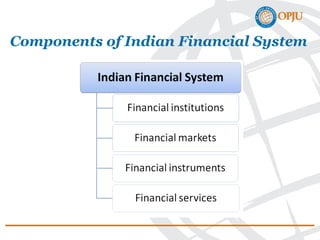
Components of Indian Financial System
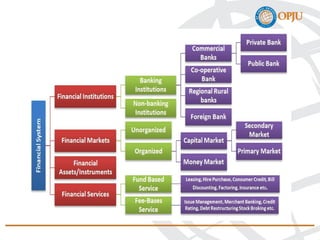
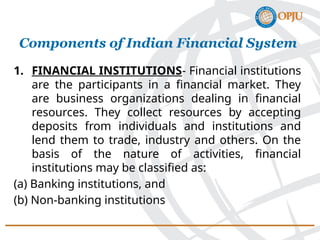
1. FINANCIAL INSTITUTIONS- Financial institutions
are the participants in a financial market. They
are business organizations dealing in financial
resources. They collect resources by accepting
deposits from individuals and institutions and
lend them to trade, industry and others. On the
basis of the nature of activities, financial
institutions may be classified as:
(a) Banking institutions, and
(b) Non-banking institutions
Components of Indian Financial System
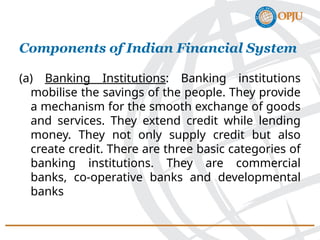
(a) Banking Institutions: Banking institutions
mobilise the savings of the people. They provide
a mechanism for the smooth exchange of goods
and services. They extend credit while lending
money. They not only supply credit but also
create credit. There are three basic categories of
banking institutions. They are commercial
banks, co-operative banks and developmental
banks
Components of Indian Financial System
(b) Non-banking Institutions: The non-banking
financial institutions also mobilize financial
resources directly or indirectly from the people.
Companies like LIC, GIC, UTI, Development
Financial Institutions, Organisation of Pension
and Provident Funds etc. fall in this category.
Non-banking financial institutions can be
categorized as investment companies, housing
companies, leasing companies, hire purchase
companies, specialized financial institutions.
Components of Indian Financial System
2. FINANCIAL MARKET- Financial Market refers to
a marketplace, where creation and trading of
financial assets, such as shares, debentures,
bonds, derivatives, currencies, etc. take place.
It plays a crucial role in allocating limited
resources, in the country’s economy. It acts as
an intermediary between the savers and
investors by mobilizing funds between them.
Components of Indian Financial System
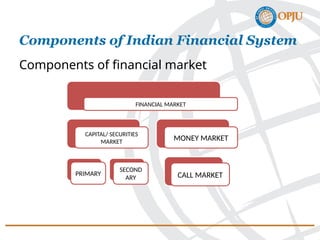
Components of financial market
Components of Indian Financial System
FINANCIAL MARKET
CAPITAL/ SECURITIES
MARKET
PRIMARY
SECOND
ARY
MONEY MARKET
CALL MARKET
Money Market
A market for dealing in monetary assets of short term
nature, less than one year. Enables raising up of
short term funds for meeting temporary shortage
of fund and obligations and temporary deployment
of excess fund.
Major participant are: RBI and Commercial Banks
Major objectives: equilibrium mechanism for evening
out short term surpluses and deficits, focal point for
influencing liquidity in economy, access to users of
short term funds at reasonable cost
Components of Indian Financial System
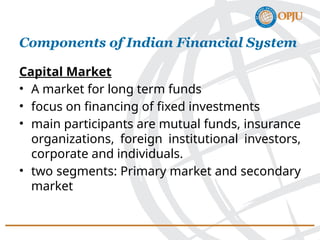
Capital Market
• A market for long term funds
• focus on financing of fixed investments
• main participants are mutual funds, insurance
organizations, foreign institutional investors,
corporate and individuals.
• two segments: Primary market and secondary
market
Components of Indian Financial System
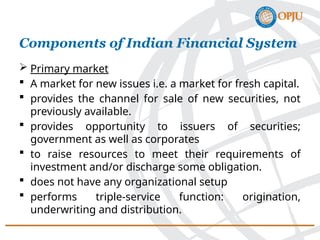
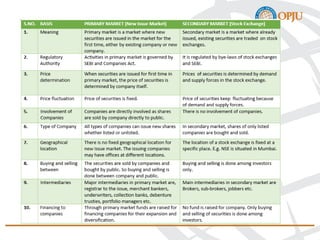
 Primary market
 A market for new issues i.e. a market for fresh capital.
 provides the channel for sale of new securities, not
previously available.
 provides opportunity to issuers of securities;
government as well as corporates
 to raise resources to meet their requirements of
investment and/or discharge some obligation.
 does not have any organizational setup
 performs triple-service function: origination,
underwriting and distribution.
Components of Indian Financial System
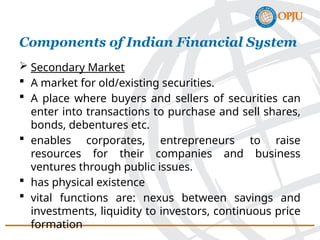
 Secondary Market
 A market for old/existing securities.
 A place where buyers and sellers of securities can
enter into transactions to purchase and sell shares,
bonds, debentures etc.
 enables corporates, entrepreneurs to raise
resources for their companies and business
ventures through public issues.
 has physical existence
 vital functions are: nexus between savings and
investments, liquidity to investors, continuous price
formation
Components of Indian Financial System
Other types of Financial market include:
1. Stock Markets: Stock Market is a type of Capital
market which deals with the issuance and trading
of shares and stocks at a certain price.
2. Bond Markets: Bond Market is a form of capital
market where buyers and sellers are involved in
the trading of bonds.
3. Commodity Market: A market which facilitates
the sale and purchase of raw goods is called a
commodity market. In such a market buyer
purchases raw products like rice, wheat, grain,
cattle and so on from the seller at a mutually
agreed rate.
Components of Indian Financial System
4. Money Market: As the name suggests, money market
involves individuals who deal with the lending and
borrowing of money for a short time frame.
5. Derivatives Market: The market which deals with the
trading of contracts which are derived from any other
asset is called as derivative market.
6. Future Market: Future market is a type of financial
market which deals with the trading of financial
instruments at a specific rate where in the delivery takes
place in future.
7. Insurance Market: Insurance market deals with the
trading of insurance products. Insurance companies pay
a certain amount to the immediate family members of
owner of the policy in case of his untimely death.
Components of Indian Financial System
8. Foreign Exchange Market: Foreign exchange market is
a globally operating market dealing in the sale and
purchase of foreign currencies.
9. Private Market: Private market is a form of market
where transaction of financial products takes place
between two parties directly.
10. Mortgage Market: A type of market where various
financial organizations are involved in providing loans
to individuals on various residential and commercial
properties for a specific duration is called a mortgage
market. The payment is made to the individual
concerned on submitting certain necessary documents
and fulfilling certain basic criteria.
Components of Indian Financial System
3. FINANCIAL INSTRUMENTS-
Financial instruments are the financial assets,
securities and claims. They may be viewed as
financial assets and financial liabilities. Financial
assets represent claims for the payment of a sum
of money sometime in the future (repayment of
principal) and/or a periodic payment in the form of
interest or dividend. Financial assets like deposits
with banks, companies and post offices, insurance
policies, NSCs, provident funds and pension funds
are not tradable.
Components of Indian Financial System
• A financial instrument is a real or virtual
document representing a legal agreement
involving any kind of monetary value.
• Financial instruments may be divided into two
types: cash instruments and derivative
instruments.
• Financial instruments may also be divided
according to an asset class, which depends on
whether they are debt-based or equity-based.
Components of Indian Financial System
Financial Instruments-
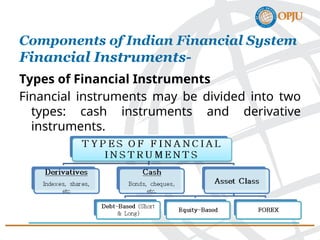
Types of Financial Instruments
Financial instruments may be divided into two
types: cash instruments and derivative
instruments.
Components of Indian Financial System
Financial Instruments-
1. Cash Instruments
• The values of cash instruments are directly
influenced and determined by the markets.
These can be securities that are easily
transferable. Stocks and bonds are common
examples of such instruments.
• Cash instruments may also be deposits and loans
agreed upon by borrowers and lenders. Cheques
are an example of a cash instrument because
they transmit payment from one bank account to
another's.
Components of Indian Financial System
Financial Instruments-
2. Derivative Instruments
• The value and characteristics of derivative
instruments are based on the vehicle’s underlying
components, such as assets, interest rates, or
indices.
• An equity options contract, such as a call option on
a particular stock for example, is a derivative
because it derives its value from the underlying
shares.
• There can be over-the-counter (OTC) derivatives or
exchange-traded derivatives. OTC is a market or
process whereby securities that are not listed on
Components of Indian Financial System
Financial Instruments-
Types of Asset Classes of Financial Instruments
Financial instruments may also be divided according
to an asset class, which depends on whether they
are debt-based or equity-based.
1. Debt-Based Financial Instruments
• Short-term debt-based financial instruments last
for one year or less. Securities of this kind come in
the form of T-bills and commercial paper. Bank
deposits and certificates of deposit (CDs) are also
technically debt-based instruments that credit
depositors with interest payments.
Components of Indian Financial System
Financial Instruments-
• Long-term debt-based financial instruments last
for more than a year. Long-term debt securities
are typically issued as bonds or mortgage-backed
securities (MBS). Exchange-traded derivatives on
these instruments are traded in the form of fixed-
income futures and options. OTC derivatives on
long-term debts include interest rate swaps,
interest rate caps and floors, and long-dated
interest rate options.
Components of Indian Financial System
Financial Instruments-
2. Equity-Based Financial Instruments
• Securities that trade under the banner of equity-
based financial instruments are most often
stocks, which can be either common stock or
preferred shares. ETFs and mutual funds may
also be equity-based instruments.
• Exchange traded derivatives in this category
include stock options and equity futures.
Components of Indian Financial System
Financial Instruments-
3. Foreign Exchange Instruments
• Foreign exchange (forex or FX) instruments
include derivatives such as forwards, futures, and
options on currency pairs, as well as CFDs
(contracts for difference). Currency swaps are
another common form of forex instrument. In
addition, forex traders may engage in spot
transactions for the immediate conversion of one
currency into another.
Components of Indian Financial System
Financial Instruments-
4. FINANCIAL SERVICES
Its objective is to intermediate and facilitate
financial transactions of individuals and
institutional investors. The financial services
include all activities connected with the
transformation of savings into investment.
Important financial services include lease
financing, hire purchase, installment payment
systems, merchant banking, factoring, forfaiting
etc
Components of Indian Financial System
Objectives of Financial Services
1) Fund Raising :
• The required funds can be raised by the help of
financial services from the host of investors,
individuals, institutions and corporate.
2) Specialized Services :
• The various specialized services are being
provided by financial service except banking and
insurance like credit rating, venture capital
financing, lease financing, factoring, mutual
funds, merchant banking, stock lending,
depository, credit cards, housing finance, book-
building, etc.
4) Regulation :
• There are various kinds of regulatory bodies
present in India like SEBI, RBI and the Department
of Banking and Insurance of the Government of
India which have different types of legislation's and
also help in providing various kinds of functions of
financial services institutions.
5) Economic Growth :
• The financial services help in increasing the
economic growth and development of country. It is
done by the help of mobilizing the saving of the
public by investing in productive investments.
Objectives of Financial Services
The scope / functions of financial service is as
follows :
1) Gross Domestic Product (GDP) :
• The gross domestic product refers to the
financial value of all the finished goods and
services manufactured inside the country in a
specific time period. The financial service
contributes to the GDP of the country.
2) Employment :
• The financial service requires various kinds of
financial institutions which need different kinds
of skilled manpower which indirectly lead to
increase in the employment of the country.
Scope of Financial Services
3) Foreign Direct Investment (FDI) :
• The financial service helps in increasing the foreign
direct investment in the country which helps in
increasing the growth of the country.
4) Mobilizing of Funds :
• The financial service helps in increasing the
investment opportunity among the public leading
to mobilizing the funds of the public.
5) Long-Term Loan :
• The long-term loan is basically required by the
industries. The financial service helps in providing
cheap and long-term loan to industries.
Scope of Financial Services
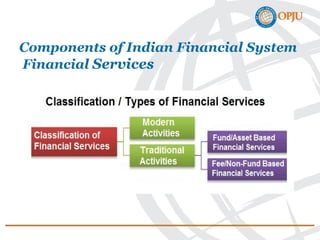
Components of Indian Financial System
Financial Services
Types Of Financial Services
1. Traditional Activities
• The financial intermediaries from the past are
providing various services including the
money and capital market activity. The
traditional activities are classified into fund
based activities and non-fund based activities.
These are also known as assets based
financial services and fee based financial
services respectively.
Fund/Asset Based Financial Services
1) Lease Financing :
• A lease is known as the agreement between two
parties known as lessor and lessee. The lessor is
the owner of the asset and lessee is the user of
the asset. In this agreement, there is transfer of
asset from lessor to lesser for certain time
period, in return the lessor receives the regular
rent. As the lease period gets over, the asset is
returned back to lessor until there is renewal of
the contract.
Types Of Financial Services
2) Hire Purchase :
• The hire purchase refers to the hiring of an asset
for certain time period and when the time period
gets over, there is purchase of same asset. At the
time of sharing of asset, the person hiring the
asset gets the ownership and is allowed in use it. It
is being used for financing of capital goods
like industrial finance, financing of consumer
goods and for selling consumer good on hire
purchase as it is a legal advice.
Types Of Financial Services
3) Factoring :
• Factoring is done when the company requires
immediate money. It is done by selling the account
receivable like invoices to a third party known as factor
at certain discount for immediate cash. This cash is
required for continuous working of the business.
4) Forfeiting :
• Forfeiting is the way of financing of receivable related
to international trade. It represents to the purchase
done by bank and financial institutions of trade
bills/promissory notes instead of recourse to the seller.
The purchase is done by discounting the documents
including the overall risk of non-payment in collection.
Types Of Financial Services
5) Housing Finance :
• The housing finance refers to the collection of all
the financial arrangements which are offered by
the Housing Finance Companies (HFCs) for
fulfilling the need of housing.
6) Venture Capital :
• Venture capital includes two words i.e. venture
and capital Venture refers to the way of doing
something whose result is not known as it is
present with various kinds of loss while capital
refers to human and non-human resources
required for starting the business.
Types Of Financial Services
Fee/Non-Fund Based Financial Services
1) Merchant Banking :
The merchant banker can be individual or
institutions like an underwriter or agent for the
companies and municipalities allocating
securities. They are also involved in broker or
dealer functions, maintain the market for
previously issued securities and also gives
suggestion to the investors on the advisory
services. It plays important part in mergers and
acquisitions, private equity placements and
corporate restructuring.
2) Securitisation :
• The change of present or future cash inflow of an
individual into trad-able security which can be
sold in the market is known as securitisation.
These cash inflows can be from financial assets
like mortgage loans, automobile loans, trade
receivables, credit card receivables, fare
collections will be security according to which
borrowing can be raised. Though an individual
can take the assistance of securitisation
instruments for efficient economic growth.
Types Of Financial Services
3) Letters of Credit (LC) :
• A letter of credit is issued by the bank of the
buyer to the seller which has a written
undertaking for repaying the cost of goods and
services given by the seller to the buyer in place
of producing documents required within the
precise time, place and to prescribed bank as
stated in the documents which is submitted
according to the terms and conditions of the LC.
Types Of Financial Services
2. Modern Activities
The financial intermediaries also have other services
besides the traditional services. These are of non
fund based activity. These are classified under New
Financial products and services. The different
services are as follows :
• It provides various project advisory services
starting from the preparation of the project report
until raising of funds along with the various
government approvals.
• The planning and implementing the process
involved in for merger and acquisition.
Types Of Financial Services
• It assists the corporate customers in capital
restructuring.
• It acts as the trustees to the debenture holders.
• It helps in achieving the better outcome by giving
required changes in the management structure
and management style.
• It help helps in finding the better joint venture
partners and also making the joint venture
agreements which directly help in structuring the
financial collaborations and joint ventures.
Types Of Financial Services
Modern Activities
• It also helps the sick companies by rehabilitating
and restructuring the proper plans in the
execution of the scheme.
• It helps in reducing risk by the help of exchange
rate risk, interest rate risk, economic risk and
political risk by using swaps and other derivative
products.
• It helps in controlling the portfolio of large public
sector company.
• It is involved in risk management service like
insurance services, buy-back options etc.
Types Of Financial Services
• It also gives suggestions to clients on the way of
choosing the better source of funds by taking up the
various funds, cost, lending time, etc.
• It also helps the companies which are related in
credit rating and want to go public by the issue of
debt instruments.
• It takes the various services associated to the capital
market like :
 Clearing services
 Registration and transfers
 Sate custody of securities
 Collection of income on securities
Types Of Financial Services
Terminology Used
Shares- a part or portion of a larger amount which is
divided among a number of people, or to which a
number of people contribute.
Debentures- a long-term security yielding a fixed rate of
interest, issued by a company and secured against
assets.
Bonds- Borrowers issue bonds to raise money from
investors willing to lend them money for a certain
amount of time.
Derivatives- type of financial contract whose value is
dependent on an underlying asset, group of assets, or
benchmark. A derivative is set between two or more
parties that can trade on an exchange or over-the-
counter (OTC).
Interest rate swap is a forward contract in which one
stream of future interest payments is exchanged for
another based on a specified principal amount. Interest
rate swaps usually involve the exchange of a fixed
interest rate for a floating rate, or vice versa, to reduce
or increase exposure to fluctuations in interest rate.
Interest rate cap is a limit on how high an interest rate
can rise on variable-rate debt. Interest rate caps can be
instituted across all types of variable rate products.
Interest rate floor specifies that the seller agrees to pay
the buyer if the reference rate is below the strike rate.
Terminology Used

Business Financial system introduction 1

  • 1.
  • 2.
    Financial system, implies- •a set of complex and closely connected or interlined institutions, agents, practices, markets, transactions, claims, and liabilities in the economy. • is the system that allows the transfer of money between savers (and investors) and borrowers. Fundamental of the Indian Financial System
  • 3.
    • is asystem which supplies the necessary financial inputs for the production of goods and service to improve the standard of life and well being of the nation. • its responsibility is to mobilize the savings in the form of money and invest them in the productive manner. • the financial system provided the intermediation between savers and investors and promotes faster economic development. Fundamental of the Indian Financial System
  • 4.
    Functions of FinancialSystem • To link the savers & investors. • To inspire the operators to monitor the performance of the investment. • To achieve optimum allocation of risk bearing. • It makes available price - related information. • It helps in promoting the process of financial deepening and broadening • Price information for decentralised decision making
  • 5.
    Components of IndianFinancial System
  • 7.
    1. FINANCIAL INSTITUTIONS-Financial institutions are the participants in a financial market. They are business organizations dealing in financial resources. They collect resources by accepting deposits from individuals and institutions and lend them to trade, industry and others. On the basis of the nature of activities, financial institutions may be classified as: (a) Banking institutions, and (b) Non-banking institutions Components of Indian Financial System
  • 8.
    (a) Banking Institutions:Banking institutions mobilise the savings of the people. They provide a mechanism for the smooth exchange of goods and services. They extend credit while lending money. They not only supply credit but also create credit. There are three basic categories of banking institutions. They are commercial banks, co-operative banks and developmental banks Components of Indian Financial System
  • 9.
    (b) Non-banking Institutions:The non-banking financial institutions also mobilize financial resources directly or indirectly from the people. Companies like LIC, GIC, UTI, Development Financial Institutions, Organisation of Pension and Provident Funds etc. fall in this category. Non-banking financial institutions can be categorized as investment companies, housing companies, leasing companies, hire purchase companies, specialized financial institutions. Components of Indian Financial System
  • 10.
    2. FINANCIAL MARKET-Financial Market refers to a marketplace, where creation and trading of financial assets, such as shares, debentures, bonds, derivatives, currencies, etc. take place. It plays a crucial role in allocating limited resources, in the country’s economy. It acts as an intermediary between the savers and investors by mobilizing funds between them. Components of Indian Financial System
  • 11.
    Components of financialmarket Components of Indian Financial System FINANCIAL MARKET CAPITAL/ SECURITIES MARKET PRIMARY SECOND ARY MONEY MARKET CALL MARKET
  • 12.
    Money Market A marketfor dealing in monetary assets of short term nature, less than one year. Enables raising up of short term funds for meeting temporary shortage of fund and obligations and temporary deployment of excess fund. Major participant are: RBI and Commercial Banks Major objectives: equilibrium mechanism for evening out short term surpluses and deficits, focal point for influencing liquidity in economy, access to users of short term funds at reasonable cost Components of Indian Financial System
  • 13.
    Capital Market • Amarket for long term funds • focus on financing of fixed investments • main participants are mutual funds, insurance organizations, foreign institutional investors, corporate and individuals. • two segments: Primary market and secondary market Components of Indian Financial System
  • 14.
     Primary market A market for new issues i.e. a market for fresh capital.  provides the channel for sale of new securities, not previously available.  provides opportunity to issuers of securities; government as well as corporates  to raise resources to meet their requirements of investment and/or discharge some obligation.  does not have any organizational setup  performs triple-service function: origination, underwriting and distribution. Components of Indian Financial System
  • 15.
     Secondary Market A market for old/existing securities.  A place where buyers and sellers of securities can enter into transactions to purchase and sell shares, bonds, debentures etc.  enables corporates, entrepreneurs to raise resources for their companies and business ventures through public issues.  has physical existence  vital functions are: nexus between savings and investments, liquidity to investors, continuous price formation Components of Indian Financial System

  • 17.
    Other types ofFinancial market include: 1. Stock Markets: Stock Market is a type of Capital market which deals with the issuance and trading of shares and stocks at a certain price. 2. Bond Markets: Bond Market is a form of capital market where buyers and sellers are involved in the trading of bonds. 3. Commodity Market: A market which facilitates the sale and purchase of raw goods is called a commodity market. In such a market buyer purchases raw products like rice, wheat, grain, cattle and so on from the seller at a mutually agreed rate. Components of Indian Financial System
  • 18.
    4. Money Market:As the name suggests, money market involves individuals who deal with the lending and borrowing of money for a short time frame. 5. Derivatives Market: The market which deals with the trading of contracts which are derived from any other asset is called as derivative market. 6. Future Market: Future market is a type of financial market which deals with the trading of financial instruments at a specific rate where in the delivery takes place in future. 7. Insurance Market: Insurance market deals with the trading of insurance products. Insurance companies pay a certain amount to the immediate family members of owner of the policy in case of his untimely death. Components of Indian Financial System
  • 19.
    8. Foreign ExchangeMarket: Foreign exchange market is a globally operating market dealing in the sale and purchase of foreign currencies. 9. Private Market: Private market is a form of market where transaction of financial products takes place between two parties directly. 10. Mortgage Market: A type of market where various financial organizations are involved in providing loans to individuals on various residential and commercial properties for a specific duration is called a mortgage market. The payment is made to the individual concerned on submitting certain necessary documents and fulfilling certain basic criteria. Components of Indian Financial System
  • 20.
    3. FINANCIAL INSTRUMENTS- Financialinstruments are the financial assets, securities and claims. They may be viewed as financial assets and financial liabilities. Financial assets represent claims for the payment of a sum of money sometime in the future (repayment of principal) and/or a periodic payment in the form of interest or dividend. Financial assets like deposits with banks, companies and post offices, insurance policies, NSCs, provident funds and pension funds are not tradable. Components of Indian Financial System
  • 21.
    • A financialinstrument is a real or virtual document representing a legal agreement involving any kind of monetary value. • Financial instruments may be divided into two types: cash instruments and derivative instruments. • Financial instruments may also be divided according to an asset class, which depends on whether they are debt-based or equity-based. Components of Indian Financial System Financial Instruments-
  • 22.
    Types of FinancialInstruments Financial instruments may be divided into two types: cash instruments and derivative instruments. Components of Indian Financial System Financial Instruments-
  • 23.
    1. Cash Instruments •The values of cash instruments are directly influenced and determined by the markets. These can be securities that are easily transferable. Stocks and bonds are common examples of such instruments. • Cash instruments may also be deposits and loans agreed upon by borrowers and lenders. Cheques are an example of a cash instrument because they transmit payment from one bank account to another's. Components of Indian Financial System Financial Instruments-
  • 24.
    2. Derivative Instruments •The value and characteristics of derivative instruments are based on the vehicle’s underlying components, such as assets, interest rates, or indices. • An equity options contract, such as a call option on a particular stock for example, is a derivative because it derives its value from the underlying shares. • There can be over-the-counter (OTC) derivatives or exchange-traded derivatives. OTC is a market or process whereby securities that are not listed on Components of Indian Financial System Financial Instruments-
  • 25.
    Types of AssetClasses of Financial Instruments Financial instruments may also be divided according to an asset class, which depends on whether they are debt-based or equity-based. 1. Debt-Based Financial Instruments • Short-term debt-based financial instruments last for one year or less. Securities of this kind come in the form of T-bills and commercial paper. Bank deposits and certificates of deposit (CDs) are also technically debt-based instruments that credit depositors with interest payments. Components of Indian Financial System Financial Instruments-
  • 26.
    • Long-term debt-basedfinancial instruments last for more than a year. Long-term debt securities are typically issued as bonds or mortgage-backed securities (MBS). Exchange-traded derivatives on these instruments are traded in the form of fixed- income futures and options. OTC derivatives on long-term debts include interest rate swaps, interest rate caps and floors, and long-dated interest rate options. Components of Indian Financial System Financial Instruments-
  • 27.
    2. Equity-Based FinancialInstruments • Securities that trade under the banner of equity- based financial instruments are most often stocks, which can be either common stock or preferred shares. ETFs and mutual funds may also be equity-based instruments. • Exchange traded derivatives in this category include stock options and equity futures. Components of Indian Financial System Financial Instruments-
  • 28.
    3. Foreign ExchangeInstruments • Foreign exchange (forex or FX) instruments include derivatives such as forwards, futures, and options on currency pairs, as well as CFDs (contracts for difference). Currency swaps are another common form of forex instrument. In addition, forex traders may engage in spot transactions for the immediate conversion of one currency into another. Components of Indian Financial System Financial Instruments-
  • 29.
    4. FINANCIAL SERVICES Itsobjective is to intermediate and facilitate financial transactions of individuals and institutional investors. The financial services include all activities connected with the transformation of savings into investment. Important financial services include lease financing, hire purchase, installment payment systems, merchant banking, factoring, forfaiting etc Components of Indian Financial System
  • 30.
    Objectives of FinancialServices 1) Fund Raising : • The required funds can be raised by the help of financial services from the host of investors, individuals, institutions and corporate. 2) Specialized Services : • The various specialized services are being provided by financial service except banking and insurance like credit rating, venture capital financing, lease financing, factoring, mutual funds, merchant banking, stock lending, depository, credit cards, housing finance, book- building, etc.
  • 31.
    4) Regulation : •There are various kinds of regulatory bodies present in India like SEBI, RBI and the Department of Banking and Insurance of the Government of India which have different types of legislation's and also help in providing various kinds of functions of financial services institutions. 5) Economic Growth : • The financial services help in increasing the economic growth and development of country. It is done by the help of mobilizing the saving of the public by investing in productive investments. Objectives of Financial Services
  • 32.
    The scope /functions of financial service is as follows : 1) Gross Domestic Product (GDP) : • The gross domestic product refers to the financial value of all the finished goods and services manufactured inside the country in a specific time period. The financial service contributes to the GDP of the country. 2) Employment : • The financial service requires various kinds of financial institutions which need different kinds of skilled manpower which indirectly lead to increase in the employment of the country. Scope of Financial Services
  • 33.
    3) Foreign DirectInvestment (FDI) : • The financial service helps in increasing the foreign direct investment in the country which helps in increasing the growth of the country. 4) Mobilizing of Funds : • The financial service helps in increasing the investment opportunity among the public leading to mobilizing the funds of the public. 5) Long-Term Loan : • The long-term loan is basically required by the industries. The financial service helps in providing cheap and long-term loan to industries. Scope of Financial Services
  • 34.
    Components of IndianFinancial System Financial Services
  • 35.
    Types Of FinancialServices 1. Traditional Activities • The financial intermediaries from the past are providing various services including the money and capital market activity. The traditional activities are classified into fund based activities and non-fund based activities. These are also known as assets based financial services and fee based financial services respectively.
  • 36.
    Fund/Asset Based FinancialServices 1) Lease Financing : • A lease is known as the agreement between two parties known as lessor and lessee. The lessor is the owner of the asset and lessee is the user of the asset. In this agreement, there is transfer of asset from lessor to lesser for certain time period, in return the lessor receives the regular rent. As the lease period gets over, the asset is returned back to lessor until there is renewal of the contract. Types Of Financial Services
  • 37.
    2) Hire Purchase: • The hire purchase refers to the hiring of an asset for certain time period and when the time period gets over, there is purchase of same asset. At the time of sharing of asset, the person hiring the asset gets the ownership and is allowed in use it. It is being used for financing of capital goods like industrial finance, financing of consumer goods and for selling consumer good on hire purchase as it is a legal advice. Types Of Financial Services
  • 38.
    3) Factoring : •Factoring is done when the company requires immediate money. It is done by selling the account receivable like invoices to a third party known as factor at certain discount for immediate cash. This cash is required for continuous working of the business. 4) Forfeiting : • Forfeiting is the way of financing of receivable related to international trade. It represents to the purchase done by bank and financial institutions of trade bills/promissory notes instead of recourse to the seller. The purchase is done by discounting the documents including the overall risk of non-payment in collection. Types Of Financial Services
  • 39.
    5) Housing Finance: • The housing finance refers to the collection of all the financial arrangements which are offered by the Housing Finance Companies (HFCs) for fulfilling the need of housing. 6) Venture Capital : • Venture capital includes two words i.e. venture and capital Venture refers to the way of doing something whose result is not known as it is present with various kinds of loss while capital refers to human and non-human resources required for starting the business. Types Of Financial Services
  • 40.
    Types Of FinancialServices Fee/Non-Fund Based Financial Services 1) Merchant Banking : The merchant banker can be individual or institutions like an underwriter or agent for the companies and municipalities allocating securities. They are also involved in broker or dealer functions, maintain the market for previously issued securities and also gives suggestion to the investors on the advisory services. It plays important part in mergers and acquisitions, private equity placements and corporate restructuring.
  • 41.
    2) Securitisation : •The change of present or future cash inflow of an individual into trad-able security which can be sold in the market is known as securitisation. These cash inflows can be from financial assets like mortgage loans, automobile loans, trade receivables, credit card receivables, fare collections will be security according to which borrowing can be raised. Though an individual can take the assistance of securitisation instruments for efficient economic growth. Types Of Financial Services
  • 42.
    3) Letters ofCredit (LC) : • A letter of credit is issued by the bank of the buyer to the seller which has a written undertaking for repaying the cost of goods and services given by the seller to the buyer in place of producing documents required within the precise time, place and to prescribed bank as stated in the documents which is submitted according to the terms and conditions of the LC. Types Of Financial Services
  • 43.
    2. Modern Activities Thefinancial intermediaries also have other services besides the traditional services. These are of non fund based activity. These are classified under New Financial products and services. The different services are as follows : • It provides various project advisory services starting from the preparation of the project report until raising of funds along with the various government approvals. • The planning and implementing the process involved in for merger and acquisition. Types Of Financial Services
  • 44.
    • It assiststhe corporate customers in capital restructuring. • It acts as the trustees to the debenture holders. • It helps in achieving the better outcome by giving required changes in the management structure and management style. • It help helps in finding the better joint venture partners and also making the joint venture agreements which directly help in structuring the financial collaborations and joint ventures. Types Of Financial Services Modern Activities
  • 45.
    • It alsohelps the sick companies by rehabilitating and restructuring the proper plans in the execution of the scheme. • It helps in reducing risk by the help of exchange rate risk, interest rate risk, economic risk and political risk by using swaps and other derivative products. • It helps in controlling the portfolio of large public sector company. • It is involved in risk management service like insurance services, buy-back options etc. Types Of Financial Services
  • 46.
    • It alsogives suggestions to clients on the way of choosing the better source of funds by taking up the various funds, cost, lending time, etc. • It also helps the companies which are related in credit rating and want to go public by the issue of debt instruments. • It takes the various services associated to the capital market like :  Clearing services  Registration and transfers  Sate custody of securities  Collection of income on securities Types Of Financial Services
  • 47.
    Terminology Used Shares- apart or portion of a larger amount which is divided among a number of people, or to which a number of people contribute. Debentures- a long-term security yielding a fixed rate of interest, issued by a company and secured against assets. Bonds- Borrowers issue bonds to raise money from investors willing to lend them money for a certain amount of time. Derivatives- type of financial contract whose value is dependent on an underlying asset, group of assets, or benchmark. A derivative is set between two or more parties that can trade on an exchange or over-the- counter (OTC).
  • 48.
    Interest rate swapis a forward contract in which one stream of future interest payments is exchanged for another based on a specified principal amount. Interest rate swaps usually involve the exchange of a fixed interest rate for a floating rate, or vice versa, to reduce or increase exposure to fluctuations in interest rate. Interest rate cap is a limit on how high an interest rate can rise on variable-rate debt. Interest rate caps can be instituted across all types of variable rate products. Interest rate floor specifies that the seller agrees to pay the buyer if the reference rate is below the strike rate. Terminology Used