Rahul De
Copyright © 2018 by Wiley India Pvt. Ltd., 4436/7, Ansari Road, Daryaganj, New Delhi-110002
MIS
MANAGING INFORMATION SYSTEMS IN BUSINESS,
GOVERNMENT AND SOCIETY
MIS : Managing Information Systems in Business, Government and Society by Rahul De
Copyright © 2018 by Wiley India Pvt. Ltd., 4436/7, Ansari Road, Daryaganj, New Delhi-110002
LEARNING OBJECTIVES
 Overview of the modern organisation
 Understand information systems in organisations
 Managing information systems in organisations
2
MIS : Managing Information Systems in Business, Government and Society by Rahul De
Copyright © 2018 by Wiley India Pvt. Ltd., 4436/7, Ansari Road, Daryaganj, New Delhi-110002
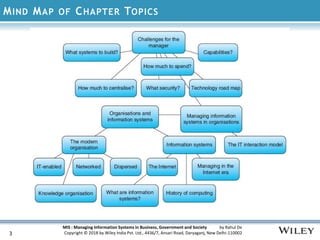
MIND MAP OF CHAPTER TOPICS
3
MIS : Managing Information Systems in Business, Government and Society by Rahul De
Copyright © 2018 by Wiley India Pvt. Ltd., 4436/7, Ansari Road, Daryaganj, New Delhi-110002
MODERN ORGANISATIONS
4
 Organisations are collections of people with shared goals
 Has people or members who are engaged in activities for a common purpose
 Organisations have many purposes
 Make cars
 Inform citizens
 Ferry passengers
MIS : Managing Information Systems in Business, Government and Society by Rahul De
Copyright © 2018 by Wiley India Pvt. Ltd., 4436/7, Ansari Road, Daryaganj, New Delhi-110002
MODERN ORGANISATIONS : IT-ENABLED ORGANISATION
5
 Organisations are collections of people with shared goals
 Has people or members who are engaged in activities for a common purpose
 Organisations have many purposes
 Make cars
 Inform citizens
 Ferry passengers
MIS : Managing Information Systems in Business, Government and Society by Rahul De
Copyright © 2018 by Wiley India Pvt. Ltd., 4436/7, Ansari Road, Daryaganj, New Delhi-110002
MODERN ORGANISATIONS: NETWORKED ORGANISATION
6
 Organisations are collections of people with shared goals
 Organisations are on digital networks linking them to others
 Requires sensing and responding to information flowing on the network
 Responding to the continuous flow of information also requires the
organisation to adjust to meet the challenge
MIS : Managing Information Systems in Business, Government and Society by Rahul De
Copyright © 2018 by Wiley India Pvt. Ltd., 4436/7, Ansari Road, Daryaganj, New Delhi-110002
MODERN ORGANISATIONS :DISPERSED ORGANISATION
7
 Organisations are highly dispersed: they have operations and offices in many
cities within the same country and also abroad
 Firms disperse their operations to best meet customer needs or locate where
resources are available
MIS : Managing Information Systems in Business, Government and Society by Rahul De
Copyright © 2018 by Wiley India Pvt. Ltd., 4436/7, Ansari Road, Daryaganj, New Delhi-110002
MODERN ORGANISATIONS:KNOWLEDGE ORGANISATION
8
 Modern organisations consist of knowledge workers – whose main job is to
access and deal with knowledge and information
 A major task of modern organisations is to process information
MIS : Managing Information Systems in Business, Government and Society by Rahul De
Copyright © 2018 by Wiley India Pvt. Ltd., 4436/7, Ansari Road, Daryaganj, New Delhi-110002
WHAT ARE INFORMATION SYSTEMS?
9
 Information Systems (IS) are collections of computers, networks, software
and people who create, store, modify and distribute data and information in
any organisation.
 Information Technology (IT) are the artefacts such as computers, software
and networks that constitute the IS.
MIS : Managing Information Systems in Business, Government and Society by Rahul De
Copyright © 2018 by Wiley India Pvt. Ltd., 4436/7, Ansari Road, Daryaganj, New Delhi-110002
BRIEF HISTORY OF COMPUTING
10
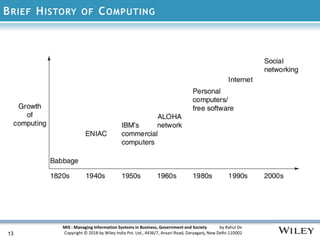
 Charles Babbage conceived of computers in 1820
 Babbage designed a mechanical device that could make computations
 Babbage's device was called the Difference Engine
 Ada Lovelace helped create the instructions for Babbage's device; Lovelace
invented the idea of software
 Electronic computers were built independently in Germany, the UK and the
USA around 1940s
 The first general purpose computer was called the ENIAC, built in the USA in
1946
 First commercial computers appeared in 1950s
 Widespread development of hardware and software around the world
MIS : Managing Information Systems in Business, Government and Society by Rahul De
Copyright © 2018 by Wiley India Pvt. Ltd., 4436/7, Ansari Road, Daryaganj, New Delhi-110002
BRIEF HISTORY OF COMPUTING
11
 First computer arrived in India in 1956 at the Indian Statistical Institute in
Kolkata
 Development of computer networks began in 1960s
 Artificial Intelligence efforts were started to write software that emulated
human capabilities
 Personal computers became widely available in the 1980s
 Early 1980s also saw the emergence of Free Software, software that was
openly available
 1990s – growth of the Internet and widespread computing around the globe
MIS : Managing Information Systems in Business, Government and Society by Rahul De
Copyright © 2018 by Wiley India Pvt. Ltd., 4436/7, Ansari Road, Daryaganj, New Delhi-110002
BRIEF HISTORY OF COMPUTING
12
 First computer arrived in India in 1956 at the Indian Statistical Institute in
Kolkata
 Development of computer networks began in 1960s
 Artificial Intelligence efforts were started to write software that emulated
human capabilities
 Personal computers became widely available in the 1980s
 Early 1980s also saw the emergence of Free Software, software that was
openly available
 1990s – growth of the Internet and widespread computing around the globe
MIS : Managing Information Systems in Business, Government and Society by Rahul De
Copyright © 2018 by Wiley India Pvt. Ltd., 4436/7, Ansari Road, Daryaganj, New Delhi-110002
BRIEF HISTORY OF COMPUTING
13
MIS : Managing Information Systems in Business, Government and Society by Rahul De
Copyright © 2018 by Wiley India Pvt. Ltd., 4436/7, Ansari Road, Daryaganj, New Delhi-110002
THE INTERNET AND WEB
14
 The Internet is a massive network of millions of computers
 The World Wide Web (or Web) is an information sharing technology built on
the Internet
MIS : Managing Information Systems in Business, Government and Society by Rahul De
Copyright © 2018 by Wiley India Pvt. Ltd., 4436/7, Ansari Road, Daryaganj, New Delhi-110002
THE INTERNET
15
 The Internet enables many services to run, which include
 The World Wide Web
 E-mail
 E-commerce
 The Internet enables new ways of doing business
MIS : Managing Information Systems in Business, Government and Society by Rahul De
Copyright © 2018 by Wiley India Pvt. Ltd., 4436/7, Ansari Road, Daryaganj, New Delhi-110002
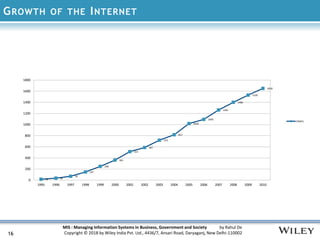
GROWTH OF THE INTERNET
16
16 36
70
147
248
361
513
587
719
817
1018
1093
1262
1400
1530
1650
1995 1996 1997 1998 1999 2000 2001 2002 2003 2004 2005 2006 2007 2008 2009 2010
0
200
400
600
800
1000
1200
1400
1600
1800
Users
MIS : Managing Information Systems in Business, Government and Society by Rahul De
Copyright © 2018 by Wiley India Pvt. Ltd., 4436/7, Ansari Road, Daryaganj, New Delhi-110002
MANAGING IN THE INTERNET ERA
17
 Challenge for organisations – find and use most relevant and useful data
 Organisations have to create a presence on the Internet
 Organisations have to decide whether to use services on the Internet
 The Internet presents many security challenges
MIS : Managing Information Systems in Business, Government and Society by Rahul De
Copyright © 2018 by Wiley India Pvt. Ltd., 4436/7, Ansari Road, Daryaganj, New Delhi-110002
THE IT INTERACTION MODEL
18
 Challenge of managing IS in organisations
 Organisations do not remain static; they have to change to respond to the
environment
 IS too continuously evolves
 Important to understand how IS and organisations interact
MIS : Managing Information Systems in Business, Government and Society by Rahul De
Copyright © 2018 by Wiley India Pvt. Ltd., 4436/7, Ansari Road, Daryaganj, New Delhi-110002
IT INTERACTION MODEL
19
MIS : Managing Information Systems in Business, Government and Society by Rahul De
Copyright © 2018 by Wiley India Pvt. Ltd., 4436/7, Ansari Road, Daryaganj, New Delhi-110002
IT INTERACTION MODEL
20
 When an organisation builds an information system, the system may be
 Used or not used
 Which may lead to positive or negative outcomes
 Outcomes will have
 First-order effects
 Second-order effects
 Third-order effects
MIS : Managing Information Systems in Business, Government and Society by Rahul De
Copyright © 2018 by Wiley India Pvt. Ltd., 4436/7, Ansari Road, Daryaganj, New Delhi-110002
IT INTERACTION MODEL
21
 When an organisation builds an information system, the system may be
 Used or not used
 Which may lead to positive or negative outcomes
 Outcomes will have
 First-order effects
 Second-order effects
 Third-order effects
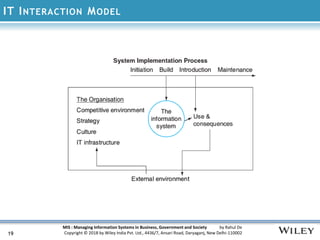
 Whether an IS is successful is largely dependent on
 The competitive environment of the firm
 The competitive strategy that the firm follows
 The work culture of the firm
 The structure of the organisation
MIS : Managing Information Systems in Business, Government and Society by Rahul De
Copyright © 2018 by Wiley India Pvt. Ltd., 4436/7, Ansari Road, Daryaganj, New Delhi-110002
IT INTERACTION MODEL
22
 Information systems may impact the organisation by
 Changing work processes and functions
 Automate manual processes
 Eliminate some work processes
 Building an IS requires choices to be made
 Build the system, if internal skills are available
 Buy the system
 Initiation requires understanding the need for the IS
 Analysis is required to understand the specifications for the system
 A new system has to be introduced and integrated within the organisation
MIS : Managing Information Systems in Business, Government and Society by Rahul De
Copyright © 2018 by Wiley India Pvt. Ltd., 4436/7, Ansari Road, Daryaganj, New Delhi-110002
CHALLENGES FOR THE MANAGER
23
 A manager who has to manage the IS of an organisation faces many
challenges
 What systems to build?
 Choose from many possible needs of the organisation
 How much to spend on IS?
 See what competitors are doing
 What level of capabilities should be created with the IS?
 Support one department or many departments
 How centralized should the services be?
 The systems should be both scalable and flexible
 What security levels are required?
 Security has to be adequate without being cumbersome and expensive
 What is the technology Road Map for the organisation?
 Plan for the evolution of the IS in the organisation

organisations and information systems

  • 1.
    Rahul De Copyright ©2018 by Wiley India Pvt. Ltd., 4436/7, Ansari Road, Daryaganj, New Delhi-110002 MIS MANAGING INFORMATION SYSTEMS IN BUSINESS, GOVERNMENT AND SOCIETY
  • 2.
    MIS : ManagingInformation Systems in Business, Government and Society by Rahul De Copyright © 2018 by Wiley India Pvt. Ltd., 4436/7, Ansari Road, Daryaganj, New Delhi-110002 LEARNING OBJECTIVES  Overview of the modern organisation  Understand information systems in organisations  Managing information systems in organisations 2
  • 3.
    MIS : ManagingInformation Systems in Business, Government and Society by Rahul De Copyright © 2018 by Wiley India Pvt. Ltd., 4436/7, Ansari Road, Daryaganj, New Delhi-110002 MIND MAP OF CHAPTER TOPICS 3
  • 4.
    MIS : ManagingInformation Systems in Business, Government and Society by Rahul De Copyright © 2018 by Wiley India Pvt. Ltd., 4436/7, Ansari Road, Daryaganj, New Delhi-110002 MODERN ORGANISATIONS 4  Organisations are collections of people with shared goals  Has people or members who are engaged in activities for a common purpose  Organisations have many purposes  Make cars  Inform citizens  Ferry passengers
  • 5.
    MIS : ManagingInformation Systems in Business, Government and Society by Rahul De Copyright © 2018 by Wiley India Pvt. Ltd., 4436/7, Ansari Road, Daryaganj, New Delhi-110002 MODERN ORGANISATIONS : IT-ENABLED ORGANISATION 5  Organisations are collections of people with shared goals  Has people or members who are engaged in activities for a common purpose  Organisations have many purposes  Make cars  Inform citizens  Ferry passengers
  • 6.
    MIS : ManagingInformation Systems in Business, Government and Society by Rahul De Copyright © 2018 by Wiley India Pvt. Ltd., 4436/7, Ansari Road, Daryaganj, New Delhi-110002 MODERN ORGANISATIONS: NETWORKED ORGANISATION 6  Organisations are collections of people with shared goals  Organisations are on digital networks linking them to others  Requires sensing and responding to information flowing on the network  Responding to the continuous flow of information also requires the organisation to adjust to meet the challenge
  • 7.
    MIS : ManagingInformation Systems in Business, Government and Society by Rahul De Copyright © 2018 by Wiley India Pvt. Ltd., 4436/7, Ansari Road, Daryaganj, New Delhi-110002 MODERN ORGANISATIONS :DISPERSED ORGANISATION 7  Organisations are highly dispersed: they have operations and offices in many cities within the same country and also abroad  Firms disperse their operations to best meet customer needs or locate where resources are available
  • 8.
    MIS : ManagingInformation Systems in Business, Government and Society by Rahul De Copyright © 2018 by Wiley India Pvt. Ltd., 4436/7, Ansari Road, Daryaganj, New Delhi-110002 MODERN ORGANISATIONS:KNOWLEDGE ORGANISATION 8  Modern organisations consist of knowledge workers – whose main job is to access and deal with knowledge and information  A major task of modern organisations is to process information
  • 9.
    MIS : ManagingInformation Systems in Business, Government and Society by Rahul De Copyright © 2018 by Wiley India Pvt. Ltd., 4436/7, Ansari Road, Daryaganj, New Delhi-110002 WHAT ARE INFORMATION SYSTEMS? 9  Information Systems (IS) are collections of computers, networks, software and people who create, store, modify and distribute data and information in any organisation.  Information Technology (IT) are the artefacts such as computers, software and networks that constitute the IS.
  • 10.
    MIS : ManagingInformation Systems in Business, Government and Society by Rahul De Copyright © 2018 by Wiley India Pvt. Ltd., 4436/7, Ansari Road, Daryaganj, New Delhi-110002 BRIEF HISTORY OF COMPUTING 10  Charles Babbage conceived of computers in 1820  Babbage designed a mechanical device that could make computations  Babbage's device was called the Difference Engine  Ada Lovelace helped create the instructions for Babbage's device; Lovelace invented the idea of software  Electronic computers were built independently in Germany, the UK and the USA around 1940s  The first general purpose computer was called the ENIAC, built in the USA in 1946  First commercial computers appeared in 1950s  Widespread development of hardware and software around the world
  • 11.
    MIS : ManagingInformation Systems in Business, Government and Society by Rahul De Copyright © 2018 by Wiley India Pvt. Ltd., 4436/7, Ansari Road, Daryaganj, New Delhi-110002 BRIEF HISTORY OF COMPUTING 11  First computer arrived in India in 1956 at the Indian Statistical Institute in Kolkata  Development of computer networks began in 1960s  Artificial Intelligence efforts were started to write software that emulated human capabilities  Personal computers became widely available in the 1980s  Early 1980s also saw the emergence of Free Software, software that was openly available  1990s – growth of the Internet and widespread computing around the globe
  • 12.
    MIS : ManagingInformation Systems in Business, Government and Society by Rahul De Copyright © 2018 by Wiley India Pvt. Ltd., 4436/7, Ansari Road, Daryaganj, New Delhi-110002 BRIEF HISTORY OF COMPUTING 12  First computer arrived in India in 1956 at the Indian Statistical Institute in Kolkata  Development of computer networks began in 1960s  Artificial Intelligence efforts were started to write software that emulated human capabilities  Personal computers became widely available in the 1980s  Early 1980s also saw the emergence of Free Software, software that was openly available  1990s – growth of the Internet and widespread computing around the globe
  • 13.
    MIS : ManagingInformation Systems in Business, Government and Society by Rahul De Copyright © 2018 by Wiley India Pvt. Ltd., 4436/7, Ansari Road, Daryaganj, New Delhi-110002 BRIEF HISTORY OF COMPUTING 13
  • 14.
    MIS : ManagingInformation Systems in Business, Government and Society by Rahul De Copyright © 2018 by Wiley India Pvt. Ltd., 4436/7, Ansari Road, Daryaganj, New Delhi-110002 THE INTERNET AND WEB 14  The Internet is a massive network of millions of computers  The World Wide Web (or Web) is an information sharing technology built on the Internet
  • 15.
    MIS : ManagingInformation Systems in Business, Government and Society by Rahul De Copyright © 2018 by Wiley India Pvt. Ltd., 4436/7, Ansari Road, Daryaganj, New Delhi-110002 THE INTERNET 15  The Internet enables many services to run, which include  The World Wide Web  E-mail  E-commerce  The Internet enables new ways of doing business
  • 16.
    MIS : ManagingInformation Systems in Business, Government and Society by Rahul De Copyright © 2018 by Wiley India Pvt. Ltd., 4436/7, Ansari Road, Daryaganj, New Delhi-110002 GROWTH OF THE INTERNET 16 16 36 70 147 248 361 513 587 719 817 1018 1093 1262 1400 1530 1650 1995 1996 1997 1998 1999 2000 2001 2002 2003 2004 2005 2006 2007 2008 2009 2010 0 200 400 600 800 1000 1200 1400 1600 1800 Users
  • 17.
    MIS : ManagingInformation Systems in Business, Government and Society by Rahul De Copyright © 2018 by Wiley India Pvt. Ltd., 4436/7, Ansari Road, Daryaganj, New Delhi-110002 MANAGING IN THE INTERNET ERA 17  Challenge for organisations – find and use most relevant and useful data  Organisations have to create a presence on the Internet  Organisations have to decide whether to use services on the Internet  The Internet presents many security challenges
  • 18.
    MIS : ManagingInformation Systems in Business, Government and Society by Rahul De Copyright © 2018 by Wiley India Pvt. Ltd., 4436/7, Ansari Road, Daryaganj, New Delhi-110002 THE IT INTERACTION MODEL 18  Challenge of managing IS in organisations  Organisations do not remain static; they have to change to respond to the environment  IS too continuously evolves  Important to understand how IS and organisations interact
  • 19.
    MIS : ManagingInformation Systems in Business, Government and Society by Rahul De Copyright © 2018 by Wiley India Pvt. Ltd., 4436/7, Ansari Road, Daryaganj, New Delhi-110002 IT INTERACTION MODEL 19
  • 20.
    MIS : ManagingInformation Systems in Business, Government and Society by Rahul De Copyright © 2018 by Wiley India Pvt. Ltd., 4436/7, Ansari Road, Daryaganj, New Delhi-110002 IT INTERACTION MODEL 20  When an organisation builds an information system, the system may be  Used or not used  Which may lead to positive or negative outcomes  Outcomes will have  First-order effects  Second-order effects  Third-order effects
  • 21.
    MIS : ManagingInformation Systems in Business, Government and Society by Rahul De Copyright © 2018 by Wiley India Pvt. Ltd., 4436/7, Ansari Road, Daryaganj, New Delhi-110002 IT INTERACTION MODEL 21  When an organisation builds an information system, the system may be  Used or not used  Which may lead to positive or negative outcomes  Outcomes will have  First-order effects  Second-order effects  Third-order effects  Whether an IS is successful is largely dependent on  The competitive environment of the firm  The competitive strategy that the firm follows  The work culture of the firm  The structure of the organisation
  • 22.
    MIS : ManagingInformation Systems in Business, Government and Society by Rahul De Copyright © 2018 by Wiley India Pvt. Ltd., 4436/7, Ansari Road, Daryaganj, New Delhi-110002 IT INTERACTION MODEL 22  Information systems may impact the organisation by  Changing work processes and functions  Automate manual processes  Eliminate some work processes  Building an IS requires choices to be made  Build the system, if internal skills are available  Buy the system  Initiation requires understanding the need for the IS  Analysis is required to understand the specifications for the system  A new system has to be introduced and integrated within the organisation
  • 23.
    MIS : ManagingInformation Systems in Business, Government and Society by Rahul De Copyright © 2018 by Wiley India Pvt. Ltd., 4436/7, Ansari Road, Daryaganj, New Delhi-110002 CHALLENGES FOR THE MANAGER 23  A manager who has to manage the IS of an organisation faces many challenges  What systems to build?  Choose from many possible needs of the organisation  How much to spend on IS?  See what competitors are doing  What level of capabilities should be created with the IS?  Support one department or many departments  How centralized should the services be?  The systems should be both scalable and flexible  What security levels are required?  Security has to be adequate without being cumbersome and expensive  What is the technology Road Map for the organisation?  Plan for the evolution of the IS in the organisation