The Amazing Ways Alibaba
Uses
Artificial Intelligence
and
Machine Learning
© 2018 Bernard Marr, Bernard Marr & Co. All rights reserved
Title
Text
Introduction
The Amazing Ways Chinese Tech Giant
Alibaba Uses Artificial Intelligence and
Machine Learning
When you discover the ways Chinese company Alibaba,
the world's largest e-commerce marketplace with $248
billion in transactions (more than eBay and Amazon
combined), invests in artificial intelligence and machine
learning, you realize quickly that the list of what it
doesn't impact is much shorter.
© 2018 Bernard Marr, Bernard Marr & Co. All rights reserved
Since 1999 when the company was launched in founder
Jack Ma's apartment, Alibaba's core business remains to
sell goods, but its influence and operations have
expanded to make it one of the most valuable tech
companies in the world.
© 2018 Bernard Marr, Bernard Marr & Co. All rights reserved
One of the reasons Alibaba and other Chinese tech companies such
as Tencent and Baidu, collectively known as BAT, are making
extraordinary gains in artificial intelligence is the support, investment
and commitment of the Chinese government to become the
dominant AI player in the world.
With plans to build a $1 trillion AI industry by 2030, China is on a
path to overtake the United States as the world’s leader in
technology.
China’s Commitment to AI
© 2018 Bernard Marr, Bernard Marr & Co. All rights reserved
Along with an enormous population that generates critical data to
inform AI algorithms and help make them better as well as a society
who is keen on technological change and not as pushy on regulation,
China is fertile ground to develop AI applications, and Alibaba is
moving full throttle ahead.
In fact, Alibaba invested in seven research labs that will focus on
artificial intelligence, machine learning, network security, natural
language processing and more.
© 2018 Bernard Marr, Bernard Marr & Co. All rights reserved
Singles’ Day, once an anti-Valentine’s Day to celebrate being single
has now transformed - thanks to Alibaba and its founder Jack Ma -
into the largest e-commerce event in the world.
To handle the incredible volume, more than Black Friday and Cyber
Monday combined in one day, Alibaba used automation, robots, AI
and machine learning throughout the process from guiding shoppers
to the products to delivery.
Here are few AI applications that were used:
Singles’ Day Leverages AI
© 2018 Bernard Marr, Bernard Marr & Co. All rights reserved
• Tmall Smart Selection: This AI-powered algorithm backed by deep
learning and natural language processing helps recommend
products to shoppers and then communicates to the retailers to
increase inventory to keep up with the demand.
• Dian Xiaomi: This AI-powered chatbot can understand more than 90
percent of customer’s queries according to Alibaba and serves more
than 3.5 million users a day. The latest version of the chatbot can
understand a customers’ emotion and can prioritise and alert human
customer service agents to intervene.
© 2018 Bernard Marr, Bernard Marr & Co. All rights reserved
• Robots to pack and drones to deliver. More than 200 robots in
automated warehouses can process 1 million shipments each day.
Once the robots received the orders on Singles’ Day, they packaged
and shipped the goods, and, in some cases, their efficient allowed
same-day shipment. Alibaba also used drones for some deliveries.
These technological advances that helped power Singles’ Day last year
resulted in $25 billion in sales, up from $17.8 billion in sales for
Single’s Day 2016 and more than the GDP of Iceland and nearly $20
billion more than Cyber Monday in the U.S.
© 2018 Bernard Marr, Bernard Marr & Co. All rights reserved
In addition to turning some physical shops into “smart stores” for
Singles’ Day, Alibaba is introducing “digitalization in a box” under its
Tmall brand to smaller retailers. Alibaba has redone about 1 million
mom-and-pop shops and 100 superstores across China where retailers
get all of their goods through Alibaba's platform and use its Alipay
app.
These efforts allow Alibaba to create self-contained, AI-infused retail
models that combine e-commerce and brick-and-mortar into a mixed
experience.
Turning Physical Shops Into “Smart Stores.”
© 2018 Bernard Marr, Bernard Marr & Co. All rights reserved
Alibaba gives retailers a relatively low cost to join and provides the
operating systems for stores to go digital.
According to the McKinsey Global Institute, 42% of global e-
commerce transactions took place in China, more than Japan, France,
Germany, the UK and the U.S. combined.
Many believe that it will only be those retailers who embrace
digitization who will survive, and Alibaba is providing the structure to
make it possible.
© 2018 Bernard Marr, Bernard Marr & Co. All rights reserved
As China’s largest R&D spender, Alibaba is the largest single investor in
SenseTime; an AI start-up known for its facial-recognition technology,
that launched an AI lab in Hong Kong.
The lab hopes to "advance the frontier of AI" by supporting other start-
ups as they commercialize their AI tech and develop ideas and
products. Researchers and other industry participants can also
collaborate with start-ups in the lab.
Alibaba plans to spend $15 billion over three years on DAMO
(discovery, adventure, momentum, and outlook) Academy. While AI is
the most significant research project for DAMO, it will also have
research groups for emerging technologies such as blockchain,
computer security, quantum computing and fintech.
Investment in SenseTime, DAMO Academt, and
Research
© 2018 Bernard Marr, Bernard Marr & Co. All rights reserved
With its City Brain project, Alibaba hopes to help cities run their
operations by artificial intelligence.
Already improving traffic issues, City Brain uses a cloud-based system
where data about a city and everyone in it is stored and processed
through AI algorithms.
The project’s success in reducing traffic jams by 15% was achieved by
monitoring every vehicle in the city. Already successful in Hangzhou,
City Brain is going to Malaysia next.
City Brain: AI Control For Cities
© 2018 Bernard Marr, Bernard Marr & Co. All rights reserved
In addition to these examples, Alibaba uses AI to optimize
its supply chain, build products and drive personalized
recommendations.
Ultimately, Alibaba aspires to be the tech giant to provide
cloud-based AI which would make AI available to anyone
with a computer and internet connection as well as an AI
chip available through the cloud.
© 2018 Bernard Marr, Bernard Marr & Co. All rights reserved
With all of these applications, it shouldn’t be a surprise
that Alibaba’s Cloud Unit recently signed a contract with a
Chinese food and ag conglomerate Tequ Group to deploy
facial and voice recognition on its pig farms.
From traffic to pigs, what will Alibaba use AI and machine
learning for next?
We can’t wait to find out.
© 2017 Bernard Marr , Bernard Marr & Co. All rights reserved
© 2018 Bernard Marr, Bernard Marr & Co. All rights reserved
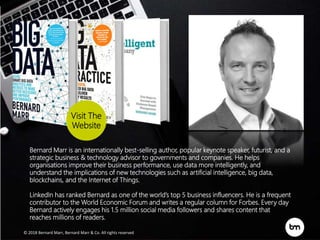
Bernard Marr is an internationally best-selling author, popular keynote speaker, futurist, and a
strategic business & technology advisor to governments and companies. He helps
organisations improve their business performance, use data more intelligently, and
understand the implications of new technologies such as artificial intelligence, big data,
blockchains, and the Internet of Things.
LinkedIn has ranked Bernard as one of the world’s top 5 business influencers. He is a frequent
contributor to the World Economic Forum and writes a regular column for Forbes. Every day
Bernard actively engages his 1.5 million social media followers and shares content that
reaches millions of readers.
Visit The
Website
© 2017 Bernard Marr , Bernard Marr & Co. All rights reserved
© 2018 Bernard Marr, Bernard Marr & Co. All rights reserved
Bernard Marr is an internationally best-selling author, popular keynote speaker, futurist, and a
strategic business & technology advisor to governments and companies. He helps
organisations improve their business performance, use data more intelligently, and
understand the implications of new technologies such as artificial intelligence, big data,
blockchains, and the Internet of Things.
LinkedIn has ranked Bernard as one of the world’s top 5 business influencers. He is a frequent
contributor to the World Economic Forum and writes a regular column for Forbes. Every day
Bernard actively engages his 1.5 million social media followers and shares content that
reaches millions of readers.
Visit The
Website
BernardMarr
hello@bernardmarr.com
www.bernardmarr.com

The Amazing Ways Alibaba Uses Artificial Intelligence And Machine Learning

  • 1.
    The Amazing WaysAlibaba Uses Artificial Intelligence and Machine Learning
  • 2.
    © 2018 BernardMarr, Bernard Marr & Co. All rights reserved Title Text Introduction The Amazing Ways Chinese Tech Giant Alibaba Uses Artificial Intelligence and Machine Learning When you discover the ways Chinese company Alibaba, the world's largest e-commerce marketplace with $248 billion in transactions (more than eBay and Amazon combined), invests in artificial intelligence and machine learning, you realize quickly that the list of what it doesn't impact is much shorter.
  • 3.
    © 2018 BernardMarr, Bernard Marr & Co. All rights reserved Since 1999 when the company was launched in founder Jack Ma's apartment, Alibaba's core business remains to sell goods, but its influence and operations have expanded to make it one of the most valuable tech companies in the world.
  • 4.
    © 2018 BernardMarr, Bernard Marr & Co. All rights reserved One of the reasons Alibaba and other Chinese tech companies such as Tencent and Baidu, collectively known as BAT, are making extraordinary gains in artificial intelligence is the support, investment and commitment of the Chinese government to become the dominant AI player in the world. With plans to build a $1 trillion AI industry by 2030, China is on a path to overtake the United States as the world’s leader in technology. China’s Commitment to AI
  • 5.
    © 2018 BernardMarr, Bernard Marr & Co. All rights reserved Along with an enormous population that generates critical data to inform AI algorithms and help make them better as well as a society who is keen on technological change and not as pushy on regulation, China is fertile ground to develop AI applications, and Alibaba is moving full throttle ahead. In fact, Alibaba invested in seven research labs that will focus on artificial intelligence, machine learning, network security, natural language processing and more.
  • 6.
    © 2018 BernardMarr, Bernard Marr & Co. All rights reserved Singles’ Day, once an anti-Valentine’s Day to celebrate being single has now transformed - thanks to Alibaba and its founder Jack Ma - into the largest e-commerce event in the world. To handle the incredible volume, more than Black Friday and Cyber Monday combined in one day, Alibaba used automation, robots, AI and machine learning throughout the process from guiding shoppers to the products to delivery. Here are few AI applications that were used: Singles’ Day Leverages AI
  • 7.
    © 2018 BernardMarr, Bernard Marr & Co. All rights reserved • Tmall Smart Selection: This AI-powered algorithm backed by deep learning and natural language processing helps recommend products to shoppers and then communicates to the retailers to increase inventory to keep up with the demand. • Dian Xiaomi: This AI-powered chatbot can understand more than 90 percent of customer’s queries according to Alibaba and serves more than 3.5 million users a day. The latest version of the chatbot can understand a customers’ emotion and can prioritise and alert human customer service agents to intervene.
  • 8.
    © 2018 BernardMarr, Bernard Marr & Co. All rights reserved • Robots to pack and drones to deliver. More than 200 robots in automated warehouses can process 1 million shipments each day. Once the robots received the orders on Singles’ Day, they packaged and shipped the goods, and, in some cases, their efficient allowed same-day shipment. Alibaba also used drones for some deliveries. These technological advances that helped power Singles’ Day last year resulted in $25 billion in sales, up from $17.8 billion in sales for Single’s Day 2016 and more than the GDP of Iceland and nearly $20 billion more than Cyber Monday in the U.S.
  • 9.
    © 2018 BernardMarr, Bernard Marr & Co. All rights reserved In addition to turning some physical shops into “smart stores” for Singles’ Day, Alibaba is introducing “digitalization in a box” under its Tmall brand to smaller retailers. Alibaba has redone about 1 million mom-and-pop shops and 100 superstores across China where retailers get all of their goods through Alibaba's platform and use its Alipay app. These efforts allow Alibaba to create self-contained, AI-infused retail models that combine e-commerce and brick-and-mortar into a mixed experience. Turning Physical Shops Into “Smart Stores.”
  • 10.
    © 2018 BernardMarr, Bernard Marr & Co. All rights reserved Alibaba gives retailers a relatively low cost to join and provides the operating systems for stores to go digital. According to the McKinsey Global Institute, 42% of global e- commerce transactions took place in China, more than Japan, France, Germany, the UK and the U.S. combined. Many believe that it will only be those retailers who embrace digitization who will survive, and Alibaba is providing the structure to make it possible.
  • 11.
    © 2018 BernardMarr, Bernard Marr & Co. All rights reserved As China’s largest R&D spender, Alibaba is the largest single investor in SenseTime; an AI start-up known for its facial-recognition technology, that launched an AI lab in Hong Kong. The lab hopes to "advance the frontier of AI" by supporting other start- ups as they commercialize their AI tech and develop ideas and products. Researchers and other industry participants can also collaborate with start-ups in the lab. Alibaba plans to spend $15 billion over three years on DAMO (discovery, adventure, momentum, and outlook) Academy. While AI is the most significant research project for DAMO, it will also have research groups for emerging technologies such as blockchain, computer security, quantum computing and fintech. Investment in SenseTime, DAMO Academt, and Research
  • 12.
    © 2018 BernardMarr, Bernard Marr & Co. All rights reserved With its City Brain project, Alibaba hopes to help cities run their operations by artificial intelligence. Already improving traffic issues, City Brain uses a cloud-based system where data about a city and everyone in it is stored and processed through AI algorithms. The project’s success in reducing traffic jams by 15% was achieved by monitoring every vehicle in the city. Already successful in Hangzhou, City Brain is going to Malaysia next. City Brain: AI Control For Cities
  • 13.
    © 2018 BernardMarr, Bernard Marr & Co. All rights reserved In addition to these examples, Alibaba uses AI to optimize its supply chain, build products and drive personalized recommendations. Ultimately, Alibaba aspires to be the tech giant to provide cloud-based AI which would make AI available to anyone with a computer and internet connection as well as an AI chip available through the cloud.
  • 14.
    © 2018 BernardMarr, Bernard Marr & Co. All rights reserved With all of these applications, it shouldn’t be a surprise that Alibaba’s Cloud Unit recently signed a contract with a Chinese food and ag conglomerate Tequ Group to deploy facial and voice recognition on its pig farms. From traffic to pigs, what will Alibaba use AI and machine learning for next? We can’t wait to find out.
  • 15.
    © 2017 BernardMarr , Bernard Marr & Co. All rights reserved © 2018 Bernard Marr, Bernard Marr & Co. All rights reserved Bernard Marr is an internationally best-selling author, popular keynote speaker, futurist, and a strategic business & technology advisor to governments and companies. He helps organisations improve their business performance, use data more intelligently, and understand the implications of new technologies such as artificial intelligence, big data, blockchains, and the Internet of Things. LinkedIn has ranked Bernard as one of the world’s top 5 business influencers. He is a frequent contributor to the World Economic Forum and writes a regular column for Forbes. Every day Bernard actively engages his 1.5 million social media followers and shares content that reaches millions of readers. Visit The Website © 2017 Bernard Marr , Bernard Marr & Co. All rights reserved © 2018 Bernard Marr, Bernard Marr & Co. All rights reserved Bernard Marr is an internationally best-selling author, popular keynote speaker, futurist, and a strategic business & technology advisor to governments and companies. He helps organisations improve their business performance, use data more intelligently, and understand the implications of new technologies such as artificial intelligence, big data, blockchains, and the Internet of Things. LinkedIn has ranked Bernard as one of the world’s top 5 business influencers. He is a frequent contributor to the World Economic Forum and writes a regular column for Forbes. Every day Bernard actively engages his 1.5 million social media followers and shares content that reaches millions of readers. Visit The Website
  • 16.