Organizational structure 
Presented by: 
Aashish narayan shukla 
Anshu kesharwani 
Shreya gupta 
Satish singh
What is Organisational Structure? 
According to Robbins, “An organisational structure 
defines how job tasks are formally divided, grouped, and 
coordinated”. 
It is the formal arrangement of jobs within an 
organisation.
Why Organisational Structure? 
• It facilitates management 
• It encourages growth and diversification 
• It facilitates the optimum use of technological 
improvement 
• It encourages proper use of human 
• It stimulates creativity
Some Key Terms 
• Authority – The right to make decisions and carry out tasks. 
• Span of control –The number of people a superior is 
responsible for. 
• Hierarchy – shows the line management in the business and 
who has specific responsibilities. 
• Delegation of Authority– Authority to carry out actions passed 
from superior to subordinate. 
• Empowerment – Giving responsibilities to people at all levels 
of the business to make decisions.
Key Terms 
•Departmentalization- jobs are divided into specialized 
parts, and are grouped together. 
•Division of labour-dividing the total task of an 
organisation into successively smaller jobs. 
•Centralisation- 
•Decentralisation-
ELEMENTS 
Functional Departmentalization 
•A method for separating the activities performed within 
an organization into groups differentiated by the 
function they perform. 
President 
Production 
Department 
Marketing 
department 
Finance 
Department Personnel 
department
Product Departmentalization 
It typically groups tasks related to a particular product 
under one senior manager who specializes in that aspect 
of the company’s business. 
Vice-President 
Fuel division Lubricants 
and waxes 
Chemical 
division
Process Deparatmentalization 
In it various manufacturing processes are taken as basis 
for dividing the activities into departments. 
General manager 
Casting 
divisions 
Pressing 
divisions 
Tubing 
divisions 
Finishing 
divisions Packing 
divisions
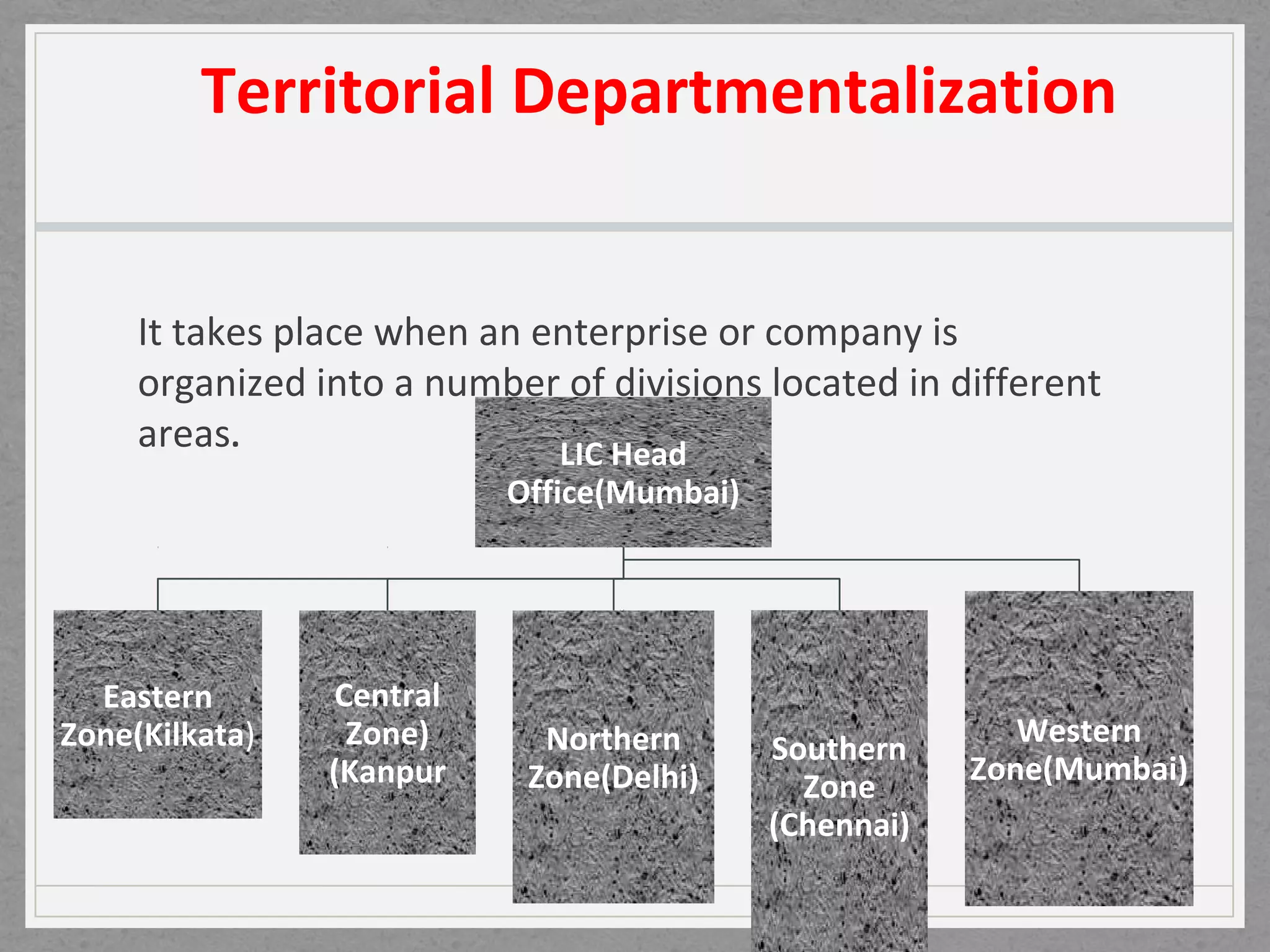
Territorial Departmentalization 
It takes place when an enterprise or company is 
organized into a number of divisions located in different 
areas. LIC Head 
Office(Mumbai) 
Eastern 
Zone(Kilkata) 
Central 
Zone) 
(Kanpur 
Northern 
Zone(Delhi) 
Southern 
Zone 
(Chennai) 
Western 
Zone(Mumbai)
Customer Departmentalization 
• It is used in a particular type of customer the 
organization seeks to cater, provide services to clearly 
identified groups of customer. 
General Manager 
Marketing 
manager 
Wholesale Retail Export
Typology of Structures 
• Functional and divisional structures 
• Vertical and horizontal structure 
• Mechanistic and organic structures 
• The matrix structure
THANK YOU

Organisational structure

  • 1.
    Organizational structure Presentedby: Aashish narayan shukla Anshu kesharwani Shreya gupta Satish singh
  • 2.
    What is OrganisationalStructure? According to Robbins, “An organisational structure defines how job tasks are formally divided, grouped, and coordinated”. It is the formal arrangement of jobs within an organisation.
  • 3.
    Why Organisational Structure? • It facilitates management • It encourages growth and diversification • It facilitates the optimum use of technological improvement • It encourages proper use of human • It stimulates creativity
  • 4.
    Some Key Terms • Authority – The right to make decisions and carry out tasks. • Span of control –The number of people a superior is responsible for. • Hierarchy – shows the line management in the business and who has specific responsibilities. • Delegation of Authority– Authority to carry out actions passed from superior to subordinate. • Empowerment – Giving responsibilities to people at all levels of the business to make decisions.
  • 5.
    Key Terms •Departmentalization-jobs are divided into specialized parts, and are grouped together. •Division of labour-dividing the total task of an organisation into successively smaller jobs. •Centralisation- •Decentralisation-
  • 6.
    ELEMENTS Functional Departmentalization •A method for separating the activities performed within an organization into groups differentiated by the function they perform. President Production Department Marketing department Finance Department Personnel department
  • 7.
    Product Departmentalization Ittypically groups tasks related to a particular product under one senior manager who specializes in that aspect of the company’s business. Vice-President Fuel division Lubricants and waxes Chemical division
  • 8.
    Process Deparatmentalization Init various manufacturing processes are taken as basis for dividing the activities into departments. General manager Casting divisions Pressing divisions Tubing divisions Finishing divisions Packing divisions
  • 9.
    Territorial Departmentalization Ittakes place when an enterprise or company is organized into a number of divisions located in different areas. LIC Head Office(Mumbai) Eastern Zone(Kilkata) Central Zone) (Kanpur Northern Zone(Delhi) Southern Zone (Chennai) Western Zone(Mumbai)
  • 10.
    Customer Departmentalization •It is used in a particular type of customer the organization seeks to cater, provide services to clearly identified groups of customer. General Manager Marketing manager Wholesale Retail Export
  • 11.
    Typology of Structures • Functional and divisional structures • Vertical and horizontal structure • Mechanistic and organic structures • The matrix structure
  • 12.