ORDER
Mathematics Lesson
Order refers the arrangement
or disposition of people or
things in relation to each
other according to a
particular sequence, pattern,
or method. (Oxford, 2024).
Ordinal
Numbers
Ordinal Numbers
An ordinal number is a type
of number that is used to
represent the position or
rank of an object or a
person.
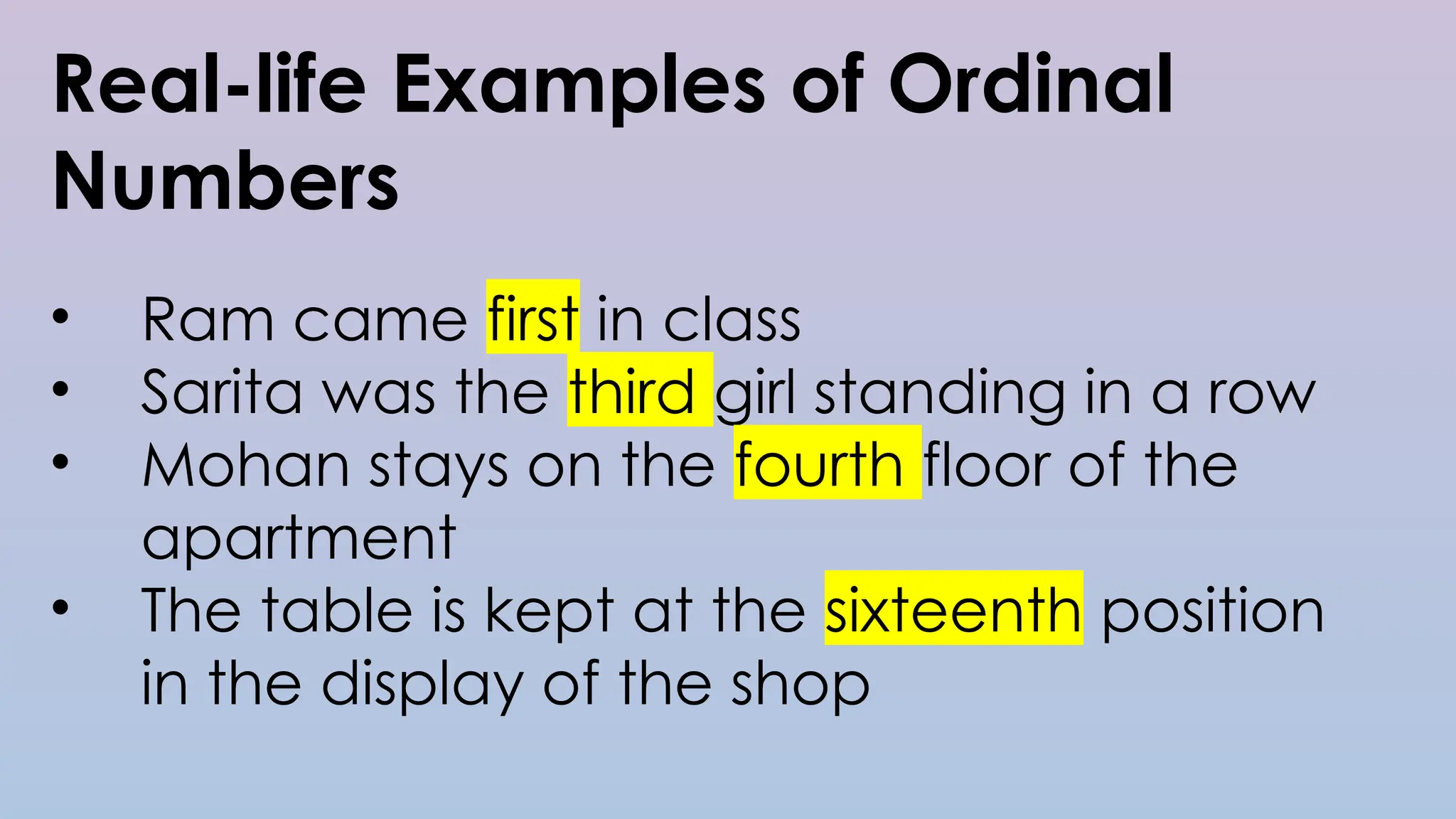
Real-life Examples of Ordinal
Numbers
• Ram came first in class
• Sarita was the third girl standing in a row
• Mohan stays on the fourth floor of the
apartment
• The table is kept at the sixteenth position
in the display of the shop
In these examples, circle (highlight) the ordinal numbers.
Real-life Examples of Ordinal
Numbers
• Ram came first in class
• Sarita was the third girl standing in a row
• Mohan stays on the fourth floor of the
apartment
• The table is kept at the sixteenth position
in the display of the shop
Ordinal
Numbers
From 1 to
50
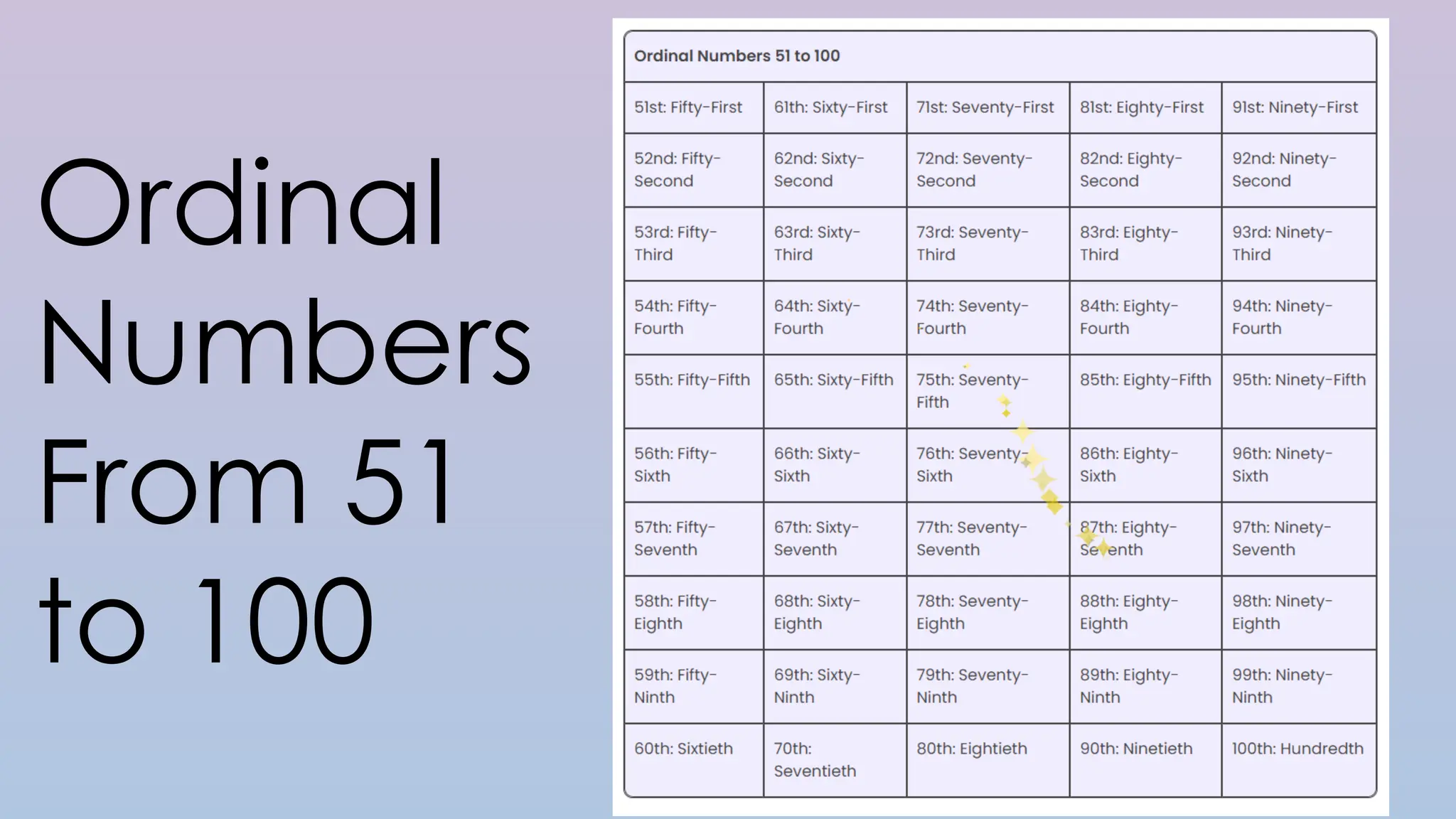
Ordinal
Numbers
From 51
to 100
Don’t worry!
We have a way to
familiarize ourselves with
these ordinal numbers
faster.
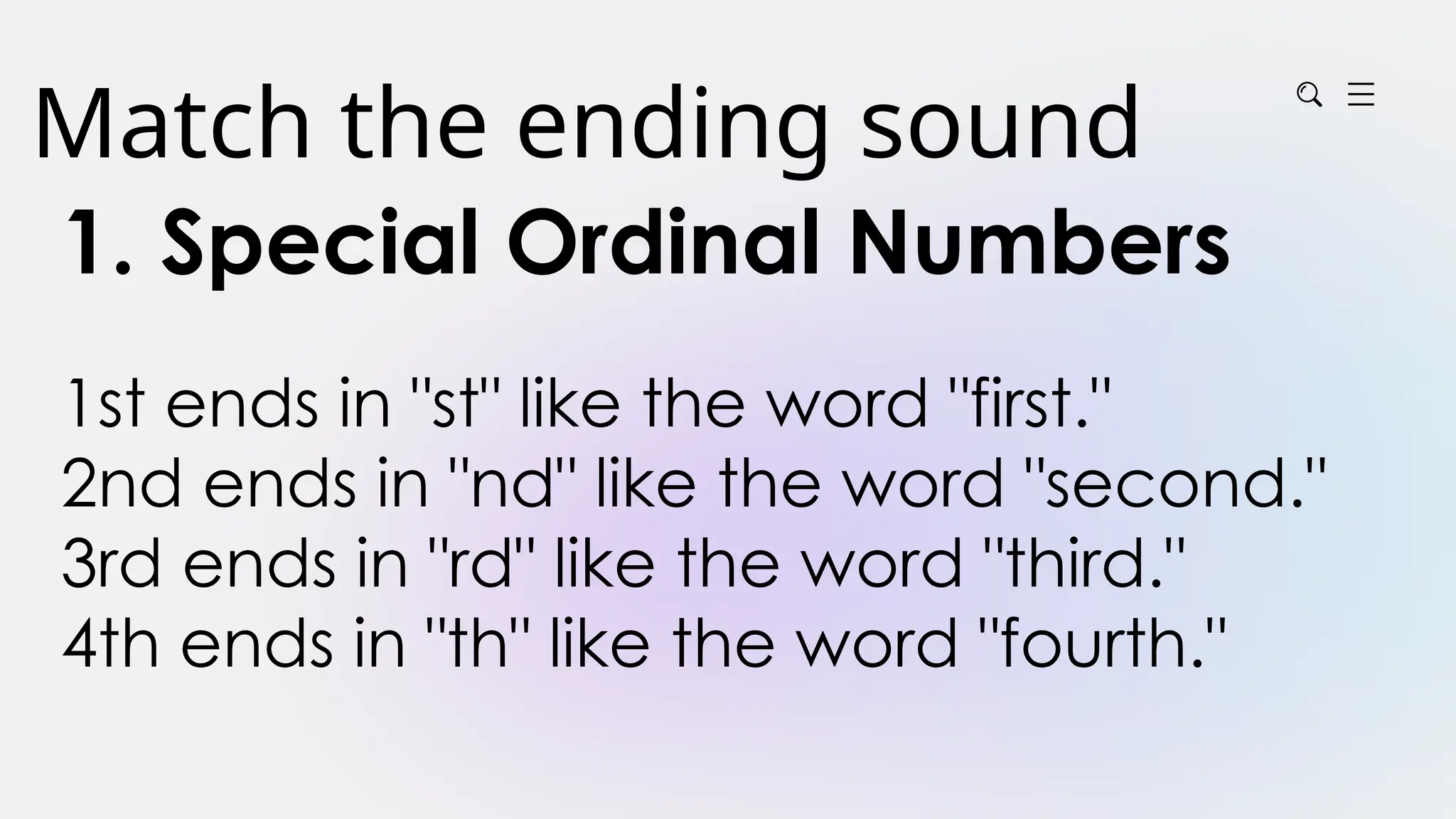
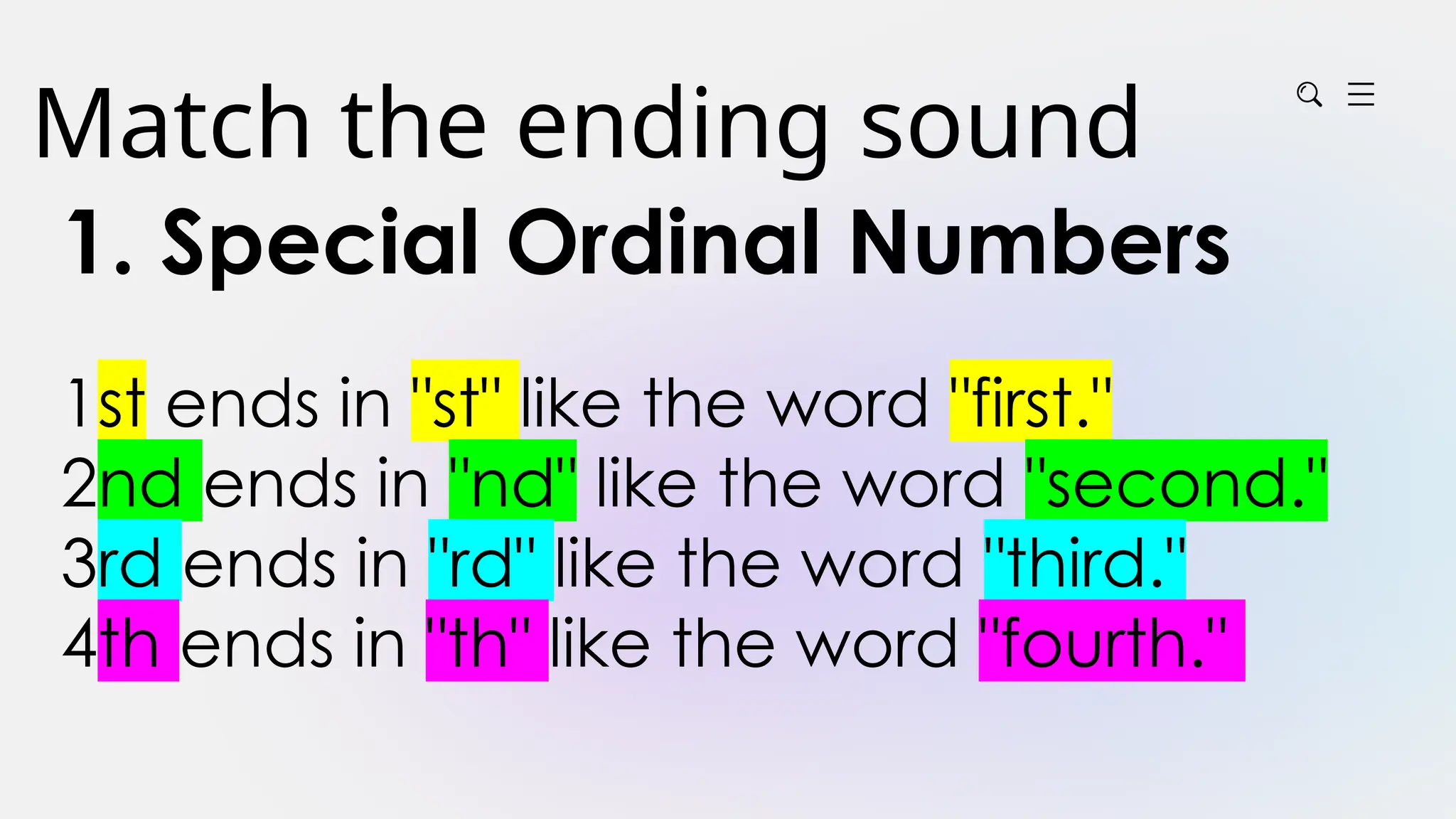
Match the ending sound
1. Special Ordinal Numbers
1st ends in "st" like the word "first."
2nd ends in "nd" like the word "second."
3rd ends in "rd" like the word "third."
4th ends in "th" like the word "fourth."
Match the ending sound
1. Special Ordinal Numbers
1st ends in "st" like the word "first."
2nd ends in "nd" like the word "second."
3rd ends in "rd" like the word "third."
4th ends in "th" like the word "fourth."
Match the ending sound
2. For numbers 5th to 20th - All
of these end in th" (like "fifth"
and "twentieth") ".
Ordinal numbers that end with a “5”
typically have “fifth” in them.
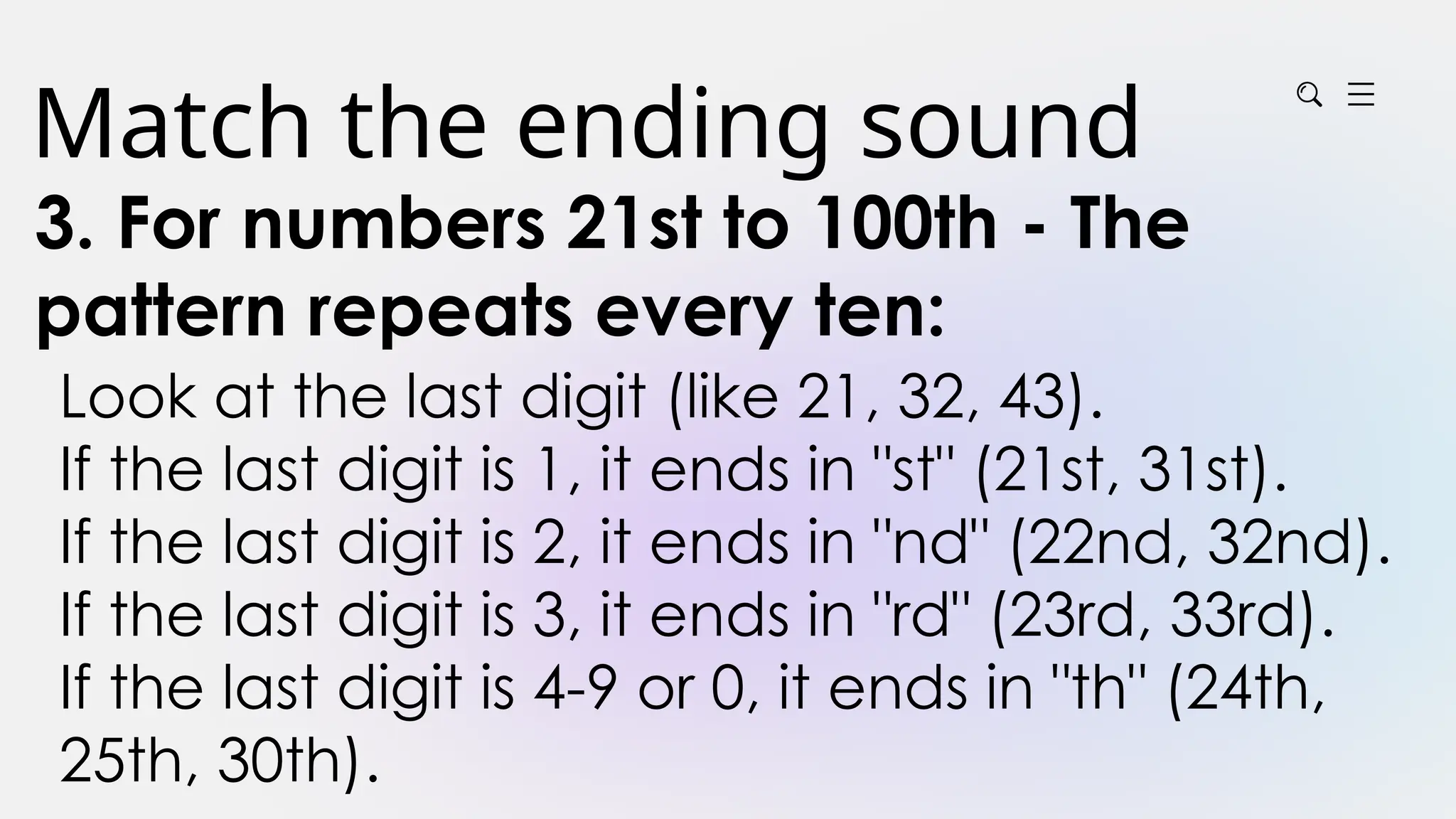
Match the ending sound
3. For numbers 21st to 100th - The
pattern repeats every ten:
Look at the last digit (like 21, 32, 43).
If the last digit is 1, it ends in "st" (21st, 31st).
If the last digit is 2, it ends in "nd" (22nd, 32nd).
If the last digit is 3, it ends in "rd" (23rd, 33rd).
If the last digit is 4-9 or 0, it ends in "th" (24th,
25th, 30th).
Match the ending sound
In addition, numbers that ends
with a 0 (aside from 10) like 20, 30,
40, etc. have the “ieth” ending in
their ordinal forms.
“Twenty” becomes “twentieth”
not “twentyth”
Match the ending sound
In addition, numbers that ends
with a 0 (aside from 10) like 20, 30,
40, etc. have the “ieth” ending in
their ordinal forms.
“Twenty” becomes “twentieth”
not “twentyth”
LET’s TRY!
Difference Between Cardinal,
Nominal and Ordinal Numbers
Apart from ordinal numbers, the
other two types of numbers,
which are used to represent
objects or people are:
• Cardinal Numbers
• Nominal Numbers
Cardinal Numbers
The counting numbers which are
used to represent the number of
objects or people are called
Cardinal numbers. They are: One,
Two, Three, Four, Five, Six, Seven,
Eight, Nine, Ten and so on.
Cardinal Numbers
Example:
There are eight men
standing in a row.
The basket contains ten
apples.
Cardinal Numbers
Example:
There are eight men
standing in a row.
The basket contains ten
apples.
Nominal Numbers
The numbers which are applied to
name the objects in a group, are
called nominal numbers. Using
these numbers, it is easy to
identify objects or a thing in a
collection of things.
Nominal Numbers
Example:
Vehicles numbers like KA 05
1220, etc.
Pin codes of different cities
Player number in a match
Nominal Numbers
Example:
Vehicles numbers like KA 05
1220, etc.
Pin codes of different cities
Player number in a match
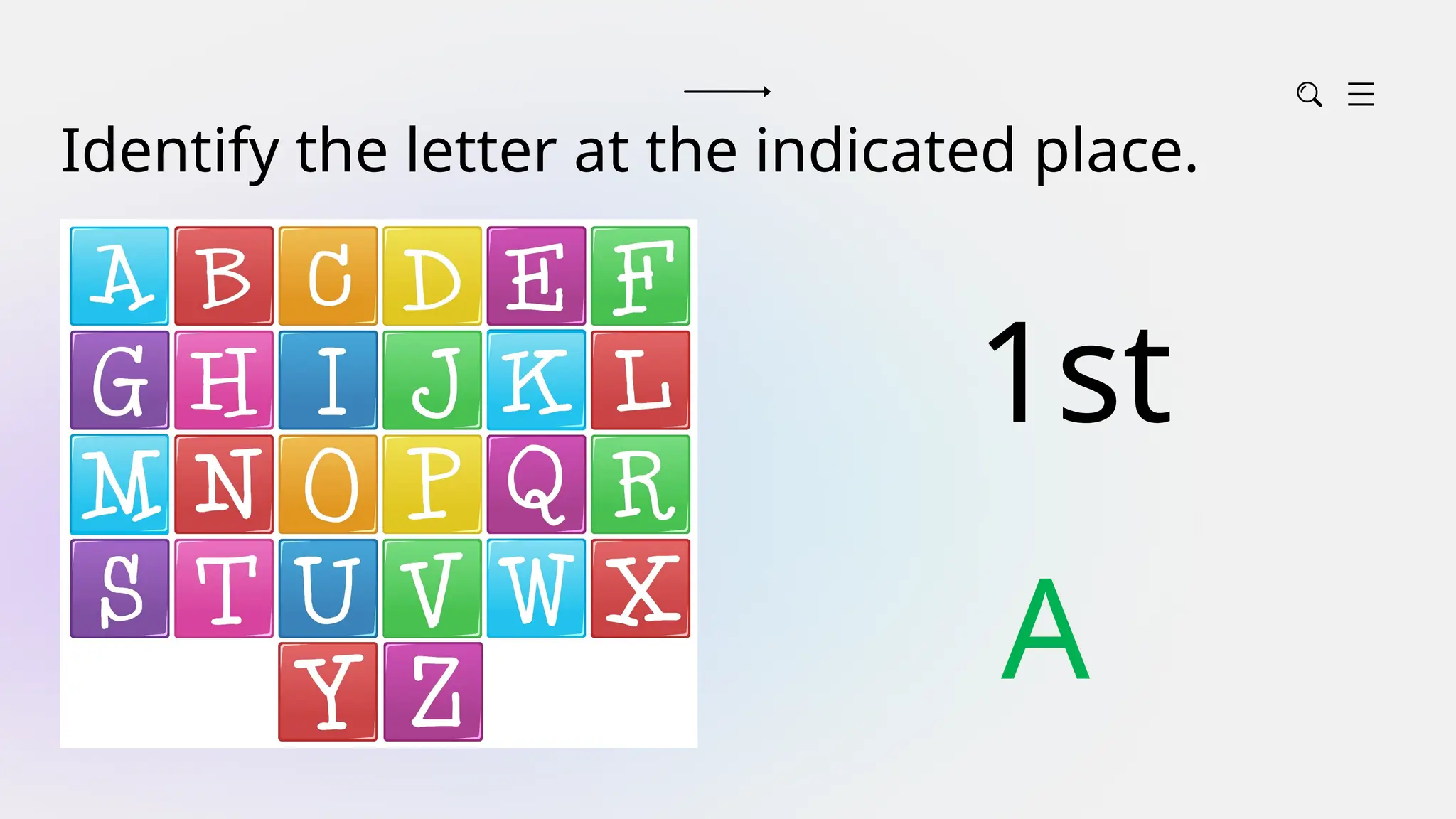
Identify the letter at the indicated place.
1st
A
Identify the letter at the indicated place.
4th
D
Identify the letter at the indicated place.
8th
H
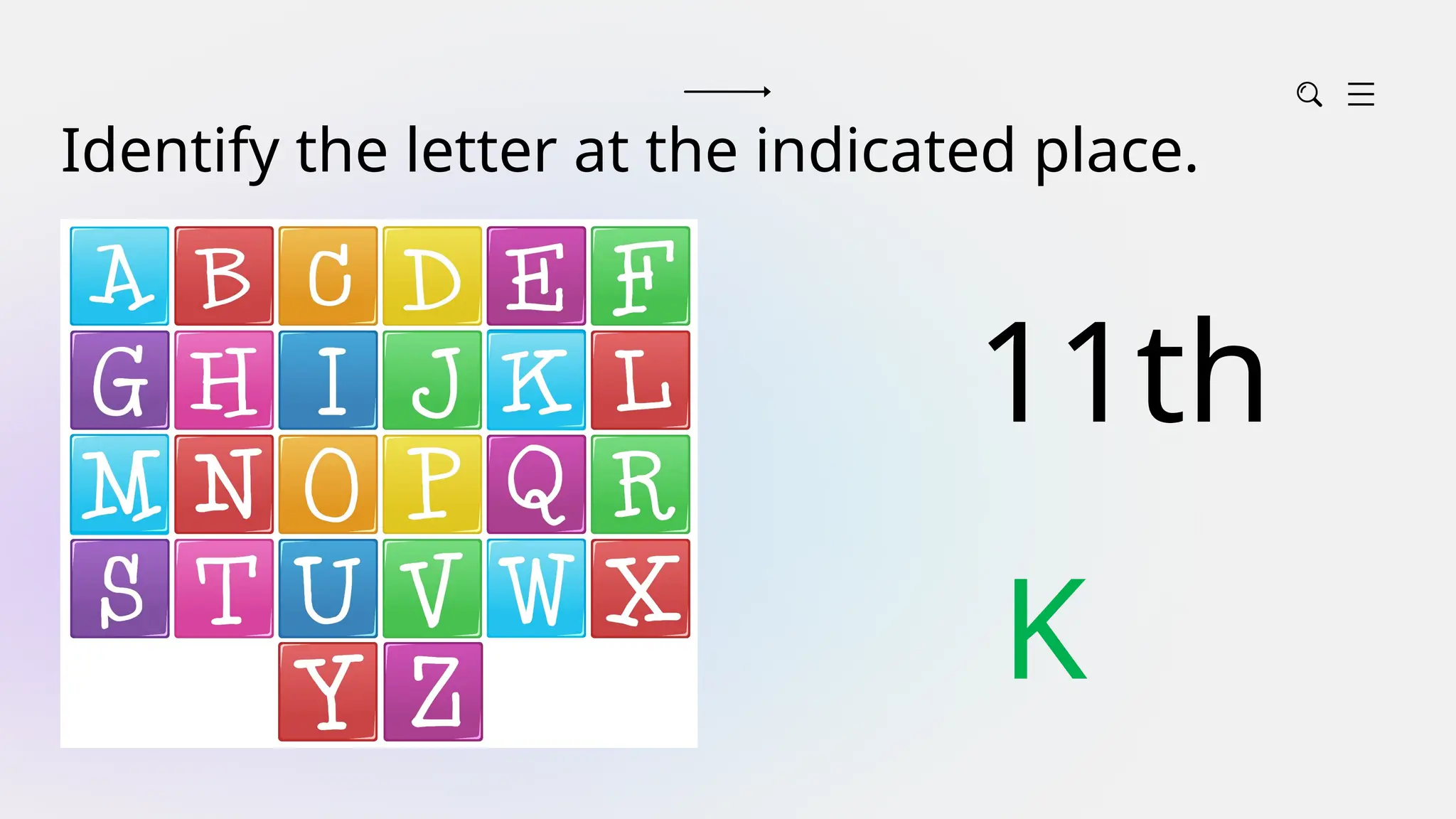
Identify the letter at the indicated place.
11th
K
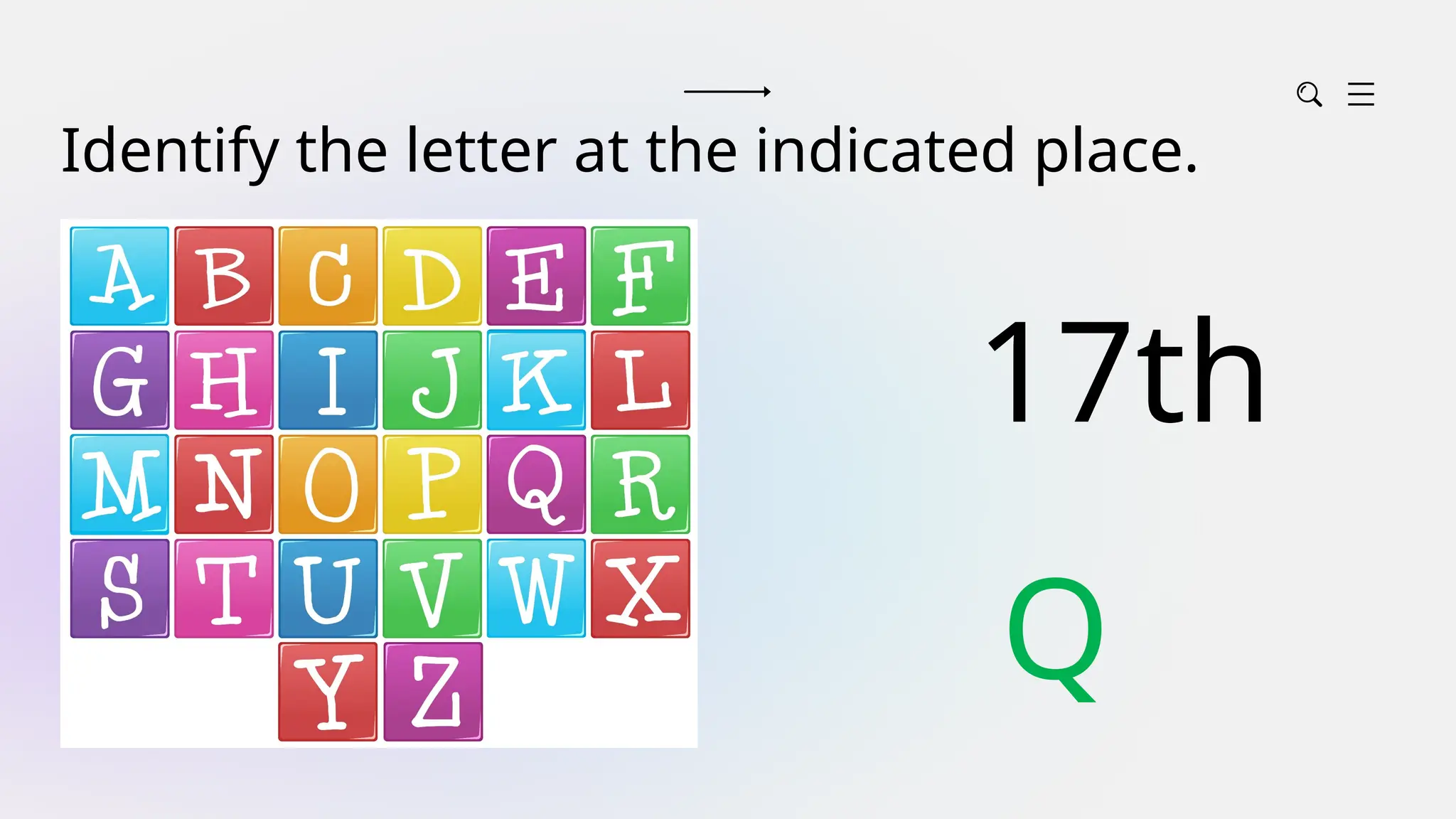
Identify the letter at the indicated place.
17th
Q
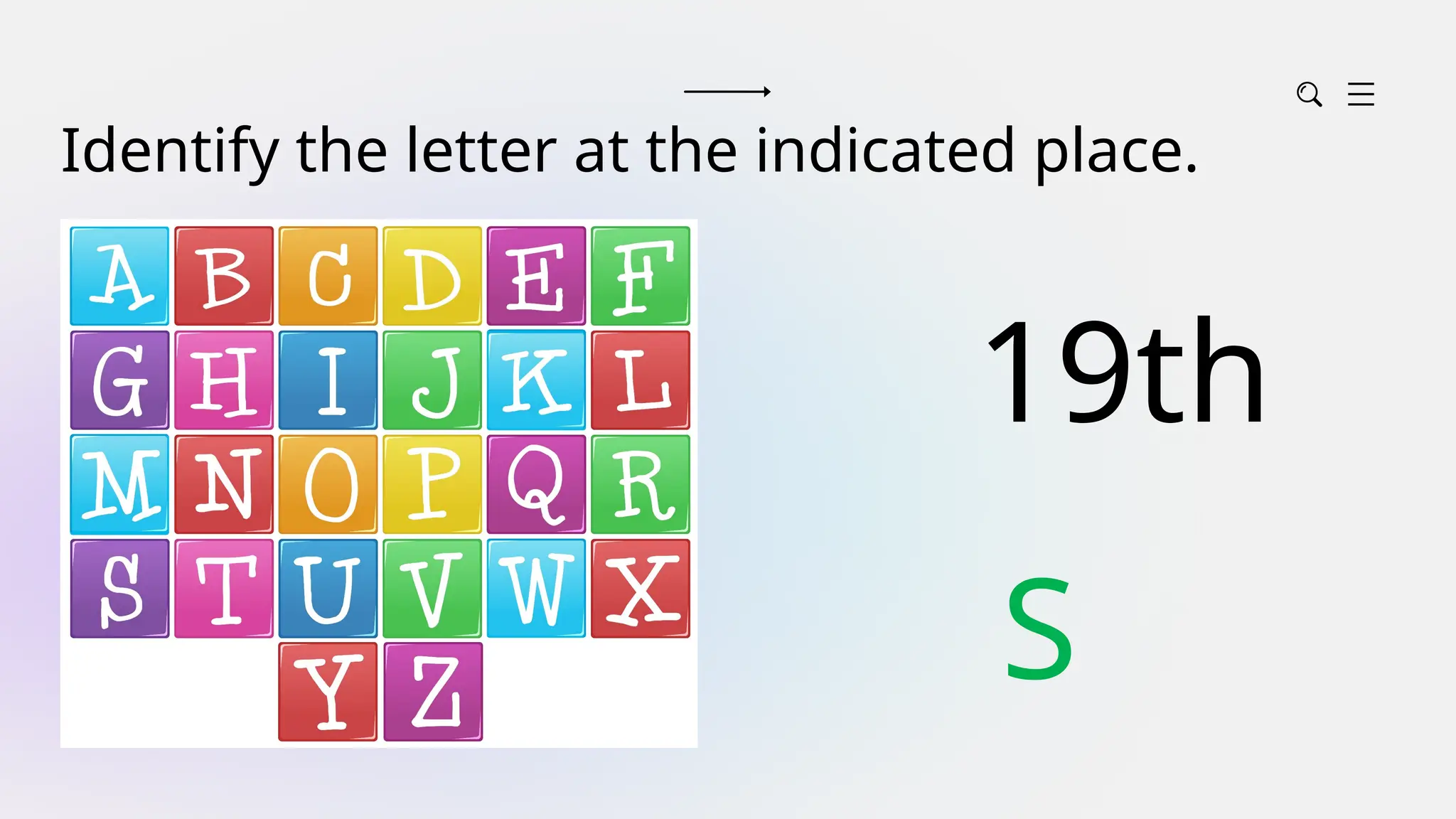
Identify the letter at the indicated place.
19th
S
Identify the letter at the indicated place.
20th
T
Identify the letter at the indicated place.
21st
U
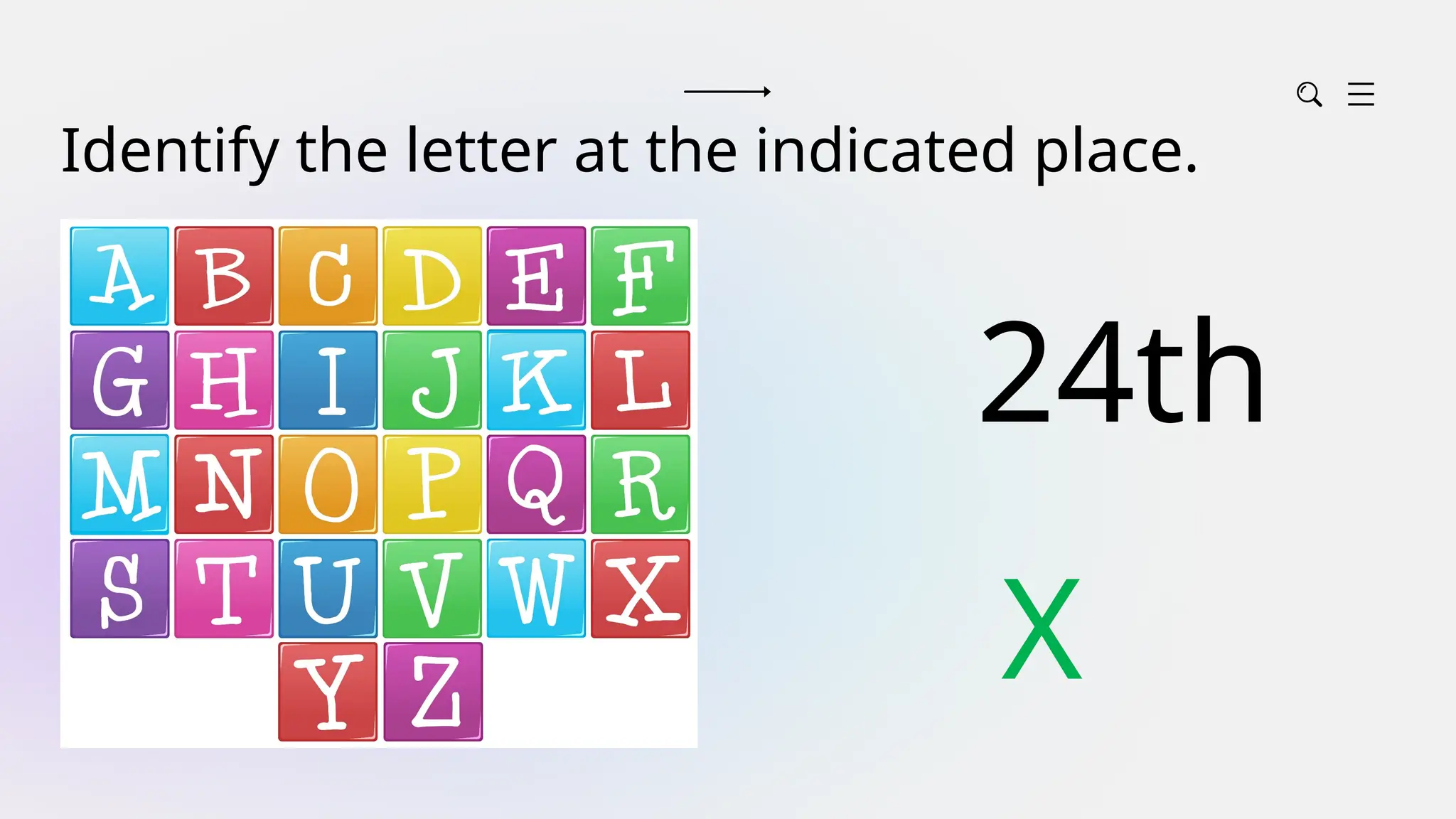
Identify the letter at the indicated place.
24th
X
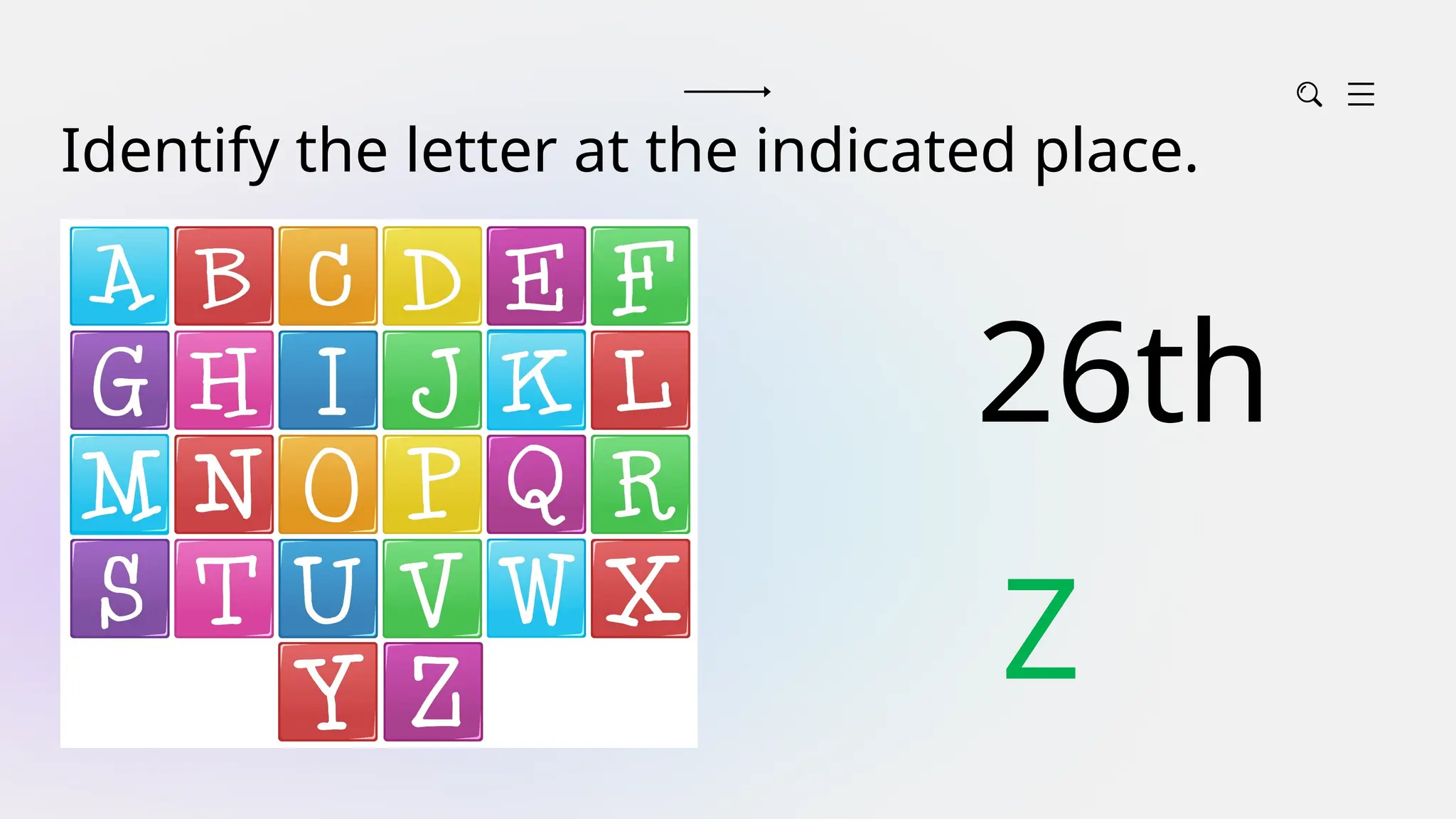
Identify the letter at the indicated place.
26th
Z
Pages 38-39
LET’s TRY! Part 2

Ordinal Numbers for grade three students

  • 1.
  • 2.
    Order refers thearrangement or disposition of people or things in relation to each other according to a particular sequence, pattern, or method. (Oxford, 2024).
  • 3.
  • 4.
    Ordinal Numbers An ordinalnumber is a type of number that is used to represent the position or rank of an object or a person.
  • 5.
    Real-life Examples ofOrdinal Numbers • Ram came first in class • Sarita was the third girl standing in a row • Mohan stays on the fourth floor of the apartment • The table is kept at the sixteenth position in the display of the shop In these examples, circle (highlight) the ordinal numbers.
  • 6.
    Real-life Examples ofOrdinal Numbers • Ram came first in class • Sarita was the third girl standing in a row • Mohan stays on the fourth floor of the apartment • The table is kept at the sixteenth position in the display of the shop
  • 7.
  • 8.
  • 9.
    Don’t worry! We havea way to familiarize ourselves with these ordinal numbers faster.
  • 10.
    Match the endingsound 1. Special Ordinal Numbers 1st ends in "st" like the word "first." 2nd ends in "nd" like the word "second." 3rd ends in "rd" like the word "third." 4th ends in "th" like the word "fourth."
  • 11.
    Match the endingsound 1. Special Ordinal Numbers 1st ends in "st" like the word "first." 2nd ends in "nd" like the word "second." 3rd ends in "rd" like the word "third." 4th ends in "th" like the word "fourth."
  • 12.
    Match the endingsound 2. For numbers 5th to 20th - All of these end in th" (like "fifth" and "twentieth") ". Ordinal numbers that end with a “5” typically have “fifth” in them.
  • 13.
    Match the endingsound 3. For numbers 21st to 100th - The pattern repeats every ten: Look at the last digit (like 21, 32, 43). If the last digit is 1, it ends in "st" (21st, 31st). If the last digit is 2, it ends in "nd" (22nd, 32nd). If the last digit is 3, it ends in "rd" (23rd, 33rd). If the last digit is 4-9 or 0, it ends in "th" (24th, 25th, 30th).
  • 14.
    Match the endingsound In addition, numbers that ends with a 0 (aside from 10) like 20, 30, 40, etc. have the “ieth” ending in their ordinal forms. “Twenty” becomes “twentieth” not “twentyth”
  • 15.
    Match the endingsound In addition, numbers that ends with a 0 (aside from 10) like 20, 30, 40, etc. have the “ieth” ending in their ordinal forms. “Twenty” becomes “twentieth” not “twentyth”
  • 16.
  • 17.
    Difference Between Cardinal, Nominaland Ordinal Numbers Apart from ordinal numbers, the other two types of numbers, which are used to represent objects or people are: • Cardinal Numbers • Nominal Numbers
  • 18.
    Cardinal Numbers The countingnumbers which are used to represent the number of objects or people are called Cardinal numbers. They are: One, Two, Three, Four, Five, Six, Seven, Eight, Nine, Ten and so on.
  • 19.
    Cardinal Numbers Example: There areeight men standing in a row. The basket contains ten apples.
  • 20.
    Cardinal Numbers Example: There areeight men standing in a row. The basket contains ten apples.
  • 21.
    Nominal Numbers The numberswhich are applied to name the objects in a group, are called nominal numbers. Using these numbers, it is easy to identify objects or a thing in a collection of things.
  • 22.
    Nominal Numbers Example: Vehicles numberslike KA 05 1220, etc. Pin codes of different cities Player number in a match
  • 23.
    Nominal Numbers Example: Vehicles numberslike KA 05 1220, etc. Pin codes of different cities Player number in a match
  • 24.
    Identify the letterat the indicated place. 1st A
  • 25.
    Identify the letterat the indicated place. 4th D
  • 26.
    Identify the letterat the indicated place. 8th H
  • 27.
    Identify the letterat the indicated place. 11th K
  • 28.
    Identify the letterat the indicated place. 17th Q
  • 29.
    Identify the letterat the indicated place. 19th S
  • 30.
    Identify the letterat the indicated place. 20th T
  • 31.
    Identify the letterat the indicated place. 21st U
  • 32.
    Identify the letterat the indicated place. 24th X
  • 33.
    Identify the letterat the indicated place. 26th Z
  • 34.
  • 35.