DEVELOPER’S FORUM
JUNE 17, 2016
INTRODUCTION
Today’s Agenda
• Why the Orange Code?
• Scope of the current effort
• Survey results & Discussion
• Approach to the Orange Code
• Invitation for further participation
BACKGROUND
Why the Orange Code?
Streamlining Initiative
• Process Improvements
• Address the “unwritten rules”
• Clearer code requiring less interpretation
• Reconcile the Comprehensive Plan and the Code
• Empower staff to make decisions that expedite
the process
BACKGROUND
Streamlining Initiative
• Correct redundancies and contradictions within
the code that muddy interpretations
• Allow for flexibility and creativity
• Create a code that enables redevelopment
• Target specific areas for infill/redevelopment
BACKGROUND
Sustainability Plan
• Development that is:
• Context-sensitive
• Walkable & Bike-able
• Infill & Redevelopment
• Transit Oriented
• Transit Ready
• Complete Streets
• Shared Parking
• Historic Preservation
BACKGROUND
Scope of the current effort?
• Year 1
• Background Research
• The Existing Code
• Peer Jurisdictions & Innovative Practices
• The Physical Context
• Public Engagement
• Implement Pilot Codes
• Years 2-3
• County-wide applications
The Existing Code
Assess the existing Land
Development Code
High level of bureaucratic
complexity
Low level of built complexity
BACKGROUND RESEARCH
Physical Context
Evaluate the County’s
physical context
Six Market Areas with
different conditions
and different trends
BACKGROUND RESEARCH
NORTHWEST
SOUTHWEST SOUTH
RURAL EAST
EASTCORE
Peer Jurisdiction Codes
• Envision Utah
• Beaufort County
• Dona Ana County
Public Engagement
• OrangeCodeFL.com
• Stakeholder Interviews
• Developers’ Forums
• Multiple Public workshops
• Expert Panels
• Staff workshops
SCOPE OF THE EFFORT
Pilot Codes
• I-Drive Vision and Code
(staff-led)
• TOD Module
• Greenfield Module
SCOPE OF THE EFFORT
County-wide Recommendations
• Initial Approach (Year 1)
• Comprehensive Proposals (Year 2-3)
SCOPE OF THE EFFORT
SURVEY RESULTS
SURVEY RESULTS
Process
• “The Code is predictable, the process is not”
• “The code is interpreted differently between the Planning and the
Zoning Department”
• “Almost everything is subjective!”
• “Lack of predictability leads to increased risk”
• “Overlap of different Codes” need improvement
SURVEY RESULTS
Planned Developments
• “Now every project is a PD. Straight zoning is really a thing of
the past.”
• “The PD process is cumbersome”
• “The PD process adds significant time to a project with
limited flexibility/innovation due to the requirement to acquire
waivers for anything that does not adhere to the land
development code.”
SURVEY RESULTS
Gaps in the Standard categories
• PD “is the only way forward given the limitations of straight zoning.
[You] can’t do a 50' wide lot without a PD.”
• “See what are the most waivers granted with all the PDs” as a good
indication of what is missing in the regular zoning categories
• Identify “differing standards and processes for mixed use vs. regular
subdivisions”
SURVEY RESULTS
Barriers to Infill & Mixed Use
• “Create true mixed use standards built around development form - move
away from land use”
• Existing standards are “too simplistic to allow urban development ”
• “The concurrency system is completely antiquated in urban areas of the
County and this retards infill”
• “PD buffers do not make much sense with an urban infill project.”
• “All of this needs to be looked at in an Urban context rather than
Suburban”
SURVEY RESULTS
DISCUSSION
Approach to the
Orange Code
Approach
• Goals
• Streamlining Objectives
• Sustainability Objectives
• Technical Approach
• Market Areas
• Sector Analysis
• Place Types
• Form-Based Coding as a tool
• Geographic tools
• The Modules
Streamlining
• Reduce complexity (overlays, overlapping standards, exceptions)
• Eliminate redundancies and inconsistencies
• Reformat for readability and navigability
• Use graphics to provide clarity
• Review approval processes for streamlining opportunities
Result: Increased efficiency and predictability for all
APPROACH TO THE ORANGE CODE
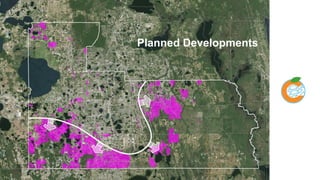
Planned Developments
Sustainability
• Coding for character rather than narrow uses
• Great streets and connected mobility networks
• Selective densification and mixing of uses
• Greening streets and neighborhoods with canopy shade trees
• Reduced areas of grass to water and mow
Result: Lifestyle and mobility options
APPROACH TO THE ORANGE CODE
Would you walk here?
APPROACH TO THE ORANGE CODE
Would you walk here?
APPROACH TO THE ORANGE CODE
Level of Change
APPROACH TO THE ORANGE CODE
Very
High
Ch 38: Zoning
High
Ch 30:
Planning and
Development
Ch 34:
Subdivision
Regulations
Medium
Ch 24:
Landscaping,
Buffering &
Open Space
Ch 31.5: Signs
Low
Ch 19:
Floodplain
Management
Market Areas
Would a context-based
approach be simpler?
Would a context-based
approach get better
results?
APPROACH TO THE ORANGE CODE
NORTHWEST
SOUTHWEST SOUTH
RURAL EAST
EASTCORE
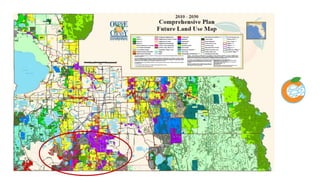
Orange County Future Land Use Map
• APPROACH TO THE ORANGE CODE
Zoning Map
Orange County Future Land Use Map
• APPROACH TO THE ORANGE CODE
Sector Planning
• Big picture of where and
how to grow
APPROACH TO THE ORANGE CODE
DONA ANA
Orange County Sector Analysis
• PO - Preserved Open space sector
• Existing preserved
• RO - Reserved Open space sector
• Desirable for conservation
• CG/RG – Controlled/Restricted Growth sector
• Rural / agricultural land in near or long term
Rural
Sectors
(Generally
outside
the USA)
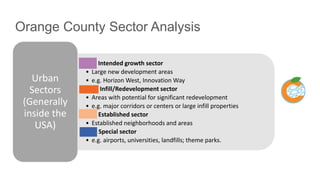
Orange County Sector Analysis
• IG - Intended growth sector
• Large new development areas
• e.g. Horizon West, Innovation Way
• I/R – Infill/Redevelopment sector
• Areas with potential for significant redevelopment
• e.g. major corridors or centers or large infill properties
• ES – Established sector
• Established neighborhoods and areas
• SP – Special sector
• e.g. airports, universities, landfills; theme parks.
Urban
Sectors
(Generally
inside the
USA)
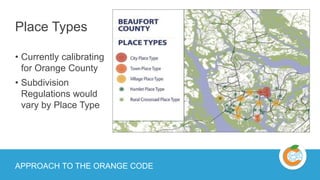
Place Types
• Currently calibrating
for Orange County
• Subdivision
Regulations would
vary by Place Type
APPROACH TO THE ORANGE CODE
Place Types in Utah
APPROACH TO THE ORANGE CODE
The Rural to Urban Transect
How Character Coding Simplifies
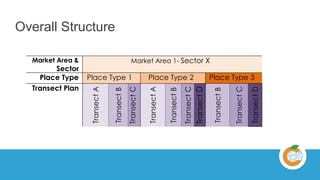
Overall Structure
Market Area &
Sector
Market Area 1- Sector X
Place Type Place Type 1 Place Type 2 Place Type 3
Transect Plan
TransectA
TransectB
TransectC
TransectA
TransectB
TransectC
TransectD
TransectB
TransectC
TransectD
Miami 21
Before
&
After
Auto Sales
Regulating form allows flexibility in uses
Before
After
• The 700-acre West
Plan Beach Plan
revitalization produced
coherent development
with targeted
interventions attentive
to the local tradition.
• The plan reinforced the
identity of each
neighborhood while
balancing the needs of
vehicles and
pedestrians on
downtown streets.
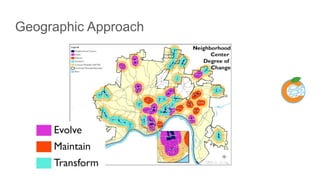
Geographic Approach
Preliminary Geographic Approach
• GROW
• E.g. Innovation Way
• County or Developer Initiated Place
Types
• Developer-Initiated Transect Plan
• TRANSFORM
• E.g. I-Drive
• County or Consortium Initiated
Transect Plan
• EVOLVE
• E.g. Pine Hills
• County Transect Plan
• MAINTAIN
• E.g. Hunter’s Creek
The Modules
The Modules
• TOD Module
• Greenfield Module
The Orange Code Goals
• Promote sustainable growth
• Regulatory flexibility and streamlined process
• Adaptable to meet specific community needs
• Encourage diverse housing options
• Create attractive, valuable places
DISCUSSION

Orange County Developer's Forum - Orange Code

  • 1.
  • 2.
  • 3.
    Today’s Agenda • Whythe Orange Code? • Scope of the current effort • Survey results & Discussion • Approach to the Orange Code • Invitation for further participation
  • 4.
  • 5.
  • 6.
    Streamlining Initiative • ProcessImprovements • Address the “unwritten rules” • Clearer code requiring less interpretation • Reconcile the Comprehensive Plan and the Code • Empower staff to make decisions that expedite the process BACKGROUND
  • 7.
    Streamlining Initiative • Correctredundancies and contradictions within the code that muddy interpretations • Allow for flexibility and creativity • Create a code that enables redevelopment • Target specific areas for infill/redevelopment BACKGROUND
  • 8.
    Sustainability Plan • Developmentthat is: • Context-sensitive • Walkable & Bike-able • Infill & Redevelopment • Transit Oriented • Transit Ready • Complete Streets • Shared Parking • Historic Preservation BACKGROUND
  • 9.
    Scope of thecurrent effort? • Year 1 • Background Research • The Existing Code • Peer Jurisdictions & Innovative Practices • The Physical Context • Public Engagement • Implement Pilot Codes • Years 2-3 • County-wide applications
  • 10.
    The Existing Code Assessthe existing Land Development Code High level of bureaucratic complexity Low level of built complexity BACKGROUND RESEARCH
  • 11.
    Physical Context Evaluate theCounty’s physical context Six Market Areas with different conditions and different trends BACKGROUND RESEARCH NORTHWEST SOUTHWEST SOUTH RURAL EAST EASTCORE
  • 12.
    Peer Jurisdiction Codes •Envision Utah • Beaufort County • Dona Ana County
  • 13.
    Public Engagement • OrangeCodeFL.com •Stakeholder Interviews • Developers’ Forums • Multiple Public workshops • Expert Panels • Staff workshops SCOPE OF THE EFFORT
  • 14.
    Pilot Codes • I-DriveVision and Code (staff-led) • TOD Module • Greenfield Module SCOPE OF THE EFFORT
  • 15.
    County-wide Recommendations • InitialApproach (Year 1) • Comprehensive Proposals (Year 2-3) SCOPE OF THE EFFORT
  • 16.
  • 17.
  • 18.
    Process • “The Codeis predictable, the process is not” • “The code is interpreted differently between the Planning and the Zoning Department” • “Almost everything is subjective!” • “Lack of predictability leads to increased risk” • “Overlap of different Codes” need improvement SURVEY RESULTS
  • 19.
    Planned Developments • “Nowevery project is a PD. Straight zoning is really a thing of the past.” • “The PD process is cumbersome” • “The PD process adds significant time to a project with limited flexibility/innovation due to the requirement to acquire waivers for anything that does not adhere to the land development code.” SURVEY RESULTS
  • 20.
    Gaps in theStandard categories • PD “is the only way forward given the limitations of straight zoning. [You] can’t do a 50' wide lot without a PD.” • “See what are the most waivers granted with all the PDs” as a good indication of what is missing in the regular zoning categories • Identify “differing standards and processes for mixed use vs. regular subdivisions” SURVEY RESULTS
  • 21.
    Barriers to Infill& Mixed Use • “Create true mixed use standards built around development form - move away from land use” • Existing standards are “too simplistic to allow urban development ” • “The concurrency system is completely antiquated in urban areas of the County and this retards infill” • “PD buffers do not make much sense with an urban infill project.” • “All of this needs to be looked at in an Urban context rather than Suburban” SURVEY RESULTS
  • 22.
  • 23.
  • 24.
    Approach • Goals • StreamliningObjectives • Sustainability Objectives • Technical Approach • Market Areas • Sector Analysis • Place Types • Form-Based Coding as a tool • Geographic tools • The Modules
  • 25.
    Streamlining • Reduce complexity(overlays, overlapping standards, exceptions) • Eliminate redundancies and inconsistencies • Reformat for readability and navigability • Use graphics to provide clarity • Review approval processes for streamlining opportunities Result: Increased efficiency and predictability for all APPROACH TO THE ORANGE CODE
  • 26.
  • 27.
    Sustainability • Coding forcharacter rather than narrow uses • Great streets and connected mobility networks • Selective densification and mixing of uses • Greening streets and neighborhoods with canopy shade trees • Reduced areas of grass to water and mow Result: Lifestyle and mobility options APPROACH TO THE ORANGE CODE
  • 28.
    Would you walkhere? APPROACH TO THE ORANGE CODE
  • 29.
    Would you walkhere? APPROACH TO THE ORANGE CODE
  • 30.
    Level of Change APPROACHTO THE ORANGE CODE Very High Ch 38: Zoning High Ch 30: Planning and Development Ch 34: Subdivision Regulations Medium Ch 24: Landscaping, Buffering & Open Space Ch 31.5: Signs Low Ch 19: Floodplain Management
  • 31.
    Market Areas Would acontext-based approach be simpler? Would a context-based approach get better results? APPROACH TO THE ORANGE CODE NORTHWEST SOUTHWEST SOUTH RURAL EAST EASTCORE
  • 33.
    Orange County FutureLand Use Map • APPROACH TO THE ORANGE CODE
  • 34.
  • 35.
    Orange County FutureLand Use Map • APPROACH TO THE ORANGE CODE
  • 36.
    Sector Planning • Bigpicture of where and how to grow APPROACH TO THE ORANGE CODE DONA ANA
  • 37.
    Orange County SectorAnalysis • PO - Preserved Open space sector • Existing preserved • RO - Reserved Open space sector • Desirable for conservation • CG/RG – Controlled/Restricted Growth sector • Rural / agricultural land in near or long term Rural Sectors (Generally outside the USA)
  • 38.
    Orange County SectorAnalysis • IG - Intended growth sector • Large new development areas • e.g. Horizon West, Innovation Way • I/R – Infill/Redevelopment sector • Areas with potential for significant redevelopment • e.g. major corridors or centers or large infill properties • ES – Established sector • Established neighborhoods and areas • SP – Special sector • e.g. airports, universities, landfills; theme parks. Urban Sectors (Generally inside the USA)
  • 39.
    Place Types • Currentlycalibrating for Orange County • Subdivision Regulations would vary by Place Type APPROACH TO THE ORANGE CODE
  • 40.
    Place Types inUtah APPROACH TO THE ORANGE CODE
  • 41.
    The Rural toUrban Transect
  • 42.
  • 43.
    Overall Structure Market Area& Sector Market Area 1- Sector X Place Type Place Type 1 Place Type 2 Place Type 3 Transect Plan TransectA TransectB TransectC TransectA TransectB TransectC TransectD TransectB TransectC TransectD
  • 44.
  • 45.
    Auto Sales Regulating formallows flexibility in uses
  • 46.
  • 48.
    • The 700-acreWest Plan Beach Plan revitalization produced coherent development with targeted interventions attentive to the local tradition. • The plan reinforced the identity of each neighborhood while balancing the needs of vehicles and pedestrians on downtown streets.
  • 49.
  • 50.
    Preliminary Geographic Approach •GROW • E.g. Innovation Way • County or Developer Initiated Place Types • Developer-Initiated Transect Plan • TRANSFORM • E.g. I-Drive • County or Consortium Initiated Transect Plan • EVOLVE • E.g. Pine Hills • County Transect Plan • MAINTAIN • E.g. Hunter’s Creek
  • 51.
  • 52.
    The Modules • TODModule • Greenfield Module
  • 53.
    The Orange CodeGoals • Promote sustainable growth • Regulatory flexibility and streamlined process • Adaptable to meet specific community needs • Encourage diverse housing options • Create attractive, valuable places
  • 54.