Oracle SOA Suite 12c
Introduction to SOA
1Z0-434: Day I
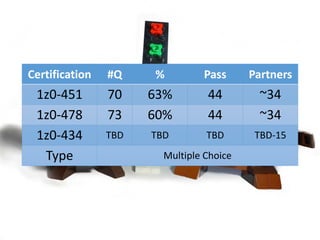
Certification #Q % Pass Partners
1z0-451 70 63% 44 ~34
1z0-478 73 60% 44 ~34
1z0-434 TBD TBD TBD TBD-15
Type Multiple Choice
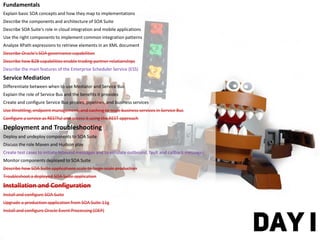
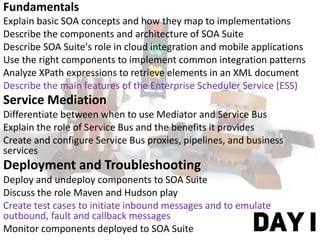
Fundamentals
Explain basic SOA concepts and how they map to implementations
Describe the components and architecture of SOA Suite
Describe SOA Suite's role in cloud integration and mobile applications
Use the right components to implement common integration patterns
Analyze XPath expressions to retrieve elements in an XML document
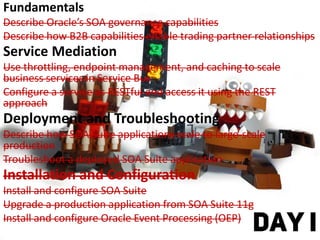
Describe Oracle’s SOA governance capabilities
Describe how B2B capabilities enable trading partner relationships
Describe the main features of the Enterprise Scheduler Service (ESS)
Service Mediation
Differentiate between when to use Mediator and Service Bus
Explain the role of Service Bus and the benefits it provides
Create and configure Service Bus proxies, pipelines, and business services
Use throttling, endpoint management, and caching to scale business services in Service Bus
Configure a service as RESTful and access it using the REST approach
Deployment and Troubleshooting
Deploy and undeploy components to SOA Suite
Discuss the role Maven and Hudson play
Create test cases to initiate inbound messages and to emulate outbound, fault and callback messages
Monitor components deployed to SOA Suite
Describe how SOA Suite applications scale to large-scale production
Troubleshoot a deployed SOA Suite application
Installation and Configuration
Install and configure SOA Suite
Upgrade a production application from SOA Suite 11g
Install and configure Oracle Event Processing (OEP)
DAY I
Fundamentals
Explain basic SOA concepts and how they map to implementations
Describe the components and architecture of SOA Suite
Describe SOA Suite's role in cloud integration and mobile applications
Use the right components to implement common integration patterns
Analyze XPath expressions to retrieve elements in an XML document
Describe the main features of the Enterprise Scheduler Service (ESS)
Service Mediation
Differentiate between when to use Mediator and Service Bus
Explain the role of Service Bus and the benefits it provides
Create and configure Service Bus proxies, pipelines, and business
services
Deployment and Troubleshooting
Deploy and undeploy components to SOA Suite
Discuss the role Maven and Hudson play
Create test cases to initiate inbound messages and to emulate
outbound, fault and callback messages
Monitor components deployed to SOA Suite DAY I
Fundamentals
Describe Oracle’s SOA governance capabilities
Describe how B2B capabilities enable trading partner relationships
Service Mediation
Use throttling, endpoint management, and caching to scale
business services in Service Bus
Configure a service as RESTful and access it using the REST
approach
Deployment and Troubleshooting
Describe how SOA Suite applications scale to large-scale
production
Troubleshoot a deployed SOA Suite application
Installation and Configuration
Install and configure SOA Suite
Upgrade a production application from SOA Suite 11g
Install and configure Oracle Event Processing (OEP)
DAY I
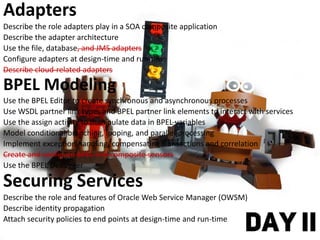
Adapters
Describe the role adapters play in a SOA composite application
Describe the adapter architecture
Use the file, database, and JMS adapters
Configure adapters at design-time and run-time
Describe cloud-related adapters
BPEL Modeling
Use the BPEL Editor to create synchronous and asynchronous processes
Use WSDL partner link types and BPEL partner link elements to interact with services
Use the assign activity to manipulate data in BPEL variables
Model conditional branching, looping, and parallel processing
Implement exception handling, compensating transactions and correlation
Create and configure BPEL and composite sensors
Use the BPEL Debugger
Securing Services
Describe the role and features of Oracle Web Service Manager (OWSM)
Describe identity propagation
Attach security policies to end points at design-time and run-time
DAY II
DAY III
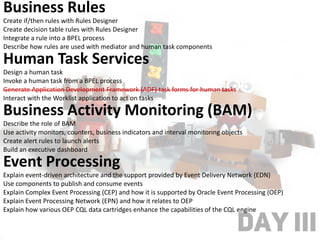
Business Rules
Create if/then rules with Rules Designer
Create decision table rules with Rules Designer
Integrate a rule into a BPEL process
Describe how rules are used with mediator and human task components
Human Task Services
Design a human task
Invoke a human task from a BPEL process
Generate Application Development Framework (ADF) task forms for human tasks
Interact with the Worklist application to act on tasks
Business Activity Monitoring (BAM)
Describe the role of BAM
Use activity monitors, counters, business indicators and interval monitoring objects
Create alert rules to launch alerts
Build an executive dashboard
Event Processing
Explain event-driven architecture and the support provided by Event Delivery Network (EDN)
Use components to publish and consume events
Explain Complex Event Processing (CEP) and how it is supported by Oracle Event Processing (OEP)
Explain Event Processing Network (EPN) and how it relates to OEP
Explain how various OEP CQL data cartridges enhance the capabilities of the CQL engine
What is
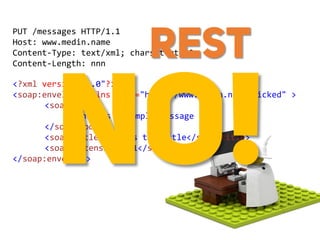
<?xml version="1.0"?>
<soap:envelope xmlns:soap="http://www.medin.name/wicked" >
<soap:body>
This is a sample message
</soap:body>
<soap:title>This is the title</soap:title>
<soap:extension>101</soap:extension>
</soap:envelope>
PUT /messages HTTP/1.1
Host: www.medin.name
Content-Type: text/xml; charset=utf-8
Content-Length: nnn
REST
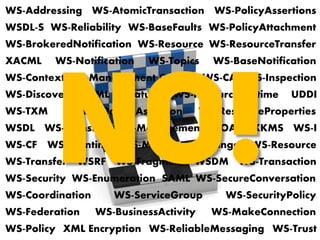
SOAP
WS-Notification WS-Topics
WS-Addressing
WS-BrokeredNotification
WS-BaseNotification
WS-Transfer
WS-Eventing
WS-Enumeration
WS-MakeConnection
WS-Policy
WS-PolicyAssertions
WS-PolicyAttachment
WS-Discovery
WS-Inspection
WS-MetadataExchange
UDDI
WSDL
WSDL-S
WS-Resource
WSRF
WS-Security
XML Signature
XML Encryption
XKMS
WS-SecureConversation
WS-SecurityPolicy
WS-Trust
WS-Federation
SAML
XACML
WS-ReliableMessaging
WS-Reliability
WS-RM Policy Assertion
WS-Resource
WS-BaseFaults
WS-ServiceGroup
WS-ResourceProperties
WS-ResourceLifetime
WS-Transfer WS-Fragment
WS-I
WS-BusinessActivity
WS-AtomicTransaction
WS-Coordination
WS-CAF
WS-Transaction
WS-Context
WS-CF
WS-TXM
WS-Management
WS-Management Catalog
WS-ResourceTransfer
WSDM
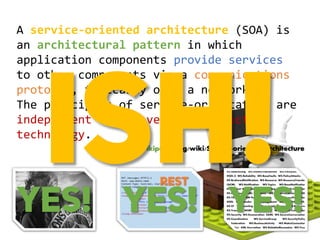
A service-oriented architecture (SOA) is
an architectural pattern in which
application components provide services
to other components via a communications
protocol, typically over a network.
The principles of service-orientation are
independent of any vendor, product or
technology.
YES! YES! YES!
http://en.wikipedia.org/wiki/Service-oriented_architecture
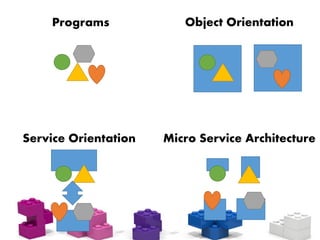
Programs
Service Orientation Micro Service Architecture
Object Orientation
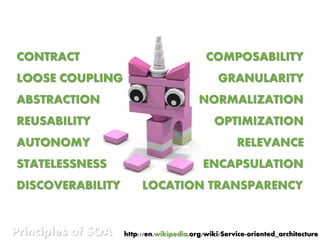
http://en.wikipedia.org/wiki/Service-oriented_architecturePrinciples of SOA
CONTRACT
LOOSE COUPLING
ABSTRACTION
REUSABILITY
AUTONOMY
STATELESSNESS
DISCOVERABILITY
COMPOSABILITY
GRANULARITY
NORMALIZATION
OPTIMIZATION
RELEVANCE
ENCAPSULATION
LOCATION TRANSPARENCY
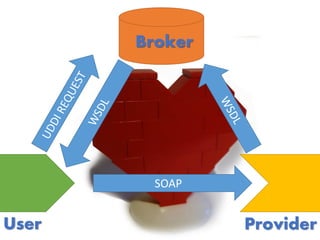
User Provider
SOAP
Broker
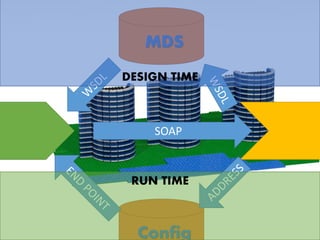
SOAP
MDS
Config
DESIGN TIME
RUN TIME
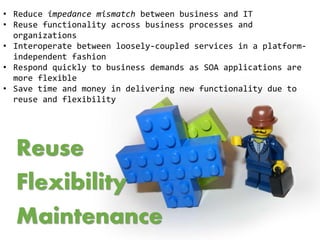
• Reduce impedance mismatch between business and IT
• Reuse functionality across business processes and
organizations
• Interoperate between loosely-coupled services in a platform-
independent fashion
• Respond quickly to business demands as SOA applications are
more flexible
• Save time and money in delivering new functionality due to
reuse and flexibility
Reuse
Flexibility
Maintenance
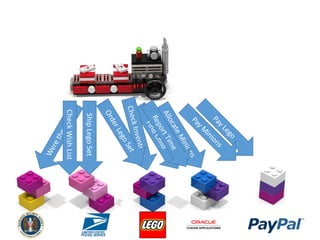
CheckWishList
ShipLegoSet
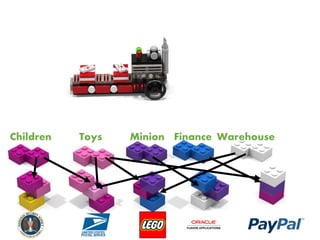
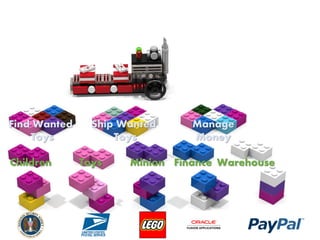
Children Toys Minion Finance Warehouse
Find Wanted
Toys
Ship Wanted
Toys
Manage
Money
Children Toys Minion Finance Warehouse
Find Wanted
Toys
Ship Wanted
Toys
Manage
Money
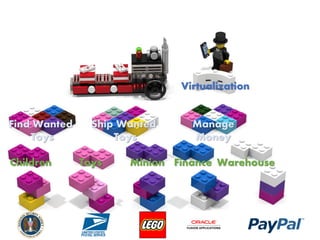
Virtualization
What is
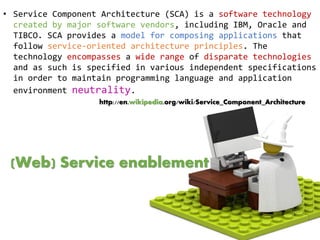
• Service Component Architecture (SCA) is a software technology
created by major software vendors, including IBM, Oracle and
TIBCO. SCA provides a model for composing applications that
follow service-oriented architecture principles. The
technology encompasses a wide range of disparate technologies
and as such is specified in various independent specifications
in order to maintain programming language and application
environment neutrality.
http://en.wikipedia.org/wiki/Service_Component_Architecture
(Web) Service enablement
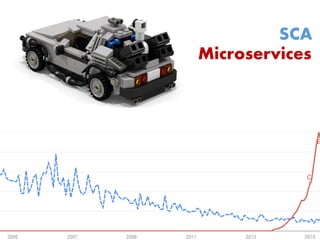
Microservices
SCA
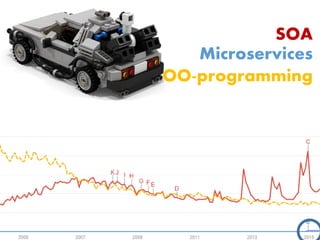
Microservices
SOA
OO-programming
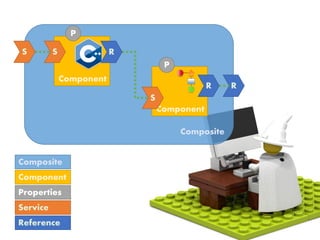
Composite
S
Component
Component
S
R R
R
S
Component
Service
Reference
Composite
P
P
Properties
Composite
S
Component
S R R
P
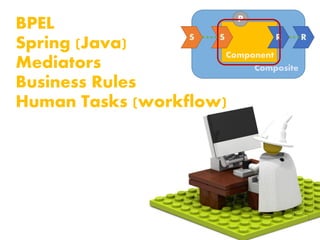
BPEL
Business Rules
Human Tasks (workflow)
Mediators
Spring (Java)
Composite
S
Component
S R R
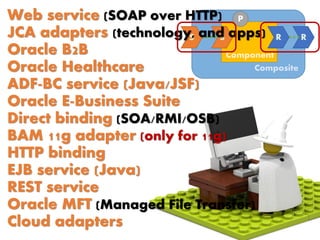
PWeb service (SOAP over HTTP)
Oracle Healthcare
ADF-BC service (Java/JSF)
Oracle B2B
JCA adapters (technology, and apps)
BAM 11g adapter (only for 11g)
EJB service (Java)
Oracle E-Business Suite
HTTP binding
REST service
Direct binding (SOA/RMI/OSB)
Cloud adapters
Oracle MFT (Managed File Transfer)
Oracle
Suite
Analytics
Orchestration
Virtualization and Mediation
Connectivity
Business Activity Monitoring Event Processing
BPEL Process Manager Business RulesHuman Tasks
Service Bus
Cloud Business to BusinessOn-premises
Apps Services Platform Apps Mainframe DB EDI XML MFT
Infrastructure
Messaging JavaCaching
ManagementandSecurity
ModellingandDevelopment
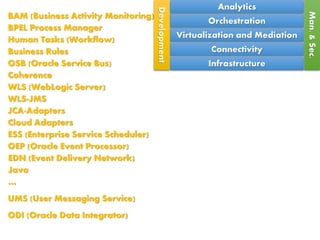
Analytics
Orchestration
Virtualization and Mediation
Connectivity
Infrastructure
Man.&Sec.
Development
BAM (Business Activity Monitoring)
BPEL Process Manager
Business Rules
Human Tasks (Workflow)
OSB (Oracle Service Bus)
WLS-JMS
WLS (WebLogic Server)
Coherence
JCA-Adapters
Cloud Adapters
ESS (Enterprise Service Scheduler)
OEP (Oracle Event Processor)
EDN (Event Delivery Network)
Java
…
UMS (User Messaging Service)
ODI (Oracle Data Integrator)
Service Bus
Service Bus
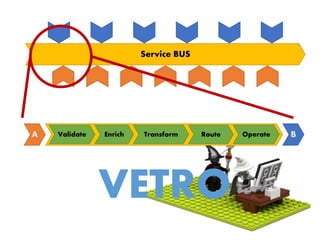
Service BUS
A BValidate Enrich Transform OperateRoute
VETRO
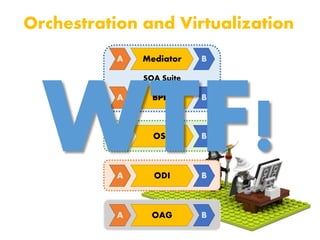
SOA Suite
A BMediator
A BBPEL
A BOSB
Orchestration and Virtualization
A BODI
A BOAG
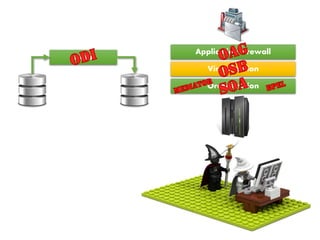
Orchestration
Virtualization
Application Firewall
Data
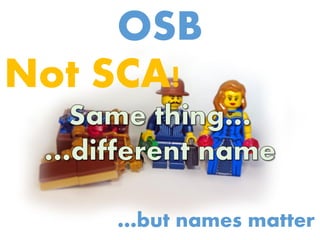
OSB
Not SCA!
…but names matter
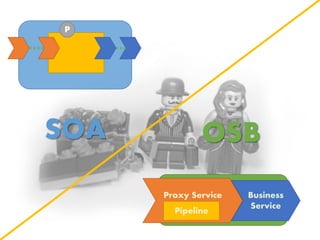
P
Business
Service
SOA OSB
Proxy Service
Pipeline
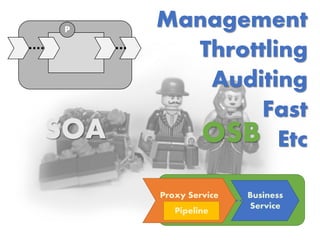
P
SOA OSB
Management
Throttling
Auditing
Fast
Business
Service
Proxy Service
Pipeline
Etc
…putting some SOA
in Oracle SOA Suite…
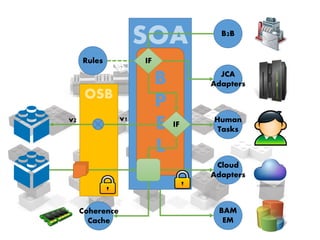
SOA
B
P
E
L
B2B
JCA
Adapters
Human
Tasks
Rules
Cloud
Adapters
OSB
IF
IF
BAM
EM
v2 v1
Coherence
Cache
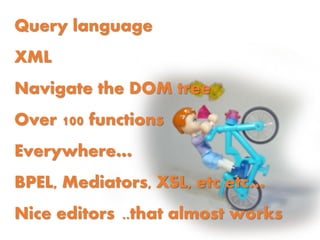
Query language
XML
Navigate the DOM tree
Over 100 functions
Everywhere…
BPEL, Mediators, XSL, etc etc…
Nice editors ..that almost works
foo
/foo
/foo/bar
//bar
/foo/*
//*
/foo/bar[@name=‘a’]
/foo/bar[1]/@name
/foo/bar[@price > 300]
/foo/bar[1]
<foo>
<bar name=“a” price=“150”>
This is a bar
</bar>
<bar name=“b” price=“300”>
This is a bar
</bar>
<bar name=“c” price=“350”>
This is a bar
</bar>
<bar name=“d” price=“400”>
This is a bar
</bar>
</foo>
THANK YOU
https://se.linkedin.com/in/mickem
http://www.medin.name
https://slideshare.net/MichaelMedin
https://github.com/mickem

Oracle SOA Suite 12c 1z0-434 Day 1/3

  • 1.
    Oracle SOA Suite12c Introduction to SOA 1Z0-434: Day I
  • 3.
    Certification #Q %Pass Partners 1z0-451 70 63% 44 ~34 1z0-478 73 60% 44 ~34 1z0-434 TBD TBD TBD TBD-15 Type Multiple Choice
  • 4.
    Fundamentals Explain basic SOAconcepts and how they map to implementations Describe the components and architecture of SOA Suite Describe SOA Suite's role in cloud integration and mobile applications Use the right components to implement common integration patterns Analyze XPath expressions to retrieve elements in an XML document Describe Oracle’s SOA governance capabilities Describe how B2B capabilities enable trading partner relationships Describe the main features of the Enterprise Scheduler Service (ESS) Service Mediation Differentiate between when to use Mediator and Service Bus Explain the role of Service Bus and the benefits it provides Create and configure Service Bus proxies, pipelines, and business services Use throttling, endpoint management, and caching to scale business services in Service Bus Configure a service as RESTful and access it using the REST approach Deployment and Troubleshooting Deploy and undeploy components to SOA Suite Discuss the role Maven and Hudson play Create test cases to initiate inbound messages and to emulate outbound, fault and callback messages Monitor components deployed to SOA Suite Describe how SOA Suite applications scale to large-scale production Troubleshoot a deployed SOA Suite application Installation and Configuration Install and configure SOA Suite Upgrade a production application from SOA Suite 11g Install and configure Oracle Event Processing (OEP) DAY I
  • 5.
    Fundamentals Explain basic SOAconcepts and how they map to implementations Describe the components and architecture of SOA Suite Describe SOA Suite's role in cloud integration and mobile applications Use the right components to implement common integration patterns Analyze XPath expressions to retrieve elements in an XML document Describe the main features of the Enterprise Scheduler Service (ESS) Service Mediation Differentiate between when to use Mediator and Service Bus Explain the role of Service Bus and the benefits it provides Create and configure Service Bus proxies, pipelines, and business services Deployment and Troubleshooting Deploy and undeploy components to SOA Suite Discuss the role Maven and Hudson play Create test cases to initiate inbound messages and to emulate outbound, fault and callback messages Monitor components deployed to SOA Suite DAY I
  • 6.
    Fundamentals Describe Oracle’s SOAgovernance capabilities Describe how B2B capabilities enable trading partner relationships Service Mediation Use throttling, endpoint management, and caching to scale business services in Service Bus Configure a service as RESTful and access it using the REST approach Deployment and Troubleshooting Describe how SOA Suite applications scale to large-scale production Troubleshoot a deployed SOA Suite application Installation and Configuration Install and configure SOA Suite Upgrade a production application from SOA Suite 11g Install and configure Oracle Event Processing (OEP) DAY I
  • 7.
    Adapters Describe the roleadapters play in a SOA composite application Describe the adapter architecture Use the file, database, and JMS adapters Configure adapters at design-time and run-time Describe cloud-related adapters BPEL Modeling Use the BPEL Editor to create synchronous and asynchronous processes Use WSDL partner link types and BPEL partner link elements to interact with services Use the assign activity to manipulate data in BPEL variables Model conditional branching, looping, and parallel processing Implement exception handling, compensating transactions and correlation Create and configure BPEL and composite sensors Use the BPEL Debugger Securing Services Describe the role and features of Oracle Web Service Manager (OWSM) Describe identity propagation Attach security policies to end points at design-time and run-time DAY II
  • 8.
    DAY III Business Rules Createif/then rules with Rules Designer Create decision table rules with Rules Designer Integrate a rule into a BPEL process Describe how rules are used with mediator and human task components Human Task Services Design a human task Invoke a human task from a BPEL process Generate Application Development Framework (ADF) task forms for human tasks Interact with the Worklist application to act on tasks Business Activity Monitoring (BAM) Describe the role of BAM Use activity monitors, counters, business indicators and interval monitoring objects Create alert rules to launch alerts Build an executive dashboard Event Processing Explain event-driven architecture and the support provided by Event Delivery Network (EDN) Use components to publish and consume events Explain Complex Event Processing (CEP) and how it is supported by Oracle Event Processing (OEP) Explain Event Processing Network (EPN) and how it relates to OEP Explain how various OEP CQL data cartridges enhance the capabilities of the CQL engine
  • 9.
  • 11.
    <?xml version="1.0"?> <soap:envelope xmlns:soap="http://www.medin.name/wicked"> <soap:body> This is a sample message </soap:body> <soap:title>This is the title</soap:title> <soap:extension>101</soap:extension> </soap:envelope> PUT /messages HTTP/1.1 Host: www.medin.name Content-Type: text/xml; charset=utf-8 Content-Length: nnn REST
  • 12.
    SOAP WS-Notification WS-Topics WS-Addressing WS-BrokeredNotification WS-BaseNotification WS-Transfer WS-Eventing WS-Enumeration WS-MakeConnection WS-Policy WS-PolicyAssertions WS-PolicyAttachment WS-Discovery WS-Inspection WS-MetadataExchange UDDI WSDL WSDL-S WS-Resource WSRF WS-Security XML Signature XMLEncryption XKMS WS-SecureConversation WS-SecurityPolicy WS-Trust WS-Federation SAML XACML WS-ReliableMessaging WS-Reliability WS-RM Policy Assertion WS-Resource WS-BaseFaults WS-ServiceGroup WS-ResourceProperties WS-ResourceLifetime WS-Transfer WS-Fragment WS-I WS-BusinessActivity WS-AtomicTransaction WS-Coordination WS-CAF WS-Transaction WS-Context WS-CF WS-TXM WS-Management WS-Management Catalog WS-ResourceTransfer WSDM
  • 13.
    A service-oriented architecture(SOA) is an architectural pattern in which application components provide services to other components via a communications protocol, typically over a network. The principles of service-orientation are independent of any vendor, product or technology. YES! YES! YES! http://en.wikipedia.org/wiki/Service-oriented_architecture
  • 14.
    Programs Service Orientation MicroService Architecture Object Orientation
  • 15.
    http://en.wikipedia.org/wiki/Service-oriented_architecturePrinciples of SOA CONTRACT LOOSECOUPLING ABSTRACTION REUSABILITY AUTONOMY STATELESSNESS DISCOVERABILITY COMPOSABILITY GRANULARITY NORMALIZATION OPTIMIZATION RELEVANCE ENCAPSULATION LOCATION TRANSPARENCY
  • 16.
  • 17.
  • 18.
    • Reduce impedancemismatch between business and IT • Reuse functionality across business processes and organizations • Interoperate between loosely-coupled services in a platform- independent fashion • Respond quickly to business demands as SOA applications are more flexible • Save time and money in delivering new functionality due to reuse and flexibility Reuse Flexibility Maintenance
  • 20.
  • 21.
    Children Toys MinionFinance Warehouse
  • 22.
    Children Toys MinionFinance Warehouse Find Wanted Toys Ship Wanted Toys Manage Money
  • 23.
    Children Toys MinionFinance Warehouse Find Wanted Toys Ship Wanted Toys Manage Money Virtualization
  • 24.
  • 25.
    • Service ComponentArchitecture (SCA) is a software technology created by major software vendors, including IBM, Oracle and TIBCO. SCA provides a model for composing applications that follow service-oriented architecture principles. The technology encompasses a wide range of disparate technologies and as such is specified in various independent specifications in order to maintain programming language and application environment neutrality. http://en.wikipedia.org/wiki/Service_Component_Architecture (Web) Service enablement
  • 26.
  • 27.
  • 28.
  • 29.
    Composite S Component S R R P BPEL BusinessRules Human Tasks (workflow) Mediators Spring (Java)
  • 30.
    Composite S Component S R R PWebservice (SOAP over HTTP) Oracle Healthcare ADF-BC service (Java/JSF) Oracle B2B JCA adapters (technology, and apps) BAM 11g adapter (only for 11g) EJB service (Java) Oracle E-Business Suite HTTP binding REST service Direct binding (SOA/RMI/OSB) Cloud adapters Oracle MFT (Managed File Transfer)
  • 31.
  • 32.
    Analytics Orchestration Virtualization and Mediation Connectivity BusinessActivity Monitoring Event Processing BPEL Process Manager Business RulesHuman Tasks Service Bus Cloud Business to BusinessOn-premises Apps Services Platform Apps Mainframe DB EDI XML MFT Infrastructure Messaging JavaCaching ManagementandSecurity ModellingandDevelopment
  • 33.
    Analytics Orchestration Virtualization and Mediation Connectivity Infrastructure Man.&Sec. Development BAM(Business Activity Monitoring) BPEL Process Manager Business Rules Human Tasks (Workflow) OSB (Oracle Service Bus) WLS-JMS WLS (WebLogic Server) Coherence JCA-Adapters Cloud Adapters ESS (Enterprise Service Scheduler) OEP (Oracle Event Processor) EDN (Event Delivery Network) Java … UMS (User Messaging Service) ODI (Oracle Data Integrator)
  • 34.
  • 35.
    Service BUS A BValidateEnrich Transform OperateRoute VETRO
  • 36.
    SOA Suite A BMediator ABBPEL A BOSB Orchestration and Virtualization A BODI A BOAG
  • 37.
  • 38.
  • 39.
  • 40.
  • 41.
    …putting some SOA inOracle SOA Suite…
  • 42.
  • 44.
    Query language XML Navigate theDOM tree Over 100 functions Everywhere… BPEL, Mediators, XSL, etc etc… Nice editors ..that almost works
  • 45.
    foo /foo /foo/bar //bar /foo/* //* /foo/bar[@name=‘a’] /foo/bar[1]/@name /foo/bar[@price > 300] /foo/bar[1] <foo> <barname=“a” price=“150”> This is a bar </bar> <bar name=“b” price=“300”> This is a bar </bar> <bar name=“c” price=“350”> This is a bar </bar> <bar name=“d” price=“400”> This is a bar </bar> </foo>
  • 46.