ABCD for Oregon’s Healthy Kids Oregon Division of Medical Assistance Programs
ABCD and Oregon Medicaid Managed Care Organizations (MCOs) care for nearly  1 in 3 Oregon  children. Use a project that mirrors a  Performance Improvement Project (PIP)  to leverage Medicaid’s Managed Care requirements. Implement a process of  community engagement in order to guide and inform the development of the PIP .
One of the Optional EQRO Activities available to states (at 75% FFP) Validate encounter data Administer consumer & provider surveys Validate consumer & provider surveys Calculate of performance measures Conduct of performance improvement projects Conduct of focused studies on quality
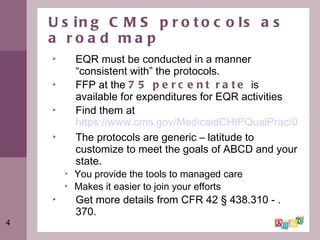
Using CMS protocols as a road map EQR must be conducted in a manner “consistent with” the protocols. FFP at the  75 percent rate  is available for expenditures for EQR activities Find them at  https://www.cms.gov/MedicaidCHIPQualPrac/07_Tools_Tips_and_Protocols.asp The protocols are generic – latitude to customize to meet the goals of ABCD and your state. You provide the tools to managed care Makes it easier to join your efforts Get more details from CFR 42 § 438.310 - .370.
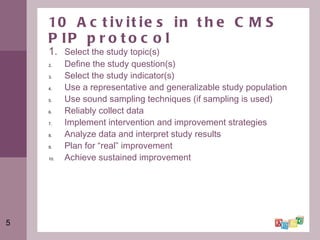
10 Activities in the CMS PIP protocol 1.  Select the study topic(s)  Define the study question(s)  Select the study indicator(s)  Use a representative and generalizable study population Use sound sampling techniques (if sampling is used) Reliably collect data Implement intervention and improvement strategies Analyze data and interpret study results Plan for “real” improvement Achieve sustained improvement
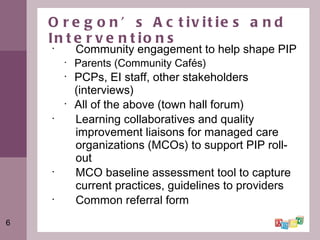
Oregon’s Activities and Interventions Community engagement to help shape PIP Parents (Community Cafés) PCPs, EI staff, other stakeholders (interviews) All of the above (town hall forum) Learning collaboratives and quality improvement liaisons for managed care organizations (MCOs) to support PIP roll-out MCO baseline assessment tool to capture current practices, guidelines to providers Common referral form
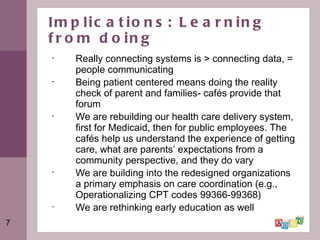
Implications: Learning from doing Really connecting systems is > connecting data, = people communicating Being patient centered means doing the reality check of parent and families- cafés provide that forum  We are rebuilding our health care delivery system, first for Medicaid, then for public employees. The cafés help us understand the experience of getting care, what are parents’ expectations from a community perspective, and they do vary We are building into the redesigned organizations a primary emphasis on care coordination (e.g., Operationalizing CPT codes 99366-99368)  We are rethinking early education as well
Oregon ABCD III Improvement Project   www. oregon . gov/DHS/ph/ch/abcd . shtml   Division of Medical Assistance Programs Charles Gallia, Ph.D.   [email_address] SPECIAL THANK to Colleen Reuland, CAHMI and OPIP and Sarah Wetherson

Or slides final

  • 1.
    ABCD for Oregon’sHealthy Kids Oregon Division of Medical Assistance Programs
  • 2.
    ABCD and OregonMedicaid Managed Care Organizations (MCOs) care for nearly 1 in 3 Oregon children. Use a project that mirrors a Performance Improvement Project (PIP) to leverage Medicaid’s Managed Care requirements. Implement a process of community engagement in order to guide and inform the development of the PIP .
  • 3.
    One of theOptional EQRO Activities available to states (at 75% FFP) Validate encounter data Administer consumer & provider surveys Validate consumer & provider surveys Calculate of performance measures Conduct of performance improvement projects Conduct of focused studies on quality
  • 4.
    Using CMS protocolsas a road map EQR must be conducted in a manner “consistent with” the protocols. FFP at the 75 percent rate is available for expenditures for EQR activities Find them at https://www.cms.gov/MedicaidCHIPQualPrac/07_Tools_Tips_and_Protocols.asp The protocols are generic – latitude to customize to meet the goals of ABCD and your state. You provide the tools to managed care Makes it easier to join your efforts Get more details from CFR 42 § 438.310 - .370.
  • 5.
    10 Activities inthe CMS PIP protocol 1. Select the study topic(s) Define the study question(s) Select the study indicator(s) Use a representative and generalizable study population Use sound sampling techniques (if sampling is used) Reliably collect data Implement intervention and improvement strategies Analyze data and interpret study results Plan for “real” improvement Achieve sustained improvement
  • 6.
    Oregon’s Activities andInterventions Community engagement to help shape PIP Parents (Community Cafés) PCPs, EI staff, other stakeholders (interviews) All of the above (town hall forum) Learning collaboratives and quality improvement liaisons for managed care organizations (MCOs) to support PIP roll-out MCO baseline assessment tool to capture current practices, guidelines to providers Common referral form
  • 7.
    Implications: Learning fromdoing Really connecting systems is > connecting data, = people communicating Being patient centered means doing the reality check of parent and families- cafés provide that forum We are rebuilding our health care delivery system, first for Medicaid, then for public employees. The cafés help us understand the experience of getting care, what are parents’ expectations from a community perspective, and they do vary We are building into the redesigned organizations a primary emphasis on care coordination (e.g., Operationalizing CPT codes 99366-99368) We are rethinking early education as well
  • 8.
    Oregon ABCD IIIImprovement Project www. oregon . gov/DHS/ph/ch/abcd . shtml Division of Medical Assistance Programs Charles Gallia, Ph.D. [email_address] SPECIAL THANK to Colleen Reuland, CAHMI and OPIP and Sarah Wetherson