
Options
Part - 2
CMT LEVEL - I
Intrinsic V/s Time Value
Intrinsic Value — The amount an option is in-the-
money. Obviously, only in-the-money options have
intrinsic value.
•Time Value — The part of an option price that is based
on its time to expiration. If you subtract the amount of
intrinsic value from an option price, you’re left with
the time value. If an option has no intrinsic value (i.e.,
it’s out-of-the-money) its entire worth is based on time
value.
Long V/s Short Position
• Long on options - Buyer of an option is said to be “long on option” When you are long on
equity option contract:
• You have the right to exercise that option.
• Your potential loss is limited to the premium amount you paid for buying the option.
• Profit would depend on the level of underlying asset price at the time of exercise/expiry of
the contract.
Short on Options - Seller of an option is said to be “short on option”.
• When you are short (i.e., the writer of) an equity option contract:
• Your maximum profit is the premium received.
• You can be assigned an exercised option any time during the life of option contract (for
American Options only). All option writers should be aware that assignment is a distinct
possibility.
• Your potential loss is theoretically unlimited as defined below.
Using the Options Market
• Hedging – Corporations, Investing Institutions, Banks and
Governments all use derivative products to hedge or reduce their
exposures to market variables such as interest rates, share values,
bond prices, currency exchange rates and commodity prices.
• Speculations - Options are very well suited to speculating on the
prices of commodities and financial assets and on key market
variables such as interest rates, stock market indices and currency
exchange rates. It is much less expensive to create a speculative
position using options than by actually trading the underlying
commodity or asset. As a result, the potential returns are much
greater.
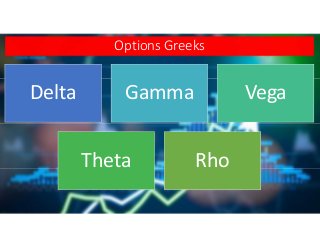
Options Greeks
Delta Gamma Vega
Theta Rho
Options Greeks
Delta – A measure of the rate of change in an options theoretical value for a one-unit
change in the price of the underlying security.
Gamma – A measure of the rate of change in an options delta for a one-unit change in
the price of the underlying. In other words, the rate of change in delta. Measured in
Delta not dollars
Vega - A measure of the rate of change in an option’s theoretical value for a one-unit
change in implied volatility.
Theta - A measure of the rate of change in an option’s theoretical value for a one-unit
change in time to the option’s expiration date.
Rho - A measure of an option’s theoretical sensitivity to changes in the risk-free
interest
Implied Volatility
• Implied volatility isn’t based on historical pricing data on the stock.
Instead, it’s what the marketplace is “implying” the volatility of the
stock will be in the future, based on price changes in an option.
• Like historical volatility, this figure is expressed on an annualized
basis.
• But implied volatility is typically of more interest to retail option
traders than historical volatility because it's forward-looking .
• Implied volatility is a dynamic figure that changes based on activity
in the options marketplace.
Implied Volatility
• Usually, when implied volatility increases, the price of options will
increase as well, assuming all other things remain constant.
• So when implied volatility increases after a trade has been placed,
it’s good for the option owner and bad for the option seller.
• Conversely, if implied volatility decreases after your trade is placed,
the price of options usually decreases.
• That’s good if you’re an option seller and bad if you’re an option
owner.

Option Part II

  • 1.
  • 2.
    Intrinsic V/s TimeValue Intrinsic Value — The amount an option is in-the- money. Obviously, only in-the-money options have intrinsic value. •Time Value — The part of an option price that is based on its time to expiration. If you subtract the amount of intrinsic value from an option price, you’re left with the time value. If an option has no intrinsic value (i.e., it’s out-of-the-money) its entire worth is based on time value.
  • 3.
    Long V/s ShortPosition • Long on options - Buyer of an option is said to be “long on option” When you are long on equity option contract: • You have the right to exercise that option. • Your potential loss is limited to the premium amount you paid for buying the option. • Profit would depend on the level of underlying asset price at the time of exercise/expiry of the contract. Short on Options - Seller of an option is said to be “short on option”. • When you are short (i.e., the writer of) an equity option contract: • Your maximum profit is the premium received. • You can be assigned an exercised option any time during the life of option contract (for American Options only). All option writers should be aware that assignment is a distinct possibility. • Your potential loss is theoretically unlimited as defined below.
  • 4.
    Using the OptionsMarket • Hedging – Corporations, Investing Institutions, Banks and Governments all use derivative products to hedge or reduce their exposures to market variables such as interest rates, share values, bond prices, currency exchange rates and commodity prices. • Speculations - Options are very well suited to speculating on the prices of commodities and financial assets and on key market variables such as interest rates, stock market indices and currency exchange rates. It is much less expensive to create a speculative position using options than by actually trading the underlying commodity or asset. As a result, the potential returns are much greater.
  • 5.
  • 6.
    Options Greeks Delta –A measure of the rate of change in an options theoretical value for a one-unit change in the price of the underlying security. Gamma – A measure of the rate of change in an options delta for a one-unit change in the price of the underlying. In other words, the rate of change in delta. Measured in Delta not dollars Vega - A measure of the rate of change in an option’s theoretical value for a one-unit change in implied volatility. Theta - A measure of the rate of change in an option’s theoretical value for a one-unit change in time to the option’s expiration date. Rho - A measure of an option’s theoretical sensitivity to changes in the risk-free interest
  • 7.
    Implied Volatility • Impliedvolatility isn’t based on historical pricing data on the stock. Instead, it’s what the marketplace is “implying” the volatility of the stock will be in the future, based on price changes in an option. • Like historical volatility, this figure is expressed on an annualized basis. • But implied volatility is typically of more interest to retail option traders than historical volatility because it's forward-looking . • Implied volatility is a dynamic figure that changes based on activity in the options marketplace.
  • 8.
    Implied Volatility • Usually,when implied volatility increases, the price of options will increase as well, assuming all other things remain constant. • So when implied volatility increases after a trade has been placed, it’s good for the option owner and bad for the option seller. • Conversely, if implied volatility decreases after your trade is placed, the price of options usually decreases. • That’s good if you’re an option seller and bad if you’re an option owner.