Optical Spectrometer using
RaspberryPi using Absorption
Fingerprinting for
Classification and Detection
Classification of test cases with its optical
abosrption nature using suitable ML Model
2XXX
2.
Introduction
An optical spectrometeris a device that measures the
properties of light over a specific spectrum. By
utilizing a Raspberry Pi 4 microprocessor module, we
can create a cost-effective and versatile
spectrometer. This presentation will explore the
principles of optics involved, its working mechanism,
key components, and practical applications in various
fields.
3.
Key Components andFeatures
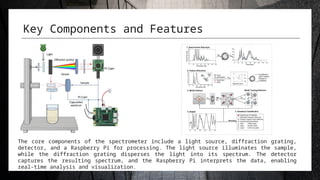
The core components of the spectrometer include a light source, diffraction grating,
detector, and a Raspberry Pi for processing. The light source illuminates the sample,
while the diffraction grating disperses the light into its spectrum. The detector
captures the resulting spectrum, and the Raspberry Pi interprets the data, enabling
real-time analysis and visualization.
4.
Sample Budget
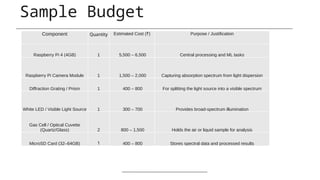
Component QuantityEstimated Cost ( )
₹ Purpose / Justification
Raspberry Pi 4 (4GB) 1 5,500 – 6,500 Central processing and ML tasks
Raspberry Pi Camera Module 1 1,500 – 2,000 Capturing absorption spectrum from light dispersion
Diffraction Grating / Prism 1 400 – 800 For splitting the light source into a visible spectrum
White LED / Visible Light Source 1 300 – 700 Provides broad-spectrum illumination
Gas Cell / Optical Cuvette
(Quartz/Glass) 2 800 – 1,500 Holds the air or liquid sample for analysis
MicroSD Card (32–64GB) 1 400 – 800 Stores spectral data and processed results
5.
Optical Properties Explained
Ethanol(Ethyl Alcohol, C₂H₅OH): Ethanol is a simpler alcohol with a
two-carbon chain and a hydroxyl (-OH) group. Its optical properties,
particularly its absorption spectrum, are largely influenced by the
vibrational modes of its C-H and O-H bonds, as well as electronic
transitions. In the visible light range, pure ethanol is highly
transparent, meaning it absorbs very little light, making it appear
clear and colorless. Any small absorptions visible in a spectrometer
within the visible range would typically be very weak overtone or
combination bands, or due to impurities.
Isopropyl Alcohol (Isopropanol, Propan-2-ol, C₃H₈O): Isopropyl
alcohol is a three-carbon alcohol with the hydroxyl (-OH) group
attached to the central carbon. Its molecular structure is slightly
more complex than ethanol, leading to subtle differences in its
vibrational modes and thus its absorption spectrum. Like ethanol,
pure isopropyl alcohol is also highly transparent in the visible
region. However, due to its slightly different arrangement of C-H
bonds and the position of the -OH group, it will exhibit a unique
"fingerprint" of absorption peaks, especially in the near-infrared
(NIR) and potentially in the deep UV, compared to ethanol, even if
these differences are subtle in the depicted visible range. These
unique spectral features are what allow an ML model to differentiate
between the two substances.
6.
CREDITS: This presentationtemplate
was created by Slidesgo, and includes
icons, and infographics & images by
Freepik
Thank you!
Do you have any questions?
+