WHAT IS LASER?
Light Amplification by Stimulated Emission
of Radiation
A device produces a coherent beam of optical
radiation by stimulating electronic, ionic, or
molecular transitions to higher energy levels
When they return to lower energy levels by
stimulated emission, they emit energy.
PROPERTIES OF LASER
2
 The light emitted from a laser is monochromatic, that is, it is of one
color/wavelength. In contrast, ordinary white light is a combination of many colors (or
wavelengths) of light.
 Lasers emit light that is highly directional, that is, laser light is emitted as a relatively
narrow beam in a specific direction. Ordinary light, such as from a light bulb, is
emitted in many directions away from the source.
 The light from a laser is said to be coherent, which means that the wavelengths of
the laser light are in phase in space and time. Ordinary light can be a mixture of
many wavelengths.
These three properties of laser light are what can make it more hazardous than
ordinary light. Laser light can deposit a lot of energy within a small area.
BASIC CONCEPTS FOR A
LASER
Absorption
Spontaneous Emission
Stimulated Emission
Population inversion
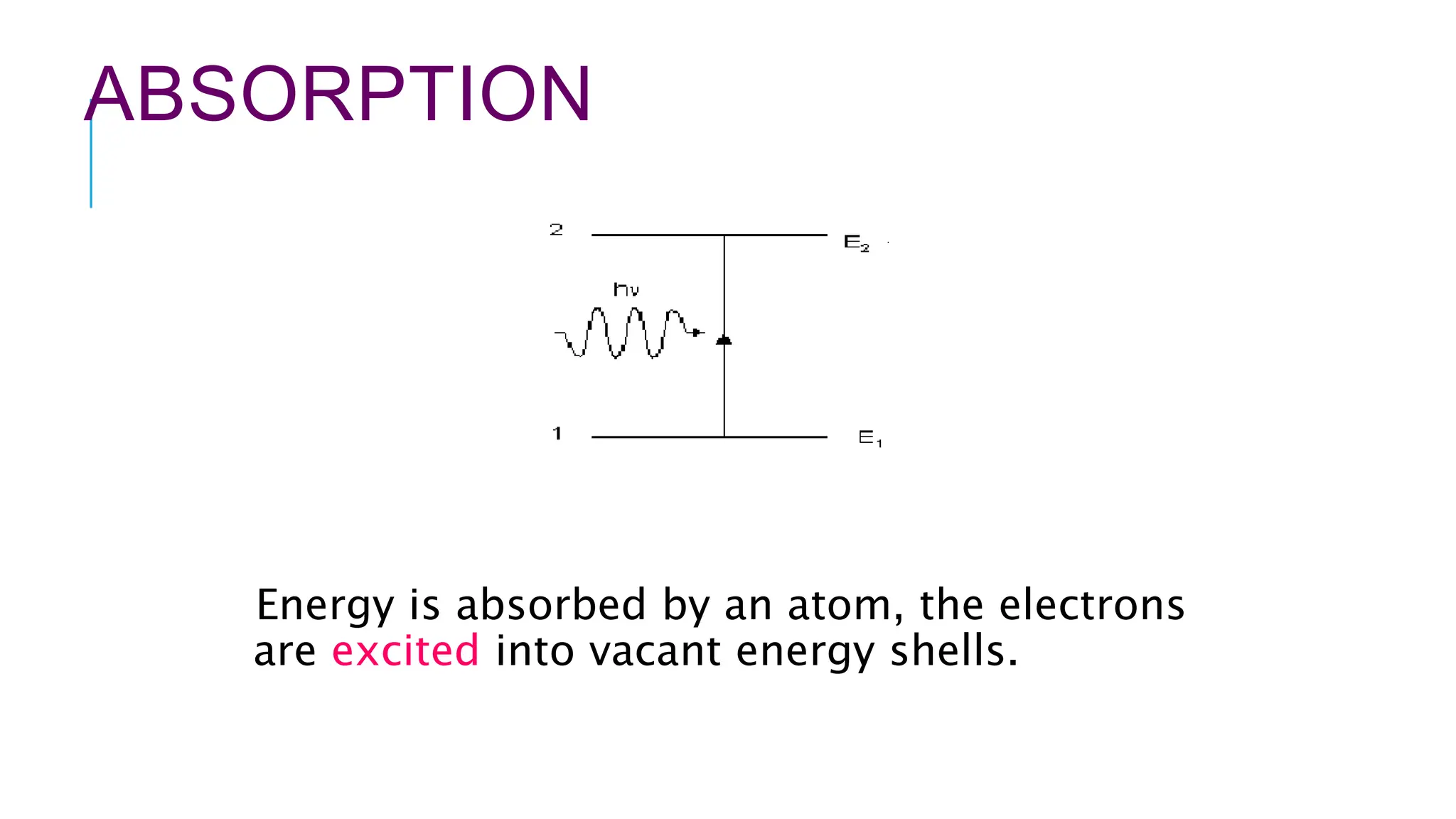
ABSORPTION
Energy is absorbed by an atom, the electrons
are excited into vacant energy shells.
SPONTANEOUS EMISSION
The atom decays from level 2 to level 1
through the emission of a photon with the
energy hv. It is a completely random process.
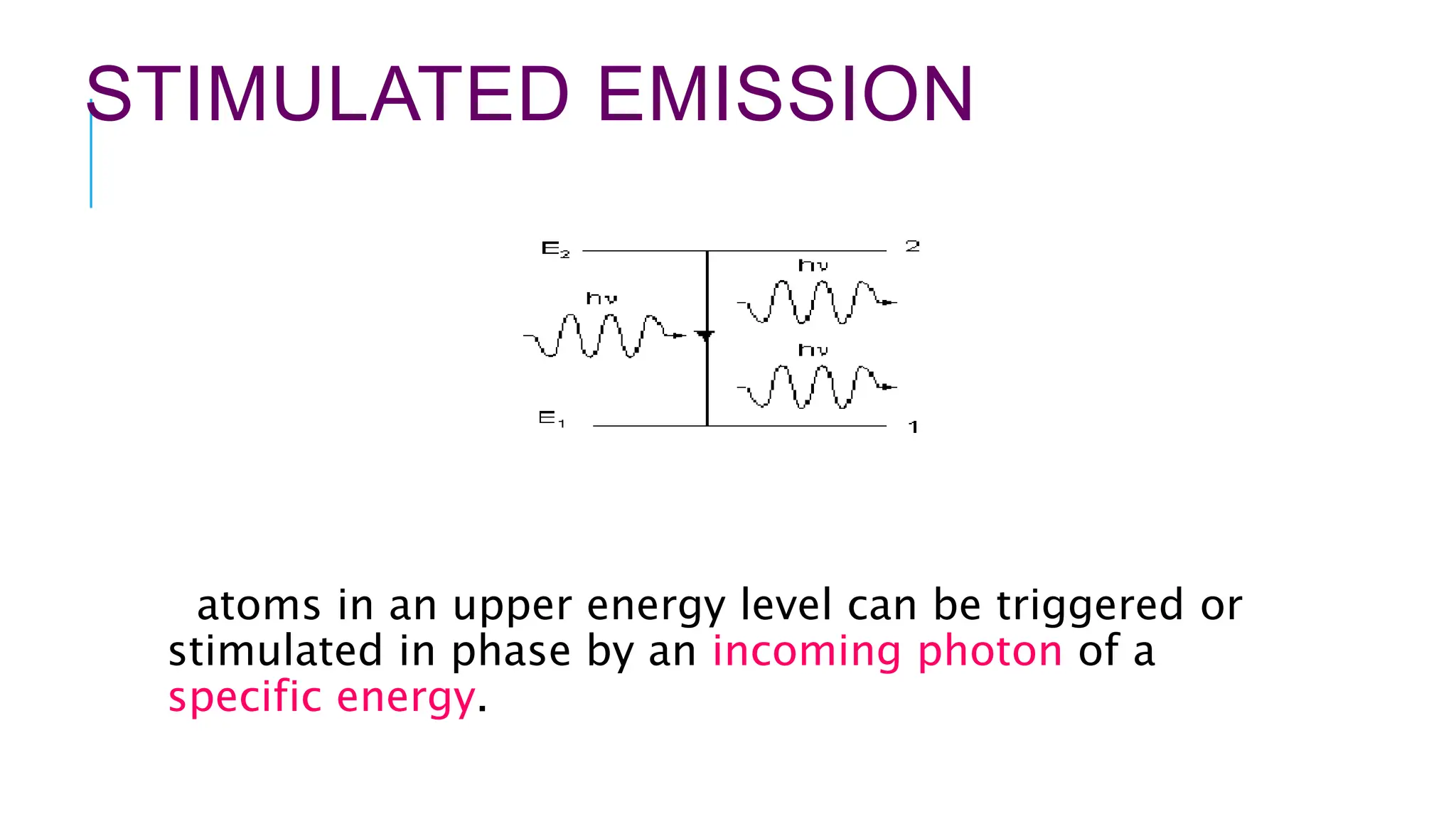
STIMULATED EMISSION
atoms in an upper energy level can be triggered or
stimulated in phase by an incoming photon of a
specific energy.
STIMULATED EMISSION
The stimulated photons have unique properties:
In phase with the incident photon
Same wavelength as the incident photon
Travel in same direction as incident photon
POPULATION INVERSION
A state in which a substance has been energized, or
excited to specific energy levels.
More atoms or molecules are in a higher excited state.
The process of producing a population inversion is
called pumping.
Examples:
→by lamps of appropriate intensity
→by electrical discharge
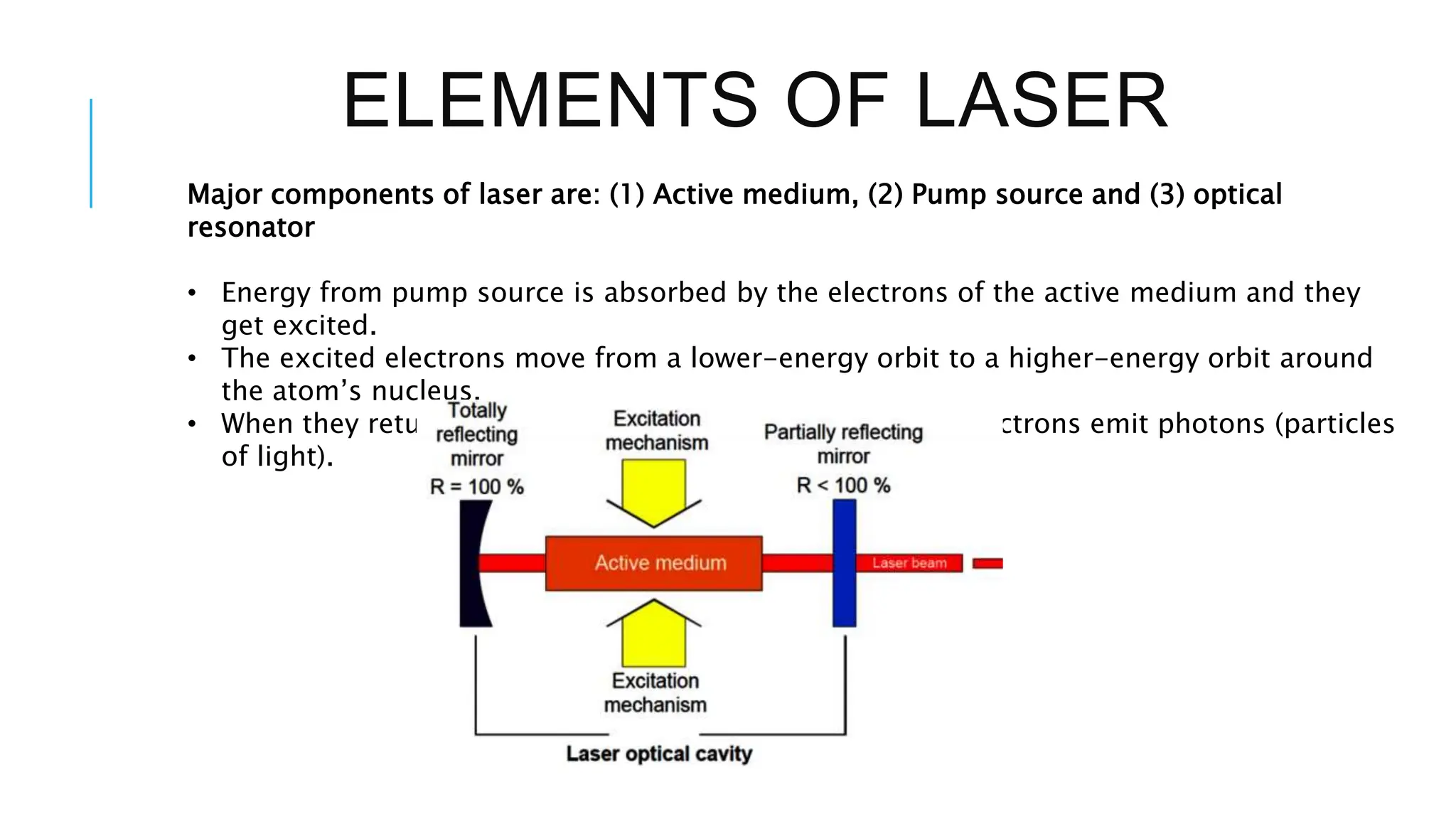
ELEMENTS OF LASER
Major components of laser are: (1) Active medium, (2) Pump source and (3) optical
resonator
• Energy from pump source is absorbed by the electrons of the active medium and they
get excited.
• The excited electrons move from a lower-energy orbit to a higher-energy orbit around
the atom’s nucleus.
• When they return to their normal or “ground” state, the electrons emit photons (particles
of light).
PHOTOLUMINESCENCE
Luminescence: emission of photons from electronically excited states of atoms,
molecules and ions.
Fluorescence and phosphorescence are two mechanisms that emit light or
examples of photoluminescence.
Fluorescence: a process in which a part of energy (UV, Visible) absorbed by a
substance is released in the form of light as long as the stimulating radiation is
continued. The fluorescence emission took place from a singlet excited states
(average lifetime: from <10-10 to 10-7 sec.
Phosphorescence: a process in which energy of light absorbed by a substance is
released relatively slowly in the form of light. The phosphorescence emission took
place from a triplet excited states. (average lifetime: from 10-5 to >10+3 sec).
In both fluorescence and phosphorescence, molecules absorb light and emit
photons with less energy (longer wavelength), but fluorescence occurs much more
quickly than phosphorescence and does not change the spin direction of the
electrons.
FLUORESCENCE
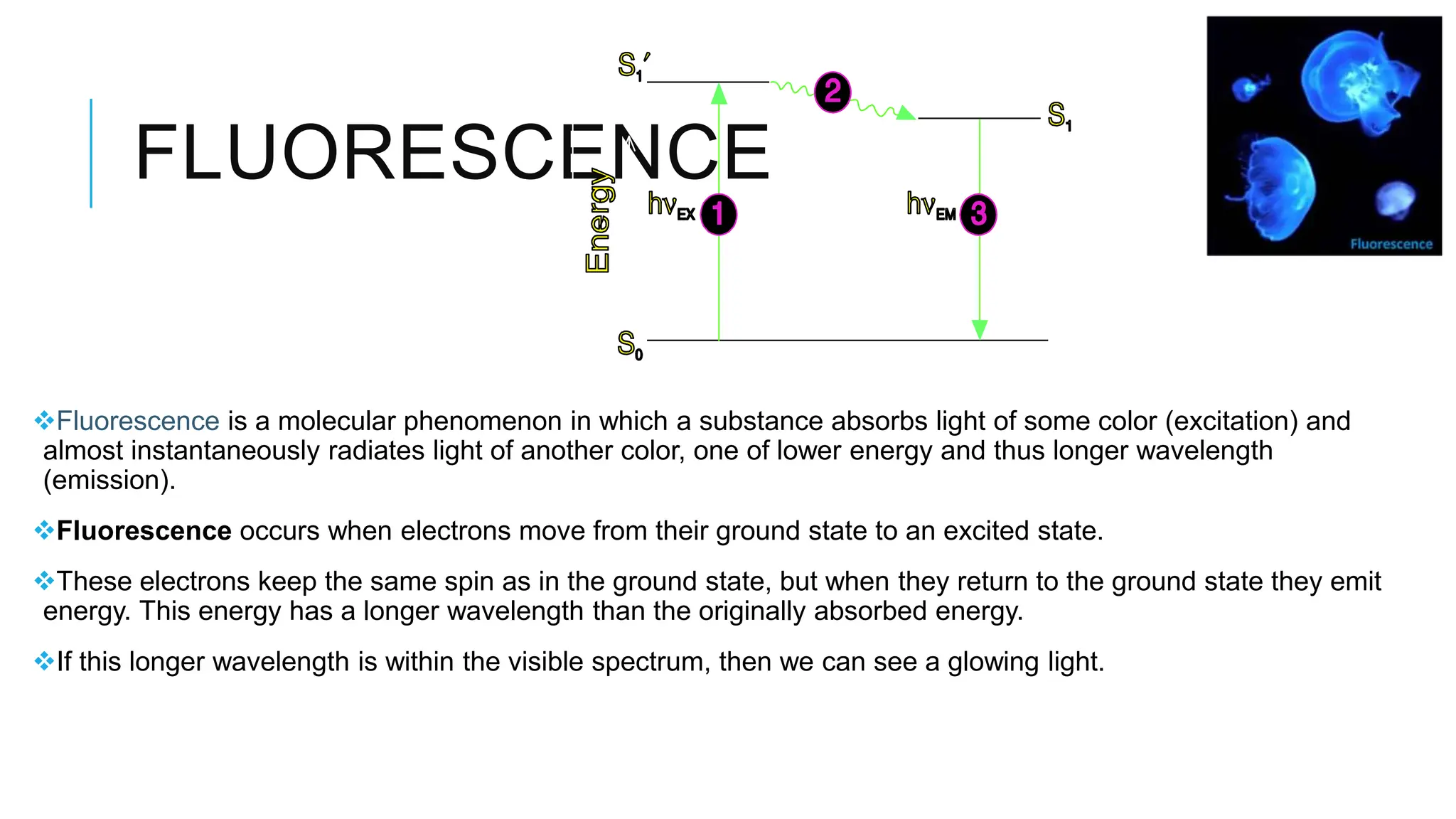
Fluorescence is a molecular phenomenon in which a substance absorbs light of some color (excitation) and
almost instantaneously radiates light of another color, one of lower energy and thus longer wavelength
(emission).
Fluorescence occurs when electrons move from their ground state to an excited state.
These electrons keep the same spin as in the ground state, but when they return to the ground state they emit
energy. This energy has a longer wavelength than the originally absorbed energy.
If this longer wavelength is within the visible spectrum, then we can see a glowing light.
PHOSPHORESCENCE
Phosphorescence is very similar to fluorescence, except when the
electron moves into the excited state, the spin changes.
Electrons spin in specific direction based on the magnetic momentum.
But when a compound shows phosphorescence, that electron has been
given enough additional energy to change the direction of this spin.
This change in spin causes the emission to last longer because it takes
longer for the electron to release all of the energy.
FLUORESCENCE VS. PHOSPHORESCENCE
Both fluorescence and phosphorescence are forms of photoluminescence.
In a sense, both phenomena cause things to glow in the dark. In both
cases, electrons absorb energy and release light when they return to a
more stable state.
Fluorescence occurs much more quickly than phosphorescence. When the
source of excitation is removed, the glow almost immediately ceases
(fraction of a second). The direction of the electron spin does not change.
Phosphorescence lasts much longer than fluorescence (minutes to several
hours). The direction of the electron spin may change when the electron
moves to a lower energy state.
ELECTROMAGNETIC
SPECTRUM
Science explanations
• a family of radiations: ‘electromagnetic waves’ that behave similarly
(reflection, refraction, dispersion, diffraction,
interference, polarisation)
• differences: wavelength, frequency
& photon energy;
ionising v non-ionising
How science works
• Practical applications of all parts of the spectrum
• Risks and benefits, health studies, making decisions
• Uncertainties in science
WHAT DOES THIS PICTURE SHOW ABOUT THE
RELATIONSHIP BETWEEN FREQUENCY AND
WAVELENGTH?
Photons, frequency, wavelength
speed of all electromagnetic waves,
where f = frequency and 𝞴= wavelength
… in ANY (inertial) frame of reference.
photon energy,

f
c 
hf
E 
s
J
10
63
.
6
constant,
Planck 34


 
h
1
8
ms
10
0
.
3 


c
RADIO WAVES
Longest wavelength EM waves
Uses:
 TV broadcasting
 AM and FM broadcast radio
 Heart rate monitors
 Cell phone communication
 MRI (MAGNETIC RESONACE IMAGING)
 Uses Short wave radio waves with a magnet to create an image
MICROWAVES
Wavelengths from 1 mm- 1 m
Uses:
 Microwave ovens
 Bluetooth headsets
 Broadband Wireless Internet
 Radar
 GPS
INFRARED RADIATION
Wavelengths in between microwaves and visible light
Uses:
 Night vision goggles
 Remote controls
 Heat-seeking missiles
VISIBLE LIGHT
Only type of EM wave able to be
detected by the human eye
Violet is the highest frequency light
Red light is the lowest frequency
light
ULTRAVIOLET
Shorter wavelengths than visible light
Uses:
 Black lights
 Security images on money
 Harmful to living things
 Used to sterilize medical equipment
 Too much causes sun burn
 Extremely high exposure can cause skin cancer
X-RAYS
Tiny wavelength, high
energy waves
Uses:
 Medical imaging
 Airport security
 Moderate dose can damaging to cells
GAMMA RAYS
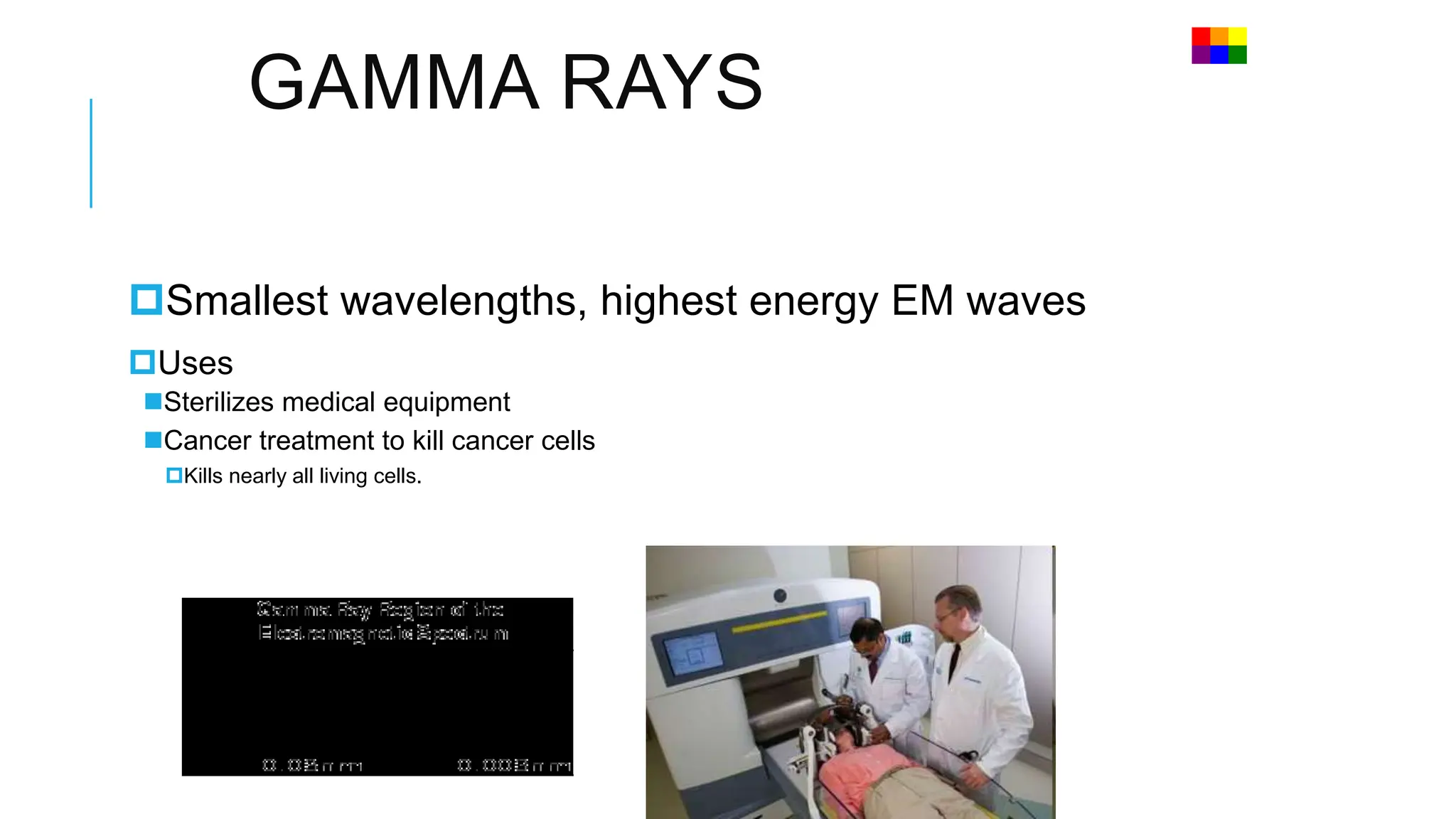
Smallest wavelengths, highest energy EM waves
Uses
Sterilizes medical equipment
Cancer treatment to kill cancer cells
Kills nearly all living cells.
RADAR (RADIO DETECTION AND RANGING):
PRINCIPLE
It refers to electronic equipment that detects the presence of objects by using reflected electromagnetic energy.
Under some conditions, radar system can measure the direction, height, distance, course, and speed of these
objects.
 The frequency of electromagnetic energy used for radar is unaffected by darkness and also penetrates fog and
clouds.
This permits radar systems to determine the position of airplanes, ships, or other obstacles that are invisible to the
naked eye because of distance, darkness, or weather.
Modern radar can extract widely more information from a target's echo signal than its range. But the calculating of
the range by measuring the delay time is one of its most important functions.
The radar antenna illuminates the target with a high
frequency radio signal, which is then reflected and
picked up by a receiving device.
The electrical signal picked up by the receiving
antenna is called echo or return.
The radar signal is generated by a powerful transmitter
and received by a highly sensitive receiver.
MICROWAVE OVEN
 Microwaves have three characteristics that allow them to be used in cooking: they are
reflected by metal; they pass through glass, paper, plastic, and similar materials; and they
are absorbed by foods.
Microwaves are produced inside the oven by an electron tube called a magnetron.
The microwaves bounce back and forth within the metal interior until they are absorbed by
food.
 Microwaves cause the water molecules in food to vibrate, producing heat that cooks the
food.
That's why foods high in water content, like fresh vegetables, can be cooked more quickly
than other foods.
The microwave energy is changed to heat as soon as it is absorbed by food.
Microwave cooking can be more energy efficient than conventional cooking because foods
cook faster and the energy heats only the food, not the oven compartment.
SUPERCONDUCTIVITY
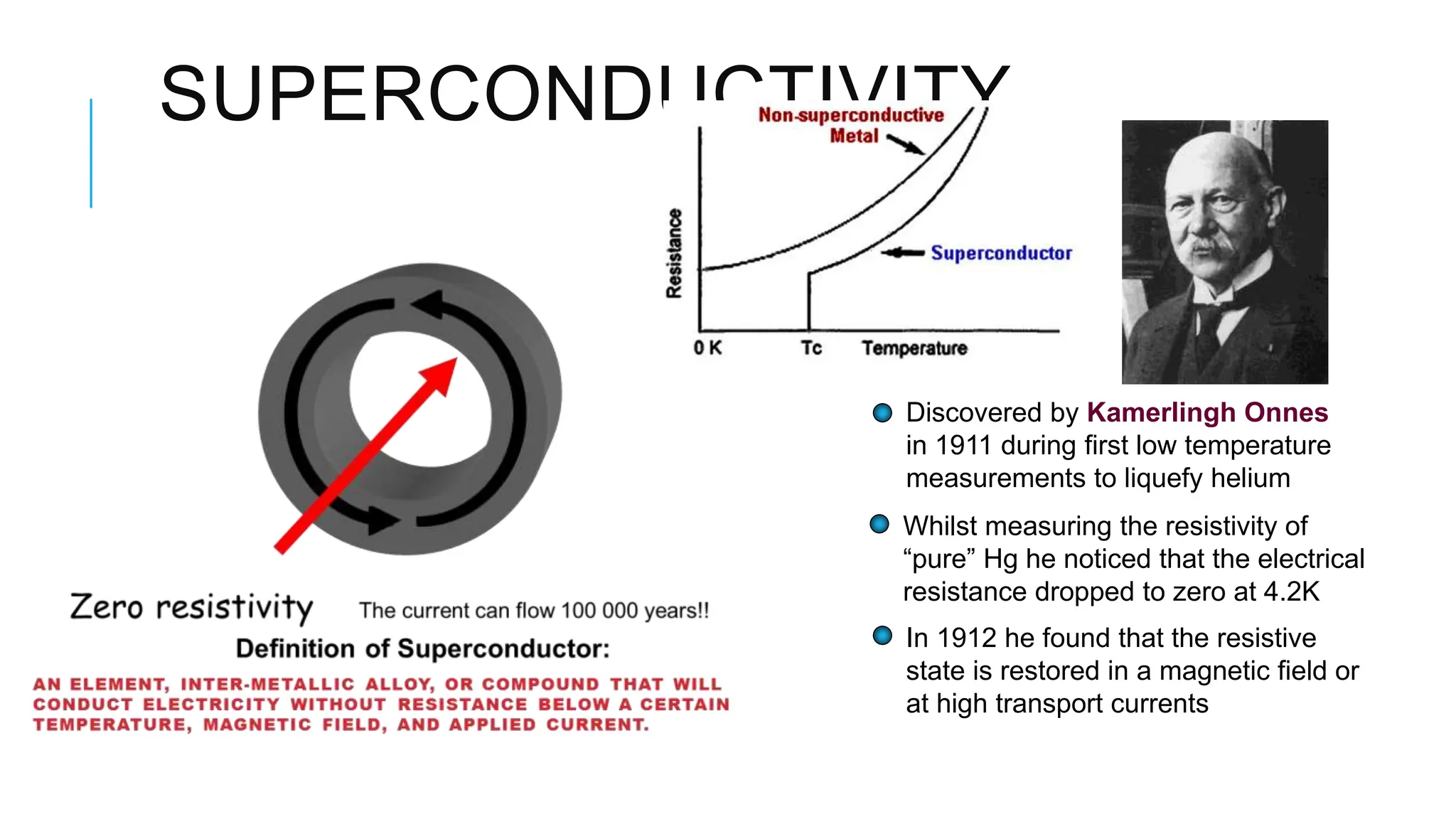
Whilst measuring the resistivity of
“pure” Hg he noticed that the electrical
resistance dropped to zero at 4.2K
Discovered by Kamerlingh Onnes
in 1911 during first low temperature
measurements to liquefy helium
In 1912 he found that the resistive
state is restored in a magnetic field or
at high transport currents
27
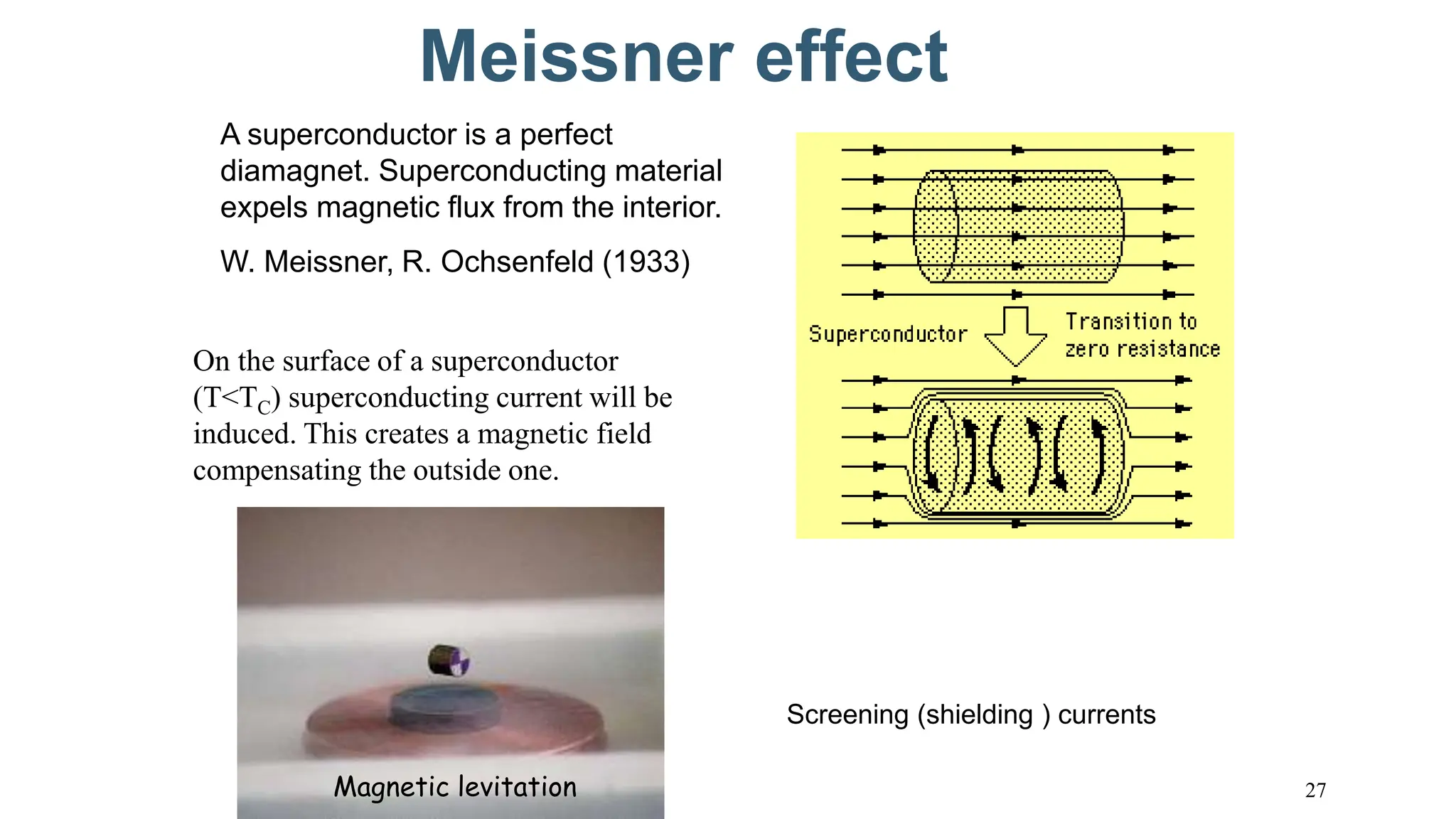
A superconductor is a perfect
diamagnet. Superconducting material
expels magnetic flux from the interior.
W. Meissner, R. Ochsenfeld (1933)
On the surface of a superconductor
(T<TC) superconducting current will be
induced. This creates a magnetic field
compensating the outside one.
Meissner effect
Screening (shielding ) currents
Magnetic levitation

Optical energy, fluorescence and phosphorescence

  • 1.
    WHAT IS LASER? LightAmplification by Stimulated Emission of Radiation A device produces a coherent beam of optical radiation by stimulating electronic, ionic, or molecular transitions to higher energy levels When they return to lower energy levels by stimulated emission, they emit energy.
  • 2.
    PROPERTIES OF LASER 2 The light emitted from a laser is monochromatic, that is, it is of one color/wavelength. In contrast, ordinary white light is a combination of many colors (or wavelengths) of light.  Lasers emit light that is highly directional, that is, laser light is emitted as a relatively narrow beam in a specific direction. Ordinary light, such as from a light bulb, is emitted in many directions away from the source.  The light from a laser is said to be coherent, which means that the wavelengths of the laser light are in phase in space and time. Ordinary light can be a mixture of many wavelengths. These three properties of laser light are what can make it more hazardous than ordinary light. Laser light can deposit a lot of energy within a small area.
  • 3.
    BASIC CONCEPTS FORA LASER Absorption Spontaneous Emission Stimulated Emission Population inversion
  • 4.
    ABSORPTION Energy is absorbedby an atom, the electrons are excited into vacant energy shells.
  • 5.
    SPONTANEOUS EMISSION The atomdecays from level 2 to level 1 through the emission of a photon with the energy hv. It is a completely random process.
  • 6.
    STIMULATED EMISSION atoms inan upper energy level can be triggered or stimulated in phase by an incoming photon of a specific energy.
  • 7.
    STIMULATED EMISSION The stimulatedphotons have unique properties: In phase with the incident photon Same wavelength as the incident photon Travel in same direction as incident photon
  • 8.
    POPULATION INVERSION A statein which a substance has been energized, or excited to specific energy levels. More atoms or molecules are in a higher excited state. The process of producing a population inversion is called pumping. Examples: →by lamps of appropriate intensity →by electrical discharge
  • 9.
    ELEMENTS OF LASER Majorcomponents of laser are: (1) Active medium, (2) Pump source and (3) optical resonator • Energy from pump source is absorbed by the electrons of the active medium and they get excited. • The excited electrons move from a lower-energy orbit to a higher-energy orbit around the atom’s nucleus. • When they return to their normal or “ground” state, the electrons emit photons (particles of light).
  • 10.
    PHOTOLUMINESCENCE Luminescence: emission ofphotons from electronically excited states of atoms, molecules and ions. Fluorescence and phosphorescence are two mechanisms that emit light or examples of photoluminescence. Fluorescence: a process in which a part of energy (UV, Visible) absorbed by a substance is released in the form of light as long as the stimulating radiation is continued. The fluorescence emission took place from a singlet excited states (average lifetime: from <10-10 to 10-7 sec. Phosphorescence: a process in which energy of light absorbed by a substance is released relatively slowly in the form of light. The phosphorescence emission took place from a triplet excited states. (average lifetime: from 10-5 to >10+3 sec). In both fluorescence and phosphorescence, molecules absorb light and emit photons with less energy (longer wavelength), but fluorescence occurs much more quickly than phosphorescence and does not change the spin direction of the electrons.
  • 11.
    FLUORESCENCE Fluorescence is amolecular phenomenon in which a substance absorbs light of some color (excitation) and almost instantaneously radiates light of another color, one of lower energy and thus longer wavelength (emission). Fluorescence occurs when electrons move from their ground state to an excited state. These electrons keep the same spin as in the ground state, but when they return to the ground state they emit energy. This energy has a longer wavelength than the originally absorbed energy. If this longer wavelength is within the visible spectrum, then we can see a glowing light.
  • 12.
    PHOSPHORESCENCE Phosphorescence is verysimilar to fluorescence, except when the electron moves into the excited state, the spin changes. Electrons spin in specific direction based on the magnetic momentum. But when a compound shows phosphorescence, that electron has been given enough additional energy to change the direction of this spin. This change in spin causes the emission to last longer because it takes longer for the electron to release all of the energy.
  • 13.
    FLUORESCENCE VS. PHOSPHORESCENCE Bothfluorescence and phosphorescence are forms of photoluminescence. In a sense, both phenomena cause things to glow in the dark. In both cases, electrons absorb energy and release light when they return to a more stable state. Fluorescence occurs much more quickly than phosphorescence. When the source of excitation is removed, the glow almost immediately ceases (fraction of a second). The direction of the electron spin does not change. Phosphorescence lasts much longer than fluorescence (minutes to several hours). The direction of the electron spin may change when the electron moves to a lower energy state.
  • 14.
    ELECTROMAGNETIC SPECTRUM Science explanations • afamily of radiations: ‘electromagnetic waves’ that behave similarly (reflection, refraction, dispersion, diffraction, interference, polarisation) • differences: wavelength, frequency & photon energy; ionising v non-ionising How science works • Practical applications of all parts of the spectrum • Risks and benefits, health studies, making decisions • Uncertainties in science
  • 15.
    WHAT DOES THISPICTURE SHOW ABOUT THE RELATIONSHIP BETWEEN FREQUENCY AND WAVELENGTH?
  • 16.
    Photons, frequency, wavelength speedof all electromagnetic waves, where f = frequency and 𝞴= wavelength … in ANY (inertial) frame of reference. photon energy,  f c  hf E  s J 10 63 . 6 constant, Planck 34     h 1 8 ms 10 0 . 3    c
  • 17.
    RADIO WAVES Longest wavelengthEM waves Uses:  TV broadcasting  AM and FM broadcast radio  Heart rate monitors  Cell phone communication  MRI (MAGNETIC RESONACE IMAGING)  Uses Short wave radio waves with a magnet to create an image
  • 18.
    MICROWAVES Wavelengths from 1mm- 1 m Uses:  Microwave ovens  Bluetooth headsets  Broadband Wireless Internet  Radar  GPS
  • 19.
    INFRARED RADIATION Wavelengths inbetween microwaves and visible light Uses:  Night vision goggles  Remote controls  Heat-seeking missiles
  • 20.
    VISIBLE LIGHT Only typeof EM wave able to be detected by the human eye Violet is the highest frequency light Red light is the lowest frequency light
  • 21.
    ULTRAVIOLET Shorter wavelengths thanvisible light Uses:  Black lights  Security images on money  Harmful to living things  Used to sterilize medical equipment  Too much causes sun burn  Extremely high exposure can cause skin cancer
  • 22.
    X-RAYS Tiny wavelength, high energywaves Uses:  Medical imaging  Airport security  Moderate dose can damaging to cells
  • 23.
    GAMMA RAYS Smallest wavelengths,highest energy EM waves Uses Sterilizes medical equipment Cancer treatment to kill cancer cells Kills nearly all living cells.
  • 24.
    RADAR (RADIO DETECTIONAND RANGING): PRINCIPLE It refers to electronic equipment that detects the presence of objects by using reflected electromagnetic energy. Under some conditions, radar system can measure the direction, height, distance, course, and speed of these objects.  The frequency of electromagnetic energy used for radar is unaffected by darkness and also penetrates fog and clouds. This permits radar systems to determine the position of airplanes, ships, or other obstacles that are invisible to the naked eye because of distance, darkness, or weather. Modern radar can extract widely more information from a target's echo signal than its range. But the calculating of the range by measuring the delay time is one of its most important functions. The radar antenna illuminates the target with a high frequency radio signal, which is then reflected and picked up by a receiving device. The electrical signal picked up by the receiving antenna is called echo or return. The radar signal is generated by a powerful transmitter and received by a highly sensitive receiver.
  • 25.
    MICROWAVE OVEN  Microwaveshave three characteristics that allow them to be used in cooking: they are reflected by metal; they pass through glass, paper, plastic, and similar materials; and they are absorbed by foods. Microwaves are produced inside the oven by an electron tube called a magnetron. The microwaves bounce back and forth within the metal interior until they are absorbed by food.  Microwaves cause the water molecules in food to vibrate, producing heat that cooks the food. That's why foods high in water content, like fresh vegetables, can be cooked more quickly than other foods. The microwave energy is changed to heat as soon as it is absorbed by food. Microwave cooking can be more energy efficient than conventional cooking because foods cook faster and the energy heats only the food, not the oven compartment.
  • 26.
    SUPERCONDUCTIVITY Whilst measuring theresistivity of “pure” Hg he noticed that the electrical resistance dropped to zero at 4.2K Discovered by Kamerlingh Onnes in 1911 during first low temperature measurements to liquefy helium In 1912 he found that the resistive state is restored in a magnetic field or at high transport currents
  • 27.
    27 A superconductor isa perfect diamagnet. Superconducting material expels magnetic flux from the interior. W. Meissner, R. Ochsenfeld (1933) On the surface of a superconductor (T<TC) superconducting current will be induced. This creates a magnetic field compensating the outside one. Meissner effect Screening (shielding ) currents Magnetic levitation